What’s in this guide
- 1. Ultimate Spa Filter Cleaner Fast-Acting Spray — Best Overall
- 2. Spa Depot Power Soak — Best Enzyme-Powered Soak
- 3. ecoone All-Natural Filter Cleaner — Best Eco-Friendly
- 4. HTH Spa Filter Cleaner — Best Budget Pick
- 5. SpaGuard Filter Cleaner — Best for Oils and Scale
- 6. Hot Tub Filter Cleaner Soak — Best 6-Month Supply
- 7. Aquatix Pro Filter Cartridge Cleaner — Best Spray-On Tool
- 8. LEISURE TIME Instant Cartridge Clean — Best Quick Clean
- 9. NOYATECH Hot Tub Filter Cleaner Spray — Best for Grease and Sunscreen
- Buying Guide: How to Choose the Right Filter Cleaner
- How We Evaluated
- Frequently Asked Questions
- Conclusion
Your hot tub filter is the first thing that fails — and a dirty one turns crystal-clear water murky fast. Finding the best hot tub filter cleaner shouldn’t take hours of research. Our team assessed 9 top-rated options on Amazon so you can pick the right cleaner and get back to soaking. Below you’ll find a quick comparison table, full product reviews, a buying guide, and answers to the most common filter questions.
| # | Preview | Product | Best For | Buy |
|---|---|---|---|---|
| 1 |  | Ultimate Spa Filter Cleaner Spray (1 Gal) | Best Overall / No-Soak | Buy on Amazon |
| 2 |  | Spa Depot Power Soak (2 × 1 lb) | Best Enzyme Soak | Buy on Amazon |
| 3 |  | ecoone All-Natural Filter Cleaner (8 oz) | Best Eco-Friendly | Buy on Amazon |
| 4 |  | HTH Spa Filter Cleaner (16 oz) | Best Budget Pick | Buy on Amazon |
| 5 |  | SpaGuard Filter Cleaner (1 qt) | Best for Oils & Scale | Buy on Amazon |
| 6 |  | Hot Tub Filter Cleaner Soak (32 oz) | Best 6-Month Supply | Buy on Amazon |
| 7 | 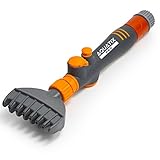 | Aquatix Pro Filter Cartridge Cleaner | Best Spray-On Tool | Buy on Amazon |
| 8 |  | LEISURE TIME Instant Cartridge Clean (1 Pt) | Best Quick Clean | Buy on Amazon |
| 9 |  | NOYATECH Filter Cleaner Spray (32 oz) | Best for Grease & Sunscreen | Buy on Amazon |
1. Ultimate Spa Filter Cleaner Fast-Acting Spray — Best Overall
Made by Black Diamond Stoneworks, this 1-gallon spray cleaner is built for hot tub and pool owners who want a fast, no-soak solution. Spray it on, wait about five minutes, rinse thoroughly — and the filter is ready to go back in. It claims zero sticky residue, which matters because residue left on filter pleats causes foaming once the pump restarts.
- +No soaking required — spray-and-rinse cycle takes under 15 minutes, making it the fastest routine maintenance option in this roundup.
- +1-gallon size delivers significantly more uses than standard 16 oz competitors, improving your cost-per-clean over a full season.
- +Zero residue formula prevents the foaming that happens when cleaners aren’t fully rinsed — a common complaint with lesser sprays reported across hot tub owner communities.
- −Spray-only format may not fully penetrate deeply embedded oils or biofilm the way an overnight enzymatic soak does — best paired with a quarterly deep soak.
- −Bulky 1-gallon jug is harder to store in a compact spa cabinet than smaller bottles.
2. Spa Depot Power Soak — Best Enzyme-Powered Soak
Power Soak is a granular enzyme and oxidizing powder from Spa Depot — a well-regarded spa supply brand. You dissolve half a cup in a 5-gallon bucket of water, submerge the filter, and let it soak for roughly one hour in hot water or overnight in cold water. It’s a deliberate, planned-ahead deep clean rather than a quick fix, and that’s exactly what makes it effective for quarterly restoration.
- +Enzyme-based formula targets organic matter at the molecular level — body oils, lotions, and sunscreen that spray cleaners leave behind are broken down during the soak, not just rinsed off the surface.
- +Four uses per 1 lb bottle, and the two-bottle pack provides multiple quarterly sessions, reducing per-use cost compared to single-use competitors.
- +Powder format stores compactly on a shelf without any spill risk — a practical advantage over liquid bottles in humid spa environments.
- −Requires planning — you need a bucket, hot water, and several hours of soak time, making this unsuitable for same-day filter reinstallation.
- −Powder must dissolve completely before use; undissolved granules sitting against filter pleats can leave uneven cleaning results.
3. ecoone All-Natural Filter Cleaner — Best Eco-Friendly
ecoone is built around a philosophy of spa care without harsh chemicals. The filter cleaner is enzyme-based, chlorine-free, phosphate-free, and produces no foam — so there’s no risk of introducing foaming agents back into your spa water after reinstalling a freshly cleaned filter. It’s sold in an 8 oz bottle that yields approximately 15 uses when two capfuls are used per cleaning session.
- +Chlorine-free, phosphate-free, and foam-free formulation — safe for households with sensitive skin and compatible with saltwater spa systems where harsh chemicals can disrupt water balance.
- +Natural enzyme action breaks down organic contaminants without acids or bleach, meaning it’s gentler on polyester filter fabric over repeated use — potentially extending filter life.
- +No residue after rinsing, so reinstalling the filter won’t trigger the cloudy or foamy water that poorly rinsed cleaners can cause.
- −Smallest bottle in this roundup at 8 oz — the higher cost-per-ounce compared to larger competitors is worth noting for budget-conscious buyers.
- −Natural formula may need longer contact time on heavily soiled or mineral-scaled filters; a second application may be required where a chemical cleaner would work in one pass.
4. HTH Spa Filter Cleaner — Best Budget Pick
HTH is one of the most recognized names in pool and spa chemicals, stocked at Home Depot, Lowe’s, and Ace Hardware nationwide. The 16 oz liquid cleaner is used as a soaking solution — one full bottle dissolved in 4 gallons of water — with a recommended soak time of 3 to 6 hours, or overnight for heavily soiled filters. It’s labeled low-odor and compatible with all sanitizer systems, including chlorine, bromine, and biguanide.
- +Deep-cleaning formula extends filter life by removing oils and mineral scale that cause early fabric degradation — users across multiple retailers report filters looking “almost new” after a single soak.
- +Widely available in-store at major home improvement retailers, so you’re never stuck waiting for a delivery if you need it urgently.
- +Compatible with all spa sanitizer types — chlorine, bromine, ozone, and biguanide systems — making it a versatile pick regardless of your water chemistry setup.
- −Chemical formula requires handling precautions — gloves and adequate ventilation are recommended, particularly when mixing the concentrated liquid into the bucket.
- −16 oz bottle provides fewer uses than the 1-gallon Ultimate Spa or 32 oz competitors, so frequent users may reorder more often.
5. SpaGuard Filter Cleaner — Best for Oils and Scale
SpaGuard is a BioLab brand with a long track record in professional spa care. Its 1 quart (32 oz) filter cleaner comes in a spray bottle and targets two problems simultaneously — body oils and mineral scale — which most single-purpose cleaners address only one at a time. You can use it as a spray (let sit 15–20 minutes, rinse) or dilute 1 part cleaner to 3 parts water for a deeper 1-hour soak.
- +Dual-action formula tackles both oils/lotions AND mineral scale — a meaningful differentiator for high-traffic hot tubs where both problems accumulate simultaneously between cleanings.
- +1 quart size delivers more uses than standard 16 oz competitors at a comparable price point, improving your cost-per-session value.
- +Flexible application — spray for routine monthly maintenance or dilute for a deeper soak, giving you two cleaning modes from one bottle.
- −Soak method requires dilution prep — an extra step compared to ready-to-use spray products, though the spray method skips this.
- −At least one user has reported nozzle reliability issues, requiring transfer to a separate spray bottle — worth checking on delivery.
6. Hot Tub Filter Cleaner Soak — Best 6-Month Supply
This 32 oz soaking solution is positioned as a buy-once, use-for-months option — the manufacturer claims 4 to 8 uses per bottle, which translates to up to 6 months of quarterly deep cleans from a single purchase. The formula is described as non-toxic and foam-free, with no residue left on the filter after rinsing. It restores filter performance by breaking down accumulated debris rather than simply rinsing the surface.
- +4 to 8 uses per 32 oz bottle makes this one of the better value-per-use options in the roundup, particularly for owners following a consistent quarterly soak schedule.
- +Non-toxic and foam-free formula means you can reinstall the filter after a thorough rinse without worrying about introducing foaming agents or chemical residue into your spa water.
- +Liquid format is easier to measure and mix than the powder-based Spa Depot Power Soak — no risk of incomplete dissolution.
- −Newer product with a shorter track record on Amazon compared to established brands like HTH or SpaGuard — fewer long-term user reviews to draw from.
- −Soak-only format means it’s not suitable for quick between-soak maintenance; you’ll still want a spray cleaner for monthly rinses.
7. Aquatix Pro Filter Cartridge Cleaner — Best Spray-On Tool
The Aquatix Pro takes a different approach from every other product on this list — it’s a hose-powered cleaning wand rather than a chemical solution. Six spray nozzles are arranged like a comb to fit between filter pleats and blast debris out with targeted water pressure. It connects to a standard garden hose, includes an on/off button and a pressure-adjustment dial, and is designed to cut cleaning time significantly compared to a plain hose nozzle alone.
- +Six-jet comb design cleans multiple pleats simultaneously, dramatically reducing the time spent rotating a single hose nozzle around the filter — users report cleaning time drops to a fraction of the old method.
- +On/off button and pressure dial give precise control, letting you reduce pressure for delicate pleats and increase it for stubborn debris without walking back to the tap.
- +Compatible with all pool and spa cartridge filters and reusable indefinitely — no chemical refills needed, making the long-term cost effectively zero after purchase.
- −Wand-only cleaning is a surface clean, not a chemical deep clean — it does not break down body oils or biofilm the way an enzyme soak does; best used for weekly rinses, not quarterly restoration.
- −Performance depends on your home’s water pressure — lower-pressure setups may see less impressive results than users with strong municipal water flow.
8. LEISURE TIME Instant Cartridge Clean — Best Quick Clean
LEISURE TIME is a long-established spa chemical brand with strong retail distribution. The Instant Cartridge Clean is a 16 oz spray-on formula with a built-in blue color indicator — so you can see exactly where you’ve applied it and ensure full pleat coverage. It’s designed for a quick spray-and-rinse cycle, removing scale, calcium, oils, and minerals without a prolonged soak. Compatible with all sanitizer types: chlorine, bromine, ozone, and biguanide.
- +Blue color indicator shows coverage in real time, eliminating the guesswork of knowing whether you’ve hit every pleat — a genuinely useful feature for first-time filter cleaners.
- +Spray-and-rinse formula removes scale, calcium, oils, and minerals in a single application, making it effective for routine maintenance cleaning between quarterly deep soaks.
- +Long-established brand with wide retail availability means replacement bottles are easy to source in-store or online at a moment’s notice.
- −16 oz size limits the number of uses compared to 32 oz or 1-gallon options — more frequent reordering for heavy users.
- −Thorough rinsing is critical — community feedback notes that inadequate rinsing causes foaming and cloudy water when the filter is reinstalled; plan for an extra rinse pass.
9. NOYATECH Hot Tub Filter Cleaner Spray — Best for Grease and Sunscreen
NOYATECH’s 32 oz spray cleaner is purpose-built for the specific problem that plagues outdoor hot tubs in summer: heavy sunscreen, body oil, and grease buildup that turns filter pleats orange or brown within weeks. The formula is non-toxic, eco-safe, acid-free, and produces no residue after rinsing. It’s a no-soak spray — apply, let it work briefly, then rinse — making it faster than an overnight soak for targeted grease removal.
- +32 oz bottle delivers significantly more uses than 16 oz spray competitors, improving cost efficiency for owners who clean filters frequently during summer months.
- +Purpose-formulated to cut through sunscreen and body grease — contaminants that general-purpose sprays address less directly, making it a more targeted solution for outdoor spa users.
- +Non-toxic, acid-free, and eco-safe formula with no harsh fumes, making it more comfortable to use without full chemical protective gear compared to stronger acid-based cleaners.
- −Newer brand with limited long-term track record — fewer independent reviews to draw from compared to established names like LEISURE TIME or SpaGuard.
- −Degreasing focus may be overkill for filters that primarily accumulate dust and light debris rather than oils — a general spray like the Ultimate Spa is a simpler choice in that case.
Buying Guide: How to Choose the Right Filter Cleaner
Spray, Soak, or Powder: Which Type Do You Need?
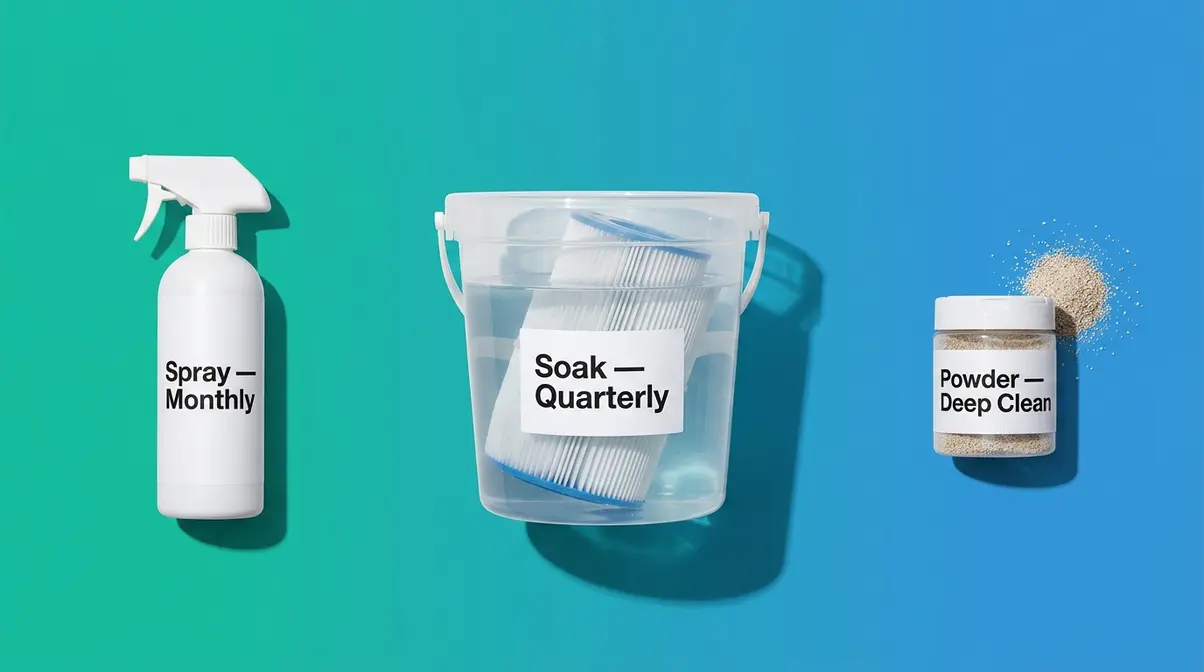
Hot tub filter cleaners come in three main formats — and choosing the wrong one for your situation wastes time and money. To choose the best hot tub filter cleaner for your needs, start by matching the format to your cleaning goal.
Spray cleaners (like Ultimate Spa and NOYATECH) work by applying the formula directly onto filter pleats, waiting a few minutes for it to penetrate, then rinsing with a hose. They’re fast, require no bucket, and are ideal for routine monthly maintenance. Soaking solutions (like SpaGuard and the B0DSCKN75M soak) involve submerging the filter in a bucket of diluted cleaner for one to several hours. They penetrate deeper into clogged pleats and are best for quarterly deep cleans. Powder cleaners (like Spa Depot Power Soak) work the same way as soaking solutions but come in granular form — dissolve before use, store compactly, and often offer excellent cost-per-use value.
For a deeper look at various types of hot tub cleaning products and how they interact with your spa’s water chemistry, it’s worth understanding how each format affects your overall maintenance routine. You can also browse commercial filter cleaning sprays and solutions to compare your options side by side before buying.
The Filter Contamination Ladder: Matching Cleaner to Contamination Level
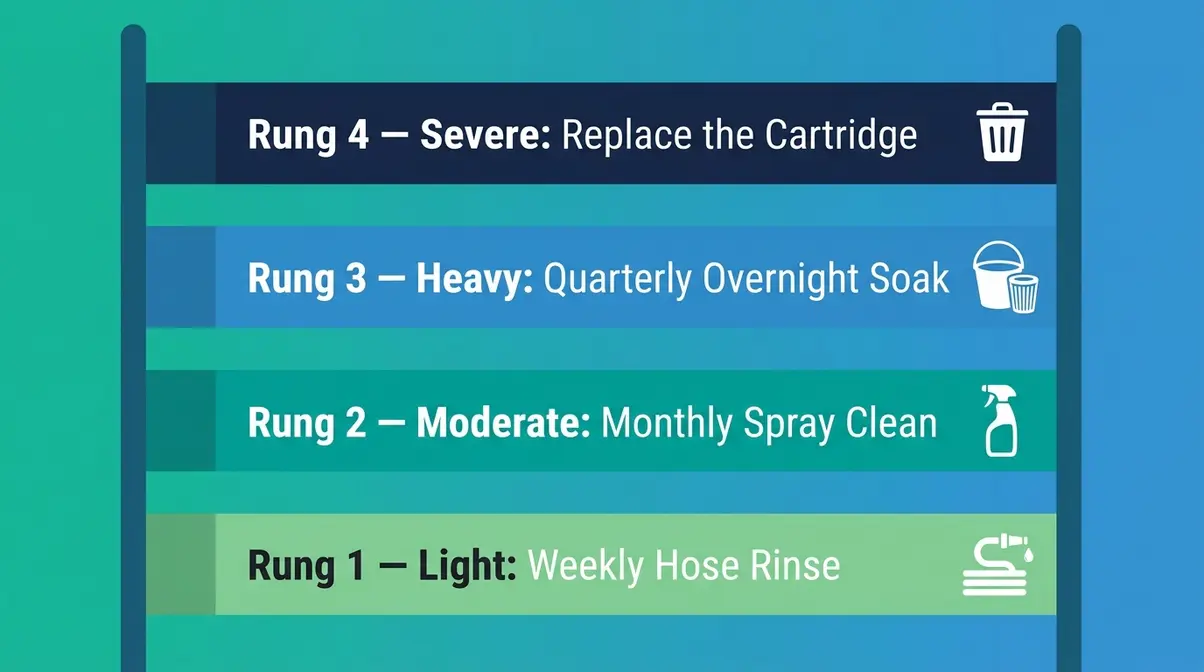
Not every dirty filter needs the same solution. The Filter Contamination Ladder is a simple four-rung framework that matches cleaning intensity to how dirty your filter actually is — so you’re not over-cleaning or under-cleaning. Use this step-by-step hot tub filter cleaning guide alongside the Ladder for the full process.
- Rung 1 — Light (weekly rinse): Garden hose only. No chemicals needed. Spray the pleats top-to-bottom to flush loose debris. This takes two minutes and extends the life of your chemical cleaners.
- Rung 2 — Moderate (monthly spray): Apply a spray cleaner like Ultimate Spa or NOYATECH, wait five minutes, and rinse. A 10-minute job that prevents moderate buildup from becoming a deep-clean problem.
- Rung 3 — Heavy (quarterly soak): Overnight or multi-hour soak using Spa Depot Power Soak, SpaGuard, or the B0DSCKN75M soaking solution. This is your quarterly reset — aligns with your drain-and-refill cycle.
- Rung 4 — Severe (replace): If the filter fabric is torn, cracked, or won’t come clean after a full soak cycle, no cleaner will fix it. Replace the cartridge. Structural damage is permanent.
The Ladder works because it prevents the common mistake of reaching for a harsh chemical soak when a simple rinse would have done the job — and vice versa.
What NOT to Use on Your Hot Tub Filter
Some of the most popular DIY filter cleaning methods cause more harm than good. Here’s what to avoid — and why each one is a problem.
Bleach can whiten filter fabric cosmetically, but it degrades polyester pleats over time. An assessment of biofilm decontamination procedures found that acid pre-treatment combined with concentrated bleach was effective on multispecies biofilms but caused damage to fibrous materials with repeated exposure (PubMed, NIH). In practical terms: bleach may look like it’s cleaning, but it’s shortening your filter’s lifespan with every use.
Dishwasher detergent (including Cascade) creates heavy foam in spa water when the filter is reinstalled. The foaming agents in dishwasher products don’t fully rinse out of filter pleats — and your jets will find every last trace.
Vinegar is mildly acidic and can help with very light mineral deposits, but it has no meaningful effect on body oils or biofilm. If you’re curious about the limits of DIY hot tub filter cleaning with vinegar, the short answer is: use it only as a supplementary rinse for light scale, never as your primary cleaner.
Pressure washers tear filter pleats. Always use a standard garden hose with a firm stream — never high-pressure equipment.
That said, one popular DIY option does have merit within limits:
“I use OxyClean, which is mostly sodium percarbonate (an oxygen-based cleaning agent). My two filters stack in a 5-gallon bucket. I add OxyClean to the bucket, the two filters, fill it with hot water, and soak overnight.”
— Hot tub owner community discussion
Sodium percarbonate works because it releases oxygen when dissolved in water, which helps lift organic debris from filter pleats. OxyClean can be an effective light-to-moderate cleaner for budget-conscious owners. However, dedicated enzyme cleaners — like ecoone or the Spa Depot Power Soak — are specifically formulated for filter media and are less likely to cause long-term fabric degradation with repeated use. For occasional deep cleans, OxyClean is a reasonable DIY fallback. For a consistent routine, a purpose-made cleaner is the smarter long-term investment.
Additionally, CDC guidelines for hot tub disinfection mandate maintaining 10 ppm free chlorine for one hour to properly disinfect hot tubs and prevent Legionella growth — a reminder that filter cleaning is part of a broader sanitation system, not a substitute for proper water chemistry (CDC).
Which Cleaner Is Right for You?
| Your Situation | Best Pick |
|---|---|
| I want the fastest monthly clean | Ultimate Spa Spray (Rank 1) |
| I want a quarterly deep soak | Spa Depot Power Soak (Rank 2) |
| I avoid all harsh chemicals | ecoone All-Natural (Rank 3) |
| I’m on a tight budget | HTH Spa (Rank 4) |
| My filter gets oily AND scaly | SpaGuard (Rank 5) |
| I want 6 months of supply upfront | Hot Tub Soak B0DSCKN75M (Rank 6) |
| I want a faster weekly rinse tool | Aquatix Pro (Rank 7) |
| I need a quick emergency clean | LEISURE TIME (Rank 8) |
| My filters get greasy from sunscreen | NOYATECH Spray (Rank 9) |
For guidance on hot tub filter maintenance and replacement schedules — including when to replace rather than clean — that resource covers the full decision.
How We Evaluated
Our team assessed each of the 9 products based on four criteria: cleaning formulation type (enzyme vs. chemical vs. natural), ease of use (spray vs. soak vs. tool), residue risk (potential to cause foaming when reinstalled), and filter compatibility. We cross-referenced manufacturer specifications with expert guidance from established spa maintenance sources and filter cleaning frequency and common mistakes documented in the hot tub owner community. Products were ranked by overall suitability for beginner hot tub owners prioritizing reliability and convenience, drawing on Swim University’s filter cleaning guide, which recommends a tiered approach: weekly rinse, monthly spray, and quarterly overnight soak for optimal filter longevity.
Frequently Asked Questions
What is the best thing to clean hot tub filters with?
Dedicated hot tub filter cleaners are the most effective option for maintaining cartridge filters. They’re specifically formulated to dissolve body oils, sunscreen residue, and organic matter without damaging the filter’s polyester fabric. Unlike household alternatives, purpose-made cleaners rinse off cleanly without leaving foaming agents behind. For routine maintenance, a monthly spray cleaner works well; for deep quarterly cleans, an enzyme-based soaking solution is more thorough. Avoid bleach and dishwasher detergent — both can degrade filter materials or cause spa foaming.
Can hot tub filters be cleaned and reused?
Yes — hot tub filter cartridges are designed to be cleaned and reused multiple times before replacement. A consistent cleaning schedule dramatically extends their effective lifespan and saves money on replacement cartridges. Most manufacturers recommend replacing filters every 12–24 months depending on usage and cleaning frequency. Weekly rinsing combined with quarterly deep soaks are the two habits that make the biggest difference in longevity. Replace the filter immediately if you notice tears, cracked end caps, or permanent discoloration that two full soak cycles cannot resolve.
How often do hot tub filters need to be cleaned?
Hot tub filters should be rinsed with a garden hose every 1–2 weeks and deep-cleaned with a soaking solution every 3–4 months. If you use the spa heavily — multiple bathers daily, or frequent use with sunscreen and body lotions — increase rinsing to weekly. A quarterly soak should align with your drain-and-refill cycle for best results. Skipping regular rinses forces your pump to work harder, which can shorten both filter and pump life over time.
Why does my hot tub filter get dirty so fast?
Filters clog quickly when bathers enter the spa wearing lotions, sunscreen, hair products, or body oils — these substances coat the filter pleats and reduce water flow within days. Poor water chemistry, particularly low sanitizer levels, can also accelerate organic buildup by allowing bacteria and biofilm to establish faster. Encouraging bathers to rinse off in a shower before entering is the single most effective way to reduce filter load between cleanings. A hose filter on your fill line also helps by reducing incoming mineral deposits. For Lay-Z-Spa filter cleaning and troubleshooting, the same principles apply — the contamination sources are identical regardless of spa brand.
How do I get my hot tub filter white again?
A yellowed or grey filter is usually coated in body oils and minerals — not permanently stained. A dedicated enzyme-based soaking solution (like the Spa Depot Power Soak or SpaGuard) will restore most discolored filters to near-original condition after an overnight soak. Bleach can whiten filter fabric cosmetically but degrades the polyester over time, shortening its lifespan. If the filter remains discolored after two deep-soak cycles, it’s time for replacement — the fabric is saturated beyond recovery and no cleaner will fix structural degradation.
Why do people put tennis balls in a hot tub?
Tennis balls are sometimes placed in hot tubs to absorb body oils from the water surface — a popular DIY trick in hot tub owner communities. The felt fabric does absorb some surface oils, which can theoretically reduce the load on your filter. However, tennis ball fuzz and synthetic dyes can shed into the water and clog filter pleats directly, creating a new problem while solving a minor one. A dedicated enzyme cleaner and a consistent filter cleaning schedule are far more effective and don’t introduce foreign materials into your spa water.
Conclusion
For hot tub owners searching for the best hot tub filter cleaner, the right choice depends on how you use your spa. The Ultimate Spa Fast-Acting Spray (Rank 1) handles quick monthly maintenance in under 15 minutes, while the Spa Depot Power Soak (Rank 2) is the go-to for quarterly deep cleans that restore heavily soiled filters. Eco-conscious owners will prefer ecoone, budget buyers will do well with HTH Spa, and outdoor spa users dealing with sunscreen buildup should look at NOYATECH. No single product is right for every situation — but now you have the full picture to decide with confidence.
Use The Filter Contamination Ladder from the Buying Guide to match your cleaner to your filter’s actual condition. A light monthly rinse calls for a spray. A quarterly deep clean calls for a soak. And if the fabric is torn or won’t come clean after soaking — replace it. The Ladder removes the guesswork so you stop reaching for the wrong product. See brand-specific hot tub filter options when it’s time to replace.
Start by picking up the cleaner that matches your most common scenario from the comparison table above. If you’re unsure how often to clean or what the complete process looks like, our step-by-step hot tub filter cleaning guide walks you through the full 3-step method — from weekly rinse to quarterly soak to knowing when to replace.

Dave King
Hot tub tester and writer at One Hot Tub.