


Table of Contents - Best Hot Tub Cleaners (2026): Products, Deep Clean Guide
- Hot Tub Cleaner Types Explained
- Best Hot Tub Cleaners by Function
- The Bio-Reset Protocol: Deep Cleaning Your Hot Tub
- Filter Cleaning: 3-Method System
- Shell, Surface & Cover Care
- Safe vs. Unsafe Household Chemicals
- Cleaning Tools: Manual vs. Robotic
- Your Hot Tub Maintenance Schedule
- When to Call a Professional
- Limitations & Chemical Safety
- Frequently Asked Questions
- Keeping Your Spa Clean & Safe
This blog post may contain affiliate links. As an Amazon Associate I earn from qualifying purchases.
⚠️ Safety First: Always follow your hot tub manufacturer’s specific instructions. Never mix cleaning chemicals — some combinations produce toxic fumes. Wear gloves and eye protection when handling concentrated spa chemicals.
Picture this: Your hot tub water looks perfect. The pH is balanced, the chlorine level is sitting at 4 ppm, and the water sparkles. But deep inside the jet lines, a colony of Pseudomonas bacteria is thriving — protected inside a slimy biofilm layer that your chlorine simply cannot penetrate. That biofilm is the reason your water turns foamy an hour after you add fresh chemicals, and it’s the reason you keep wondering what you’re doing wrong.
The real problem isn’t your hot tub cleaners or your dosing routine. It’s that most cleaning guides skip the one step that matters most: flushing the hidden biological reservoir inside your plumbing before you ever pull the drain plug. According to research published by the NIH, biofilm provides bacteria with increased resistance to disinfectants — making physical removal and flushing essential, not optional (NIH/PMC, 2023). The consequence of skipping this step isn’t cosmetic. The CDC directly links improperly maintained hot tubs to Pseudomonas folliculitis (hot tub rash) and Legionella infections (CDC, 2025).
This guide covers everything: the four categories of hot tub cleaners, the best products by function, a step-by-step deep clean using The Bio-Reset Protocol, filter care, surface restoration, safe household chemicals, manual and robotic cleaning tools, and a printable maintenance schedule. By the end, you’ll know exactly which products to buy, how to execute a complete clean, and how to maintain your spa safely — without guessing.
Hot tub cleaners fall into four categories — plumbing flushes, shell cleaners, filter cleaners, and sanitizers — and most owners only use one or two, leaving the rest of their spa unprotected. The CDC recommends maintaining at least 3 ppm free chlorine and a pH between 7.0–7.8 to prevent harmful bacteria (CDC, 2025).
- The Bio-Reset Protocol starts BEFORE draining: an enzymatic purge clears biofilm (bacterial slime) from plumbing that chlorine cannot reach — this is the step 4 out of 5 competitors ignore entirely
- Never use Dawn dish soap — even a small amount causes foam that takes days to clear and can clog your filter
- Filters need 3 levels of cleaning: weekly rinse, monthly spray, quarterly overnight soak
- Robotic cleaners (e.g., Polaris Spabot) now automate debris removal with a 60-minute cordless cycle and zero manual vacuuming required
- DIY maintenance costs $15–30/month in chemicals; professional service runs $150–300 per visit (HomeGuide)
Hot Tub Cleaner Types Explained
Hot tub cleaners — the collective term for all products used to clean and sanitize a spa — fall into four distinct categories: enzymatic plumbing purges, shell and surface cleaners, filter cleaners, and chemical sanitizers and balancers. Each targets a completely different part of your spa. The CDC recommends maintaining free chlorine at least 3 ppm and pH between 7.0–7.8 to make those sanitizers effective (CDC, 2025). Using the wrong product in the wrong place is the single most common beginner mistake, and understanding this taxonomy is the fastest way to fix it.
Most beginners think “hot tub chemicals” means one or two bottles of chlorine. In reality, hot tub chemicals span an entire system — and buying just a sanitizer while ignoring your plumbing and filter is like mopping the kitchen floor while the drain is clogged. The four categories work together, and neglecting any one of them creates the chain reaction most new owners experience: cloudy water, persistent foam, chemical resistance, and eventual frustration.
One more concept to introduce here: biofilm (a slimy layer of bacteria that forms inside plumbing pipes and jets, protected from chlorine by a waxy outer coating). Biofilm is the invisible enemy that no sanitizer reaches on its own. You’ll hear about it a lot in this guide — because understanding biofilm changes everything about how you approach hot tub maintenance. All four cleaner categories work together in what we call The Bio-Reset Protocol — the complete deep-clean sequence covered in detail later.
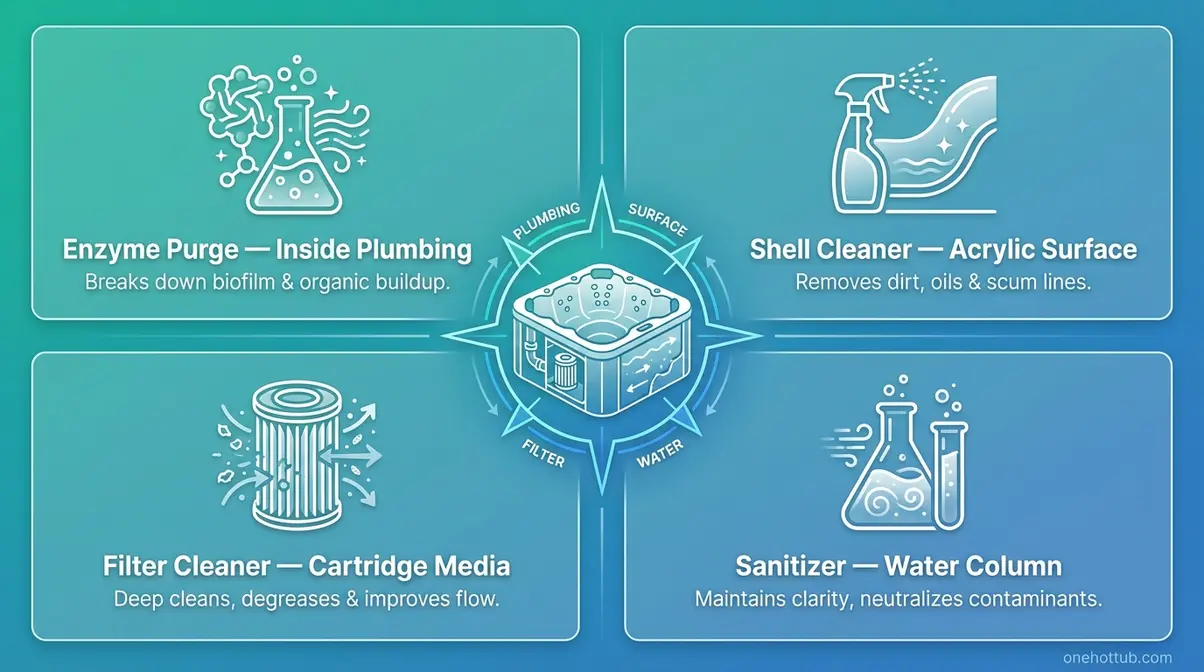
Caption: The four categories of hot tub cleaners each target a different part of the spa — no single product does all four jobs.
Enzyme & Line Flush Cleaners
Enzyme-based cleaners are the most important category most beginners never buy. These products — brands like Ahh-Some, Spa System Flush, and Oh Yuk — use biological enzymes (natural proteins that break down organic matter, similar to the active ingredients in biological laundry detergent) to attack biofilm and dissolve it from the inside of your plumbing. Think of them as drain cleaner for the biological gunk that’s accumulated in your jet lines over months of use.
The critical insight: these products are used before you drain, not after. The enzymes loosen biofilm from the pipe walls, and the contaminated water carries it out when you pull the drain plug. If you drain first and then try to flush, the biofilm stays cemented in place — your fresh water re-contaminates the moment you refill. This is the most commonly skipped step in all of hot tub maintenance, and it’s the reason so many owners feel like they’re fighting a losing battle with their water quality.
For the hot tub line flush cleaner specifically, use it every time you drain — roughly every 3–4 months — and also after heavy-use periods like parties or extended visits. Check out our essential hot tub chemicals guide for a full breakdown of what belongs in your starter kit.
Enzymatic cleaners work inside the plumbing. The next category handles what you can actually see — the shell, jets, and surfaces.
Sanitizers and Balancers
Here’s the analogy that makes this click: sanitizers are the mouthwash, and physical cleaners are the toothbrush. Mouthwash kills bacteria that remain after brushing. But if you skip the toothbrush and just rinse with mouthwash, the plaque is still there. Both are essential — and they do completely different things.
Sanitizers (chlorine or bromine) kill bacteria and viruses suspended in the water. They are not cleaners. They don’t remove biofilm, scale (mineral deposits that build up on surfaces), or scum lines. Beginners often reach for more chlorine when water turns cloudy — but if the root cause is biofilm or a dirty filter, extra chlorine won’t fix anything. Chlorine comes as granules (specifically, sodium dichloro-s-triazinetrione) or tablets. The CDC recommends maintaining at least 3 ppm free chlorine for hot tubs — and for Legionella prevention specifically, bromine should be at least 4 ppm (CDC, 2025).
pH balance is equally non-negotiable. The CDC recommends keeping pH between 7.0–7.8 (CDC, 2025). Outside this range, chlorine becomes up to 80% less effective even when the reading looks correct. This is why owners sometimes feel like their chemicals aren’t working — the sanitizer is there, but the pH is wrong.
For new owners, a hot tub chemical starter kit — which includes pH adjusters, chlorine granules, and shock — is the easiest way to get all essential chemicals in one purchase and avoid buying incompatible products.
Understanding chemicals sets the foundation. But before committing to a full kit, some owners wonder: can regular household products do the job? The answer is nuanced — and the next section covers exactly when natural options work.
Natural & Eco-Friendly Options
Can you keep a hot tub clean without chemicals? The short answer is: not safely. This is one of the most common questions new owners search for, and it deserves a direct, honest answer. “Chemical-free” hot tub maintenance is largely marketing language for lower-chemical approaches — some level of sanitizer is always required for safety, per CDC guidelines.
That said, mineral sanitizer systems like Nature2 cartridges genuinely reduce your chlorine demand. These cartridges use silver and zinc ions to suppress bacterial growth, allowing you to run chlorine at lower levels without sacrificing protection. They don’t replace chlorine — they allow you to use less of it, which is kinder on skin and equipment.
Enzyme-based maintenance products — separate from the purge flushes described above — break down organic material continuously between deep cleans, reducing the load on your sanitizer. Brands like Eco-TUB Spa Clean use plant-derived surfactants (gentle, soap-like cleaning agents) for shell surface cleaning. How to clean a hot tub with household cleaners is covered in detail in the household chemicals section later, including when vinegar is genuinely useful and when it falls short.
Best Hot Tub Cleaners by Function
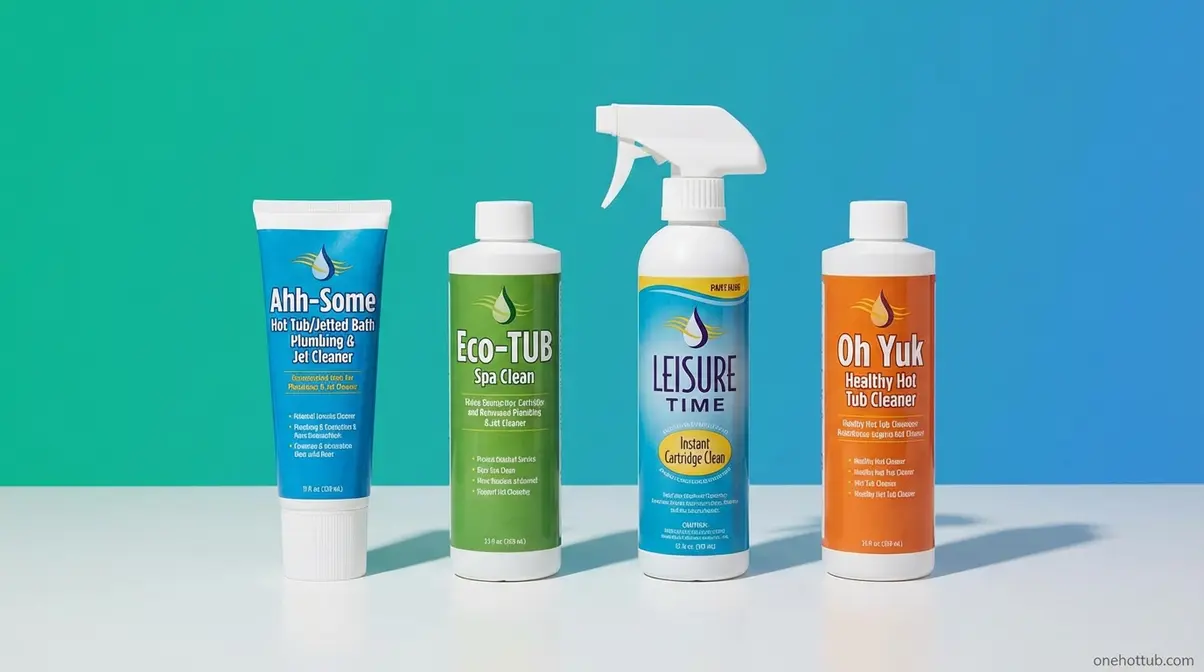
The best hot tub cleaner for your situation depends entirely on what you’re trying to fix. A cloudy water problem and a scum line problem have completely different solutions — and most comparison guides miss this entirely by ranking products in a generic “Top 10” list. Our team reviewed product specifications, user feedback from hot tub owner forums and community groups, third-party data where available, and ingredient transparency. Products reflect the current market — verify current pricing before purchasing.
Our Evaluation Methodology
Our evaluation criteria covered five dimensions: effectiveness at their primary function (biofilm removal, filter clarity restoration, shell safety), ingredient transparency (enzyme vs. chemical vs. natural formulation), user experience from hot tub owner communities, availability at national retailers and online, and price-to-performance ratio. The Bio-Reset Protocol relies on the enzymatic purge products in this section as Step 1 — so choosing the right line flush cleaner is the most important buying decision in this entire guide.
Best Line Flush Cleaners
Ahh-Some — a gel-based enzymatic purge concentrate for hot tub plumbing lines — is the community favorite for quarterly deep purges. A single 2 oz bottle treats hot tubs up to 400–450 gallons, and the cost per purge runs roughly $5–15 depending on bottle size. Current pricing ranges from approximately $12.95 for a single-use pouch to $32–50 for multi-use bottles (Ahh-Some official site — verify current pricing). What makes Ahh-Some distinctive is the visible proof of action: the expelled gunk — brown or grey foamy sludge — looks alarming, but that’s exactly what you want to see. It’s biofilm leaving your pipes.
Spa System Flush — a liquid plumbing purge by SpaDepot designed to clear biofilm and scale from jets and pipes — runs approximately $15–20 for a 16 oz bottle and is the preferred choice for owners who want a liquid format rather than gel. Compatible with saltwater and standard sanitizer systems (verify saltwater compatibility on current labels before purchasing).
Oh Yuk Healthy Hot Tub Cleaner — a line flush and maintenance cleaner compatible with all hot tub types — is the budget-conscious option at approximately $15 for a 32 oz bottle. It’s designed for more frequent use between major purges, making it a smart addition alongside a quarterly Ahh-Some treatment.
Pro tip from hot tub communities: Run the jets at maximum power for 15–20 minutes after adding your flush product. This agitates the solution through every inch of plumbing, including air channels and the blower line — areas a low-jet setting misses entirely.
For a deeper dive into purging biofilm from plumbing, our dedicated guide walks through each product’s exact dosing protocol.
Best Shell Cleaners
The key rule for shell cleaners is simple: non-abrasive only. Your hot tub’s acrylic shell is scratch-sensitive — microscopic scratches create tiny crevices where bacteria establish a foothold, and they’re virtually impossible to repair without professional refinishing ($500 or more). A $12–18 spa-specific shell cleaner is not optional spending; it’s damage prevention.
Eco-TUB Spa Clean uses plant-derived surfactants, is pH-neutral, and won’t alter your water chemistry if minor residue enters the tub. It’s effective on scum lines (the ring of body oils, lotions, and minerals that forms at the waterline) and general surface grime.
Dazzle Surface Cleanse is enzyme-based and particularly effective on bathtub ring, pollen deposits, and calcium scale — the hard white mineral crust that forms around jets and fittings in hard-water areas.
For a non abrasive cleaner for hot tub surfaces in a pinch, white vinegar diluted 1:4 with water works on mild scum lines and light scale, and it won’t harm your shell. Full DIY details are in the household chemicals section. Avoid bleach sprays, Comet, Mr. Clean, and anything labeled “antibacterial soap” — all cause excessive foam when the jets run and can damage the shell surface over time.
Best Filter Cleaners
Hot tub filter cleaner solution is one of the most searched categories in spa maintenance — and for good reason. A clogged or chemically saturated filter is the most common hidden cause of cloudy water, poor circulation, and premature pump wear.
Leisure Time Instant Cartridge Clean — a spray-on filter cleaner with a color-change indicator showing where product has been applied — is the top choice for weekly and monthly spray cleaning. Apply it to a removed filter cartridge, wait 10–15 minutes, then rinse thoroughly. The color indicator removes the guesswork of coverage. Current pricing ranges from approximately $10–19 for a 16 oz bottle depending on retailer (check current listings for pricing updates). Using a proper filter cleaning solution can improve filtration efficiency, reduce circulation issues, and lower overall maintenance costs over time.
For quarterly deep soaks: Remove the filter and submerge it overnight in a bucket containing a diluted filter soak solution (such as Leisure Time Filter Clean or Dazzle Stain & Scale). This removes the deep-seated oils and minerals that a spray can’t reach. A dedicated Filter Flosser — a spray attachment that fits a standard garden hose and delivers a pressurized inter-pleats rinse — makes the pre-soak rinse far more thorough. Read our full guide to mastering filter maintenance for soak ratios and step-by-step instructions.
Best Natural Cleaner Options
For the truly chemical-sensitive owner, Eco-TUB Spa Clean (plant-derived, biodegradable) covers shell cleaning without synthetic compounds. For filter spot cleaning and scale removal, white vinegar is genuinely effective and costs almost nothing — roughly $2–3 per use. The important caveat: vinegar is not a sanitizer. It cleans surfaces, but it does not kill bacteria in your water. Use it for surfaces and as a filter pre-rinse, not as a water treatment substitute.
Top Cleaners Comparison
Prices are estimates and subject to change; check current retailer pricing before purchase.
| Function | Top Product | Price Range | Best For | Caution |
|---|---|---|---|---|
| Plumbing Line Flush | Ahh-Some | ~$13–50 | Quarterly deep purge | Produces foam/gunk — normal, expected |
| Plumbing Line Flush | Spa System Flush | ~$15–20 | Monthly maintenance flush | Verify saltwater system compatibility |
| Shell & Surface | Eco-TUB Spa Clean | ~$12–18 | All acrylic shell types | Not a sanitizer |
| Filter (Spray) | Leisure Time Cartridge Clean | ~$10–19 | Weekly/monthly spray | Not a substitute for quarterly soak |
| Filter (Soak) | Leisure Time Filter Clean | ~$15–25 | Quarterly deep soak | Rinse thoroughly before reinstalling |
| Natural/Eco | White Vinegar + Water | ~$2–3/use | Shell and filter spot cleaning | NOT a sanitizer; never substitute for chlorine |
Decision Framework — Which cleaner do I actually need right now?
- My water is foamy or smells musty → Plumbing flush (Ahh-Some or Spa System Flush) — this is a biofilm signal
- My shell has a scum ring at the waterline → Shell cleaner (Eco-TUB Spa Clean or 1:4 vinegar solution)
- My water is cloudy despite correct chemical levels → Filter cleaner (Leisure Time Instant Cartridge Clean first, then soak if spray doesn’t clear it)
- I want to reduce chemical use → Mineral sanitizer system (Nature2) combined with enzyme-based maintenance products
For a full explanation of understanding chlorine options including the chlorine vs. bromine decision, see our dedicated guide. Note that many excellent products exist beyond those listed here — this table represents the most widely available and reviewed options in the current market.
These products handle surface, shell, and filter cleaning. But the most critical cleaning step happens somewhere most owners never think about: inside the plumbing. That’s what the Bio-Reset Protocol addresses.
The Bio-Reset Protocol: Deep Cleaning Your Hot Tub
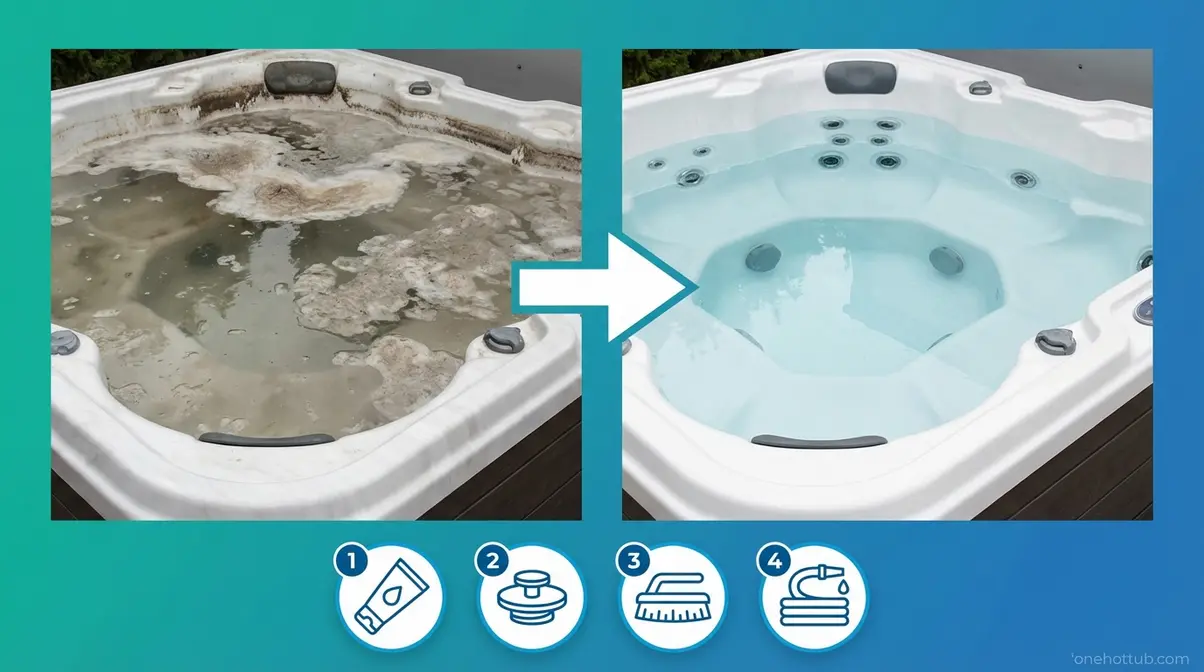
Picture this: You’ve just added fresh chemicals, the water looks crystal clear, and the pH is perfect. But deep inside the jet lines, a colony of Pseudomonas bacteria is thriving — protected inside a slimy biofilm layer that chlorine simply cannot penetrate. Biofilm — a sticky bacterial layer that forms inside hot tub pipes and jets — resists standard chlorine treatment because bacteria produce a protective coating called an extracellular matrix that shields them from chemical attack (NIH/PMC, 2023). The Bio-Reset Protocol — our 4-step deep-clean sequence for eliminating biofilm from hot tub plumbing — solves this problem by targeting the invisible reservoir that surface cleaning alone can never reach.
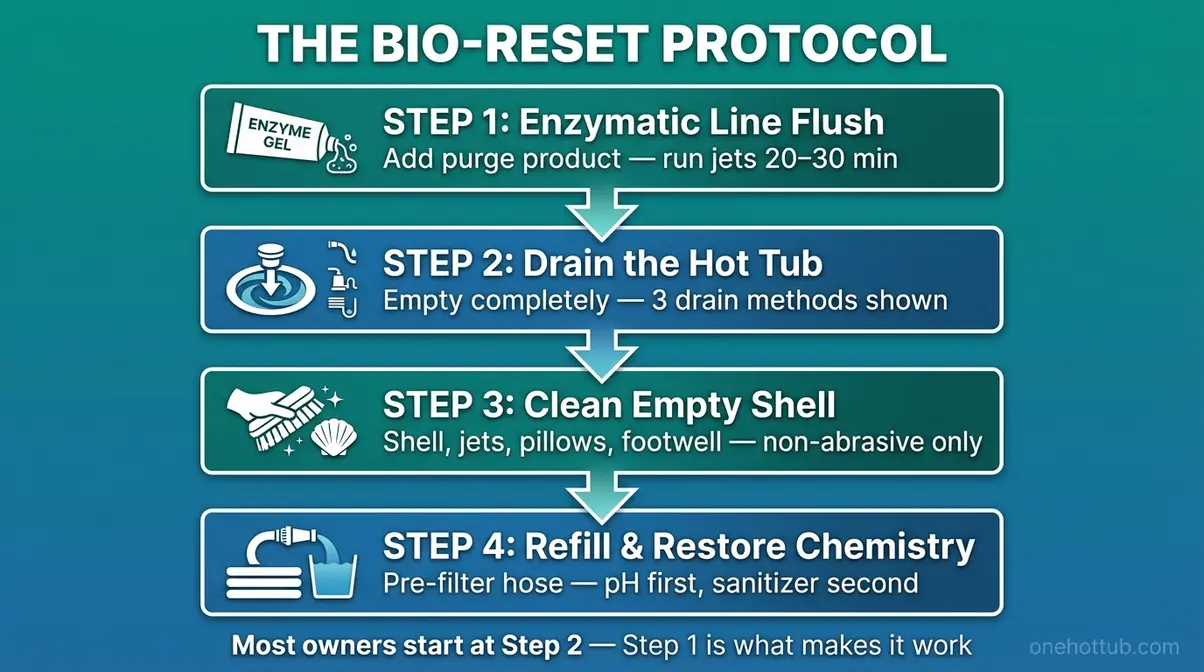
Caption: The Bio-Reset Protocol’s four steps — flush, drain, clean, and restore — performed in this exact order to prevent biofilm re-contamination.
- The Bio-Reset Protocol consists of four steps:
- Enzymatic Line Flush (before draining)
- Drain the hot tub completely
- Clean the empty shell and components
- Refill and restore chemistry
Most owners start at Step 2. Starting at Step 1 is what separates a genuine deep clean from a water change that re-contaminates within days.
What Is Hot Tub Biofilm?
Biofilm is like the greasy film inside a kitchen drainpipe. You can pour bleach down the drain and the outer surface gets clean — but the grease clinging to the pipe walls is still there. In a hot tub, chlorine kills bacteria that are floating free in the water. But bacteria inside biofilm are different: they’ve organized themselves into a colony protected by an extracellular matrix (a protective coating the bacteria produce to shield themselves from chemical attack). Published research confirms that decreased susceptibility of bacteria embedded in hydrated biofilms to disinfection is a multifactorial event — the matrix physically blocks penetration while the bacteria adapt to lower-dose chemical exposure (PMC/NIH, 2023).
The health stakes are real. For deep cleaning, CDC guidelines for cleaning hot tub surfaces specifically advise scrubbing all surfaces to remove slime (biofilm) and rinsing thoroughly before refilling — because biofilm is the primary habitat for Legionella (a type of bacteria associated with hot tub lung and Pontiac fever that thrives in poorly maintained warm water) (CDC, 2025). Pseudomonas folliculitis — hot tub rash — follows the same pathway: the bacteria live in biofilm colonies inside your jet plumbing, and no amount of chlorine maintenance reaches them there.
The good news: enzymes do reach them. As research on biofilm resistance from the NIH confirms, enzymatic treatments combined with physical flushing are the effective approach where chemical-only disinfection falls short (NIH/PMC, 2023). This is the entire scientific basis for Step 1 of the Bio-Reset Protocol.
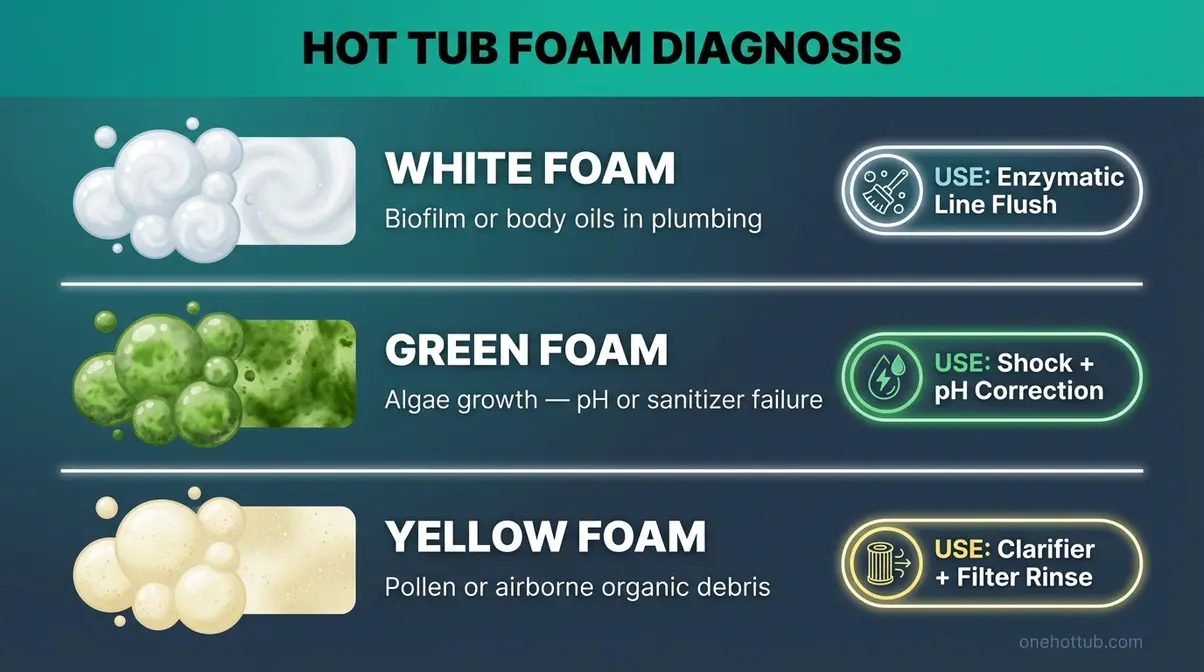
Caption: Foam color tells you what’s actually wrong — white foamy water points to biofilm or organics, not a chemical overdose.
Now that you know what you’re fighting, here’s the exact process for flushing it out — before you ever touch a drain plug.
Step 1: Enzymatic Line Flush
Ahh-Some — the gel-based enzymatic purge — is the most widely recommended product for this step in hot tub owner communities. A single 2 oz tube treats a tub of 300–450 gallons. Spa System Flush and Oh Yuk are effective liquid alternatives — follow label dosing for each. This step is performed with the hot tub full and running, before any draining begins.
Exact steps:
1. Remove all filter cartridges: Do NOT run the flush through the filter. The expelled biofilm would saturate and clog it immediately.
2. Add the enzymatic purge product: Apply directly to the water according to label dosing (approximately 1 tsp per 400 gallons for Ahh-Some concentrated formula).
3. Turn jets to maximum speed: Activate ALL jet channels, including air blowers and any secondary jet zones, to ensure the entire system receives agitation.
4. Run for the recommended time: Typically 20–30 minutes for Ahh-Some; check the label for others. Watch for the expelled gunk: brown or grey foamy sludge rising to the surface. This is the biofilm being loosened and carried out of the pipes. It looks alarming, but it means it’s working.
5. Final precautions: Do NOT add more sanitizer during the flush cycle, as chlorine will neutralize the enzymes before they finish the job. After the cycle ends, do NOT top up the water. Proceed directly to Step 2.
What if you skip this step? If you drain without flushing first, the biofilm stays cemented to the inside of your pipes. Your fresh refill water immediately contacts the intact biofilm layer and re-contaminates within days. You’ve spent the water, the chemicals, and the time — and your tub is no cleaner than before.
⚠️ Safety note: Wear eye protection during the flush. The purge water contains expelled bacteria and should not splash into your eyes or mouth.
For step-by-step draining instructions after completing the flush, our draining guide covers every method and equipment option.
With the plumbing flushed and the gunk expelled, the water is now safe to drain. Here’s how.
Step 2: Drain Your Hot Tub
How to drain a hot tub depends on your equipment and how much time you have. Three methods work reliably:
Method 1: Submersible Sump Pump (Fastest) A submersible pump ($25–50 from any hardware store) drops into the water and connects to a standard garden hose for the output. A 400-gallon hot tub drains completely in 10–15 minutes. This is the fastest, most complete method and leaves the least residual water in the footwell.
Method 2: Built-In Drain Spigot (No Extra Equipment) Most hot tubs have a drain spigot at the base of the cabinet. Connect a garden hose to the threaded fitting and run the output to your drain location. Expect 1–2 hours for a full drain. No extra equipment needed.
Method 3: How to Drain a Hot Tub with a Hose (Siphon) If your tub has no built-in drain and you don’t own a pump, a garden hose siphon works. Fill the hose completely with water (run it from a tap until water flows from both ends), seal both ends with your thumbs, submerge one end in the hot tub, and release the other end at a point below the tub’s base level. The siphon effect starts water flowing without any pump or power. It’s slow — plan for 2–3 hours — but it works.
Where to drain your water: Chemically treated water should not enter storm drains or run off near waterways. The safest approach is to allow chlorine levels to drop naturally (leave the tub uncovered for 24–48 hours before draining) before directing water to a non-sensitive landscaping area. Check your local municipality’s guidelines — regulations vary by area.
Eco-friendly disposal note: This step is absent from most competitor guides, but it matters. Off-gassed, chlorine-neutral water can safely irrigate grass and garden beds. Water with active chlorine levels above 1 ppm can harm plants and soil organisms.
With the tub empty, you now have access to everything — shell, jets, pillows, and footwell. Here’s the right way to clean them all.
Step 3: Clean the Empty Shell
What to clean a hot tub with when empty comes down to two reliable options: a spa-specific shell cleaner (Eco-TUB Spa Clean, Dazzle Surface Cleanse) or a 1:4 white vinegar-to-water dilution for mild scum lines and light scale.
Apply with a soft microfiber cloth or non-scratch sponge only — never a scrubbing pad, steel wool, or abrasive powder cleaner. Apply your chosen cleaner, let it sit for 3–5 minutes to lift deposits, then wipe clean and rinse with fresh water from a hose or bucket.
Pay specific attention to: the scum line at the previous waterline (body oils and minerals concentrate here), jet nozzles and surrounds (calcium scale builds up around them), headrest pillows (remove and soak in diluted cleaner if detachable), and the footwell drain area. What to clean hot tub surfaces with when doing a DIY version: for stubborn calcium scale around jets, apply undiluted white vinegar directly with a soft cloth and allow 10 minutes of contact time before scrubbing gently with a soft toothbrush — effective on calcium without any risk to the acrylic.
Step 4 – Refill and Restore Chemistry: Refill using a hose pre-filter (removes incoming minerals and metals that cause scale and staining). Fill via the filter compartment rather than directly into the tub to prevent air locks (trapped air pockets in the jet plumbing that cause gurgling and reduce jet performance). Once full, add your chemical start-up sequence: adjust pH first, add sanitizer second, and run the jets for 20–30 minutes before re-testing. For detailed refill protocol, see Jacuzzi’s official drain and refill guide.
Filter Cleaning: 3-Method System
Your filter is doing a job that most owners dramatically underestimate. It captures body oils, sunscreen, minerals, hair products, airborne debris, and the biofilm particles that the enzymatic flush dislodged. A dirty filter doesn’t just filter poorly — it reduces water flow, stresses your pump, and becomes a secondary source of water contamination. The best way to clean hot tub filters involves three distinct methods performed on different schedules, each addressing a different type of buildup.
Weekly & Monthly Methods
Weekly (2 minutes): Remove the filter cartridge and rinse it with a firm garden hose spray, working from the top down between the pleats (the folded sections of the filter material). This removes loose debris — leaves, hair, sand — that would otherwise compact deeper into the media over the week.
Monthly (15 minutes): This is where Leisure Time Instant Cartridge Clean earns its place. Spray the entire cartridge surface until covered (the color indicator confirms coverage), wait 10–15 minutes, then rinse thoroughly with the garden hose. This step removes oils, lotions, and light mineral deposits that a water rinse misses. Do this consistently and your quarterly soak will be much less work. A Filter Flosser (a hose attachment with a comb-shaped spray head) significantly improves the rinse step by forcing water pressure directly between each pleat.
Quarterly (overnight): The deep soak. Mix a dedicated filter soak solution (Leisure Time Filter Clean, or a 1:5 white vinegar-to-water dilution for a DIY version) in a bucket large enough to submerge the entire cartridge. Soak overnight — 8–12 hours. The extended contact time allows the solution to dissolve deep-seated calcium deposits and saturated oils that have been compressed into the filter media over months of use. Rinse thoroughly before reinstalling — residual cleaner in the filter can create foam and affect your water chemistry.
Commercial vs. Vinegar Cleaners
The honest comparison: commercial filter cleaners like Leisure Time Instant Cartridge Clean are more effective at removing body oils and organic buildup, while white vinegar excels at mineral and calcium scale removal. For an all-purpose monthly spray, the commercial product wins. For a hard-water household where calcium scale is the primary problem, a vinegar soak is a highly cost-effective quarterly solution.
How to clean a hot tub filter with vinegar: Mix 1 part white vinegar with 5 parts water in a bucket. Submerge the filter cartridge completely. Soak for 4–12 hours (overnight is ideal). Rinse until the rinse water runs clear — vinegar odor should be undetectable before reinstalling. For a DIY alternative, cleaning filters with vinegar offers a budget-friendly option that costs approximately $1–2 per soak versus $3–5 for a commercial solution per use. Both work. The commercial product requires less soaking time for oil-based deposits.
Replace your filter cartridge entirely every 12–18 months regardless of cleaning routine. Filter media degrades over time — the pleats lose structural integrity and the fibers compress, reducing filtration surface area. No amount of cleaning restores a spent filter.
Shell, Surface & Cover Care
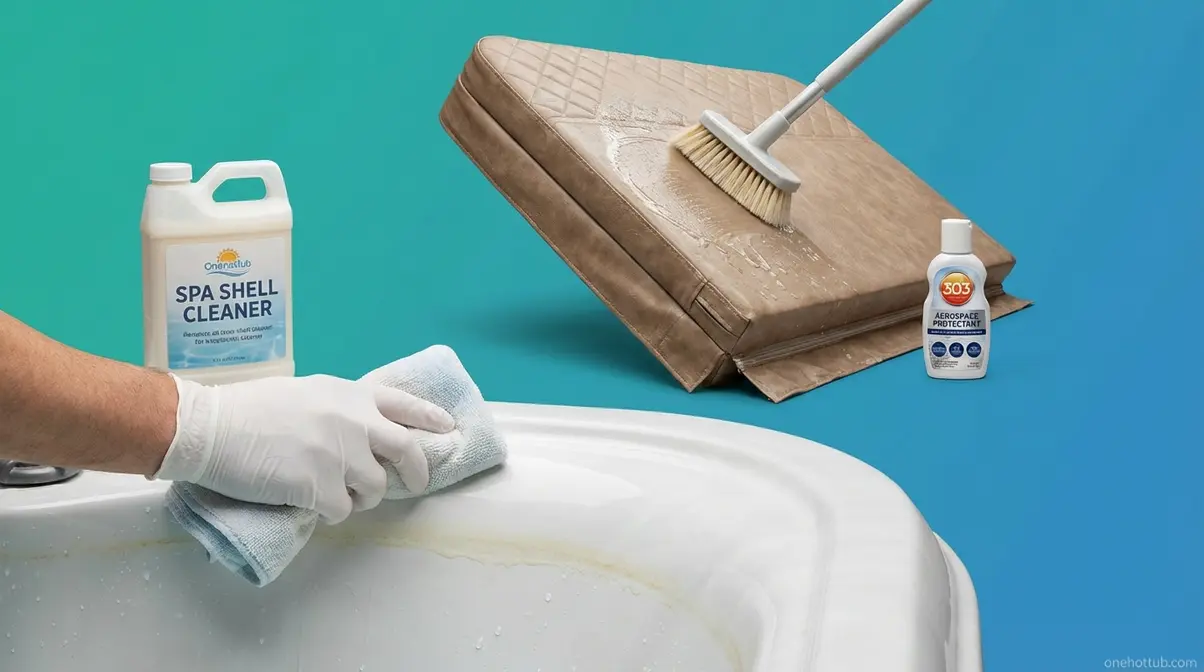
The shell and cover are your hot tub’s most visible components — and two of the most commonly damaged through well-intentioned but incorrect cleaning. Beginners reaching for household cleaning sprays cause more surface damage than months of normal use. The good news: proper care is simple and inexpensive.
Scratch-Free Shell Cleaning
The golden rule: soft cloth, spa-specific cleaner, gentle pressure. Acrylic hot tub shells have a gel coat (a clear protective layer applied over the fiberglass base) that scratches permanently with any abrasive contact. Microscopic scratches trap bacteria and are essentially impossible to repair without professional refinishing. That is why it’s critical when cleaning the acrylic shell to prevent damage.
Apply Eco-TUB Spa Clean or Dazzle Surface Cleanse with a microfiber cloth in circular motions. For the scum line specifically — the greasy ring at the former waterline — a direct application with 3–5 minutes of dwell time before wiping removes most deposits without pressure. For calcium scale around jets, a soft-bristle toothbrush with undiluted white vinegar works well on the nozzle surrounds without contacting the broader shell surface.
Jet nozzles on most hot tubs unscrew counterclockwise for removal. Remove them and soak in diluted white vinegar for 30 minutes, then rinse and reinstall. The interior of the jet housing — the recessed cavity behind the nozzle — accumulates calcium and biofilm deposits. A cotton swab dipped in vinegar reaches the interior cavity effectively.
Cover Cleaning & UV Protection
How to clean a hot tub cover correctly prevents the two most common cover failures: vinyl cracking (from UV exposure and oxidation) and waterlogging (from a failing foam core absorbing moisture).
- Cleaning steps:
- Remove the cover and lay flat on a clean surface
- Rinse with fresh water to remove loose debris
- Apply a vinyl-specific hot tub cover cleaner (or a 1:10 dilution of gentle dish soap in water) with a soft brush — never a pressure washer
- Rinse thoroughly and allow to fully air dry before applying protectant
- Apply a UV protectant specifically formulated for vinyl (303 Aerospace Protectant is widely recommended in hot tub communities) — this step dramatically extends cover lifespan
Signs your cover needs replacing: If the cover feels heavy when you lift it — noticeably heavier than when new — the foam core has absorbed water and is no longer providing thermal insulation. For comprehensive advice on restoring your hot tub cover, ensure you apply a UV protectant faithfully. A saturated foam core adds 30–50 lbs of weight and loses up to 80% of its insulating value, increasing your heating costs significantly.
Frequency: Clean the cover monthly. Apply UV protectant every 4–6 weeks, or more often in high-sun climates.
Safe vs. Unsafe Household Chemicals
This section answers the questions that generate the most confusion among new owners — and where the most damage gets done. The short version: two household products are genuinely useful (vinegar and a carefully managed bleach solution), and one product should never touch your hot tub under any circumstances.
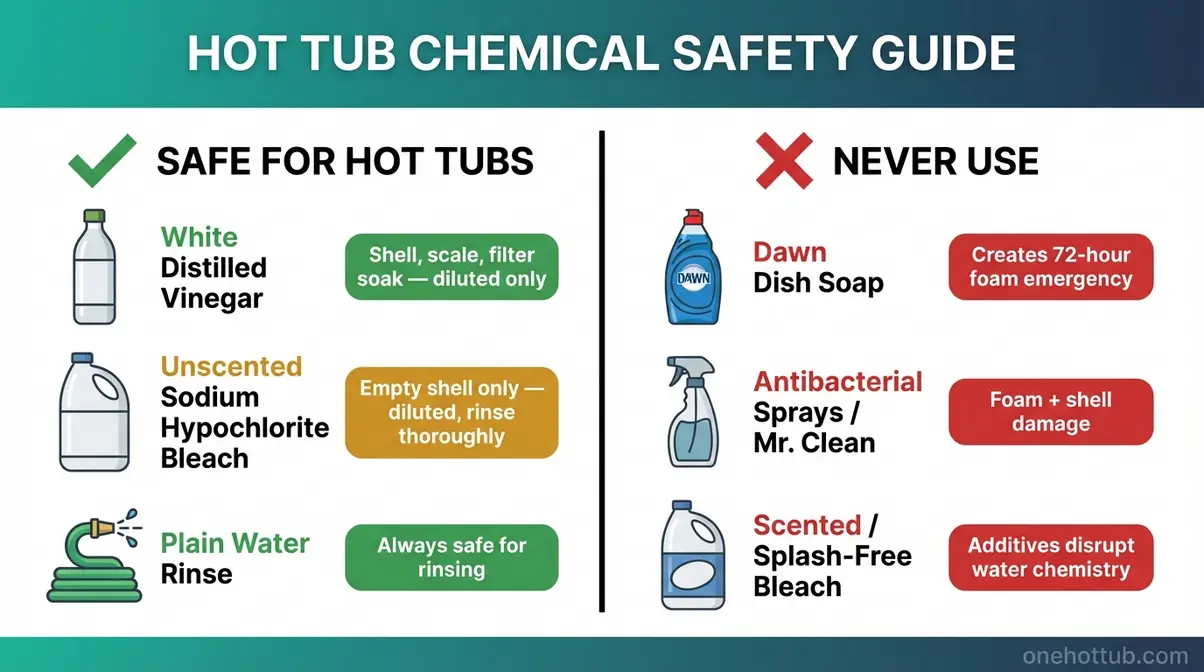
Caption: Not all household cleaners are safe for hot tubs — this chart shows which ones work, which to avoid, and exactly why.
According to the CDC, maintaining appropriate disinfectant levels is essential for preventing waterborne illness in hot tubs — using inappropriate household substitutes can disrupt that balance and create dangerous conditions (CDC, 2025). For chemical safety questions beyond routine cleaning, consult a licensed pool and spa technician.
Vinegar: The Safe DIY Cleaner
White distilled vinegar (5% acidity) is genuinely useful in three specific hot tub applications: dissolving calcium scale on shell surfaces and jet nozzles, soaking filter cartridges to remove mineral buildup, and cleaning the empty shell between deep cleans. It’s non-toxic, biodegradable, and costs almost nothing.
- Safe use rules:
- Always dilute for shell contact: 1:4 vinegar-to-water for general cleaning, undiluted only for spot scale treatment on jets. When cleaning with vinegar and household items, always dilute properly.
- Never add vinegar directly to a filled, operating hot tub — it will temporarily drop your pH and can irritate skin at higher concentrations
- Always rinse thoroughly after any vinegar application before refilling
Vinegar is NOT a sanitizer. It does not kill bacteria in water, does not treat biofilm, and cannot substitute for chlorine or bromine under any circumstances. Use it for surfaces and filter cleaning — that’s where it genuinely excels.
Bleach: When It Is Safe to Use
Can you use bleach in a hot tub? The answer is: occasionally and carefully, in a specific context. Before using bleach safely in your hot tub, remember that unscented sodium hypochlorite bleach (regular household bleach, typically 6–8.25% concentration) is chemically the same compound as liquid chlorine — it’s just more diluted. For emergency sanitization of an empty, drained shell before refilling, a diluted bleach solution (1 tablespoon per gallon of water) wiped across surfaces and rinsed thoroughly is acceptable.
Never use bleach in a filled hot tub as a regular sanitizer substitute — the concentration is inconsistent, it can cause rapid pH swings, and the additional chemicals in scented or “splash-free” varieties are problematic for water chemistry and equipment.
⚠️ Critical chemical safety warning: Never mix bleach or chlorine products with muriatic acid (used for pH reduction) or any acid-based descaler. This combination produces toxic chlorine gas — the same compound used as a chemical weapon. Store chemicals separately, never in the same cabinet, and always add chemicals to water, not water to chemicals. If you spill concentrated chemicals, ventilate immediately and contact Poison Control (1-800-222-1222). Per the EPA’s Chemical Safety guidance, chemical mixing accidents in residential pool settings are among the most common causes of residential chemical injuries.
Can I Use Dawn Dish Soap?
No — Dawn and all dish soaps should never be used in a hot tub, for any purpose. Even a single drop of dish soap creates foam that the jets amplify dramatically, producing suds that can take 24–72 hours to fully clear. During that time, your water chemistry readings are unreliable and your filter is overloaded. Dish soap surfactants are designed to create bubbles, and hot tub jet turbulence is the ideal environment for that reaction. For cleaning surfaces, use diluted white vinegar or a spa-specific shell cleaner instead — both are effective, affordable, and completely foam-safe.
Cleaning Tools: Manual vs. Robotic
The tools you use determine how efficiently you complete each cleaning step. For years, the standard approach was a sponge, a bucket, and a wet-vac attachment. That approach still works — but a new category of purpose-built robotic spa cleaners has changed the cost-benefit equation significantly for owners who clean weekly.
Essential Manual Tools
A basic manual cleaning kit covers the core tasks with an investment of approximately $30–50:
- Hot tub vacuum (spa vac): A hand-powered or battery-operated suction tool that removes settled debris (sand, leaves, dirt) from the footwell and seat ledges. The manual “Water Maid” style uses the pressure differential from a garden hose to create suction — no batteries required.
- Filter Flosser: A hose-end attachment with a multi-directional spray nozzle designed to blast between filter pleats. One of the best $15–20 investments in your cleaning toolkit.
- Non-scratch sponge or microfiber cloth: For shell cleaning. Designate these exclusively for hot tub use — cross-contamination from household cleaners is a real issue.
- Soft-bristle brush: For jet nozzle cleaning and footwell scrubbing.
- Hot tub scrubber on an extendable handle: For cleaning the shell waterline without having to lean in on your knees.
The limitation of manual tools: they require your time, physical access to the tub, and consistent discipline. Debris that settles between cleaning days (pollen, leaves, insects) sits on the footwell and can enter your filter and pump. Manual vacuuming also requires partial water displacement when using hose-powered models, which adds time and water costs over the course of a year.
Why Use Tennis Balls?
“People put tennis balls in hot tubs because the felt surface absorbs body oils, lotions, sunscreens, and makeup, preventing them from causing foamy, cloudy water and scum lines.”
This advice from hot tub communities actually works for oil absorption between cleanings. Tennis balls act as passive oil-absorption tools in a hot tub. The felt surface absorbs body oils and cosmetics that bathers bring into the water, preventing those organics from accumulating at the waterline. Drop 2–3 tennis balls in when the tub is in use. Replace them every 3–4 weeks as the felt saturates. This doesn’t replace your cleaning routine, but it reduces the oil load your filter and chemicals have to manage between cleanings.
Robotic Spa Cleaners
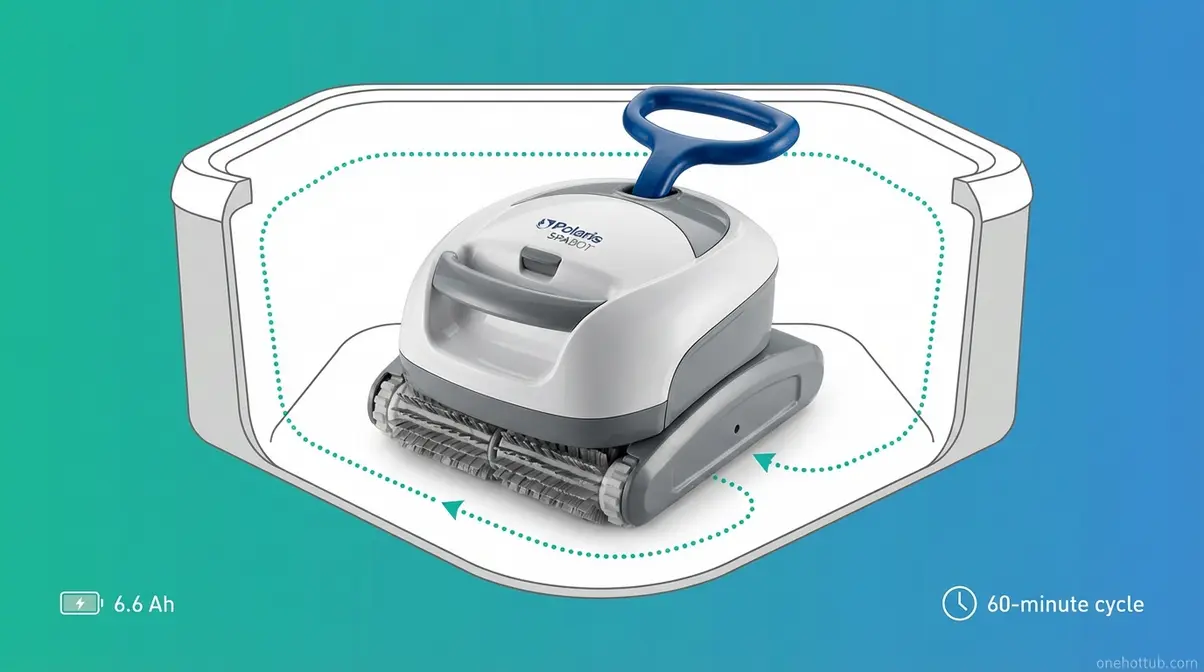
The Polaris Spabot is a cordless robotic spa cleaner designed specifically for in-ground spas and above-ground hot tubs up to 9×9 feet. It represents a genuinely new approach to debris management — one that removes the manual vacuuming step from the weekly routine entirely.
- Key specifications:
- Cleaning cycle: 60 minutes, fully autonomous
- Battery: 6.6 Ah lithium-ion, 4-hour charge time
- Navigation: SpaNav™ technology covers floor, walls, seats, and footwell
- Retrieval: Float Finish™ floats the unit to the surface at cycle end for easy removal
- Filter: 1-liter fine debris canister (removable for rinsing)
- Weight: approximately 5.5–6 lbs
- Surfaces: all spa surfaces including textured footwells
Pricing: Approximately $499–799 depending on retailer and current promotions (check current pricing before purchasing).
The Spabot doesn’t replace your enzymatic purge, filter cleaning, or shell cleaning routine — it handles the physical debris layer (leaves, sand, hair, algae flakes) that settles to the bottom and collects on seating surfaces. What it removes is the 15–30 minutes of manual vacuuming per week plus the associated hassle of hoses, nozzle attachments, and water loss.
Manual vs. Robotic Tools
| Factor | Manual Vacuuming | Polaris Spabot |
|---|---|---|
| Upfront cost | $15–50 (tools) | ~$499–799 |
| Time per clean | 15–30 min active | 0 min active (60 min autonomous) |
| Coverage | Depends on thoroughness | Full floor, walls, seats, footwell |
| Hose/cord required | Yes (garden hose pressure) | No — fully cordless |
| Water loss per use | Small (hose-powered vacs) | None |
| Maintenance required | Replace brush heads annually | Rinse filter canister after each use |
| Best for | Occasional/budget cleaning | Weekly automated maintenance |
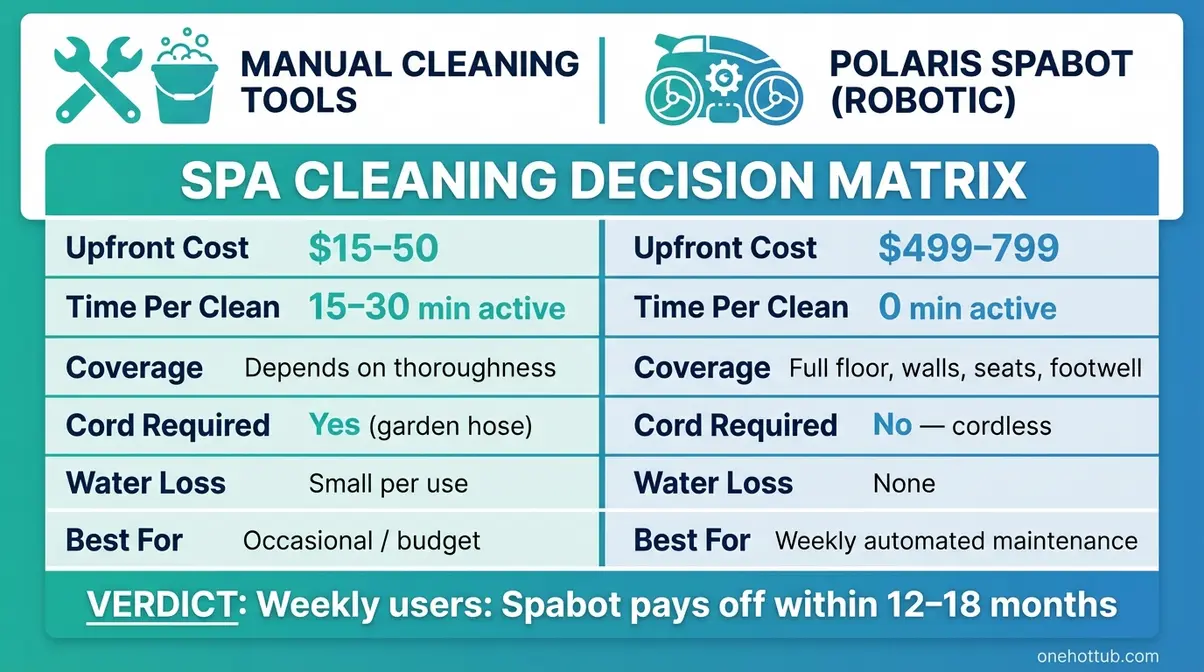
Caption: The Manual vs. Robotic Decision Matrix — at weekly cleaning frequency, the Spabot’s time savings offset its upfront cost within the first year.
The verdict: If you clean your hot tub weekly and value your time, the robotic approach pays for itself in convenience within 12–18 months of consistent use. If you drain and refill quarterly with minimal mid-cycle cleaning, the manual toolkit is entirely sufficient.
Your Hot Tub Maintenance Schedule
Consistency matters more than intensity in hot tub maintenance. A 5-minute weekly routine prevents the 3-hour quarterly emergency that beginners dread. Most hot tub manufacturers recommend a drain-and-refill cycle every 3–4 months based on average bather load — adjust more frequently for heavy use or larger household sizes. For more detail, see how to maintain a hot tub with our full maintenance guide linked at the end of this section.
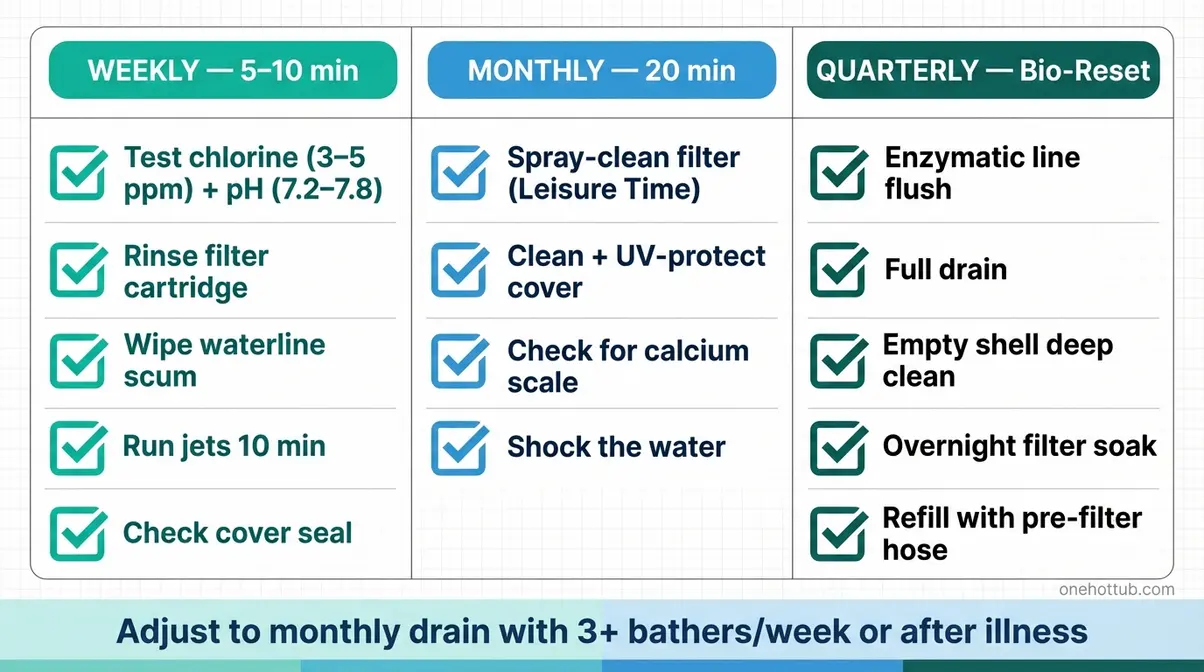
Caption: Print this maintenance schedule and attach it to your equipment cabinet — consistency at each interval prevents every major hot tub problem.
Weekly Cleaning Tasks
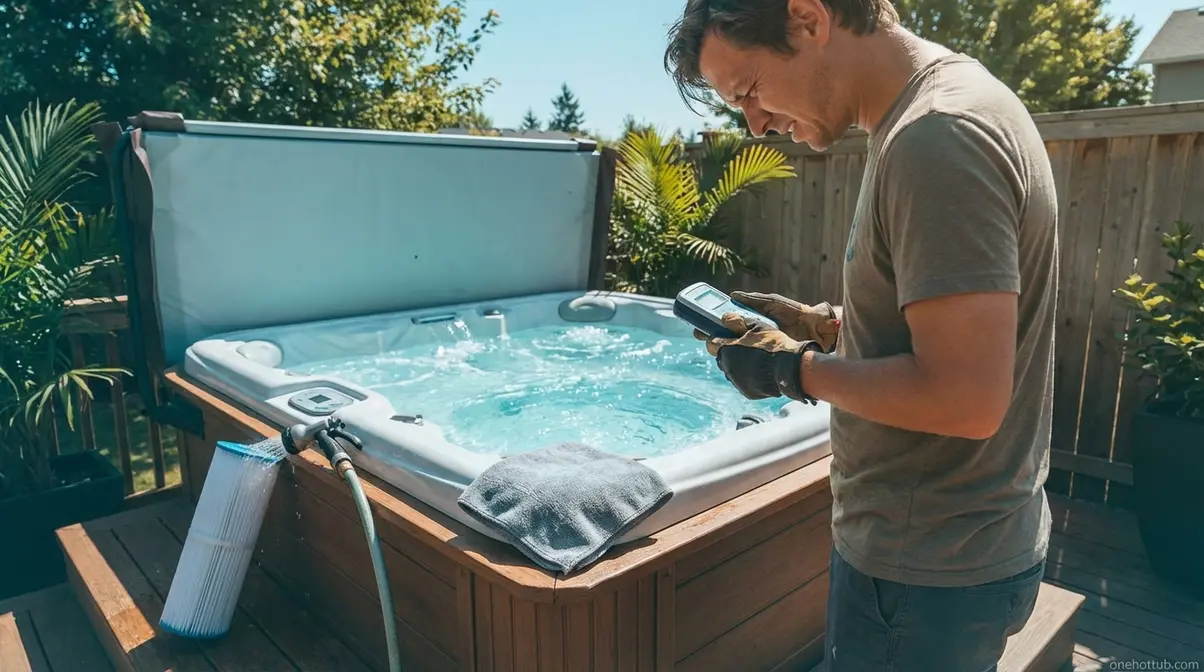
How often should a hot tub be cleaned? The honest answer is: something needs attention every single week, even if it only takes 5–10 minutes.
- Weekly checklist:
- Test water chemistry: Check free chlorine (target: 3–5 ppm), pH (target: 7.2–7.8), and alkalinity (total alkalinity target: 80–120 ppm). Adjust as needed using reliable water testing accessories.
- Rinse the filter cartridge: 2-minute garden hose spray, top to bottom between the pleats.
- Check and clean the waterline: Wipe the scum line with a microfiber cloth and diluted shell cleaner if visible.
- Run the jets (10 minutes): Running jets weekly — even without bathers — circulates water through all plumbing and prevents stagnant pockets from developing.
- Check the cover: Wipe moisture from the underside to prevent mold and ensure the seal is intact.
Skipping weekly water chemistry checks is the single biggest predictor of expensive problems. pH drift outside the 7.2–7.8 range causes chlorine to become ineffective (low pH) or irritating to skin and corrosive to equipment (high pH).
Monthly & Quarterly Cleaning
- Monthly tasks:
- Spray-clean the filter cartridge with Leisure Time Instant Cartridge Clean or equivalent (10–15 min contact time, thorough rinse)
- Wipe down the cover with vinyl cleaner and apply UV protectant
- Check for calcium scale buildup around jets and fittings — treat with diluted vinegar before scale hardens
- Shock the water (add an oxidizing shock treatment to break down accumulated organics and restore sanitizer efficiency)
- Quarterly tasks — The Bio-Reset Protocol:
- Perform the enzymatic line flush (Step 1 above) — this step is non-negotiable every quarter
- Drain completely using your preferred drainage method
- Deep-clean the empty shell (all surfaces, jets, pillows, footwell)
- Quarterly overnight filter soak in dedicated solution
- Refill using a hose pre-filter
- Restore full water chemistry from scratch
Printable quarterly reminder: Mark your calendar for drain days — 3 months from last drain, or earlier if your hot tub sees unusually heavy use (3+ bathers per week, or after illness). See our comprehensive maintenance guide for a downloadable maintenance checklist template.
When to Call a Professional
Some hot tub problems are genuinely beyond DIY territory. Consult a troubleshooting and repair guide to know when professional service is the right call — particularly for fixing hot tub leaks or mechanical failures.
- Call a professional when:
- Water stays cloudy after multiple chemical corrections and a full drain-and-refill cycle — persistent cloudiness after a complete reset points to a filter, pump, or circulation problem that no cleaner can fix
- Your pH or alkalinity will not stabilize — unstable chemistry that won’t respond to standard adjustment often indicates a plumbing issue or chemistry contamination requiring professional diagnosis
- Jets have significantly reduced flow — this may indicate a blocked impeller, failed pump, or air-lock issue in the plumbing
- You see visible corrosion on metal fittings, the heater element, or the control panel — these are electrical/mechanical issues where DIY intervention creates safety risks
- You notice a persistent chemical or sewage smell after a full Bio-Reset clean — this can indicate a cracked pipe, failed seal, or cross-contamination issue in the equipment compartment
What does it cost to have a hot tub professionally cleaned? Routine service visits typically run $75–150 per hour, with a minimum 1–2 hour visit, putting most one-time service calls at $150–300 (Angi). Monthly professional service contracts average $140–200 per month in most U.S. markets, according to industry service pricing studies. One-time deep cleaning or troubleshooting visits can reach $300–400 in complex cases (HomeGuide).
For owners in high-use situations, a quarterly professional service alongside your own monthly maintenance often delivers better outcomes than DIY alone — the technician catches developing equipment issues before they become expensive repairs.
Limitations & Chemical Safety
Common Pitfalls
Pitfall 1: Adding chemicals directly on top of each other without testing between additions. Each chemical adjustment affects the next reading. Add pH adjuster, wait 30 minutes, re-test before adding anything else. Skipping this produces inaccurate chemistry and can lead to pH lock — a condition where the water’s buffering capacity becomes so disrupted that readings swing unpredictably.
Pitfall 2: Running the Bio-Reset flush through the installed filter. The expelled biofilm and organic material will saturate your filter in a single cycle, potentially damaging it beyond recovery. Always remove filter cartridges before adding any enzymatic purge product.
Pitfall 3: Using vinegar directly in a filled, operating hot tub. Vinegar in undiluted form will temporarily acidify your water, irritate skin, and may damage seals in some pump and heater systems. Vinegar belongs on surfaces during the empty-shell cleaning step — not in your water.
Pitfall 4: Skipping the quarterly drain and running chemicals for 6+ months straight. Chemical byproducts (combined chlorines, chloramines, total dissolved solids) accumulate in hot tub water over time and reach a point where no chemical addition can restore water quality. The quarterly drain is not optional — it resets the chemical baseline.
Pitfall 5: Mixing chemical products before reading labels. This pitfall can be dangerous. Never combine chlorine products with acid-based products in any container or in close physical proximity. Always add chemicals to water (not water to chemicals) to prevent splashback reactions.
When to Choose Alternatives
Choose a mineral sanitizer system (Nature2) over standard chlorine if you or your household members experience consistent skin irritation, red eyes, or respiratory sensitivity after hot tub use. Mineral systems reduce chlorine demand by 50–75%, making the water significantly gentler while maintaining safe sanitation.
Choose professional service over DIY when dealing with Legionella-suspected contamination (fever, respiratory symptoms in household members following hot tub use), any electrical or plumbing repair, or if your hot tub has been unoccupied and uncleaned for more than 6 months. Reopening a stagnant hot tub safely requires hyperchlorination protocols beyond standard DIY chemistry — the CDC recommends hyperchlorinating to 20 ppm free chlorine for hot tubs that have been sitting, then circulating for several hours before testing and adjusting to normal operating levels (CDC, 2025). For guidance on cleaning a hot tub that has been sitting, Leslie’s Pool Supplies outlines the full reactivation protocol.
Frequently Asked Questions
What is the best thing to clean a hot tub with?
The best approach uses a combination of products — not a single cleaner — targeting different parts of the spa. For plumbing, an enzymatic purge (Ahh-Some or Spa System Flush) clears biofilm before draining. For the empty shell, a spa-specific non-abrasive cleaner like Eco-TUB Spa Clean or diluted white vinegar removes scum and scale safely. For the filter, Leisure Time Instant Cartridge Clean handles routine spray cleaning, while an overnight soak solution addresses quarterly deep maintenance. Using one product for everything is the most common beginner mistake — each cleaner targets a different part of the spa.
How much does it cost to clean a hot tub yourself?
DIY hot tub maintenance typically costs $15–40 per month in chemicals and supplies (water test strips, chlorine/bromine, pH adjusters, and a filter spray cleaner). The quarterly Bio-Reset deep clean adds approximately $15–25 for an enzymatic purge product. A complete annual DIY toolkit — including replacement filter cartridges — runs approximately $200–350 total. Compare this to professional service costs of $150–300 per visit (HomeGuide), and the DIY approach saves $600–1,200 per year for owners who maintain a consistent routine.
How much does professional hot tub cleaning cost?
Professional hot tub service costs $75–150 per hour in most U.S. markets, with most service calls running 1–2 hours (Angi). Monthly service contracts average $140–200 per month nationally, with higher rates in California and Florida. One-time deep cleans or troubleshooting visits typically run $150–400 depending on complexity and location (HomeGuide). An annual professional drain-and-refill service typically runs $100–300 (Sundance Spas).
Can a hot tub help with sore muscles?
Hot tub hydrotherapy can genuinely help with muscle soreness and tension. The combination of warm water (98–104°F), buoyancy reducing joint pressure, and jet massage targeting specific muscle groups creates measurable relaxation effects. Water temperature above 100°F increases peripheral circulation, which supports muscle recovery. The key condition for safe use: water chemistry must be properly maintained. Soaking in unbalanced or biofilm-contaminated water negates the wellness benefit and introduces health risks.
How often should a hot tub be cleaned?
Hot tub cleaning happens at four distinct intervals. Weekly: test and adjust water chemistry, rinse the filter cartridge, wipe the waterline. Monthly: spray-clean the filter with a dedicated filter cleaner, wipe the cover with vinyl cleaner and UV protectant, check for scale buildup. Every 3–4 months: perform a complete Bio-Reset deep clean — enzymatic flush, full drain, shell scrub, filter soak, and refill. Heavy use (3+ bathers weekly) or illness in the household warrants more frequent draining.
Can I use Clorox bleach to clean my hot tub?
Unscented Clorox bleach can be used in a limited, specific context — wiping down the empty shell before refilling, diluted at approximately 1 tablespoon per gallon of water. As a water treatment substitute for chlorine granules, liquid bleach works chemically but is impractical: dosing accurately is difficult, it can cause rapid pH drops, and scented or “splash-free” varieties contain additives that disrupt water chemistry. For regular sanitization, use spa-grade chlorine granules or tablets instead. ⚠️ Critical safety reminder: never mix bleach with muriatic acid or any acid-based descaler — this produces toxic chlorine gas.
Keeping Your Spa Clean & Safe
For hot tub owners — especially those new to spa ownership — The Bio-Reset Protocol changes the entire framework of what “cleaning” means. Standard surface cleaning leaves the most dangerous contamination untouched inside the plumbing. The four-step protocol — enzymatic flush before draining, full drain, empty-shell deep clean, and proper chemical restoration — addresses every layer of the spa. The CDC’s confirmation that free chlorine must reach at least 3 ppm, combined with NIH-backed evidence that biofilm actively resists chlorine penetration (NIH/PMC, 2023), makes the enzymatic purge step non-negotiable for anyone serious about safe water quality.
The Bio-Reset Protocol works because it targets the real source of persistent water problems — not the symptoms. Cloudy water, stubborn foam, chemical resistance, and recurring odors are almost always signs of an intact biofilm colony inside your plumbing. Surface cleaning and chemistry adjustments treat the water in the tub. The enzymatic flush treats the water inside every inch of pipe, jet channel, and fitting — the reservoir most cleaning guides completely ignore.
Your next step is straightforward: if you haven’t done an enzymatic line flush in the last 3 months, that’s your starting point. Order Ahh-Some or Spa System Flush (both available at national pool retailers), schedule your next drain day, and follow the four-step Bio-Reset sequence. For a complete chemical setup guide, visit our essential hot tub chemicals guide. For step-by-step drain logistics, our draining guide covers every method with clear instructions. Start the protocol this quarter — your water quality will reflect the difference within 24 hours of the refill.