
What’s in this guide
Medically Reviewed By: — Reviewed January 2026
⚠️ Medical Disclaimer: This article is for informational purposes only and is not a substitute for professional medical advice, diagnosis, or treatment. Always consult a board-certified dermatologist or qualified healthcare provider if you suspect you have scabies. Seek medical attention promptly.
The itching is relentless. It wakes you up at night, follows you through the day, and drives you to search for any remedy that might bring relief. If you’re wondering whether do hot tubs kill scabies — the short answer is no. Using one may actually make your symptoms significantly worse.
That logic feels reasonable on the surface. Heat kills bacteria. Hot water sanitizes surfaces. So why wouldn’t a 104°F soak eliminate the mites burrowing in your skin? Because the science tells a very different story — and every hour spent on an ineffective remedy is another hour the infestation continues to spread to others in your household.
In this guide, you’ll learn exactly why hot tubs fall short, what the research says about heat and scabies mites, and the medically proven steps that actually eradicate the infestation. We’ll cover mite biology, the critical temperature gap, prescription treatments, itch relief, and a complete home decontamination protocol.
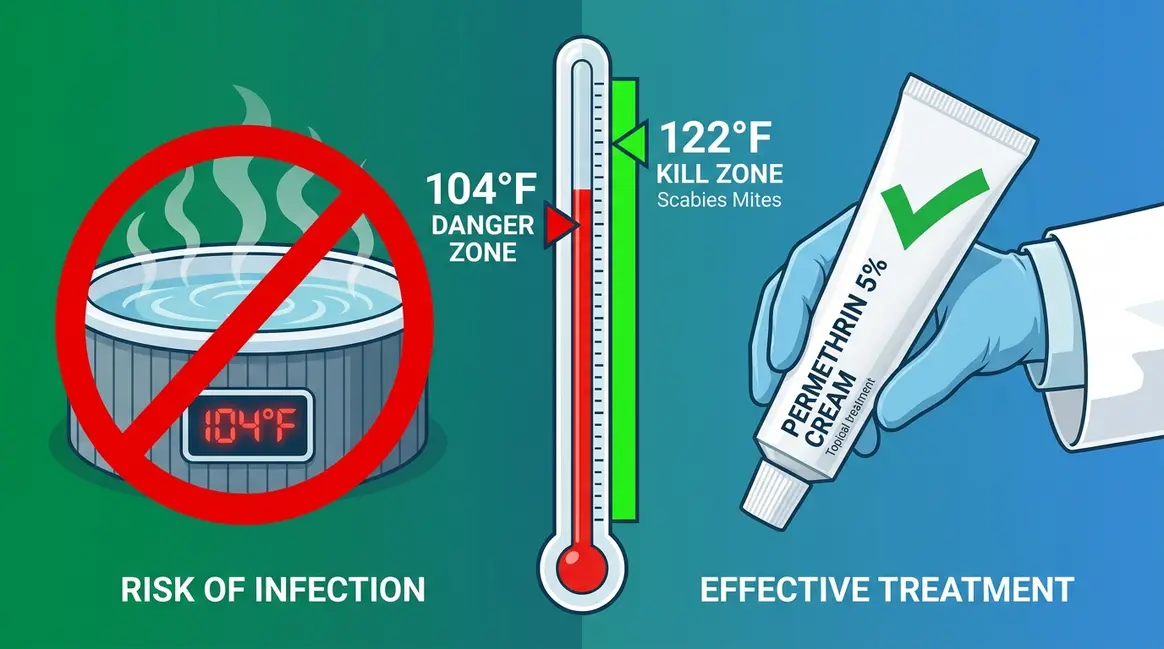
Hot tubs cannot kill scabies — the 18°F “Temperature Gap” between a hot tub’s maximum (104°F) and the mite death threshold (122°F) makes them medically useless as a treatment.
- Hot tubs max out at 104°F: Scabies mites require 122°F for 10 minutes to die — a gap no hot tub can close (CDC; NJ Dept of Health)
- Mites burrow into skin: Hot water cannot reach them even at maximum temperature — they live in tunnels beneath the skin surface
- Hot water worsens itching: A 2021 PubMed Central review found hot water intensified itching in 67% of scabies patients, amplifying the discomfort you’re already experiencing
- Only prescription treatments work: Permethrin 5% cream or oral ivermectin, prescribed by a doctor, are the only proven eradication methods
- The Temperature Gap framework: Understanding this 18°F gap explains why all hot-water home remedies — showers, baths, and hot tubs — fail equally
What Is Scabies & Why Is It Hard to Treat?
Scabies is a highly contagious skin infestation caused by a burrowing mite — and it is far more difficult to eliminate than most people expect. Understanding why requires a quick look at what you’re actually dealing with.
How Scabies Mites Burrow
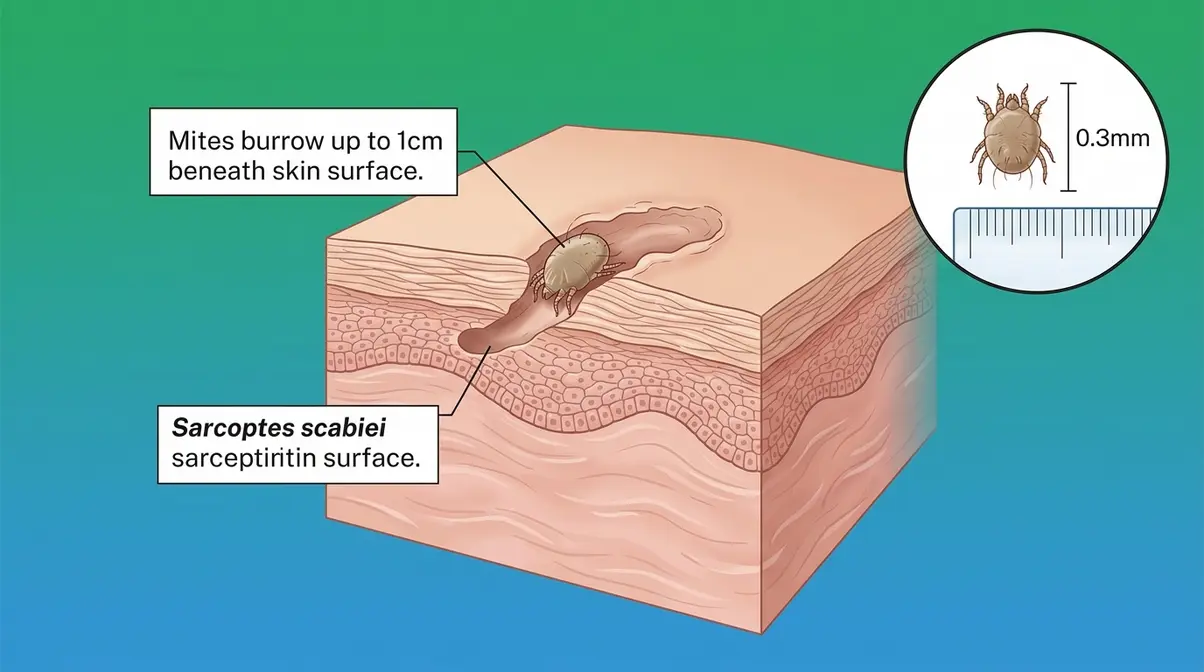
Sarcoptes scabiei (the microscopic mite responsible for scabies) is barely visible to the naked eye — roughly 0.3 millimeters long. Think of it like a microscopic crab that digs tunnels directly under your skin. Female mites burrow into the outermost layer of skin, creating channels up to 1 centimeter long where they lay their eggs and deposit waste. This waste is what triggers the body’s allergic response — the intense, maddening itch you feel, especially at night.
Scabies mites (Sarcoptes scabiei) burrow up to 1 centimeter beneath the skin surface, where no amount of external heat or water can reach them. This is the core reason why surface-level treatments — including hot water — simply cannot work. The mites are not on your skin; they are inside it.
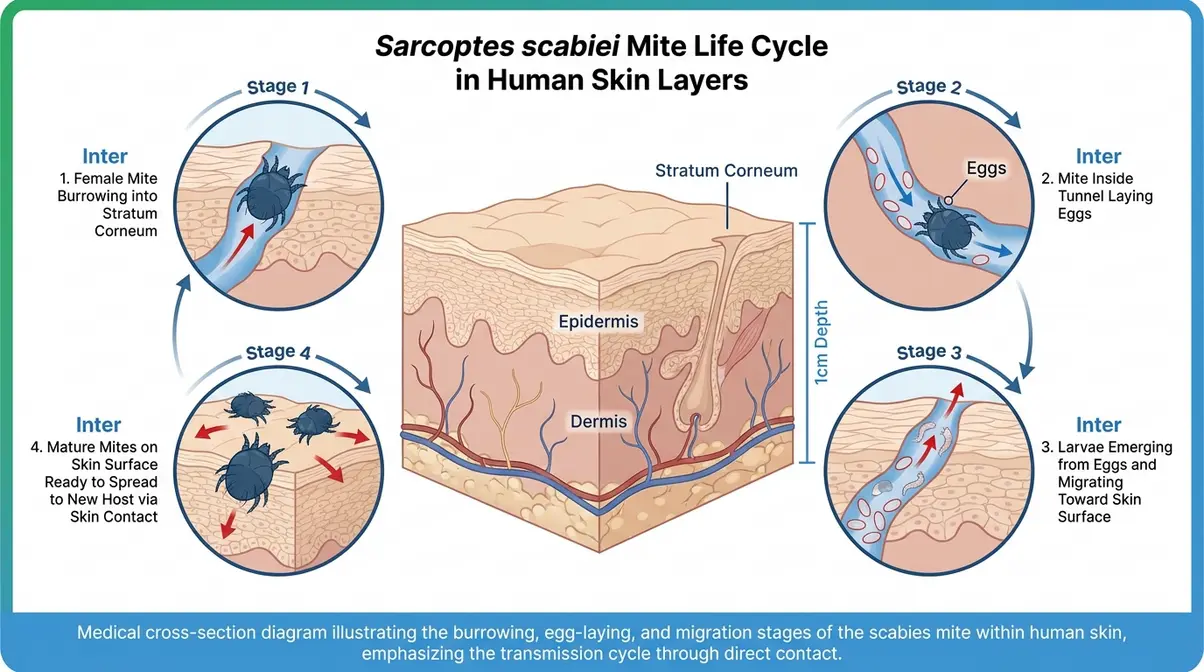
Scabies spreads primarily through prolonged, direct skin-to-skin contact — typically lasting 10 minutes or more, according to the CDC. It does not spread through brief handshakes or casual contact, and it is not transmitted through water. Off a human host, mites survive only 24 to 72 hours at room temperature (PMC, 2018) — which is why household decontamination matters, but is not the primary battleground.
Symptoms typically include intense itching (worse at night), a pimple-like rash, and thin, thread-like burrow tracks on the skin — particularly between fingers, on wrists, and around the waistline. The Mayo Clinic notes that symptoms may take 4 to 8 weeks to appear after first exposure, because the immune system needs time to react.
This burrowing behavior is exactly why heat-based home remedies — including hot tubs — fall short. No matter how hot the water, it cannot penetrate deep enough to reach mites living in skin tunnels. We’ll explain the precise science of why in the next section.
Do Hot Tubs Kill Scabies? The Science
The direct answer: no, hot tubs do not kill scabies mites. The temperature a hot tub reaches is not high enough, and even if it were, the water cannot penetrate the skin layers where mites live. Our editorial team reviewed Tier 1 medical sources — including the CDC, NJ Department of Health, and peer-reviewed research — and found unanimous agreement on this point. For a deeper dive into the science behind why heat treatments fail for scabies, we must look closely at thermal thresholds.
“First of all, a hot tub will do nothing to kill mites — if anything, the heat, water, and chemicals will irritate your skin.”
— Community experience, r/scabies
Why Hot Tub Temperatures Fall Short
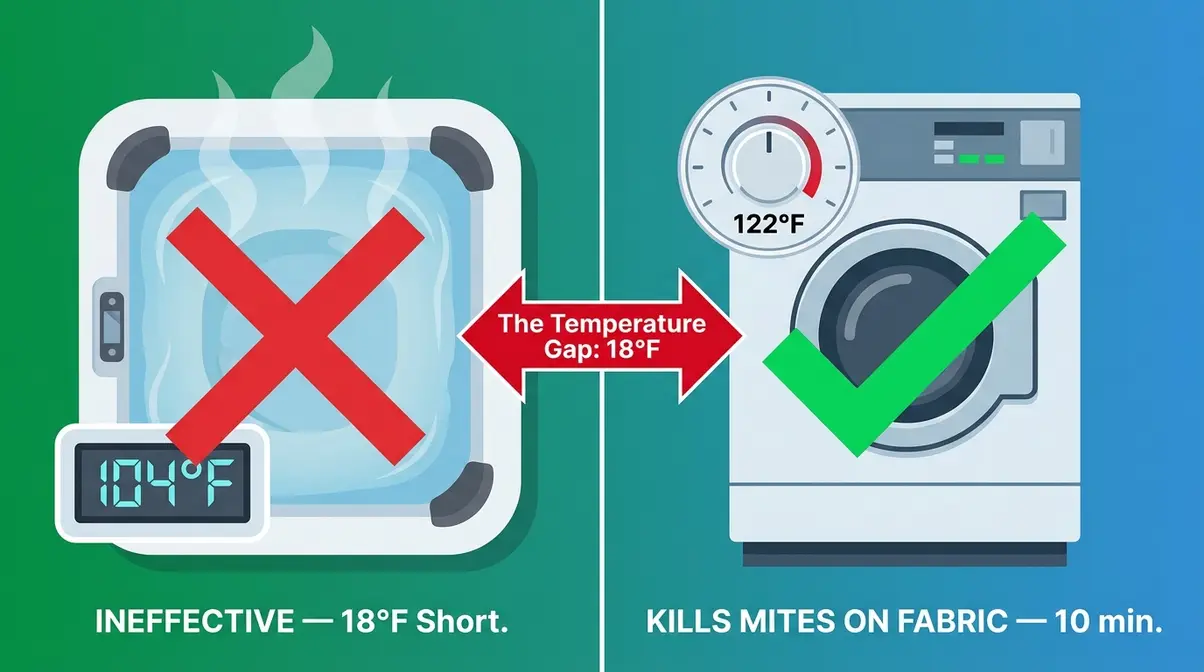
This is where The Temperature Gap becomes critical to understand. According to the CDC’s scabies guidelines, temperatures in excess of 122°F (50°C) for a minimum of 10 minutes are required to kill scabies mites and their eggs. The NJ Department of Health scabies guidance document confirms this same threshold: 50°C (122°F) for 10 minutes.
A standard hot tub, by regulation and design, maxes out at 104°F (40°C). That is an 18°F gap — and it is not a small margin. At 104°F, mites are stressed but alive. They do not die. Research published in the Indian Journal of Dermatology, Venereology and Leprology (2019) found that complete mite death required sustained exposure at 50°C, and that lower temperatures failed to achieve this even over extended periods.
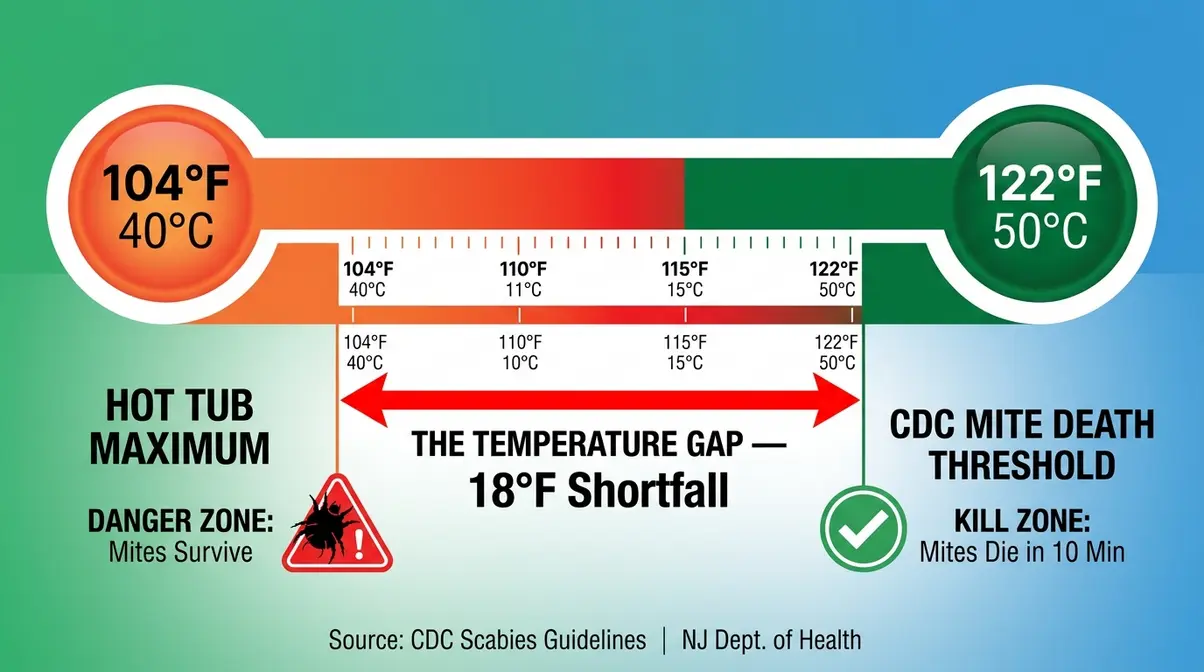
Furthermore, even if a hot tub could somehow reach 122°F, the water still cannot penetrate the skin layers where mites burrow. The thermal death threshold applies to mites on fabric surfaces — laundry, bedding — not to mites living inside living skin tissue. The skin itself acts as an insulating barrier.
The Temperature Gap — the 18°F shortfall between what a hot tub can deliver (104°F) and what science requires to kill scabies mites (122°F) — renders all hot-water home remedies equally ineffective.
Can Hot Showers Kill Scabies Either?
Hot showers face the same problem, compounded. A shower reaches approximately 105–110°F at its hottest — still below the 122°F threshold. More importantly, shower water is in contact with your skin for seconds per area, not the sustained 10 minutes required for thermal mite death.
According to the Virginia Department of Health’s scabies fact sheet, no topical water-based remedy — hot or cold — has been shown to eradicate scabies. The mites are simply not reachable by surface water. A hot shower may temporarily reduce surface skin debris, but it does nothing to the mites tunneling beneath.
There is also a compounding harm: a 2021 review published in PubMed Central found that hot water intensified itching in 67% of scabies patients. So a hot shower does not treat the infestation, and it is likely to worsen the symptom you most want to soothe.
Can You Get Scabies From a Hot Tub?
This is a separate but important question. Scabies is not transmitted through water. You cannot catch scabies by sitting in a hot tub that an infested person recently used.
MedlinePlus and the CDC both confirm that scabies requires prolonged, direct skin-to-skin contact — typically sustained contact lasting several minutes. Mites do not swim freely in water, and they die within 24 to 72 hours off a human host. In a hot tub’s chlorinated water, survival would be even shorter.
However, if you have active scabies, you should avoid hot tubs for two reasons. First, the heat will worsen your itching. Second, if the tub’s surfaces — towels, seating areas — come into prolonged skin contact with another person shortly after your use, a very small transmission risk exists through those surfaces (not the water itself). The safest approach is to complete treatment before using shared facilities.
Can scabies survive in a hot tub?
Scabies mites cannot survive long in hot tub water. Off a human host, mites die within 24 to 72 hours at room temperature, and the combination of hot water and chlorine would accelerate their death significantly. However, this does not mean a hot tub treats your scabies — the mites causing your infestation are inside your skin, not in the water. You will not “soak them out.” The hot tub’s heat also falls 18°F below the 122°F threshold required to kill mites on fabric surfaces. In short: the hot tub water is inhospitable to loose mites, but completely irrelevant to treating the mites already burrowed into your body.
Proven Medical Treatments for Scabies
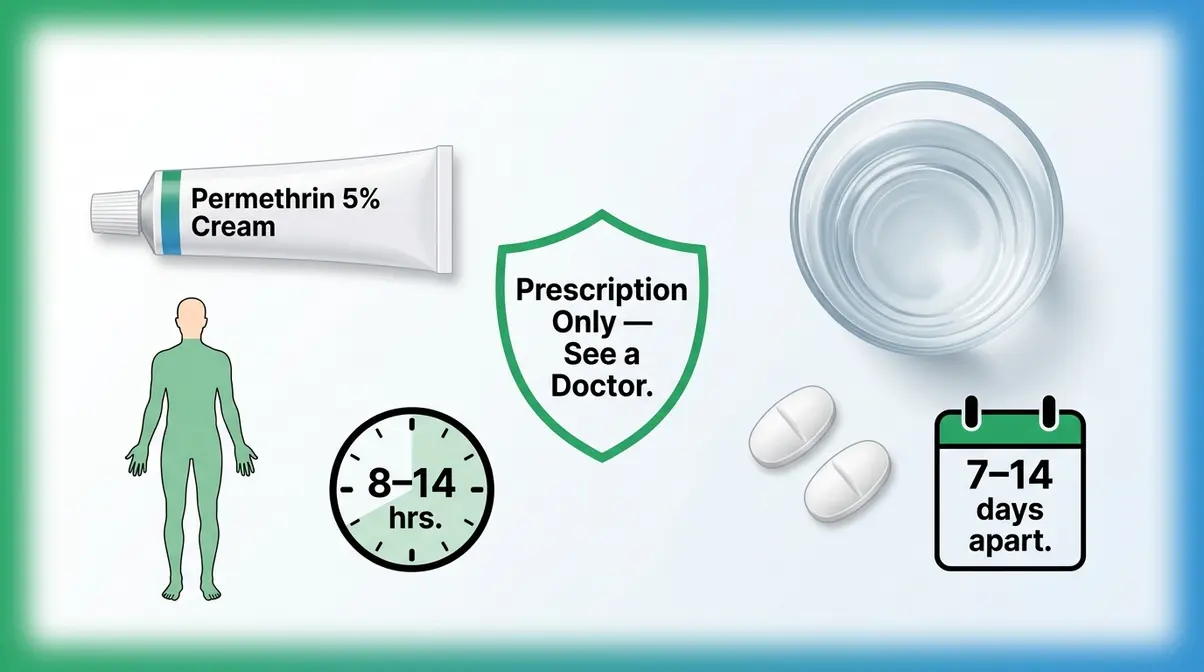
The only way to eliminate scabies is with prescription medication. Medical consensus among dermatologists is clear: no over-the-counter product, home remedy, or environmental treatment — including hot water — has been approved or proven to cure scabies. According to the CDC, “no non-prescription products have been tested and approved to treat scabies.” You need a doctor.
What kills scabies immediately?
No treatment kills scabies instantly, but prescription permethrin 5% cream is the fastest-acting first-line option. Applied from neck to toes and left on for 8 to 14 hours, permethrin begins killing mites on contact. A second application 7 to 14 days later ensures eggs that hatched after the first treatment are also eliminated. Oral ivermectin works similarly but via the bloodstream. According to CDC clinical care guidance, both medications have comparable efficacy for classic scabies. Itching may persist for 2 to 4 weeks after successful treatment — this is a normal immune response, not treatment failure.
Prescription Scabies Medications
Two prescription medications are the established first-line treatments for scabies. Both are scabicides (medications designed to kill scabies mites).
Permethrin 5% cream is the most commonly prescribed first-line treatment. It is a topical cream applied from the neck down to the soles of the feet, left on for 8 to 14 hours, then washed off. A second application is typically recommended 7 to 14 days later. According to the CDC’s clinical care guidelines, permethrin is FDA-approved for scabies in individuals at least 2 months old. A 2026 study published in the BMJ found that applying permethrin directly to the skin showed strong cure rates for classic scabies.
Oral ivermectin is a pill-based alternative with similar efficacy to permethrin for classic scabies, according to CDC guidance. It is prescribed as two doses taken 7 to 14 days apart (200 µg/kg per dose). Ivermectin is not FDA-approved specifically for scabies, but it is widely used off-label and is recommended by the CDC, especially for cases where topical treatment is difficult or for crusted (severe) scabies, where combination therapy is required.
| Medication | Type | Application | Doses | FDA-Approved for Scabies |
|---|---|---|---|---|
| Permethrin 5% cream | Topical | Neck to toes, 8–14 hrs | 2 (7–14 days apart) | Yes (2+ months old) |
| Oral ivermectin | Oral | Taken by mouth | 2 (7–14 days apart) | Off-label |
| Sulfur ointment (5–10%) | Topical | Full body | Multiple nights | Yes (infants/special cases) |
Important: All close contacts and household members must be treated at the same time, even if they show no symptoms. If you treat yourself but not your household, reinfection is highly likely.
According to Harvard Health, itching may continue for 2 to 4 weeks after successful treatment. This is a normal allergic reaction to dead mite proteins — it does not mean treatment failed. If new burrows appear after 4 weeks, contact your doctor.
How to Soothe Scabies Itching
While prescription medication works, your body needs time to clear the allergic reaction. The itching can persist for weeks — and that is normal. However, you can soothe symptoms without making the infestation worse. Applying a gentle, fragrance-free moisturizer can also help repair the skin barrier, which is often compromised by both the mites and the intense scratching.
Use cool or lukewarm water — not hot. As confirmed by Healthdirect Australia’s scabies guidance, itching is typically worse after a hot bath or shower. Cool water reduces vasodilation (the widening of blood vessels) and calms the allergic response rather than amplifying it.
Additional symptom-relief options supported by Harvard Health include:
- Calamine lotion applied to itchy areas to soothe the skin surface
- Oral antihistamines such as diphenhydramine (Benadryl) — particularly helpful at night when itching is worst
- Hydrocortisone cream (1%) for localized inflammation — ask your doctor before using alongside permethrin
- Trimmed fingernails to prevent skin damage from scratching, which can introduce secondary bacterial infection
Avoid harsh soaps, fragranced products, and anything that further irritates already-inflamed skin. The goal is to reduce the allergic response, not to treat the mites — that is your medication’s job.
5-Step Home Decontamination Guide
Home decontamination does not replace medication — but it is an essential second step. Mites can survive on fabric surfaces for 24 to 72 hours. If you treat yourself but sleep on contaminated bedding, reinfection is possible.
What you need: Access to a washing machine, a dryer, plastic bags, and a vacuum. Budget approximately 2 to 3 hours for this process.
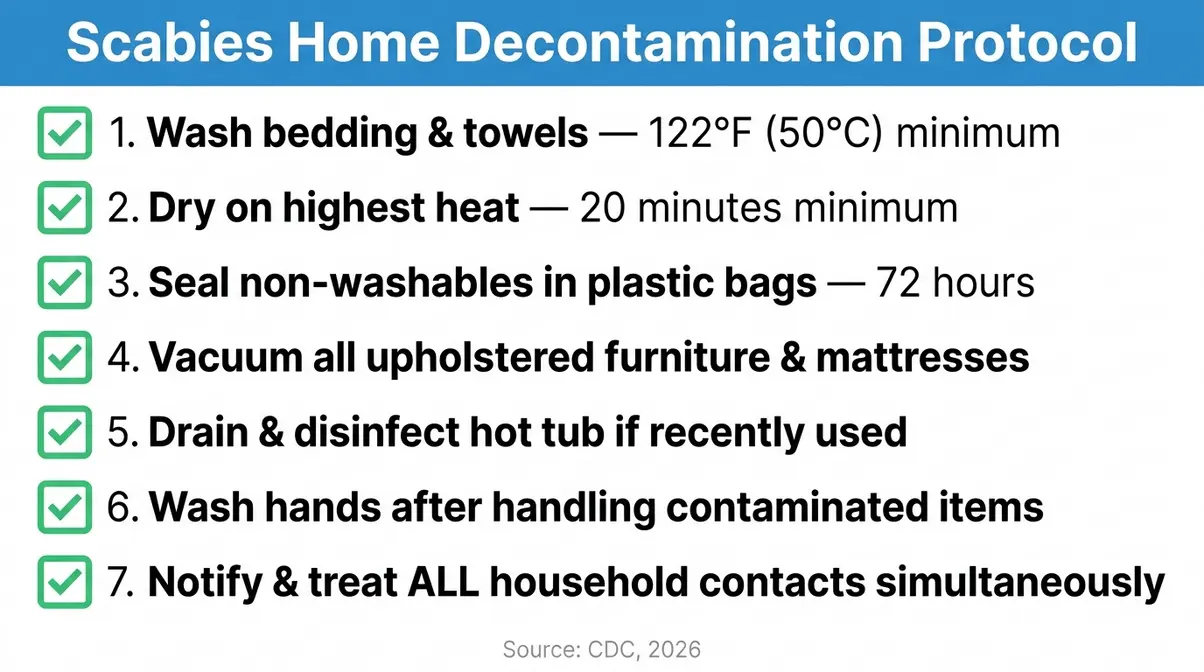
Step 1: Wash all clothing and bedding in hot water (122°F / 50°C or hotter). (~30–60 minutes)
Wash all clothing, bed linens, pillowcases, towels, and any fabric worn or slept on in the 3 days before your treatment date. The water temperature must reach at least 122°F to kill mites and eggs, as confirmed by the CDC’s public health strategy for scabies. Many home washing machines reach this temperature on a “sanitize” or “hot” setting — check your machine’s manual. Why this matters: washing at lower temperatures leaves mites alive in fabric.
Step 2: Dry everything on high heat for at least 20 minutes. (~20–40 minutes)
The dryer’s heat reinforces the kill. According to the Michigan DHHS Scabies Prevention and Control Manual, hot-water washing followed by high-heat drying is the recommended protocol for eliminating mites from fabric. Do not air-dry items that have been washed for scabies decontamination.
Step 3: Seal non-washable items in a plastic bag for at least 72 hours. (~10 minutes to bag; 72-hour wait)
Stuffed animals, throw pillows, shoes, and other items that cannot be machine-washed should be sealed in a tied plastic bag. Mites die within 24 to 72 hours off a human host. Keeping items bagged for a full 72 hours eliminates the risk. Do not open the bag until the waiting period is complete.
Step 4: Vacuum all upholstered furniture, carpets, and mattresses. (~20–30 minutes)
Vacuum the entire home — sofas, chairs, rugs, and mattresses — on the day you start treatment. Dispose of the vacuum bag immediately after. You do not need to throw out your mattress; the CDC confirms this is unnecessary in most cases. Routine vacuuming is sufficient.
Step 5: Treat all household members and close contacts simultaneously. (same day as your treatment)
This is the most critical step of all. The American Academy of Dermatology recommends that all household members and sexual partners be treated on the same day, regardless of whether they have symptoms. Untreated contacts are the most common source of reinfection.
When Hot Tubs Can Actually Make Scabies Worse
Beyond simply failing to kill mites, hot tubs actively worsen scabies in two measurable ways. Understanding this helps you avoid a common mistake that prolongs suffering.
Hot water intensifies itching. Research is clear on this point. A 2021 clinical review published in PubMed Central (“Itch in Scabies — What Do We Know?”) found that hot water increased itch intensity in 67% of scabies patients, and sweating worsened itching in 73%. The mechanism involves heat-driven vasodilation — blood vessels widen, increasing blood flow to already-inflamed skin, which amplifies the histamine-mediated allergic reaction causing the itch. You step out of the hot tub feeling worse than when you got in.
Hot tub chemicals may further irritate broken skin. Chlorine and bromine, used to sanitize hot tubs, are skin irritants. When your skin is already inflamed and potentially broken from scratching, these chemicals can cause additional stinging, redness, and irritation. This does not treat scabies — it adds a new layer of discomfort on top of an existing infestation.
Additionally, the Penn Medicine scabies overview notes that any activity that causes sweating or skin overheating can trigger significant itch flares in people with active scabies. A hot tub delivers exactly this combination: heat, moisture, and prolonged exposure.
The practical takeaway is straightforward. Avoid hot tubs, hot baths, and hot showers until your treatment is complete. Use cool or lukewarm water instead. This will not cure you — only prescription medication does that — but it will prevent you from needlessly amplifying your symptoms during the treatment period.
Frequently Asked Questions About Scabies
What draws scabies out of the skin?
Nothing “draws” scabies mites out of the skin — they burrow in and stay there until treated with a prescription scabicide. Mites emerge naturally only to mate or spread to a new host. No topical remedy, essential oil, or heat treatment forces them to the surface. The only way to eliminate them is with prescription permethrin cream or oral ivermectin, which penetrate the skin and kill mites and eggs in their tunnels. Trying to “draw them out” delays effective treatment and allows the infestation to spread.
Historical Scabies Treatments
Historically, sulfur ointment (5–10%) was the primary treatment for scabies before modern scabicides were developed. Sulfur-based preparations have been used for centuries and remain a recognized treatment option today — the WHO lists 5–10% sulfur ointment among approved topical treatments. Before sulfur became standard, tar preparations and benzyl benzoate emulsion were also used. Sulfur ointment is still prescribed today for infants and in cases where permethrin or ivermectin cannot be used, though it has a strong odor and can irritate skin.
Can I swim in a pool with scabies?
Scabies is not transmitted through pool water, so you are unlikely to infect others by swimming. The CDC and MedlinePlus confirm that scabies requires prolonged skin-to-skin contact to spread — not water exposure. However, sharing towels, pool toys, or having prolonged physical contact with others at the pool does carry a transmission risk. More practically, pool water and sun exposure may worsen your itching. It is advisable to avoid public pools until your treatment is complete and symptoms have resolved, as a courtesy to others and for your own comfort.
Can hot baths get rid of scabies?
No — hot baths cannot get rid of scabies. The water temperature of a hot bath (typically 100–110°F) falls well below the 122°F threshold required to kill mites, according to CDC guidance. Even at the correct temperature, bath water cannot penetrate the skin layers where mites burrow. Furthermore, hot water worsens scabies itching in the majority of patients, according to a 2021 PubMed Central review. Cool or lukewarm baths may provide temporary itch relief, but they do not treat the infestation. Only prescription scabicides eliminate the mites.
What STD is caused by a tiny mite?
Scabies is not technically a sexually transmitted disease (STD), but it is sometimes classified alongside STDs because it can spread through sexual contact. The causative organism is Sarcoptes scabiei var. hominis — a mite, not a bacterium or virus. Scabies spreads through any prolonged skin-to-skin contact, including but not limited to sexual activity. The CDC lists sexual partners as priority contacts for simultaneous treatment. Unlike true STDs, scabies can also spread through shared bedding, clothing, or household contact — it is fundamentally a contact infestation, not a sexually transmitted infection. While evaluating hot tub health risks and disease transmission myths, it helps to understand these classifications.
Which celebrities have had scabies?
Scabies affects people of all backgrounds and social statuses — including celebrities, though most cases are not publicly disclosed. The Irish Health Protection Surveillance Centre explicitly states that scabies “is not caused by poor hygiene” and can affect anyone. Specific celebrity cases are rarely confirmed publicly, as scabies carries a social stigma it does not deserve. What matters medically is that anyone who has prolonged skin contact with an infested person — regardless of wealth, cleanliness, or status — is at risk. Scabies is a medical condition, not a reflection of personal hygiene.
Getting Better Starts With the Right Treatment
For anyone dealing with scabies, the core reality is this: if you are wondering do hot tubs kill scabies, the definitive answer is no. Hot tubs, hot baths, and hot showers cannot kill the mites causing your infestation. The Temperature Gap — the 18°F shortfall between what hot water can deliver and what science requires to kill Sarcoptes scabiei — means every minute spent in a hot tub is a minute lost from effective treatment. According to CDC guidance, only temperatures above 122°F sustained for 10 minutes kill mites, and that threshold applies to laundry and surfaces — not to mites already burrowed inside living skin.
The Temperature Gap framework matters because it explains all hot-water home remedies in one principle. Whether it is a shower, a bath, or a hot tub, the physics are identical: not hot enough, and unable to reach where the mites actually live. Recognizing this helps you move past ineffective remedies and toward the only approach that works.
Contact a dermatologist or your primary care physician today and ask specifically about permethrin 5% cream or oral ivermectin. Treat all household members on the same day. Run your bedding and clothing through a hot wash cycle at 122°F or above. Within 4 weeks of completing treatment correctly, the infestation can be resolved — and the nightmare can be behind you for good. Remember that while the itching is incredibly frustrating, scabies is a highly treatable condition when approached with the right medical guidance. Focus your energy on proven eradication methods rather than ineffective heat treatments.

David King
Hot tub tester and writer at One Hot Tub.