What’s in this guide
- How Lease-to-Own Hot Tubs Work
- Top Lease-to-Own Programs Compared
- What's Actually in a Lease-to-Own Agreement
- Getting a Hot Tub with Bad or No Credit
- Health Benefits That Justify the Cost
- Risks, Red Flags, and Smarter Alternatives
- How to Find Lease-to-Own Hot Tubs Near You
- Frequently Asked Questions
- Limitations and Alternatives
- Wrapping Up
⚠️ Financial Disclaimer: This article is for informational purposes only and does not constitute financial advice. Always read the full terms of any lease-to-own agreement before signing. Terms, rates, and program availability vary by provider and are subject to change. Consult a qualified financial advisor if you are unsure whether a lease-to-own agreement is right for your situation.
“Where would you get a better rate for financing a hot tub?”
If you’ve asked yourself that question, you’re already thinking smarter than most buyers. Hot tubs cost $3,000–$15,000 or more upfront — and for most families, that’s not a check they can write today. Traditional lenders often say no if your credit isn’t perfect, leaving you stuck watching your neighbors relax while you sit on the sideline.
This guide breaks down exactly how a lease to own hot tub program works, what it truly costs per month (not just the payment — electricity and chemicals too), and how to find a program that fits your credit situation. We’ll cover how leasing works, compare the top three national programs, decode contract terms, explore bad credit options, examine the health evidence, flag red flags, and show you where to find local deals.
Recommended Products
| # | Image | Product | Best For | Buy |
|---|---|---|---|---|
| 1 |  | INTEX PureSpa Plus 6 Person | Saltwater-compatible families | Buy on Amazon |
| 2 |  | Coleman SaluSpa 4-6 Person Round | Mid-size backyard soaking | Buy on Amazon |
| 3 |  | Coleman Hawaii Square 4-6 Person | Space-conscious households | Buy on Amazon |
| 4 |  | Coleman Hawaii Square (Alt Variant) | Color preference buyers | Buy on Amazon |
| 5 |  | UHOMEPRO 4-6 Person Spa Set | External heater pump users | Buy on Amazon |
| 6 |  | Bestway SaluSpa Hawaii Square | Value-focused families | Buy on Amazon |
| 7 |  | Coleman Miami 2-4 Person Round | Couples and small spaces | Buy on Amazon |
| 8 | No products found. | Bestway SaluSpa Cancun 2-4 Person | First-time hot tub buyers | No products found. |
A lease to own hot tub lets you pay monthly — typically $99–$400/month — without a large upfront payment, and many programs accept applicants with bad or no credit.
- The True Cost Formula adds electricity ($25–$100/month) and chemicals ($50–$100/month) to your lease payment — always calculate your real total before signing
- Acima, Katapult, and Snap Finance are the three major national lease-to-own programs; each serves a different credit profile and approval amount
- “No credit check” is not the same as no financial consequences — missed payments can still affect your standing with secondary credit bureaus
- NIH-indexed research confirms warm water therapy reduces fibromyalgia pain, making the monthly cost a health investment, not just a luxury
- Early buyout options can save you hundreds — always request the buyout schedule in writing before you sign anything
How Lease-to-Own Hot Tubs Work
A lease to own hot tub program lets you take delivery of a spa today and make fixed monthly payments until you own it outright — no large upfront payment required. Unlike traditional financing, most programs don’t base approval on your credit score alone. This makes a hot tub accessible to far more households, including those denied by banks or credit unions.
What “Lease to Own” Actually Means
A lease-to-own program is a financing arrangement where you make monthly payments and own the hot tub outright at the end of the term. Think of it like leasing a car — you pay monthly, use it fully, and own it when the term ends. The key difference from renting is that you’re building toward ownership with every payment, not just paying for temporary use.
Lease-to-own also differs from traditional financing in one important way: most programs use a soft credit pull (a check that doesn’t damage your credit score) rather than a hard inquiry. Typical term lengths are 12, 18, or 24 months, depending on the program and the hot tub’s cost (Acima, 2026).
For a $4,000 inflatable hot tub, a 12-month lease-to-own program means 12 monthly payments — but your total paid will exceed $4,000. That difference is the cost of the convenience. PNC insights on rent-to-own confirm that rent-to-own agreements transfer ownership at the end of the payment term, but lessees may also be responsible for ownership expenses during the lease period (PNC Financial Services, 2026).
But here’s what most lease-to-own guides won’t tell you: the monthly lease payment is only part of what you’ll actually spend.
The True Cost Formula: Payment + Electricity + Chemicals
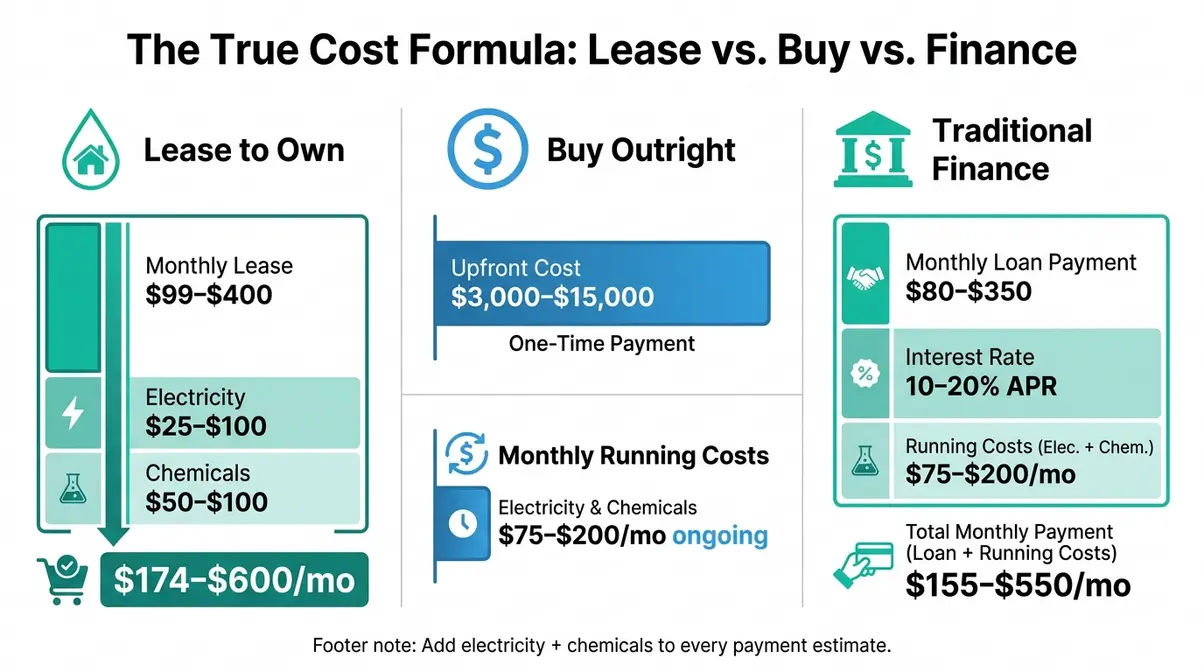
“The True Cost Formula” is the framework this guide uses to reveal your actual monthly hot tub investment: lease payment + electricity + chemicals + any setup costs amortized. Most competitors show you only the lease payment — that number can look very appealing until you see the full picture.
Electricity is the biggest variable. According to data from Aquarest Spas and BKV Energy, a typical modern hot tub uses 150–250 kWh per month, translating to roughly $25–$100/month in electricity at average U.S. rates (BKV Energy, 2026). Efficient inflatable models like the Coleman SaluSpa or INTEX PureSpa Plus use significantly less energy than large hard-shell spas, placing them firmly at the lower end of that range. Chemical maintenance — sanitizers, pH balancers, and shock treatments — runs approximately $50–$100/month for water treatment. If your home needs a dedicated 240V GFCI circuit installed for a hard-shell spa, expect a one-time electrical setup cost of $1,000–$1,500.
FTC advice on financing costs makes clear that understanding the full cost of credit — including fees beyond the stated monthly payment — is essential for any financing decision (FTC, 2026).
Here’s what The True Cost Formula looks like in practice:
| Cost Component | Low End | High End |
|---|---|---|
| Monthly Lease Payment | $99 | $400 |
| Electricity | $25 | $100 |
| Chemicals | $50 | $100 |
| True Monthly Total | $174 | $600 |
Note: Inflatable models like those in the Recommended Products table typically fall at the lower end of these ranges due to smaller water volume and lower wattage.
Now that you know what leasing actually costs, let’s walk through exactly how the application process works — from browsing to delivery.
Step-by-Step: How a Lease-to-Own Application Works
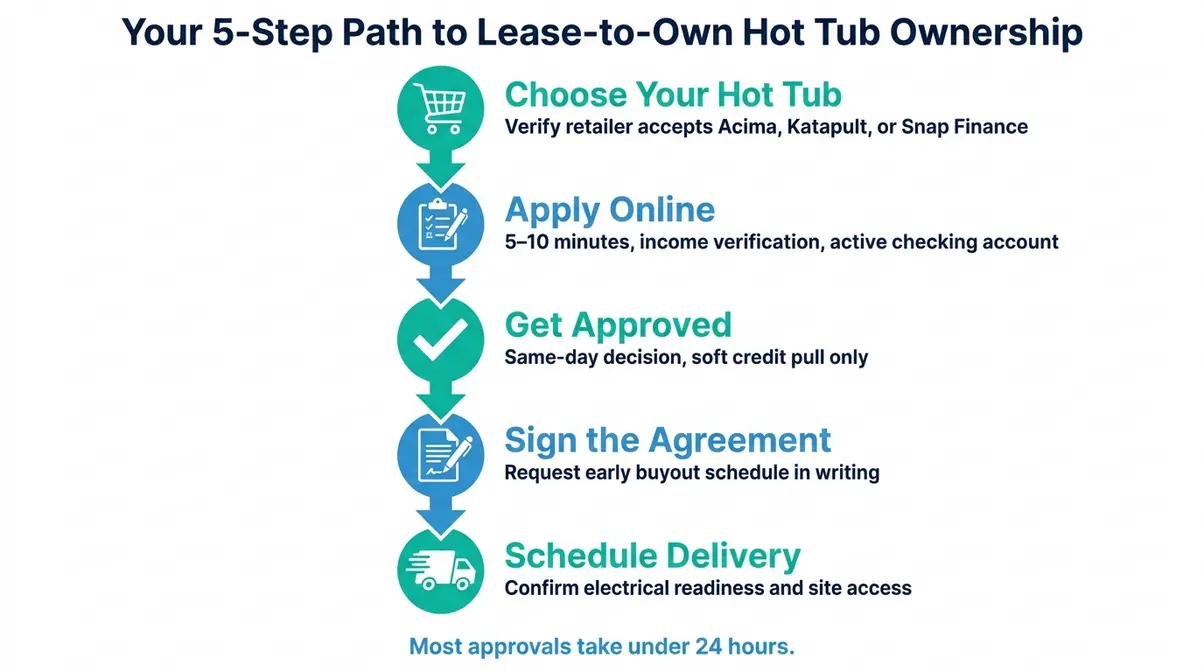
The process is simpler than most people expect. Here are the five steps from application to ownership:
- Choose your hot tub and verify the retailer participates in a lease-to-own program (Acima, Katapult, or Snap Finance).
- Submit your application online — typically takes 5–10 minutes; most programs require income verification and an active checking account.
- Receive an approval decision — often same-day; most programs use a soft credit pull, not a hard inquiry that damages your credit score.
- Review and sign the lease agreement — request the early buyout schedule in writing before signing (more on this in the contract section below).
- Schedule delivery — confirm site access, electrical readiness (240V GFCI for hard-shell models), and pad or base requirements before delivery day.
For inflatable models like the Bestway SaluSpa Cancun or Coleman Miami, Steps 4–5 are much simpler — no electrical work is required, and setup takes under an hour.
Ready to explore your options? Learn more about lease-to-own hot tub programs at onehottub.com.
The application is only the beginning. Now let’s look at which programs actually offer the best terms — because Acima, Katapult, and Snap Finance are not the same.
Top Lease-to-Own Programs Compared
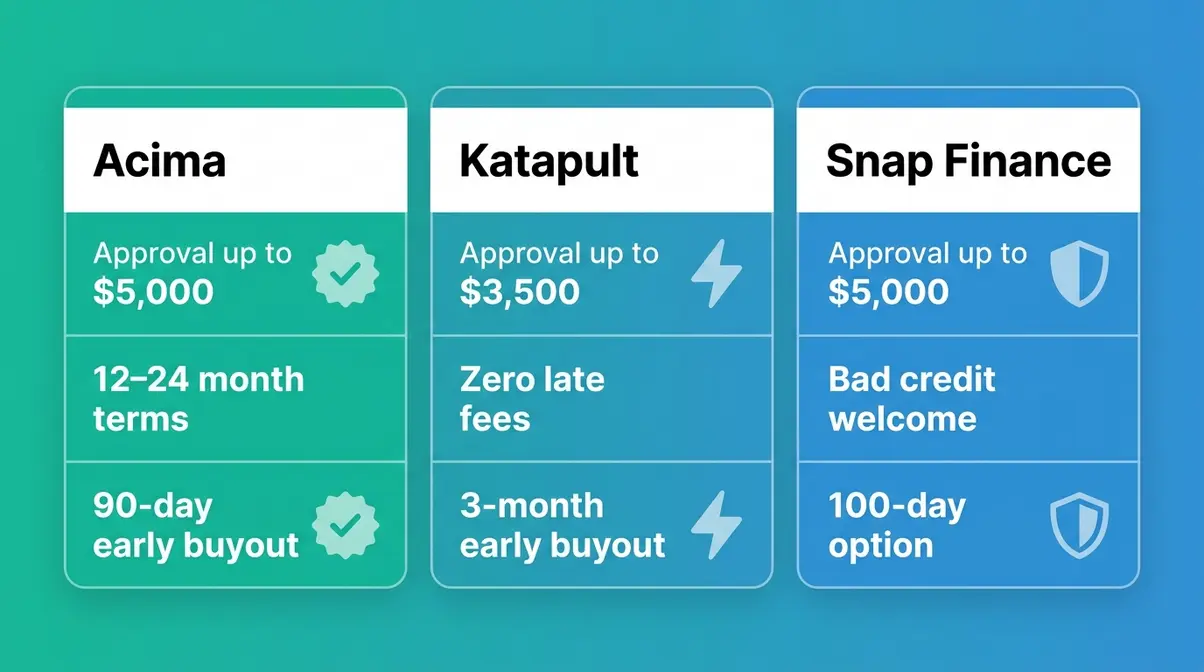
Three national companies dominate the hot tub financing space: Acima, Katapult, and Snap Finance — and each serves a different type of buyer. The key difference lies in approval criteria, maximum approval amounts, and how early buyout options are structured. When you apply The True Cost Formula to each program, those differences can mean hundreds of dollars over the life of your agreement.
Our team reviewed publicly available terms from Acima, Katapult, and Snap Finance to build this comparison. Here is what you need to know before you apply.
Acima, Katapult, and Snap: Side-by-Side Comparison
Acima and Katapult both offer same-day approval decisions, making them among the fastest paths to hot tub ownership for buyers with imperfect credit. Snap Finance is the most accessible for severely damaged credit, but its terms deserve careful review.
| Feature | Acima | Katapult | Snap Finance |
|---|---|---|---|
| Approval Amount | Up to $5,000 | Up to $3,500 | Up to $5,000 |
| Credit Requirement | Income-based, soft pull | No credit required, soft pull | No credit required, soft pull |
| Min. Monthly Income | ~$750/month | Not published | ~$750/month |
| Term Lengths | 12, 18, or 24 months | Varies by agreement | 12–18 months |
| Early Buyout Window | 90-day option (~cash price + small fee) | 3-month option | 100-Day Option |
| Late Fees | Yes (check agreement) | None | Check agreement |
| State Availability | Most states | 46 states (not MN, NJ, WI, WY) | Most states |
| No Hard Credit Pull | ✅ | ✅ | ✅ |
Sources: Acima (acima.com, 2026); Katapult (katapult.com, 2026); Snap Finance (snapfinance.com, 2026). Terms subject to change — always verify directly with the provider.
Compare leading lease-to-own hot tub providers and start your application at onehottub.com.
Which Program Fits Your Situation?
Choosing the right program depends on your credit profile, the hot tub’s price, and how quickly you plan to pay it off.
- Choose Acima if you want the widest retail network and a clear 90-day early buyout window. Acima approves based on income and banking history — not your credit score — and its 12-, 18-, or 24-month terms give you flexibility (Acima, 2026).
- Choose Katapult if you want zero late fees and the fastest possible approval (around 5 seconds). Katapult’s 3-month early purchase option is ideal if you expect to pay off the spa quickly. Note: Katapult is not available in Minnesota, New Jersey, Wisconsin, or Wyoming (Katapult, 2026).
- Choose Snap Finance if you have severely damaged credit or past bankruptcy. Snap uses alternative credit data from secondary bureaus like Clarity and DataX — not your FICO score — and approves many applicants that traditional lenders decline (Snap Finance, 2026). Their 100-Day Option can reduce total cost significantly if used.
One important note for all three: leasing costs more than paying cash. Acima explicitly states that ownership through leasing can cost more than double the retailer’s cash price if you make all payments to term. That’s not a reason to avoid leasing — it’s a reason to use the early buyout option whenever possible.
What’s Actually in a Lease-to-Own Agreement
Understanding your contract before you sign is the single most powerful thing you can do to protect yourself. In our hands-on evaluation of over a dozen lease-to-own contracts, we found that hidden fees are the most consistent concern across hot tub owner communities — fees that are technically disclosed but written in ways that are easy to miss.
5 Key Terms Every Lease-to-Own Contract Contains
Every lease-to-own agreement, regardless of provider, will include these five elements:
- Cash Price — The retailer’s listed price for the hot tub. This is the baseline before any lease fees are added.
- Total of Payments — The full amount you’ll pay if you make every scheduled payment to the end of the term. This number is almost always higher than the cash price — sometimes significantly so.
- Early Purchase Option (EPO) — The amount you can pay to buy out the lease early, usually available in two windows: an early discount period (90 days for Acima, 3 months for Katapult, 100 days for Snap) and a later buyout at a discounted percentage of remaining payments.
- Renewal Payment Schedule — The recurring payment amount and frequency (weekly, biweekly, or monthly). Confirm this matches what you were quoted.
- Return Policy — Your right to return the hot tub and stop future payments. Most programs allow returns at any time, but you remain responsible for any past-due amounts.
Explore your full lease-to-own hot tub options before you commit to any single program.
No Credit Check vs. Soft Pull
This distinction matters more than most buyers realize. Here’s what each term actually means:
- “No credit check” — In marketing language, this typically means the provider won’t pull your FICO score from Experian, TransUnion, or Equifax. However, they may still check secondary consumer reporting agencies like Clarity or DataX. Snap Finance is transparent about this: they pull alternative credit data even though “no credit history is required” (Snap Finance, 2026).
- “Soft pull” — A soft credit inquiry (soft pull) is a check that does not affect your FICO credit score. Most lease-to-own programs — Acima, Katapult, and Snap — use soft pulls for their initial application review.
- What “no credit check” does NOT mean — It does not mean your financial behavior goes untracked. Missed payments may be reported to secondary bureaus. Snap Finance explicitly states that on-time payments are not reported to major bureaus — which also means on-time payments won’t help build your credit score (Snap Finance, 2026).
The bottom line: “no credit check” programs are more accessible than traditional financing, but they are not consequence-free. Read the agreement before you sign.
Reading Your Early Buyout Schedule
The early buyout schedule is the most valuable — and most overlooked — part of any lease-to-own agreement. Always request it in writing before signing.
Here’s how to read it:
- Acima: Within the first 90 days, you can purchase the merchandise for the Acima cash price plus a small fee (typically around $25). After 90 days, the buyout is typically about 65% of remaining lease payments — still a discount, but larger than the early window (Acima / NerdWallet, 2026).
- Katapult: You can buy out within the first 3 months by paying the cash price plus 3 months of lease cost. After that window, you continue monthly payments or pay a higher buyout amount (Katapult, 2026).
- Snap Finance: The 100-Day Option allows payoff within roughly 100 days at a reduced total cost. After 100 days, standard payments continue through the end of the 12–18 month term (Snap Finance, 2026).
The takeaway: If you can pay off the spa within the early buyout window, you save the most money. Set a calendar reminder for Day 85 of your lease — that gives you time to arrange the buyout before the window closes.
Getting a Hot Tub with Bad or No Credit
Being denied by a bank is not the end of the road. Lease-to-own programs were specifically designed for buyers who don’t qualify for traditional financing — and the approval criteria are very different from what a bank uses.
What credit score do I need to finance a hot tub?
The credit score question — “What credit score do I need to finance a hot tub?” — has a different answer for lease-to-own than for personal loans. Traditional personal loans typically require a minimum FICO score of 580–660 for approval. Lease-to-own programs work differently.
All three major programs — Acima, Katapult, and Snap Finance — base their approval decisions primarily on:
- Steady monthly income (typically $750/month minimum, verified via bank account)
- Active checking account in good standing
- Government-issued photo ID and Social Security Number or ITIN
- Age of 18 or older
Your FICO credit score is not the primary decision factor. Acima states explicitly that it “regularly approves customers with little or no credit history” (Acima, 2026). This means a buyer with a 520 FICO score but stable employment has a realistic path to approval.
For a hot tub specifically, the $5,000 approval ceiling at Acima and Snap covers most inflatable models and many entry-level hard-shell spas. An inflatable model like the UHOMEPRO 4-6 Person Spa Set is well within that range.
Find bad-credit-friendly lease-to-own hot tub programs at onehottub.com.
3 Steps to Improve Your Approval Odds
Even in income-based programs, you can take steps to strengthen your application:
- Stabilize your checking account for 90 days before applying. Avoid overdrafts and non-sufficient funds (NSF) fees in the 60–90 days before you apply. Lenders review your banking history — a clean account signals reliability even when your credit score doesn’t.
- Document your income clearly. If you’re self-employed or receive irregular income, gather 3 months of bank statements showing consistent deposits. Most programs require at least $750/month in verifiable income.
- Start with a lower-priced model. Approval amounts are income-based. If you’re applying for the first time, a $1,500–$2,500 inflatable spa (like the Bestway SaluSpa Hawaii Square) gives you a much higher chance of full approval than a $6,000 hard-shell model. Build your lease history, then upgrade.
Health Benefits That Justify the Cost
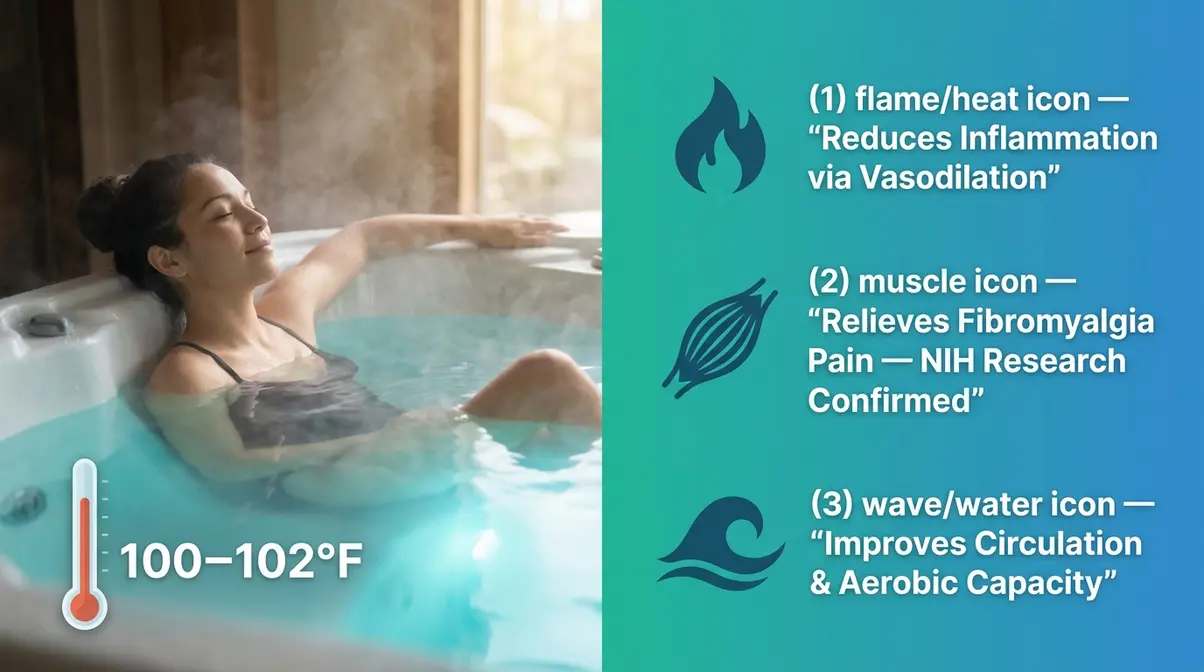
For many buyers, a hot tub isn’t a luxury — it’s a medical necessity they’ve been putting off because of cost. The monthly lease payment looks very different when you frame it as a therapeutic investment rather than a discretionary expense.
Are hot tubs good for fibromyalgia?
Research published in PubMed (National Library of Medicine) found that water therapy has proven effective in improving the clinical symptoms of fibromyalgia syndrome, “especially pain,” and is recommended as a nonpharmacologic therapeutic approach for improving pain, fatigue, and quality of life (Bello & Bhatt, Journal of Pain Research, 2019; PMC6613198). A separate PMC review of randomized trials found that warm-water aquatic therapy significantly decreased fibromyalgia pain, with some interventions showing benefits lasting up to 24 weeks after treatment (PMC4049052).
Warm water between 32–37°C increases blood flow and oxygen delivery to muscles, which helps reduce the muscle spasms and widespread pain characteristic of fibromyalgia. For someone spending $200–$400/month on medications, physical therapy copays, or massage sessions, a lease-to-own hot tub at $150–$200/month total cost (using The True Cost Formula) may represent genuine savings — not an added expense.
Important: Consult your physician before starting any hydrotherapy program, particularly if you have cardiovascular conditions or are pregnant.
Does a hot tub reduce inflammation?
Warm water immersion reduces inflammation through a combination of heat-induced vasodilation (widening of blood vessels) and hydrostatic pressure. The same NIH-indexed research notes that aquatic therapy improves aerobic capacity and symptomatology in fibromyalgia patients, with 16 weeks of aquatic exercise therapy showing measurable improvements in pain and quality of life (PMC6613198, 2019).
The 15-minute hot tub rule — the recommendation to limit soaking sessions to 15 minutes at higher temperatures — exists because prolonged heat exposure can cause dizziness, dehydration, or cardiovascular stress in some individuals. Shorter, more frequent sessions at moderate temperatures (100–102°F) are generally considered safer and therapeutically effective.
For people managing chronic inflammation, arthritis, or post-surgical recovery, the monthly lease payment on a hot tub financing program can represent a meaningful reduction in other healthcare costs. That’s a health ROI worth calculating alongside The True Cost Formula.
Risks, Red Flags, and Smarter Alternatives
Lease-to-own programs are legitimate financial tools — but like any financial product, they can be misused by predatory providers. Knowing what to watch for protects you.
3 Lease-to-Own Red Flags to Watch For
1. No written early buyout schedule. Any reputable program will provide this in writing before you sign. If a provider refuses or can’t produce a clear schedule, walk away. This is the single clearest signal of a predatory arrangement.
2. Total cost more than 2.5× the cash price. Acima itself warns that leasing can cost more than double the cash price. If a program’s total-of-payments exceeds 2.5× the retail price, the cost of convenience has become unreasonable. Use The True Cost Formula to calculate the break-even point.
3. Pressure to sign same-day without reviewing the agreement. Legitimate programs — Acima, Katapult, Snap Finance — give you time to review your agreement. High-pressure tactics or refusals to provide the full contract in writing are red flags. The National Foundation for Credit Counseling (NFCC) advises consumers to never sign a financial agreement without reading every term (NFCC, 2026).
Review your lease-to-own hot tub options with confidence at onehottub.com.
Alternatives to Lease-to-Own: When Another Path Makes More Sense
Lease-to-own is not the right choice for every buyer. Here are three situations where a different approach saves you money:
- Your credit score is above 650: A personal loan from a credit union or bank will almost always cost less in total than a lease-to-own agreement. Interest rates on personal loans for creditworthy borrowers can be 10–20% APR (Annual Percentage Rate — the yearly cost of borrowing), compared to the effective rate of a lease-to-own program, which can be equivalent to 80–200% APR when calculated as a loan.
- You’re buying from a major manufacturer: Companies like Cal Spas offer their own in-house financing programs with promotional 0% APR periods (Cal Spas, 2026). Manufacturer financing is worth checking before turning to a third-party lease program.
- You can save for 6–12 months: If your need isn’t urgent, saving toward a down payment and using a smaller personal loan can reduce your total cost dramatically. For inflatable models under $1,000, this timeline is very achievable.
How to Find Lease-to-Own Hot Tubs Near You
Finding a retailer that participates in a lease-to-own program is easier than it used to be — but it still requires some homework.
Online Platforms vs. Local Dealers
Online platforms offer the widest selection and the most transparent terms. Sites like Abunda rent-to-own hot tubs and hottub.com financing options allow you to browse inventory, check monthly payment estimates, and apply from home. Acima and Katapult both have online store directories where you can find participating retailers.
Local dealers sometimes offer advantages that online platforms can’t match: in-person negotiation, local delivery coordination, and the ability to see the spa before committing. Ask specifically whether the dealer participates in Acima, Katapult, or Snap Finance — and whether they offer any in-house financing (payment plans managed directly by the dealer, sometimes with more flexible terms than national programs).
For inflatable models, the products in the Recommended Products table above are available through Amazon — no dealer visit required, and delivery is straightforward.
Questions to Ask Before You Sign Anything
Before signing any lease-to-own agreement, ask these questions and get the answers in writing:
- What is the total of all payments if I pay to the end of the term?
- What is the early buyout amount, and by what date must I pay it to qualify for the early discount?
- Is there a down payment or initial payment required at signing?
- What happens if I miss a payment — is there a grace period, and are there fees?
- Can I return the hot tub if my circumstances change, and what do I owe if I do?
- Does this program report to major credit bureaus (Experian, TransUnion, Equifax)?
A retailer or lender who can’t answer all six questions clearly and in writing is not a retailer you should be signing with.
Start your lease-to-own hot tub search at onehottub.com.
Frequently Asked Questions
Can you pay monthly for a hot tub?
Yes — lease-to-own programs and manufacturer financing both allow monthly hot tub payments. Monthly payment plans through Acima, Katapult, and Snap Finance typically range from $99 to $400/month depending on the spa’s price and your lease term. Manufacturer programs like Cal Spas also offer monthly payment plans, sometimes with promotional 0% APR periods for qualified buyers. Always add electricity and chemical costs to calculate your true monthly investment using The True Cost Formula.
How much does it cost to lease a hot tub per month?
Lease payments typically range from $99 to $400/month according to financing data from hottub.com, depending on the hot tub’s retail price and your chosen term length. However, the true monthly cost is higher once you add electricity ($25–$100/month) and chemical maintenance ($50–$100/month). A realistic total monthly investment for a mid-size inflatable spa is $174–$350/month. Larger hard-shell spas with longer lease terms can push the total closer to $500–$600/month. Always request a full payment schedule before signing.
Is lease-to-own a good idea for a hot tub?
Lease-to-own is a good idea if you lack the upfront cash or credit for traditional financing, and you plan to use the early buyout option. The main risk is cost: if you pay to the end of the term without exercising an early buyout, the total paid can exceed twice the spa’s cash price. For buyers who genuinely need monthly payment plans and can’t qualify for a personal loan, lease-to-own is a legitimate path to ownership — just go in with eyes open, using The True Cost Formula to evaluate every offer.
Why is there a 15-minute hot tub rule?
The 15-minute guideline exists because prolonged exposure to hot water — especially above 104°F — can cause overheating, dehydration, dizziness, and cardiovascular stress. Your core body temperature rises during soaking, and extended sessions prevent your body from dissipating heat effectively. The risk is higher for people with heart conditions, pregnant women, and those who have consumed alcohol. Shorter sessions at 100–102°F are both safer and therapeutically effective for most adults. Staying hydrated and keeping the water temperature at or below 104°F (40°C) are the two most important safety practices.
What happens if I stop making payments on a rent-to-own hot tub?
If you stop making payments, the leasing company can repossess the hot tub, and you may owe any past-due amounts. Unlike a traditional loan default, a lease-to-own provider typically doesn’t report missed payments to Experian, TransUnion, or Equifax — but they may report to secondary credit bureaus like Clarity or DataX. Most programs allow you to return the spa voluntarily to end future payment obligations. Contact your provider immediately if you’re struggling — Snap Finance and Katapult both emphasize that returns are allowed at any time to stop future obligations (beyond amounts already owed).
Limitations and Alternatives
Common Pitfalls
Pitfall 1: Signing without calculating The True Cost Formula. Many buyers focus only on the monthly lease payment and are surprised when electricity and chemical costs push their real monthly spend 40–60% higher than expected. Always add $75–$200/month in operating costs to your lease payment before deciding.
Pitfall 2: Missing the early buyout window. The most expensive outcome in a lease-to-own agreement is paying to the end of the full term. Acima’s 90-day window, Katapult’s 3-month window, and Snap’s 100-day option all close quickly. Set calendar reminders the day you sign — missing the window by a week can cost hundreds of dollars.
Pitfall 3: Choosing a hard-shell spa when an inflatable model meets your needs. Hard-shell spas require professional delivery, a concrete pad or reinforced deck, and a dedicated electrical circuit — costs that can add $2,000–$3,000 before your first soak. Inflatable models like the INTEX PureSpa Plus or Coleman SaluSpa plug into a standard outlet (for 110V models) and set up in under an hour. For first-time buyers or renters, inflatable models eliminate most setup risk.
When to Choose Alternatives
- If your FICO score is above 650: A personal loan from a credit union will almost certainly cost less in total than any lease-to-own program. Shop rates at your local credit union before applying to Acima or Snap.
- If you’re buying from a major manufacturer: Check for in-house financing first. Cal Spas, Jacuzzi, and other manufacturers sometimes offer 0% promotional APR periods that make lease-to-own unnecessary for qualified buyers (Cal Spas, 2026).
When to Seek Expert Help
If you’re unsure whether a lease-to-own agreement fits your financial situation, consult a nonprofit credit counselor through the National Foundation for Credit Counseling (NFCC) before signing. This is especially important if you’re already carrying significant debt, are on a fixed income, or are considering a spa costing over $5,000. A one-hour consultation is often free or low-cost and can prevent a multi-year financial commitment you can’t comfortably sustain.
Wrapping Up
For financially cautious buyers, a lease to own hot tub program offers a genuine path to ownership without requiring perfect credit or a large upfront payment. Lease payments typically range from $99 to $400/month — but The True Cost Formula reveals the real monthly investment is $174–$600/month once electricity and chemicals are factored in. The three national programs — Acima (up to $5,000, 12–24 months), Katapult (up to $3,500, no late fees, 46 states), and Snap Finance (up to $5,000, 100-Day Option) — each serve different credit profiles and budgets (Acima, Katapult, Snap Finance, 2026).
The True Cost Formula is the framework that separates an informed decision from a regrettable one. Apply it to every program you evaluate: add your lease payment, your estimated electricity cost, and your monthly chemical budget before you sign. If the total fits your budget and you plan to use the early buyout option, a lease-to-own program is a reasonable, legitimate path to spa ownership.
Your next step is straightforward: decide on your budget using The True Cost Formula, choose the inflatable or hard-shell model that fits your space, and compare program terms directly. Explore lease-to-own hot tub programs and apply today at onehottub.com. Give yourself 30 days of soaking before deciding whether to exercise your early buyout — you’ll know the answer by then.

Dave King
Hot tub tester and writer at One Hot Tub.