
What’s in this guide
- What You'll Need Before You Start
- The 3-Tier Filter Care System
- How Often Should You Clean Your Hot Tub Filter?
- DIY & Home Remedy Methods
- Dishwasher and Washing Machine
- Tips for Specific Filter Types
- Filter Cleaning & Broader Routine
- Mistakes That Damage Your Filter
- Frequently Asked Questions
- Keep Your Filter Clean, Keep Your Water Clear
Home ›Maintenance And Troubleshooting
“Whats the best way to clean the filter please. We’ve used the tub once, 3 people and the filter is gross 🤮 i’ve tried cleaning it under the tap but it still looks dirty.”
Sound familiar? You’re not doing it wrong — a quick rinse under the tap almost never gets the job done. If you’ve been wondering how to clean hot tub filter cartridges effectively, you are in the right place.
A clogged filter doesn’t just look dirty. It forces your pump to work harder, shortens its lifespan, and lets bacteria multiply in water you’re sitting in (CDC hot tub maintenance guidelines). That’s not a minor inconvenience — it’s a real health and equipment risk.
In this guide, you’ll learn exactly how to clean a hot tub filter using three proven methods — matched to how dirty your filter actually is — so you can stop guessing and start soaking. We cover everything from a 5-minute weekly rinse to a 24-hour deep soak, plus the DIY hacks that actually work and the ones that quietly destroy your filter.



The 3-Tier Filter Care System gives every hot tub owner a clear, repeatable routine for how to clean a hot tub filter — weekly, monthly, and quarterly — using progressively deeper methods. The CDC recommends maintaining free chlorine at 3–10 ppm, which is only possible with a clean, functional filter (CDC, 2026).
- Weekly: Rinse with a garden hose — takes 5 minutes, prevents heavy buildup
- Monthly: Apply a chemical spray cleaner — dissolves oils and lotions in 20 minutes
- Quarterly: Soak in filter solution for 12–24 hours — the only method that truly resets a clogged filter
- Never use: Dishwasher, washing machine, bleach, or dish soap — all cause permanent damage
- Replace when: Pleats are frayed, cracked, or discoloured after cleaning — no cleaning method fixes a worn-out filter
What You’ll Need Before You Start
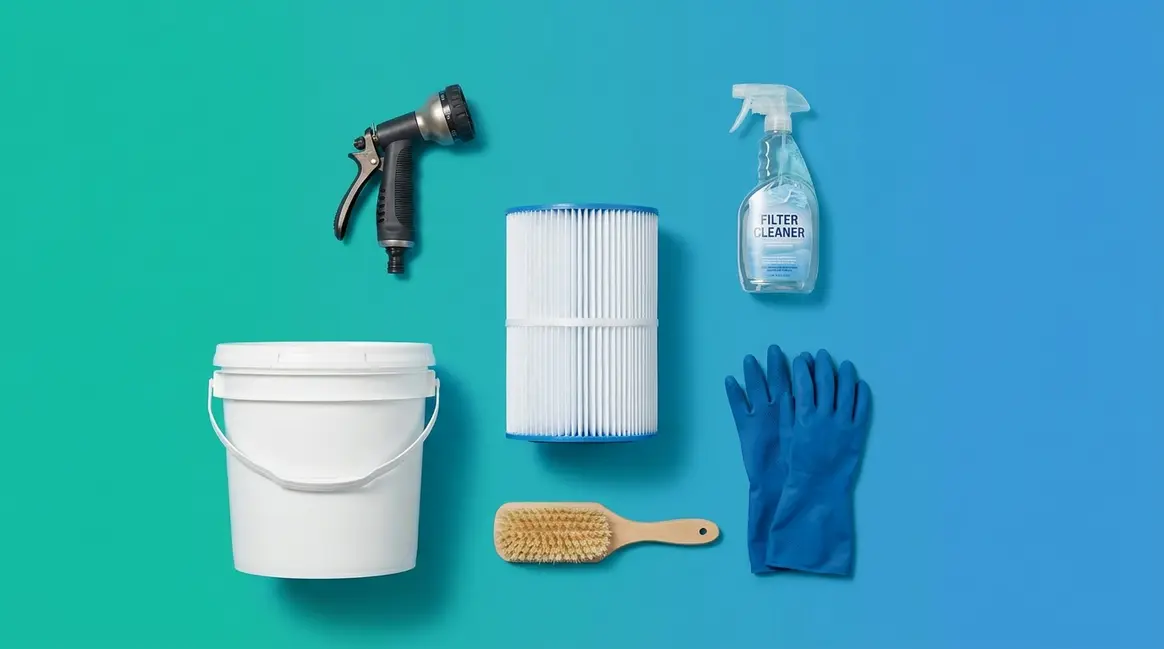
Before you figure out how to clean hot tub filter media, gather everything in one place. Stopping mid-clean to hunt for a bucket risks leaving the cartridge exposed to debris or drying out improperly. Here’s your full checklist:
- Garden hose with an adjustable nozzle (not a pressure washer — see the Mistakes section for why this damages pleats)
- Bucket large enough to fully submerge the filter cartridge
- Filter cleaning solution for quarterly soaking (e.g., Leisure Time Filter Clean, Pleatco PCCL-OR — look for products labelled “cartridge cleaner”)
- Spray-on filter cleaner for monthly cleaning (e.g., Natural Chemistry Filter Perfect, Spa Marvel Filter Cleaner)
- White vinegar (optional — for mineral scale only; see the DIY section)
- Rubber gloves — recommended when handling any chemical cleaner
- Safety first: Turn off your hot tub at the breaker before removing the filter — never handle it with the pump running
- Time budget: 5 minutes (weekly), 20 minutes (monthly), 12–24 hours (quarterly — plan ahead)
With your supplies ready, here’s how The 3-Tier Filter Care System works — and which method your filter needs right now.
The 3-Tier Filter Care System
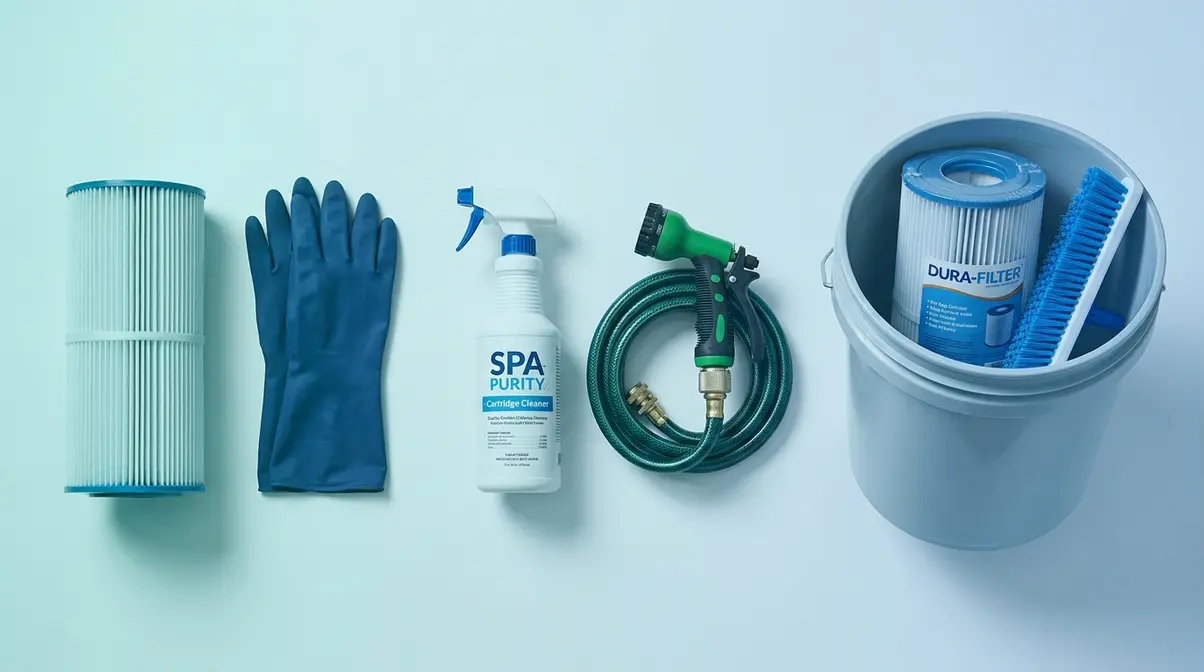
The 3-Tier Filter Care System works because it matches cleaning intensity to contamination level — not every dirty filter needs the same treatment. A rinse removes loose debris from the surface, but oils from sunscreen and body lotion, along with mineral scale from hard water, embed themselves deep in the pleats — the accordion-like folds in the filter fabric — where water pressure alone can’t reach them. Choosing the right tier for your filter’s actual condition is what separates a filter that “came out like new” from one that still looks dirty after cleaning.
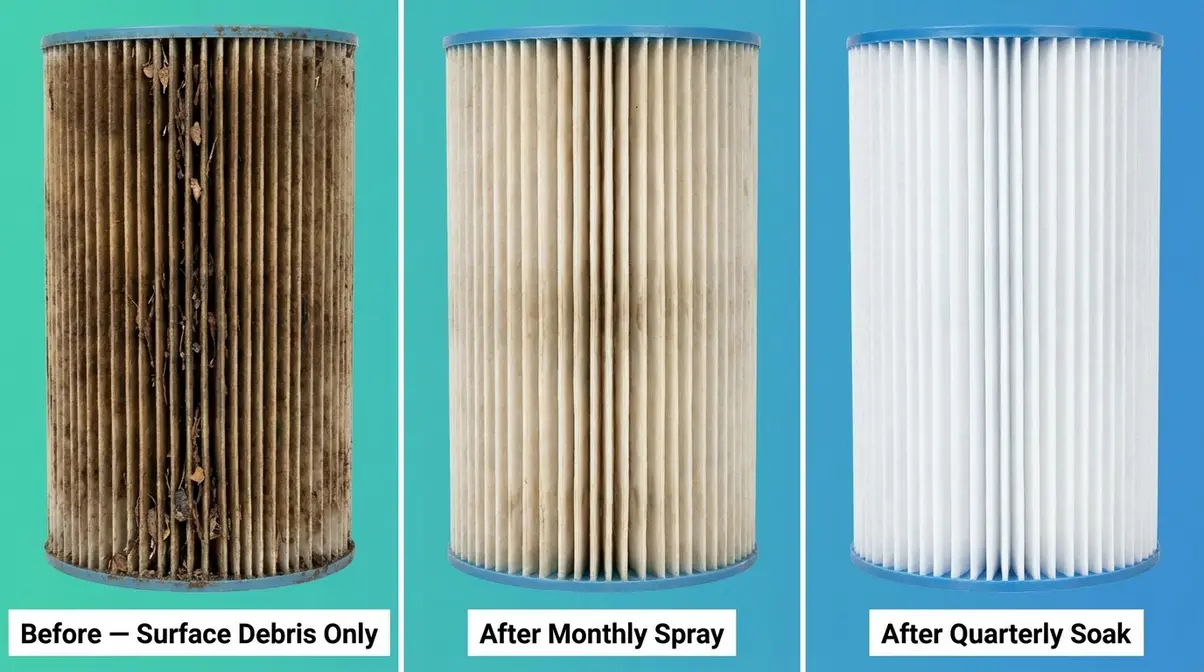
The CDC hot tub maintenance guidelines recommend maintaining free chlorine at 3–10 ppm and bromine at 4–8 ppm — levels only achievable with a clean, functioning filter (CDC, 2026). A filter clogged with oils and scale restricts flow, forces your sanitiser to work overtime, and ultimately fails to protect you.
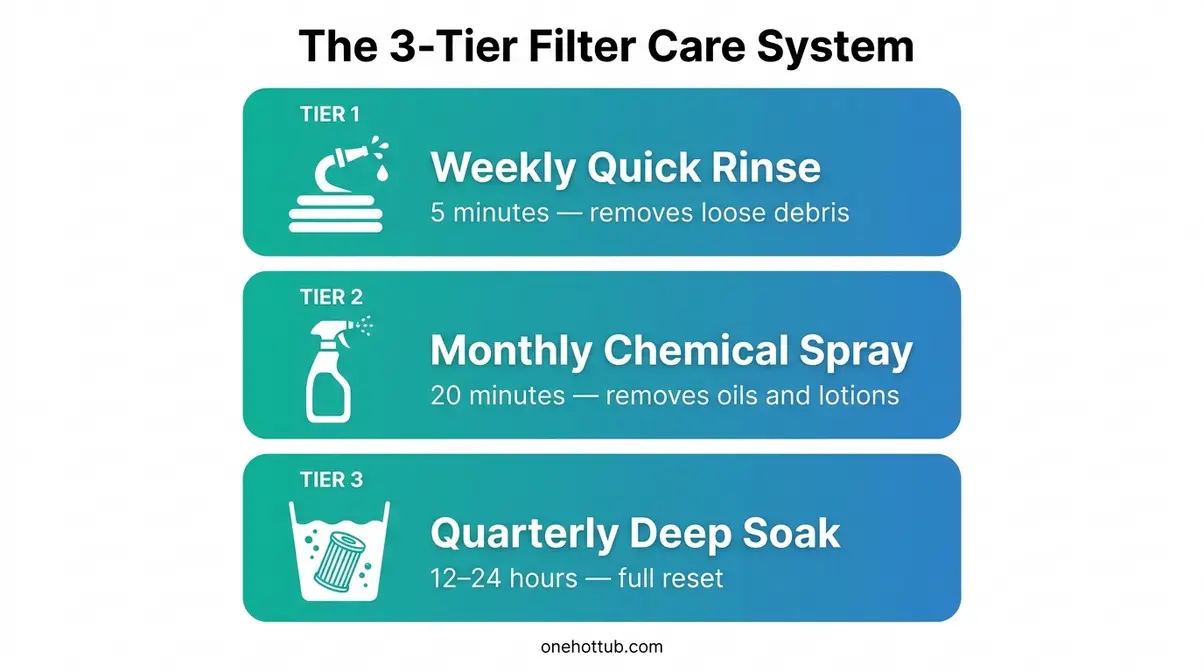
Method 1: Weekly Quick Rinse
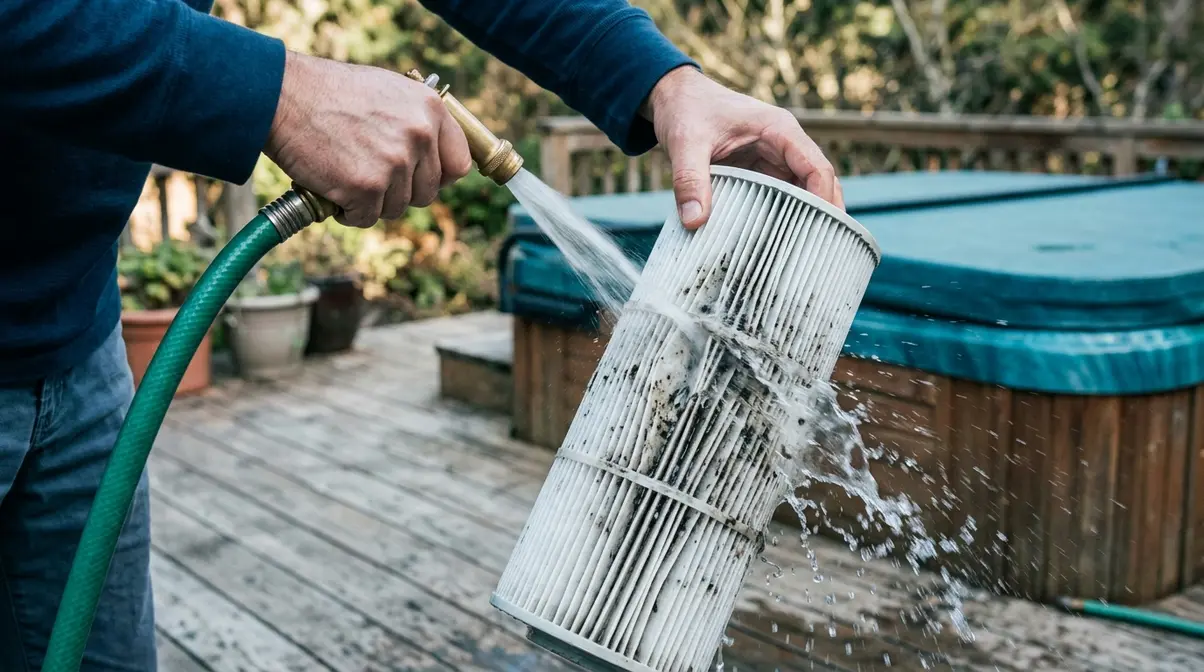
What it removes: Loose debris — hair, leaves, insects, and surface grime. It does not remove embedded oils or mineral scale.
Why it works: Physical water pressure dislodges particulate matter sitting on and between the pleats. Done weekly, it prevents light debris from compacting into the filter media and becoming harder to remove.
- Turn off the hot tub at the breaker or control panel. Never remove the filter with the pump running — you risk damaging the impeller.
- Remove the filter cartridge by twisting it counter-clockwise (most models) or unclipping the filter housing cover. Set it aside on a clean surface.
- Rinse from top to bottom using a garden hose on medium pressure — or, ideally, a Filter Flosser, a hose attachment designed to blast water between filter pleats at the correct angle. Hold the nozzle at roughly 45 degrees to the pleats, not directly perpendicular.
- Rotate as you go — work around the full circumference of the cartridge, not just the visible side.
- Rinse the filter core (the solid plastic tube at the centre) and end caps to remove any debris that has worked its way down.
- Inspect and reinstall — if the filter still looks discoloured after rinsing, move to Method 2. Otherwise, reinstall, restore power, and you’re done.
Our recommendation at onehottub.com: After evaluating multiple hose attachments across community feedback, the Filter Flosser consistently outperforms a standard nozzle for pleat cleaning — the angled jets reach between folds that a straight stream misses entirely.
Where Method 1 handles the surface, Method 2 goes deeper — targeting the oils and lotions that rinsing can never fully remove.
Method 2: Monthly Chemical Spray
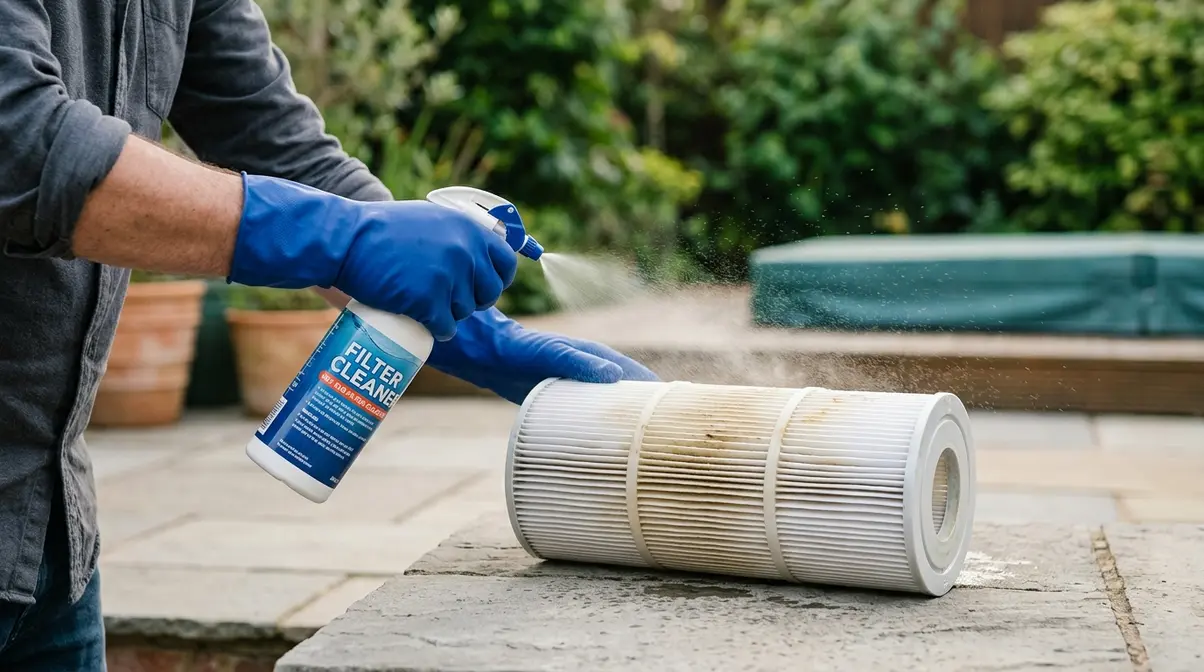
What it removes: Body oils, sunscreen, lotions, and light biofilm that have penetrated the outer layer of the filter media.
Why it works: Spray-on cartridge cleaners contain surfactants that chemically break down oil-based residues. Water alone can’t emulsify oils — it simply pushes them further into the pleats.
- Remove the filter cartridge as described in Method 1 (power off first).
- Rinse lightly with a garden hose first to remove loose surface debris — this makes the spray cleaner more effective.
- Apply spray cleaner generously to all surfaces of the filter, working it into the pleats. Products like Natural Chemistry Filter Perfect or Spa Marvel Filter Cleaner are well-regarded choices. Follow the product’s dwell time (typically 5–15 minutes).
- Let it soak in — do not rinse immediately. The cleaner needs contact time to break down oils. Lay the filter horizontally on a clean surface while it works.
- Rinse thoroughly from top to bottom with the garden hose until the water runs completely clear. Residual cleaner in the filter will foam in your hot tub.
- Inspect the pleats — they should look noticeably lighter and cleaner. If heavy discolouration remains, the filter needs a quarterly soak (Method 3), not another spray application.
Product note: The PHTA (Pool & Hot Tub Alliance) recommends using manufacturer-approved chemical cleaners rather than household alternatives for monthly maintenance — household products carry a higher risk of leaving residue that disrupts water chemistry (PHTA, 2026).
Method 2 handles oils efficiently. But for the embedded mineral scale and biofilm that builds up over months, only Method 3 delivers a true reset.
Method 3: Quarterly Deep Soak
What it removes: Embedded mineral scale, deep-seated biofilm, calcium deposits, and oils that monthly spraying hasn’t fully addressed.
Why it works: Soaking the cartridge overnight in a diluted filter cleaning solution gives the active ingredients time to penetrate the full depth of the filter media — something a 15-minute spray contact time simply cannot achieve. This is the tier that most owners skip, and it’s the reason filters still look dirty after repeated rinsing and spraying.
- Remove the filter cartridge (power off first) and rinse off loose debris with the garden hose.
- Fill a bucket large enough to fully submerge the filter. Use cold or lukewarm water — hot water can warp some filter cores.
- Add filter cleaning solution according to the product’s dilution instructions. Leisure Time Filter Clean and Pleatco PCCL-OR are both effective for overnight soaks. Do not substitute with bleach, dish soap, or dishwasher tablets — see the Mistakes section.
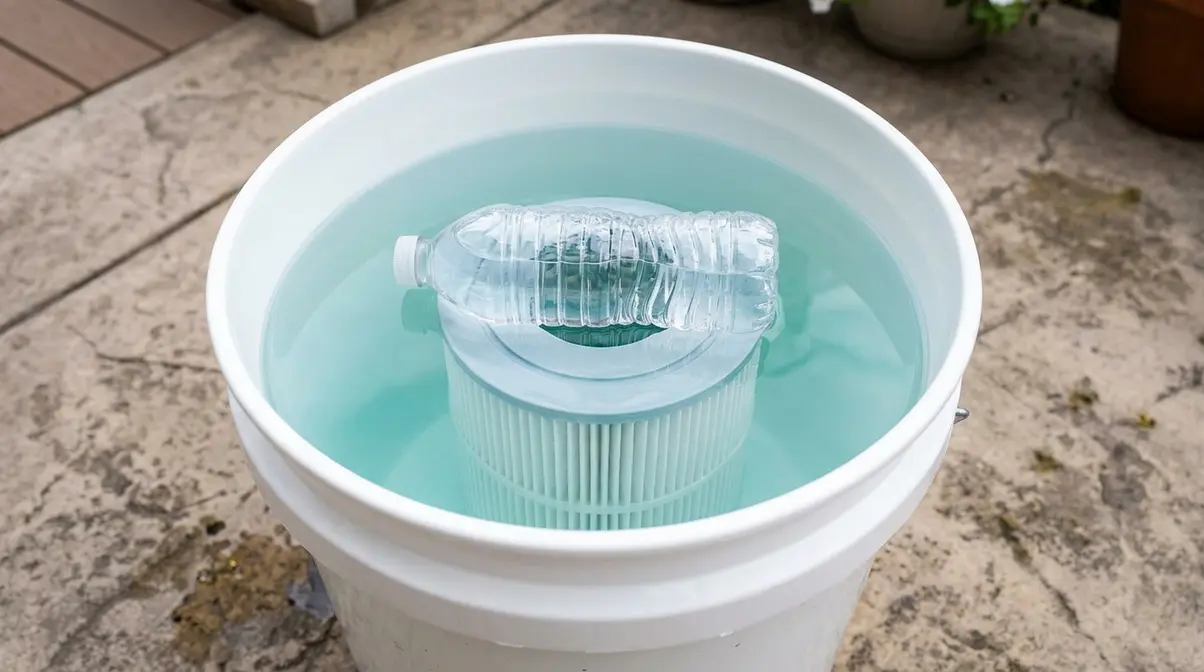
- Submerge overnight — a minimum of 12 hours, ideally 24. Weigh the filter down if it floats (a full water bottle placed on top works well).
- Remove and rinse thoroughly the next morning. Rinse until the water runs completely clear — this typically takes 2–3 minutes of continuous hosing.
- Air-dry before reinstalling — at least 30 minutes. A wet filter reinstalled immediately can slightly dilute your spa chemistry.
- Run the hot tub on circulation for 15 minutes after reinstalling and check your water chemistry before use.
| Soak Duration | Best For | Notes |
|---|---|---|
| 12 hours | Lightly to moderately soiled filters | Minimum effective time |
| 24 hours | Heavily discoloured or clogged filters | Recommended for quarterly resets |
| 48 hours | Filters not cleaned in 6+ months | Only if 24 hours hasn’t restored appearance |
Across hot tub communities and manufacturer guidance from Jacuzzi and Master Spas, the consistent finding is that filters cleaned only with rinsing lose significant filtration efficiency within 3 months — making the quarterly soak the most critical tier in the system. For a deeper breakdown of the full maintenance routine, see our 3-step method for cleaning hot tub filters.
How Often Should You Clean Your Hot Tub Filter?
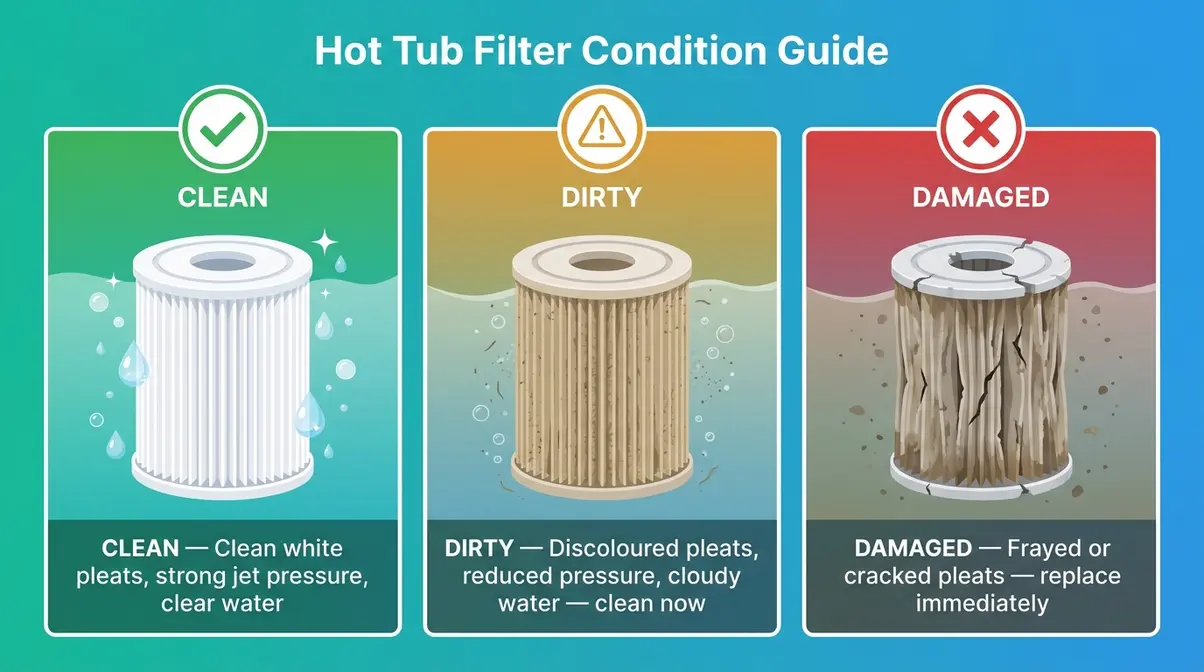
Cleaning frequency depends on bather load, water chemistry, and how hard your local water is. A filter in a lightly used tub with balanced water will need less frequent attention than one handling three or four users several times a week. The 3-Tier Filter Care System gives you a baseline schedule — adjust it based on the signs below.
Filter Cleaning Schedule
The PHTA recommends rinsing your hot tub filter at least every two weeks for average household use, with chemical cleaning monthly and a full soak quarterly (PHTA, 2026). In practice, weekly rinsing is better — it takes five minutes and prevents the compaction that makes monthly and quarterly cleaning harder. This schedule also aligns with how often should you change hot tub water, ensuring your entire system stays fresh.
| Cleaning Tier | Frequency | Time Required | Method |
|---|---|---|---|
| Quick Rinse | Weekly | 5 minutes | Garden hose |
| Chemical Spray | Monthly | 20 minutes | Spray cleaner |
| Deep Soak | Quarterly | 12–24 hours | Bucket + solution |
| Replacement | Every 12–24 months | — | New cartridge |
Heavy use adjustment: If you use your tub more than 3 times per week, or regularly have 3+ bathers, move to rinsing every 3–4 days and monthly soaks instead of quarterly. A clean filter means your sanitiser works more efficiently — the DOE estimates that a restricted filter can increase pump energy consumption by up to 30% (DOE).
Signs of Immediate Attention
Don’t wait for your scheduled cleaning if you notice any of these warning signs:
- Cloudy or foamy water that doesn’t clear within 24 hours of chemical treatment
- Reduced jet pressure — a clogged filter restricts flow to the pump
- Persistent chemical smell despite correct sanitiser levels — a sign the filter isn’t removing contaminants
- Visible slime or discolouration on the filter pleats that doesn’t rinse off
- Water that looks dirty shortly after a chemical treatment
Any of these signals means your filter needs at minimum a Method 2 spray clean immediately — and possibly a Method 3 soak if the problem persists.
When to Replace Rather Than Clean
No cleaning method can fix a physically degraded filter. Manufacturer guidelines from Jacuzzi and Master Spas both recommend replacing cartridge filters every 12–24 months under normal use conditions, regardless of cleaning frequency.
Replace your filter if you notice:
- Pleats that are frayed, torn, or collapsing inward
- Cracks in the filter core or end caps
- Persistent discolouration that remains after a full 24-hour soak
- A persistent musty or chemical odour even after thorough rinsing
- The filter is more than two years old and performance has declined
A replacement cartridge for most residential hot tubs costs £15–£50 — significantly less than the pump repair bill that follows running a degraded filter for months.
DIY & Home Remedy Methods
Home remedies for filter cleaning circulate widely in hot tub communities. Some have genuine merit in specific situations; others cause damage that isn’t immediately obvious. Here’s an honest assessment of the most common ones.
Can I Use Vinegar to Clean It?
Yes, white vinegar can help with mineral scale, but it’s not a complete cleaning solution. White vinegar can be a useful supplementary tool for mineral scale — the chalky white deposits caused by hard water. Its acetic acid content dissolves calcium and magnesium buildup that standard rinse cleaning leaves behind.
How to use it correctly: After a standard rinse, soak the filter in a 1:1 solution of white vinegar and water for 1–2 hours. Rinse thoroughly afterwards — residual vinegar will affect your spa’s pH balance.
Where it falls short: Vinegar does nothing useful for body oils, lotions, or biofilm. If your filter looks brown or greasy rather than chalky white, you need a dedicated cartridge cleaner — not vinegar. For a targeted how-to on this approach, our guide on cleaning a hot tub filter with vinegar covers the soak method in detail, alongside whatspa.co.uk’s filter cleaning guide.
Important: Never mix vinegar with bleach or any chlorine-based cleaner. The EPA warns that combining these chemicals produces chlorine gas — a toxic irritant — even in small quantities (EPA).
Baking Soda and OxiClean Options
Baking soda is sometimes suggested as a gentle abrasive cleaner. In practice, it’s largely ineffective for filter cleaning — it doesn’t dissolve oils or mineral scale in meaningful concentrations, and its alkaline nature can slightly affect water chemistry if residue remains on the filter.
OxiClean (sodium percarbonate) is a more credible option for filters with organic staining — it releases hydrogen peroxide when dissolved in water, which can break down some biofilm and organic residue. Use it as a diluted soak (1–2 tablespoons per gallon of water) for 30–60 minutes, then rinse thoroughly. It’s not a replacement for a dedicated cartridge cleaner, but it’s a reasonable interim option if you’ve run out.
Neither product should be used as a substitute for the quarterly soak — purpose-built filter cleaning solutions are formulated specifically for the polymer and polyester media used in hot tub cartridges.
Why Bleach & Dish Soap Cause Damage
These are the two most commonly suggested “quick fixes” in online forums — and the two most damaging.
Bleach: Sodium hypochlorite degrades the polyester fibres in filter media over time, making pleats brittle and prone to tearing. It can also leave chlorine residue that spikes your spa’s sanitiser levels unpredictably. The EPA cautions against using bleach in enclosed or poorly ventilated spaces, and mixing it with any other cleaning chemical — including vinegar — creates hazardous by-products (EPA).
Dish soap (including Dawn): Surfactant-heavy soaps like dish detergent are extremely difficult to rinse out of tightly-packed filter pleats. Residual soap causes persistent foaming in your hot tub — a problem that can take days and multiple water changes to resolve. Consumer Reports notes that soaps not designed for spa equipment consistently leave residue that disrupts water chemistry and can damage pump seals over time (Consumer Reports).
The rule is straightforward: use only products labelled for hot tub or spa cartridge cleaning.
Dishwasher and Washing Machine
This section answers two of the most searched questions about filter cleaning directly — because the short answer matters: don’t use either.
Dishwasher for Hot Tub Filters?
No — dishwasher cleaning permanently damages hot tub filter cartridges. The dishwasher is appealing because it seems like a hands-off solution, but in practice, it causes two specific types of damage.
First, heat. Dishwashers operate at 55–75°C (130–170°F) during the wash and dry cycles. Hot tub filter cartridges use polyester media bonded with adhesives that begin to degrade above 50°C — the heat warps the cartridge core, loosens the end caps, and causes the pleats to collapse or separate. Consumer Reports confirms that heat damage from dishwasher cleaning is the leading cause of premature filter failure outside of normal wear (Consumer Reports).
Second, detergent residue. Dishwasher tablets and gels are highly concentrated surfactants. Even a “rinse-only” cycle leaves residue in the pleats that causes severe foaming in your hot tub — a problem that often requires a full drain and refill to resolve.
!(https://pub-8ce7ac24839649d585b239b4a6127843.r2.dev/images/how-to-clean-hot-tub-filter__2840__en/hot-tub-filter-cleaning-dont-use.webp)
Four cleaning methods that permanently damage hot tub filter cartridges — avoid all of these.
Washing Machine: Similar Risks
The washing machine carries identical risks to the dishwasher, with one additional concern: mechanical agitation. The tumbling action of a washing machine physically stresses the filter’s structural components — the end caps, the core, and the bond between the pleats and the frame. Even a delicate or cold-water cycle generates enough movement to crack end caps or permanently deform the pleats.
Master Spas explicitly advises against washing machine cleaning in their official filter maintenance documentation, noting that mechanical damage from agitation is irreversible — the filter cannot be restored once the structural integrity is compromised.
The bottom line: both appliances feel like shortcuts but reliably shorten filter lifespan. Stick to the 3-Tier system — it takes no longer than a dishwasher cycle and actually works.
Tips for Specific Filter Types
Most hot tub filters follow the same basic cartridge design, but there are meaningful differences between standard residential cartridges and the filters found in inflatable hot tubs. Here’s what to adjust based on your setup.
Cartridge Filters (Most Common)
The hot tub filter cartridge — the cylindrical pleated component that traps debris and bather contaminants — is the standard in virtually all permanent in-ground and above-ground hot tubs. Brands like Pleatco, Filbur, and Unicel manufacture replacement cartridges across hundreds of model-specific sizes.
All three methods of the 3-Tier Filter Care System apply directly to cartridge filters. A few model-specific notes:
- Single-cartridge systems (common in smaller 2–4 person tubs): Clean weekly and consider keeping a spare cartridge so you can reinstall immediately and clean the dirty one at your leisure.
- Dual-cartridge systems (common in larger 6–8 person tubs): Rotate cleaning so one cartridge is always installed — never remove both simultaneously.
- Top-load vs. side-load housings: The cleaning process is identical; the difference is only in how you access and reinstall the cartridge.
For model-specific cartridge dimensions and replacement part numbers, our definitive filter cleaning guide includes a compatibility reference for the most common residential hot tub brands. When it’s time for a replacement, browse our recommended hot tub filters to find the exact match.
Inflatable Hot Tub Filters
Inflatable hot tub filters — used in Lay-Z-Spa, Intex, and similar portable models — are smaller, less dense, and more fragile than standard cartridge filters. They require a gentler approach. For detailed steps, refer to our dedicated guide on how to clean your Lay-Z-Spa filter.
Key differences:
- Replace more frequently: Inflatable tub filters are designed for lighter duty and typically need replacing every 2–4 weeks with regular use, rather than every 12–24 months. Many manufacturers recommend replacing rather than cleaning after each use.
- Rinse only — no chemical soaks: The thinner filter media in most inflatable tub cartridges can degrade faster with chemical soak cleaners. A thorough rinse after each use is the primary maintenance method.
- Check your manual first: Lay-Z-Spa and Intex both publish model-specific filter guidance — some newer models support gentle spray cleaners; older or budget models do not.
- Low cost = replace regularly: Replacement filters for inflatable tubs typically cost £3–£8 each. At that price, replacement is often more practical than extended cleaning cycles.
Filter Cleaning & Broader Routine
Filter cleaning doesn’t happen in isolation — it’s one part of a balanced maintenance routine. Two common questions connect directly to how your filter performs day-to-day.
The Tennis Ball Trick Explained
Dropping a tennis ball into your hot tub is a widely shared tip, and it does have a real (if modest) benefit. The fibres of a tennis ball absorb body oils, sunscreen, and cosmetic residue from the water’s surface — contaminants that would otherwise be drawn into the filter and clog the pleats.
It’s not a cleaning method — it’s a preventive measure that reduces the load on your filter between cleaning cycles. Think of it as a pre-filter for the surface layer of your water. Replace the tennis ball every 2–4 weeks, or sooner if it becomes visibly discoloured.
Practical note: Use only new, unplayed tennis balls — used balls may carry dirt or chemical residue from courts. And the tennis ball doesn’t replace any tier of the 3-Tier Filter Care System; it simply extends the time before your filter reaches the same contamination level.
Chemical Balance & Performance
A dirty filter and unbalanced water chemistry create a feedback loop that’s worth understanding. When your filter is clogged, circulation drops — and poor circulation means sanitiser isn’t distributed evenly through the water. Uneven sanitiser distribution leads to faster bacteria growth, which accelerates biofilm buildup on the filter pleats, which clogs the filter faster.
The CDC recommends testing hot tub water at least twice per week (CDC, 2026) — and your filter’s condition directly affects how stable those readings will be. Maintaining pH between 7.2–7.8 and total alkalinity between 80–120 ppm reduces scale formation on your filter pleats, extending the time between quarterly soaks. For a complete walkthrough of balancing your spa water alongside your filter routine, see how to maintain a hot tub for the full chemical balance guide.
Mistakes That Damage Your Filter
Common complaints from first-time owners — and consistent feedback across hot tub communities — point to the same handful of avoidable errors. Here’s what to watch for.
5 Most Damaging Cleaning Mistakes
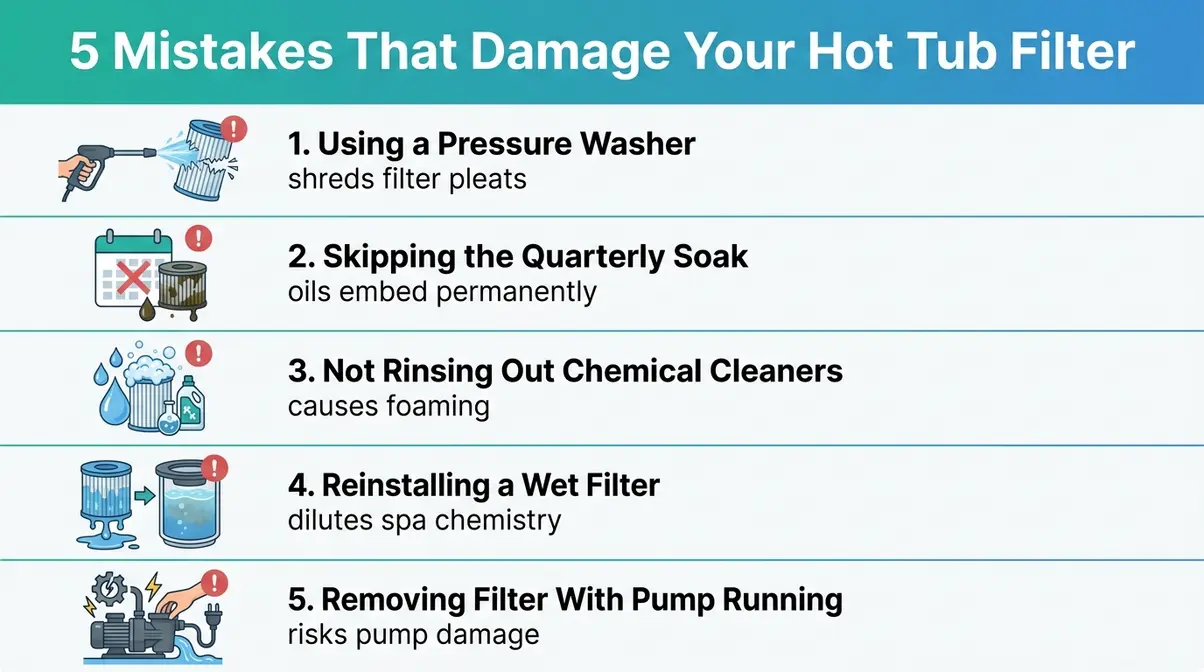
- Using a pressure washer. The high-pressure jet shreds filter pleats — what looks like a thorough clean is actually destroying the filter media. A garden hose on medium pressure is the maximum safe option.
- Skipping the quarterly soak. This is the most common mistake in the 3-Tier Filter Care System. Owners who only rinse and spray are managing surface contamination — the embedded oils and scale that accumulate over months require the full overnight soak to dissolve.
- Not rinsing out chemical cleaners completely. Residual spray cleaner or soaking solution left in the pleats will foam aggressively in your hot tub. Rinse until the water runs completely clear — this usually takes longer than you expect.
- Reinstalling a wet filter. A soaking-wet filter reinstalled immediately can dilute your spa water chemistry and temporarily affect sanitiser readings. Air-dry for at least 30 minutes before reinstalling.
- Cleaning the filter with the pump running. Removing the filter housing while the pump is active risks air-locking the pump impeller — a repair that costs significantly more than a replacement filter. Always cut power at the breaker first.
When DIY Methods Fall Short
The 3-Tier system handles the vast majority of filter maintenance scenarios effectively. However, there are situations where DIY cleaning isn’t enough — and recognising them early saves money.
If your filter fails the smell test — a persistent musty or chemical odour after a complete 24-hour soak and thorough rinse — the filter media has absorbed contaminants that no cleaning method will fully remove. Replace it.
If your water remains cloudy after installing a freshly cleaned (or new) filter and balancing your chemistry, the issue may be with your sanitiser system or water source rather than the filter itself. At that point, a water test kit or professional water analysis is the right next step — not another round of filter cleaning.
If your filter is more than two years old, the cumulative effect of chemical exposure and physical wear means its filtration efficiency has declined regardless of how diligently you’ve cleaned it. Manufacturer guidelines from Jacuzzi and Bullfrog Spas both recommend replacement at this interval as a baseline. For additional guidance on hot tub water care beyond filter maintenance, our water care section covers when to escalate to a professional service.
Frequently Asked Questions
How do you unclog a hot tub filter?
A clogged hot tub filter needs a full 12–24 hour chemical soak — rinsing alone won’t clear an embedded blockage. Remove the cartridge, submerge it overnight in a diluted filter cleaning solution (such as Leisure Time Filter Clean), then rinse thoroughly until the water runs clear. If reduced jet pressure or cloudy water persists after soaking, the filter may be past recovery and needs replacing. Filters clogged by heavy scale benefit from a preliminary 1–2 hour vinegar soak before the chemical treatment.
What is the best thing to use to clean a hot tub filter?
A purpose-built cartridge cleaning solution is the most effective option for a thorough clean. For the quarterly deep soak, products like Pleatco PCCL-OR and Leisure Time Filter Clean are consistently well-regarded across hot tub communities. For monthly spray cleaning, Natural Chemistry Filter Perfect and Spa Marvel Filter Cleaner both perform well. Avoid household alternatives — dish soap, bleach, and dishwasher tablets all cause damage or leave residue that disrupts your water chemistry (Consumer Reports).
How can you tell if a hot tub filter is clogged?
The clearest signs of a clogged filter are reduced jet pressure and persistently cloudy water. Additional indicators include: foam that doesn’t dissipate within a few minutes, a chemical smell despite correct sanitiser levels, and visible slime or heavy discolouration on the pleats. You can also do a simple flow test — hold the filter cartridge up to a light source; if you can’t see light through the pleats, it’s significantly restricted. Any of these signs means the filter needs at minimum a Method 2 spray clean immediately.
How long do hot tub filters last?
Hot tub filters typically last 12 to 24 months with proper care. Even with regular weekly rinsing and quarterly chemical soaks, the polyester media eventually degrades. If your filter remains discoloured after a 24-hour deep soak or the pleats begin to fray, it is time for a replacement.
Can I clean it with the pump running?
No, always turn off the hot tub’s power before removing the filter. Removing the cartridge while the pump is active can pull debris directly into the plumbing. This risks air-locking the pump impeller, which can cause severe mechanical damage and lead to costly repairs.
Keep Your Filter Clean, Keep Your Water Clear
A well-maintained filter is the difference between water that stays clear for weeks and water that turns cloudy after a single session. The 3-Tier Filter Care System — weekly rinse, monthly spray, quarterly soak — gives you a framework that removes the guesswork and matches the cleaning method to what your filter actually needs.
The single most impactful change most hot tub owners can make is committing to the quarterly deep soak. Across manufacturer guidance from Jacuzzi, Master Spas, and Bullfrog Spas, the consistent recommendation is the same: rinsing manages the surface, but only the overnight chemical soak fully resets a filter’s performance. The CDC’s free chlorine standard of 3–10 ppm is achievable only when your filter is genuinely clean — not just rinsed (CDC, 2026).
Start with whichever tier your filter needs today. If it’s visibly dirty after your last rinse, go straight to the monthly spray. If it hasn’t had a soak in more than three months, skip ahead to the quarterly method. Check our definitive filter cleaning guide for a printable maintenance schedule you can keep inside your spa cabinet — and get back to actually enjoying your hot tub. Mastering how to clean hot tub filter systems is the difference between constant frustration and a perfect soak.

David King
Hot tub tester and writer at One Hot Tub.