Hot Tub Pump Keeps Turning On and Off: 5-Step Fix
Join me on my hot tub pump troubleshooting journey! I'll share what worked for me when my pump wasn't working—easy tips to help you relax again.

What’s in this guide
- ⚠️ Safety First: Electrical Hazards
- What You Need Before You Start
- Step 1: Check and Clean Your Hot Tub Filter
- Step 2: Fix an Air Lock and Check Water Level
- Step 3: Reset the Control Panel
- Step 4: Diagnose Pump Overheating
- Step 5: Test for Advanced Electrical Faults
- When to Stop DIY and Call a Professional
- Frequently Asked Questions
- Wrapping Up Your Diagnosis
Home ›Maintenance And Troubleshooting
“My hot tub pump will turn on for a few seconds then off then repeats this process until the pump overheats. I replaced the capacitor and the same thing happens.”
Sound familiar? You are not alone. If you are looking for a definitive hot tub pump keeps turning on and off fix, you are in the right place. A hot tub pump keeps turning on and off for one of five specific, fixable reasons — and most owners never find the right one because they start diagnosing from the middle, not the beginning.
Without a systematic approach, you can spend hundreds of dollars replacing parts — filters, capacitors, even whole pumps — and still come back to the same cycling problem. Most owners replace what’s easy to reach, not what’s actually broken.
By the end of this guide, you’ll know exactly which of the five causes is making your pump turn on and off — and how to fix it safely, starting with the free checks. We’ll work through The Diagnostic Ladder: five steps from the simplest hydraulic fixes to advanced electrical testing, with clear safety checkpoints at each rung.
Finding a reliable hot tub pump keeps turning on and off fix usually comes down to one of five causes — most of which cost nothing to diagnose.
- Dirty filters are the #1 cause: they restrict flow and trigger the pump’s thermal shutoff
- Air locks (trapped air in the plumbing) cause pumps to run briefly, then cut out
- Control panel glitches can send false on/off signals — a reset often fixes this in 2 minutes
- Thermal overload trips the pump’s safety switch when it overheats from poor flow or electrical strain
- The Diagnostic Ladder works best in order: hydraulic checks first, electrical last
⚠️ Safety First: Electrical Hazards
ELECTRICAL SAFETY WARNING — READ BEFORE TOUCHING ANYTHING
Hot tubs operate on 240V electricity — that is roughly twice the household current that can already cause cardiac arrest. Working near water multiplies that danger significantly.
According to the U.S. Consumer Product Safety Commission, hot tubs must be protected by Ground-Fault Circuit-Interrupters (GFCIs) to prevent electrocution — and these devices should be tested regularly (CPSC guidelines on hot tub GFCI protection, CPSC, 2003). A GFCI (Ground-Fault Circuit-Interrupter) is a safety device that cuts power the instant it detects electricity flowing where it shouldn’t — like toward water or your body.
Steps 1–3 in this guide are safe for most DIYers. Steps 4–5 involve electrical components. Before touching any wiring, the spa pack (the control box), capacitors, or circuit board, disconnect power at the main breaker. If you are ever unsure, stop and call a licensed electrician.
What You Need Before You Start
You don’t need a toolbox full of gear. Here’s what to gather before you begin:
Estimated Time: 30-45 minutes
- Tools and Materials:
- A clean towel or rag — for wiping down filter housings and pump surfaces
- A garden hose — for rinsing the filter cartridge
- A flashlight — to inspect dark equipment bays
- Rubber-soled shoes — required any time you work near electrical components
- Your hot tub’s owner manual — for model-specific reset button locations and error codes
- A digital multimeter (a handheld tool that measures voltage and resistance — available at hardware stores for ~$20) — only needed for Steps 4–5
- A helper — strongly recommended for any electrical diagnostic work
Steps 1–3 only require the towel, hose, and flashlight. You’ll only need the multimeter if you reach Steps 4–5. This keeps the early rungs of The Diagnostic Ladder completely accessible for beginners.
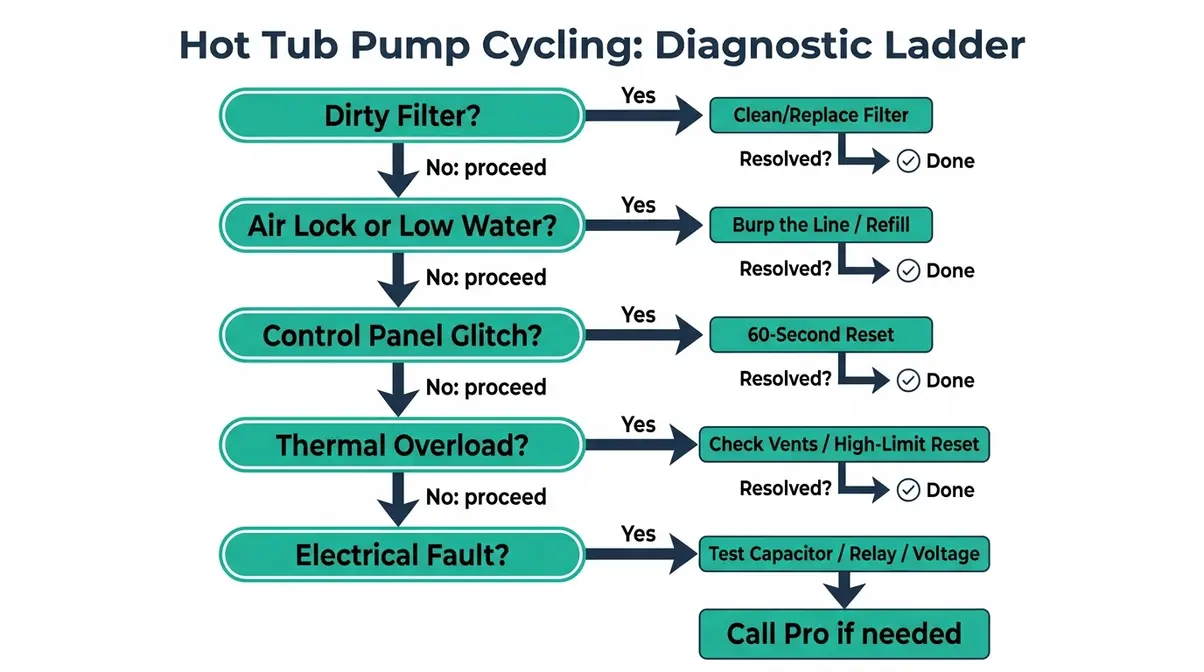
Use the flowchart above as your roadmap — work through each step in order and stop when you find your fix.
With your tools ready, start at Step 1 — the most common cause of pump cycling and the easiest to fix.
Step 1: Check and Clean Your Hot Tub Filter
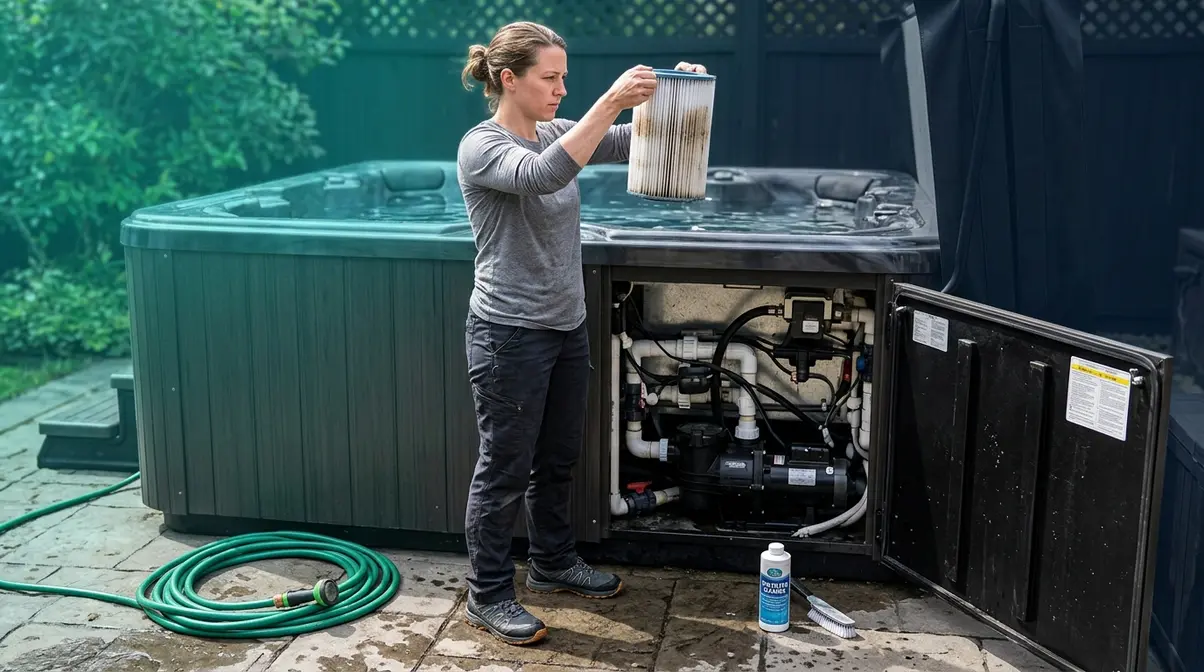
A dirty filter is the single most common reason a hot tub pump keeps turning on and off. When the filter clogs, it starves the pump of water flow. The pump strains, overheats, and its built-in thermal safety switch shuts it down. Once it cools, it restarts — then overheats again. This repeating cycle is exactly what you’re experiencing. Understanding the common causes for a hot tub pump turning on and off always starts with evaluating water flow.
Spa technicians report that restricted flow from a clogged filter accounts for the majority of pump cycling calls they receive, particularly in tubs that haven’t had a filter clean in 30 or more days (Leslie’s Pool Supplies, 2026). The fix is free and takes about 20 minutes.
How to Inspect Your Hot Tub Filter
- Turn off power at the main breaker. Never reach into the filter housing with power on.
- Locate the filter housing. This is usually a cylindrical compartment near the waterline, often inside the footwell or behind a side panel.
- Remove the filter cartridge. Do this by unscrewing the cap or pulling the locking ring counterclockwise.
- Hold the filter up to a light source. A clean filter looks pale white or cream-colored, with visible pleated folds. A clogged filter looks gray, brown, or compressed — the pleats may be matted together.
- Check the impeller area. Look closely at the rotating part inside the pump housing for debris like leaves, hair, or small stones. Even partial blockages force the motor to work harder and generate excess heat.
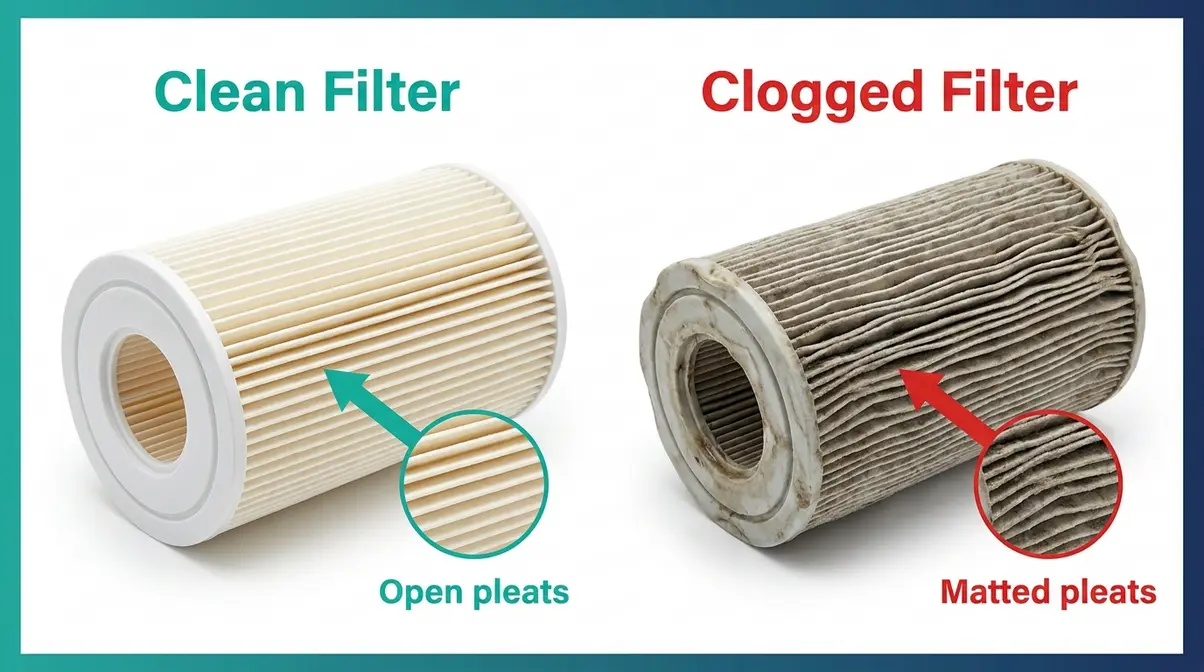
How to Clean or Replace a Clogged Filter
Properly maintaining clean hot tub filters is essential for preventing future thermal overloads.
- Rinse the filter with a garden hose, working from the inside outward to push debris out through the pleats. Use a gentle spray — high pressure can damage the filter media.
- Rotate the cartridge as you rinse, working from top to bottom in overlapping passes.
- Soak overnight in a filter-cleaning solution (available at pool supply stores for ~$10) if the filter is heavily soiled. Rinse thoroughly before reinstalling.
- Inspect for physical damage. Torn pleats, cracked end caps, or deformed cores mean the filter needs replacement, not cleaning. A replacement filter typically costs $20–$60 depending on your spa model.
- Reinstall the filter and restore power. Run the pump and watch for the cycling behavior. If the pump now runs continuously without shutting off, you’ve found your fix.
Replace your filter every 12–18 months regardless of appearance. Filters degrade internally even when they look clean, and an aging filter restricts flow even after rinsing.
If cleaning the filter doesn’t stop the cycling, move to Step 2.
Step 2: Fix an Air Lock and Check Water Level
An air lock (a pocket of trapped air blocking water flow inside the pump or plumbing) is the second most common cause of pump cycling — and it’s especially likely if your problem started right after refilling the tub, draining it for maintenance, or after a period of inactivity. The pump turns on, pulls air instead of water, loses its prime, and shuts itself off. Then it tries again. The cycle repeats.
Users on spa repair forums consistently report this as the culprit when cycling begins immediately after a water change, often accompanied by gurgling, whining, or sputtering sounds from the jet area.
Why Does My Pool Pump Run for 10 Seconds Then Stop?
Watch for these specific signals that point to trapped air rather than a dirty filter. If your pump runs for exactly 10 to 15 seconds before cutting out, an air lock is highly likely.
- The pump makes a gurgling, hissing, or whining noise for a few seconds before shutting off
- Little or no water comes out of the jets when the pump briefly runs
- The problem started immediately after refilling the hot tub or after a service visit
- You can hear the pump spinning freely but feel almost no jet pressure
- The pump runs for roughly 10–15 seconds, then cuts out — shorter than a typical thermal overload cycle
How to Burp the Air Lock Out
This process is called “burping” — you’re releasing trapped air the same way you’d burp a radiator hose. Power must be OFF at the breaker before you loosen anything.
- Turn off power at the main breaker. Confirm it’s off.
- Open the equipment bay panel to access the pump and plumbing.
- Locate the pump union. This is a large threaded collar connecting the pump to the inlet pipe. It looks like a thick plastic ring you can turn by hand.
- Slowly loosen the union (counterclockwise) by about a quarter turn. You’ll hear a hiss of escaping air. Do not fully remove it.
- Wait until water begins to drip steadily from the loosened joint. Steady dripping means water has replaced the air pocket.
- Retighten the union firmly by hand — do not overtighten or you’ll crack the fitting.
- Restore power and test. If the pump now runs smoothly without cutting out, the air lock was your problem.
Check Water Level and Slice Valves
Low water level is a related but separate issue. If the water level drops below the skimmer intake opening, the pump pulls air with every cycle — mimicking an air lock but caused by simple evaporation or a slow leak.
Check that your water level sits at the midpoint of the skimmer opening — not just “full enough to see water.” Refill if needed, then test.
Also check your slice valves (the ball-shaped or lever-style valves on the plumbing before and after the pump). A partially closed slice valve restricts flow the same way a clogged filter does. Confirm both the suction-side and return-side valves are fully open. A valve that’s 80% open can still cause cycling.
If the pump still cycles after addressing air locks and water level, move to Step 3.
Step 3: Reset the Control Panel
Hot tub control systems — the spa pack and its topside control (the keypad panel on the tub’s edge) — can develop software glitches, especially after power outages, voltage spikes, or lightning strikes. When this happens, the control panel may send incorrect on/off signals to the pump, causing it to cycle even though the pump itself is perfectly healthy.
This is one of the most frequently misdiagnosed causes of pump cycling. Owners assume the pump is failing, replace parts, and the problem persists — because the pump was never the issue.
How to Perform a Full System Reset
When it comes to resetting your hot tub system, a full reset clears temporary software faults and restores factory communication between the spa pack and the topside control. This takes about 2 minutes.
- Turn off power at the main breaker. Wait a full 60 seconds — not just a quick flip. Many spa pack capacitors hold a charge for 30–45 seconds, and a short reset may not fully clear the fault.
- Restore power at the breaker.
- Do not press any buttons on the topside control for 60 seconds. Let the spa pack complete its startup sequence without interruption.
- Watch the pump behavior. Under normal startup, the low-speed circulation pump may run briefly. If the pump immediately starts rapid cycling again, a software reset alone hasn’t fixed the issue.
- Consult your owner’s manual for model-specific reset procedures. Some brands (Balboa, Gecko, Jacuzzi) have a specific button sequence — often holding the Jets and Temperature buttons simultaneously for 5 seconds — that performs a deeper diagnostic reset.
Where is the hot tub reset button? Many hot tubs have a small red reset button on the outside of the spa pack (the gray or black control box in the equipment bay). It resembles a garbage disposal reset button. Press it firmly once after restoring power if a simple breaker reset doesn’t resolve the cycling.
Diagnosing Topside Control Panel Faults
If the pump cycles randomly — not at regular intervals — and the cycling stops when you disconnect the topside control panel, the keypad itself is the culprit. A failed keypad (corroded buttons, water intrusion, or a damaged ribbon cable) can send continuous false “on” signals to the pump relay.
Here’s how to test this safely:
- Turn off power at the breaker.
- Disconnect the topside control panel from the spa pack — typically a single ribbon cable or a plug-in connector. Consult your manual for the exact location.
- Restore power and watch the pump. If cycling stops completely, the topside panel is faulty and needs replacement.
- If cycling continues with the topside disconnected, the fault lies in the spa pack’s circuit board or relay — proceed to Step 5.
Topside control panels typically cost $50–$200 depending on your spa brand, and they’re a straightforward plug-in replacement most owners can handle themselves.
Step 4: Diagnose Pump Overheating
If you’ve cleaned the filter, resolved any air lock, and reset the control panel — and the pump still cycles — you’re likely dealing with a thermal overload issue. Thermal overload is a built-in safety mechanism inside the motor that shuts it down when internal temperature exceeds a safe threshold. Once the motor cools, it restarts automatically. This creates the exact on/off pattern described in the user quote at the top of this guide.
According to Hayward’s technical documentation, a pump’s thermal overload protector will repeatedly shut the motor off when it runs too hot, restarting only once it cools — and blocked air intake vents or restricted flow are the most common triggers (Hayward, 2026). This is a protective feature, not a defect — but repeated cycling damages the motor over time.
Why Is My Pump Turning On and Off So Often?
Frequent, rapid pump cycling usually points directly to thermal overload. Check these specific signs before touching anything:
- The motor housing is hot to the touch — uncomfortably warm, not just slightly warm from normal operation
- The pump runs longer on cool mornings and cycles faster in hot weather or when the equipment bay is poorly ventilated
- The motor makes a buzzing or straining sound before shutting off, suggesting it’s working harder than normal
- The air vents on the motor end cap are blocked by debris, insulation, or equipment bay walls positioned too close to the motor
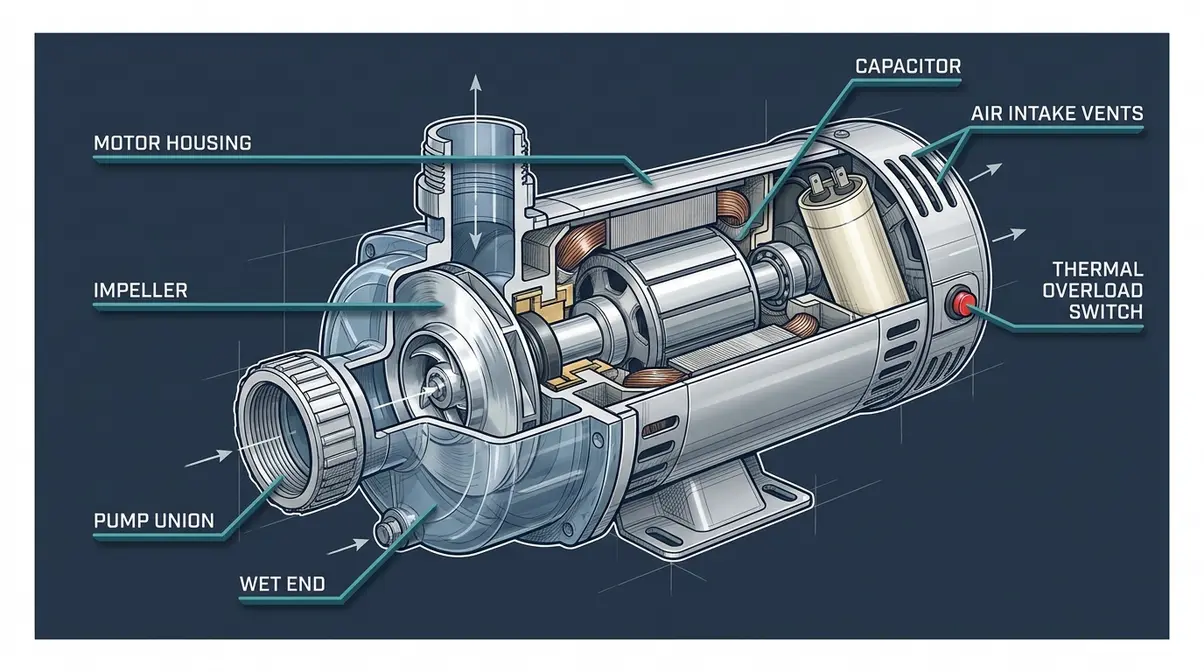
Resetting the High-Limit Thermostat
The high-limit thermostat is a separate safety device that cuts power to the heater — and sometimes the pump — when water temperature exceeds a safe limit (typically 104°F / 40°C) or when it detects inadequate water flow through the heater. Caldera Spas’ technician documentation notes that a tripped high-limit often shows as an error light or flashing logo light on the control panel (Caldera Spas, 2026).
To reset the high-limit thermostat, which is similar to troubleshooting hot tub heating issues:
- Turn off power at the GFCI breaker for at least 30 seconds.
- Check that water level is correct (mid-skimmer height) and filters are clean before resetting — otherwise the thermostat will trip again immediately.
- Restore power and observe. If the error light clears and the pump runs normally, restricted flow was causing false overheating signals.
- Locate the red reset button on the outside of your spa pack if the error persists after a power cycle. Press it firmly once. Refer to your owner’s manual for exact location — it varies by brand.
- If the high-limit trips again within minutes of resetting, the underlying cause (flow restriction, faulty sensor, or control fault) must be addressed first.
Checking the Temperature Sensor
A faulty temperature sensor (a small probe submerged in the water that reports temperature to the spa pack) can trigger false overheating shutdowns even when the water is at a normal temperature. The spa pack receives an incorrect high-temperature reading, decides the tub is dangerously hot, and shuts down the pump as a precaution.
Signs of a faulty sensor include: the displayed water temperature doesn’t match a separate thermometer reading, or the pump shuts off even when the water feels cool to the touch. Temperature sensors typically cost $15–$40 and are a plug-in replacement — but confirm with your manufacturer before ordering, as sensor resistance specs vary by brand.
If overheating and sensor checks don’t resolve the issue, you’ve reached the top of the hydraulic rungs. Step 5 covers advanced electrical diagnosis.
Step 5: Test for Advanced Electrical Faults
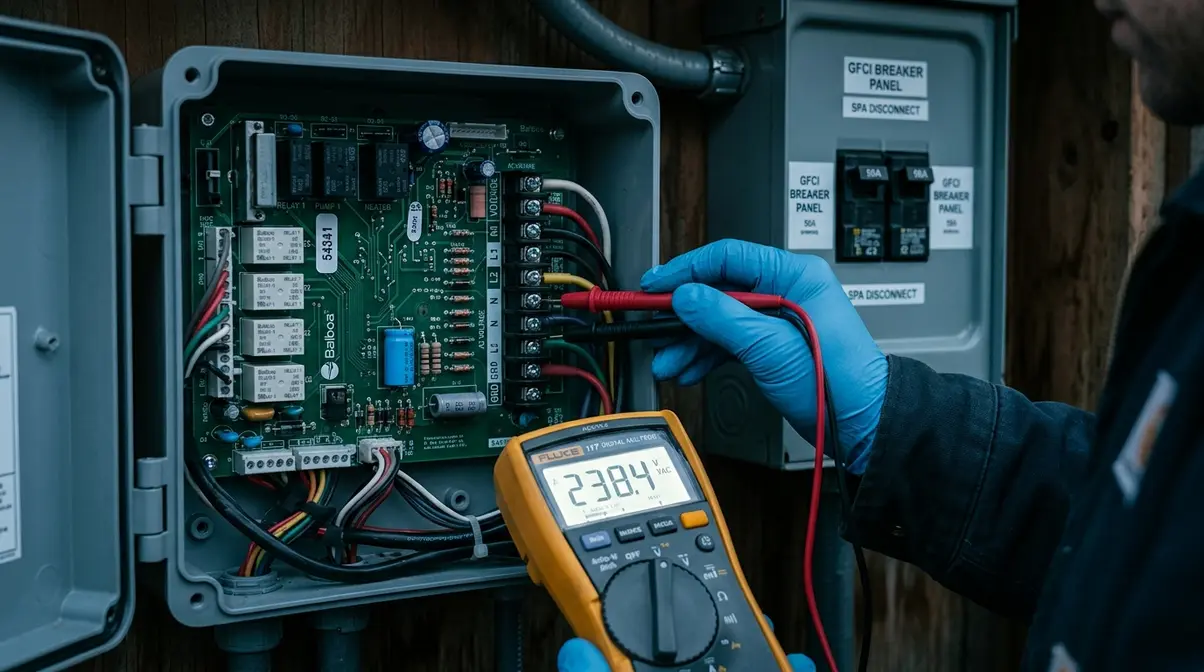
⚠️ STOP — Disconnect power at the main breaker before proceeding. Do not skip this step.
If Steps 1–4 haven’t resolved the cycling, the problem lies in an electrical component: the GFCI breaker, the motor start capacitor, the spa pack relay, or the supply voltage. These checks require a multimeter and basic comfort with electrical components. If you are not comfortable, skip to the “When to Call a Professional” section — no shame in that call.
Check the GFCI Breaker First
The GFCI breaker (Ground-Fault Circuit-Interrupter — a safety switch in your electrical panel that cuts power when it detects an electrical imbalance) is often confused with pump cycling. Understanding hot tub GFCI breakers is crucial. When a GFCI trips, the pump shuts off completely and won’t restart until you reset it. However, a weak or failing GFCI may trip and reset repeatedly on its own — mimicking pump cycling.
- Locate your GFCI breaker in the electrical sub-panel near the hot tub, or in your main home panel.
- Press the Test button — the breaker should trip immediately. Then press Reset. If the breaker won’t reset, or resets but trips again within seconds of the pump starting, the GFCI itself may be faulty.
- Check for moisture or corrosion inside the panel box. Water intrusion around the panel is a serious hazard — call a licensed electrician immediately if you see rust, water stains, or corrosion on any breaker.
- Note the NEC requirement: Under NEC Article 680, GFCI protection is required for virtually all circuits serving hot tub electrical equipment (Nassau National Cable, 2026). A GFCI that trips immediately every time the pump starts — rather than cycling — suggests a ground fault in the motor or wiring that requires a licensed electrician.
How to Test the Motor Start Capacitor
The start capacitor is a small cylindrical component inside the motor housing (usually behind the rear end cap or inside a bump on the motor body). It stores an electrical charge and releases it in a burst to help the motor start spinning. When it fails, the motor hums or buzzes but can’t fully start — it tries briefly, draws excess current, and shuts down. This matches the exact symptom in the user quote above.
Power must be disconnected at the breaker before you open the motor housing.
- Remove the motor’s rear end cap (usually 4–6 screws) to access the capacitor. It looks like a small metal or plastic cylinder with two terminals on top.
- Discharge the capacitor before touching it — even with power off, capacitors hold a charge. Use an insulated screwdriver to briefly short across both terminals. You may see a small spark.
- Read the microfarad (µF) rating printed on the capacitor body — it will look like “45 µF” or a range like “124–149 µF.”
- Set your multimeter to capacitance mode (marked “CAP” or with a capacitor symbol) if your meter has it.
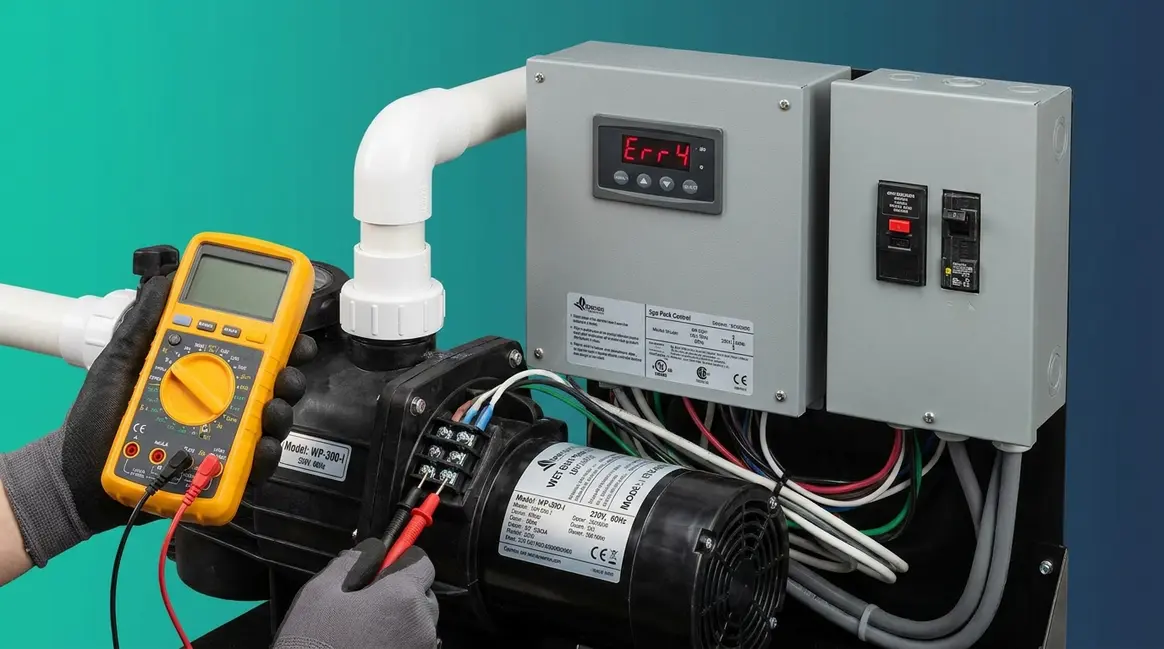
- Connect one probe to each terminal and read the value. A good capacitor reads within 10% of its printed rating. A reading significantly below the range, at zero, or showing “OL” (open) means the capacitor has failed.
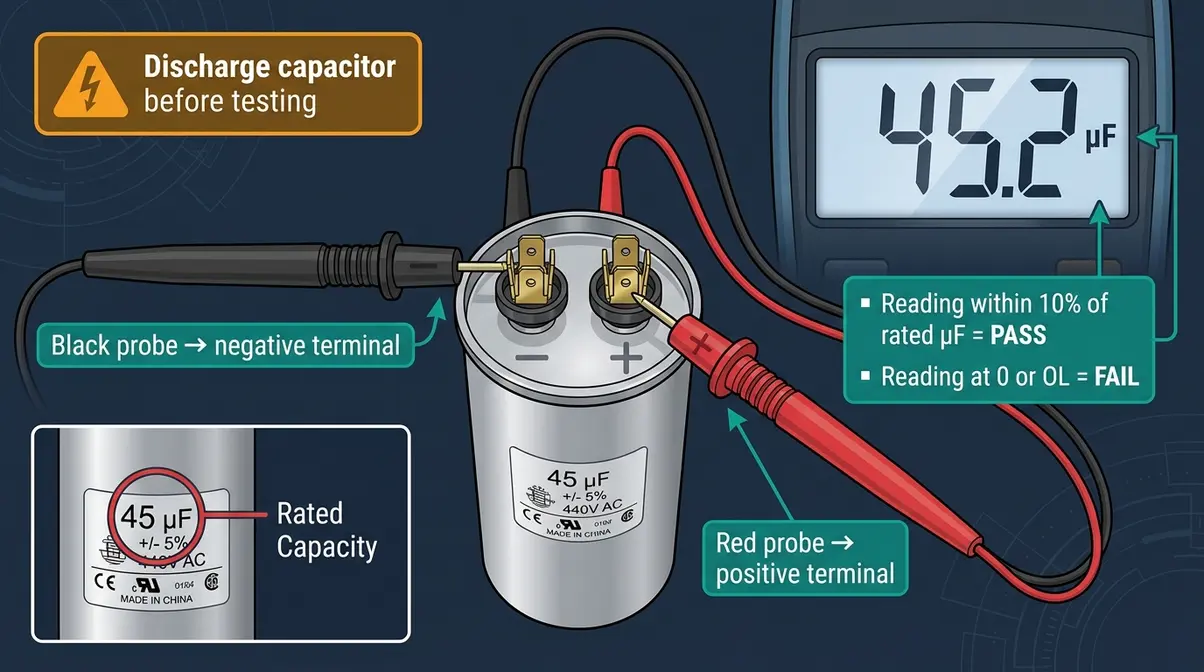
If your multimeter lacks a capacitance mode, use the ohms (resistance) setting on the highest range available. Touch one probe to each terminal. A healthy capacitor causes the reading to start low and climb steadily toward infinity as it charges. A reading that stays at zero (shorted) or doesn’t move at all (open) indicates a failed capacitor (In The Swim, 2026; KS Capacitor, 2026).
Replacement capacitors cost $10–$30. Match the µF rating within ±10% and use the same or higher voltage rating.
Inspect the Spa Pack Relay
The spa pack relay is an electromechanical switch on the circuit board inside your spa pack that turns the pump on and off based on signals from the control system. A relay that is stuck closed (always sending power to the pump) or intermittently failing can cause rapid, unpredictable cycling independent of anything else in the system.
Signs of a relay fault:
- The pump starts immediately at power-up without any button pressed, and the Jets indicator light is OFF — Canadian Spa Company’s technical support explicitly identifies this as a control system fault, not normal behavior (Canadian Spa Company, 2026).
- The relay makes an audible clicking sound from the spa pack even when the pump is disconnected.
- Visible burn marks, discoloration, or melted plastic around the relay component on the circuit board.
- Inspecting the relay requires opening the spa pack. With power disconnected:
- Remove the spa pack cover (typically 4 screws).
- Locate the pump relay — a rectangular component, often blue or black, with the pump circuit wires attached.
- Look for scorching, swollen components, or corrosion. If you see any of these, relay or board replacement is required.
Relay replacement is a component-level repair best handled by a certified spa technician unless you have electronics repair experience.
Check Voltage at the Motor Terminals
Low voltage (supply power below the acceptable range) is a frequently overlooked cause of pump cycling. When voltage drops, the motor draws more current to compensate, generates excess heat, and trips its thermal overload. Spa technicians on repair forums consistently identify low voltage as a cause of both rapid cycling and premature motor failure (PoolSpaForum, 2026). In these situations, testing hot tub circuit breakers and fuses can reveal underlying issues.
To check voltage with power on (use extreme caution — do not touch bare wires):
- Set your multimeter to AC voltage (VAC), 300V range.
- Place probes on the motor’s terminal block — the connection point where supply wires attach to the motor. Your manual shows the exact location.
- Read the voltage while the pump attempts to start. A 240V hot tub should read between 216V and 264V (±10% of rated voltage per NEC guidelines). Anything below 216V under load is a low-voltage fault.
- If voltage is low, check for loose connections at the breaker, corroded wire terminals, or an undersized supply wire. These are electrician-territory repairs.
When to Stop DIY and Call a Professional
The Diagnostic Ladder has a top rung. Knowing when to stop is as important as knowing how to diagnose.
Signs You Need a Certified Electrician
Call a licensed electrician — not a general handyman — if you encounter any of these situations:
- The GFCI trips immediately every time the pump starts, even after replacing the GFCI breaker itself
- Voltage at the motor terminals is below 216V under load — this indicates a supply wiring problem
- You see burn marks, melted insulation, or scorched wires anywhere in the equipment bay or electrical panel
- The GFCI panel has moisture, rust, or corrosion inside the box
- Any breaker feels warm to the touch or shows discoloration
- You smell burning plastic or hot metal from the electrical panel or spa pack
These are not “advanced DIY” scenarios. They are genuine electrical hazards in a wet environment. Hot tub electrical work near water requires a licensed electrician familiar with NEC Article 680 requirements. Do not proceed.
Signs You Need a Spa Technician
Some faults require specialized diagnostic tools that most homeowners don’t own. Call a certified spa technician if:
- The spa pack circuit board shows burnt components or the relay requires component-level soldering
- The motor continues to overheat after cleaning filters, fixing air locks, and confirming correct voltage — internal bearing failure or winding damage requires motor testing equipment
- The temperature sensor reads incorrectly and you cannot identify the correct replacement part by spec
- Error codes on the topside control are not covered in your owner’s manual — unlisted codes often indicate firmware or proprietary hardware faults
- You replaced the capacitor and the problem persists — as in the user quote above, this strongly suggests a motor winding fault or a control system issue, both requiring professional diagnosis
A service call typically costs $100–$200 for diagnosis, with repairs quoted separately. That’s often less than the cost of a misdiagnosed part replacement.
Frequently Asked Questions
How do I fix a pump that runs constantly without stopping?
A pump running continuously without stopping is usually caused by a stuck relay on the spa pack circuit board — the relay is sending constant power to the pump even when it should be off. First, try a full power reset (60 seconds at the breaker). If the pump starts immediately at power-up without any button being pressed, and the Jets indicator light is OFF, Canadian Spa Company’s technical documentation identifies this as a confirmed control system fault. Reduce filtration cycle duration in your settings to 2 hours as a temporary measure (per standard manufacturer guidelines), then have a spa technician inspect and replace the faulty relay or control board.
How do I reset a hot tub pump?
To reset a hot tub pump, start by turning off power at the main GFCI breaker for a full 60 seconds — this clears temporary electrical faults in the spa pack. After restoring power, wait 60 seconds before pressing any buttons to let the system complete its startup sequence. Many hot tubs also have a red reset button on the outside of the spa pack (the control box in the equipment bay) — press it once firmly if a breaker reset alone doesn’t work. For model-specific reset sequences (common on Balboa and Gecko systems), check your owner’s manual, as some require holding two buttons simultaneously.
Why does my pump keep kicking on and off?
A hot tub pump kicks on and off because one of five causes is interrupting its operation: a clogged filter restricting water flow, an air lock trapping air in the plumbing, a control panel glitch sending false signals, the motor’s thermal overload tripping from overheating, or an electrical fault such as a failing capacitor or relay. The most common cause — by a significant margin — is a dirty filter. Spa technicians at Leslie’s Pool Supplies report filter-related flow restriction as the leading cause of pump cycling complaints. Work through The Diagnostic Ladder in order, starting with the filter, before replacing any parts.
How do I stop my hot tub from running constantly?
To stop a hot tub pump from running constantly, first check your filtration cycle settings in the spa pack menu. Many owners inadvertently set filtration to run 8 to 12 hours per day when 2 to 4 hours is usually sufficient for residential use. If the pump runs outside of the programmed filtration window, a stuck relay is the likely cause. Canadian Spa Company’s support documentation notes that a pump starting immediately at power-up — with no button pressed and the Jets light off — is a definitive sign of a control system fault requiring professional service. A temporary workaround is switching the spa to Rest mode, which reduces pump run time while you arrange a service call.
Why does my hot tub pump keep turning on and off?
Your hot tub pump keeps turning on and off because a safety system is repeatedly shutting it down to prevent damage — and then restarting it once the trigger clears. The most common triggers are: (1) a clogged filter causing the pump to overheat, (2) an air lock preventing water from flowing, (3) a control panel fault sending incorrect signals, (4) the motor’s thermal overload switch tripping from genuine overheating, or (5) a failing start capacitor that can’t give the motor enough torque to start properly. Start at Step 1 of The Diagnostic Ladder and work upward — most owners find their fix before reaching the electrical steps.
Where is the hot tub reset button?
The hot tub reset button is typically located on the outside of the spa pack — the gray or black control box mounted in the equipment bay behind the side panel. It’s usually a small red button, similar to a garbage disposal reset button, and may be labeled “Reset” or have no label at all. Some models place the reset button on the pump motor itself (on the rear end cap). Plug-and-play hot tubs (like Lay-Z-Spa models) often have a recessed reset button on the pump unit that requires a pencil tip to press. Always check your owner’s manual for your specific model’s reset location, as placement varies significantly between brands.
How much does it cost to fix a hot tub pump?
Repair costs vary widely depending on the root cause. A simple filter replacement costs $20 to $60, while a new capacitor runs about $15 to $30. If the motor itself has failed and requires complete replacement, expect to pay between $200 and $500 for the part, plus $100 to $200 for professional labor.
Can a dirty filter cause a hot tub to shut off?
Yes, a dirty filter is the most common reason a hot tub shuts down unexpectedly. When pleats become clogged with oils and debris, water flow is severely restricted. This forces the pump motor to work harder, generating excess heat until the thermal overload switch trips and shuts the system down.
Wrapping Up Your Diagnosis
For frustrated hot tub owners, a pump that keeps turning on and off is almost always fixable without a full pump replacement. If you need a lasting hot tub pump keeps turning on and off fix, remember that most issues are hydraulic, not electrical. The key insight — what The Diagnostic Ladder makes clear — is that a dirty filter or trapped air lock accounts for the majority of cases, costs nothing to diagnose, and takes under 30 minutes to fix.
The Diagnostic Ladder framework works because it sequences fixes by cost and complexity. You start with the free hydraulic checks (Steps 1–2), move to the zero-cost control reset (Step 3), confirm thermal causes (Step 4), and only reach electrical testing (Step 5) when simpler causes have been genuinely ruled out. This prevents the most common and expensive mistake: replacing parts without understanding the root cause.
Ready to get your spa back in perfect condition? Start at Step 1 right now — check your filter before anything else. If it’s been more than 30 days since your last filter clean, there’s a strong chance that’s your fix. Work through each rung in order, stop when you find the cause, and use the “When to Call a Professional” thresholds as your safety guardrail. If you reach Step 5 and still haven’t found the problem, that service call is the right call — and you’ll be able to tell the technician exactly what you’ve already ruled out.
David King
Hot tub tester and writer at One Hot Tub.