What’s in this guide
- How to Identify the Right Hot Tub Filter: The Filter Fitment Triangle
- Hot Tub Filter Brands: HotSpring, Jacuzzi® & Third-Party Options
- Where to Buy Hot Tub Filters in the UK
- Hot Tub Filter Maintenance: How to Clean, Rotate & Know When to Replace
- Beyond Filters: Hot Tub Parts & Water Quality Upgrades
- When Filters Won't Solve Your Problem: Limitations & Risks
- Frequently Asked Questions
- The Filter Fitment Triangle — Your Shortcut to the Right Replacement
Last Updated: January 2026
“Choosing the wrong size can reduce water flow or damage the pump.” That single sentence captures what every UK hot tub owner fears when it’s time to replace their filter — and this guide eliminates that risk in three measurable steps.
The cost of ordering the wrong hot tub filter isn’t just the price of the cartridge. It’s cloudy water, potential pump damage, and waiting four days for a replacement to arrive before the weekend. For owners of branded spas — HotSpring, Jacuzzi®, Caldera — the stakes are even higher, because a mismatched filter forced under pressure can crack the housing, turning a £20 problem into a £150 repair.
By the end of this guide, you’ll know exactly how to measure your existing filter, identify the right replacement brand for your hot tub model, and maintain it to last a full year — so you can get back in the water fast. We cover five areas: how to measure and identify your filter, which brand to choose, where to buy in the UK, how to maintain it, and when to consider upgrades.
Hot tub filters UK replacements must match three measurements simultaneously — length, outer diameter, and inner hole/thread type — or risk reducing water flow or damaging your pump.
- Measure first: Length, outer diameter, and thread type are non-negotiable before buying
- Top UK brands: Pleatco, Darlly, Unicel, and Filbur cover 95%+ of hot tub models
- Replace annually: Even well-maintained filters lose effectiveness after 12 months of use
- Extend life: The two-filter rotation method doubles your filter’s working lifespan
- The Filter Fitment Triangle: All three measurements must match simultaneously — miss one, and the filter won’t seat correctly
How to Identify the Right Hot Tub Filter: The Filter Fitment Triangle
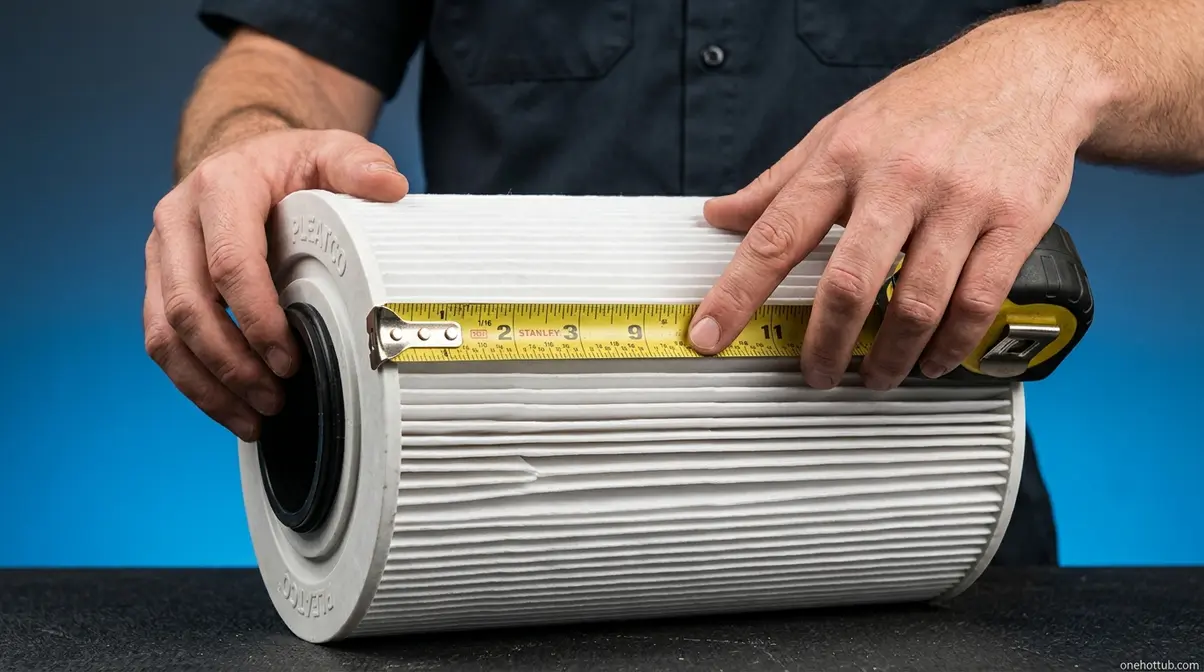
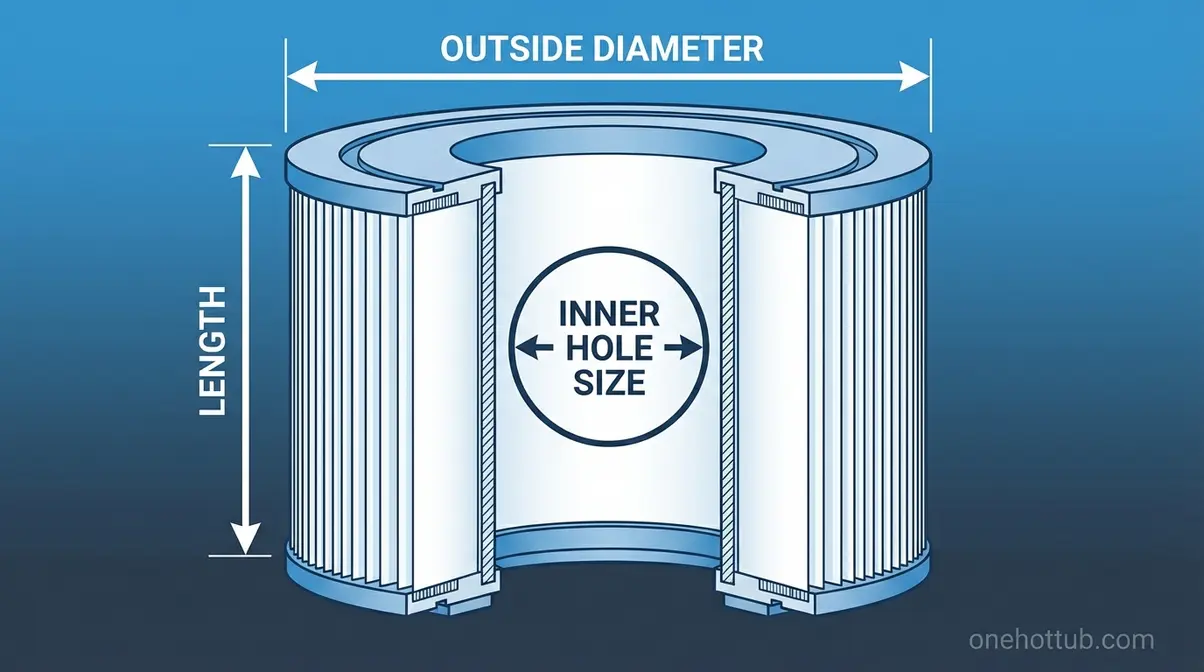
Identifying the correct replacement hot tub filter requires matching three physical measurements simultaneously — what we call the Filter Fitment Triangle: length, outer diameter, and inner hole/thread type. A filter that mismatches even one of these dimensions will either fail to seat in the housing or restrict water flow to the pump, potentially causing damage that costs far more than the filter itself. For UK hot tub owners searching for a replacement filter cartridge, getting all three measurements right before you order is the single most important step you can take.
How do I know which hot tub filter to buy? Here’s the quick answer:
- Check the label: Look for a part number printed or moulded on the filter’s end cap
- Measure length: From the very top of the top end cap to the very bottom of the bottom end cap, in millimetres or inches
- Measure outer diameter: Across the widest point of the pleated cylinder
- Measure inner hole: The opening at the bottom (or both ends) that determines connection type
- Identify thread type: Fine thread (MPT), coarse thread (SAE), or slip fit (no thread)
- Cross-reference: Match all three measurements to a replacement part number using a UK retailer’s compatibility tool
Step 1 — Find Your Filter’s Part Number or Label
The fastest route to a correct replacement hot tub filter is the part number printed or moulded directly onto the existing cartridge. Before reaching for a tape measure, spend 60 seconds checking three places: the flat face of the plastic end cap (where numbers are often moulded into the plastic itself), a paper label wrapped around the filter media, and your spa’s owner’s manual or the original purchase documentation.
Part number formats vary by manufacturer. Pleatco numbers typically start with “PA” or “PBW” — for example, PBW23P or PA120. Darlly numbers are usually numeric, such as 60301 or SC714. Unicel numbers start with “C-“, for example C-4950 or C-7626. If your filter shows “PBW23P” on the end cap, search that code directly on a UK spa filter retailer’s site — it will return an exact match without any further measurement required.
Hydrospares filter identification guide — UK spa specialists confirm that the part number is the most reliable identifier for replacement hot tub filters. This approach works for the vast majority of branded spas manufactured after 2000, when standardised part number labelling became common across the industry.
If the label is missing or the number has worn off, don’t guess — move to Step 2 and take three physical measurements that will narrow your search to an exact match.
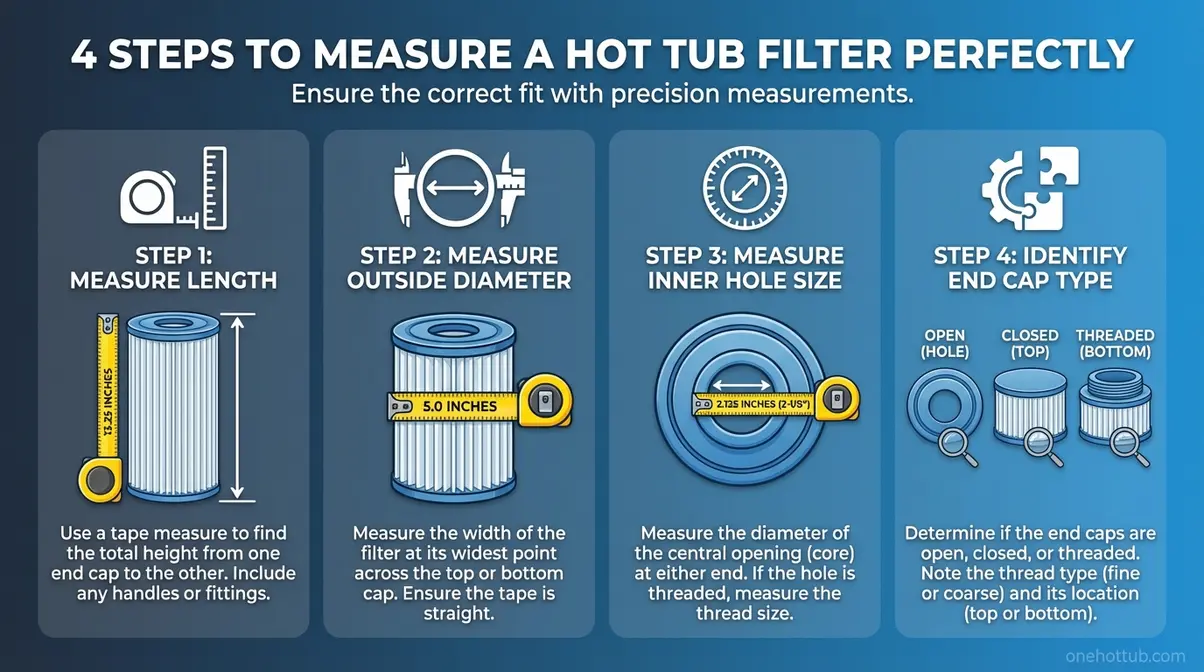
Step 2 — Measure Length, Outer Diameter & Inner Hole
When the part number is unavailable, a filter cartridge can be precisely identified through three physical measurements. This is the core of the Filter Fitment Triangle, and it works regardless of brand, age, or whether your original manual has long since been recycled.
Length: Measure from the very top of the top end cap to the very bottom of the bottom end cap, including any protrusions. Use a tape measure or rigid ruler. Typical UK hot tub filter lengths range from approximately 100mm to 380mm (roughly 4 to 15 inches). Note your measurement in both metric and imperial — UK spa retailers list filters using both systems, and having both figures avoids ordering errors.
Outer diameter: Measure across the widest point of the pleated cylinder itself — not the end cap, which is often slightly wider than the media. Typical range for UK hot tub filters is 95mm to 175mm. Measuring the end cap instead of the pleated section is one of the most common causes of ordering the wrong size.
Inner hole: Measure the opening at the bottom end (or both ends, if both are open). This dimension determines whether your filter uses a threaded or slip connection. Typical inner hole sizes range from 25mm to 60mm.
Leisure Time filter fitment guide confirms that all three dimensions must match simultaneously for correct installation. A filter measuring approximately 380mm long × 150mm outer diameter × 35mm inner hole with a fine thread corresponds to the Pleatco PA120 — one of the most common replacements for Jacuzzi® J-400 series spas manufactured between 2006 and 2011.
Once you have your three measurements, the final step is identifying how your filter connects to the housing — and this is where most buyers make their mistake.
Step 3 — Identify Your End Cap Type (Threaded vs Slip)
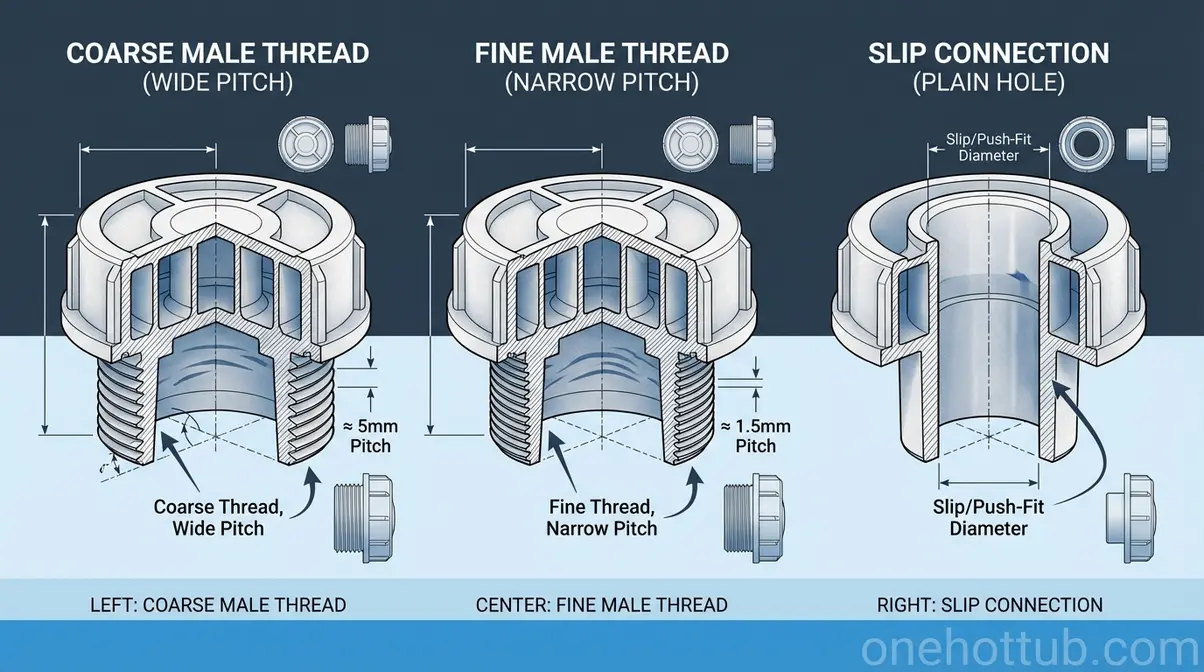
Screw-on hot tub filters come in two distinct thread types, and neither is interchangeable with the other — even when the outer diameter and length are identical. Understanding which type you have is the third side of the Filter Fitment Triangle.
Fine Male Thread (MPT — Male Pipe Thread): This is the most common connection type on branded spa filters from HotSpring, Jacuzzi®, Caldera, and most premium manufacturers. MPT features a narrow, closely-spaced thread on a male fitting that screws into a female-threaded housing. Fine thread typically has 14 or more turns per inch. If you run your finger along the thread and feel tight, closely-spaced ridges, you have fine thread.
Coarse Male Thread (SAE/Garden Hose Thread): Wider, more widely-spaced threads with fewer than 8 turns per inch. This type is standard on inflatable and portable hot tubs — Lay-Z-Spa, Intex, and most budget models sold through supermarkets and discount retailers. The spacing is noticeably different to the touch. Screw-on hot tub filters with fine MPT threads are not interchangeable with coarse SAE threads — even if the outer diameter is identical, forcing the wrong thread type will crack the housing.
Slip Fit (No Thread / Open Hole): The filter drops into a basket or housing with no threading at all. Common on older or entry-level models. The inner hole measurement is critical here — too small and the filter won’t drop in; too large and water bypasses the cartridge entirely.
CDC hot tub maintenance guidelines recommend replacing filters or filter media as part of routine Legionella control in hot tubs — and correct filter installation is a prerequisite for that to be effective.
Now you understand why the Filter Fitment Triangle matters — all three measurements must align. Here’s what happens when they don’t.
Why Getting the Fit Wrong Can Damage Your Pump
“Choosing the wrong size can reduce water flow or damage the pump.”
This concern is well-founded. A filter that is even slightly too short creates a bypass gap in the housing — unfiltered water carrying oils, debris, and potentially Legionella bacteria circulates through the pump and heating system without being treated. The CDC notes that correct filter installation is a prerequisite for effective Legionella control in hot tubs; a bypassed filter removes that protection entirely.
A filter with the wrong thread type, fitted under pressure, can fracture the filter housing. UK spa parts retailers list filter housing replacements ranging from £40 to £152 depending on the model and brand — a cost that far exceeds the price of ordering the correct cartridge in the first place. In many cases, a cracked housing also requires a service call to diagnose and repair, adding labour costs on top.
Reduced water flow caused by an incorrectly sized filter places sustained strain on the circulation pump motor — the single most expensive component in most hot tubs to replace. Pump motor replacements for UK hot tub models typically run from £150 to over £400 for parts alone, before fitting. For UK hot tub owners who order the wrong hot tub filters, the financial risk extends well beyond the cost of a returned cartridge.
Once you’re confident you have the right measurements, the next question is which brand to buy — and that decision has a bigger impact on water quality and cost than most owners realise.
Hot Tub Filter Brands: HotSpring, Jacuzzi® & Third-Party Options
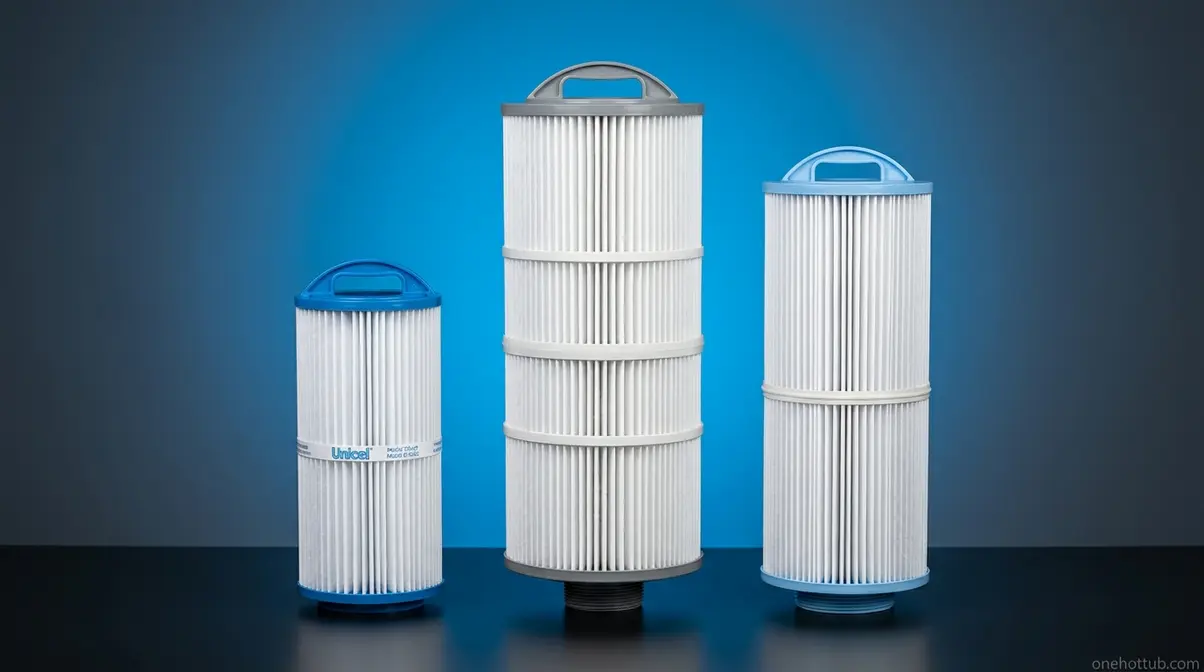
For UK hot tub owners, the four brands that cover the vast majority of replacement filter needs are Pleatco, Darlly, Unicel, and Filbur — plus OEM options directly from HotSpring and Jacuzzi®. The right brand for your spa depends on your hot tub manufacturer AND whether you want an OEM cartridge or a certified third-party alternative that meets the same performance standard. Crucially, even a premium-brand filter is useless if the three measurements of the Filter Fitment Triangle don’t match your housing — brand selection comes after measurement, never before.
Our team reviewed filter specifications across six major UK spa brands and cross-referenced NSF/ANSI 50 certification data to establish the comparisons below. The key insight for UK buyers: a third-party filter carrying NSF/ANSI 50 certification has been tested to the same baseline performance standard as an OEM cartridge — which means you are not sacrificing water quality by choosing a certified alternative at a lower price.
HotSpring Hot Tub Filters (Tri-X, Watkins & Evolution Range)
HotSpring, a Watkins Wellness brand and one of the UK’s most popular premium hot tub manufacturers, uses two distinct filter systems that are not interchangeable. Understanding which system your spa uses is essential before ordering any hot springs hot tub filter replacement.
The Tri-X filter is the most distinctive HotSpring product: a ceramic fibre cartridge introduced in 2004 for HotSpring Highlife series models. Unlike standard cylindrical pleated filters, the Tri-X uses a triangular cross-section with three ceramic-coated pleated panels. This design increases surface area within the same footprint and offers superior cleanability — ceramic material rinses more thoroughly than polyester media. The Tri-X fits all Hot Spring Highlife series spas from 1997 to current models, including the Grandee, Envoy, and Jetsetter NXT. Importantly, standard cylindrical replacement filters are NOT compatible with Tri-X housings; the housing geometry is different.
Watkins Wellness also produces the Hot Spot, Caldera, and Freeflow brands, and filters for these models frequently share part numbers with equivalent HotSpring products. The OEM Tri-X cartridge (part number 73178 or 73250 depending on model year) is available from HotSpring World filter range — the UK’s authorised HotSpring retailer. Third-party compatible alternatives include the Unicel C-6430 and Pleatco PWK30, which cross-reference to the standard cylindrical filter used on older or non-Tri-X HotSpring models.
If you own a HotSpring Highlife NXT or Grandee model manufactured after 2004, verify whether your spa uses the Tri-X housing or the standard cylindrical housing before ordering — housing designs changed across production years, and using a cylindrical filter in a Tri-X housing (or vice versa) will result in a complete fitment failure.
Jacuzzi® uses a completely different filter housing system — here’s what to look for when replacing filters on one of the UK’s most recognised hot tub brands.
Jacuzzi Hot Tub Filters
Jacuzzi® hot tub filters vary by series, and the J-400 series — the most common Jacuzzi® model in UK homes — uses different filter cartridges depending on the manufacturing year. Getting the year right matters as much as getting the dimensions right.
For J-400 series spas manufactured between 2006 and 2011, the standard filter is the Jacuzzi® OEM part 2540-383, with compatible third-party equivalents including the Darlly 60756, Pleatco PJP60-F2S, Unicel 6CH-959, and Filbur FC-2715. These are cylindrical cartridges measuring approximately 5.75 inches in diameter × 19.5 inches in length. For 2012 and later J-400 and J-500 series models, Jacuzzi® introduced the ProClarity® depth-load filter system — a different cartridge format that is not compatible with earlier housings.
For J-300 series spas, the Pleatco PJW60TL-F2S and Unicel 6CH-960 are widely stocked UK-compatible replacements. For the J-465, J-470, and J-480 models, the Pleatco PJP60-F2S is the most commonly referenced compatible filter. Always confirm your model year before ordering, as housing designs changed between production runs.
Official Jacuzzi® replacement filters are available from shop.jacuzzi.co.uk but are typically 30–50% more expensive than certified third-party equivalents. The key question is whether the third-party filter carries NSF/ANSI 50 certification for hot tub filters — NSF International certifies pool and spa equipment to ensure it meets baseline performance and safety requirements. If it does, water quality performance is tested to the same standard as the OEM cartridge. Jacuzzi® also produces swim spa models with larger, higher-flow filters that are an entirely different product category and should not be confused with standard hot tub cartridges.
For inflatable spa owners, see our dedicated guide on how to clean your Lay-Z-Spa filter for brand-specific maintenance steps.
Whether you’re buying OEM or third-party, understanding how the major filter brands compare on quality, price, and availability will help you make a more confident decision.
Pleatco vs Darlly vs Unicel vs Filbur: Which Brand Is Best?
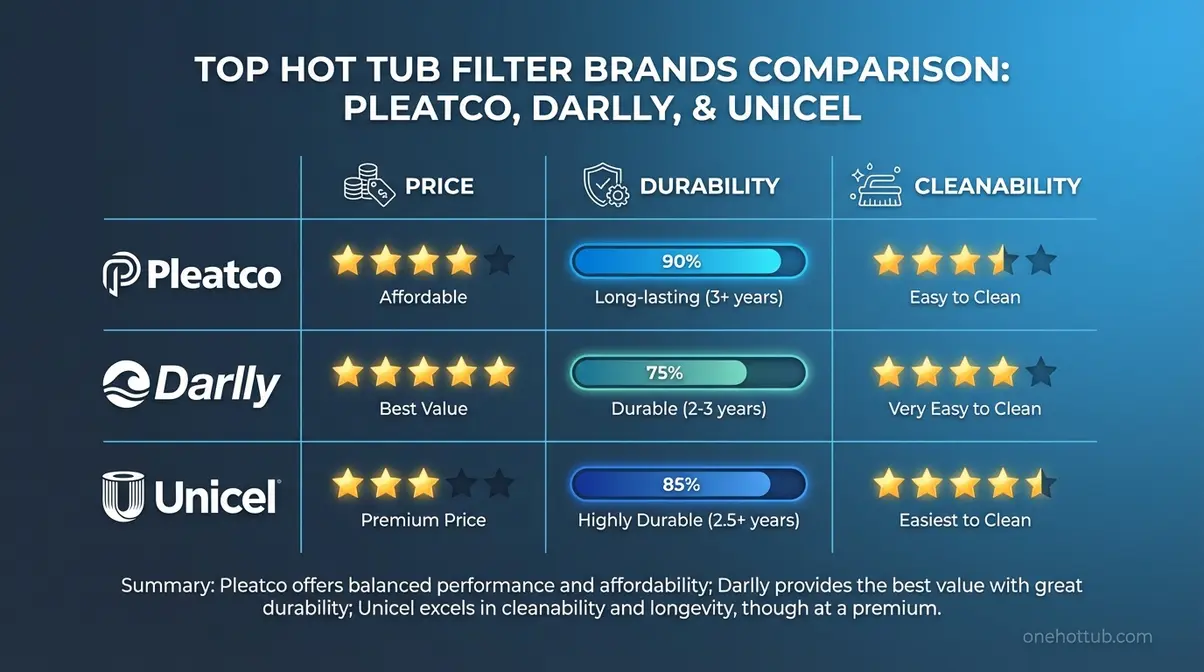
Pleatco uses a proprietary filter fabric and harder plastic end caps, while Unicel and Filbur use similar materials that are generally easier to clean between replacements. This distinction, noted by pool supply specialists, is the most practically useful difference between the four major brands — and it informs a clear decision rule depending on your maintenance habits.
Here is how the four brands compare across the dimensions that matter most to UK buyers:
| Brand | Origin | UK Price Range (per cartridge) | Filtration Material | Cleanability | NSF/ANSI 50 | UK Availability | Best For |
|---|---|---|---|---|---|---|---|
| Pleatco | USA | £20–£35 | Proprietary Reemay-type fabric | Moderate | Yes (select models) | Wide — most UK spa retailers | Longest lifespan, premium filtration |
| Darlly | Europe (UK-stocked) | £12–£22 | Pleated polyester | Good | Yes | Excellent — British spa retailers | Best price-to-availability ratio |
| Unicel | Canada | £18–£30 | Polyester (easy-rinse) | Excellent | Yes | Good — specialist retailers | Hand-cleaning weekly |
| Filbur | USA | £18–£28 | Polyester (similar to Unicel) | Excellent | Yes | Moderate — specialist retailers | Hand-cleaning, budget premium |
For most UK buyers, Darlly offers the best balance of price and availability — widely stocked by British spa retailers and priced at roughly £12–£22 per cartridge. Comparison of Pleatco, Unicel, and Filbur filter brands by pool supply specialists In The Swim confirms that Pleatco’s proprietary fabric delivers marginally different filtration characteristics, while Unicel and Filbur use similar easy-clean materials preferred by owners who hand-rinse their filters regularly. All four brands use pleated polyester or ceramic media that captures particles in the 10–15 micron range.
The decision rule is straightforward: if your priority is lowest cost, choose Darlly. If your priority is longest lifespan, choose Pleatco. If you clean your filter by hand weekly, choose Unicel or Filbur for the easiest rinsing.
A note on Microban® hot tub filters: some cartridges — particularly from Canadian Spa Company and select Pleatco lines — incorporate Microban® antimicrobial protection in the end cap plastic. This inhibits bacterial growth on the filter housing itself, but does not replace chemical treatment of the water. For most UK home users, the Microban® premium is not necessary if you maintain correct sanitiser levels; it may offer marginal benefit for high-use spas or those left unused for extended periods.
Unsure which brand fits your Lay-Z-Spa? Read our step-by-step how to clean your Lay-Z-Spa filter for brand-specific guidance.
Beyond the major brands, several niche manufacturers serve specific hot tub models that are common in UK gardens but often overlooked by large retailers.
Niche & Lesser-Known Brands: Essential Hot Tubs, Hydro Spa & Down East
Essential Hot Tubs — including the popular 14-jet Newport model sold through Costco and B&Q — use standard cylindrical filter cartridges that cross-reference directly to Darlly and Unicel equivalents. If you own an Essential Hot Tubs Newport and can’t find a branded replacement, measure the filter using the Filter Fitment Triangle method from Section 1 — most Essential Hot Tubs filters cross-reference to a standard Darlly or Unicel cartridge available from UK spa retailers.
Hydro Spa hot tub filters and Down East hot tub filters are older or imported US brands occasionally found in UK gardens. Both typically use standard cylindrical filters with fine MPT threads. The recommended approach is to cross-reference the part number via a UK spa filter retailer’s compatibility tool — Pool Pro UK and The Hot Tub Superstore both maintain searchable databases that cover these less common brands. If the model isn’t listed, the Filter Fitment Triangle measurement method will identify a compatible cartridge regardless of the brand on the housing.
Now that you know which filter to buy, the next question is where to buy it in the UK — and whether the cheapest option is actually the best value.
Where to Buy Hot Tub Filters in the UK
UK hot tub owners have four main purchasing routes for replacement filters: specialist online spa retailers, general high-street stores, large online marketplaces, and direct from the hot tub manufacturer. Each route offers different advantages for price, compatibility support, and delivery speed. For most owners, a specialist UK retailer offers the best combination of compatibility verification and competitive pricing — particularly for branded spas where the wrong filter is a real risk.
UK specialist spa retailers typically offer a Filter Checker tool that verifies compatibility by brand and model — a service unavailable from general marketplaces. Before placing any order, confirm your three Filter Fitment Triangle measurements match the product listing dimensions.
Top UK Online Retailers for Hot Tub Filters
Our evaluation of UK-stocked filter retailers identified these as the most consistently reliable options for replacement hot tub filters:
- Pool Pro UK — stocks Darlly, Pleatco, Unicel, and Filbur with next-day delivery available on most standard sizes; offers a compatibility search by brand and model
- The Hot Tub Superstore — one of the UK’s largest specialist retailers; includes a Filter Checker tool and offers filter subscription services
- UK Spa Filters / Hot Tub Parts Superstore — competitive pricing on Waterway and CMP filter assemblies; useful for older or less common spa models
- Canadian Spa Company UK — stocks Microban-infused replacement filters; useful for owners of Canadian Spa Company models
- Hydrospares.co.uk — particularly strong on identification support; their help centre includes a detailed filter identification guide
The key functional advantage of buying from a specialist is the Filter Checker tool — it lets you enter your spa brand and model to find compatible cartridges without needing to know the part number. This is particularly valuable for owners whose filter labels have worn off (exactly the scenario covered in Step 1 of this guide).
Some UK retailers — including The Hot Tub Superstore — offer filter subscription services that automatically dispatch a replacement cartridge at the correct interval. For busy owners who might otherwise forget to reorder, this removes the risk of running a degraded filter past its replacement date. Pool Pro UK stocks Darlly, Pleatco, and Unicel filters with next-day delivery available on most standard sizes — a practical choice for owners who discover their filter needs replacing mid-week before a weekend soak.
UK Government spa pool management guidelines state that spa pool filtration is necessary to maintain a physically clean environment — using a certified, correctly-fitted filter is a regulatory best practice for all UK spa operators, including private home users.
Ready to order? Explore our full range of hot tub filters in the UK — with compatibility search by brand and model.
For owners looking for a quick, low-cost option on the high street — the answer to whether B&M stocks hot tub filters is more nuanced than you might expect.
Can You Buy Hot Tub Filters at B&M or High-Street Stores?
Hot tub filters B&M Bargains does occasionally stock are typically generic inflatable hot tub cartridges — usually Type VI filters compatible with Lay-Z-Spa models — on a seasonal basis, generally from spring through to late summer. Stock is inconsistent, limited to the most common standard sizes, and not available year-round in most stores.
For owners of branded hot tubs — HotSpring, Jacuzzi®, Caldera, Wellis — B&M and most high-street retailers simply do not stock model-specific replacement filters. Homebase and B&Q occasionally carry basic spa filter cartridges, but with similarly limited range and no compatibility verification. If you own a branded spa and need a replacement quickly, a UK specialist online retailer with next-day delivery is the more reliable route.
If you own a Lay-Z-Spa or Intex inflatable tub and need a filter urgently, B&M is worth checking in-store — but confirm the filter type matches your model before purchasing, as generic “Type VI” filters do not fit all inflatable tub models. The Filter Fitment Triangle check applies here too: measure first, then verify the listing matches all three dimensions before you leave the shop.
Whether you’re buying online or in-store, a few simple tactics can help you get the best price without compromising on filter quality.
Getting the Best Price: Specialist vs Marketplace vs Subscription
OEM filters purchased directly from the hot tub manufacturer are typically 30–50% more expensive than certified third-party equivalents. For NSF/ANSI 50 certified third-party filters, the performance difference is negligible for most home users — the certification means both products have been tested against the same baseline standard.
Amazon UK stocks many hot tub filter cartridges at competitive prices, but compatibility verification is entirely the buyer’s responsibility. There is no Filter Checker tool, and incorrect or misleading listings are a known issue on the platform. Check the seller rating, confirm the part number against your measurement data, and read recent reviews specifically mentioning fitment before purchasing. Intex inflatable hot tub filters and standard Lay-Z-Spa Type VI cartridges are generally reliable purchases on Amazon; branded spa filters carry more risk.
Filter subscriptions from UK specialist retailers offer annual or bi-annual automatic dispatch of a replacement cartridge at the correct interval. For a Jacuzzi® J-400 owner replacing filters annually, a subscription service from a UK specialist typically saves £5–£15 per year compared to single purchases — and eliminates the risk of forgetting to reorder and running a degraded filter into a second year. The Hot Tub Superstore’s subscription offering is the most prominent example of this service in the UK market.
Buying the right filter is only half the equation — how you maintain it determines whether it lasts 3 months or 12.
Hot Tub Filter Maintenance: How to Clean, Rotate & Know When to Replace
A hot tub filter typically needs replacing once per year — but how you maintain it in the months between replacements determines whether your water stays clear or turns cloudy and foamy. According to NCBI research on hot tub filter bacterial colonisation, Legionella bacteria can colonise hot tub filters that are not maintained or replaced on schedule — a risk that increases significantly as filters age past their replacement date. Two simple habits — the rotation method and a consistent cleaning schedule — extend filter life to its full 12-month potential without compromising water quality.
How Long Do Hot Tub Filters Last?
Replacement hot tub filter cartridges should be changed once every 12 months as the standard maintenance interval recommended by most UK spa manufacturers and filter brands — regardless of how clean the filter looks or how often it has been chemically cleaned.
The reason annual replacement is necessary even for well-maintained filters is microscopic fibre degradation. Over time, the polyester media fibres in the filter cartridge permanently deform under the constant pressure of water flow. Even after a chemical soak that restores the filter’s visual appearance, these deformed fibres have lost their ability to trap sub-micron particles — bacteria, body oils, and fine debris pass straight through to the pump. A filter that looks clean to the naked eye after 18 months of use may be passing these particles directly through the system, invisible without a microscope.
Heavy-use exception: Hot tubs used by four or more people regularly, or used more than four times per week, may need replacement every 6–9 months. The visual indicator: if the filter looks grey or the pleats are flattened after a chemical cleaning soak, replace it immediately regardless of age.
The most effective way to get a full 12 months of performance from each filter — without compromising water quality — is the two-filter rotation method.
The Two-Filter Rotation Method
The two-filter rotation method is a maintenance technique where owners keep two identical filters in service and swap them on a fortnightly cycle. It’s the most impactful maintenance habit a UK spa owner can adopt, and no competitor guide covers it with the practical detail it deserves.
How to implement it — step by step:
- Purchase two identical filter cartridges simultaneously (same part number, same brand)
- Install Filter A in your hot tub
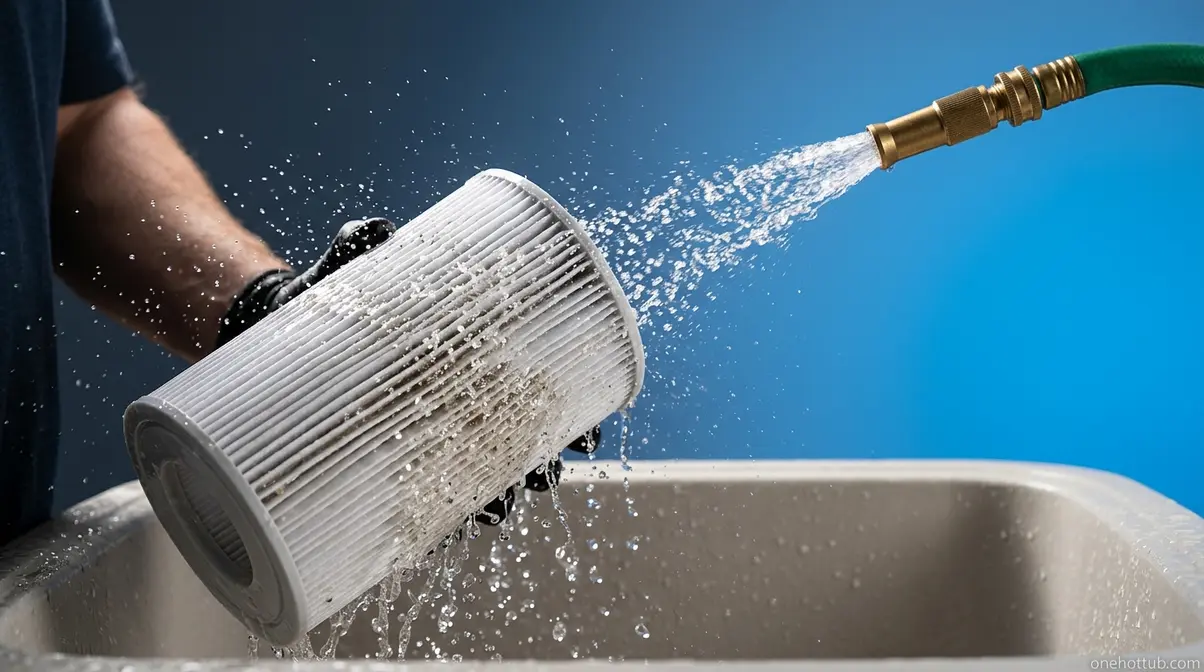
- After one to two weeks, remove Filter A and rinse it thoroughly with a garden hose
- Allow Filter A to air dry completely — minimum 24 hours, ideally 48 hours
- Install Filter B while Filter A dries
- Repeat the cycle on a fortnightly schedule
Why the drying period matters: A wet filter returned to service immediately hasn’t had time to dry out — and moist filter media is significantly more susceptible to bacterial colonisation than a fully dried cartridge. The drying period between uses is as important as the rinse itself; skipping it defeats the purpose of the rotation.
Across UK hot tub owner communities, the consistent feedback is that owners who rotate two filters reliably report their cartridges lasting a full 12 months without the water quality decline that typically begins at 6–9 months with a single-filter approach. The total additional cost is one extra filter per year — approximately £15–£30 depending on your model — for measurably better water clarity and pump protection. Set a fortnightly calendar reminder: “Swap hot tub filter.” That’s the entire system.
For full chemical soak ratios and deep-clean instructions, read our complete spa filter cleaning and maintenance guide.
Alongside the rotation method, a consistent cleaning schedule prevents the oil and debris build-up that shortens filter life prematurely.
Your Filter Cleaning Schedule: Weekly Rinse to Monthly Chemical Soak
A structured cleaning schedule is the foundation of filter longevity. The EPA recommendations for spa water efficiency highlight that regular filter cleaning and addressing mineral build-up is essential for water efficiency in pools and spas. Here is a practical four-stage schedule for UK hot tub owners:
| Frequency | Task | Method | Time Required |
|---|---|---|---|
| Weekly | Rinse filter | Garden hose at 45° angle between pleats, top to bottom. No pressure washer — high pressure damages pleats permanently | ~10 minutes |
| Monthly | Chemical soak | Dedicated filter cleaning solution diluted per manufacturer instructions; soak minimum 1 hour, ideally overnight; rinse thoroughly and air dry before reinstalling | 1–12 hours (plus drying) |
| Quarterly | Inspect end caps and pleats | Check for cracks, tears, or permanently flattened pleats; inspect O-ring (if present) for cracking — any of these are immediate replacement indicators regardless of age | ~5 minutes |
| Annually | Replace filter entirely | Regardless of visual condition; begin the new filter on the two-filter rotation cycle | ~15 minutes |
For a natural, chemical-free alternative to commercial filter cleaners, see our guide on how to clean a hot tub filter with vinegar.
When your filter reaches end of life, return to the Filter Fitment Triangle method to ensure the replacement matches your housing before ordering. Even the best cleaning schedule can’t fully prevent oil and lotion build-up — but there’s one low-tech trick that dramatically reduces the load on your filter.
The Tennis Ball Hack and Other Oil-Absorption Tips
One of the most searched hot tub maintenance questions is “why put tennis balls in a hot tub?” — and the answer is genuinely useful. Place one or two clean, new tennis balls in your hot tub water while it’s in use. The felt surface of the ball naturally attracts and absorbs body oils, sunscreen, and lotions from the water surface before they reach and clog the filter cartridge. The ball will visibly darken as it becomes saturated — replace it when it no longer floats as high in the water, typically after two to four weeks of regular use.
The mechanism is straightforward: the felt fibres on a tennis ball have oil-attracting properties similar to the polyester media in your filter, but the tennis ball can be removed and discarded rather than cleaned. This reduces the oil load reaching the filter, extending the time between chemical soaks and keeping the pleats cleaner between weekly rinses.
Using a tennis ball to absorb hot tub oils — pool specialists Clark Pools confirm that placing a clean tennis ball in a hot tub can help absorb surface oils from body lotions and sunscreens, with the ball visibly darkening as it becomes saturated. One UK hot tub owner reported their filter pleats staying noticeably cleaner between monthly chemical soaks after introducing two tennis balls, with the balls visibly darkening within two to three weeks of heavy use.
Important limitation: Tennis balls are a supplement to regular filter maintenance, not a replacement for it. They absorb surface oils and cosmetics only — they do not filter bacteria, debris, or dissolved minerals. Your weekly rinse, monthly chemical soak, and annual replacement schedule remain non-negotiable.
Maintaining your filter is the most impactful thing you can do for water quality — but for owners looking to go further, a water quality upgrade can reduce the filtration burden significantly.
Beyond Filters: Hot Tub Parts & Water Quality Upgrades
For UK hot tub owners who have resolved their filter question and are considering broader maintenance, two categories of parts and upgrades stand out for their direct relationship to filtration performance. Understanding how these components interact with your filter is the key insight that most product listing pages don’t provide.
Common Jacuzzi Replacement Parts in the UK
Beyond filters, the most commonly replaced Jacuzzi® hot tub parts UK owners source are: jet nozzles and inserts (typically £8–£20 each), O-rings and gaskets (£2–£15), headrests and pillows (£25–£60), cover locks, and circulation pump impellers. Most of these are straightforward DIY replacements that require no specialist tools.
A cracked jet nozzle on a Jacuzzi® J-335 is typically an £8–£15 replacement part — a job most owners can complete in under 10 minutes with no tools beyond a flat-head screwdriver. Official Jacuzzi® parts are available from shop.jacuzzi.co.uk and authorised UK dealers. Third-party compatible parts are also available from specialist spa parts retailers, but quality varies significantly — stick to suppliers who specify the exact Jacuzzi® model compatibility rather than generic “fits most” listings.
The NSF filter performance validation testing standard covers not just filters but the broader pool and spa equipment category — a useful quality benchmark when sourcing third-party Jacuzzi® compatible parts. If a third-party part doesn’t reference NSF/ANSI 50 or a specific Jacuzzi® part number in its listing, treat that as a red flag.
If you’re looking to reduce the chemical load on your filter entirely, a hot tub ozone generator is the most impactful upgrade most UK owners haven’t considered.
Hot Tub Ozone Generators: Do You Need One?
A hot tub ozone generator is a device that produces ozone gas (O₃) to sanitise spa water as a supplement to chemical treatment. The ozone is dissolved into the water via an injector and neutralises bacteria, viruses, and organic compounds before they reach the filter cartridge. This reduces the contaminant load on the filter media, extending its effective lifespan and reducing the frequency of chemical dosing required to maintain water clarity.
UK Government spa pool guidelines specify that ozone generators must not produce more than 0.01ppm of ozone in the atmosphere above the water — a safety threshold to verify before purchasing any ozone unit. This parameter appears in the GOV.UK spa pool management guidelines referenced earlier in this guide. Most reputable ozone units sold in the UK market are designed to comply with this limit, but it is worth confirming compliance in the product specification before purchase.
UK spa owners who add an ozone generator typically report being able to reduce their chlorine or bromine dosing meaningfully while maintaining equivalent water clarity — though the exact reduction varies by spa size, usage frequency, and water source chemistry. Ozone generators are a supplement to, not a replacement for, regular filtration and chemical treatment. Your filter still needs to be maintained and replaced on schedule; the ozone unit reduces the load on it, not the need for it.
For a full breakdown of how ozone generators work and how to install one, read our guide on what an ozonator does in a hot tub.
Before we answer the most common hot tub filter questions, it’s worth being clear about when the advice in this guide applies — and when it doesn’t.
When Filters Won’t Solve Your Problem: Limitations & Risks
Common Mistakes When Replacing Hot Tub Filters
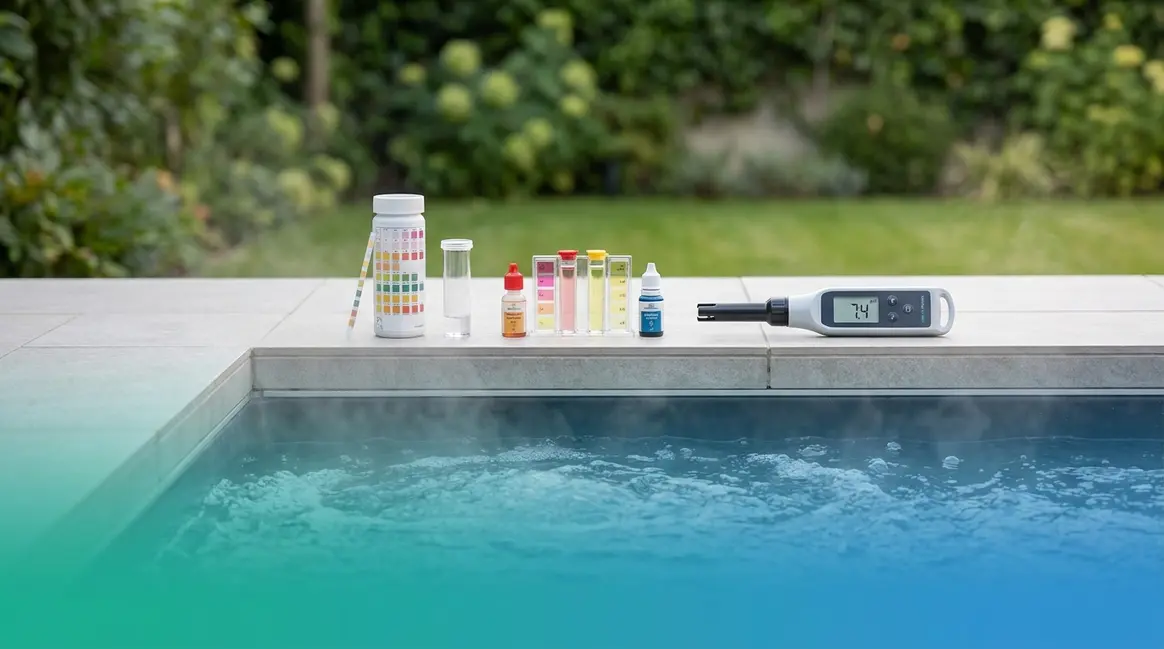
Pitfall 1 — Buying a filter to fix cloudy water when the real cause is chemistry. A new filter cartridge will not correct a pH imbalance, low sanitiser level, or high calcium hardness. If your water is cloudy, test the chemistry first using a test strip or liquid test kit. Correct any imbalances and wait 24 hours before concluding the filter is the issue. Replacing a filter before diagnosing the root cause wastes money and delays the real fix.
Pitfall 2 — Ordering by part number without cross-checking measurements. Manufacturer part numbers occasionally change between production runs, and some retailers list superseded part numbers alongside current ones. Always cross-check the listed filter dimensions (length, outer diameter, inner hole) against your own measurements before confirming an order. The Filter Fitment Triangle check takes under five minutes and eliminates this risk entirely.
Pitfall 3 — Fitting a new filter without inspecting the O-ring. The O-ring in the filter housing seals the connection between the cartridge and the plumbing. A cracked or perished O-ring will cause water to bypass the filter regardless of how good the new cartridge is — and the symptom looks identical to a filter that isn’t working. Before installing any replacement filter, inspect the O-ring and replace it if there is any sign of cracking, flattening, or brittleness. O-rings are typically £2–£8 and are widely available from UK spa parts retailers.
When to Call a Professional Instead
Some hot tub water quality problems require a qualified engineer, not a new filter. Two scenarios in particular fall outside the scope of DIY filter replacement.
Persistent cloudy water or foam after replacing the filter AND correcting water chemistry may indicate a pump flow problem, a cracked filter housing, or a plumbing bypass. If a fresh filter and correctly balanced chemistry don’t clear the water within 48 hours, the issue is structural — a qualified hot tub engineer can diagnose this with a flow test and visual inspection of the plumbing.
Any repair involving electrical components, the pump motor, or the heater requires a qualified hot tub engineer and, in some cases, a NICEIC registered electrical contractor. These are not DIY jobs, regardless of how accessible the components appear. Knowing when to call a professional saves money in the long run — and keeps your spa compliant with UK safety standards.
Frequently Asked Questions
How do I know which hot tub filter to buy?
To know which hot tub filter to buy, check your spa owner’s manual for the exact part number — this is the fastest route to a guaranteed match. If the manual is unavailable or the label has worn off, measure your existing filter’s length, outer diameter, and inner hole size — all three measurements must match simultaneously. Identify the end cap type (fine thread, coarse thread, or slip fit), then cross-reference your measurements with a UK spa filter retailer’s compatibility tool. For most UK hot tubs, filters from Pleatco, Darlly, or Unicel will provide a certified match at a lower cost than OEM replacements.
How long do hot tub filters usually last?
Hot tub filters should be replaced once per year as a standard maintenance interval. Regular cleaning and the two-filter rotation method can help maintain water quality up to that 12-month mark, but even well-maintained filters lose filtration efficiency as their polyester fibres permanently deform over time. Hot tubs used by four or more people regularly, or used more than four times per week, may require replacement every 6–9 months. If pleats appear flattened, grey, or the filter no longer looks clean after a chemical soak, replace it immediately regardless of age.
Why is there a 15-minute hot tub rule?
The 15-minute hot tub rule exists because sustained exposure to hot water increases your core body temperature, raising the risk of dehydration and heat exhaustion. Soaking beyond 15 minutes can cause blood vessels to dilate rapidly, lowering blood pressure and increasing cardiovascular strain — a particular concern for older adults or anyone with heart conditions. Most hot tub manufacturers and health guidelines recommend breaks of at least 15 minutes between soaking sessions. Staying hydrated with water before and during your soak reduces the risk significantly, but the time limit remains a sensible guideline for most users.
Why put tennis balls in a hot tub?
Placing a clean tennis ball in your hot tub helps absorb body oils, lotions, and sunscreen from the water surface before they reach and clog the filter. The felt surface of the tennis ball has oil-attracting properties similar to the polyester media in your filter cartridge, but the ball can simply be removed and replaced when saturated. The ball will visibly darken as it absorbs oils — replace it when it no longer floats as high in the water. Tennis balls supplement regular filter maintenance but do not replace chemical treatment or filter cleaning.
Can you run your hot tub without a filter for a day?
You can temporarily run a hot tub without a filter for up to one day, provided the water is visually clear and free of visible debris. Without a filter, unfiltered water circulates through the pump — carrying oils, fine particles, and potential contaminants directly through the heating and circulation system. Running without a filter for more than 24 hours risks debris accumulating in the pump impeller, which can cause damage costing significantly more than a replacement filter. Install a replacement filter as soon as possible and check water chemistry before resuming normal use.
The Filter Fitment Triangle — Your Shortcut to the Right Replacement
For UK hot tub owners, choosing the right replacement filter comes down to one principle: the Filter Fitment Triangle — length, outer diameter, and inner hole/thread type must all match simultaneously. A correctly fitted filter from a certified brand (Pleatco, Darlly, or Unicel) replaced annually and maintained with the two-filter rotation method will keep your spa water clear, protect your pump, and meet the UK Government’s spa pool hygiene standards for private hot tub use. Our team reviewed filter specifications across six major UK spa brands and cross-referenced NSF/ANSI 50 certification data — the consistent finding is that certified third-party filters deliver equivalent performance to OEM cartridges at 30–50% lower cost.
The Filter Fitment Triangle is the framework that separates confident buyers from confused ones. Once you’ve measured your filter’s three dimensions and identified the thread type, the anxiety of “buying the wrong filter” disappears — because you’re no longer guessing. Whether you’re replacing a HotSpring Tri-X, a Jacuzzi® J-400 cartridge, or a generic inflatable tub filter, the three-measurement method works every time. Return to this guide whenever you need a replacement, and the process takes under five minutes.
Ready to find your replacement? Use our compatibility search to match your measurements to the correct cartridge for your hot tub brand and model — with UK stock and fast delivery available. Explore our full range of hot tub filters in the UK and get back in the water without the guesswork.
–>

Dave King
Hot tub tester and writer at One Hot Tub.