
What’s in this guide
- Hot Tub Maintenance for Beginners: Where to Start
- Your Complete Hot Tub Maintenance Schedule
- Hot Tub Maintenance Chemicals: Your Complete Water Chemistry Guide
- Choosing the Right Hot Tub Maintenance Kit
- Hot Tub Health and Safety: What Every Owner Must Know
- Common Hot Tub Maintenance Mistakes (And How to Avoid Them)
- Frequently Asked Questions About Hot Tub Maintenance
- Your Hot Tub Routine Starts Today
Home ›Maintenance And Troubleshooting
You just filled your hot tub for the first time. The water looks clear, the jets are humming, and then someone mentions “shocking” the water — and suddenly you’re staring at a wall of chemicals at the pool store wondering where on earth to start.
You’re not alone. Most new hot tub owners feel the same low-grade panic. The good news: hot tub maintenance tips are far simpler to follow than the industry makes them sound. With the right routine, you can keep your water crystal-clear, bacteria-free, and safe in about five minutes per session.
This guide gives you that complete routine — daily, weekly, monthly, and quarterly — along with a plain-English chemistry primer, a health and safety breakdown, and a kit checklist you can use from day one.
“Daily: Keep your spa covered. Weekly and before each use: Test the spa water (and add chemicals accordingly). Monthly: Deep clean your spa’s filter.”
That three-sentence summary is genuinely all hot tub maintenance is. Everything in this guide builds on it.
Hot tub maintenance tips boil down to one principle: brief, consistent sessions prevent almost every problem new owners face.
- Test water 2–4 times per week: pH should sit at 7.2–7.8; chlorine at 3–5 ppm (CDC, 2026)
- The 5-Minute Maintenance Method works: Daily cover checks + weekly chemical tests + monthly filter cleans = 90% of issues prevented
- Drain and refill every 3–4 months: High TDS (total dissolved solids) makes chemicals ineffective — fresh water resets everything
- Temperature cap is 104°F: Never exceed it, and limit soaks to 15 minutes at a time (CPSC)
- Inflatable tubs need gentler care: Lower pressure limits and different liner materials change your chemical and cleaning approach
Hot Tub Maintenance for Beginners: Where to Start
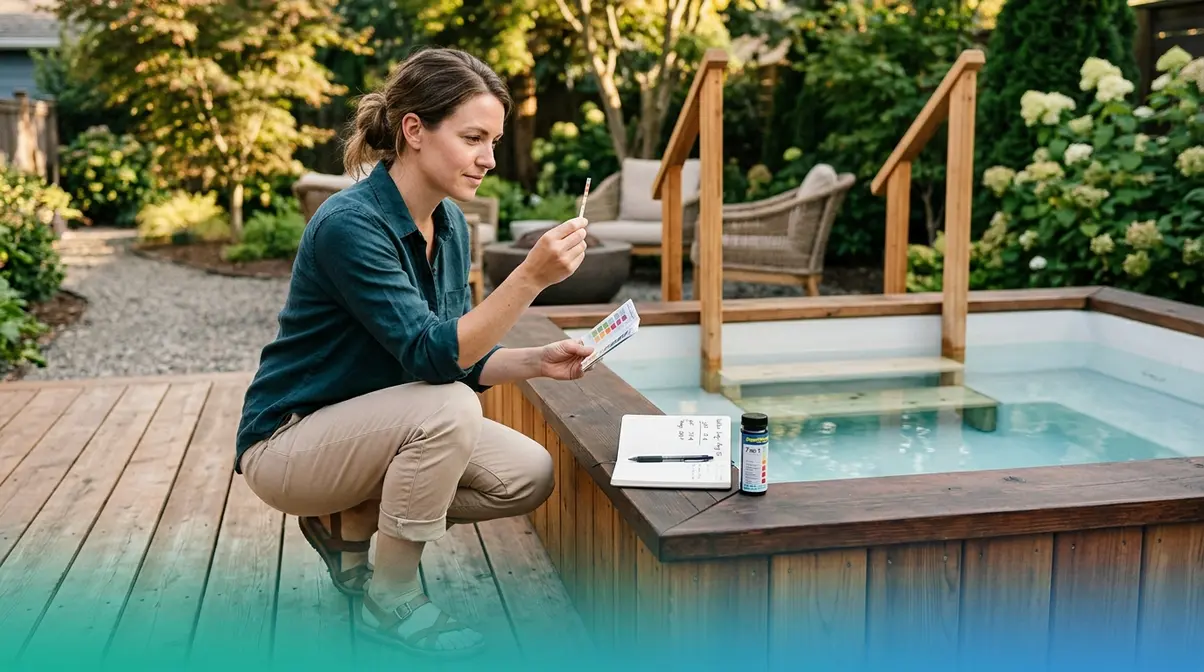
Good hot tub maintenance isn’t about mastering chemistry — it’s about building a short habit. Industry guidelines recommend testing your water 2–4 times per week and performing a handful of quick tasks each visit. Do that consistently, and you’ll prevent cloudy water, skin irritation, equipment damage, and costly repairs before they ever start.
What Is Hot Tub Maintenance and Why Does It Matter?
Hot tub maintenance is the ongoing process of balancing water chemistry, cleaning physical components, and monitoring equipment to keep your spa safe and functional. It matters for three reasons: your health, your investment, and your enjoyment.
Untreated hot tub water is a breeding ground for bacteria. The CDC identifies Pseudomonas aeruginosa as the primary cause of hot tub rash (folliculitis) (CDC, 2026), and Legionella bacteria — responsible for a serious form of pneumonia — can also thrive in poorly maintained spa water (CDC, 2026). Regular sanitizer testing directly prevents both.
On the equipment side, water that’s too acidic corrodes your heater, pump seals, and shell. Water that’s too alkaline causes scale buildup that clogs jets and damages the heating element. According to industry guidelines from Swim University, imbalanced water is the single leading cause of premature hot tub equipment failure.
The practical answer to “What regular maintenance does a hot tub need?” for hassle-free hot tub water care is this: test the water, add chemicals when needed, rinse the filter monthly, and drain every 3–4 months. Everything else is detail around those four pillars.
What You Need Before You Start
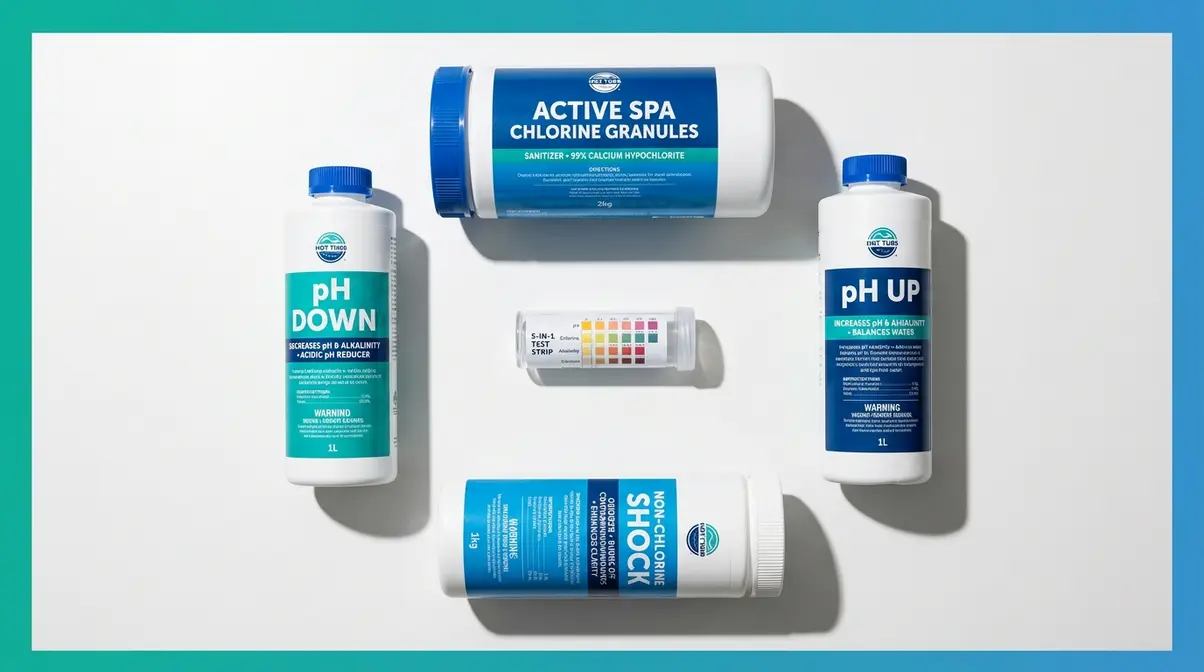
Before you add a single drop of chemical, gather these tools. Having them within arm’s reach makes the five-minute routine actually take five minutes.
Essential starter supplies:
| Item | Purpose | Notes |
|---|---|---|
| Test strips or liquid test kit | Measure pH, chlorine/bromine, alkalinity | Test strips are faster; liquid kits are more accurate |
| Chlorine granules or bromine tablets | Primary sanitizer | Granules dissolve faster; tablets use a floater |
| pH increaser (sodium carbonate) | Raise low pH | Also called “pH Up” |
| pH decreaser (sodium bisulfate) | Lower high pH | Also called “pH Down” |
| Alkalinity increaser | Stabilize pH swings | Sodium bicarbonate (baking soda works) |
| Hot tub shock (oxidizer) | Break down organic waste | Non-chlorine or chlorine shock |
| Filter cleaner spray | Monthly filter rinse | Removes oils and debris |
| Water clarifier | Polish cloudy water | Optional but useful |
| Nitrile gloves | Chemical handling safety | Always wear when dosing |
| Floating thermometer | Monitor water temp | Digital is more reliable |
Always refer to your hot tub manufacturer’s manual for model-specific dosing instructions — volumes vary significantly between a 250-gallon inflatable and a 500-gallon acrylic spa.
Acrylic vs. Inflatable Hot Tub Maintenance: Key Differences
Most guides online assume you own a hard-shell acrylic spa. If you have an inflatable hot tub (like a Lay-Z-Spa or Intex), the core chemistry is the same — but several practical steps differ significantly.
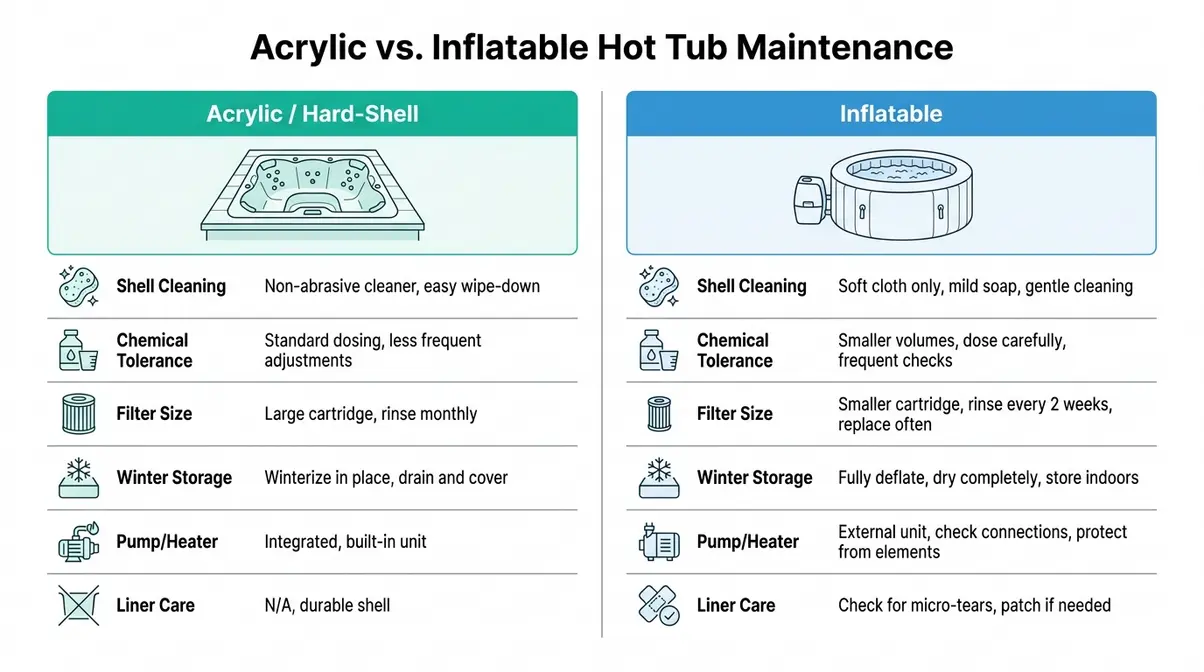
| Factor | Acrylic/Hard-Shell | Inflatable |
|---|---|---|
| Shell cleaning | Non-abrasive spa cleaner | Soft cloth only — no abrasive pads |
| Chemical tolerance | Standard dosing per gallon | Same ratios, but smaller volumes — dose carefully |
| Filter size | Larger cartridge, monthly clean | Smaller cartridge, clean every 2 weeks |
| Winter storage | Winterize in place or drain | Fully deflate, dry, and store indoors |
| Pump/heater | Integrated, higher flow rate | External unit — check connections regularly |
| Liner care | N/A | Check for micro-tears after each use |
For inflatable tubs, use the lower end of every chemical dosing range. The smaller water volume means chemicals concentrate faster, and an overdose is harder to dilute.
Introducing the 5-Minute Maintenance Method
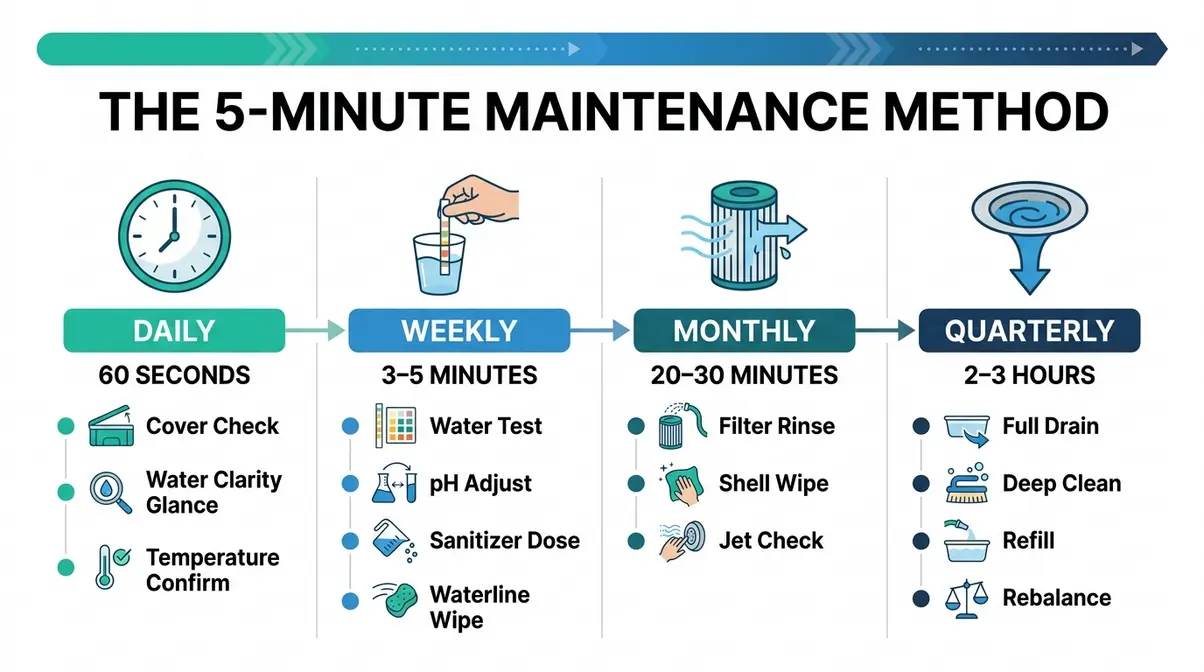
When learning how to maintain a hot tub, the 5-Minute Maintenance Method is the organizing framework for this entire guide. The core insight: most hot tub problems don’t develop overnight. They build gradually when small tasks get skipped repeatedly. Catching them early — in five minutes or less — prevents the hours-long fixes later.
Here’s how the time breaks down:
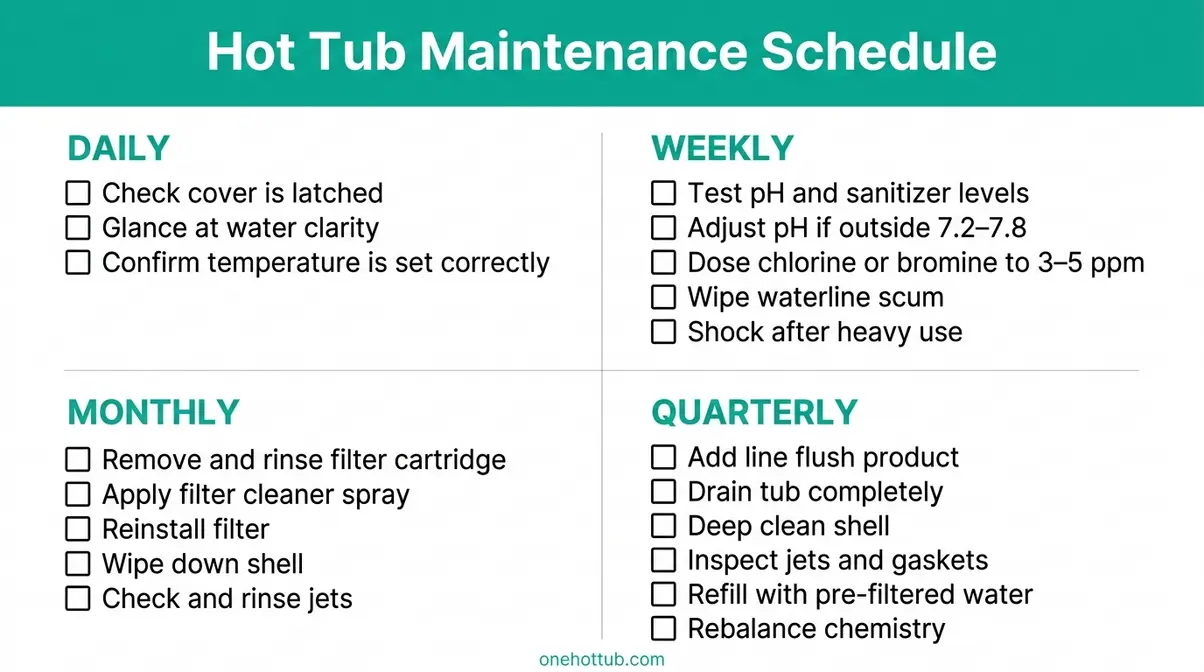
- Daily (60 seconds): Check the cover, glance at the water clarity, confirm the temperature
- Weekly (3–4 minutes): Test the water, adjust chemicals, rinse the waterline
- Monthly (20–30 minutes): Remove and rinse the filter, wipe the shell
- Quarterly (2–3 hours, twice a year): Drain, deep clean, refill, rebalance
The daily and weekly tasks are where the 5-Minute Method lives. They’re the habit that keeps the quarterly drain from being a disaster. Hot tub owners who skip weekly testing consistently report the same three problems: cloudy water, skin irritation, and a strong chemical smell — all of which are signs of imbalanced water that a two-minute test strip check would have caught.
Your Complete Hot Tub Maintenance Schedule
A consistent schedule is the single biggest predictor of clean, clear water. According to Hot Spring Spas, owners who follow a structured weekly routine spend 70% less time troubleshooting water problems than those who test reactively.
Daily Hot Tub Maintenance Tasks

Daily tasks take under a minute. Their purpose is observation — catching problems before they escalate.
Every day, do these three things:
- Check the cover. Make sure it’s fully latched. A covered tub retains heat, reduces chemical evaporation, and keeps debris out. A loose cover can raise your heating costs by 30–40% (Hot Spring, internal data).
- Glance at the water. It should be clear and slightly blue-tinted. Cloudiness, foam, or a green tint are early warning signs — note them and plan to test that day.
- Confirm the temperature. Set your tub to your preferred temperature (maximum 104°F per CPSC guidelines). If the temp has dropped unexpectedly, the heater or cover may need attention.
That’s it. Sixty seconds, three checks. The cover step alone prevents more problems than any chemical.
Weekly Hot Tub Maintenance Tasks
Weekly tasks are where the 5-Minute Method earns its name. Plan for 3–5 minutes before or after each soak.
Before each use (and at least twice a week):
- Test the water. Dip a test strip and read the results within 15 seconds. Check pH, chlorine or bromine, and total alkalinity.
- Adjust pH first. Target range: 7.2–7.8. Low pH (below 7.2) corrodes equipment and irritates eyes. High pH (above 7.8) reduces sanitizer effectiveness and causes scale. Add pH increaser or decreaser in small amounts — typically ½ teaspoon per 100 gallons — then wait 30 minutes and retest.
- Adjust alkalinity if needed. Target: 80–120 ppm (parts per million). Alkalinity acts as a buffer that prevents pH from swinging wildly. If it’s low, add alkalinity increaser; if it’s high, use pH decreaser.
- Dose sanitizer. Chlorine target: 3–5 ppm; bromine target: 3–5 ppm (CDC, 2026). Add granules directly to the water with the jets running, never to the skimmer.
- Wipe the waterline. Use a soft cloth or spa-safe sponge to remove the scum line (body oils, lotions, and minerals) that builds up at the water’s surface. This takes 60 seconds and prevents buildup that clogs filters, reducing the time spent cleaning and maintaining spa filters.
After heavy use (4+ bathers or a party):
- Shock the water. Heavy use depletes sanitizer rapidly. Add a non-chlorine shock oxidizer after each heavy-use session and run the jets for 20 minutes with the cover off.
Monthly Hot Tub Maintenance Tasks
Monthly tasks go deeper. Plan for 20–30 minutes once a month.
Steps for your monthly maintenance session:
- Remove the filter cartridge. Turn off the pump first. Most filters twist out counterclockwise.
- Rinse with a garden hose. Hold the filter at a 45-degree angle and work the hose between each pleat. This removes trapped debris, hair, and fine particles.
- Apply filter cleaner spray. Spray the entire cartridge with a dedicated spa filter cleaner and let it soak for 15 minutes. This breaks down oils and mineral deposits that water alone can’t remove.
- Rinse again thoroughly. Make sure no cleaner residue remains — it will foam your water.
- Reinstall the filter and restart the pump.
- Wipe down the shell. Use a non-abrasive spa cleaner on the acrylic surface (or a soft cloth on inflatable liners). Pay attention to the seats and footwell where body oils concentrate.
- Check the jets. Remove any jet faces you can unscrew and rinse them. Clogged jets reduce circulation, which accelerates bacteria growth.
Industry guidelines recommend keeping a spare filter cartridge on hand so you can rotate them — one soaking in filter cleaner while the other runs in the tub.
Quarterly Draining and Deep Cleaning
Every 3–4 months, drain your hot tub completely and start fresh. This isn’t optional — it’s the most important maintenance task on the calendar.
Why draining matters: Over time, the water accumulates TDS (total dissolved solids) — minerals, body oils, chemical byproducts, and dissolved organic matter. Once TDS climbs above 1,500 ppm, chemicals stop working effectively regardless of how much you add. Leslie’s Pool recommends testing TDS quarterly and draining whenever it exceeds 1,500 ppm or every 3–4 months as a baseline.
Quarterly drain and refill process:
If you’re wondering how often should you change hot tub water, the rule is every 3–4 months using this exact process:
- Add a line flush product to the water 24 hours before draining. This cleans the internal plumbing lines of biofilm buildup.
- Turn off all power at the breaker before draining.
- Drain via the drain valve or a submersible pump. A submersible pump empties most tubs in 30–45 minutes; the drain valve takes 1–2 hours.
- Clean the shell thoroughly with a spa surface cleaner while it’s empty. Scrub the seats, footwell, and waterline ring.
- Rinse the empty shell with fresh water to remove all cleaner residue.
- Inspect jets, gaskets, and fittings for cracks or wear while you have clear access.
- Refill with fresh water using a pre-filter hose attachment (this removes metals and minerals from tap water that cause staining).
- Balance the new water — test and adjust alkalinity first, then pH, then sanitizer. New water often needs a full balancing session before it’s ready to use.
Hot Tub Maintenance Chemicals: Your Complete Water Chemistry Guide
Water chemistry is the part that intimidates most beginners — and the part that becomes second nature within a month. The core principle: keep four numbers in range, and your water will stay clear and safe. According to Swim University, the vast majority of cloudy water, skin irritation, and equipment damage traces back to just one of these four parameters being out of range.
The Essential Hot Tub Chemicals You Need
Hot tub maintenance chemicals fall into four categories. You need all four—along with reliable hot tub water testing kits—but you don’t need to buy every product on the shelf.
| Chemical | Purpose | Target Range |
|---|---|---|
| Chlorine granules OR bromine tablets | Sanitizer — kills bacteria | 3–5 ppm (chlorine) / 3–5 ppm (bromine) |
| pH increaser (sodium carbonate) | Raise low pH | Use when pH < 7.2 |
| pH decreaser (sodium bisulfate) | Lower high pH | Use when pH > 7.8 |
| Alkalinity increaser | Stabilize pH | Target: 80–120 ppm |
| Shock (non-chlorine oxidizer) | Destroy organic waste | Weekly or after heavy use |
| Calcium hardness increaser | Prevent corrosion/scale | Target: 150–250 ppm |
Calcium hardness — the measure of dissolved calcium in your water — is the one parameter many beginners skip. Water that’s too soft (below 150 ppm) is “hungry” and will leach calcium from your shell and equipment. Water that’s too hard (above 250 ppm) causes white scale deposits on jets and the waterline.
Always add chemicals to the water with the jets running, never to a stagnant tub. Never mix two chemicals together outside of the water. Always refer to your manufacturer’s guidelines for dosing amounts specific to your tub’s gallon capacity.
Chlorine vs. Bromine: Which Sanitizer Should You Use?
Both chlorine and bromine kill bacteria and viruses effectively. The CDC recommends maintaining sanitizer levels between 3–10 ppm for hot tubs, with 3–5 ppm as the practical target for regular use (CDC, 2026). The choice between them comes down to your preferences and tub type.
Chlorine dissolves faster, costs less, and is easier to adjust quickly. It’s the default choice for most acrylic tubs. The downside: it breaks down faster at high temperatures and in UV light, so outdoor tubs may need more frequent dosing.
Bromine is more stable at high temperatures, making it better suited to hot tubs than swimming pools. It’s gentler on skin and eyes, and it doesn’t produce the strong chemical smell chlorine does at high levels. The trade-off: it costs more and requires a bromine “bank” to be established before it works effectively.
| Factor | Chlorine | Bromine |
|---|---|---|
| Cost | Lower (~$15–25/month) | Higher (~$25–40/month) |
| Stability at high heat | Moderate | High |
| Skin sensitivity | Can irritate some users | Generally gentler |
| Smell | Stronger at high levels | Milder |
| Best for | Most acrylic tubs, budget-conscious owners | Sensitive skin, outdoor tubs |
| Works with saltwater system? | Yes | No |
For inflatable tubs, chlorine granules are generally preferred — they’re easier to dose precisely for smaller water volumes.
How to Balance pH and Total Alkalinity
pH is a measure of how acidic or alkaline your water is, on a scale of 0–14. When managing pH levels in a hot tub, remember that water should sit between 7.2 and 7.8 — slightly alkaline. Below 7.2 and the water becomes acidic enough to corrode your heater and irritate skin. Above 7.8, chlorine loses up to 80% of its effectiveness, which means bacteria can survive even when your sanitizer reads in range.
Total alkalinity (TA) is the buffer that holds your pH stable. Think of it as the anchor: when alkalinity is in range (80–120 ppm), pH stays put. When alkalinity is low, pH swings wildly from day to day, making the water unpredictable and hard to balance.
The correct adjustment order (always follow this sequence):
- Adjust total alkalinity first. If TA is below 80 ppm, add alkalinity increaser per the package instructions. If it’s above 120 ppm, add pH decreaser slowly and retest after 4 hours.
- Adjust pH second. Once alkalinity is stable, pH is much easier to fine-tune. Add pH Up or pH Down in small increments (½ teaspoon per 250 gallons), wait 30 minutes with jets running, then retest.
- Adjust sanitizer third. Add chlorine or bromine after pH is in range — sanitizer is far more effective at the correct pH.
- Shock last. Add shock after all other parameters are balanced, run the jets for 20 minutes, and leave the cover off for 30 minutes.
Skipping this order is the most common beginner mistake. Adding sanitizer to water with a pH of 8.2 wastes product and leaves your water unsafe.
When and How to Shock Your Hot Tub
Shocking means adding a large dose of oxidizer to break down chloramines (combined chlorine), organic waste, and other contaminants that regular sanitizer can’t eliminate. You should shock your hot tub in three situations:
- Weekly as part of your regular routine (or after every 3–4 uses)
- After heavy use — parties, multiple bathers, or guests who didn’t shower first
- After a water problem — cloudy water, foam, or an unusual smell
How to shock your hot tub (step by step):
- Test the water first and confirm pH is between 7.2–7.8.
- Remove the cover and turn the jets on high.
- Measure the shock dose according to your product label (typically 1–2 oz per 250 gallons for non-chlorine shock).
- Broadcast the shock granules across the surface of the water — don’t dump it all in one spot.
- Run the jets for 20 minutes with the cover off to allow oxidation gases to escape.
- Wait 30–60 minutes before re-testing sanitizer levels.
- Replace the cover only after sanitizer returns to the 3–5 ppm range.
Safety note: Always wear nitrile gloves when handling shock. Never add shock directly to the skimmer — it can damage the filter. Never mix shock with any other chemical. Store all hot tub chemicals in a cool, dry place away from children.
Low-Chemical Alternatives: Saltwater, Ozone, and Mineral Systems
If you prefer to reduce your reliance on traditional chlorine, three systems can lower — but not eliminate — chemical use.
Saltwater systems use a salt cell to generate chlorine from dissolved salt. The result is softer-feeling water and lower ongoing chemical costs. Salt levels run around 2,000–3,000 ppm (far lower than ocean water). You still need to test pH and alkalinity weekly, and you’ll still add shock periodically.
Ozone systems inject ozone gas into the water to destroy bacteria and organic contaminants. Ozone is highly effective but dissipates quickly, so you still need a residual sanitizer (chlorine or bromine at reduced levels, around 1–3 ppm). Most ozone-equipped tubs run the ozone generator automatically during filtration cycles.
Mineral systems use silver and copper ions to supplement sanitization, allowing you to reduce chlorine levels to as low as 0.5 ppm. They typically come as a cartridge inserted into the filter housing and last 4–6 months.
None of these systems are truly “chemical-free” — the term is a marketing claim. They reduce chemical demand, which is a genuine benefit for skin-sensitive owners and those who prefer a more natural approach.
Choosing the Right Hot Tub Maintenance Kit
A well-stocked starter kit prevents the most common beginner problem: running out of a critical chemical mid-session and being unable to use the tub safely. Buying the right kit upfront saves multiple emergency trips to the pool store.
What a Starter Maintenance Kit Should Include
A hot tub maintenance kit for beginners should cover testing, balancing, sanitizing, and cleaning. While advanced hot tub chemical monitoring systems are great upgrades, a basic kit should cover the essentials. Here’s what to look for:
Non-negotiable kit components:
- Test strips (5-in-1 minimum: pH, chlorine/bromine, alkalinity, hardness, cyanuric acid) — or a liquid drop test kit for more accuracy
- Chlorine granules (1–2 lbs to start) or a bromine tablet floater with tablets
- pH Up and pH Down (small bottles — 1 lb each to start)
- Alkalinity increaser (sodium bicarbonate, 1 lb)
- Non-chlorine shock (1 lb)
- Filter spray cleaner (1 bottle lasts 6–8 monthly cleanings)
- Waterline cleaning sponge (spa-safe, non-abrasive)
- Nitrile gloves (chemical handling)
Optional but recommended:
- Water clarifier (for clearing minor cloudiness)
- Calcium hardness increaser (if your tap water is soft)
- Enzyme-based cleaner (breaks down oils in the water naturally)
- Pre-filter hose attachment (removes metals from tap water during refills)
Pre-packaged beginner kits from brands like Leisure Time, SpaGuard, and In The Swim typically run $40–$80 and include most of the essentials. Verify the kit matches your sanitizer choice (chlorine vs. bromine) before buying.
The Best Maintenance Kit for Inflatable Hot Tubs
Inflatable hot tub owners need a slightly modified kit. The core chemistry is identical, and you’ll still need a reliable hot tub water tester kit, but several tools and products differ.
Inflatable-specific additions:
| Item | Why It’s Different | Recommendation |
|---|---|---|
| Soft microfiber cloths | Abrasive pads scratch and weaken vinyl liners | Replace sponge with microfiber |
| Vinyl repair kit | Micro-tears happen — catch them early | Keep on hand at all times |
| Smaller chemical doses | 150–300 gallon volume vs. 400–500 for acrylic | Buy smaller packages or measure carefully |
| Compact filter cartridges | Inflatable filters are smaller and clog faster | Stock 2 spare cartridges |
| Submersible pump (small) | Inflatable drain valves are slow | Speeds up quarterly drains significantly |
For inflatable tubs, the filter needs rinsing every 1–2 weeks rather than monthly — the smaller cartridge surface area clogs faster with the same bather load. Many inflatable tub manufacturers (including Lay-Z-Spa and Intex) offer brand-specific chemical starter kits — these are worth considering since dosing instructions are calibrated to their tub volumes.
Hot Tub Health and Safety: What Every Owner Must Know
Safe hot tub use comes down to two things: clean water and responsible soaking habits. The health risks from poorly maintained hot tubs are real and well-documented — but they’re almost entirely preventable with the routines covered in this guide.
How to Prevent Hot Tub Rash (Folliculitis)
To prevent hot tub folliculitis, which is a skin infection caused by Pseudomonas aeruginosa bacteria, you must maintain properly sanitized water. Symptoms include red, itchy bumps — typically appearing 12–48 hours after a soak — most often on the torso and areas covered by a swimsuit.
The CDC identifies inadequate chlorine levels as the primary cause of hot tub folliculitis outbreaks (CDC, 2026). The prevention protocol is straightforward:
- Maintain chlorine at 3–5 ppm (or bromine at the same range) at all times. Test before every soak.
- Shower before entering. Body oils, lotions, and cosmetics consume sanitizer rapidly, dropping effective chlorine levels within minutes of entering.
- Shock after heavy use. Chloramines — the byproduct of chlorine reacting with organic matter — are ineffective against bacteria and cause the characteristic “chemical smell.” Shocking eliminates them.
- Rinse your swimsuit with fresh water after each use. Bacteria can survive in wet fabric and re-enter the tub on your next soak.
Legionella bacteria — responsible for Legionnaires’ disease, a serious pneumonia — can also grow in hot tub water and aerosolized spray (CDC, 2026). Maintaining proper sanitizer levels and completing quarterly drains eliminates the biofilm environments where Legionella colonizes.
If you develop a rash, bumps, or respiratory symptoms after using your hot tub, consult a doctor and check your water chemistry immediately.
The Tennis Ball Trick and Other Practical Maintenance Hacks
Why put tennis balls in a hot tub?
The fuzzy felt surface of a standard tennis ball absorbs body oils, sunscreen, and cosmetic residue that accumulate on the water’s surface and cause the waterline scum ring. As noted by Consumer Reports, dropping one or two tennis balls into the water allows them to passively absorb oils during each soak session.
The tennis ball trick is a widely endorsed home remedy among hot tub communities — the r/hottub community has thousands of posts confirming it works for reducing waterline buildup and filter clogging. The mechanism is straightforward: the synthetic fibers in the felt act like a sponge for hydrophobic (oil-based) substances that don’t mix with water.
How to use the tennis ball method:
- Drop 1–2 clean, unused tennis balls into the water.
- Leave them in during soaking sessions.
- Replace them monthly, or when they feel saturated and heavy.
- Use in combination with — not as a replacement for — regular filter cleaning.
Are walker glides better than tennis balls for hot tubs?
Walker tennis ball glides (the hollow plastic caps used on walkers and crutches) are smoother and don’t shed felt fibers into the water. Several hot tub owners prefer them for inflatable tubs where felt fibers could potentially clog the smaller filter cartridge. For acrylic tubs, either works well.
Other practical hacks worth knowing:
- Baking soda as alkalinity increaser: Pure sodium bicarbonate (baking soda) raises total alkalinity at a fraction of the cost of branded products. Use the same dosing rate (1 oz raises alkalinity ~10 ppm in 100 gallons).
- White vinegar for calcium scale: A diluted white vinegar solution (1:1 with water) applied with a cloth removes light calcium deposits from the waterline and jet faces.
- Pantyhose over the skimmer: Stretching a nylon stocking over the skimmer basket catches fine hair and debris before it reaches the filter — extends filter life between cleanings.
Safe Soaking: Temperature Limits and the 15-Minute Rule
⚠️ Safety Warning: The following guidelines are based on CPSC and CDC recommendations. Always consult your doctor before using a hot tub if you are pregnant, have cardiovascular conditions, or take medications that affect blood pressure or circulation. As part of any comprehensive hot tub safety guide, safe soaking comes down to managing temperature and time.
Why is there a 15-minute hot tub rule?
The 15-minute rule comes directly from CPSC safety guidelines: limit continuous soaking sessions to 15 minutes at a time at temperatures between 100–104°F. Exit the tub, cool down for at least 5 minutes, and re-enter if desired. This prevents hyperthermia (dangerous overheating of the body’s core temperature).
According to the CPSC, water temperatures should never exceed 104°F (40°C). Above this threshold, the risk of heat stroke, dizziness, and cardiac stress increases significantly — particularly for children, elderly individuals, and pregnant women (CPSC).
What happens if you sit in a hot tub for 3 hours?
Continuous soaking for extended periods — particularly at high temperatures — causes the body’s core temperature to rise progressively. Symptoms include dizziness, nausea, rapid heartbeat, and in severe cases, loss of consciousness. The risk is highest for those who have been drinking alcohol, as alcohol impairs the body’s ability to regulate temperature. The CPSC links extended hot tub use to dozens of drowning and heat-related deaths annually.
Can you go in a hot tub twice a day?
Yes, with proper intervals. Follow the 15-minute rule each time, allow your body to cool fully between sessions (at least 20–30 minutes), stay hydrated, and avoid alcohol before soaking. Two brief, safe soaks are far better than one dangerously long one.
Why shouldn’t you put your head under water in a hot tub?
Hot tub water contains higher concentrations of sanitizing chemicals than a swimming pool, and the warm temperature can cause chemicals to irritate eyes, ears, and nasal passages more aggressively. More critically, submerging your head near jet intakes creates a serious hair and body entrapment risk. The CPSC has documented entrapment incidents involving drains and jet openings — keep hair tied back and heads above water.
Common Hot Tub Maintenance Mistakes (And How to Avoid Them)
Even diligent hot tub owners run into trouble. The most common problems aren’t random — they follow predictable patterns that experienced owners recognize immediately.
Common Pitfalls
1. Testing water reactively instead of proactively.
Waiting until the water looks cloudy to test means the problem has already developed. By the time water turns visibly cloudy, bacterial counts may already be elevated and chemical imbalance has been present for days. Fix: Test before every soak and at least twice a week regardless of appearance.
2. Adding chemicals in the wrong order.
Adding sanitizer before adjusting pH means a significant percentage of that sanitizer is immediately ineffective. Chlorine is only about 20% effective at pH 8.0 vs. nearly 80% effective at pH 7.2. Fix: Always follow the sequence: alkalinity → pH → sanitizer → shock.
3. Skipping the shower before soaking.
This is the single fastest way to deplete your sanitizer and trigger folliculitis. A single bather who hasn’t showered can introduce enough body oils and organic matter to drop effective chlorine by 1–2 ppm within minutes. Fix: Make pre-soak showering a non-negotiable house rule.
4. Overdosing chemicals to “fix” problems faster.
Doubling the chemical dose doesn’t fix imbalanced water twice as fast — it often creates a new imbalance. High chlorine (above 10 ppm) irritates skin and eyes and degrades your tub’s shell and equipment. Fix: Dose per instructions, wait the recommended time, retest, and adjust incrementally.
5. Neglecting the filter.
A clogged filter reduces water circulation, which means the sanitizer isn’t distributed evenly — creating dead zones where bacteria can grow. Hot tub owners commonly report that the fastest improvement to cloudy water comes from cleaning the filter, not adding more chemicals. Fix: Rinse monthly, deep clean with filter spray quarterly, and replace annually.
When to Choose Alternatives
When your water problems persist after three days of correct treatment: Consider draining and refilling. Sometimes TDS is simply too high for chemicals to work effectively, and a fresh start is faster and cheaper than continued product use.
When you have severe skin sensitivity to chlorine: Switch to bromine or explore an ozone/mineral hybrid system. Persistent skin reactions to properly dosed chlorine are a real issue for some users, and alternatives exist.
When your inflatable tub shows liner damage: Repair kits handle minor punctures, but visible cracking or seam separation means it’s time to replace the tub. Continuing to use a compromised inflatable creates both safety and sanitation risks.
When to Seek Expert Help
Some problems genuinely require a professional. Contact a certified pool and spa technician if:
- Your heater stops functioning and a filter clean doesn’t resolve it
- You notice persistent green or brown staining that doesn’t respond to shock treatment (may indicate metal contamination from your water supply)
- Your pump makes unusual sounds or loses prime
- You experience recurring folliculitis despite maintaining correct chemical levels — this may indicate a biofilm problem in the plumbing lines requiring professional line flushing
Always consult your hot tub manufacturer’s warranty documentation before attempting repairs — some DIY fixes void coverage.
Frequently Asked Questions About Hot Tub Maintenance
What regular maintenance does a hot tub need?
Hot tub maintenance requires four recurring tasks: daily cover checks, weekly water testing and chemical adjustment, monthly filter cleaning, and a full drain and refill every 3–4 months. Industry guidelines recommend testing pH and sanitizer levels 2–4 times per week — pH should sit at 7.2–7.8 and chlorine at 3–5 ppm (CDC, 2026). Most owners find that 5 minutes before or after each soak covers the daily and weekly tasks completely.
Can hot tubs cause folliculitis?
Yes — hot tub folliculitis is a real skin infection caused by Pseudomonas aeruginosa bacteria that thrive in warm, under-sanitized water. The CDC identifies inadequate chlorine levels as the primary cause. To prevent it, maintain chlorine at 3–5 ppm, shower before entering, and shock after heavy use.
What happens if you sit in a hot tub for 3 hours?
Extended soaking causes your body’s core temperature to rise to dangerous levels. Symptoms of prolonged exposure include dizziness, nausea, rapid heartbeat, and in severe cases, loss of consciousness or heat stroke. The risk is compounded by alcohol consumption, which impairs temperature regulation. The CPSC links extended hot tub use to heat-related deaths and drowning incidents annually. Limit continuous soaks to 15 minutes, cool down fully between sessions, and stay hydrated throughout.
Can you go in a hot tub twice a day?
Yes, you can safely soak twice a day with proper intervals. Follow the 15-minute rule each time and allow at least 20–30 minutes of cooling between sessions. Your water chemistry won’t suffer from two soaks in a day, provided you test and adjust the sanitizer afterward.
Why shouldn’t you put your head under water in a hot tub?
Two reasons: chemical irritation and entrapment risk. Hot tub water contains higher sanitizer concentrations than swimming pools, and the warm temperature intensifies how chemicals affect eyes, ears, and nasal passages. More critically, jet intakes and drain covers create suction forces that pose a documented hair and body entrapment hazard. Keep hair tied back, avoid submerging near any openings, and ensure your drain cover is ASME/ANSI compliant.
Your Hot Tub Routine Starts Today
For new hot tub owners, the most important thing to understand is this: hot tub maintenance tips work best when they’re habits, not events. The 5-Minute Maintenance Method isn’t about doing everything perfectly on day one — it’s about doing a few small things consistently every time you use your tub. Test the water. Check the cover. Rinse the waterline. Those three habits, done reliably, prevent 90% of the problems that send panicked hot tub owners to the pool store.
The 5-Minute Maintenance Method also reframes what maintenance actually is. It’s not a chore you delay until the water turns green. It’s a 60-second check before you soak and a 3-minute adjustment after. The quarterly drain feels like a big task until you’ve done it twice — then it’s just an afternoon, and the fresh water is worth every minute.
Start this week. Fill a bucket with your starter chemicals, keep your test strips on the ledge next to the tub, and run through your first weekly test before your next soak. Within 30 days, the routine will feel automatic — and your water will prove it’s working.

David King
Hot tub tester and writer at One Hot Tub.