What’s in this guide
Home ›Hot Tub Water Management
⚠️ Safety Disclaimer: This guide contains health and safety information about hot tub use, including chemical handling and temperature limits. The content is for educational purposes only and is not a substitute for professional medical advice. Always follow your hot tub manufacturer’s instructions. If you develop a skin rash, dizziness, or any other health symptom after using your hot tub, consult a doctor promptly. When in doubt about chemical safety, contact a certified pool and spa professional.
You just got a hot tub — and now you’re staring at a bag of chemicals wondering what on earth you’re supposed to do with them.
“Got a hot tub I didn’t ask for, now I need to learn how to…”
Sound familiar? You’re not alone. Hot tub water care for beginners feels intimidating at first, but here’s the reassuring truth: once you understand three simple steps, it becomes almost second nature. The whole system comes down to The Safe Soak Cycle — Test → Treat → Enjoy. Test your water before every soak, treat whatever is out of range, then enjoy with confidence. That’s it. This guide walks you through every part of that cycle, from filling your tub for the very first time to keeping it sparkling week after week.
Hot tub water care for beginners is manageable when you follow The Safe Soak Cycle: Test → Treat → Enjoy — a simple three-step framework that keeps your water safe and your skin happy.
- Test first, always: Check pH, alkalinity, and sanitizer before every soak — not after.
- Four numbers matter most: pH (7.2–7.8), Total Alkalinity (80–120 ppm), Calcium Hardness (150–250 ppm), and sanitizer (chlorine 1–3 ppm or bromine 2–4 ppm).
- Weekly maintenance takes five minutes: A consistent routine prevents 90% of beginner problems before they start.
Hot Tub Startup: How to Fill and Add Chemicals
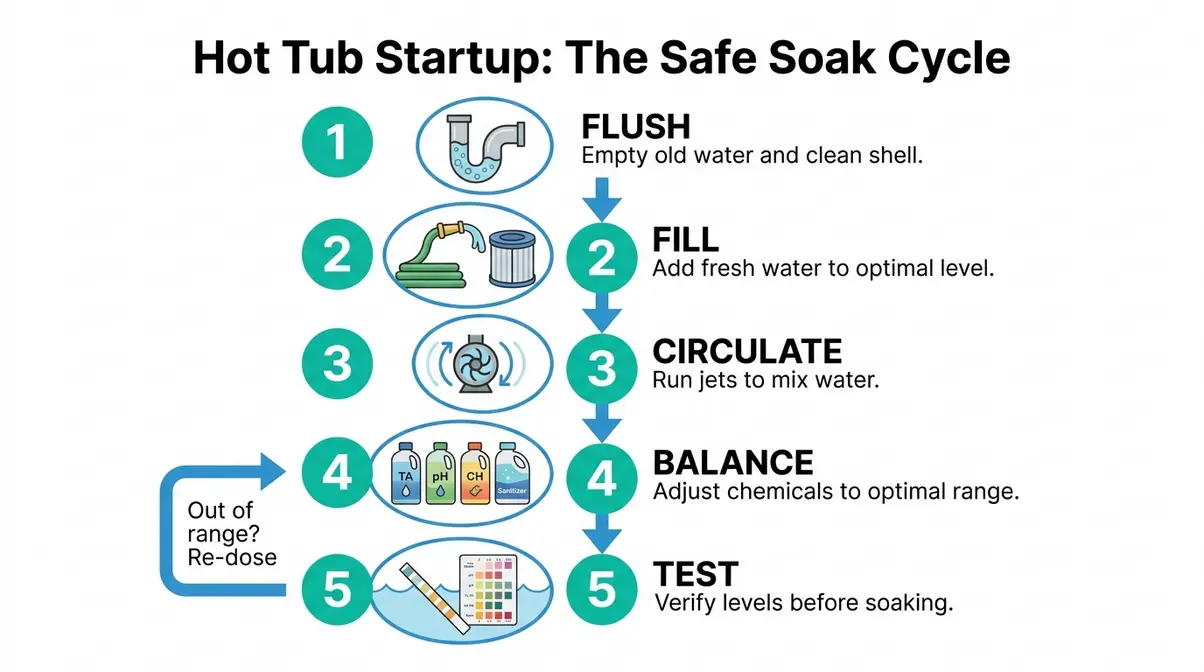
Getting your hot tub started correctly is the single most important thing you’ll do as a new owner. Industry consensus among certified pool and spa professionals is clear: the mistakes made at startup — filling without pre-flushing, adding chemicals in the wrong order, or skipping the initial balance — are the root cause of most beginner headaches in the first month of ownership. Follow these steps precisely once, and you’ll save yourself hours of troubleshooting later with the ultimate beginner’s guide to hassle-free hot tub water care.
What You’ll Need Before You Begin
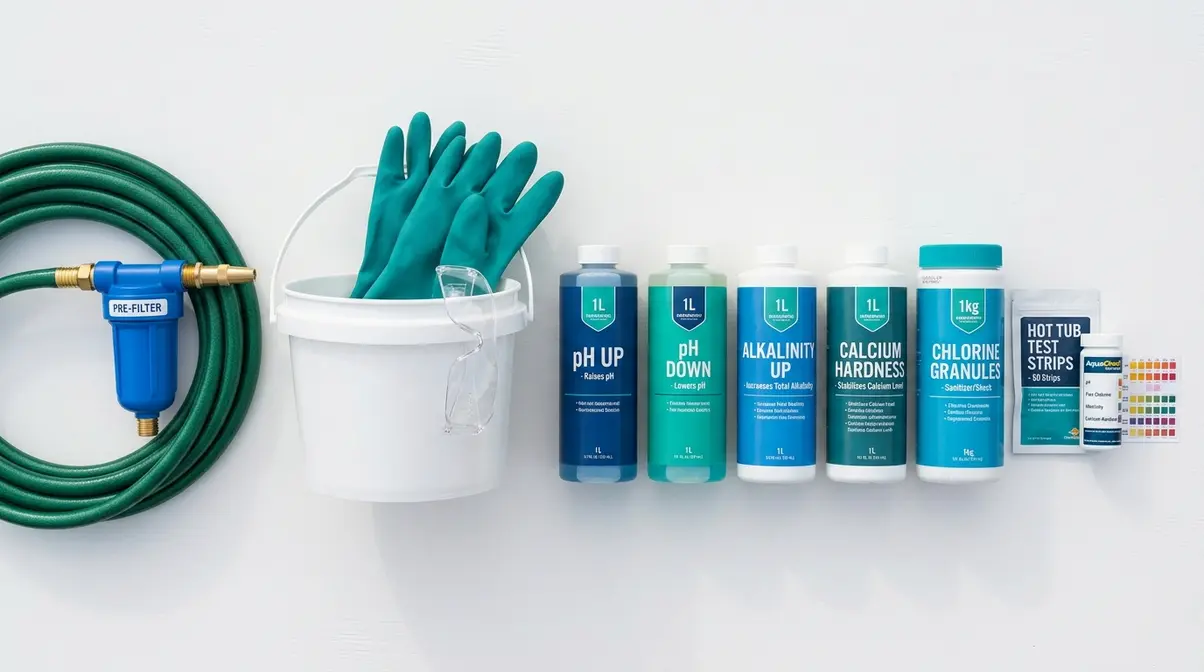
Before you fill with water, gather everything in one place. Hot tub professionals consistently advise that having your hot tub guide with essential tips for first-time owners and your chemical kit ready before you start prevents mid-process panic.
- Your Starter Kit:
- Garden hose with a pre-filter attachment (removes metals and minerals from tap water)
- Hot tub test strips or a liquid test kit
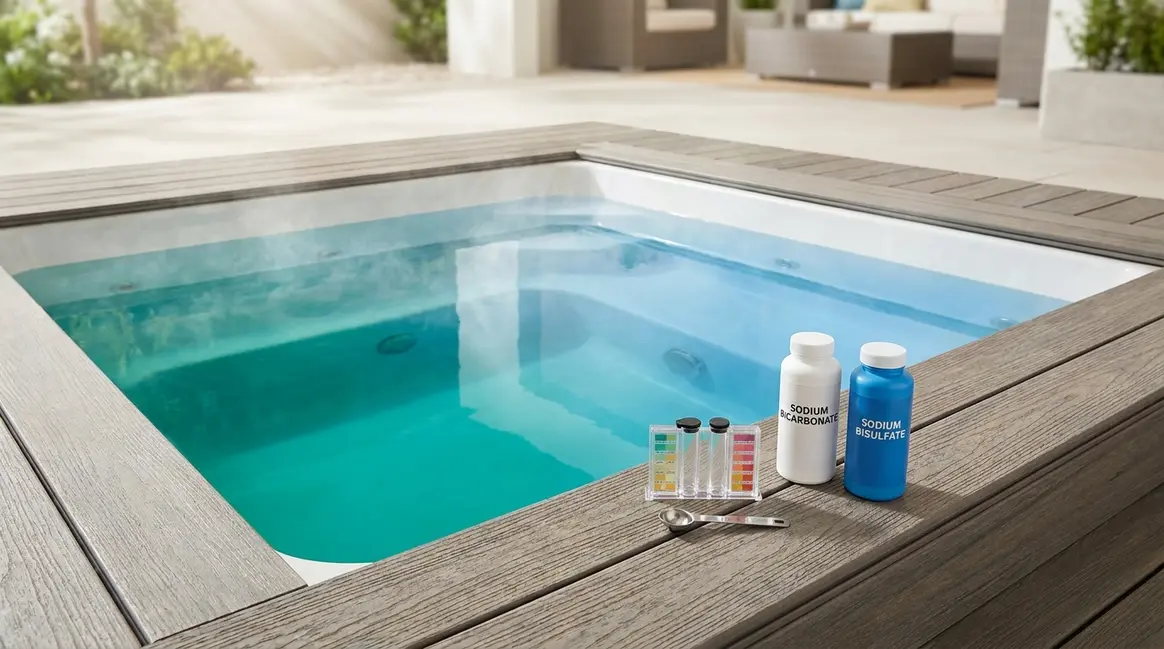
- pH increaser (sodium carbonate) and pH decreaser (sodium bisulfate)
- Total Alkalinity increaser (sodium bicarbonate)
- Calcium hardness increaser (calcium chloride)
- Chlorine granules or bromine tablets (choose one — more on this below)
- Non-foaming hot tub shock (oxidising shock)
- A clean bucket for mixing chemicals
- Protective gloves and safety glasses
You do not need to buy every chemical at once. Start with pH increaser, pH decreaser, alkalinity increaser, and your chosen sanitiser. Add the rest as your test results indicate.
How to Fill and Start Circulating Water
- Flush the plumbing first. Add a line flush product (available at any pool supply store) to the water already in the tub. Run the jets for 20–30 minutes, then drain completely. This removes biofilm — a slimy layer of bacteria — from the pipes.
- Insert a pre-filter on your garden hose. This step is optional but strongly recommended. Pre-filters remove iron, copper, and calcium from your tap water, making the initial balance far easier.
- Fill via the filter housing, not the footwell. Place your hose inside the filter compartment and fill slowly. This prevents an “airlock” — a pocket of trapped air that stops the pump from circulating water properly.
- Fill to the waterline marker. Most hot tubs have a clear fill line. Aim for the middle of the skimmer opening.
- Turn on the power and start circulating water. Set the pumps to run for at least 30 minutes before you add any chemicals. This heats the water and ensures any added chemicals distribute evenly.
Adding Chemicals in the Right Order
This is where most beginners go wrong. Adding chemicals in the wrong order is the #1 startup mistake — and it can lock your chemistry into a frustrating loop that takes days to fix.
Always add chemicals in this sequence:
- Total Alkalinity (TA) first. TA is the “buffer” that stabilises pH. Target: 80–120 ppm (parts per million — how we measure chemical concentration). Add TA increaser with jets running, wait 30 minutes.
- pH second. With TA stable, pH adjusts more predictably. Target: 7.2–7.8. Add increaser or decreaser as needed. Wait 30 minutes, then retest.
- Calcium Hardness third. Target: 150–250 ppm. Low calcium causes water to “eat” your tub’s surfaces; high calcium causes scale. Add with jets running, wait 30 minutes.
- Sanitiser last. Add your chosen sanitiser (chlorine or bromine) only after the other parameters are balanced. An unbalanced pH makes sanitisers far less effective — at pH 8.0, chlorine loses roughly 80% of its sanitising power (Pool & Spa News, 2026).
- Shock the water. After adding sanitiser, add a dose of non-foaming shock. Wait at least 20 minutes (or until sanitiser levels drop to the safe range) before your first soak.
For a deeper dive into chemical troubleshooting beyond startup, our guide to fixing cloudy hot tub water walks through the most common scenarios step by step.
Hot Tub Chemistry 101: Four Numbers to Know
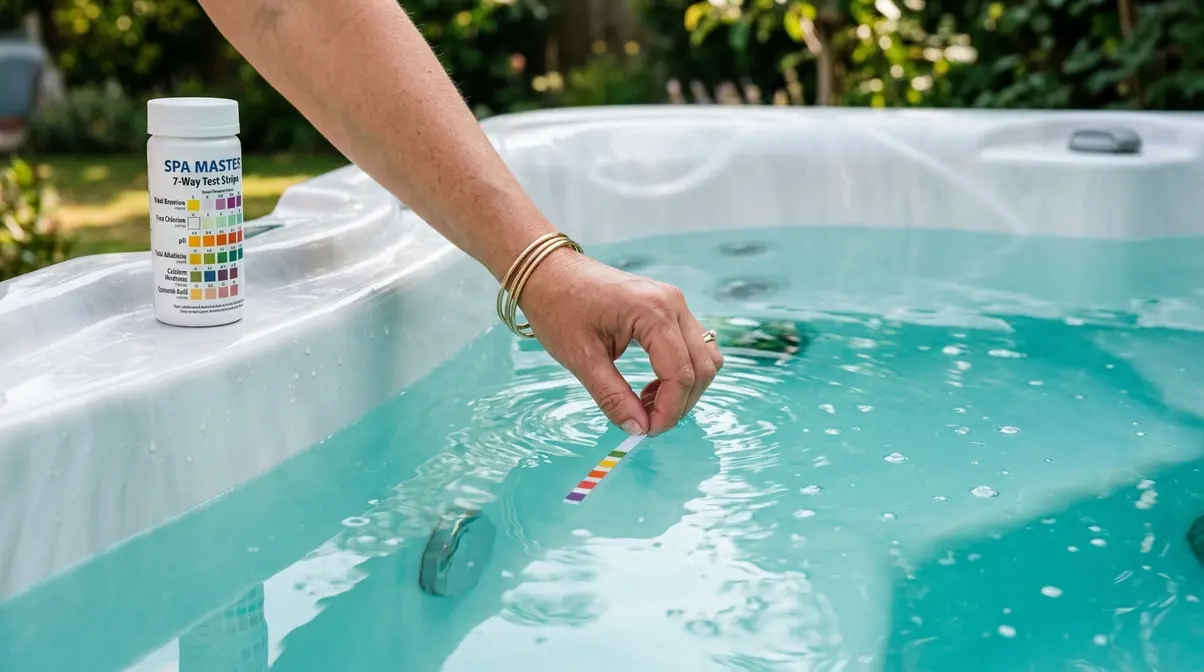
Hot tub chemistry sounds complicated, but you only need to track four numbers. Think of them as the vital signs of your water. When all four are in range, your tub is safe, comfortable, and kind to its own equipment. When even one drifts out of range, problems cascade quickly — cloudy water, skin irritation, and equipment damage all trace back to these four measurements.
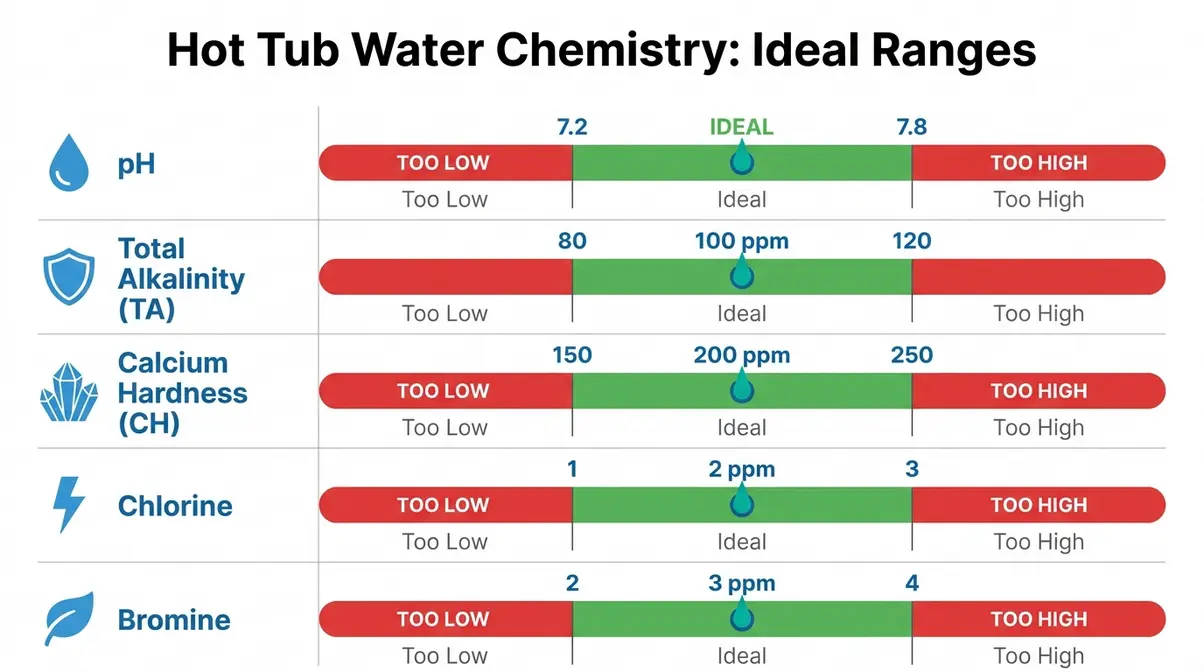
| Parameter | Ideal Range | Too Low = | Too High = |
|---|---|---|---|
| pH | 7.2 – 7.8 | Corrosive water, eye irritation | Cloudy water, scale, weak sanitiser |
| Total Alkalinity | 80 – 120 ppm | pH swings wildly | Scale build-up, cloudy water |
| Calcium Hardness | 150 – 250 ppm | Etched surfaces, foamy water | White scale on shell and jets |
| Chlorine | 1 – 3 ppm | Bacteria survive and multiply | Skin irritation, bleached surfaces |
| Bromine | 2 – 4 ppm | Bacteria survive and multiply | Skin and eye irritation |
**
What Is Total Alkalinity?
Total Alkalinity (TA) is the measure of your water’s ability to resist sudden changes in pH — think of it as a “shock absorber” for your chemistry. When TA is in the correct range (80–120 ppm), your pH stays predictable and easy to manage. When TA is too low, pH bounces around erratically — you add pH increaser and it shoots too high, then you add decreaser and it drops too far. Hot tub professionals refer to this as “pH bounce,” and it is almost always caused by low alkalinity.
Always balance TA before you touch pH. This single rule prevents the most common beginner chemistry loop.
pH: Your Water’s Balance Point
pH is a measure of how acidic or alkaline your water is, on a scale of 0 to 14. Pure water sits at 7.0 (neutral). The CDC guidelines on preventing hot tub rash recommend maintaining hot tub pH between 7.2 and 7.8 to prevent bacterial growth and protect bathers (CDC, Healthy Swimming, 2026). Below 7.2, water becomes acidic — it irritates eyes and skin and slowly corrodes your tub’s shell, pump seals, and heater element. Above 7.8, water turns alkaline — sanitisers become dramatically less effective, scale forms on surfaces, and water turns cloudy.
- Quick fix scenarios:
- pH reads 8.1? Add pH decreaser (sodium bisulfate) in small doses — roughly 1 tablespoon per 500 litres. Retest after 30 minutes.
- pH reads 7.0? Add pH increaser (sodium carbonate). Same dose, same wait time. Never add more than the label specifies in a single dose.
Calcium Hardness and Sanitizers
Calcium Hardness (CH) measures the amount of dissolved calcium in your water. The ideal range is 150–250 ppm. Water that is too “soft” (low calcium) is aggressive — it leaches calcium directly from your tub’s acrylic shell and plumbing, causing pitting and foamy water. Water that is too “hard” (high calcium) deposits white scale on jets, the shell, and the waterline.
If your tap water is very hard (above 300 ppm), consider using a pre-filter when filling. If it is very soft (below 100 ppm), add calcium hardness increaser during startup following the label dosage.
Chlorine vs. Bromine: Which to Choose?
Both chlorine and bromine kill bacteria effectively. If you are wondering what chemicals do I need for my hot tub, your choice depends heavily on how you use your tub.
Choose chlorine if you use your tub occasionally (once or twice a week), prefer a lower-cost option, or want faster-acting sanitisation. Chlorine dissipates more quickly in UV light, so it’s better for outdoor tubs used in daytime.
Choose bromine if you soak frequently, have sensitive skin, or keep your tub indoors. For guidance on choosing bromine or chlorine for your hot tub, note that bromine is more stable at high temperatures and higher pH levels, remains active longer, and produces less of the “chemical smell” associated with chlorine. The CDC notes that bromine can be used as an alternative to chlorine in hot tubs and spas (CDC, Healthy Swimming, 2026).
Neither is wrong. Pick one, stick with it, and never mix the two — combining chlorine and bromine products can cause dangerous chemical reactions.
How to Test Your Water Correctly
Testing is the “T” in The Safe Soak Cycle, and it comes first for a reason. Test your water before every soak — not after — because adding chemicals to water you’re about to sit in can cause skin irritation if levels haven’t had time to stabilise.
- Using test strips (easiest for beginners):
- Dip the strip into the water for 2 seconds, wrist-deep, with jets off.
- Remove and hold horizontally — do not shake.
- Wait exactly 15–20 seconds (as directed on your strip packaging).
- Compare each colour block to the reference chart on the bottle under natural light.
- Record your readings. Then treat what’s out of range before soaking.
Using a liquid test kit (more accurate): Follow the kit instructions precisely, adding the specified number of drops to a water sample. Liquid kits are more accurate than strips for sanitiser levels, especially at lower concentrations.
Test strips are perfectly adequate for weekly maintenance. Many hot tub owners also take a water sample to their local pool supply store every 1–2 months for a free professional analysis — a valuable habit, especially in your first year.
For a full breakdown of which test kit to buy, our review of the best hot tub test kits compares strips, liquid kits, and digital testers side by side.
Hot Tub Maintenance Schedule for Beginners
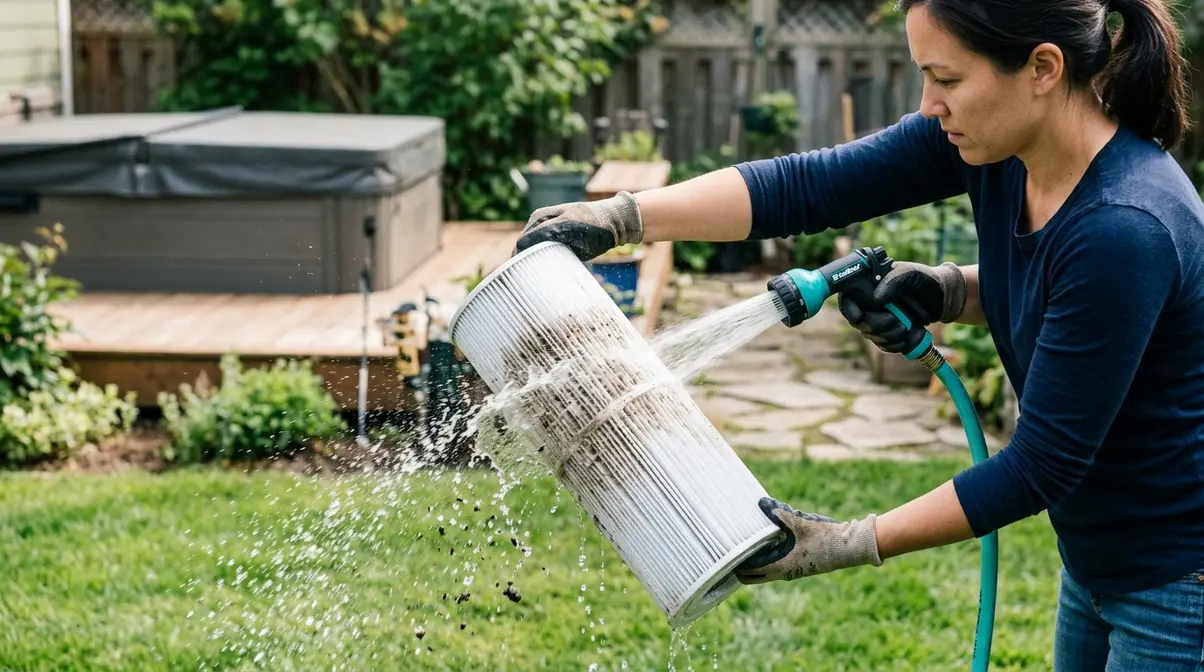
One of the biggest fears new owners share is that hot tub maintenance will consume their weekends. The good news: hot tub maintenance for beginners is far less time-consuming than most people expect. According to our complete guide on how to maintain a hot tub for longevity and enjoyment, a consistent weekly routine takes approximately 5–10 minutes. A monthly filter rinse adds another 10 minutes. The entire quarterly drain-and-refill takes about two to three hours — and you only do it four times a year.
The Safe Soak Cycle makes this routine automatic: Test before you get in, treat what needs adjusting, then enjoy without worry.
Weekly Tasks: The 5-Minute Routine
Perform these tasks every week, even if you haven’t used the tub.
- Test the water using strips or a liquid kit. Record pH, TA, and sanitiser levels.
- Adjust pH and alkalinity if they’ve drifted. Add increaser or decreaser in small doses, wait 30 minutes, retest.
- Check sanitiser levels. Add chlorine or bromine if below the target range.
- Clean the waterline with a non-abrasive spa surface cleaner and a soft cloth. Body oils and sunscreen accumulate here and feed bacteria.
- Rinse the filter with a garden hose (no soap). A clean filter is the single most effective thing you can do for water clarity.
That’s it. Five steps, five minutes. Most experienced owners do this while the tub heats up before their weekly soak.
How to Shock Your Hot Tub
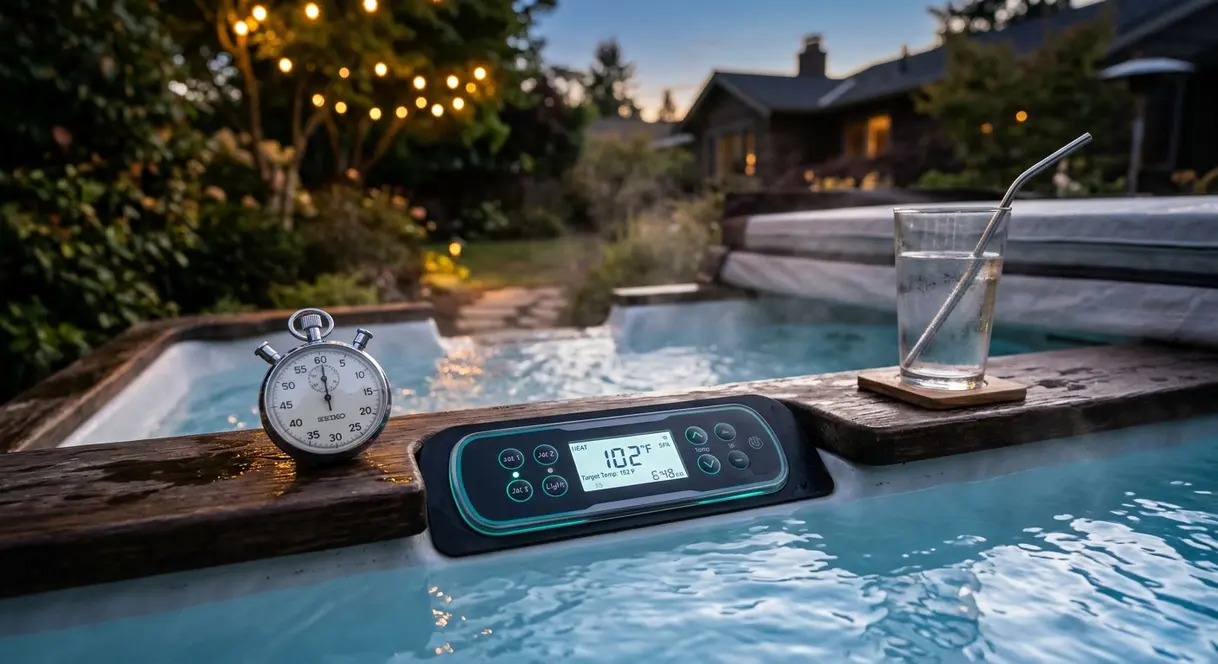
Shocking (also called oxidising) means adding a concentrated dose of sanitiser or non-chlorine oxidiser to break down organic waste — body oils, sweat, lotions, and the by-products left behind when sanitiser does its job. Industry consensus among pool and spa professionals is that you should shock your hot tub every 1–2 weeks, and always after heavy use (four or more bathers, or a party).
Step-by-step shock procedure:
- Test your water first. Shocking into water with a pH above 7.8 is far less effective — bring pH into range before shocking.
- Remove the cover and turn jets to high. Good circulation distributes shock evenly.
- Measure the shock dose. Follow the label precisely — typically 35g per 1,500 litres of water.
- Dissolve granular shock in a bucket of warm water first. Never add granules directly to the tub — undissolved shock can bleach the shell.
- Pour slowly around the perimeter of the tub with jets running.
- Leave the cover off for 20–30 minutes to let chlorine gas escape safely.
- Wait until sanitiser levels return to the safe range before soaking. Test before you get in.
Monthly Tasks: Filter Care
Your filter is working every time the pump runs — trapping body oils, debris, and fine particles that would otherwise cloud your water. Rinsing it weekly is good; a deeper clean once a month is better.
- Monthly filter soak:
- Remove the filter cartridge from the filter housing.
- Rinse thoroughly with a garden hose to remove loose debris.
- Soak overnight in a dedicated filter cleaning solution (available at pool supply stores). Do not use household detergents — they cause severe foaming.
- Rinse again the next day until the water runs completely clear.
- Reinsert the filter and restore circulation.
Replace filter cartridges entirely every 12–18 months, or sooner if they appear discoloured, torn, or no longer come clean after soaking. A worn filter is a false economy — it passes particles straight back into your water.
For guidance on which replacement filters fit your specific spa model, our hot tub filter guide includes a compatibility checker.
Quarterly: Drain and Clean
Every three to four months, drain your hot tub completely and start fresh. Fresh water is easier to balance than water that has accumulated months of dissolved solids, minerals, and chemical by-products.
- Add a line flush product and run the jets for 30 minutes before draining. This cleans biofilm from the plumbing.
- Drain completely using the drain valve or a submersible pump (much faster).
- Clean the shell with a non-abrasive spa cleaner. Pay attention to the waterline, jets, and filter housing.
- Rinse thoroughly — no cleaning product residue should remain.
- Refill via the filter housing with a pre-filter on your hose.
- Balance chemistry from scratch following the startup sequence above (TA → pH → Calcium Hardness → Sanitiser → Shock).
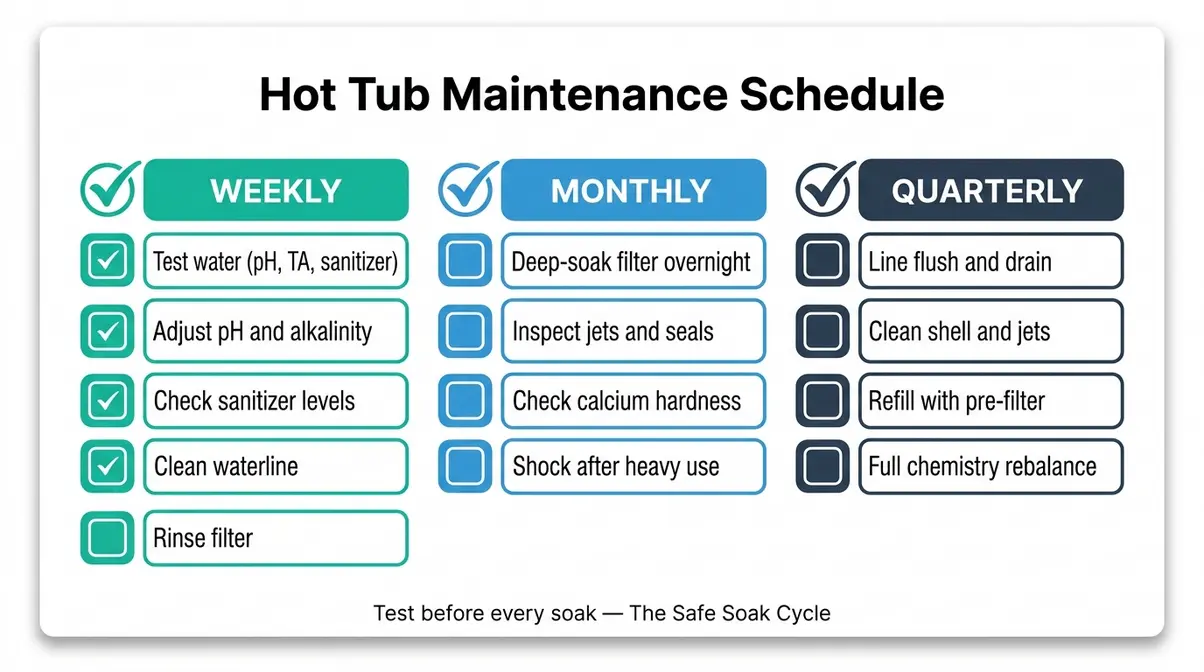
For a full walkthrough of the drain-and-refill process, check out our ultimate guide to hot tub cleaning, which covers every detail, including what to do if your drain valve is stuck.
Hot Tub Health and Safety Rules
This is the section most beginner guides skip — and it’s the one that matters most. Hot tubs are genuinely safe when maintained correctly, but improperly maintained water and ignoring temperature limits creates real health risks. The good news: every risk covered here is entirely preventable. Our evaluation of CDC, CPSC, and WHO guidance found that the vast majority of hot tub-related health incidents stem from three causes — water that isn’t properly sanitised, soaking sessions that are too long, or temperatures set too high.
For more details, consult our essential hot tub safety guide for owners. Leslie’s Pool Supply’s beginner spa care guide echoes these priorities, emphasising that consistent chemistry maintenance is the foundation of safe hot tub use.
The 15-Minute Rule Explained
The 15-minute rule is not a myth or an overly cautious suggestion. According to the CPSC recommendation for a 15-minute soaking limit, soaking sessions should be limited to 15 minutes at water temperatures at or above 104°F (40°C) — the maximum safe temperature for healthy adults (CPSC, Hot Tub Safety, 2026).
At these temperatures, your body temperature rises faster than it can cool itself through sweating. Prolonged exposure leads to heat exhaustion and, in severe cases, hyperthermia (dangerously elevated body temperature). Mayo Clinic warnings on heat exhaustion identify symptoms including dizziness, nausea, confusion, and fainting as warning signs that require immediate exit from the tub and medical attention (Mayo Clinic, Heat Exhaustion, 2026).
- Practical guidance:
- Set your tub to 100–102°F (38–39°C) for everyday soaking — comfortable, safe, and sustainable for longer sessions.
- At 104°F, limit sessions to 15 minutes, then exit, cool down for at least 5 minutes, and rehydrate before re-entering.
- Children under 5 should not use hot tubs. Their bodies cannot regulate temperature effectively. The CPSC advises that children older than 5 should soak at lower temperatures (below 98°F) for no more than 5 minutes (CPSC, 2026).
- Pregnant women should consult their doctor before using a hot tub.
- Never use a hot tub alone if you have a heart condition, low blood pressure, or are taking medications that affect circulation.
Hot Tub Rash and Folliculitis
Hot tub folliculitis is an infection of the hair follicles caused by the bacterium Pseudomonas aeruginosa, which thrives in warm, poorly sanitised water. If you want to learn more about hot tub folliculitis, it is an infection that appears as a red, itchy rash — typically on areas covered by a swimsuit — within 12 to 48 hours of exposure to contaminated water. The CDC guidelines on preventing hot tub rash identify inadequately chlorinated hot tubs and pools as the primary source of hot tub folliculitis outbreaks (CDC, Healthy Water, 2026).
- Prevention is straightforward:
- Maintain chlorine levels at 1–3 ppm or bromine at 2–4 ppm at all times.
- Shock your tub every 1–2 weeks and after heavy use.
- Test your water before every soak. Never enter a tub with a sanitiser reading of zero.
If you develop a skin rash after using your hot tub, consult a doctor promptly. Most cases of hot tub folliculitis resolve on their own within 7–10 days, but persistent or worsening symptoms require medical evaluation. A doctor may prescribe topical or oral antibiotics depending on severity.
What Kills Hot Tub Bacteria?
The most effective tools against hot tub bacteria — including Pseudomonas aeruginosa and Legionella (the bacteria behind Legionnaire’s disease) — are properly maintained chemical sanitisers and heat.
Chlorine at 1–3 ppm kills most hot tub pathogens within minutes when pH is in the correct range (7.2–7.8). At pH 8.0, chlorine’s effectiveness drops by approximately 80%, which is why pH management is not optional — it’s a direct health protection measure (CDC, Model Aquatic Health Code, 2026).
Bromine at 2–4 ppm provides equivalent protection and remains effective at slightly higher pH levels than chlorine, making it a practical choice for tubs where pH tends to drift upward.
Shocking destroys the organic waste compounds (called chloramines) that build up over time and reduce sanitiser effectiveness. A tub that smells strongly of chemicals is usually under-sanitised, not over-sanitised — the smell comes from chloramines, not free chlorine.
The WHO standards for hot tub chemical levels recommend that all public and private hot tubs maintain documented sanitiser levels and conduct regular water testing to prevent waterborne disease (WHO, Water Safety in Buildings, 2026).
For guidance on choosing between chlorine and bromine sanitisers, our comparison covers cost, effectiveness, and skin sensitivity in detail.
Do Hot Tubs Reduce Cortisol?
Research suggests that warm water immersion can reduce cortisol (the primary stress hormone) and promote relaxation, though the effect varies between individuals. A study published in the International Journal of Complementary and Alternative Medicine found that regular hydrotherapy sessions were associated with measurable reductions in self-reported stress and physiological stress markers. The warmth causes blood vessels to dilate, improving circulation and triggering the parasympathetic nervous system — the body’s “rest and digest” response. While a hot tub is not a medical treatment for stress or anxiety, the relaxation benefits are well-supported by existing hydrotherapy research.
Common Hot Tub Mistakes Beginners Make
Even well-intentioned beginners make the same handful of mistakes. After evaluating the most common issues flagged across hot tub owner communities and professional spa technician forums, these five chemical errors and two escalation scenarios account for the overwhelming majority of beginner problems. Knowing them in advance means you can sidestep them entirely.
5 Chemical Mistakes to Avoid
Mistake 1: Adding chemicals in the wrong order.
Adding chlorine before balancing pH and alkalinity is the most common startup error. Chlorine added to water with high pH is largely ineffective — you waste the chemical and the bacteria survive. Always follow the sequence: TA → pH → Calcium Hardness → Sanitiser.
Mistake 2: Testing too infrequently.
Many beginners test once a week and assume that’s enough. However, bather load, rainfall, and temperature fluctuations all shift chemistry between tests. Hot tub professionals recommend testing before every soak — it takes 60 seconds and prevents every problem in this list.
Mistake 3: Adding shock to water with high pH.
Shocking at pH above 7.8 wastes most of the shock — it reacts with the alkaline water rather than oxidising organic waste. Test and adjust pH first, every time.
Mistake 4: Overdosing chemicals.
“If a little is good, more is better” is a dangerous approach to hot tub chemistry. Overdosing chlorine above 5 ppm causes skin and eye irritation, bleaches swimwear, and degrades your tub’s shell. Always dose according to label instructions, wait 30 minutes, and retest before adding more.
Mistake 5: Neglecting the filter.
A clogged filter is the hidden cause behind most cloudy water complaints. Water circulates through the filter constantly — if the filter is blocked, chemical distribution becomes uneven and debris re-enters the water. Rinse weekly, soak monthly, replace annually.
Why Put Tennis Balls in a Hot Tub?
Tennis balls absorb body oils, sunscreen, cosmetics, and other organic residues that accumulate on the water surface. These oils reduce the effectiveness of your sanitiser and contribute to waterline scum and foamy water. The felt material on a tennis ball acts as a natural sponge — drop two or three clean balls into the water and they passively collect surface oils between uses. Remove and replace them when they look discoloured. This is an inexpensive, chemical-free way to reduce the organic load on your sanitiser and extend the time between shocks, and using a tennis ball to absorb hot tub oils is a widely reported tip in consumer hot tub communities (Consumer Reports, 2026).
When to Call a Professional
Most hot tub problems are solvable with the steps in this guide. However, some situations call for a certified spa technician rather than a DIY fix.
- Call a professional if:
- Your water remains cloudy for more than 48–72 hours despite correct chemistry.
- You notice a persistent chemical smell that doesn’t resolve after shocking.
- Your jets have significantly reduced pressure or make unusual noises.
- You see green or black discolouration on the shell, jets, or filter housing — this may indicate algae or mould that requires professional treatment.
- Your heater fails to maintain temperature or trips the circuit breaker.
- You are unsure whether a chemical problem is resolved before a vulnerable person (child, elderly individual, or someone with a health condition) uses the tub.
Following manufacturer instructions is the baseline — but manufacturers also acknowledge that unusual water conditions and equipment faults are beyond the scope of a beginner’s guide. A one-time professional water analysis (typically $50–$100) can diagnose persistent problems that resist home treatment and save you far more in wasted chemicals.
Frequently Asked Questions
Why is there a 15-minute hot tub rule?
The 15-minute rule exists because prolonged exposure to water at 104°F (40°C) raises your core body temperature faster than your body can cool itself. At this temperature, your blood vessels dilate, your heart rate increases, and sweating — your primary cooling mechanism — becomes ineffective in a hot, humid environment. The CPSC established this guideline to prevent heat exhaustion and hyperthermia in healthy adults (CPSC, 2026). For most people, soaking at a slightly lower temperature (100–102°F) allows comfortable sessions of 20–30 minutes. Always exit immediately if you feel dizzy, nauseous, or lightheaded.
Is a hot tub bad for folliculitis?
A hot tub can cause folliculitis if the water is not properly sanitised — but a well-maintained tub does not pose this risk. Hot tub folliculitis is caused by Pseudomonas aeruginosa, a bacterium that survives in warm water when chlorine or bromine levels fall below safe thresholds. The CDC confirms that maintaining chlorine at 1–3 ppm or bromine at 2–4 ppm, combined with correct pH (7.2–7.8), effectively prevents the bacteria from reaching infectious concentrations (CDC, 2026). Test your sanitiser levels before every soak. If you already have folliculitis, avoid the hot tub until your skin has fully healed.
Sitting in a Hot Tub for 3 Hours?
Sitting in a hot tub for three hours — particularly at temperatures at or above 100°F — carries serious health risks including heat exhaustion, severe dehydration, and in extreme cases, loss of consciousness. Even at lower temperatures, prolonged immersion causes skin to become overly softened and more susceptible to bacterial infection. Dehydration occurs rapidly because you lose fluids through sweating without the sensation of thirst that normally signals it. The CPSC recommends exiting the tub every 15 minutes at high temperatures to cool down and rehydrate (CPSC, 2026). If you want to soak for longer, lower the temperature to 98–100°F and take regular breaks.
Can you go in a hot tub twice a day?
Yes, you can soak twice a day, provided the water chemistry is correct and you follow temperature and time guidelines for each session. Two short sessions of 15–20 minutes at a moderate temperature (100–102°F) are far safer than one extended session. Drink water between sessions to replace fluids lost through perspiration. The main concern with frequent use is the increased organic load on your water — more bather time means sanitiser is consumed faster. Test your water between sessions if you soak twice daily, and shock the tub after every second or third double-session day.
What kills hot tub rash bacteria?
*Properly maintained chlorine (1–3 ppm) or bromine (2–4 ppm) at the correct pH (7.2–7.8) kills the Pseudomonas aeruginosa bacteria responsible for hot tub rash within minutes of contact.* If you’ve had an outbreak of hot tub rash, shock your tub immediately with a double dose of non-chlorine shock, then raise your sanitiser to the high end of the safe range for 24 hours. Clean or replace the filter. Drain and refill if the problem persists after 48 hours of treatment. The CDC confirms that proper disinfection eliminates the bacteria effectively (CDC, Healthy Water, 2026).
What kills folliculitis naturally?
Mild hot tub folliculitis often resolves on its own within 7–10 days without treatment, provided you avoid re-exposure to the contaminated water. Warm compresses applied to affected areas may reduce discomfort. Some people find that over-the-counter antibacterial wash (containing chlorhexidine or benzoyl peroxide) helps speed recovery. However, “natural” remedies such as tea tree oil or apple cider vinegar are not clinically proven treatments for Pseudomonas folliculitis specifically. If your rash worsens, spreads, or is accompanied by fever, consult a doctor — you may need a prescription antibiotic (topical or oral) to clear the infection.
What not to put in a hot tub?
You should never put household cleaning products, bubble bath, regular soap, or essential oils directly into your hot tub. These substances create massive amounts of foam, clog your filters, and completely disrupt your water chemistry balance. Standard soaps contain phosphates that actively feed algae and bacteria. If you want to add fragrance to your soak, only use specially formulated spa aromatherapy products that are explicitly designed to dissolve without leaving oily residues or affecting your sanitiser levels.
How often should I change hot tub water?
You should completely drain and refill your hot tub every three to four months, depending on how frequently you use it. Over time, the total dissolved solids (TDS) in your water increase from sweat, lotions, and the chemicals you add. When TDS levels get too high, your water becomes difficult to balance, sanitisers stop working effectively, and the water may look dull or cloudy regardless of how much shock you use. Draining quarterly gives you a fresh start and protects your equipment from scale buildup.
The Safe Soak Cycle for Confident Ownership
Hot tub water care for beginners becomes straightforward the moment you stop thinking of it as chemistry and start thinking of it as a simple three-part habit. The Safe Soak Cycle — Test → Treat → Enjoy — is the framework that turns an overwhelming list of tasks into a five-minute routine you’ll do without thinking. Test your four numbers before every soak, treat whatever is out of range with the right chemical in the right order, then enjoy your tub with the confidence that the water is genuinely safe. Research consistently supports the health benefits of warm water immersion when water quality is properly maintained — the key phrase being “properly maintained.”
The most important insight from evaluating hot tub owner communities and professional spa guidance is this: the owners who struggle are the ones who skip the testing step. The owners who thrive are the ones who test consistently and treat small imbalances before they compound into expensive problems. A pH that drifts from 7.4 to 8.2 over two weeks is a 30-second fix if you catch it early. Left for a month, it becomes cloudy water, a worn-out filter, and a frustrated afternoon of troubleshooting.
Start with your first soak this week. Fill the tub, balance the chemistry using the startup sequence in this guide, and run your first test. From that point, The Safe Soak Cycle takes over — test before you get in, adjust what needs adjusting, and enjoy. Your hot tub is simpler than it looks — and now you have everything you need to prove it.

David King
Hot tub tester and writer at One Hot Tub.