How to Manage Hot Tub pH Levels: Beginner’s Guide
Keeping my hot tub’s pH level perfect is simple! With my top tips, I ensure crystal-clear water every time. Join me for a relaxing soak today!

What’s in this guide
Home ›Hot Tub Water Management
You bought the hot tub to relax. Instead, you’re spending every weekend running water tests, pouring in chemicals, and watching the numbers bounce right back to where they started. The frustration is real — and you’re not alone.
“Well after having my 9th water test this month on my 1.5 month old hot tub, I’m ready to flip out. I’ve followed their recommended treating plan that prints out after the test, to try and get the PH and alkalinity in line, but nothing is working.”
— Hot tub owner, r/hottub community
Every week your pH is off, your sanitizer loses effectiveness — and your water may not be as safe as you think. Wasted chemicals add up fast. The anxiety about bacteria and skin rashes is real. Here’s the good news: there is one step most guides skip that changes everything — adjusting Total Alkalinity before you ever touch pH. In this guide, you’ll learn exactly how to manage hot tub pH levels using that approach, plus a dosing chart, troubleshooting fixes, honest health answers, and myth-busting quick answers.
Understanding how to manage hot tub pH levels starts with Total Alkalinity — adjust it to 80–120 ppm first, then correct pH to 7.2–7.8. The CDC recommends at least 3 ppm free chlorine in hot tubs to prevent bacterial growth (CDC, 2026).
- The Alkalinity-First Rule: Always fix Total Alkalinity before touching pH — it prevents pH bounce and makes every adjustment stick
- Ideal pH range: 7.2–7.8 (below 7.2 = corrosive to equipment and skin; above 7.8 = cloudy water and bacteria risk)
- Test before you dose: Never add chemicals without testing first — guessing wastes money and destabilizes your water
- High pH warning: As pH rises above 8.0, the germ-killing ability of chlorine decreases significantly (CDC, 2026)
- Health risk: Poorly balanced water enables Pseudomonas aeruginosa bacteria — the direct cause of hot tub rash (folliculitis)
Before You Start: What You Need to Know
Before you add a single drop of chemical, understand The Alkalinity-First Rule: Total Alkalinity (TA) must always be corrected before pH. We’ll prove exactly why in Step 2. But first, you need two things — a reference table and a shopping list.
Your Target Water Chemistry Ranges
The target chemistry ranges in this guide are based on CDC guidelines for hot tub pH levels and industry standards from certified pool chemical manufacturers. Always follow your specific hot tub manufacturer’s recommendations as a secondary reference (CDC, 2026).
Think of these four numbers as your water’s vital signs. All four need to be in range for your hot tub to be safe, clear, and comfortable.
| Parameter | Ideal Range | Too High Means… | Too Low Means… |
|---|---|---|---|
| pH | 7.2–7.8 | Cloudy water, skin irritation, weak sanitizer | Corrosive to equipment and skin |
| Total Alkalinity (TA) | 80–120 ppm | pH becomes sluggish and hard to adjust | pH “bounces” wildly up and down |
| Calcium Hardness | 150–250 ppm | Scale buildup on surfaces and jets | Foamy, corrosive water that damages equipment |
| Free Chlorine | 3–5 ppm | Chemical odor, eye and skin irritation | Bacteria and algae growth |
A note on units: Parts per million (ppm) is simply the unit used to measure how much of a chemical is dissolved in your water. Think of it like a pinch of salt in a glass — ppm tells you exactly how much. Total Alkalinity (TA) is the chemical buffer that prevents your pH from swinging up or down. pH itself measures how acidic or alkaline your water is on a scale of 0 to 14 — 7 is neutral, and your hot tub wants to stay just slightly above that. Total Alkalinity is the most critical parameter to get right first, because it controls how stable every other reading will be.
Now that you know your targets, here’s everything you’ll need to hit them.
Tools and Chemicals You’ll Need
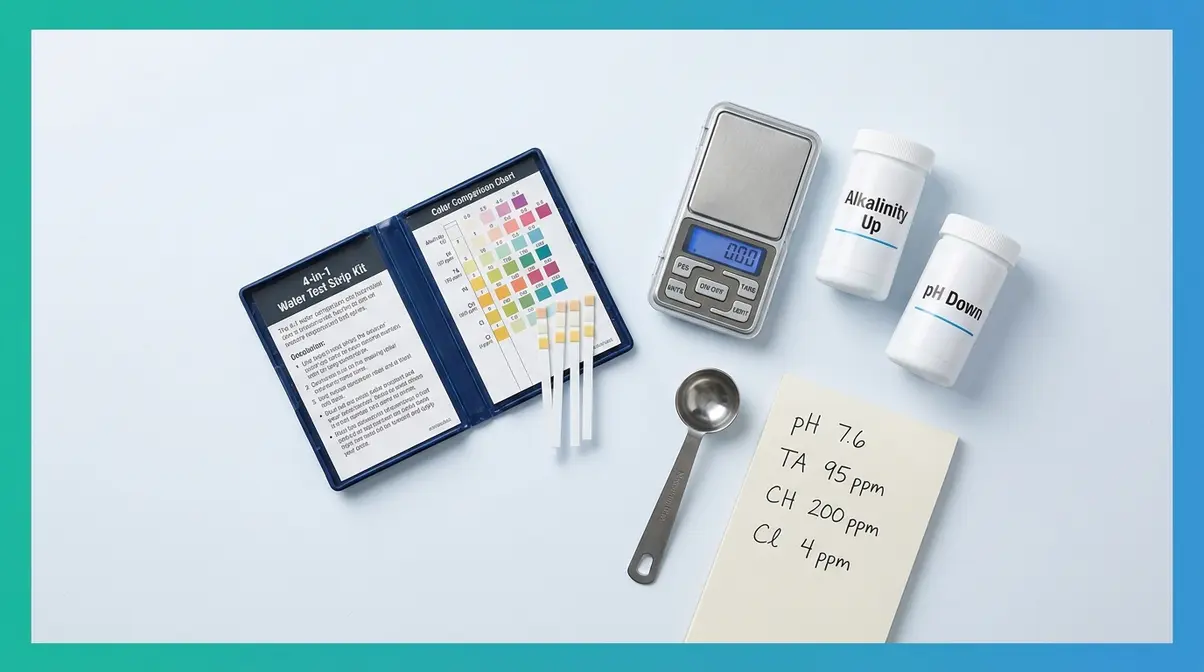
Gather these before you start. You’ll find all of them at any pool supply store or online:
- Test strips — quick and beginner-friendly; ideal for daily checks. Or a liquid test kit for more precise readings when you’re troubleshooting
- pH Down (sodium bisulfate — the dry acid sold as pH Minus) — lowers both pH and TA
- pH Up (sodium carbonate or soda ash) — raises pH when it’s too low
- Alkalinity Up (sodium bicarbonate, the same compound as baking soda) — raises Total Alkalinity
- Chlorine or bromine sanitizer — added last, after pH and TA are balanced
One important note: there is no product called “Alkalinity Down.” To lower Total Alkalinity, you use the same dry acid as pH Down — it brings both numbers down simultaneously. Buy the dry acid (pH Down) form rather than liquid muriatic acid. It’s safer and far easier to handle if you’re new to this.
For more on best practices for managing pH, see our dedicated guide.
The target chemistry ranges in this guide are based on CDC guidelines for residential hot tubs and industry standards from certified pool chemical manufacturers. Always follow your specific hot tub manufacturer’s recommendations as a secondary reference.
You have your targets and your toolkit. Here’s the step-by-step process — in the exact order that actually works.
Step-by-Step: How to Balance Your Hot Tub pH
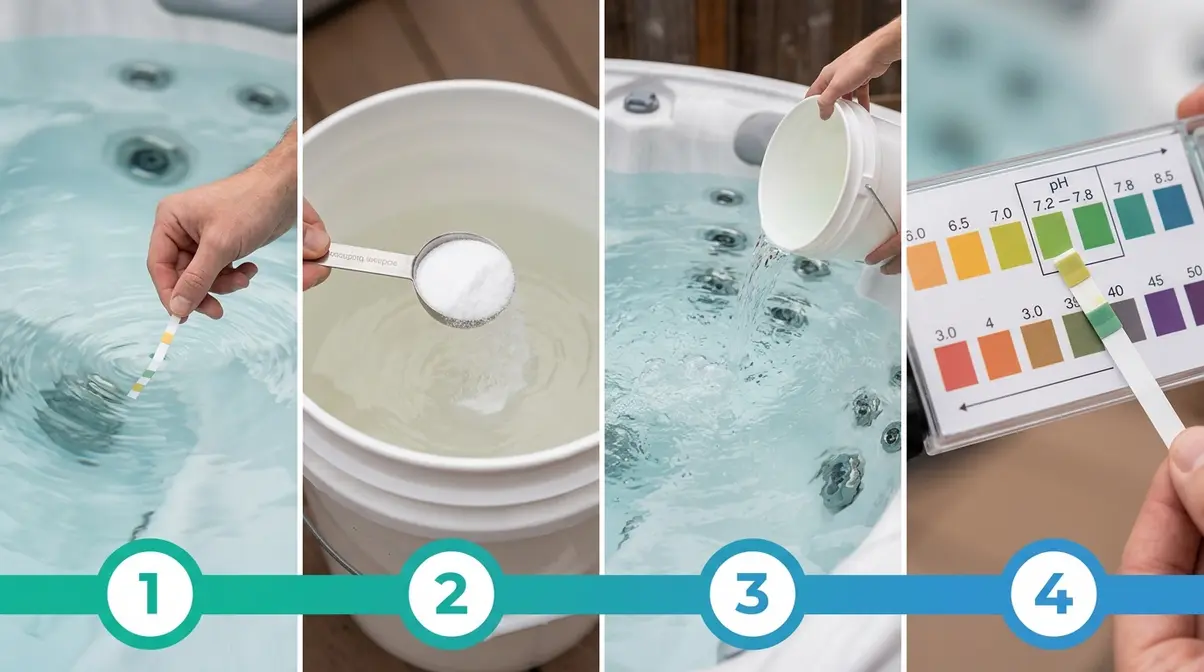
Balancing hot tub water chemistry takes about 30–45 minutes when you follow the steps in order. The sequence matters more than most guides admit — and that’s exactly where most frustrated beginners go wrong. Water chemistry experts and certified pool operators consistently advise the same four-step sequence: test, fix alkalinity, adjust pH, then sanitize. Skipping or reordering these steps is why “nothing is working.”
Step 1 – Test Your Water First
Tools needed: Test strips or liquid test kit, 15 minutes
Never add chemicals without knowing your current numbers. Guessing is the single most common reason beginners end up constantly adding acid and still missing the mark.
- Turn your jets on and let the water circulate for at least 10 minutes before testing. This mixes the water evenly and gives you an accurate sample.
- Dip a test strip into the water at elbow depth (not near a jet). Hold it still for about 5 seconds, then remove it.
- Wait the time specified on your strip packaging (usually 15–30 seconds) before reading.
- Record all four readings: pH, Total Alkalinity, Calcium Hardness, and Free Chlorine. Write them down — don’t rely on memory.
- Compare each reading to the target ranges in the table above.
Why this matters: You cannot dose correctly without knowing your starting point. Adding pH Down to water that’s already at 7.4 will drop it too low, forcing you to add pH Up — and you’re back to “constantly adding acid.”
Step 2: Fix Total Alkalinity First
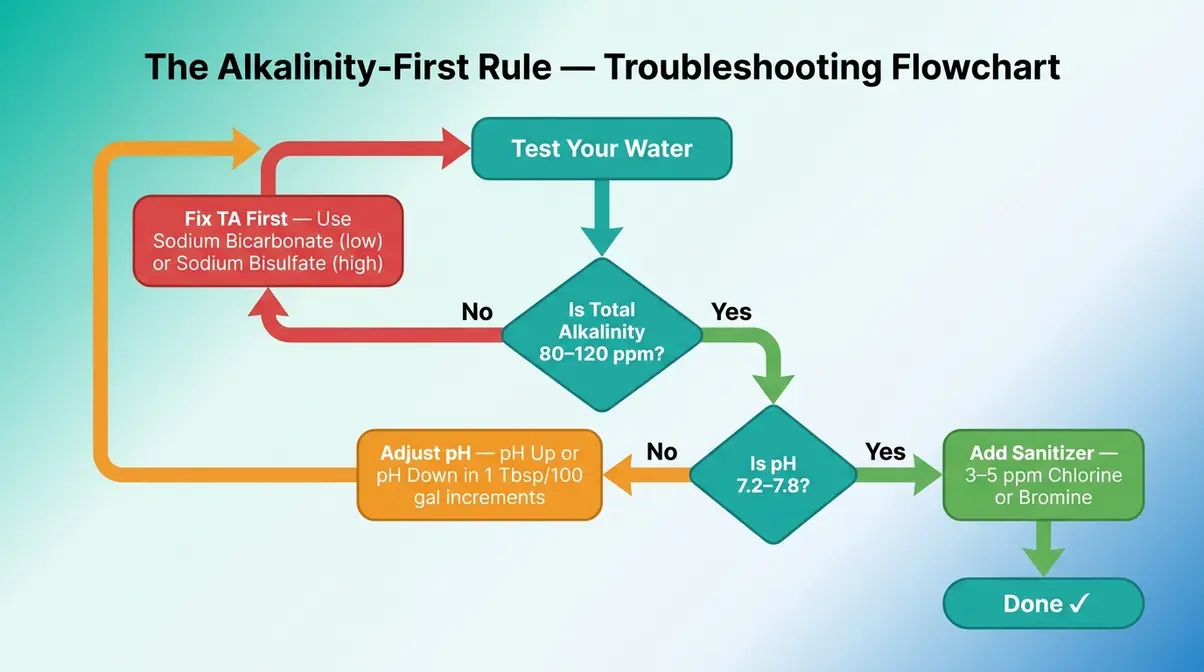
This is the step most guides skip. The Alkalinity-First Rule is simple: fix TA before you touch pH, every single time.
Here’s why it works. Think of Total Alkalinity as a shock absorber for your pH. When TA is in the correct range (80–120 ppm), your pH stays stable after you adjust it. When TA is too low, pH bounces wildly — you add pH Down, the number drops, then it shoots back up the next day. You’re not doing anything wrong; the water just has no chemical stability to hold the adjustment.
If your TA is below 80 ppm (raise it with sodium bicarbonate):
- Calculate your dose: use 1 tablespoon of sodium bicarbonate (Alkalinity Up) per 100 gallons of water to raise TA by approximately 10 ppm (Atlas Scientific, 2026).
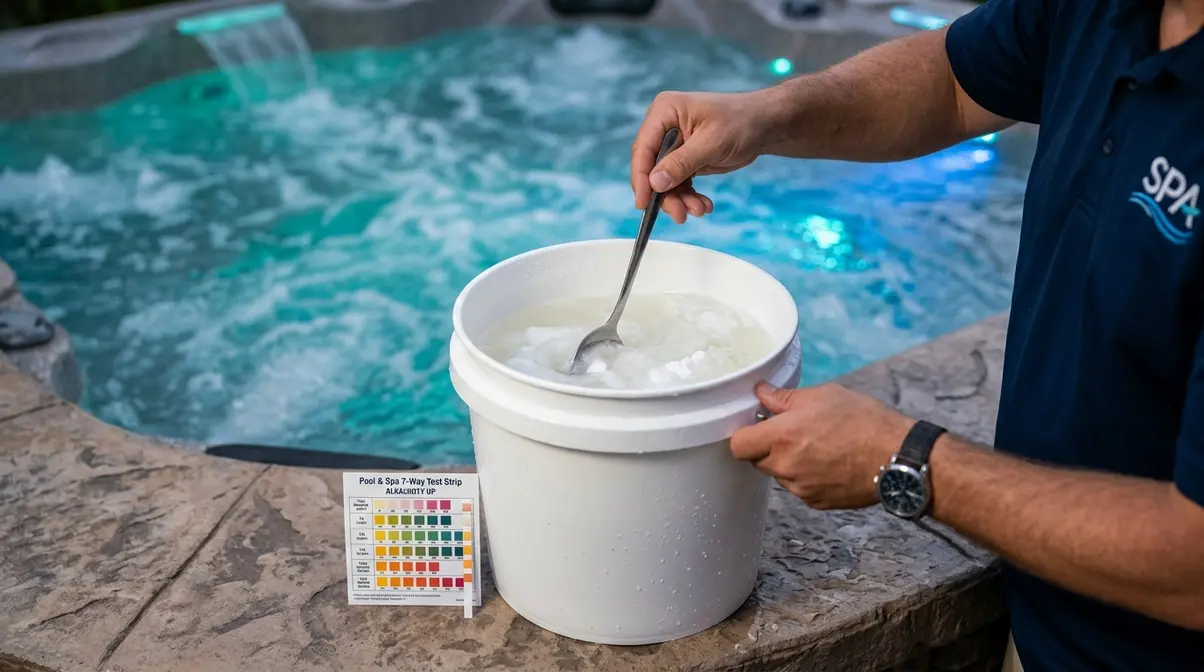
- Pre-dissolve the measured amount in a bucket of warm tub water. Stir until fully dissolved.
- Pour the solution slowly around the perimeter of the tub with the jets running.
- Wait at least 3–4 hours (ideally overnight) before retesting. Adding more too soon is a common mistake.
- Retest and repeat in small doses until TA reaches 80–120 ppm.
If your TA is above 120 ppm (lower it with pH Down / sodium bisulfate):
- Use 1 tablespoon of sodium bisulfate (pH Down) per 100 gallons to lower TA by approximately 10 ppm (Beatbot, 2026).
- Pre-dissolve in a bucket of warm tub water before adding.
- Add with jets running, pouring slowly around the perimeter.
- Aerate the water by running the jets with the cover off for 1–2 hours — this helps drive down TA while allowing pH to stabilize naturally.
- Wait 3–4 hours, retest, and repeat as needed.
Important: After adjusting TA, wait before touching pH. Let the water settle. In most cases, once TA is correct, pH will naturally move closer to the ideal range on its own — requiring a smaller correction than you expected.
For more detail on how to control hot tub pH levels after balancing TA, see our dedicated resource.
Step 3 – Adjust Your pH Level
Once Total Alkalinity is in range, pH adjustment becomes straightforward. Water chemistry experts recommend making small, incremental corrections rather than large single doses.
If pH is above 7.8 (lower it with pH Down):
- Calculate your dose: approximately 1 tablespoon of sodium bisulfate per 100 gallons lowers pH by roughly 0.2 units. Start conservatively.
- Pre-dissolve in a bucket of warm water, then pour around the perimeter with jets running.
- Wait at least 2–3 hours before retesting.
- Repeat in small increments until pH reaches 7.2–7.8.
If pH is below 7.2 (raise it with pH Up):
- Add 1 tablespoon of sodium carbonate (pH Up) per 100 gallons to raise pH by approximately 0.2 units.
- Pre-dissolve and add with jets running, same as above.
- Wait 2–3 hours, retest, and adjust further if needed.
The golden rule: Never try to correct more than 0.4 pH units in a single treatment. Overshooting forces a correction in the opposite direction — and suddenly you’re “constantly adding acid” again.
Step 4 – Add Your Sanitizer Last
Sanitizer goes in last, after pH and TA are stable. This is not just convention — it’s chemistry. The effectiveness of chlorine and bromine is directly tied to pH. The CDC confirms that as pH rises, the germ-killing ability of chlorine decreases, especially above pH 8.0 (CDC, 2026). If you add sanitizer while pH is off, you waste product and leave your water unprotected.
- Test your Free Chlorine or Bromine level. Target: 3–5 ppm chlorine or 3–5 ppm bromine for residential hot tubs.
- Add your sanitizer according to the product label, with jets running.
- Wait 20 minutes before retesting sanitizer levels.
- Replace your cover and let the water circulate for another 30 minutes.
Maintenance schedule: Test pH and sanitizer at least 2–3 times per week. After heavy use (parties, multiple bathers), test the next day. Consistent testing is the only way to catch problems before they become expensive.
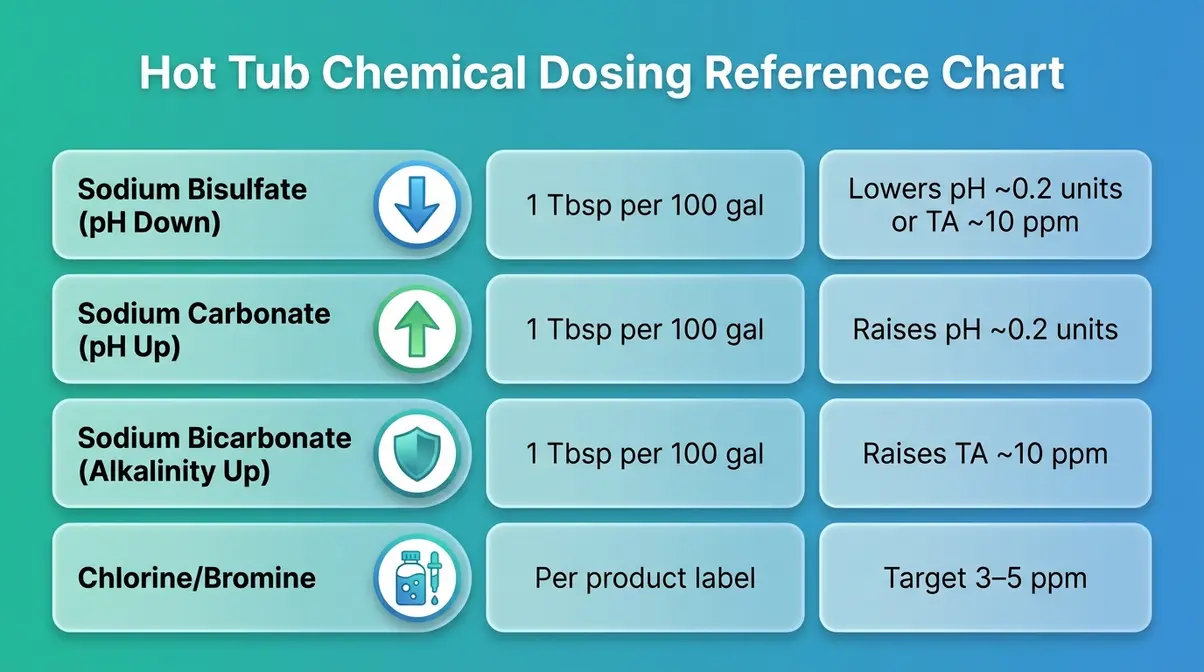
Chemical Dosing Reference Chart
Use this chart as your quick-reference guide. All doses assume a standard 300–500 gallon residential hot tub. Pre-dissolve all chemicals before adding, and always retest before adding a second dose.
| Chemical | Purpose | Starting Dose | Effect | Notes |
|---|---|---|---|---|
| Sodium bisulfate (pH Down) | Lower pH or TA | 1 Tbsp per 100 gal | ~0.2 pH drop or ~10 ppm TA drop | Pre-dissolve; add in stages |
| Sodium carbonate (pH Up) | Raise pH | 1 Tbsp per 100 gal | ~0.2 pH increase | Pre-dissolve; small doses only |
| Sodium bicarbonate (Alkalinity Up) | Raise TA | 1 Tbsp per 100 gal | ~10 ppm TA increase | Pre-dissolve; wait overnight before retesting |
| Chlorine granules | Sanitize | Per label | Raises free chlorine | Add last, after pH/TA are stable |
| Bromine tablets | Sanitize | Per label | Raises free bromine | Add last; target 3–5 ppm |
Dosing estimates based on industry guidance from certified pool operators and multiple pool chemistry authorities (Atlas Scientific, 2026; Beatbot, 2026). Always verify with your specific product label, as granule density varies by brand.
Troubleshooting: When Your pH Won’t Cooperate
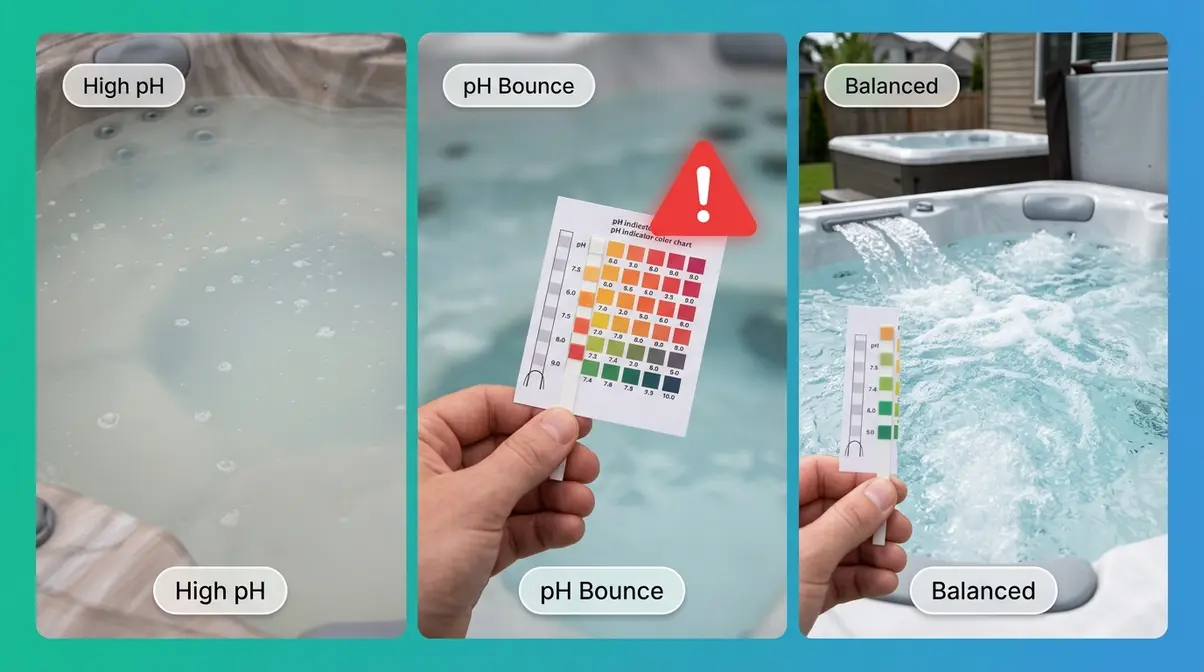
Even with the right approach, problems happen. High pH, low pH, and that maddening “pH bounce” are the three most common complaints in hot tub owner communities. Here’s how to diagnose and fix each one.
High pH: Causes and Fixes
High pH (above 7.8) is the most common hot tub problem — and it’s often misdiagnosed as a sanitizer issue. When pH climbs, chlorine becomes dramatically less effective. The CDC confirms that the germ-killing ability of chlorine decreases as pH rises, particularly above pH 8.0 (CDC, 2026). Your sanitizer is in the water, but it’s barely working.
Symptoms of high pH include cloudy water (and you’ll need to clear cloudy hot tub water by addressing the root cause), a slippery feeling on surfaces, and skin or eye irritation even when chlorine levels appear adequate.
Common causes: Fresh fill water with naturally high pH, adding too much pH Up, heavy bather load (body oils and sweat raise pH), and aeration from jets (which off-gasses CO2 and naturally raises pH).
- Fix it:
- Test and record your current pH and TA.
- If TA is also high (above 120 ppm), address TA first with sodium bisulfate — this will bring pH down too.
- If TA is already in range, add sodium bisulfate in 1 Tbsp per 100 gallon increments, waiting 2–3 hours between doses.
- Retest until pH reads 7.2–7.8.
For a complete guide on high pH in hot tubs, Master Spas provides additional context on causes specific to different water sources.
Low pH: Causes and Correction
Low pH (below 7.2) is less common but more immediately damaging. Corrosive water etches acrylic shells, corrodes metal fittings, degrades your pump seals, and causes burning eyes and skin irritation. If you’re noticing your tub surfaces feel rough or you’re seeing greenish staining around jets, low pH may be the culprit.
Common causes: Overuse of pH Down or muriatic acid, heavy rainfall diluting the water, or a low TA that allows pH to crash.
- Fix it:
- Check TA first. Low pH often accompanies low TA — if both are off, raise TA first using sodium bicarbonate.
- Once TA is stable, add sodium carbonate (pH Up) in 1 Tbsp per 100 gallon doses.
- Wait 2–3 hours between doses and retest before adding more.
- Target pH of 7.4–7.6 (the middle of your ideal range) so you have a buffer in both directions.
For more detail on lowering hot tub pH safely, Hydropool’s resource covers water source variables that affect starting pH.
pH Bounce: Stabilizing Your Levels
pH bounce is the frustrating cycle where you adjust pH, it looks right, then the next day it’s off again — sometimes in the opposite direction. This is the root cause of “cannot get my pH down” and “nothing is working.” The good news: pH bounce has one primary cause, and it’s almost always low Total Alkalinity.
When TA is below 80 ppm, your water has no chemical buffering capacity. Any small input — bathers, rain, aeration from jets, even CO2 from the air — causes pH to swing dramatically. The Alkalinity-First Rule exists specifically to solve this: you cannot fix pH bounce by adjusting pH. You fix it by stabilizing TA first.
- If you’re experiencing pH bounce:
- Stop adding pH adjustment chemicals temporarily.
- Test TA. If it’s below 80 ppm, raise it to 100–110 ppm using sodium bicarbonate (slightly higher than minimum gives you a buffer).
- Wait 24 hours after TA correction before testing pH.
- In most cases, pH will have naturally stabilized closer to the target range.
Common feedback from hot tub communities is that once TA is corrected, the “trouble balancing alkalinity and pH” resolves within one or two treatment cycles.
How to Lower Chlorine Levels
If your Free Chlorine reads above 5 ppm, your water is over-sanitized. High chlorine causes bleaching of swimwear, strong chemical odor, and skin and eye irritation. Fortunately, lowering it is simple — and doesn’t require any additional chemicals. These exact same aeration principles apply if you need to lower bromine levels in a hot tub.
- Natural dilution method (easiest):
- Remove the cover and run the jets on high for 1–2 hours. Aeration and UV exposure from sunlight naturally break down chlorine.
- Test chlorine every 30 minutes. Most over-chlorinated tubs return to the 3–5 ppm range within 2–4 hours of aeration.
- If chlorine is extremely high (above 10 ppm), partially drain the tub (20–30%) and refill with fresh water, then retest.
Avoid the temptation to add sodium thiosulfate (chlorine neutralizer) unless levels are dangerously high — it can overcorrect and leave you with no sanitizer protection at all.
Hot Tub Water Safety – Bacteria, Rashes & Viruses
This article is for informational purposes only. Consult a healthcare professional for any skin conditions or health concerns related to hot tub use.
Well-balanced water isn’t just about comfort — it’s about safety. Hot tubs are warm, aerated, and used by multiple people, creating ideal conditions for certain bacteria to thrive when chemistry is off. Here’s what the evidence actually says about the most common health concerns.
What Is Hot Tub Folliculitis?
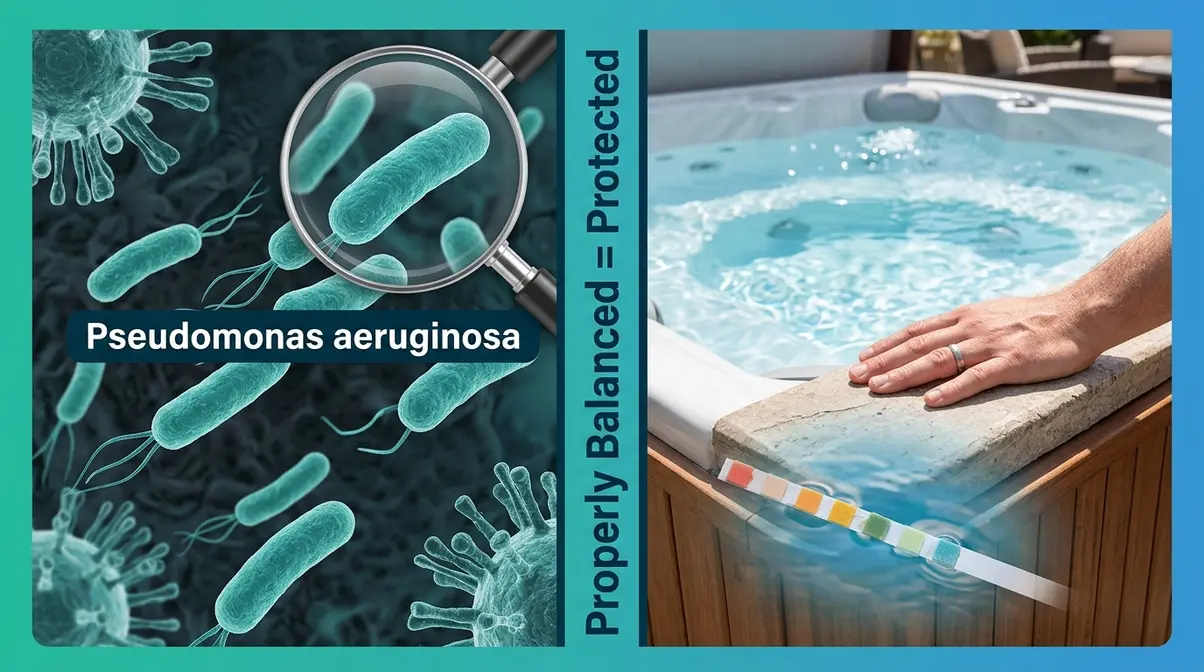
Hot tub folliculitis is an infection of the hair follicles caused by the bacterium Pseudomonas aeruginosa, which thrives in warm, poorly disinfected water (CDC, 2026). The rash typically appears 12–48 hours after exposure — red, itchy bumps often concentrated where a swimsuit traps water against the skin.
The connection to pH is direct. Pseudomonas aeruginosa multiplies rapidly when chlorine or bromine levels fall below effective ranges, which happens fastest when pH is too high. As the CDC notes, the germ-killing ability of chlorine decreases significantly as pH rises above 8.0 — meaning your sanitizer may read 3 ppm but be functioning far below that level (CDC, 2026).
Why only some people get it: Not everyone exposed to contaminated water develops folliculitis. People who shave before hot tub use, have minor skin abrasions, or spend extended time in the water face higher risk. The condition is not contagious between people — multiple bathers get it from the same water source, not from each other (Wisconsin Department of Health Services, 2026).
Prevention: Maintain proper chlorine (3–5 ppm) and pH (7.2–7.8) consistently. Shower immediately after exiting the tub and wash your swimsuit after each use. For more detailed guidance, review our complete guide on hot tub folliculitis prevention.
If you develop a rash after hot tub use, consult a healthcare professional. Most cases resolve on their own within 7–10 days, but medical treatment may be needed for severe or persistent infections.
For more on preventing hot tub rash, the CDC’s Healthy Swimming resource provides current clinical guidance.
Can Norovirus Survive in a Hot Tub?
Yes — norovirus can survive in inadequately disinfected hot tubs. Norovirus is more environmentally stable than many bacteria. It can withstand temperatures up to 145°F (62.8°C), well above the 104°F maximum of most hot tubs (CDC, 2026). Hot tub heat alone is not enough to kill it.
However, properly maintained chlorine levels are effective. Research published in the journal Epidemiology & Infection found that a documented norovirus outbreak in a pool ended abruptly after chlorine was raised to 3.5 ppm (PMC, 2010). This supports maintaining your hot tub at the recommended 3–5 ppm free chlorine range — not just for bacteria, but for viral pathogens as well.
Public health guidance is clear: avoid using hot tubs or pools for at least two weeks after experiencing norovirus symptoms (Wellington-Dufferin-Guelph Public Health, 2026). Swallowing contaminated water is the primary transmission route.
The practical takeaway: a well-maintained hot tub with stable pH and adequate chlorine is far safer than one where chemistry is allowed to drift. This is another reason The Alkalinity-First Rule matters — stable pH keeps your sanitizer working at full strength, continuously.
Legionella and Other Waterborne Risks
Legionella pneumophila, the bacteria responsible for Legionnaires’ disease, is a serious concern in poorly maintained hot tubs and spas. Legionella thrives in warm water (77–113°F) and is spread through inhalation of contaminated water droplets — the mist generated by hot tub jets is an ideal transmission vehicle (CDC, 2026).
Research published in Emerging Infectious Diseases and cited by the NIH confirms that improper maintenance of public spas significantly increases Legionnaires’ disease risk (PMC, 2023). The same maintenance principles apply to residential tubs: maintain free chlorine at 3–5 ppm, pH at 7.2–7.8, and drain and thoroughly clean your hot tub every 3–4 months.
Other risks to know about: Giardia can survive in properly chlorinated water for up to 45 minutes. Cryptosporidium cannot be killed by standard chlorine levels at all — the only defense is preventing contamination in the first place (never use a hot tub if you have an active gastrointestinal illness).
For current Legionella guidance for hot tub operators, the CDC’s Legionella prevention resources cover both residential and commercial spa settings.
Preventing Waterborne Illness
Across hot tub owner communities, the consistent feedback is that most health incidents trace back to the same root causes: letting chemistry drift between tests, and skipping the shower before and after soaking. Water chemistry experts recommend these prevention habits:
- Test 2–3 times per week — more often after heavy use or rainfall
- Shower before entering — body oils, lotions, and sweat consume chlorine rapidly, dropping effective sanitizer levels
- Shower and change immediately after — rinse off any bacteria before it can cause a skin reaction
- Drain and refill every 3–4 months — total dissolved solids (TDS) accumulate over time and make chemistry increasingly difficult to balance
- Never use the hot tub during or after illness — especially gastrointestinal illness
For a broader overview of spa maintenance, check out these essential hot tub safety tips.
Hot Tub Myths and Quick Answers
Not every tip you read online is accurate. Here are three common questions — with honest, evidence-based answers.
The Tennis Ball Trick Explained
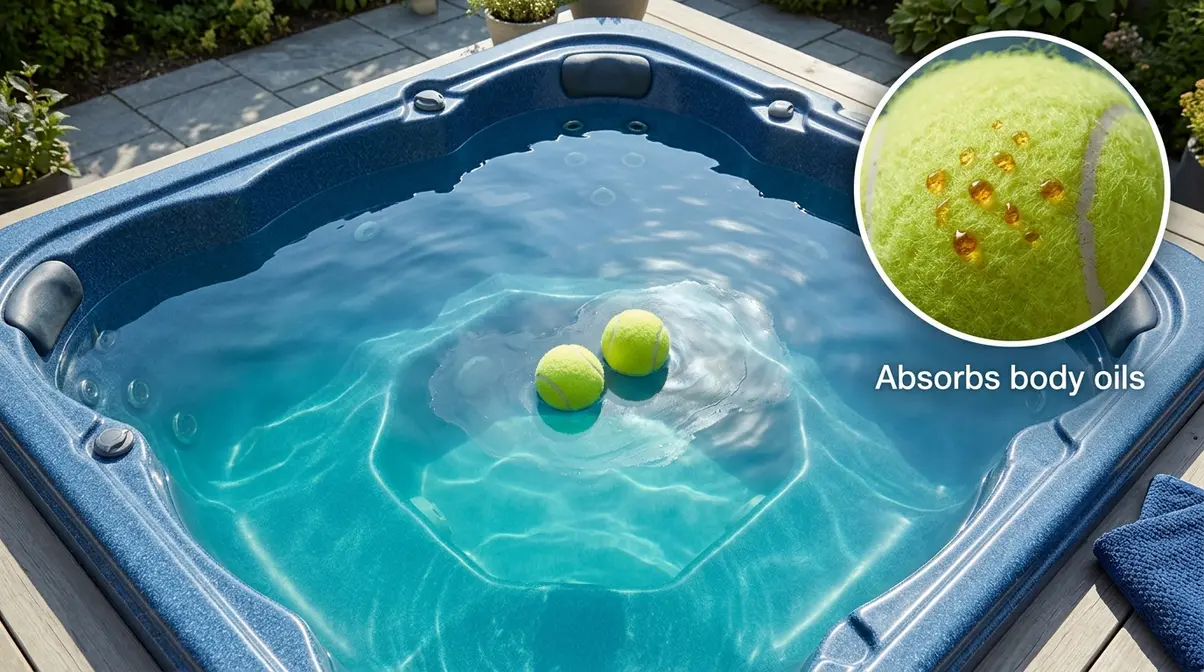
Dropping tennis balls into your hot tub is a popular tip, and it does work — just not for pH. Tennis balls absorb body oils, lotions, and cosmetics from the water surface. This reduces the oily film that can cloud water and clog filters. It does not affect pH, alkalinity, or sanitizer levels in any meaningful way.
Think of tennis balls as a filter supplement, not a chemistry tool. They’re useful for keeping water cleaner between filter cycles, but if your pH is off, a tennis ball won’t help. Use the chemical steps in this guide for actual chemistry problems.
Limits of Natural pH Methods
Baking soda (sodium bicarbonate) is genuinely effective for raising Total Alkalinity and can slightly raise pH. At 1 tablespoon per 100 gallons, it’s a legitimate, low-cost alternative to branded Alkalinity Up products (the chemistry is identical). Water chemistry experts consider it a reliable tool for TA correction.
Vinegar (acetic acid) is a different story. While vinegar is acidic and can theoretically lower pH, the volume required to meaningfully affect a 400-gallon hot tub makes it impractical and potentially harmful to your equipment. Vinegar also does not lower Total Alkalinity the way sodium bisulfate does, meaning it won’t address the root cause of pH bounce. Stick to sodium bisulfate for pH and TA reduction.
Natural methods have real limits. Neither baking soda nor vinegar can replace proper sanitization. Vinegar, essential oils, and similar alternatives have no proven effectiveness against norovirus or Pseudomonas aeruginosa (WDG Public Health, 2026). For a safe hot tub, chemistry must be maintained with tested, approved products.
For a broader overview of hot tub water chemistry approaches, including natural alternatives, see our full guide.
Do Hot Tubs Lower Cortisol?
Research suggests that hot water immersion does reduce perceived stress and may lower cortisol levels — the primary stress hormone. A 2018 study published in PLOS ONE found that regular warm-water bathing improved mood and reduced subjective stress. However, the specific cortisol-reduction effects of hot tub use have not been studied with the same rigor as clinical hydrotherapy.
The practical answer: hot tubs are genuinely relaxing, and that relaxation has measurable physiological effects. Just make sure your water is properly balanced first — soaking in unbalanced, bacteria-prone water is likely to raise cortisol, not lower it.
Limitations and When to Seek Help
Common Pitfalls to Avoid
Even with the right knowledge, these specific mistakes trip up beginners repeatedly:
- Adding multiple chemicals at once. Never add pH Down and Alkalinity Up in the same treatment session. Each chemical affects the other — add one, wait, test, then add the next.
- Retesting too soon. Water needs time to mix and react. Testing 20 minutes after adding sodium bicarbonate will give a false reading. Wait at least 3–4 hours, ideally overnight.
- Ignoring Calcium Hardness. Most beginners focus only on pH and TA. But Calcium Hardness below 150 ppm creates “hungry” water that actively dissolves calcium from your shell, jets, and equipment — an expensive mistake. Test CH monthly.
- Using the wrong test strips. Basic strips often test only pH and chlorine. You need a 4-in-1 or 5-in-1 strip that also measures Total Alkalinity and Calcium Hardness.
- Treating symptoms instead of causes. If your pH keeps bouncing back, stop adjusting pH and fix TA. Treating pH bounce with more pH chemicals is like mopping a floor while the tap is still running.
When to Seek Expert Help
When to drain and start fresh: If your Total Dissolved Solids (TDS) have built up over many months, water becomes increasingly resistant to balancing — no amount of chemicals will help. If you’ve been treating the same water for more than 4 months without a drain, a fresh fill may be the most efficient solution.
When to call a professional: If you’ve correctly followed The Alkalinity-First Rule, balanced TA and pH, and still can’t achieve stable results within two treatment cycles, there may be a plumbing issue (air leak causing excess aeration), a failing heater affecting water chemistry, or an unusually high TDS load. A certified pool operator (CPO) can test for these factors with equipment beyond standard test strips.
For health concerns: Any persistent skin rash, ear pain, or respiratory symptoms following hot tub use warrants a visit to a healthcare professional — not a water test.
Frequently Asked Questions
How do I balance the pH in my hot tub?
Balance hot tub pH by fixing Total Alkalinity first, then adjusting pH. Learning how to manage hot tub pH levels requires you to test your water and bring Total Alkalinity to 80–120 ppm using sodium bicarbonate (1 tablespoon per 100 gallons raises TA by ~10 ppm). Once TA is stable, add sodium bisulfate to lower pH above 7.8, or sodium carbonate to raise pH below 7.2. The CDC recommends maintaining hot tub pH between 7.0 and 7.8 for effective sanitization (CDC, 2026). Always wait 3–4 hours between treatments before retesting.
Is a hot tub bad for folliculitis?
A poorly maintained hot tub can cause folliculitis — but a well-maintained one does not. Hot tub folliculitis is caused by Pseudomonas aeruginosa, a bacterium that multiplies in warm water when chlorine or pH levels are off (CDC, 2026). Specifically, high pH reduces chlorine’s germ-killing effectiveness, allowing bacteria to survive. Maintaining free chlorine at 3–5 ppm and pH at 7.2–7.8 prevents Pseudomonas growth. Consult a healthcare professional if you develop a rash after hot tub use.
Can norovirus survive in a hot tub?
Yes — norovirus can survive in an inadequately disinfected hot tub. Norovirus withstands temperatures up to 145°F (62.8°C), far above typical hot tub temperatures of 100–104°F (CDC, 2026). However, research shows that properly maintained chlorine levels (3.5 ppm) can inactivate norovirus in water (PMC, 2010). The key defense is keeping your hot tub’s free chlorine at 3–5 ppm and pH stable. Avoid using a hot tub for at least two weeks after norovirus symptoms (WDG Public Health, 2026).
Do hot tubs lower cortisol?
Research suggests warm water immersion can reduce stress and may lower cortisol. Studies on hydrotherapy and warm bathing show measurable reductions in self-reported stress and physiological stress markers. However, specific hot tub cortisol studies are limited. The relaxation effect is real — but only in a clean, properly balanced hot tub. Soaking in water with unstable chemistry or bacteria risk creates stress rather than relieving it, so getting your water balanced is itself part of the wellness benefit. To maximize these wellness benefits without risking skin irritation, be sure to follow safe hot tub soaking time limits.
Why put tennis balls in a hot tub?
Tennis balls absorb body oils, lotions, and cosmetics from the water surface. They act as a supplemental filter, reducing the oily film that can cloud water and clog your filter cartridge. However, tennis balls have no effect on pH, Total Alkalinity, or sanitizer levels. They’re a useful maintenance trick for keeping water cleaner between filter cleanings — not a chemistry solution. If your pH is off, use the chemical steps in this guide.
What if hot tub pH is too high?
High pH (above 7.8) causes cloudy water, skin irritation, and dramatically reduced sanitizer effectiveness. The CDC confirms that as pH rises above 8.0, the germ-killing ability of chlorine decreases significantly (CDC, 2026) — meaning bacteria can survive even when your chlorine reads in range. High pH also causes calcium scale to deposit on your shell, jets, and heater. Fix it with sodium bisulfate (1 tablespoon per 100 gallons), but check Total Alkalinity first — high TA is often the underlying cause of persistently high pH.
Who gets hot tub folliculitis?
Individual susceptibility varies based on skin condition and behavior before and after hot tub use. People who shave immediately before soaking have micro-abrasions that make hair follicles more vulnerable to Pseudomonas infection. Extended time in contaminated water and not showering promptly afterward also increase risk. Folliculitis is not contagious between people — multiple people develop it from the same water source, not from each other (Wisconsin DHS, 2026). People with compromised immune systems or sensitive skin face higher baseline risk.
What kills folliculitis naturally?
Most cases of hot tub folliculitis resolve on their own within 7–10 days without treatment. The rash typically clears once exposure to the contaminated water ends. Keeping the affected area clean and dry helps. Some people find warm compresses soothing for itching. However, natural resolution is not guaranteed — if the rash spreads, becomes painful, or is accompanied by fever, seek medical attention promptly. A healthcare professional may prescribe topical or oral antibiotics for persistent cases. Do not attempt to self-treat with essential oils or vinegar — there is no evidence these kill Pseudomonas aeruginosa in skin infections.
Putting It All Together
Figuring out how to manage hot tub pH levels is straightforward once you understand the one relationship most guides ignore: Total Alkalinity controls pH stability. For frustrated beginners, the revelation is almost always the same — the problem was never pH, it was TA. The CDC recommends maintaining pH between 7.0 and 7.8 with free chlorine at least 3 ppm in hot tubs (CDC, 2026). Following The Alkalinity-First Rule — fix TA to 80–120 ppm, then correct pH to 7.2–7.8, then add sanitizer — is the sequence that makes every adjustment stick.
The Alkalinity-First Rule works because it addresses the root cause of pH bounce rather than chasing symptoms. Every time you’re tempted to add more acid because “nothing is working,” check TA first. A stable TA means a stable pH. A stable pH means your sanitizer works at full strength. And full-strength sanitizer means a genuinely safe, comfortable hot tub — not just one that looks clear.
Start with one complete test session this week: record all four parameters, correct TA first if needed, and resist the urge to adjust pH until TA is in range. Most hot tub owners who apply this approach report stable readings within one to two treatment cycles. For a deeper dive into hot tub water chemistry beyond the basics, our full resource library covers advanced balancing, equipment care, and seasonal maintenance.
David King
Hot tub tester and writer at One Hot Tub.