What’s in this guide
- What Is the Ideal Hot Tub Temperature?
- Hot Tub Temperature Safety: Health Risks & the 15-Minute Rule
- Ideal Hot Tub Temperature by Season
- Hot Tub Temperature When Not in Use
- Hot Tub Temperature in Celsius: UK & International Guide
- Common Hot Tub Temperature Mistakes to Avoid
- Frequently Asked Questions About Hot Tub Temperature
- Getting Your Temperature Right — Every Soak, Every Season
Home ›Hot Tub Water Management
“I’d like to swim in the morning and my husband would like ‘hot tub’ at night. 73°F at 7am to 100°F at 9pm doesn’t seem realistic.”
— Real hot tub owner question, hot tub community forum
Most hot tub owners set a temperature and never change it. But the right temperature isn’t one number — it’s different for every person, every season, and every health situation.
Soaking at the wrong temperature isn’t just uncomfortable — it can be genuinely dangerous. The U.S. Consumer Product Safety Commission (CPSC) warns that water above 104°F (40°C) significantly increases the risk of heatstroke, especially for children and anyone with a heart condition. Yet millions of owners never look beyond the factory default setting.
By the end of this guide, you’ll know the exact ideal hot tub temperature for your situation — whether you’re soaking solo, with kids, or managing a health condition — so you can enjoy every soak safely. We cover the standard range, safety rules by user type, seasonal adjustments, energy-saving standby settings, and Celsius conversions all in one place.
The ideal hot tub temperature for most adults is 100–102°F (37.8–38.9°C), with a hard maximum of 104°F (40°C) set by the U.S. Consumer Product Safety Commission.
- Adults (general): 100–102°F for comfort; max 104°F for 15 minutes per session
- Children under 12: 95–98°F maximum; limit soaks to 5 minutes
- Pregnancy: Avoid temps above 101°F; consult your doctor before every soak
- Seniors & heart conditions: 98–100°F; limit to 10 minutes per session
- The Safe Soak Matrix maps every temperature, user type, and time limit in one chart — see the Health & Safety section below
⚕️ Important Medical Notice: This guide is for general informational purposes only and does not constitute medical advice. If you have a heart condition, high blood pressure, diabetes, are pregnant, or have any other health condition, consult your doctor before using a hot tub. Water temperature above 104°F (40°C) is never safe for any user.
What Is the Ideal Hot Tub Temperature?
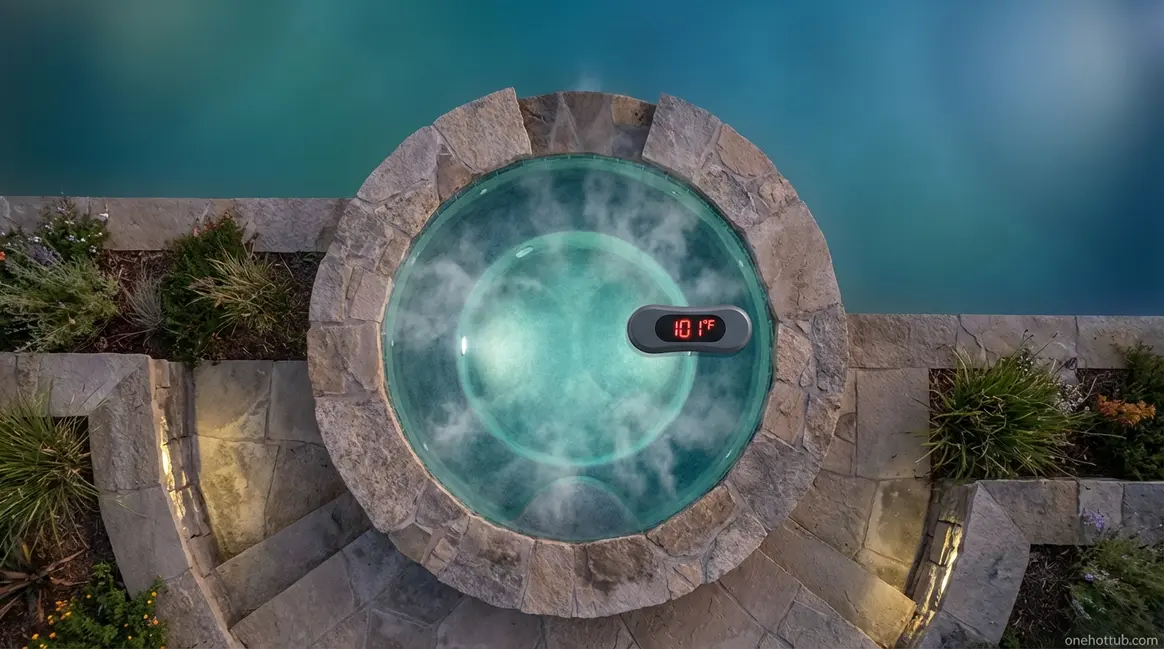
The ideal hot tub temperature for most adults is 100–102°F (37.8–38.9°C), though the U.S. Consumer Product Safety Commission (CPSC) sets the absolute maximum at 104°F (40°C). Most hot tubs ship from the factory pre-set to 100°F, which is the industry’s recognized comfort baseline. Getting this number right means the difference between a relaxing, therapeutic soak and a session that leaves you dizzy or overheated.
Most hot tubs are set between 100°F and 104°F (37.8°C–40°C), with 104°F being the absolute maximum safe temperature established by the CPSC — a figure that applies to every user, every tub, and every season.
The Industry Standard Range (100–104°F)
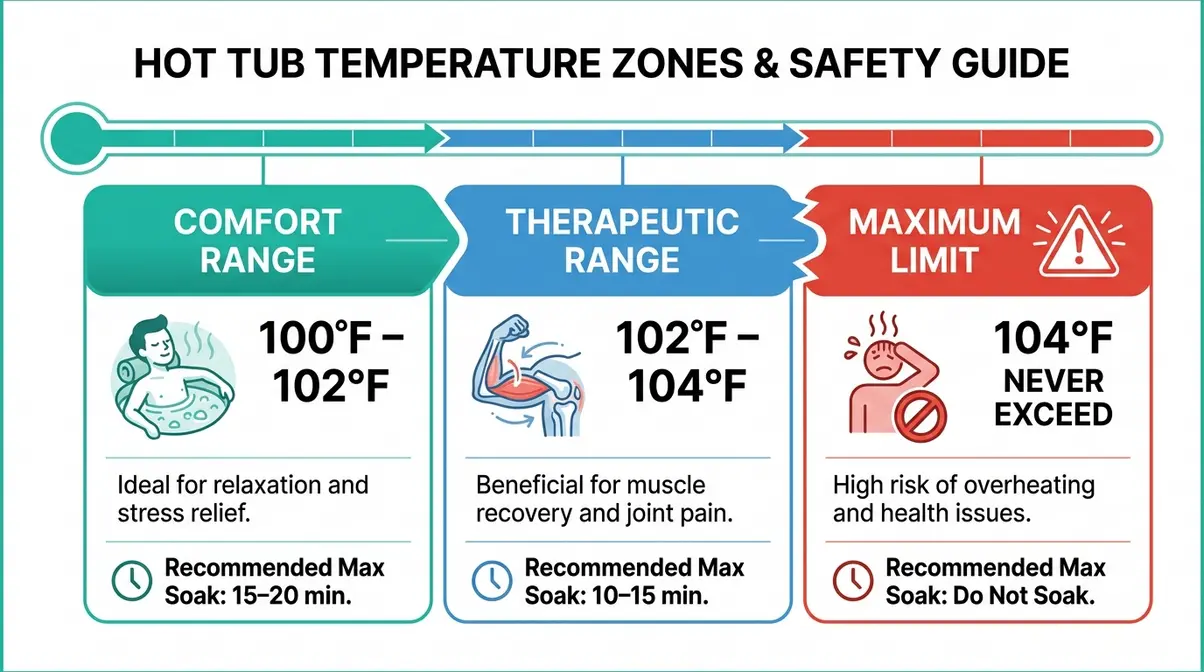
Spa professionals consistently recognize three distinct temperature zones within the 100–104°F range. Understanding each one helps you make smarter decisions about your daily settings.
Zone 1 — Comfort Range (100–102°F)
This is the sweet spot for most owners. The water is warm enough to relax muscles and dilate blood vessels, but not so hot that your body struggles to regulate its core temperature. You can comfortably soak for 20–30 minutes in this zone. It’s the right setting for casual relaxation, socializing, and evening wind-down sessions.
Zone 2 — Therapeutic Range (102–104°F)
At this level, the water works harder on tight muscles and stiff joints. Blood circulation increases more aggressively, which is why this range is popular for post-workout recovery and jet hydrotherapy. The trade-off is time: spa professionals recommend limiting soaks in this zone to 15 minutes or less. This range is not appropriate for children, pregnant individuals, or anyone with cardiovascular concerns.
Zone 3 — The Maximum Limit (104°F)
Think of 104°F as the speed limit, not a target. At this temperature, your body absorbs heat faster than it can release it. Core body temperature begins climbing toward dangerous levels — a condition called hyperthermia (dangerous overheating of the body) — within 15 to 20 minutes. According to CPSC guidelines on maximum hot tub temperatures, exceeding this limit increases the risk of heatstroke and cardiac stress, particularly for vulnerable users (CPSC, 2023).
What about “average” hot tub temperature? Most owners run their tubs between 100°F and 102°F in practice. The “average” is not the same as the “ideal” — personal preference, health status, and the season all matter. We’ll cover each of those factors in detail below.
For a detailed breakdown of what happens when you push past the limit, see our guide on hot tub maximum temperature limits.
Finding Your Personal Perfect Temperature
Finding the ideal temperature for a hot tub is a personal process, not a preset number. Factors like outdoor air temperature, individual heat tolerance, soak duration, and whether you’re soaking for relaxation or muscle recovery all shift your personal “perfect.” Here’s a beginner-friendly protocol that spa professionals recommend for new owners.
5-Step Personal Calibration Protocol:
- Start at 98°F for your first soak. This is warm but not hot, giving your body a safe chance to adjust to hydrotherapy (water-based therapy).
- Soak for 10 minutes and check in with yourself. Too cool? Comfortable? Too warm? Listen to your body — mild warmth and relaxation is the goal, not intensity.
- If you want it warmer, raise the temperature by 1–2°F before your next soak. Never jump more than 2°F at a time.
- Repeat the process over your first three to five soaks. Each session gives you more data about your personal comfort zone.
- Most people land between 100°F and 102°F after this process. If you feel lightheaded or flushed before that, your ideal is lower — and that’s completely normal.
Your personal calibration is also shaped by circumstances. An outdoor hot tub in January feels very different at 102°F than the same tub in July. If you’re soaking after exercise, you may want it slightly warmer. If you’re planning a long social soak, cooler is safer and more comfortable over time.
“I’d like to swim in the morning and my husband would like ‘hot tub’ at night. 73°F at 7am to 100°F at 9pm doesn’t seem realistic.”
If that sounds familiar, you’re not alone. Dual-use situations — where one person wants a cool pool and another wants a hot soak — require a clear baseline temperature and a realistic plan. Most hot tubs take 1–2 hours to raise temperature by 10°F, so dramatic same-day swings aren’t practical. The solution is establishing a baseline temperature (your default resting setting), then adjusting by a few degrees for specific sessions rather than attempting extreme swings.
Think of your baseline temperature like a thermostat setting for your home — it’s your starting point, and you adjust it by a degree or two based on the day.
For more guidance on dialing in your settings, our detailed breakdown of ideal hot tub temperature settings walks through additional scenarios.
Temperature for Relaxation vs. Therapeutic Soaking
The “correct” hot tub temperature is not one-size-fits-all. A 40-year-old using the tub after a gym session has different needs than a 65-year-old soaking for joint pain — and both are different from a family evening soak with kids in the water.
Relaxation Range (100–102°F): Warm water in this range relaxes muscles, slows the nervous system, and improves sleep quality by gently lowering core body temperature after you exit. It’s appropriate for most people and most situations, and you can comfortably soak for up to 30 minutes at the lower end of this range. This is the setting to default to when you’re unsure.
Therapeutic Range (102–104°F): At higher temperatures, blood circulation increases more aggressively — which is why this range is effective for targeted muscle relaxation, post-workout soreness, and jet hydrotherapy targeting specific joints. However, the benefit window is shorter. Limit soaks to 15 minutes in this range. This is not appropriate for children, pregnant individuals, or those with heart conditions — no exceptions.
| Purpose | Recommended Temp | Max Soak Time | Who It’s For |
|---|---|---|---|
| Casual relaxation / socializing | 100–102°F | 20–30 min | Most adults |
| Post-workout muscle recovery | 102–104°F | 15 min | Healthy adults only |
| Evening wind-down / sleep prep | 98–101°F | 20 min | Everyone |
| Family soak with children | 95–98°F | 5–10 min | Kids + adults |
| Therapeutic joint / arthritis | 100–102°F | 15–20 min | Seniors (consult doctor) |
The 100–102°F “sweet spot” is not arbitrary. It’s the range where water is warm enough to relax muscles and dilate blood vessels without pushing core body temperature into dangerous territory. In Section 2, we’ve built a tool called the Safe Soak Matrix — a single chart that maps temperature, soak time, and user type together. For now, let’s establish your baseline and then move into the safety rules that protect everyone who uses your tub.
Hot Tub Temperature Safety: Health Risks & the 15-Minute Rule
Hot tub safety comes down to understanding what heat does to the human body — and recognizing that different bodies respond very differently. This section covers the core rules, backed by Tier 1 medical sources, so you can protect every person who steps into your tub.
The Safe Soak Matrix: Temperature, Time & Who’s in the Tub
The Safe Soak Matrix is a single reference tool that maps the three key variables of safe hot tubbing: temperature, soak time, and the user’s health profile. No other guide maps all three together. Bookmark this section — it’s the most important chart in this article.
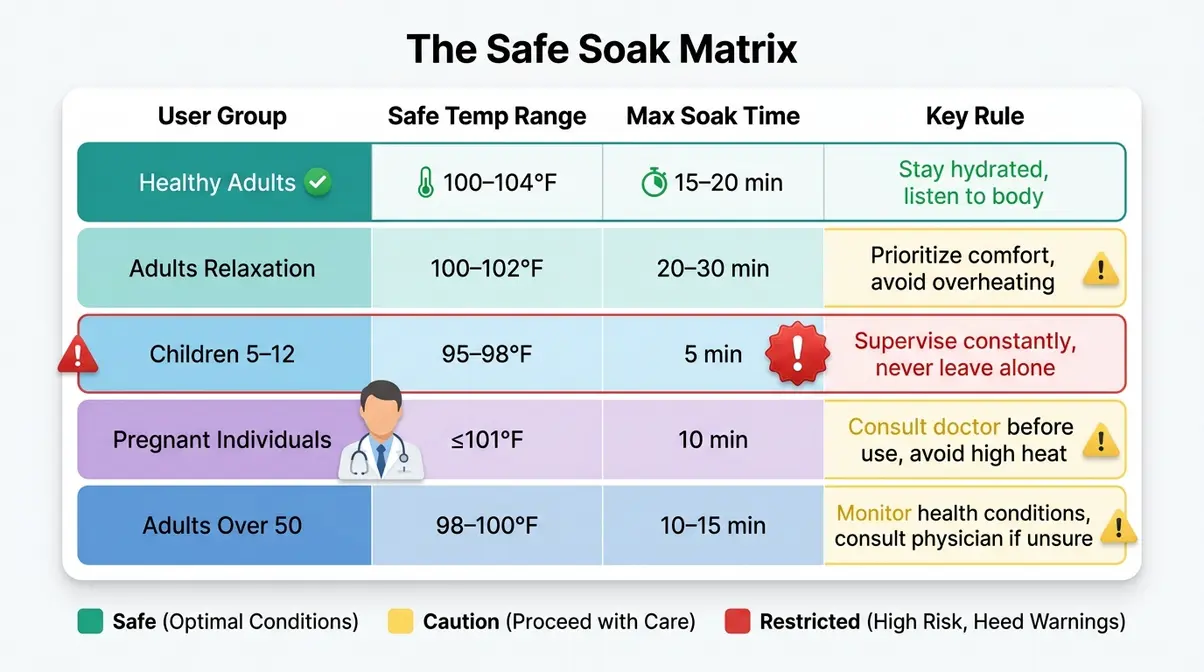
| User Group | Safe Temp Range | Max Soak Time | Key Rule |
|---|---|---|---|
| Healthy Adults (18–49) | 100–104°F (37.8–40°C) | 15–20 min at 102°F+ | Exit if lightheaded or flushed |
| Adults (relaxation) | 100–102°F (37.8–38.9°C) | 20–30 min | Hydrate before and after |
| Children (5–12) | 95–98°F (35–36.7°C) | 5 min maximum | Adult supervision always |
| Children under 5 | Not recommended | N/A | Too high a risk of overheating |
| Pregnant individuals | ≤101°F (38.3°C) | 10 min max | Consult doctor before every soak |
| Adults over 50 | 98–100°F (36.7–37.8°C) | 10–15 min | No alcohol; exit if dizzy |
| Heart conditions / AFib | 98–100°F (36.7–37.8°C) | 10 min max | Doctor’s clearance required |
| Diabetes | 98–100°F (36.7–37.8°C) | 10 min max | Check feet after; risk of burns |
Spa professionals consistently recommend printing or bookmarking this matrix and reviewing it any time a new person uses your tub — especially guests who may not know their own risk factors.
The 15-Minute Rule Explained
Why is there a 15-minute hot tub rule? The answer is simple physiology. When you immerse yourself in hot water, your body’s core temperature begins to rise. At 104°F, your body absorbs heat faster than sweat and circulation can dissipate it. After approximately 15 minutes at higher temperatures, most adults begin experiencing early signs of hyperthermia: flushed skin, lightheadedness, nausea, and elevated heart rate.
The CPSC guidelines on maximum hot tub temperatures specifically recommend limiting soaks to 15 minutes at higher temperature ranges (CPSC, 2023). This isn’t a conservative suggestion — it’s grounded in documented cases of heat-related illness linked to extended hot tub use.
The 15-Minute Rule in practice:
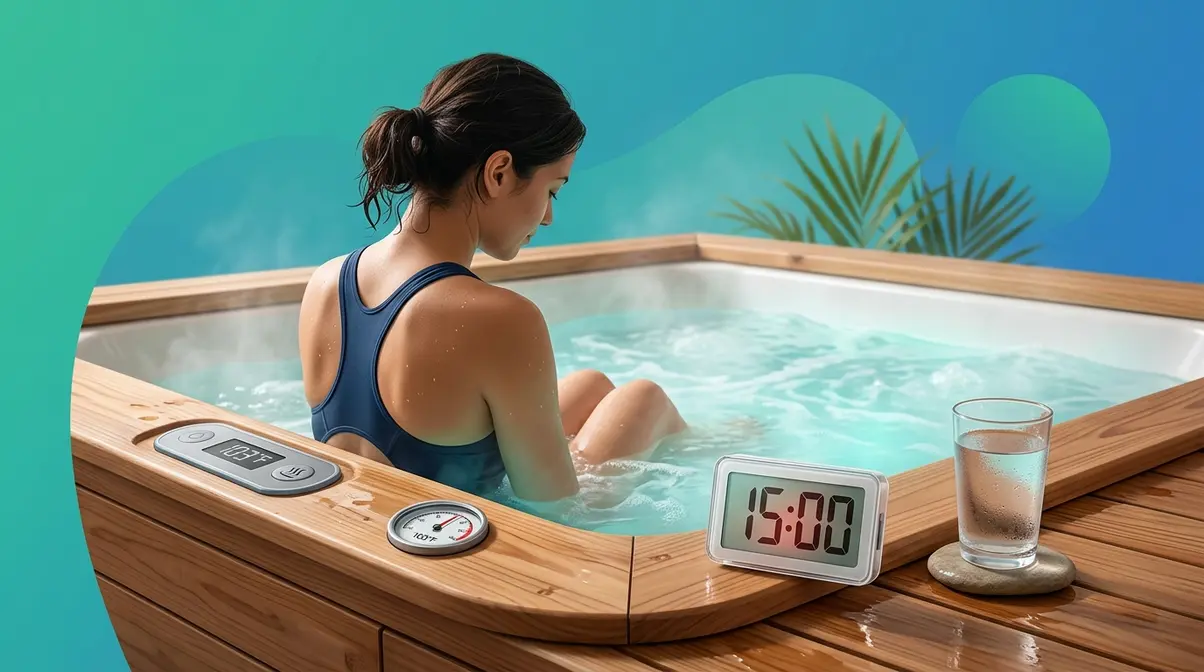
- Set a timer before entering the tub — don’t rely on memory.
- Exit the tub after 15 minutes if soaking above 102°F.
- Cool down for at least 5 minutes outside the water before re-entering.
- Drink water before you get in and after you get out. Hot water accelerates dehydration.
- Never consume alcohol before or during a soak — it impairs your body’s ability to regulate temperature and dramatically increases the risk of fainting.
At 100–102°F, healthy adults can comfortably extend soaks to 20–30 minutes, provided they stay hydrated and exit if any discomfort begins. The rule is most critical above 102°F.
Is 110°F Too Hot? Understanding the 104°F Maximum
Yes — 110°F is far too hot and should never be used under any circumstances. The 104°F maximum set by the CPSC is not a conservative estimate. It is the threshold above which the risk of serious heat injury becomes clinically significant for otherwise healthy adults.
At 110°F, the body cannot maintain safe core temperature even briefly. Heat exhaustion can begin within 5–10 minutes. For children, seniors, or anyone with a cardiovascular condition, the risk of heat stroke at 110°F is severe and potentially life-threatening.
What if your hot tub reads above 104°F?
- If your thermostat is malfunctioning and the water has climbed above 104°F, do not enter the tub.
- Turn off the heater and let the water cool naturally, or add cold water to bring the temperature down.
- Have your thermostat and temperature sensor inspected by a qualified spa technician.
A properly functioning hot tub should never exceed 104°F. If yours does, that’s a mechanical fault — not a setting to soak in. Our guide on hot tub maximum temperature limits covers thermostat troubleshooting in detail.
Hot Tub Temperature for Vulnerable Groups
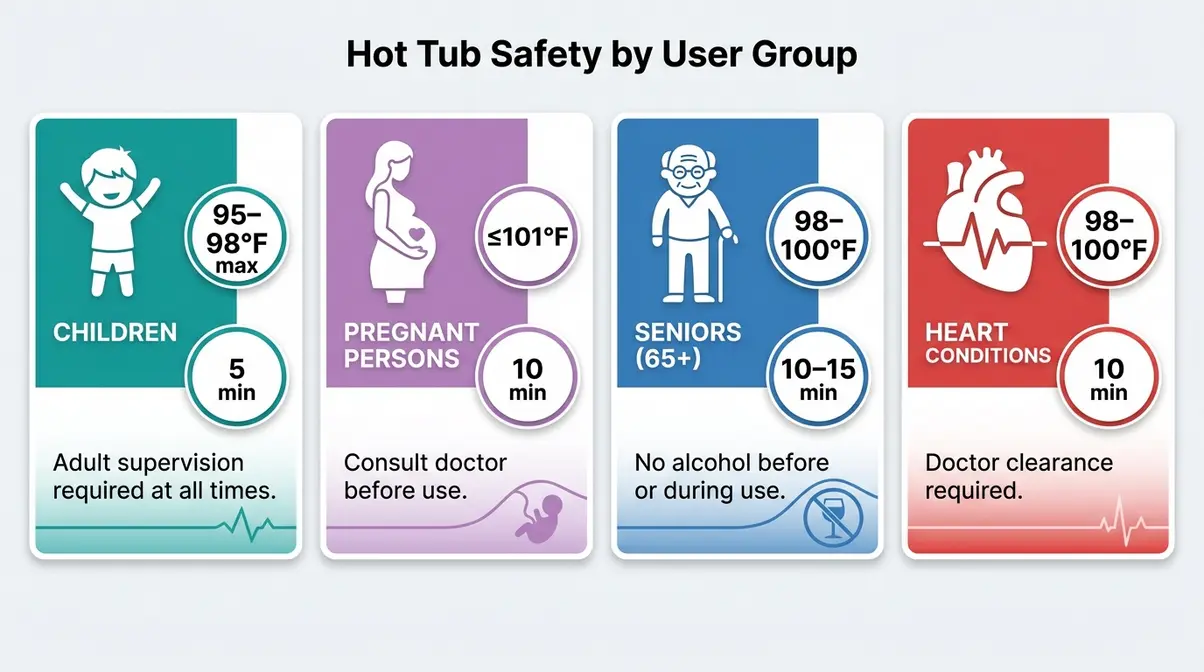
Different bodies face different risks in hot water. Understanding those risks — backed by Tier 1 medical sources — is what separates a safe hot tub owner from an uninformed one.
Children Under 12
Children’s bodies overheat faster than adults’ because they have a higher surface-area-to-body-mass ratio, meaning they absorb heat more quickly relative to their size. The CPSC guidelines on maximum hot tub temperatures advise that children should not use hot tubs without adult supervision, and water temperature should be kept at or below 98°F for children aged 5–12 (CPSC, 2023). Children under 5 should not use hot tubs at all.
Keep soaks to 5 minutes maximum. Children often don’t recognize the signs of overheating until they’re already in trouble — a parent or guardian must monitor them continuously.
Pregnant Individuals
Heat exposure during pregnancy is a serious concern. According to Mayo Clinic guidance on pregnancy and heat exposure, raising core body temperature above 101°F (38.3°C) during the first trimester has been associated with an increased risk of neural tube defects (Mayo Clinic, 2024). Pregnant individuals should avoid water above 101°F, limit soaks to 10 minutes, and consult their doctor before using a hot tub at any stage of pregnancy.
Adults Over 50
Age-related changes in circulation, cardiovascular function, and the body’s heat-regulation mechanisms make older adults more vulnerable to heat stress. Spa professionals recommend keeping the temperature at 98–100°F for regular users over 50, limiting soaks to 10–15 minutes, and avoiding alcohol entirely before or during hot tubbing.
The question “Why should people over 50 not use a hot tub?” is too absolute — most healthy adults over 50 can use a hot tub safely with these adjustments. The risks are real, but they’re manageable with the right settings and habits.
Heart Conditions and AFib
Can a hot tub trigger AFib (atrial fibrillation — an irregular heart rhythm)? According to Harvard Health research on heat and cardiovascular stress, heat causes blood vessels to dilate rapidly, which lowers blood pressure and forces the heart to work harder (Harvard Health, 2024). For individuals with existing heart conditions, this cardiovascular stress can trigger arrhythmias including AFib. Anyone with a diagnosed heart condition — including high blood pressure, coronary artery disease, or a history of arrhythmia — must consult their doctor before using a hot tub.
For those who receive medical clearance, keeping temperature at 98–100°F and limiting soaks to 10 minutes significantly reduces cardiac stress.
A note on sperm count: Mayo Clinic notes that regular hot tub use at elevated temperatures can temporarily reduce sperm count due to scrotal temperature elevation. This effect is generally reversible after several months of reduced heat exposure, but individuals concerned about fertility should discuss hot tub use with their healthcare provider.
Hot Tub Bacteria: The Temperature-Safety Connection
Hot water and bacteria have a complicated relationship. Warm water accelerates the growth of harmful bacteria — including Legionella (the bacteria responsible for Legionnaires’ disease, a serious form of pneumonia) and Pseudomonas aeruginosa (which causes hot tub rash). According to the CDC guidelines on healthy swimming and hot tub safety, hot tubs are a higher-risk environment than pools because the warm water depletes sanitizing chemicals like chlorine faster (CDC, 2024).
The connection to temperature: water maintained below 78°F (25.6°C) becomes a breeding ground for bacteria, because sanitizers work less effectively at low temperatures and organic material accumulates faster. On the other end, water above 104°F doesn’t eliminate bacteria — it just creates new health risks.
The safe operating range for bacterial control is 78°F–104°F, with proper chemical maintenance. Key practices:
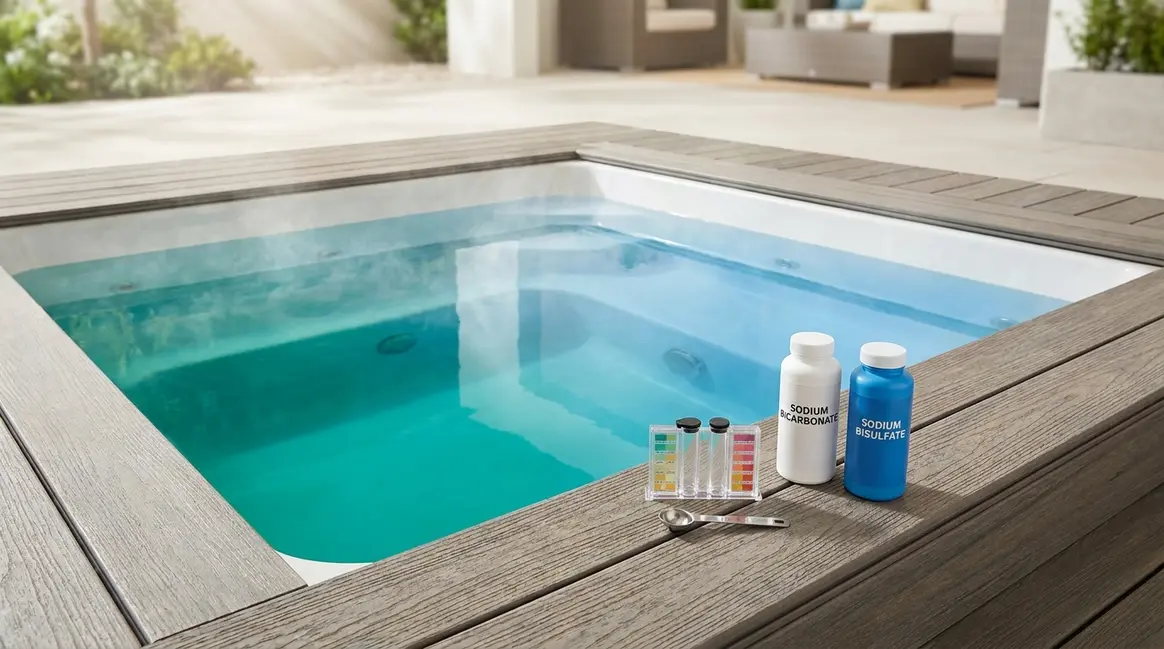
- Test water chemistry (pH, chlorine or bromine levels) at least 2–3 times per week.
- Never let pH drift below 7.2 or above 7.8 — both extremes reduce sanitizer effectiveness.
- Shock the water weekly to eliminate organic contaminants.
- Keep the cover on when not in use to prevent debris and temperature fluctuation.
Maintaining your temperature within the recommended range is not just about comfort — it’s directly tied to water safety.
Ideal Hot Tub Temperature by Season
The ideal hot tub temperature changes with the seasons — not just for comfort, but for energy efficiency and safety. Running your tub at the same setting year-round is one of the most common (and costly) mistakes new owners make.
Winter Hot Tub Temperature: Staying Warm and Safe
Winter is peak hot tub season for a reason. The contrast between cold air and warm water is deeply satisfying — and the insulating properties of a quality hot tub cover mean your heater doesn’t have to work as hard as you might expect to maintain temperature.
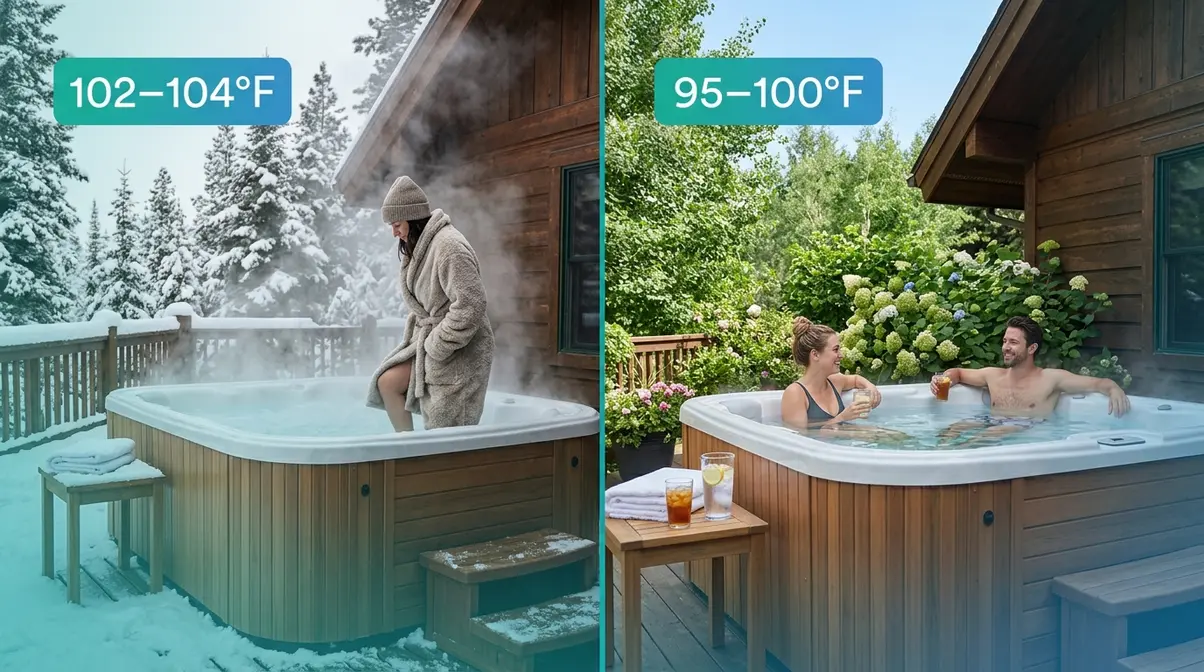
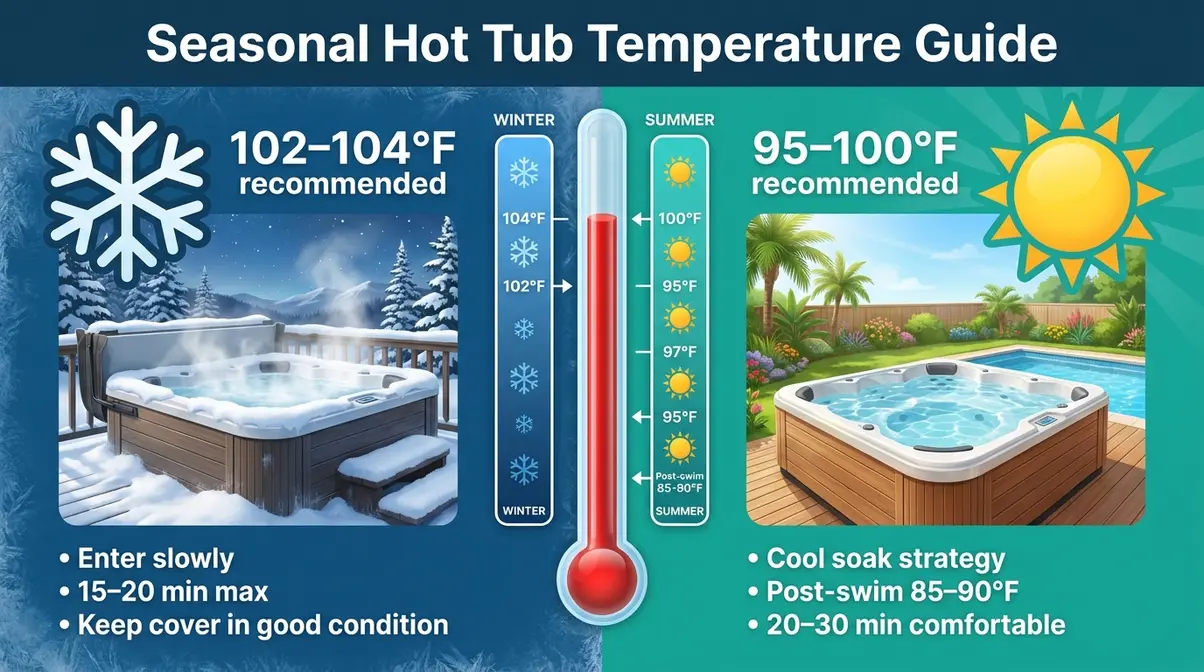
Recommended winter range: 102–104°F
In cold weather, the ambient air temperature creates a natural cooling effect on the water surface. Your body also acclimates to the cold faster outdoors, which means the water needs to be slightly warmer to deliver the same relaxation effect. Spa professionals recommend running it a degree or two warmer in winter — up to 104°F if you’re a healthy adult who enjoys the intensity.
Winter safety adjustments:
- The dramatic temperature contrast between cold air and very hot water can spike blood pressure rapidly on entry. Lower yourself in slowly, giving your body 30–60 seconds to adjust.
- Keep soaks to 15–20 minutes maximum even in winter. Cold air can mask the signs of overheating — you may not feel as flushed, but your core temperature is still rising.
- Have a warm robe or towels within arm’s reach. Exiting a 104°F tub into freezing air creates a rapid heat-loss scenario that can cause dizziness.
- Ensure your cover is in good condition. A damaged or waterlogged cover can increase heat loss by 50% or more, significantly raising your winter energy costs.
Summer Hot Tub Temperature: The Cool Soak Strategy
Hot tubbing in summer requires a completely different mindset. When the air temperature is 85°F or higher, soaking at 104°F is genuinely uncomfortable for most people — and raises real safety concerns around heat exhaustion.
The cool soak strategy: run it cooler at 95–100°F in summer.
At these lower settings, the water still delivers hydrotherapy benefits and muscle relaxation, but the risk of overheating drops dramatically. Many owners find that 98°F in summer feels as satisfying as 102°F in winter, because the ambient air temperature is warmer and the contrast effect is smaller.
Summer temperature guidelines:
| Situation | Recommended Setting |
|---|---|
| Hot summer day (85°F+ air temp) | 95–98°F |
| Warm evening (70–80°F air temp) | 98–100°F |
| Cool summer night (below 65°F) | 100–102°F |
| Post-swim cool-down soak | 85–95°F |
A post-swim “cool soak” at 85–90°F is increasingly popular among owners with both a pool and a hot tub. The slightly warm water — cooler than typical hot tub settings — is refreshing after swimming while still providing mild hydrotherapy. This is also the solution to the scenario from our user quote: set the tub to 85–90°F for morning swimming, then warm it up to 100°F for an evening soak.
Seasonal Energy Efficiency: Real Numbers
Temperature management is one of the most powerful tools you have for controlling your hot tub’s running costs. The U.S. Department of Energy notes that water heating is one of the largest energy costs associated with hot tub ownership — and small temperature adjustments create meaningful savings over time.
Concrete energy-saving examples:
- Dropping your standby temperature from 104°F to 100°F reduces the energy needed to maintain that temperature by approximately 10–15%, because heat loss is proportional to the difference between water temperature and ambient air temperature.
- In summer, lowering your set temperature from 104°F to 98°F can reduce monthly heating energy costs by 15–20%, since the smaller gap between water and air temperature means less constant heating is required.
- Using an insulating cover consistently reduces heat loss by up to 75% compared to an uncovered tub — this single habit has more impact than any temperature adjustment.
| Temperature Setting | Relative Energy Cost | Best Season |
|---|---|---|
| 104°F | Highest | Winter (premium comfort) |
| 102°F | High | Winter/Fall |
| 100°F | Moderate | Spring/Fall |
| 98°F | Lower | Summer |
| 95°F | Lowest | Hot summer days |
The most cost-conscious approach is a seasonal baseline strategy: set your baseline temperature to 100–102°F in cooler months and drop it to 96–98°F in summer. Combine this with a good insulating cover and a timer-based heating schedule, and you can meaningfully reduce your annual energy spend without sacrificing comfort.
Hot Tub Temperature When Not in Use
What temperature should you leave your hot tub when you’re not using it? This is one of the most common questions from new owners — and the answer surprises most people.
The Standby Temperature Strategy
The instinct to turn your hot tub completely off when you’re not using it makes sense on the surface — why heat water you’re not soaking in? But for most owners, this is actually the more expensive option.
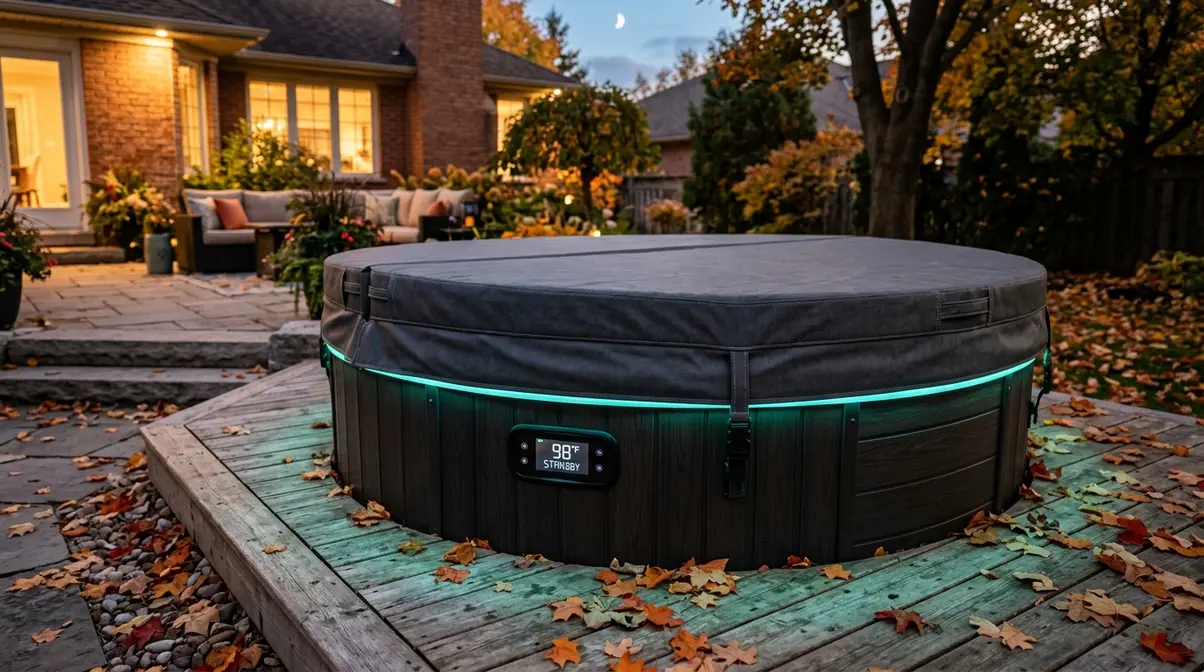
The standby temperature recommendation: keep it at 95–100°F when not in use.
Here’s why: reheating a completely cooled hot tub from ambient temperature (say, 60°F in autumn) back to 102°F requires a large amount of energy delivered in a short window. Maintaining the water at 95–100°F uses a small, steady amount of energy to offset heat loss. For most hot tubs in most climates, the continuous low-energy maintenance approach is cheaper than the reheat-from-cold approach.
The exception: if you’re away for more than 2 weeks, dropping to a frost-protection setting (around 50–55°F in cold climates) makes sense. But for regular weekly use, don’t turn it completely off.
Standby temperature by season:
| Season | Recommended Standby Temp |
|---|---|
| Winter | 100–102°F (maintains near-use temp) |
| Spring/Fall | 98–100°F |
| Summer | 95–98°F |
| Extended absence (2+ weeks) | 50–55°F (frost protection only) |
For more detail on managing your hot tub’s energy use, our guide on hot tub running costs and energy tips breaks down monthly cost scenarios by climate zone.
Why Is My Hot Tub Temperature Dropping?
A hot tub that loses more than 1–2°F overnight has a problem worth diagnosing. Normal heat loss is gradual and predictable. Rapid temperature drops point to specific causes — most of which are straightforward to fix.
Common causes of unexpected temperature drops:
| Cause | What Happens | Fix |
|---|---|---|
| Damaged or missing cover | Heat escapes rapidly from the water surface | Replace or repair cover; check seal |
| Inadequate insulation | Heat bleeds through tub walls | Check insulation panels; add thermal wrap |
| Heater malfunction | Heater not maintaining set temperature | Test heater output; call a technician |
| Incorrect thermostat calibration | Tub thinks it’s hotter than it is | Recalibrate or replace sensor |
| High winds (outdoor tubs) | Surface cooling accelerates | Add a windbreak or privacy screen |
| Low ambient temperature extremes | Greater temperature differential = faster loss | Raise standby temp slightly in extreme cold |
A drop of 3–5°F overnight in very cold weather with a good cover is within normal range. A drop of 10°F or more overnight almost always indicates a cover problem, a heater issue, or a leak. If your temperature is dropping rapidly and you can’t identify the cause, contact a certified spa technician.
For a full diagnostic walkthrough, our hot tub troubleshooting guide covers temperature, chemistry, and equipment issues step by step.
How to Adjust Your Hot Tub Temperature
Adjusting your hot tub temperature is straightforward on most modern control panels — but the process varies slightly by brand. Here’s a general guide that applies to most hot tubs, including Jacuzzi, Bullfrog, and other major manufacturers.
Standard temperature adjustment steps:
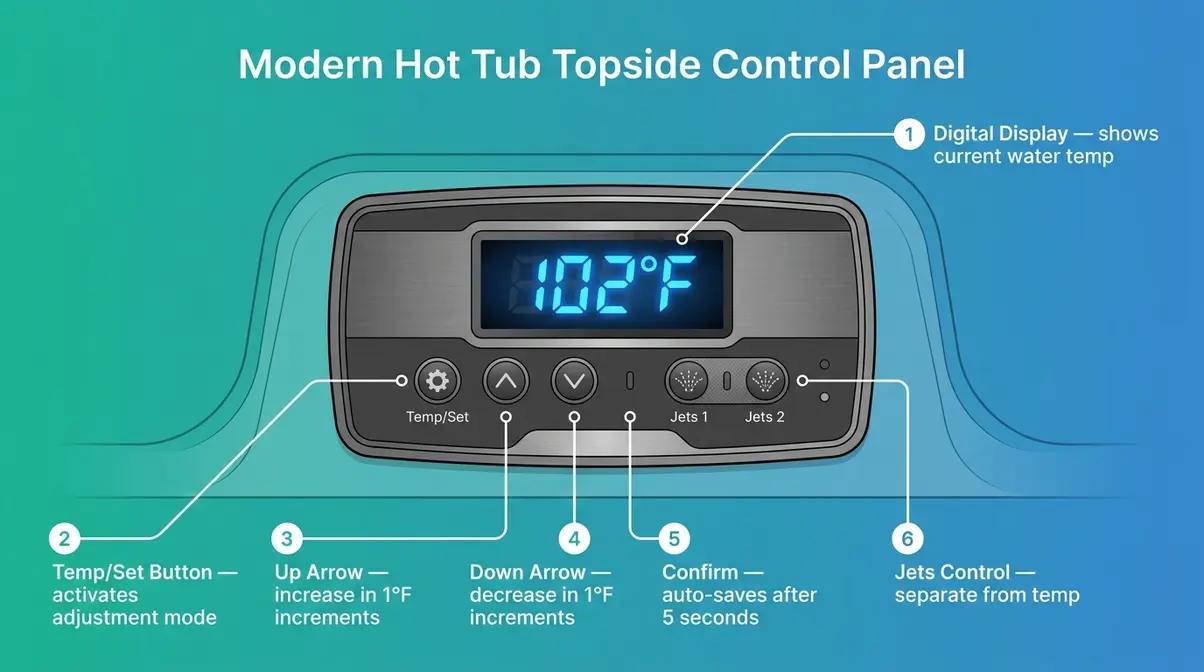
- Locate the control panel. On most hot tubs, this is a topside panel on the tub’s edge or a separate keypad. It typically shows the current water temperature digitally.
- Press the “Temp” or “Set” button. This activates the temperature adjustment mode. The display will typically flash or show an arrow icon.
- Use the up/down arrows to adjust. Most panels adjust in 1°F increments. Hold the button to scroll faster.
- Confirm the new setting. On most models, the panel automatically saves after 5 seconds of inactivity, or you press “Set” again to confirm.
- Allow time for the water to reach the new temperature. Hot tubs typically heat at 3–6°F per hour, depending on heater size and ambient temperature. A 5°F increase takes roughly 1–2 hours.
- Check the actual water temperature with a separate floating thermometer periodically — control panel readings can drift from actual water temperature if the sensor is positioned near a jet or in a cool pocket.
For Jacuzzi-specific instructions, see how to adjust your Jacuzzi hot tub settings for model-specific guidance.
Hot Tub Temperature in Celsius: UK & International Guide
If your hot tub’s control panel displays Celsius — common in the UK, Canada, Australia, and most of Europe — the same safety principles apply. Only the numbers on the dial change.
Fahrenheit to Celsius Conversion Chart
The ideal hot tub temperature in Celsius for most adults is 37.8–38.9°C, with a hard maximum of 40°C. Here’s a quick reference for the key temperatures discussed in this guide:
| Fahrenheit | Celsius | What It Means |
|---|---|---|
| 95°F | 35°C | Children’s maximum; cool soak |
| 98°F | 36.7°C | Seniors/heart conditions; summer baseline |
| 100°F | 37.8°C | Industry comfort baseline; factory default |
| 101°F | 38.3°C | Pregnancy maximum (consult doctor) |
| 102°F | 38.9°C | Upper comfort range; therapeutic low end |
| 104°F | 40°C | Absolute maximum — never exceed |
| 110°F | 43.3°C | Dangerously hot — never use |
Quick conversion formula: Subtract 32 from the Fahrenheit temperature, then multiply by 5/9. Example: (104 − 32) × 5/9 = 40°C.
UK Hot Tub Temperature Recommendations
The recommendations for ideal hot tub temperature in the UK are identical to those in the United States — the physics of heat and human physiology don’t change with geography. The UK’s Health and Safety Executive (HSE) aligns with international guidance: maximum water temperature of 40°C (104°F), with particular caution advised for children, pregnant individuals, and those with cardiovascular conditions.
UK owners should also be aware that domestic hot tubs (inflatable or “lay-Z-spa” style soft tubs, which are common in the UK market) often have lower maximum temperatures of 40°C built in as a hard limit — consistent with safety guidelines. Hard-shell spa units typically offer the same 40°C maximum.
The seasonal advice is equally applicable: UK summers rarely require water above 36–38°C (96–100°F) for comfort, while UK winters (particularly in Scotland and northern England) may justify pushing toward the 40°C maximum for the same warming contrast effect.
Common Hot Tub Temperature Mistakes to Avoid
Even experienced hot tub owners make temperature-related mistakes. These are the five most common — and the ones most likely to cost you money, comfort, or safety.
5 Mistakes That Make Your Hot Tub Unsafe or Expensive
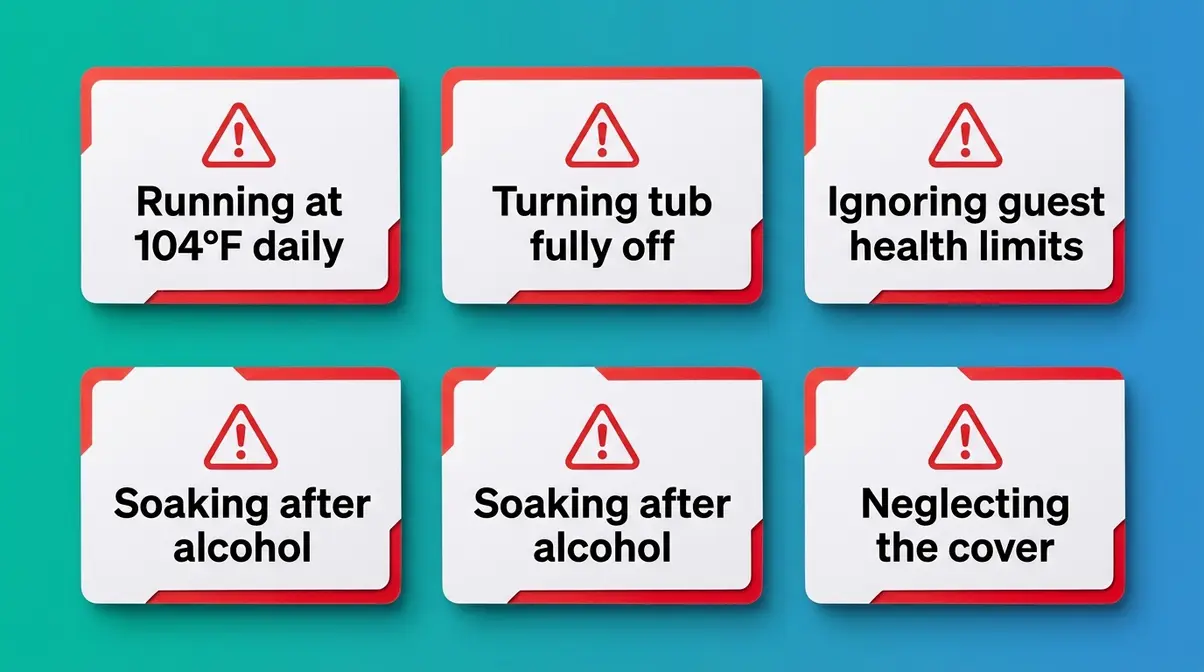
Mistake 1: Running the tub at maximum temperature as a default
Setting 104°F as your everyday baseline is the single most common mistake new owners make. It’s not more beneficial than 102°F for relaxation — it’s just riskier and more expensive. Across hot tub owner communities, the consensus is that most people actually prefer 100–102°F once they’ve tried it. Start lower and work up.
Mistake 2: Turning the tub completely off between uses
As covered in the standby section, fully powering down your hot tub and reheating from cold uses more energy than maintaining a steady standby temperature. It also stresses your heater. For regular users (2–3 times per week or more), a standby temperature of 95–100°F is almost always more cost-effective.
Mistake 3: Ignoring temperature limits for guests
Your temperature might be calibrated for a healthy adult — but your guests may be pregnant, over 60, or have undisclosed heart conditions. Before any group soak, mention the temperature and invite guests to let you know if they’d prefer it cooler. A quick “we run it at 102°F — does that work for everyone?” takes five seconds and could prevent a serious incident.
Mistake 4: Soaking after alcohol consumption
Alcohol impairs your body’s thermoregulation — its ability to regulate its own temperature. Even one drink before a hot soak meaningfully increases the risk of dizziness, fainting, and heat-related illness. This risk is significantly higher at temperatures above 102°F. Spa professionals consistently list alcohol + hot tub as one of the top preventable causes of hot tub emergencies.
Mistake 5: Neglecting the cover and insulation
Temperature management starts with heat retention. A damaged, waterlogged, or ill-fitting cover can increase heat loss by 50% or more, forcing your heater to run constantly and driving up energy costs. Check your cover’s condition every season — lift it, check the foam core for water absorption (a heavy, saggy cover has lost its insulating value), and replace it if needed.
For more on avoiding common ownership errors, our guide on hot tub maintenance mistakes covers chemical, equipment, and temperature-related issues together.
When to Consult a Doctor Before Soaking
Hot tubs are generally safe for healthy adults — but several health conditions require medical clearance before use. This isn’t overly cautious advice. It’s the standard recommendation from the CDC, Mayo Clinic, and CPSC.
Consult your doctor before using a hot tub if you have:
- Any diagnosed heart condition, including AFib, coronary artery disease, or high blood pressure
- Type 1 or Type 2 diabetes (hot water can cause numbness in extremities, masking burns)
- Pregnancy at any stage
- A recent surgical wound or open skin condition
- A history of fainting or dizziness
- A condition requiring blood-thinning medications
- Chronic kidney disease or liver disease
Signs that you should exit the tub immediately:
- Dizziness or lightheadedness
- Nausea
- Rapid or irregular heartbeat
- Flushed skin that doesn’t cool when you want it to
- Feeling unusually fatigued or confused
If you experience any of these symptoms during a soak, exit the tub calmly, sit in a cool area, and drink water. If symptoms persist or worsen, seek medical attention. For guidance on general health-related hot tub questions, our hot tub health benefits and risks guide provides a balanced overview.
Frequently Asked Questions About Hot Tub Temperature
Can a hot tub trigger AFib?
Yes, a hot tub can trigger AFib (atrial fibrillation) in susceptible individuals. Hot water causes rapid vasodilation (widening of blood vessels), which drops blood pressure and forces the heart to increase its output. For people with existing heart conditions or a predisposition to arrhythmias, this cardiovascular stress can provoke an irregular heartbeat. According to Harvard Health research on heat and cardiovascular stress, the risk is highest at temperatures above 102°F and during extended soaks (Harvard Health, 2024). Anyone with a diagnosed heart condition should get explicit medical clearance before using a hot tub.
Is 90°F too cold for a hot tub?
90°F (32.2°C) is below the typical comfort range for most hot tub users, but it’s not dangerous. Standard hot tub comfort begins around 98–100°F. At 90°F, the water feels warm rather than hot — similar to a heated pool. Some owners intentionally use 88–92°F for a “cool soak” in summer or for children’s sessions. For therapeutic muscle relaxation or the classic hot tub experience, most people find 90°F unsatisfying. It’s a safe temperature, just not an optimal one for most use cases.
Is 110°F too hot for a hot tub?
Yes — 110°F (43.3°C) is dangerously hot and should never be used. The CPSC sets the absolute maximum at 104°F (40°C) for a specific reason: above this threshold, the human body absorbs heat faster than it can dissipate it, and core body temperature begins to rise toward heat stroke levels within minutes (CPSC, 2023). At 110°F, heat exhaustion can begin in under 10 minutes for healthy adults. For children, seniors, or anyone with a heart condition, 110°F poses a life-threatening risk. If your tub reads 110°F, do not enter — your thermostat is malfunctioning.
Is 72°F pool water cold?
72°F (22.2°C) is considered cool for recreational swimming by most standards. The American Red Cross recommends pool temperatures of 78–82°F for recreational swimming. At 72°F, water feels noticeably cold on entry, and most casual swimmers find it uncomfortable for extended sessions. Competitive swimmers often train in cooler water (76–78°F), but 72°F is below the comfort threshold for most people. It’s not dangerous for healthy adults in short sessions, but it’s cold enough to cause muscle cramping in longer swims.
Why should people over 50 not use a hot tub?
The premise is slightly overstated — most healthy adults over 50 can use a hot tub safely with adjustments. The concern stems from age-related changes: reduced cardiovascular reserve, slower thermoregulation, and medications (such as blood pressure drugs) that can interact with heat exposure. The real guidance is not “avoid hot tubs” but “adjust your settings.” Spa professionals recommend 98–100°F (not 104°F), soaks of 10–15 minutes (not 20–30), no alcohol, and immediate exit at any sign of dizziness. Anyone over 50 with a cardiovascular condition should get medical clearance first.
What are the four signs your heart is quietly failing?
The four classic early signs of heart failure are shortness of breath, persistent fatigue, swelling in the legs or ankles, and rapid or irregular heartbeat. These symptoms are relevant to hot tub use because heat stress accelerates heart rate and can exacerbate fluid retention. If you experience any of these symptoms during or after a soak, exit immediately and consult a doctor. Hot tub use is not recommended for anyone with diagnosed heart failure without explicit medical clearance. This question falls outside the scope of hot tub guidance — please consult a cardiologist or your primary care physician for a full assessment.
Why is there a 15-minute hot tub rule?
The 15-minute rule exists because at temperatures above 102°F, the body absorbs heat faster than it can release it through sweating and circulation. After approximately 15 minutes, most adults begin experiencing early signs of hyperthermia: elevated heart rate, flushed skin, and lightheadedness. The CPSC recommends limiting soaks to 15 minutes at higher temperature ranges to prevent heat-related illness (CPSC, 2023). At lower temperatures (100–102°F), healthy adults can comfortably extend soaks to 20–30 minutes. The rule is a guideline calibrated to the highest safe temperature, not a hard limit at all temperatures.
What’s better, a 110V or 220V hot tub?
For most homeowners, a 220V (also written as 240V) hot tub offers significantly better performance. A 110V (“plug-and-play”) hot tub requires no special electrical installation but has a smaller heater (typically 1kW), which means slower heating — often 1–2°F per hour — and difficulty maintaining temperature in cold weather. A 220V hot tub uses a dedicated circuit (professionally installed) and a more powerful heater (4–6kW), reaching target temperature in roughly half the time and maintaining it more efficiently in winter. For year-round use in any climate, spa professionals consistently recommend 220V for better temperature control and lower long-term energy costs.
Getting Your Temperature Right — Every Soak, Every Season
The ideal hot tub temperature is not a single number — it’s a framework. For most healthy adults, 100–102°F delivers the best balance of relaxation, safety, and energy efficiency. The 104°F maximum set by the CPSC is a hard ceiling, not a target. And for children, pregnant individuals, seniors, and anyone with a heart condition, the Safe Soak Matrix in this guide gives you the exact numbers to use.
The Safe Soak Matrix is the core insight here: temperature alone doesn’t determine safety. The combination of temperature, soak time, and who is in the tub is what matters. A 102°F soak for 15 minutes is safe for a healthy adult and risky for a 10-year-old. A 98°F soak is therapeutic for a senior and underwhelming for someone seeking post-workout muscle recovery. One number can’t serve all those situations — but one framework can.
Start with your personal calibration: begin at 98°F, work up in 1–2°F increments over your first few soaks, and note where you feel genuinely relaxed without feeling lightheaded. Adjust seasonally — run it cooler in summer, warmer in winter. Keep your standby temperature at 95–100°F to balance comfort and energy costs. And before any new person uses your tub, check the Safe Soak Matrix for their user group.
Your next step: set your hot tub to 100°F tonight and do a 15-minute calibration soak. Note how you feel. That single soak will tell you more about your personal ideal than any chart — and it’s the safest place to start.

Dave King
Hot tub tester and writer at One Hot Tub.