


Table of Contents - Hot Tub Tips for Beginners: Complete Guide to Safe Soaking
This blog post may contain affiliate links. As an Amazon Associate I earn from qualifying purchases.
“Is there a community consensus guide on owning and operating a hot tub? I normally would look in the subreddit about section but I don’t see a sticky…”
If you’ve ever typed something like that into a search bar, you’re in exactly the right place. Getting a new hot tub is exciting — but the water chemistry, the chemicals, and the safety rules can feel like a second job.
Most guides online are written by manufacturers pushing their own products, or by experts who forgot what it’s like to be a beginner. You end up with six browser tabs open and still no idea what order to add chemicals.
This guide gives you a clear, step-by-step plan for setting up your hot tub, keeping the water balanced, staying safe, and learning a few clever tricks that make ownership genuinely enjoyable. These hot tub tips for beginners are sourced from CDC guidelines, CPSC safety standards, and the collective wisdom of real hot tub communities — so you can trust what you’re reading. We cover everything from your very first fill to your weekly maintenance routine — no chemistry degree required.
Key Takeaways: Hot Tub Tips for Beginners
New hot tub owners need to master three things: a safe first fill, a weekly water chemistry check, and basic safety rules — and it’s simpler than most guides make it sound.
- First fill: Add metal sequestrant → balance alkalinity (80–120 ppm) and pH (7.4–7.6) → add sanitizer → shock the water
- Weekly habit: The Hot Tub Health Score check takes under 2 minutes and tells you if your water is safe to soak in
- Safety rule #1: The CPSC recommends limiting soaks to 15 minutes at a time at temperatures above 100°F
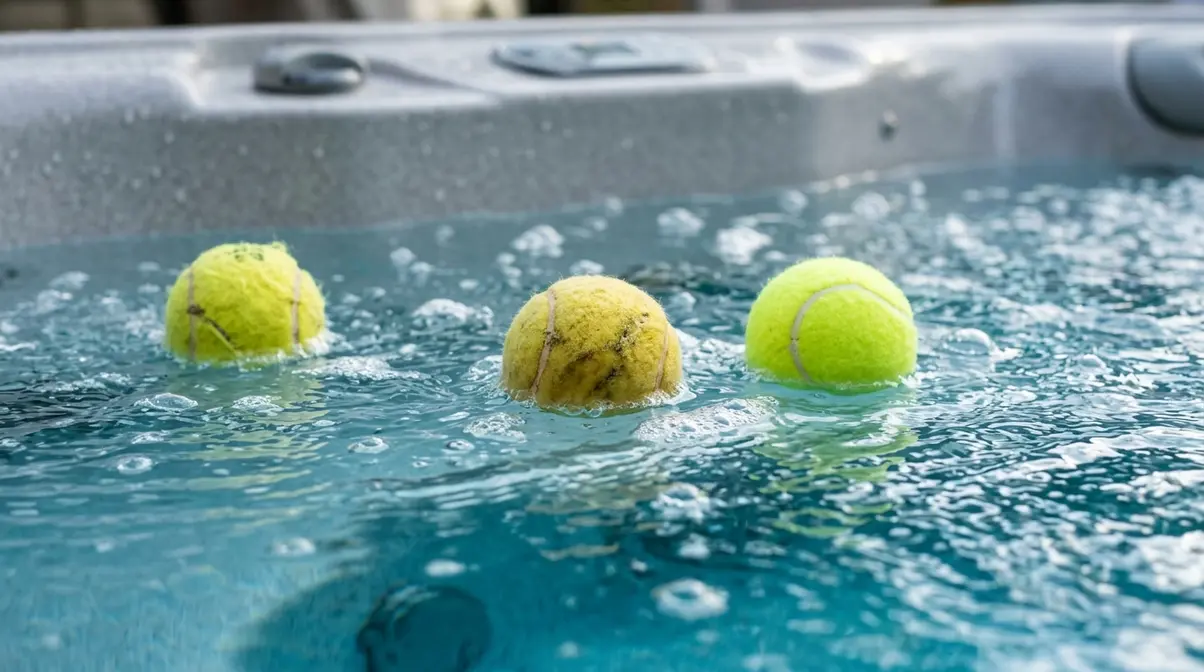
- Hack of the week: Toss 2–3 tennis balls in after each soak — they absorb body oils and keep your water cleaner for longer
- Sanitizer choice: Chlorine (1–3 ppm) is cheaper and faster-acting; bromine (2–4 ppm) is gentler on skin and more stable in heat
Your First Fill Checklist
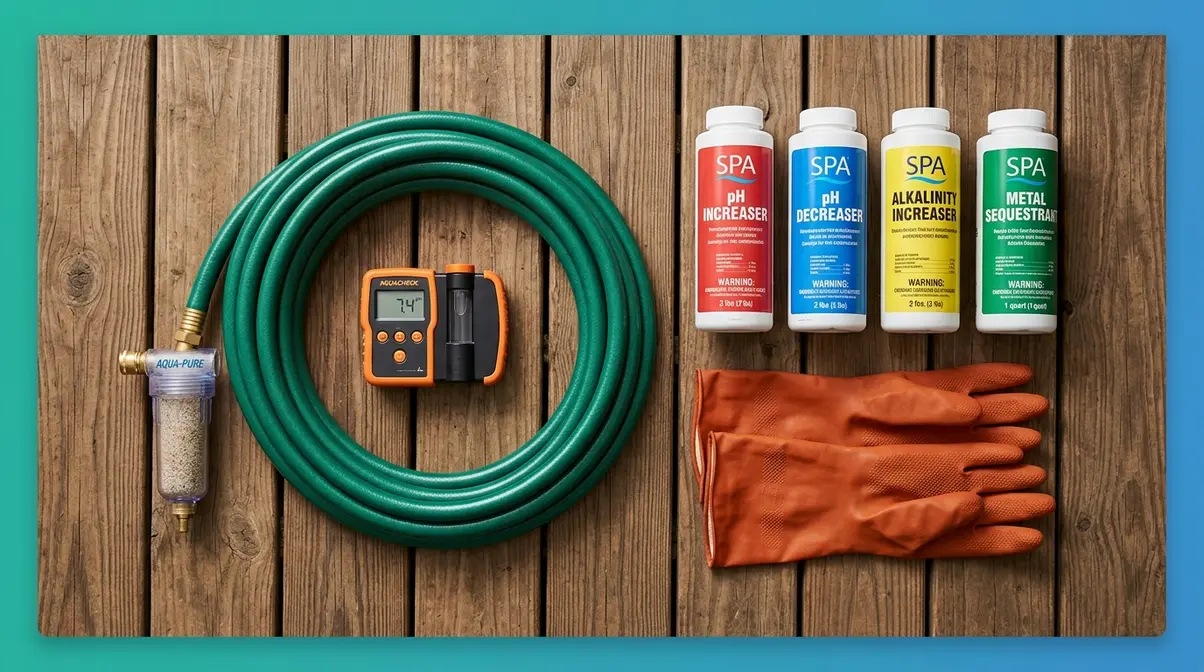
Setting up your hot tub correctly from day one prevents expensive headaches later. If you want essential tips for first-time hot tub owners, new owners consistently report that skipping site prep and chemical order are the two most common — and costliest — first-fill mistakes. This section walks you through every step, from making sure your deck can handle the weight to adding your first chemicals in the right sequence.
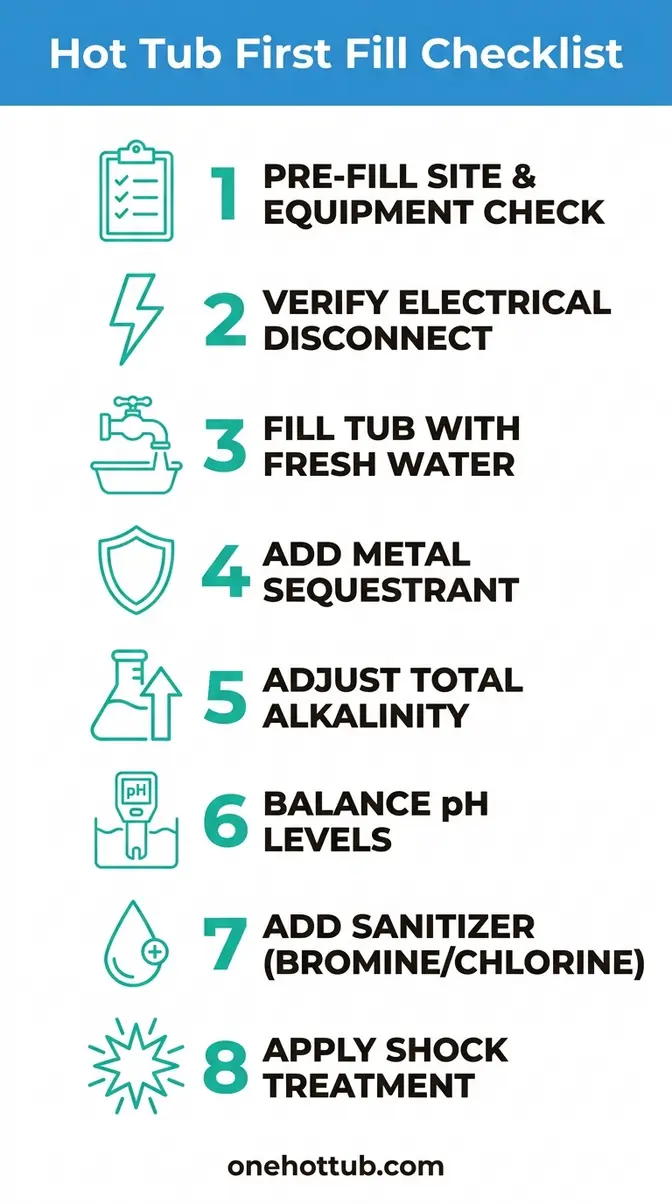
Site and Supply Checklist
Before you turn on the hose, take 10 minutes to confirm your site is ready. This step is almost always skipped in manufacturer manuals — and it’s the one that causes the most headaches.
Site readiness checklist:
- Structural support: A filled hot tub weighs 3,000–6,000 lbs. Your deck, patio, or concrete pad must support at least 100 lbs per square foot. If you’re unsure, consult a structural engineer before filling.
- Level surface: The surface must be within ½ inch of level. An unlevel tub stresses the shell and causes leaks over time.
- Electrical connection: Most hot tubs require a dedicated 240V/50-amp GFCI-protected circuit installed by a licensed electrician. Never use an extension cord.
- Access clearance: Leave at least 3 feet of clearance on all sides for maintenance access. Your filter and equipment panels need room to open.
- Cover lifter space: If you’re adding a cover lifter (highly recommended), account for the swing radius behind the tub.
Supplies you’ll need on hand before filling:
- Garden hose (clean — avoid hoses with brass fittings, which can leach metals)
- A pre-filter hose attachment (filters metals and minerals from tap water — worth every penny)
- Test strips or a digital water testing kit
- Metal sequestrant (also called metal stain remover — prevents rust stains from minerals in your fill water)
- pH increaser and pH decreaser
- Alkalinity increaser (sodium bicarbonate)
- Your chosen sanitizer (chlorine granules or bromine tablets)
- Non-chlorine shock (oxidizer)
⚠️ Safety Note: Store all chemicals separately, in a cool, dry place, away from direct sunlight. Never mix chemicals together — even “similar” products can react violently. Always add chemicals to water, never water to chemicals.
Step-by-Step First Fill Guide
Hot tub communities consistently report that following chemical steps out of order is the single biggest first-fill mistake. Here’s the correct sequence:
- Rinse the shell. Wipe down the inside of the empty tub with a soft cloth dampened with clean water. Do not use soap or household cleaners — they cause massive foam.
- Place the pre-filter on your hose. Attach a garden hose pre-filter before you start filling. This removes metals and minerals that would otherwise stain your shell and throw off your chemistry.
- Fill to the manufacturer’s indicated water line. This is typically 2–3 inches above the highest jet. Filling too low can damage the pump; filling too high causes overflow.
- Power on the tub. Once filled, turn on the power and let the pump circulate for at least 15–20 minutes before adding any chemicals. This primes the system and removes any air pockets.
- Add metal sequestrant first. Pour the recommended dose (check your product label — typically 1 oz per 100 gallons) directly into the water with the jets running. Wait 30 minutes. This binds any metals in your fill water and prevents staining.
- Balance Total Alkalinity (TA) next. Test your water and adjust TA to 80–120 ppm (parts per million) before touching pH. TA is the foundation — it makes pH adjustment far easier and more stable.
- Balance pH. After TA is stable, adjust pH to 7.4–7.6. Below 7.2 irritates eyes and skin; above 7.8 reduces sanitizer effectiveness dramatically (CDC, 2026).
- Add your sanitizer. Once pH is balanced, add chlorine (target: 1–3 ppm) or bromine (target: 2–4 ppm). Follow product label dosing.
- Shock the water. Add a non-chlorine shock to oxidize any organic material and activate your sanitizer. Run the jets for 30 minutes with the cover off.
- Test again and wait. Re-test after 30 minutes. Wait until chlorine or bromine reads within the safe range before your first soak. This typically takes 1–4 hours.
⚠️ Safety Note: Never soak in freshly shocked water. Wait until sanitizer levels return to the safe range (chlorine 1–3 ppm, bromine 2–4 ppm) before entering the tub.
First Fill Chemical Guide
The short answer: four chemical categories, added in a specific order. If you are wondering about the best hot tub chemicals for initial setup, skipping one — or adding them in the wrong sequence — makes balancing much harder.
| Chemical | Purpose | When to Add | Target Level |
|---|---|---|---|
| Metal Sequestrant | Binds metals in fill water; prevents staining | First, before anything else | Per label (1 oz/100 gal typical) |
| Alkalinity Increaser | Stabilizes water so pH adjustments “stick” | Second, before pH | 80–120 ppm |
| pH Increaser / Decreaser | Balances acidity for comfort and sanitizer effectiveness | Third, after TA is set | 7.4–7.6 |
| Sanitizer (Chlorine or Bromine) | Kills bacteria and keeps water safe | Fourth, after pH is balanced | Chlorine: 1–3 ppm / Bromine: 2–4 ppm |
| Non-Chlorine Shock | Oxidizes organic material; activates sanitizer | Last, after sanitizer is added | Per label |
According to Leslie’s Pool’s beginner spa care guide, always balance alkalinity before pH — trying to fix pH in unbalanced water is like trying to paint a wet wall. The result never holds.
Hot Tub Water Chemistry 101
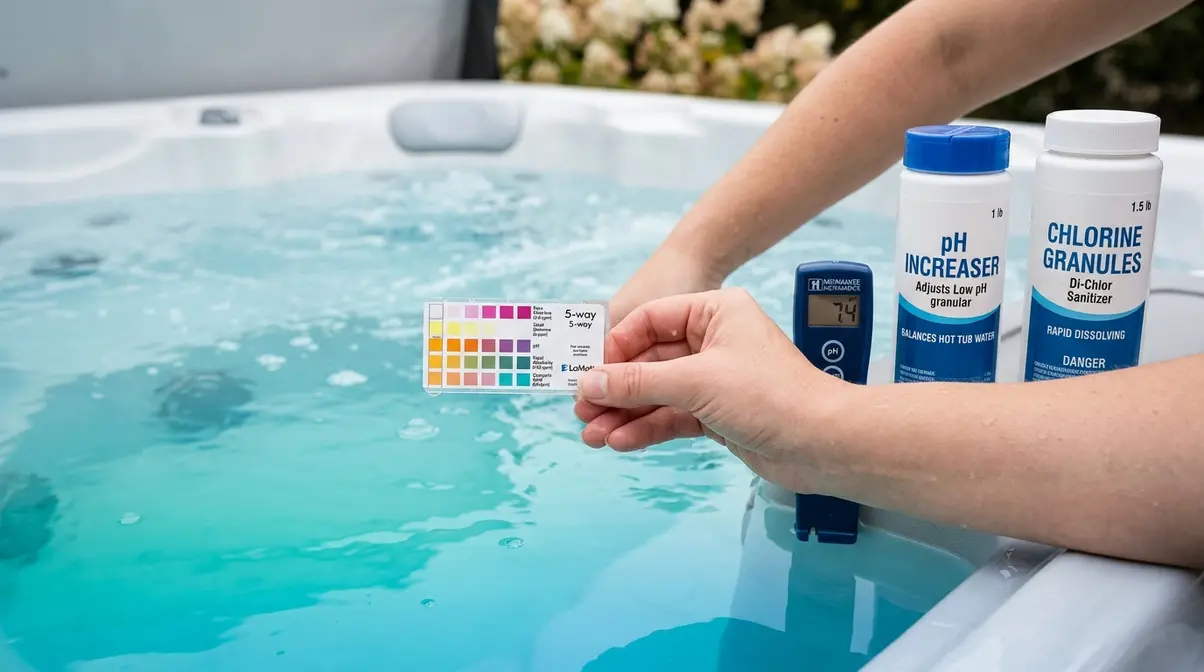
Water chemistry is the part that scares most new owners the most — and it’s also the part that becomes completely automatic within a few weeks. Think of your hot tub water like a living system with three vital signs. Once you understand those three numbers, everything else falls into place. For a deeper dive, check out our complete guide to hot tub maintenance.
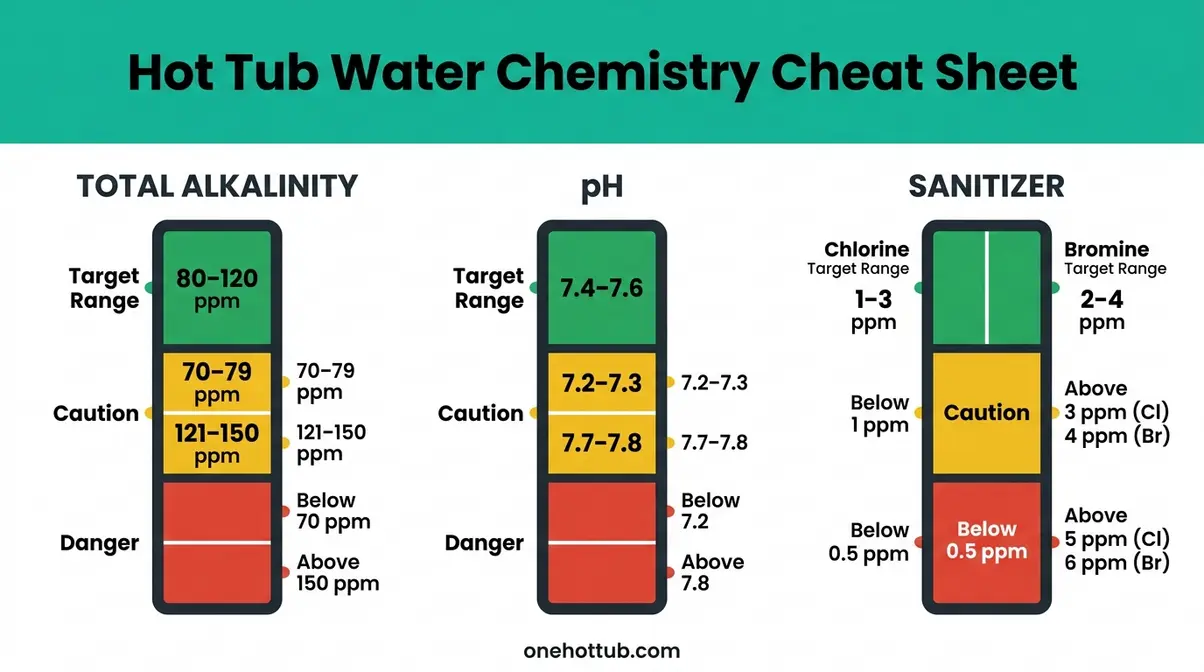
3 Numbers for Hot Tub Safety
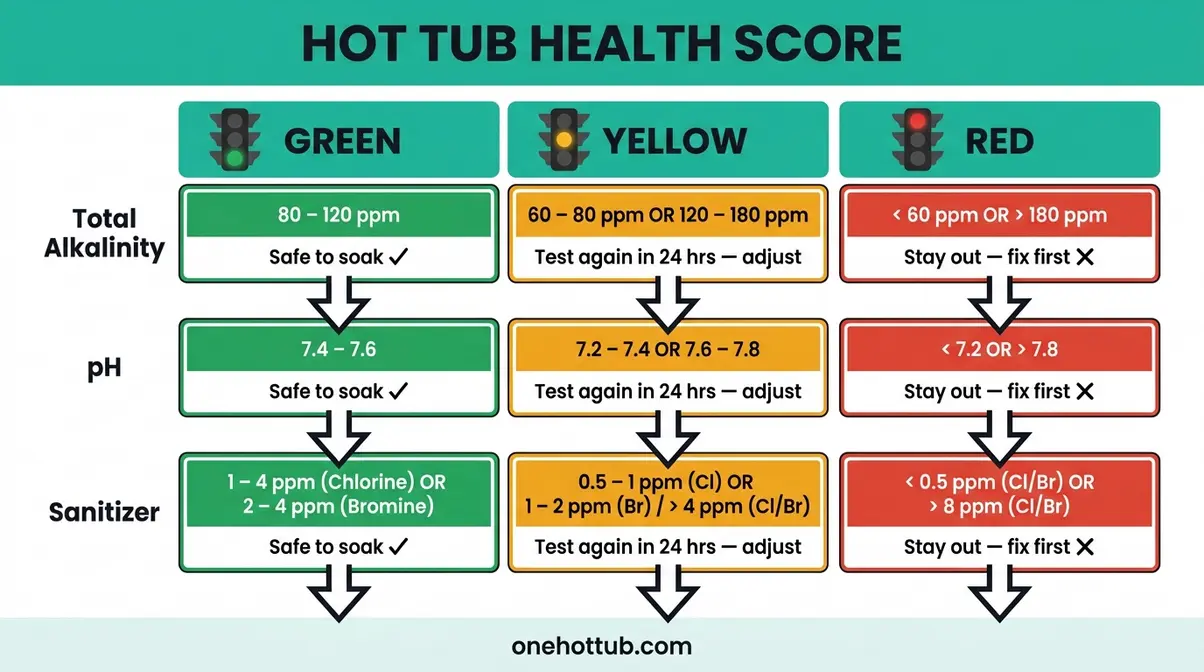
Here’s a concept that hot tub communities have collectively landed on: think of your water chemistry as a Hot Tub Health Score. Just like a traffic light, your water is either green (safe to soak), yellow (needs attention), or red (stay out until fixed). There are only three numbers you need to check.
The Hot Tub Health Score — Your Three Vital Signs:
1. Total Alkalinity (TA) — the foundation
Total Alkalinity (TA) is the measure of how well your water resists pH changes. Think of it as a shock absorber. When TA is in range, pH stays stable on its own. When TA is off, pH bounces around no matter how much you adjust it. Target: 80–120 ppm.
2. pH — the comfort number
pH measures how acidic or basic your water is. Low pH (below 7.2) corrodes your equipment and irritates eyes and skin. High pH (above 7.8) makes sanitizer ineffective, which means bacteria can survive even when your chlorine or bromine levels look fine. Target: 7.4–7.6 (CDC, 2026).
3. Sanitizer — the safety number
Sanitizer (chlorine or bromine) kills bacteria, viruses, and algae. This is the number that keeps your water safe to soak in. If sanitizer drops too low, even perfectly balanced water can harbor harmful bacteria within hours.
“Properly maintained hot tub water — with pH between 7.2 and 7.8 and adequate sanitizer — is one of the most effective ways to prevent recreational water illness in residential settings.” — CDC Healthy Swimming guidelines
The Hot Tub Health Score Quick Reference:
| Parameter | Green (Safe) | Yellow (Adjust) | Red (Stay Out) |
|---|---|---|---|
| Total Alkalinity | 80–120 ppm | 70–79 or 121–150 ppm | Below 70 or above 150 ppm |
| pH | 7.4–7.6 | 7.2–7.3 or 7.7–7.8 | Below 7.2 or above 7.8 |
| Chlorine | 1–3 ppm | 0.5–0.9 or 3.1–5 ppm | Below 0.5 or above 5 ppm |
| Bromine | 2–4 ppm | 1–1.9 or 4.1–6 ppm | Below 1 or above 6 ppm |
When all three are green, your Hot Tub Health Score is passing. When any number hits yellow, test again in 24 hours and adjust. When any number hits red, don’t soak — fix it first.
Chlorine vs. Bromine Sanitizers
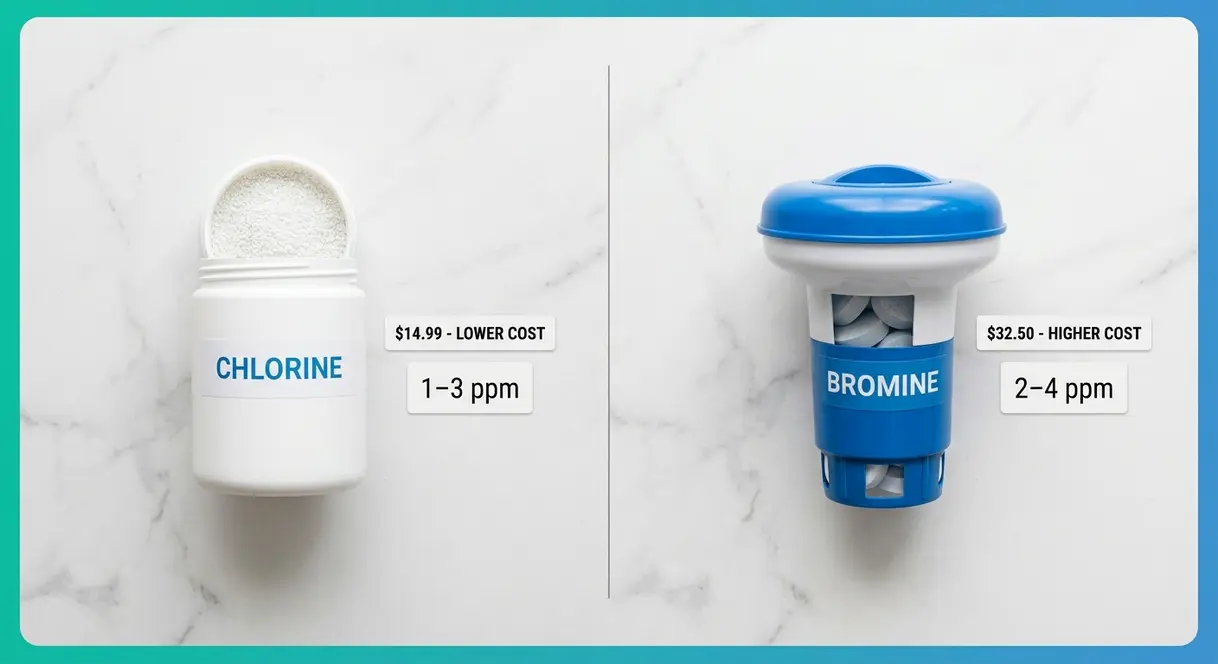
Both chlorine and bromine kill bacteria effectively. The right choice depends on your skin, your usage habits, and where your tub is located. New owners frequently ask which is better when choosing between bromine and chlorine — the honest answer is that both work well, and the “best” one is the one you’ll actually use consistently.
- Chlorine (granular or tablets):
- Target level: 1–3 ppm
- Faster-acting and less expensive than bromine
- Breaks down more quickly in heat and UV light — outdoor tubs need more frequent dosing
- Can cause a slight smell and skin irritation in some people at high levels
- Works best in covered indoor or shaded tubs
- Bromine (tablets, usually in a floater):
- Target level: 2–4 ppm
- More stable in heat — makes it the preferred choice for hot tubs over pools
- Gentler on skin and eyes, and produces less odor
- More expensive and slower-acting than chlorine
- Reactivates after shocking, meaning it lasts longer per dose
| Feature | Chlorine | Bromine |
|---|---|---|
| Cost | Lower | Higher |
| Skin sensitivity | Moderate | Lower |
| Heat stability | Lower | Higher |
| Outdoor UV resistance | Lower | Moderate |
| Odor | Stronger | Milder |
| Best for | Budget-conscious, indoor/covered tubs | Sensitive skin, outdoor tubs |
According to Jacuzzi’s beginner setup guide, bromine is the most commonly recommended sanitizer for residential hot tubs because of its superior heat stability — water at 100°F+ degrades chlorine significantly faster than pool-temperature water.
⚠️ Safety Note: Never mix chlorine and bromine products. Switching sanitizers requires draining and refilling the tub completely — you cannot simply switch mid-water.
Weekly Maintenance Checklist
This is the routine that separates sparkling water from murky, foamy disappointment. Hot tub communities consistently report that most water problems trace back to one cause: skipping the weekly check. The good news? Once you build the habit, it takes less than 10 minutes.
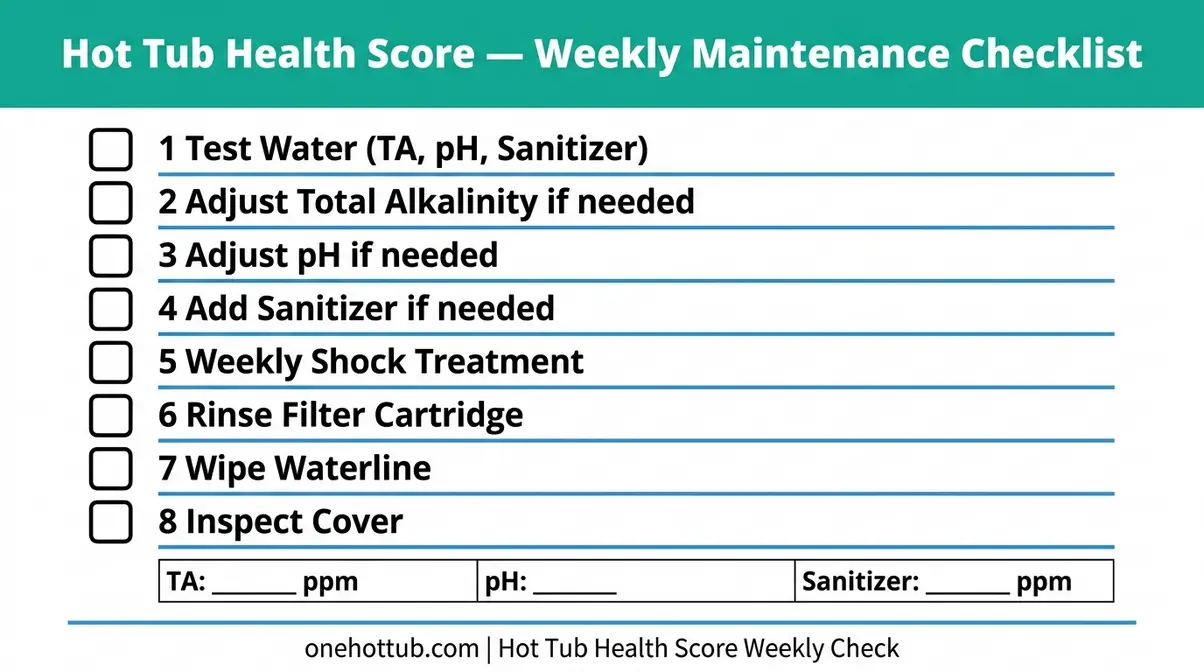
Weekly Hot Tub Maintenance Checklist:
- Test your water (2 minutes). Use test strips or a digital tester. Check TA, pH, and sanitizer levels. Record your readings — even a simple notes app works. Tracking trends helps you spot problems early.
- Adjust TA first (if needed). If TA is outside 80–120 ppm, add alkalinity increaser (sodium bicarbonate) or pH decreaser (which also lowers TA). Wait 30 minutes with jets running, then retest.
- Adjust pH (if needed). Once TA is stable, nudge pH into the 7.4–7.6 range with pH increaser (sodium carbonate) or pH decreaser (sodium bisulfate). Add in small doses — pH is easy to overshoot.
- Add sanitizer (if needed). Dose chlorine or bromine to bring levels back into the green zone. Always add with jets running and cover off for 15 minutes after dosing.
- Shock the water (once per week). Add a weekly non-chlorine shock to oxidize organic waste — body oils, lotions, and sweat that sanitizer alone can’t fully break down. This is what keeps water sparkling clear.
- Rinse your filter (once per week). Remove the filter cartridge and rinse it with a garden hose, working top to bottom between the pleats. A clean filter means better circulation and clearer water.
- Wipe the waterline. Use a hot-tub-safe surface cleaner on a soft cloth to wipe the shell at the waterline. This removes the oily ring that builds up from body products.
- Check your cover. Inspect for cracks, waterlogging, or damage. A damaged cover loses heat rapidly, doubling your energy bill.
Monthly Tasks & Filter Cleaning
Weekly rinsing keeps your filter functional. Monthly deep cleaning keeps it performing at its best. And every 3–4 months, your tub needs a complete drain and refill — no matter how good your water looks.
Monthly filter deep-clean (once per month):
- Remove the filter cartridge from the tub.
- Rinse off loose debris with a garden hose.
- Soak the cartridge overnight in a commercial filter cleaning solution (not dish soap — it causes foam).
- Rinse thoroughly until the water runs completely clear.
- Allow to air dry before reinstalling, or use your backup filter while this one dries.
When to drain and refill your hot tub:
Most manufacturers recommend draining every 3–4 months, based on total dissolved solids (TDS) — the buildup of minerals, chemicals, and organic material that accumulates in the water over time. When TDS gets too high, even perfect chemical balancing stops working. According to WhatSpa’s maintenance beginner guide, a simple rule of thumb: divide the number of gallons in your tub by 3, and that’s roughly how many days your water lasts before needing a change.
Quick drain schedule:
| Usage Level | Recommended Drain Interval |
|---|---|
| Light (1–2 soaks/week, 1–2 people) | Every 4 months |
| Moderate (3–4 soaks/week, 2–4 people) | Every 3 months |
| Heavy (daily use, 4+ people) | Every 2 months |
⚠️ Safety Note: When draining, never use a submersible pump on an electrical circuit without GFCI protection. Keep all electrical components dry during the drain and refill process.
Hot Tub Safety Rules
Hot tubs are wonderfully relaxing — and they’re also one of the few home products regulated by the U.S. Consumer Product Safety Commission (CPSC) because of documented safety risks. Following these essential hot tub safety rules protects everyone who uses your tub, especially children and guests who may not know the risks.
Why a 15-Minute Rule?
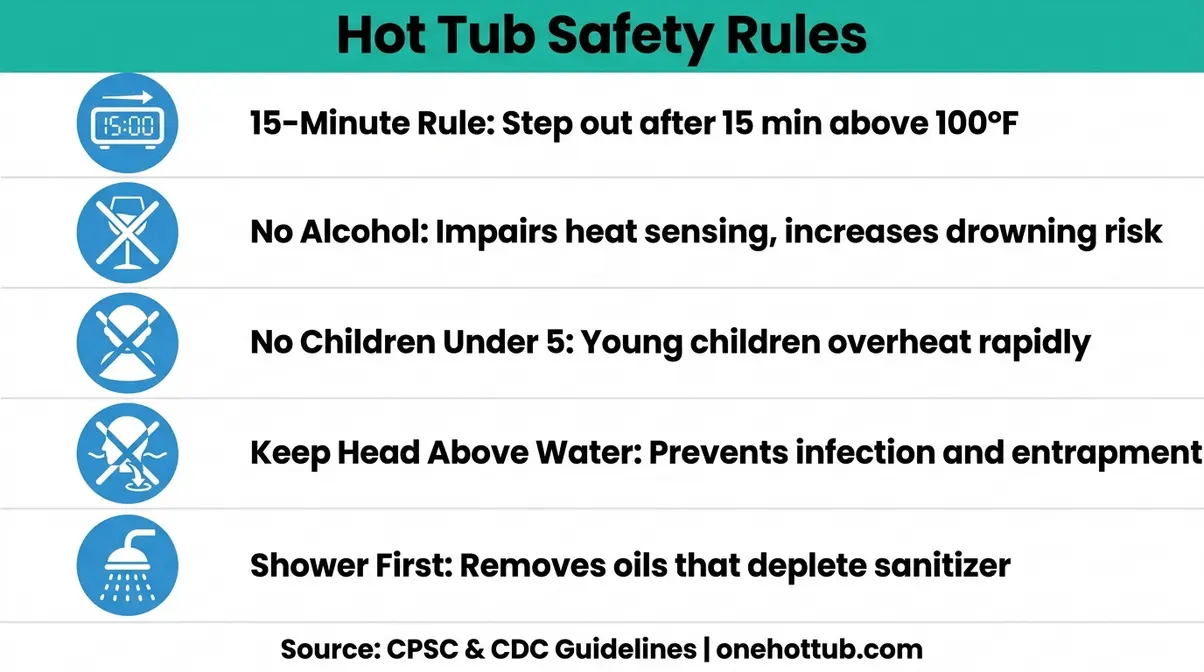
The 15-minute hot tub rule exists because hot water raises your core body temperature faster than most people realize. At 104°F (the maximum recommended temperature), your body temperature can rise to dangerous levels within 15–20 minutes — a condition called hyperthermia that mimics the effects of a high fever (CPSC, 2026). Understanding safe hot tub soaking time limits is crucial.
The CPSC advises limiting soaks to 15 minutes at a time at temperatures above 100°F, especially for first-time users, older adults, and anyone who has been drinking alcohol. After 15 minutes, step out, cool down for at least 10 minutes, hydrate with water, and then re-enter if you’d like to continue soaking.
- Signs you’ve been in too long:
- Dizziness or lightheadedness
- Nausea
- Rapid heartbeat
- Excessive sweating even in the water
- Feeling flushed or overheated
If you experience any of these, exit the tub immediately, sit in a cool area, and drink water. If symptoms persist, seek medical attention.
“Exposure to high temperatures in hot tubs can cause dangerous drops in blood pressure and lead to drowning, even in adults.” — U.S. Consumer Product Safety Commission (CPSC, 2026)
Most experienced owners find that 15–20 minute sessions feel best anyway — and that the temptation to stay longer is usually the first sign your body is already overheating.
Should You Shower Before Soaking?
Yes — and the CDC is direct about why. The CDC recommends showering with soap for at least 1 minute before entering any hot tub or spa (CDC, 2026). The reason is practical: your body carries residues that directly harm water quality.
A single person carries an average of 0.14 grams of fecal matter on their body at any given time (CDC, 2026). Beyond that, body oils, lotions, sunscreen, deodorant, and hair products all consume sanitizer the moment they hit the water. Every unit of sanitizer that fights lotion is a unit that isn’t fighting bacteria.
- What a pre-soak shower does:
- Removes sweat, body oils, and personal care products
- Dramatically reduces the sanitizer load your water has to handle
- Keeps your water cleaner for longer between chemical treatments
- Reduces foam, scum lines, and filter clogging
Hot tub communities consistently report that households where everyone showers before soaking spend significantly less on chemicals and deal with far fewer water quality problems. It’s the single highest-impact free habit in hot tub ownership.
Safety for Kids and Pregnancy
Some groups face higher risks in hot tubs. Here’s what the major health organizations advise:
Children:
The CPSC advises that children under 5 should not use hot tubs at all (CPSC, 2026). Young children cannot regulate body temperature as effectively as adults and overheat much faster. For children 5 and older, keep water temperature at or below 95°F, limit sessions to 5 minutes, and ensure an adult is physically present at all times — never just nearby.
Pregnancy:
Pregnant women should consult their doctor before using a hot tub. Raising core body temperature above 101°F in the first trimester has been associated with increased risk of neural tube defects. Most OB-GYNs advise avoiding hot tubs during pregnancy, particularly in the first trimester.
Heart conditions and high blood pressure:
The heat causes blood vessels to dilate, which drops blood pressure. For people with cardiovascular conditions, this can cause fainting or cardiac stress. Always consult your doctor if you have a heart condition before using a hot tub regularly.
Alcohol:
The CPSC specifically warns against alcohol use in or around hot tubs. Alcohol impairs your ability to sense overheating, increases drowning risk, and interacts dangerously with the blood pressure drop caused by hot water (CPSC, 2026). Even one or two drinks meaningfully increase the risk of hot tub-related accidents.
Medications:
Some medications — including anticoagulants, antihistamines, and blood pressure medications — interact with heat in ways that increase risk. If you take regular prescription medication, ask your pharmacist whether hot tub use is safe for you.
⚠️ Safety Note: If you have any chronic health condition, consult your doctor before establishing a regular hot tub routine. This is especially important for cardiovascular conditions, diabetes, and neurological conditions.
Never Submerge Your Head
Submerging your head in a hot tub exposes you to a serious infection risk that most people don’t know about. Hot tubs are maintained at temperatures that, while uncomfortable for most bacteria, are ideal for one dangerous organism: Pseudomonas aeruginosa, which causes “hot tub folliculitis” — a skin rash that can be severe. More critically, Naegleria fowleri — a rare but nearly always fatal brain-eating amoeba — has been linked to warm freshwater environments, including poorly maintained hot tubs.
Additionally, hot tub water near the jets contains aerosolized droplets. Submerging your head forces contaminated water into your ears, nose, and sinuses — areas far more vulnerable to infection than intact skin. The CDC advises against submerging the head in hot tubs for this reason (CDC, 2026).
Beyond infection, hair can become entangled in drain covers and suction fittings — a documented drowning risk that has resulted in fatalities. The CPSC requires anti-entrapment drain covers on all new hot tubs for this reason (CPSC, 2026). Keep hair tied up and never submerge your head.
Clever Hot Tub Hacks and Tips
Once you’ve got the basics down, a few simple tricks can make ownership noticeably more enjoyable — and save you money. These are the tips that hot tub communities share most often in forums and subreddits, collected here so you don’t have to dig for them.
Why Put Tennis Balls in a Tub?
Tennis balls absorb body oils, lotions, and other organic residues that float on the water’s surface. The fuzzy felt exterior of a standard tennis ball acts like a sponge for oils that your sanitizer would otherwise have to work overtime to break down. Toss 2–3 clean tennis balls into the water after each soak, leave them in for 30–60 minutes, then remove them.
New owners frequently discover this hack in hot tub forums and are skeptical — until they see the balls turn noticeably yellow after just a few sessions. The absorbed oils are oils that would otherwise build up into the scum ring at your waterline, clog your filter, and consume your sanitizer.
- How to use the tennis ball hack:
- Use new or very clean tennis balls — used sports balls carry dirt and grime.
- Drop 2–3 balls in the water with jets running after your soak.
- Leave them for 30–60 minutes.
- Remove, squeeze out, and let dry. Replace when they stop absorbing (usually after 4–6 uses).
Walker Glides vs. Tennis Balls
This is a surprisingly popular question in hot tub communities. Walker glides — the small rubber or felt pads designed for chair and walker legs — are sometimes suggested as a “cleaner” alternative because they don’t have the dye risk of tennis balls (some low-quality tennis balls can leach yellow dye into water).
In practice, both work similarly. Walker glides tend to be denser and absorb slightly less per piece, so you’d need more of them to match the surface area of a tennis ball. The consensus from hot tub communities: tennis balls work well for most owners. If you have a light-colored shell and are concerned about dye, opt for white or undyed walker glides instead.
Hot Tubs and Sciatic Nerve Pain
Hot water therapy has a well-documented history of use for muscle and nerve pain. Heat causes blood vessels to dilate (vasodilation), which increases blood flow to affected areas, reduces muscle tension, and can temporarily relieve the compression-related discomfort associated with sciatica. The National Institute of Neurological Disorders and Stroke (NINDS) acknowledges heat therapy as a commonly used complementary approach for back pain relief (NINDS, 2026).
Many people with sciatica report meaningful short-term relief from soaking in a hot tub — particularly from the combination of heat and jet hydrotherapy, which provides a gentle massage effect on the lower back and glutes where the sciatic nerve runs. For those dealing with chronic discomfort, exploring hot tub benefits for lower back pain and sciatica can be helpful.
⚠️ Important: Hot tubs are not a medical treatment for sciatica. If you have a diagnosed herniated disc, spinal stenosis, or acute nerve inflammation, consult your doctor before using a hot tub regularly. Heat can occasionally worsen acute inflammation in the short term.
Quick Hacks for New Owners
A few more tips that make a real difference:
- Rinse your swimsuit before soaking. Laundry detergent residue in swimwear is one of the biggest causes of hot tub foam. Rinse suits in clean water before getting in.
- Keep a water bottle at the tub. You sweat in a hot tub even though you don’t feel it. Dehydration is a real risk. Drink 8–12 oz of water before and after each soak.
- Use a floating thermometer. Your tub’s built-in thermometer can drift over time. A $10 floating thermometer confirms your actual water temperature — important for safety, especially with kids.
- Invest in a good cover lifter. Manually lifting a waterlogged cover is the #1 reason people stop using their hot tub in winter. A cover lifter removes all friction from the routine.
- Outdoor tub tip: If your tub is in direct sunlight, UV rays degrade chlorine significantly faster. Use a UV-stabilized sanitizer (cyanuric acid-buffered chlorine) or switch to bromine, which is more UV-stable. According to AJ Spa’s hot tub care guide, outdoor tubs in direct sun may need sanitizer checks every 2–3 days rather than weekly.
- Keep a small spray bottle of water nearby. Spray your face occasionally during long soaks to prevent the skin-drying effect of hot, humid air.
Common Hot Tub Owner Mistakes
Even with a great guide, most new owners make at least one of these mistakes in their first few months. Knowing them in advance saves you money, frustration, and potentially a costly service call.
Costly Startup Mistakes
Mistake 1: Adding chemicals in the wrong order.
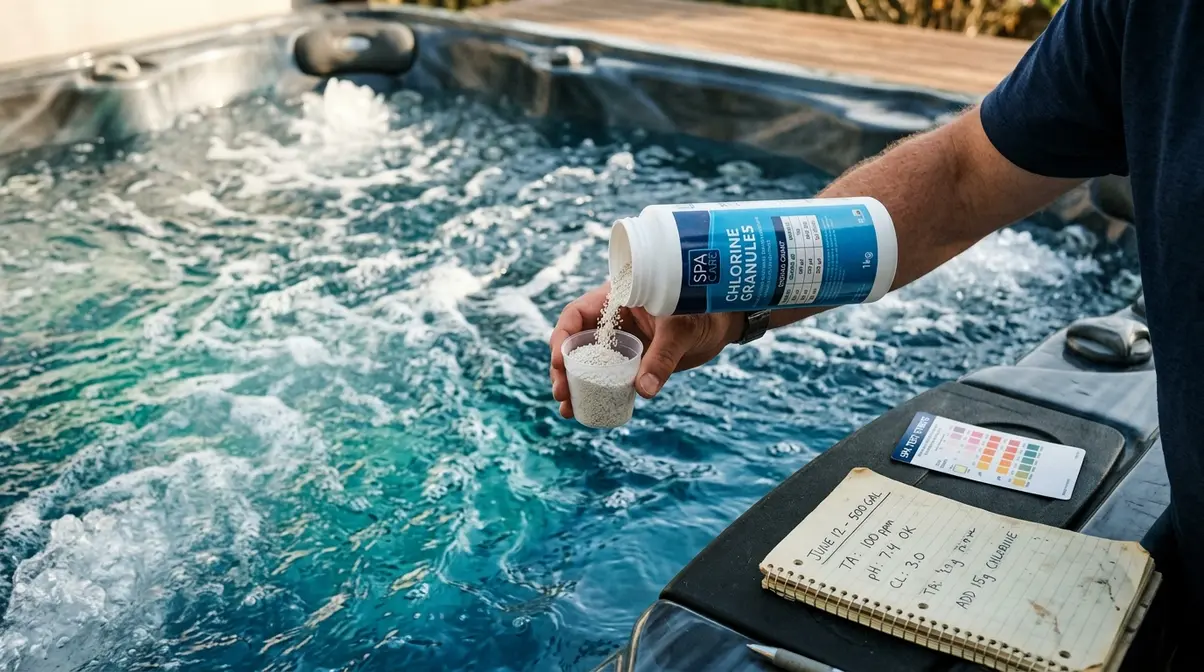
This is the most common first-fill error. Adding sanitizer before balancing TA and pH makes the sanitizer far less effective — and you end up using twice as much chemical trying to compensate. Always follow the sequence: metal sequestrant → TA → pH → sanitizer → shock.
Mistake 2: Skipping the pre-filter on the hose.
Tap water contains metals, minerals, and chloramines that immediately stress your water chemistry. A pre-filter attachment costs $15–$30 and can save hours of chemistry adjustments on your first fill.
Mistake 3: Overdosing chemicals “just to be safe.”
More is not better with hot tub chemicals. Excess chlorine causes skin and eye irritation. Excess pH increaser sends pH sky-high and renders your sanitizer useless. Always dose conservatively, wait 30 minutes, retest, and adjust again if needed.
Mistake 4: Never cleaning the filter.
A clogged filter is the single most common cause of cloudy water, poor jet performance, and pump strain. Many new owners don’t realize filters need weekly rinsing and monthly deep cleaning. A neglected filter can fail within months, costing $30–$100 to replace.
Mistake 5: Letting the tub sit unused without maintenance.
Your tub needs weekly chemical checks whether you use it or not. Bacteria doesn’t take a week off because you’re busy. If you’re going on vacation, either ask someone to check the tub or use a slow-release sanitizer cartridge to maintain levels while you’re away.
Mistake 6: Ignoring the waterline scum ring.
That ring of grime at the waterline isn’t cosmetic — it’s a biofilm of oils, bacteria, and minerals that, if left too long, bonds to the shell and becomes very difficult to remove. Wipe it weekly with a hot-tub-safe surface cleaner.
When to Call a Professional
DIY maintenance handles the vast majority of hot tub care. However, some situations call for a professional technician — and recognizing them early saves money.
- Call a professional when:
- Your water stays cloudy or green despite correct chemical levels (may indicate a plumbing, filtration, or biofilm issue)
- Jets have significantly reduced pressure despite a clean filter (possible pump or plumbing issue)
- You hear unusual sounds from the pump or heater (bearings, cavitation, or heater element failure)
- The tub loses temperature faster than usual despite a good cover (possible heater failure or shell leak)
- You notice a burning smell near the equipment panel (electrical issue — turn off the tub and call immediately)
- The GFCI breaker trips repeatedly (electrical fault — do not reset and ignore; have an electrician evaluate)
For routine issues like chemistry balancing, a local pool and spa supply store will often test your water for free and recommend specific products. This is a great resource for new owners who aren’t sure what their test results mean.
Frequently Asked Questions
Why use tennis balls in a tub?
Tennis balls absorb body oils, lotions, and other organic residues that float on the water’s surface. The fuzzy felt exterior acts like a sponge, pulling oils out of the water before they can build up into the scum ring at your waterline or clog your filter. Drop 2–3 clean tennis balls in after each soak for 30–60 minutes, then remove them. New owners frequently report this simple hack noticeably extends the time between filter cleanings and reduces waterline buildup.
Why the 15-minute rule?
The 15-minute hot tub rule exists because hot water raises your core body temperature to potentially dangerous levels. At 104°F, your body temperature can reach hyperthermia-level readings within 15–20 minutes (CPSC, 2026). The CPSC recommends limiting soaks to 15 minutes at a time above 100°F, then stepping out to cool down and hydrate before re-entering. Dizziness, nausea, or rapid heartbeat are warning signs you’ve been in too long — exit the tub immediately if you feel any of these symptoms.
Does it help sciatic nerve pain?
Hot tub soaking may provide temporary relief from sciatic nerve pain through heat therapy and hydrotherapy. Heat causes vasodilation — widening of blood vessels — which increases blood flow to tense muscles and can reduce the compression that aggravates sciatic nerve pain. Jet massage adds a hydrotherapy component that targets the lower back and glutes where the sciatic nerve runs (NINDS, 2026).
Which chemicals for first fill?
Add chemicals in this exact order: metal sequestrant first, then alkalinity increaser, then pH adjuster, then sanitizer, then shock. Skipping this sequence — especially adding sanitizer before balancing TA and pH — dramatically reduces chemical effectiveness. Target levels are generally Total Alkalinity 80–120 ppm, pH 7.4–7.6, Chlorine 1–3 ppm or Bromine 2–4 ppm. Always wait 30 minutes between chemical additions and retest before adding the next product. Never add chemicals to an empty tub — always add to circulating water with jets running.
Why keep your head above water?
Submerging your head in a hot tub exposes your ears, nose, and sinuses to concentrated bacteria and potential pathogens. Hot tub water can harbor Pseudomonas aeruginosa (which causes hot tub folliculitis) and in rare cases, Naegleria fowleri in poorly maintained tubs (CDC, 2026). Additionally, hair can become entangled in drain covers and suction fittings — a documented drowning risk. The CPSC requires anti-entrapment drain covers on all new tubs specifically because of this hazard. Keep hair tied up and always stay above the waterline.
Walker glides vs. tennis balls?
Walker glides and tennis balls both absorb body oils effectively — the main difference is dye risk. Low-quality tennis balls can leach yellow dye into hot tub water, which is harmless but cosmetically unpleasant. Walker glides are made of rubber or felt without dye, making them a safer choice for light-colored shells. For most owners, quality tennis balls work perfectly well; choose walker glides if you’re cautious about dye.
What if I soak for 2 hours?
Staying in a hot tub for 2 hours significantly increases the risk of hyperthermia, dehydration, and blood pressure complications. Prolonged exposure to water at 100–104°F keeps your core body temperature elevated for an extended period, stressing your cardiovascular system. Dehydration accelerates because you sweat continuously even though the water masks the sensation. The CPSC is explicit that extended soaking — particularly combined with alcohol — is one of the leading causes of hot tub-related fatalities (CPSC, 2026). If you want a long session, soak for 15 minutes, exit for 10 minutes to cool down and drink water, then re-enter.
Should you shower before a soak?
Yes — the CDC recommends showering with soap for at least 1 minute before entering a hot tub (CDC, 2026). Body oils, lotions, sweat, and personal care products consume sanitizer the moment they enter the water. Every unit of chlorine or bromine that fights residue from your body is a unit that isn’t fighting bacteria. Showering before soaking is the single highest-impact free habit in hot tub ownership — households that follow this consistently report cleaner water, lower chemical costs, and fewer water quality problems between maintenance cycles.
Next Steps for Confident Soaking
For new hot tub owners, the path from overwhelmed to relaxed runs through three fundamentals: a correct first fill, a consistent weekly water check, and a clear understanding of the safety rules that protect everyone in your tub. Research from the CDC and CPSC, combined with decades of community consensus from real hot tub owners, confirms that most hot tub problems are preventable — and most of them trace back to skipping one of these three basics.
The Hot Tub Health Score framework is your shortcut. When your TA, pH, and sanitizer are all in the green zone, your water is safe and your tub is healthy. When something drifts yellow, you catch it early and fix it in minutes rather than dealing with a cloudy, foamy, or bacteria-laden tub that requires draining. That traffic-light system replaces the anxiety of “am I doing this right?” with a simple, repeatable check.
Start with your first fill this week. Use the step-by-step sequence in this guide, keep your test strips handy, and run through the weekly checklist every Sunday. Within a month, hot tub maintenance will feel completely automatic — and you’ll finally get to enjoy the thing you bought it for. If you want to go deeper on any topic, explore our pro tips and hacks for hot tub maintenance for the next level of ownership confidence.