What’s in this guide
- Natural Hot Tub Privacy Ideas UK Gardens Love
- Structural Hot Tub Privacy Solutions
- DIY and Renter-Friendly Privacy Ideas
- UK Planning Rules for Hot Tub Enclosures
- Indoor and Enclosed Hot Tub Installations
- Hot Tub Health and Safety Guidelines
- Common Mistakes to Avoid
- Frequently Asked Questions
- Finding the Right Privacy Solution for Your Garden
“Hi, what is everyone putting their hot tubs in? I’m not wanting a permanent, but am wanting something with a bit of privacy thanks.”
If you’ve ever climbed into your hot tub only to catch a neighbour’s eye over the fence, you’re not alone. That moment of awkward eye contact is something UK hot tub owners raise time and again.
Every soak you take without proper privacy is a soak you can’t fully relax in. And the longer you leave it, the more time you spend self-conscious instead of unwinding.
In this guide, you’ll find 15 practical hot tub privacy ideas UK homeowners and renters can use right now — from bamboo screens you can buy for under £50 to permanent pergola builds that transform your garden. You’ll also find UK planning permission rules, DIY options for inflatable hot tubs, and essential health safety guidelines, all in one place.
The best hot tub privacy ideas UK gardens need combine two or three layers of screening — not just one solution. This is the core principle behind The Privacy Layer System.
- Bamboo screens offer fast, budget-friendly privacy from £30–£80
- Pergolas and gazebos provide structure and weather shelter from ~£500
- The Privacy Layer System works best: combine a Boundary Layer, a Mid-Zone Layer, and an Overhead Layer for complete coverage
- Renters and inflatable hot tub owners have 4+ non-permanent options (see Section 3)
- UK planning rules cap freestanding structures at 2.5m near boundaries — no permission needed below this height
Natural Hot Tub Privacy Ideas UK Gardens Love
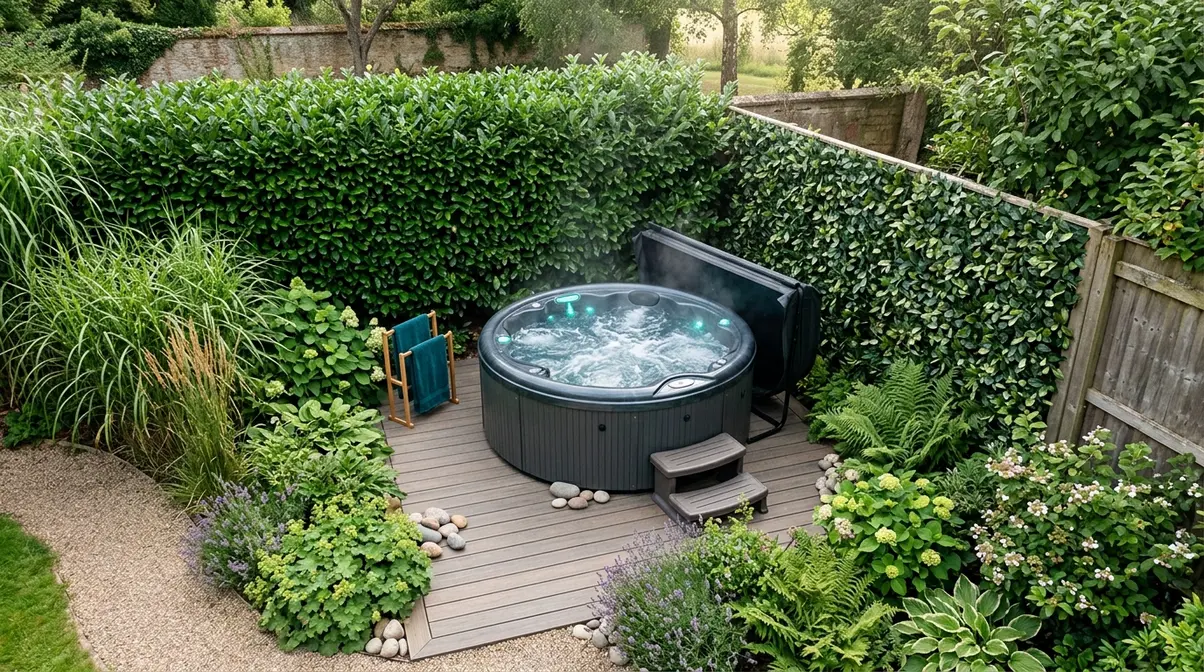
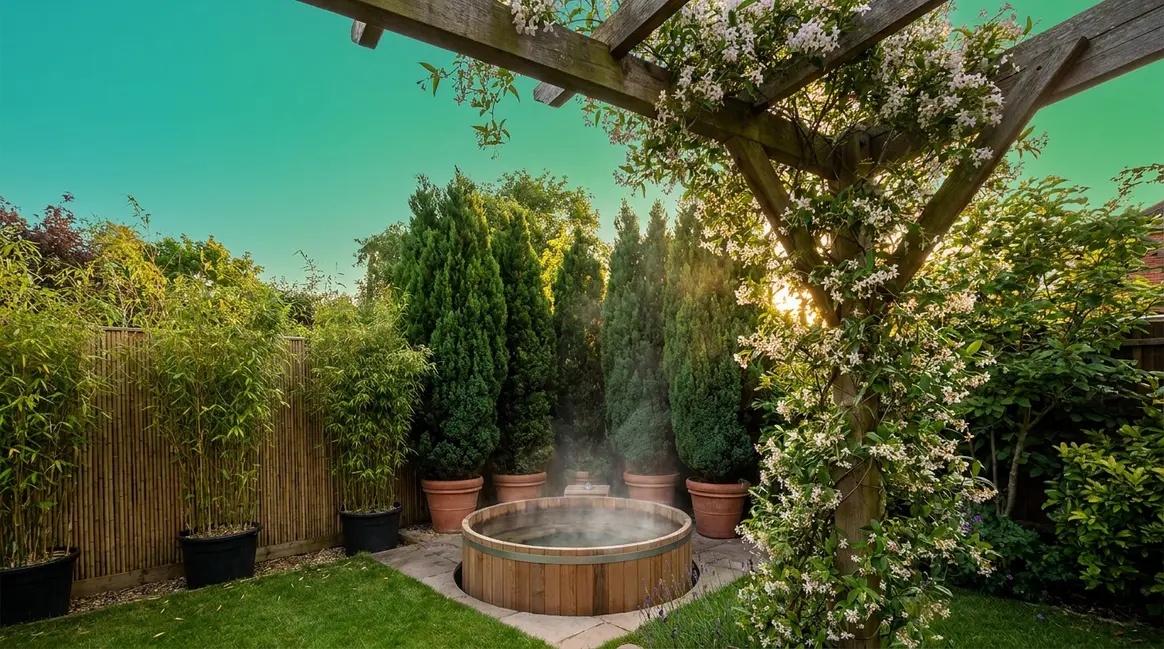
Natural planting is one of the most popular hot tub privacy ideas UK gardeners choose because it looks beautiful, costs relatively little, and genuinely improves with age. This is where The Privacy Layer System — a three-layer approach combining (1) a Boundary Layer at the garden edge, (2) a Mid-Zone Layer around the hot tub itself, and (3) an Overhead Layer above — really starts to take shape. Plants typically form your Boundary and Mid-Zone layers. For UK gardens, which are often considerably smaller than the North American gardens featured in most online guides, this layered approach is especially effective because each element works harder in a compact space.
Here are the most effective natural hot tub privacy ideas to consider:
- Bamboo screens: fast, affordable, movable from £30
- Evergreen hedges: permanent, year-round privacy from £150
- Large potted trees: renter-friendly, repositionable, no planting required
- Living walls: vertical greenery ideal for small or paved gardens
- Tall ornamental grasses: lightweight, windproof, and low maintenance
- Faux foliage panels: zero maintenance, all-weather, looks realistic
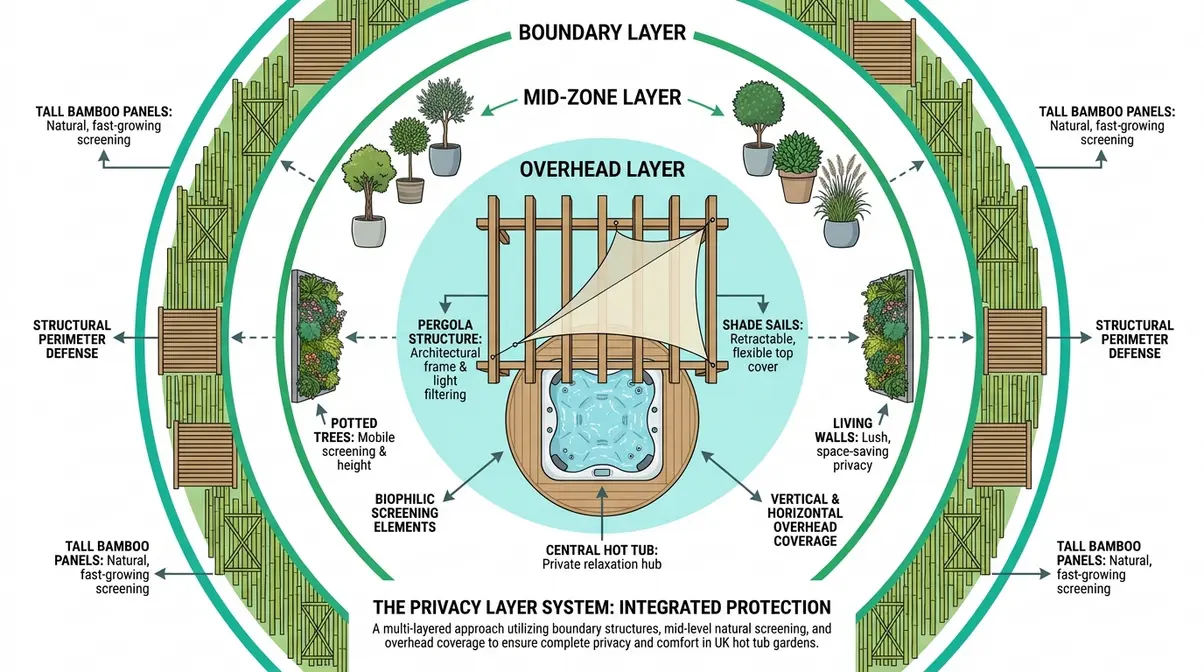
Bamboo Screens: Fast UK Privacy
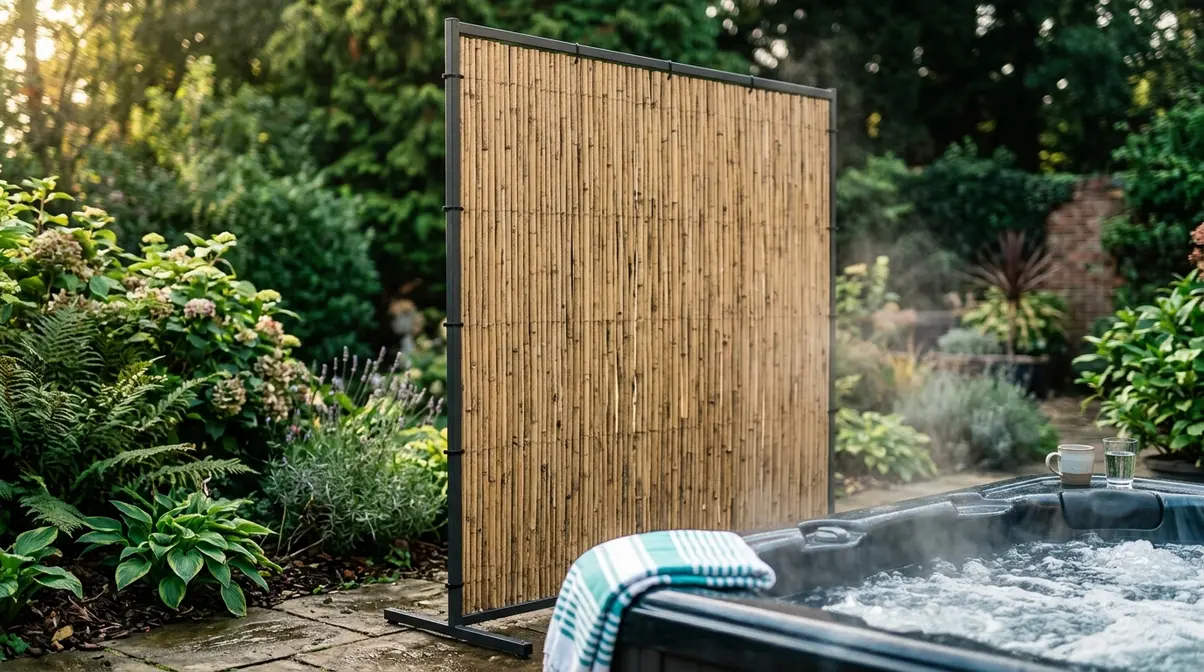
Bamboo screens — panels or planted clumps of fast-growing bamboo — are one of the quickest natural privacy solutions available. In UK conditions, bamboo can grow up to 90cm per year, reaching heights of 2–5m. It stays green all year round (that’s what “evergreen” means: it keeps its leaves through winter), so you get privacy during the colder months when a hot tub is often used most.
⚠️ Important UK Warning: Bamboo spreads aggressively in UK soil. RHS recommendations for bamboo screens are clear: always install a physical root barrier (a solid underground membrane buried at least 60cm deep) before planting bamboo in the ground to prevent it invading neighbouring gardens or lifting paving (RHS, 2026). Bamboo can grow up to 90cm per year in UK conditions, making it one of the fastest natural privacy screens available — but always install a root barrier to prevent invasive spreading (RHS, 2026).
Bamboo screen panels cost approximately £30–£80 for a 1.8m section (2026 UK prices). Potted bamboo plants start at around £20–£40 each. For renters, the best approach is potted bamboo in large containers (at least 45cm diameter) — completely movable, no root spread risk, and easy to reposition as the season changes.
If you want something that grows more slowly but needs zero maintenance once established, evergreen hedges are the UK gardener’s most reliable long-term choice.
Evergreen Hedges and Tall Shrubs
Evergreen hedges keep their leaves all year, meaning they provide privacy in winter — exactly when you’re most likely to be using your hot tub. Unlike temporary hot tub privacy options such as screens or curtains, a well-established hedge becomes a permanent feature of your garden that adds value to your property.
The best UK species for hot tub screening include:
- Laurel (Prunus laurocerasus): fast-growing at around 60cm per year, very dense, and tolerates shade — ideal for north-facing gardens
- Leylandii (× Cuprocyparis leylandii): extremely fast at up to 90cm per year, but requires regular trimming to avoid disputes with neighbours
- Photinia Red Robin: colourful red new growth, compact upright habit — perfect for smaller UK gardens where spread is a concern
Be realistic about timelines. Most hedges take 2–4 years to reach full screening height. Budget approximately £150–£400 for plants to cover a 6m fence line, plus your installation time. This is a permanent solution and not suitable for renters.
Explore more hot tub privacy ideas for every budget at every price point, from quick screens to full landscaping projects.
For something that gives you privacy instantly — without waiting years for plants to grow — large potted trees and container planting offer a clever middle ground.
Large Potted Trees and Containers
Large potted trees are the ideal temporary hot tub privacy option for renters or anyone who wants flexibility. You’re not planting anything permanently — you’re positioning tall, leafy containers exactly where you need screening. When you move house, the trees move with you.
Good choices for UK containers include pleached hornbeam (trained into flat “panels” on a frame), standard bay trees, and columnar Italian cypress — all of which grow tall without spreading wide, which matters in compact UK gardens. Expect to pay approximately £40–£120 per specimen tree in a large pot (2026 UK prices).
Position two or three large containers in an arc around the hot tub to create a natural mid-zone screen. This works beautifully alongside a boundary hedge or fence panel to give you that layered effect.
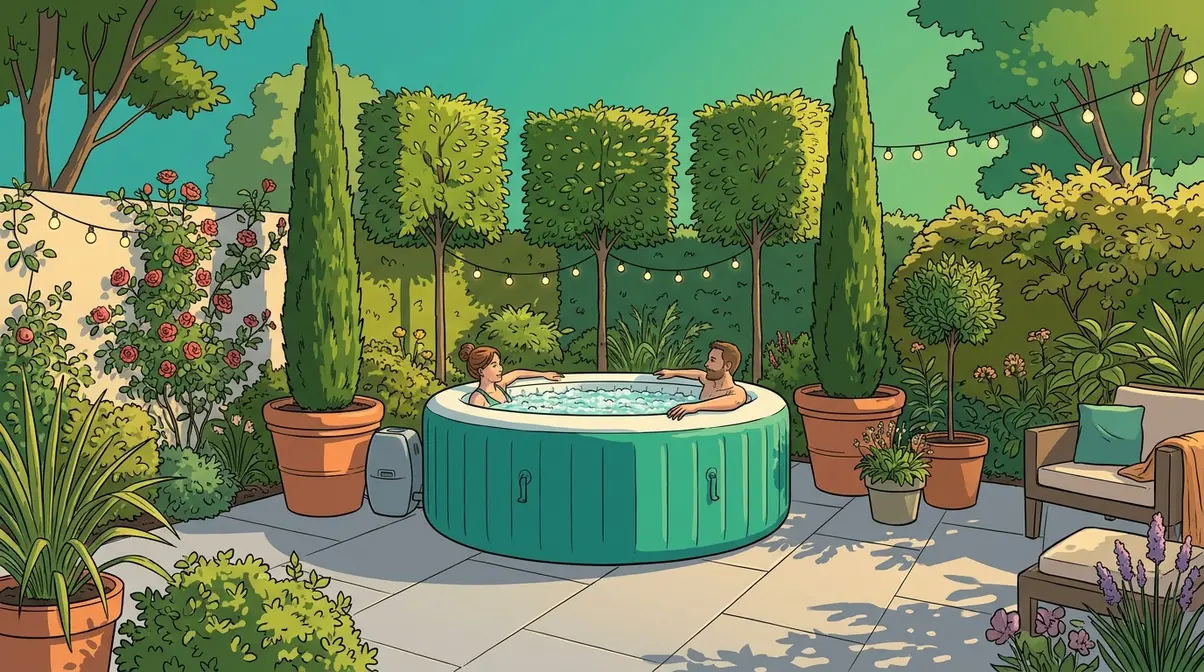
Columnar potted trees create instant hot tub privacy ideas UK renters can take with them when they move.
Living Walls: Year-Round Greenery
A living wall is a vertical structure covered in real or artificial plants, mounted on a fence, wall, or freestanding frame. In small UK gardens where floor space is limited, a living wall gives you maximum screening with minimal footprint.
Real living walls using plants like ivy, ferns, or trailing geraniums cost approximately £80–£300 for a modular panel system. They require watering and occasional maintenance. Artificial living wall panels — which look increasingly realistic — cost from £30–£120 and need no upkeep at all, making them a strong choice for busy households. Either option forms an excellent Mid-Zone Layer in The Privacy Layer System, positioned directly around the hot tub for close-range screening.
Structural Hot Tub Privacy Solutions
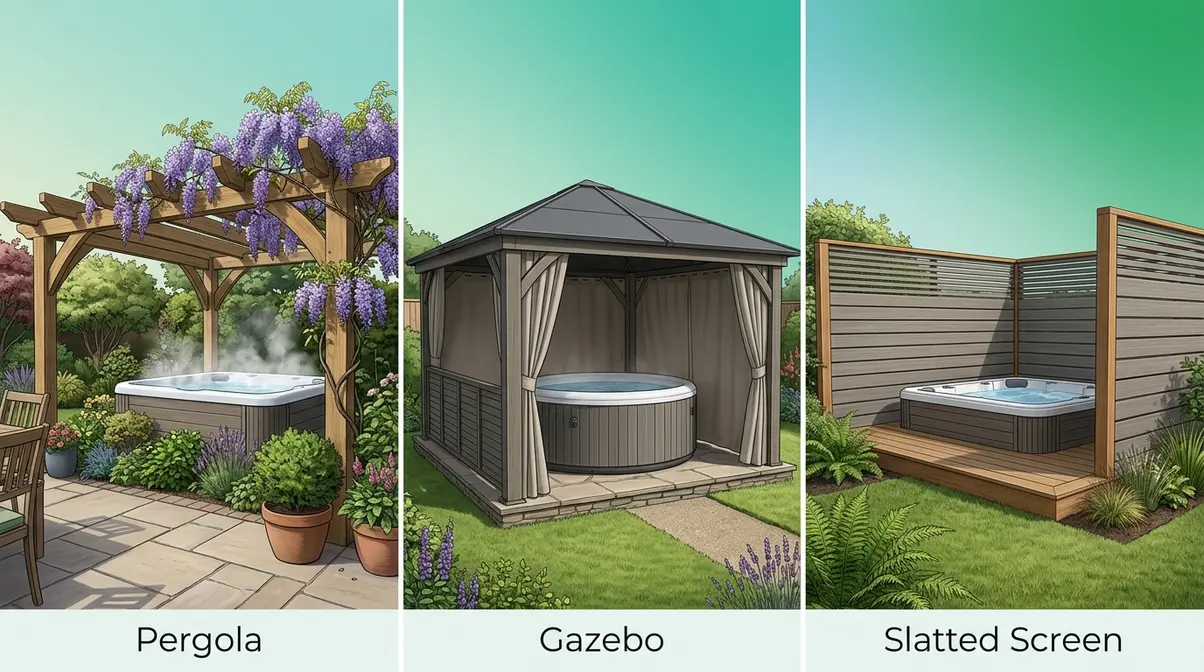
Structural solutions add a permanent or semi-permanent framework to your garden that provides privacy, weather protection, and a sense of occasion. UK hot tub owners consistently report that adding even a simple pergola transforms the experience from “paddling pool in the garden” to “proper outdoor retreat.” These options form the backbone of The Privacy Layer System’s Overhead Layer — the element that competitors most often focus on exclusively, while ignoring the boundary and mid-zone work that makes them truly effective.
Pergolas and Gazebos: Popular Choice
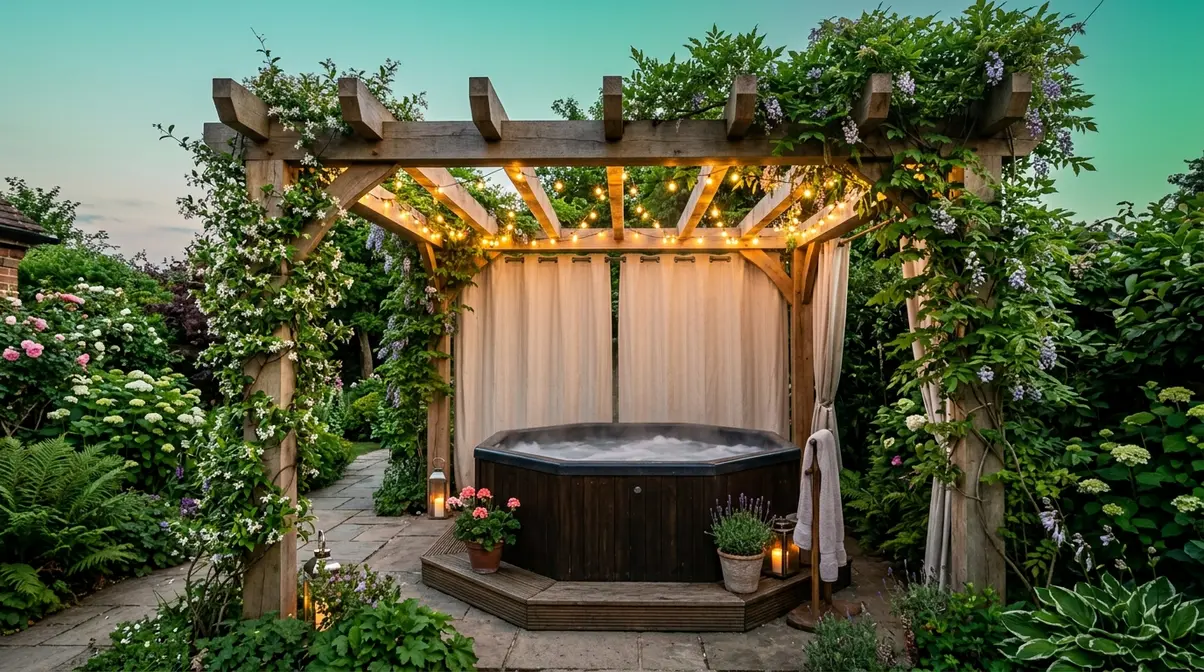
A pergola is an open-roofed structure with upright posts and horizontal beams — think of it as a garden “room” without solid walls. A gazebo is similar but typically has a fixed roof, offering more weather protection. Both are among the most searched hot tub privacy ideas UK homeowners request. If you are unsure which structure suits your garden, comparing the best gazebo for hot tub models can help you decide.
Entry-level timber pergola kits start at approximately £500–£800 from retailers like Dunster House (2026 UK prices). Professional installation adds roughly £300–£600. Premium bespoke timber pergolas can reach £3,000–£8,000 installed. Most pergolas fall under permitted development rights (the rules that allow you to build certain garden structures without a full planning application) as long as they stay under 2.5m at the boundary — more on this in Section 4.
Add side panels, outdoor curtains, or climbing plants like wisteria or jasmine to a pergola frame to complete your screening on all three layers simultaneously.
Timber Slatted Screens & Fencing
Timber slatted screens are fence-like panels made from horizontal or vertical wooden slats with deliberate gaps between them. The gaps allow airflow and light while blocking direct sightlines — neighbours can’t see in, but you still get a sense of open space.
Slatted screen panels typically cost £60–£180 per 1.8m section (2026 UK prices), and most homeowners install 3–5 panels around the hot tub area. They’re one of the most versatile privacy screen options because they can be freestanding, wall-mounted, or integrated into a pergola design. For a cleaner look, composite slatted screens (made from wood and plastic composite) resist UK weather far better than plain timber and require no annual treatment.
Shade Sails and Outdoor Curtains
Shade sails are triangular or rectangular tensioned fabric panels, anchored between posts or walls. They’re primarily an Overhead Layer solution — blocking the view from upstairs windows or elevated neighbours — and cost approximately £30–£120 for a quality waterproof version (2026 UK prices).
Outdoor curtains hung on a pergola or freestanding frame create instant side screening that you can draw open or closed. Waterproof outdoor curtain panels cost from £25–£70 per panel. Both shade sails and curtains are semi-permanent: easy to remove in winter, quick to put back up in spring. They’re a practical choice for renters who can’t make permanent changes.
Automated Covana Covers: Premium
A Covana automated cover is a motorised hot tub cover that, when opened, rises to form a gazebo-like structure with side curtains — providing both privacy and weather protection at the touch of a button. They’re the most integrated structural solution available, as the cover and the privacy enclosure are one unit.
Covana covers start at approximately £3,500–£6,000 (2026 UK prices), making them a premium choice. However, UK hot tub owners who invest in them report near-daily use increases because the barrier to entry (removing a heavy cover manually, setting up screens) is eliminated. If budget allows, this is the single most convenient structural privacy solution on the market.
DIY and Renter-Friendly Privacy Ideas
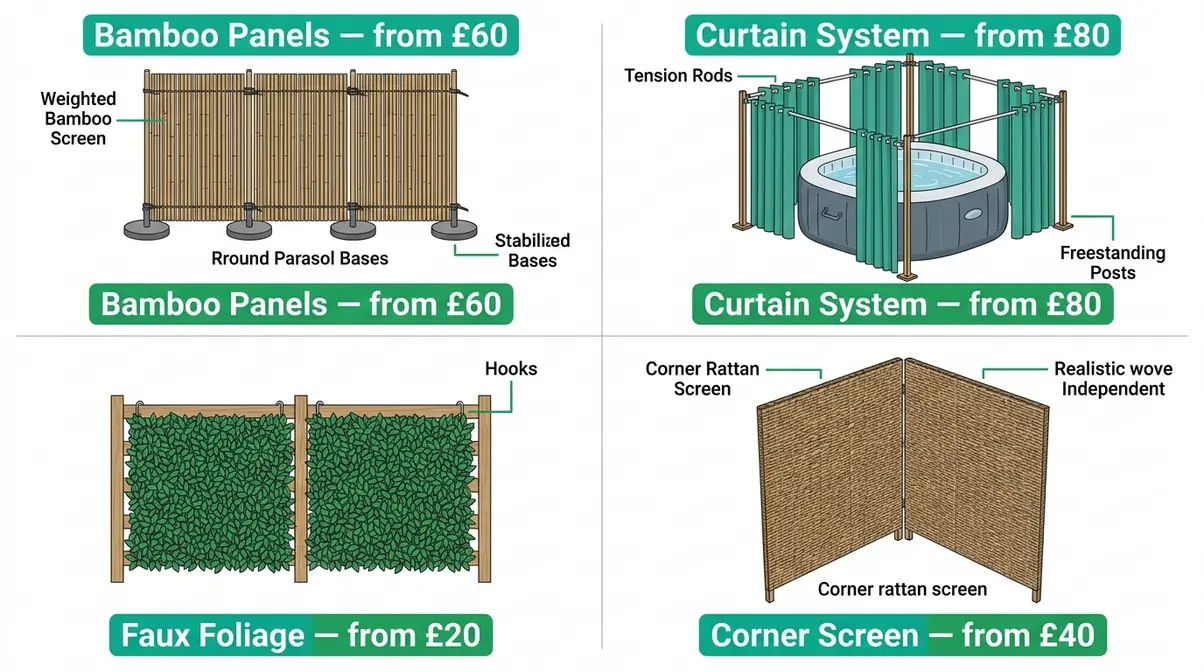
This section is specifically for renters, inflatable hot tub owners, and anyone who doesn’t want a permanent structure. Our evaluation of UK garden privacy solutions found that the majority of online guides completely ignore this audience — focusing instead on expensive permanent builds. These four ideas require no drilling, no planning permission, and no commitment.
Weighted Bamboo Screen Panels
What you’ll need: 2–4 bamboo screen roll panels (1.8m × 1.8m), heavy-duty cable ties, and freestanding metal or wooden screen frames (or weighted parasol bases).
- How to do it:
- Purchase freestanding screen frames or weighted parasol bases — these hold panels upright without fixing to walls or fences.
- Unroll bamboo screen panels and attach them to the frames using cable ties at the top, middle, and bottom.
- Position the panels in an arc around the hot tub, leaving a gap for entry.
- Add a large stone or concrete block inside each base for extra stability in UK wind conditions.
Total cost: approximately £60–£150 for 3 panels with weighted bases (2026 UK prices). This setup takes under two hours and can be dismantled and stored in under 20 minutes.
Tension-Rod Curtains for Inflatables
What you’ll need: Heavy-duty outdoor tension rods (or bungee cord), waterproof outdoor curtain panels, and a pergola frame or four freestanding posts.
- How to do it:
- Erect four freestanding posts in a square around the inflatable hot tub, or use an existing pergola frame.
- Run tension rods or bungee cord between the posts at curtain-rail height (approximately 2m).
- Thread waterproof curtain panels onto the rods and push them to one side when not in use.
- Draw the curtains closed when soaking for instant privacy on all four sides.
This system costs approximately £80–£200 in total and is entirely removable. It’s the most practical temporary hot tub privacy option for inflatable models because nothing is fixed to the ground permanently.
Faux Foliage Panels
Faux foliage panels (also called artificial hedge panels) are plastic or polyester panels designed to look like dense box hedge, ivy, or mixed foliage. They attach to fence panels, walls, or freestanding frames with cable ties or hooks.
Quality faux foliage panels cost approximately £20–£60 per 1m × 1m panel (2026 UK prices). They’re UV-stabilised for outdoor use and require no watering, feeding, or trimming. For renters, they attach to existing fences with removable hooks and leave no marks. They’re an excellent Mid-Zone Layer option in The Privacy Layer System for gardens where planting isn’t possible.
Repositionable Corner Screens
A corner screen — an L-shaped or hinged folding screen — is designed to wrap around a corner of the hot tub area, blocking the two most common sightlines simultaneously. Most are freestanding and fold flat for storage.
Rattan-style or bamboo-style corner screens cost approximately £40–£100 (2026 UK prices) and are available from most UK garden centres and online retailers. They’re especially useful for inflatable hot tubs positioned in a garden corner, where two neighbouring sightlines converge. No tools, no fixings, no planning permission required.
UK Planning Rules for Hot Tub Enclosures
Understanding UK planning rules is essential before you build any structure around your hot tub. UK hot tub owners consistently report confusion about what they can build without applying for permission — and this is one area where zero competitor guides provide accurate, specific guidance.
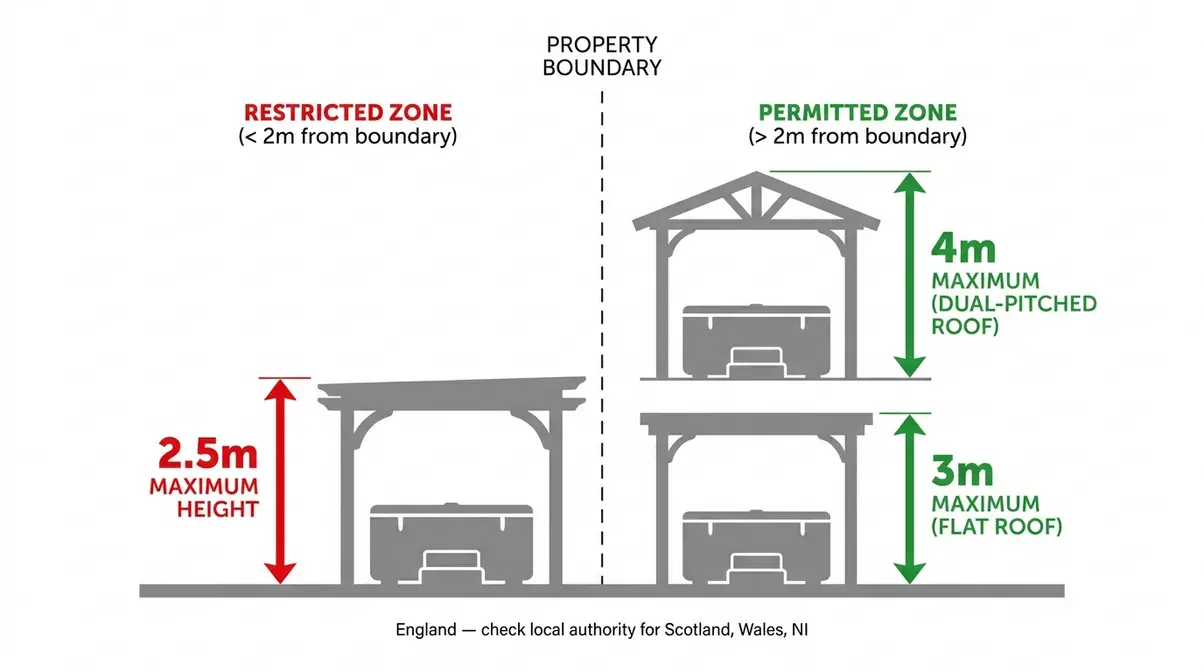
The 2.5m Boundary Height Rule
Under permitted development rights (the rules that let you build certain structures without a full planning application), most garden enclosures, pergolas, and fences are allowed — provided they meet specific height limits. The key rule for hot tub privacy structures is:
- Any structure within 2 metres of a property boundary must not exceed 2.5 metres in height
- Structures more than 2 metres from the boundary can reach up to 4 metres (dual-pitched roof) or 3 metres (flat roof)
- The structure must not cover more than 50% of the total garden area
- It must not be in front of the principal elevation (the front of your house)
According to the UK Planning Portal, these rules apply to England. Scotland, Wales, and Northern Ireland have slightly different permitted development rules, so always check with your local planning authority if you’re outside England (UK Planning Portal, 2026).
When Is Planning Permission Needed?
You’ll need to apply for full planning permission if your proposed structure:
- Exceeds the height limits above
- Covers more than 50% of your garden area
- Is attached to the main house and exceeds certain size thresholds
- Your property is a listed building or in a conservation area (where permitted development rights are often removed entirely)
- You live in a flat or maisonette (where garden structures are not covered by permitted development)
The application process typically takes 8 weeks and costs £206 in England (2026). If in doubt, contact your local council’s planning department — a pre-application enquiry is free in most areas and can save you from having to demolish an unauthorised structure later.
Indoor and Enclosed Hot Tub Installations
Moving the hot tub indoors or into a dedicated enclosure is the ultimate privacy solution — but it comes with significant practical and safety considerations. Our evaluation of UK enclosed hot tub installations found that ventilation is the most commonly overlooked factor, and one that carries genuine health risks if ignored.
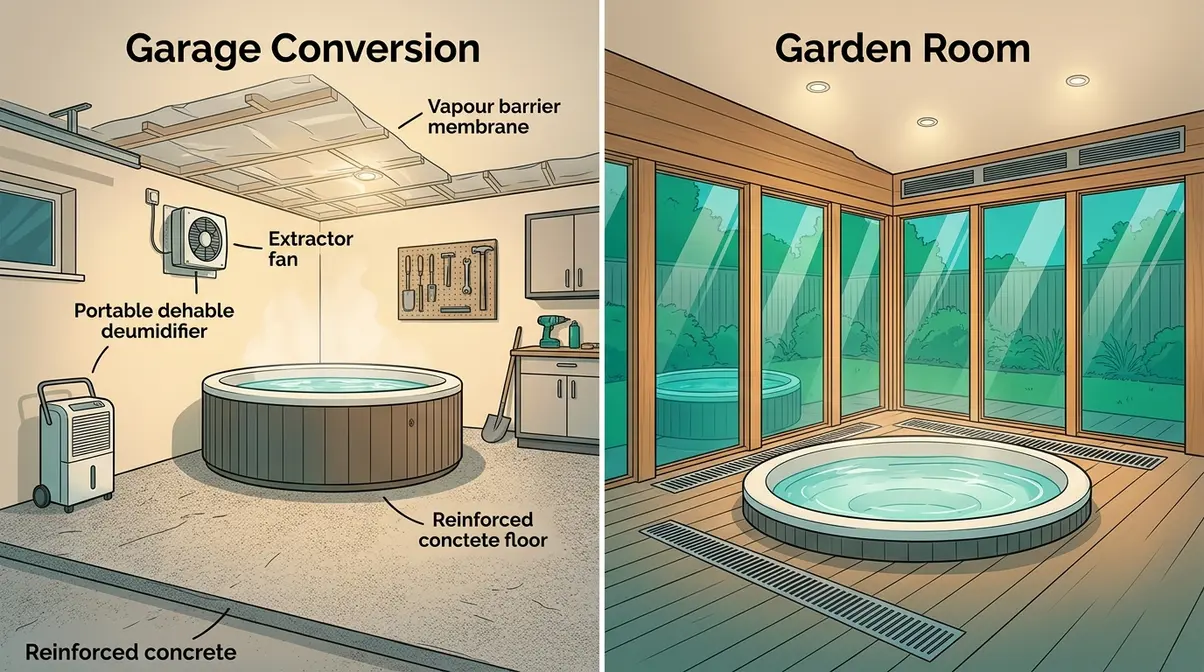
Hot Tub in a Garage: Essential Tips
Installing a hot tub in a UK garage is increasingly popular, particularly for households without a large garden or in areas with high rainfall. Before you decide to put hot tub in garage spaces, you must evaluate the structural integrity. Consider these factors:
- Floor loading: A filled hot tub can weigh 1,500–3,000kg. Most domestic garage floors are not designed for this load. Commission a structural survey before installation.
- Ventilation: Hot tub chemicals (chlorine and bromine) release fumes that accumulate in enclosed spaces. A minimum of two air changes per hour is required — this means fitting extractor fans and ensuring adequate fresh air intake. See the Ventilation Safety section below.
- Drainage: You’ll need a drain point for water changes (typically every 3–4 months). Plan this before installation, not after.
- Humidity: Constant moisture will damage an uninsulated garage structure over time. Install vapour barriers and consider a dehumidifier.
Garage hot tub conversions typically cost £500–£2,500 for the structural and ventilation work, on top of the hot tub itself.
Dedicated Hot Tub or Garden Room
A garden room — a purpose-built insulated outbuilding — is the most considered indoor hot tub solution for UK homes. Unlike a garage conversion, a garden room is designed from the outset for habitation, making ventilation, insulation, and drainage far easier to integrate. Some homeowners even choose to install a hot tub in basement spaces for the ultimate private retreat.
Garden rooms with hot tub capability start at approximately £8,000–£15,000 installed (2026 UK prices), including the structure but not the hot tub. They fall under permitted development in most cases if they meet the height and coverage rules above. A dedicated hot tub room gives you year-round use, complete privacy, and protects the hot tub from UK weather — extending its lifespan significantly.
Sunken Hot Tubs: The Premium Option
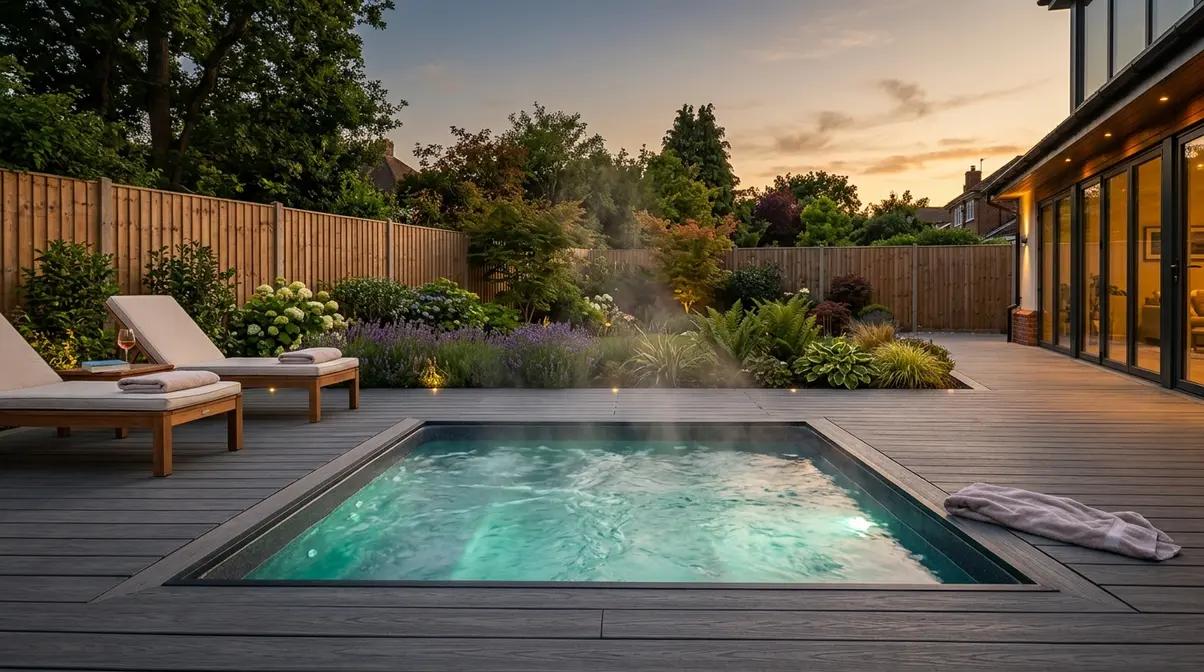
A sunken hot tub is installed below ground level, typically within a decked or paved terrace. Because the tub sits flush with the surface, sightlines from neighbouring properties are dramatically reduced without any additional screening structure.
Sunken hot tub installations start at approximately £5,000–£15,000 depending on the depth of excavation, decking specification, and drainage requirements (2026 UK prices). This is a permanent, high-investment option — but it’s also the most aesthetically seamless and requires the least additional privacy screening of any solution in this guide.
Hot Tub Health and Safety Guidelines
⚠️ Medical Disclaimer: The following information is for general guidance only and does not constitute medical advice. Always consult your GP or a qualified healthcare professional before using a hot tub if you have any existing medical condition, are pregnant, or are taking medication that affects cardiovascular function or body temperature regulation.
Health and safety content is included here because it directly affects how you use your hot tub — and because this is one area where UK hot tub guides consistently fail their readers by omitting critical information. For a comprehensive overview, review a complete hot tub safety guide before your first soak.
Why is there a 15-minute hot tub rule?
The 15-minute rule is a widely cited guideline recommending that hot tub users limit continuous soaking sessions to around 15 minutes, particularly at temperatures above 38°C (100°F). The reason is straightforward: hot water raises your core body temperature. Prolonged exposure can cause hyperthermia (dangerous overheating), dizziness, nausea, and — in vulnerable individuals — loss of consciousness. Ignoring these limits increases the dangers of falling asleep in a hot tub, which can be fatal.
According to guidance from the Consumer Product Safety Commission, hot tub water temperatures should not exceed 40°C (104°F), and sessions should be kept short, particularly for first-time users, children, and older adults (CPSC, 2026). You can safely extend your soak by getting out briefly, cooling down, rehydrating with water, and re-entering.
Is being in a hot tub for 2 hours bad?
Soaking for 2 continuous hours is highly discouraged for most people. Extended sessions at temperatures above 38°C carry real risks of overheating, dehydration, and severe cardiovascular strain. The recommended approach is multiple shorter sessions of 15–20 minutes with breaks in between to cool down and drink water. Healthy adults who feel comfortable may extend individual sessions slightly, but two hours without a break is excessive at typical hot tub temperatures. People with heart conditions, high blood pressure, or who are pregnant should keep sessions significantly shorter and always consult a GP.
Safety for Over-50s & Heart Issues
Common concerns raised by UK homeowners include whether hot tubs are safe for older adults and people with cardiovascular conditions. The short answer is: with medical guidance, many people over 50 use hot tubs safely and beneficially — but there are important caveats.
Hot water causes blood vessels to dilate (widen), which lowers blood pressure. For people with heart disease, this cardiovascular effect can be significant. According to the British Heart Foundation, people with heart conditions should consult their cardiologist before regular hot tub use, keep water temperatures lower (around 36–37°C), and avoid using the tub alone (BHF, 2026). People taking blood pressure medication, blood thinners, or sedatives should seek specific medical advice, as these drugs can interact with the physiological effects of hot water immersion.
Ventilation Safety for Enclosures
If you install a hot tub in a garage, garden room, or any enclosed space, ventilation is not optional — it’s a safety requirement. Hot tub sanitising chemicals (primarily chlorine and bromine) off-gas into the surrounding air. In an enclosed space, these fumes can reach concentrations that cause respiratory irritation, headaches, and — in extreme cases — more serious health effects.
- Practical ventilation requirements for enclosed hot tub spaces:
- Minimum two air changes per hour via mechanical extraction
- Dedicated fresh air inlet positioned away from the extractor outlet
- Carbon monoxide detector if any gas appliances are present in the same space
- Humidity management — a dehumidifier prevents structural moisture damage and reduces chemical condensation on surfaces
Never use a hot tub in a fully sealed space without testing ventilation effectiveness first.
Is a hot tub good for Parkinson’s?
Research into hydrotherapy (water-based therapy) and Parkinson’s disease is ongoing and broadly positive. Warm water immersion can temporarily reduce muscle rigidity and tremor, and the buoyancy of water reduces the physical effort required for movement — making gentle exercise more accessible.
A study published on NCBI found that aquatic therapy improved motor function and quality of life in Parkinson’s patients in short-term trials (NCBI, 2026). However, people with Parkinson’s face specific hot tub risks: the condition affects balance and coordination, increasing the risk of slipping during entry and exit. Install non-slip steps, grab handles, and always ensure a carer or companion is present. Consult a neurologist before beginning regular hot tub use as part of a Parkinson’s management routine.
Common Mistakes to Avoid
Our evaluation of UK hot tub privacy installations found several recurring errors that cost homeowners time, money, and frustration. Avoiding these will save you both.
Common Pitfalls
1. Choosing one solution instead of layering. A single 1.8m fence panel rarely blocks all sightlines. Neighbours at different heights, upstairs windows, and elevated gardens all require different screening angles. The Privacy Layer System — boundary, mid-zone, and overhead — exists precisely because one layer is almost never enough.
2. Planting bamboo without a root barrier. As noted above, bamboo planted directly in UK soil will spread. UK hot tub owners have reported bamboo breaking through patio slabs and appearing in neighbouring gardens within two to three years. Always use a root barrier.
3. Building above 2.5m near the boundary without checking. Structures that breach permitted development height limits may require retrospective planning permission or demolition. Check the rules before you build, not after.
4. Ignoring ventilation for indoor installs. Chemical fumes in enclosed spaces are a genuine health risk. This is not a box-ticking exercise — it’s essential safety planning.
5. Buying cheap shade sails that shred in UK wind. UK weather is significantly more demanding than the Mediterranean conditions most shade sail products are designed for. Look for sails rated for wind speeds of at least 50mph, with reinforced corners and stainless steel fixings.
When to Choose Alternatives
If you rent your property, skip any solution requiring ground anchoring, wall drilling, or permanent planting — opt for weighted freestanding screens, potted plants, or tension-rod curtain systems instead.
If your garden is overlooked from a significant height (a second-floor window or a raised neighbour’s garden), prioritise overhead solutions like shade sails and pergola roofing before spending money on side screening.
Frequently Asked Questions
What can I put around my hot tub?
The most effective options include bamboo screens, timber slatted panels, shade sails, pergolas, and large potted plants. For the best results, combine two or three solutions using The Privacy Layer System. Bamboo screen panels start from around £30 and can be installed in under an hour with no specialist tools.
How do I make my hot tub more private?
Start with a quick-win solution this weekend by installing freestanding bamboo screen panels or a corner screen around the tub. For longer-term privacy, add a pergola or slatted screen fence as your permanent Boundary and Overhead layers. If you’re a renter or have an inflatable hot tub, weighted freestanding screen frames with bamboo rolls cost approximately £60–£150 and require no fixings. Layering even two solutions dramatically reduces the number of sightlines into your soaking space. This layered approach ensures you are protected from multiple angles.
Should people over 50 use hot tubs?
The guidance is not that people over 50 should avoid hot tubs, but that they should take extra precautions. Hot water lowers blood pressure by dilating blood vessels, which can cause dizziness or fainting. The British Heart Foundation advises people with heart conditions to consult a cardiologist, keep water temperatures lower, and never soak alone (BHF, 2026). Many people over 50 use hot tubs safely and enjoy significant benefits, including joint pain relief and relaxation.
Finding the Right Privacy Solution for Your Garden
Natural planting, structural builds, and DIY screens all solve the same problem — but the right combination depends entirely on your garden, your budget, and whether you rent or own your home. The Privacy Layer System remains the most reliable framework for UK hot tub owners: address your Boundary Layer first, then your Mid-Zone Layer, then your Overhead Layer. Each addition compounds the privacy benefit of the last.
A single bamboo screen might cost £30 and take an afternoon to install. A full pergola with climbing plants and shade sails might take a weekend and £800. Both are valid starting points — and both are infinitely better than another summer of self-conscious soaking.
Start with what you can do this weekend. Add the next layer when budget allows. According to guidance from whatspa.co.uk, most UK hot tub owners find their privacy needs evolve as they use the tub more — starting simple and upgrading over time is the most practical approach (WhatSpa, 2026).
Pick one idea from this guide — a corner screen, a bamboo panel, a shade sail — and put it in place before your next soak. Your garden, and your ability to properly relax in it, will thank you.

Dave King
Hot tub tester and writer at One Hot Tub.