What’s in this guide
Picture this: your new hot tub arrives on a flatbed truck, and the delivery crew takes one look at your 36-inch garden gate and shakes their head. The tub is going back. That single oversight — a gate measurement nobody thought to check — is the most expensive mistake first-time buyers make.
“Hot tub dimensions will vary based on brand and model. There are some standard sizes, however, such as 78 by 78 inch hot tubs, 84 by 84 inch hot tubs and 94 by 94 inch hot tubs…”
Most buyers measure their patio and stop there. They forget the delivery path, the cover lifter clearance, and whether their deck can physically hold 3,000+ pounds of water, shell, and bathers. By the time they find out, the tub is already on the truck — and the return fees are brutal.
By the end of this hot tub dimensions guide, you’ll know exactly how to measure your space, which size fits your needs, and what every competitor guide forgets to tell you about getting the tub from the street to your backyard. We cover how to measure your space step by step, dimensions by person capacity, sizes by shape, specialist tub types, popular brand specs, and the most common planning mistakes to avoid.
Note: All dimension ranges in this guide are general standards — always confirm exact measurements with your chosen manufacturer’s spec sheet before purchasing.

Most hot tub dimensions range from 5’4″ square (2-person) to 9′ square (10-person), with a standard depth of 29–38 inches — but the tub’s footprint is only half the story.
- Plan 18–24 inches of extra clearance on at least one side for a cover lifter (Master Spas installation guidance)
- Check your delivery path — the minimum corridor is typically 40 inches wide to allow safe manoeuvring
- Your foundation must support at least 100 lbs per square foot when the tub is filled (Fairfax County Government building codes)
- “The Delivery Envelope” — measure your gate and delivery path before you choose a model, not after; this is the single step most buyers skip
- 6-person hot tubs are the most popular size, typically measuring 84″ × 84″ (7′ × 7′) (Caldera Spas)
How to Measure Your Space for a Hot Tub
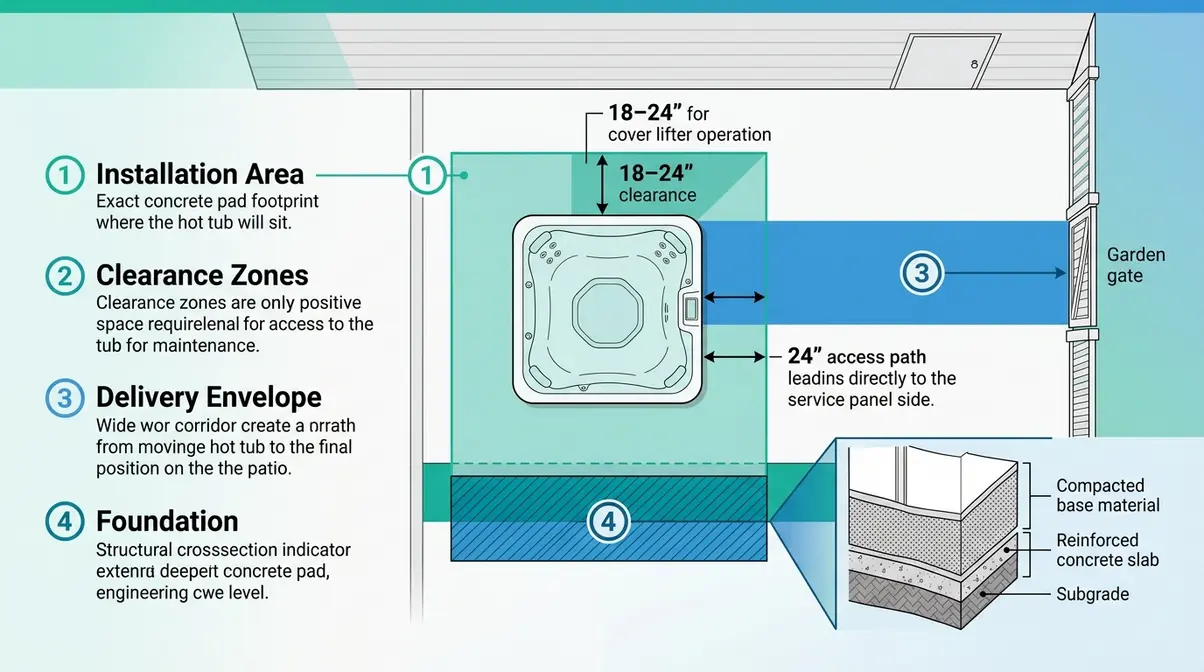
Measuring for a hot tub requires four separate measurements — not just the footprint of the tub itself. According to the Pool & Hot Tub Alliance (PHTA), the industry body that sets residential spa standards, installations must account for structural support, clearance zones, and safe access corridors alongside floor space. Get any one of these wrong and you could face a failed delivery, a rejected installation, or a structural repair bill that costs more than the tub itself.
In our experience at onehottub.com reviewing and recommending hot tubs to UK buyers, the measurement step is where most planning falls apart — not because people don’t measure, but because they measure the wrong things. This section walks you through each of the four zones you need to assess, in the order you should assess them.
The measurement steps and clearance figures in this section are compiled from industry guidance published by the Pool & Hot Tub Alliance (PHTA), Fairfax County Government deck-load building codes, and manufacturer installation manuals from Jacuzzi, Master Spas, and Caldera Spas. Metric conversions are based on standard imperial-to-metric equivalences.
For a complete reference on how different models compare spatially, see our complete hot tub dimensions guide as you work through these steps.
Step 1 — Measure the Installation Area
Start with the floor space. Measure the full length and width of the flat, level area where the tub will sit — not just the patio in general, but the specific zone where the foundation pad will go. Then subtract the hot tub’s footprint from that measurement to find the remaining clearance on each side.
Here is a worked example: if your patio is 12 feet × 10 feet and your chosen tub is 7 feet × 7 feet, you have roughly 2.5 feet of clearance on the long sides and 1.5 feet on the short sides. That 1.5-foot margin is tighter than it sounds once you add steps and service access.
One detail that surprises many buyers: the concrete pad — or reinforced base — should extend at least 6 inches beyond the tub’s edge on all sides. This is the “pad footprint” versus “tub footprint” distinction. A 7′ × 7′ tub therefore needs a pad of at least 8′ × 8′. For a standard 6-person hot tub measuring 84″ × 84″, that translates to a pad of 96″ × 96″ — 64 square feet of reinforced surface.
A note on hot tub dimensions depth: depth in a manufacturer’s spec sheet refers to the interior water depth (typically 29–38 inches), which is separate from the overall cabinet height. For most above-ground models, the cabinet height and interior depth are similar, but always check both figures. Standard hot tub depth ranges from 29 to 38 inches, with deeper models providing a more submerged soaking experience for most adults (Caldera Spas sizing guidance).
This hot tub size guide step sounds basic, but it eliminates the single most common measurement error: planning for the tub, not the pad.
Once you know the floor space available, the next challenge is less obvious — and the one most buyers miss entirely: the clearance zones around the tub.
Step 2 — Calculate Clearance Zones
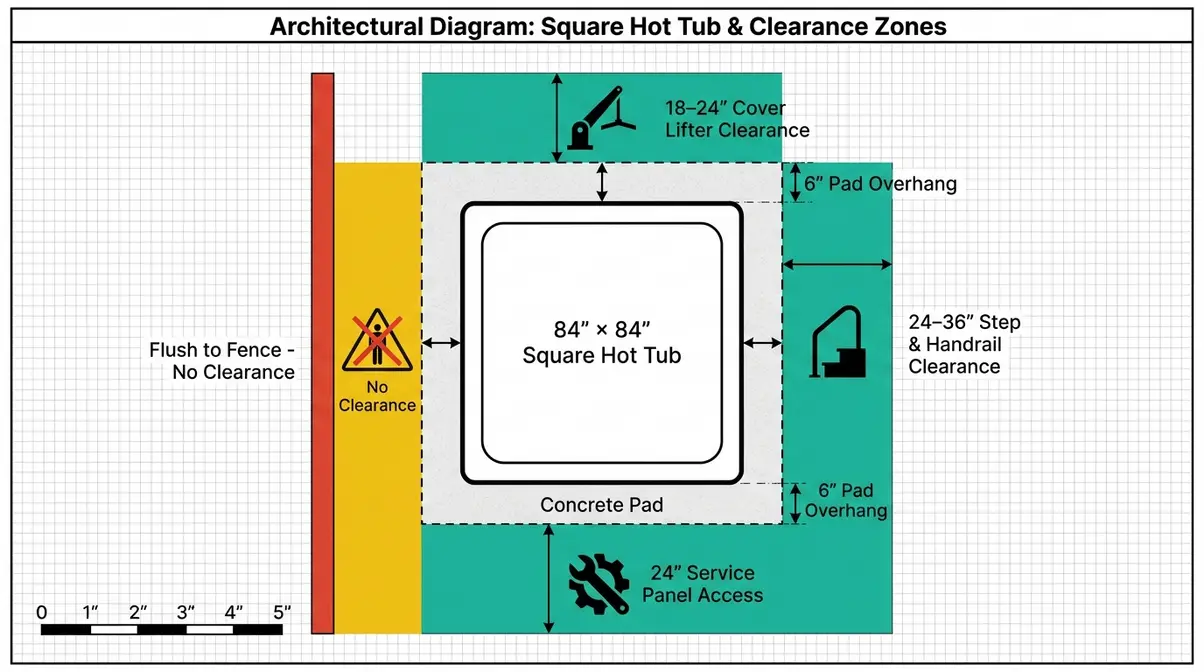
This step of the hot tub measuring guide is where plans most often unravel. Your tub’s footprint tells you how much space the shell occupies. It tells you nothing about the space the tub needs to function.
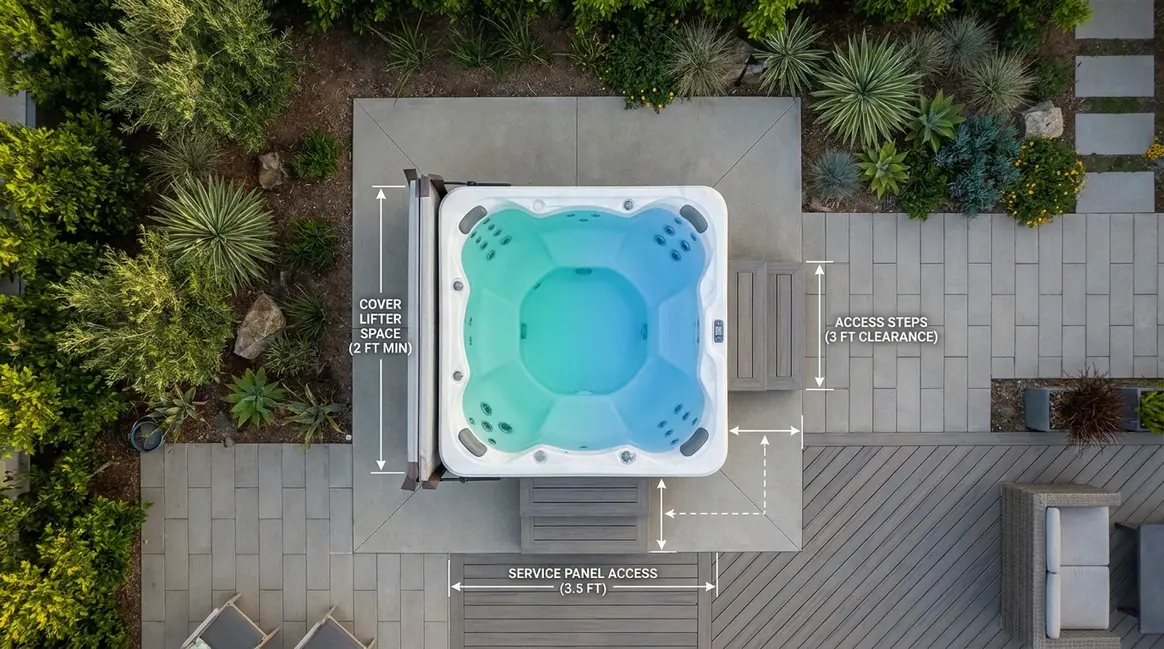
Cover lifter clearance is the big one. A cover lifter — the mechanical arm system that folds and stores the hot tub lid — requires 18–24 inches of unobstructed space on the side where it operates (Master Spas installation guidance). Place the tub flush against a fence or wall on that side and the cover simply cannot open. Many buyers only discover this after the tub is installed and the lifter bracket is already bolted on.
Service panel clearance matters for long-term ownership. Every hot tub has an equipment access panel — usually at the back or one side — where a technician reaches the pump, heater, and control board for maintenance. Most manufacturers recommend at least 24 inches of clear space at the panel. Before finalising your tub’s position, check the spec sheet to identify which side the panel sits on. Placing a planter or wall cabinet in front of it is a costly mistake to undo later.
Steps and handrail clearance adds more to your total footprint than most buyers expect. If you plan to use external entry steps (typically sold separately), add 24–36 inches to the entry side of the tub. Factor this into your total zone measurement before you commit to a position.
Here is what that looks like in practice: a 7′ × 7′ tub with a cover lifter on the north side and steps on the east side effectively needs a 7′ × 9’6″ clear zone — not the 7′ × 7′ footprint the spec sheet lists.
According to the CPSC pool and spa safety guidelines, adequate access and egress clearance around residential spas is a baseline safety requirement, not just a convenience.
Step 3 — Measure The Delivery Envelope
This is the section no competitor covers — and the one that causes the most expensive surprises on delivery day.
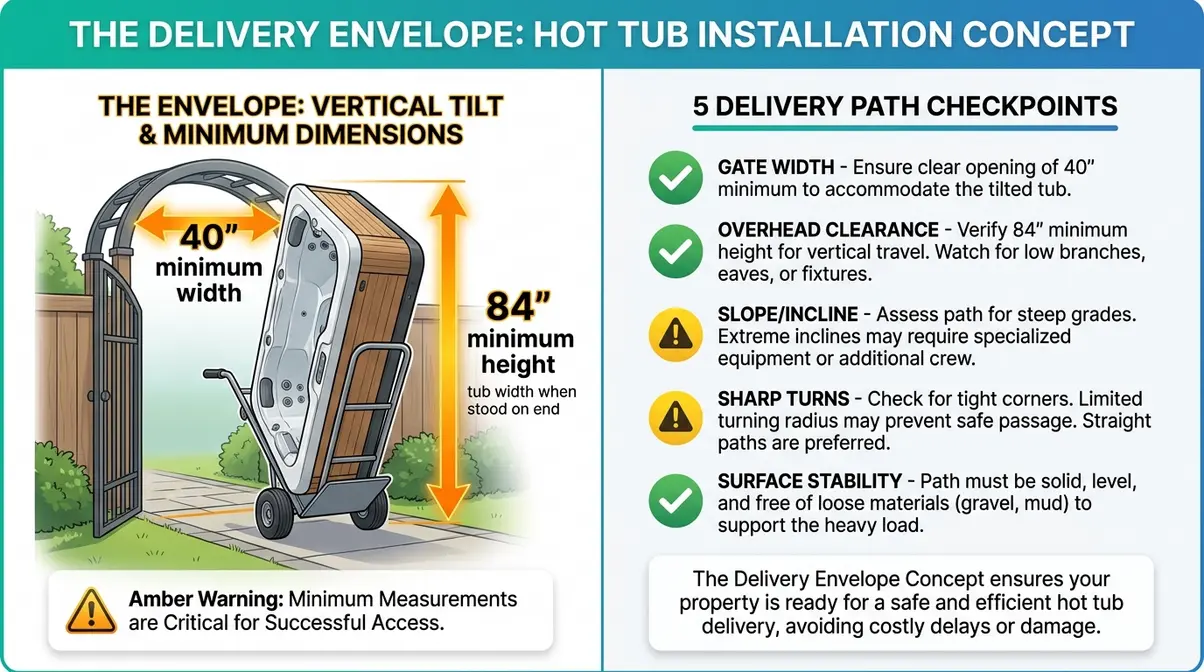
“The Delivery Envelope” is the minimum clearance corridor — height × width — required to physically move a hot tub from the delivery truck to its final installation position. Typically, this means a corridor at least 40 inches wide and 78 inches tall at every point along the route (based on manufacturer delivery guidance and installer community consensus). Every gate latch, pergola beam, overhanging branch, and fence corner is a potential blocker.
Here is the detail that surprises virtually every first-time buyer: hot tubs often arrive standing on their end. The delivery crew tilts the tub upright to navigate narrow paths — which means the critical height clearance through any gate or low structure is not the tub’s standing height (typically 34–38 inches) but the tub’s width. A 7-foot-wide tub stood vertically needs 84 inches of overhead clearance. A pergola at 80 inches suddenly becomes an obstacle.
How to assess your Delivery Envelope:
- Walk the full route from the kerb (or nearest point the truck can reach) to the installation site
- Measure the width of every gate, gap, and corridor along the route — the minimum must be 40 inches
- Measure the height of any overhead obstruction: pergolas, low-hanging eaves, tree branches
- Check for steps, slopes, or soft ground that could prevent a dolly from rolling safely
- Note any sharp turns — a 90-degree turn in a narrow side passage may require professional rigging equipment
Common tight-space scenarios and what to do:
| Scenario | Challenge | Solution |
|---|---|---|
| Side-gate delivery (standard 36″ gate) | Gate too narrow for 40″ minimum | Replace gate or remove post temporarily |
| Pergola overhead | Low beam blocks tub on end | Measure beam height vs. tub width; consider partial disassembly |
| Sloped garden path | Dolly cannot navigate incline safely | Request crane-lift quote from installer |
| Small patio with no side access | No route from front to back | Front-only delivery; plan installation position from front |
| Soft or uneven ground | Dolly sinks; tub tips | Lay temporary boards; request extra crew |
If your delivery path is under 40 inches wide at any point, contact your retailer before you place the order. Many installers offer crane delivery as an upgrade — typically for an additional fee — which completely bypasses ground-level access constraints.
Step 4 — Check Foundation Weight Capacity
A filled 6-person hot tub can weigh over 3,500 pounds — your deck must be engineered to handle at least 100 lbs per square foot to avoid structural failure (Fairfax County Government building codes, representative of standard residential deck codes across most US jurisdictions).
Understanding this step requires two key terms. Dry weight is the weight of the tub before it is filled with water and occupied by bathers — typically 500–1,000 lbs for a standard above-ground model. Live load is the total weight a surface must safely support, including water, bathers, and the tub shell. For a filled 7′ × 7′ tub with four bathers, the live load can easily reach 4,000+ lbs. Understanding your hot tub water capacity and weight is essential for accurately calculating this live load.
Most standard residential decks are built to support 40–50 lbs per square foot — well short of the 100 lbs per square foot that the PHTA and local building codes recommend as the minimum for hot tub installation. A deck that is not specifically engineered for this load is a structural risk.
How to calculate your foundation’s load:
- Find your hot tub’s dry weight (on the manufacturer’s spec sheet)
- Calculate water weight: multiply the tub’s water capacity in gallons by 8.34 lbs (the weight of one US gallon of water)
- Add bather weight: multiply the number of seats by 175 lbs (a conservative average)
- Add all three figures together — this is your total live load
- Divide by the tub’s footprint in square feet to get lbs per square foot
Worked example:
| Component | Calculation | Weight |
|---|---|---|
| Dry weight (6-person tub) | Manufacturer spec | 750 lbs |
| Water weight (400 gallons) | 400 × 8.34 | 3,336 lbs |
| Bather weight (4 people) | 4 × 175 | 700 lbs |
| Total live load | 4,786 lbs | |
| Footprint (7′ × 7′ = 49 sq ft) | 4,786 ÷ 49 | ~97.7 lbs/sq ft |
If your deck cannot meet the 100 lbs per square foot threshold, consult a structural engineer before proceeding. Reinforcing an existing deck is often less expensive than the liability of a structural failure.
Hot tub dimensions and weight are inseparable considerations — a larger tub does not just need more space; it needs a proportionally stronger foundation. For a quick reference on how weight scales with tub size, see our section on dimensions by capacity below.
Imperial-to-metric conversion reference:
| Imperial | Metric |
|---|---|
| 78″ × 78″ | 1,981 × 1,981 mm |
| 84″ × 84″ | 2,134 × 2,134 mm |
| 94″ × 94″ | 2,388 × 2,388 mm |
| 36″ depth | 914 mm |
| 40″ path width | 1,016 mm |
| 100 lbs/sq ft | 488 kg/m² |
For hot tub dimensions in mm, the table above covers the most common standard sizes. All hot tub dimensions mm conversions use the standard factor of 25.4 mm per inch.
Electrical clearance (brief note): Most jurisdictions also require a minimum of 5 feet between a hot tub and any overhead electrical line, and GFCI-protected wiring within 10 feet. Check your local code before finalising placement — your installer should confirm this as part of their site survey.
Ready to choose your size? Jump to our dimensions-by-capacity table below.
Hot Tub Dimensions by Person Capacity
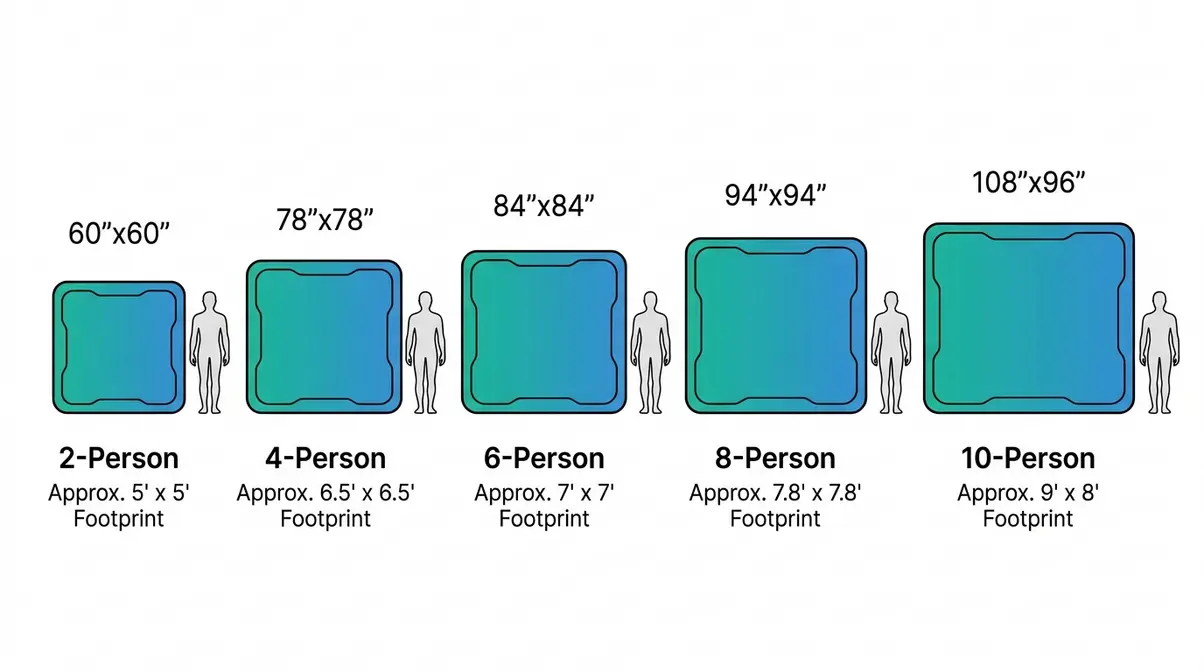
The most practical way to find the right hot tub size is to start with the number of people who will use it most often — not the maximum you might ever host. A tub sized for 6 people that regularly holds 2 will feel cavernous and expensive to heat. A 4-person tub squeezed with 6 adults is uncomfortable and potentially unsafe.
This hot tub dimensions guide organises standard sizes by seating capacity, from compact 2-person models to large party spas. For each category, dimensions represent typical industry ranges — individual models will vary, so always verify with the manufacturer’s spec sheet.
“The 6-person hot tub is the industry’s sweet spot — it is the most widely stocked, most frequently recommended, and the size that most backyard footprints can accommodate with proper planning.” — onehottub.com editorial assessment, based on UK buyer data and manufacturer range analysis.
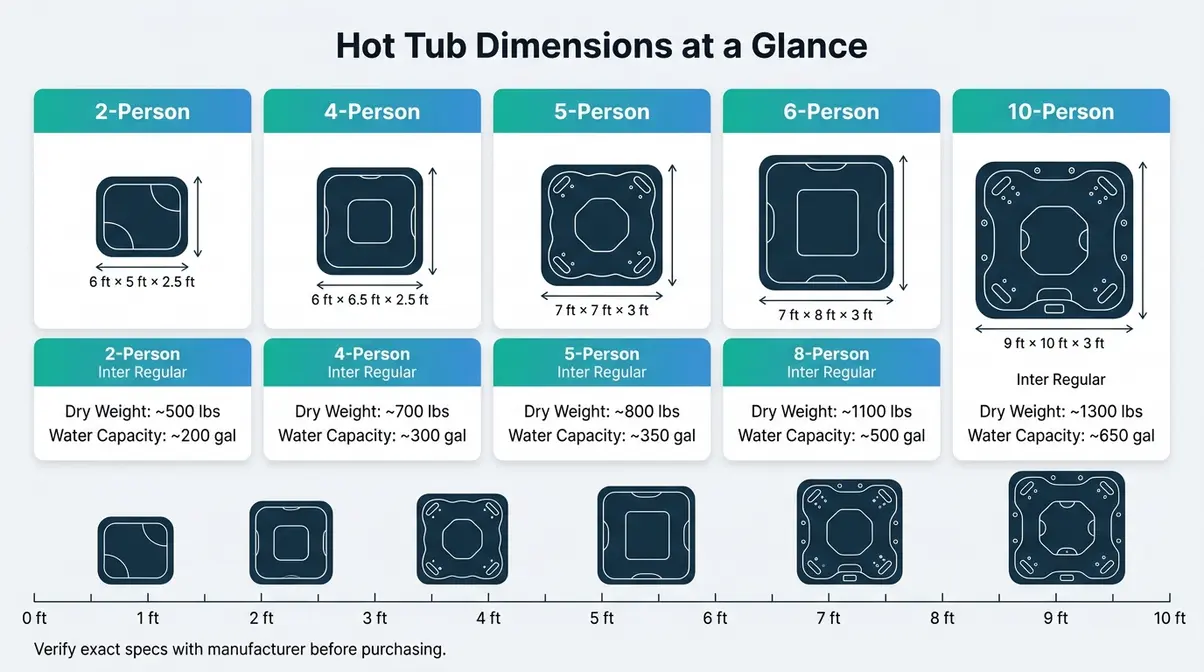
2–4 Person Hot Tub Dimensions
Small hot tubs designed for 2–4 people are the most space-efficient option for compact patios, urban gardens, and balconies (where structural loads permit). They are also the most affordable to purchase, run, and heat.
Typical dimensions for a 2–4 person hot tub:
| Capacity | Length | Width | Depth (interior) | Approx. Dry Weight |
|---|---|---|---|---|
| 2-person | 60″–66″ (5’–5’6″) | 60″–66″ (5’–5’6″) | 29″–32″ | 400–550 lbs |
| 3-person | 66″–72″ (5’6″–6′) | 60″–66″ (5’–5’6″) | 29″–34″ | 450–600 lbs |
| 4-person | 72″–78″ (6’–6’6″) | 72″–78″ (6’–6’6″) | 30″–36″ | 500–700 lbs |
A 4-person hot tub measuring 78″ × 78″ (6’6″ × 6’6″) is one of the most common “standard sizes” you will see listed across manufacturers. The 78 by 78 inch footprint fits comfortably on a 10′ × 10′ reinforced patio with room for cover lifter clearance. For the smallest available models, some manufacturers produce “2-person soaking tubs” closer to 60″ × 60″ — useful for tight spaces but limited in terms of stretch-out room for taller adults.
Why this matters: A 4-person tub filled to capacity with four adults and water weighs approximately 3,000–3,400 lbs. Ensure your foundation calculation (see Step 4) accounts for full capacity even if you rarely host four people at once.
5–6 Person Hot Tub Dimensions
The 5–6 person category is the most popular size bracket in the market. A 6-person hot tub typically measures 84″ × 84″ (7′ × 7′), which has become the de facto “standard” size that most installation guides and deck-building resources are written around (Caldera Spas). When evaluating the dimensions of a 6 person hot tub, you will quickly see why this size dominates the market.
Typical dimensions for a 5–6 person hot tub:
| Capacity | Length | Width | Depth (interior) | Approx. Dry Weight |
|---|---|---|---|---|
| 5-person | 78″–84″ (6’6″–7′) | 78″–84″ (6’6″–7′) | 32″–36″ | 600–750 lbs |
| 6-person | 84″–90″ (7’–7’6″) | 84″–90″ (7’–7’6″) | 33″–38″ | 700–900 lbs |
The 84 by 84 inch footprint is the benchmark most buyers use when planning. It fits on a standard 10′ × 10′ deck with adequate service clearance, and the 7-foot width is the key measurement to carry into your Delivery Envelope calculation. When stood on its end for delivery, an 84-inch-wide tub needs 84 inches of vertical clearance at every gate and overhead obstruction.
A filled 6-person tub holds approximately 400–450 gallons of water. Combined with the shell weight and four bathers, the live load regularly approaches or exceeds 4,500 lbs — making the 100 lbs per square foot foundation standard essential, not optional.
7–8 Person Hot Tub Dimensions
Moving up to 7–8 person capacity, tubs begin to take on a larger, often rectangular or L-shaped footprint. These are the models most often installed on purpose-built decks or large patios rather than existing outdoor spaces.
Typical dimensions for a 7–8 person hot tub:
| Capacity | Length | Width | Depth (interior) | Approx. Dry Weight |
|---|---|---|---|---|
| 7-person | 84″–94″ (7’–7’10”) | 84″–94″ (7’–7’10”) | 34″–38″ | 800–1,000 lbs |
| 8-person | 90″–96″ (7’6″–8′) | 90″–96″ (7’6″–8′) | 34″–38″ | 900–1,100 lbs |
The 94 by 94 inch footprint is the next common “standard size” step above the 7′ × 7′ benchmark. At just under 8 feet square, this size requires a foundation of at least 9’6″ × 9’6″ to accommodate the recommended 6-inch pad overhang on each side. Delivery path planning becomes more critical at this size — an 8-foot-wide tub stood on end needs 96 inches (8 feet) of overhead clearance, which rules out many standard pergola structures.
10+ Person Hot Tub Dimensions
At the large end of the residential market, 10+ person hot tubs are essentially swim-spa adjacents — long, wide, and designed for entertaining rather than everyday soaking. These are rarely installed on existing decks without significant structural reinforcement.
Typical dimensions for 9–10+ person hot tubs:
| Capacity | Length | Width | Depth (interior) | Approx. Dry Weight |
|---|---|---|---|---|
| 9–10 person | 96″–108″ (8’–9′) | 84″–96″ (7’–8′) | 36″–40″ | 1,000–1,400 lbs |
| 10+ person | 108″–114″ (9’–9’6″) | 96″–108″ (8’–9′) | 36″–40″ | 1,200–1,600 lbs |
At this scale, live loads can exceed 6,000 lbs. Professional structural assessment of the foundation is not optional — it is a code requirement in most jurisdictions. Delivery almost always requires crane-lift logistics. If you are considering a 10+ person model, factor crane hire into your total installation budget from the start.
Hot Tub Dimensions by Size and Shape
Beyond person capacity, hot tubs are often described by general size category (small, medium, large) and by shape. Understanding both helps you cross-reference a manufacturer’s marketing language with the actual footprint you need to plan for.
Hot Tub Dimensions vary more by shape than many buyers realise. A round 6-person tub and a square 6-person tub can have the same seating capacity but very different footprints — and very different installation requirements.
Small, Medium, and Large Size Ranges
The terms “small,” “medium,” and “large” are not standardised across the industry, but the following ranges reflect the consensus across major manufacturers including Jacuzzi’s sizing guidance, Master Spas, and Caldera Spas.
| Size Category | Typical Footprint | Seating Capacity | Interior Depth | Best For |
|---|---|---|---|---|
| Small | 60″–78″ × 60″–78″ | 2–4 people | 29″–34″ | Compact patios, couples, limited budgets |
| Medium | 78″–90″ × 78″–90″ | 5–6 people | 32″–38″ | Most family homes; the industry standard |
| Large | 90″–108″ × 84″–96″ | 7–10 people | 34″–40″ | Entertaining, purpose-built decks |
| Extra Large | 108″+ × 96″+ | 10+ people | 36″–42″ | Commercial, resort-style, or bespoke builds |
What qualifies as “small”? A small hot tub is generally anything under 78 inches on its longest side. These models are designed for 2–4 people and prioritise compact installation over seating volume. The dimensions of a small hot tub typically start at 60″ × 60″ and top out around 74″ × 74″.
What qualifies as “medium”? The medium bracket — 78″ to 90″ square — covers the most popular models on the market. The 84″ × 84″ 6-person tub sits squarely in this range and is the size most guides and online calculators default to when illustrating “standard” installation requirements.
What qualifies as “large”? Anything over 90 inches on the long side crosses into the large category. These tubs require more careful structural planning and often more involved delivery logistics.
Square vs. Round Hot Tub Footprints
Shape affects not just aesthetics but spatial efficiency, clearance planning, and — critically — how a tub behaves during delivery. If you are specifically researching round hot tub dimensions, keep in mind that the circular base requires full perimeter support.
Square and rectangular tubs are by far the most common. Their straight edges make them easier to position flush against a wall or fence (accounting for service clearance), and they make more efficient use of a rectangular patio or deck. Most of the dimension figures in this guide refer to square or near-square footprints.
Round hot tubs are popular for smaller, more intimate installations. A round tub with a diameter of 78 inches (6’6″) seats 4–5 people and has a smaller corner clearance requirement than a square tub of similar capacity — helpful on tight circular patios or deck corners. However, the circular base requires a larger poured-concrete pad to ensure full perimeter support, since the corners of a standard square pad will not support the curved shell edge.
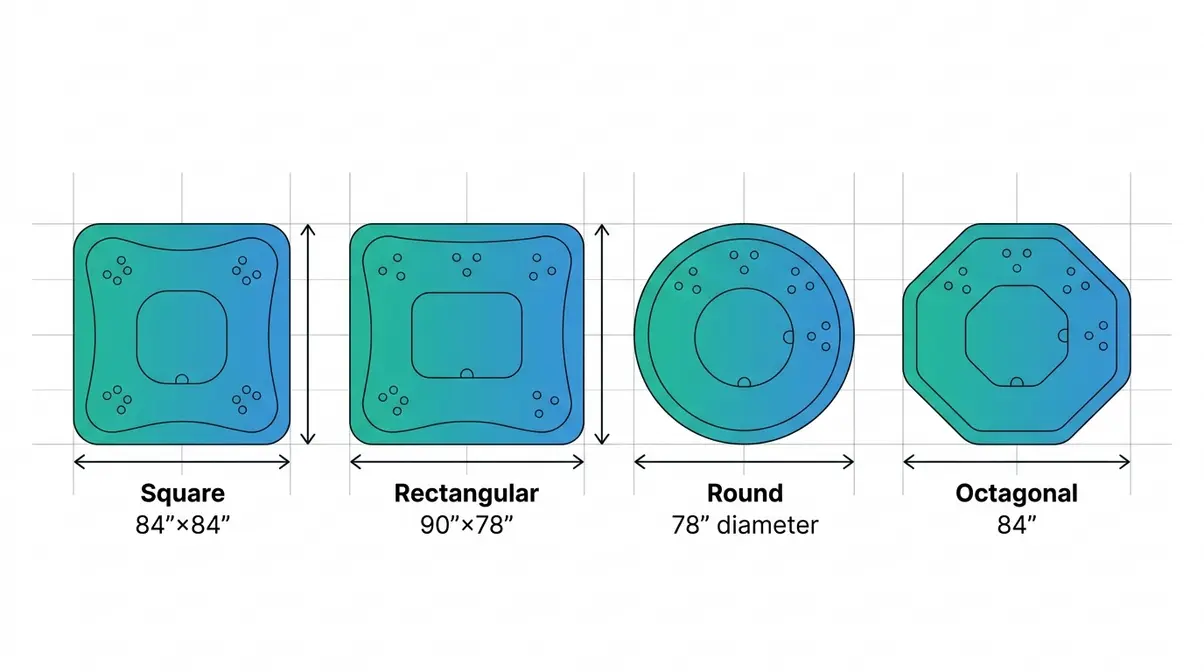
| Shape | Footprint Example | Capacity | Key Consideration |
|---|---|---|---|
| Square | 84″ × 84″ | 5–6 people | Most efficient for rectangular patios |
| Rectangular | 90″ × 78″ | 6–7 people | Better for side-by-side lounger seats |
| Round | 78″ diameter | 4–5 people | Requires full circular pad support |
| Octagonal | 84″ across | 5–6 people | Hybrid aesthetics; pad planning similar to round |
Standard round hot tub dimensions typically range from 60 inches in diameter (2-person) to 92 inches (6–7 person). If you are considering a round model, confirm the base support requirements with your installer before pouring the pad.
Dimensions for Specific Hot Tub Types
Not all hot tubs are above-ground acrylic shells. Inflatable, in-ground, and concrete models each come with their own dimension ranges and — more importantly — their own planning requirements. This section covers what changes when you move beyond the standard freestanding spa.
Inflatable Hot Tub Dimensions
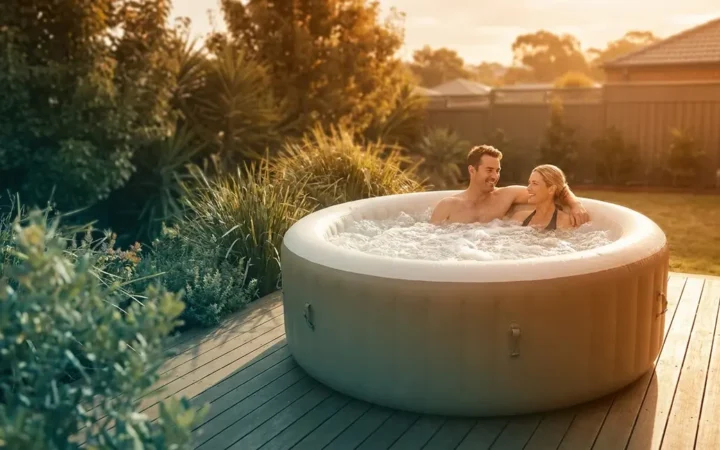
Inflatable hot tubs are portable, air-structure spas — typically made from PVC or reinforced vinyl — that can be inflated and set up without professional installation. They are the entry-level option for buyers who want the hot tub experience without the permanent commitment or structural demands. Reviewing standard inflatable hot tub dimensions helps determine if they fit your temporary or rented outdoor space.
Typical inflatable hot tub dimensions are smaller than their rigid counterparts:
| Capacity | Diameter / Length | Height (inflated) | Water Capacity | Approx. Weight (filled) |
|---|---|---|---|---|
| 2–4 person | 71″–77″ (round) | 26″–28″ | 150–180 gallons | 1,400–1,800 lbs |
| 4–6 person | 77″–85″ (round) | 28″–30″ | 180–250 gallons | 1,800–2,400 lbs |
| 6–8 person | 85″–92″ (round or square) | 28″–32″ | 230–300 gallons | 2,200–2,800 lbs |
Popular models from brands like Lay-Z-Spa and Intex typically fall in the 71″–85″ diameter range for their most common 4–6 person configurations. The Lay-Z-Spa Paris, for example, measures approximately 71 inches in diameter — compact enough for most balconies, provided the structural load is verified.
What changes with inflatables:
- Foundation requirements are lower — the filled weight of an inflatable is significantly less than a rigid shell tub of comparable size, but you still need a flat, stable surface free from sharp objects
- Depth is shallower — at 26″–30″ interior depth, most inflatable tubs sit notably shallower than rigid models (29″–38″), which affects the soaking experience for taller adults
- No Delivery Envelope concern — inflatables ship deflated in boxes, so gate width and delivery path are irrelevant; a standard doorway is sufficient
- No cover lifter clearance needed — inflatable covers are soft and fold away; no mechanical arm clearance required
The trade-off: Inflatable hot tubs are dramatically easier to install, but they heat more slowly, retain heat less efficiently, and typically lack the jet pressure of rigid models. For buyers in cold climates or planning year-round use, the running cost difference often justifies the step up to a rigid shell.
In-Ground Hot Tub Dimensions
In-ground hot tubs are permanent structures excavated into the ground and typically constructed from gunite (a sprayed concrete), fibreglass, or vinyl-lined shells. They are often integrated with swimming pools or designed as standalone architectural features. Planning in-ground hot tub dimensions and depth requires accounting for the excavation space, which is always larger than the finished interior.
In-ground hot tub dimensions follow slightly different conventions because the visible footprint and the excavation footprint are different measurements:
| Configuration | Interior Footprint | Excavation Required | Interior Depth | Wall Thickness |
|---|---|---|---|---|
| Small in-ground | 60″ × 60″ | 72″ × 72″ (min) | 36″–40″ | 6″–8″ each side |
| Standard in-ground | 72″ × 72″ to 84″ × 84″ | 84″ × 84″ to 96″ × 96″ | 36″–42″ | 6″–8″ each side |
| Large/pool-integrated | 84″ × 84″ to 96″ × 96″ | 100″+ × 100″+ | 40″–48″ | 8″–12″ each side |
Key planning differences for in-ground models:
The excavation footprint is always larger than the finished interior — typically by 12–18 inches on each side to accommodate wall construction and plumbing routing. If you are planning an in-ground hot tub in a tight space, the excavation zone, not the finished tub, is the measurement that determines whether it fits.
In-ground hot tubs are typically deeper than above-ground models — 36–48 inches of interior depth versus 29–38 inches — which affects the soaking posture and the structural design of the surround. Most in-ground installations also require a surrounding coping (a finished edge material) that adds 4–8 inches to the visible footprint on each side.
Base requirements: In-ground spas require a reinforced concrete shell or fibreglass insert set into a prepared, compacted base. The base preparation alone — excavation, gravel bed, concrete pour — typically adds 3–5 days to the installation timeline and requires building permits in most jurisdictions. Always check local planning requirements before breaking ground.
According to Master Spas’ installation guidance, proper base preparation is the single most important factor in the long-term structural integrity of any hot tub installation — above-ground or in-ground.
Outdoor and Concrete Hot Tub Dimensions
Outdoor concrete hot tubs (sometimes called “custom spas”) are bespoke installations where the shell is formed from sprayed concrete or block construction rather than a manufactured acrylic shell. They offer complete freedom of shape and size, but they come with unique planning requirements.
Because outdoor concrete tubs are custom-built, there are no “standard dimensions” in the same way as manufactured models. However, industry practice and common sense converge on a few benchmarks:
- Minimum practical interior size: 48″ × 48″ (4′ × 4′) — smaller than this and the experience becomes claustrophobic
- Common residential sizes: 72″ × 84″ to 84″ × 96″ for 4–6 person builds
- Interior depth: 36″–42″ is standard; some custom builds go to 48″ for a more immersive soak
- Wall thickness: 6″–8″ for a standard concrete shell, adding 12″–16″ to the exterior footprint versus the interior dimensions
What makes concrete outdoor tubs different to plan for:
First, the excavation and construction timeline is longer — typically 4–8 weeks from groundbreak to first fill. Second, the total footprint (including walls and coping) is noticeably larger than the interior dimensions suggest. Third, waterproofing and tiling add to both the build cost and the finished dimensions.
Heating and plumbing runs also affect space planning. Concrete tubs require an external equipment room or cabinet to house the pump, heater, and filtration system. This equipment zone — typically a 24″ × 36″ cabinet minimum — needs to be factored into the overall space plan.
Popular Brand Hot Tub Dimensions at a Glance
One of the most common searches from buyers in the planning stage is simply: “what are the dimensions of a hot tub?” This section provides a quick reference across the most popular brands in the market. Note: These represent typical ranges across each brand’s current lineup — specific model dimensions vary, and you should always verify against the manufacturer’s current spec sheet.
| Brand | Smallest Model | Mid-Range Model | Largest Model | Depth Range |
|---|---|---|---|---|
| Jacuzzi | 66″ × 66″ (2-person) | 84″ × 84″ (6-person) | 94″ × 94″ (8-person) | 30″–38″ |
| Caldera Spas | 64″ × 57″ (2-person) | 84″ × 84″ (6-person) | 92″ × 92″ (8-person) | 29″–38″ |
| Master Spas | 66″ × 66″ (2-person) | 84″ × 84″ (6-person) | 96″ × 96″ (8-person) | 32″–38″ |
| Hot Spring Spas | 60″ × 60″ (2-person) | 83″ × 83″ (5-person) | 92″ × 92″ (7-person) | 30″–38″ |
| Sundance Spas | 66″ × 66″ (2-person) | 84″ × 84″ (6-person) | 94″ × 94″ (7-person) | 30″–36″ |
| Lay-Z-Spa (inflatable) | 66″ diameter (2-person) | 77″ diameter (4-person) | 92″ diameter (6-person) | 26″–28″ |
| Intex (inflatable) | 71″ diameter (2-person) | 77″ diameter (4-person) | 85″ × 85″ (6-person) | 26″–28″ |
A note on Jacuzzi hot tub dimensions: Jacuzzi’s J-200 series starts at 66″ × 66″ and scales to 94″ × 94″ in the J-400 series. The brand’s best-selling configurations fall in the 84″ × 84″ to 88″ × 88″ range — the same 7-foot footprint bracket that dominates the wider market. For the most current Jacuzzi model specifications, the Jacuzzi sizing and space planning guide is the most reliable reference.
Brand dimensions as a planning tool: Use this table to shortlist models that fit your measured space before visiting a showroom. If your Delivery Envelope is 40 inches wide and your patio supports a maximum 90″ × 90″ footprint, you can immediately filter out any model with a width over 88″ (leaving room for the pad overhang) — regardless of brand.
Common Mistakes When Planning Hot Tub Dimensions
The most expensive hot tub problems are not mechanical failures — they are planning failures that happen before the tub is even ordered. Across buyer communities and installer forums, the same mistakes appear repeatedly. This section addresses the most common ones so you can avoid them.
Pitfalls to Avoid
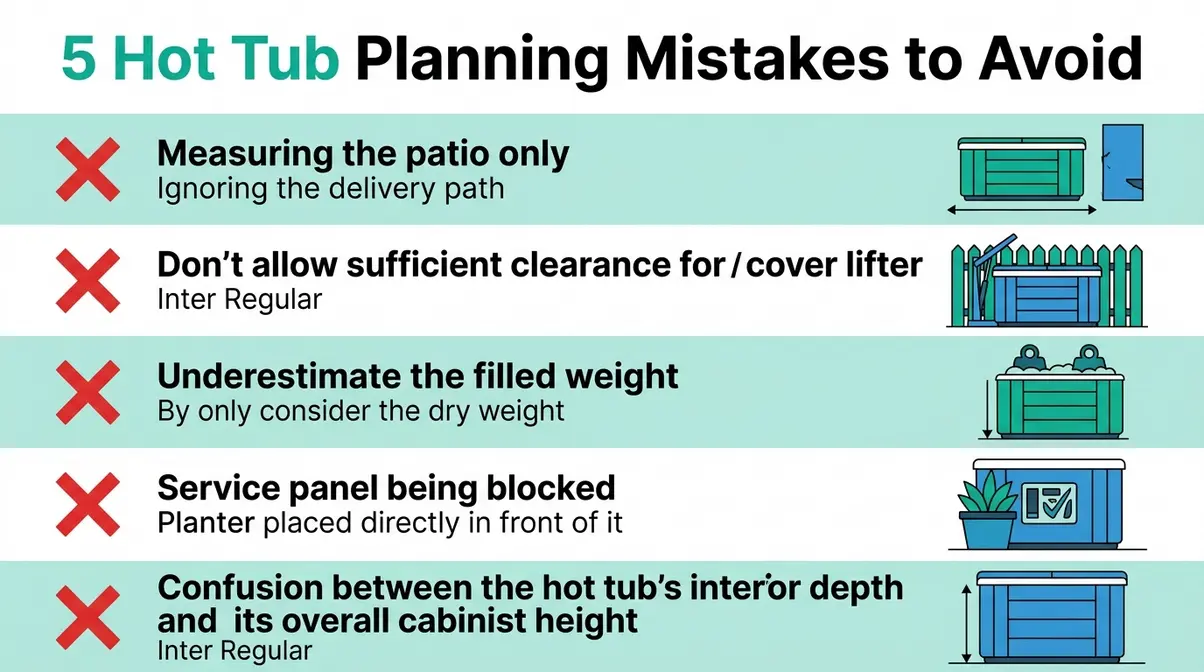
The most critical mistake buyers make is measuring their patio while completely ignoring the 40-inch minimum delivery path width — a failure that guarantees the tub will be sent back on the truck.
Mistake 1 — Measuring the patio, not the Delivery Envelope. The single most reported planning failure. Buyers confirm the tub fits their patio, place the order, and only discover on delivery day that the garden gate is 34 inches wide. The Delivery Envelope — that minimum 40-inch-wide corridor from the street to the installation site — must be measured first, not as an afterthought. The Delivery Envelope is the concept this guide was built around for exactly this reason.
Mistake 2 — Ignoring cover lifter clearance. Placing a hot tub flush against a wall or fence on the cover lifter side prevents the lid from ever being opened properly. The 18–24 inch clearance requirement is non-negotiable for mechanical lifters. Buyers who skip this step often find themselves manually lifting a heavy cover every time they use the tub — which defeats the purpose of the lifter entirely.
Mistake 3 — Underestimating filled weight. Dry weight figures in marketing materials are often the number buyers remember. The live load — dry weight + water weight + bather weight — is typically 4–5 times the dry weight for a standard 6-person tub. A deck that “looks solid” is not the same as a deck engineered to 100 lbs per square foot, which is why Fairfax County Government building codes and similar local regulations strictly mandate proper structural reinforcement.
Mistake 4 — Skipping the service panel check. Placing a planter, outdoor cabinet, or trellis in front of the service access panel is a mistake that reveals itself the first time a technician visits. The 24-inch clearance requirement for the service panel should be confirmed on the spec sheet before the tub’s final position is decided.
Mistake 5 — Confusing interior depth with cabinet height. A tub listed as “34 inches deep” means the interior water depth is 34 inches — not that the cabinet sits 34 inches off the ground. For most above-ground models the cabinet height and interior depth are similar, but this varies by model. Taller bathers in particular should confirm the interior seat depth, not just the overall height.
When to Choose a Different Type or Size
Sometimes the right answer is not “how do I make this tub fit?” but “should I choose a different type of tub entirely?”
Consider in-ground if: You are planning a full garden renovation with a professional contractor, have no access constraints (since the shell arrives as components), and want a permanent, architecturally integrated feature. The delivery and structural challenges of above-ground tubs disappear — replaced by excavation and construction timelines.
Seek professional advice if: Your patio is a raised deck over 24 inches off the ground, your garden has no side access at all, or your installation site is more than 30 metres from the nearest power source. These scenarios require structural engineers, electricians, or specialist installers — not just a tape measure.
Hot Tub Dimensions FAQ
What are standard hot tub dimensions?
Standard hot tub dimensions range from 60″ × 60″ (2-person) to 94″ × 94″ (8-person), with a depth of 29–38 inches for most above-ground models (according to Caldera Spas). The most common size is the 84″ × 84″ (7′ × 7′) 6-person configuration, which has become the default benchmark across the industry. Depth refers to the interior water depth, not the overall cabinet height — though for most above-ground models the two figures are similar. Always verify exact dimensions against your chosen model’s specification sheet, as measurements vary by brand and series.
What is the minimum space needed?
The minimum usable space for a hot tub is approximately 8′ × 8′ — enough to accommodate a compact 4-person model (78″ × 78″) with a 6-inch pad overhang on each side (based on standard installer recommendations). However, once you account for cover lifter clearance (18–24 inches on one side) and service panel access (24 inches on another), a more realistic minimum planning zone is 10′ × 10′. Smaller spaces may work with a 2-person soaking tub (60″–66″ square), but the Delivery Envelope — the path to the installation site — must also be at least 40 inches wide.
How deep is a typical hot tub?
A typical hot tub has an interior depth of 29–38 inches, with most standard above-ground models falling in the 32″–36″ range (Caldera Spas). Deeper models (36″–38″) provide a more fully submerged soak and are preferred by taller adults. Inflatable hot tubs are shallower, typically 26″–30″. In-ground and custom concrete builds can reach 40″–48″ of interior depth. Depth is measured as the water depth from the seat surface to the waterline — not the height of the outer cabinet.
How much does a filled hot tub weigh?
A filled 6-person hot tub typically weighs between 3,500 and 5,000 pounds, combining the dry shell weight (700–900 lbs), water weight (~3,300 lbs for 400 gallons), and the weight of bathers (Fairfax County Government building codes). This means your foundation must support at least 100 lbs per square foot — significantly more than a standard residential deck, which is typically rated at 40–50 lbs per square foot. Always calculate your specific tub’s live load using the formula in Step 4 of this guide, and consult a structural engineer if your deck was not purpose-built for a hot tub.
What is the Delivery Envelope?
The Delivery Envelope is the minimum clearance corridor required to physically move a hot tub from the delivery truck to its installation position — typically 40 inches wide and up to 84 inches tall when the tub is stood on its end (according to Master Spas delivery guidelines). It matters because delivery crews cannot proceed if any gate, path, or overhead structure falls below these minimums. When a hot tub is tilted vertically for transport through a narrow space, the critical height measurement is the tub’s width, not its standing height — so an 84-inch-wide tub needs 84 inches of overhead clearance. Measure every gate, pergola beam, and overhead obstacle along the delivery route before placing your order.
Final Thoughts on Hot Tub Dimensions
For most buyers, a 6-person hot tub measuring 84″ × 84″ (7′ × 7′) with a depth of 32″–38″ is the right starting point — it fits the majority of standard patios, suits most family households, and is the size that installers, retailers, and deck builders default to when giving general advice. At onehottub.com, after reviewing and recommending hot tubs to hundreds of buyers, the pattern is consistent: buyers who measure all four zones — installation area, clearance zones, The Delivery Envelope, and foundation load — have smooth installations. Buyers who skip even one zone face delays, extra costs, or compromises.
The Delivery Envelope is the concept that separates prepared buyers from surprised ones. It costs nothing to walk your delivery route with a tape measure before you order. It can save you hundreds in crane fees, gate replacement costs, or return delivery charges.
Your next step is straightforward: grab a tape measure, work through the four steps in this guide, and note your critical numbers — your maximum footprint, your Delivery Envelope width and height, and your foundation’s load capacity. Then use the dimensions-by-capacity tables to shortlist models that fit within those numbers. If your figures are borderline on any dimension, contact your chosen retailer before placing the order — most will confirm delivery feasibility at no charge.
Remember: All dimensions in this guide are general industry standards. Always verify with your specific manufacturer’s spec sheet before purchasing.

Dave King
Hot tub tester and writer at One Hot Tub.