What’s in this guide
- How We Selected the Best UK Hot Tubs
- Quick Comparison: Top 7 UK Hot Tubs
- 1. Best Overall: Lay-Z-Spa Helsinki AirJet
- 2. Best for Winters: Helsinki HydroJet
- 3. Best Budget: Intex PureSpa Bubble
- 4. Best for Groups: Coleman SaluSpa
- 5. Best Premium: SaluSpa Hollywood
- 6. Best Compact Option: Wave Spa Pacific 4 Person
- 7. Best for Hard Water Areas: Intex PureSpa Plus
- True Cost of Ownership for UK Buyers
- Choosing the Right Size for Your Garden
- Hot Tub Health & Safety for UK Buyers
- Honest Downsides of Inflatable Hot Tubs
- Frequently Asked Questions
- The Right Hot Tub for Your UK Garden
The best inflatable hot tub UK market offers isn’t necessarily the most expensive one — it’s the one that won’t cost you a fortune to run through a British winter. We’ve compared 7 models on purchase price, monthly energy costs, and real-world durability so you don’t have to.
Most guides list products without telling you what they’ll actually cost to run — or whether they’ll survive a November frost. That gap can turn a £400 purchase into a £600 regret. By the end of this guide, you’ll know exactly which inflatable hot tub suits your garden, budget, and how often you plan to use it — with the running costs calculated to the penny using the True Cost Formula. We cover our top 7 picks, a quick comparison table, the true cost of ownership, and an honest look at the downsides competitors rarely mention.
The best inflatable hot tub UK buyers can choose costs £250–£730 to buy and £40–£85/month to run — but the right choice depends on your winter use, garden size, and budget.
- Best Overall: Lay-Z-Spa Helsinki AirJet — Freeze Shield tech, Drop-Stitch build, year-round use
- Best Budget: Intex PureSpa Bubble Jet — solid value, easy setup, honest trade-offs
- Best for Winters: Lay-Z-Spa Helsinki HydroJet Pro — active freeze protection below 4°C
- True Cost Formula: Add monthly running costs × 36 months to the sticker price before deciding — a mid-range model costs approximately £2,400 over 3 years, not £500
TL;DR — Quick Pick
For year-round UK use, the Lay-Z-Spa Helsinki AirJet (~£425–£730) is the clear front-runner thanks to automatic Freeze Shield. On a tight budget, the Intex PureSpa Bubble Jet (~£250–£350) delivers honest summer value. Unless you use your hot tub 3+ times weekly through winter, the standard AirJet beats the pricier HydroJet Pro.
How We Selected the Best UK Hot Tubs
When searching for the best inflatable hot tub UK retailers offer, our team evaluated more than a dozen models available in 2026, narrowing the shortlist to 7 based on five criteria specific to British buyers: winter performance, true running cost, build quality, capacity accuracy, and UK availability. US-centric guides often miss critical factors — the Ofgem electricity rate, hard water in the South and East, and the reality that a UK autumn night drops to 4–8°C by October. This guide is built around those conditions.
Our Evaluation Criteria
Here are the five criteria we used, and why each one matters for UK buyers:
- Winter Performance: Does the model include Freeze Shield or equivalent auto-heating? Most inflatable hot tubs stop functioning reliably below 4°C — the average UK overnight low in October. A model without Freeze Shield becomes a seasonal toy rather than a year-round investment. Most inflatable hot tubs fail to specify their Freeze Shield activation threshold — the Lay-Z-Spa Helsinki activates automatically below 4°C, the average UK overnight low in October.
- True Running Cost: Monthly energy cost calculated using a standard 1kW–1.5kW pump at Ofgem’s April 2026 unit rate of 24.67p/kWh (Ofgem, 2026). This is the figure most competitors don’t publish — and the one that matters most over 3 years.
- Build Quality & Lifespan: Drop-Stitch construction (thousands of internal threads connecting the walls, creating a more rigid and durable shell) versus standard PVC. Average inflatable lifespan ranges from 2–5 years depending on construction quality and maintenance.
- Capacity Accuracy: Advertised figures versus comfortable real-world seating. A “6-person” tub typically comfortably seats 4 adults — the gap matters.
- UK Availability & Value: Only models sold by UK retailers (Amazon UK, Argos, Lay-Z-Spa direct, Costco UK, Wave Spas UK) with active UK warranty support were considered.
For our extended shortlist, see our comprehensive guide to the best inflatable hot tubs.
What We Looked For
UK buyers face a different set of questions than US shoppers — and a different set of practical challenges. Hard water in the South and East of England accelerates limescale build-up on heating elements and filter cartridges, shortening both component life and filter replacement intervals. British winters make Freeze Shield a practical necessity rather than a premium feature. UK electrical standards (230V, 13-amp socket) also mean that US wattage specifications don’t translate directly to our running cost calculations.
We excluded models available only from US retailers, models without UK warranty support, and any model discontinued before 2026. We also excluded models that couldn’t be independently verified across multiple UK buyer forums and retailer reviews.
The honest caveat: these are inflatable hot tubs — not hard shells. The trade-off is cost and convenience versus longevity. The True Cost Formula — purchase price + (monthly running cost × expected lifespan in months) — is the lens this guide uses to make that trade-off visible. Here’s a quick look at how all 7 models stack up before we go deeper on each.
Quick Comparison: Top 7 UK Hot Tubs
Before diving into each model, here’s how the full field compares across the criteria that matter most for UK buyers.
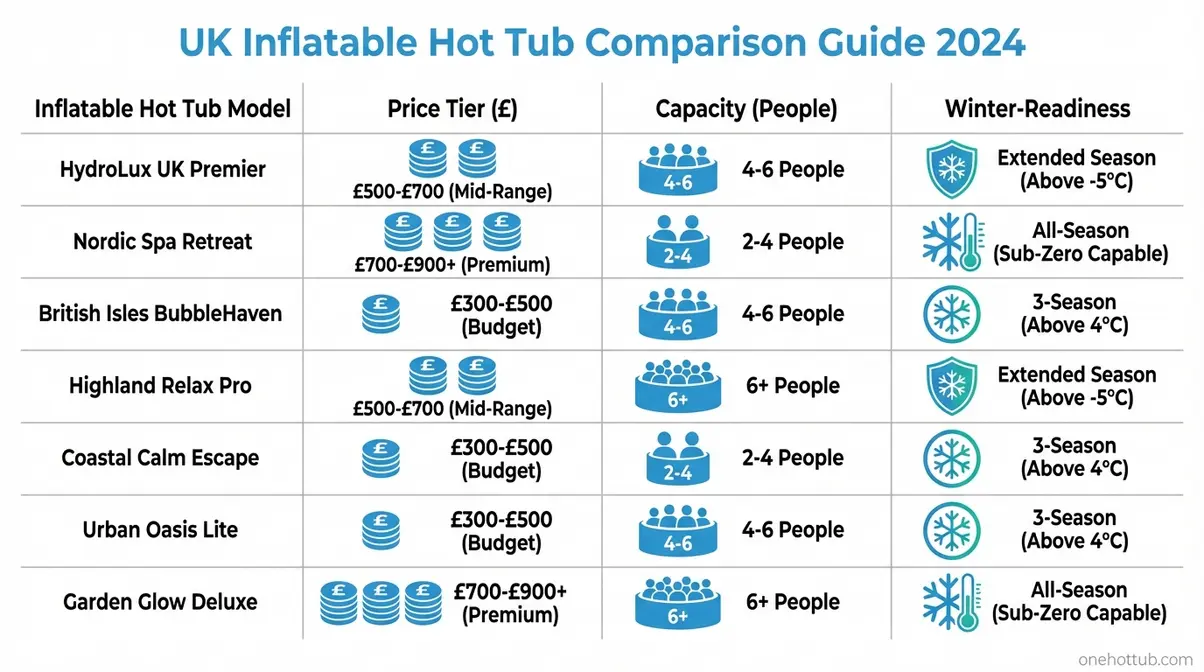
Caption: The 7 best inflatable hot tubs for UK gardens in 2026, compared on price, capacity, winter-readiness, and estimated monthly running costs.
| # | Model | Price (approx.) | Capacity | Winter-Ready? | Est. Monthly Cost | Best For |
|---|---|---|---|---|---|---|
| 1 | Lay-Z-Spa Helsinki AirJet | ~£425–£730 | 4–7 person | ✅ Freeze Shield | ~£45–£60 | Best Overall |
| 2 | Lay-Z-Spa Helsinki HydroJet Pro | ~£500–£650 | 4–6 person | ✅ Active Freeze | ~£55–£75 | UK Winters |
| 3 | Intex PureSpa Bubble Jet 4-Person | ~£250–£350 | 4 person | ❌ No | ~£40–£55 | Budget |
| 4 | Coleman SaluSpa AirJet 4–6 Person | ~£350–£500 | 4–6 person | ⚠️ Limited | ~£45–£65 | Large Groups |
| 5 | Bestway SaluSpa Hollywood EnergySense | ~£500–£700 | 4–6 person | ✅ Freeze Shield | ~£40–£60 | Premium |
| 6 | Wave Spa Pacific 4 Person | ~£300–£355 | 4 person | ❌ No | ~£40–£50 | Compact Gardens |
| 7 | Intex PureSpa Plus Hard Water | ~£350–£450 | 4 person | ❌ No | ~£40–£55 | Hard Water Areas |
FS = Freeze Shield. Est. monthly costs calculated at Ofgem April 2026 unit rate of 24.67p/kWh, assuming typical usage. Prices correct as of April 2026 — check retailer for current figures.
Quick Decision Matrix:
| User Type / Need | Best Choice | Why | Est. Price |
|---|---|---|---|
| Year-round UK use | Lay-Z-Spa Helsinki AirJet | Freeze Shield activates automatically below 4°C | ~£425–£730 |
| Tightest budget | Intex PureSpa Bubble Jet | Lowest entry cost; honest trade-offs | ~£250–£350 |
| Large family (5–6 adults) | Coleman SaluSpa AirJet 4–6 | Largest comfortable capacity | ~£350–£500 |
| Lowest running costs | Bestway SaluSpa Hollywood EnergySense | EnergySense insulation reduces heating time | ~£500–£700 |
| Hard water area (South/East UK) | Intex PureSpa Plus Hard Water | Enhanced filtration for limescale-prone water | ~£350–£450 |
Now let’s look at each pick in detail — starting with our overall recommendation.
1. Best Overall: Lay-Z-Spa Helsinki AirJet
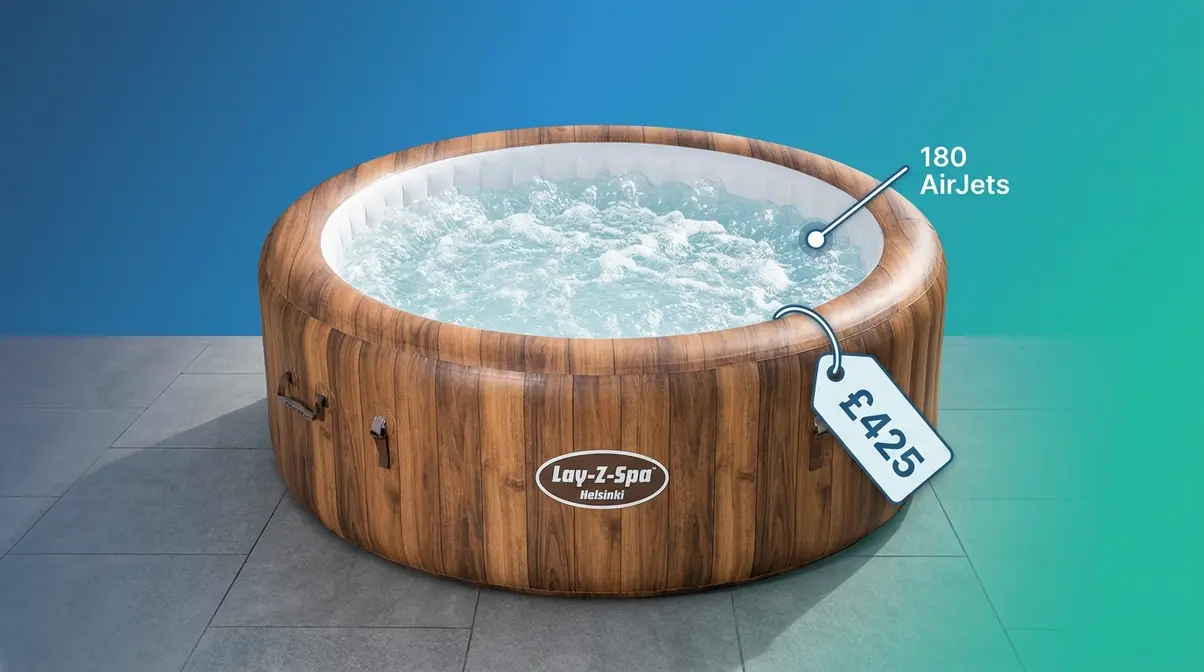
The Lay-Z-Spa Helsinki AirJet is the best inflatable hot tub for UK gardens in 2026, combining automatic Freeze Shield technology with a robust Drop-Stitch build that outperforms standard PVC at a comparable price point. Freeze Shield activates automatically when water temperature drops below 4°C — the average UK overnight low from October through February — meaning you don’t need to drain and store the tub between uses throughout autumn and winter. For most UK buyers, that single feature makes the Helsinki the obvious starting point.
Key Features & Specifications
The Lay-Z-Spa Helsinki AirJet is Bestway’s premium inflatable spa range designed for year-round UK use. Here are the core specs:
- Dimensions: 180cm × 71cm (approximately 71″ × 28″) — fits on a standard UK patio with a minimum 3m × 2.5m clearance recommended
- Capacity: 4–7 person advertised; 4 adults is comfortable, 6 is “pushing it,” and 7 is technically possible but means reduced elbow room
- Jets: 180 AirJets — AirJet is a system that uses air bubbles rather than pressurised water jets, producing a gentle, full-body bubble massage rather than targeted jet therapy
- Temperature range: 20–40°C; medical guidelines recommend keeping water at or below 40°C to prevent heat stress (medical advice on maximum hot tub temperature, Bronson Healthcare)
- Freeze Shield: Activates automatically below 4°C
- Construction: Drop-Stitch — thousands of internal threads connecting the top and bottom walls, making the walls far more rigid than standard PVC
- +Freeze Shield provides genuine year-round usability in UK conditions
- +Drop-Stitch construction is significantly more durable than standard PVC
- +Strong UK retailer support (Argos, Costco, Lay-Z-Spa direct, Wayfair)
- +Competitive price for the feature set; WiFi app control on Plus model
- −AirJets produce bubble massage, not hydrotherapy — don’t expect deep muscle pressure
- −Setup takes 20–30 minutes, not the 10-minute claim some listings suggest
- −Below approximately -5°C, the tub should be drained and stored — Freeze Shield has limits
- −Higher end of the price range (~£730 direct) can stretch some budgets
Real-World Usage
In a UK winter, overnight temperatures in October regularly drop to 4–8°C across most of England — exactly the range where standard inflatables fail and Freeze Shield earns its keep. The Helsinki’s auto-activation means you simply leave the tub filled and covered between sessions; the pump kicks in to maintain temperature without any manual intervention. User consensus across UK retailer reviews and forums consistently identifies the Helsinki as the “no-brainer” recommendation for first-time buyers who want year-round use. Hard water is a secondary but real consideration for buyers in the South and East. Drop-Stitch construction doesn’t affect water chemistry directly, but the mineral content in hard water areas accelerates limescale on heating elements. Buyers in those regions should plan to clean filter cartridges every two weeks rather than the standard monthly schedule. Using the included thermal cover whenever the tub is not in active use reduces heat loss substantially — this is the single most effective energy-saving measure available, cutting running costs by an estimated 15–20%.
Choose the Helsinki AirJet if: You want a reliable, year-round inflatable hot tub that won’t need draining every October, and your budget stretches to £425–£730.
Skip the Helsinki AirJet if: Budget is your primary constraint — the Intex PureSpa Bubble Jet delivers a solid summer experience for £200 less, and you can always top blow-up hot tub options.
Check the latest Helsinki AirJet price on Amazon UK or Lay-Z-Spa.co.uk.
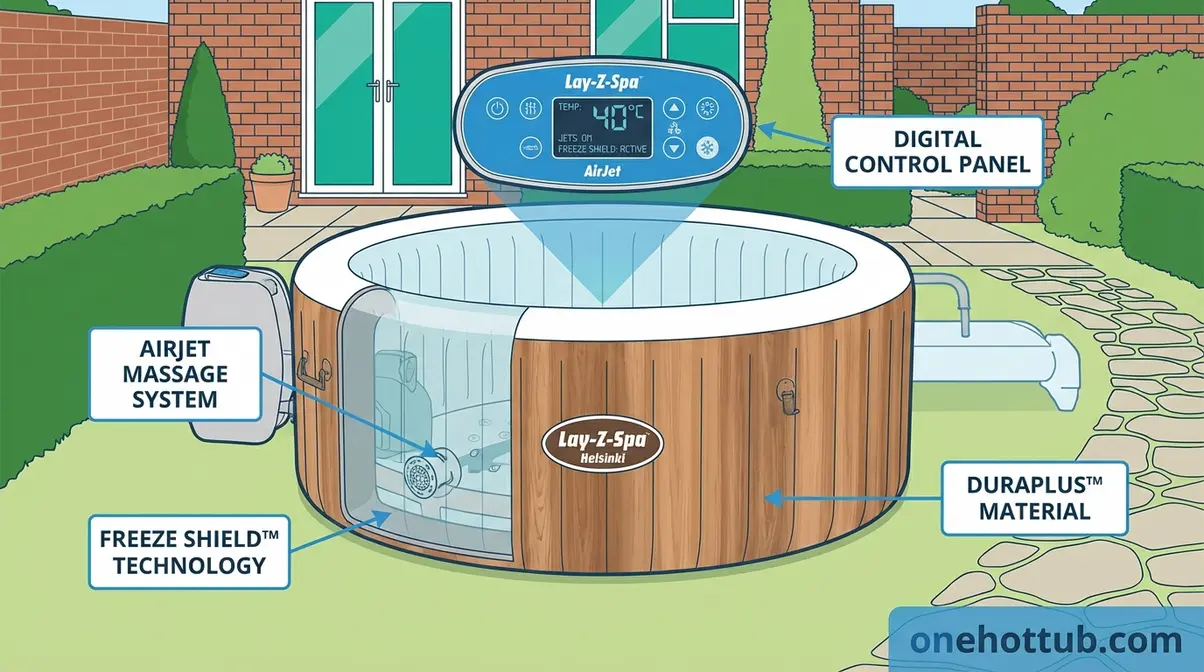
Caption: The Helsinki AirJet’s control panel gives straightforward access to temperature, jets, and Freeze Shield settings — all operable via the optional WiFi app.
If you want the Helsinki’s winter credentials with more powerful jets, the HydroJet Pro version is worth the upgrade — here’s why.
2. Best for Winters: Helsinki HydroJet
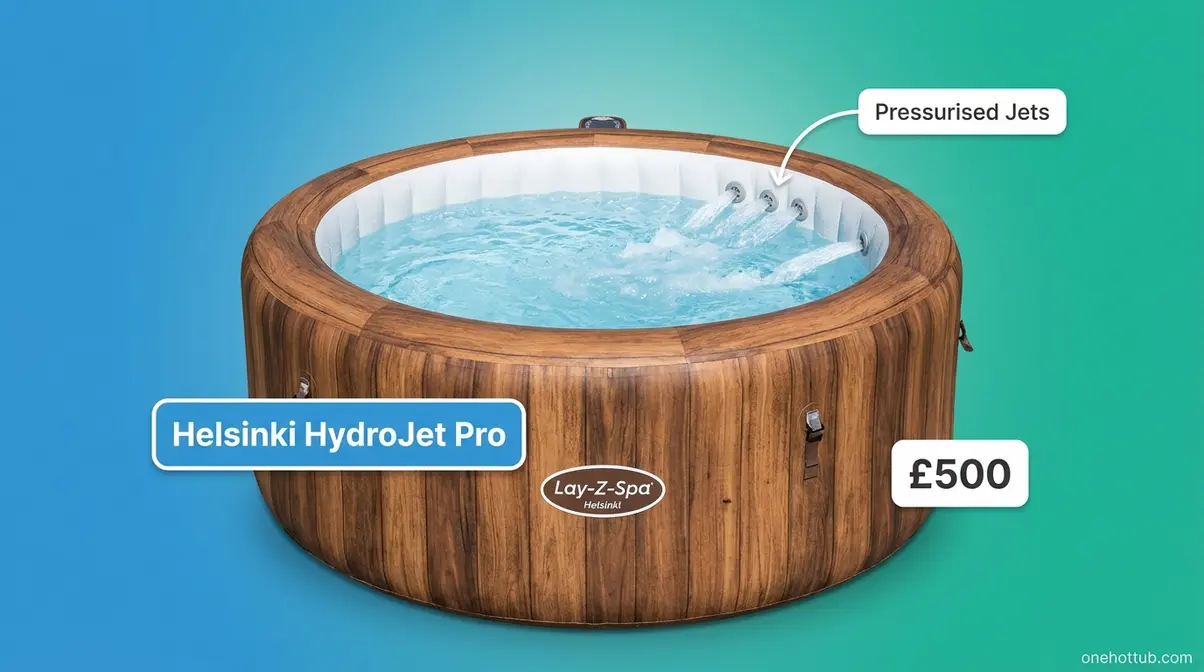
HydroJet systems pump water through pressurised nozzles rather than releasing air bubbles — delivering a targeted massage experience that AirJet models cannot replicate. The Lay-Z-Spa Helsinki HydroJet Pro is the pressurised-jet upgrade to the standard Helsinki AirJet model, combining the same Freeze Shield winter protection with a genuinely stronger massage system. It costs more to buy and slightly more to run — but for buyers who use their tub regularly and want therapeutic benefit, the difference is tangible.
Freeze Shield Technology Explained
Freeze Shield is not a marketing term — it’s an automatic temperature sensor built into the pump unit that monitors water temperature continuously, even in standby mode. When water drops below approximately 4°C, the heater activates automatically to prevent the water from approaching freezing point. This matters in the UK because British winters regularly deliver overnight lows of 2–6°C from November through February. Without Freeze Shield, every sub-5°C forecast would require you to drain, deflate, and store the tub — adding 30–45 minutes of setup each time you want a soak.
What Freeze Shield does not do is protect the tub in genuinely sub-zero conditions. Below approximately -5°C, the tub should be drained and stored indoors regardless of whether Freeze Shield is active. For the vast majority of UK winters — particularly in the South, Midlands, and much of the North — temperatures rarely sustain below -5°C for extended periods, making Freeze Shield sufficient for practical year-round use. In practice, this is what that means for running costs and usability through a British winter.
- +Pressurised HydroJets deliver genuine, targeted muscle massage
- +Automatic Freeze Shield protects the system during UK winters
- +Robust Drop-Stitch construction ensures long-term durability
- +Suitable for year-round use without constant draining
- −Higher purchase price compared to standard AirJet models
- −Increased running costs due to the more powerful jet pump
- −Pump unit is heavier and slightly louder during operation
Real-World Usage
For the best inflatable hot tub for winter UK use, the HydroJet Pro’s additional jet pump means it uses more energy than the standard AirJet. Based on Ofgem’s April 2026 unit rate of 24.67p/kWh, expect running costs of approximately £55–£75/month in winter (when Freeze Shield is active and ambient temperatures are low) versus £40–£55/month in summer. That’s a seasonal uplift of roughly 25–35%, consistent with data from WhatSpa?’s running cost analysis (WhatSpa?, 2026). Most UK users run their hot tub 3–4 times per week for 20–30 minutes per session — that’s the usage pattern these estimates are built on, not 24/7 operation. Using the thermal cover whenever the tub is not in use remains the single highest-impact cost-reduction measure. RoSPA safety guidance on hot tub hydration also notes that drinking plenty of water before and after sessions is especially important during longer winter soaks, when steam can cause dehydration without obvious thirst signals (RoSPA).
Stick with the standard AirJet if: You’ll use it occasionally or primarily in summer, or if the price difference matters — the AirJet Helsinki gives nearly identical winter protection at a lower cost. The HydroJet Pro is a meaningful upgrade only if jet strength is a priority.
Check the latest HydroJet Pro price on Lay-Z-Spa.co.uk.
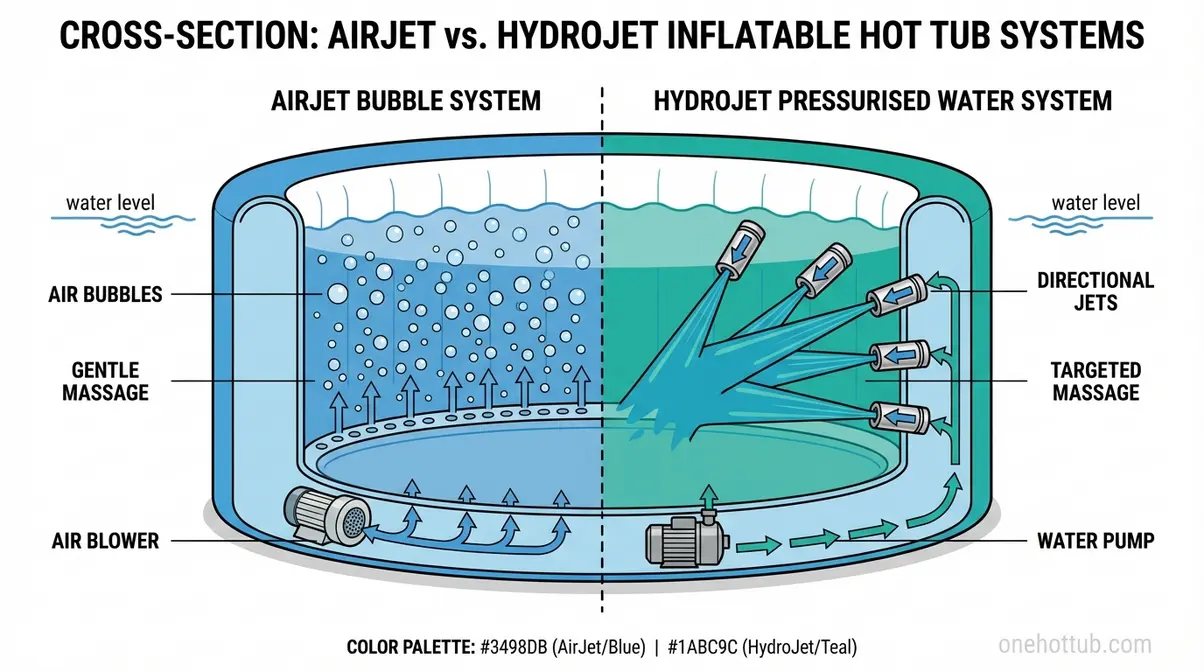
Caption: AirJets (left) release thousands of air bubbles for a gentle, all-over soak. HydroJets (right) pump pressurised water through directional nozzles for targeted muscle relief.
If budget is the primary concern, the Intex PureSpa Bubble Jet delivers solid value — here’s what you’re trading off.
3. Best Budget: Intex PureSpa Bubble
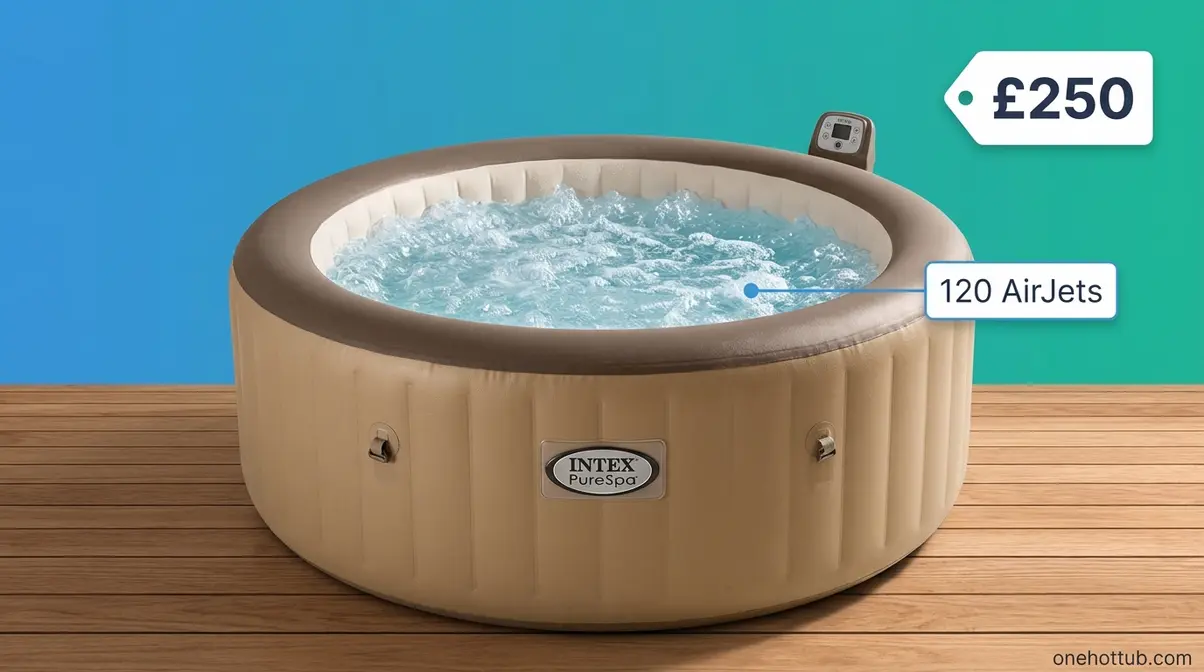
For buyers looking for the best inflatable hot tub deals UK has to offer without overcommitting, the Intex PureSpa Bubble Jet is Intex’s most accessible portable hot tub available across UK retailers. At £250–£350, it lets you dip your toes into hot tub ownership without a significant financial risk. The Intex PureSpa Bubble Jet costs under £350 to buy and under £55/month to run — making it the most accessible inflatable hot tub for UK buyers on a strict budget.
What You Get for the Price
Here’s what the PureSpa Bubble Jet delivers at its price point:
- Price: ~£250–£350 (Amazon UK, Argos — as of April 2026)
- Capacity: 4-person advertised; comfortably fits 2–3 adults, 4 at a squeeze
- Jets: 120 AirJets — fewer than the Helsinki but sufficient for a relaxing soak
- Construction: Standard PVC (not Drop-Stitch) — lighter and easier to move, but less rigid and more susceptible to punctures
- Setup time: Approximately 15–20 minutes — among the fastest of the models reviewed
- No Freeze Shield: Should be drained when temperatures drop below 10°C for extended periods
The PVC construction makes it lighter and easier to store when the season ends, which is a genuine advantage for renters or buyers with limited storage. That value does come with genuine trade-offs — here’s what you’re giving up at this price.
- +Highly accessible entry price for first-time hot tub owners
- +Fast 15-20 minute setup process
- +Lighter PVC construction makes it easy to move and store
- +Honest value for summer-primary use
- −Lacks Freeze Shield, requiring draining during cold snaps
- −Standard PVC is more puncture-prone than Drop-Stitch
- −120 AirJets provide a weaker bubble massage
- −Shorter overall lifespan of 2-3 years
Real-World Usage
Expect a lifespan of 2–3 years with careful use. Standard PVC degrades more quickly under UV exposure and is more puncture-prone than Drop-Stitch alternatives — the mirror image of the user experience that UK buyers consistently report:
“CleverSpa’s are cheap and work very well, but the build quality isn’t the greatest. Don’t expect years of use.” — UK buyer, verified retailer review
Without Freeze Shield, using the PureSpa through a UK winter requires draining after every session when overnight temperatures are forecast below 4°C. For occasional summer users, that’s no issue — but for anyone wanting year-round use, the friction adds up quickly. The 120 AirJets provide a pleasant bubble effect rather than a therapeutic massage, which is fine for relaxation but not for hydrotherapy. Buyers in hard water areas (South/East England) should also budget for additional filter cartridges — standard PureSpa filters can struggle with high mineral content, requiring changes every two weeks rather than monthly. As AARP warnings regarding hot tubs and heart conditions note, the heat from a hot tub can stress the cardiovascular system — a consideration for older UK buyers evaluating any model, budget or premium (AARP).
Check the latest PureSpa Bubble Jet price on Amazon UK.
Despite those trade-offs, for buyers who want to try inflatable hot tub ownership without overcommitting, the PureSpa Bubble Jet is a genuine no-brainer. For buyers who need to fit more people comfortably, the Coleman SaluSpa steps up on capacity.
4. Best for Groups: Coleman SaluSpa
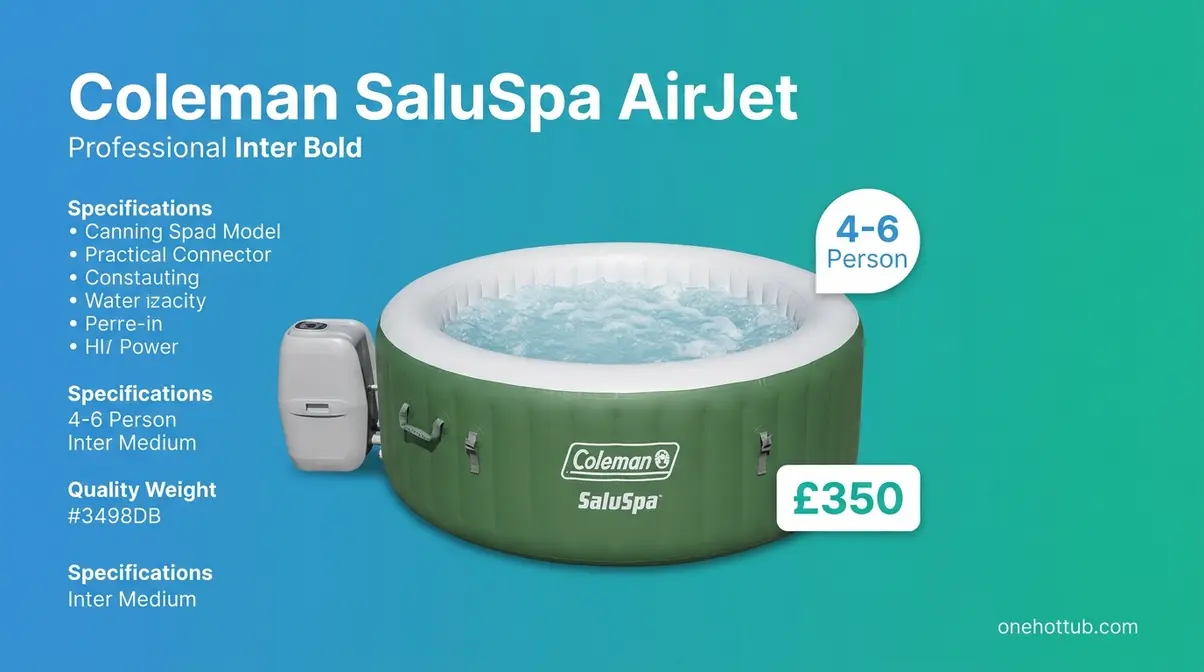
The Coleman SaluSpa AirJet 4–6 Person is SaluSpa’s mid-range family inflatable spa, distributed under the Bestway brand, and the best option for the best 6 person inflatable hot tub UK buyers can access. It offers a larger footprint than the Helsinki at a mid-range price — but the capacity reality check matters before you buy.
Capacity Reality Check
A “6-person” inflatable hot tub comfortably seats 4 adults — the sixth person is technically possible but means everyone sits with knees touching. The SaluSpa’s dimensions are approximately 180cm × 71cm (round models) or up to 196cm × 66cm on larger variants, requiring a minimum patio clearance of 3.5m × 3.5m. Water capacity sits around 800–900 litres. The jet system is AirJet — the same bubble-massage principle as the Helsinki, not pressurised water — with around 114–140 jets depending on the specific model variant.
Winter performance is limited. Some SaluSpa variants include a basic freeze protection mode, but it is not the same automatic, sensor-triggered Freeze Shield found in the Helsinki range. Buyers planning winter use should verify the specific model’s freeze protection spec before purchasing. Price sits at approximately £350–£500 from UK retailers as of April 2026.
For genuinely large groups, see our guide to finding the perfect 7-person hot tub.
Best For / Not For
Best for: Families of 4–5 people, buyers with larger patios (minimum 3.5m × 3.5m clearance), and buyers who regularly entertain and want a tub that doesn’t feel cramped with four adults.
Not for: Couples or small patios where the footprint is unnecessary; buyers who want reliable winter use without draining; buyers who prioritise jet massage strength over group capacity.
Check the latest SaluSpa AirJet price on Amazon UK.
For buyers who want the lowest possible running costs alongside premium features, the Bestway SaluSpa Hollywood EnergySense takes a different approach.
5. Best Premium: SaluSpa Hollywood
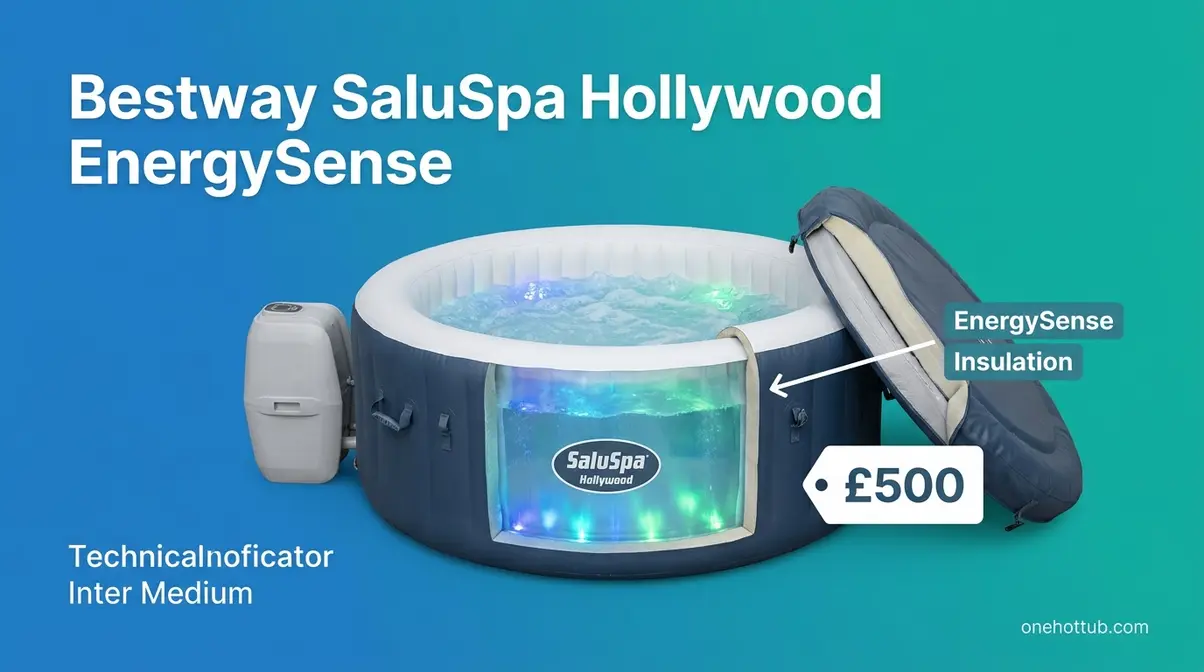
The SaluSpa Hollywood EnergySense uses an insulated liner to retain heat — reducing heating time and cutting monthly running costs compared to standard inflatable hot tubs. The Bestway SaluSpa Hollywood EnergySense is Bestway’s top-tier inflatable spa and the only model in this roundup where a higher purchase price can result in a lower total cost over 3 years — making it the smart choice for regular, long-term users.
Energy-Saving Features
EnergySense insulation is a layered lining that wraps the tub’s body and base, slowing heat loss between sessions. Where a standard inflatable might lose several degrees overnight and require 30–45 minutes of reheating, the EnergySense model retains heat far more effectively — reducing both the time and the electricity needed to get back to temperature. Based on current Ofgem rates, that translates to estimated running costs of £40–£60/month versus £50–£75 for non-insulated models at equivalent usage.
Freeze Shield is included, making the Hollywood EnergySense suitable for year-round UK use. Jets are AirJet — buyers wanting HydroJet pressure should refer back to the Helsinki HydroJet Pro covered above. Price sits at approximately £500–£700 from UK retailers (as of April 2026).
Applying the True Cost Formula: ~£600 purchase + (£50/month average × 36 months) = approximately £2,400 over 3 years — broadly equivalent to the Helsinki AirJet’s total cost, but with a more comfortable running cost per month. For buyers who use their tub daily, the EnergySense’s insulation pays for itself within the first year of ownership.
For a full breakdown of the SaluSpa range, see our deep dive into Bestway and SaluSpa models.
AirJet vs HydroJet Differences
To consolidate the distinction introduced earlier: AirJet systems push air through small holes in the tub floor and walls, producing thousands of gentle bubbles — quieter, lower energy, and suitable for relaxation. HydroJet systems pump water at pressure through directional nozzles, producing a focused, stronger massage experience — louder, higher energy, and genuinely therapeutic for muscle tension. The Hollywood EnergySense uses AirJets. If targeted jet pressure is your priority, the Helsinki HydroJet Pro is the model to choose.
For buyers with smaller gardens or tighter spaces, the Wave Spa Pacific offers a compact footprint without sacrificing the core experience.
6. Best Compact Option: Wave Spa Pacific 4 Person
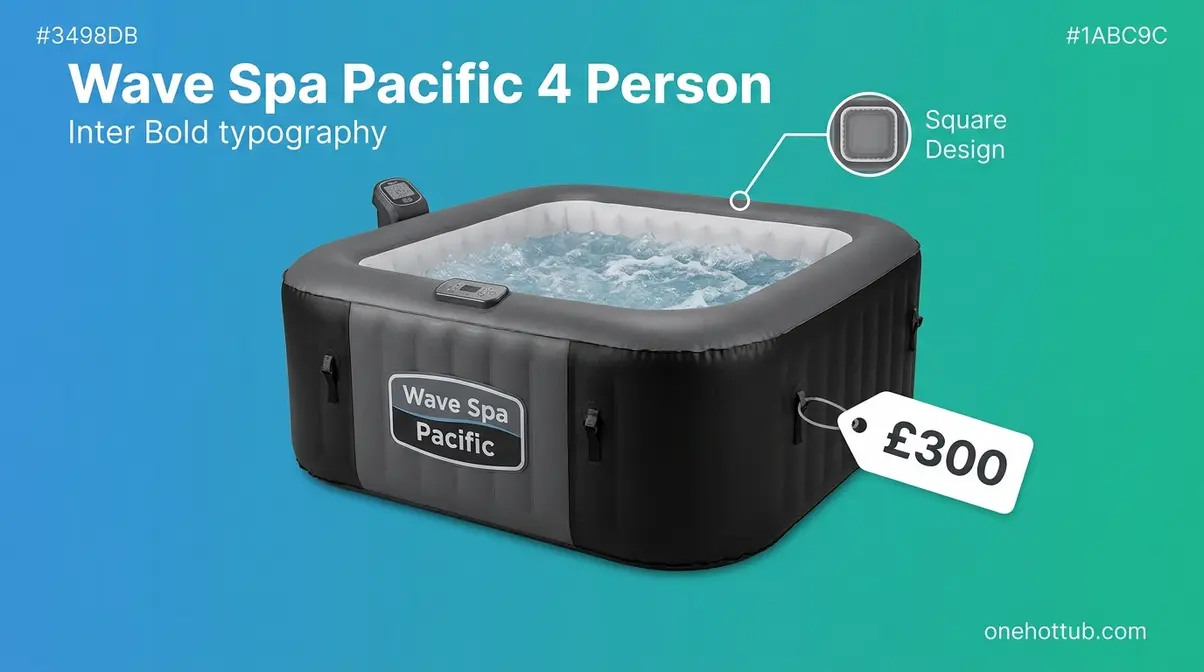
The Wave Spa Pacific 4 Person is Wave Spas’ entry into the compact UK market and the best square inflatable hot tub option for buyers with limited garden space. Its square footprint (155cm × 155cm external, 115cm × 115cm internal) uses patio space more efficiently than round models — fitting comfortably in smaller gardens where a circular tub would leave awkward dead corners.
Key specs: ~155cm × 155cm, 110 AirJets, integrated rapid heater, 600-litre capacity. Price from approximately £300–£355 (PriceRunner UK, 2026). No Freeze Shield — this is a summer-primary model, best drained before sustained cold weather. Wave Spas is a UK-founded brand with dedicated UK warranty support.
Best for: Couples, studio flat gardens, small patios, and buyers who want the square design to maximise usable patio space alongside the tub.
Not for: 4+ adults wanting genuine comfort; buyers planning winter use; anyone who needs Freeze Shield.
Check the latest Wave Spa Pacific price on Wave Spas UK or Amazon UK. For more compact options, see our guide to choosing a 4-person hot tub.
Finally, if you live in a hard water area — particularly in the South or East of England — the Intex PureSpa Plus addresses a problem most inflatable tubs ignore.
7. Best for Hard Water Areas: Intex PureSpa Plus
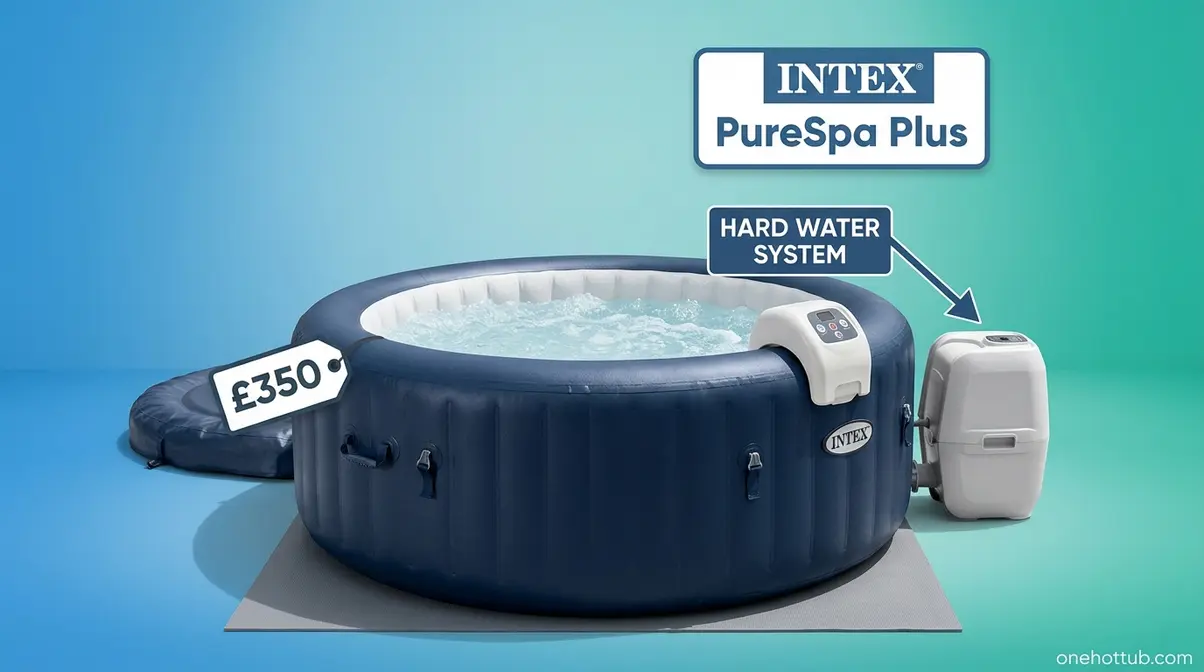
Hard water affects roughly 60% of UK homes — and inflatable hot tubs in these areas require filter changes every 2 weeks rather than the standard monthly schedule (Mr Central Heating, 2026). In hard water regions, the mineral content (primarily calcium and magnesium) builds up on heating elements and filter cartridges, reducing efficiency and shortening component lifespan. London, Kent, Essex, and most of the South East register as “hard” to “very hard” on the UK water hardness map.
The Intex PureSpa Plus Hard Water edition addresses this with enhanced filtration designed for high-mineral water. It’s the same AirJet 4-person format as the standard PureSpa — approximately £350–£450 from UK retailers (as of April 2026) — but with a filtration system better suited to the limescale challenge that standard cartridges struggle with in the South and East.
Best for: Buyers in South/East England and London, where hard water is the norm rather than the exception; buyers who want lower maintenance friction and a longer filter lifespan.
Not for: Winter use (no Freeze Shield); buyers in soft water areas where the enhanced filtration is unnecessary overhead; buyers wanting more than 4-person comfortable capacity.
Now that you’ve seen all 7 models, let’s look at the number most buyers forget to calculate before they buy.
True Cost of Ownership for UK Buyers
An inflatable hot tub costs between £40 and £85 per month to run in the UK, depending on the model, usage frequency, and current Ofgem electricity rate (WhatSpa?, 2026). Most buyers calculate only the purchase price — but over 3 years, running costs typically exceed the original purchase price by 2–4×. The True Cost Formula makes this comparison straightforward: Purchase Price + (Monthly Running Cost × Expected Lifespan in Months) = Real Cost of Ownership.
Monthly Running Costs (Ofgem-Adjusted)
Here’s how to calculate your own monthly cost: kWh used per month × Ofgem unit rate = monthly electricity cost. A kWh (kilowatt-hour) is simply the amount of energy a 1,000-watt device uses in one hour. At Ofgem’s April 2026 unit rate of 24.67p/kWh, a standard 1–1.5kW inflatable hot tub pump running approximately 8 hours per day (heating maintenance plus 3–4 sessions per week) uses roughly 180–220 kWh per month. That’s the basis for the estimates below.
| Model | Avg Monthly Cost | Annual Cost | 3-Year Total |
|---|---|---|---|
| Intex PureSpa Bubble Jet (budget) | ~£45 | ~£540 | ~£1,620 |
| Lay-Z-Spa Helsinki AirJet (mid-range) | ~£52 | ~£624 | ~£1,872 |
| Helsinki HydroJet Pro (winter use) | ~£65 | ~£780 | ~£2,340 |
| SaluSpa Hollywood EnergySense (premium) | ~£50 | ~£600 | ~£1,800 |
Based on Ofgem April 2026 unit rate of 24.67p/kWh and typical usage of 3–4 sessions per week. Winter running costs run approximately 20–35% higher than summer due to increased heat loss and Freeze Shield operation (WhatSpa?, 2026).
One practical tip that consistently reduces costs: keeping the thermal cover on whenever the tub is not in active use cuts heat loss and reduces the energy needed to reheat water — an estimated saving of 15–20% on monthly bills. So how does this compare to a permanent hard shell hot tub?
Inflatable vs Hard Shell: ROI Breakdown
The True Cost Formula applied to the inflatable versus hard shell decision looks like this:
| Inflatable Hot Tub | Hard Shell Hot Tub | |
|---|---|---|
| Purchase Price | £250–£730 | £3,000–£8,000 |
| Installation | £0 (DIY) | £500–£2,000 |
| Monthly Running Cost | £40–£85 | £40–£80 |
| Expected Lifespan | 2–5 years | 15–20 years |
| 3-Year Total Cost | ~£1,900–£3,790 | ~£4,940–£12,880 |
Hard shell costs based on current UK retailer listings and installation estimates, April 2026.
Using the True Cost Formula, a mid-range inflatable hot tub costs approximately £2,400 over 3 years — compared to £4,000–£10,000 for an equivalent hard shell, including installation. The break-even point — where the hard shell’s longer lifespan offsets its higher upfront cost — sits at roughly 7–10 years of regular use. For buyers who are unsure whether they’ll use a hot tub regularly, the inflatable is the right way to dip your toes in before committing to a permanent installation.
Caption: The True Cost Formula reveals that a mid-range inflatable hot tub costs roughly £2,400 over 3 years — less than half the hard shell equivalent once installation is factored in.
Choosing the Right Size for Your Garden
Selecting the right size is less about preference and more about physical reality — both in terms of garden space and the number of adults who’ll genuinely use it at once.
Quick Size Guide
- 2–4 person: Suits couples and small patios; minimum 2.5m × 2.5m garden space; compact models like the Wave Spa Pacific fit here
- 4–6 person: The most common UK size; minimum 3m × 3m; comfortably fits 4 adults — the “6-person” label is optimistic
- 6–7 person: Requires a larger garden (minimum 4m × 4m); suitable for genuine group use; harder to find in the inflatable category
- Square vs round: Square tubs (like the Wave Spa Pacific) use garden space more efficiently; round tubs are typically cheaper, more widely available, and easier to position centrally on a patio
For specific 4-person recommendations, see our guide to choosing a 4-person hot tub.
Space Requirements at a Glance
Always leave at least 1 metre of clearance around the tub on all sides — this provides safe access for entry and exit, space for the pump unit, and room for maintenance tasks like filter changes and water testing. The surface underneath must be level and stable: patio slabs and solid decking (check the weight rating — a full tub can weigh 700–1,000kg) work well; soft grass alone does not provide sufficient stability and can cause uneven wall pressure over time.
For larger groups, see our guide to finding the perfect 7-person hot tub.
Before you buy any inflatable hot tub, there are safety guidelines every UK buyer should know — particularly if you have a pre-existing health condition.
Hot Tub Health & Safety for UK Buyers
Every health question in this section represents a PAA box that competitor guides leave empty — and the answers matter. The Centers for Disease Control and Prevention (CDC), the US public health authority, and the Royal Society for the Prevention of Accidents (RoSPA), the UK’s leading safety charity, both provide clear guidance on hot tub use that applies directly to the models in this roundup.
The 15-Minute Rule Explained
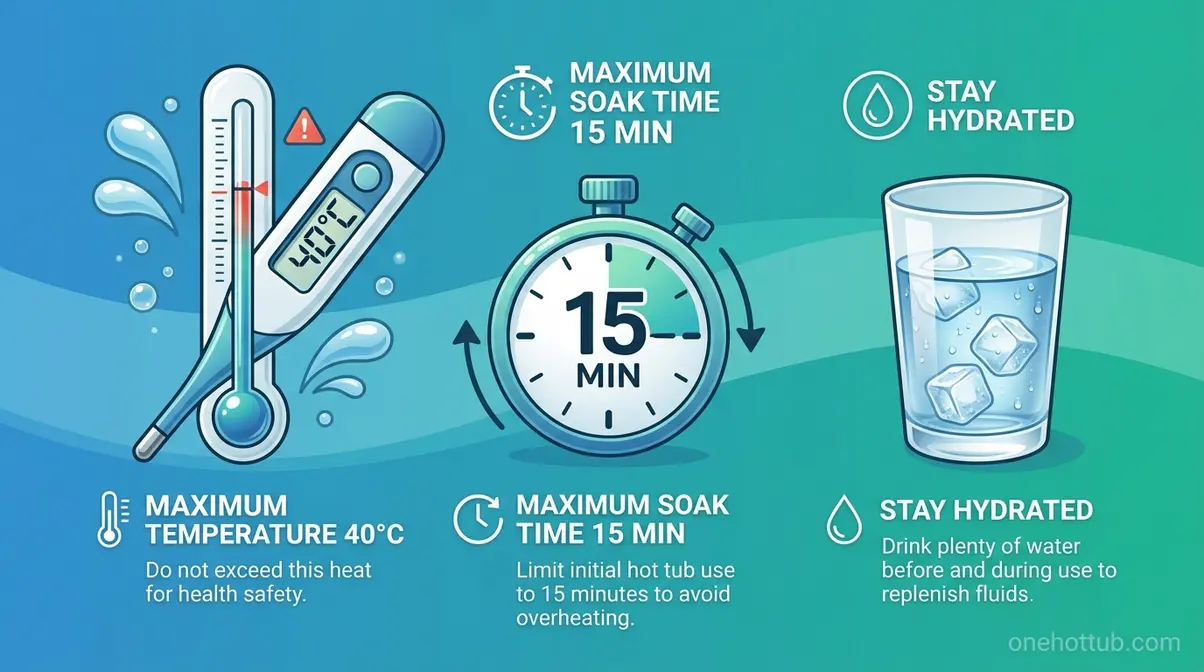
Limit hot tub sessions to 15–20 minutes at a time, especially at temperatures above 38°C. Prolonged exposure to hot water raises your core body temperature — a condition called hyperthermia (dangerous overheating) — which can cause dehydration, dizziness, and cardiovascular strain. The risk increases with both temperature and session length, which is why the 15-minute guideline exists as a practical safety threshold rather than an arbitrary rule.
medical advice limiting hot tub sessions recommends keeping water temperature at or below 40°C (104°F) and taking breaks of at least 10–15 minutes between sessions. Drink water before and after each soak — steam and elevated body temperature cause dehydration even when you don’t feel thirsty. Older adults, people with cardiovascular conditions, and pregnant women face higher risk and should take shorter sessions at lower temperatures.
For a full breakdown of safe session lengths by age group, see our guide to safe hot tub soaking times and guidelines.
Water Quality, Hygiene & Bacterial Risks
The CDC identifies three main bacteria in poorly maintained hot tubs: Cryptosporidium, Pseudomonas, and Legionella — all preventable with correct chlorine levels and regular filter changes.
- Cryptosporidium: Causes gastrointestinal illness; resistant to standard chlorine at low concentrations
- Pseudomonas aeruginosa: Causes “hot tub rash” (folliculitis) — a skin rash that appears 12–48 hours after exposure
- Legionella: The bacteria behind Legionnaires’ disease, a serious respiratory illness; thrives in warm, stagnant water
CDC guidelines on hot tub health risks confirm these three as the primary germs spread through poorly maintained hot tub water (CDC). Harvard Health report on common hot tub bacteria corroborates Cryptosporidium, Pseudomonas, and Legionella as the main culprits in hot tub infections (Harvard Medical School).
Prevention is straightforward: maintain chlorine or bromine at recommended levels, keep pH between 7.2–7.8, change filter cartridges on schedule (every 2 weeks in hard water areas), and shower before use. UK buyers in hard water areas should test water chemistry more frequently, as mineral content can affect pH balance.
Who Should Avoid Hot Tubs (or Consult a GP First)
If you have a heart condition, high blood pressure, are pregnant, or have a condition affecting circulation or nerve sensitivity, consult your GP before using a hot tub.
Specific at-risk groups include:
- Heart disease: Heat stresses the cardiovascular system by increasing heart rate and dilating blood vessels — a real concern for anyone with existing cardiac conditions
- Pregnancy: Elevated core temperature in early pregnancy carries documented risks; most guidance recommends avoiding hot tubs during the first trimester entirely
- Children under 5: Young children cannot regulate body temperature effectively and should not use hot tubs; RLSS UK advice on lockable hot tub covers recommends fitting a solid, lockable cover immediately after every use to prevent unsupervised access (RLSS UK)
- Peripheral neuropathy: Reduced ability to detect dangerous heat levels means users may not notice overheating. NIH-published research on heat therapy for neuropathy indicates that patients with peripheral neuropathy report heat therapy as effective for pain reduction — but individual medical advice is essential before use (NIH, 2026)
For the full picture on therapeutic benefits, see our guide to the health benefits of using a hot tub.
With safety covered, let’s be honest about the practical downsides that no amount of positive marketing should gloss over.
Honest Downsides of Inflatable Hot Tubs
The main downsides of inflatable hot tubs include a shorter lifespan of 2–5 years, higher winter running costs, and the absence of moulded seating found in hard shell models. They use AirJet bubble systems rather than powerful pressurised hydrotherapy jets, and their PVC or Drop-Stitch construction requires more careful maintenance than a hard shell. Inflatable hot tubs typically last 2–5 years — significantly shorter than hard shell alternatives — making them best suited to buyers who want to test ownership before committing to a permanent installation.
Downsides of Inflatable Hot Tubs
The main downsides of inflatable hot tubs are a shorter lifespan of 2–5 years, limited jet power compared to hard shells, and higher winter running costs when Freeze Shield heating is active. Standard PVC models are more puncture-prone than Drop-Stitch alternatives, and none offer the moulded ergonomic seating of a permanent hot tub. Without Freeze Shield, most models require draining when UK overnight temperatures drop below 4°C — adding friction for year-round users.
Average Inflatable Hot Tub Lifespan
The average lifespan of an inflatable hot tub is 2–5 years (Jacuzzi, 2026), depending on construction quality and maintenance. Budget models using standard PVC typically last 2–3 years with careful use. Premium Drop-Stitch models like the Lay-Z-Spa Helsinki can reach 4–5 years when maintained correctly — with regular water chemistry balancing, UV-protected storage, and prompt puncture repair. Hard shell alternatives last 15–20 years, which is why the True Cost Formula matters when comparing the two categories.
Common Pitfalls to Avoid
These are the four most common mistakes UK buyers make — and how to avoid each one:
- Plugging into an extension lead on wet ground. Extension leads outdoors in damp conditions create a genuine electrical hazard and will trip your RCD breaker at best. Use the supplied cable directly into a weatherproof outdoor socket; if you don’t have one, have a qualified electrician install one before the tub arrives.
- Over-inflating the walls. Pumping past the recommended pressure puts stress on the seams — the most common cause of premature failure. Use the included pump, stop when the walls are firm but not drum-tight, and never use a third-party high-pressure pump.
- Storing in direct sunlight. UV radiation degrades PVC faster than almost anything else — causing brittleness, cracking, and punctures within a single season. Store deflated, indoors or under a purpose-made UV-resistant cover.
- Skipping water chemistry. Neglecting chlorine treatment doesn’t just risk bacteria — it causes algae growth, a slimy base liner, and filter blockages that can damage the pump. Test and balance the water every 2–3 days during active use.
When to Choose a Hard Shell Instead
Choose a hard shell if: You plan to use a hot tub daily for 5 or more years, want powerful pressurised hydrotherapy jets, and are comfortable with a £3,000+ investment plus professional installation. At that usage level and time horizon, the hard shell’s 15–20 year lifespan makes the True Cost Formula work in its favour.
The inflatable is the right choice if: You want to try hot tub ownership before committing; you rent your home; you need portability; or your budget is under £700 and year-round use isn’t essential. See our comprehensive guide to the best inflatable hot tubs for the full shortlist.
Still have questions? Here are the most common ones UK buyers ask — with direct answers.
Frequently Asked Questions
Most Reliable Inflatable Hot Tubs
The Lay-Z-Spa Helsinki AirJet is the most reliable inflatable hot tub available to UK buyers in 2026. It features automatic Freeze Shield technology that prevents water from freezing during British winters, alongside a robust Drop-Stitch construction significantly more durable than standard PVC. Expert reviews from UK publications including WhatSpa? and Expert Reviews consistently rank the Helsinki as their top inflatable pick. Results do vary based on usage frequency and maintenance — proper chemical treatment and correct winter storage extend lifespan considerably.
Are Inflatable Hot Tubs Worth It?
Yes — inflatable hot tubs are worth it in the UK for buyers who want hot tub ownership without a £3,000+ hard shell investment. They cost £250–£730 to purchase, take under 30 minutes to set up, and modern models with Freeze Shield technology work year-round in British weather. Running costs range from £40–£85 per month depending on the model and usage frequency (WhatSpa?, 2026). They are best suited to buyers who want to experience hot tub ownership before committing to a permanent installation.
Why is there a 15-minute hot tub rule?
The 15-minute hot tub rule exists to prevent hyperthermia — dangerous overheating of your core body temperature. Soaking in water at 38–40°C raises your body temperature steadily; after 15–20 minutes, most adults begin to experience cardiovascular strain, dizziness, and dehydration risk. Medical guidance recommends limiting sessions to 15–20 minutes, taking a 10–15 minute break before re-entering, and keeping water temperature at or below 40°C. The risk is higher for older adults, pregnant women, and people with heart conditions.
The Right Hot Tub for Your UK Garden
For UK buyers who want genuine year-round use without a hard shell price tag, the Lay-Z-Spa Helsinki AirJet remains the clearest choice in 2026. Running costs for inflatable hot tubs average £40–£85 per month at the current Ofgem rate of 24.67p/kWh — and applying the True Cost Formula, a mid-range inflatable costs approximately £2,400 over 3 years versus £4,000–£10,000 for a hard shell equivalent. That gap is why inflatables continue to dominate the UK garden leisure market.
The True Cost Formula is the lens that separates a smart purchase from a regrettable one. A £250 tub with no Freeze Shield and a 2-year lifespan is not always the cheapest option when you factor in three winters of draining and setup friction. Conversely, a £700 EnergySense model may pay back its premium through lower monthly energy costs within the first year of regular use. Knowing your usage pattern — occasional summer soaks versus three-times-weekly year-round sessions — is the single most important variable in that calculation.
Finding the best inflatable hot tub UK market offers means balancing your budget with your desire for winter use. Start by deciding whether Freeze Shield is non-negotiable for you. If it is, the Helsinki AirJet is your baseline. If budget is the constraint, the Intex PureSpa Bubble Jet delivers honest summer value for under £350. Check the latest prices on Amazon UK, Argos, and Lay-Z-Spa.co.uk — and run the True Cost Formula with your own usage estimate before committing.
| Pick | Best For | Key Strength | Price Range |
|---|---|---|---|
| Lay-Z-Spa Helsinki AirJet | Year-round UK use | Freeze Shield + Drop-Stitch | ~£425–£730 |
| Intex PureSpa Bubble Jet | Budget / summer-primary | Lowest entry cost | ~£250–£350 |
| Helsinki HydroJet Pro | Winter + hydrotherapy | Pressurised jets + Freeze Shield | ~£500–£650 |
| SaluSpa Hollywood EnergySense | Lowest running costs | EnergySense insulation | ~£500–£700 |

David King
Hot tub tester and writer at One Hot Tub.