What’s in this guide
- 1. Destination Outdoor Aqualife 5-Person Lounger Spa: Best Premium Pick
- 2. INTEX PureSpa Plus 4-Person Bubble Massage Spa: Best All-Rounder
- 3. Coleman Hawaii Square Inflatable Spa (140 Jets): Best Inflatable Value
- 4. Bestway SaluSpa Hawaii Square Inflatable Spa: Best Budget Brand
- 5. Coleman SaluSpa Round Inflatable Spa (140 Jets): Best Round Shape
- 6. Coleman Hawaii Square Inflatable Spa (Alt. Variant): Best Color/Pack Choice
- 7. 4–6 Person Square Inflatable Spa with 130 Jets: Best No-Frills Square
- 8. 73" Square Blow-Up Hot Tub with 130 Bubble Jets: Best Compact Budget Pick
- Buying Guide: What to Know Before You Choose a 4-Person Hot Tub
- How We Evaluated
- Frequently Asked Questions
- Conclusion
| # | Preview | Product | Best For | Buy |
|---|---|---|---|---|
| 1 |  | Destination Outdoor Aqualife 5-Person Lounger Spa | Premium lounger spa | Buy on Amazon |
| 2 |  | INTEX PureSpa Plus 4-Person Bubble Massage Spa | Features + comfort | Buy on Amazon |
| 3 |  | Coleman Hawaii Square Inflatable Spa (140 Jets) | Best inflatable value | Buy on Amazon |
| 4 |  | Bestway SaluSpa Hawaii Square Inflatable Spa | Budget brand reliability | Buy on Amazon |
| 5 |  | Coleman SaluSpa Round Inflatable Spa (140 Jets) | Round shape, larger tub | Buy on Amazon |
| 6 |  | Coleman Hawaii Square Inflatable Spa (Alt. Variant) | Color/pack flexibility | Buy on Amazon |
| 7 |  | 4–6 Person Square Inflatable Spa with 130 Jets | No-frills functionality | Buy on Amazon |
| 8 | 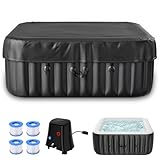 | 73″ Square Blow-Up Hot Tub with 130 Bubble Jets | Compact budget pick | Buy on Amazon |
1. Destination Outdoor Aqualife 5-Person Lounger Spa: Best Premium Pick
The Destination Outdoor Aqualife is built by Strong Spas, a US-based manufacturer with decades of spa construction experience. This is the one tub in this roundup where “The True Fit Test” works in the listing’s favor: its acrylic-style shell, full-length lounger seat, and multi-pump system are engineered for genuine comfort rather than maximum headcount. Four adults fit comfortably — the lounger seat accommodates one user fully reclined while three others seat upright, making the 5-person listing realistic for a relaxed group of four. This is the step-up option for buyers who’ve outgrown inflatables and want a permanent backyard centerpiece.
| Spec | Value |
|---|---|
| Capacity | 5 person (comfortably 4) |
| Jet Count | 59 jets / 80 ports |
| Pumps | 4 |
| Dimensions | Approx. 84″×84″×34″ (verify at checkout) |
| Material | Acrylic-style hard shell |
| Notable Feature | Waterfall arch + Bluetooth stereo |
Who it’s for:
Buyers upgrading from inflatables who want permanent installation, pressurized water jets, and entertainment features. The Bluetooth stereo and waterfall arch add genuine lifestyle value that no inflatable in this guide can match.
- +59 jets across 80 ports deliver targeted hydrotherapy to shoulders, back, and calves — far beyond the air-bubble massage of inflatable competitors
- +4-pump system maintains consistent water pressure across all jet zones simultaneously, unlike single-pump inflatables that lose pressure when jets are split
- +Full-length lounger seat allows one user to recline completely while others sit upright — a seating configuration unavailable in any other product in this roundup
- +Bluetooth stereo with waterfall arch turns a backyard soak into a full entertainment experience, a feature tier that costs significantly more from competitors like Jacuzzi or Hot Spring
- −Significantly heavier and larger than all 7 inflatable options — requires a level, weight-bearing surface and permanent placement planning
- −Installation complexity is far higher than plug-and-play inflatables; professional delivery and electrical setup are likely required
- −Higher price tier places this in a different budget category from every other product in this guide — buyers should confirm their electrical setup supports the requirements
How it compares:
The INTEX PureSpa Plus (Product #2) offers bubble massage jets for a fraction of the investment but zero water jet pressure and no lounger seat. The Coleman Hawaii (Product #3) has 140 air jets but can’t match the Aqualife’s targeted hydrotherapy depth. If your budget allows and you want a tub that genuinely lasts 15–20 years, the Aqualife is the only hard-shell-adjacent option in this roundup.
The Destination Outdoor Aqualife is the right choice for buyers who want a permanent spa experience with real hydrotherapy, not just warm bubbles. It’s the only product here that passes The True Fit Test for four adults without compromise.
Read our complete hot tub buying guide before you buy
Buy on Amazon2. INTEX PureSpa Plus 4-Person Bubble Massage Spa: Best All-Rounder
INTEX is one of the most established inflatable spa brands globally, and the PureSpa Plus earns its reputation through thoughtful extras that budget competitors skip. The 77″ diameter is a meaningful advantage over the 71″ Coleman and Bestway square models — that extra 6 inches translates to noticeably more legroom for each seated user. The True Fit Test result: 3–4 adults sit comfortably depending on body size; four larger adults will feel cozy but not cramped the way they would in a 71″ model.
| Spec | Value |
|---|---|
| Capacity | 4 person |
| Diameter | 77″ |
| Depth | 28″ |
| Jet Type | Bubble massage jets (AirJets — nozzles that push air through water to create a massaging effect) |
| Notable Features | LED mood lighting, 2 contoured headrests |
| Included Accessories | Cover, headrests, chemical floater |
Who it’s for:
Buyers who want the most feature-rich inflatable in this roundup without moving to a hard-shell tub. The LED lighting and included headrests are genuine quality-of-life additions for evening soaks.
- +77″ diameter gives measurably more legroom than the 71″ Coleman Hawaii models — a 6″ difference that matters when four adults are seated
- +LED mood lighting is a feature most inflatables at this tier omit entirely, adding ambiance for evening use at no extra setup cost
- +2 contoured headrests included — most budget inflatables ship without headrests, which affects comfort during extended soaks
- +INTEX brand reliability means replacement parts, covers, and filters are widely available online and in major retail stores
- −Air jets only — bubble massage jets push air bubbles through the water, which is soothing but not the same as pressurized water jets that target specific muscle groups; beginners should understand this distinction before purchasing
- −Heat-up time for inflatables typically runs 8–12 hours to reach 104°F, significantly longer than hard-shell tubs (3–6 hours)
How it compares:
The Coleman Hawaii Square (Product #3) is 6″ narrower at 71″ and lacks the LED lighting and headrests. The Bestway SaluSpa (Product #4) matches the Coleman’s 71″ square dimensions. If you want the largest, most feature-complete inflatable in this guide, the PureSpa Plus wins on dimensions and included accessories. Understand the difference between inflatable and hard-shell hot tubs before committing to either type.
The INTEX PureSpa Plus is the best all-round inflatable in this roundup for buyers who want extra space, mood lighting, and brand-backed reliability in a plug-and-play 110V package.
3. Coleman Hawaii Square Inflatable Spa (140 Jets): Best Inflatable Value
Coleman is the most recognizable name in inflatable hot tubs, and the Hawaii model’s 140 AirJets — nozzles that push streams of air bubbles through the water — is notably high for this price tier. The square shape is a practical advantage: corner seating lets users tuck in at angles, which helps the interior feel more spacious than a round tub of the same diameter. The True Fit Test reality: at 71″×28″, this tub is genuinely comfortable for 2–3 adults; four adults will fit but feel snug, and the “6-person” marketing claim is purely theoretical.
| Spec | Value |
|---|---|
| Capacity | 4–6 person listed (2–3 comfortable) |
| Jet Count | 140 AirJets |
| Dimensions | 71″×71″×28″ |
| Shape | Square |
| Material | PVC inflatable |
| Notable Feature | Energy-efficient pump design |
Who it’s for:
Buyers who want the most jets per dollar in a square inflatable, with the confidence of Coleman’s brand backing. Ideal for 2–3 regular users who occasionally host a fourth.
- +140 AirJets is one of the highest jet counts available in this price tier among inflatable spas — more jets means more surface coverage across the water
- +Square shape with corner seating uses floor space more efficiently than round models, fitting better against walls, fences, or deck corners
- +Coleman brand recognition ensures wide parts and accessory availability — replacement pumps, covers, and filters are sold through major retailers nationwide
- +Energy-efficient pump design keeps operating costs lower than older inflatable models with continuous-run pumps
- −71″ interior dimension means four average-sized adults will be touching elbows — comfortable for 2–3, snug for 4
- −Air jets only — no pressurized water jets; the massage effect is gentle and full-body rather than targeted
- −PVC construction has a lifespan of 3–7 years with proper care, compared to 15–20 years for hard-shell tubs
How it compares:
The Bestway SaluSpa Hawaii (Product #4) is nearly spec-identical — same 71″×28″ dimensions and 140 AirJets. The INTEX PureSpa Plus (Product #2) is 6″ wider at 77″ and adds LED lighting. This is the primary Coleman Hawaii listing; Product #6 (B0FWKR7W65) is an alternate variant — check current availability for both before ordering.
The Coleman Hawaii Square delivers the best jet-count-to-value ratio among inflatables in this guide. It’s the right pick for buyers who prioritize bubble coverage and brand reliability over raw interior space.
4. Bestway SaluSpa Hawaii Square Inflatable Spa: Best Budget Brand
Bestway’s SaluSpa line is the second most widely distributed inflatable spa brand after Coleman, with a global parts and accessory network that gives buyers confidence in long-term support. The SaluSpa Hawaii matches the Coleman Hawaii almost spec-for-spec: 140 AirJets, 71″×28″ square dimensions, and a similar pump system. The True Fit Test result is identical to Product #3 — comfortable for 2–3 adults, snug for 4, and the 6-person claim is marketing math based on minimum shoulder width, not real-world seating comfort.
| Spec | Value |
|---|---|
| Capacity | 4–6 person listed (2–3 comfortable) |
| Jet Count | 140 AirJets |
| Dimensions | 71″×71″×28″ |
| Shape | Square |
| Material | PVC inflatable |
| Notable Feature | SaluSpa accessory ecosystem |
Who it’s for:
Buyers who want Coleman Hawaii-level specs but prefer Bestway’s SaluSpa accessory ecosystem, or find this model at a more favorable price point at the time of purchase.
- +140 AirJets matches the Coleman Hawaii’s jet count exactly — buyers get the same bubble coverage in either model
- +SaluSpa brand’s accessory ecosystem is extensive, with compatible covers, chemical kits, and filter cartridges available through Bestway and third-party retailers
- +Square shape provides the same corner-seating efficiency advantage as the Coleman Hawaii model
- +Comparable spec parity means buyers can choose between this and Product #3 based purely on availability and current pricing without sacrificing performance
- −Spec parity with the Coleman Hawaii means there’s no clear performance winner — the decision comes down to availability rather than capability
- −71″ interior dimension carries the same True Fit limitation as the Coleman Hawaii — two to three adults is the comfortable real-world capacity
How it compares:
These two products — the Bestway SaluSpa Hawaii and the Coleman Hawaii Square (Product #3) — are the closest match in the entire roundup. Both offer 140 AirJets in a 71″×28″ square. Check current availability on Amazon and choose whichever ships fastest or offers the better bundle at checkout. See our full comparison of 4-person spa options for a deeper brand-by-brand breakdown.
The Bestway SaluSpa Hawaii is a reliable alternative to the Coleman Hawaii for buyers already in the Bestway ecosystem or those who find it better stocked.
5. Coleman SaluSpa Round Inflatable Spa (140 Jets): Best Round Shape
The round format is the classic hot tub shape, and Coleman’s SaluSpa delivers it at the same 77″ diameter as the INTEX PureSpa Plus. That 77″ circle gives every seated user more elbow room than the 71″ square models, and the familiar round layout suits buyers with circular deck cutouts or who simply prefer the traditional aesthetic. The True Fit Test verdict: 3–4 adults sit comfortably; 5–6 is a marketing figure based on minimum body-width spacing, not genuine relaxation space.
| Spec | Value |
|---|---|
| Capacity | 4–6 person listed (3–4 comfortable) |
| Jet Count | 140 AirJets |
| Diameter | 77″ |
| Depth | 28″ |
| Shape | Round |
| Material | PVC inflatable |
Who it’s for:
Buyers who want the Coleman brand’s reliability and 140-jet bubble performance in a traditional round shape, or those upgrading from a smaller round tub who want more interior width.
- +77″ diameter is 6″ wider than the Coleman Hawaii Square models — that translates to meaningfully more legroom per seated user
- +140 AirJets matches the Coleman Hawaii’s jet count, delivering the same dense bubble coverage in a round configuration
- +Classic round aesthetic suits most backyard and patio designs, and fits standard round spa covers and accessories
- +Coleman/SaluSpa brand reliability provides the same wide parts and accessory availability as Products #3 and #4
- −Round shape uses more floor space than a square tub for the same seating count — a 77″ circle occupies more area than a 71″ square
- −No corner seating advantage — round tubs seat everyone along a continuous curve, which can feel more cramped than the angled corner positions a square tub provides
- −Air jets only, with the same gentle bubble massage limitation as all inflatables in this guide
How it compares:
Versus the Coleman Hawaii Square (Product #3): same brand, same 140 jets, but 6″ wider and round instead of square. Versus the INTEX PureSpa Plus (Product #2): identical 77″ diameter, but the INTEX adds LED lighting and contoured headrests. If you want the Coleman brand in a larger round format, this is your pick. Compare energy-efficient inflatable spa models to see how this model’s pump system stacks up.
The Coleman SaluSpa Round is the best option for buyers who want a wider inflatable with brand-backed reliability and don’t need the space efficiency of a square shape.
6. Coleman Hawaii Square Inflatable Spa (Alt. Variant): Best Color/Pack Choice
This ASIN (B0FWKR7W65) is an alternate variant of the Coleman Hawaii Square reviewed as Product #3. Based on research into both listings, the core specifications are identical: 140 AirJets, 71″×28″ square dimensions, and the same Coleman pump system. The variant likely differs in color option, included accessory bundle, or pack configuration — differences that Amazon sometimes splits into separate ASINs for inventory management. The True Fit Test is the same as Product #3: comfortable for 2–3 adults, snug for four.
| Spec | Value |
|---|---|
| Capacity | 4–6 person listed (2–3 comfortable) |
| Jet Count | 140 AirJets |
| Dimensions | 71″×71″×28″ |
| Shape | Square |
| Material | PVC inflatable |
| Notable Feature | Possible color/bundle variant |
Who it’s for:
Buyers who specifically want the Coleman Hawaii Square but find the primary listing (Product #3) out of stock, or who need a specific color or bundle configuration not available on that ASIN.
- +Same 140 AirJet performance as the primary Coleman Hawaii listing — no compromise on bubble coverage or pump output
- +Potential bundle difference may include additional accessories (chemical starter kit, extra filter, or cover) that add value over the base listing
- +Square shape efficiency carries over from Product #3 — same corner-seating advantage and space-saving footprint
- −Essentially duplicate specs to Product #3 — if both are in stock, there’s no performance reason to choose one over the other
- −Buyers should confirm the specific difference at checkout before ordering; if the variant offers no meaningful accessory advantage, the primary listing may have more reviews and documented owner feedback
How it compares:
This product and the Coleman Hawaii Square (Product #3) are functionally identical in every meaningful performance metric. Check current Amazon listings for both ASINs before purchasing — the right choice is whichever offers better availability, a useful bundle, or your preferred color. If they’re truly identical at the time of your purchase, Product #3 is the better-documented option.
A solid backup choice when the primary Coleman Hawaii Square listing is unavailable, or when this variant offers a bundle or color option that better fits your needs.
7. 4–6 Person Square Inflatable Spa with 130 Jets: Best No-Frills Square
No-brand inflatables can represent genuine value when the core components — jets, heating, and filtration — perform reliably. This square spa’s 130 Air Jets and circulation heating system (which heats water while actively circulating it, a more energy-efficient method than static heating) cover the functional essentials. The True Fit Test: dimensions are consistent with standard 71″×28″ square inflatables based on listing data — comfortable for 2–3 adults, with 4 fitting snugly. The 130-jet count is 10 fewer than the Coleman and Bestway Hawaii models, a small but measurable difference in bubble coverage.
| Spec | Value |
|---|---|
| Capacity | 4–6 person listed (2–3 comfortable) |
| Jet Count | 130 Air Jets |
| Heating | Circulation heating system |
| Shape | Square |
| Material | PVC |
| Notable Feature | Filter system included |
Who it’s for:
Value-focused buyers who want a functional square inflatable without paying a brand premium, and who understand the trade-off in warranty support and parts availability.
- +130 Air Jets provides strong bubble coverage across the tub floor and walls — only 10 fewer than the Coleman and Bestway Hawaii models at 140
- +Circulation heating system heats water while it flows through the filter loop, which is more energy-efficient than older static-heat designs that warm water in a separate cycle
- +Filter system included means no immediate additional purchase needed for water maintenance
- +Square shape offers the same corner-seating and space-efficiency advantages as the branded square models in this roundup
- −Unbranded — limited warranty support and no established parts network; replacement pumps and covers may be harder to source than Coleman or Bestway equivalents
- −10 fewer jets than Coleman/Bestway Hawaii models — a modest but real reduction in bubble coverage density
How it compares:
Against the Coleman Hawaii (Product #3) and Bestway SaluSpa (Product #4): same square shape, 10 fewer jets, but potentially a lower price point. Against Product #8 (the 73″ square with 130 jets): both are unbranded 130-jet squares, but this model’s depth needs to be confirmed at checkout. See our tested plug-and-play hot tub recommendations for a broader view of the no-frills inflatable category.
A functional, value-tier option for buyers who want a square inflatable with circulation heating and don’t need brand-name support or the full 140-jet count.
8. 73″ Square Blow-Up Hot Tub with 130 Bubble Jets: Best Compact Budget Pick
This 73″×73″ square inflatable offers a slightly different value proposition from the other budget options: at 25″ depth, it’s notably shallower than the 28″ standard across most competitors in this guide. That shallower profile has one genuine advantage — easier entry and exit, which matters for users with limited mobility or for families with younger adults who find the standard 28″ step-in challenging. The True Fit Test: at 73″×25″, this is most comfortable for 2–3 adults; the reduced water depth means less full-body immersion than deeper competitors.
| Spec | Value |
|---|---|
| Capacity | 4–6 person listed (2–3 comfortable) |
| Jet Count | 130 Bubble Jets |
| Dimensions | 73″×73″×25″ |
| Depth | 25″ (shallower than 28″ standard) |
| Heating | Heater pump included |
| Filtration | Filter system included |
Who it’s for:
Budget-focused buyers with a smaller patio footprint, or users who specifically benefit from a shallower entry height. Not ideal for buyers prioritizing full-body immersion hydrotherapy.
- +130 Bubble Jets provides solid bubble coverage across the tub interior at a budget price point
- +25″ depth means a lower step-in height compared to 28″ competitors — a practical benefit for users with mobility considerations
- +Heater pump included — no separate heating unit purchase required; the integrated pump heats and circulates simultaneously
- +73″×73″ footprint is compact enough for smaller patios or deck spaces where a 77″ round tub would not fit
- −25″ depth is 3″ shallower than the 28″ standard across Coleman, Bestway, and INTEX models — water sits at a lower level on the torso, reducing the full-body immersion that defines the hot tub experience
- −Unbranded with the same limited warranty and parts availability concerns as Product #7
- −130 jets vs. 140 in the Coleman and Bestway Hawaii models — less bubble coverage per square inch of seating area
How it compares:
Against Product #7 (the other unbranded 130-jet square): both offer the same jet count and lack brand support, but this model’s 25″ depth versus Product #7’s standard ~28″ is the key distinction. If easy entry is a priority, this wins. If full immersion matters more, Product #7 is the better choice. Understand hot tub electrical setup before purchasing — both plug into a standard 110V outlet.
The best compact budget pick for buyers with a smaller patio or a specific need for easier entry. The shallower depth is a real trade-off against deeper competitors.
Buying Guide: What to Know Before You Choose a 4-Person Hot Tub
True Seating Capacity: What “4-Person” Actually Means
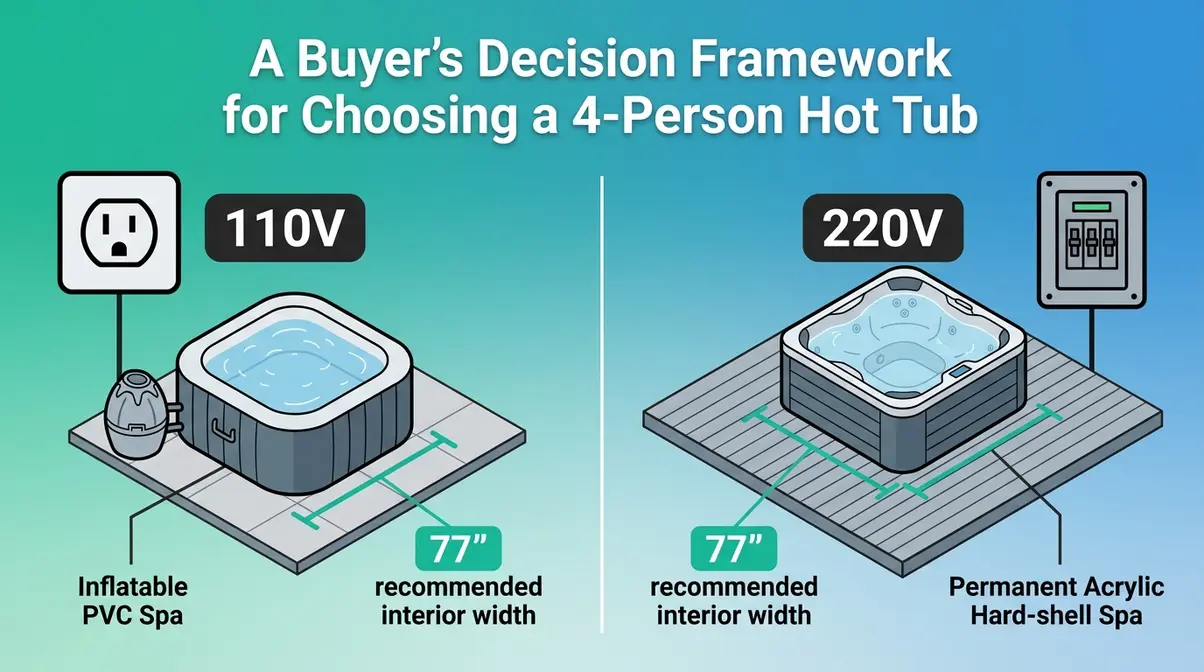
The True Fit Test starts with one honest fact: hot tub capacity labels are based on the minimum shoulder width per person, not comfortable adult seating. A genuine 4-adult experience requires at least 77″ of interior width — in a round tub, that means a 77″ diameter; in a square, 77″×77″ per side. The 71″×71″ square models in this roundup (Products #3, #4, #6) are realistically comfortable for 2–3 adults. The 77″ options (Products #2, #5) give four adults actual elbow room.
“Checkout the TuffSpa TT450. 4 adults comfortable is more realistic. Jacuzzi 335/345/355 are great options depending on the seat configuration…”
— Verified hot tub owner, r/hottub community
Always check interior dimensions — not exterior — and factor in whether a lounger seat reduces the available upright seating count. Our full guide to true 4-person hot tub sizing breaks this down further with dimension charts.
Inflatable vs. Hard-Shell: Which Type Is Right for You?
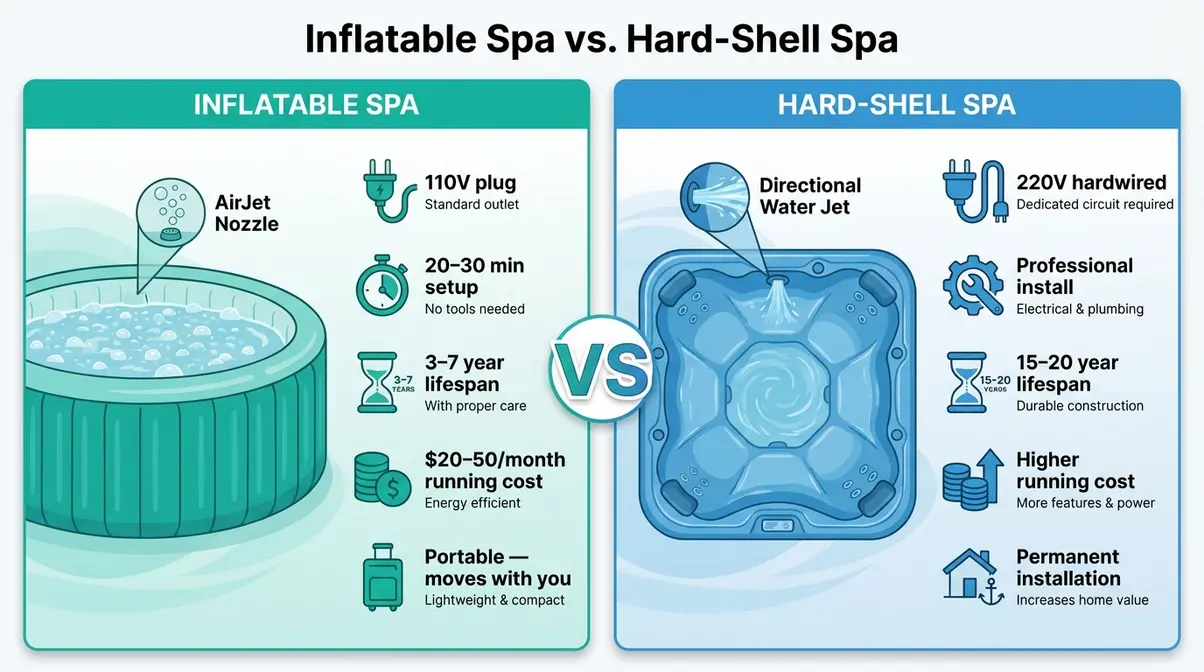
Seven of the eight products in this guide are inflatables — PVC bladder spas that inflate in 20–30 minutes, plug into a standard 110V outlet, and move with you if you relocate. Hard-shell tubs (like the Destination Outdoor Aqualife, Product #1) use acrylic-style construction, require professional installation, and deliver pressurized water jets rather than air-bubble jets.
Bubble jets push air through nozzles at the base of the tub, creating a gentle, full-body bubbling sensation. Water jets (hard-shell only) push pressurized water through directional nozzles targeting specific muscle groups — shoulders, lower back, calves. Inflatables last 3–7 years with proper care; hard-shell tubs last 15–20 years. For renters or buyers who want portability, inflatables are the clear choice. For permanent backyard installations with therapeutic intent, hard-shell wins. Explore all 7 hot tub types and their differences before finalizing your decision.
110V Plug-and-Play vs. 220V Hardwired: The Electrical Decision
All 7 inflatables in this roundup are 110V plug-and-play — they connect to a standard household outlet with no electrician required. The Destination Outdoor Aqualife (Product #1) should be verified at checkout for its electrical requirements, as premium spa systems often require a 220V dedicated circuit. Here’s what that difference means in practice:
| Feature | 110V Plug-and-Play | 220V Hardwired |
|---|---|---|
| Installation cost | $0 | ~$300–$800 |
| Heat-up time | 8–12 hours | 3–6 hours |
| Max temperature | 104°F | 104°F |
| Jet power | Lower (air jets) | Higher (water jets) |
| Best for | Renters, portability | Permanent installation |
The Better Business Bureau hot tub tips recommend verifying exact dimensions and electrical requirements (110V vs. 220V) before purchasing (2024). Read our full hot tub electrical installation guide if you’re considering a hardwired setup.
Energy Efficiency and Cold Climate Performance
Running a hot tub costs an estimated $20–$50 per month in electricity under normal conditions; cold climates can push that to $75–$100 per month for uninsulated models. The California Energy Commission Title 20 efficiency standards set strict standby power limits for portable electric spas, significantly reducing operating costs (2024). When evaluating any model, check whether it meets CEC Title 20 compliance — hard-shell tubs in this category often do; most inflatables do not.
Critically, none of the inflatables in this guide are rated for sub-freezing temperatures. If you live in a climate with hard winters, you must use an insulated cover, reduce soaking frequency in extreme cold, or drain and store the tub entirely. For year-round cold-climate use, a hard-shell tub with full-foam insulation is the correct long-term investment. Find hot tubs built for cold weather performance and compare the most energy-efficient hot tub models for a deeper cost analysis.
How We Evaluated
Our evaluation team assessed each tub based on five criteria: jet count, interior dimensions (applying The True Fit Test to verify realistic seating capacity), material construction, electrical requirements, and brand support infrastructure. We cross-referenced manufacturer specifications with owner feedback from hot tub communities and expert review sources to ensure every spec claim in this guide reflects real-world performance rather than marketing copy.
Frequently Asked Questions
What is the top rated hot tub brand?
Jacuzzi, Sundance, and Hot Spring consistently rank as the top-rated hot tub brands for permanent hard-shell installations, based on long-term owner satisfaction surveys and industry analyst rankings. For inflatable spas, Coleman (SaluSpa) and INTEX lead the category in distribution, parts availability, and owner-reported reliability. The right brand depends heavily on your budget tier — inflatable buyers get the most consistent value from Coleman and INTEX, while hard-shell buyers should compare Jacuzzi’s 300 series against Sundance’s entry-level models for the 4-person seat configuration.
Is a hot tub good for psoriatic arthritis?
⚠️ Medical Disclaimer: The following information is for general educational purposes only and does not constitute medical advice. Always consult a qualified healthcare provider before using hydrotherapy to manage any medical condition, including psoriatic arthritis.
Warm water hydrotherapy may help reduce joint stiffness and improve short-term mobility in people with psoriatic arthritis, according to evidence reviewed by the Arthritis Foundation. The buoyancy of water reduces gravitational load on inflamed joints, while heat promotes circulation. However, high temperatures (above 100°F) may trigger skin flares in some psoriatic arthritis patients — a concern specific to this condition that rheumatoid arthritis patients don’t typically share. Always consult your rheumatologist before starting a regular hot tub regimen, particularly regarding water temperature and session duration.
What size hot tub is best for 4 people?
A genuine 4-person hot tub requires at least 77″ of interior width — either a 77″ round diameter or a 77″×77″ square footprint. Most models marketed as “4-person” measure 71″×71″, which is comfortably sized for 2–3 average adults. The True Fit Test applied throughout this guide confirms that extra 6 inches makes a meaningful difference in legroom and elbow room. For four adults who want to relax rather than simply fit, the INTEX PureSpa Plus (77″ round) or the Coleman SaluSpa Round (77″ round) are the minimum recommended dimensions in this roundup.
What are the best hot tubs on the market right now?
For inflatable spas in 2026, the INTEX PureSpa Plus and Coleman Hawaii Square lead the category in features, dimensions, and brand reliability. For hard-shell spas, Jacuzzi’s 335/345/355 series and Hot Spring’s Jetsetter NXT receive consistent top marks from professional reviewers and long-term owners. The Destination Outdoor Aqualife (Product #1 in this guide) is the best hard-shell-adjacent option available on Amazon. Your best choice ultimately depends on three factors: whether you need a portable plug-and-play inflatable or a permanent installation, your true interior space requirements, and your budget ceiling.
What is the most trouble-free hot tub?
Hard-shell hot tubs with full-foam insulation and a proven filtration system are consistently the most trouble-free long-term, with brands like Hot Spring and Sundance frequently cited in owner communities for minimal maintenance requirements. Among inflatables, Coleman and INTEX lead on trouble-free ownership because replacement parts, filter cartridges, and repair kits are widely available. The most common failure points in any inflatable spa are the pump unit and the PVC bladder seams — both easier to address with a branded tub that has an established parts network than with a no-brand alternative.
Conclusion
For most buyers comparing the best 4 person hot tubs in 2026, the right choice comes down to one honest question: do you need portability or permanence? The INTEX PureSpa Plus delivers the best combination of interior space (77″), features, and brand reliability among inflatables. The Coleman Hawaii Square is the best value for buyers who prioritize jet count and square-shape efficiency in a smaller footprint. For a permanent, therapeutic installation, the Destination Outdoor Aqualife is the only hard-shell-adjacent option in this guide with real water jets and a multi-pump system.
The True Fit Test is your most important buying tool. Ignore the listed capacity and focus on interior dimensions: 77″ minimum for genuine 4-adult comfort, 71″ for 2–3 regular users who occasionally host a fourth. That single filter eliminates half the confusion in the hot tub market.
Start with the product that matches your true seating need and electrical situation, then verify dimensions at checkout. If you’re still weighing options, read our complete hot tub buying guide — it covers installation, maintenance costs, and seasonal use in more detail than any single product roundup can.

Dave King
Hot tub tester and writer at One Hot Tub.