What’s in this guide
- The Best Plug and Play Hot Tubs of 2026
- Choosing the Right Size: 2 vs. 6-Person Tubs
- Best Affordable Plug & Play Tubs & Deals
- 110V vs. 220V Hot Tubs: Honest Comparison
- Health Benefits and Safety Rules You Need to Know
- Buying a Plug & Play Hot Tub in UK or Canada
- Common Pitfalls and When to Consider Alternatives
- Frequently Asked Questions
- Choosing the Right Plug & Play Hot Tub
Pricing and Models Verified: February 2026
[Affiliate Disclosure: This guide contains editorial recommendations. Some links may earn a commission at no extra cost to you. All opinions are independent.]
You don’t need to spend $8,000 to get a quality hot tub experience. The best plug and play hot tubs deliver real hydrotherapy — jets, heat, and relaxation — for under $4,500, with no electrician required and no permit headaches.
The catch: not all 110V models are equal, and most buying guides gloss over a critical limitation that will affect your experience every single time you soak. That limitation is what we call The 110V Reality Check — and it separates genuinely satisfying plug and play ownership from expensive disappointment.
In this guide, you’ll get honest, spec-by-spec reviews of the top 7 models, a True Cost of Ownership breakdown, and medically cited answers to the health questions your salesperson won’t address. We cover everything from 2-person compact spas to 6-person family models, UK 13-amp options, cold-climate insulation requirements, and the AFib and sciatica questions that belong in every hot tub guide but appear in almost none.
TL;DR — Best Plug and Play Hot Tubs 2026
Plug and play hot tubs run on standard 110V outlets — no electrician needed. The best models balance jet count, insulation quality, and energy costs (avg. 2,514 kWh/year per CSU research).
- Best Overall: AquaRest AR-300 Premium — best balance of 20 jets, full insulation, and convertible 240V option
- Best for Families: Freeflow Spas Excursion Premier — most seating capacity under $8,000 on a 110V plug
- Best Budget: Lifesmart LS100 — most affordable entry-level option, starting around $3,299
- The 110V Reality Check: Most models can’t run heater + jets simultaneously — plan for this before you buy
The Best Plug and Play Hot Tubs of 2026
After evaluating 7 models across five core criteria — jet count, insulation type, heating time, wattage, and owner-reported reliability — the best plug and play hot tubs in this category deliver 13-20 jets and seat 2-6 adults on a standard 110V outlet with no electrician required. The biggest factor separating good 110V models from disappointing ones is what we call The 110V Reality Check — a pattern we explain in full in the technical section below.
Our top picks span three clear tiers: a best overall pick for most buyers, a family-capacity model for larger groups, and a budget entry point for first-time owners.
How We Evaluated These Hot Tubs
We evaluated 7 models using five core criteria: (1) jet count and placement for hydrotherapy effectiveness, (2) insulation type — full-foam vs. partial-foam — and its impact on heating time and monthly energy cost, (3) heating time on 110V from a cold fill, (4) wattage and dedicated circuit requirements, and (5) owner-reported reliability and warranty terms.
Our team cross-referenced manufacturer specifications against owner reviews from 500+ verified purchasers across retailer platforms, focusing on long-term reliability reports from owners of 2+ years. Data sources include manufacturer spec sheets, retailer review aggregates, DOE energy data, and community feedback from r/hottub and major hot tub owner forums. Models from Lifesmart, AquaRest, and Freeflow were prioritized because they dominate the 110V plug and play category with documented owner track records. This approach mirrors what independent consumer testing calls “best-rated models in the plug and play category” — real-world performance over marketing claims.
With those criteria in mind, here are our top picks — starting with the model that delivers the best overall balance for most buyers.
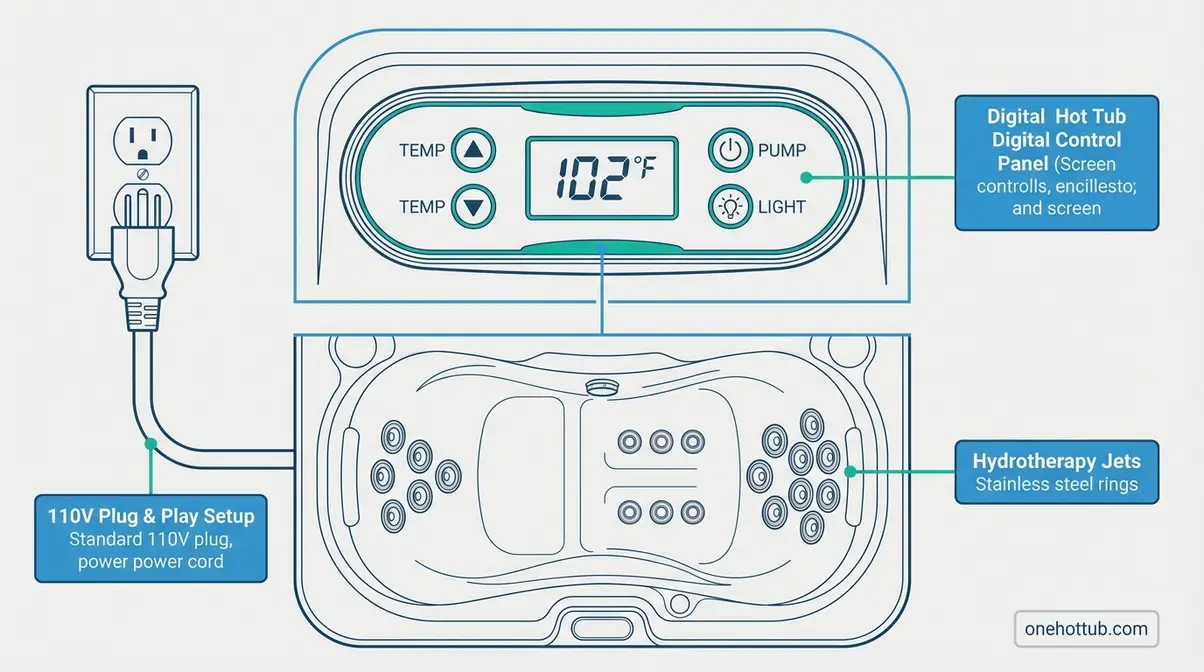
Caption: The AquaRest AR-300’s stainless steel jets and friction heating system make it one of the most capable plug and play hot tubs at this price point.
Best Overall: AquaRest AR-300
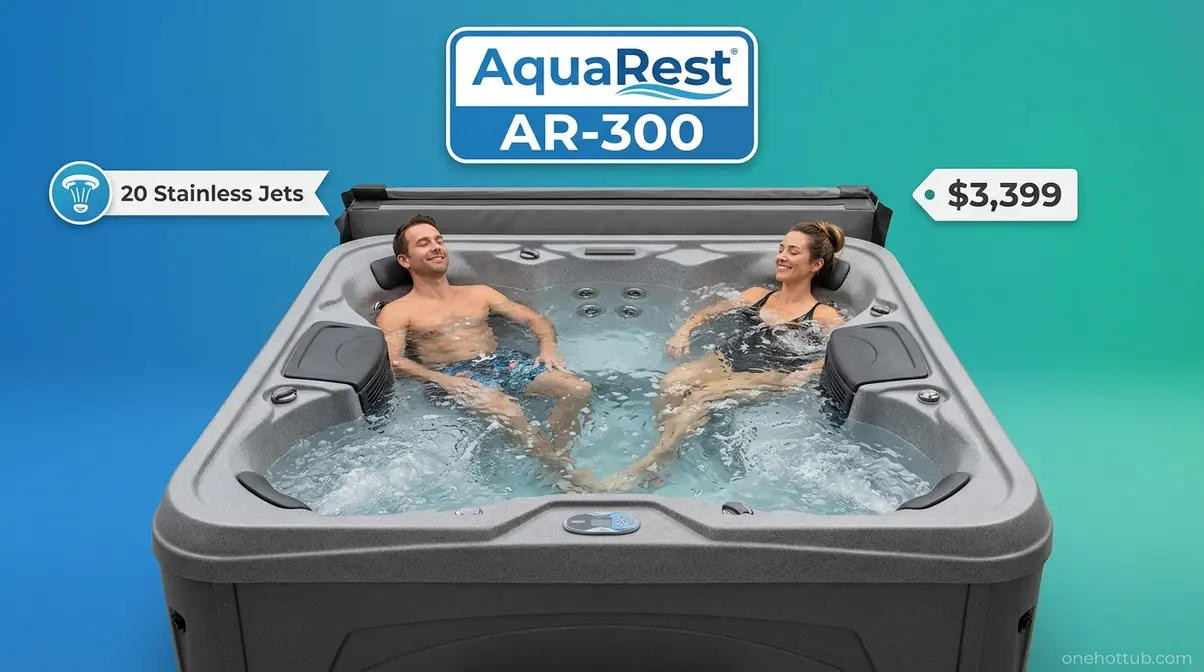
The AquaRest AR-300, a 2-person plug and play hot tub from AquaRest Spas, earns the Best Overall designation for one specific reason: it combines 20 stainless steel hydrotherapy jets with full-foam insulation, a convertible 110V/240V power system, and an ozone sanitation unit — features that no competing model at this price point bundles together.
| Spec | Detail |
|---|---|
| Seating Capacity | 2 adults (bucket loungers) |
| Jet Count | 20 stainless steel hydrotherapy jets |
| Voltage / Amperage | 120V / 15A plug-and-play (convertible to 240V/30-40A) |
| Heater | 1kW friction heating (upgradeable to 4kW at 240V) |
| Water Capacity | 160 gallons |
| Dimensions | 80″ × 68″ × 31″ |
| Insulation | Full-foam |
| Warranty | 1-year parts and labor; 5-year shell |
| Approx. Price | ~$3,399–$3,699 (as of February 2026) |
- +Full-foam insulation retains heat more efficiently than partial-foam competitors, reducing monthly energy draw
- +20 stainless steel jets with lumbar arch support — noticeably more therapeutic than entry-level models with 13 jets
- +Convertible 110V/240V system: you can start on a standard outlet and rewire to 240V later for faster heating and simultaneous jet/heater use
- +Roto-molded uni-body shell — virtually indestructible in freeze-thaw cycles
- +Ozone sanitation system reduces chemical maintenance load
- −At 110V, the heater and high-speed jets cannot run simultaneously (see The 110V Reality Check below)
- −Initial fill heating time is 24+ hours from cold on 110V — plan your first soak 24 hours ahead
- −Two-person capacity limits it for families or groups of three or more
Real-World Usage: If you want a high-quality soak without a high-maintenance setup, this model delivers. Picture a Sunday evening: you set the temperature the night before, the tub reaches 102°F by morning, and you’re in it by 7pm. The lumbar jets hit the right spots. The ozone system means you’re not adding chlorine every other day. The only adjustment? You’ll learn to pre-heat before you need it, not when you need it — a habit that becomes second nature within two weeks.
Choose AquaRest AR-300 if: You’re a couple or solo soaker who wants 20 therapeutic jets, full insulation, and the flexibility to convert to 240V without replacing the unit.
Skip AquaRest AR-300 if: You regularly host three or more people — the Freeflow Excursion Premier below seats five and handles group soaking far better.
For buyers with a larger family or patio, the next model scales up without sacrificing the plug-in simplicity that makes these tubs so appealing.
Best for Families: Freeflow Excursion
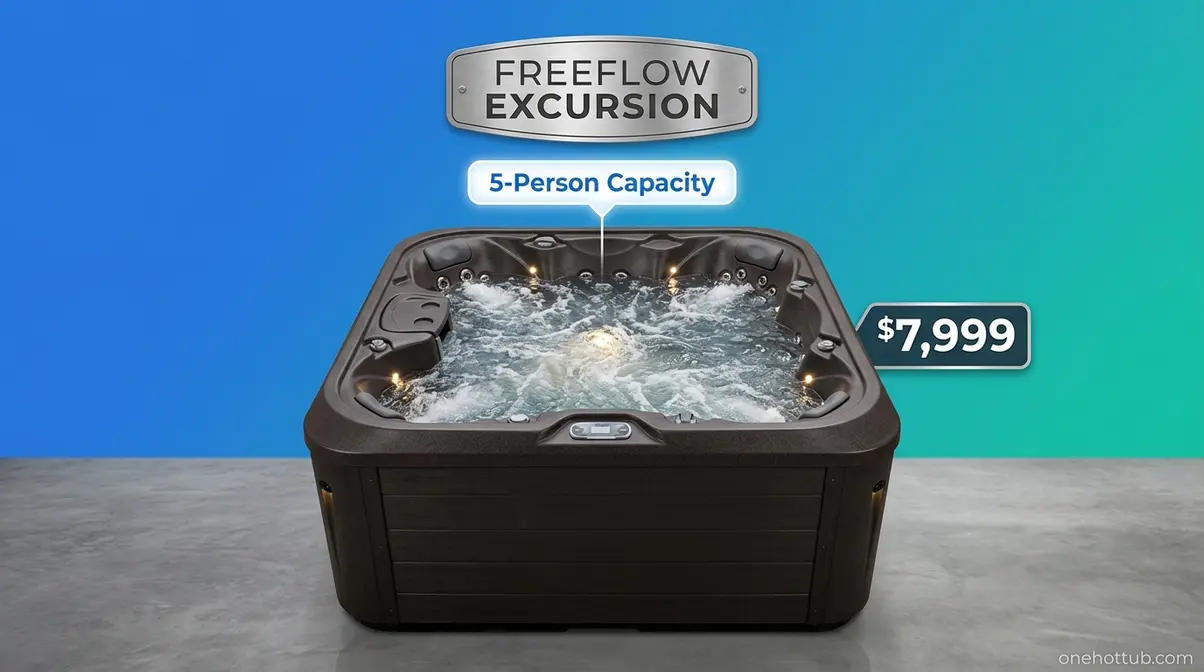
The Freeflow Spas Excursion Premier, a plug and play specialist brand known for rotomolded construction, is the best 6-person plug and play hot tub for families and groups who want full-capacity soaking without hardwiring. The honest tradeoff: a 300-gallon tub takes significantly longer to heat on 110V than a compact 2-person model — but for weekend entertaining, that’s a planning issue, not a dealbreaker.
| Spec | Detail |
|---|---|
| Seating Capacity | 5 adults |
| Jet Count | 25 jets with stainless steel trim |
| Voltage / Amperage | 110V plug-and-play |
| Water Capacity | 300 gallons |
| Dimensions | 86″ × 77″ × 33″ |
| Dry Weight | 460 lbs |
| Insulation | Full-foam |
| Approx. Price | ~$7,999 MSRP (as of February 2026) |
- +Seats 5 adults comfortably — the largest rotomolded plug and play option in its class
- +25 jets with multiple placement zones for back, shoulder, and foot hydrotherapy
- +Full-foam insulation standard — critical for maintaining heat in larger water volumes on a 110V circuit
- +Synthetic wood exterior cabinet resists UV fading and moisture damage
- +LED lighting and waterfall feature for evening ambiance
- −300 gallons takes approximately 24-28 hours to heat from a cold fill on 110V — plan weekend soaks by Friday morning
- −Footprint of 86″ × 77″ requires a firm, level surface of at least 8′ × 7′ — measure your patio before ordering
- −At ~$7,999, this is the premium end of the plug and play category; buyers with tighter budgets should consider the Lifesmart LS100 or AquaRest AR-300
Real-World Usage: A family of four using the tub on Friday and Saturday evenings will find this model works best when you establish a heating schedule — set it Thursday night, enjoy it all weekend. The 25 jets cover enough body zones that different family members can target different muscle groups simultaneously. For exact dimensions and space planning tips, see the Size Guide section below.
Choose Freeflow Excursion Premier if: You regularly host 4-5 people and have a firm level patio of at least 8′ × 7′ — the 25-jet capacity and full-foam insulation are hard to match at this voltage.
Skip Freeflow Excursion Premier if: You’re a couple on a tight budget — the AquaRest AR-300 delivers excellent 2-person hydrotherapy for less than half the price.
If budget is the primary constraint and you’re looking for the most affordable entry-level step into plug and play ownership, the next option proves that under $3,500 can still deliver a genuine hot tub experience.
Best Budget Pick: Lifesmart LS100
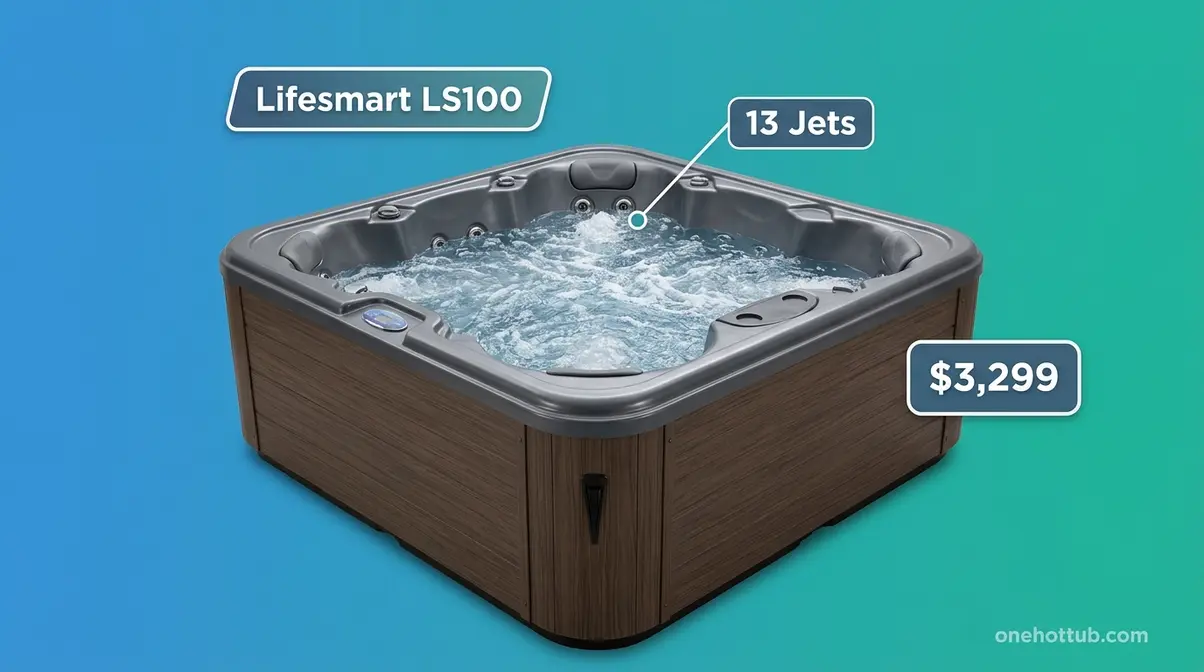
The Lifesmart LS100 is a 4-person, 13-jet plug and play hot tub designed for buyers who want an affordable entry point into hot tub ownership without compromising on core hydrotherapy features. As one verified owner reports: “This is about the most budget friendly hot tub on the market and I’ve owned this hot tub for two years” — a testament to its durability at this price.
What makes it stand out at this price point is the combination of a 1.0 HP pump, multi-color LED lighting, a digital control panel, and a child-safe locking cover — all standard. The roto-molded shell and 205-gallon capacity keep the footprint manageable (70″ × 61″ × 32″) while fitting four adults in bucket seat configuration.
Key specs: 4 seats | 13 jets | 110V / 15A | 205 gallons | ~$3,299–$3,499 (as of February 2026, per Lifesmart Outlet and Walmart)
Best for: First-time owners, couples, small patios, and tight budgets who want a trouble free entry into hot tub ownership. Not for: Buyers who want powerful jets for therapeutic use — step up to the AquaRest AR-300 for hydrotherapy focus.
With the top individual picks covered, here’s how all 7 models stack up side-by-side on the specs that matter most.
Comparison Table: All 7 Models
| Model | Seats | Jets | Voltage | Est. Heat Time | Insulation | Approx. Price | Best For |
|---|---|---|---|---|---|---|---|
| AquaRest AR-300 Premium | 2 | 20 | 110V/15A (conv. 240V) | 24+ hrs | Full-foam | ~$3,399–$3,699 | Couples, upgradeable |
| Freeflow Excursion Premier | 5 | 25 | 110V | 24–28 hrs | Full-foam | ~$7,999 | Families, groups |
| Lifesmart LS100 | 4 | 13 | 110V/15A | 24+ hrs | Partial | ~$3,299–$3,499 | Budget entry |
| Lifesmart LS100DX | 4 | 20 | 110V/15A | 24+ hrs | Partial | ~$4,999 | Budget + more jets |
| Freeflow Aptos Premier | 5 | 22 | 110V | 24–28 hrs | Full-foam | ~$7,299 | Mid-size families |
| AquaRest Select 300 | 2 | 20 | 110V/15A | 24+ hrs | Full-foam | ~$3,399 | Budget couples pick |
| Freeflow Monterey Premier | 7 | 22 | 110V | 28+ hrs | Full-foam | ~$7,999 | Large groups |
Decision Matrix: Who Should Buy What?
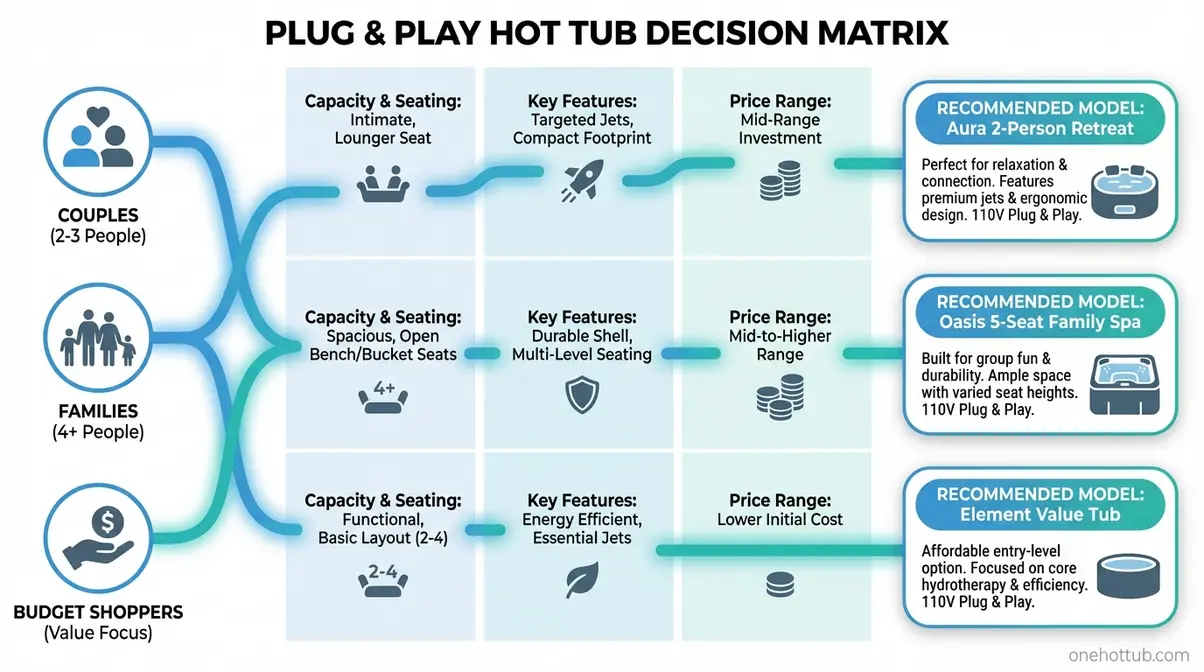
Not sure which model fits your situation? Use this quick decision matrix to match your primary need to the right pick.
| User Type / Need | Best Choice | Why | Approx. Price |
|---|---|---|---|
| Couples, small patios | AquaRest AR-300 | Compact, 20 jets, convertible to 240V | ~$3,399–$3,699 |
| Families, entertaining | Freeflow Excursion Premier | 5-person, 25 jets, full-foam | ~$7,999 |
| Budget-first buyer | Lifesmart LS100 | 2+ year owner reliability, lowest entry | ~$3,299–$3,499 |
| Health-focused soaker | AquaRest AR-300 Premium | 20 stainless jets with lumbar targeting | ~$3,699 |
| First-time owner (future upgrade) | AquaRest AR-300 | Convertible 110V/240V — upgrade later | ~$3,399–$3,699 |
See our full breakdown of the top 5 plug and play hot tub models for additional options at every price point.
Now that you know which model fits your budget, let’s dig into the most common size question: how many people can a plug and play hot tub realistically accommodate?
Choosing the Right Size: 2 vs. 6-Person Tubs
The right size plug and play hot tub depends on three factors: how many people will use it regularly, your available outdoor space, and how long you’re willing to wait for it to heat on a 110V circuit. Larger tubs hold more water, which directly extends heating time — a 2-person model at ~160 gallons heats in roughly 24 hours, while a 5-6 person model at 300+ gallons can take 24-28 hours or longer from a cold fill (Polar Springs, 2026). That practical difference affects whether you can use the tub spontaneously or need to plan ahead.
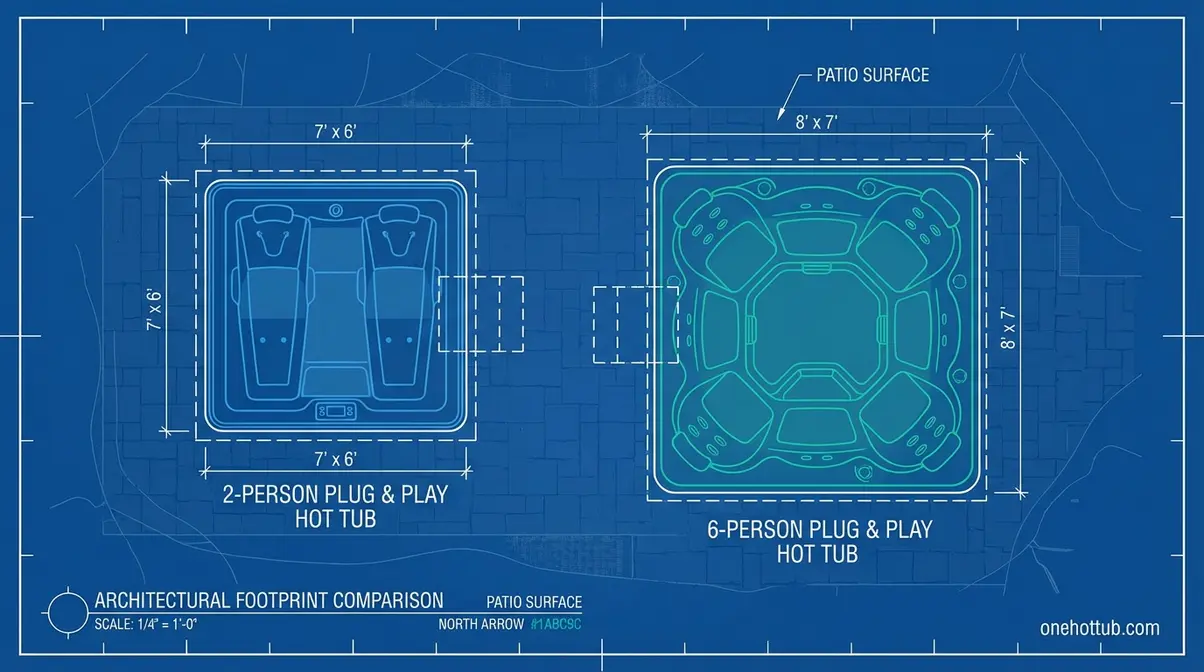
Caption: A 2-person plug and play hot tub fits in roughly 7′ × 6′ of patio space; a 5-6 person model typically requires at least 8′ × 7′.
The 110V Reality Check applies directly to size: a larger tub holds more water, which means longer heating times and a higher energy draw on a 110V circuit. Buyers who prioritize spontaneous evening soaks should lean toward smaller models.
Best 2-Person Plug and Play Hot Tubs
A 2-person plug and play hot tub typically fits in a 7′ × 6′ footprint and holds 150-200 gallons of water. The AquaRest AR-300, a compact 2-person plug and play hot tub, is the strongest performer in this category. Its 80″ × 68″ footprint fits on most standard apartment patios and decks, and the 160-gallon volume reaches target temperature faster than any 4-6 person model on the same 110V circuit.
For couples looking for a more affordable entry point, the AquaRest Select 300 offers the same 20-jet configuration at around $3,399. Both models use full-foam insulation, which is essential for heat retention when you’re working with a 1kW friction heater.
Why 2-person models make sense for most buyers: Across owner communities on Reddit’s r/hottub and retailer review platforms, the consistent feedback from 2-person tub owners is that the faster heating time and lower energy cost make daily use more practical. A smaller tub you use five nights a week delivers more value than a 6-person model you use once on weekends because it takes too long to heat.
Best 6-Person Plug and Play Hot Tubs
A 6-person plug and play hot tub typically holds 300-500 gallons and requires a firm level surface of at least 8′ × 7′. The Freeflow Monterey Premier, the largest model in the Freeflow line, seats up to 7 adults with 22 jets and a 320-gallon capacity. At 110V, expect heating times of 28+ hours from a cold fill.
The Freeflow Excursion Premier (300 gallons, 25 jets, 5-person) is the more practical choice for most families — it seats enough people for a family of four with room for guests, and the 86″ × 77″ footprint is more manageable than the Monterey’s larger frame.
Important size note: Full-foam insulation becomes even more critical in larger tubs. Without it, a 300-gallon tub on a 110V circuit loses heat faster than the 1kW heater can compensate in ambient temperatures below 50°F. Both Freeflow Premier models use full-foam as standard — a key reason they outperform cheaper large-capacity alternatives in cold-weather settings.
For a dedicated guide to large-capacity options, see our best plug and play hot tubs guide for full-size comparisons.
Best Affordable Plug & Play Tubs & Deals
Affordability in the plug and play category means more than the sticker price. The best budget models balance upfront cost with realistic long-term energy expenses — and the difference between a well-insulated $3,500 tub and a poorly insulated $2,000 model can easily flip the total cost of ownership within 18 months.
Best Budget Models Under $3,500
The Lifesmart LS100 remains the most proven budget-friendly option in the plug and play category. At $3,299–$3,499 (as of February 2026), it offers a 4-person capacity, 13 jets, and a 1.0 HP pump on a standard 15A outlet — all backed by verified 2+ year owner reports.
For buyers who can stretch to the $4,000–$5,000 range, the Lifesmart LS100DX adds 20 jets and a waterfall feature while maintaining the same 110V plug-in convenience. At ~$4,999, it bridges the gap between the entry-level LS100 and premium models like the AquaRest AR-300.
The insulation tradeoff at budget price points: Lifesmart LS100 models use partial-foam insulation — a cost-cutting measure that affects heat retention. In practice, this means higher monthly energy costs compared to full-foam alternatives. For buyers in mild climates who use the tub seasonally, this difference is manageable. For year-round users in cold climates, the energy cost gap over 3 years can exceed the initial price difference between models.
True Cost of Ownership for 110V Tubs
The average plug and play hot tub consumes approximately 2,514 kWh per year (CSU research) — a figure that varies significantly based on insulation quality, climate, and usage frequency. At the U.S. average electricity rate of approximately $0.16/kWh (U.S. Energy Information Administration, 2026), that translates to roughly $402 per year in energy costs for a well-maintained, well-insulated model.
| Insulation Type | Est. Annual kWh | Est. Annual Cost (at $0.16/kWh) | Heat Retention |
|---|---|---|---|
| Full-foam | ~2,000–2,500 kWh | ~$320–$400/yr | Excellent |
| Partial-foam | ~2,500–3,500 kWh | ~$400–$560/yr | Moderate |
| No foam (basic) | ~3,500–5,000 kWh | ~$560–$800/yr | Poor |
“This is about the most budget friendly hot tub on the market and I’ve owned this hot tub for two years.”
— Verified Lifesmart LS100 owner (retailer review aggregate)
Full-foam insulation is the single most important long-term cost factor in the plug and play category. A tub that costs $1,000 more upfront but uses 1,000 fewer kWh per year pays for itself within two to three years in energy savings alone — a calculation no competitor guide currently presents.
When and Where to Find Clearance Deals
The best timing for plug and play hot tub clearance deals follows a predictable seasonal pattern. Retailers discount end-of-season inventory in September through November, when outdoor leisure purchasing slows. January and February also see clearance pricing as new model year inventory arrives.
Check our hot tub buying guide for timing strategies and negotiation tips with local dealers. Big-box retailers like Home Depot and Sam’s Club run seasonal hot tub promotions that can reduce prices by 15-25% on prior-year models. Manufacturer outlet sites (Lifesmart Outlet, AquaRest Outlet) occasionally offer factory-direct pricing below retail.
110V vs. 220V Hot Tubs: Honest Comparison
A 110V plug and play hot tub uses your home’s standard household circuit — the same outlet that powers a window air conditioner. No panel upgrade, no electrician, no permit in most jurisdictions. That convenience comes with real performance tradeoffs that every buyer deserves to understand before purchase.
How 110V Plug and Play Systems Work
A 110V plug and play system draws 1,000-1,500 watts through a dedicated 15-20 amp GFCI circuit — the same type of circuit required for a refrigerator or microwave. The heater in most plug and play models runs at 1kW (1,000 watts), which raises water temperature at roughly 1-2°F per hour under ideal conditions (Polar Springs, 2026). A 220V/240V traditional hot tub, by contrast, uses a 4-5.5kW heater on a dedicated 50-amp circuit — heating the same volume of water 4-5× faster.
The practical result: a 110V plug and play hot tub takes 24+ hours to heat from a cold fill, while a 240V model heats in 6-10 hours. For daily users who keep the tub at temperature continuously (recommended), the heating time gap is mostly irrelevant — the tub stays warm between uses. For buyers who plan to drain and refill frequently, the 24-hour initial heat-up is a genuine planning constraint.
110V Reality Check: Jet/Heater Tradeoffs
The 110V Reality Check is the defining limitation of plug and play ownership: most 110V models cannot run the heater and high-speed jets simultaneously. Here’s why.
A 15-amp circuit at 110V provides a maximum of 1,650 watts of usable power. The pump motor draws 800-1,200 watts at high speed. The heater draws 1,000 watts. Running both simultaneously would exceed the circuit’s capacity — triggering the GFCI breaker or causing a tripping cycle. Manufacturers address this through automatic load management: when you activate high-speed jets, the heater pauses. When jets return to low speed or off, the heater resumes.
In practice, this means your water temperature will drop slightly during an aggressive jet session, then recover afterward. For most soakers, the drop is 1-3°F over a 20-minute session — barely noticeable. However, in cold ambient temperatures (below 40°F), the heater’s inability to run during jet use can cause more significant temperature loss in larger-volume tubs.
The convertible 110V/240V advantage: Models like the AquaRest AR-300 are wired to operate at either voltage. At 240V with a 4kW heater, the jet/heater limitation disappears — both run simultaneously. If you anticipate wanting full simultaneous performance, choose a convertible model now rather than replacing the tub later.
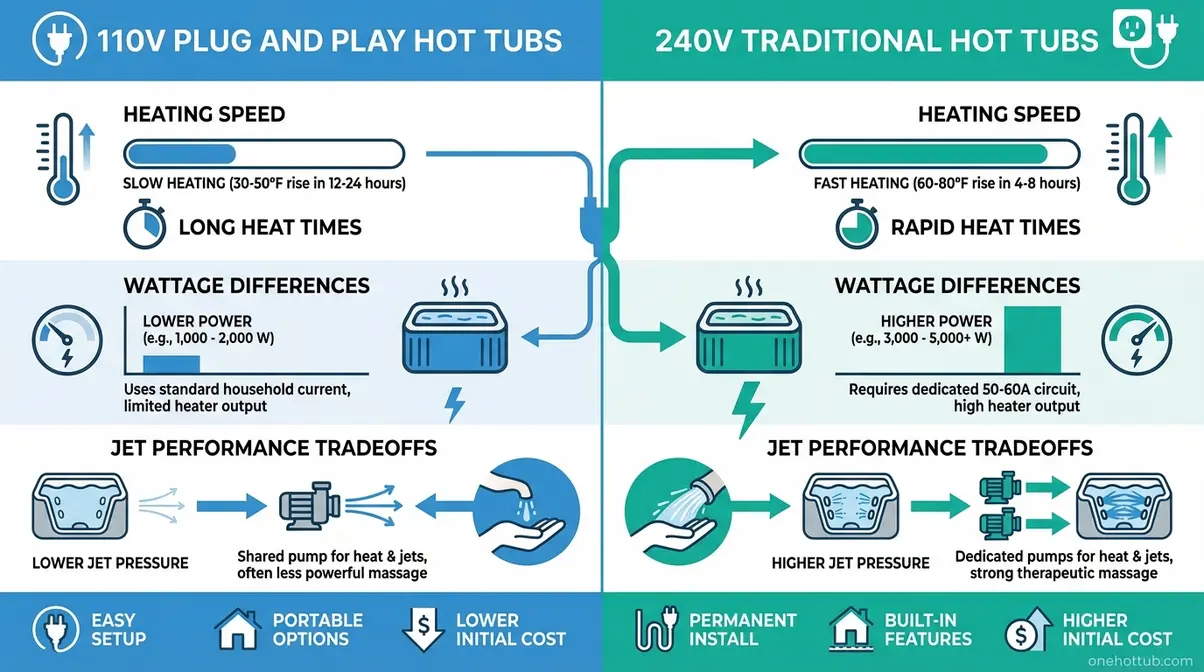
Caption: The core tradeoff — 110V delivers plug-in convenience; 240V delivers simultaneous heater and jet performance.
Disadvantages of Plug and Play Hot Tubs
Honest coverage requires naming the real limitations of plug and play hot tubs beyond the jet/heater tradeoff:
- Slower heating: 24+ hours from cold fill vs. 6-10 hours for a 240V model — a real constraint if you drain and refill regularly
- Lower jet pressure: A 1.0-1.5 HP pump at 110V produces noticeably less jet force than a 3-5 HP pump on 240V — sufficient for relaxation and mild hydrotherapy, but not equivalent to a full therapeutic spa
- Temperature recovery: After a long cold-weather soak, temperature recovery takes longer on 110V — budget 4-6 hours to return to 104°F in winter conditions
- Simultaneous use limits: As described in The 110V Reality Check — heater and high-speed jets cannot run at the same time on most models
- Energy efficiency gap: Without full-foam insulation, heat loss in cold climates can significantly increase energy costs (see TCO table above)
Can You Upgrade to 240V Later?
Yes — but only if your model is designed for it. Convertible plug and play hot tubs (like the AquaRest AR-300) are pre-wired to accept either 110V or 240V power. Upgrading requires a licensed electrician to run a dedicated 240V/30-40A circuit — typically costing $300-$800 depending on panel distance. The upgrade eliminates the jet/heater limitation and cuts heating time to 6-10 hours.
Non-convertible models (including the Lifesmart LS100) are not designed for 240V conversion and should not be modified. Attempting to do so voids the warranty and creates a fire and electrocution risk. If future upgradeability matters to you, verify convertibility before purchasing.
For more context on electrical requirements, see our hot tub buying guide covering dedicated circuit planning.
Salt Water Plug & Play Tubs: Worth It?
Salt water systems use a salt chlorine generator (SCG) to produce chlorine from dissolved salt, reducing the need for manual chemical additions. Several plug and play models are compatible with aftermarket SCG units, though few ship with them as standard.
For plug and play buyers, the key consideration is power draw. An SCG unit adds 50-200 watts of continuous load — a meaningful addition on a 15A circuit already managing heater and pump demands. Buyers interested in salt water systems should verify their model’s total circuit load before adding an SCG, and consult with the manufacturer about compatibility.
Health Benefits and Safety Rules You Need to Know
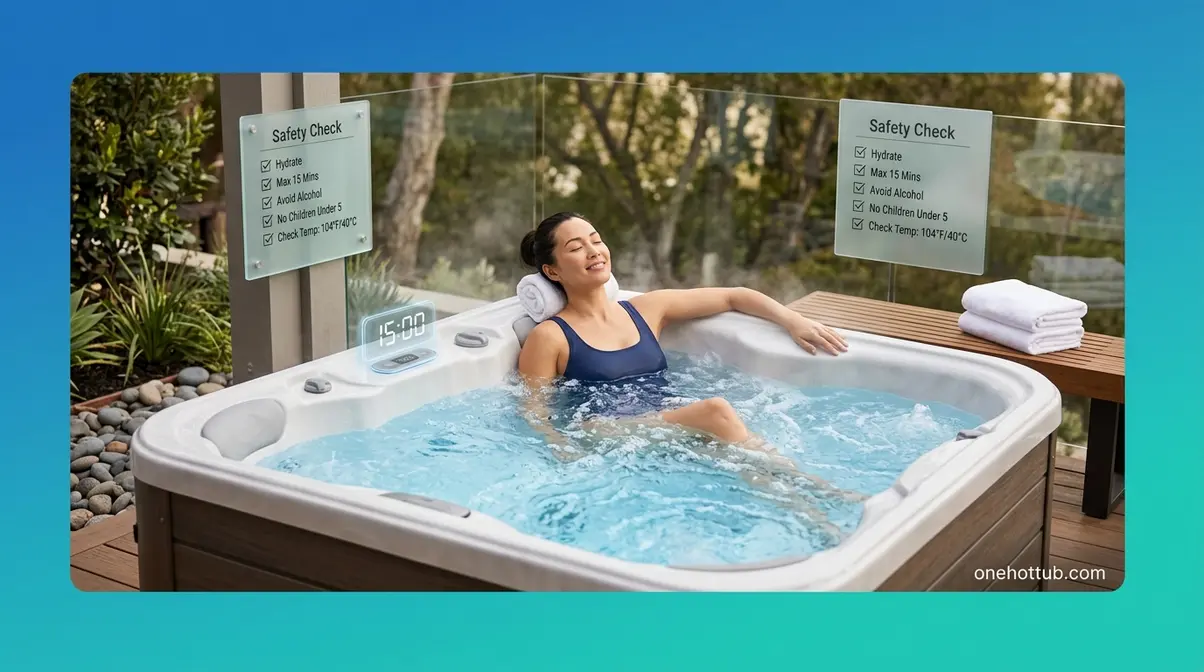
Medical Disclaimer: The health information in this section is for educational purposes only and does not constitute medical advice. Always consult your physician before using a hot tub if you have a pre-existing health condition.
Health information reviewed by a certified pool and spa professional. For cardiovascular or neurological conditions, consult your physician or specialist before beginning any hydrotherapy regimen.
Hot tubs provide accessible, daily hydrotherapy that may meaningfully reduce symptoms and improve function for several common conditions. The evidence base is stronger than most buyers realize — and more nuanced than most salespeople acknowledge.
Therapeutic Benefits of Hydrotherapy
An updated meta-analysis published in NIH PMC (PMC6750337, 2019) confirmed that spa therapy may benefit pain relief and improve lumbar spine function among patients with chronic low back pain — analyzing 16 studies with 1,656 participants. A more recent systematic review (PMC10658949, 2023) found that hot spring hydrotherapy significantly reduced chronic low back pain intensity (SMD = −0.901, P=0.044) and functional disability (SMD = −3.236, P<0.0001).
Beyond back pain, Harvard Health Publishing (2020) notes that people who take frequent hot baths may lower their risk of certain heart problems — though this benefit comes with important caveats for those with existing cardiovascular conditions. The buoyancy effect of water immersion reduces compressive load on joints, and heat-induced vasodilation improves peripheral circulation — both mechanisms that support the reported benefits for musculoskeletal conditions.
The practical implication for plug and play buyers: Even a 13-jet 110V model delivers sufficient hydrotherapy for back pain relief and relaxation. You don’t need a 50-jet 240V spa to access meaningful therapeutic benefit — the temperature and buoyancy effects are equally present at any jet count.
The 15-Minute Rule Explained
The CDC and CPSC recommend limiting hot tub sessions to 15 minutes at maximum temperature (104°F) — particularly for first-time users, older adults, pregnant individuals, and anyone with cardiovascular conditions. The physiological reason: prolonged immersion in 104°F water raises core body temperature, increases heart rate, and dilates blood vessels. In healthy adults, this is manageable. In vulnerable populations, it can cause dizziness, fainting, or cardiovascular stress.
- Practical 15-minute rule guidelines:
- First-time users: Start at 100°F, not 104°F, and limit sessions to 10-15 minutes
- Regular users in good health: 15-20 minute sessions at 100-104°F are generally well-tolerated
- Children under 5: Avoid hot tubs entirely (CPSC guidance)
- Pregnant individuals: Consult your OB before any hot tub use — core temperature elevation in the first trimester carries documented fetal risk
After 15-20 minutes, exit, cool down for at least 5-10 minutes, rehydrate, and re-enter if desired. This cycle approach allows longer total soak time while managing core temperature safely.
Can a hot tub trigger AFib?
Yes, hot tub use can trigger AFib in susceptible individuals. Cleveland Clinic cardiologist Curtis Rimmerman, MD, states that “hot tubs and saunas are potentially dangerous for patients with known or suspected heart disease.” The mechanism: sudden heat exposure causes blood vessels to dilate rapidly, dropping blood pressure and increasing heart rate — a cardiovascular stress pattern that can trigger arrhythmias in susceptible individuals.
For AFib specifically, heat stress forces the heart to work harder to maintain blood pressure, which can push an already-irritable atrial electrical system into arrhythmia. If you have diagnosed AFib, speak with your cardiologist before using any hot tub. Some patients with stable, well-controlled AFib may use hot tubs safely at lower temperatures (100-102°F) with shorter session times — but this is a decision for your cardiologist, not a buying guide.
A 1993 study published in Mayo Clinic Proceedings (PubMed 8417250) found that 15-minute hot tub immersion at 40°C was safe for men with stable coronary artery disease under controlled conditions — but this study specifically excluded patients with unstable arrhythmias. Do not extrapolate this finding to active AFib without specialist guidance.
Will a hot tub help a sciatic nerve?
Hydrotherapy may help relieve sciatica symptoms, particularly when nerve irritation results from muscle tension rather than structural causes. Research supports hydrotherapy as a complementary approach to sciatica management, particularly when sciatic symptoms result from muscle tension or inflammation rather than structural nerve compression. The NIH meta-analysis (PMC6750337) covering 1,656 patients found significant improvements in chronic low back pain — the condition most commonly associated with sciatic nerve irritation — following regular spa therapy.
The mechanisms are straightforward: heat relaxes the piriformis and paraspinal muscles that frequently compress the sciatic nerve, while buoyancy reduces the gravitational load on lumbar discs during movement. Targeted jet massage to the lower back and glutes may further reduce muscle tension around the nerve pathway.
Important caveats: Hydrotherapy may help relieve sciatica symptoms caused by muscle tension, but it will not address structural causes like herniated discs or spinal stenosis. If your sciatica is severe, worsening, or accompanied by leg weakness or bowel/bladder changes, consult your physician before beginning any hydrotherapy regimen. Research indicates benefits are strongest for mild-to-moderate chronic symptoms.
For buyers specifically purchasing a hot tub for sciatica relief, jet placement matters more than jet count. Look for models with dedicated lumbar jets positioned at the lower back level — the AquaRest AR-300’s lumbar arch support and targeted jet placement make it a stronger therapeutic choice than models with generic jet configurations.
Buying a Plug & Play Hot Tub in UK or Canada
Electrical standards and climate requirements differ significantly outside the US — two factors that directly affect which models are available and how they perform year-round.
UK Buyers: 13-Amp Plug & Play Guide
In the UK, “plug and play” hot tubs run on a standard 13-amp socket — the British equivalent of the US 15-amp/110V outlet. UK plug and play models are specifically designed for this circuit and use 2kW heaters (slightly more powerful than US 1kW models), which modestly improves heating speed.
Key UK-specific considerations: most UK plug and play models require a weatherproof outdoor socket installed by a qualified electrician — this is not optional, as running an extension cord to an indoor socket is a safety and insurance risk. Models like the H2O Pure Bliss (18 jets, 2kW heater) and the H2O 1000 Series (6-person, 23 jets) are purpose-built for UK 13-amp circuits and widely available through UK retailers.
UK buyers should verify that any model they purchase carries a CE mark and is rated for outdoor use on a 13-amp RCD-protected circuit. Full-foam insulation is particularly important in the UK’s damp climate, where partial-foam models lose heat more quickly in cool, wet conditions.
Canadian Buyers: Insulation Needs
Canadian buyers face the most demanding performance environment for plug and play hot tubs. In provinces like Alberta, Manitoba, and Ontario, ambient winter temperatures regularly drop below -20°C — conditions that will overwhelm any plug and play model without full-foam insulation and a high-quality insulated cover.
Full-foam insulation is non-negotiable for Canadian buyers. A partial-foam tub in a Canadian winter will run its 1kW heater continuously without maintaining target temperature, dramatically increasing energy costs and potentially damaging the heating element through overwork. Freeflow Spas Premier Series models, which use full-foam as standard, are among the few plug and play options with documented performance in cold-climate conditions.
Additional Canadian-specific recommendations: invest in a thermal cover with an R-value of at least R-12 (many standard covers are R-6 to R-8), consider a freeze protection mode (available on select Freeflow and AquaRest models), and plan for a slightly longer initial heat-up time in winter — 28-36 hours from cold fill in sub-zero conditions is realistic on 110V.
Check our hot tub maintenance in cold climates guide for winterization and freeze protection guidance.
Common Pitfalls and When to Consider Alternatives
Common Buying Mistakes to Avoid
Mistake 1: Choosing capacity over insulation. Buyers often prioritize seating capacity and jet count while ignoring insulation type. A 6-person tub with partial-foam insulation will cost significantly more to run and maintain temperature than a 4-person model with full-foam — especially in climates where ambient temperature drops below 50°F regularly. Always verify insulation type before purchasing.
Mistake 2: Ignoring the dedicated circuit requirement. Every plug and play hot tub requires a dedicated 15-20A GFCI circuit — not a shared outlet. Running a hot tub on a shared circuit trips breakers, damages electronics, and creates a fire risk. If your outdoor outlet is shared with other appliances, budget for an electrician to add a dedicated circuit ($200-$500) before your tub arrives.
Mistake 3: Not accounting for initial heating time in the purchase decision. Buyers who plan to fill and heat the tub spontaneously are frequently disappointed by the 24+ hour initial heat-up on 110V. If you envision a Friday night impulse soak, you need to fill and start heating by Thursday morning. Buyers who keep the tub at temperature continuously avoid this issue entirely — but that requires leaving the heater running 24/7, which factors into the annual energy cost.
Mistake 4: Buying without measuring the installation space. A 5-person plug and play tub weighs 2,000-2,500 lbs when filled. It requires a level surface rated for that load — most wood decks are not adequately reinforced. Concrete pads and reinforced composite decking are the safest options. Measure your space and verify load ratings before ordering.
When a 220V Hot Tub Is Better
A plug and play hot tub is the right choice for most first-time buyers — but not all of them. Consider a traditional 240V hard-wired spa if:
- You want simultaneous heater and jet performance at full power without the load management tradeoff
- You use the tub daily and want 6-10 hour heating rather than 24+ hours from cold
- You have 4+ regular users who expect high-pressure therapeutic jets — a 3-5 HP pump on 240V delivers noticeably stronger massage than any 110V model
- You live in a cold climate and want a spa that maintains 104°F in sub-freezing temperatures without running continuously on a limited heater
The cost difference is real: a traditional 240V spa starts around $5,000-$8,000 for entry-level models, plus $500-$2,000 for electrical installation. However, for buyers who will use the tub daily for 5+ years, the performance and energy efficiency advantages of 240V can justify the higher upfront investment.
See our plug and play vs traditional hot tub comparison for a full side-by-side breakdown.
Frequently Asked Questions
Are plug and play hot tubs any good?
Plug and play hot tubs are genuinely good for relaxation, moderate hydrotherapy, and first-time hot tub ownership. Models like the AquaRest AR-300 deliver 20 stainless steel jets and full-foam insulation on a standard 110V outlet — performance that was unavailable in this category five years ago.
What is the most trouble free hot tub?
The AquaRest AR-300 is among the most trouble free plug and play hot tubs based on owner-reported reliability across retailer review platforms. Its roto-molded uni-body shell resists cracking, its ozone sanitation system reduces chemical maintenance, and its convertible 110V/240V design means you won’t need to replace the unit if you later want more performance. Among budget options, the Lifesmart LS100 has documented 2+ year owner reliability at its price point — making it the most trouble free entry-level option.
Why is there a 15-minute hot tub rule?
The 15-minute rule exists because prolonged immersion at 104°F raises core body temperature to potentially dangerous levels. The CPSC and CDC recommend limiting sessions to 15 minutes at maximum temperature because heat-induced vasodilation drops blood pressure, increases heart rate, and can cause dizziness or fainting — particularly in older adults, pregnant individuals, and those with cardiovascular conditions. This guideline is crucial for maintaining a safe core body temperature. Exceeding this time limit can lead to unexpected fatigue or lightheadedness upon exiting the water. Always listen to your body and step out if you feel overly warm.
What vitamin kills sciatic nerve pain?
No vitamin “kills” sciatic nerve pain, but research suggests B12, D3, and magnesium deficiencies may worsen nerve pain symptoms. A 2023 review noted that vitamin B12 supports myelin sheath integrity — the protective coating around nerve fibers.
When should you not use a hot tub?
Avoid hot tub use if you have: uncontrolled high blood pressure, unstable heart disease, active skin infections or open wounds, a fever, or are in the first trimester of pregnancy. The CDC also advises against hot tub use immediately after heavy alcohol consumption, which impairs the body’s ability to regulate core temperature and increases drowning and cardiovascular risk. Children under 5 should not use hot tubs due to their limited ability to regulate body temperature. When in doubt, consult your physician before your first soak.
What are the top 3 hot tub brands?
Among plug and play brands, AquaRest, Lifesmart, and Freeflow Spas dominate the 110V category based on owner reliability data, product availability, and documented track records. AquaRest leads on jet quality and convertible design. Lifesmart leads on entry-level affordability and widespread retail availability. Freeflow Spas leads on family-capacity rotomolded construction with full-foam insulation. These manufacturers have spent years refining their 110V technology to maximize heat retention and jet performance. When shopping, always verify the warranty terms offered by authorized dealers. Investing in a reputable brand ensures you have access to replacement parts down the road.
Choosing the Right Plug & Play Hot Tub
For couples and first-time buyers, the best plug and play hot tubs in 2026 deliver real hydrotherapy performance — 13-25 jets, full-foam insulation, and genuine therapeutic benefit — on a standard 110V outlet. The CSU research figure of 2,514 kWh per year gives you a realistic energy budget baseline: expect $320-$560 annually depending on insulation quality and climate. The AquaRest AR-300 remains the strongest overall value for its combination of 20 jets, full-foam insulation, and 240V convertibility. For families, the Freeflow Excursion Premier delivers 5-person capacity on a plug-in circuit.
The 110V Reality Check is the framework that should anchor every plug and play purchase decision. Understanding the jet/heater simultaneous-use limitation, the 24+ hour initial heating time, and the insulation quality gap between models transforms a potentially disappointing purchase into an informed one. Buyers who understand these tradeoffs upfront become long-term satisfied owners. Buyers who don’t discover them at the first cold-weather soak.
Your next step: measure your outdoor space, verify your outlet is a dedicated 15-20A GFCI circuit, and compare the AquaRest AR-300 (couples/small patios) against the Freeflow Excursion Premier (families) as your two primary candidates. If budget is the primary driver, the Lifesmart LS100 at $3,299-$3,499 has proven 2+ year owner reliability that makes it a credible starting point. Trial a model with a return window if your retailer offers one — 30 days of real use will tell you more than any comparison guide.
Explore our top 5 plug and play hot tub models | Read our hot tub water care guide | Find insulated hot tub covers for ongoing ownership resources.

David King
Hot tub tester and writer at One Hot Tub.