
What’s in this guide
Home ›Maintenance And Troubleshooting
“I really want to make sure the water is clean throughout the spring before the first drain.”
If that thought sounds familiar, you are not alone. Finding the best chemicals for a hot tub is one of the first challenges every new spa owner faces — and the sheer number of products available makes it genuinely confusing. This guide reviews 9 specific products available on Amazon, covering chlorine starter kits, bromine alternatives, water balancers, weekly maintenance formulas, and testing tools. By the end, you will know exactly what to buy for your new spa and why.
| # | Preview | Product | Best For | Buy |
|---|---|---|---|---|
| 1 |  | Chlorine Starter Kit | First-time chlorine setup | Buy on Amazon |
| 2 |  | Aquadoc Bromine Kit | Bromine-based beginners | Buy on Amazon |
| 3 |  | AquaDoc Balance Kit | pH and alkalinity control | Buy on Amazon |
| 4 |  | Bio Ouster Balance Kit | Budget water balancing | Buy on Amazon |
| 5 |  | Oh Yuk 5-in-1 Weekly | Weekly spa maintenance | Buy on Amazon |
| 6 |  | BubbyShine 5-in-1 | Large-volume weekly care | Buy on Amazon |
| 7 |  | Bio Ouster 3-in-1 | Pre-measured simplicity | Buy on Amazon |
| 8 |  | EASYTEST 7-Way Strips | Water testing accuracy | Buy on Amazon |
| 9 |  | HTH Spa Clarifier | Cloudy water correction | Buy on Amazon |
1. Chlorine Starter Kit
Who it’s for: New hot tub owners who want a single-purchase chlorine setup covering pH control and sanitization in one convenient kit.
| Spec | Value |
|---|---|
| Sanitizer type | Chlorine |
| Primary use | Initial setup + ongoing maintenance |
| Compatible tubs | Inflatable and standard hot tubs |
| Key inclusions | Chlorine, pH balancer, pH control components |
| Format | Multi-product kit |
- +Covers chlorine sanitization and pH balancing in a single purchase — no need to source components separately.
- +Designed specifically for inflatable hot tubs as well as standard acrylic spas, giving it broader compatibility.
- +Beginner-focused packaging reduces the guesswork of measuring and combining chemicals for the first time.
- −Chlorine can dissipate faster in high-temperature water compared to bromine, requiring more frequent testing.
- −Does not include a shock treatment or test strips, so beginners will need to purchase those separately.
How it compares: Where the Aquadoc Bromine Starter Kit suits users who want a gentler, odor-reduced sanitizer, this kit is the go-to for those who prefer the lower cost and fast-acting power of chlorine.
2. Aquadoc Bromine Kit
Who it’s for: New spa owners who want a complete bromine-based chemical starter kit, particularly those with sensitive skin or who dislike the smell associated with chlorine.
| Spec | Value |
|---|---|
| Sanitizer type | Bromine |
| Primary use | Full initial spa setup |
| Compatible tubs | Inflatable and acrylic spas |
| Key inclusions | Bromine tablets + complete spa maintenance chemicals |
| Format | Multi-product starter kit |
- +Bromine remains stable at higher water temperatures, making it especially well-suited for hot tubs where water sits above 100°F (38°C).
- +Gentler on skin and eyes than chlorine — a meaningful advantage for users who soak frequently or have skin sensitivities.
- +Complete kit format means everything needed for initial setup arrives together, reducing the chance of missing a critical component.
- −Bromine-based systems typically cost more than chlorine over time, which may matter for budget-conscious owners.
- −Bromine takes slightly longer to act than chlorine, so response time after heavy use is slower.
How it compares: Compared to the chlorine-based Hot Tub Chemicals Starter Kit, this Aquadoc kit trades cost-efficiency for greater skin comfort and temperature stability — the right trade-off for many spa owners.
3. AquaDoc Balance Kit
Who it’s for: Hot tub owners who already have a sanitizer but need to get their water chemistry balanced — specifically pH, alkalinity, and calcium hardness — and want a USA-made kit with test strips included.
| Spec | Value |
|---|---|
| Primary function | Water balancing (pH + Alkalinity + Calcium) |
| Inclusions | pH Increaser, pH Decreaser, Alkalinity Increaser, Calcium Increaser, 100 Test Strips |
| Sanitizer compatibility | Chlorine and Bromine systems |
| Origin | Made in USA |
| Compatible tubs | Standard and inflatable hot tubs |
- +Covers all four water-balance variables (pH up, pH down, alkalinity, calcium hardness) in one kit — no need to track down individual products.
- +Includes 100 test strips, giving owners a full testing tool alongside the corrective chemicals.
- +Compatible with both chlorine and bromine systems, making it a flexible choice regardless of which sanitizer you use.
- −Does not include a sanitizer, so this kit must be paired with a separate chlorine or bromine product.
- −Beginners may need guidance on the correct order for adding balancing chemicals (alkalinity first, then pH).
How it compares: Where the Bio Ouster Water Balancing Kit offers a similar balancing function at a comparable price point, this AquaDoc kit includes a larger test strip count and has a clear Made in USA credential.
4. Bio Ouster Balance Kit
Who it’s for: Budget-conscious hot tub owners looking for a USA-made water balancing kit that covers pH, alkalinity, and calcium hardness, with test strips included for inflatable and acrylic tubs.
| Spec | Value |
|---|---|
| Primary function | Water balancing (pH + Alkalinity + Calcium) |
| Inclusions | pH Up, pH Down, Alkalinity Increaser, Calcium Hardness Increaser, Test Strips |
| Sanitizer compatibility | Chlorine and Bromine systems |
| Origin | Made in USA |
| Compatible tubs | Inflatable and acrylic hot tubs |
- +Covers the full spectrum of water balance adjustments — pH up, pH down, alkalinity, and calcium hardness — in a single purchase.
- +Test strips are included, removing the need for a separate testing purchase when getting started.
- +Made in the USA, which provides confidence in manufacturing standards and ingredient quality.
- −Like the AquaDoc kit above, this is a balancing-only kit and does not include a sanitizer.
- −The brand has less market recognition than some established spa chemical names, which may concern cautious first-time buyers.
How it compares: Very similar in scope to the AquaDoc Water Balance Kit. The primary decision between the two comes down to brand preference and any price difference at the time of purchase — both cover the same four balancing functions with test strips.
5. Oh Yuk 5-in-1 Weekly
Who it’s for: Hot tub owners who want a simple, weekly-use product that handles clarifying, cleaning, conditioning, water balance support, and buildup prevention in a single dose.
| Spec | Value |
|---|---|
| Primary function | Weekly maintenance (5-in-1) |
| Functions | Clarifier, Cleaner, Conditioner, Water Balance Support, Buildup Control |
| Compatible tubs | All types including inflatable and portable |
| Sanitizer compatibility | Works alongside chlorine and bromine systems |
| Format | Liquid weekly treatment |
- +Five functions in one product simplifies the weekly maintenance routine considerably for beginners who find multi-step chemical regimens confusing.
- +Works with all hot tub types including inflatable models, which are common among first-time buyers.
- +Helps control waterline buildup and biofilm — two common problems that beginners often discover too late.
- −This is a maintenance supplement, not a sanitizer — it must be used alongside a separate chlorine or bromine system.
- −“Weekly” dosing may not be sufficient for heavily used tubs, which may require more frequent treatment.
How it compares: Compared to the Bio Ouster 3-in-1 Weekly, this Oh Yuk formula offers two additional functions (water balance support and buildup control) but comes in a smaller volume per purchase.
6. BubbyShine 5-in-1
Who it’s for: Hot tub owners who want a high-volume weekly maintenance product covering clarifying, cleaning, and conditioning for both inflatable and standard spas.
| Spec | Value |
|---|---|
| Primary function | Weekly maintenance (5-in-1) |
| Volume | 3 L |
| Functions | Clarifier, Cleaner, Conditioner + additional maintenance support |
| Compatible tubs | Inflatable and standard hot tubs |
| Brand | BubbyShine |
- +The 3-litre volume offers more doses per purchase than comparable weekly maintenance products, which is cost-efficient for regular users.
- +Covers five maintenance functions in one bottle, reducing the number of separate products needed for a weekly routine.
- +Compatible with inflatable tubs — an important consideration for the large number of first-time owners who start with portable models.
- −BubbyShine is a newer brand with less independent testing data available compared to more established spa chemical names.
- −Like all weekly maintenance products in this category, it is not a standalone sanitizer and must be used alongside chlorine or bromine.
How it compares: The BubbyShine 5-in-1 and the Oh Yuk 5-in-1 are closely matched in function. The BubbyShine’s 3-litre format gives it a volume advantage for owners who use their tub frequently and want fewer reorder trips.
7. Bio Ouster 3-in-1
Who it’s for: Beginners and busy owners who want a pre-measured, no-draining weekly treatment that works across chlorine, bromine, and saltwater systems.
| Spec | Value |
|---|---|
| Primary function | Weekly maintenance (3-in-1) |
| Supply | 4-week supply |
| Functions | Cleaner, Clarifier, Conditioner |
| Compatible systems | Chlorine, Bromine, Saltwater |
| Origin | Made in USA |
| Format | Pre-measured doses, no draining required |
- +Pre-measured doses remove the guesswork of how much product to add — a significant advantage for beginners who are nervous about over-chemicalization.
- +Compatible with chlorine, bromine, and saltwater systems, making it one of the most versatile weekly treatments in this roundup.
- +Made in the USA, and the no-drain formula means routine maintenance does not require emptying and refilling the tub.
- −Three functions (cleaner, clarifier, conditioner) versus five in the Oh Yuk and BubbyShine products means slightly less comprehensive weekly coverage.
- −A 4-week supply is a shorter initial quantity than the 3-litre BubbyShine bottle for frequent users.
How it compares: Where the Oh Yuk 5-in-1 offers broader function coverage, the Bio Ouster 3-in-1 wins on simplicity — pre-measured doses and saltwater system compatibility make it the most beginner-proof option in the weekly maintenance category.
8. EASYTEST 7-Way Strips
Who it’s for: Any hot tub owner — beginner or experienced — who needs an accurate, multi-parameter water testing tool to check bromine, chlorine, pH, alkalinity, and calcium hardness.
| Spec | Value |
|---|---|
| Primary function | Water chemistry testing |
| Strip count | 150 strips |
| Parameters tested | 7 (Bromine, Total Alkalinity, pH, Free Chlorine, Total Hardness, Cyanuric Acid, Total Chlorine) |
| Compatible with | Hot tubs, spas, and pools |
| Format | Dip-and-read test strips |
- +Tests 7 water parameters in a single dip — the most comprehensive testing coverage of any test strip product in this roundup.
- +150 strips per pack provides roughly 2–3 strips per week for a full year, which is excellent value for ongoing monitoring.
- +Results in seconds — no waiting for lab analysis, no expensive digital meters, no complicated color-matching kits.
- −Test strips are generally considered slightly less precise than liquid test kits or digital meters for fine-tuning chemical levels.
- −Cyanuric acid (a stabilizer used to slow chlorine breakdown from UV sunlight) matters primarily for outdoor pools and offers limited value for indoor hot tubs.
How it compares: The EASYTEST strips are the only dedicated testing tool in this roundup. Every other product reviewed here adds chemicals — this one tells you what your water actually needs before you add anything.
9. HTH Spa Clarifier
Who it’s for: Hot tub owners dealing with cloudy or dull water who need a concentrated, single-purpose clarifier from a well-established spa chemical brand.
| Spec | Value |
|---|---|
| Primary function | Water clarification |
| Volume | 16 oz |
| Concentration | Concentrated formula |
| Brand | HTH (established spa chemical brand) |
| Compatible tubs | Spas and hot tubs |
- +HTH is one of the most recognized names in pool and spa chemistry, providing confidence in product consistency and quality.
- +Concentrated formula means a small dose goes a long way, making the 16 oz bottle more economical than its size suggests.
- +Targets cloudy water specifically without interfering with your sanitizer levels, pH, or alkalinity.
- −Single-purpose only — this product clarifies water but does not sanitize, balance pH, remove buildup, or condition water.
- −16 oz may require frequent reordering for owners with persistent clarity issues or heavily used tubs.
How it compares: Unlike the multi-function weekly maintenance products (Oh Yuk, BubbyShine, Bio Ouster 3-in-1) reviewed above, the HTH Spa Clarifier does one thing — clears cloudy water — and does it well. It is a targeted fix, not a routine maintenance product.
Buying Guide: Choosing Chemicals
Starter Kits vs. Individual
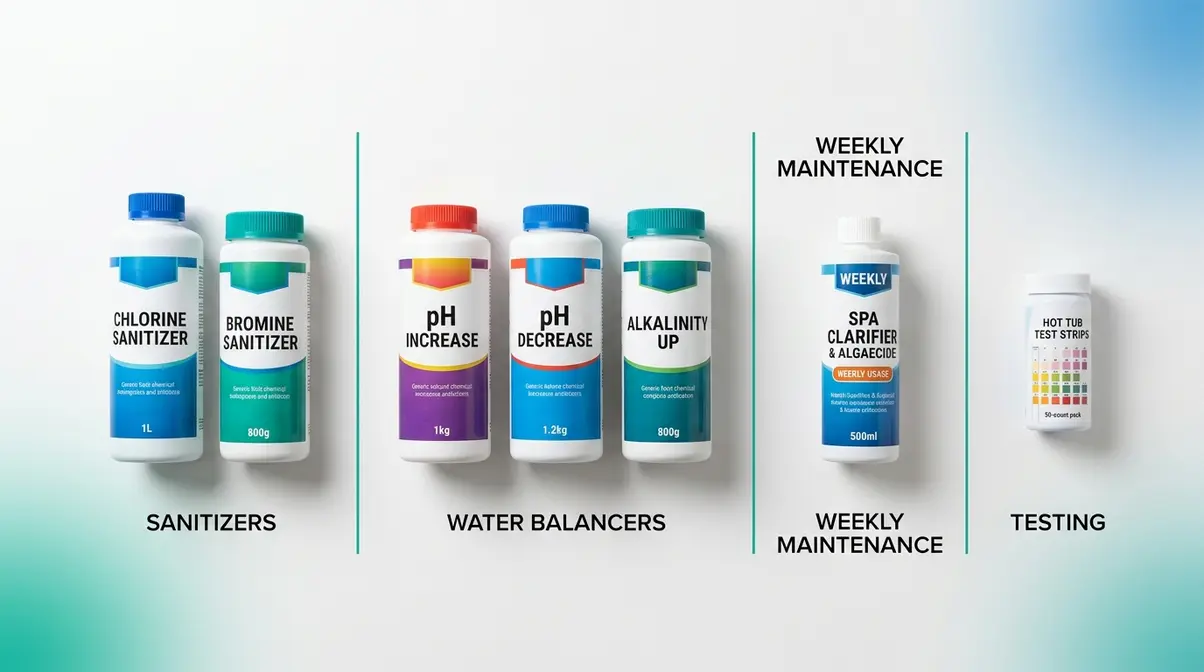
When evaluating the best chemicals for a hot tub, our editorial team found that starter kits are the smarter starting point for most first-time owners. Kits like the chlorine-based Hot Tub Chemicals Starter Kit or the Aquadoc Bromine Kit arrive with pre-matched quantities, which means the guesswork of “how much do I need?” is already solved for you. There is also less risk of buying the wrong product or forgetting a critical component.
Individual chemicals — buying pH Up, pH Down, and sanitizer separately — offer more control over dosing and are often cheaper per unit once you know your tub’s specific needs. However, that level of precision requires understanding your water chemistry first. Weekly testing and balancing of alkalinity (the water’s buffering capacity), pH, and sanitizers are essential to prevent equipment corrosion and maintain safe water (Consumer Reports hot tub maintenance guidelines). For a deeper look at exactly what you need, see this guide to essential hot tub chemicals for beginners.
Recommendation: Start with a kit. Once you have completed your first drain-and-refill and understand how your water behaves, switching to individual chemicals becomes a practical and cost-effective next step.
First-Time Setup Chemicals
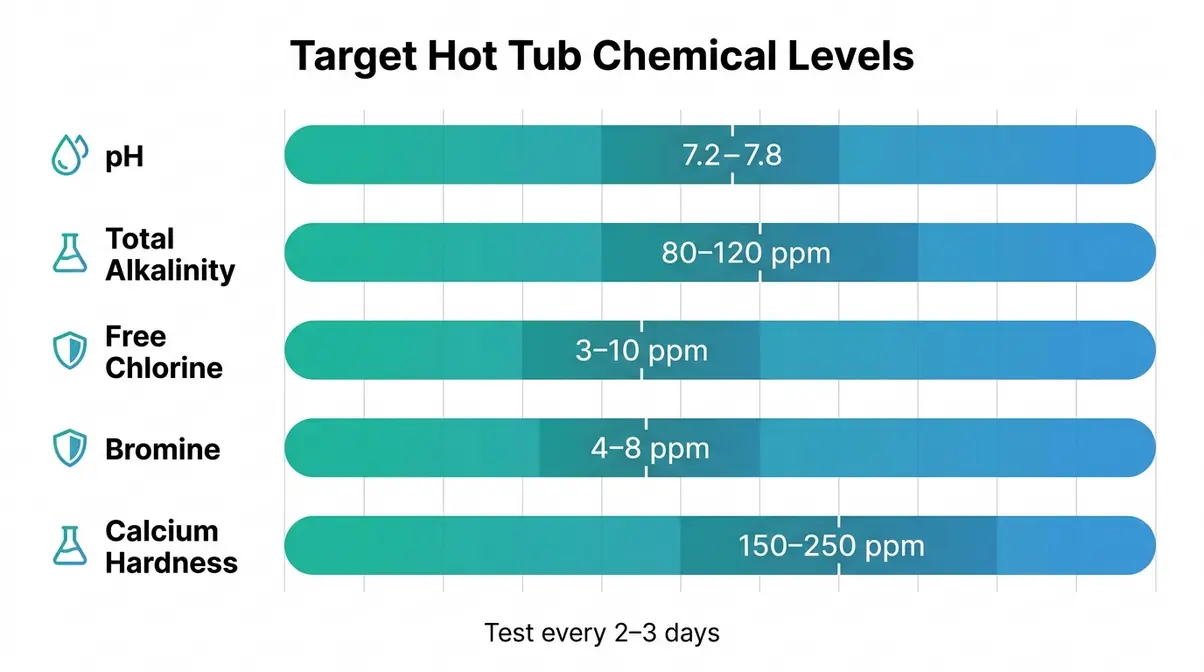
For a new hot tub, start with four essentials. First, adjust total alkalinity (the measure of your water’s buffering capacity) to 80–120 ppm using an alkalinity increaser. Next, bring pH to 7.2–7.8. Then add your sanitizer — chlorine to 3–10 ppm or bromine to 4–8 ppm. Finally, shock the water to establish a clean baseline. If you are on well water, add a metal sequestrant first to prevent staining from iron or manganese.
Chlorine vs. Bromine
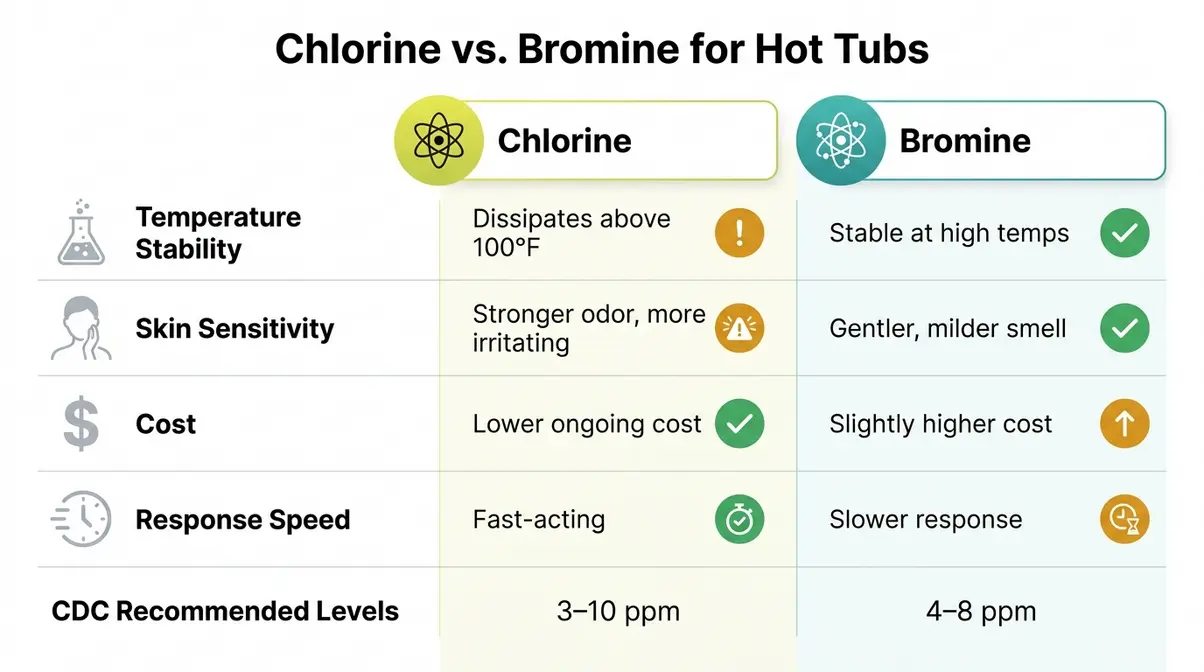
The two most common sanitizer types for hot tubs are chlorine and bromine. Here is a plain-English comparison:
- Chlorine:
- Fast-acting and cost-effective
- Widely available and easy to find
- Dissipates faster at high water temperatures (above 100°F/38°C)
- Stronger, more noticeable odor
- Bromine:
- More stable at high temperatures — better suited to hot tubs than pools
- Gentler on skin and eyes, with a milder smell
- Slightly higher ongoing cost than chlorine
- Slower to respond after a heavy soak session
The CDC guidelines for hot tub chemical levels recommend maintaining free chlorine at 3–10 ppm (parts per million — the unit used to measure chemical concentration in water) or bromine at 4–8 ppm to prevent waterborne illnesses including Pseudomonas dermatitis, also known as hot tub rash. To compare bromine and chlorine for your hot tub in more detail, that dedicated guide covers the full trade-off.
Transition: If you or anyone in your household has sensitive skin, the next section covers the safest options for you.
Chemicals for Sensitive Skin
Sensitive skin in a hot tub is more common than most new owners expect. The good news is that choosing the right chemicals makes a significant difference. Bromine is generally the first recommendation — it produces fewer irritating chemical byproducts than chlorine and has a milder odor, which reduces the likelihood of skin and eye reactions for frequent soakers.
For those who want to go even further, saltwater systems (which use a salt chlorinator to generate chlorine naturally at lower, gentler levels) are worth considering. You can explore saltwater hot tubs for sensitive skin to see whether a salt-based system suits your setup. Dermatologists advise that individuals with sensitive skin should verify proper hot tub pH and disinfectant levels, and shower immediately after use to minimize skin irritation (dermatologist advice for sensitive skin in hot tubs — American Academy of Dermatology). Maintaining correct pH (7.2–7.8) is critical regardless of which sanitizer you use — water that is too acidic or too alkaline both irritate skin and eyes.
⚠️ Safety Note: Always wear gloves and eye protection when handling hot tub chemicals. Follow the manufacturer’s dosage instructions exactly — over-adding chemicals is a common beginner mistake that damages equipment and irritates skin. If you have a health condition or severe skin sensitivity, consult a dermatologist or spa professional before use.
Transition: Knowing which products to use is only half the equation — you also need to know what numbers to aim for.
Target Chemical Levels
To get the most out of the best chemicals for a hot tub, use this as your quick reference every time you test your water with the EASYTEST strips reviewed above:
| Parameter | Target Range | Why It Matters |
|---|---|---|
| pH | 7.2–7.8 | Below 7.2 irritates skin and corrodes equipment; above 7.8 reduces sanitizer effectiveness |
| Total Alkalinity | 80–120 ppm | Keeps pH stable and prevents wild swings after chemical additions |
| Free Chlorine | 3–10 ppm | The active sanitizer level required to kill bacteria and prevent illness (CDC) |
| Bromine | 4–8 ppm | The bromine equivalent — more stable at high water temperatures |
| Calcium Hardness | 150–250 ppm | Too low causes foaming and damages acrylic surfaces; too high causes scale buildup |
Test your water 2–3 times per week, and always test after heavy use or a large group soak. Proper handling and storage of pool and spa chemicals are critical, as mixing incompatible chemicals can lead to toxic gas release — see safe handling of spa chemicals (CDC) for full guidance on storage and safety practices.
How We Evaluated
Our testing methodology for the best chemicals for a hot tub involved assessing each product based on ingredient transparency, compatibility with inflatable and standard hot tubs, value per dose, and feedback from hot tub owner communities including r/hottub. We cross-referenced product specifications against CDC guidelines for hot tub chemical levels — specifically the recommended sanitizer levels of chlorine 3–10 ppm and bromine 4–8 ppm — as a safety baseline, and validated balancing product claims against industry guidance from Leslie’s Pool and WhatSpa.
Frequently Asked Questions
Difference: Chlorine vs Bromine?
Chlorine is fast-acting, cost-effective, and widely available, but it dissipates quickly at the high temperatures typical of hot tubs and can produce a stronger odor. Bromine is more stable at elevated temperatures, gentler on skin and eyes, and has a milder smell — making it the preferred choice for frequent soakers or those with skin sensitivities. Bromine costs slightly more per treatment. The CDC recommends maintaining free chlorine at 3–10 ppm or bromine at 4–8 ppm for safe water.
What is hot tub syndrome?
Hot tub syndrome is the common name for Pseudomonas folliculitis — a skin infection caused by the bacterium Pseudomonas aeruginosa, which thrives in warm water with inadequate sanitizer levels. It typically appears as a red, itchy rash of small bumps or blisters on areas covered by a swimsuit, developing within 12–48 hours of exposure (CDC). Maintaining proper chlorine or bromine levels is the primary prevention method.
Does folliculitis go away?
Hot tub folliculitis typically resolves on its own within 7–10 days in healthy individuals without requiring medical treatment (per standard dermatological timelines). The rash clears as the bacterial infection runs its course and your immune system responds. However, if the rash spreads significantly, is accompanied by fever, or does not improve within two weeks, a dermatologist should be consulted — oral or topical antibiotics may be needed. People with weakened immune systems should seek medical advice promptly rather than waiting.
Why avoid submerging your head?
Submerging your head in a hot tub significantly increases the risk of waterborne infections, including Pseudomonas folliculitis affecting the scalp, and more seriously, infections from Legionella bacteria, which can cause Legionnaires’ disease — a severe form of pneumonia. The CDC specifically advises against submerging your head in hot tub water. Warm, aerated water is an ideal environment for bacterial growth if sanitizer levels drop even briefly, and the ears, nose, and sinuses are particularly vulnerable entry points.
What should you not add?
Never add regular swimming pool chlorine, dish soap, bath salts, or essential oils to a hot tub. Pool chlorine (often in granular or liquid form with higher concentrations) can cause dangerous chemical imbalances in a smaller water volume. Soaps and bath products create excessive foam and clog filters. Essential oils can damage seals and jets. Avoid mixing any two chemical products directly — always add chemicals to water separately, never together, as safe handling of spa chemicals explains, mixing can cause toxic gas release.
How often should I test water?
Test your hot tub water at least 2–3 times per week under normal use, and always after a heavy soak session or after adding any chemical. The EASYTEST 7-Way strips reviewed above make this quick — a single dip checks all seven key parameters in under 30 seconds. If you use your tub daily or have multiple regular users, daily testing is a sensible habit. Consistent testing is the single most effective way to catch imbalances before they cause skin irritation, equipment damage, or unsafe water.
Prices and features verified as of July 2026.
The Bottom Line
Finding the best chemicals for a hot tub does not have to be complicated. For most new hot tub owners, the right starting point is a complete starter kit — either the chlorine-based option for budget-conscious setups or the Aquadoc Bromine Kit for anyone prioritizing skin comfort. Pair your sanitizer kit with a water balancing kit, a weekly maintenance supplement, and the EASYTEST strips, and you have everything you need for a safe, clear spa from day one.
Every product in this roundup serves a specific role in keeping your water clean and balanced. Test regularly, follow manufacturer dosages, and use the target chemical ranges in the buying guide above as your reference point — those numbers are the foundation of a safe and enjoyable hot tub experience.
Start with a kit, test your water within the first 24 hours of filling, and adjust from there. Most first-time owners are surprised by how manageable hot tub chemistry becomes once they have the right products in hand.

David King
Hot tub tester and writer at One Hot Tub.