

Table of Contents - Can You Get Electrocuted in a Hot Tub? Safety Guide
- Is Hot Tub Electrocution a Real Risk?
- The Three-Layer Safety Stack Explained
- Warning Signs of an Electrical Problem
- Layer 1 — Hardware: GFCI, Bonding, and Wiring
- Layer 2 — How to Test Your GFCI (Step-by-Step)
- Layer 3 — Behavioral Safety: Usage Habits That Reduce Risk
- Hot Tub Electrical Safety During Installation
- What to Do in an Electrical Emergency
- Health Considerations: Who Should Use Extra Caution
- Limitations: When to Call a Professional
- Frequently Asked Questions
- Is it common to get electrocuted in a hot tub?
- What are the warning signs of a hot tub electrical problem?
- What is a GFCI and why does it matter for hot tub safety?
- What should you do if someone is being shocked in a hot tub?
- Can you use a hot tub in the rain?
- Is it safe to use a hot tub with a pacemaker or heart condition?
- Protecting Yourself: The Complete Safety Framework
This blog post may contain affiliate links. As an Amazon Associate I earn from qualifying purchases.
⚠️ Safety Disclaimer: This guide is for educational purposes only. All electrical work on your hot tub — including wiring, bonding, and GFCI installation — must be performed by a licensed electrician. If you suspect an electrical problem with your hot tub right now, exit the water immediately, do not touch any electrical components, and contact a licensed electrician before using the tub again.
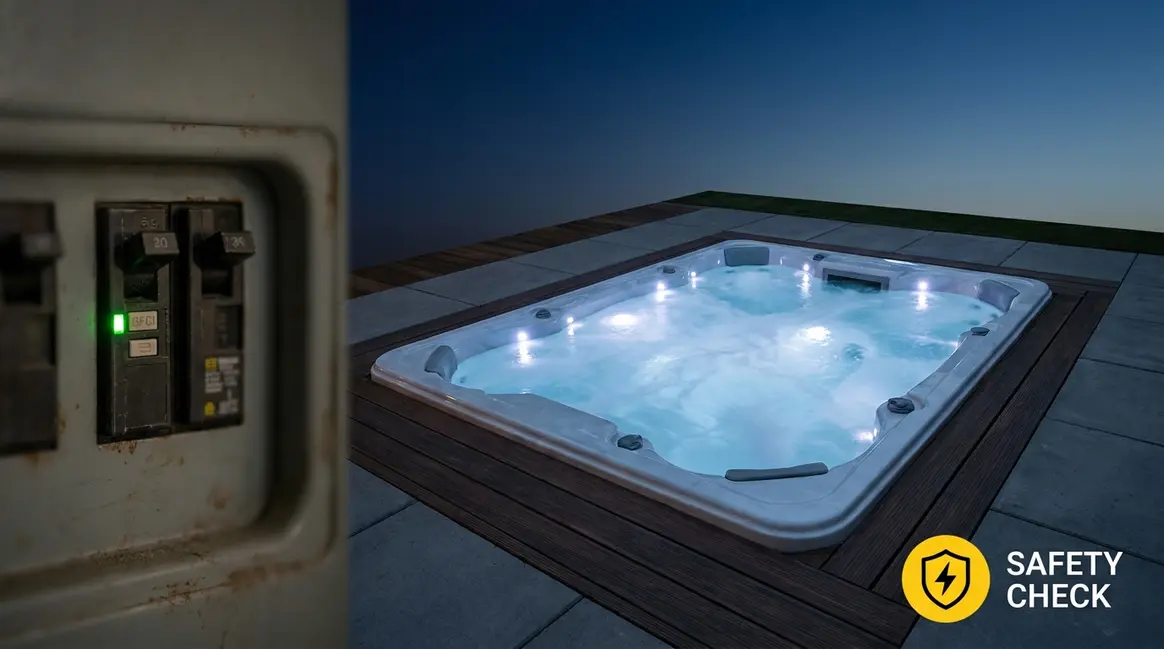
Yes, you can get electrocuted in a hot tub — and that’s not a scare tactic. It’s a real hazard documented by the U.S. Consumer Product Safety Commission (CPSC). However, the critical follow-up is this: hot tub electrocution is almost entirely preventable when three specific layers of protection are in place. If you’ve felt a tingling sensation in your tub, or you’re simply doing your homework before buying one, you’re in the right place.
This guide explains exactly what causes hot tub electrocution risk, what warning signs to look for, and the precise steps you can take today to protect yourself and your family. The framework we’ll use is called The Three-Layer Safety Stack — Hardware, Maintenance, and Behavior — and by the end of this guide, you’ll understand each layer completely.
Hot tub electrocution is a documented but highly preventable risk. The Three-Layer Safety Stack — Hardware protection (GFCI and bonding), regular Maintenance testing, and safe Behavior habits — gives you a complete framework for soaking safely.
- GFCI protection is non-negotiable: A ground fault circuit interrupter cuts power in as little as 1/40th of a second — fast enough to prevent electrocution if installed and tested correctly.
- Tingling = danger signal: A mild electric shock or tingling sensation in your hot tub is never normal. Exit immediately and call a licensed electrician.
- Annual inspections matter: The National Electrical Code (NEC) Article 680 mandates specific wiring and bonding standards; professional inspections verify compliance.
- Three layers protect you: Hardware (GFCI, bonding, wiring) + Maintenance (testing, inspections) + Behavior (usage habits, weather awareness) = The Three-Layer Safety Stack.
Is Hot Tub Electrocution a Real Risk?
Hot tub electrocution is real, but understanding the actual scale of the risk — and what drives it — helps you respond with informed action rather than panic. The CPSC has documented electrical incidents in pools, hot tubs, and spas dating back decades, and the data reveals a consistent pattern: nearly every fatal incident involved at least one missing or failed safety component.
What the Statistics Say
The CPSC’s “Don’t Swim with Shocks” electrical safety campaign documents that between 1990 and 2019, there were at least 33 electrocution deaths and 56 serious injuries in pools and spas in the United States (CPSC, cpsc.gov). That averages roughly one death per year across a period when tens of millions of Americans used residential pools and hot tubs regularly. The risk is real — but it is not common when proper safeguards are in place.
The Electrical Safety Foundation International (ESFI) reports that most electric shock drowning (ESD) and electrocution incidents in recreational water involve faulty wiring, missing ground fault protection, or improper bonding — not random equipment failure. In other words, these incidents are almost always traceable to a specific, correctable deficiency.
The takeaway: Hot tub electrocution is statistically rare but preventable. The danger is not inherent to hot tubs — it is inherent to hot tubs with compromised electrical systems.
What Is Electric Shock Drowning (ESD)?
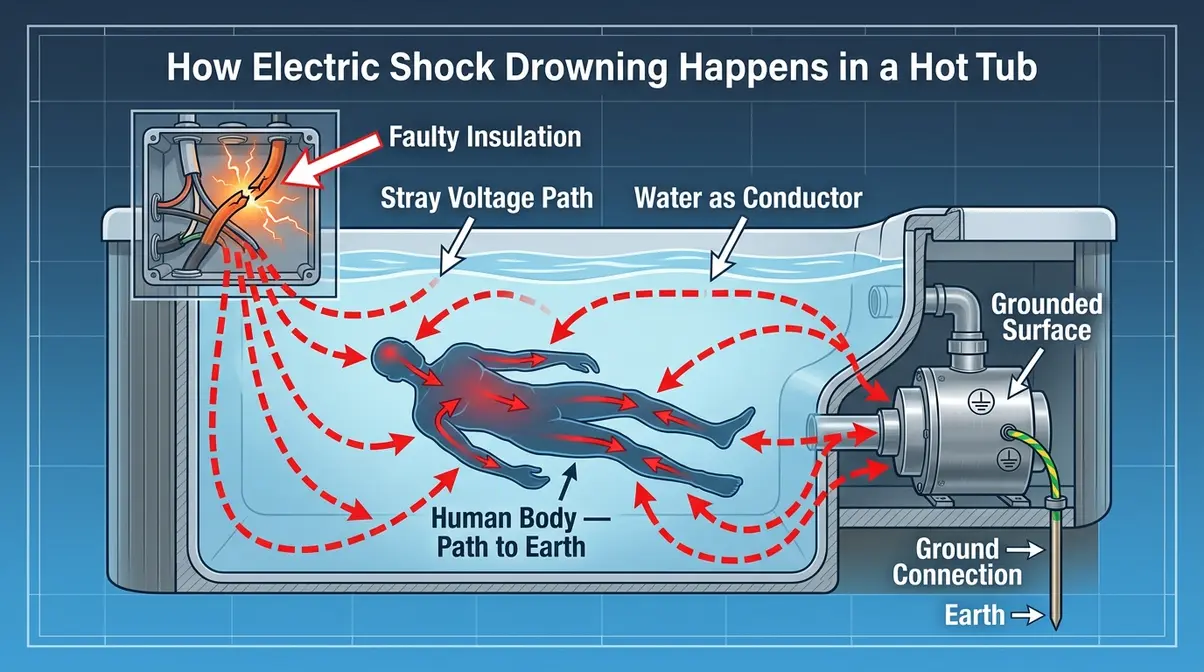
Electric Shock Drowning (ESD) is a specific and particularly dangerous phenomenon in which low-level AC (alternating current) electricity enters the water and causes a swimmer or bather to become paralyzed, lose muscle control, and drown — even without receiving a lethal shock voltage. ESD is distinct from direct electrocution in that the electrical current is often subtle enough that the victim feels only a tingling or numbing sensation before losing the ability to swim.
ESD occurs when AC current leaks into the water through faulty wiring, a damaged pump, or an improperly grounded electrical system. The current creates a voltage gradient across the water — meaning different parts of the water carry different electrical potentials. When a person enters that gradient, current flows through their body along the path of least resistance.
According to the Electric Shock Drowning prevention resource at getthebestelectric.com, AC current at levels as low as 15 milliamps (mA) can cause muscle paralysis — and a person can drown in a hot tub without anyone around them realizing there was an electrical problem. This is why a tingling sensation in your hot tub is never something to dismiss as “probably nothing.”
Why Hot Tubs Carry a Unique Electrical Risk
Hot tubs combine three factors that make electrical faults especially dangerous:
- Continuous water contact. Unlike a pool where you might be partially above water, hot tub users are typically submerged to chest level, maximizing the body’s exposure to any voltage gradient in the water.
- High-power electrical systems. A standard residential hot tub runs on a 240-volt, 50-amp circuit — a significantly more powerful electrical supply than most household appliances. Faulty wiring at that voltage level carries serious consequences.
- Heat-related conductivity and relaxation. Hot water dilates blood vessels and reduces the body’s natural resistance. Additionally, the relaxed state of a hot tub user means they may not immediately recognize or respond to a mild shock sensation.
The combination of immersion, high voltage, and physiological relaxation is what makes hot tub electrical safety a YMYL (Your Money or Your Life) topic that deserves serious, evidence-based attention.
The Three-Layer Safety Stack Explained
The most effective way to protect yourself from hot tub electrocution is to think in three distinct, complementary layers. The Three-Layer Safety Stack is a framework that organizes every safety measure into Hardware, Maintenance, and Behavior. No single layer is sufficient alone — but all three together create defense-in-depth that makes electrical incidents extremely unlikely.
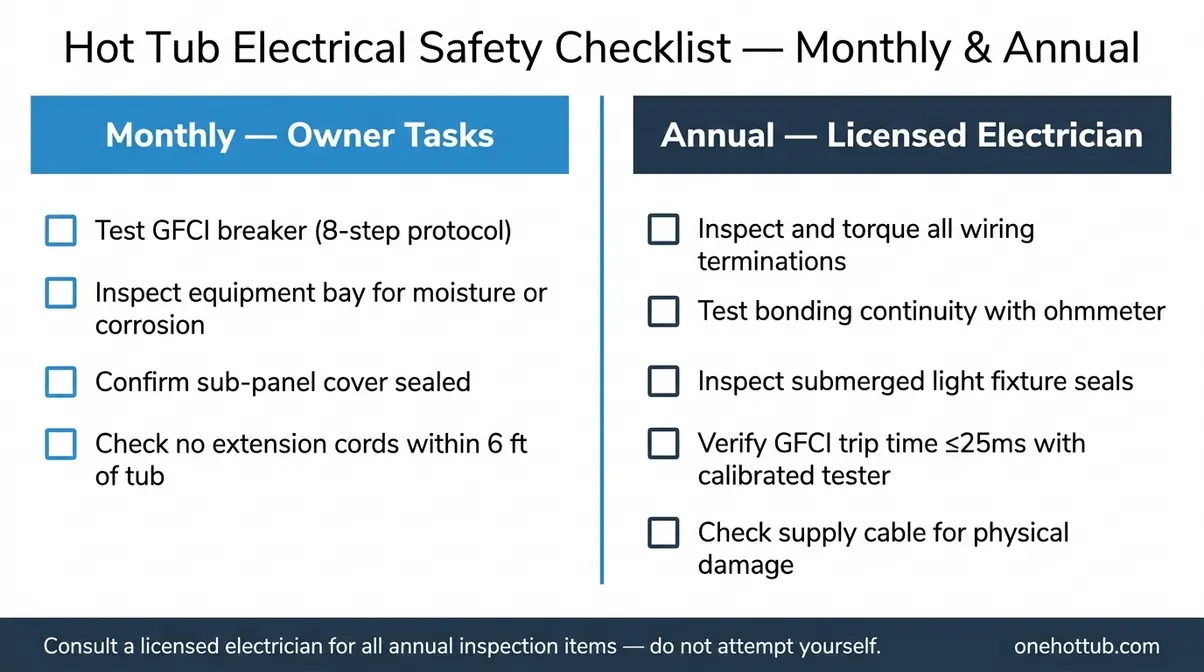
Layer 1 — Hardware: The physical components built into your hot tub’s electrical system. This includes the GFCI breaker, equipotential bonding, proper wiring gauge, and grounding. These are your passive, always-on protections.
Layer 2 — Maintenance: The ongoing testing and inspection practices that verify your hardware is still functioning correctly. A GFCI that hasn’t been tested in two years may have failed silently. Regular maintenance keeps Layer 1 working.
Layer 3 — Behavior: The usage habits, weather decisions, and situational awareness that prevent human error from creating electrical hazards. Even a perfectly wired hot tub can be made dangerous by using extension cords nearby or entering during a lightning storm.
Each section of this guide maps directly to one or more of these layers, so you’ll know exactly which protective action you’re taking as you read.
Warning Signs of an Electrical Problem
Recognizing the warning signs of a hot tub electrical hazard is the most important skill you can develop as an owner. Many electrocution incidents could have been prevented if an earlier warning sign had been taken seriously. Across licensed electrician communities and CPSC incident reports, there is strong professional agreement that the following signals should trigger an immediate exit from the water and a call to a professional.
“I have noticed that when I touch the water of my Hot Tub when I am grounded (barefoot standing outside of tub) I am getting a very small electric shock.”
If this sounds familiar, you are not alone — and you are right to be concerned. That sensation is not a quirk or a calibration issue. It is charge leaking into the water, and it is a direct indicator of a fault in your electrical system.
The Seven Warning Signs
1. Tingling or mild electric shocks in the water. Any tingling sensation — even subtle — when your body is in or near the water is a sign of current leaking into the water. This is the most common early warning sign before a serious incident.
2. Tingling when touching the tub shell or metal fittings. If you feel a mild shock when gripping the tub edge or touching a metal jet fitting, the bonding system (explained in the next section) may be compromised.
3. Lights flickering or dimming when the pump runs. This can indicate a wiring fault or a circuit that is overloaded — both of which can create shock hazards.
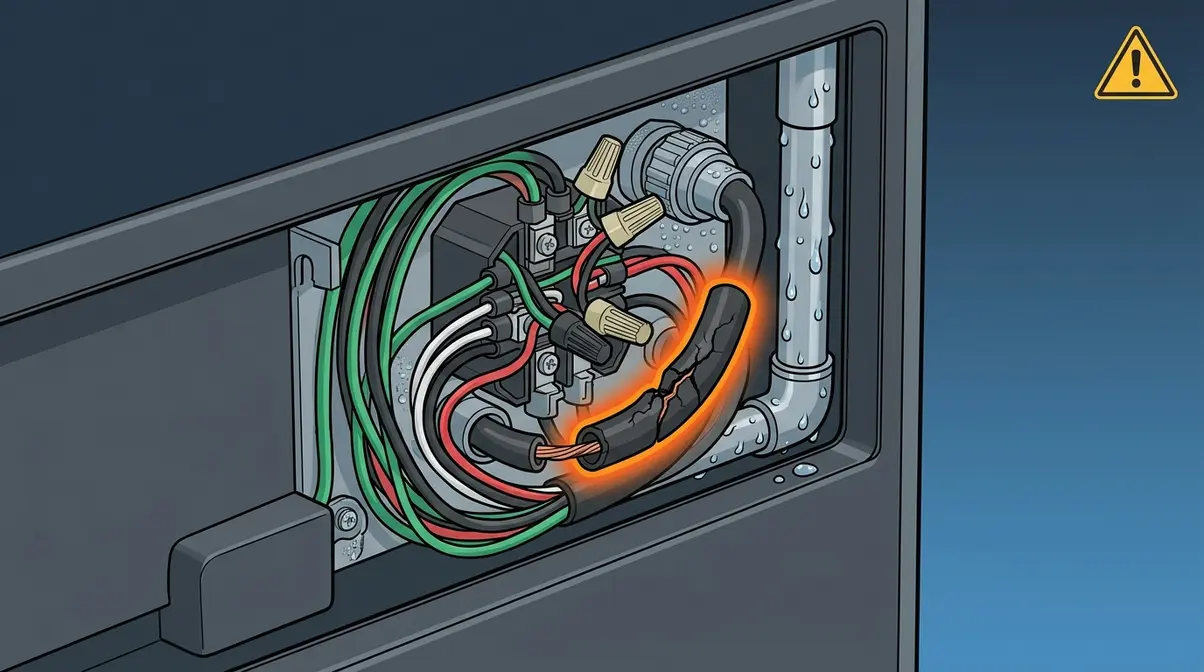
4. A burning smell near the electrical panel or equipment compartment. Burning or melting insulation has a distinctive smell. Never ignore it. Exit the area, do not use the tub, and call an electrician.
5. The GFCI breaker trips repeatedly. A GFCI that trips once during a storm might be normal. A GFCI that trips every time you run the jets is telling you there is a ground fault in the system — which is exactly the condition it is designed to detect.
6. Corrosion or discoloration around wiring connections. If you can safely view the equipment compartment without touching anything, look for green or white corrosion on wire terminals. Moisture intrusion into wiring is a leading cause of hot tub electrical faults.
7. The pump or heater runs erratically without explanation. Unexpected cycling on and off can indicate an intermittent fault in the wiring, which may not yet have triggered the GFCI but could escalate.
According to the City of Raleigh Electrical Water Safety Tips (cityofraleigh0drupal.blob.core.usgovcloudapi.net), bathers who feel any electrical sensation should exit the water calmly (without grabbing metal pool ladders or fittings) and immediately notify others in the water.
The rule is simple: Any of these signs means stop using the tub until a licensed electrician has inspected and cleared the system.
Layer 1 — Hardware: GFCI, Bonding, and Wiring
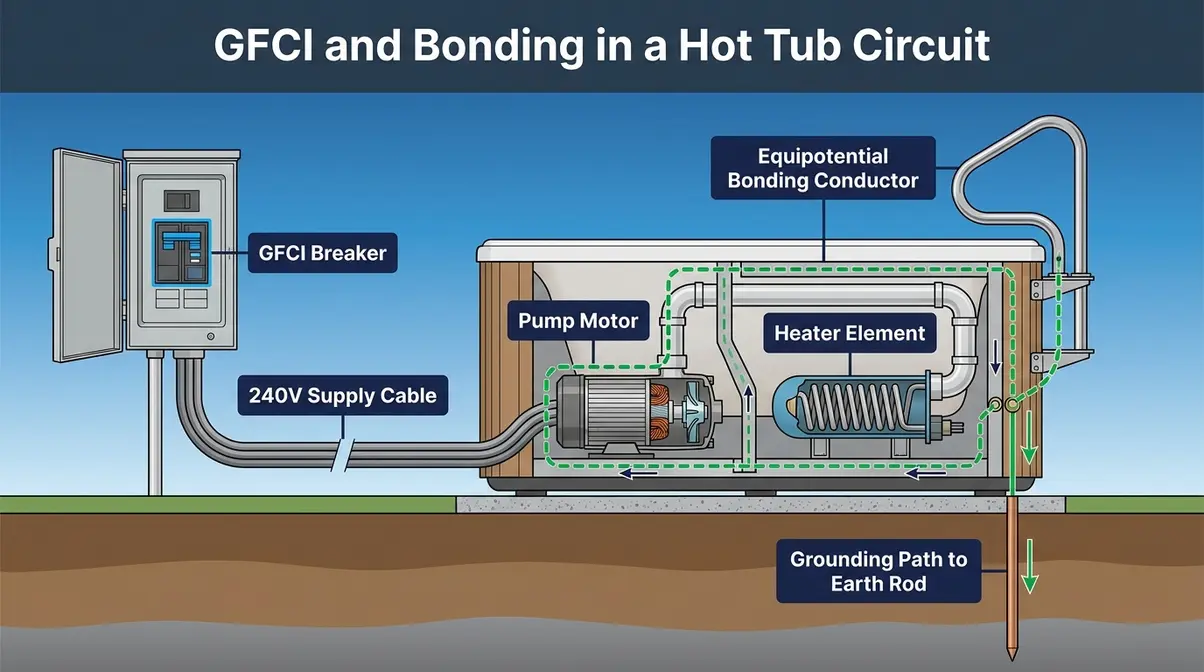
Hardware protection is the foundation of the Three-Layer Safety Stack. These are the permanent, built-in systems that prevent electrical faults from reaching the water in the first place — or cut power the instant they do. Understanding what each component does helps you verify that yours is installed correctly.
GFCI: Your Fastest Line of Defense
A GFCI (Ground Fault Circuit Interrupter) is a specialized electrical device that continuously monitors the current flowing through a circuit. The moment it detects an imbalance — meaning current is escaping to ground through an unintended path, such as a person’s body — it cuts power. It does this in approximately 1/40th of a second (25 milliseconds), which is fast enough to prevent a lethal shock in most circumstances (NFPA/NEC Article 680).
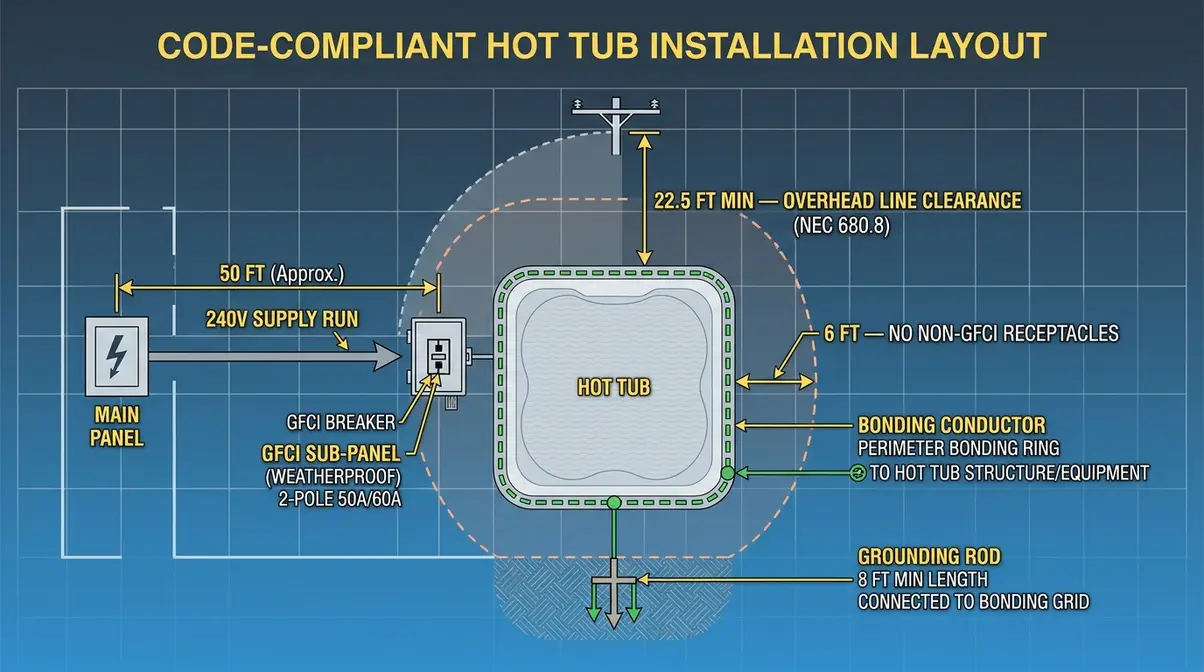
The NEC (National Electrical Code) Article 680, which governs pools, fountains, and spas, requires GFCI protection for all 120-volt and 240-volt receptacles within 20 feet of a hot tub. The 2023 NEC edition, which forms the basis of most current local codes, tightened these requirements further. Your hot tub should be on a dedicated 240-volt, 50-amp GFCI-protected circuit — not shared with any other appliance.
What a GFCI does NOT do: A GFCI protects against ground faults (current leaking to ground). It does not protect against short circuits or overloads in the same way a standard breaker does. This is why bonding — covered next — is a separate and equally necessary layer.
Consult a licensed electrician to verify that your hot tub’s GFCI breaker is correctly rated for your specific model’s amperage draw. An undersized or incorrectly wired GFCI provides false security.
Equipotential Bonding vs. Grounding: The Critical Difference
This is the concept that confuses most hot tub owners, and the confusion can be dangerous. Bonding and grounding are not the same thing.
Equipotential bonding connects all metal components of the hot tub — jets, heater housing, pump motor, light fixtures, and the water itself (via a bonding lug) — to a common bonding conductor. The goal is to ensure that every metal surface you might touch while in or near the tub is at the same electrical potential. When everything is at the same potential, no current flows between objects — including through your body.
Grounding provides a deliberate, low-resistance path for fault current to travel safely to earth (the ground). If a wire inside the pump shorts to the metal housing, grounding ensures that current flows to earth rather than accumulating on the metal surface waiting to discharge through the next person who touches it.
Why both matter: Bonding prevents voltage differences that cause shock. Grounding provides a path for fault current that triggers the GFCI. They work in tandem. NEC Article 680.26 specifies the exact bonding requirements for spas and hot tubs, including the requirement for a No. 8 AWG solid copper bonding conductor connecting all metal parts within 5 feet of the tub.
According to Verywell Health’s pool and hot tub electrical safety analysis, missing or improperly installed bonding is one of the most commonly cited deficiencies in hot tub electrical incident investigations.
Wiring Requirements
Your hot tub requires a dedicated, correctly gauged electrical circuit. The most common residential hot tub configuration requires:
| Specification | Requirement | Why It Matters |
|---|---|---|
| Voltage | 240V (most models) | Standard 120V is insufficient for heater/pump loads |
| Amperage | 50A (typical) | Undersized circuits overheat and create fire/shock risk |
| Wire type | 4-wire (2 hot, 1 neutral, 1 ground) | Neutral and ground are both required for GFCI operation |
| Disconnect | Lockable disconnect within sight of tub | Allows power to be cut before servicing |
| Distance from tub | Receptacles min. 6 feet away | NEC 680.22 — prevents appliance use near water |
Never use an extension cord to power a hot tub or any appliance near a hot tub. Extension cords are not rated for the sustained current draw of hot tub equipment, and they bypass the safety ratings of your fixed wiring.
Layer 2 — How to Test Your GFCI (Step-by-Step)
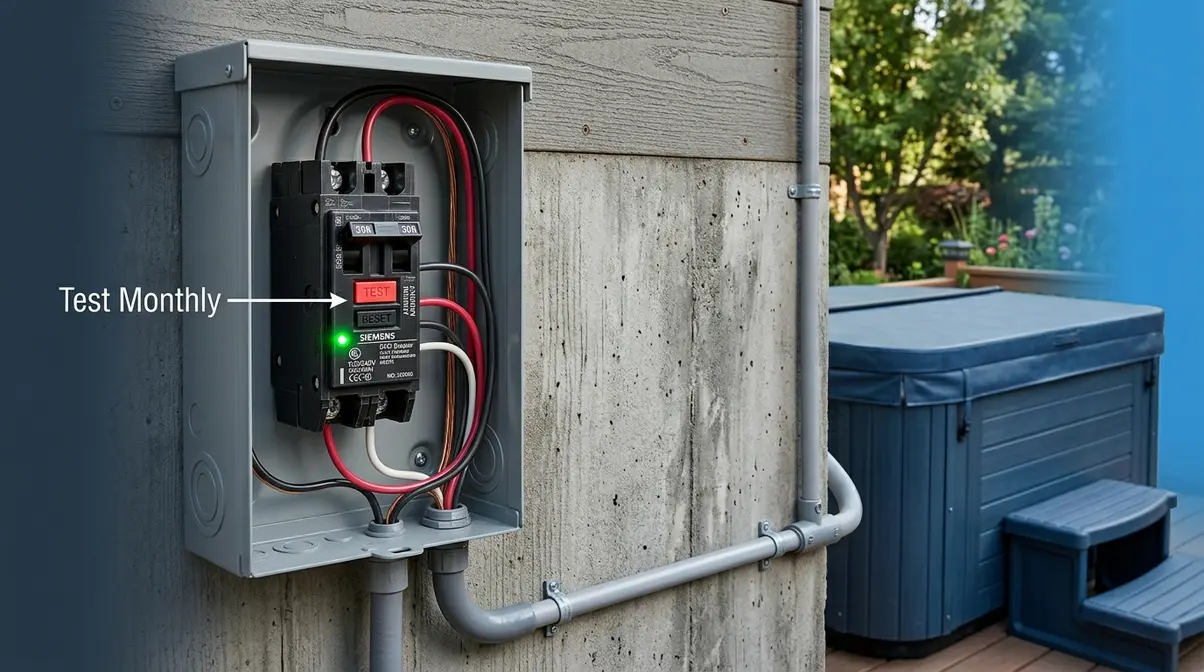
Testing your GFCI is one of the most important maintenance actions you can take — and it takes less than five minutes. The CPSC and ESFI both recommend testing GFCI devices monthly. A GFCI can fail silently, meaning it stays in the “on” position but no longer provides protection. Regular testing is the only way to confirm it is still working.
Important: The steps below describe testing an existing, properly installed GFCI breaker or outlet. Do not attempt to install, replace, or rewire a GFCI yourself. All wiring work must be performed by a licensed electrician.
How to Test Your Hot Tub GFCI: 6 Steps
What you need: Yourself. No tools required. The test and reset buttons are built into the GFCI device.
Estimated time: 3–5 minutes.
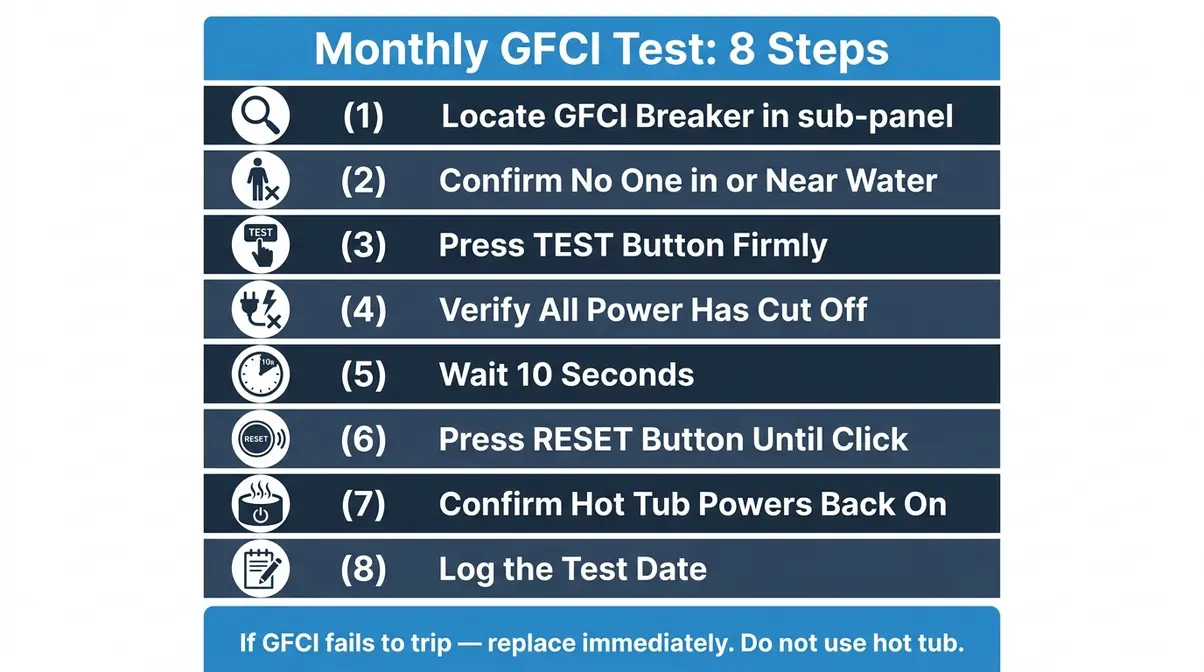
Step 1: Locate your GFCI protection device.
Your hot tub’s GFCI protection may be at the electrical panel (a GFCI breaker with TEST and RESET buttons on the breaker face) or at a GFCI outlet within the hot tub’s equipment circuit. Check your owner’s manual if you’re unsure which type your installation uses.
Step 2: Confirm the hot tub is powered on and running normally.
The pump or heater should be running. This confirms the circuit is live before you test. If the tub is already off, turn it on via its control panel and wait 60 seconds for the pump to engage.
Step 3: Press the TEST button on the GFCI device.
The TEST button is typically black (RESET is typically red, though colors vary by manufacturer). Press TEST firmly. You should hear a click as the breaker or outlet trips.
Step 4: Confirm the hot tub has lost power.
Go to the hot tub control panel. The display should be blank or unresponsive. If it is still on, the GFCI has failed and is not providing protection — call a licensed electrician immediately before using the tub again.
Step 5: Press the RESET button.
Press RESET firmly until you feel or hear it click into place. Return to the hot tub control panel and verify that power has been restored (the display should come back on within 30–60 seconds).
Step 6: Document the test date.
Write the date on a piece of tape affixed to the electrical panel, or note it in a maintenance log. The CPSC recommends monthly testing. If your GFCI fails the test at any point — either by not tripping on Step 3 or not resetting on Step 5 — do not use the hot tub until a licensed electrician has inspected and replaced the device.
- Recommended testing schedule:
- Monthly: GFCI test (Steps 1–6 above)
- Annually: Full electrical inspection by a licensed electrician, including bonding conductor integrity check
- After any electrical storm: Visual inspection of equipment compartment and GFCI test before next use
- After any service work: GFCI test before re-entering the water
According to NFPA guidance on NEC Article 680, GFCI protection in permanently installed spas must meet specific trip-time standards. A GFCI that passes the test button check is functioning within those parameters.
Layer 3 — Behavioral Safety: Usage Habits That Reduce Risk

Hardware and maintenance create a protected environment. Behavior determines whether you introduce new risks into that environment. The third layer of the Three-Layer Safety Stack focuses on the human decisions that either preserve or undermine your electrical protection.
Keep Electrical Devices Away from the Water
The NEC requires that receptacles (outlets) be located at least 6 feet from the inside wall of a hot tub. This distance exists because most electrical devices — phone chargers, radios, hair dryers — are not designed to be used near water. A device that falls into a hot tub while plugged in can create an immediately lethal situation, even with a GFCI in place, because the GFCI’s response time (25ms) may not prevent cardiac arrest from a direct appliance-to-body electrical path.
- Practical rules:
- No corded devices within 6 feet of the water surface
- Use only battery-powered or purpose-built waterproof speakers near the tub
- Never charge a phone or tablet on the hot tub edge
- Keep extension cords entirely out of the hot tub area
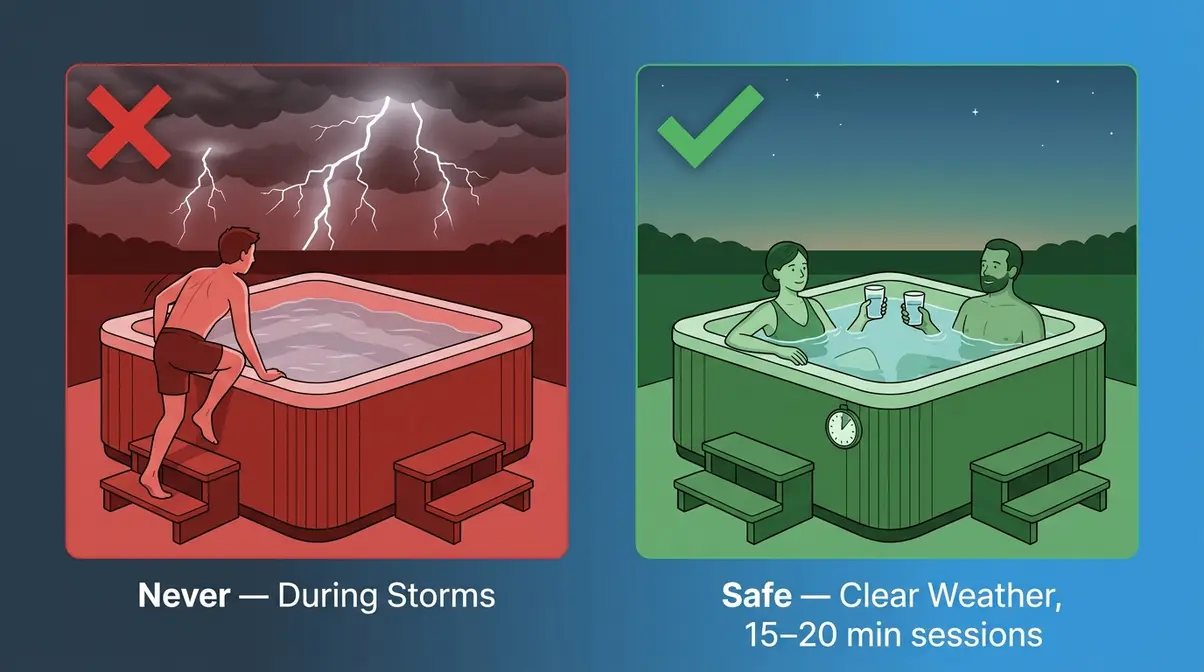
Never Soak During a Thunderstorm
Lightning strike risk is separate from electrical fault risk, but the behavioral response is the same: exit the water. Lightning does not need to strike your tub directly to cause a fatal shock. A strike within several hundred feet can send current through the ground and into your tub’s plumbing and electrical system.
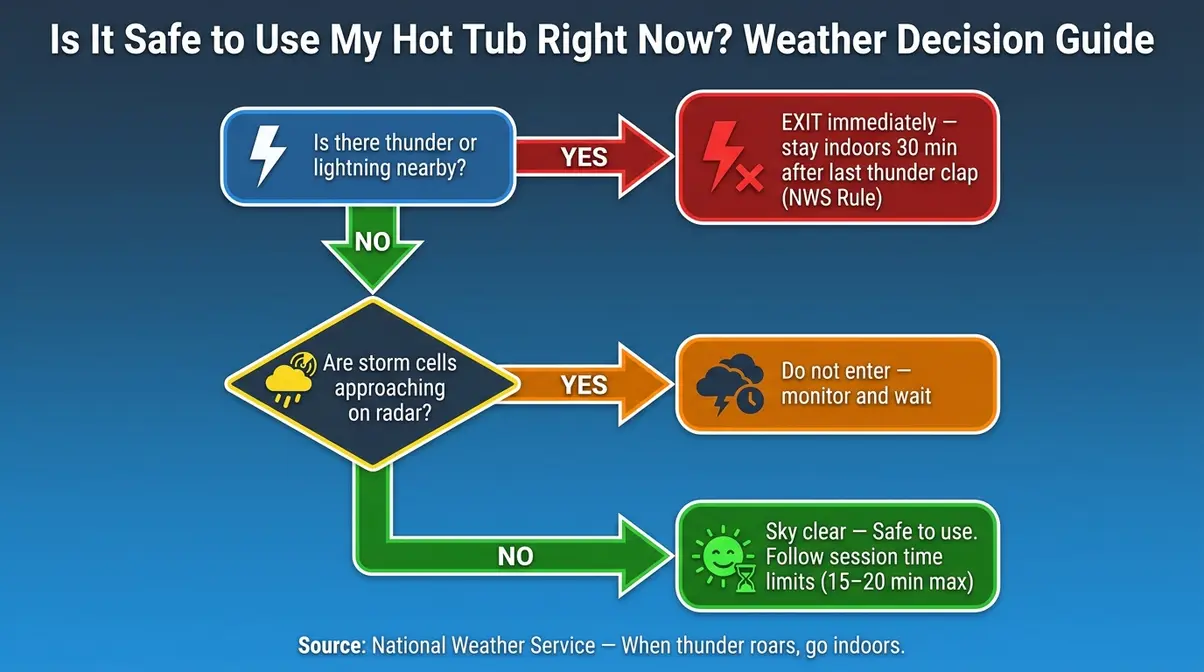
The National Weather Service recommends exiting any body of water — pool, hot tub, lake — when thunder is heard. Thunder means lightning is within striking distance (approximately 10 miles). The rule: when thunder roars, go indoors. Wait at least 30 minutes after the last thunder before returning to the water.
Additional Behavioral Guidelines
- Never use the hot tub alone. If an electrical fault causes muscle paralysis (ESD), another person present can remove you from the water and call emergency services.
- Exit before adding chemicals. Chemical addition involves leaning over the water while handling containers — an unnecessary exposure window.
- Inspect the area after storms. Check for downed power lines near the tub, and inspect the equipment compartment for water intrusion before resuming use.
- Supervise children at all times. Children may not recognize or articulate a tingling sensation as a warning sign.
Hot Tub Electrical Safety During Installation
If you are purchasing a new hot tub or having one moved, the installation phase is where most long-term electrical hazards are either created or prevented. A correctly installed hot tub will serve safely for years; a shortcuts-taken installation can create latent hazards that don’t manifest until months later.
Hire a Licensed Electrician — Not a General Handyman
Hot tub electrical installation requires knowledge of NEC Article 680 specifically. A general handyman or even a competent DIYer does not have the code knowledge or testing equipment to verify equipotential bonding continuity or confirm GFCI trip times. In most jurisdictions, residential hot tub electrical work requires a permit and an inspection by the local authority having jurisdiction (AHJ).
- What the electrician must verify at installation:
- Dedicated 240V/50A circuit with correct wire gauge
- 4-wire cable (two hots, neutral, ground) to the disconnect
- GFCI breaker correctly rated for the hot tub’s amperage
- Lockable disconnect within line-of-sight of the tub
- Equipotential bonding grid connecting all metal components per NEC 680.26
- All connections weather-sealed and protected from moisture
After installation, request documentation: Ask for the permit, the inspection approval, and the electrician’s license number. Keep these records for insurance purposes and future resale of the property.
Portable vs. Permanently Installed Hot Tubs
Portable hot tubs (inflatable or plug-and-play models) typically run on 120V and come with a built-in GFCI cord. While these have a simpler electrical footprint, they carry their own risks:
- The built-in GFCI must still be tested monthly
- The power cord must not be run under rugs, through doorways, or near standing water
- The outlet used must itself be GFCI-protected
- Plug-and-play tubs should never be connected to extension cords
Permanently installed hard-shell hot tubs require the full 240V installation described above and must meet all NEC 680 requirements. If your hot tub is “permanent” in placement but was installed by plugging into a standard outdoor outlet, it is not compliant with NEC requirements and should be evaluated by a licensed electrician.
What to Do in an Electrical Emergency
Knowing what to do in the first 30 seconds of a hot tub electrical emergency can be the difference between a near-miss and a fatality. The CPSC and ESFI both provide emergency guidance that differs from instinct — and the differences matter.
If You Feel a Shock or Tingling in the Water
- Exit the water calmly and immediately. Do not grab metal railings, ladders, or fittings — these may be energized. Use the tub steps or push yourself out over the edge.
- Warn anyone else in or near the water to exit the same way.
- Do not re-enter the water for any reason until a licensed electrician has inspected the system.
- Cut power at the breaker or disconnect — only if you can do so without touching anything wet or standing in water.
- Call a licensed electrician before using the tub again.
If Someone Else Is Being Electrocuted in the Water
This is the scenario where instinct — grabbing the person — can kill the rescuer.
- Do NOT touch the person or the water. You will complete the circuit and receive the same shock.
- Call 911 immediately. Announce that there is an electrical emergency in water.
- Cut power at the main breaker or disconnect panel — this is the fastest way to break the circuit. Only do this if you can reach the panel without touching water or wet surfaces.
- Once power is confirmed off, you can safely assist the person out of the water.
- Begin CPR if the person is unresponsive and you are trained. Dispatch can guide you if you are not.
According to the CPSC’s electrical water safety guidance, bystanders who enter electrified water to rescue a victim account for a significant portion of secondary fatalities in pool and spa electrical incidents. Breaking the electrical circuit first — not jumping in — is the correct response.
Consult a licensed electrician before resuming hot tub use after any electrical incident, regardless of how minor it seemed.
Health Considerations: Who Should Use Extra Caution
Most healthy adults can use a properly maintained hot tub safely. However, certain health conditions interact with both the heat and the electrical environment of a hot tub in ways that warrant medical guidance before use. This section summarizes the key considerations — it is not a substitute for personalized medical advice.
Hot Tubs and Pacemakers
If you have a pacemaker or implantable cardioverter-defibrillator (ICD), consult your cardiologist or physician before using a hot tub. The concern is twofold: hot water can cause vasodilation (blood vessel widening) that stresses the cardiovascular system, and any residual electrical field in the water could theoretically interact with pacemaker sensing circuits, though modern pacemakers are designed with electromagnetic interference (EMI) shielding.
The American Heart Association (AHA) notes that hot tub use in cardiac patients carries risks related to heat stress and blood pressure changes. Your cardiologist can advise based on your specific device model and cardiac history.
Pregnancy
The primary concern with hot tub use during pregnancy is hyperthermia (elevated core body temperature), not electrical risk. The American College of Obstetricians and Gynecologists (ACOG) advises pregnant women to avoid raising core body temperature above 102.2°F (39°C), which can occur within 10 minutes in a 104°F hot tub. Consult your OB-GYN for specific guidance.
Other Conditions Requiring Medical Guidance
- Low blood pressure: Hot water causes vasodilation, which can cause dizziness or fainting upon exiting the tub.
- Skin conditions or open wounds: Hot tub water can introduce bacteria into open skin. Exit and consult a physician if you have active skin infections or wounds.
- Hot tub lung and folliculitis: These are bacterial and lung-related conditions associated with Pseudomonas aeruginosa and Mycobacterium avium in poorly maintained hot tubs — unrelated to electrical safety but worth noting. Proper water chemistry maintenance (pH, sanitizer levels) prevents both.
Limitations: When to Call a Professional
This guide gives you the knowledge to understand your hot tub’s electrical safety system and perform basic maintenance checks. It does not qualify you to perform electrical work. There is a clear line between what a hot tub owner can and should do, and what requires a licensed professional.
⚠️ Safety disclaimer: The following situations require a licensed electrician. Attempting DIY electrical work on a 240-volt hot tub circuit is dangerous and may void your warranty, violate local code, and create the exact hazards you are trying to prevent.
Common Pitfalls to Avoid
Pitfall 1: Assuming a GFCI that hasn’t tripped is working.
A GFCI can fail in the “on” position — meaning it stays energized but no longer provides protection. The only way to verify function is the monthly test described in this guide. Owners who haven’t tested their GFCI in years may have no protection at all.
Pitfall 2: Treating repeated GFCI trips as a nuisance rather than a warning.
When a GFCI trips repeatedly, the instinct is often to reset it and move on. Repeated tripping is the GFCI detecting a real ground fault in the system. Resetting it without investigation means the fault is still present. Call an electrician.
Pitfall 3: Using a hot tub that was “just moved” without electrical re-inspection.
Moving a hot tub can disturb bonding conductors, pull wiring connections loose, or shift the unit off its proper pad in ways that affect drainage into the equipment compartment. Any moved hot tub should be electrically inspected before first use at the new location.
When to Choose Professional Help
Scenario 1: You felt a tingling sensation.
This is not a self-diagnosis situation. Exit, cut power, and call a licensed electrician before re-entering the water. No amount of online research substitutes for an in-person electrical inspection with proper test equipment.
Scenario 2: Your GFCI fails the monthly test.
A GFCI that does not trip when the TEST button is pressed, or does not reset after pressing RESET, must be replaced by a licensed electrician. This is not a DIY task on a 240-volt circuit.
Scenario 3: You’re buying an older used hot tub.
Used hot tubs may have deteriorated wiring insulation, corroded bonding connections, or outdated GFCI devices. Commission a licensed electrician’s inspection before the tub is energized at your property.
Scenario 4: Any work inside the equipment compartment.
Pump replacement, heater element replacement, or any work that involves disconnecting and reconnecting electrical components in the equipment bay must be done with power fully off at the breaker — and ideally by a licensed electrician who can verify reconnection is correct.
Consult a licensed electrician for all electrical installation, repair, and inspection work on your hot tub. This guide is educational, not a substitute for professional assessment.
Frequently Asked Questions
Is it common to get electrocuted in a hot tub?
Hot tub electrocution is not common, but it is a documented risk. The CPSC recorded at least 33 electrocution deaths in pools and spas between 1990 and 2019 — roughly one per year across the entire U.S. The vast majority of incidents involved a specific, identifiable electrical deficiency: missing GFCI protection, improper bonding, or faulty wiring. For hot tubs with properly installed and maintained electrical systems, the risk is extremely low. The key phrase is “properly maintained” — which is why monthly GFCI testing and annual professional inspections matter.
What are the warning signs of a hot tub electrical problem?
The most important warning sign is any tingling sensation or mild electric shock while in or near the water. Additional signals include a GFCI breaker that trips repeatedly, lights or controls that flicker when the pump runs, a burning smell near the equipment compartment, and visible corrosion on wiring terminals. Any one of these signs is sufficient reason to exit the water immediately, cut power at the breaker, and call a licensed electrician before using the tub again. Never dismiss a tingling sensation as “just static” — it indicates charge leaking into the water.
What is a GFCI and why does it matter for hot tub safety?
A GFCI (Ground Fault Circuit Interrupter) is the single most important active safety device in your hot tub’s electrical system. It continuously monitors current flow and cuts power in approximately 25 milliseconds — fast enough to prevent electrocution — the moment it detects current leaking through an unintended path. The NEC Article 680 requires GFCI protection on all hot tub circuits. A GFCI that has never been tested may have failed silently. Test yours monthly using the TEST and RESET buttons on the device, and replace it immediately if it fails the test.
What should you do if someone is being shocked in a hot tub?
Do not touch the person or enter the water — you will complete the circuit and receive the same shock. Call 911 immediately and announce an electrical emergency in water. Then cut power at the main breaker or disconnect panel if you can do so without touching water or wet surfaces. Only after power is confirmed off should you physically assist the person. Begin CPR if the person is unresponsive and you are trained — 911 dispatch can guide you through it if you are not. This counter-instinctive sequence — cut power first, assist second — is the protocol recommended by the CPSC and ESFI.
Can you use a hot tub in the rain?
Light rain without lightning is generally safe for hot tub use, provided the electrical system is properly installed and maintained. The risk is not rain itself — it is lightning. The National Weather Service recommends exiting any body of water when thunder is heard, because thunder indicates lightning within approximately 10 miles. Wait at least 30 minutes after the last thunder before returning to the water. Never use a hot tub during an active thunderstorm, regardless of whether lightning appears to be nearby. When in doubt, get out.
Is it safe to use a hot tub with a pacemaker or heart condition?
Consult your cardiologist or physician before using a hot tub if you have a pacemaker, ICD, or any heart condition. The concern involves both heat stress — hot water causes vasodilation that can affect blood pressure and cardiac workload — and the theoretical possibility of electromagnetic interference with pacemaker sensing circuits in a hot tub with any electrical fault. Modern pacemakers include EMI shielding, but the heat-related cardiovascular effects are real and vary by individual. The American Heart Association advises cardiac patients to discuss hot tub use with their physician before soaking. This is a medical decision, not a general safety guideline.
Protecting Yourself: The Complete Safety Framework
For hot tub owners and prospective buyers, hot tub electrocution is a real but highly preventable risk. The CPSC data is clear: nearly every fatal incident involved a missing or failed safety component — not random equipment failure. The Three-Layer Safety Stack — Hardware protection (GFCI, bonding, correct wiring), Maintenance testing (monthly GFCI tests, annual inspections), and Behavior habits (no corded devices, no thunderstorm use, never soak alone) — addresses every major risk vector with specific, actionable steps.
The framework matters because no single layer is sufficient. A GFCI that has never been tested may have failed silently. Perfect hardware means nothing if you bring a corded speaker to the tub edge. And safe behavior cannot compensate for faulty wiring. All three layers, working together, create defense-in-depth that makes hot tub electrocution extremely unlikely.
The Three-Layer Safety Stack gives you a complete, memorable structure for protecting yourself and your family — not just a list of fears. Hardware, Maintenance, Behavior. Know which layer each action belongs to, and you’ll never miss a critical step.
Your next step is concrete: test your GFCI today using the six-step protocol in this guide. If it passes, schedule your annual electrical inspection. If it fails, call a licensed electrician before your next soak. That single action — verifying that your fastest line of defense is actually working — takes five minutes and eliminates one of the most common latent hazards in residential hot tub ownership.
Consult a licensed electrician for all electrical work on your hot tub. This guide provides educational context — it does not substitute for a professional on-site inspection.