
What’s in this guide
- Quick Comparison Table
- 1. Lupo 3-in-1 Pool Test Kit: Best for Core Basics
- 2. Wynvex 7-in-1 Digital Reader: Best Entry Kit
- 3. DXPOOL 10-in-1 App Kit: Best for Tracking
- 4. Varify 7-in-1 Test Strips: Best All-Rounder
- 5. 7-in-1 Spa Test Strips 150ct: Best for Volume
- 6. JNW 7-in-1 Pool Test Strips: Best Value Pack
- 7. Taylor K-1004 DPD 6-in-1 Kit: Best Liquid Kit
- 8. SuperAccurate 7-in-1 Strips: Best High-Count
- 9. Taylor K-1005 DPD 9-in-1 Kit: Best Accuracy
- 10. Taylor Complete Pool Test Kit: Best Starter
- Buying Guide: Choosing the Right Test Kit
- How We Evaluated These Hot Tub Test Kits
- Frequently Asked Questions
- Choosing the Right Kit Starts Here
Test strips are the most frustrating tool in your hot tub kit. If you’ve ever squinted at a color chart under the porch light wondering whether your chlorine is “low” or “very low,” you’re not alone.
“I need a better way to test my swim spa water other than test strips or dragging a sample to the spa store. Anyone have a good kit they love?”
That question — posted in a hot tub owners forum — captures exactly what’s wrong with the standard approach. Inaccurate test strips lead to wrong chemistry decisions. Wrong chemistry means skin irritation, cloudy water, and equipment damage that costs far more than any test kit. In this guide, you’ll find the 10 best hot tub water testing kits on Amazon — strips, liquid drops, and digital options — reviewed and compared so you can buy with confidence. The quick comparison table below will get you oriented in seconds.
Quick Comparison Table
| # | Preview | Product | Best For | Buy |
|---|---|---|---|---|
| 1 |  |
Lupo 3-in-1 Pool Test Kit | Core 3-parameter liquid checks | Buy on Amazon |
| 2 |  |
Wynvex 7-in-1 Digital Reader Kit | Beginners ditching color charts | Buy on Amazon |
| 3 |  |
DXPOOL 10-in-1 App Kit | App-connected data logging | Buy on Amazon |
| 4 |  |
Varify 7-in-1 Test Strips | Reliable everyday strip checks | Buy on Amazon |
| 5 |  |
7-in-1 Spa Test Strips 150ct | High-frequency households | Buy on Amazon |
| 6 |  |
JNW 7-in-1 Pool Test Strips | Brand-name value pack | Buy on Amazon |
| 7 |  |
Taylor K-1004 DPD 6-in-1 Kit | Precision liquid testing | Buy on Amazon |
| 8 |  |
SuperAccurate 7-in-1 Strips | Bulk strip buyers | Buy on Amazon |
| 9 |  |
Taylor K-1005 DPD 9-in-1 Kit | Professional-level accuracy | Buy on Amazon |
| 10 |  |
Taylor Complete Pool Test Kit | Starter liquid kit | Buy on Amazon |
1. Lupo 3-in-1 Pool Test Kit: Best for Core Basics
The Lupo 3-in-1 is a compact liquid drop kit — not a strip kit — that tests the three parameters hot tub owners check most often: total chlorine, total bromine, and pH (a measure of how acidic or basic your water is). It uses a small plastic comparator block with reagent drops rather than dip strips, which means more consistent readings than color-matching strips for these core vitals. Reviewers in pool and spa communities describe it as a solid “daily or midweek” check kit, best paired with a more comprehensive kit monthly.
- +Liquid reagent accuracy — Drop-based testing is more consistent than strip color matching for chlorine and pH, producing reliable, repeatable reads when you follow drop counts and fill lines precisely.
- +Bromine-scale included — Useful for hot tub owners who use bromine sanitizer; the comparator block includes a dedicated bromine scale calibrated for spa use.
- +Compact, portable design — The comparator, reagents, and instruction card fit in a small case that stores easily beside your hot tub.
- −Only 3 parameters — Misses total alkalinity (which acts as a pH stability buffer), calcium hardness, and cyanuric acid (a chlorine stabilizer) — parameters that matter for full hot tub chemistry management.
- −Visual color matching still required — Although more accurate than strips, you still compare reagent color to a printed scale, which can be affected by poor lighting.
2. Wynvex 7-in-1 Digital Reader: Best Entry Kit
Wynvex, a digital pool testing brand, combines traditional dip strips with a digital reader that displays your results as numbers rather than colors. This single change removes the biggest frustration with standard test strips: subjective color matching. If you’ve held a strip up to a chart and genuinely couldn’t tell whether your pH was 7.2 or 7.4, the Wynvex digital reader solves that problem directly. The kit includes 150 strips and tests 7 parameters covering the core hot tub chemistry checklist.
- +Digital reader eliminates color guesswork — The reader interprets the strip’s color change electronically and displays a numeric result, removing the lighting and eyesight variables that make visual strips unreliable.
- +150 strips included — At twice-weekly testing frequency, that’s approximately 5 months of supply before you need to reorder.
- +7-parameter coverage — Tests pH, free chlorine, bromine, total alkalinity, total hardness, and more — covering every essential hot tub chemistry parameter in one dip.
- −Technique-dependent accuracy — The digital reader’s result depends on consistent strip dipping; shaking the strip or holding it at an angle can produce variable readings across the 7 pads.
- −No independent lab validation found — No third-party accuracy testing for this specific kit was available at time of publication; results should be cross-checked periodically with a liquid kit.
3. DXPOOL 10-in-1 App Kit: Best for Tracking
Ten parameters in a single strip — including nitrate and sulfate alongside the standard chlorine, pH, and alkalinity readings — makes the DXPOOL app kit the broadest strip-based option in this roundup. The companion app lets you log each test result and review your water chemistry trends over days and weeks. For hot tub owners who want to spot patterns — why does my pH drop every Friday after heavy use? — this data-logging feature is genuinely useful in a way that a single strip reading never can be. Note that at time of writing, the “DXPOOL” brand name is primarily associated with cryptocurrency mining online; verify the app functionality on iOS and Android before purchasing.
- +10 parameters tested — The broadest strip coverage in this roundup, adding nitrate and sulfate to the standard 7-parameter suite, giving a more complete picture of your water’s overall chemistry.
- +App trend logging — Recording results over time lets you identify chemistry patterns tied to bather load, season, or chemical additions — something no single-reading strip can do.
- +Saltwater compatible — Works with saltwater hot tub systems, which are growing in popularity as an alternative to traditional chlorine sanitization.
- −App dependency risk — Your testing workflow relies entirely on app availability; if the app is discontinued or requires a subscription, the digital functionality breaks.
- −Brand recognition is limited — Unlike Taylor Technologies or JNW Direct, this brand has minimal independent review coverage, making accuracy claims harder to verify.
4. Varify 7-in-1 Test Strips: Best All-Rounder
The Varify 7-in-1 — confirmed as the EASYTEST 7-way pool and spa strips at ASIN B08BKVPH2V — covers every essential hot tub parameter in one 15-second dip: pH, total alkalinity (which acts as a buffer that stabilizes your pH), free chlorine, bromine, total hardness, cyanuric acid, and total chlorine. Users consistently report that colors develop quickly and match the chart on the bottle very clearly — a meaningful improvement over strips where the color blocks are hard to distinguish. The 100-strip count covers 3–4 months at twice-weekly testing.
- +Cyanuric acid included — This chlorine stabilizer reading is important for outdoor hot tubs exposed to sunlight; without it, UV rays degrade your chlorine faster than you realize.
- +Clear color chart — Multiple user reviews specifically note the color development is fast and the chart matching is easier than competing strip brands.
- +Full 7-parameter coverage — Tests water hardness, which protects heater elements from scale buildup — a parameter the Lupo 3-in-1 completely misses.
- −100-strip count — Lower than the 150-strip alternatives in this roundup, making the cost per test slightly higher for frequent testers.
- −Visual color matching only — No digital reader included; accuracy depends on your lighting conditions and color vision.
5. 7-in-1 Spa Test Strips 150ct: Best for Volume
If you’re going through strips “quicker than toilet roll” — a phrase hot tub owners use constantly in forums — the 150-strip count here solves your reorder problem. This spa-specific kit covers all seven essential parameters including cyanuric acid and calcium hardness, and works with both chlorine and bromine sanitizer systems. The spa-branded positioning matters: color chart ranges are calibrated for smaller spa water volumes rather than full swimming pools, which can affect alkalinity and hardness readings in ways that pool-branded strips sometimes miss.
- +150 strips — Approximately 5 months at twice-weekly testing, or 2.5 months at daily frequency — the highest strip count in this roundup tied with JNW and SuperAccurate.
- +Spa-specific calibration — Marketed specifically for spas and hot tubs rather than pool-first, which may mean more appropriate color chart ranges for smaller water volumes.
- +Bromine and chlorine compatible — Tests both sanitizer types, so you’re covered whether you run a traditional chlorine system or prefer bromine for its softer feel at hot tub temperatures.
- −Visual color matching only — No digital reader; accuracy depends on consistent technique and good lighting.
- −No independent accuracy data — Like most strip brands, no third-party lab validation is available to confirm the precision of individual parameter readings.
6. JNW 7-in-1 Pool Test Strips: Best Value Pack
JNW Direct, a UK-based water testing brand, has built a recognizable reputation among pool and spa owners for consistent strip quality and an easy-to-navigate color chart. The 150-strip count matches the best value options in this roundup, and independent testers consistently report the strips give a reliable quick snapshot of overall water chemistry — with the caveat that alkalinity readings were the least precise of the seven parameters. If you primarily rely on strips for chlorine and pH spot-checks and use a liquid kit for monthly deep dives, JNW performs well in that role.
- +150 strips — Same high count as the spa-specific 150ct above, providing months of regular testing at a practical price.
- +Recognized brand with established user base — JNW Direct has broader review coverage than newer brands, making it easier to find community feedback on real-world performance.
- +7-parameter coverage — Tests free chlorine, pH, total alkalinity, total hardness, bromine, and cyanuric acid in a single dip.
- −Alkalinity accuracy flagged — Independent testing found alkalinity readings were the least reliable of the seven parameters — worth keeping in mind if alkalinity management is a recurring issue for your hot tub.
- −Pool-focused branding — Color chart ranges are calibrated for larger pool volumes; readings may need interpretation for hot tub-specific targets.
7. Taylor K-1004 DPD 6-in-1 Kit: Best Liquid Kit
Taylor Technologies, a US-based water testing manufacturer since 1930, makes the kit that professional spa technicians recommend most often when hot tub owners ask what to buy after getting frustrated with inaccurate test strips. The K-1004 uses DPD (N,N-diethyl-p-phenylenediamine — a chemical that reacts with chlorine to produce a precise color change), which is a liquid drop method that’s significantly more accurate than strip color matching for the six parameters it covers. According to CDC guidelines, DPD test kits provide more accurate hot tub water chemistry readings than test strips — this is the kit that backs that claim up.
- +DPD liquid accuracy — Taylor’s DPD reagents are NSF-certified, meaning if the DPD test shows 3 ppm, you know that is exactly 3 parts per million — a level of confidence no dip strip can match.
- +Tests both free and total chlorine — Most strips measure only one; knowing the difference reveals how much “combined chlorine” (a byproduct of sanitizer reacting with body oils) is present, which strips can’t show you.
- +Made in the USA since 1930 — Taylor’s reagents are manufactured to consistent quality standards that generic strip brands don’t publish.
- −3–5 minutes per test — The multi-step drop-counting process is slower than a 15-second strip dip; not ideal for quick daily checks.
- −Reagents expire annually — The testing chemicals (reagents) must be replaced each year to maintain accuracy, which adds to the long-term cost.
8. SuperAccurate 7-in-1 Strips: Best High-Count
The EASYTEST-branded strips sold as “SuperAccurate 7-in-1” (ASIN B0BQJSB98J) deliver 150 strips covering seven parameters: pH, free chlorine, total chlorine, bromine, total hardness, total alkalinity, and cyanuric acid. Independent video reviews confirm a 3-year shelf life on the strip bottle, meaning one purchase can last years at typical twice-weekly testing. Users commonly report that the colors on the strips develop quickly and match the chart on the bottle very clearly, which solves a common struggle with other strips. The “SuperAccurate” name is a marketing claim rather than a lab-verified specification, so treat it as a brand label, not a precision guarantee.
- +150 strips with a 3-year shelf life — At twice-weekly hot tub testing, one bottle provides approximately 75 weeks of supply — among the best long-term value in this roundup.
- +Fast, clear color development — User reviews specifically praise how quickly the color pads change and how clearly they match the bottle’s chart compared to competing strip brands.
- +7-parameter coverage — Includes cyanuric acid and total hardness alongside the core chlorine, pH, and alkalinity readings needed for complete hot tub chemistry monitoring.
- −“SuperAccurate” is unverified — No independent lab testing was found to substantiate the accuracy claims in the product name; treat it as a convenient strip, not a precision instrument.
- −Visual color matching required — No digital reader; results depend on lighting conditions and consistent technique.
9. Taylor K-1005 DPD 9-in-1 Kit: Best Accuracy
Nine parameters. Liquid DPD and FAS-DPD (ferrous ammonium sulfate-DPD — a more sensitive drop-counting technique that measures free chlorine up to 5 ppm with greater precision than standard DPD color matching). Made in the USA by Taylor Technologies. This is the kit that hot tub owners recommend in forums after they’ve finally solved a chronic water problem that strips and even the K-1004 couldn’t pin down. Buyers consistently report that ditching strips for this DPD test kit results in noticeably better water clarity.
- +9 parameters including calcium hardness and cyanuric acid — Calcium hardness (the concentration of dissolved calcium) protects your heater element from scale buildup; the K-1004 doesn’t test this at all.
- +FAS-DPD chlorine method — Provides precise free chlorine readings up to 5 ppm, important for hot tubs where sanitizer levels fluctuate rapidly with bather load — Taylor training confirms this method is more sensitive than standard liquid DPD.
- +Professional benchmark — Spa technicians and serious pool/hot tub communities consistently recommend the K-1005 as the most complete homeowner liquid kit available.
- −More complex process — Nine parameters means more reagent bottles to manage and more steps per testing session compared to the K-1004.
- −Higher reagent replacement cost — Annual reagent refills cost more than the K-1004 due to the expanded parameter set; see the Buying Guide’s TCO section for a full breakdown.
10. Taylor Complete Pool Test Kit: Best Starter
Taylor Technologies’ entry-level liquid kit covers the three parameters that matter most for hot tub safety: chlorine (your sanitizer), pH (water acidity or alkalinity), and total alkalinity (the buffer that keeps your pH from swinging). The Amazon listing confirms it’s “ideal for pools, hot tubs, and spas” — and the Taylor K-1005 instruction manual confirms the same DPD reagent chemistry is used across the Taylor residential range. For owners who’ve never used a liquid test kit before and want to learn the drop-counting process before committing to the full K-1004 or K-1005, this is the least intimidating entry point into Taylor’s lineup.
- +Three most critical parameters — Chlorine, pH, and total alkalinity are the three readings that directly affect water safety, equipment longevity, and bather comfort — everything else is secondary for most hot tub owners.
- +Taylor manufacturing quality — Same US-based reagent production standards as the K-1004 and K-1005; you’re getting Taylor accuracy in a simplified package.
- +Easier to learn — Fewer reagent bottles and fewer steps than the K-series kits make this the most beginner-friendly liquid option for owners new to drop testing.
- −No calcium hardness or cyanuric acid — Missing these two parameters means you can’t fully diagnose scale buildup on heater elements or chlorine degradation from UV exposure.
- −Fewer parameters than the K-1004 — For a similar price point, the K-1004 adds acid demand, bromine testing, and more precise chlorine differentiation, making it the better long-term choice for most hot tub owners.
Buying Guide: Choosing the Right Test Kit
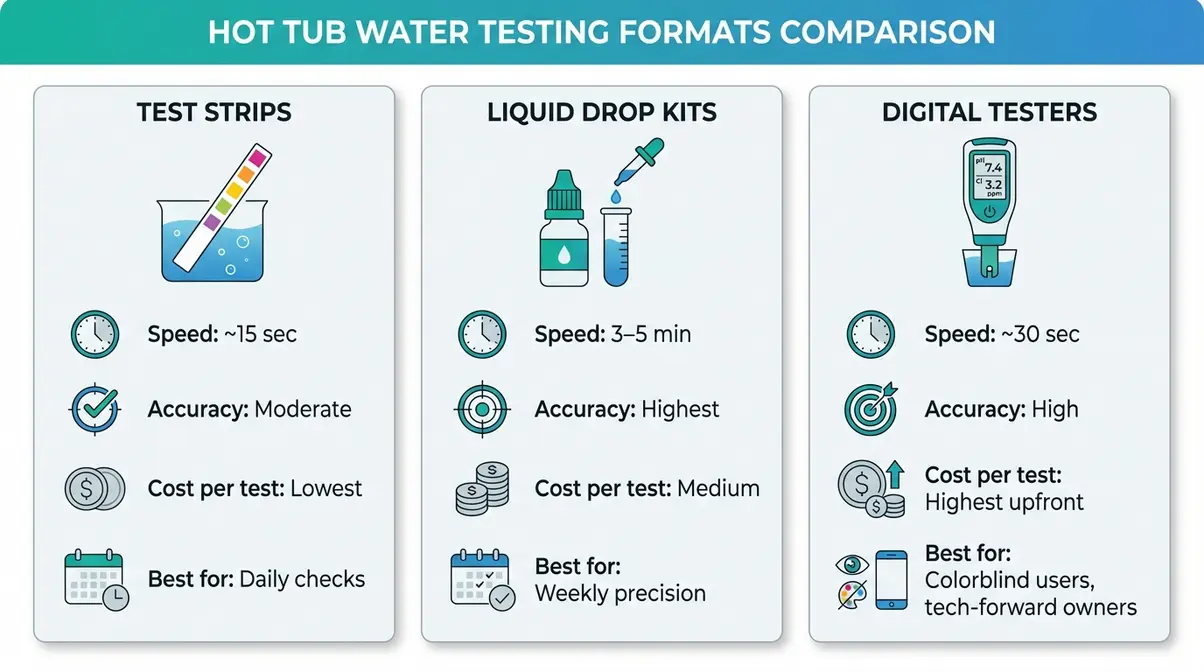
The right kit depends on three things: how accurate you need your readings to be, how much time you want to spend testing, and what you’ll actually spend over a full year. Here’s how the three main formats stack up.
Strips vs. Liquid vs. Digital Testers
Three formats dominate the hot tub testing market, and each involves a fundamentally different approach to reading your water chemistry.
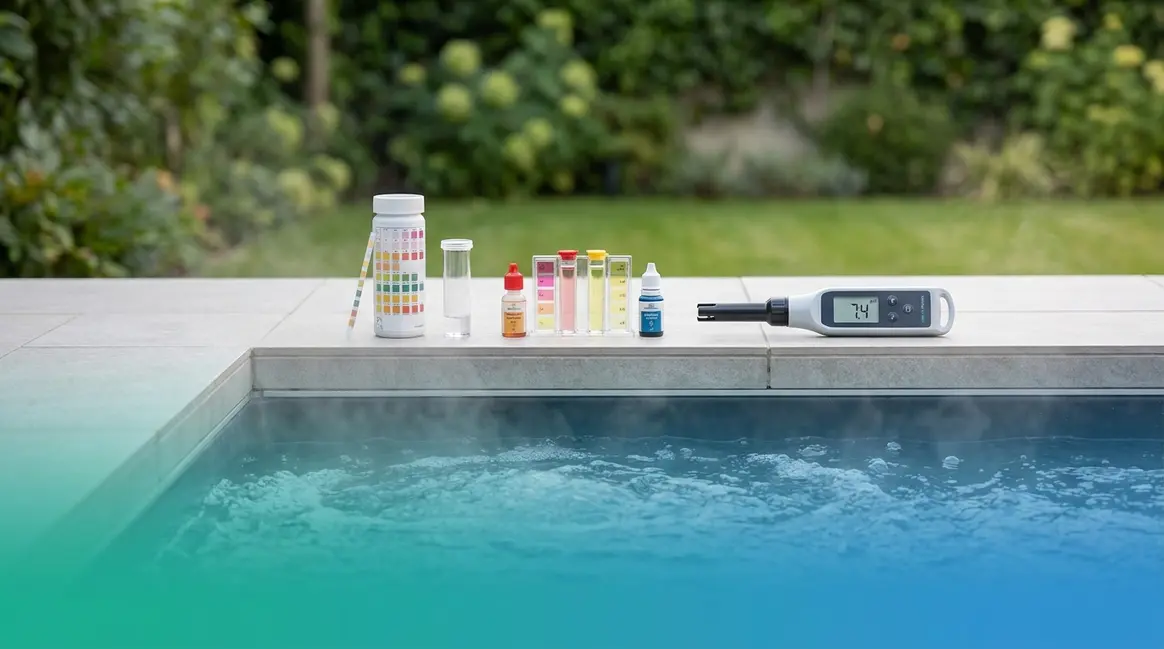
Test strips (dip sticks) are the most common starting point. You dip a strip into your hot tub water for about one second, hold it horizontally, and compare the color pads to a chart on the bottle after 15–30 seconds. They’re fast and inexpensive, but as an independent 2026 Bob Vila test confirmed, “strips are not as accurate as a liquid or digital test kit.” The main issue: color matching is subjective. Lighting conditions, color vision, and strip age all introduce error.
Liquid drop kits use chemical reagents (testing liquids) that react with your water to produce a color change. You count the drops until the color shifts — the drop count tells you the exact concentration. This DPD (N,N-diethyl-p-phenylenediamine) method eliminates the strip’s color-matching problem. CDC guidelines on test strip accuracy confirm DPD test kits provide more accurate hot tub water chemistry readings than test strips (CDC, 2026). The trade-off is time: 3–5 minutes per test versus 15 seconds.
Digital testers use an electronic reader to interpret strip results as numbers, or a photometric sensor to measure water chemistry directly. They eliminate the visual color-matching step entirely. Digital water testers and electronic water test devices are the fastest accurate option — typically 30 seconds — and are particularly valuable for users who struggle with color differentiation.
| Method | Accuracy | Speed | Cost per Test | Best For |
|---|---|---|---|---|
| Test Strips | Moderate | ~15 sec | Lowest | Daily quick checks |
| Liquid Drops | Highest | 3–5 min | Medium | Weekly precision testing |
| Digital Testers | High | ~30 sec | Highest upfront | Colorblind users, tech-forward owners |
Test strips cost less upfront but can cost more over a year when factoring in frequent replacement and the risk of inaccurate readings that lead to chemical overdosing.
How to accurately test hot tub water?
To test hot tub water accurately, collect your sample from about 18 inches below the surface, away from the jets. For test strips, dip briefly for one second, hold the strip horizontally without shaking, and read the color chart within 15–30 seconds in good natural light. For liquid drop kits, count each drop carefully and swirl the sample gently between additions. Avoid testing immediately after adding chemicals — wait at least 30 minutes for the water to fully circulate. Consistent technique matters more than kit brand for reliable readings; even the best kit gives poor results with sloppy sampling.
Total Cost of Ownership: Real Spending
This is where “The True Cost of Wrong Water” becomes real. The concept is simple: the cumulative financial and health cost of using an inaccurate test kit — from over-dosing chemicals because your strip read “low” when levels were fine, to equipment damage from pH imbalance your strips never caught. Many hot tub owners go through strips “quicker than toilet roll” and still have levels that are off, spending more on chemicals than they would have with a more accurate kit.
Here’s what each format actually costs over a year. Strip kits — a 150-count pack — are generally the most affordable upfront option and may need replacing once or twice annually depending on testing frequency. Liquid reagent refills for Taylor kits require a modest annual investment for the K-1004 or K-1005 when you replace the core reagent bottles annually (as required for accurate results). State health regulations require testing reagents to be replaced at manufacturer-recommended frequencies to maintain test accuracy — regulations on replacing testing reagents for accuracy (Cornell Law / Texas Admin Code). Digital reader kits have a higher upfront cost but lower ongoing cost once you’ve purchased the reader itself, since only the strip refills need replacing.
The real cost comparison isn’t kit price — it’s what inaccurate readings cost you downstream in chemicals, equipment repairs, and water corrections.
Are water test kits worth it?
Yes — a water test kit is the single most important maintenance tool for any hot tub owner. Regular testing is the only way to confirm that sanitizer levels are high enough to kill bacteria but low enough to avoid skin irritation. Unbalanced water also damages equipment: pH (water acidity) that’s too low corrodes heater elements and pump seals over time. An inexpensive test kit protects a multi-thousand-dollar hot tub investment. The “True Cost of Wrong Water” is real — it’s the lowest-cost, highest-return maintenance item you’ll buy.
Accessibility: Colorblind Testing
Most test strips and liquid kits rely entirely on color matching, which creates a real problem for the approximately 8% of men who have red-green color blindness — the most common form. If you struggle to distinguish between the pink-to-red range on a chlorine comparator, or the blue-to-green range on an alkalinity strip, you’re not getting accurate readings regardless of which kit you buy.
Digital reader kits like the Wynvex 7-in-1 solve this directly. The electronic water test device displays your results as numbers, removing any color dependency from the testing process. Photometric digital devices work the same way — they measure light absorption electronically rather than asking you to judge a color. Research on digital water tester accuracy from the NIH confirms digital testers provide accurate chlorine and pH readings without requiring visual color matching (NIH, 2026). For colorblind hot tub owners, a digital water tester isn’t a luxury — it’s the only format that gives you reliable results.
Which Kit Is Right for You?
The best hot tub water testing kit is the one that matches your testing habits, accuracy needs, and budget. Here’s the decision framework:
- Quick daily checks + budget priority: → 7-in-1 test strips with a 150-count (the Spa 150ct, JNW, or SuperAccurate options)
- Weekly precision testing + accuracy priority: → Taylor K-1004 for core parameters, or Taylor K-1005 for the most complete liquid kit available
- Color-matching difficulty or tech preference: → Wynvex 7-in-1 with digital reader, or DXPOOL 10-in-1 app kit for data logging
The cheapest kit isn’t always the cheapest option over a full year. “The True Cost of Wrong Water” compounds: one bad reading that leads to a chemical overdose can cost more than the difference between a strip kit and a Taylor liquid kit. If you’ve been dealing with resolve issues with green hot tub water, that’s often a sign your testing method isn’t catching chemistry problems early enough.
How We Evaluated These Hot Tub Test Kits
Our team evaluated each of the 10 kits against five criteria: number of parameters tested, testing format (strip, liquid, or digital), strip count or reagent quantity, hot tub-specific compatibility, and real-world accuracy feedback gathered from hot tub owner communities, pool and spa forums, and independent review publications including Bob Vila’s 2026 pool test kit comparison. Products were ranked by their combination of accuracy, value, and practical usability for hot tub owners specifically — not pool owners — given the differences in water volume, temperature, and chemistry management that make spa testing distinct.
Frequently Asked Questions
What is the best hot tub test kit?
The best hot tub water testing kit depends on your accuracy needs and testing habits. For the highest accuracy, liquid drop kits like the Taylor K-1004 or K-1005 are the professional standard — they use the DPD method to eliminate color-matching errors that make test strips unreliable. For fast daily checks, 7-in-1 test strips with a 150-count offer the best cost-per-test value. For colorblind users or tech-forward owners, a digital reader kit removes visual guesswork entirely by displaying numeric results. Most beginners do well starting with a 7-in-1 strip kit and upgrading to liquid testing once they’re comfortable with the chemistry basics.
What is the most accurate test kit?
Liquid titration kits using the FAS-DPD method are the most accurate water test kits available for home hot tub use. The FAS-DPD method — a drop-counting technique using ferrous ammonium sulfate — measures free chlorine with greater precision than standard color-matching strips, reading accurately up to 5 ppm. Taylor Technologies kits, particularly the K-1005, are the professional benchmark recommended by spa technicians and serious pool owner communities. Digital photometric testers are a close second, eliminating visual color-matching errors while displaying numeric readings. Test strips, while convenient for daily checks, introduce the most potential for reading error of the three formats.
How to tell if hot tub water is bad?
Bad hot tub water typically shows three warning signs: a strong chemical or musty smell, cloudy or discolored water, and persistent foam that doesn’t clear within a minute. A strong chlorine smell often indicates chloramines (combined chlorine compounds that form when sanitizer reacts with body oils and sweat) — not excess sanitizer. Green water signals algae growth from insufficient sanitizer levels. Excessive foam usually points to high levels of body care products or a pH imbalance that’s allowing organic matter to build up. Any of these signs means it’s time to test and rebalance immediately — diagnose and fix cloudy hot tub water for a step-by-step correction guide.
Does a hot tub lower cortisol?
Yes, regular hot tub use can lower cortisol (the body’s primary stress hormone) through thermal exposure. Studies on thermal stress and cortisol reduction from the NIH indicate significant decreases in cortisol concentrations following hot tub-level heat exposure (NIH, 2026). The warm water also promotes muscle relaxation and improved circulation. However, these benefits only apply when your water is properly balanced — unbalanced water causes skin irritation that counteracts the relaxation response entirely. This is one more reason accurate water testing directly supports the health benefits you bought the hot tub to enjoy. Understand safe hot tub soaking times to get the most from each session.
Why is there a 15-minute hot tub rule?
The 15-minute hot tub rule exists to prevent hyperthermia — dangerous overheating of the body’s core temperature. Hot tub water at 104°F (40°C) raises body temperature faster than the body can cool itself through sweating, because the surrounding water prevents sweat from evaporating. CDC recommended 15-minute hot tub time limit guidelines for spas and hot tubs advise observing 10–15 minute soaking limits before exiting to cool down (CDC). Children, pregnant individuals, and people with cardiovascular conditions face higher risk and should follow stricter time limits. Always exit the water if you feel dizzy, lightheaded, or nauseous — those are early warning signs of overheating. Review essential hot tub safety tips for a full safety overview.
Choosing the Right Kit Starts Here
For hot tub owners who are done guessing with inaccurate test strips, the best hot tub water testing kit comes down to one question: how much accuracy do you actually need? Test strips are fast and affordable for daily checks when your chemistry is stable. Liquid drop kits — especially the Taylor K-1004 and K-1005 — deliver professional-grade accuracy for weekly chemistry management. Digital reader kits solve the color-matching problem for tech-forward or colorblind owners who need numeric results they can trust.
“The True Cost of Wrong Water” is real: a cheap strip kit that gives you a false reading can lead to hundreds of dollars in chemical corrections or equipment repairs. The right kit isn’t the cheapest one — it’s the one that gives you accurate readings consistently, week after week, so you’re never guessing whether your levels are off.
Start with the Taylor K-1004 if you’re ready to upgrade from strips and want proven liquid accuracy. Pick up the Wynvex 7-in-1 digital kit if color matching has been your frustration. Either way, test your water this week — your hot tub, your equipment, and your skin will all thank you for it.

Dave King
Hot tub tester and writer at One Hot Tub.