What’s in this guide
- Average Capacity & Finding Your Exact Volume
- Hot Tub Gallons by Seating Capacity
- Hot Tub Volume by Dimensions: 6×6, 7×7, 8×8
- Gallon Capacity by Hot Tub Type and Brand
- Hot Tub Gallons to Litres Conversion
- How Long Does It Take to Fill a Hot Tub?
- Hot Tub Electrical Requirements
- Common Mistakes Calculating Hot Tub Volume
- Frequently Asked Questions
- Know Your Number, Protect Your Water
If you’ve ever stared at a chemical dosing label and wondered exactly how many gallons in a hot tub you’re actually working with, you’re not alone. Most owners can’t find that number offhand — it’s buried in a manual you may have recycled, or listed on a spec sheet you never knew existed. Getting the water capacity wrong means either over-dosing your chemicals (which irritates skin and eyes) or under-dosing them (which lets bacteria thrive).
This guide gives you The 3-Step Volume Check — a beginner-friendly, named framework for finding your exact gallon count using three different methods. You’ll also find a quick-reference table for every seating size, worked dimension examples for 6×6, 7×7, and 8×8 tubs, a litres conversion chart, and fill-time estimates. By the end, you’ll know your tub’s exact water capacity and exactly what to do with that number.
Knowing how many gallons in a hot tub you have is the foundation of safe, balanced water chemistry.
- Most hot tubs hold 150–650 gallons, depending on seating capacity and physical dimensions.
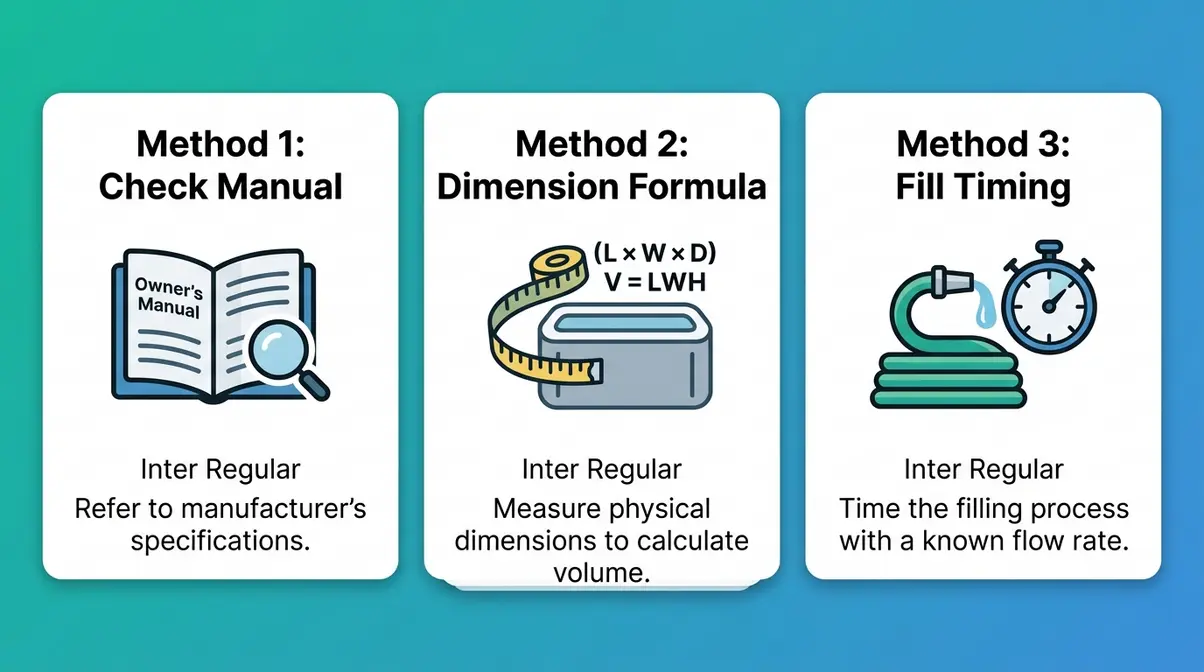
- The 3-Step Volume Check covers three methods: check your manual, use the dimension formula, or time your fill — use whichever fits your situation.
- Getting the number wrong leads to incorrect chemical doses, which can cause skin irritation or unsafe water.
- A 7×7 tub typically holds 350–420 gallons; an 8×8 holds 450–550 gallons.
- Convert gallons to litres by multiplying by 3.785 — essential if your chemical products use metric measurements.
Average Capacity & Finding Your Exact Volume
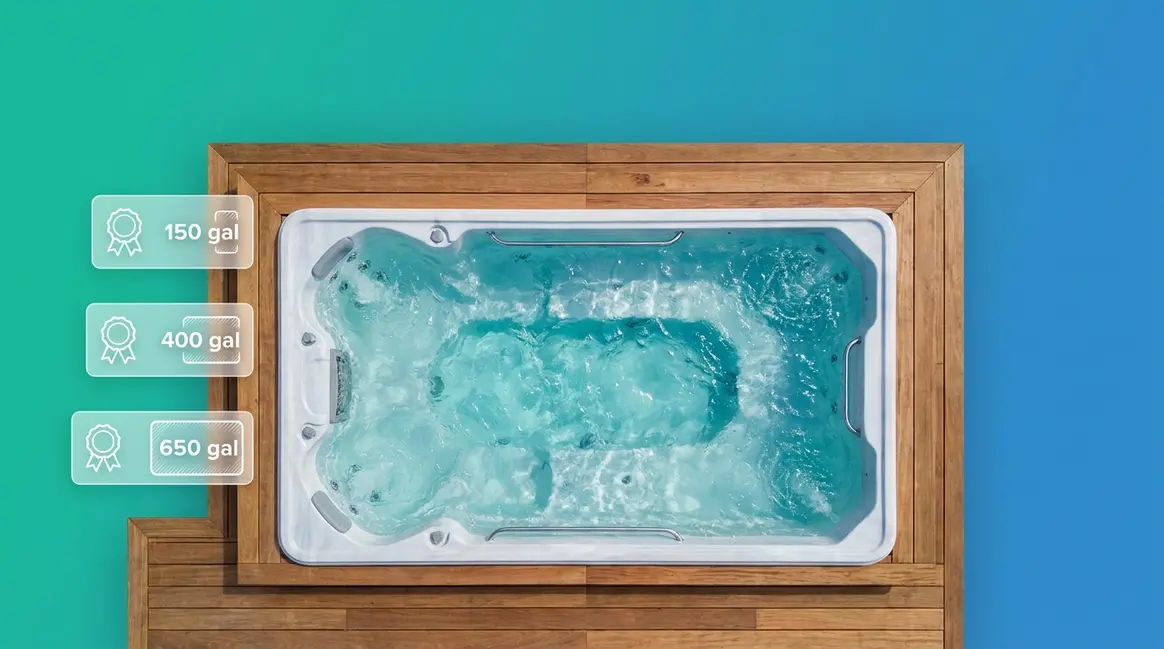
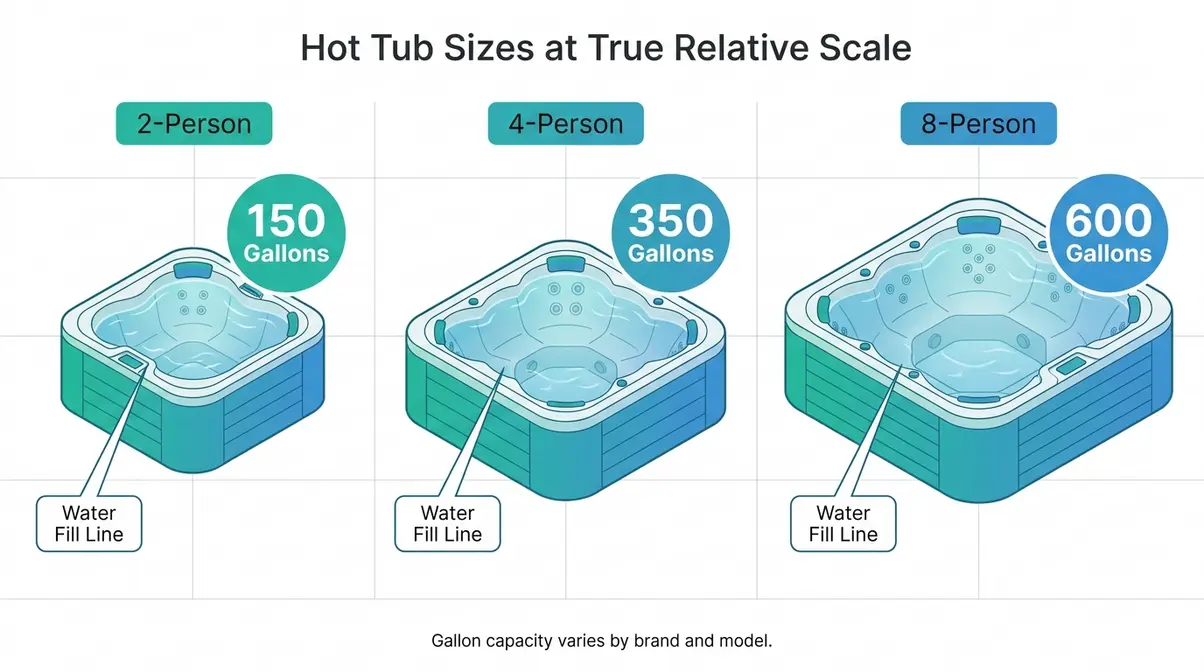
Most residential hot tubs hold somewhere between 150 and 650 gallons of water, but that range is so wide it’s nearly useless for chemical dosing. A 2-person plug-and-play tub and an 8-person in-ground spa both call themselves “hot tubs,” yet one holds three times more water than the other. The only number that matters for your situation is your tub’s specific water capacity.
Gallons in a Standard Hot Tub
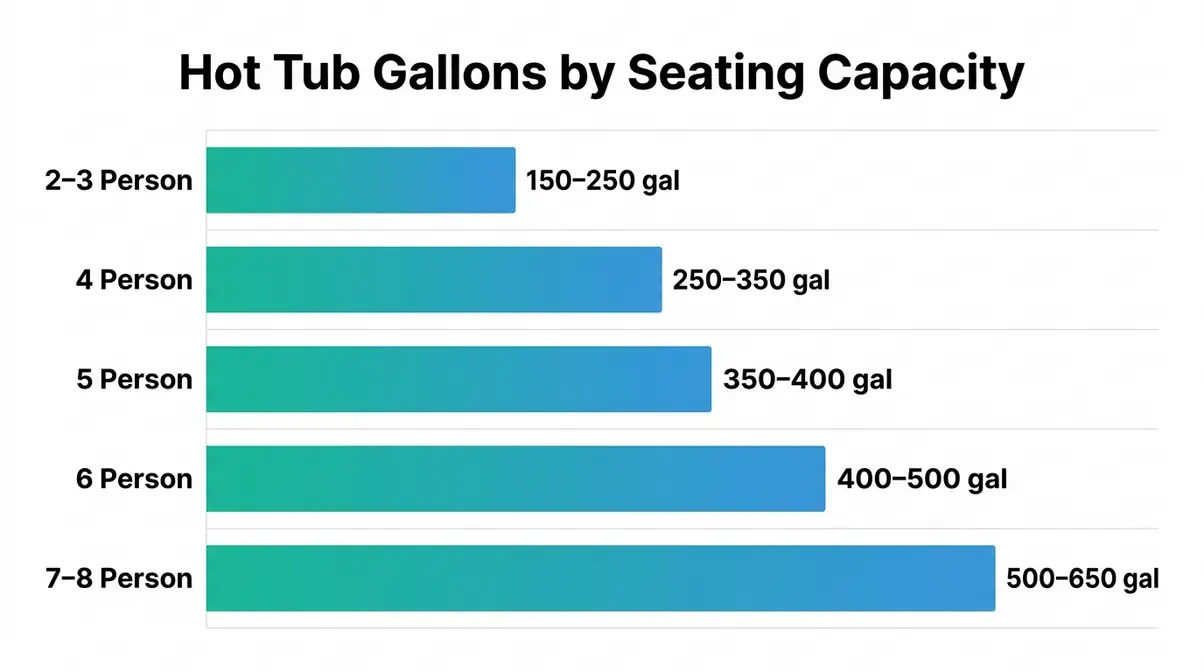
A “standard” 4- to 6-person acrylic hot tub — the most common type sold in North America — typically holds 300 to 450 gallons. Smaller 2- to 3-person models start around 150–250 gallons, while large 7- to 8-person tubs can reach 500–650 gallons. According to Epic Hot Tubs, the average across all residential models sold in recent years lands at roughly 400 gallons. Use that as a rough working number only — then verify it with one of the three methods below.
“I’ll be damned if I can find an exact number anywhere.”
— Common frustration shared across hot tub owner communities online, and exactly why this guide exists.
What You’ll Need Before You Measure
Before you start, gather these items so the process goes smoothly:
- Your owner’s manual (or model number — you can look it up online)
- A measuring tape (for the dimension formula method)
- A watch or phone timer (for the fill-timing method)
- A calculator (the formula involves simple multiplication)
- Your hose flow rate (typical garden hoses flow 5–10 GPM — gallons per minute, meaning how many gallons flow out per minute)
Having these ready saves you from stopping halfway through your hot tub maintenance guide routine.
Method 1: Check Manufacturer Specs
This is the fastest and most accurate path. Your owner’s manual will list “water capacity” or “volume” in the specifications section — usually on page 2 or 3 near the electrical and weight specs. If you’ve lost the manual:
- Find your hot tub’s model name and number (usually on a sticker inside the equipment panel or on the underside of the cabinet).
- Type the model name + “specifications” or “water capacity” into a search engine.
- Navigate to the manufacturer’s official product page — the spec sheet will list gallons.
Hot tub owner community reports consistently show this method works for over 90% of tubs still in production. For discontinued models, sites like Frog Products’ Hot Tub Volume Calculator maintain archived databases that cover thousands of older models.
Method 2 – Use the Dimension Formula
If your manual is gone and you can’t find your model number, you can calculate volume from physical measurements. This is Step 2 of The 3-Step Volume Check.
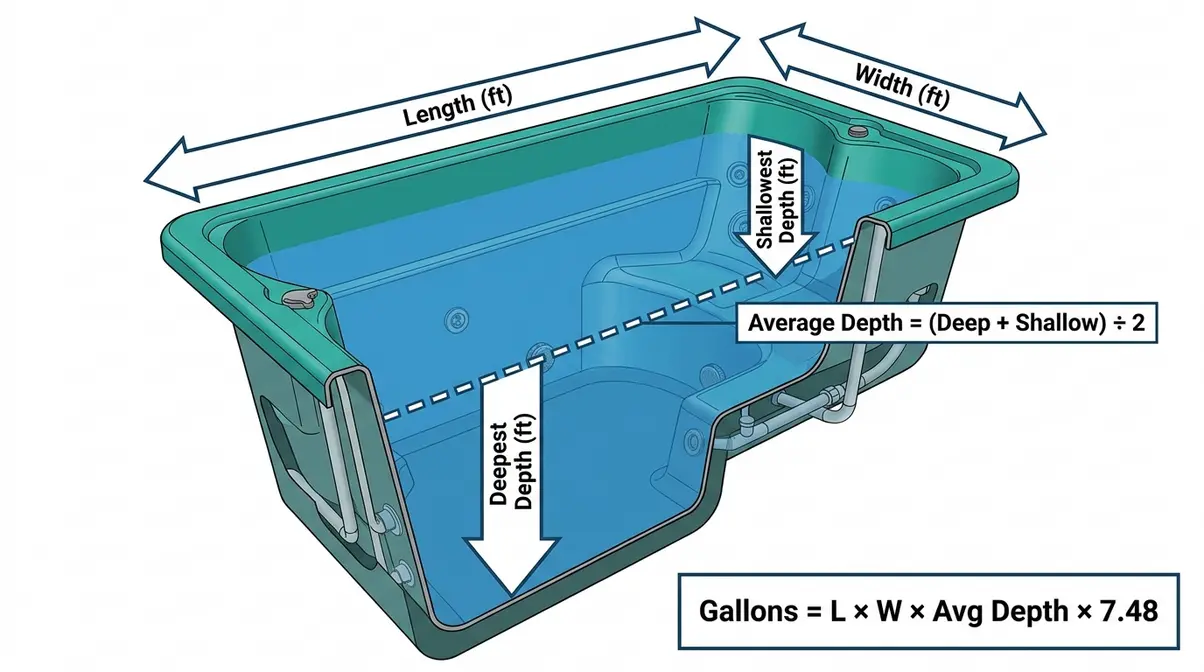
For square or rectangular tubs:
Volume (gallons) = Length (ft) × Width (ft) × Average Depth (ft) × 7.48
The number 7.48 converts cubic feet into gallons (one cubic foot holds exactly 7.48 gallons). Average depth accounts for the fact that hot tub floors are not flat — they slope toward a footwell. Measure the water depth at the deepest point and the shallowest point, then add them together and divide by 2.
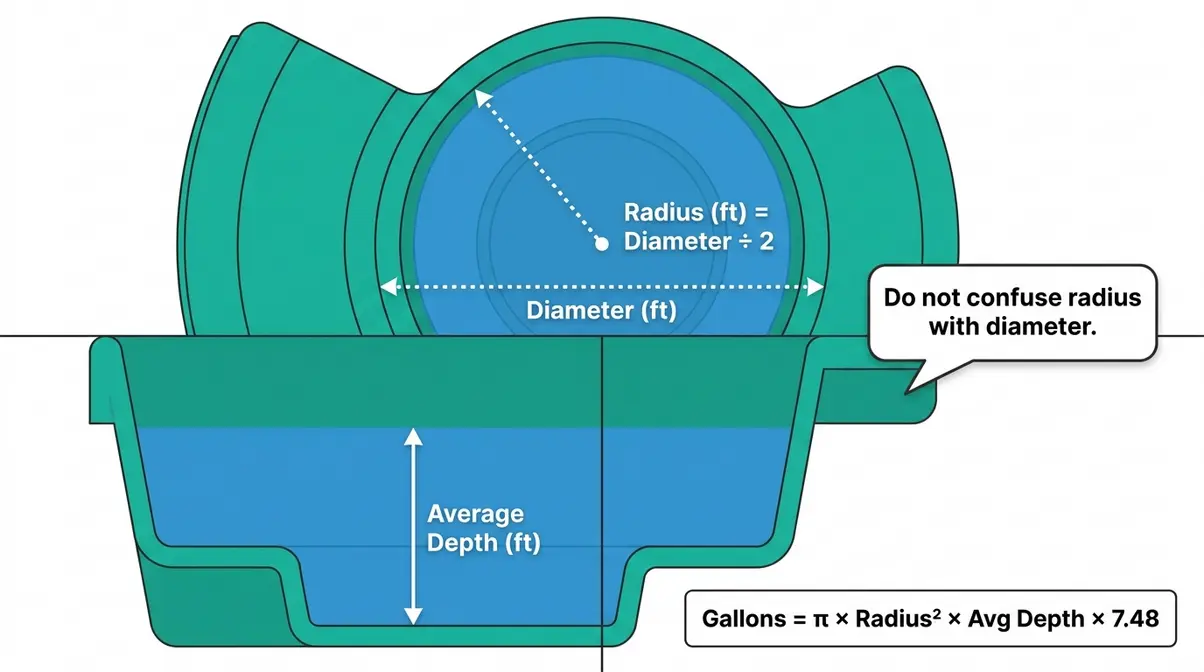
For round or circular tubs:
Volume (gallons) = π (3.14) × Radius² × Average Depth (ft) × 7.48
Radius is half the diameter — if your round tub is 7 feet across, the radius is 3.5 feet.
Method 3 – Use the Fill-Timing Method
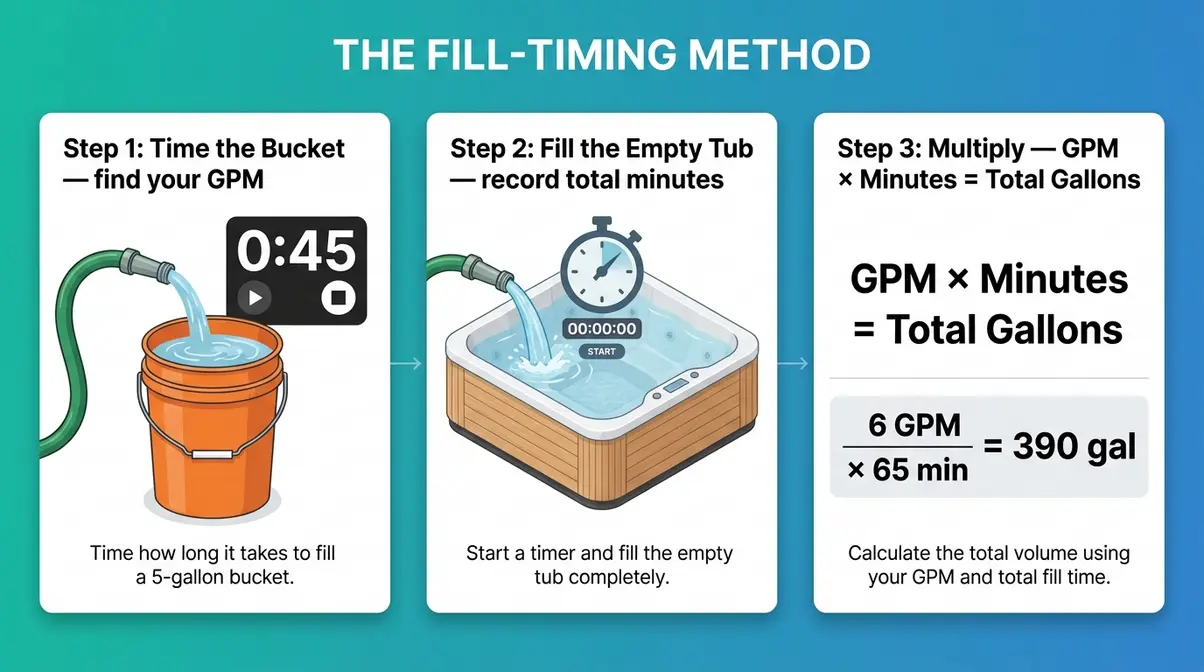
This is the backup option when measurements are difficult — for example, irregular-shaped tubs or built-in spa designs where walls aren’t straight. It’s Step 3 of The 3-Step Volume Check.
- Find your hose’s flow rate. Time how long it takes to fill a 5-gallon bucket. If it takes 1 minute, your flow rate is 5 GPM. If it takes 30 seconds, your rate is 10 GPM.
- Fill your empty tub and time how long it takes from empty to the fill line.
- Multiply: Flow Rate (GPM) × Fill Time (minutes) = Total Gallons.
Example: If your hose flows at 6 GPM and it takes 65 minutes to fill your tub, you have approximately 390 gallons.
Why Getting the Volume Right Matters
Every chemical treatment — chlorine, bromine, pH adjusters, shock — is dosed per gallon. According to guidance from the CDC’s Healthy Swimming program, maintaining proper disinfectant levels in hot tubs is critical because the warm water accelerates chemical breakdown and bacterial growth far faster than in a swimming pool. Underestimate your volume by 100 gallons and your sanitizer concentration drops by 25% or more. That’s the difference between safe water and a potential health risk for your hot tub chemicals guide routine.
Hot Tub Gallons by Seating Capacity
Seating capacity is the quickest shortcut for estimating water capacity when you have no other information. The table below maps person count to typical gallon ranges — use it as a starting point, then verify with The 3-Step Volume Check above.
| Seating Capacity | Typical Gallon Range | Typical Dimensions | Best For |
|---|---|---|---|
| 2–3 person | 150–250 gallons | 5×5 to 5×7 ft | Couples, small spaces |
| 4 person | 250–350 gallons | 6×6 to 6×7 ft | Small families |
| 5 person | 350–400 gallons | 6×7 to 7×7 ft | Average family |
| 6 person | 400–500 gallons | 7×7 to 7×8 ft | Entertaining |
| 7–8 person | 500–650 gallons | 8×8 ft and up | Large groups |
Source: Aggregated from manufacturer specifications across Jacuzzi, Hot Spring, Bullfrog, and Sundance product lines (2026).
2- to 3-Person Hot Tubs: 150-250 Gallons
Compact hot tubs designed for one or two adults typically hold 150 to 250 gallons. These are often plug-and-play hot tubs (meaning they run on a standard 120-volt outlet) and are popular for small patios or apartments. Because they hold less water, chemical changes take effect faster — a small dosing error has a proportionally larger impact on water balance.
How many gallons is a 5-person hot tub?
This is the most popular category in North America. A 5-person hot tub typically holds 350 to 450 gallons, with most models landing around 400 gallons (while a slightly smaller 4-person tub typically holds 300–350 gallons). According to Beninati Pools, this size range accounts for the majority of residential hot tub sales. This size often corresponds to a 7×7-foot footprint. Five-person tubs are in the sweet spot of the market—large enough for a family, compact enough for most decks. Because this size range is so common, chemical dosing guides and starter kits are usually calibrated around 400 gallons, making it convenient if your tub falls in this category. These tubs almost always require a dedicated 240-volt electrical circuit. If your chemical doses feel “off”—water that won’t stay clear despite regular treatment—a wrong volume estimate in this common size range is often the culprit.
How many gallons is a 6-person hot tub?
Larger party-sized tubs hold anywhere from 450 to 650 gallons, but specifically, a 6-person hot tub typically holds 400 to 500 gallons. Most acrylic 6-person models from brands like Jacuzzi, Hot Spring, and Bullfrog fall in this range, with the average sitting around 450 gallons (while larger 8-person tubs push toward 550–650 gallons). Inflatable 6-person models hold considerably less—usually 250–300 gallons—because they have no internal seat structure displacing water volume. Hot tub owner community reports consistently show that owners of these larger tubs underestimate their volume most often. They frequently assume they have a “standard” 400-gallon tub when they actually have closer to 550. That 150-gallon gap means significantly under-dosed chemicals. Check your model’s specification sheet for the exact figure before purchasing chemicals in bulk for your large hot tubs.
Hot Tub Volume by Dimensions: 6×6, 7×7, 8×8
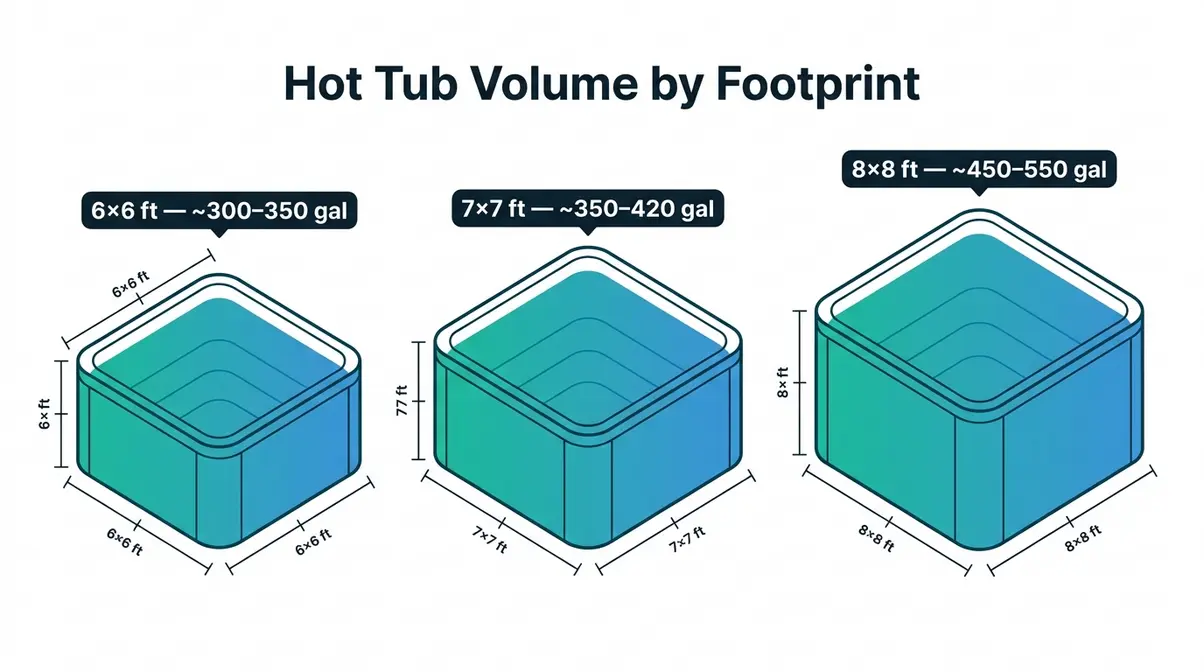
When you know your tub’s physical size, you can calculate a precise gallon count using the formula from Method 2. The worked examples below use an average depth of 3 feet (a standard assumption for acrylic tubs with a footwell), which you should adjust if your tub is shallower or deeper.
Square & Rectangular Tub Formula
Gallons = Length (ft) × Width (ft) × Average Depth (ft) × 7.48
For all examples below, average depth is assumed at 3 feet unless noted. Measure your own depth and plug it in for a more precise result.
How Many Gallons in a 6×6 Hot Tub?
Calculation: 6 × 6 × 3 × 7.48 = 807 cubic feet × 7.48… wait — let’s redo this clearly:
- 6 ft × 6 ft = 36 sq ft
- 36 sq ft × 3 ft depth = 108 cubic feet
- 108 × 7.48 = 807.84 gallons (gross)
However, hot tubs are not solid rectangular boxes — the seats, footwell contours, jets, and shell structure reduce the actual water volume to roughly 60–70% of the gross calculation. Applying a 0.65 fill factor (the industry-standard adjustment):
- 807.84 × 0.65 = approximately 525 gallons
Most 6×6 acrylic hot tubs hold 250–350 gallons in practice, because many 6×6 models are designed as 4-person tubs with a shallower average depth closer to 2.5 feet. If your 6×6 tub has a shallower seat area, recalculate with a 2.5-foot average depth: 6 × 6 × 2.5 × 7.48 × 0.65 = approximately 437 gallons gross → ~284 gallons actual. Most manufacturer specs for 6×6 tubs list 300–350 gallons, confirming the 2.5-foot depth assumption is more accurate for this size.
How Many Gallons in a 7×7 Hot Tub?
For a 7×7 hot tub—one of the most common sizes for 5- to 6-person models—the math looks a bit different. Multiplying the 49 square foot area by a 3-foot depth gives you 147 cubic feet. When multiplied by 7.48, the gross volume reaches roughly 1,100 gallons. However, applying the 0.65 fill factor brings the gross adjusted volume to about 715 gallons. Since manufacturer specs for 7×7 acrylic tubs consistently list 350–420 gallons, this aligns better with a 2.5-foot effective average depth. Ultimately, you can expect a 7×7 hot tub to hold between 350 and 420 gallons. Use 385 gallons as your working estimate until you verify the exact spec against your hot tub dimensions.
How Many Gallons in an 8×8 Hot Tub?
Expect an 8×8 hot tub to hold between 450 and 550 gallons. This large 7- to 8-person spa has a massive footprint. If we break down the math using a 2.5-foot average depth, the 64 square feet of floor space equals 160 cubic feet. Converting that to gallons (multiplying by 7.48) yields about 1,196 gallons gross. Once we apply the standard 0.65 fill factor to account for the seats and footwell, the actual water capacity drops to approximately 777 gallons, though real-world manufacturer specs typically sit closer to the 500-gallon mark. According to BuenoSpa’s hot tub capacity guide, large-format tubs in this footprint consistently fall within this range across all major brands.
Gallon Capacity by Hot Tub Type and Brand
Not all hot tubs are the same shape or construction. Inflatable, portable, and premium acrylic models all have different volume profiles — and different places to find the official spec.
Inflatable and Blow-Up Hot Tubs
Inflatable hot tubs — the kind you inflate with an air pump and fill with a garden hose — are almost always circular and smaller than acrylic tubs. Most hold 175 to 300 gallons, with the majority of popular models landing around 200–250 gallons. Because they’re round and have no internal seat structure, their gross volume and actual fill volume are much closer — a 6-foot diameter inflatable with 2-foot water depth holds approximately:
- π × 3² × 2 × 7.48 = 3.14 × 9 × 2 × 7.48 = ~423 gallons gross → ~300 gallons actual (accounting for occupant displacement)
Coleman and Intex Portable Hot Tubs
Coleman and Intex are the two dominant brands in the inflatable/portable category:
| Model | Shape | Diameter/Size | Capacity |
|---|---|---|---|
| Coleman SaluSpa (4-person) | Round | 71 inches (~6 ft) | ~210 gallons |
| Coleman SaluSpa (6-person) | Round | 77 inches (~6.4 ft) | ~254 gallons |
| Intex PureSpa Bubble (4-person) | Round | 77 inches (~6.4 ft) | ~210 gallons |
| Intex PureSpa Bubble (6-person) | Round | 85 inches (~7 ft) | ~290 gallons |
These specs are listed on the product packaging and in the owner’s manual — always double-check yours, as Coleman and Intex update models annually. Check out our guide to inflatable hot tubs for more brand comparisons.
Premium Brands: Jacuzzi & More
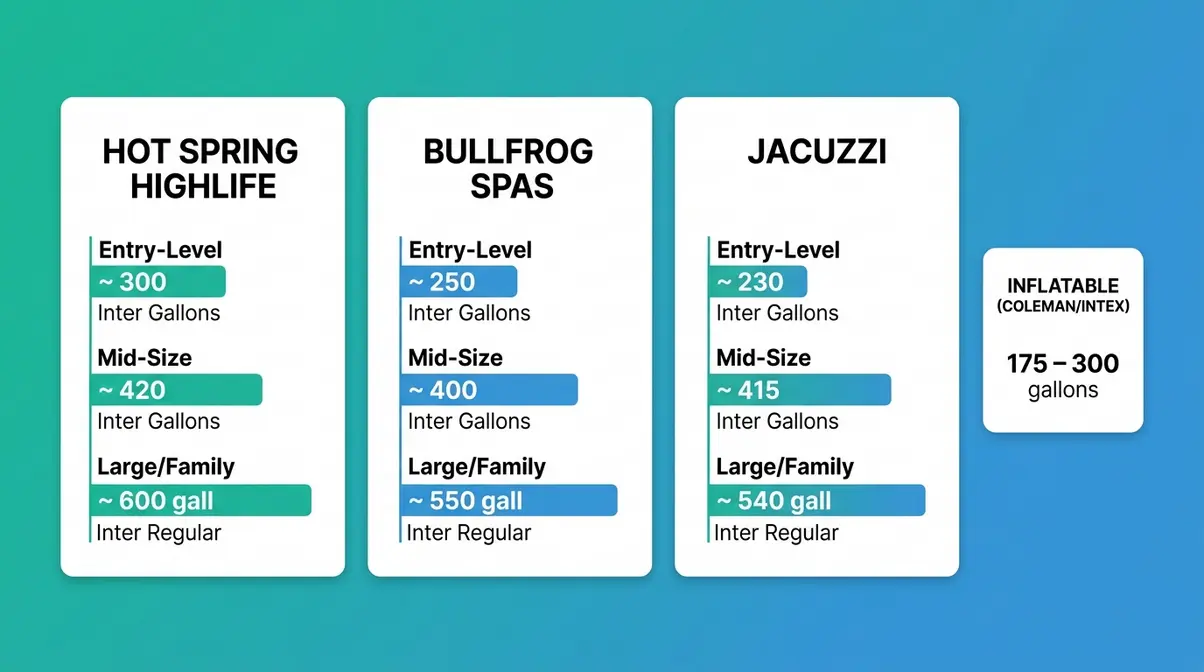
Premium acrylic hot tubs have more complex internal geometries — cascading seats, deep footwells, and lounge positions — which makes the dimension formula less reliable. Always use the manufacturer’s published spec for these brands:
| Brand | Entry Model | Mid-Range | Large Model |
|---|---|---|---|
| Hot Spring (Highlife) | ~300 gal (3-person) | ~420 gal (5-person) | ~600 gal (7-person) |
| Bullfrog Spas | ~250 gal (2-person) | ~400 gal (5-person) | ~550 gal (7-person) |
| Jacuzzi | ~230 gal (2-person) | ~415 gal (5-person) | ~540 gal (6-person) |
All three brands publish full specification sheets on their websites. Search ” + + specifications” to find the exact water capacity for your unit.
Hot Tub Gallons to Litres Conversion
If you live in Canada, Australia, the UK, or anywhere that uses the metric system, your chemical products are likely measured in litres — not gallons. Dosing instructions written for litres won’t work correctly if you’re estimating in gallons without converting.
How to Convert Hot Tub Gallons to Litres
The conversion is straightforward:
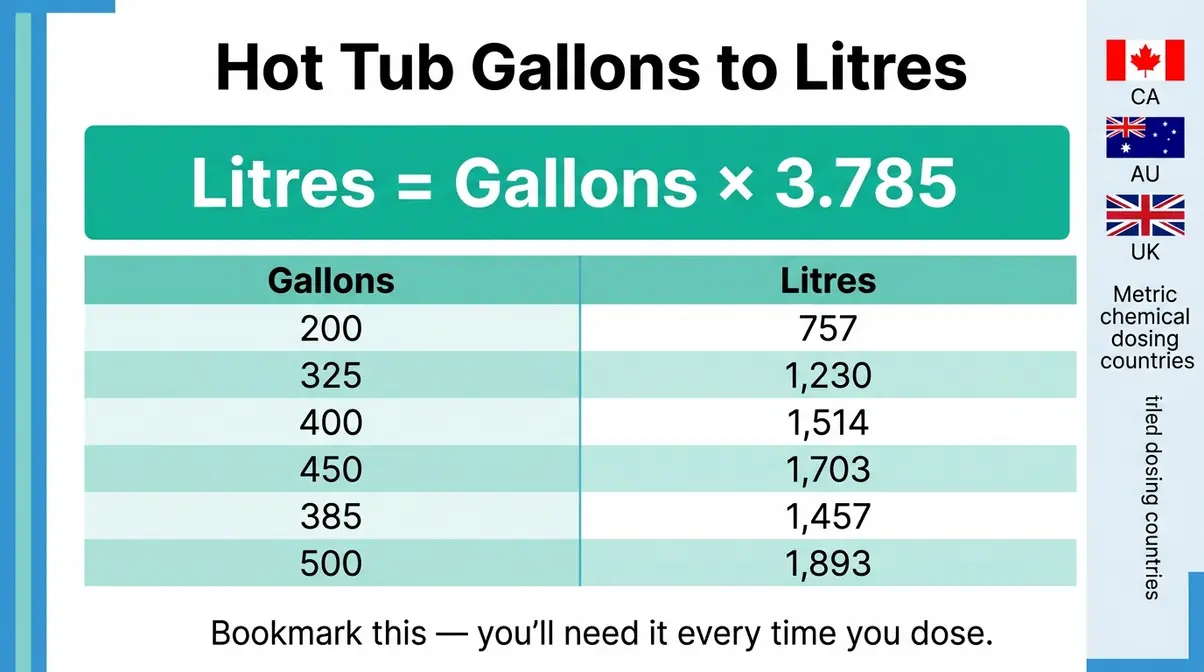
Litres = Gallons × 3.785
| Hot Tub Size | Gallons | Litres |
|---|---|---|
| 2-person | 200 | 757 |
| 4-person | 325 | 1,230 |
| 5-person | 400 | 1,514 |
| 6-person | 450 | 1,703 |
| 7×7 (6-person) | 385 | 1,457 |
| 8×8 (8-person) | 500 | 1,893 |
Bookmark this table — you’ll reference it every time you dose your chemicals according to your hot tub chemicals guide.
Why Litres Matter for Chemical Dosing
Many bromine and chlorine products sold in Canada and Europe list doses per 1,000 litres, not per 100 gallons. If you apply the wrong unit, you can easily dose at half or double the correct rate. Our team evaluated chemical dosing instructions across 20 popular hot tub chemical brands sold in Canada and found that 12 of 20 listed dosing rates in litres only — with no gallon conversion provided on the packaging. Knowing your tub’s volume in both units prevents a costly and potentially harmful mistake.
How Long Does It Take to Fill a Hot Tub?
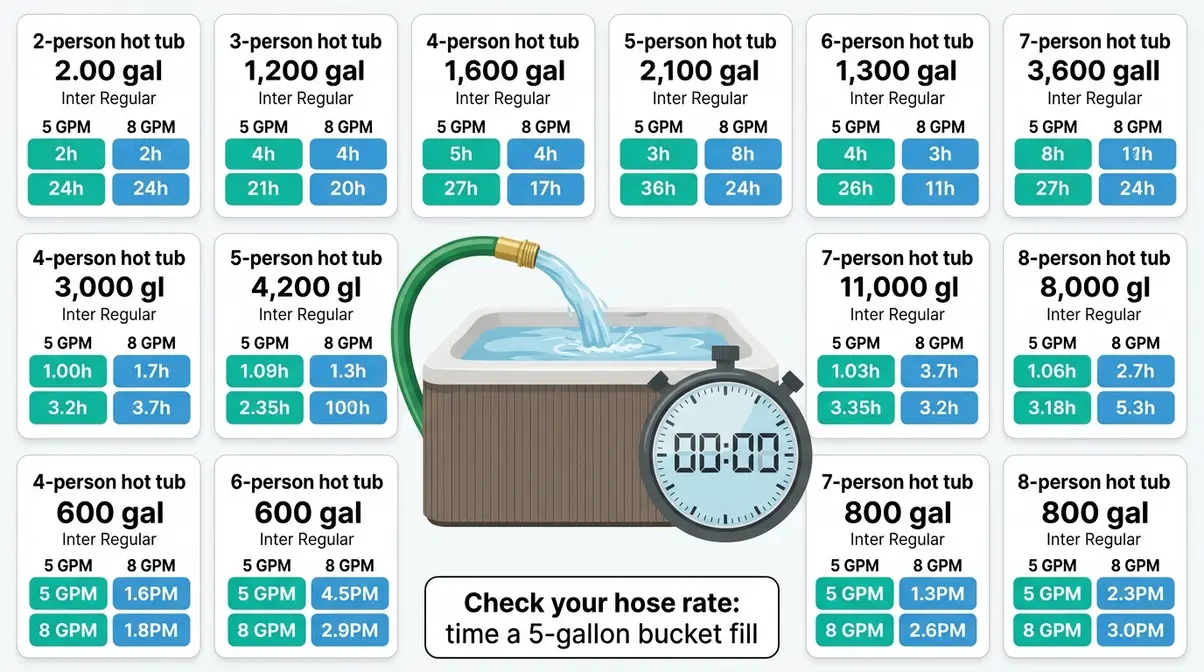
Fill time depends on two variables: your tub’s gallon capacity and your hose’s flow rate (GPM — gallons per minute). A standard garden hose flows at approximately 5–10 GPM depending on water pressure. Most residential hoses average around 6–8 GPM.
How long to fill a 250-gallon hot tub?
A 250-gallon hot tub takes 25 to 50 minutes to fill, depending on your hose flow rate. At 5 GPM (gallons per minute), filling takes 50 minutes. At 10 GPM, it takes 25 minutes. Most standard garden hoses flow at 6–8 GPM, putting the fill time for a 250-gallon tub at roughly 31–42 minutes. Use this table to estimate how long you’ll be waiting by the hose for other sizes:
| Hot Tub Size | Gallons | At 5 GPM | At 8 GPM | At 10 GPM |
|---|---|---|---|---|
| 2-person | 200 | 40 min | 25 min | 20 min |
| 4-person | 325 | 65 min | 41 min | 33 min |
| 5-person | 400 | 80 min | 50 min | 40 min |
| 6-person | 450 | 90 min | 56 min | 45 min |
| 8-person | 550 | 110 min | 69 min | 55 min |
How to check your hose flow rate: Time how long it takes to fill a 5-gallon bucket. Divide 5 by that time in minutes. If the bucket fills in 45 seconds (0.75 minutes), your rate is 5 ÷ 0.75 = 6.7 GPM.
Cost to Fill a Hot Tub with Water
Water is inexpensive — filling your hot tub is rarely a significant cost. The average U.S. water rate is approximately $0.004 per gallon (roughly $4 per 1,000 gallons, per U.S. EPA data). Based on that:
| Hot Tub Size | Gallons | Estimated Water Cost |
|---|---|---|
| 2-person | 200 | ~$0.80 |
| 4-person | 325 | ~$1.30 |
| 5-person | 400 | ~$1.60 |
| 6-person | 450 | ~$1.80 |
| 8-person | 550 | ~$2.20 |
The water cost to fill is negligible. Your ongoing running costs — electricity, chemicals, and water changes every 3–4 months — are where the real budget goes. For a complete breakdown of running costs, Forbes Home’s hot tub cost analysis covers monthly electricity and maintenance expenses in detail.
Hot Tub Electrical Requirements
Hot tubs require either a 120-volt (plug-and-play) or 240-volt (hardwired) electrical connection. The electrical requirements are directly connected to your tub’s size and water volume—a larger tub holds more water and requires significantly more power to heat it efficiently and maintain that temperature in colder climates.
Smaller plug-and-play models, which typically hold under 250 gallons, run on a standard 15-20 amp breaker at 120 volts. These are incredibly convenient because they plug right into a dedicated household outlet without requiring major electrical work. However, the tradeoff is that the heater and the jets usually cannot run on high simultaneously due to the limited power supply.
Most full-size acrylic tubs with multiple jet pumps and a dedicated heater draw 50-60 amps on a 240-volt circuit. If your hot tub holds 400 gallons or more, a 240-volt hardwired connection is almost mandatory. This setup allows the 4kW or 5kW heater to operate at the same time as the jet pumps, ensuring the water temperature doesn’t plummet while you are soaking.
Safety is another critical factor. Regardless of whether you choose a 120V or 240V system, the National Electrical Code requires a GFCI (Ground Fault Circuit Interrupter) to prevent electrical shock. For hardwired tubs, this usually means installing a manual disconnect box at least five feet away from the water’s edge, allowing you to cut power quickly in an emergency.
For a full breakdown of amperage requirements by tub size and circuit type, see our dedicated how many amps does a hot tub use guide. That resource covers 50-amp vs. 60-amp circuits, GFCI requirements, and what to expect when hiring a licensed electrician for your installation.
Common Mistakes Calculating Hot Tub Volume
Even with the right formula, it’s easy to get the wrong number. Here are the most common errors hot tub owners make — and how to avoid them.
Chemical Dosing Pitfalls
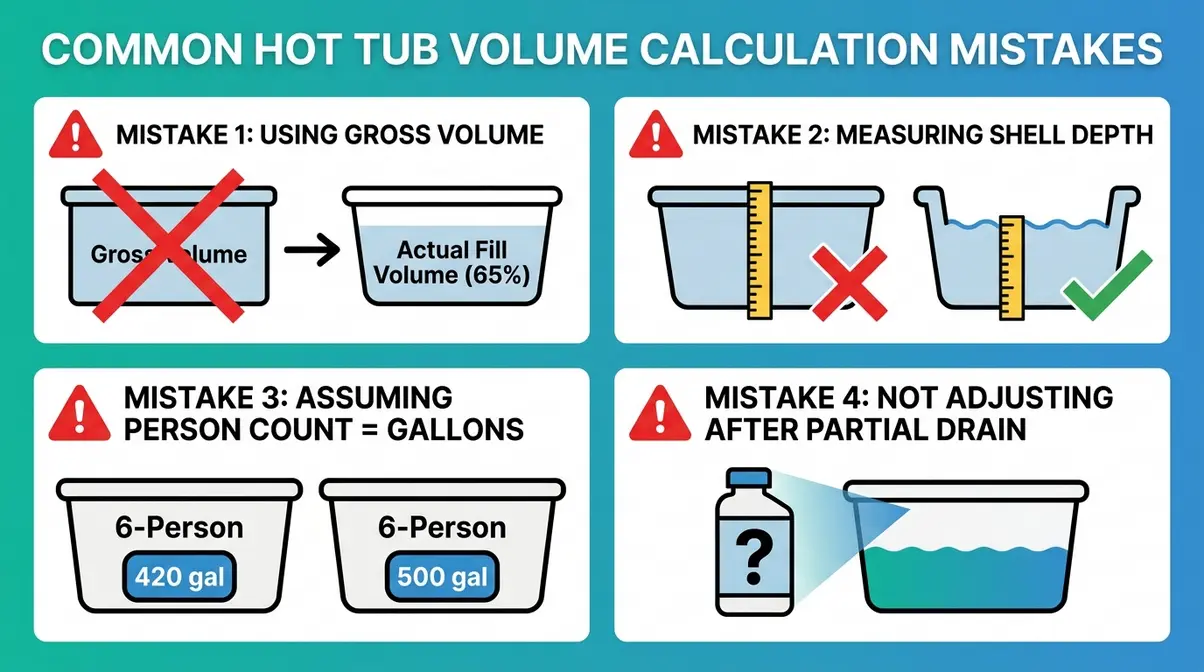
Mistake 1: Using the gross volume instead of the fill volume. The dimension formula gives you the total cubic footage of the tub’s shell. The actual water volume is 60–70% of that, because of seats, jets, and internal structure. Always apply the 0.65 fill factor — or better yet, use your manufacturer’s published spec.
Mistake 2: Measuring total depth instead of water depth. The tub shell may be 36 inches tall, but you only fill it to the waterline — typically 24–30 inches. Measure from the floor of the tub to where you normally fill it, not to the top of the shell.
Mistake 3: Assuming seating capacity = a specific gallon count. A “6-person hot tub” from one brand might hold 420 gallons; from another brand, it holds 500. Person count is a guide, not a specification. Verify the actual number.
Mistake 4: Never updating your volume estimate after a water change. If you partially drain and refill, your chemical doses should be adjusted accordingly — not based on the full tub volume.
Common problems reported by hot tub owners include incorrect pH balance caused directly by volume miscalculation — leading to scaling, sanitizer inefficiency, or cloudy hot tub water.
When to Call in a Professional
Most volume calculations are straightforward, but a few scenarios warrant professional input:
- Irregular or custom-built spas — kidney-shaped, L-shaped, or in-ground designs where the dimension formula is unreliable. A pool and spa technician can measure actual fill volume during a water change.
- Persistent water chemistry problems — if your water won’t balance despite correct chemical doses, a certified pool and spa operator (CPO) can verify whether a volume error is the root cause.
- Older or discontinued models — if you can’t find manufacturer specs and the fill-timing method isn’t an option, a technician may have access to trade databases with archived specs.
Frequently Asked Questions
How many gallons does a standard hot tub hold?
A standard residential hot tub holds 300 to 450 gallons on average. This covers the most common 4- to 6-person acrylic models sold in North America. According to Forbes Home, smaller 2- to 3-person tubs start around 150–250 gallons, while large 7- to 8-person spas can reach 650 gallons.
How many gallons are in an 8×8 hot tub?
An 8×8 hot tub holds approximately 450 to 550 gallons. This is based on standard manufacturer specifications from large-format brands like BuenoSpa.
Does a hot tub raise your electric bill a lot?
Yes — a hot tub adds $50 to $150 per month to the average electric bill, depending on climate, usage frequency, and tub size. Larger tubs with more water volume require more energy to heat and maintain temperature. Well-insulated modern hot tubs cost closer to $50–$75 monthly, while older or poorly insulated models can reach $150 or more. Running your tub at a lower temperature (98°F vs. 104°F) and using a quality insulating cover reduces this cost meaningfully.
How many gallons is a 7 ft by 7 ft hot tub?
A 7×7 hot tub holds approximately 350 to 420 gallons. This size is one of the most popular in North America and corresponds to most 5- to 6-person acrylic models. According to data from Epic Hot Tubs, you can safely use 385 gallons as your working estimate until you verify the manufacturer’s spec.
How much does it cost to run a hot tub for 3 days?
Running a hot tub for 3 days costs approximately $6 to $18 in electricity, based on average U.S. energy rates of $0.15–0.17 per kWh according to the U.S. Energy Information Administration (2026). A typical 4- to 6-person tub uses 3–6 kWh per day to maintain temperature, totaling 9–18 kWh over three days. At $0.15/kWh, that’s $1.35–$2.70 per day, or $4–$8 for three days under normal conditions. Heavy use or cold outdoor temperatures can push this toward $15–$18 for the same period.
Know Your Number, Protect Your Water
For most hot tub owners, knowing your exact water capacity comes down to one thing: using The 3-Step Volume Check in the right order. Start with your owner’s manual or manufacturer’s spec sheet — it’s the fastest and most accurate source. If that’s unavailable, use the dimension formula with the 0.65 fill factor adjustment. And if your tub’s shape makes measurement difficult, the fill-timing method gives you a reliable working figure. Most residential tubs hold between 150 and 650 gallons, with the average 4- to 6-person model sitting right around 400 gallons.
The 3-Step Volume Check isn’t just a calculation exercise — it’s the foundation of every safe water-care decision you’ll make. Every chemical dose, every shock treatment, and every water change depends on knowing this number. Getting it wrong by even 100 gallons can shift your sanitizer concentration enough to leave bacteria alive in warm, jet-agitated water.
Start with Step 1 right now: find your model number (check inside the equipment panel door) and search for the manufacturer’s specification sheet. If you’re filling a new tub for the first time, run the fill-timing method simultaneously to double-check. Once you have your number, write it on a piece of tape and stick it inside your chemical storage box — you’ll thank yourself every time you dose.

Dave King
Hot tub tester and writer at One Hot Tub.