What’s in this guide
- 1. Oval Inflatable Hot Tub with Side Table: Best for Solo Soaking
- 2. Coleman Miami Inflatable Hot Tub: Best Energy-Efficient Pick
- 3. Bestway SaluSpa Cancun: Best for Versatility
- 4. PVC Blow Up Hot Tub: Best Budget Pick
- Buying Guide: What to Know Before You Buy a 1-Person Hot Tub
- How We Evaluated
- Frequently Asked Questions
- Closing Thoughts
| # | Preview | Product | Best For | Buy |
|---|---|---|---|---|
| 1 |  | Oval Inflatable Hot Tub with Side Table | Best for Solo Soaking | Buy on Amazon |
| 2 |  | Coleman Miami Inflatable Hot Tub | Best Energy-Efficient Pick | Buy on Amazon |
| 3 | No products found. | Bestway SaluSpa Cancun | Best for Versatility | No products found. |
| 4 | 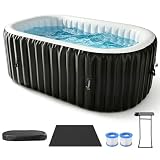 | PVC Blow Up Hot Tub | Best Budget Pick | Buy on Amazon |
1. Oval Inflatable Hot Tub with Side Table: Best for Solo Soaking
Who it’s for: Solo soakers who want a dedicated 1–2 person inflatable spa with a convenient side table and generous jet coverage in a compact oval footprint.
| Spec | Value |
|---|---|
| Dimensions | 75″ × 47″ × 25″ |
| Water capacity | ~145 gallons |
| Capacity | 1–2 persons |
| Shape | Oval |
| Jet count | 100 bubble jets |
| Heater power | ~1,350 W |
| Power requirement | 110–120 V standard outlet |
| Included accessories | Side table, heater/pump, insulated cover, filter |
- +Oval shape measures just 47″ at its narrowest — that’s 24″ narrower than a standard 71″ round tub, which means less water to heat and meaningfully lower monthly running costs for a solo user
- +100 bubble jets deliver full-body coverage across the seated area, with jets positioned along the base and sides for consistent massage contact
- +Built-in side table is a practical bonus — no reaching over the tub wall to grab your phone or a drink
- +The ~1,350 W integrated heater, insulated cover, and ~145-gallon water volume all work together to reach 104°F faster than larger round models
- −Oval shape may not fit standard round spa covers sold separately — measure the 75″ × 47″ footprint carefully before purchasing any third-party cover
- −At 75″ in its longest dimension, this tub is larger than some “solo” listings suggest — always measure your outdoor space before ordering
How it compares: The oval footprint is narrower in one dimension than the Bestway SaluSpa Cancun’s 71″ round diameter, making it easier to position along a fence line or deck rail where square footage runs in one direction.
2. Coleman Miami Inflatable Hot Tub: Best Energy-Efficient Pick
Who it’s for: Solo buyers who prioritize lower running costs and want a trusted outdoor brand behind their purchase, with 120 AirJets in a round format that fits most standard decks and patios.
| Spec | Value |
|---|---|
| Dimensions | 71″ × 26″ (outer diameter × height) |
| Inner diameter | 52″ |
| Water capacity | ~177 gallons (at 80% fill) |
| Capacity | 2–4 persons |
| Shape | Round |
| Jet count | 120 AirJets |
| Power requirement | 110–120 V, 3-prong grounded outlet |
| Energy designation | Energy-efficient |
- +120 AirJets deliver more jet coverage per session than the oval model’s 100 jets — more bubble contact across the lower back, hips, and legs for a solo user seated in the center
- +Coleman’s energy-efficient designation, combined with the power-saving timer (which pre-sets spa temperature up to 40 days in advance), directly reduces monthly electricity costs for solo users who soak frequently
- +Coleman is an established outdoor brand with a documented warranty and a customer support infrastructure that generic brands can’t match
- +71″ outer diameter (52″ inner) fits most standard-size decks — setup involves inflating with the built-in pump, filling with a garden hose, and plugging into a standard grounded outlet
- −Rated 2–4 persons — the interior is roomier than a dedicated solo design, which means slightly more water to heat compared with the oval model (#1)
- −Round shape requires roughly equal space in both directions; less practical than the oval for narrow deck configurations along a fence or wall
How it compares: Shares the same 71″×26″ round format as the Bestway SaluSpa Cancun (Product #3), but Coleman’s brand recognition and energy-saving timer give it a slight edge for buyers focused on long-term running costs and customer support availability.
3. Bestway SaluSpa Cancun: Best for Versatility
No products found.
Who it’s for: Solo buyers who want a well-supported inflatable brand with a wide accessories ecosystem — or those who may occasionally share the tub with a partner.
| Spec | Value |
|---|---|
| Dimensions | 71″ × 26″ (outer diameter × height) |
| Water capacity | ~177 gallons (at 80% fill) |
| Capacity | 2–4 persons |
| Shape | Round |
| Jet count | 120 AirJets |
| Power requirement | 120 V standard outlet (GFCI recommended) |
| Energy designation | EnergySense — up to 40% more efficient than standard inflatable models |
| All-season protection | Freeze Shield technology |
- +EnergySense multi-layer insulation is rated up to 40% more energy-efficient than standard inflatable hot tubs — a meaningful difference for solo users who run the tub several times per week (Home Depot, 2026)
- +120 AirJets across the 71″ round interior provide consistent bubble massage coverage; the same jet density as the Coleman Miami
- +Freeze Shield technology protects the pump and liner in colder temperatures, extending the usable season beyond summer for most climates
- +Bestway SaluSpa’s broad accessory ecosystem — replacement filters, chemical kits, compatible covers, and ChemConnect dispensers — is widely available and well-documented
- −Core specifications (dimensions, jet count, energy rating) are nearly identical to the Coleman Miami — the decision between the two comes down to current pricing and brand preference at time of purchase
- −At 177 gallons, the water volume is larger than a dedicated solo design, which slightly increases heating time compared with the narrower oval model
How it compares: Functionally equivalent to the Coleman Miami (#2) in dimensions, jet count, and energy rating. The Cancun’s standout advantage is Freeze Shield all-season protection and its particularly deep accessory ecosystem — choose between the two based on current pricing and which accessories you plan to add.
4. PVC Blow Up Hot Tub: Best Budget Pick
Who it’s for: Solo buyers on a tight budget who want a basic 1–2 person inflatable spa for backyard, garden, or patio use without paying brand-name pricing.
| Spec | Value |
|---|---|
| Capacity | 1–2 persons |
| Material | PVC (multi-layer construction) |
| Jet type | Air jets |
| Max temperature | 104°F (standard for this class) |
| Power requirement | 110–120 V standard outlet |
| Intended use | Backyard, garden, patio |
| Dimensions | Verify on product listing before purchase |
- +1–2 person capacity means a smaller water volume than the 177-gallon round models — less water to heat, faster warm-up time, and lower per-session energy use for a solo user
- +PVC multi-layer construction is standard for this class of inflatable hot tub — the same basic material used across the category; verify specific thickness or layer count on the product listing before purchasing
- +Plug & Play setup (meaning it runs on a standard 110–120 V outlet — no electrician or 240V wiring required), making it as accessible as the branded options above
- −Exact dimensions and jet count are not prominently specified in the listing title — confirm these details on the product page before ordering, especially if you have a specific space requirement
- −Fewer brand-recognition signals and less documented customer support infrastructure compared with Coleman and Bestway SaluSpa
- −Warranty terms vary widely for generic PVC inflatables — read the warranty section of the product listing carefully before committing
How it compares: The most affordable entry point in this roundup. However, it trades the brand assurance of the Coleman Miami (#2), the EnergySense insulation of the Bestway SaluSpa Cancun (#3), and the purpose-built oval design of the top pick (#1) for a lower purchase price. For occasional use, that trade-off is reasonable.
Buying Guide: What to Know Before You Buy a 1-Person Hot Tub
Before you add one of these to your cart, run it through “The Solo Soak Test” — a four-question framework designed specifically for space-conscious solo buyers:
- Do you have the space? Measure your outdoor area before you order.
- Inflatable or hard-shell? Your budget and lifestyle determine the right type.
- Can you afford to run it? The sticker price is only part of the cost.
- Is it safe for your health needs? Warm water has real benefits — and real limits.
Work through each question below and you’ll know exactly which model fits your situation.
What Size Do You Actually Need?
Most 1-person inflatable hot tubs measure between 60″–75″ at their longest dimension. That means you need at least 6–7 feet of clear, level outdoor space — plus a few extra inches on each side for access and airflow around the pump unit.
Weight is the detail most buyers miss. Inflatable hot tubs in this size range typically hold 145–177 gallons of water. Water weighs approximately 8.3 lbs per gallon, which puts the filled weight of these models between roughly 1,200 and 1,470 lbs — before accounting for the tub structure itself. Verify that your deck, patio, or balcony can support that load. When in doubt, consult a structural engineer or place the tub directly on a ground-level concrete pad.
Oval models (like the #1 pick in this guide) fit better in narrow rectangular spaces because they extend in one primary direction. Round models need roughly equal square footage in both dimensions. For a deeper look at how shape affects placement, see our guide to different types of hot tubs.
Once you’ve confirmed the space, the next question is which type of tub fits your lifestyle — inflatable or hard-shell.
Inflatable vs. Hard-Shell: Which Is Right for You?
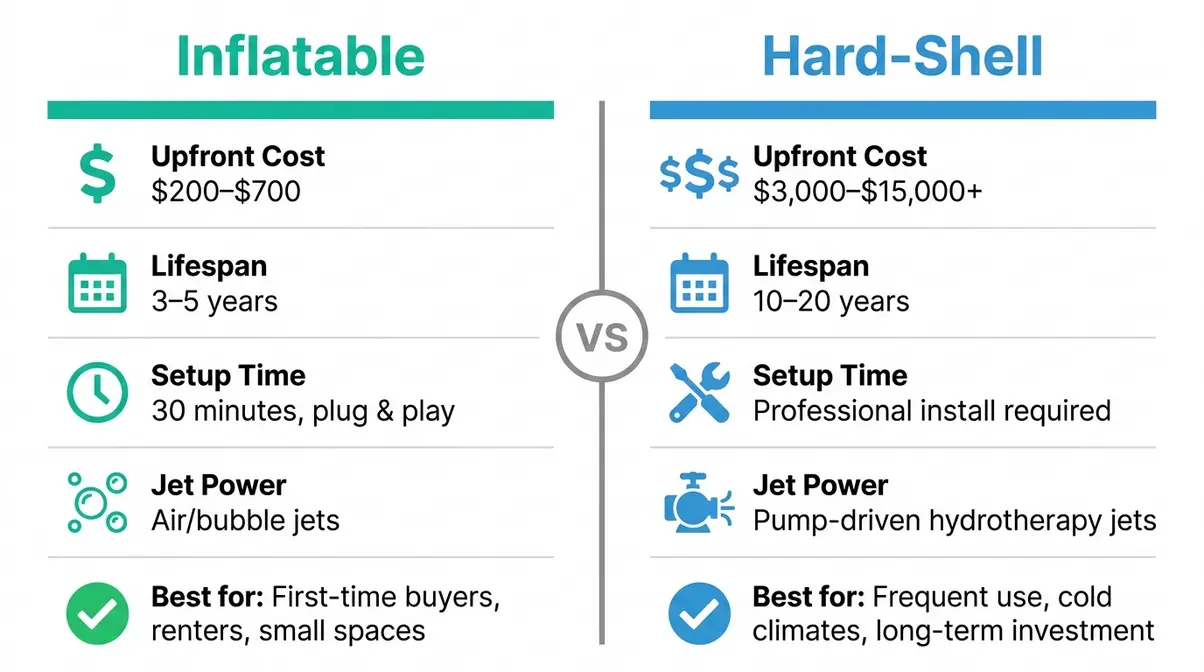
Inflatable advantages are practical and immediate. All four models in this guide are Plug & Play — meaning they plug into a standard 110V outlet with no electrician or 240V wiring required. They’re portable, storable over winter, and far less expensive upfront than hard-shell alternatives.
Hard-shell advantages show up over time. A quality acrylic hard-shell spa typically lasts 10–20 years, compared with 3–5 years for a well-maintained inflatable. Hard-shell models also offer better insulation, more powerful pump-driven hydrotherapy jets (as opposed to air/bubble jets), and more consistent heat retention in cold climates.
For most solo buyers starting out, inflatable is the practical and economical entry point. You can always upgrade to a hard-shell later once you know how often you actually use it. Browse our full list of 1-person inflatable hot tub options or dive deeper into the decision with our hot tub buying guide.
Now that you know which type suits you, let’s talk about the ongoing costs — because the sticker price is only part of the picture.
Running Costs and Energy Use
Portable electric spas consume an average of 1,567–1,699 kWh per year, according to the U.S. Department of Energy — roughly $250–$270 annually at average US electricity rates of ~$0.16/kWh (Department of Energy hot tub power consumption estimates, DOE, 2022). For a solo user, that works out to approximately $20–$23 per month in electricity — roughly the cost of a single massage session.
There’s a chemical cost many buyers overlook, too. As one experienced hot tub owner put it:
“One person in a hot tub requires roughly the same sanitizer load as 50-100 people in a POOL!! Also the larger the spa, the easier to maintain…”
Sanitizer load refers to the amount of chlorine or bromine needed to keep the water safe. For a small hot tub, this is surprisingly high relative to the water volume — hot water degrades sanitizer faster than a pool, and a smaller volume means chemical swings happen quickly. Budget for chemical costs alongside electricity when calculating your total hot tub running costs.
A practical tip: smaller tubs like the oval #1 hold fewer gallons, which means faster heat-up times and lower energy use per session. Pair that with a good insulated cover (included with all four models here) and follow our hot tub maintenance guide to maximize efficiency. For a full cost breakdown across your first year of ownership, see our complete hot tub buying roadmap.
Energy costs are manageable — but before you buy, there’s one more consideration that’s especially important if you’re buying a hot tub for health reasons.
Health Benefits and Safety: What You Need to Know
Medical Disclaimer: The health information in this section is for general informational purposes only and is not medical advice. Always consult your physician before using a hot tub to manage any medical condition or symptom.
Research published on PubMed suggests that aquatic therapy in warm water can improve sleep quality, reduce pain, and enhance quality of life for adults with fibromyalgia — though it’s important to note this evidence comes from therapeutic exercise in supervised clinical settings, not from unsupervised home spa use (aquatic therapy effects on sleep quality, PubMed, 2023). These are promising findings, but they are not a direct product claim for any inflatable hot tub.
Hot tub water temperatures should never exceed 104°F (40°C), and sessions should be limited to 15 minutes at maximum heat — per CDC guidelines. Set a timer on your phone before you get in. According to the CDC hot tub temperature and safety limits, overheating is the most common safety risk for home hot tub users, and it happens faster than most people expect.
Certain groups should skip hot tub use entirely or check with a doctor first. Per CDC guidance, medical and age restrictions for hot tub use include children under 5, pregnant individuals, and anyone with heart disease, high blood pressure, or low blood pressure. The heat raises core body temperature and places added strain on the cardiovascular system — which can be dangerous for those with pre-existing conditions.
For a deeper look at the evidence on warm water therapy, see our guide to the health benefits of hot tubs and our hot tub safety tips for owners.
With those factors in mind, here’s how our editorial team selected the products in this guide.
How We Evaluated
Our editorial team evaluated each model against five criteria: solo-use suitability (dimensions and shape), jet count and coverage type, brand support and warranty terms, energy efficiency designations, and ease of setup based on published product specifications and expert community consensus. Products were ranked by how well each model serves a single adult user in a typical outdoor residential setting, with The Solo Soak Test framework applied to each to ensure recommendations reflect real solo-buyer priorities rather than general spa features.
Frequently Asked Questions
Does anyone make a one-person hot tub?
Yes — several manufacturers produce hot tubs designed specifically for solo use. Options range from inflatable blow-up models (like the oval tub ranked #1 in this guide) to hard-shell acrylic spas with single-lounger designs from brands like Cal Spas and Luxury Spas. Inflatable 1-person models are the most accessible entry point for most buyers, running on a standard 110V outlet with no installation required and starting at a fraction of the cost of hard-shell alternatives.
What is the best most reliable hot tub brand?
For long-term reliability, brands like Hot Spring, Cal Spas, and Wellis consistently earn high marks from industry reviewers and long-term owners. These manufacturers back their products with multi-year warranties and established customer support networks. For inflatable hot tubs specifically, Coleman and Bestway SaluSpa are the most widely trusted brands, with proven track records, broad accessory ecosystems, and replacement parts that remain available years after purchase — a meaningful advantage over generic alternatives.
What medical conditions should not use a hot tub?
Individuals with heart disease, high or low blood pressure, or pregnancy should avoid hot tubs or consult a physician first. Hot water raises core body temperature and places additional strain on the cardiovascular system, which can be dangerous for those with pre-existing conditions. Children under 5 should not use hot tubs. If you take prescription medications or have any chronic health condition, always check with your doctor before using a hot tub — even for short, low-temperature sessions.
Are hot tubs good for fibromyalgia?
Warm water immersion may help ease muscle pain and stiffness associated with fibromyalgia. Research published on PubMed suggests aquatic therapy can improve sleep quality and reduce pain for adults with the condition — though these findings come from supervised therapeutic settings, not unsupervised home use. Sessions should be kept under 15 minutes at maximum temperature, and results vary by individual. Always consult your physician before using a hot tub to manage fibromyalgia symptoms, as it is not a replacement for medical treatment.
Closing Thoughts
For most solo buyers, the oval 75″×47″ inflatable hot tub (ASIN B0G1M1C615) is the best 1-person hot tub in this roundup — its purpose-built shape, 100-bubble-jet coverage, and included side table make it the most complete solo spa package available on Amazon right now. If energy efficiency and brand support are your priorities, the Coleman Miami’s 120 AirJets, power-saving timer, and proven customer service infrastructure make it the strongest long-term pick. Whichever model you choose, measure your outdoor space before ordering and keep the 15-minute safety rule in mind — your first soak is closer than you think.

Dave King
Hot tub tester and writer at One Hot Tub.