What’s in this guide
- Prerequisites: What You Need Before You Start
- Step 1: Pre-Move Preparation and Safety Checks
- Step 2: Gather Your Tools and Equipment
- Step 3: How to Lift and Position Your Hot Tub
- Step 4: Tipping Your Hot Tub on Its Side
- Step 5: Moving Your Hot Tub Across Grass
- Step 6: Prepare Your New Hot Tub Site
- Limitations, Safety Warnings, and Common Mistakes
- Frequently Asked Questions
- Conclusion
Moving a hot tub on grass is one of the hardest DIY jobs a homeowner can tackle — not because of the technique, but because of what’s underfoot. Soft turf turns every dolly wheel into an anchor, and without the right approach, you’ll end up with a stuck spa and a ruined lawn.
Most guides tell you to “use a dolly and some plywood” — but they skip the part about how to actually get a 500–900 lb spa rolling across soft, uneven ground without it sinking after the first foot. That’s the Grass Anchor Problem: soft turf doesn’t just resist movement, it actively traps wheels and feet, making every generic moving tip fail on contact.
In this guide, you’ll learn exactly how to move a hot tub on grass safely — step by step — using two proven methods: plywood tracks and PVC pipe rolling. We cover everything from draining and disconnecting power to protecting your lawn and preparing your new site.
Learning how to move a hot tub on grass requires draining the tub completely, assembling a team of 3–4 people, and creating a temporary “road” using 3/4-inch plywood sheets or PVC pipe rollers to defeat the Grass Anchor Problem — the tendency of soft turf to trap wheels and halt movement.
- Drain first: Never attempt to move a filled or partially filled hot tub — water adds 3,000+ lbs to the load
- Two proven methods: The plywood track method for precision; the PVC pipe rolling method for speed
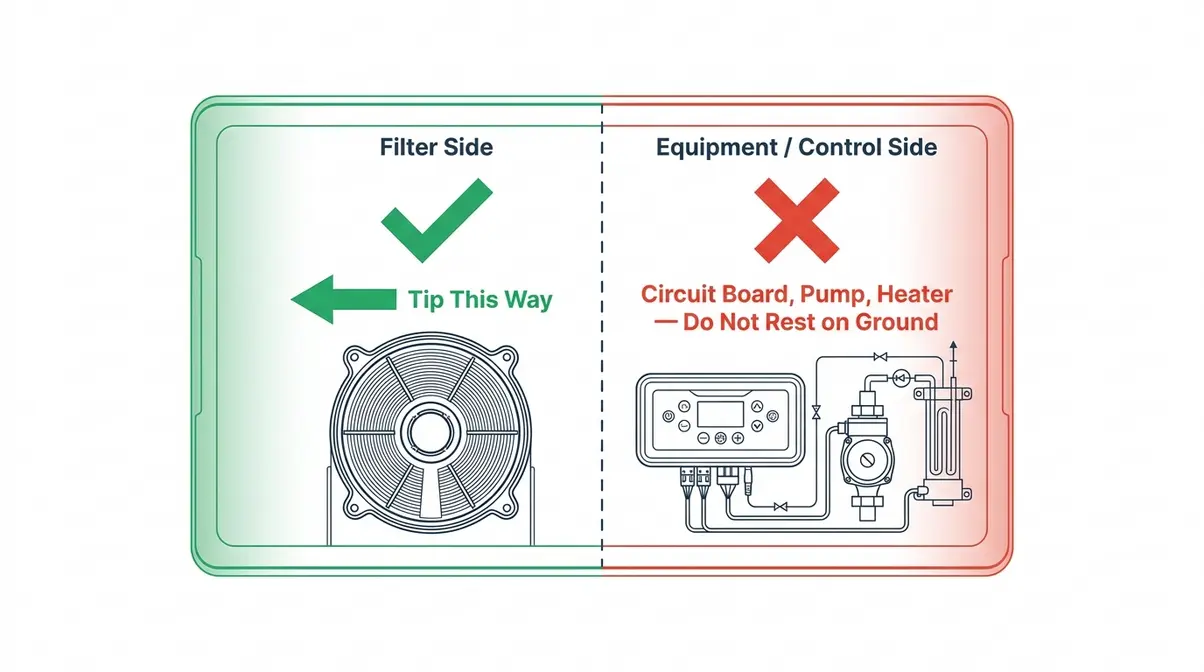
- Tip safely: Always rest the tub on the filter side, never the equipment/control side
- Protect your lawn: Use plywood sheets to distribute weight and prevent deep ruts during the move
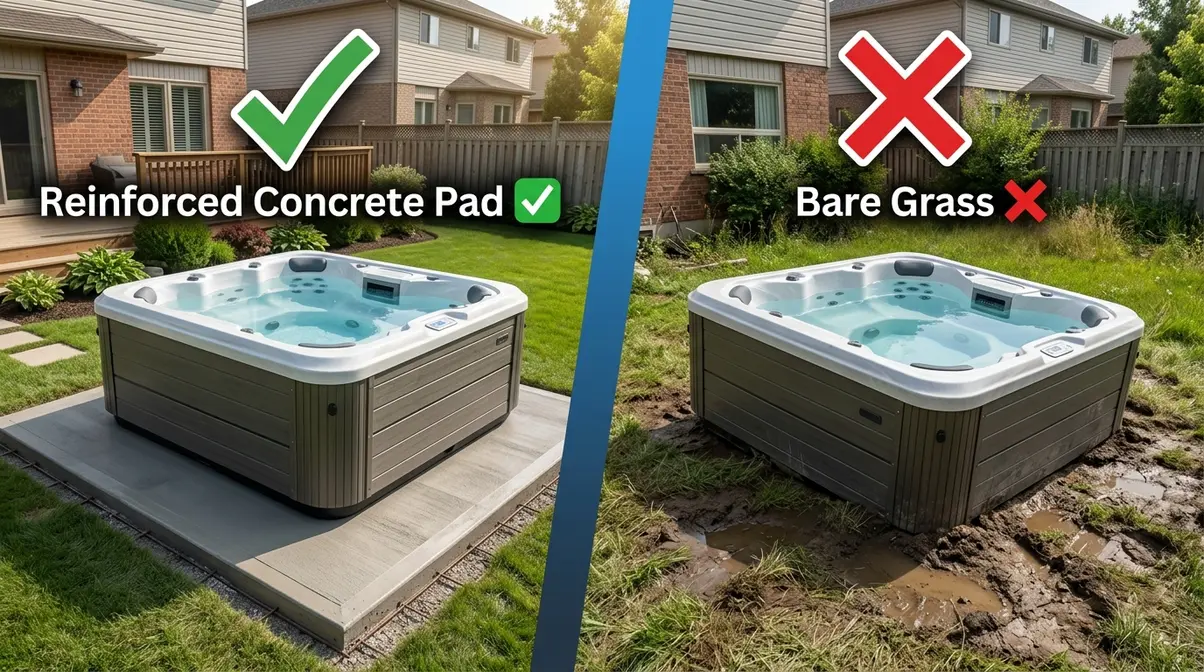
- Site prep matters: Never place a hot tub directly on bare grass — it needs a solid, level foundation rated for 100+ lbs per square foot
Prerequisites: What You Need Before You Start
Before diving into the steps, confirm you have the following in place. Skipping any one of these will stall the job mid-move.
People: A minimum of 3–4 adults with no back or joint problems. The control panel end of most spas is significantly heavier — plan your team positions before you start.
Time: Block out a full day. Rushing a multi-hundred-pound object across a lawn is how injuries happen.
Dry ground: Move on firm, dry turf whenever possible. Wet grass compresses under load and dramatically worsens the Grass Anchor Problem. Check the forecast and plan accordingly.
Clear path: Walk your entire route before lifting anything. Measure every gate, doorway, or tight corner. A standard hot tub is 7–8 feet square — a 36-inch gate will not work.
Tools confirmed: Verify your equipment list against Step 2 before you drain the tub. You do not want to discover a missing item after the water is out.
Step 1: Pre-Move Preparation and Safety Checks
Proper preparation is what separates a smooth move from a dangerous one. Before anything else gets touched, you need to assess what you’re dealing with, cut the power safely, and drain the tub completely.
Assess the Weight and Assemble Your Team
Empty hot tubs typically weigh between 500 and 1,000 lbs depending on brand and size, with larger models reaching 1,200 lbs (manufacturer specifications vary — check your owner’s manual for your exact model’s dry weight). When filled with water and bathers, that figure climbs to 3,000–6,000 lbs. This is why draining completely before any move is non-negotiable.
⚠️ Safety Warning — Weight: OSHA ergonomics guidelines recommend that no single person lift more than 50 lbs unassisted. At 500–1,000 lbs empty, even divided across 4 people, each person is managing 125–250 lbs of awkward, shifting load. A minimum team of 3–4 physically capable adults is essential — OSHA ergonomics guidelines strongly advise against improvising team lifts without a coordinated plan.
User consensus across hot tub owner communities consistently identifies underestimating the weight as the single most common mistake. Many owners assume their emptied spa weighs “a few hundred pounds” — the actual figure is typically two to three times their estimate.
Assign roles before you lift: one person per corner, and one designated “caller” who gives all movement commands. Nobody moves until the caller says move.
Disconnect Power Safely
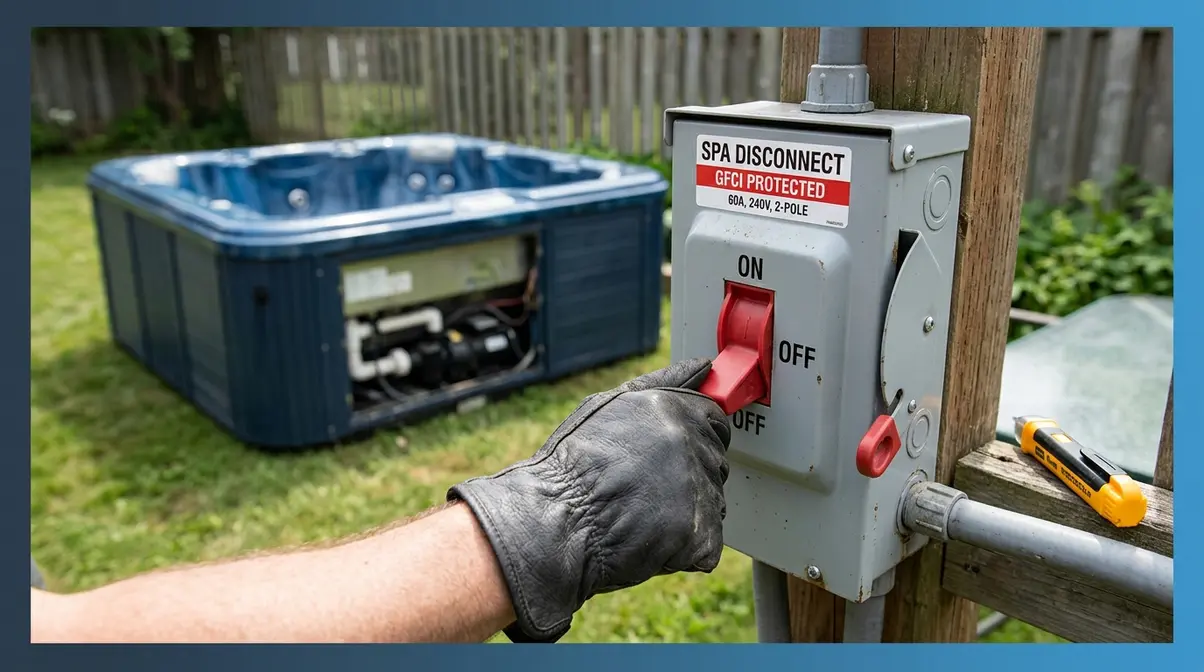
⚠️ Safety Warning — Electricity: Hot tubs operate on 240V dedicated circuits. NFPA 70 (National Electrical Code) Article 680 requires a disconnect means within sight of the hot tub — typically a GFCI breaker or a dedicated disconnect box. Do not simply turn off the jets. You must cut power at the breaker panel or the dedicated disconnect box before touching any wiring.
Follow these steps in order:
- Turn off the hot tub at its control panel.
- Locate the dedicated disconnect box (usually mounted within 5–10 feet of the spa, outdoors).
- Switch the disconnect to the OFF position.
- Go to your main breaker panel and switch the hot tub’s dedicated circuit breaker to OFF.
Once the power is cut, proceed with the final safety verifications:
- Tape the breaker in the OFF position and post a note — someone could accidentally switch it back on.
- Verify the power is dead using a non-contact voltage tester before touching any wiring.
- If your tub is hardwired (no plug), hire a licensed electrician to disconnect and cap the supply wires. This is not a DIY step. Per NFPA 70 Article 680, improper disconnection creates a serious electrocution hazard.
Leave all wiring in the disconnect box — do not attempt to pull conduit or cut wires unless you are a licensed electrician.
Drain the Hot Tub Properly
A standard 300–400 gallon hot tub takes 1–2 hours to drain via the built-in drain valve, or 30–45 minutes with a submersible pump. Alternatively, you can safely drain your hot tub using a standard garden hose and gravity if you have a slight downhill slope.
⚠️ Can you drain a hot tub on grass? Yes — but only after the water chemistry has been neutralized. Freshly dosed chlorine or bromine water (above 3 ppm chlorine) can scorch grass and kill soil microbes. Stop adding chemicals 48–72 hours before your move date, allow chlorine levels to drop below 1–2 ppm, and then drain slowly across a wide area of lawn rather than directing the flow to a single spot. Penn State Extension’s turfgrass guidelines confirm that diluting chemical loads across a broader surface area significantly reduces turf damage.
Drain steps:
- Stop adding chemicals 48–72 hours before the move.
- Test water chemistry — wait until chlorine/bromine reads below 2 ppm.
- Connect a garden hose to the drain valve or drop in a submersible pump.
- Direct flow across a broad area of lawn or into a storm drain (check local regulations first — some municipalities prohibit draining pool/spa water into storm systems).
- Once drained, remove the filter cartridge and set it aside.
- Open the cabinet panel and sponge out any remaining water in the equipment bay — trapped water adds weight and can damage components during tipping.
Step 2: Gather Your Tools and Equipment
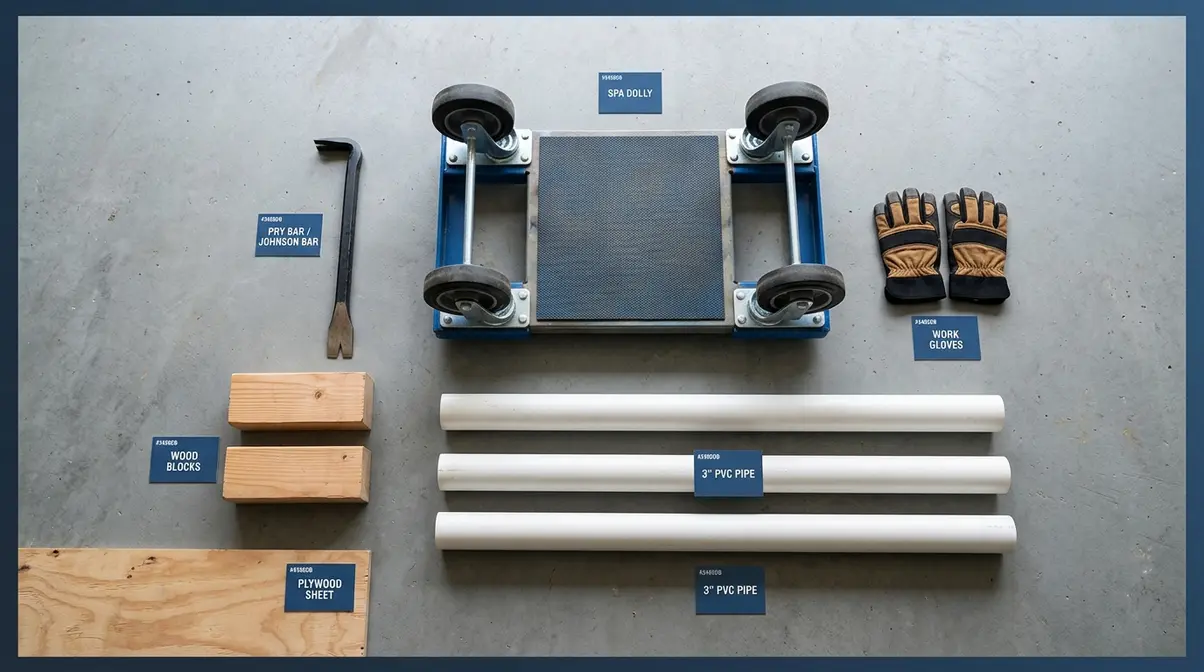
The right equipment makes the difference between a 3-hour move and a 3-day ordeal. You have two main options: professional spa equipment or DIY alternatives using materials from any hardware store.
Spa Dollies and Sleds
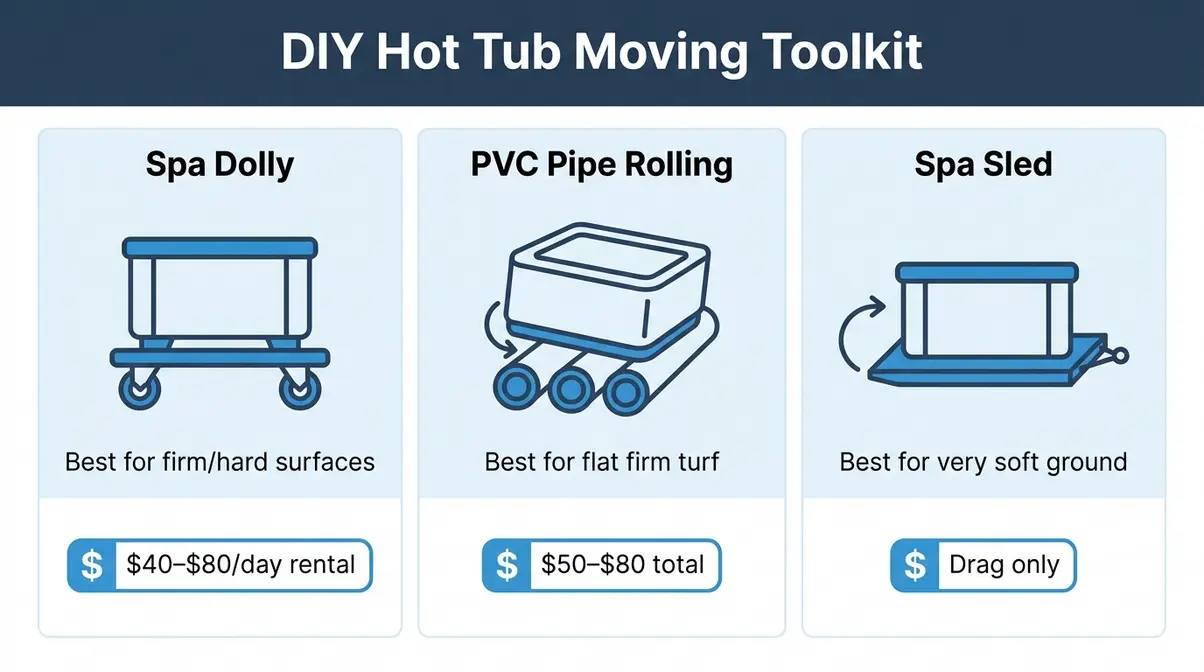
A spa dolly (also called a 4-wheeled flat dolly or hot tub dolly) is a low-profile platform on heavy-duty casters rated for 1,000–1,500 lbs. It slides under the tipped spa and allows controlled rolling movement. A spa sled is a flat steel or HDPE platform used when the tub must be dragged rather than rolled — useful on very soft ground where wheels still sink.
Furniture dollies (standard moving dollies) can work for short, flat moves on hard surfaces, but their smaller wheels are highly susceptible to the Grass Anchor Problem. On grass, they are a last resort — not a first choice.
For most homeowners, renting a proper spa dolly or other essential hot tub moving equipment is the most reliable option. Many moving equipment rental companies and some hot tub dealers rent them directly.
DIY: PVC Pipes and Plywood
If a spa dolly isn’t available or the rental cost isn’t justified for a short move, two DIY methods work well on grass — and both are covered in detail in Step 5.
PVC pipe rollers: Use 3–4 sections of 3–4 inch diameter Schedule 40 PVC pipe, each cut to approximately 3 feet in length. The spa rests on these pipes and rolls forward as you feed pipes from the back to the front — essentially creating a manual conveyor belt. This method works best on relatively flat ground.
Plywood tracks: Two or three sheets of 3/4-inch plywood (4×8 feet) laid end-to-end create a temporary road that bridges soft turf and distributes the spa’s weight across a larger surface area. This is the most accessible DIY method and the one most commonly recommended by professional movers for grass surfaces.
2026 Equipment Rental Costs
Based on current rental market data (verify with your local supplier, as rates vary by region):
| Equipment | Typical Rental Cost (2026) | Where to Rent | Notes |
|---|---|---|---|
| Spa / hot tub dolly | $40–$80/day | Moving equipment rentals, hot tub dealers | Best for smooth, firm surfaces |
| 4-wheeled furniture dolly (pair) | $15–$30/day | Home Depot, U-Haul | Limited use on grass |
| Appliance dolly / hand truck | $15–$25/day | Home Depot, Lowe’s | For vertical tipping assist only |
| Pry bar / Johnson bar | $20–$35/day | Equipment rental shops | Essential for initial lift |
| Submersible pump (for draining) | $25–$50/day | Home Depot, Sunbelt Rentals | Cuts drain time to 30–45 min |
| 3/4-inch plywood (4×8 sheets) | $35–$55 each (purchase) | Home Depot, Lowe’s | Cheaper to buy than rent; resell after |
| Schedule 40 PVC pipe (3-ft sections) | $8–$15 each (purchase) | Home Depot, Lowe’s | Buy 4–6 sections; reuse indefinitely |
Total estimated DIY budget (plywood method): $120–$200 for plywood + dolly rental
Total estimated DIY budget (PVC method): $50–$80 for pipe + minimal equipment
Rental rates as of early 2026 — verify current pricing with your local supplier before budgeting.
Step 3: How to Lift and Position Your Hot Tub
With your tub drained, power disconnected, and equipment ready, it’s time to get the spa off the ground. Before you start pushing, you need to master basic hot tub lifting and moving techniques to get the spa off the ground safely. This is where the Grass Anchor Problem first appears — even on dry turf, the spa’s base will resist any attempt to slide it.
Lifting With Levers and Blocks
You cannot simply grab the sides and lift a 500–1,000 lb spa. You need to create mechanical advantage using a pry bar (also called a Johnson bar) to raise one corner at a time, then slide blocking material underneath.
⚠️ Safety Warning — Lifting: Coordinate every lift with a single caller. Back injuries from uncoordinated team lifts account for a significant portion of DIY moving injuries. OSHA’s ergonomics guidelines recommend keeping loads close to the body, bending at the knees, and never twisting at the waist under load.
Follow this sequence:
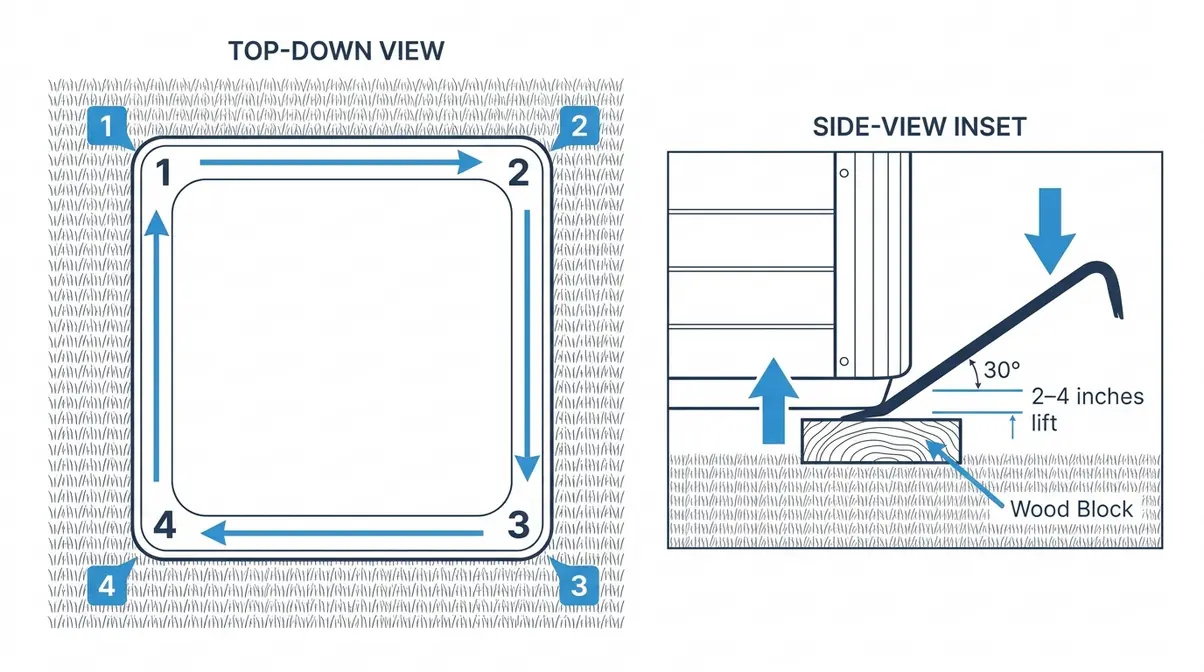
- Position one person with a pry bar at the first corner of the spa.
- Slide the pry bar under the spa’s base frame (most spas have a recessed bottom rail).
- Apply steady downward pressure on the pry bar handle — the corner will rise 2–4 inches.
- A second person immediately slides a wood block or thick rubber pad under the raised corner.
- Move to the opposite corner and repeat.
- Continue around all four corners, raising the spa incrementally until it is high enough to slide the dolly platform underneath.
- Never raise one corner more than 4–6 inches without blocking — an unsupported spa can shift and fall.
Positioning Dollies Correctly
Once the spa is raised on blocks, slide the dolly or furniture dollies into position. For a 4-wheeled flat dolly, center it under the spa’s base so the load is balanced front-to-back and side-to-side. For furniture dollies (using two), position one under the front third and one under the rear third of the base.
Lower the spa onto the dolly by reversing the pry-bar sequence — remove blocks one corner at a time while a second person holds the dolly in position. Test the dolly’s movement on a hard surface before attempting to roll onto grass.
Moving Short Distances
For moves of less than 10–15 feet on relatively firm ground, some homeowners skip the dolly entirely and use a “walking” technique: two people tilt the spa slightly toward one corner, pivot it a few inches, then set it back down. This inch-by-inch walking method is slow but requires no equipment and causes minimal turf damage for very short distances.
This technique works only on flat ground. On any slope or soft turf, the Grass Anchor Problem makes walking impractical — you’ll need the plywood or PVC method described in Step 5.
Step 4: Tipping Your Hot Tub on Its Side
Tipping the spa on its side is often necessary to navigate through gates, narrow side yards, or doorways. It’s also the method most professional movers use to get the spa onto a dolly for transport. Done correctly, it’s safe. Done wrong, it can crack the shell, damage components, or crush someone’s hand.
Filter Side vs. Equipment Side
“Put the spa up on its side (usually filter side down, control end is the very heaviest).”
— Experienced hot tub owner, r/hottub community
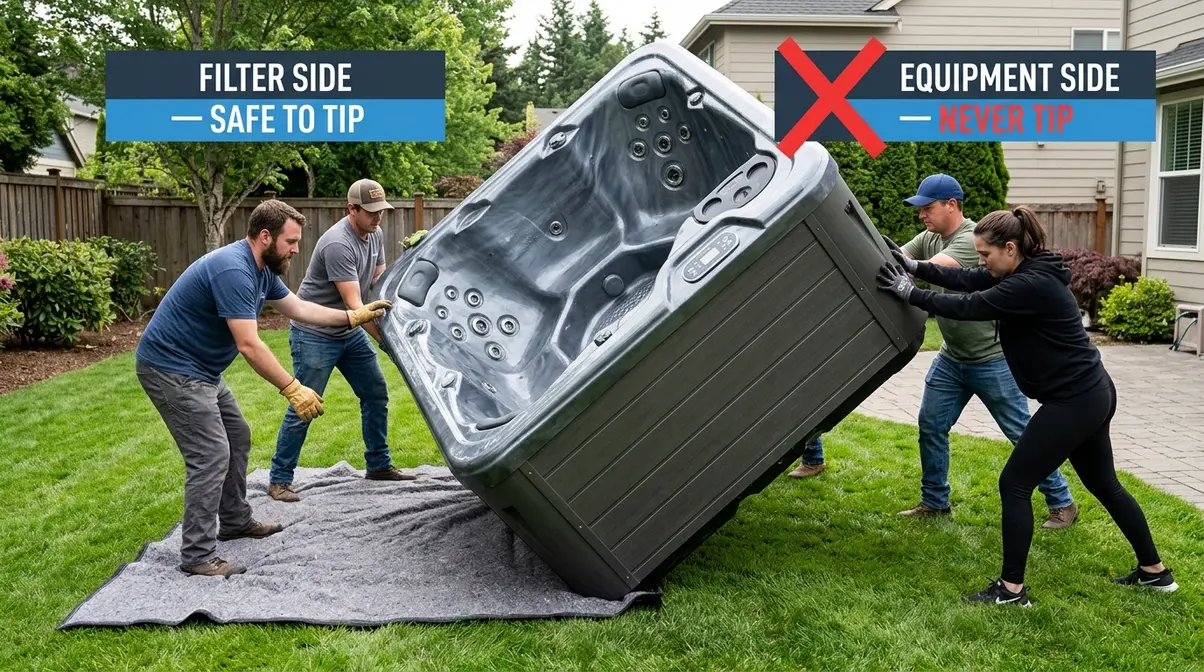
This is the most important rule in the entire tipping process. Hot tubs have two distinct sides:
- Filter side (safe to tip onto): The filter housing is a durable, reinforced component. Resting the tub on this side distributes weight onto a structurally strong area and keeps the more fragile plumbing elevated.
- Equipment/control side (never tip onto): The control panel, circuit board, pump, and heater assembly are mounted on this side. Tipping the spa onto the equipment side risks cracking the housing, bending the heater manifold, or shattering the circuit board.
User consensus across hot tub owner communities and professional mover forums consistently confirms: filter side down, every time. Before tipping, identify which side holds the filter (usually marked on the cabinet or visible through the access panel) and plan your tip direction accordingly.
Tipping and Maneuvering
- Clear the area on the filter side — lay down a moving blanket or thick cardboard to protect the spa’s shell on impact.
- Station two people on the equipment side to push, and two people on the filter side to guide and control the descent.
- On the caller’s signal, the push team tilts the spa slowly toward the filter side. The guide team controls the rate of descent — do not let it drop freely.
Once the spa is safely resting on the blanket, proceed with maneuvering:
- Lower the spa onto its side in a controlled motion. The filter housing should make contact with the blanket first.
- Once on its side, the spa can be walked upright on its bottom edge through narrow spaces — one person per end, tilting and pivoting in small increments.
- To stand the spa back upright at the destination, reverse the process: two people lift the top edge while two guide the base into position.
For moving through a standard 36-inch gate: most spas will fit through a 36-inch opening when tipped on their side, but measure your specific tub first. Width on the side is typically 30–36 inches for standard models.
Step 5: Moving Your Hot Tub Across Grass
When figuring out how to move a hot tub on grass, this is the core challenge of the entire operation — and the section where most generic guides fail. Moving a hot tub on grass means defeating the Grass Anchor Problem with one of two proven methods. If you are removing a hot tub from a deck before crossing the lawn, ensure you have a clear transition ramp to reach the grass safely. Both methods work; the right choice depends on your distance, terrain, and available equipment.
The Plywood Track Method
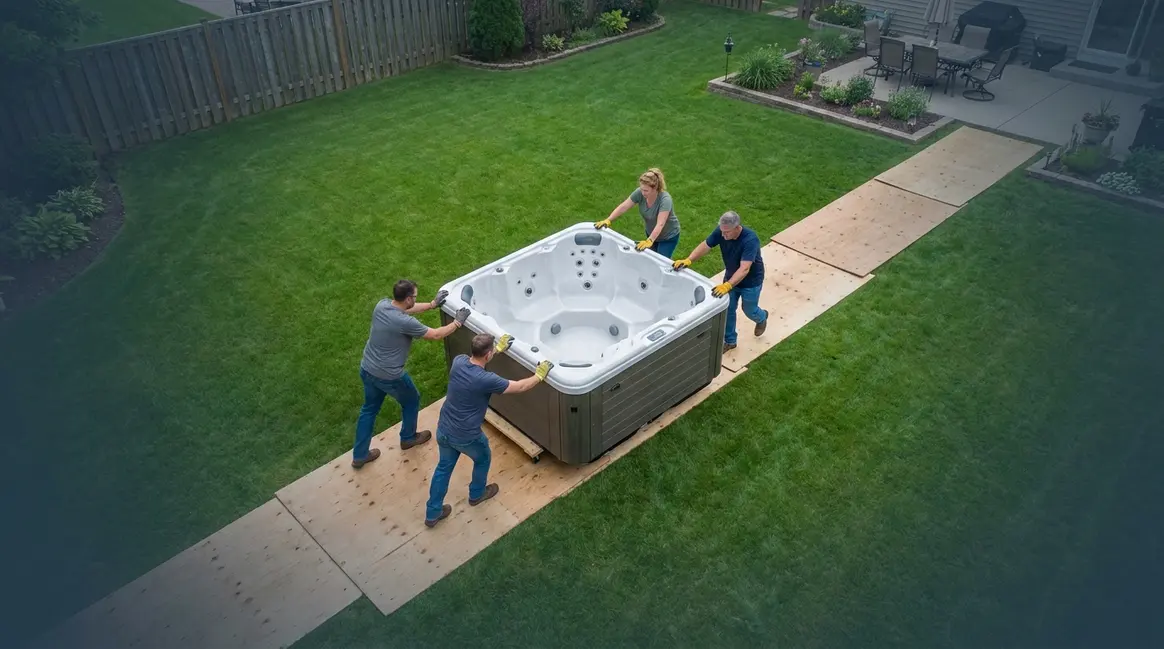
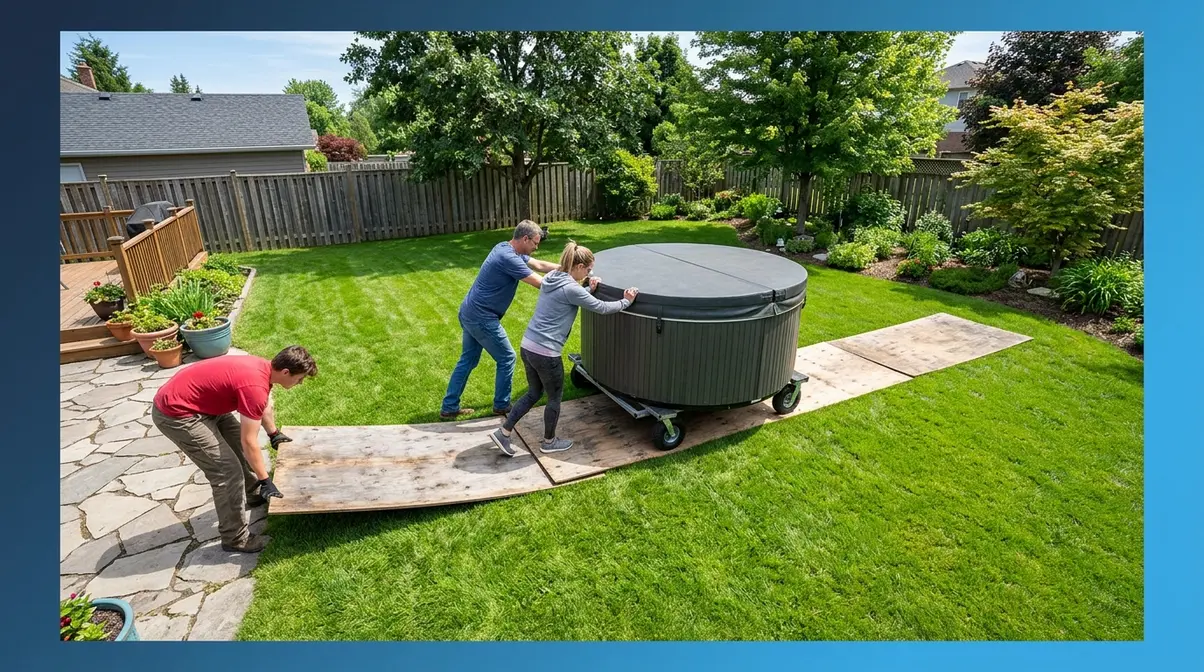
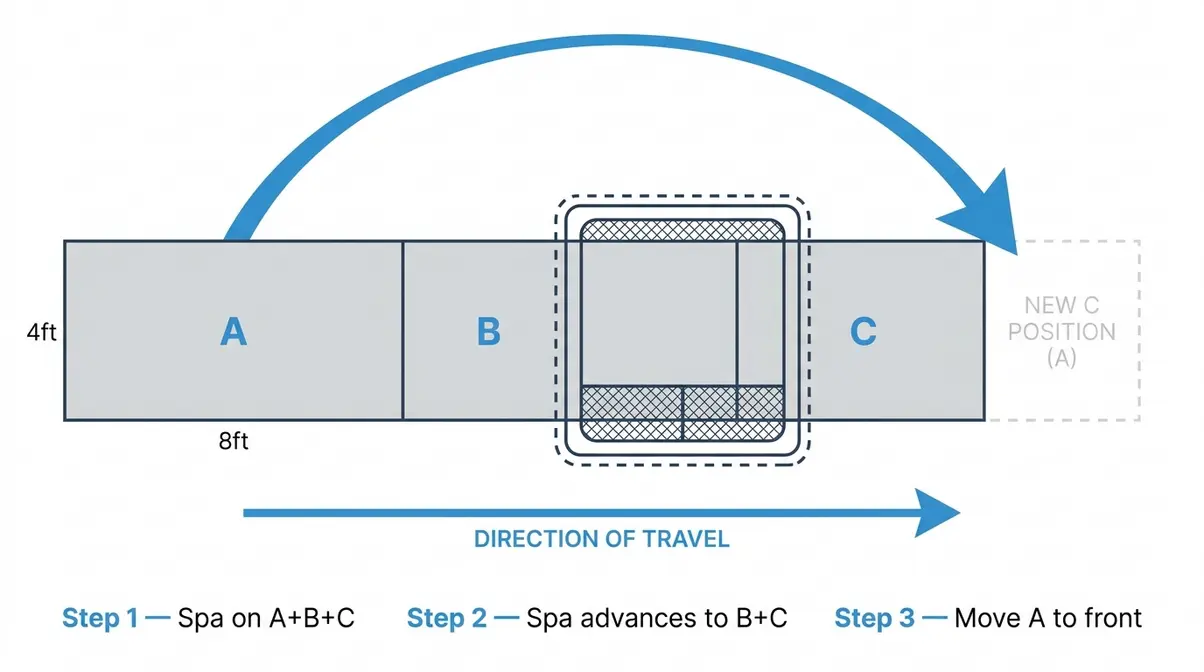
The plywood track method is the most reliable approach for moving a hot tub across soft or uneven grass. Three or four sheets of 3/4-inch plywood (4×8 feet) are laid end-to-end to create a temporary road. The spa (on its dolly or directly on the plywood) rolls or slides along this track.
Why it works: A full sheet of 3/4-inch plywood distributes the spa’s weight across 32 square feet of surface area — compared to the 2–4 square inches of a dolly wheel. That distribution prevents the Grass Anchor Problem by stopping wheels and the spa’s base from sinking into soft turf. Penn State Extension’s turfgrass research confirms that wide-surface weight distribution is the most effective method for minimizing turf compaction during equipment moves.
Plywood track setup — step by step:
- Lay the first two sheets end-to-end from the spa’s current position toward the destination.
- Roll or slide the spa onto the first sheet.
- As the spa clears the rearmost sheet, pick it up and leapfrog it to the front of the track.
- Repeat the leapfrog sequence until the spa reaches its destination.
- Keep sheets tightly butted together — gaps cause the dolly wheels to drop and re-anchor.
The PVC Pipe Rolling Method
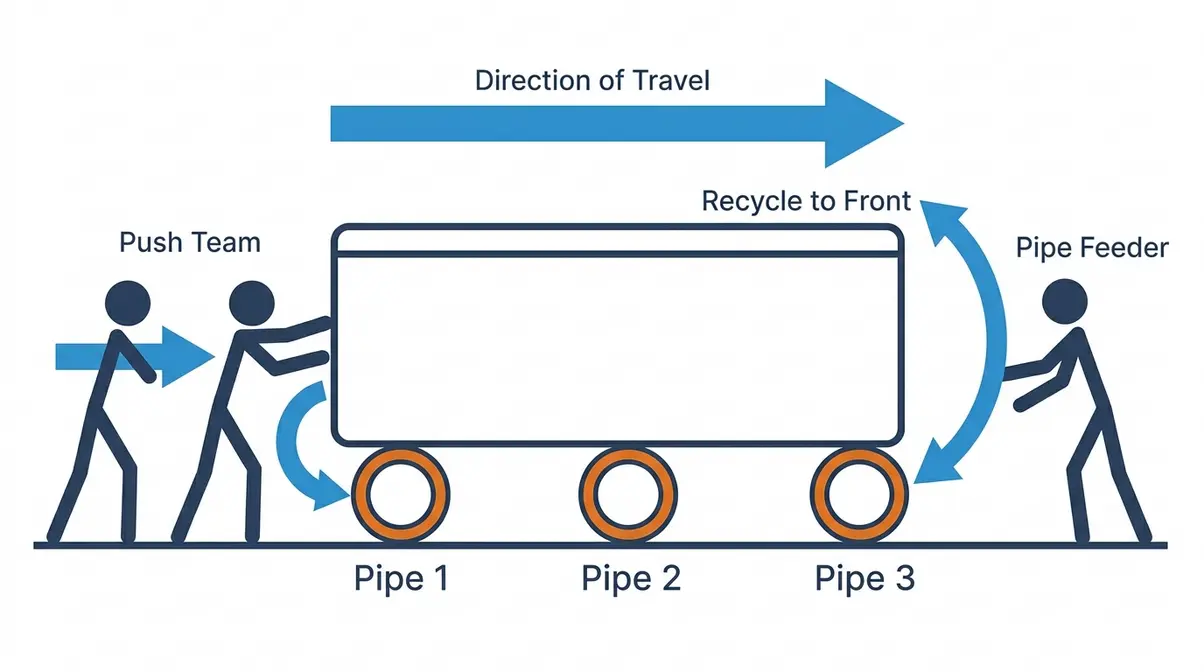
The PVC pipe rolling method uses 3–6 sections of 3–4 inch diameter Schedule 40 PVC pipe as manual rollers. The spa rests on the pipes and rolls forward as you continuously feed pipes from the back to the front.
Why it works: Round pipes eliminate the flat-surface friction that causes dragging, and their circular contact point with the ground reduces the sinking effect compared to flat dolly wheels. This method is faster than plywood on flat, firm-ish turf but requires more coordination from your team.
PVC pipe rolling — step by step:
- Tip the spa onto its side (per Step 4) or raise it on blocks high enough to slide pipes underneath.
- Position 3 pipes evenly spaced under the spa’s base — one near the front, one in the middle, one near the rear.
- Station one person at the rear to collect pipes as they emerge and feed them to the front.
Once the pipes are in place, begin the rolling sequence:
- On the caller’s signal, the push team applies steady forward pressure. The spa rolls on the pipes.
- As each rear pipe clears the spa, immediately carry it to the front and lay it down — the spa should always have at least 2 pipes beneath it.
- Move at a slow, controlled pace — rushing causes pipes to skew sideways and the spa to veer off course.
Protecting Your Lawn
Even with plywood or PVC pipes, some turf damage is inevitable. Here’s how to minimize it and recover quickly.
- During the move:
- Work on dry turf whenever possible — wet soil compresses far more deeply under load.
- Remove plywood sheets promptly after the spa passes — leaving them in place for hours accelerates grass yellowing.
- Avoid pivoting or spinning the spa in place on grass — this tears roots and creates circular bare patches.
After the move — turf recovery:
- Relieve compaction: Use a garden fork to aerate compressed areas by pushing the tines 4–6 inches deep and gently rocking.
- Lift crushed grass: Gently rake flattened grass upright with a leaf rake. Many blades will recover within 2–3 days if the roots are intact.
- Water deeply: Irrigate the affected area thoroughly — 1 inch of water — to help roots recover from stress.
- Overseed bare patches: If the move left bare ruts, overseed with matching grass seed within 1–2 weeks and keep moist until germination (7–14 days for most cool-season grasses).
- Avoid foot traffic: Keep people and pets off the move path for 7–10 days to allow recovery.
Most healthy lawns recover from a single hot tub move within 2–4 weeks with proper aftercare.
Step 6: Prepare Your New Hot Tub Site
Getting the spa to its new location is only half the job. Placing it on a substandard foundation is one of the most common — and costly — mistakes hot tub owners make. A fully filled hot tub can weigh 3,000–6,000 lbs. Whatever it sits on must handle that load permanently.
Foundation Requirements
The American Wood Council’s deck construction guide recommends that any deck intended to support a hot tub be engineered for the full wet weight load — typically 100 lbs per square foot or more. When preparing your hot tub site with a pad, a reinforced concrete base is the gold standard.
Acceptable foundations:
| Foundation Type | Minimum Spec | Best For |
|---|---|---|
| Reinforced concrete pad | 4 inches thick, 3,500 PSI, rebar-reinforced | Permanent installations |
| Compacted gravel base | 4–6 inches crushed stone, well-compacted | Budget-friendly alternative |
| Engineered deck | Designed for full wet weight by a structural engineer | Elevated/deck-mounted spas |
| Concrete pavers | 2-inch minimum, set on compacted gravel (installing a hot tub on pavers) | Semi-permanent, level ground |
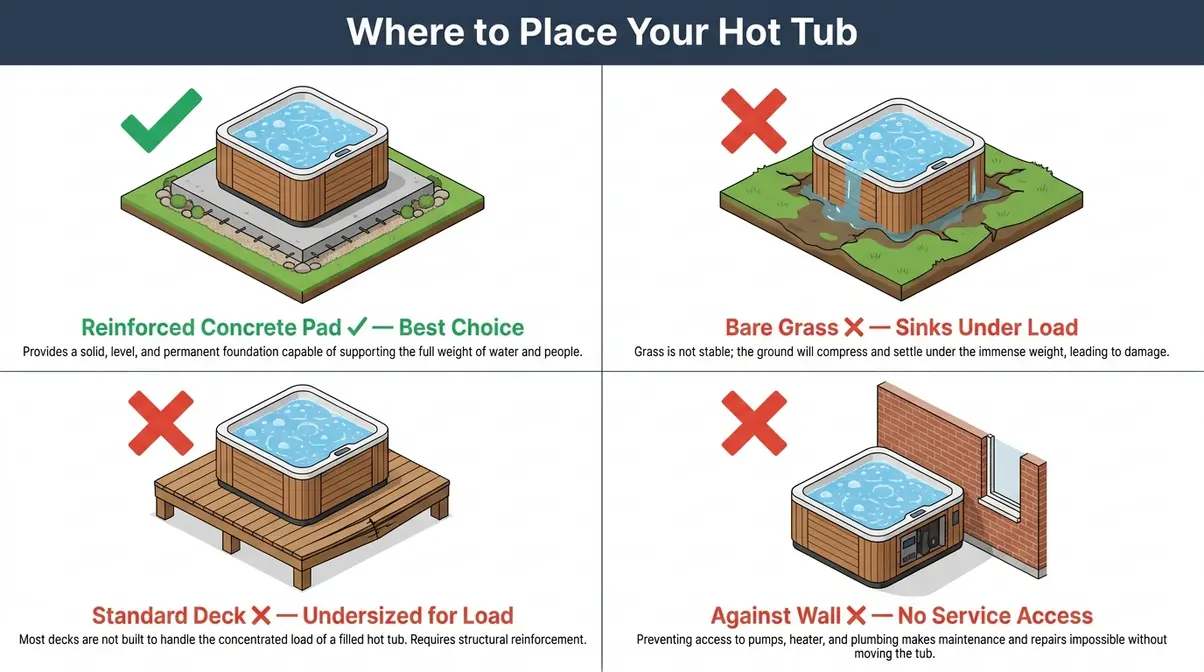
Unacceptable foundations: Bare soil, soft fill dirt, uncompacted gravel, standard (non-reinforced) wood decks not engineered for the load, asphalt in warm climates (softens under sustained weight).
The foundation must be level to within 1/4 inch across the entire footprint. An unlevel spa stresses the shell, causes premature pump wear, and results in uneven water coverage on the jets.
Placement Mistakes to Avoid
Directly on grass: Grass and topsoil cannot support 3,000–6,000 lbs long-term. The spa will sink, tilt, and eventually damage its plumbing and shell. Placing a hot tub on bare grass is not a temporary solution — it causes permanent damage within weeks.
Under low-hanging trees: Falling leaves clog filters constantly and certain tree species (black walnut, for example) release compounds that degrade water chemistry.
Against the house wall: Spas require clearance for service access — most manufacturers specify a minimum 24–36 inches on all sides. Placing the spa flush against a wall makes filter changes, pump repairs, and electrical service impossible without moving the tub again.
On a non-reinforced deck: A standard residential deck is designed for 40–50 lbs per square foot of live load. A filled hot tub exceeds that by 100–200%. Per the AWC deck construction guide, deck reinforcement for hot tub loads requires specific beam sizing, post spacing, and footing depth — consult a structural engineer before placing any spa on an existing deck.
In a flood-prone low spot: Water pooling around the spa’s base accelerates cabinet rot and creates a slip hazard.
Limitations, Safety Warnings, and Common Mistakes
Moving a hot tub on grass is achievable for most determined DIYers — but there are real limits to what a non-professional team should attempt.
Common Pitfalls
Pitfall 1: Not draining completely. Even a few inches of residual water adds hundreds of pounds. Sponge out the equipment bay and let the tub sit open for 30 minutes after draining before you attempt to move it.
Pitfall 2: Moving on wet or recently watered grass. Wet turf multiplies the Grass Anchor Problem dramatically. Wheels sink twice as deep, plywood sinks slightly, and the risk of slipping while pushing increases sharply. Reschedule if rain is expected within 24 hours of your move date.
Pitfall 3: Using furniture dollies without plywood on grass. Standard furniture dolly wheels (3–4 inch diameter) sink immediately into turf. Always pair dollies with a plywood track on grass — never attempt to roll a dolly across bare lawn.
Pitfall 4: Tipping onto the equipment side. This is the most expensive mistake in hot tub moving. A cracked pump housing or shattered circuit board can cost $500–$2,000+ to repair. Identify the filter side before you tip, every time.
Pitfall 5: Moving alone or with an undertrained team. User reports from hot tub communities indicate that most moving injuries happen when teams are too small (2 people instead of 4) or when one person lets go unexpectedly. Assign roles, rehearse the verbal commands, and never begin a lift until every team member confirms they are ready.
When to Hire Professionals
Some situations call for professional hot tub movers — and recognizing them early saves money compared to a failed DIY attempt:
- Distance over 50 feet on soft or sloped ground. Sustained movement across a long, soft turf path is physically exhausting and the risk of loss of control compounds with distance.
- Slopes greater than 5–10 degrees. A spa on a slope requires mechanical restraint to prevent rolling — this is beyond standard DIY capability.
- Tight access requiring cranes or lifts. If the only path to the destination requires lifting the spa over a fence or wall, hire a crane service. The cost ($300–$800 typically) is far less than a damaged spa or a serious injury.
- Any uncertainty about electrical disconnection. If you are not confident in safely disconnecting a 240V hardwired circuit, stop and call a licensed electrician.
When to Seek Expert Help
If any team member has a back injury, heart condition, or limited mobility — do not proceed. The physical demands of moving a 500–1,000 lb object, even with good equipment, are significant. Professional hot tub moving services typically charge $200–$600 for local moves and are worth every dollar when the alternative is a medical bill.
Frequently Asked Questions
How do you move an outdoor spa?
Moving an outdoor spa requires draining it completely, cutting power at the breaker, and assembling a team of at least 3-4 adults. The most effective method on grass is laying 3/4-inch plywood sheets end-to-end to create a temporary track, then rolling the drained spa along the track using a spa dolly or PVC pipe rollers. For moves through narrow spaces, tip the spa onto its filter side and walk it through on its edge, keeping in mind the entire process typically takes 3-6 hours for a 20-40 foot move.
Can you drain a hot tub on grass?
Yes, you can drain a hot tub on grass, but only after neutralizing the water chemistry first. Stop adding chlorine or bromine 48-72 hours before draining. Then, test the water until chlorine levels drop below 2 ppm. At that level, the water is safe for lawn drainage when dispersed broadly. Directing concentrated, freshly dosed spa water onto a single patch of grass can scorch the turf, so always drain slowly and spread the flow across a wide area.
How do you prepare a hot tub area?
A proper hot tub site needs a flat, reinforced foundation rated for at least 100 lbs per square foot, according to the American Wood Council. The best option is a 4-inch reinforced concrete pad (3,500 PSI minimum) poured level to within 1/4 inch, though a compacted gravel base is a reliable budget alternative. The site must also provide 24-36 inches of clearance on all sides for service access and adequate drainage.
How do you move and install a hot tub?
Moving and installing a hot tub is a two-phase process involving the move itself and the site setup. For the move, you must drain completely, disconnect power, assemble your team, and use plywood tracks or PVC rollers to cross grass. For installation, place the spa on a level, reinforced foundation. Next, have a licensed electrician reconnect the 240V supply. Finally, refill with water, balance chemistry, and run a test cycle before use.
How difficult is it to move a hot tub?
Moving a hot tub ranks among the most physically demanding DIY home tasks, primarily because you are managing 500-1,000 lbs of awkward, rigid weight across imperfect terrain, as noted by The Spruce. On grass, the Grass Anchor Problem adds another layer of difficulty that catches most first-timers off guard. With proper preparation and a team of four, it’s achievable, but you should expect 4-8 hours of hard physical work.
How do you move a 500 pound hot tub?
Moving a 500 lb hot tub requires a pry bar for initial lifting, wood blocks for staging, and a spa dolly or plywood track for rolling. Start by raising each corner of the drained spa with a pry bar and sliding wood blocks underneath. Once elevated enough, position a flat dolly under the base. On grass, lay 3/4-inch plywood sheets ahead of the dolly path and leapfrog them forward as the spa moves. A team of 3 adults can manage a 500 lb spa safely with this approach, provided everyone communicates clearly.
Where should you not put a hot tub?
Never place a hot tub directly on grass, bare soil, a non-reinforced deck, or in a low-lying area prone to water pooling. Grass and topsoil cannot support the 3,000-6,000 lb wet weight long-term, meaning the spa will sink and tilt within weeks. Non-reinforced standard residential decks are dangerously undersized for hot tub loads, per AWC guidelines. Also avoid placement under large trees or flush against walls.
Can a hot tub be placed on grass?
A hot tub should not be permanently placed on grass, but grass is fine as a temporary resting point during a move. Because grass and topsoil compress under sustained loads of 3,000-6,000 lbs, the spa will sink unevenly over weeks or months, which severely stresses the shell and plumbing. For any permanent installation, the spa needs a solid foundation like reinforced concrete or compacted gravel.
Conclusion
Figuring out how to move a hot tub on grass is genuinely difficult — but it’s a problem with a clear solution. The Grass Anchor Problem is real, and every generic guide that ignores it is setting you up for a stuck spa and a frustrated afternoon. The fix is straightforward: create a temporary road with 3/4-inch plywood or PVC pipe rollers, assemble a proper team of 3-4 people, drain completely before you move anything, and tip onto the filter side every time.
The two methods in this guide — the plywood track and the PVC pipe rolling technique — are the same approaches professional spa movers use. They work because they solve the actual physics of the problem: distributing weight broadly enough to prevent sinking, and creating a rolling surface where turf provides none.
Your next step: walk your move path today. Measure every gate, note any slopes, and identify your foundation at the destination. Check out our guides at onehottub.com to find the right equipment and site preparation tips for your project. Then gather your equipment, confirm your team, and schedule your move on a dry day. With preparation in place, what feels overwhelming becomes a manageable, step-by-step job — one sheet of plywood at a time.

David King
Hot tub tester and writer at One Hot Tub.