What’s in this guide
- Recommended Products
- Hot Tub Prices at a Glance
- Hot Tub Costs by Type, Size, and Brand
- Hidden Installation and Setup Costs
- Monthly and Annual Running Costs
- Maintenance, Service, and Repair Costs
- Hot Tub Parts and Accessories Costs
- Moving and Removal Costs
- Common Hot Tub Budget Mistakes to Avoid
- Frequently Asked Questions
- Limitations and When to Seek Alternatives
- Conclusion
“We would like to purchase a hot tub and have been quoted $24,000 for a price. Does anyone have a more cost effective suggestion?”
— Hot tub owner forum
That quote might be completely legitimate — or it might be 40% more than you need to pay. The answer depends on which type of hot tub you’re comparing, what your site requires, and what your dealer is bundling into the price.
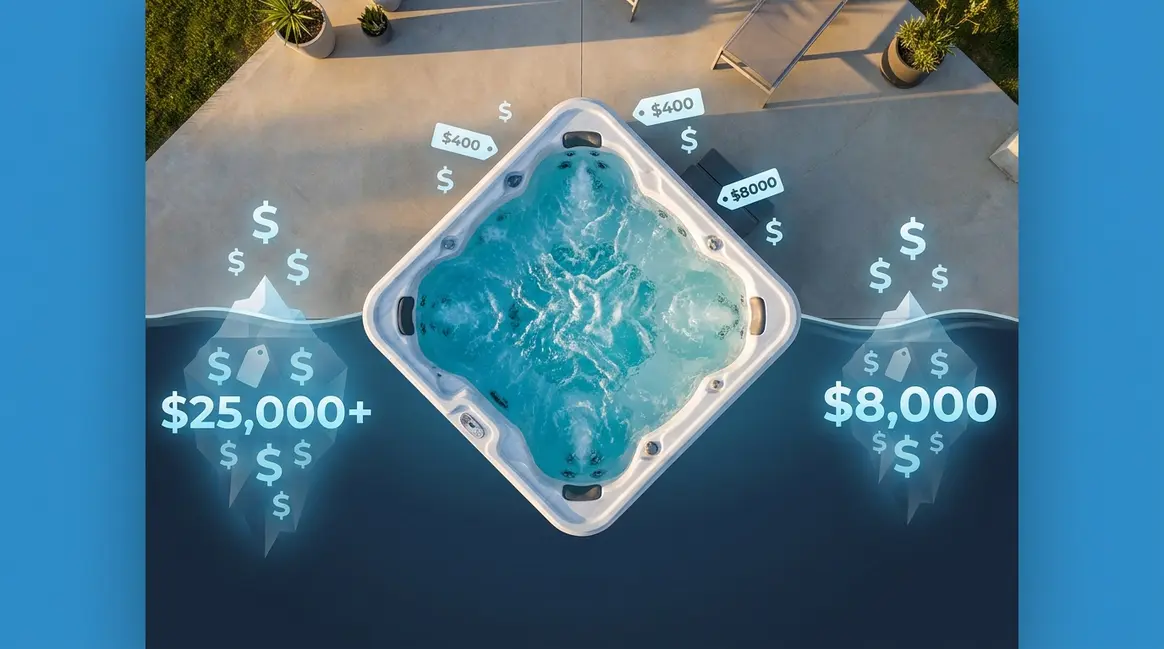
So how much does a hot tub cost, really? Most pricing guides stop at the sticker price. But the True Cost Iceberg tells a different story: the purchase price is only the visible tip. Below the surface sits a mass of installation fees, electrical upgrades, monthly electricity bills, chemical costs, maintenance, and eventually, removal expenses — costs that can double what you thought you’d spend.
This guide gives you a complete financial picture of hot tub ownership, from the first purchase to the final removal, so you can budget accurately and buy with confidence. We cover purchase price by tier, hidden setup costs, monthly running expenses, maintenance budgets, and the end-of-life costs most buyers never think about.
All prices in this guide are estimates. Costs vary significantly by location, dealer, model, and selected features. Always get at least three quotes before purchasing.
Recommended Products
| # | Image | Product | Best For | Buy |
|---|---|---|---|---|
| 1 |  | Coleman Miami Inflatable Spa | Couples, small spaces | Buy on Amazon |
| 2 |  | Coleman Hawaii Square Hot Tub | Families, square footprint | Buy on Amazon |
| 3 |  | Coleman Hawaii Inflatable Spa | Groups, backyard use | Buy on Amazon |
| 4 |  | UHOMEPRO Bubble Massage Spa | External heater buyers | Buy on Amazon |
| 5 |  | Coleman SaluSpa Round Spa | Larger groups, 77-inch | Buy on Amazon |
| 6 |  | Bestway SaluSpa Hawaii Spa | Square-format families | Buy on Amazon |
| 7 | No products found. | Bestway SaluSpa Cancun Spa | Budget-first couples | No products found. |
| 8 |  | INTEX PureSpa Plus 6-Person | Saltwater compatibility | Buy on Amazon |
Key Takeaways: How Much Does a Hot Tub Cost?
A new hot tub costs between $400 and $25,000+ depending on type and tier — but the sticker price is only part of the story. The True Cost Iceberg reveals that over 10 years, total ownership can reach $15,000–$30,000 beyond the purchase price.
- Purchase price: Entry-level inflatable models start around $400–$1,000; mid-range acrylic spas run $5,000–$12,000; luxury models exceed $16,000
- Installation adds $1,000–$5,000+: Electrical upgrades and concrete foundations are the two costs most buyers overlook
- Monthly running costs: Expect $40–$100/month in electricity plus $25–$50/month in chemicals
- The True Cost Iceberg: Over 10 years, total ownership cost can reach $15,000–$30,000 beyond the purchase price
- Inflatable options like Coleman, Bestway SaluSpa, and INTEX offer a budget entry point from $400–$1,000 with plug-and-play setup
Hot Tub Prices at a Glance
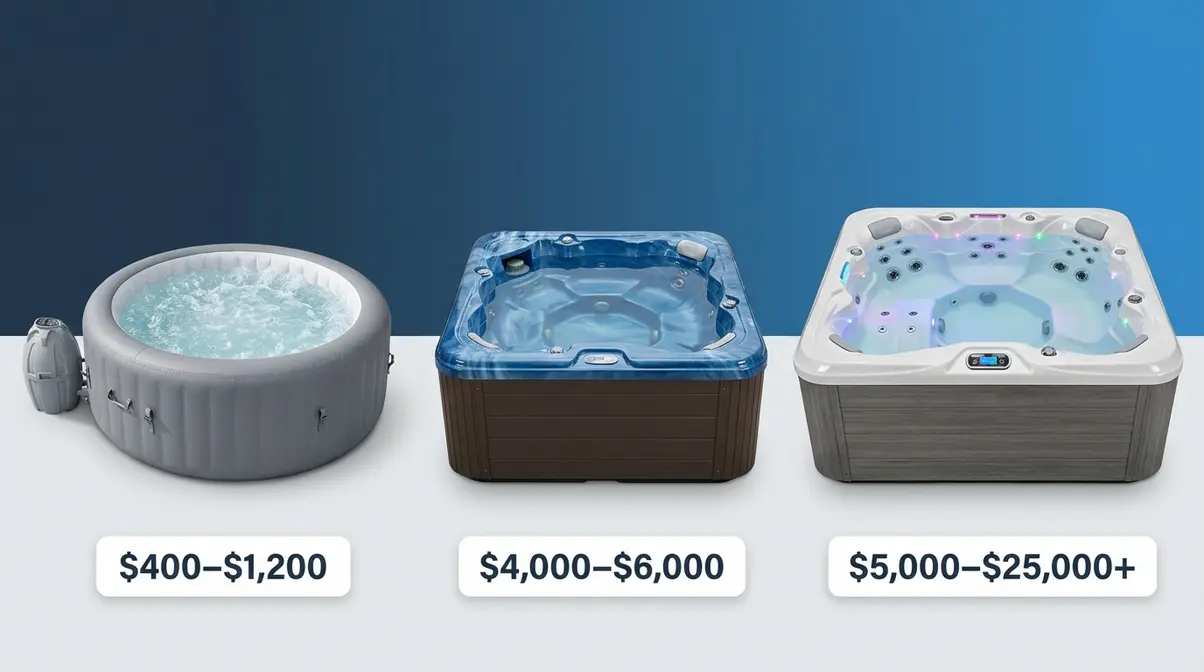
How much does a hot tub cost? New hot tubs range from roughly $400 for a basic inflatable to well over $25,000 for a fully loaded luxury spa. According to multiple pricing guides, most buyers land between $5,000 and $12,000 for a quality acrylic model that holds 4–6 people (HomeGuide, 2026). However — and this is critical — the purchase price is only the visible tip of the True Cost Iceberg.
The True Cost Iceberg is the framework that separates financially prepared buyers from those who get blindsided: the sticker price typically represents only 30–40% of what you’ll spend over 10 years of ownership. Installation, electrical upgrades, monthly electricity, chemicals, repairs, and eventual removal make up the hidden bulk below the surface. Buyers who budget only for the tub itself routinely discover they need an additional $1,500–$5,000 in site preparation alone, before a single jet fires.
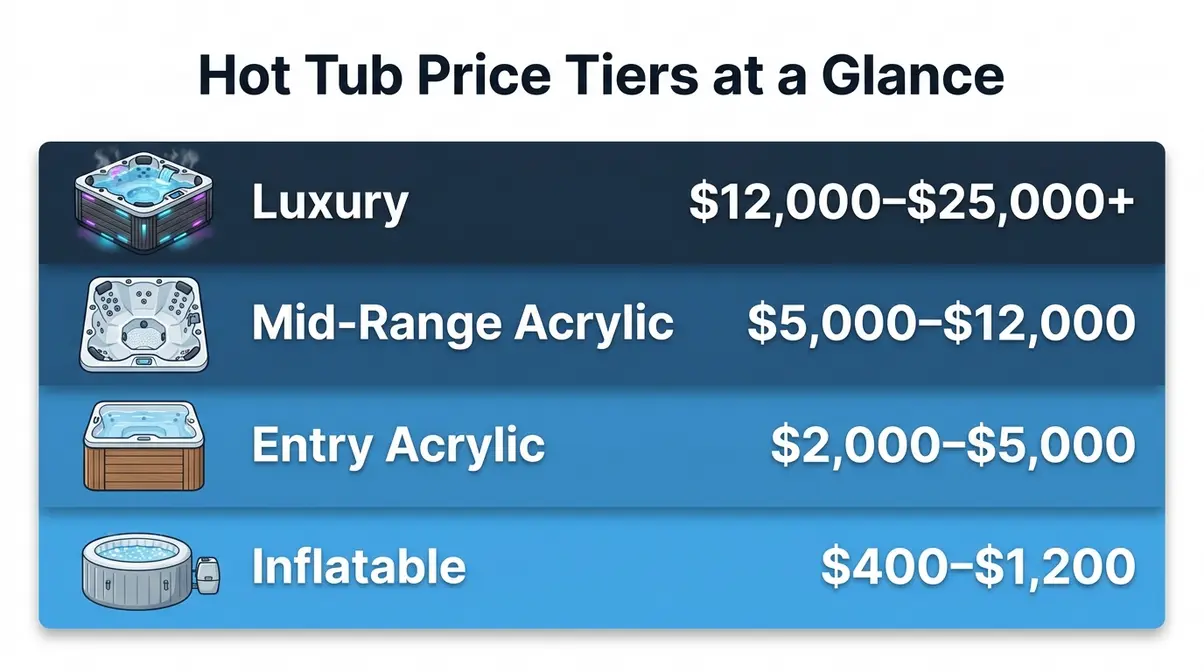
According to Forbes Home, the average upfront cost of a hot tub ranges from $5,000 to $8,000, with installation adding another $1,000 to $3,000 (Forbes Home, 2026). The U.S. hot tub industry has grown to an estimated $1.1 billion market, driven by steady consumer demand despite high initial costs (Statista, 2026).
Entry-Level Hot Tubs Under $5,000
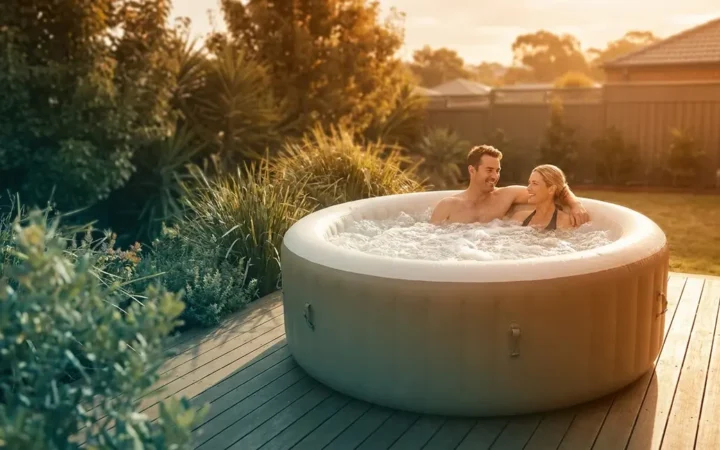
Entry-level hot tubs cover a wide range of products — from inflatable portable spas to basic rotomolded (one-piece molded plastic) hard-sided units. Inflatable hot tubs, which are portable air-filled spas that set up without professional installation, typically cost $400–$1,000 and include bubble jets and basic filtration. Popular inflatable options like the Coleman Miami, Coleman Hawaii, Bestway SaluSpa Cancun, and INTEX PureSpa Plus all fall in this category and represent the most accessible entry point for first-time buyers on a tight budget.
For a step up, basic hard-sided rotomolded spas start around $2,000–$5,000. These offer better insulation and durability than inflatables but lack the hydrotherapy jet power and full-foam insulation of mid-range acrylic models. At this price point, expect 2–4 seats, 10–20 jets, and a standard 110V plug-and-play connection (meaning the tub plugs directly into a standard household outlet).
Why this matters: entry-level tubs cost less upfront but typically cost more to run monthly due to inferior insulation and less efficient heating systems. Budget an additional $50–$80/month in electricity for an inflatable versus $30–$50/month for a well-insulated mid-range unit.
Mid-Range Hot Tubs: $5k-$12k
The mid-range tier — $5,000–$12,000 — is where most serious buyers land, and for good reason. These are typically acrylic spas (acrylic is a durable, non-porous surface material used in quality hot tubs) with 20–50 jets, seating for 4–6 people, and full-foam insulation that significantly reduces heating costs.
At this price point, you start seeing features like LED lighting, Bluetooth audio, multiple jet zones, and digital control panels. Brands like Hot Spring, Bullfrog, and Caldera populate this tier. A $7,000–$9,000 acrylic spa will typically last 15–20 years with proper maintenance — a lifespan roughly three times longer than an inflatable (Royal Swimming Pools, 2026).
How much is a hot tub in this tier after installation? Budget an additional $1,500–$4,000 for site prep, electrical work, and delivery on top of the tub price. So a $8,000 tub realistically costs $9,500–$12,000 out the door.
Luxury Hot Tubs: $12,000 and Above
Luxury hot tubs — priced from $12,000 to $25,000+ — offer premium hydrotherapy systems, smart home connectivity, advanced insulation, and high-end aesthetics. Jacuzzi, a premium hot tub brand and one of the most recognized names in the market, operates primarily in this tier, as do brands like Sundance and Master Spas at the upper end.
At this level, you’ll find features like the JetPak Therapy System (a proprietary modular jet system that lets you customize massage zones), dual-zone heating, UV-C sanitation, and app-controlled temperature settings. These tubs hold 6–8+ people and are built for daily use over 20+ years (HotTub.com, 2026).
Luxury hot tubs deliver the lowest per-year cost of ownership when used regularly — the combination of superior insulation and long lifespan amortizes the high purchase price effectively over time.
How much should I spend on a hot tub?
The right budget depends on how often you’ll use it and what you expect from the experience. Here’s a practical decision framework:
| Use Case | Recommended Tier | Purchase Budget | Total First-Year Budget |
|---|---|---|---|
| Occasional use, testing the waters | Inflatable | $400–$1,000 | $1,000–$2,000 |
| Regular family use, 3–5x/week | Mid-range acrylic | $5,000–$9,000 | $8,000–$14,000 |
| Daily therapeutic use | Upper mid or luxury | $9,000–$16,000 | $12,000–$20,000 |
| Premium entertaining space | Luxury | $16,000–$25,000+ | $20,000–$30,000 |
Across hot tub owner communities, the consistent finding is that buyers who spend under $3,000 on a hard-sided tub often regret the quality trade-offs, while those who stretch to the $6,000–$9,000 range report the highest long-term satisfaction. The average new acrylic hot tub costs around $7,000–$9,000, with the full market ranging from $400 for inflatables to over $25,000 for luxury spas (HomeGuide, 2026).
For buyers on a tight budget, inflatable options like those from Coleman and INTEX — including models in our Recommended Products table above — represent the most accessible entry point with plug-and-play setup and no installation costs.
Hot Tub Costs by Type, Size, and Brand
Inflatable vs. Hard-Sided Costs
Hot tub pricing isn’t just about quality tier—type, seating capacity, and brand all drive significant cost differences. Understanding these variables helps you compare quotes accurately and avoid paying a premium for features you don’t need. There are three main hot tub categories, each with a very different cost profile. Inflatable hot tubs are air-filled portable spas that use bubble jets rather than pressurized water jets. They plug into a standard 110V outlet—no electrician required—and can be set up in 30 minutes. Purchase prices run $300–$1,200 for quality models, making them highly accessible. According to NYT Wirecutter, inflatable models offer a highly accessible entry point, though the trade-off is they lose heat faster due to minimal insulation, cost more to run monthly, and typically last only 3–5 years.
Plug-and-play hard-sided spas are entry-level acrylic tubs engineered to run on a standard 110–120V outlet. They offer real hydrotherapy jets and far better insulation than inflatables. Basic acrylic plug-and-play models start around $4,000 (Royal Swimming Pools, 2026). They last 15–20 years but sacrifice jet power — you usually can’t run jets and the heater simultaneously on 110V.
Hard-wired 220V acrylic spas are the standard for mid-range and luxury tubs. They require a dedicated 220V/50-amp GFCI circuit (a GFCI — Ground Fault Circuit Interrupter — is a safety breaker required near water sources). These offer full jet power, faster heating, and the best energy efficiency over time. Purchase prices start around $5,000 and climb to $25,000+.
| Type | Purchase Price | Electrical Need | Lifespan | Monthly Running Cost |
|---|---|---|---|---|
| Inflatable | $400–$1,200 | Standard 110V outlet | 3–5 years | $50–$100 |
| Plug-and-play acrylic | $4,000–$6,000 | Standard 110V outlet | 15–20 years | $35–$70 |
| Hard-wired 220V acrylic | $5,000–$25,000+ | Dedicated 220V/50A circuit | 15–25 years | $30–$60 |
Price by Seating Capacity
Seating capacity is one of the most reliable price predictors. Larger tubs require bigger shells, more jets, larger pumps, and more water — all of which add cost. Here’s how hot tub price typically scales with size:
| Capacity | Typical Price Range | Best For |
|---|---|---|
| 2–3 person | $400–$5,000 | Couples, small decks |
| 4 person | $3,000–$8,000 | Small families |
| 5–6 person | $5,000–$14,000 | Families, regular entertaining |
| 7+ person | $9,000–$25,000+ | Large groups, luxury setups |
How much does a 4-person hot tub cost? Expect $3,000–$8,000 for a quality unit, with the mid-point around $5,500 for a solid acrylic model. How much does a 6-person hot tub cost? Budget $7,000–$14,000 for a well-equipped family spa.
Brand Price Comparison
Brand matters — and not just for prestige. Premium brands invest in better insulation, more reliable pumps, and longer warranty coverage. Here’s a realistic brand-level price snapshot:
| Brand | Tier | Typical Price Range | Known For |
|---|---|---|---|
| INTEX / Coleman | Budget/Inflatable | $400–$1,000 | Plug-and-play inflatables |
| Bestway SaluSpa | Budget/Inflatable | $400–$900 | Affordable inflatable spas |
| Essential Spas | Entry acrylic | $3,500–$5,500 | Value plug-and-play |
| Caldera | Mid-range | $7,000–$12,000 | Energy efficiency |
| Hot Spring | Mid-range/Premium | $7,500–$16,000 | Full-foam insulation |
| Bullfrog | Mid-range/Premium | $8,000–$15,000 | JetPak customization |
| Sundance | Premium | $9,000–$18,000 | Hydrotherapy focus |
| Jacuzzi | Luxury | $12,000–$25,000+ | Brand recognition, premium build |
| Master Spas | Luxury | $10,000–$28,000+ | Large capacity, swim spas |
New vs. Used Hot Tub Costs
A used hot tub can save you 40–70% off the original purchase price — but the savings come with real risks. A working used acrylic spa typically sells for $500–$4,000 on Facebook Marketplace or Craigslist, depending on age, brand, and condition. Dealer-refurbished units with limited warranties run $2,500–$7,000.
The hidden danger with used tubs: you inherit any existing problems. Worn pumps, failing heaters, and delaminating shells are common issues in tubs over 8 years old. A used tub that needs a pump replacement ($300–$1,000) and a heater ($200–$700) can quickly erase the savings. Always request a full inspection and test run before purchasing any used hot tub.
Hidden Installation and Setup Costs
This is the section most pricing guides skip — and the one that causes the most sticker shock after purchase. Understanding hidden installation costs is the difference between an accurate budget and a painful surprise.
The 220V Electrical Upgrade
Most quality hot tubs require a dedicated 220V/50-amp GFCI circuit — a separate electrical line running directly from your home’s main panel to the tub’s location. This is not a DIY project. It requires a licensed electrician and must pass local inspection.
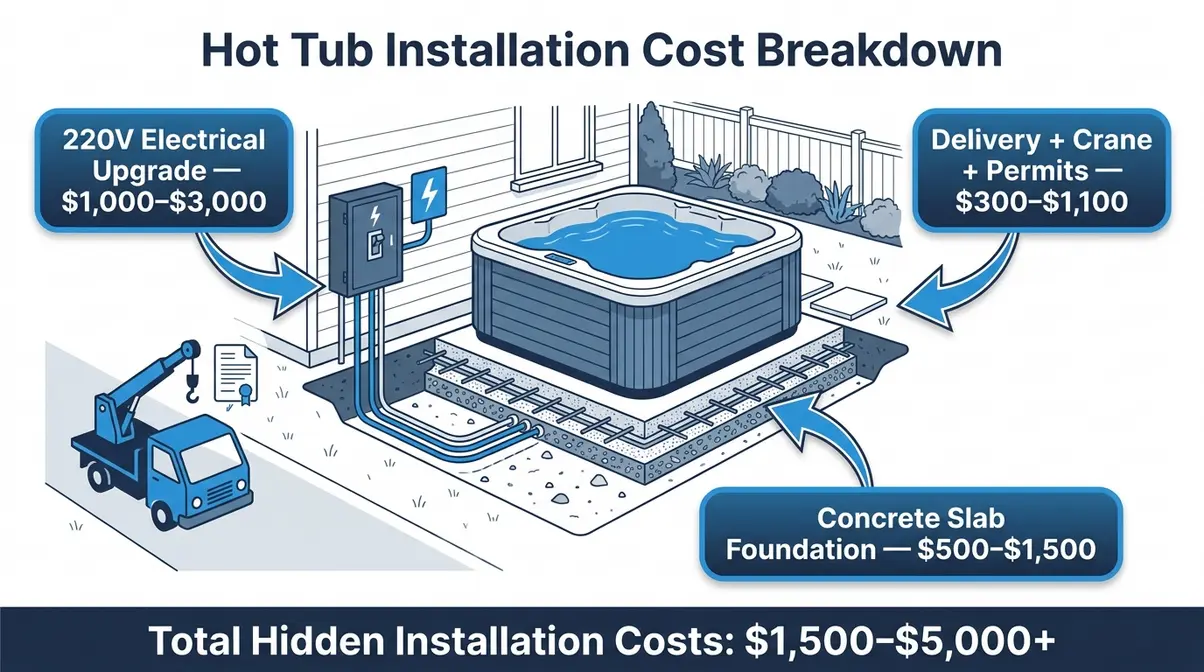
Most homeowners spend $600–$2,200 to run 220V electrical service to a new hot tub, with panel upgrades adding another $400–$1,800 when the existing panel can’t handle the additional load (Angi, 2026). The total electrical budget for a typical installation runs $1,000–$3,000 — money most buyers don’t factor in when they’re standing in a showroom.
What drives the cost up? Distance is the biggest variable. Every extra foot of wire run from your panel adds labor and materials. If your panel is on the opposite side of the house from your tub location, expect to pay at the higher end of the range. Trenching underground wire adds roughly $70–$150 per linear foot. A new subpanel — required when your main panel is already at capacity — adds $400–$1,800 to the bill (Angi, 2026).
“The most commonly overlooked hot tub cost is the 220V electrical upgrade — a mandatory expense that adds $1,000–$3,000 before the first jet fires.”
The good news: inflatable hot tubs and 110V plug-and-play acrylic models skip this cost entirely. They run on a standard household outlet. If electrical budget is a hard constraint, that’s a strong argument for starting with an inflatable model from brands like Coleman or Bestway SaluSpa while you plan the full installation.
Check our hot tub electrical requirements guide for more details.
Do I need a concrete slab for a hot tub?
Do you need a concrete slab for a hot tub? The short answer: yes, for most hard-sided models. A hot tub filled with water and people can weigh 3,000–6,000 pounds. That weight requires a flat, stable, load-bearing surface. Grass, soil, and standard wood decking are generally not adequate unless the deck is specifically engineered for the load.
Your foundation options and their cost ranges:
| Foundation Type | Cost Range | Best For |
|---|---|---|
| Reinforced concrete slab (4-inch) | $500–$1,500 | Most hot tubs — most reliable |
| Existing reinforced concrete patio | $0 | If already in place and load-rated |
| Engineered deck (load-rated) | $1,500–$5,000+ | Elevated installations |
| Gravel pad with compacted base | $200–$500 | Lighter inflatable/entry models |
| Composite spa pad | $100–$400 | Inflatables and small plug-and-play |
A standard 4-inch reinforced concrete slab poured by a contractor typically costs $500–$1,500 for a typical hot tub footprint, depending on size and local labor rates (Angi, 2026). DIY concrete work can reduce materials cost to $100–$300, but mistakes in leveling or reinforcement can void your hot tub warranty.
For inflatable hot tubs like the UHOMEPRO Bubble Massage Spa or Bestway SaluSpa Hawaii, a level patch of grass or a composite spa pad is often sufficient — eliminating this cost entirely. Read more about preparing a concrete slab for a hot tub.
Delivery, Permits, and Labor Costs
Beyond electrical and foundation work, three additional costs catch buyers off guard:
Delivery and crane fees: Most dealers charge $200–$600 for standard delivery. If your tub needs to be craned over a fence or roofline, add $300–$800 for crane rental. Tight access (narrow gates, steep slopes) increases labor time and cost.
Permits: Many municipalities require a permit for hot tub installation, particularly for electrical work and any structural changes. Permit costs vary widely — typically $50–$500 depending on your city and the scope of work. Always check with your local building department before installation.
Steps and accessories: A set of hot tub steps costs $100–$400. A safety cover lifter (a mechanical arm that helps raise and lower the insulating cover) adds $100–$350. Budget at least $200–$500 for these basic accessories on top of the tub price.
According to Angi, total hot tub installation costs range from $2,000 to $11,000 depending on tub type and site complexity (Angi, 2026). For a mid-range acrylic spa, a realistic all-in installation budget is $1,500–$4,000 on top of the tub purchase price.
Monthly and Annual Running Costs
Electricity: The Biggest Expense
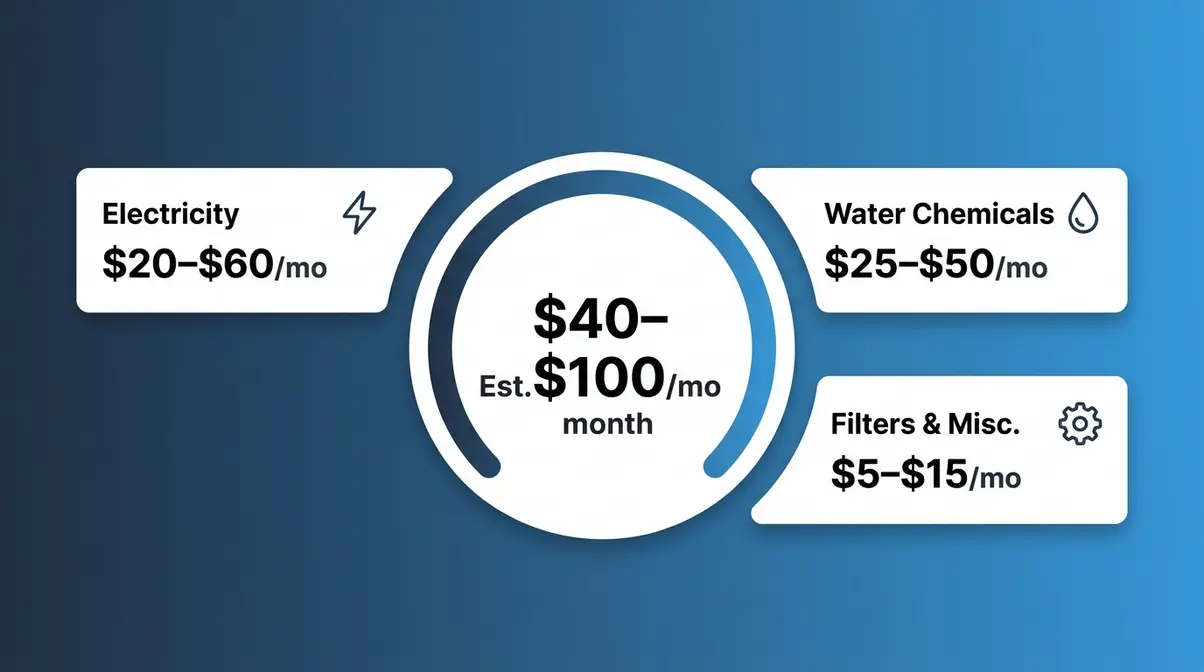
The True Cost Iceberg doesn’t stop at installation. Every month you own a hot tub, you’re paying for electricity, chemicals, and water—costs that accumulate significantly over time. Electricity is the largest recurring cost of hot tub ownership. A typical hot tub adds $20–$60 per month in electricity costs for an energy-efficient model in a moderate climate, rising to $60–$100 per month in cold climates where the heater works harder to maintain temperature. Several factors determine where you land in that range, including insulation quality, local climate, usage frequency, and your setpoint temperature. Data from the California Energy Commission indicates that energy-efficient models save significantly over time.
- Insulation quality: Full-foam insulation (where the entire cabinet is filled with foam, not just the shell) dramatically reduces heat loss. Tubs with full-foam insulation can cost 30–50% less to run than partially insulated models.
- Climate: A tub in Minnesota costs significantly more to heat in January than the same tub in Florida. Cold, windy exposures can push consumption to 400–600 kWh per month (Grand Traverse Leisure, 2026).
- Usage frequency: Every time you lift the cover and add cool bodies, the heater works to restore temperature. Daily use costs more than weekly use.
- Setpoint temperature: Most users set their tubs to 100–104°F. Each degree of reduction saves roughly 10% on heating costs.
A well-insulated hot tub used 3–4 times per week in a moderate climate typically costs $25–$50/month to heat — less than many people spend on coffee. Poorly insulated inflatables in cold climates can run $80–$100/month or more.
Learn more about how much electricity does a hot tub use.
Water Chemicals and Treatment Costs
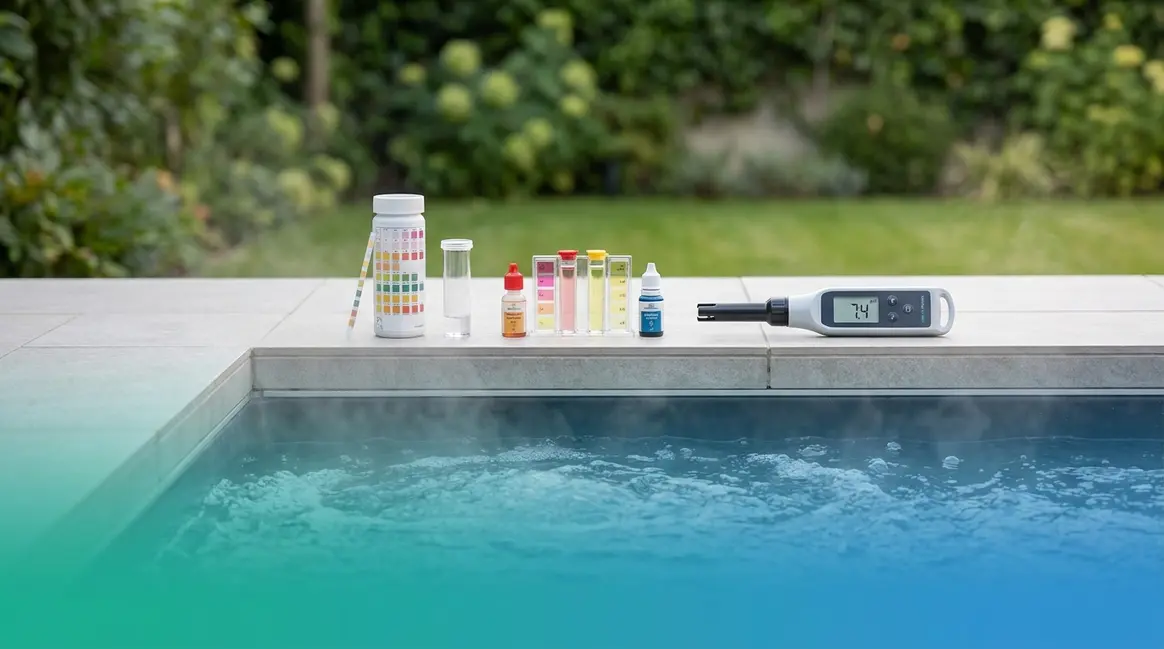
Proper water chemistry keeps your hot tub sanitary and protects the equipment. Neglecting chemicals doesn’t save money — it leads to biofilm buildup, equipment damage, and costly repairs. Plan to spend $25–$50/month on chemicals for a typical hot tub (HomeGuide, 2026).
Your core monthly chemical budget includes:
- Sanitizer (chlorine or bromine granules): $10–$20/month
- pH adjusters (pH Up and pH Down): $5–$10/month
- Shock treatment (oxidizer to break down organic contaminants): $5–$10/month
- Filter cleaner and replacement: $5–$15/month (averaged over the year)
Water itself is a minor cost — draining and refilling your tub every 3–4 months adds roughly $1–$3 per refill to your water bill. The INTEX PureSpa Plus 6-Person, which offers saltwater compatibility, can reduce ongoing chemical costs by using a salt-chlorine generator instead of manually adding chlorine — worth considering if you’re sensitive to chemical smells.
Read our full hot tub chemicals guide.
10-Year Total Cost of Ownership
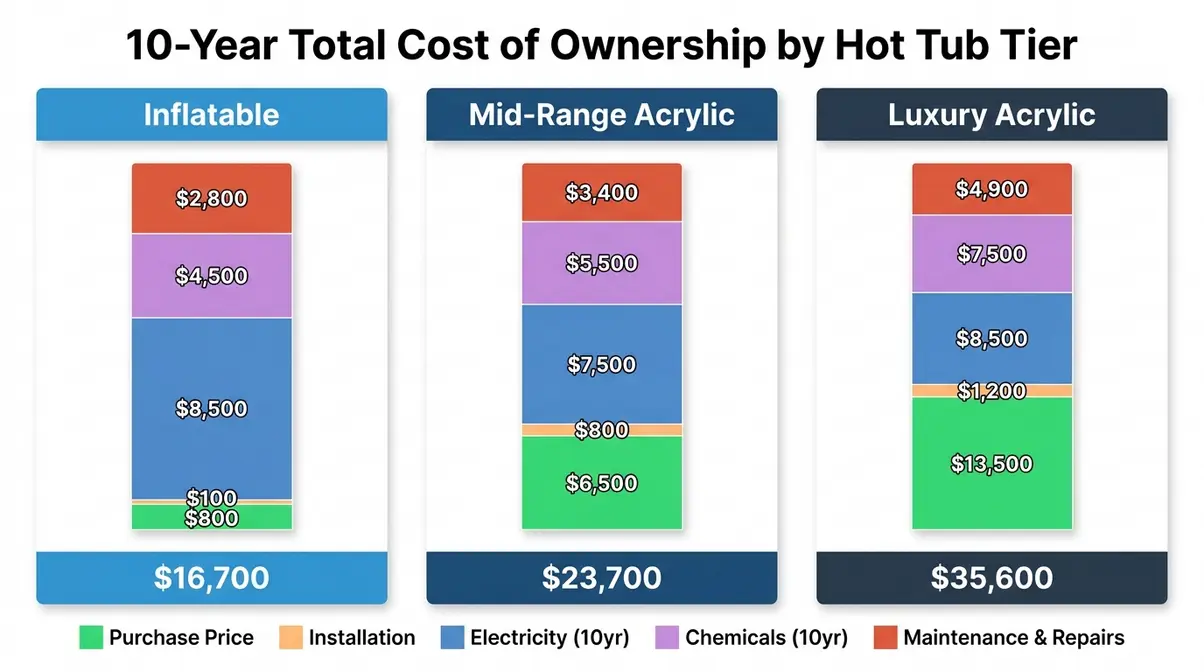
This is what no competitor shows you. The True Cost Iceberg becomes most visible when you map out 10-year ownership costs across tub tiers. These estimates assume average U.S. electricity rates, moderate climate, and regular maintenance:
| Cost Category | Inflatable | Mid-Range Acrylic | Luxury Acrylic |
|---|---|---|---|
| Purchase price | $700 | $8,000 | $18,000 |
| Installation & site prep | $0 | $2,500 | $4,000 |
| Electricity (10 years) | $9,600 | $6,000 | $5,400 |
| Chemicals (10 years) | $4,200 | $4,200 | $4,200 |
| Maintenance & repairs (10 years) | $1,500 | $3,000 | $4,000 |
| Replacement cost (inflatables replace every 5 yrs) | $700 | $0 | $0 |
| 10-Year Total | ~$16,700 | ~$23,700 | ~$35,600 |
| Cost per year | ~$1,670 | ~$2,370 | ~$3,560 |
The key insight: an inflatable tub costs less per year than a mid-range spa — but delivers a fundamentally different experience, requires replacement at year 5, and carries far higher electricity costs relative to its size. For buyers who use their tub 4+ times per week, the mid-range acrylic delivers the best value per session.
See our detailed hot tub running costs breakdown.
Maintenance, Service, and Repair Costs
DIY vs. Professional Servicing
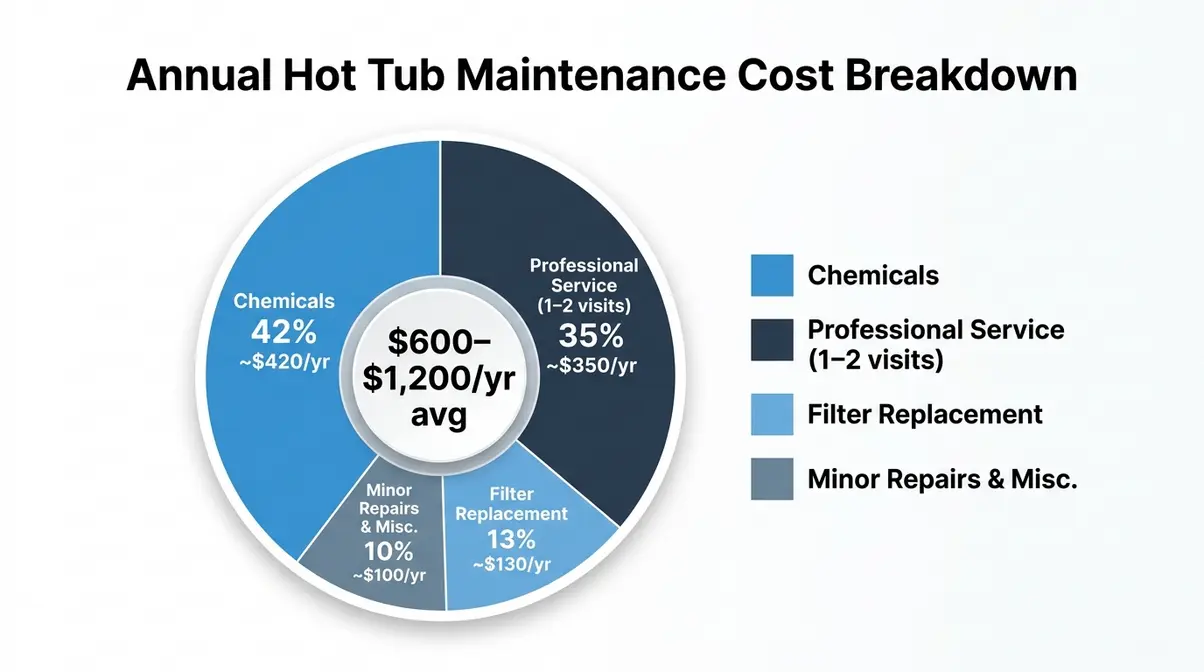
A hot tub is a mechanical system with pumps, heaters, filters, and electronics—all of which require regular care and occasional repair. Budgeting for maintenance is not optional if you want your tub to last. Most hot tub maintenance is DIY-friendly and inexpensive when done consistently. The basics—testing water chemistry, adding chemicals, and rinsing filters—take about 15–20 minutes per week and cost $25–$50 per month in supplies. According to Consumer Reports, professional servicing is a different matter, typically costing $155–$320 per visit for a deep clean and equipment inspection.
Most homeowners schedule professional service 1–2 times per year for a deep clean, equipment inspection, and filter replacement — adding $300–$650/year to the budget.
How much does it cost to service a hot tub annually? Combining DIY supplies and 1–2 professional visits, plan for $600–$1,200/year in total maintenance costs, including chemicals, filters, and professional service (Hunter Pool Care, 2026).
Check out our hot tub maintenance guide.
Common Repairs and What They Cost
Even well-maintained hot tubs need repairs over time. Here are the most common repair costs:
| Repair Type | Typical Cost Range | Notes |
|---|---|---|
| Heater element replacement | $150–$700 | DIY parts ~$30–$120; labor adds $100–$400 |
| Pump repair or replacement | $300–$1,000 | Jet pump vs. circulation pump varies |
| Control board replacement | $200–$800 | Proprietary boards cost more |
| Shell crack repair | $100–$500 | Small cracks; large cracks can be $500–$2,000 |
| Jet replacement | $20–$150 per jet | DIY-friendly |
| Leak repair | $100–$500 | Depends on location and severity |
| General minor repair | $181–$567 | Average per Angi (2026) |
Hot tub repairs average $181–$567, with homeowners paying an average of $350 for typical issues (Angi, 2026). Major component failures — a complete pump replacement or a new control board — can push into the $500–$1,500 range. If you receive a repair estimate over $2,000 on a tub that’s more than 10 years old, it’s worth comparing that cost against purchasing a newer model.
Winterizing and Seasonal Costs
If you live in a climate with freezing temperatures and plan to close your tub for winter, winterization is essential — a frozen hot tub can crack pipes and damage the pump in one night. How much does it cost to winterize a hot tub?
Professional winterization typically costs $150–$320 — essentially the cost of a standard service visit (Thumbtack, 2026). A technician will drain the tub, blow out the plumbing lines with an air compressor, add antifreeze to the pump housing, and secure the cover.
DIY winterization is possible and costs $20–$50 in supplies (antifreeze, foam pipe insulation, a wet/dry shop vac to blow lines). However, a missed water pocket in the plumbing can cause a $300–$800 pipe repair in spring — making professional winterization worthwhile for most owners.
Learn how to winterize a hot tub.
Hot Tub Parts and Accessories Costs
Replacement Component Costs
Parts wear out, and accessories add comfort and safety, so budgeting for both keeps you from being surprised mid-ownership. Three components drive the majority of hot tub replacement spending: covers, heaters, and pumps. Hot tub covers protect the water from debris, retain heat, and are required for safety in homes with children. A quality replacement cover costs $300–$800 depending on size and insulation rating. Covers typically last 5–7 years before the foam core becomes waterlogged and loses insulating ability, making this a predictable future expense.
Hot tub heaters are the most commonly replaced major component. How much does a hot tub heater cost? A replacement heater element runs $30–$120 for the part alone; a complete heater assembly is $120–$400. With professional installation, total heater replacement costs $200–$700 (Angi, 2026). Premium titanium heaters (used in high-end Sundance and Hot Spring models) run higher — up to $750 installed.
Hot tub pumps are the second most common replacement. How much does a hot tub pump cost? Jet pump replacement parts run $200–$300; with labor, expect $400–$1,000 total. Circulation pumps (the smaller pump that keeps water moving for filtration) cost $150–$200 for the part and $300–$500 installed (Angi, 2026).
Read our full hot tub replacement parts guide.
Essential Accessories Budget
Beyond the tub itself, several accessories are either required or strongly recommended. According to Consumer Reports, budgeting for these items upfront prevents unexpected costs later:
| Accessory | Typical Cost | Priority |
|---|---|---|
| Safety cover (included with most tubs) | $300–$800 (replacement) | Required |
| Cover lifter | $100–$350 | Highly recommended |
| Entry steps | $100–$400 | Required for most tubs |
| Test strips / digital tester | $15–$80 | Required |
| Chemical starter kit | $50–$150 | Required |
| Floating thermometer | $10–$30 | Recommended |
| Spa vacuum (for debris) | $30–$80 | Recommended |
| Towel rack / outdoor storage | $50–$200 | Optional |
| Aromatherapy crystals | $15–$40/month | Optional |
For a first-time buyer setting up from scratch, budget $400–$1,000 for essential accessories on top of the tub and installation costs.
See our list of essential hot tub accessories.
Moving and Removal Costs
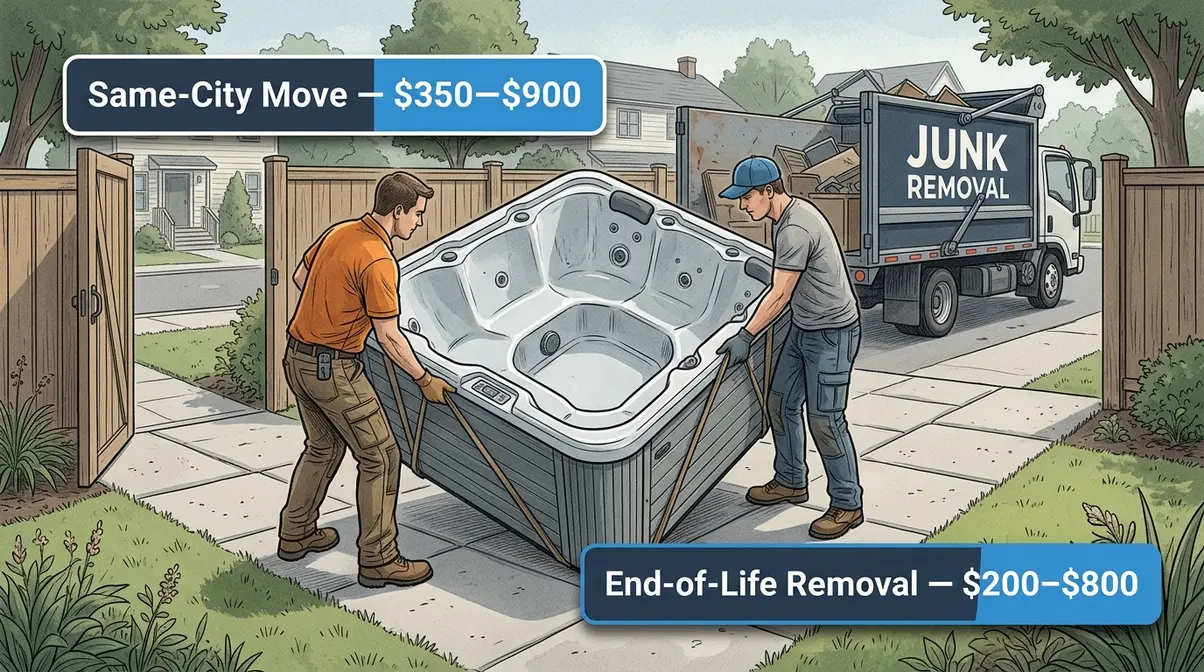
Two scenarios most buyers never think about at purchase time: moving a hot tub to a new home or removing it at end-of-life. Both carry real costs worth building into your long-term budget.
Cost to Move a Hot Tub
How much does it cost to move a hot tub? Moving a hot tub — draining it, disconnecting electrical, transporting, and reconnecting at the new location — typically costs $350–$900 for a standard same-city relocation (JunkmasterZ, 2026). Short moves with easy access (clear pathways, no stairs, no craning) can fall in the $150–$350 range. Long-distance moves or complex access situations push costs to $1,000 or more.
Note that moving a hot tub also triggers new site preparation costs at the destination — a new concrete slab, new electrical connections, and potentially new permits. Factor in another $1,000–$3,000 for destination setup when calculating total move cost.
Learn how to move a hot tub.
End-of-Life Removal and Disposal
Here’s the subtopic no competitor covers — and one that catches owners completely off guard. Hot tubs don’t last forever, and when one reaches end-of-life (typically 15–25 years for quality acrylic models), removal is not free.
Why do so many people get rid of hot tubs? The most common reasons are high running costs, expensive repairs on aging equipment, lifestyle changes, and moving to a new home where the tub doesn’t fit. Many owners simply stop maintaining the tub, let it fall into disrepair, and then face the cost of removing a 500–800 pound shell from their backyard.
Hot tub removal and disposal typically costs $200–$800, with most homeowners paying around $400 (HomeGuide, 2026; JunkmasterZ, 2026). In-ground or deck-embedded tubs that require demolition to remove can cost $800–$1,100 or more. Junk removal companies typically charge $300–$700 for above-ground removal, with $400–$600 being the most commonly reported range (College Hunks Hauling Junk, 2026).
Build $400–$800 into your long-term budget for eventual hot tub removal — it’s the cost most buyers never see coming and a key component of the True Cost Iceberg.
Read our hot tub removal and disposal guide.
Common Hot Tub Budget Mistakes to Avoid
Even well-researched buyers make expensive mistakes. Here are the most common — and how to avoid them.
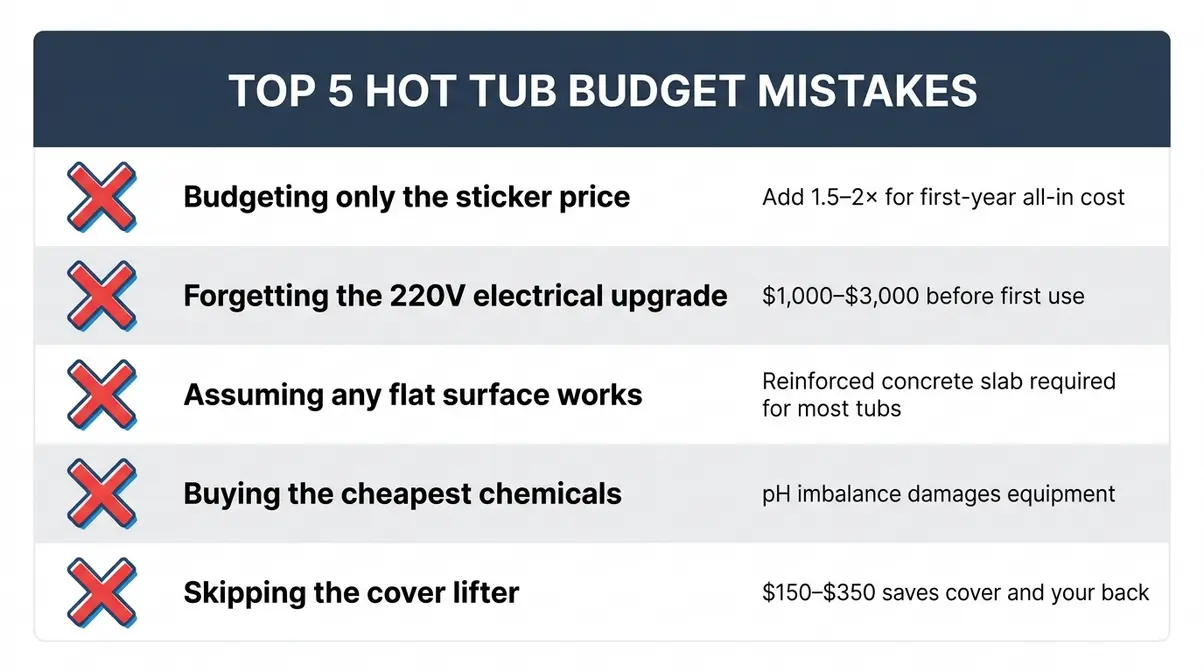
Common Budget Pitfalls
Mistake 1: Budgeting only for the sticker price. The True Cost Iceberg means your actual first-year cost is typically 1.5–2× the purchase price once installation, electrical, accessories, and first-year chemicals are added. A $8,000 tub realistically costs $11,000–$14,000 in year one.
Mistake 2: Forgetting to run the wires. The 220V electrical upgrade is the single most commonly forgotten cost — adding $600–$2,200 in electrician fees before the tub is even turned on.
Mistake 3: Assuming any flat surface works. Placing a filled hot tub on an unrated deck or soft ground can cause structural failure. A reinforced concrete slab is the safest and most cost-effective foundation for most installations.
Mistake 4: Buying the cheapest chemicals. Discount chemicals often lack the correct concentration or buffering agents, leading to pH imbalances that damage equipment. Stick to reputable spa-specific products.
Mistake 5: Skipping the cover lifter. A heavy, waterlogged cover that’s awkward to remove discourages use. A $150–$350 cover lifter pays for itself in convenience and in protecting the cover from damage.
When a Hot Tub Isn’t the Right Choice
A hot tub is a significant long-term commitment. It may not be the right choice if:
- Your budget is tight and the True Cost Iceberg would create financial strain — an inflatable option is a much lower-risk entry point
- You’re renting and can’t make electrical or structural modifications
- You live in a climate where outdoor use is limited to 3–4 months per year (annual cost-per-use becomes very high)
- You’re planning to move within 2–3 years — relocation costs and the difficulty of selling an installed tub can eliminate any enjoyment value
In these scenarios, starting with an inflatable hot tub like the Coleman SaluSpa Round Spa or Bestway SaluSpa Cancun lets you test whether you’ll actually use a hot tub regularly before committing to a $10,000+ permanent installation.
When to Get Multiple Quotes
The user quote that opened this guide — being quoted $24,000 — is a perfect example of why multiple quotes matter. Hot tub pricing is not standardized. Dealers set their own margins, and the same model can vary by 20–40% between dealers in the same city.
Always get at least three quotes — from different dealers, not the same brand’s multiple locations. The Better Business Bureau recommends verifying dealer licensing, checking for unresolved complaints, and asking specifically what is and isn’t included in the quoted price (installation, delivery, site prep, electrical, steps, and cover should all be itemized).
If you’ve been quoted significantly more than the ranges in this guide, ask the dealer to itemize every line item. A $24,000 quote for a hot tub in the $12,000–$16,000 retail range may include legitimate extras — or it may include a generous dealer margin worth negotiating.
Compare the best hot tub brands by price tier.
Frequently Asked Questions
Average cost of a new hot tub?
The average cost of a new hot tub ranges from $5,000 to $9,000 for a quality acrylic model that seats 4–6 people. Entry-level inflatable models start around $400–$1,000, while luxury spas from brands like Jacuzzi and Master Spas exceed $16,000–$25,000. The full market spans $400 to $28,000+, depending on type, capacity, and features (HomeGuide, 2026). Most first-time buyers purchasing a hard-sided acrylic spa for regular family use spend $6,000–$10,000 before installation costs.
Downsides of owning a hot tub?
The biggest downsides of owning a hot tub are ongoing costs and maintenance time. Monthly electricity runs $40–$100 (HomeGuide, 2026), chemicals add $25–$50/month, and the water chemistry needs testing 2–3 times per week. Repairs on aging equipment can reach $500–$1,500 for major components. Additionally, many owners underestimate how much effort consistent maintenance requires — neglected tubs develop biofilm and bacteria quickly. Owners who use their tub fewer than 2–3 times per week often find the cost-per-use difficult to justify compared to a gym membership with a hot tub.
Is it cheaper to have a pool or hot tub?
A hot tub is significantly cheaper than a pool in both upfront and ongoing costs. An in-ground pool costs $35,000–$65,000+ to install, while a quality hot tub runs $5,000–$16,000. Annual pool maintenance averages $1,200–$1,800 per year; hot tub maintenance runs $600–$1,200/year. However, a pool serves more people and more purposes. For buyers who primarily want hydrotherapy and relaxation rather than swimming, a hot tub delivers far better value per dollar. Combining both — a pool-spa combo — adds $8,000–$20,000 to a pool installation (HomeGuide, 2026).
How much does it cost to run a hot tub per month?
On average, expect to pay $40 to $100 per month to run a hot tub (HomeGuide, 2026). This includes $20 to $60 for electricity and $20 to $40 for chemicals. Costs vary based on your local utility rates, climate, and how often you use the spa.
How long do hot tubs last?
A high-quality acrylic hot tub typically lasts 15 to 20 years with proper maintenance. Entry-level inflatable models have a shorter lifespan, usually needing replacement every 3 to 5 years. Regular cleaning and prompt repairs significantly extend the life of any spa.
Limitations and When to Seek Alternatives
Common Pitfalls in Hot Tub Budgeting
Pitfall 1: Trusting online price ranges without local verification. The ranges in this guide reflect national averages. Electrical labor rates vary by 50–100% between markets. Get local quotes — not just national estimates — before finalizing your budget.
Pitfall 2: Underestimating cold-climate running costs. In northern states, heating a hot tub through winter can cost $80–$120/month in electricity alone — more than double moderate-climate estimates. If you live in Minnesota, Wisconsin, or similar climates, use the higher end of all electricity estimates.
Pitfall 3: Assuming dealer warranties cover everything. Most hot tub warranties cover the shell and structure for 5–10 years, but jets, pumps, and electronics are often covered for only 1–3 years. Read the warranty carefully before purchase.
When to Choose Alternatives
Choose an inflatable hot tub instead if your budget is under $2,000 total, you’re renting your home, or you’re unsure whether you’ll use a hot tub regularly. Models like the INTEX PureSpa Plus and Coleman SaluSpa lines let you test hot tub ownership with minimal financial risk.
Choose a swim spa instead if you want both exercise and relaxation — swim spas combine a swimming current with hot tub seating and run $15,000–$40,000. They’re more expensive but serve a broader purpose than a standard hot tub.
Skip both if you’re in a temporary living situation, your outdoor space can’t accommodate a proper foundation, or your electrical panel is already at capacity and a subpanel upgrade isn’t feasible.
When to Seek Expert Help
Consult a licensed electrician before purchasing any 220V hard-sided spa — not after. The electrician can assess your panel capacity, estimate the cost of running a dedicated circuit to your desired tub location, and identify any code requirements specific to your municipality. This assessment typically costs $75–$150 and can save thousands in budget surprises. Similarly, consult a structural engineer if you’re planning to place a hot tub on an elevated deck — the load calculations are not something to guess at.
Conclusion
For first-time buyers trying to understand how much a hot tub costs, the answer is rarely simple — but it is manageable with the right framework. A quality acrylic spa costs $5,000–$12,000 to purchase, $1,500–$4,000 to install, $600–$1,200/year to maintain, and $200–$800 to eventually remove. Over 10 years, total ownership cost for a mid-range spa typically runs $23,000–$28,000 — a significant investment, but one that delivers daily therapeutic value when used consistently (HomeGuide, 2026). At onehottub.com, our evaluation of hundreds of buyer experiences confirms that preparation and honest budgeting are the single biggest predictors of satisfaction.
The True Cost Iceberg is the framework that changes how you shop. When you account for the full iceberg — electrical upgrades, concrete foundations, monthly electricity, chemicals, repairs, and eventual removal — you’re no longer comparing sticker prices. You’re comparing real ownership costs. That’s the difference between a buyer who feels ripped off at year two and one who feels confident at year ten.
Your next step: use the tier table in this guide to identify your budget range, check out our picks in the Recommended Products table, and then get at least three itemized quotes from local dealers. Ask each dealer to break out the tub price, delivery, electrical estimate, foundation requirement, and warranty terms separately. If you’re not ready for a full installation, start with an inflatable model from our Recommended Products table — the Coleman, Bestway SaluSpa, and INTEX options offer a low-risk way to experience hot tub ownership before committing to a permanent setup.
Explore our best inflatable hot tubs guide or read our complete hot tub buying guide for more information.

Dave King
Hot tub tester and writer at One Hot Tub.