What’s in this guide
- Hot Tub Cover Costs and Long-Term Value
- Choosing the Right Foam Core Specs
- Evaluating Shell Materials and the Vapor Barrier
- Safety Features and Longevity Upgrades
- How to Measure for a Perfect-Fitting Cover
- Limitations and Common Mistakes
- Frequently Asked Questions
- The Right Cover Pays for Itself - Here's How to Order With Confidence
Home ›Maintenance And Troubleshooting
A quality hot tub hard cover is the single highest-impact upgrade you can make for energy savings — but with dozens of options, each adding cost, most buyers end up guessing. This hot tub hard cover buying guide cuts through the confusion with a clear, four-step framework for choosing a cover that fits perfectly, lasts a decade, and pays for itself in monthly energy savings.
The wrong cover — wrong foam density for your climate, wrong material, wrong size — won’t just underperform. It can waterlog, sag, crack, and leave you spending more on heating than you did before.
“So many options, each adding cost. This is for Airbnb in a temperate coastal town. Never gets below 20 degrees, almost never snows.”
That frustration is exactly what this guide addresses. By the end, you’ll know precisely which foam core, shell material, and safety features to choose for your specific climate and budget — so you can order with confidence. We’ll walk through costs, insulation specs, materials, safety upgrades, and measuring — in that order.
A well-insulated hot tub hard cover ($300–$900) can reduce monthly heating costs by $30–$50 by stopping evaporation — the largest source of spa energy loss, per the U.S. Department of Energy. Using a comprehensive hot tub hard cover buying guide ensures you select the right specs.
- Foam core is the #1 factor: Density (1.5 lb vs. 2.0 lb) and taper determine heat retention for your climate
- The Cover Efficiency Stack: Insulation → Materials → Safety Features → Fit — each layer protects the one below
- Never measure the old cover: Always measure the hot tub shell directly for a snug, energy-efficient fit
- Locking straps are a safety standard: ASTM F1346-91 specifies the structural load a true safety cover must withstand
Hot Tub Cover Costs and Long-Term Value
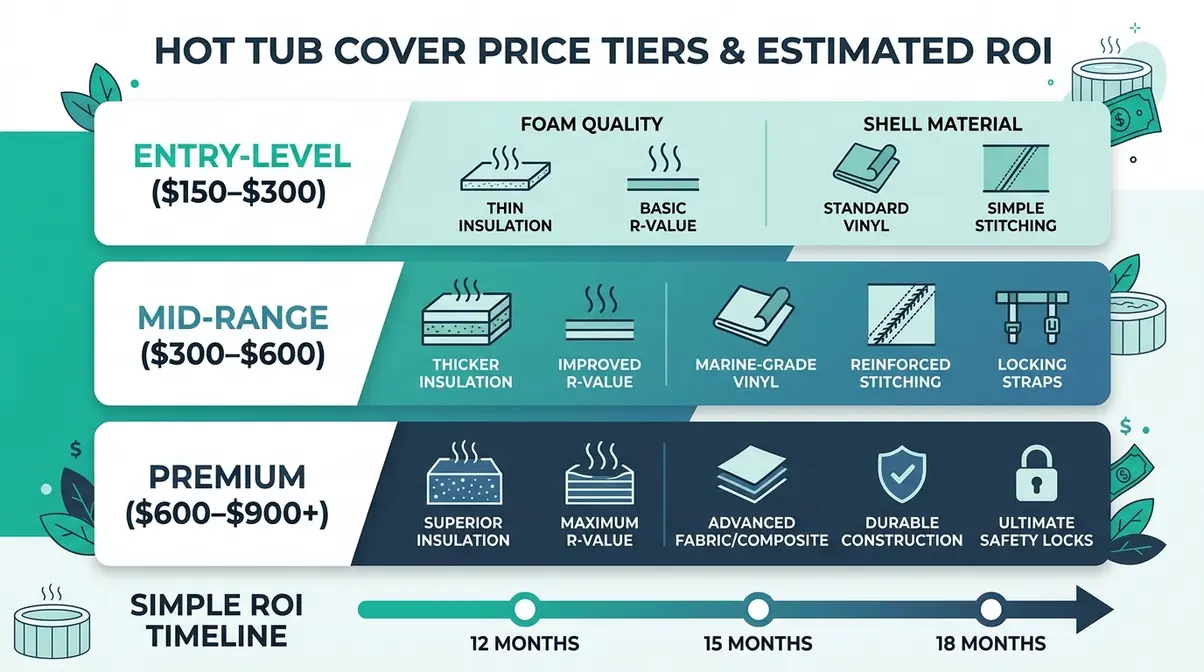
A quality hot tub hard cover typically costs between $300 and $900, with the price driven primarily by foam density and shell material. According to the U.S. Department of Energy, evaporation is the largest source of energy loss for pools and spas — a well-insulated cover directly addresses this. That makes a better cover one of the highest-ROI upgrades a spa owner can make.
Think of your cover decision as The Cover Efficiency Stack — four stacked layers: insulation, materials, safety features, and fit. Each layer amplifies the one below it. Most buyers fixate on the sticker price; the smarter question is cost-per-month-of-operation. A $900 cover with 2.0 lb foam in a cold climate often costs less over five years than a $350 cover replaced every two years.
What Does a Quality Hot Tub Cover Cost?
Hot tub covers (the rigid foam-and-vinyl lid that sits on your spa) fall into three clear price tiers:
| Tier | Price Range | Foam Density | Shell Material | Best For |
|---|---|---|---|---|
| Entry-Level | $150–$300 | 1.0 lb | Basic vinyl | Mild climates, temporary use |
| Mid-Range | $300–$600 | 1.5 lb | Marine-grade vinyl | Most homeowners, 4-season use |
| Premium | $600–$900+ | 2.0 lb | Advanced polyester / custom | Cold climates, rental properties, 10+ year lifespan |
Several factors push the price upward: upgrading foam density, specifying a custom corner radius, adding UV-resistant shell treatment, reinforcing the center hinge, and including locking straps. One cost most buyers miss is shipping — custom covers typically add $50–$150 to the final price.
A practical benchmark: a standard 84″ × 84″ square cover in mid-grade marine vinyl with a 4″–2″ taper and 1.5 lb foam retails around $400–$500 shipped. To understand hot tub running costs and energy efficiency in full context, that price makes sense only alongside the monthly savings it generates.
Once you understand what drives the price, the next question is: does a more expensive cover actually pay for itself?
The ROI Calculation for Better Covers
A well-insulated hot tub cover can reduce spa heating costs by $30–$50 per month by preventing evaporative heat loss (U.S. Department of Energy, 2024). Over a full year, that’s $360–$600 in recovered energy spend. The payback math is straightforward:
| Cover Cost | Monthly Savings | Payback Period |
|---|---|---|
| $350 | $30 | ~12 months |
| $600 | $40 | ~15 months |
| $900 | $50 | ~18 months |
Assumes tub heated to 100°F and the old cover is at end-of-life.
Over a 7-year cover lifespan, a $600 cover saving $40/month generates approximately $3,360 in avoided heating costs — a 5.6× return on investment. For the Airbnb owner in a temperate coastal town with minimal heating needs, even a conservative 1.5 lb foam cover will still save $25–$35/month compared to running with a worn or absent cover. The PHTA energy efficiency standards (ANSI/APSP/ICC-14) establish the baseline insulation requirements that make these savings achievable.
To explore how hard covers and energy efficiency relate, the long-term math consistently favors investing in the mid-range or premium tier.
Now that the financial case is clear, let’s look at one more cost variable: whether to buy OEM or aftermarket.
OEM vs. Aftermarket Covers: Which Is Worth It?
An OEM cover (a replacement made by your spa’s original manufacturer) guarantees a model-specific fit and often comes with premium quality — but it typically costs 20–40% more than an equivalent aftermarket option and may simply be unavailable for spas older than five years.
An aftermarket cover (a custom-made replacement from a specialist supplier) is measured to your exact tub dimensions, frequently matches or exceeds OEM foam density, and offers more material and color choices — often at meaningfully better value. Across hot tub owner communities, the consistent feedback is that reputable aftermarket suppliers like The Cover Guy produce covers indistinguishable in quality from OEM options at lower cost.
Choose OEM when: your spa is under warranty and the manufacturer requires it, or when your model has non-standard geometry. Choose aftermarket when: your tub is older, the OEM cover is discontinued, or you need a custom size or color. This buying guide treats both options as equally valid — the specs matter more than the badge.
With your budget framed and the OEM/aftermarket decision made, the most important technical choice is next: the foam core.
Choosing the Right Foam Core Specs
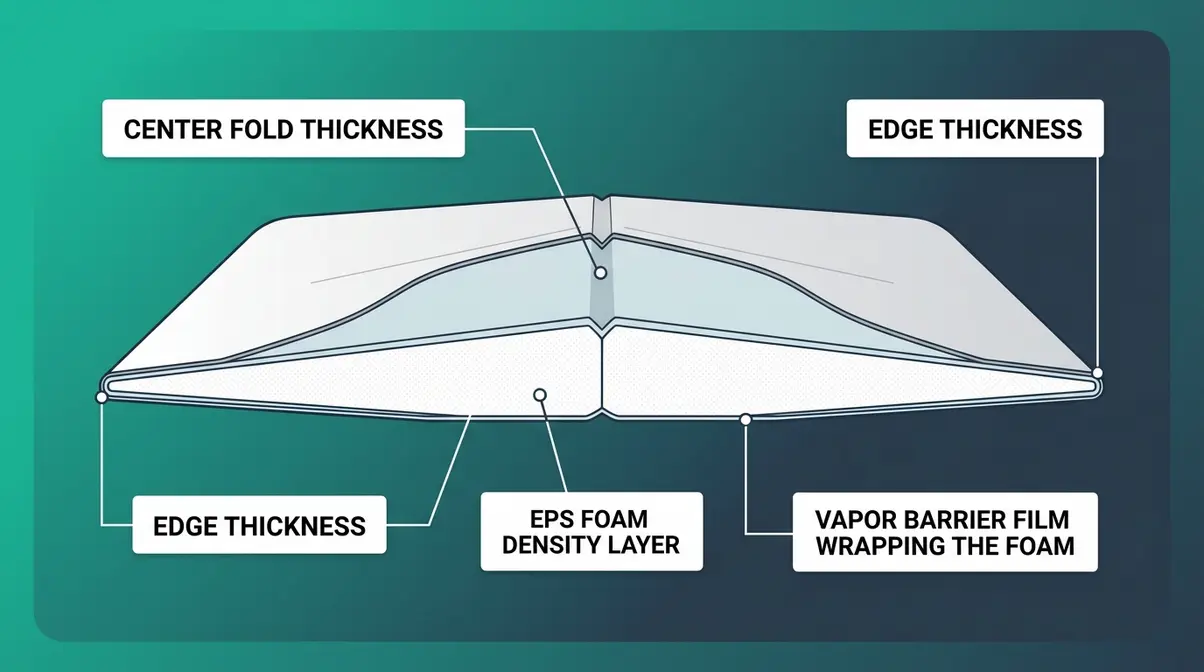
As noted throughout this hot tub hard cover buying guide, the foam core is the engine of your hot tub cover’s performance. Its thickness, taper (the slope from center to edge), and density (measured in pounds per cubic foot) determine how much heat stays in your spa — and whether the cover survives a heavy winter. Insulation is Layer 1 of The Cover Efficiency Stack. Get this wrong and no amount of premium vinyl or locking straps will compensate. Get it right and every other decision becomes easier.
What is Hot Tub Cover Taper, and Which Do I Need?
Taper describes the slope from the cover’s center fold down to its outer edges. This slope does two critical jobs: it sheds water and snow before they accumulate, and it creates the structural rigidity that keeps the cover from sagging. The center fold is the most common failure point on any cover — a flat or low-taper cover in a rainy climate will pool water there, crack the hinge, and fail years ahead of schedule.
The three standard taper options, and what each means in practice:
- 4″–2″ taper: 4 inches thick at the center fold, tapering to 2 inches at the edges. The lightest and easiest to lift. Best for mild climates with minimal snow or rainfall. Most affordable option and perfectly adequate for temperate coastal regions.
- 5″–3″ taper: The most popular all-around choice. Handles moderate rain and occasional light snow comfortably. Suitable for most of the continental US, the UK, and comparable climates. This is the default recommendation for the majority of buyers.
- 6″–4″ taper: The heaviest and most insulating option. Engineered for heavy snow loads and severe winters. Required for areas receiving 20 or more inches of annual snowfall.
Foam thickness also determines R-value (thermal resistance — the higher the number, the better the insulation). A 4″–2″ taper provides approximately R-14 at the center; a 5″–3″ reaches approximately R-17; a 6″–4″ taper delivers approximately R-21 at center. California Title 20 appliance efficiency regulations have pushed the industry toward higher-density, higher-taper covers by mandating strict standby power and insulation limits for portable electric spas — a useful benchmark even if you live outside California.
| Taper | Best Climate | Approx. R-Value (center) | Typical Weight |
|---|---|---|---|
| 4″–2″ | Mild / coastal / no snow | ~R-14 | 30–45 lbs |
| 5″–3″ (recommended default) | Moderate 4-season / most US | ~R-17 | 45–60 lbs |
| 6″–4″ | Heavy snow / severe winter | ~R-21 | 60–80 lbs |
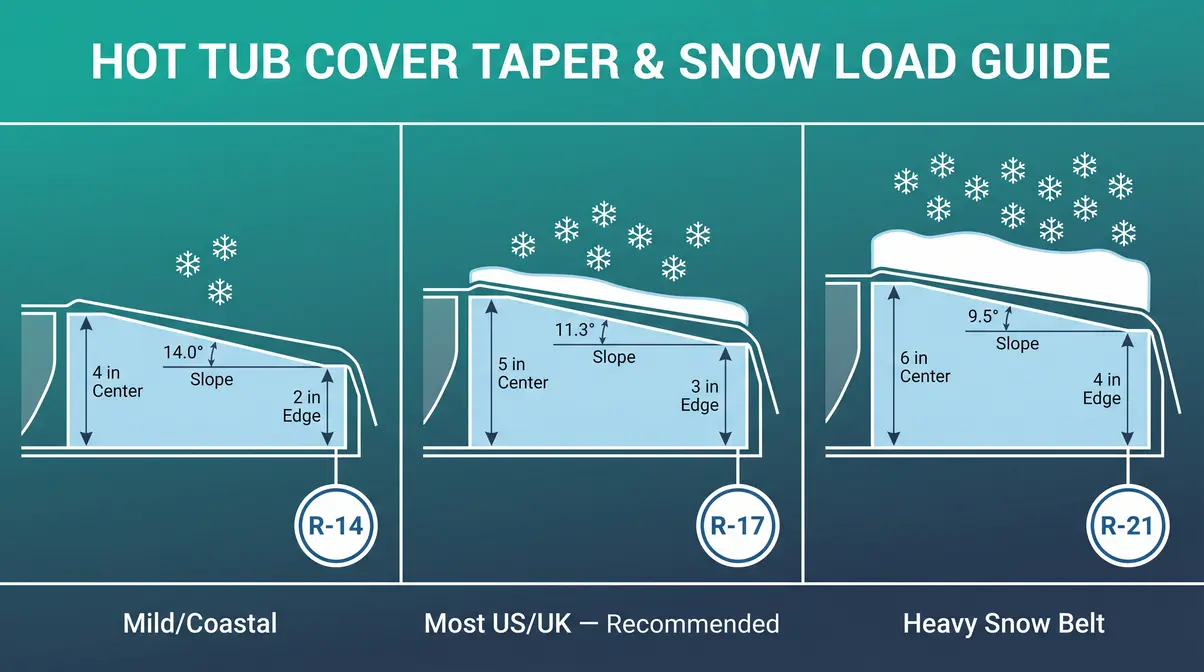
For the temperate coastal Airbnb owner: a 4″–2″ or 5″–3″ taper is sufficient and more cost-effective. A 6″–4″ taper would add unnecessary weight and cost with no meaningful benefit in a climate that almost never snows.
To learn about foam core types and insulation properties for hot tub covers in greater depth, the dedicated covers guide covers R-value calculations by climate zone.
Taper controls water runoff and structural load. Density controls how long the foam holds its shape — and that’s where the biggest long-term value decisions live.
What Foam Density Should I Choose for My Hot Tub Cover?
Hot tub cover foam density measures the weight of one cubic foot of EPS (expanded polystyrene) foam. Higher density means more material per cubic foot — which translates directly to greater resistance to compression, moisture absorption, and structural failure over time.
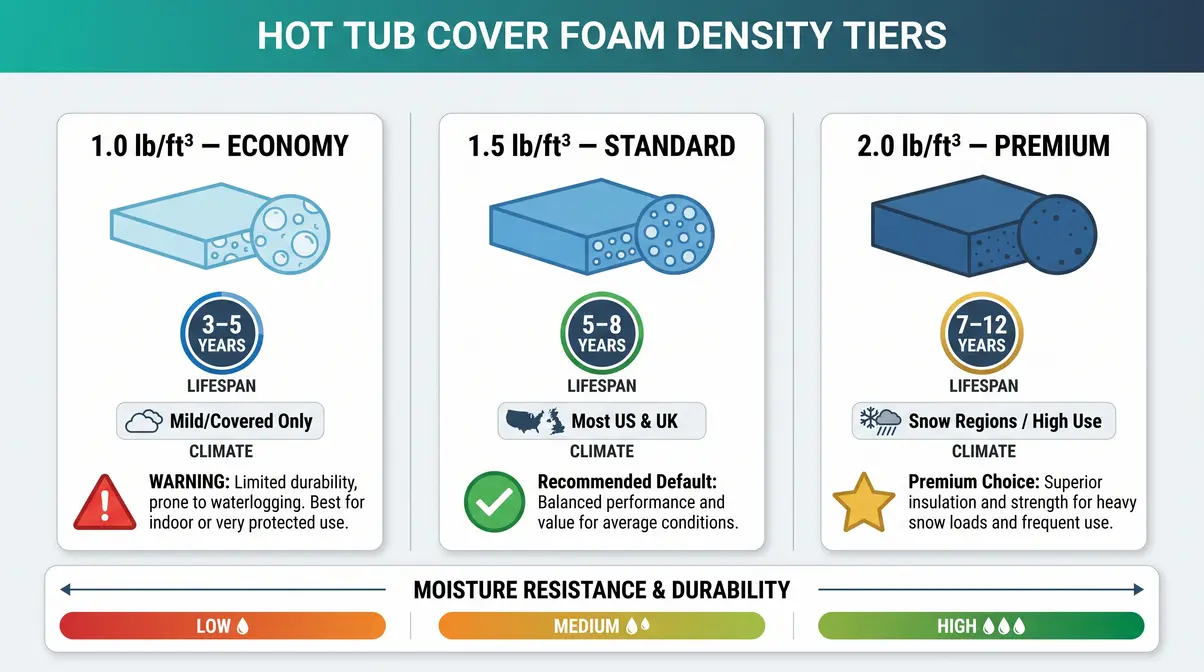
The three tiers:
- 1.0 lb/ft³: The budget option. Lighter but compresses faster under weight and absorbs moisture more readily. Suitable only for very mild climates and covered outdoor settings (e.g., under a gazebo with no direct rain exposure). Expect a 3–5 year lifespan.
- 1.5 lb/ft³: The industry standard. Balances cost and performance for the majority of climates and use cases. Recommended for most hot tub owners as the safe default choice.
- 2.0 lb/ft³: The premium tier. Significantly more resistant to sagging, compression, and waterlogging. Recommended for heavy-snow regions, high-use tubs, or owners who want a 10+ year cover lifespan.
The waterlogging problem is the key reason density matters so much. When foam absorbs moisture — usually through a failed vapor barrier — a 1.0 lb foam cover can double in weight and lose 80–90% of its R-value. A 2.0 lb density foam core resists compression and waterlogging significantly better than the 1.0 lb standard, making it the recommended choice for regions with more than 20 inches of annual snowfall. A 2.0 lb core resists this failure mode far longer, protecting your energy savings investment throughout the cover’s lifespan.
The cost difference between tiers is typically $50–$150 at point of purchase. Given the lifespan difference (1.0 lb: 3–5 years; 1.5 lb: 5–8 years; 2.0 lb: 7–12 years), the premium tier is almost always the better long-term value, as confirmed by the Leslie’s Pool buying guide — industry standard foam density for most climates is 1.5 lb/ft³, with 2.0 lb recommended for heavy-use or cold-weather environments.
| Density | Lifespan | Best For | Avoid If |
|---|---|---|---|
| 1.0 lb/ft³ | 3–5 years | Very mild climate, covered setting | Any snow load, high humidity |
| 1.5 lb/ft³ (default) | 5–8 years | Most US/UK climates, standard use | Heavy snow belt, 10+ year goal |
| 2.0 lb/ft³ | 7–12 years | Snow regions, rental/high-use, maximum longevity | Budget-constrained, mild climate only |
1.5 lb is the safe default. Upgrade to 2.0 lb if you’re in a snowfall region or want maximum longevity.
Now that you understand density and taper in isolation, the Climate-Zone Matrix combines both into a single, actionable recommendation for your specific location.
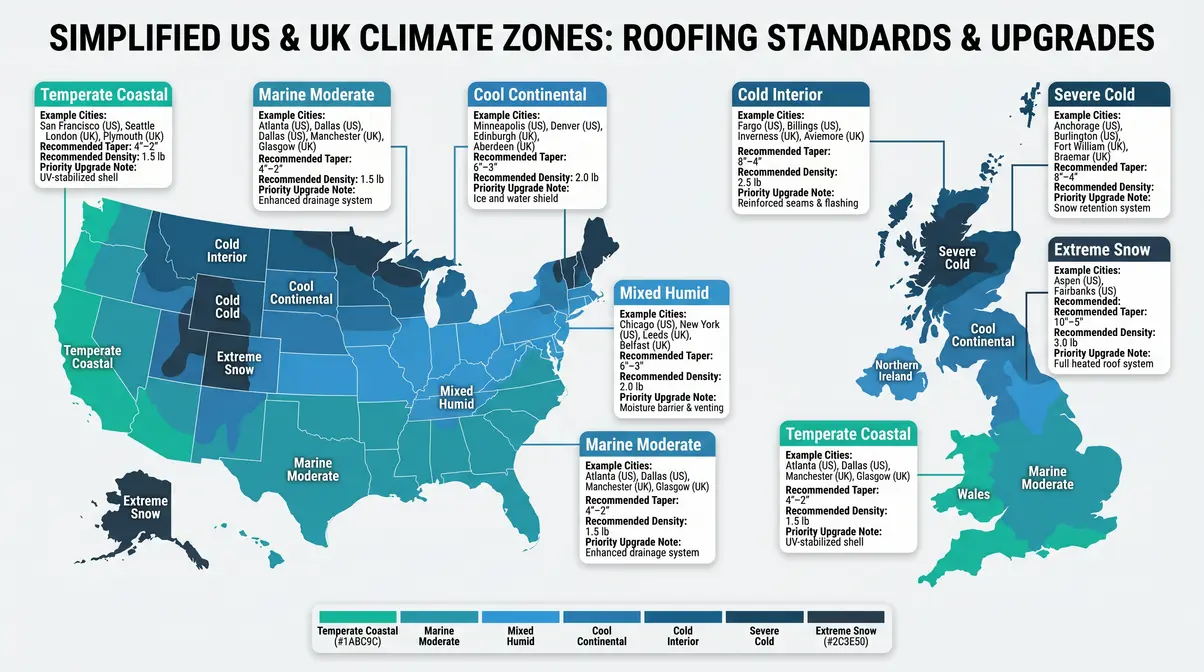
Climate-Zone Recommendation Matrix
Your climate determines your minimum specs. Common pain points reported by spa owners include over-specifying (paying for a heavy 6″–4″ cover in Miami) and under-specifying (ordering a 4″–2″ / 1.0 lb cover in Buffalo and replacing it in three years). The matrix below eliminates both mistakes.
Use the table to find your zone, then match it to the recommended taper and density combination. Note that these are minimum recommendations — upgrading one tier (e.g., from 1.5 to 2.0 lb density) is always a safe choice for longevity regardless of climate. R-value increases with both thickness and density.*
| Climate Zone | Example Cities | Taper | Density | Priority Upgrade |
|---|---|---|---|---|
| Temperate Coastal | San Diego, CA; Coastal UK | 4″–2″ | 1.5 lb | UV-stabilized shell, light color |
| Mild Inland | Austin, TX; Atlanta, GA | 4″–2″ or 5″–3″ | 1.5 lb | UV treatment |
| Moderate Four-Season | Nashville, TN; Seattle, WA | 5″–3″ | 1.5 lb | UV-treated shell |
| Northern Continental | Chicago, IL; Minneapolis, MN | 5″–3″ or 6″–4″ | 2.0 lb | Reinforced hinge |
| Heavy Snow Belt | Buffalo, NY; Denver, CO; Quebec | 6″–4″ | 2.0 lb | Reinforced hinge mandatory |
| High UV / Desert | Phoenix, AZ; Las Vegas, NV | 4″–2″ | 1.5 lb | UV-stabilized shell mandatory, light color |
| Humid Subtropical | Miami, FL; Houston, TX | 4″–2″ | 1.5 lb | Sealed vapor barrier critical |
The temperate coastal and heavy snow belt rows represent the two extremes. Every other climate zone falls somewhere between them. For the Airbnb owner in a temperate coastal town with minimal snow and high UV exposure, the prescription is clear: 4″–2″ taper, 1.5 lb foam, UV-stabilized shell, and a heat-sealed vapor barrier to handle ambient coastal moisture.
You’ve now chosen your foam core specs. Layer 2 of The Cover Efficiency Stack is the outer shell — the material that protects the foam from UV, moisture, and physical wear.
Evaluating Shell Materials and the Vapor Barrier
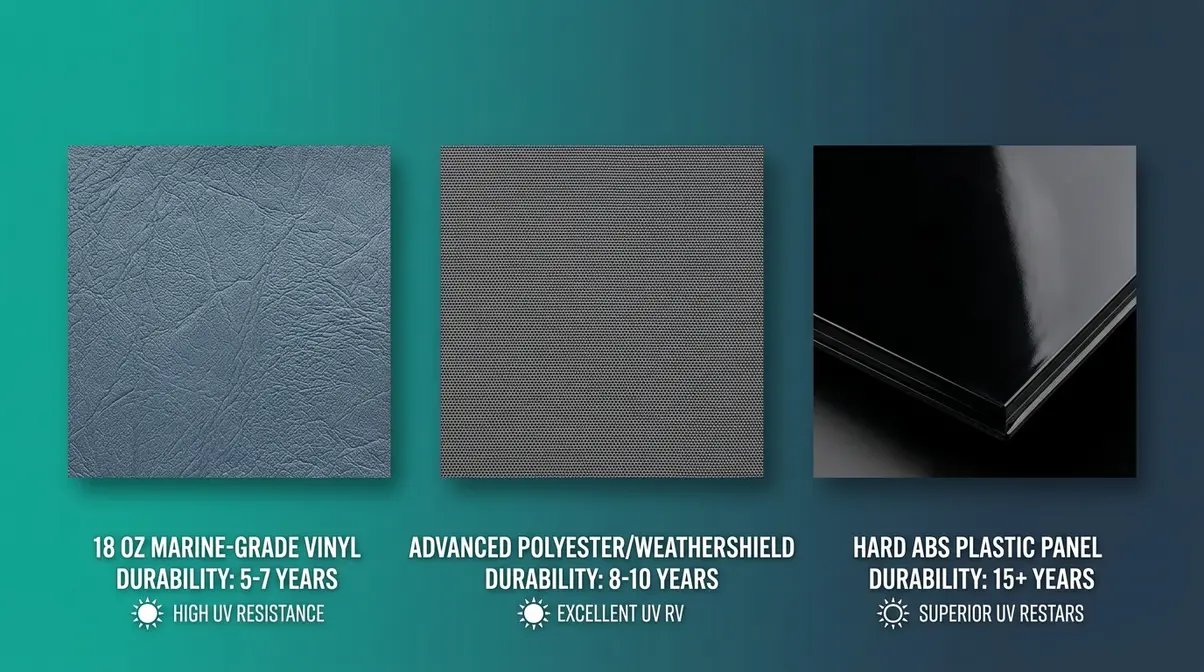
The outer shell of a hot tub cover does one job: protect the foam core from UV radiation, rain, and physical wear. Three main materials dominate the market — marine-grade vinyl, advanced polyester (WeatherShield), and hard ABS plastic — each with distinct durability, cost, and climate trade-offs. Choosing the right one can add 3–5 years to your cover’s lifespan.
Layer 2 of The Cover Efficiency Stack protects Layer 1. The shell’s job is to keep moisture and UV away from the foam core you’ve just specified — and the vapor barrier on the inside does the same job from the other direction.
Marine-Grade Vinyl vs. Advanced Polyester vs. Hard ABS
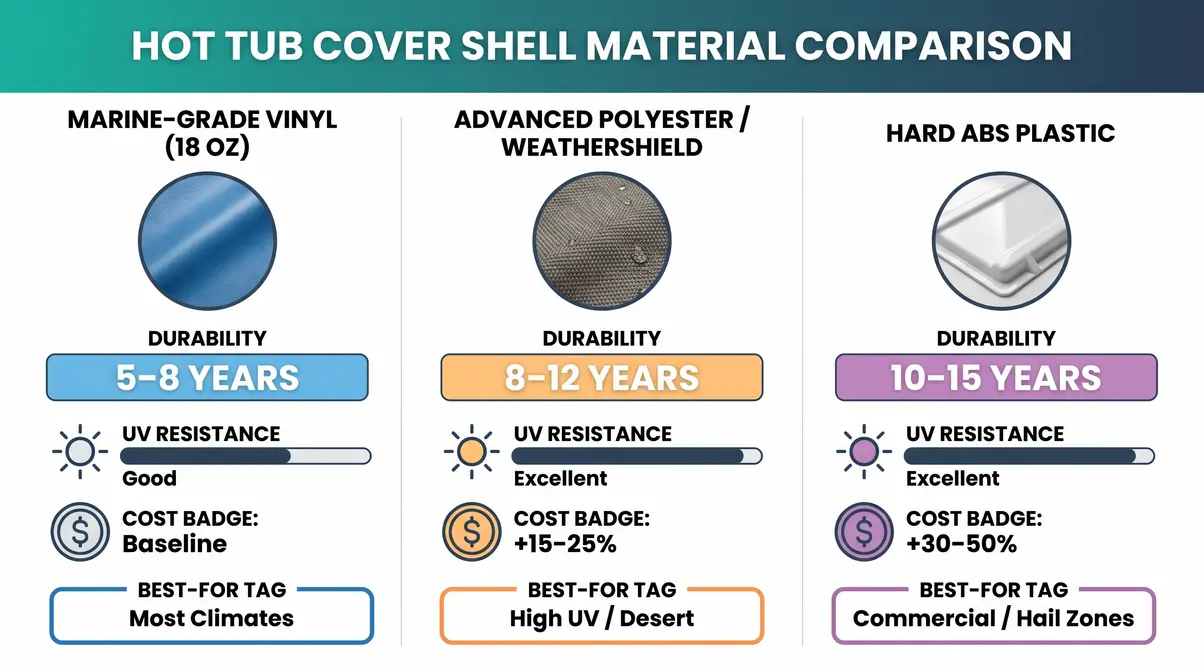
Marine-grade vinyl (a UV-stabilized, water-resistant PVC material originally developed for boat upholstery) remains the industry standard for hot tub covers. Advanced Polyester — sometimes marketed as WeatherShield — is a woven fabric shell with superior UV and abrasion resistance. Hard ABS plastic is a rigid shell used on some premium covers for maximum structural protection.
Marine-grade vinyl in 18–24 oz weight is the most common choice. Heavier weight means greater durability; UV-treated vinyl in a dark color absorbs heat but degrades faster in high-UV climates, while lighter colors reflect UV and last longer outdoors. Properly maintained, expect 5–8 years from a quality vinyl shell.
Advanced Polyester / WeatherShield is bonded to a waterproof backing, making it more UV-resistant and more abrasion-resistant than vinyl. It also maintains flexibility in cold temperatures where vinyl can crack and stiffen. Typical lifespan: 8–12 years. The cost premium is 15–25% over standard vinyl — worth it in desert or high-UV climates. Marine-grade vinyl remains the industry standard for hot tub covers, but Advanced Polyester (WeatherShield) shells last 30–50% longer in high-UV environments — making them the better choice for desert and southern climates.
Hard ABS plastic (a rigid outer shell) delivers maximum impact resistance against hail and falling branches. It’s heavier, more expensive, and rarely necessary except in areas with genuine physical hazard exposure — heavy tree canopy, severe hail zones, or commercial settings with high-traffic wear.
| Material | Durability (years) | UV Resistance | Cost Premium | Best Climate |
|---|---|---|---|---|
| Marine-Grade Vinyl (18 oz) | 5–8 | Good | Baseline | Most climates, temperate coastal |
| Marine-Grade Vinyl (24 oz) | 6–9 | Good–Very Good | +10–15% | Four-season, moderate |
| Advanced Polyester (WeatherShield) | 8–12 | Excellent | +15–25% | High UV, desert, southern US |
| Hard ABS Plastic | 10–15 | Excellent | +30–50% | Severe hail zones, commercial use |
For the temperate coastal Airbnb use case: marine-grade vinyl (18 oz, UV-treated, light color) is the optimal value choice. For a high-UV desert climate like Phoenix: Advanced Polyester/WeatherShield is worth the 20% premium.
To discover durable materials and vapor barrier importance for hot tub covers, the full materials guide includes supplier comparisons and color recommendations by climate.
The shell protects the outside. But the component that protects the foam from the inside — the vapor barrier — is what most buyers overlook entirely.
Why the Vapor Barrier Is the Most Underrated Component
A vapor barrier (a heat-sealed polyethylene film that wraps each foam core half) prevents the steam rising from hot spa water from penetrating and saturating the foam. It’s the most underrated component in the entire cover assembly — and the first thing to verify when comparing suppliers.
Without a quality vapor barrier, the foam absorbs moisture over time. A standard cover weighing approximately 30 lbs when new can double or triple in weight — reaching 60–90 lbs — as the foam waterlog. Along with that weight gain comes a near-total loss of R-value. A waterlogged cover is effectively no cover at all: it traps heat in the foam rather than reflecting it back into the water, and it becomes so heavy that users leave it off entirely. The PHTA energy efficiency standards (ANSI/APSP/ICC-14) establish the baseline insulation requirements that a properly sealed vapor barrier is essential to meeting.
This failure mode is especially relevant in humid subtropical climates (Miami, Houston) and temperate coastal environments where ambient moisture is high — exactly the conditions many Airbnb owners face.
- What to look for in a vapor barrier:
- Heat-sealed seams — not just folded and taped (taped seams fail within 2–3 years)
- 6-mil or heavier polyethylene film — thinner film tears and allows steam infiltration
- Full-wrap coverage — the barrier must wrap the entire foam block, not just the top face
When shopping, ask the supplier directly: “Is the vapor barrier heat-sealed or taped?” Heat-sealed is the non-negotiable standard.
With your material and vapor barrier specs confirmed, the next step is choosing the safety and longevity features that complete the cover.
What to Check: Stitching, UV Treatment, and Finish Quality
Before ordering, verify three quality indicators that separate a durable cover from one that fails at the seams — literally:
- Stitching: Look for double-stitched seams with UV-resistant thread throughout. Single-stitch seams fail at the corners first, where stress concentrates. This is the most common quality shortcut on budget covers.
- UV treatment: Confirm the vinyl or polyester has a UV inhibitor embedded in the coating — not just a surface spray that wears off within one season. Reputable manufacturers specify UV resistance by years or UV exposure hours. Ask for the spec sheet if it isn’t listed.
- Skirt finish: The skirt (the flap hanging over the tub edge) should have a clean, hemmed edge and reinforced tie-down points. A raw or poorly hemmed skirt edge frays quickly and allows wind to catch and lift the cover.
These quality markers maximize protection and contribute to long-term efficiency. A cover that fails at the seams after two years negates every smart decision you made on foam density and shell material.
You’ve now specified insulation and materials. The final layer of The Cover Efficiency Stack is safety and longevity features — upgrades that are often optional but sometimes essential.
Safety Features and Longevity Upgrades
Three upgrades separate a basic hot tub cover from a true safety cover: locking straps, a reinforced center hinge, and steam stopper pads. Each addresses a specific failure mode — unauthorized access, structural sagging, and heat loss at the fold — and together they determine whether a cover lasts five years or ten-plus. Layer 3 of The Cover Efficiency Stack is safety and longevity. These features protect your investment and your family.
Locking Straps: Safety, Wind Resistance, and ASTM Compliance
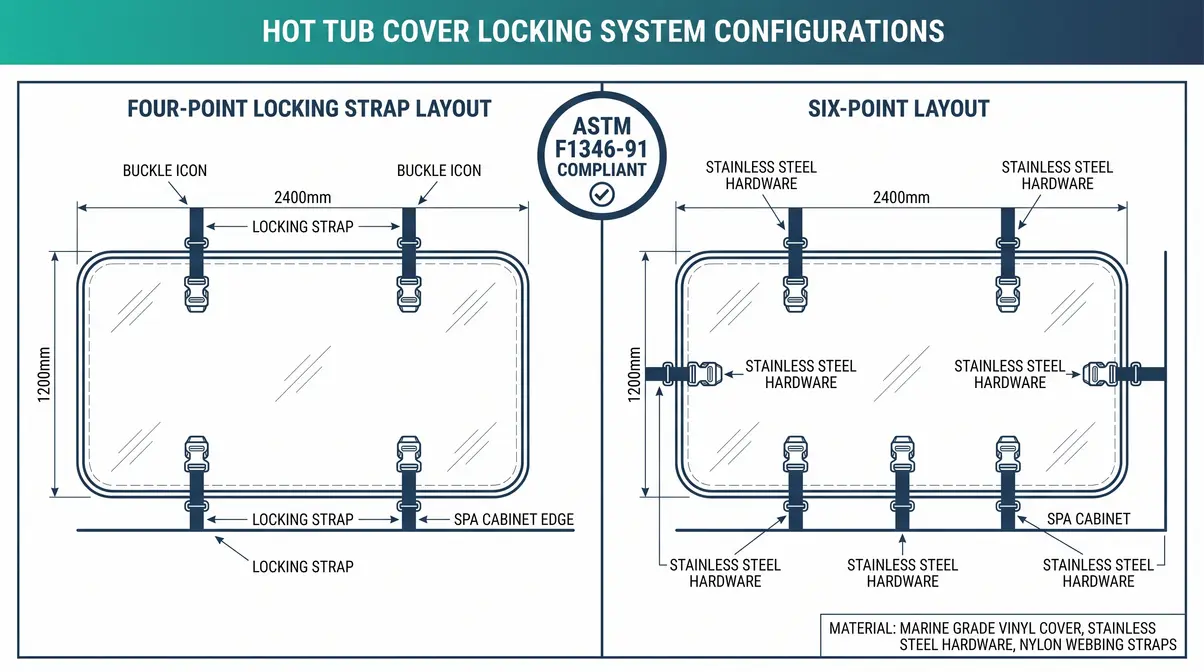
Locking straps (the buckled tie-downs that secure the cover to the spa cabinet) serve two distinct functions: preventing unauthorized access and resisting wind uplift.
On the safety side, the CPSC safety recommendations for lockable covers are unambiguous — the Consumer Product Safety Commission strongly recommends installing a lockable safety cover on spas to prevent unauthorized access and protect children from drowning hazards. ASTM F1346-91 requires a safety cover to support a minimum static load of 485 lbs — a standard that locking straps and a reinforced frame are essential to meeting. For any property with children present, locking straps are not optional.
On the wind resistance side, an unsecured cover in a coastal or exposed location can become a projectile in high winds. Four-point locking straps (two per side) are the standard configuration; six-point straps are available for areas with severe weather exposure. When specifying hardware, choose stainless steel over zinc — zinc corrodes rapidly in coastal environments and salt air, often failing within one to two seasons.
For the Airbnb owner in a temperate coastal town, keyed locking straps address both concerns simultaneously: guest safety, liability protection, and resistance to coastal wind events. Specify stainless steel hardware without exception.
To examine essential features for hot tub cover safety and extended lifespan, the full safety features guide includes hardware comparisons by climate zone.
Locking straps secure the cover at the perimeter. The reinforced hinge addresses the cover’s most vulnerable structural point: the center fold.
Reinforced Hinges and Steam Stopper Pads
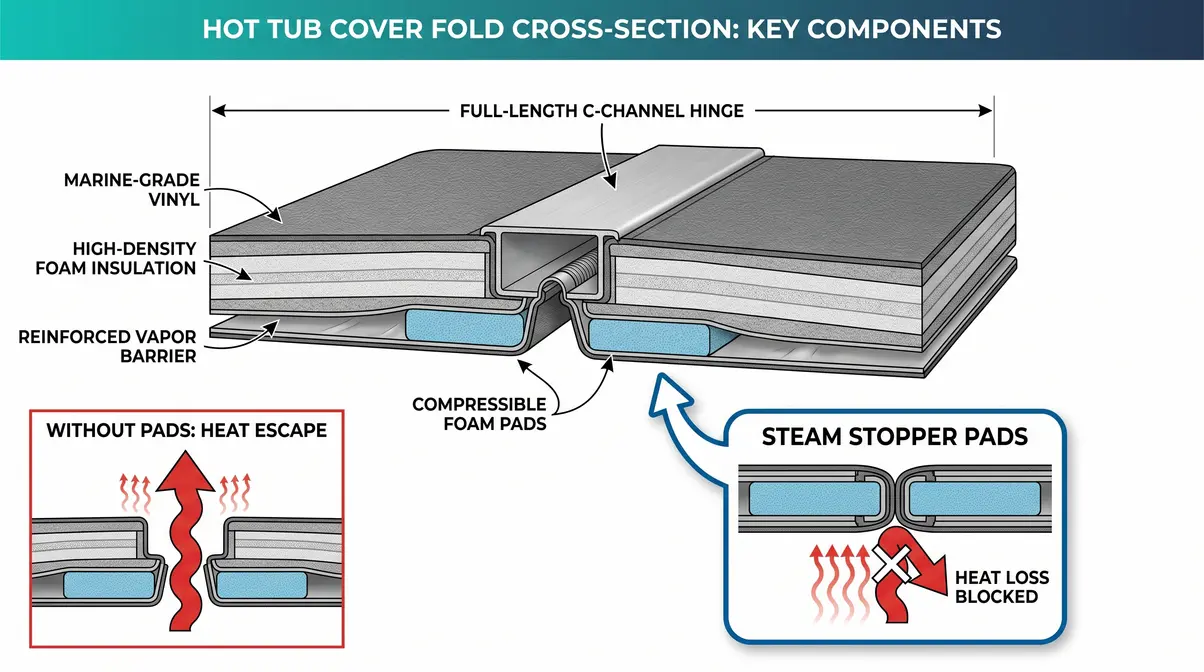
The C-channel hinge (a reinforced aluminum or steel spine running along the cover’s center fold) and steam stopper pads (foam gaskets installed along the inside edges at the fold) address the two most common performance failures — structural sagging and heat loss at the center gap.
Without a reinforced C-channel hinge, the fold is the first point to sag under snow load, UV stress, or simple repeated use. That sag creates a trough that pools water, accelerates deterioration, and eventually cracks the cover in half. A quality full-length C-channel hinge adds negligible cost — typically $20–$40 as an upgrade — but extends cover life by two to four years. Always ask whether the hinge is “full-length” (running the entire fold) or a short center section, which provides far less support.
Steam stopper pads seal the gap between the two cover halves at the fold — precisely where heat escapes most readily. Industry testing shows the center fold can account for 15–25% of a cover’s total heat loss when unpadded. Adding steam stoppers effectively closes this thermal gap and meaningfully improves the cover’s real-world R-value performance.
ASTM F1346-91 safety cover specifications dictate the weight and structural requirements a hot tub cover must meet to be classified as a true safety cover, including load-bearing requirements that a reinforced hinge is essential to meeting (ASTM International, 2018).
The final optional upgrade is a cover lifter — a worthwhile addition if the cover is heavy or if you open the tub frequently.
Cover Lifters: Should You Add One?
A cover lifter (a mechanical arm system that attaches to the spa cabinet) allows one person to remove and store a heavy cover without dragging it on the ground — which is one of the fastest ways to damage vinyl and strain stitching at the skirt edge.
Three main types are available, and options matter when matching the lifter to your setup:
- Under-mount lifters: Store the cover directly beside the tub. Most compact footprint. Best for tight deck spaces.
- Off-to-side lifters: Swing the cover to one side on a pivot arm. The most popular configuration. Requires clearance on one side.
- Cover valet (roll-back): The cover rolls back rather than lifting off. Smoothest operation; highest cost.
Pricing runs $100–$400 depending on type and brand. A lifter is worth adding when: the cover weighs more than 50 lbs (common with 2.0 lb foam or premium shells), the tub is opened multiple times per week, older users or those with mobility considerations are involved, or rental guests need to manage the cover independently.
For a temperate coastal Airbnb with a 1.5 lb foam cover (~40 lbs), a lifter is optional but improves guest experience. For a northern climate with a 2.0 lb / 6″–4″ cover (~70 lbs), a lifter is effectively essential — a 70 lb cover dragged off and laid on a deck will fail years ahead of schedule.
You’ve now specified all four layers of The Cover Efficiency Stack. The final step before ordering is getting the measurements exactly right.
How to Measure for a Perfect-Fitting Cover
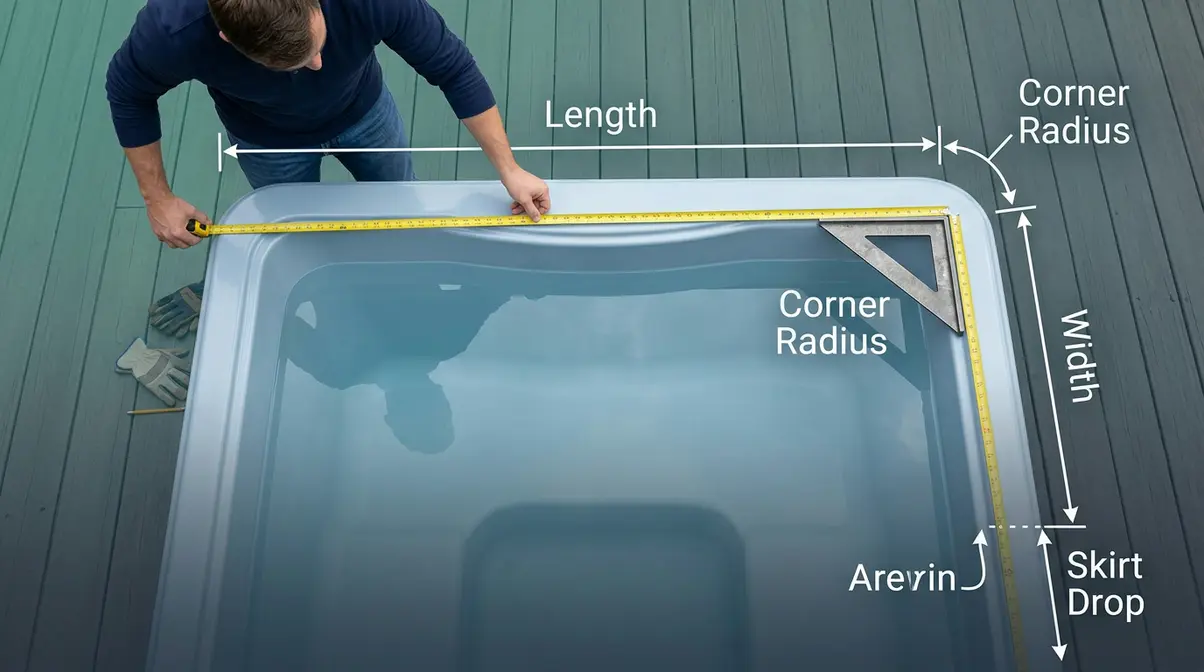
An improper fit negates the benefits of even the best insulation and materials. A cover that’s two inches too wide won’t seal at the edges; a cover with the wrong corner radius will gap at every corner, bleeding heat continuously. Before you order, take 10 minutes to measure correctly — and measure the tub shell, not the old cover.
Should I Measure My Old Cover or the Hot Tub Shell?
Old covers stretch, shrink, and warp over time. An old cover that no longer fits snugly is almost certainly no longer the correct shape for your tub — using it as a measuring reference is the single most common ordering mistake our team has encountered across cover replacement consultations.
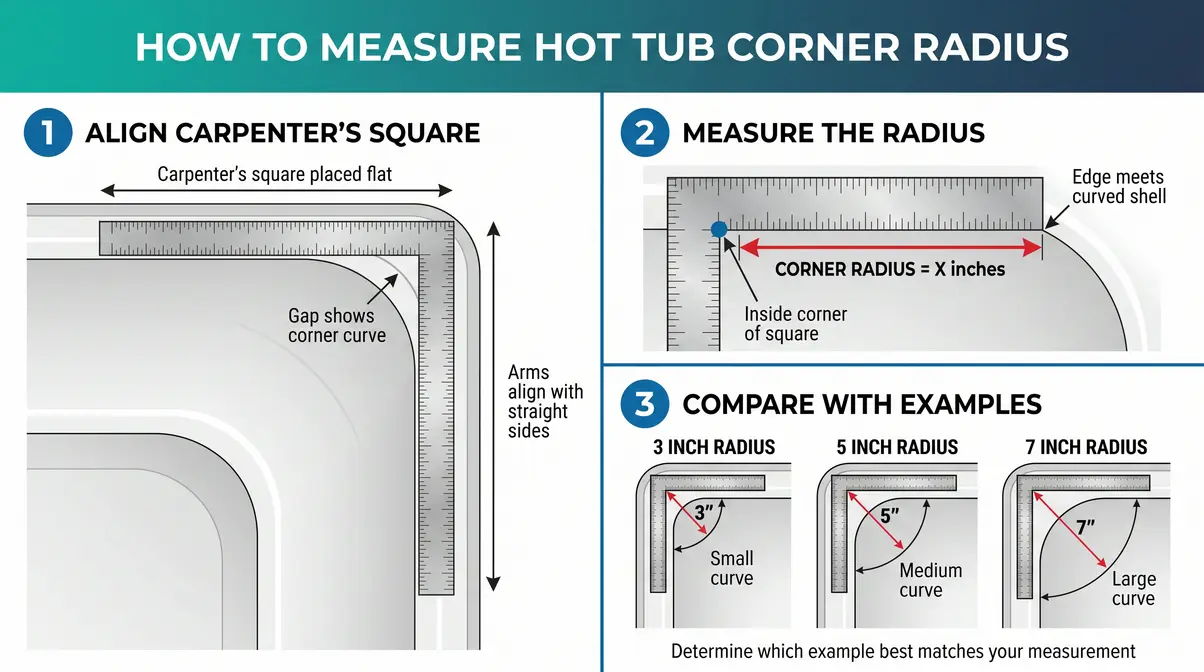
Measure the hot tub shell itself at the waterline — specifically the top lip of the acrylic shell. This is the surface your new cover will seal against. Tools needed: a flexible tape measure for length, width, and skirt measurements, and a carpenter’s square for corner radius.
For a complete step-by-step walkthrough with printable templates, consult the precise hot tub measuring guide.
Key Measurements: Length, Width, Corner Radius, and Skirt
Four measurements determine whether your cover fits correctly:
- Length and Width: Measure the outside edge of the shell at the widest points — not the cabinet, not the old cover, not the step. Round up to the nearest 0.5 inch. Most standard covers are square or rectangular; measure both dimensions even if you expect them to be equal.
- Corner Radius: Hold a carpenter’s square flat against the corner of the shell. The radius is the distance from the inside corner of the square to the point where the square’s edge meets the acrylic shell curve. Common radii are 3″, 5″, and 7″. An incorrect corner radius creates a visible gap at every corner — a major source of heat loss.
- Skirt Length: The skirt is the vinyl flap that drapes over the tub cabinet edge. Standard skirt lengths are 3″ and 4″. Measure the vertical drop from the top of the shell lip to where you want the skirt to end on the cabinet side.
- Fold Direction: Note which direction the cover folds when removed — this determines hinge placement and affects lifter compatibility.
Write all four measurements down before contacting any supplier. A reputable aftermarket supplier will ask for all four; if they don’t ask for corner radius, treat that as a warning sign.
Limitations and Common Mistakes
Common Pitfalls to Avoid
Even with the right specs, several ordering and installation mistakes consistently undermine cover performance. Industry testing and community feedback from spa owners highlight these recurring errors:
- Ordering by old cover dimensions: As covered above, a warped or stretched cover is never a reliable reference. Always measure the shell directly. This single mistake accounts for the majority of cover returns and ill-fitting replacements.
- Choosing 1.0 lb foam to save $50–$75 upfront: The cost difference between 1.0 lb and 1.5 lb foam is minimal at purchase. The lifespan difference — 3–5 years vs. 5–8 years — means the budget option costs more over any five-year period once replacement and shipping are factored in.
- Ignoring the vapor barrier spec: Many buyers compare covers on price and taper without asking about vapor barrier construction. A taped vapor barrier on an otherwise premium cover will fail within two to three years, waterlogging the foam and negating all insulation value.
- Skipping the corner radius measurement: A 3″ radius cover on a 5″ radius tub will gap at all four corners. Those gaps are small enough to miss visually but large enough to bleed significant heat — and they cannot be corrected after the cover is manufactured.
When to Choose Alternatives
A hard foam cover is the right choice for the vast majority of hot tub owners — but not every situation calls for the same approach:
- Lightweight rollup covers: If your primary concern is ease of use rather than insulation (e.g., a frequently used indoor spa), a rollup thermal blanket used in combination with a lighter hard cover may outperform a single heavy cover. Note that rollup covers alone do not meet ASTM F1346-91 safety standards.
- OEM covers for warranty compliance: If your spa is under manufacturer warranty and the terms require OEM replacement parts, an aftermarket cover — however equivalent in quality — may void coverage. Verify warranty terms before ordering aftermarket.
- Aluminum or hard shell covers: For commercial spas with very high traffic (hotel pools, therapy centers), a rigid aluminum or ABS shell cover offers durability that foam-core covers cannot match. These are significantly more expensive ($1,200–$2,500+) and rarely justified for residential use.
When to Seek Expert Help
If your spa has a non-standard shape (octagonal, round, or custom-built), has an integrated waterfall or speaker system that affects the cover seal, or is a commercial installation subject to local health codes, consult a certified spa professional before ordering. Non-standard geometry significantly affects both corner radius measurement and skirt fit — mistakes here are expensive to correct.
Frequently Asked Questions
How much does a hot tub hard cover cost?
Hot tub hard covers range from $150 to $900+, depending on foam density, shell material, and whether the cover is custom-sized. Entry-level covers with 1.0 lb foam and basic vinyl start around $150–$300; mid-range covers with 1.5 lb foam and marine-grade vinyl run $300–$600; premium covers with 2.0 lb foam and advanced polyester shells reach $600–$900 or more. Shipping for custom covers typically adds $50–$150. A standard 84″ × 84″ mid-grade cover retails around $400–$500 shipped. Factor in the $30–$50/month energy savings (according to the U.S. Department of Energy) when evaluating the total cost of ownership.
How long does a hot tub hard cover typically last?
A quality hot tub hard cover typically lasts between 5 and 8 years. Budget covers with 1.0 lb foam may only last 3 to 5 years, while premium covers with 2.0 lb foam and advanced polyester shells can last 10 to 12 years with proper maintenance. The lifespan is heavily dependent on your climate, the cover’s UV resistance, and how well the vapor barrier prevents moisture absorption.
Can a waterlogged hot tub cover be repaired?
No, once a hot tub cover becomes waterlogged, it cannot be effectively repaired. The foam core has absorbed moisture and lost its insulation value (R-value). The only solution is to replace the cover entirely to restore energy efficiency.
Do I need locking straps on my hot tub cover?
Yes — locking straps are strongly recommended for all residential spas and essential for any property with children or guest access. The Consumer Product Safety Commission recommends lockable covers on all spas, and ASTM F1346-91 specifies the structural load (485 lbs minimum static load) a qualifying safety cover must withstand — locking straps are integral to meeting that standard. For coastal or exposed locations, four-point straps also prevent wind uplift. For rental properties like Airbnbs, keyed locking straps address both safety liability and wind resistance. Specify stainless steel hardware for corrosion resistance.
What is the most durable material for a hot tub cover?
Advanced Polyester (often marketed as WeatherShield) is generally the most durable material for residential hot tub covers. It is a woven fabric shell bonded to a waterproof backing, making it highly resistant to UV degradation and abrasion. While marine-grade vinyl remains the industry standard, Advanced Polyester shells typically last 30–50% longer in high-UV environments, making them the superior choice for desert and southern climates.
The Right Cover Pays for Itself – Here’s How to Order With Confidence
Every decision in this guide builds on the one before it. Start with foam core specs — your climate zone determines the minimum taper and density you need. Then select a shell material that protects that foam core from UV and moisture. Add the safety and longevity features that match your use case. Finally, measure the tub shell directly before you order a single thing.
The Cover Efficiency Stack — insulation, materials, safety features, and fit — is the framework that turns a confusing purchase into a confident one. When each layer is correctly specified, the cover works as a system: the vapor barrier protects the foam, the shell protects the vapor barrier, the locking straps secure the shell, and the precise fit ensures nothing leaks heat at the edges.
A mid-range cover ($400–$600) with 1.5 lb foam, marine-grade vinyl, heat-sealed vapor barrier, and four-point locking straps will pay for itself within 15–18 months for most owners. For a temperate coastal Airbnb, that same specification — with a light-colored UV-treated shell and stainless steel hardware — covers every requirement without overspending on heavy-winter specs you don’t need. Start with the climate-zone matrix, confirm your measurements against the full measuring guide, and order with confidence. We hope this hot tub hard cover buying guide has given you the confidence to make the right choice.

David King
Hot tub tester and writer at One Hot Tub.