
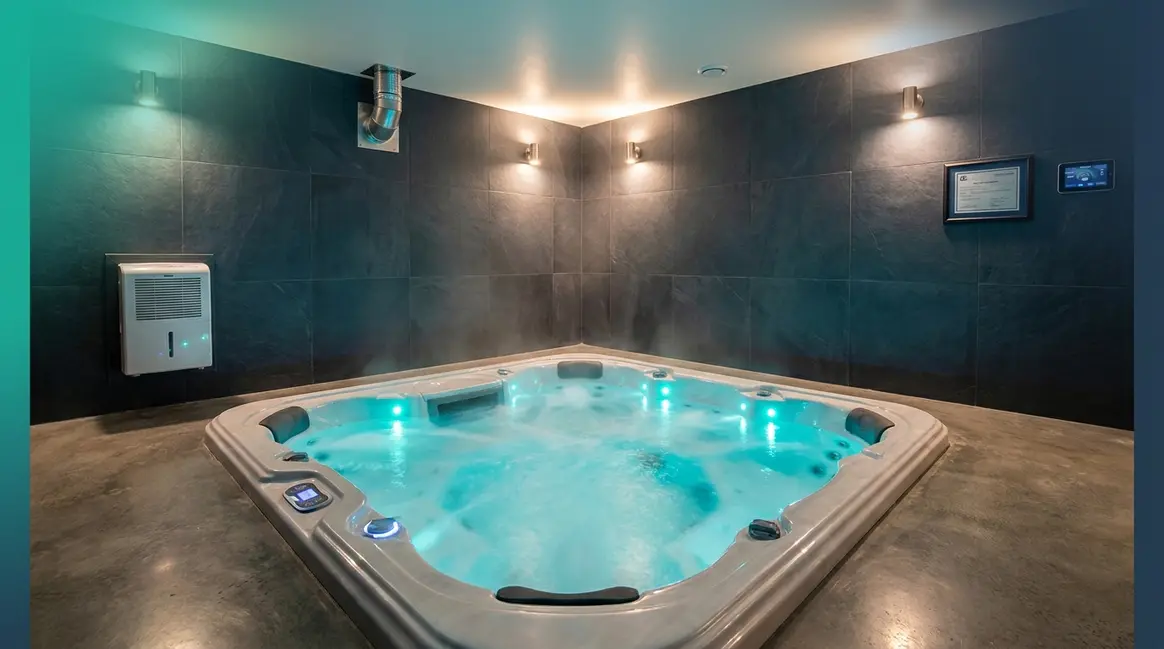
Hot Tub in Basement Installation: 5-Step Safety Guide
Ready to transform your basement? I’ll share my easy steps for installing a hot tub, ensuring a fun and relaxing retreat in your own home!

What’s in this guide
- Is a Basement Hot Tub Right for You?
- Before You Begin: What Every Homeowner Must Know
- Step 1: Structural Requirements
- Step 2: Moisture & Ventilation
- Step 3: Delivery & Logistics
- Step 4: Electrical Requirements & GFCI Safety
- Step 5: The Installation Process
- Risks, Pitfalls & When to Walk Away
- Frequently Asked Questions
- Plan Smart, Build Once
“Basements are sometimes mold/mildew prone to begin with, so adding a hot tub may make matters worse.”
That fear is legitimate — and it’s exactly why most basement hot tub projects fail.
Generic guides tell you to “make sure your floor is strong” and “get some ventilation” — then leave you with no idea what “strong enough” actually means or how much ventilation is required. The result? Expensive mistakes that surface months later as cracked concrete, black mold spreading behind finished walls, or an electrical code violation discovered during a home sale inspection.
By the end of this guide, you’ll have the exact specifications — concrete thickness, exhaust fan sizing, NEC (National Electrical Code) electrical codes, and stairwell clearance measurements — so you can plan a safe, code-compliant hot tub in basement installation with full confidence. This guide walks you through five sequential steps: feasibility assessment, structural evaluation, moisture and ventilation design, delivery logistics, and the installation process itself — followed by a clear-eyed look at when to stop and call a professional.
A successful hot tub in basement installation is achievable, but requires addressing three simultaneous risks — structural overload, moisture infiltration, and electrical hazard — what we call “The Danger Triangle.”
- Concrete: A standard 4-inch slab is insufficient; a minimum 6-inch, 3,000 PSI (pounds per square inch) reinforced slab is required for most hot tubs
- Ventilation: Your exhaust fan must be sized to at least 1 CFM (cubic feet per minute) per square foot of room area — not just “any exhaust fan”
- Electrical: NEC Article 680 mandates GFCI (Ground Fault Circuit Interrupter) protection for all receptacles within 20 feet of the hot tub’s interior walls
- Delivery: Most standard hot tubs require a stairwell opening of at least 36 inches wide and 80 inches tall — measure before you buy
Is a Basement Hot Tub Right for You?
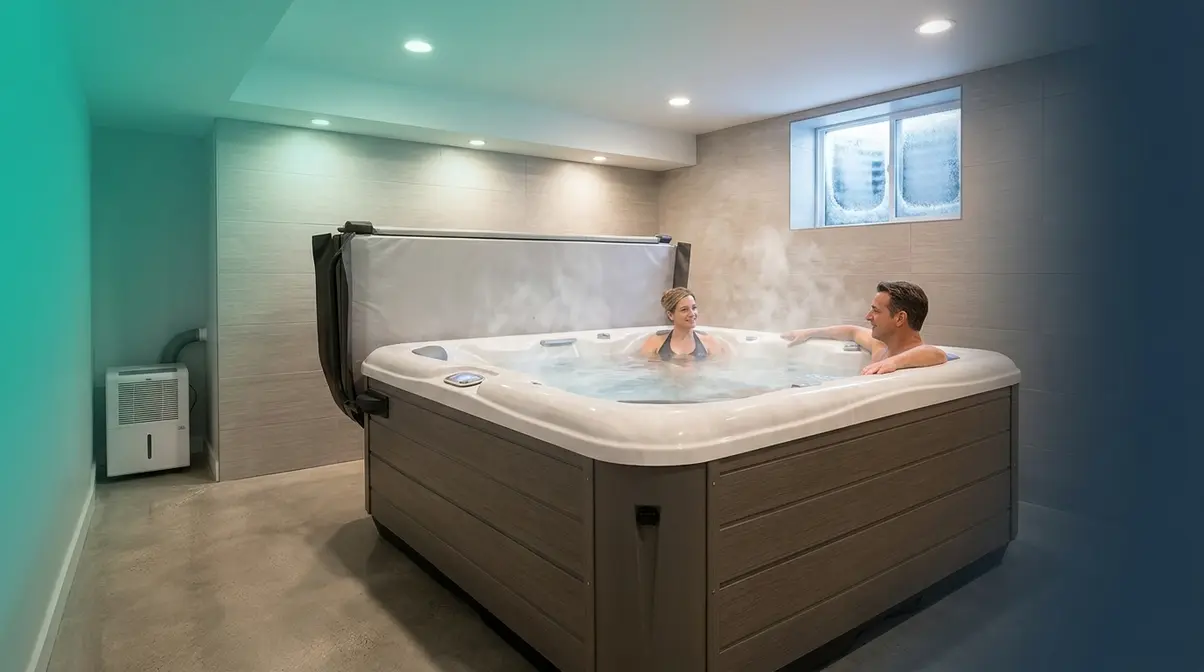
A basement hot tub installation is achievable for most homes — but only when three critical systems are engineered together: structural support, moisture control, and electrical safety. These three failure points form what this guide calls “The Danger Triangle” — an interconnected set of risks where failing to address even one puts the entire project at risk. You cannot waterproof your way out of a structural problem, and you cannot reinforce your way out of an electrical hazard. All three must be solved simultaneously.
Is It a Good Idea to Put a Tub Inside?
When considering the feasibility of a basement hot tub, you must weigh these advantages against the logistical challenges. Installing a hot tub underground offers genuine, practical benefits that outdoor installations simply cannot match.
- Year-round usability without weather interference. Outdoor hot tubs in cold climates require winterization, freeze protection, and careful chemical management when temperatures drop below freezing. A basement installation eliminates that entirely — your pipes never freeze, and you can soak comfortably in January.
- Complete privacy. No neighbors, no sightlines, no fence required. This is a meaningful quality-of-life upgrade that outdoor installations rarely achieve without expensive landscaping.
- Extended equipment lifespan. UV radiation from direct sunlight degrades acrylic shells, covers, and cabinet materials over time. Licensed contractors consistently report that basement hot tubs outlast outdoor units by three to five years on average, simply because sunlight never reaches them.
- No outdoor pad or landscaping costs. Outdoor installations typically require a reinforced concrete pad, electrical trenching, and landscaping work. In a basement, the slab already exists — your structural costs go toward reinforcement, not new construction.
The privacy and year-round access advantages are real. However, none of them matter if the project is executed without addressing the structural, moisture, and electrical requirements head-on.
Challenges You Cannot Ignore
The same enclosed environment that makes a basement hot tub appealing also makes it uniquely dangerous if any element of The Danger Triangle is left unaddressed.
- Moisture and mold risk. According to the EPA, approximately 60% of U.S. homes have below-grade moisture problems. Adding a hot tub — which evaporates constantly — dramatically increases that risk. Relative humidity above 60% creates ideal conditions for mold growth on wood framing, drywall, and insulation within weeks.
- Structural load. A standard 6-person acrylic hot tub holds roughly 400–500 gallons of water. Filled with water and three occupants, the total weight routinely exceeds 4,500 lbs — roughly equivalent to a mid-size SUV sitting on your basement floor. Most standard 4-inch residential slabs are not engineered for that concentrated load.
- Electrical hazard. Water and electricity in an enclosed space create lethal conditions if wiring is improper. NEC Article 680 governs all underwater and wet-location electrical installations. Non-compliance is not a minor code issue — it is a life-safety violation.
- Delivery complexity. Getting a hot tub that measures 7 feet × 7 feet × 36 inches through a standard basement stairwell is a genuine logistical challenge that many homeowners don’t anticipate until the delivery truck arrives.
Which Hot Tub Type Works Best?
Not every hot tub is equally suited for basement installation. Your choice of unit directly affects the structural load, delivery logistics, and long-term maintenance requirements.
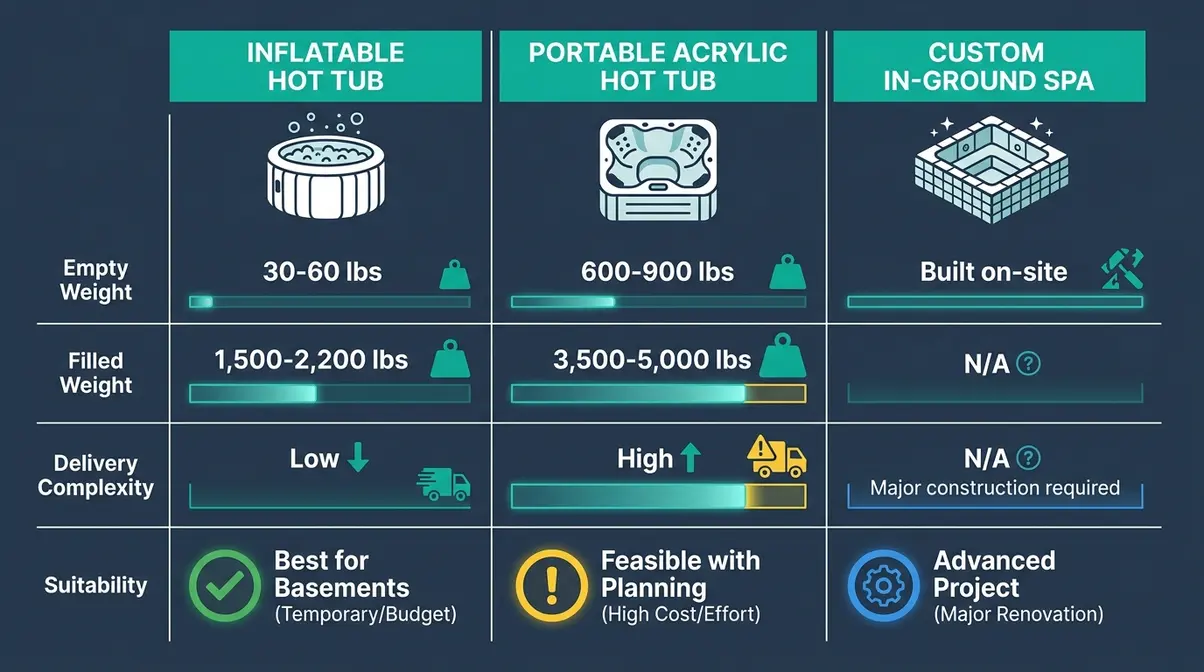
| Type | Empty Weight | Filled Weight | Delivery Complexity | Best For |
|---|---|---|---|---|
| Inflatable Hot Tub | 30–60 lbs | 1,500–2,200 lbs | Low — fits through any door | Testing the concept, low budgets |
| Portable Acrylic | 600–900 lbs | 3,500–5,000 lbs | High — requires professional crew | Permanent installations |
| Custom In-Ground Spa | Built on-site | N/A (integrated) | N/A — constructed in place | Full renovation projects |
Portable acrylic hot tubs are the most common choice for basement installations. They offer the best balance of features, durability, and resale value. However, they present the greatest delivery and structural challenges. Inflatable hot tubs are dramatically lighter and easier to install, making them a reasonable choice for homeowners who want to test the concept before committing to a permanent installation — though they lack the longevity and hydrotherapy performance of acrylic units. Custom in-ground spas are built on-site and sidestep the delivery problem entirely, but they require full excavation and are typically reserved for major renovation projects with budgets exceeding $20,000.
According to Hydro Pool, a leading Canadian hot tub manufacturer, portable hot tubs are the most practical choice for existing basement spaces because they can be removed for repairs or replacement — a significant advantage over permanently installed in-ground models.
Before You Begin: What Every Homeowner Must Know
⚠️ Professional Consultation Disclaimer: The specifications in this guide reflect standards used by licensed contractors across residential basement projects, sourced from the American Concrete Institute (ACI), National Electrical Code (NEC), ASHRAE ventilation guidelines, and EPA moisture management recommendations. This guide is for informational purposes only. Before purchasing any equipment or beginning any work, you must consult a licensed structural engineer, a certified electrician, and your local building department. Structural failures, electrical faults, and moisture damage in basements can cause serious injury, property loss, and health hazards. No guide — including this one — replaces a professional site assessment.
When planning your basement hot tub project, three administrative steps are non-negotiable before you take any measurements or contact a dealer.
1. Pull a permit. Most jurisdictions require a building permit for hot tub installations, and virtually all require an electrical permit. Installing without permits can void your homeowner’s insurance, create liability during a home sale, and result in a mandatory removal order. Contact your local building department first.
2. Notify your insurance provider. Adding a hot tub — especially in an enclosed basement — changes your liability exposure. Some policies require a rider or endorsement. Others exclude water damage caused by hot tub overflow. Get this in writing before installation begins.
3. Assess egress and ventilation before buying a unit. The single most common and costly mistake homeowners make is purchasing a hot tub before confirming it will physically fit through their stairwell and that the space can be adequately ventilated. Both assessments cost nothing. Returning a hot tub because it won’t fit costs everything.
The installation framework in this guide reflects the process used by licensed contractors across residential basement projects in the United States. Each specification cited has a code or standards reference — treat any figure without a source as a recommendation, not a requirement.
Step 1: Structural Requirements
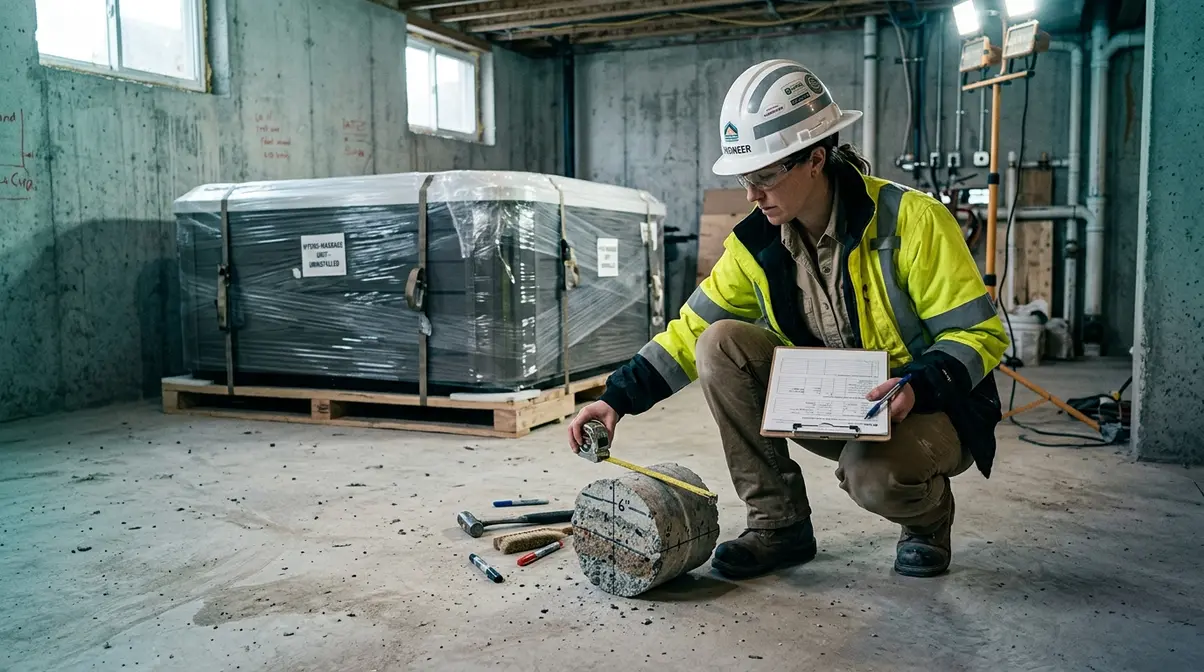
Estimated Time: 4-6 weeks (including planning, permitting, and contractor scheduling)
- Tools/Materials Required:
- Tape measure
- 6-mil polyethylene vapor barrier
- Dehumidifier (70+ pints/day)
- GFCI breaker and 6 AWG copper wire
- Structural engineer consultation
Your basement floor must be engineered to handle a load it was almost certainly never designed for. While choosing the right hot tub foundation outdoors often involves simple concrete pads, a basement requires specific structural engineering. This is the most technically demanding part of the installation, and it is the section where a licensed structural engineer’s assessment is not optional — it is essential.
Will 4 Inches of Concrete Hold a Tub?
The first number every homeowner needs to understand is the total wet weight — the combined weight of the hot tub shell, the water it holds, and the occupants using it simultaneously.
Here is how to calculate it:
- Shell weight: Portable acrylic hot tubs typically weigh 600–900 lbs empty
- Water weight: Water weighs 8.34 lbs per gallon. A 400-gallon hot tub adds 3,336 lbs
- Occupant weight: Assume 175 lbs per person × the rated capacity of your tub
For a 6-person, 450-gallon hot tub with a 750 lb shell and three occupants:
750 + (450 × 8.34) + (3 × 175) = 750 + 3,753 + 525 = 5,028 lbs
That load is concentrated on a footprint of roughly 49–64 square feet (a 7×7 or 8×8 ft tub). A standard residential basement slab engineered for typical live loads of 40 PSF (pounds per square foot) cannot support that concentration without reinforcement. Licensed structural engineers recommend calculating your specific load-per-square-foot figure and comparing it against your slab’s rated capacity before proceeding.
Concrete Thickness Standards
Unlike an outdoor paver base for hot tub support, an indoor slab must handle concentrated loads without shifting. The American Concrete Institute (ACI) specifies that residential slabs supporting concentrated loads — such as hot tubs — require a minimum 6-inch thickness with 3,000 PSI concrete and #4 rebar (reinforcing bar) on 12-inch centers. A standard 4-inch residential slab, which is what most basements have, does not meet this threshold for a fully loaded portable hot tub.
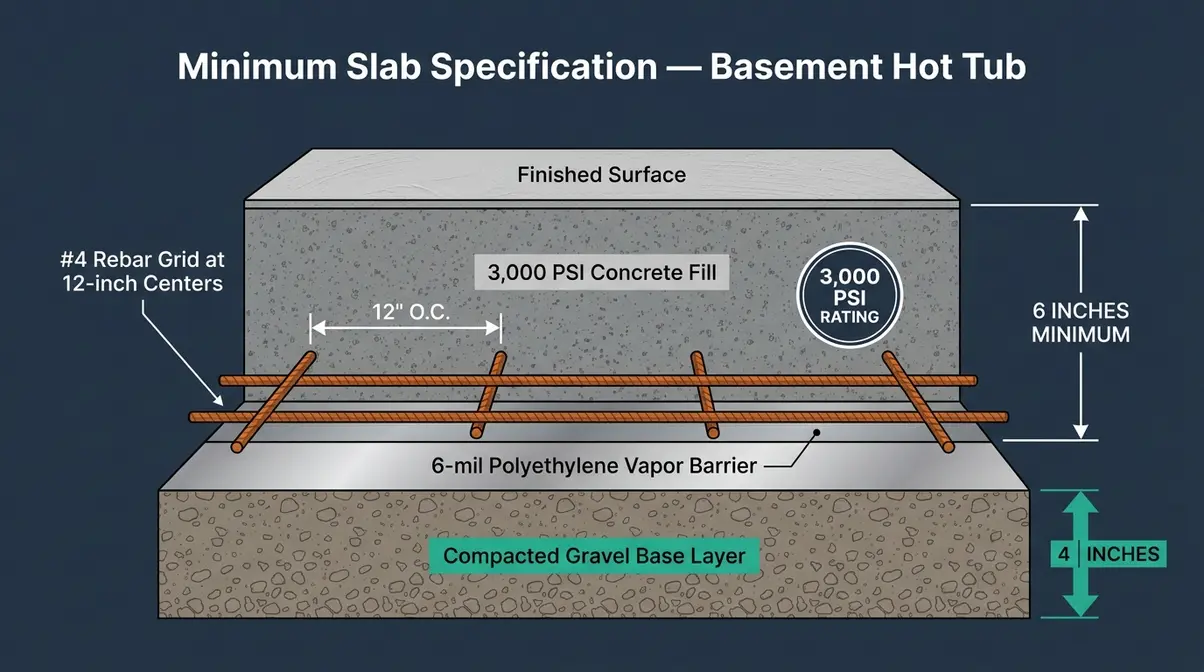
Key specifications from ACI standards and licensed structural engineer practice:
| Specification | Standard Residential Slab | Hot Tub-Rated Slab |
|---|---|---|
| Thickness | 4 inches | 6 inches minimum |
| Concrete Strength | 2,500 PSI | 3,000 PSI minimum |
| Reinforcement | None or wire mesh | #4 rebar, 12″ centers |
| Subbase | Varies | 4″ compacted gravel minimum |
| Vapor Barrier | Optional | Required — 6-mil poly |
According to Prairie Electric, a licensed electrical contractor with direct basement hot tub installation experience, structural preparation is the most frequently underestimated phase of any basement hot tub project. Contractors consistently report discovering inadequate slabs after homeowners have already purchased their hot tub.
If Your Existing Slab Falls Short
If your structural engineer determines that your existing slab is insufficient, you have three options:
- Pour a new reinforced slab over the existing one. This is the most common remediation. A licensed contractor pours a bonded overlay of 2–3 inches of high-strength concrete with integral reinforcement, bringing the effective depth to 6 inches or greater. Cost: typically $3,000–$6,000 depending on region and slab area.
- Install a structural steel plate distribution system. Steel plates spread the point load across a wider slab area, reducing the per-square-foot load to within the existing slab’s rated capacity. This is less invasive but requires an engineer’s stamp for each specific installation.
- Choose a lighter hot tub. Inflatable hot tubs weigh 1,500–2,200 lbs fully loaded — a fraction of a portable acrylic unit. If structural reinforcement is cost-prohibitive, this is a legitimate alternative.
Always consult a licensed structural engineer before selecting a remediation approach. Do not proceed based solely on contractor estimates without an engineer’s review.
Step 2: Moisture & Ventilation
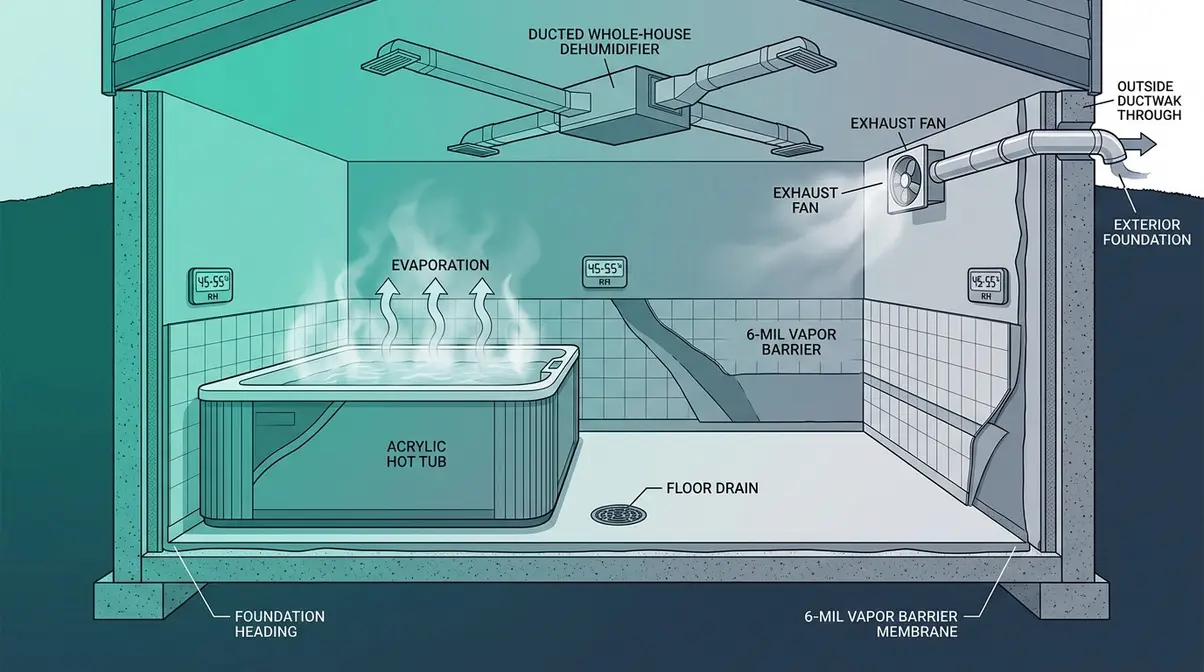
A major concern for any hot tub in basement installation is managing the constant evaporation. Moisture is the silent failure mode of basement hot tub installations. You can reinforce the perfect slab, wire the perfect circuit, and install a beautiful hot tub — and still end up with a mold-infested basement two years later if your ventilation system is undersized. Addressing this leg of The Danger Triangle requires the same engineering precision as the structural and electrical phases.
Why Moisture Is Your Biggest Enemy
“Basements are sometimes mold/mildew prone to begin with, so adding a hot tub may make matters worse.”
This concern is well-founded. The EPA reports that excess moisture is the primary cause of indoor air quality problems in residential buildings, and basements are the most vulnerable zone. A hot tub evaporates continuously — even when covered — releasing warm, humid air into an enclosed space. Without active mechanical ventilation, relative humidity in a basement with a hot tub can reach 80–90% within hours of use.
Mold growth begins at sustained relative humidity above 60% (EPA, A Brief Guide to Mold, Moisture, and Your Home). At 70% and above, mold colonies can establish on wood framing, drywall paper, and insulation batting within 24–48 hours of continuous exposure. In a finished basement, this damage is often invisible until it is extensive and expensive.
The target for your basement hot tub space is a sustained relative humidity between 45% and 55% — achievable only with a properly sized mechanical system.
Sizing Your Exhaust Fan & Dehumidifier
“Get an exhaust fan” is the extent of the ventilation guidance in most competitor guides. Here are the actual sizing formulas licensed HVAC contractors use.
Exhaust Fan Sizing (ASHRAE Standard 62.2):
The minimum exhaust rate for a basement hot tub room is 1 CFM per square foot of floor area, with a minimum of 50 CFM for any enclosed space. For a dedicated 200-square-foot hot tub room, you need a minimum 200 CFM exhaust fan — not a standard 110 CFM bathroom fan.
Formula: Room Length (ft) × Room Width (ft) × 1 CFM = Minimum Fan Rating
For a 14 × 16 ft room: 14 × 16 × 1 = 224 CFM minimum
The exhaust duct must vent directly to the exterior — not into the attic, not into a crawl space, not into an adjacent room. Recirculating fans do not qualify.
Dehumidifier Sizing:
For a basement hot tub space, a standard portable dehumidifier is insufficient. Licensed HVAC contractors recommend a whole-house or ducted dehumidifier rated for the specific moisture load. A rough sizing formula:
- Calculate your room volume: L × W × H (in cubic feet)
- For a hot tub room with active use, target a dehumidifier rated for at least 70 pints per day for rooms up to 1,500 sq ft
- For rooms over 1,500 sq ft or climates with high ambient humidity, size up to 90–120 pints per day
The Department of Energy’s appliance efficiency standards require all dehumidifiers sold after 2019 to meet higher efficiency ratings — look for the ENERGY STAR label when selecting a unit (U.S. Department of Energy, Dehumidifier Buying Guide).
Vapor Barriers & Waterproofing
Mechanical ventilation addresses airborne moisture. You also need a physical barrier system to manage liquid water from splashing, overflow, and condensation.
Vapor barrier: Install a minimum 6-mil polyethylene vapor barrier beneath the slab (if pouring new concrete) or applied directly to existing walls and floor. This prevents ground moisture from migrating upward through the concrete — a process called capillary wicking that occurs in virtually all below-grade slabs.
Floor drain: A floor drain is not optional — it is a code requirement in most jurisdictions for any enclosed wet area. The drain must connect to your home’s sanitary sewer system (not a storm drain) and include a trap to prevent sewer gas backflow. If your basement does not have a floor drain, a licensed plumber must install one before the hot tub arrives. According to Angi, adding a basement floor drain typically costs $500–$2,000 depending on the existing plumbing configuration.
Wall waterproofing: Apply a waterproof membrane or hydraulic cement coating to all masonry walls within the hot tub room. Standard drywall — even moisture-resistant “green board” — is not appropriate for this application. Use cement board or waterproof tile board for any wall surface within the splash zone (6 feet from the tub perimeter).
Step 3: Delivery & Logistics
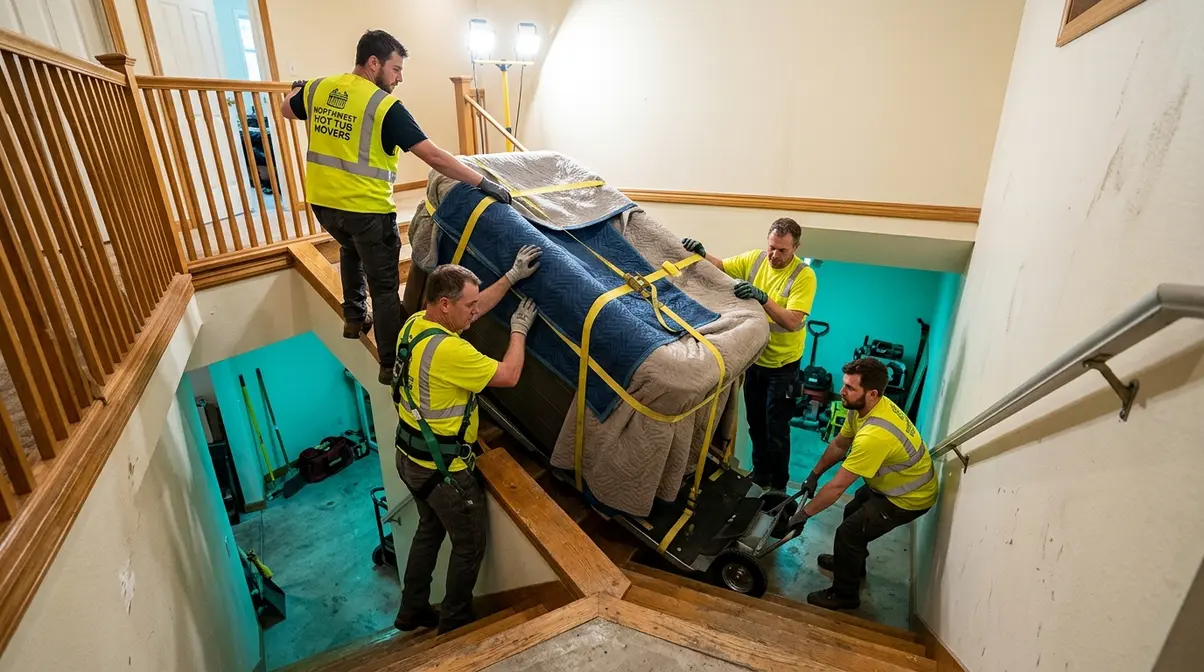
The most overlooked aspect of a hot tub in basement installation is physically moving the unit down the stairs. Getting a hot tub into a basement is the step that surprises most homeowners. A portable acrylic hot tub measuring 7 ft × 7 ft × 36 inches tall and weighing 700+ lbs empty does not navigate a standard residential stairwell easily — or sometimes at all. This assessment must happen before you purchase any unit.
Measuring Stairwell Access
Licensed delivery crews use a specific set of measurements to determine whether a hot tub can be moved into a basement. Take all of these measurements before speaking to a dealer.
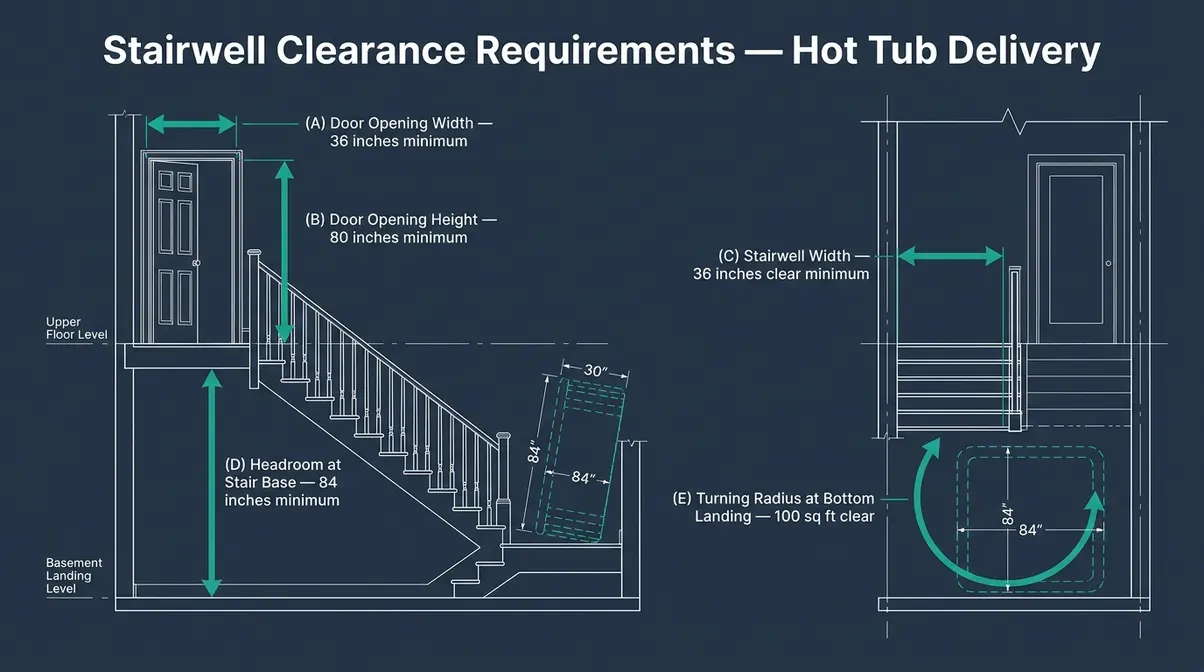
The five critical measurements:
- Door opening width — Measure the clear opening (not the door itself). Minimum needed: 36 inches
- Door opening height — Measure from floor to top of door frame. Minimum needed: 80 inches
- Stairwell width — Measure the narrowest point of the staircase, including any handrail intrusion. Minimum needed: 36 inches clear
- Headroom at stair base — Measure the vertical clearance at the bottom of the stairs where the hot tub will be tipped to a horizontal position. Minimum needed: 84 inches (the diagonal of a 7-foot tub)
- Turning radius at the bottom landing — The hot tub must rotate from the stairwell orientation into its final position. Measure the available turning space in square feet. A 7×7 ft tub requires approximately 100 square feet of clear maneuvering space.
If any of these measurements fall short, a standard stairwell delivery is not feasible. Do not assume delivery crews can “make it work” — consult with a specialized hot tub delivery company before purchasing.
Methods for Tight Access
When standard stairwell delivery is not possible, licensed contractors use several alternative approaches.
Hot tub sleds and skate dollies: Specialized low-profile sleds allow delivery crews to slide a hot tub across a floor and down a gentle incline. These are effective when the stairwell is slightly undersized but the landing dimensions are adequate.
Window well enlargement: Some homeowners widen an existing basement window well and temporarily remove the window frame to create an opening large enough for horizontal entry. This approach typically costs $800–$2,500 in carpentry and window work but avoids the stairwell problem entirely.
Basement egress door installation: For homes without a walkout basement entrance, installing a bilco-style egress door (an exterior basement access hatch) is the most reliable permanent solution. Cost: $2,500–$5,000 installed. This also adds a secondary egress route, which may be required by code in your jurisdiction.
On-site assembly (custom spas only): Custom in-ground or modular spa systems can be assembled in the basement from components that fit through standard doorways. This eliminates the delivery logistics problem entirely, though it significantly increases installation complexity and cost.
According to Hot Spring, a leading hot tub manufacturer, delivery logistics are the most frequently cited reason that basement hot tub projects are abandoned after initial planning. Measure first, buy second — without exception.
Step 4: Electrical Requirements & GFCI Safety
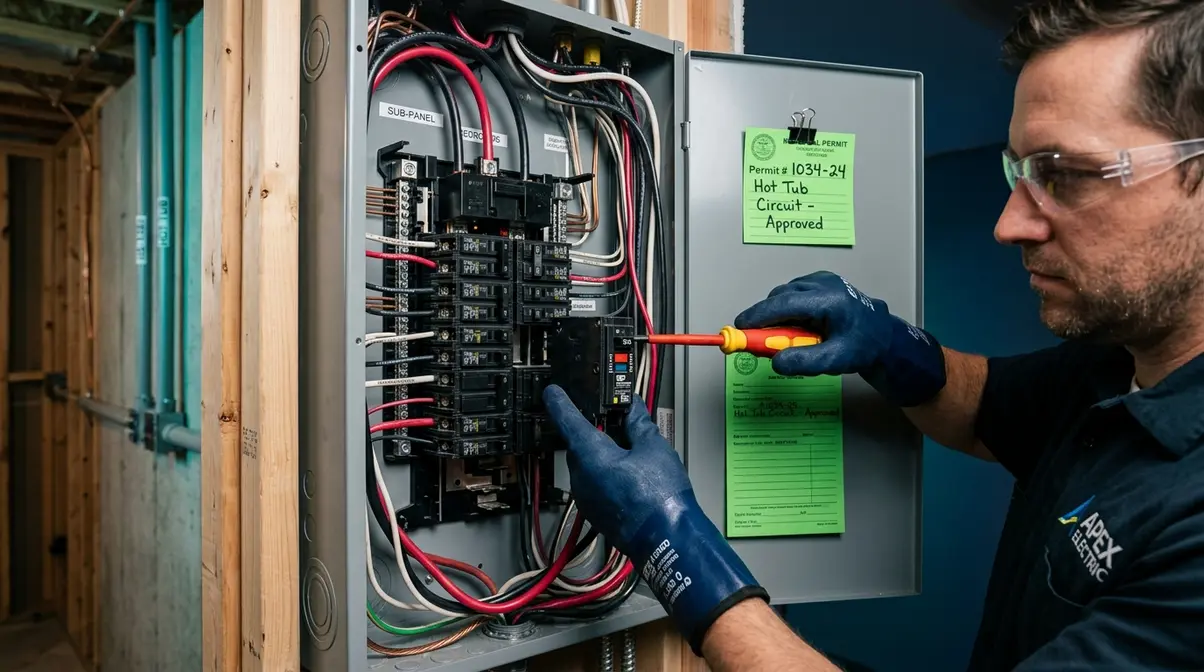
Understanding hot tub electrical wiring requirements is essential before consulting your electrician. Electrical safety is the most critical and least negotiable leg of The Danger Triangle. Water and electricity in an enclosed basement space create conditions for electrocution if any component of the electrical system is improperly installed. This work requires a licensed electrician. Full stop.
NEC Article 680 & GFCI Rules
The National Electrical Code (NEC), published by the National Fire Protection Association (NFPA) and adopted by most U.S. jurisdictions, governs all electrical installations for hot tubs and spas under Article 680 — Swimming Pools, Fountains, and Similar Installations.
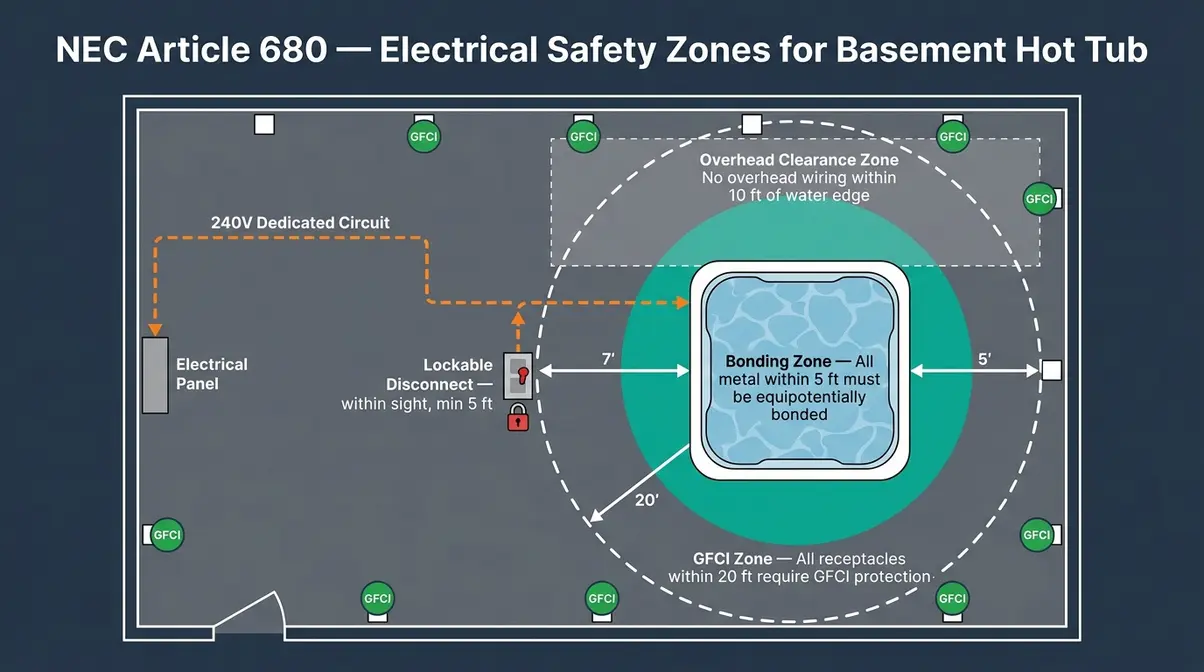
The key requirements for a basement hot tub installation under NEC Article 680 are:
| NEC 680 Requirement | Specification |
|---|---|
| GFCI protection zone | All receptacles within 20 feet of the hot tub’s interior wall |
| Dedicated circuit | 240V, 50-amp circuit for most portable hot tubs (verify with manufacturer) |
| Bonding | All metal components within 5 feet of the hot tub must be equipotentially bonded |
| Disconnect location | A lockable disconnect must be located within sight of the hot tub but not less than 5 feet away |
| Overhead clearance | No overhead wiring permitted within 10 feet horizontally of the water’s edge |
GFCI (Ground Fault Circuit Interrupter) protection is the single most important safety device in a hot tub electrical system. A GFCI detects current leakage as small as 4–6 milliamps — far below the 100+ milliamps that cause cardiac arrest — and trips the circuit in under 1/40th of a second. According to the CPSC (Consumer Product Safety Commission), GFCI protection has been credited with preventing thousands of electrocution deaths in wet-location applications since its widespread adoption.
Working with an Electrician
Never attempt hot tub electrical work as a DIY project. Beyond the life-safety risks, unpermitted electrical work in a basement hot tub installation will almost certainly be flagged during any future home inspection or insurance claim — and the cost of remediation far exceeds the cost of doing it correctly the first time.
Here is what a licensed electrician will do during a basement hot tub electrical installation:
- Site assessment — Evaluate your electrical panel’s available capacity and the routing distance from the panel to the hot tub location
- Permit application — File the required electrical permit with your local authority having jurisdiction (AHJ)
- Circuit installation — Run a dedicated 240V, 50-amp circuit with appropriate wire gauge (typically 6 AWG copper) from the panel to the disconnect
- Disconnect installation — Mount a lockable disconnect in a code-compliant location
- Bonding — Connect all required metal components with a #8 solid copper bonding conductor
- GFCI installation — Install GFCI protection at the panel or at the disconnect as required
- Inspection — Schedule and pass the required electrical inspection before the hot tub is energized
Typical cost for a licensed electrician to complete a basement hot tub electrical installation ranges from $1,500–$3,500 depending on panel distance, local labor rates, and whether panel upgrades are required (Angi, 2026).
Step 5: The Installation Process
This step-by-step hot tub installation guide outlines the critical sequence. With structural reinforcement complete, ventilation designed, delivery confirmed, and electrical permitted, you are ready to execute the basement hot tub installation process itself. This phase involves coordinating multiple trades in the correct sequence.
The Step-by-Step Installation Sequence
Licensed contractors follow this sequence for a standard portable acrylic hot tub basement installation. Do not reorder these steps — each one creates the conditions for the next.
Step 1: Complete all structural reinforcement work.
Confirm with your structural engineer that the slab meets the 6-inch, 3,000 PSI, #4 rebar standard. Allow new concrete overlays to cure for a minimum of 28 days before placing any load on them. (Concrete reaches approximately 70% of its rated strength at 7 days and 99% at 28 days — ACI 318.)
Step 2: Install the floor drain and plumbing.
A licensed plumber installs or confirms the floor drain, connects it to the sanitary sewer with a proper trap, and installs any water supply lines if your hot tub uses an auto-fill system. This work must be completed and inspected before the slab is finished.
Step 3: Apply vapor barrier and waterproofing.
Apply a 6-mil polyethylene vapor barrier to the floor and a waterproof membrane to all walls within the hot tub room. Allow all coatings to cure per manufacturer specifications before proceeding.
Step 4: Install ventilation and mechanical systems.
Your HVAC contractor installs the exhaust fan (minimum 1 CFM per sq ft, ducted to exterior), the dehumidifier system, and any supplemental heating. This work should be permitted and inspected separately.
Step 5: Coordinate the hot tub delivery.
Schedule the delivery with a specialized hot tub delivery crew — not a standard furniture or appliance delivery service. Confirm all stairwell measurements with the crew chief before the delivery date. Have the final placement location marked on the floor with tape so the crew can position the tub precisely on the first attempt.
Step 6: Have your licensed electrician complete the wiring.
The hot tub should be in its final position before the electrician connects the circuit. The electrician connects the dedicated 240V circuit, installs the disconnect, completes the bonding, and schedules the electrical inspection.
Step 7: Pass all inspections.
Your local building department will require a final inspection covering structural work (if a permit was pulled), electrical work, and potentially plumbing. Do not fill or energize the hot tub until all inspections are passed and the permit is closed.
Step 8: Fill and commission the hot tub.
Fill the tub with a garden hose through the filter compartment (not the footwell) to avoid air locks in the plumbing. Once filled, energize the system and run the startup sequence per the manufacturer’s instructions.
Filling & Starting Up Your Tub
Once your hot tub is in position, wired, and inspected, the startup process is straightforward but requires attention to water chemistry from day one.
Fill the tub slowly through the filter housing to prevent air pockets. Once full, turn on the system and allow the circulation pump to run for 30 minutes before adding any chemicals. Then follow this startup sequence:
- Test the source water with a test strip to establish your baseline pH, alkalinity, and hardness
- Adjust total alkalinity first — target 80–120 ppm (parts per million)
- Adjust pH second — target 7.4–7.6
- Adjust calcium hardness — target 150–250 ppm for acrylic surfaces
- Add your primary sanitizer (chlorine or bromine) to the manufacturer’s recommended startup dose
- Run the jets for 20 minutes to circulate all chemicals, then retest
Do not use the hot tub until all chemistry readings are within target range. Using a hot tub with unbalanced chemistry can irritate skin and eyes, and can damage the shell and equipment over time.
DIY vs. Professional Installation
The honest answer: the structural, electrical, and plumbing phases of a basement hot tub installation are not appropriate DIY projects for the vast majority of homeowners. Each requires licensed professionals, permits, and inspections. Attempting these phases without proper credentials voids most manufacturer warranties, violates building codes, and creates serious liability exposure.
- Where homeowners can reasonably participate:
- Taking initial measurements and planning the layout
- Coordinating between trades and scheduling inspections
- Handling the water chemistry startup and ongoing maintenance
- Installing surface finishes (tile, trim, non-structural elements) with appropriate permits
The total professional installation cost for a basement hot tub — including structural reinforcement, plumbing, ventilation, and electrical — typically ranges from $5,000–$15,000 beyond the cost of the hot tub itself, depending on the condition of your existing basement and your local labor market (Angi, 2026).
Risks, Pitfalls & When to Walk Away
Even with careful planning, basement hot tub installations carry risks that must be understood before you commit. This section examines the most common mistakes and the scenarios where a basement location is genuinely the wrong choice.
Common Basement Hot Tub Mistakes
Buying the hot tub before confirming delivery access. This is the single most expensive mistake in basement hot tub projects. A non-refundable hot tub sitting in a driveway because it won’t fit through the stairwell is a painful and avoidable outcome. Measure first, always.
Undersizing the ventilation system. Installing a standard 110 CFM bathroom exhaust fan in a 200-square-foot hot tub room is functionally inadequate. The result is chronic high humidity, progressive mold growth, and eventual structural damage to the framing and finishes — often hidden behind walls for months before it becomes visible.
Skipping the structural engineer assessment. Contractors consistently report discovering inadequate slabs after homeowners have already purchased and scheduled delivery of their hot tub. A structural engineer’s assessment costs $300–$600 and can save tens of thousands in remediation costs.
Attempting electrical work without a permit and licensed electrician. Beyond the safety risk, unpermitted electrical work in a basement hot tub installation creates serious complications during home sales, insurance claims, and any future electrical inspection.
Neglecting ongoing water chemistry. Improperly balanced water in an enclosed basement space accelerates corrosion on the hot tub’s equipment, damages surfaces, and creates conditions for bacterial growth — including Legionella, which causes Legionnaire’s disease. Test and adjust your water chemistry at least twice per week.
When a Basement Is the Wrong Choice
A basement hot tub is the wrong choice in these specific scenarios:
When your basement has an active water intrusion problem. If your basement already experiences water seepage, flooding, or chronic moisture issues, adding a hot tub will compound those problems significantly. Resolve the underlying waterproofing issue first — or choose a different location.
When stairwell access is genuinely impassable. If your stairwell is under 30 inches wide or has a ceiling height below 7 feet, the cost of creating adequate access (window well enlargement, egress door installation) may exceed the value of the basement location advantage.
When your home is on a post-and-beam or wood-framed floor system. Concrete basement slabs can often be reinforced. Wood-framed floors over a crawl space or unfinished basement present a fundamentally different and far more complex structural challenge. Consult a structural engineer before proceeding — in many cases, the reinforcement cost makes a basement installation economically impractical.
When local code prohibits it. Some jurisdictions have specific restrictions on below-grade hot tub or spa installations. Always confirm with your local building department before investing in planning.
Frequently Asked Questions
Will a 4-inch concrete slab support a hot tub?
A standard 4-inch residential concrete slab is not sufficient for most portable hot tubs. A fully loaded 6-person hot tub can exceed 5,000 lbs, requiring a minimum 6-inch, 3,000 PSI reinforced slab to prevent cracking. Always have a licensed structural engineer assess your specific slab before installation.
How much does it cost to install a hot tub in a basement?
The total cost of a basement hot tub installation — beyond the hot tub itself — typically ranges from $5,000 to $15,000. This includes structural reinforcement ($3,000–$6,000), electrical work ($1,500–$3,500), ventilation system ($1,000–$3,000), and plumbing/drainage ($500–$2,000). These figures are regional averages and can vary significantly based on your existing basement condition and local labor rates (Angi, 2026). The hot tub unit itself adds $3,000–$12,000 for a quality portable acrylic model.
What electrical requirements does a basement hot tub need?
Most portable hot tubs require a dedicated 240V, 50-amp circuit with GFCI protection. All electrical receptacles within 20 feet must be GFCI-protected, and all metal components within 5 feet must be equipotentially bonded. This work requires a licensed electrician and an electrical permit.
How do I prevent mold in a basement hot tub room?
Preventing mold requires a mechanical ventilation system sized to maintain relative humidity below 60% at all times. The EPA identifies sustained humidity above 60% as the primary trigger for mold growth. Your exhaust fan must be rated for at least 1 CFM per square foot of room area and ducted directly to the exterior. A ducted dehumidifier rated for 70–90 pints per day provides additional moisture control. Wall surfaces should be waterproofed with cement board and tile — not standard drywall — within the hot tub room.
Can you put an inflatable hot tub in a basement?
Yes — an inflatable hot tub is often the most practical choice for basement installation. According to manufacturer specifications, inflatable models weigh 30–60 lbs empty and 1,500–2,200 lbs fully loaded. This is a fraction of a portable acrylic unit’s weight. They fit through standard doorways and require no specialized delivery crew. They also place far less structural load on your slab. However, the trade-offs include reduced durability and lower hydrotherapy performance.
Where should you not put a hot tub?
Avoid locations with active water intrusion, inadequate structural support, poor ventilation options, or impassable delivery access. A basement with existing moisture problems, seepage, or flooding will become significantly worse with a hot tub present. Wood-framed floors over crawl spaces present complex structural challenges that often make installation economically impractical. Avoid any location where you cannot duct an exhaust fan directly to the exterior — recirculating ventilation is not adequate for a hot tub room.
Plan Smart, Build Once
A safe hot tub in basement installation is genuinely achievable — but only for homeowners who treat The Danger Triangle as a single, integrated engineering problem rather than three separate checklists. Structural overload, moisture infiltration, and electrical hazard are interconnected: a reinforced slab means nothing if the ventilation system fails and mold destroys the framing above it. According to licensed contractors across residential basement projects, the installations that succeed share one common characteristic — every phase was permitted, inspected, and executed by licensed professionals before the next phase began.
The framework in this guide — from the 6-inch, 3,000 PSI concrete specification to the 1 CFM-per-square-foot ventilation formula to the NEC Article 680 electrical requirements — gives you the vocabulary and the benchmarks to have intelligent conversations with your structural engineer, electrician, and HVAC contractor. That knowledge is the difference between a project that delivers years of private, year-round relaxation and one that creates hidden damage you won’t discover until it’s expensive to fix.
Your next step is a site assessment, not a shopping cart. Hire a licensed structural engineer to evaluate your slab, contact your local building department to confirm permit requirements, and measure your stairwell before you speak to a single hot tub dealer. Get those three data points in hand, and the rest of this project becomes a manageable sequence of professional trades working toward a clear, inspected outcome.
David King
Hot tub tester and writer at One Hot Tub.