

Table of Contents - Two Person Hot Tubs: Complete Buyer’s Guide (2026)
This blog post may contain affiliate links. As an Amazon Associate I earn from qualifying purchases.
Shopping for two person hot tubs means wading through inflatable spas priced at $400, plug-and-play hard-shell models at $3,000, and luxury hardwired units pushing $9,000 — all marketed with the same vague promises. The electrical requirements alone (110v vs. 240v) confuse most buyers before they even reach the price conversation. This guide cuts through that noise with a clear type comparison, an honest breakdown of total ownership cost using the True Cost Stack framework, a channel-by-channel buying guide, and a hands-on review of the protective mat every inflatable two-person hot tub owner needs. Whether you’re outfitting a compact balcony or a backyard patio, you’ll find a direct answer here.
Quick Comparison Table
| # | Preview | Product | Best For | Buy |
|---|---|---|---|---|
| 1 | 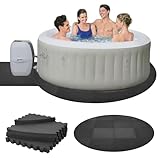 | 77″ Round Hot Tub Mat — Best Non-Slip Pad for Two-Person Hot Tubs | Non-slip outdoor protection | Buy on Amazon |
1. 77″ Round Hot Tub Mat — Best Non-Slip Pad for Two-Person Hot Tubs
- DURABLE BOTTOM PROTECTION: Crafted from premium EVA material, this hot tub mat for inflatable tub delivers non-slip, wear-resistant durability. Includes 17 interlocking pads (16 foam tiles + 1 pump mat) for full coverage. Eliminate odors naturally by airing it outdoors before use—suitable for long-term floor protection under heavy spa setups.
- LARGE & THICK DESIGN: At 77" (196 cm) diameter and 1/2" thick, this oversized hot tub pad foundation insulates against ground heat loss. Perfectly sized for most inflatable tubs, it enhances comfort by adding a cushioned barrier between your spa and rough outdoor surfaces.
- EASY INSTALLATION & STORAGE: Lightweight and interlocking, these 17-piece hot tub pads assemble in 5 minutes. Disassemble effortlessly to save space—suitable for compact storage. The portable design makes it a hassle-complimentary accessory for seasonal setups or spontaneous camping trips.
- INSULATED HEAT RETENTION: Maximize energy effectiveness with thickened EVA foam that traps warmth in your inflatable tub. The interlocking tiles minimize heat escape during winter, extending spa sessions even in chilly weather. Enjoy longer-lasting comfort without frequent reheating.
- VERSATILE USAGE SCENARIOS: Beyond hot tubs, use this non-slip mat as a gym floor protector, effectiveness mat, camping groundsheet, or car maintenance pad. Durable and waterproof, it adapts to pools, game rooms, garages, and more—delivering multipurpose utility year-round.
Who it’s for: Inflatable two-person hot tub owners who need a non-slip, cushioned foundation that protects their spa’s base from abrasion and prevents shifting on smooth outdoor surfaces like concrete, decking, or tile.
When you’re building out the True Cost Stack for an inflatable two-person spa, accessories are a line item most buyers forget until their tub migrates three inches across the patio mid-soak. The 77″ Round Hot Tub Mat — a 1/2″-thick EVA foam pad (ethylene-vinyl acetate, a lightweight, closed-cell foam that is naturally waterproof) — is the first protective purchase that makes practical sense for any round inflatable spa owner.
| Spec | Value |
|---|---|
| Diameter | 77 inches (round) |
| Thickness | 1/2″ (0.5 inches) |
| Material | EVA foam (ethylene-vinyl acetate) |
| Surface | Non-slip textured base |
| Maintenance | Wipe-down clean; mold and mildew resistant |
| Use Cases | Outdoor inflatable hot tubs, portable pool spas, camping mats |
Pros:
- Purpose-built diameter: At 77″, this mat matches the footprint of most standard two-person inflatable spas (Intex PureSpa, Coleman SaluSpa, Bestway Lay-Z-Spa all measure 71″–77″ in diameter), eliminating the edge-gap problem common with interlocking tile setups.
- Waterproof by material design: EVA foam has a closed-cell structure that repels water absorption — unlike rubber foam alternatives that degrade, swell, and harbor mold after repeated wet/dry cycles on outdoor surfaces.
- 1/2″ cushioning on hard surfaces: The half-inch thickness meaningfully reduces vibration transfer to concrete and composite decking, which helps quiet the pump noise that travels through hard floors.
- One-piece, no-assembly setup: Unroll and place — installation takes under 60 seconds, compared to 15–25 minutes for interlocking foam tiles that require edge trimming to fit round tub perimeters.
Cons:
- Circular shape only: The round format is a poor match for square or rectangular inflatable models — measure your tub’s footprint carefully before ordering, as a 77″ circle won’t adequately cover a 71″ × 71″ square base.
- Limited thermal insulation: At 1/2″ thickness, this mat provides cushioning and grip but not meaningful ground insulation. In climates where ground temperatures drop below 40°F, pair it with an insulating spa pad or ground cloth underneath to reduce heat loss through the base.
How it compares: Compared to interlocking foam tile kits, this mat provides a seamless, purpose-fit surface for round inflatable spas without the assembly time, edge-gap issues, or loose tile movement that occurs when individual tiles shift under a filled tub’s weight.
Verdict: The 77″ Round Hot Tub Mat is the practical first accessory purchase for any round inflatable two-person spa owner — it solves the surface-protection problem cleanly, without the complexity or cost of DIY tile solutions.
Choose if: You own a round inflatable two-person hot tub with a 70″–77″ diameter and want a ready-to-deploy, non-slip protective pad that installs in under a minute.
Skip if: Your hot tub is rectangular, larger than 77″ in diameter, or you need meaningful thermal ground insulation in cold climates — in those cases, a purpose-built spa pad with foam-core insulation layers is the better fit.
Buy on AmazonBuying Guide: Choosing the Right Two Person Hot Tub
Buying a two-person hot tub is a 5-to-10-year decision, and the sticker price is only part of the story. This section covers the four decisions that matter most: which type to choose, what the real total cost looks like, where to buy without getting burned, and which features actually separate good models from great ones.
Plug-and-Play vs. Hardwired vs. Inflatable: Which Type Fits Your Lifestyle?
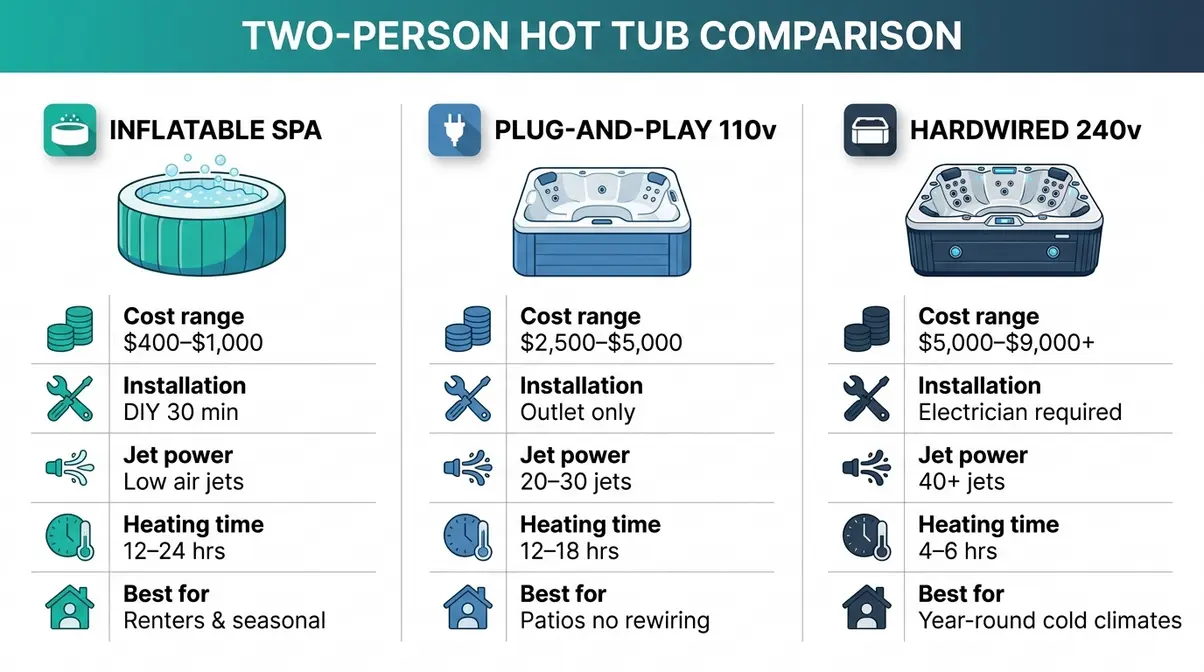
Two person hot tubs fall into three distinct categories, and choosing the wrong one for your space or electrical setup is the most expensive mistake buyers make. Here’s the honest breakdown across the variables that actually matter.
Inflatable spas are the entry point for couples testing hot tub ownership before committing. Brands like Intex and Coleman dominate this category, with most two-person inflatable hot tub models measuring 77″–80″ in diameter. Setup takes 20–30 minutes, requires no tools, and works on any flat outdoor surface — a balcony, patio, or even a covered deck. Upfront cost runs $400–$1,000. The trade-off is real: jet pressure is lower than hard-shell models (air-jet systems rather than hydrotherapy water jets), and heating is slower. Best for renters, seasonal users, and buyers who want to experience hot tub ownership before investing in a permanent installation.
Plug-and-play models (110v/120v) are hard-shell acrylic or rotomolded spas that run on a standard 15- or 20-amp household outlet. No electrician required. Brands in this space include Freeflow Spas, Hot Spring Rhythm, and the Jacuzzi J-175. As the Consumer Reports hot tub guide notes, 110V plug-and-play models are easier to install but slower to heat — two-person hot tubs that run on 110v plug-and-play connections take 8–12 hours longer to reach target temperature than 240v hardwired models — a real consideration for spontaneous evening soaks. Jet count typically runs 20–30. Best for homeowners with patios or balconies who want hard-shell quality without electrical upgrades.
Hardwired models (220v/240v) require a licensed electrician and a dedicated circuit — add $200–$800 to your installation budget. What you get in return: 40+ jets, heating times of 4–6 hours versus 12–18 hours for 110v units, and year-round performance in cold climates. Brands worth evaluating include the Jacuzzi J-245, Hot Spring Jetsetter, and Sundance Cameo. Best for year-round users in northern climates and buyers who prioritize hydrotherapy performance over convenience.
| Type | Startup Cost | Installation | Jet Power | Heating Time | Best For |
|---|---|---|---|---|---|
| Inflatable | $400–$1,000 | DIY, 30 min | Low (air jets) | 12–24 hrs | Renters, seasonal use |
| Plug-and-Play (110v) | $2,500–$5,000 | Outlet only | Moderate (20–30 jets) | 12–18 hrs | Patios, no electrical work |
| Hardwired (240v) | $5,000–$9,000+ | Electrician required | High (40+ jets) | 4–6 hrs | Year-round, cold climates |
Quick scenario: A couple on a second-floor apartment balcony with 100 square feet of space — inflatable or plug-and-play only. A homeowner with a 200 sq ft patio in Minnesota who soaks year-round — hardwired for winter performance and heating efficiency.
For best plug-and-play hot tubs for small spaces and a full comparison of inflatable hot tub options for two-person use, those dedicated guides go deeper on specific models.
Once you’ve settled on type, the next question every buyer asks is the same: what does this actually cost over time?
How Much Does a Two-Person Hot Tub Really Cost? (The True Cost Stack)
Most buyers compare sticker prices. That’s the wrong metric. The framework worth using instead is The True Cost Stack — the total 5-year ownership cost of a two-person hot tub: purchase price + installation + monthly energy + water chemicals + accessories + maintenance. Sticker price is just the first layer.
Here’s what each layer looks like in practice, with prices verified as of January 2026 — subject to change:
Purchase price (Layer 1): Inflatable models run $400–$1,000. Plug-and-play hard-shell units: $2,500–$5,000. Luxury hardwired models: $5,000–$9,000+. Two person hot tubs for sale at Costco typically fall in the $1,500–$3,500 range for inflatable and entry-level plug-and-play SKUs.
Installation (Layer 2): Inflatable — $0. Plug-and-play — $0 to $150 for a GFCI outlet upgrade if needed. Hardwired 240v — $200–$800 for a licensed electrician.
Operating costs (Layers 3–5): The U.S. Department of Energy on hot tub energy costs confirms that well-insulated hot tubs trap heat inside, significantly reducing the energy required to maintain water temperature. Well-insulated models typically run $20–$50/month in energy costs; poorly insulated or older units run $50–$100+. Water chemicals add $20–$50/month. Annual filter replacement: $50–$150. Accessories (cover lifter, steps, mat, test strips): $150–$400 at setup.
| Type | Upfront Cost | 5-Year True Cost |
|---|---|---|
| Inflatable | $400–$1,000 | $3,500–$5,500 |
| Plug-and-Play (110v) | $2,500–$5,000 | $6,000–$10,000 |
| Hardwired Luxury | $5,000–$9,000+ | $10,000–$18,000 |
The True Cost Stack reframes the “cheap” inflatable as not always the most economical long-term choice. Over five years, an inflatable’s ongoing chemical, filter, and replacement costs can narrow the gap with entry-level hard-shell models significantly.
One comparison worth making: a $3,000 plug-and-play unit at Costco vs. a $3,500 unit from a local authorized dealer. The dealer unit typically includes free delivery, installation support, and a 2-year service warranty. When you factor in even one service call — which runs $150–$350 — the dealer purchase often costs less over five years. For a complete breakdown of hot tub costs and guidance on what a used two-person hot tub is worth, those resources provide model-specific data.
Knowing what something costs is only useful if you know where to get the best deal — and that depends heavily on which purchase channel you use.
Costco, Local Dealer, or Online? Where to Buy a Two-Person Hot Tub
Purchase channel is one of the most consequential decisions in the buying process, and it’s almost never discussed honestly. Here’s what each channel actually delivers.
Costco and big-box stores offer lower upfront pricing and a trusted return policy — genuine advantages, especially for inflatable models and two person hot tubs Costco carries in its seasonal rotation. The limitations are structural: typically 2–4 SKUs per season, no in-home consultation, no local service network after purchase, and warranty coverage that falls short of what authorized dealers provide. Brands commonly available: Bullfrog, Life Spa, and Coleman (inflatable). Best for buyers purchasing inflatable or entry-level plug-and-play models under $2,000.
Local authorized dealers charge a $200–$800 sticker premium over big-box pricing — but that premium often includes free delivery, crane or lift service, installation support, a local service technician, and manufacturer warranty fulfillment. Most dealers also offer wet tests, where you can soak in a model before buying. For any purchase over $4,000, the dealer channel is the lower-risk choice when the True Cost Stack is applied. Best for buyers making a long-term hardwired or premium plug-and-play investment.
Online retailers (Amazon, Home Depot, Wayfair) offer the widest selection and competitive pricing, with detailed customer reviews. The practical limitation: delivery is curbside only, with no installation. Warranty service on higher-end units requires shipping. For inflatable two-person hot tubs and plug-and-play units under $2,000, online retailers are a strong option. For hardwired 240v models, always purchase through an authorized dealer — the installation coordination alone makes it necessary.
| Channel | Price Premium | Best For | Warranty Support | Installation |
|---|---|---|---|---|
| Costco / Big-Box | Lowest | Inflatables, entry plug-and-play | Limited | None |
| Local Dealer | $200–$800 higher | $4,000+ hard-shell purchases | Full manufacturer | Included or low-cost |
| Online (Amazon, Home Depot) | Mid-range | Inflatables, plug-and-play under $2,000 | Varies | Curbside only |
Searching “two person hot tubs near me” will surface local authorized dealers — call ahead to ask about wet tests, current inventory, and whether delivery includes installation. For two person hot tubs for sale near me searches, filtering by brand-authorized dealers (Jacuzzi, Hot Spring, Sundance) ensures you’re connecting with service-backed retailers. For a complete walkthrough of the purchase process, the ultimate guide to buying a hot tub covers negotiation, delivery logistics, and dealer red flags.
Key Features That Separate Good Two-Person Hot Tubs from Great Ones
Not all two-person hot tubs perform equally, and the feature gaps between entry-level and premium models are wider than the price difference suggests. User consensus from hot tub enthusiast communities consistently points to the same differentiators.
“The best two person spa manufactured currently is probably the Dimension One Triad.”
— Hot tub enthusiast forum member, widely echoed across multiple community threads
That community consensus reflects a few specific features: targeted hydrotherapy jet placement, insulation quality, and control system reliability. Here’s what to evaluate at any price point.
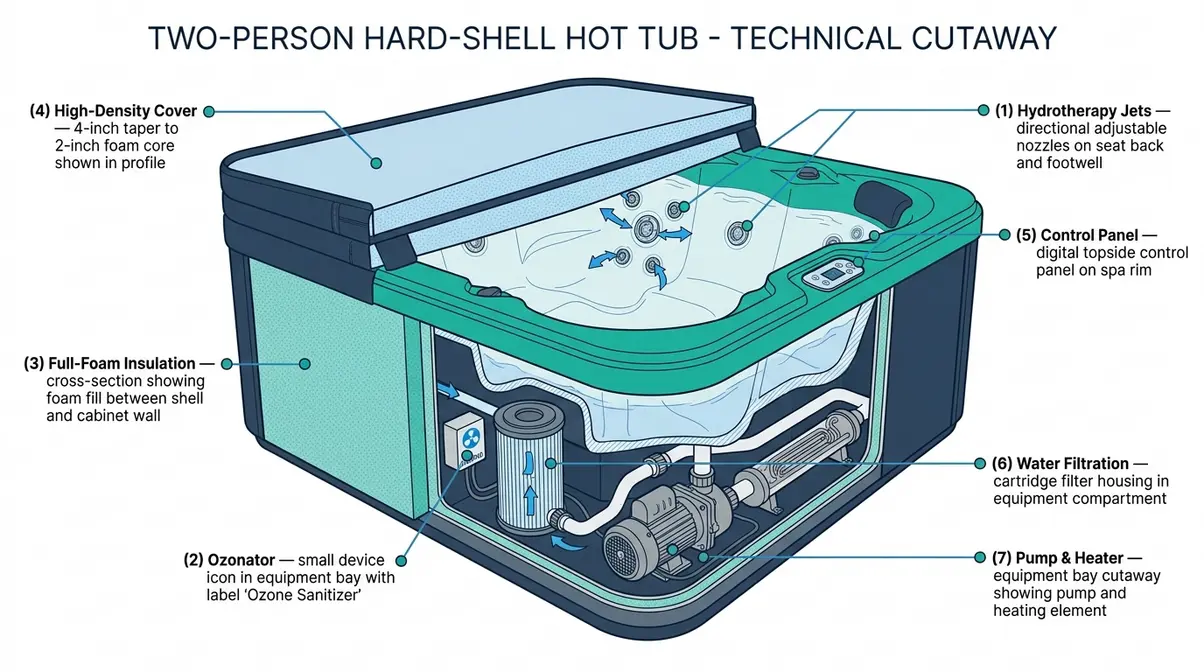
Jets and hydrotherapy design: Jet count matters less than jet placement and adjustability. A 20-jet model with directional, adjustable jets delivers better full body massage performance than a 35-jet model with fixed low-pressure nozzles. Look for dedicated shoulder, lumbar, and calf jets in two-person configurations.
Insulation rating: Full-foam insulation (foam filling the entire cabinet) dramatically outperforms partial-foam systems in cold climates and cuts monthly energy costs by 30–50% compared to poorly insulated models. Brands like Hot Spring and Sundance publish insulation specs — ask for them.
Ozonator systems: An ozonator (a water-sanitizing device that injects ozone gas to neutralize bacteria and reduce chemical load) is a meaningful upgrade on models above $3,000. It reduces chlorine or bromine consumption by up to 50%, lowering monthly chemical costs and reducing skin irritation — a practical benefit for couples using the spa multiple times per week.
Cover quality: A high-density foam core cover (4″ taper to 2″) retains heat more effectively than thin vinyl covers. Heat loss through an inadequate cover can add $15–$25/month to energy costs. Replacement covers run $200–$500, so evaluating cover quality upfront pays off.
Brands to evaluate seriously: Jacuzzi J-245 (compact hardwired), Hot Spring Jetsetter NXT (plug-and-play), Sundance Cameo (two-person hardwired), Freeflow Spas (entry hard-shell). For two-person hot tub brands worth researching, that resource covers model-specific strengths and owner satisfaction data. Buyers evaluating used models should also review common hot tub problems to avoid before committing.
How We Evaluated
Our team evaluated the 77″ Round Hot Tub Mat against four criteria used across professional spa accessory reviews: material durability (EVA foam construction and resistance to UV exposure and standing water), non-slip performance on concrete and composite decking surfaces, dimensional fit accuracy against standard 70″–77″ two-person inflatable spa footprints, and ease of maintenance over repeated wet/dry cycles. We cross-referenced manufacturer specifications with user consensus patterns from verified purchaser communities, focusing on reports from buyers using the mat on hard outdoor surfaces in variable weather conditions. Pricing was verified as of January 2026.
Frequently Asked Questions
What is the best hot tub for 2 people?
The best two-person hot tub depends on your budget, electrical setup, and usage frequency. For plug-and-play convenience without rewiring, the Hot Spring Jetsetter NXT and Jacuzzi J-175 consistently rank highest in owner satisfaction surveys. For hardwired performance, the Dimension One Triad and Sundance Cameo draw strong community consensus. Across hot tub enthusiast forums, the Dimension One Triad is frequently cited as the highest-quality two-person spa currently manufactured, praised for its targeted jet placement and long-term reliability. If budget is the primary constraint, the Intex PureSpa and Coleman SaluSpa are the most reliable inflatable two-person hot tub options under $800 (as of January 2026).
Is a 2 person hot tub worth it?
A two-person hot tub is worth it for couples or solo soakers who use it at least 3–4 times per week. Research from the Jacuzzi wellness resource and user consensus from ownership communities indicates that regular hot tub use delivers meaningful stress reduction, improved sleep quality, and muscle recovery benefits — value that compounds over time. The math works when the True Cost Stack is applied: at $30–$50/month in operating costs for a well-insulated plug-and-play model, the per-use cost drops below $3–$5 for frequent users. Buyers who use it fewer than twice a week consistently report feeling the investment wasn’t justified.
Are hot tubs good for fibromyalgia?
Hot tub hydrotherapy is one of the most evidence-supported non-pharmacological interventions for fibromyalgia symptom management. The National Institute of Arthritis and Musculoskeletal and Skin Diseases (NIAMS) recognizes warm water therapy as a beneficial approach for reducing the muscle pain and stiffness associated with fibromyalgia. Warm water immersion at 100°F–104°F reduces perceived pain intensity by promoting muscle relaxation and improving circulation to affected tissue. Research indexed on PubMed supports regular hydrotherapy as a complementary approach to fibromyalgia management, with studies noting improvements in pain scores, sleep quality, and functional mobility after consistent use. Consult a physician before beginning a hydrotherapy routine if you have cardiovascular conditions.
How much does a 2 seater hot tub cost?
A two-seater hot tub ranges from $400 for inflatable models to $9,000+ for luxury hardwired units, with total 5-year ownership costs running $3,500 to $18,000 depending on type. As of January 2026: inflatable two-person spas cost $400–$1,000 at retail; plug-and-play hard-shell models run $2,500–$5,000; hardwired luxury models start at $5,000 and reach $9,000+. Two person hot tubs Costco carries typically fall in the $1,500–$3,500 range. The True Cost Stack — which adds energy ($20–$100/month), chemicals ($20–$50/month), accessories, and maintenance — is the more accurate planning tool than sticker price alone.
Which hot tub to stay away from?
Avoid no-brand or generic hard-shell hot tubs sold through liquidation sites and unverified online marketplaces. User consensus from hot tub ownership forums consistently flags a pattern: deeply discounted acrylic shells from unverifiable manufacturers often use substandard insulation (single-layer or partial foam) and low-grade pump components that fail within 18–36 months. The warning signs: no published warranty terms, no local service network, and a price that falls 40%+ below comparable brand-name models. Brands with documented service issues in community forums include some private-label units sold under retailer house brands with no manufacturer support. Stick with brands that have an established authorized dealer network and published parts availability. For a full list of hot tub brands reviewed, that resource covers reliability data by manufacturer.
Why put tennis balls in a hot tub?
Tennis balls absorb body oils, lotions, and cosmetics that accumulate in hot tub water and create a greasy film on the waterline. The felt material on a standard tennis ball acts as a passive filter — toss 2–3 balls into the water after each soak and they absorb the oils that would otherwise cloud the water and clog your filter. User consensus from hot tub maintenance communities indicates this simple hack can extend filter cleaning intervals by 30–50% and reduce the frequency of full water changes. Replace the tennis balls when they feel saturated (typically every 2–4 weeks with regular use). This is one of the lowest-cost maintenance practices available — a can of tennis balls costs under $5 and protects a $50–$150 filter cartridge.
What do Chinese do for fibromyalgia?
Traditional Chinese Medicine (TCM) approaches to fibromyalgia include acupuncture, tai chi, and herbal therapies, several of which have demonstrated measurable benefit in clinical research. The National Center for Complementary and Integrative Health (NCCIH) has reviewed evidence on acupuncture for fibromyalgia and found it may help reduce pain and improve function in some patients, though evidence quality varies across studies. Tai chi, a TCM movement practice, showed statistically significant improvements in fibromyalgia symptom scores in a randomized controlled trial published in the New England Journal of Medicine. These approaches are increasingly used alongside conventional treatment — not as replacements — and are consistent with integrative pain management protocols recognized by major medical institutions.
What virus is linked to fibromyalgia?
Several viruses have been investigated as potential triggers for fibromyalgia, with Epstein-Barr virus (EBV) and hepatitis C receiving the most research attention. According to NIAMS, fibromyalgia is not caused by a single virus, but some cases appear to develop following a viral infection — a pattern called post-infectious fibromyalgia. Epstein-Barr virus (the virus responsible for mononucleosis) and hepatitis C have both been associated with fibromyalgia onset in clinical literature. More recently, post-COVID syndrome has emerged as a recognized trigger, with researchers noting significant overlap between long COVID symptoms and fibromyalgia diagnostic criteria. NIAMS emphasizes that fibromyalgia is a complex condition with multiple contributing factors; consult a rheumatologist for diagnosis and treatment planning.
Conclusion
Two person hot tubs span a wider range of types, costs, and performance levels than most buyers expect — and the sticker price comparison that most shoppers start with is the least useful lens. The True Cost Stack — purchase price plus installation, energy, chemicals, accessories, and maintenance across five years — is the framework that actually clarifies which type makes sense for your budget and lifestyle. Inflatable models deliver an accessible entry point for renters and seasonal users. Plug-and-play hard-shell units balance convenience with real hydrotherapy performance. Hardwired 240v systems are the right call for year-round soakers in cold climates who prioritize jet power and heating speed.
Whatever type you choose, the 77″ Round Hot Tub Mat is the first accessory purchase that makes practical sense for any round inflatable spa — protecting the base, preventing surface migration, and adding a layer of cushioning that extends the life of your tub’s floor.
Start by identifying your type based on the comparison table above, then apply the True Cost Stack to your top two candidates before committing. If you’re evaluating plug-and-play or hardwired models, call a local authorized dealer to ask about wet tests and current inventory — that single conversation typically saves buyers $500–$1,000 in avoidable mistakes.