

What’s in this guide
- 1. The Ultimate 2025 Hot Tub Buyer's Guide: Best Overall
- 2. The Hot Tub Guidebook: Best for Complete Care
- 3. Hot Tub Clarity: Best for New Owners
- 4. The Newbies Guide to Hot Tub Chemicals: Best for Maintenance
- 5. Hot Tubs, Saunas, and Steam Baths: Best for Planning
- 6. Build Your Own Hot Tub: Best DIY Guide
- Buying Guide: How to Choose the Right Hot Tub Book
- How We Evaluated
- Frequently Asked Questions
- Conclusion
| # | Preview | Product | Best For | Buy |
|---|---|---|---|---|
| 1 |  | The Ultimate 2025 Hot Tub Buyer’s Guide | Pre-purchase planning | Buy on Amazon |
| 2 |  | The Hot Tub Guidebook | Complete care & water | Buy on Amazon |
| 3 |  | Hot Tub Clarity | Frustrated new owners | Buy on Amazon |
| 4 |  | The Newbies Guide to Hot Tub Chemicals | Chemical management | Buy on Amazon |
| 5 |  | Hot Tubs, Saunas, and Steam Baths | Planning & design | Buy on Amazon |
| 6 |  | Build Your Own Hot Tub | DIY builders | Buy on Amazon |
1. The Ultimate 2025 Hot Tub Buyer’s Guide: Best Overall
Who it’s for: The buyer who hasn’t purchased yet and needs a structured decision framework — covering budget, spa types, and electrical requirements — before stepping into a showroom.
| Spec | Value |
|---|---|
| Format | Kindle / Paperback |
| Focus | Pre-purchase decision-making |
| Published | 2025 |
| Coverage | Buying criteria, spa types, budget planning |
| Ideal Reader | First-time buyer, pre-purchase stage |
- +Most current publication in this roundup — the 2025 edition addresses Ofgem energy tariff context and modern 13-amp plug-and-play versus 32-amp hardwired decisions that older guides predate entirely.
- +Structured decision framework — covers spa types (inflatable, rotomoulded, acrylic hard-shell), seat count, jet configuration, and insulation ratings in a logical sequence that mirrors the actual buying journey.
- +Budget planning chapters — breaks down total cost of ownership including installation, chemicals, and monthly running costs, giving UK buyers a realistic financial picture before they commit.
- −Kindle-first format — the digital-forward edition is less convenient for poolside reference once you own a tub; buyers who want a splash-proof maintenance manual will need a second book.
- −No dedicated planning permissions section — UK buyers considering permanent installations in listed buildings or conservation areas will need to research permitted development rules independently.
How it compares: Where this guide focuses entirely on the pre-purchase decision, The Hot Tub Guidebook picks up precisely where it leaves off — covering the post-purchase maintenance and water chemistry that this title doesn’t address.
2. The Hot Tub Guidebook: Best for Complete Care
Who it’s for: The new or existing hot tub owner who wants a comprehensive, authoritative reference for water chemistry, sanitisation routines, and day-to-day maintenance.
| Spec | Value |
|---|---|
| Format | Kindle / Paperback |
| Focus | Water management & ongoing care |
| Published | 2021 |
| Coverage | Water chemistry, sanitisation, troubleshooting |
| Ideal Reader | New owner, post-purchase stage |
- +Comprehensive water chemistry coverage — addresses chlorine and bromine sanitisation, pH balancing, total alkalinity, and calcium hardness across multiple chapters, giving owners a complete reference rather than a surface-level overview.
- +Troubleshooting depth — dedicates specific sections to cloudy water, foaming, and equipment issues, which are the most common complaints reported in UK hot tub owner communities in the first six months of ownership.
- +Relevant to UK hard water areas — the guidance on calcium hardness and scale prevention is particularly valuable for owners in the Midlands, South East, and East of England, where limescale is a persistent maintenance challenge.
- −Less focused on the initial buying decision — readers still in the pre-purchase stage will find little guidance on which type of tub to buy or how to evaluate dealers; pair with The Ultimate 2025 Buyer’s Guide for that context.
- −May feel technical for readers with no chemistry background — the depth that makes it authoritative can also overwhelm complete beginners; Hot Tub Clarity is a gentler entry point for non-technical owners.
How it compares: The Hot Tub Guidebook is more comprehensive and technical than Hot Tub Clarity — the right choice if you want depth, but Clarity wins on accessibility for first-timers who find chemistry intimidating.
3. Hot Tub Clarity: Best for New Owners
Who it’s for: The new or frustrated hot tub owner who finds technical manuals overwhelming and wants plain-English, step-by-step guidance they can actually follow without a chemistry degree.
| Spec | Value |
|---|---|
| Format | Kindle / Paperback |
| Focus | Accessible troubleshooting & basic maintenance |
| Published | 2022 |
| Coverage | Common problems, water clarity, simple fixes |
| Ideal Reader | Non-technical new owner, post-purchase |
- +Plain-English format — avoids the dense chemical terminology that makes other guides inaccessible; each process is explained in clear, sequential steps that a first-time owner can follow on day one without prior knowledge.
- +Directly addresses the “will I regret buying a hot tub” anxiety — the book’s structure acknowledges that most new owners feel overwhelmed in the first few weeks, and its troubleshooting-first approach is specifically designed to restore confidence quickly.
- +Practical quick-reference layout — sections are short and scannable, making it easy to look up a specific problem (cloudy water, strong smell, filter issues) rather than reading cover to cover.
- −Less comprehensive than The Hot Tub Guidebook for advanced scenarios — owners who develop persistent water chemistry problems or equipment faults may outgrow this guide and need a more technical reference.
- −Limited coverage of UK-specific electrical and installation context — does not address 13-amp vs 32-amp decisions or Ofgem running cost planning, so pre-purchase buyers will need a separate guide.
How it compares: Hot Tub Clarity is the more accessible alternative to The Hot Tub Guidebook — less technical depth, but far better suited to non-technical owners who need reassurance rather than chemistry lectures.
4. The Newbies Guide to Hot Tub Chemicals: Best for Maintenance
Who it’s for: The brand-new hot tub owner who is specifically confused about chemicals — chlorine versus bromine, pH balance, shock treatments — and wants a beginner-friendly primer that includes a bonus maintenance log to track their routine.
| Spec | Value |
|---|---|
| Format | Kindle / Paperback |
| Focus | Chemical management & maintenance logging |
| Published | 2024 |
| Coverage | Sanitisers, pH, alkalinity, bonus log book |
| Ideal Reader | Complete beginner, chemical-phobic new owner |
- +Chlorine vs. bromine explained clearly — one of the few guides that dedicates specific sections to explaining the practical differences between the two main sanitiser options, helping UK buyers choose the right system for their usage pattern and local water supply.
- +Bonus maintenance log book — a structured log for recording chemical additions, pH readings, and water test results; for UK owners tracking chemical costs against monthly running budgets, this built-in record-keeping tool adds immediate practical value.
- +Published in 2024 — the most recently published maintenance-focused guide in this roundup, meaning chemical product references and dosing guidance reflect current UK market availability rather than discontinued formulations.
- −Narrow focus on chemicals only — does not cover mechanical maintenance, filter cleaning schedules, pump care, or equipment troubleshooting; owners who need a broader operational manual will need The Hot Tub Guidebook alongside it.
- −Less depth on advanced water chemistry problems — persistent issues such as combined chlorine (chloramines), metal staining, or biofilm are not covered in the detail that experienced owners dealing with recurring problems will require.
How it compares: Where The Hot Tub Guidebook covers the full spectrum of hot tub ownership, this guide goes deeper on chemicals specifically — more focused, but less comprehensive as a standalone reference.
5. Hot Tubs, Saunas, and Steam Baths: Best for Planning
Who it’s for: The buyer at the planning and design stage who wants to think through how a hot tub, sauna, or steam bath fits into their home or garden — particularly useful for those designing a complete outdoor wellness space.
| Spec | Value |
|---|---|
| Format | Paperback |
| Focus | Planning, design & home health spa integration |
| Published | 2004 |
| Coverage | Siting, foundations, access, design options |
| Ideal Reader | Pre-purchase, design-focused buyer |
- +Comprehensive siting and foundations guidance — covers ground preparation, load-bearing requirements, and access routes in practical detail; for UK buyers working with small gardens or awkward side-gate access, this planning depth is genuinely useful before any purchase decision is made.
- +Wellness space design thinking — uniquely among the books in this roundup, it addresses how to integrate multiple wellness features (hot tub, sauna, steam room) into a coherent garden or home design, which appeals to buyers planning a long-term outdoor space.
- +Durable paperback format — well suited to being marked up, annotated, and passed between household members during the planning phase; the physical format works well at this stage of the buying journey.
- −Published in 2004 — a significant caveat — UK electrical standards, particularly the distinction between 13-amp plug-and-play and 32-amp hardwired installations, postdate this book entirely; any electrical or technical guidance must be verified against current UK regulations before acting on it.
- −No Ofgem running cost context — energy pricing and the financial case for insulation quality are not addressed; UK buyers making cost-of-ownership decisions will need The Ultimate 2025 Buyer’s Guide for current figures.
How it compares: This book offers far more design and planning depth than The Ultimate 2025 Hot Tub Buyer’s Guide, but the 2025 guide is substantially more current on UK-specific electrical and running cost considerations.
6. Build Your Own Hot Tub: Best DIY Guide
Who it’s for: The hands-on buyer who wants to build their own hot tub from scratch to reduce costs significantly, and who has the practical construction skills and time to complete a multi-weekend project.
| Spec | Value |
|---|---|
| Format | Paperback |
| Focus | DIY hot tub construction |
| Published | 1984 |
| Coverage | Materials, construction steps, plumbing basics |
| Ideal Reader | Experienced DIYer, budget-first buyer |
- +Fills a genuine gap — no other book in this roundup, and no competitor content targeting UK buyers, covers the DIY construction route; if building your own tub is your goal, this is the only structured guide available.
- +Step-by-step cedar construction process — details the material selection, frame construction, plumbing connections, and sealing process for a traditional cedar wood hot tub in a logical sequence that an experienced DIYer can follow across multiple weekends.
- +Cost-reduction potential — for buyers with construction experience and access to materials, the DIY route can reduce the overall cost of a functional hot tub substantially compared to purchasing a ready-made acrylic model.
- −Published in 1984 — critical caveat for UK buyers — UK building regulations, Part P electrical standards, and material specifications have changed fundamentally since publication; any construction or electrical guidance must be verified against current UK Building Regulations and BS 7671 wiring standards before proceeding. Do not follow electrical instructions from this book without consulting a qualified electrician.
- −Does not address modern UK options — 13-amp plug-and-play, acrylic shells, rotomoulded construction, and contemporary insulation standards are absent; this is a wood-construction guide from a pre-digital era.
How it compares: This book occupies an entirely separate niche from every other title in this roundup — it doesn’t compete with buyer’s guides or maintenance manuals, and should only be considered if the DIY construction route is your specific goal.
Buying Guide: How to Choose the Right Hot Tub Book
What to Look for in a Hot Tub Book
Not all hot tub guides are created equal — and for UK buyers, the gap between a relevant guide and a generic one is significant. Three criteria matter most. First, UK relevance: does the book address Ofgem energy costs, the 13-amp versus 32-amp (hardwired) electrical decision, and the tight garden access constraints that affect most UK installations? Second, stage alignment: a pre-purchase planning guide and a post-purchase maintenance manual serve completely different needs — buying the wrong type is a common and frustrating mistake. Third, recency: books published before 2020 may reference outdated UK electrical standards and running cost figures that no longer reflect current Ofgem tariffs. BISHTA UK hot tub buying standards recommends buyers verify electrical requirements — 13-amp plug-and-play versus 32-amp hardwired models — and insulation quality before purchase (BISHTA, 2024). For a broader overview of the purchase process, our comprehensive hot tub buying guide covers what dealers often don’t tell you.
Matching the Right Guide to Your Buyer Stage
“Best thing to do is find your local showroom and go down to take a look. Sit in a few and get a feel for them.”
That advice holds — but arriving at a showroom without any prior research means you’re relying entirely on a salesperson’s framing. The right book changes that dynamic. Match your current stage to the guide most likely to move you forward:
| Your Stage | Best Book |
|---|---|
| Pre-purchase (haven’t decided yet) | The Ultimate 2025 Hot Tub Buyer’s Guide |
| Planning your garden space | Hot Tubs, Saunas, and Steam Baths |
| Just bought, need maintenance help | The Hot Tub Guidebook or Hot Tub Clarity |
| Chemical management only | The Newbies Guide to Hot Tub Chemicals |
| Considering DIY | Build Your Own Hot Tub |
Independent testing by Which? found that poorly insulated hot tubs can cost over £100 per month to run — the right buying guide helps you ask the right questions before committing. For a comparison of different types of hot tubs or to explore small 2-person hot tubs for compact UK gardens, see our dedicated guides.
The Two-Book Rule
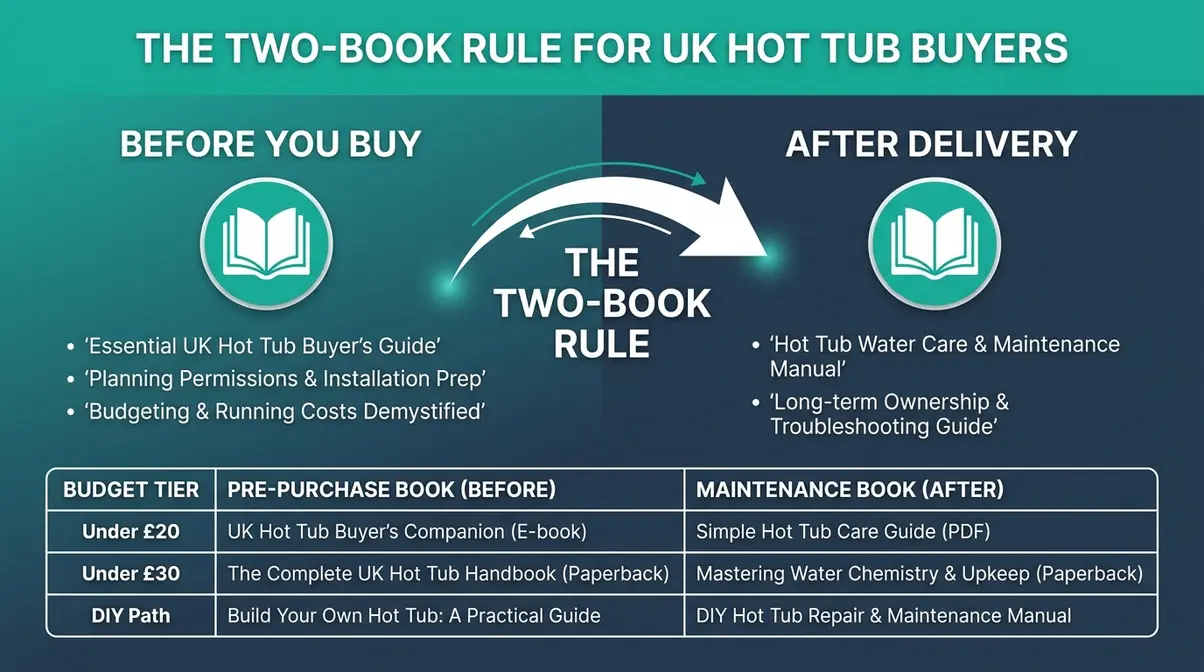
The Two-Book Rule — the insight that most hot tub owners who struggle in year one bought a buying guide but skipped the maintenance manual, or vice versa — is the single most practical framework this roundup can offer. Pre-purchase and post-purchase knowledge are genuinely different skill sets. A buying guide tells you what to choose and why; a maintenance manual tells you what to do once it’s in your garden. Owners who skip either half tend to either buy the wrong tub or fail to maintain the one they bought.
The optimal approach is to pair one pre-purchase guide with one ongoing maintenance reference:
| Budget | Recommended Pairing |
|---|---|
| Under £20 | The Ultimate 2025 Buyer’s Guide + Hot Tub Clarity |
| Under £30 | The Ultimate 2025 Buyer’s Guide + The Hot Tub Guidebook |
| DIY path | Build Your Own Hot Tub + The Newbies Guide to Hot Tub Chemicals |
Prices and specific pairings are based on editorial assessment; individual book prices may vary. Once you’ve chosen your approach, see our ranked list of best small hot tubs for UK gardens and our guide to best plug-and-play hot tubs for specific model recommendations.
Digital vs. Print: Which Format Works Best?
The format you choose matters more than it might seem. Kindle and digital editions are well suited to the pre-purchase research phase — convenient on a phone or tablet during commutes, easy to search, and instantly available. However, a tablet poolside is a water-damage risk, which makes digital a poor choice for ongoing maintenance reference. Paperback editions are the better format for poolside use: they survive splashes, can be annotated, and don’t require a charged device. The practical recommendation: buy your pre-purchase guide digitally for the research phase, then invest in a paperback maintenance manual for long-term poolside reference. For a full breakdown of hot tub prices in the UK including purchase and running costs, see our UK pricing guide.
How We Evaluated
Our editorial team assessed each of these six books against four criteria specific to UK buyers: relevance of content to UK electrical standards (13-amp vs 32-amp), Ofgem running cost context, and typical UK garden access constraints; depth and accuracy of practical guidance; recency of publication relative to current UK standards; and accessibility for the intended reader stage — pre-purchase planning versus post-purchase maintenance. Books were not evaluated on format alone, but on whether their content genuinely moves a UK buyer forward at their specific stage of the ownership journey.
Frequently Asked Questions
How Do You Choose a Hot Tub in the UK?
To choose a small hot tub in the UK, start by assessing your garden access route and the available space — most delivery teams need a clear path of at least 90cm wide. Decide between a 13-amp plug-and-play model, which requires no electrician and runs from a standard socket, or a 32-amp hardwired tub, which offers higher performance but requires a qualified electrician and a dedicated circuit. Factor in long-term running costs based on current Ofgem tariffs, insulation quality, and the number of seats you realistically need. A well-insulated 4-person hard-shell tub typically costs £50–£80 per month to run at current UK energy prices. Visit a local showroom to sit in your shortlisted models before committing — no amount of online research replaces the experience. For a full breakdown of purchase and running costs, see our complete guide to hot tub costs.
What Is the Best Hot Tub Brand in the UK?
The best hot tub brand in the UK depends on your budget and performance requirements. Lay-Z-Spa leads the inflatable market with accessible pricing and widespread availability across major UK retailers. For hard-shell models, Hot Spring, Jacuzzi, and Canadian Spa Co. are consistently rated by UK owners for insulation quality, hydrotherapy performance, and after-sales support. Hard-shell models from premium brands typically last 15–20 years versus 3–5 years for inflatable alternatives — a meaningful difference when calculating total cost of ownership. Visiting a BISHTA-registered dealer ensures you receive compliant, quality-assured products and honest advice on running costs.
What’s the Cheapest Time of Year to Buy a Hot Tub in the UK?
The cheapest time to buy a hot tub in the UK is typically October through February. Retailers clear previous-year stock ahead of spring deliveries, offering end-of-season discounts of 15–30% on many models. January sales and Black Friday promotions also produce significant price reductions on both inflatable and hard-shell ranges. Buying in winter also means faster delivery slots and more flexible installation scheduling, as demand is considerably lower than the spring and summer peaks. Budget for installation costs separately — these are rarely included in advertised prices and can add £300–£800 for a hardwired 32-amp model.
Can a Hot Tub Trigger AFib?
⚠️ Medical Disclaimer: If you have any cardiovascular condition, including atrial fibrillation, consult your GP or cardiologist before using a hot tub. The information below is general context only and does not constitute medical advice.
Hot tubs can pose a cardiovascular risk for people with atrial fibrillation (AFib), primarily because immersion in hot water raises heart rate and lowers blood pressure through vasodilation. The American Heart Association notes that heat stress places additional demand on the heart, which may be significant for those with existing arrhythmias or compromised cardiac function (AHA, 2023). For healthy adults, moderate hot tub use is generally considered safe, but those with AFib, pacemakers, or a history of cardiac events should seek specific medical clearance before use. Water temperature should not exceed 40°C (104°F) regardless of health status — the standard upper limit recommended by UK spa safety guidance. Always consult your doctor before using a hot tub if you have any heart condition.
Do Hot Tubs Reduce Cortisol?
Hot tub use is associated with measurable reductions in cortisol, the body’s primary stress hormone, through the combined effects of heat immersion and hydrotherapy. Research published via the National Institutes of Health (NIH) supports the use of warm water immersion as a means of activating the parasympathetic nervous system, which counteracts the stress response and promotes relaxation (NIH, 2023). Regular sessions of 15–20 minutes at 38–40°C appear to produce the most consistent results in stress reduction studies. However, individual responses vary, and hot tub use should be considered a complementary wellness practice rather than a medical treatment. Those with health conditions should, as always, seek medical advice before beginning a regular hydrotherapy routine.
Conclusion
The right book won’t just answer your questions — it will change the questions you think to ask. Whether you’re still deciding which hot tub to buy or already dealing with cloudy water at 7am on a Sunday, there’s a guide in this roundup built for exactly your stage. Apply The Two-Book Rule: pair a pre-purchase guide with a maintenance manual, and you’ll enter hot tub ownership better prepared than the majority of UK buyers. Start with The Ultimate 2025 Buyer’s Guide, then add The Hot Tub Guidebook or Hot Tub Clarity once your tub arrives.

Dave King
Hot tub tester and writer at One Hot Tub.