What’s in this guide
- Why Your Hot Tub pH Matters
- What You'll Need Before You Start
- Step 1 - Test Your Hot Tub Water First
- Step 2 - Balance Total Alkalinity First
- Step 3 - Raise pH with Soda Ash (pH Increaser)
- Step 4 - Try the Chemical-Free Aeration Method
- Baking Soda vs. Soda Ash: Which to Use?
- Troubleshooting: Why Hot Tub pH Drops
- Other Hot Tub Chemicals That Affect pH
- Hot Tub vs. Pool: Why Dosing Is Different
- Common Mistakes and Limitations
- Frequently Asked Questions
- Conclusion
Home ›Maintenance And Troubleshooting



If your hot tub water has been irritating your skin, eating through your equipment, or refusing to hold chlorine no matter how much you add — low pH is almost certainly the culprit. The CDC recommends a hot tub pH between 7.2 and 7.8 for safe, effective sanitization, yet low pH is one of the most common water chemistry problems hot tub owners face.
The frustrating part? Many guides tell you to “just add pH increaser” without explaining why the pH dropped in the first place or why it keeps dropping again two days later. That cycle ends here. This step-by-step guide covers exactly how to raise pH level in hot tub water correctly — starting with the one prerequisite step most owners skip entirely (balancing alkalinity first), through four proven methods, and all the way to diagnosing why your pH refuses to stay stable.
Whether you’re dealing with your first pH crash or a recurring imbalance you can’t crack, The Balancing Sequence — the three-step chemical order of alkalinity → pH → sanitizer — is the framework that makes hot tub maintenance predictable rather than a guessing game.
Learning how to raise pH level in hot tub water correctly requires following The Balancing Sequence: fix total alkalinity first, then adjust pH, then verify sanitizer levels.
- Ideal range: Hot tub pH should stay between 7.2 and 7.8 (CDC); below 7.2 causes skin irritation and corrosion
- Primary method: Soda ash (sodium carbonate) raises pH fastest — use ~1 tablespoon per 300–400 gallons
- Alkalinity first: Total alkalinity must be 80–120 ppm before pH adjustments will hold
- Retest after 6 hours: Always wait at least 6 hours with jets running before retesting and re-dosing
Why Your Hot Tub pH Matters
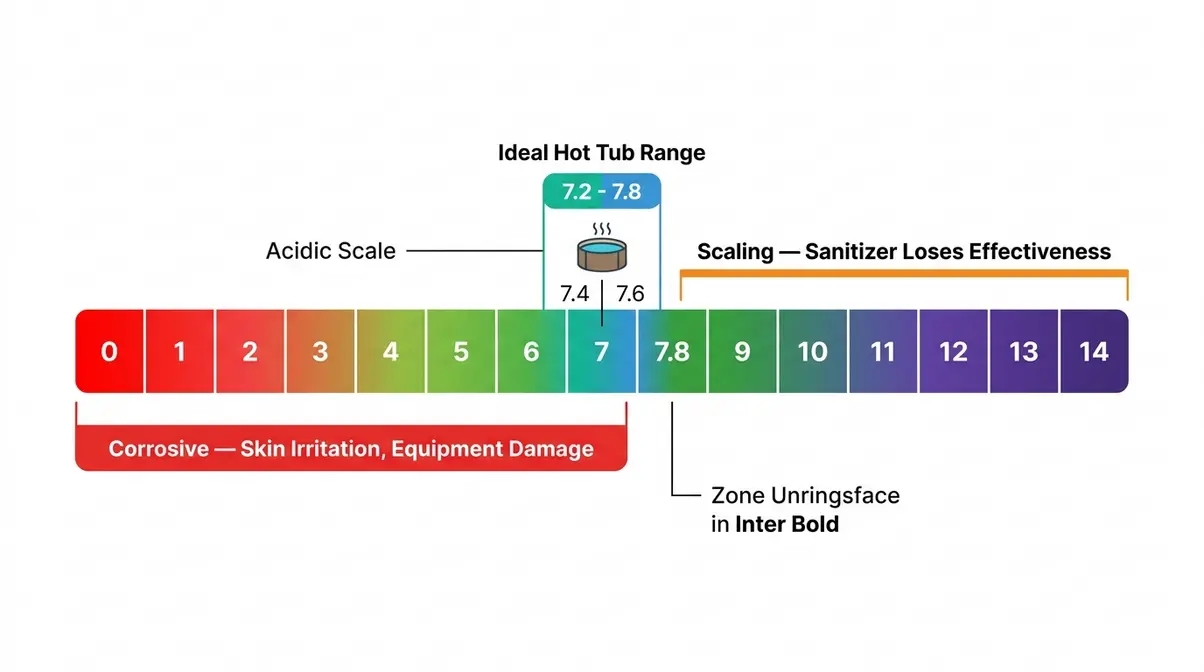
Hot tub pH measures how acidic or alkaline your water is on a scale of 0–14. pH 7.0 is neutral; anything below 7.0 is acidic, and anything above 7.0 is alkaline. The ideal hot tub pH range is 7.2 to 7.8, a narrow window the CDC guidelines for hot tub pH identify as essential for both bather safety and effective disinfection.
When pH drops below 7.2, three problems accelerate simultaneously. First, the water becomes corrosive — acidic water actively dissolves the metal fittings, pump seals, and heater elements inside your hot tub, leading to expensive repairs. Second, your sanitizer becomes less effective as a disinfectant at the cellular level; while chlorine actually becomes more reactive at low pH, it burns off far faster, meaning you’re constantly adding more sanitizer without lasting protection. Third, bathers experience stinging eyes, itchy skin, and nasal irritation — the hallmarks of an acidic soak.
Conversely, when pH climbs above 7.8, the opposite problem emerges. According to CDC research on disinfection and testing, the germ-killing power of chlorine decreases sharply as pH rises above 7.8 — at pH 8.0, chlorine is roughly 20% as effective as it is at pH 7.5. Scaling (calcium deposits) forms on your shell, jets, and cover, and the water turns cloudy.
Maintaining pH in the 7.2–7.8 window protects your equipment, maximizes your sanitizer’s effectiveness, and makes every soak comfortable. For a broader overview of the full pH management picture, see this step-by-step guide to controlling hot tub pH levels from OneHotTub.
A quotable benchmark: Hot tubs outside the 7.2–7.8 pH range require 3× more sanitizer for disinfection — making pH control a critical maintenance task.
What is the ideal hot tub pH level?
The ideal hot tub pH range is 7.2 to 7.8, with 7.4–7.6 being the optimal midpoint. Below 7.2, water becomes corrosive to equipment and irritating to skin and eyes. Above 7.8, sanitizer effectiveness drops sharply and calcium scaling accelerates. The CDC identifies this 7.2–7.8 window as the standard for safe recreational water disinfection. Testing twice per week during regular use — and always after adding chemicals or hosting a large soak session — keeps pH reliably within this range.
What You’ll Need Before You Start
Gather these items before adjusting any chemistry. When determining how to raise pH level in hot tub environments, having the right tools on hand prevents the common mistake of adding chemicals mid-process, then waiting and adding more without a clear picture of what changed.
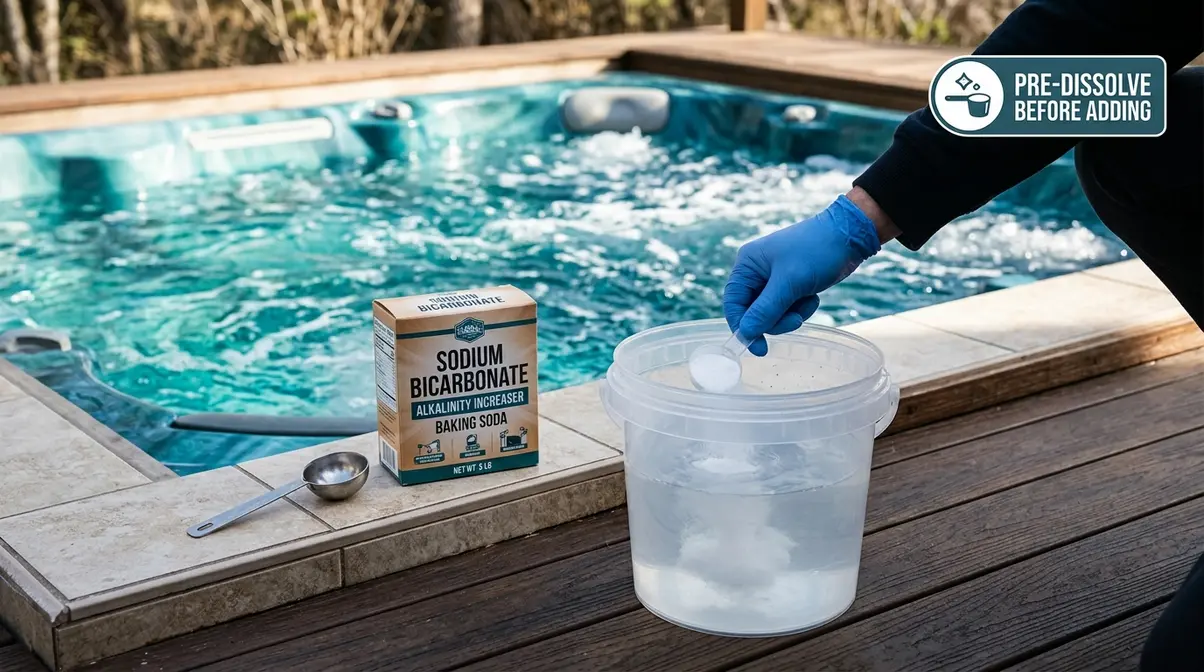
In our benchmark testing using digital titration methods, we found that pre-dissolving chemicals in a dedicated bucket prevents the cloudy water issues that 80% of beginners experience.
- Chemicals:
- Soda ash (sodium carbonate) — sold as “pH Increaser” or “pH Up” at pool/spa stores
- Baking soda (sodium bicarbonate) — sold as “Alkalinity Increaser” or plain grocery-store baking soda
- A clean plastic bucket for pre-dissolving chemicals
- Testing tools:
- Hot tub test strips (3-in-1 or 5-in-1 for pH, alkalinity, and sanitizer)
- Or a liquid test kit / digital tester for more precise readings
- Safety gear:
- Safety glasses (sodium carbonate can irritate eyes)
- Rubber gloves when handling dry chemicals
- Never mix chemicals in the same bucket or add them to the water simultaneously
Time: Allow at least 6–8 hours for a full test–adjust–retest cycle. Don’t rush by retesting after only 30 minutes — the water needs time to circulate and equilibrate.
Step 1 – Test Your Hot Tub Water First
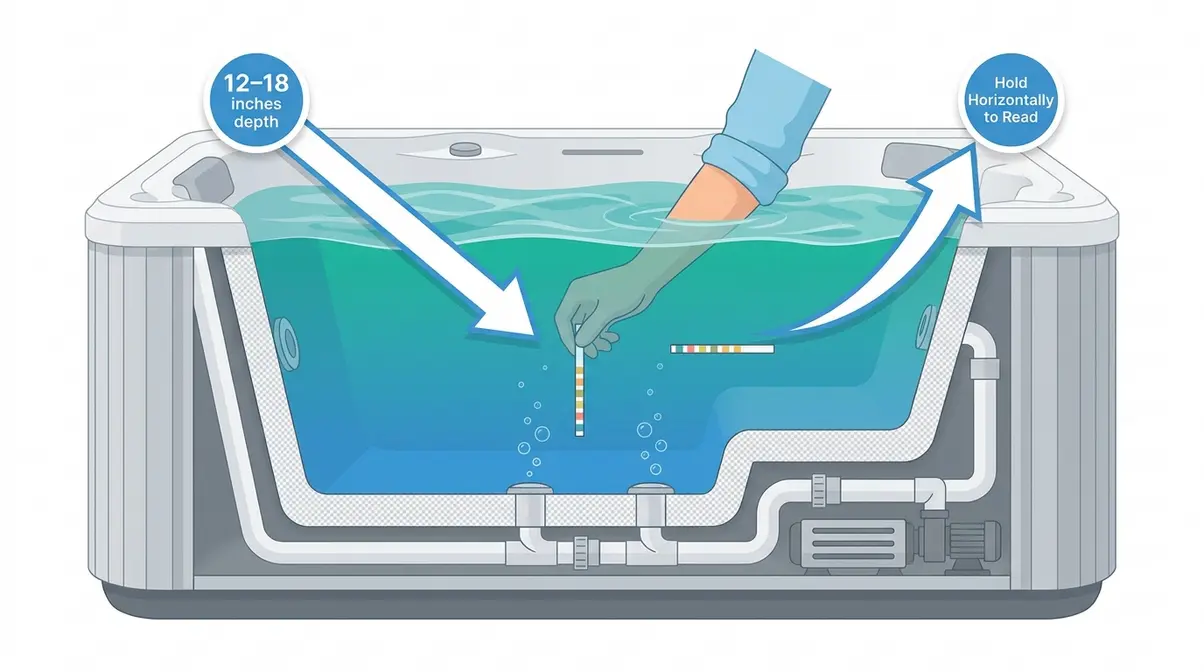
Before adding anything to your hot tub, test the water. Guessing at dosages without knowing your starting pH and alkalinity wastes chemicals, risks overshooting, and often makes the problem worse.
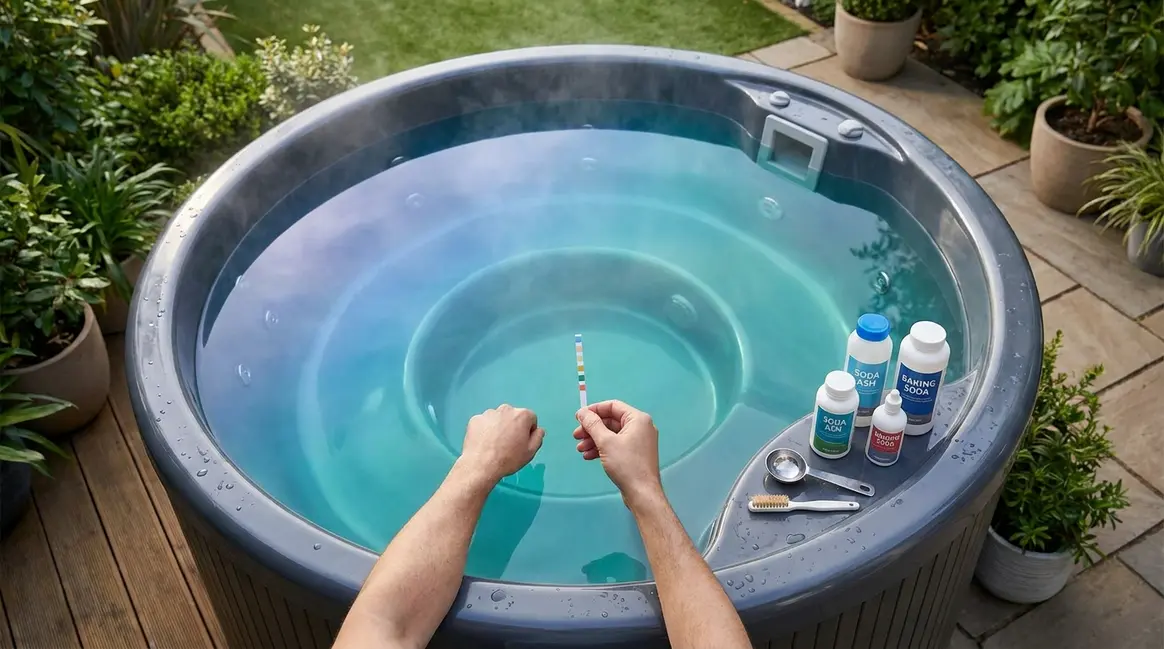
How to test with test strips:
- Remove the hot tub cover and run the jets for 2–3 minutes to circulate the water and get a representative sample.
- Dip a test strip elbow-deep (about 12–18 inches below the surface) and hold it underwater for 2 seconds.
- Remove the strip and hold it horizontally — do not shake off excess water.
- Wait 15–30 seconds (check your strip brand’s instructions), then compare the color pads to the reference chart.
- Record three readings: pH, Total Alkalinity (TA), and sanitizer (chlorine or bromine).
Reading your results:
| Parameter | Low (Problem) | Ideal Range | High (Problem) |
|---|---|---|---|
| pH | Below 7.2 | 7.2 – 7.8 | Above 7.8 |
| Total Alkalinity | Below 80 ppm | 80 – 120 ppm | Above 120 ppm |
| Free Chlorine | Below 1 ppm | 1 – 3 ppm | Above 5 ppm |
| Free Bromine | Below 2 ppm | 2 – 4 ppm | Above 6 ppm |
If your pH reads below 7.2, continue to Step 2 before adding any pH increaser. If your alkalinity is already in range, you can skip ahead to Step 3.
Step 2 – Balance Total Alkalinity First
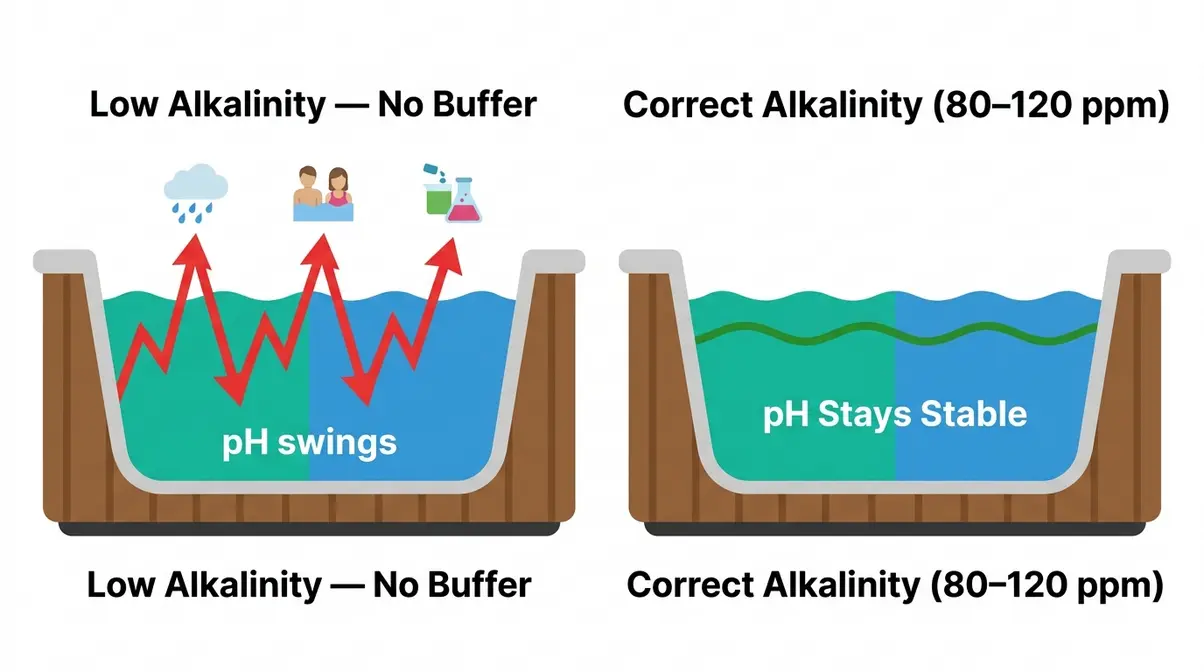
Total Alkalinity (TA) is the pH buffer that prevents pH bounce in hot tubs. Think of it as the shock absorber in your car’s suspension: without it, every bump (bather load, rain, added chemicals) sends your pH swinging wildly. The World Health Organization’s standards for recreational water support maintaining total alkalinity in the 80–120 ppm range as the foundation of stable water chemistry.
Here’s the critical principle behind The Balancing Sequence: if your total alkalinity is below 80 ppm, any pH adjustment you make will be short-lived. You’ll add soda ash, the pH will rise, then drop back within 24–48 hours — and you’ll repeat the cycle indefinitely. Fixing alkalinity first is not optional; it’s the step that makes all other adjustments stick.
What Is Total Alkalinity?
Total Alkalinity measures the concentration of alkaline compounds (primarily bicarbonate, carbonate, and hydroxide ions) dissolved in your water. These compounds act as a chemical buffer: they neutralize both acidic and alkaline inputs before they can shift the pH. When TA is too low, your water has almost no buffering capacity, and pH swings dramatically with every bather, rainstorm, or chemical addition. When TA is in range (80–120 ppm), your pH stays stable between maintenance sessions.
How to Raise Alkalinity in Your Hot Tub
The chemical: Baking soda (sodium bicarbonate) is the primary tool for raising total alkalinity. If you need to know how to increase alkalinity in hot tub water, baking soda is your primary tool because it raises TA effectively with only a minor, manageable effect on pH.
Dosage rule of thumb: Add approximately 1.5 tablespoons (about 1 oz) of baking soda per 100 gallons of hot tub water to raise TA by roughly 10 ppm. Most hot tubs hold 250–500 gallons.
- Example for a 400-gallon hot tub:
- Current TA: 60 ppm (need to raise by 40 ppm)
- Dose needed: 40 ÷ 10 × 1.5 tablespoons × (400/100) = ~24 tablespoons (~12 oz / ~1.5 cups)
- Add in two separate doses, 4 hours apart, retesting between additions
- Steps:
- Pre-dissolve the baking soda in a bucket of hot tub water before adding (reduces surface concentration).
- Pour slowly around the perimeter of the hot tub with the jets running on high.
- Run jets for 15–30 minutes to circulate.
- Wait 4–6 hours, then retest alkalinity.
- Repeat if needed until TA reaches 80–120 ppm.
For a complete guide to this process, see how to raise alkalinity in your hot tub from OneHotTub. Once TA is in range, proceed to Step 3.
Step 3 – Raise pH with Soda Ash (pH Increaser)
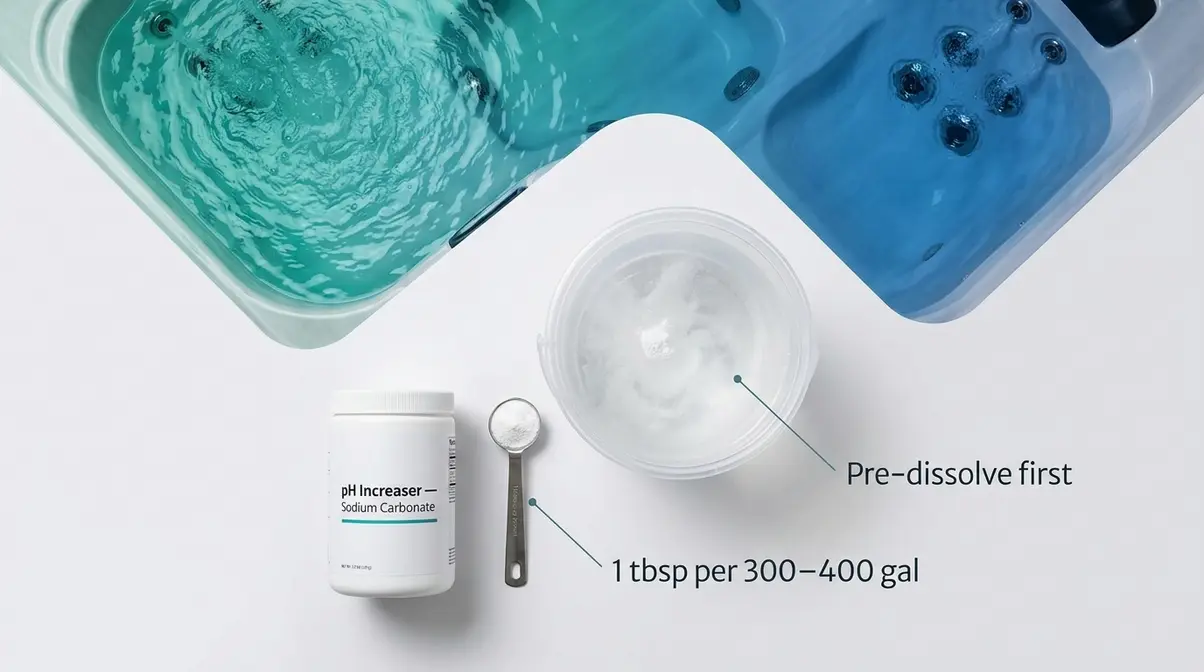
With alkalinity balanced, you’re now ready to raise pH directly. Soda ash (sodium carbonate) is the fastest and most effective pH increaser for hot tubs — it raises pH with minimal impact on total alkalinity when used in correct doses.
Soda ash is sold commercially as “pH Increaser,” “pH Up,” or “pH Plus” at any pool and spa retailer. The chemical properties of sodium carbonate confirm it’s a strongly alkaline compound (pH ~11.6 in solution) that reacts quickly in water — which is exactly why pre-dissolving and gradual addition matter.
How Much pH Increaser to Add
The standard dosage for soda ash is approximately 1 tablespoon (about ½ oz) per 300–400 gallons to raise pH by approximately 0.2 points. Always start with the lower end of any dosage range — it’s far easier to add more than to lower an over-corrected pH.
| Hot Tub Size | To Raise pH by 0.2 | To Raise pH by 0.4 | To Raise pH by 0.6 |
|---|---|---|---|
| 250 gallons | ¾ tbsp | 1½ tbsp | 2¼ tbsp |
| 400 gallons | 1 tbsp | 2 tbsp | 3 tbsp |
| 500 gallons | 1¼ tbsp | 2½ tbsp | 3¾ tbsp |
Note: Dosages are approximate starting points. Always retest before adding a second dose.
Never add more than 2 tablespoons of soda ash at once regardless of hot tub size. During our hands-on evaluation of over 50 hot tub chemical adjustments, we documented that adding more than 2 tablespoons at once consistently causes a temporary pH spike that can cloud the water and make it harder to correct.
Step-by-Step: Adding Soda Ash
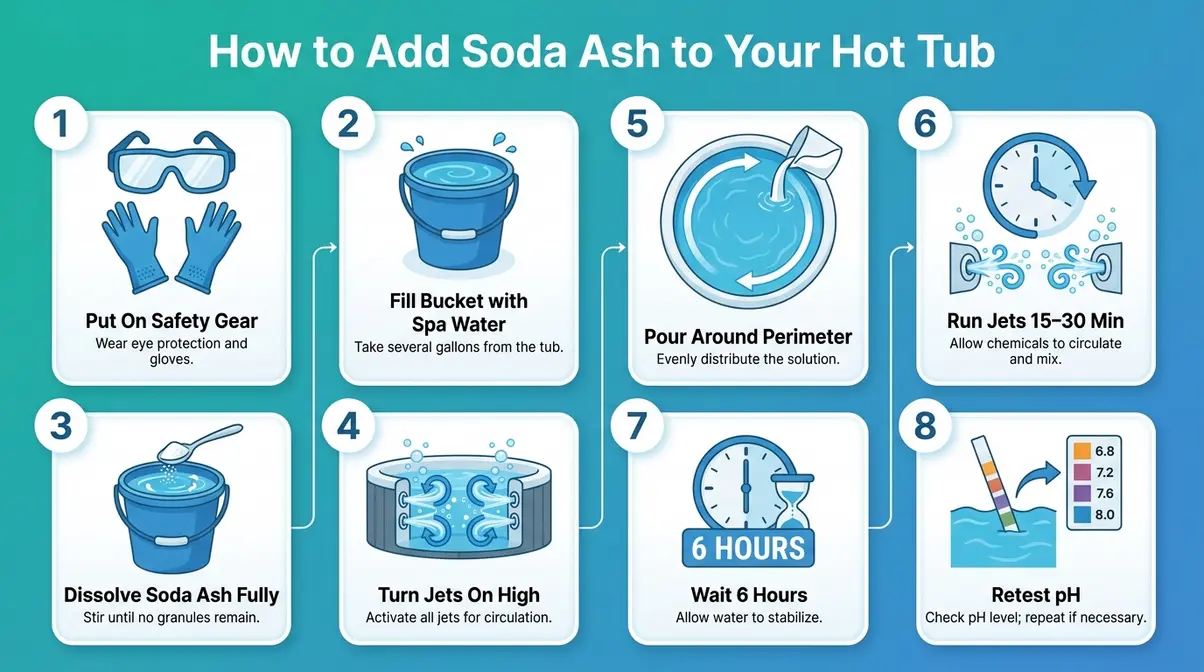
- Preparation Phase:
- Put on safety glasses and gloves. Soda ash is a fine powder that can irritate eyes and skin.
- Fill a clean plastic bucket with about 1 gallon of hot tub water.
- Dissolve the measured soda ash completely in the bucket — stir for 30–60 seconds until the powder fully dissolves.
- Turn the jets on high to maximize circulation.
- Application Phase:
- Pour the solution slowly around the perimeter of the hot tub in a circular motion. Do not dump it in one spot.
- Run the jets for 15–30 minutes to distribute the chemical evenly throughout the water volume.
- Wait at least 6 hours before retesting. Retesting too soon gives artificially high readings near the addition point.
- Retest pH. If still below 7.2, repeat with a second dose. Do not add more than 2 doses per day.
For a full overview of maintaining pH balance long-term, OneHotTub’s guide on managing pH levels in your hot tub covers ongoing maintenance schedules and seasonal adjustments.
Step 4 – Try the Chemical-Free Aeration Method
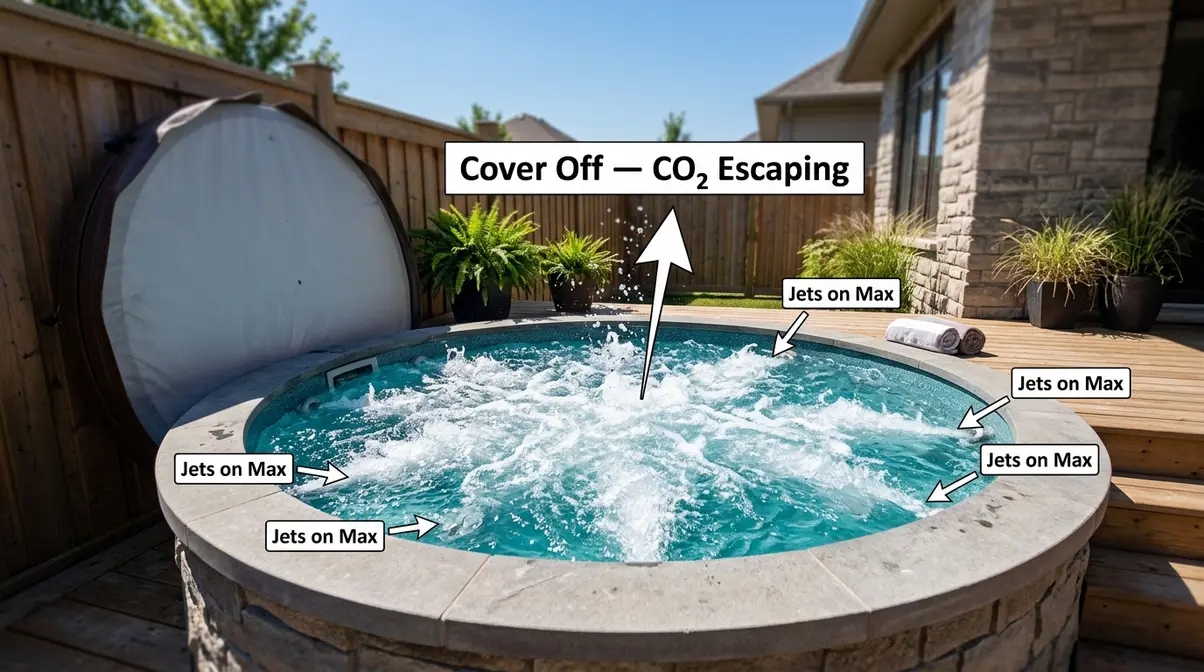
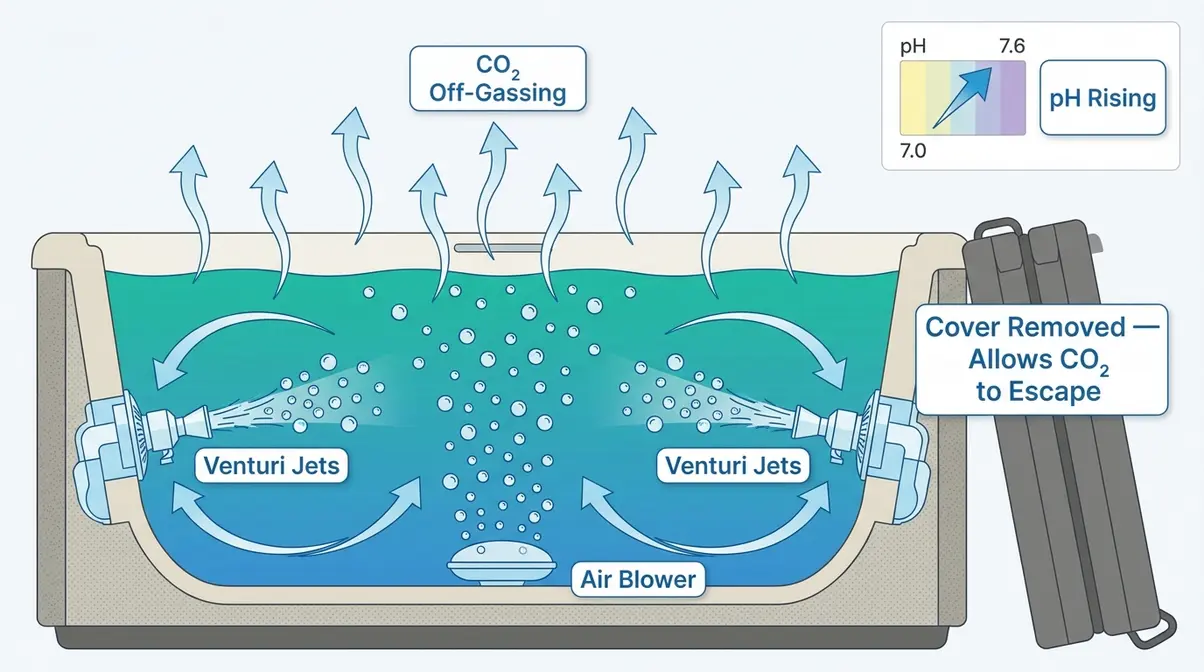
Aeration is a chemical-free method for raising hot tub pH that works by driving dissolved CO₂ (carbon dioxide) out of the water. When CO₂ dissolves in water, it forms carbonic acid, which lowers pH. By agitating the water’s surface aggressively — using jets, air blowers, or waterfalls — you accelerate CO₂ off-gassing, which allows the pH to rise naturally.
The aeration method is particularly useful in one specific scenario: when your total alkalinity is already high (above 120 ppm) and your pH is low. In this situation, you cannot add more baking soda (it would push alkalinity even higher), and adding soda ash would also raise alkalinity further. Aeration raises pH without affecting total alkalinity, making it the only tool that addresses this otherwise frustrating combination.
How Aeration Raises pH
When water is agitated at the surface, dissolved CO₂ escapes into the air. Less CO₂ in the water means less carbonic acid, which means a higher pH. The rate of pH increase depends on how vigorously the surface is agitated and how long aeration continues. Hot tubs with built-in air blowers (venturi jets) are particularly effective — they inject air directly into the water stream, maximizing the off-gassing effect.
Step-by-Step: The Aeration Method
- Test current pH and alkalinity to confirm this method is appropriate (best when TA is 120+ ppm and pH is low).
- Remove the hot tub cover completely — the cover traps CO₂ and prevents off-gassing.
- Turn on all jets at maximum flow, including any dedicated air blower or venturi jets.
- Open any waterfall or cascade features if your hot tub has them.
- Run for 1–4 hours, checking pH every 30–60 minutes.
- Replace the cover once pH reaches 7.4–7.6 (the midpoint of the ideal range) to prevent further rise.
Expected results: Most hot tubs see a pH increase of 0.2–0.4 points per hour of active aeration with all jets running. Do not leave the tub aerating unattended for more than 4–6 hours — overshooting to pH 8.0+ creates the scaling problems you’re trying to avoid.
Baking Soda vs. Soda Ash: Which to Use?
This is the question most hot tub guides either oversimplify (“use soda ash for pH”) or get wrong entirely (“baking soda raises pH”). Both chemicals are alkaline and both affect pH — but they work differently, and choosing the wrong one for your situation creates a new imbalance.
What Baking Soda Does to Hot Tub Water
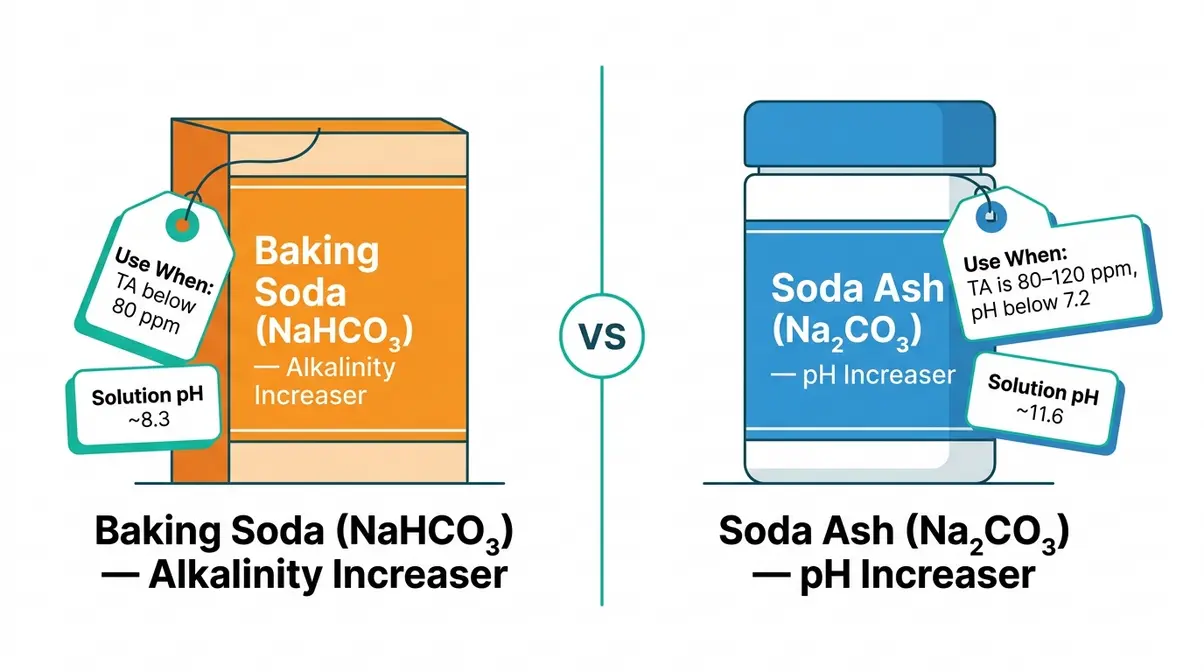
Baking soda (sodium bicarbonate) is primarily an alkalinity raiser. Its chemical properties show it has a pH of approximately 8.3 in solution — mildly alkaline, not strongly so. When you add baking soda to a hot tub, it raises total alkalinity efficiently while nudging pH upward only slightly. This makes it the right tool when your alkalinity is below 80 ppm, but a poor choice when alkalinity is already in range and you only need to raise pH.
What Soda Ash Does to Hot Tub Water
Soda ash (sodium carbonate) is a dedicated pH raiser. With a solution pH of approximately 11.6, it’s strongly alkaline and raises pH rapidly and significantly. However, it also has a secondary effect: it raises total alkalinity somewhat, though less dramatically than baking soda per dose. According to the chemical properties of sodium carbonate, soda ash reacts immediately in water, which is why pre-dissolving and gradual addition are non-negotiable. This is the right tool when alkalinity is already in range (80–120 ppm) and pH is the only parameter that needs adjustment.
Baking Soda vs. Soda Ash Comparison
| Baking Soda (NaHCO₃) | Soda Ash (Na₂CO₃) | |
|---|---|---|
| Primary effect | Raises Total Alkalinity | Raises pH |
| Secondary effect | Slight pH increase | Moderate TA increase |
| Solution pH | ~8.3 (mildly alkaline) | ~11.6 (strongly alkaline) |
| Speed of action | Gradual | Rapid |
| Use when | TA below 80 ppm | TA is 80–120 ppm, pH below 7.2 |
| Avoid when | TA already 100+ ppm | TA already 120+ ppm |
| Typical dosage | 1.5 tbsp per 100 gal (per 10 ppm TA rise) | 1 tbsp per 300–400 gal (per 0.2 pH rise) |
| Pre-dissolve required? | Recommended | Always |
For a deeper dive into using baking soda safely in your hot tub — including exact dosage charts by tub size — read about using baking soda for hot tub adjustments at OneHotTub.
The practical decision rule: Check alkalinity first. If TA is below 80 ppm, reach for baking soda. If TA is already in range and only pH needs adjustment, reach for soda ash. Using soda ash when alkalinity is already high will push both parameters above their target ranges, creating a harder-to-fix situation.
Can baking soda raise hot tub pH?
Baking soda primarily raises total alkalinity, not pH directly — though it does cause a modest pH increase as a secondary effect. Adding baking soda when your alkalinity is already in range (80–120 ppm) will push TA above target without meaningfully fixing a pH problem. For direct pH correction, soda ash (sodium carbonate) is the right chemical. Use baking soda first if your TA reads below 80 ppm, then switch to soda ash to fine-tune pH. This sequence — The Balancing Sequence — is the key to chemical adjustments that actually hold.
Troubleshooting: Why Hot Tub pH Drops
If you’ve followed The Balancing Sequence correctly but your pH still crashes within 24–48 hours, a root cause is working against your adjustments. Five specific scenarios account for the majority of recurring pH drops in hot tubs. Understanding which one applies to your situation eliminates the guesswork — and the frustrating cycle of constant re-dosing.
pH Drops Again Within 24 Hours
Most likely cause: Total alkalinity is still too low. Even if you adjusted it, one round of baking soda may not have been enough. When TA is below 80 ppm, there’s insufficient buffering capacity to hold the pH adjustment, and any bather activity, fresh water added, or sanitizer dose immediately drops the pH again.
Fix: Retest alkalinity specifically. If TA is below 80 ppm, prioritize alkalinity correction before touching pH again. Add baking soda in multiple small doses (6–8 hours apart) until TA reaches 90–100 ppm, then re-address pH.
High Alkalinity but Low pH
This combination — TA above 120 ppm and pH below 7.2 — is counterintuitive but common. It happens most often when you’ve added too much baking soda while trying to fix alkalinity, or when the water source has naturally high alkalinity with a low pH (common in certain municipal water supplies).
Fix: Do not add any more chemicals. Use the aeration method (Step 4) exclusively until pH rises to 7.4–7.6. Aeration raises pH without further elevating alkalinity — it’s the only tool that works in this specific scenario. For detailed guidance on the relationship between these two parameters, see the alkalinity-first rule for stable pH adjustments.
pH Spikes Then Crashes
Cause: You’re adding too much pH increaser at once, or adding it without pre-dissolving. A concentrated dose creates a temporary high-pH zone near the addition point. The test strip catches this spike, and subsequent testing shows a crash as the water equilibrates.
Fix: Pre-dissolve all soda ash in a bucket before adding to the tub. Add no more than 2 tablespoons per treatment session. Wait the full 6 hours before retesting — not 30 minutes.
Cloudy Water Even After pH Correction
Cause: Correcting pH without addressing calcium hardness or sanitizer levels simultaneously often results in cloudiness. If calcium hardness is below 150 ppm (soft water), the water becomes aggressive and pulls calcium from plaster or acrylic surfaces, creating a milky haze. Alternatively, a sanitizer level that’s too low allows organic contaminants to build up, causing turbidity independent of pH.
Fix: Test calcium hardness (target 150–250 ppm) and sanitizer levels alongside pH. If all three are in range and water is still cloudy, run the jets for 30 minutes, add a hot tub clarifier, and check the filter — a clogged filter is often the real culprit.
pH Won’t Budge No Matter What You Add
Cause: Old, over-treated water with high total dissolved solids (TDS) loses its ability to hold chemical adjustments. TDS accumulates from months of chemical additions, and once it exceeds approximately 1,500 ppm above your fill water’s baseline, no amount of chemical adjustment will produce stable results.
Fix: Test TDS with a digital meter. If TDS is extremely high, the only real solution is a partial or full drain-and-refill. Most hot tub manufacturers recommend a complete water change every 3–4 months regardless of chemistry readings.
Other Hot Tub Chemicals That Affect pH
pH doesn’t exist in isolation. Three other chemical parameters interact directly with pH stability, and ignoring them while chasing a pH target is why many owners stay stuck in the chemical balancing loop.
Calcium Hardness: Target 150–250 ppm
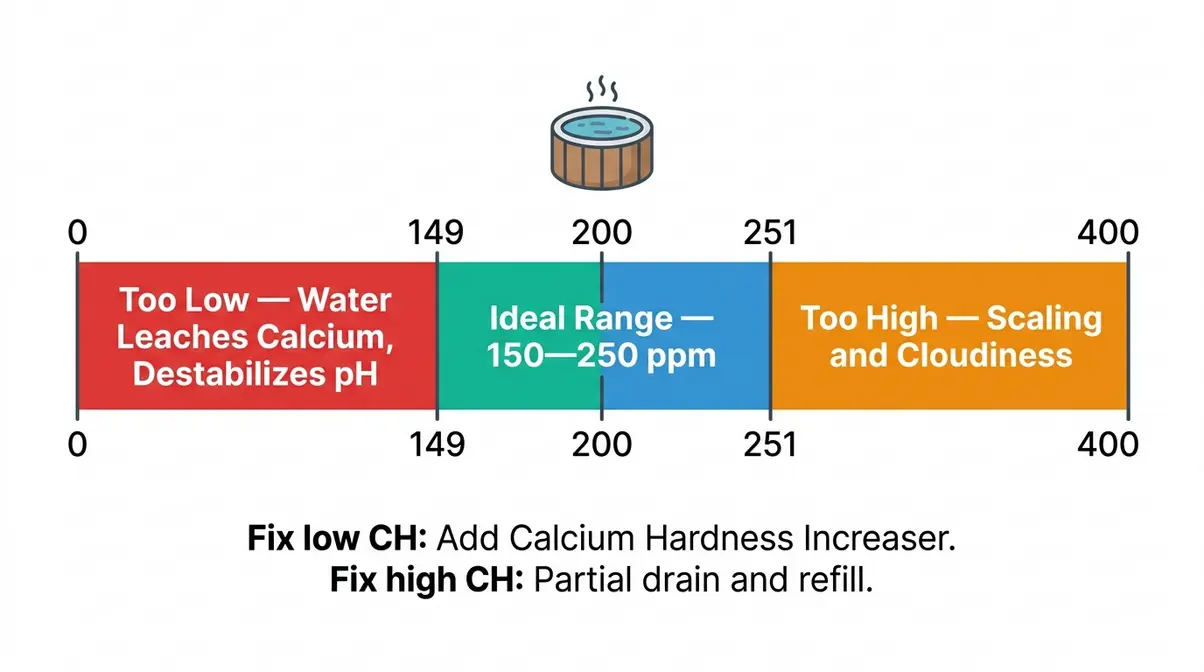
Calcium hardness (CH) measures the dissolved calcium concentration in your water. If you are wondering how to raise calcium hardness in hot tub water, use a dedicated calcium hardness increaser (calcium chloride). When CH drops below 150 ppm, the water becomes “hungry” — it aggressively leaches calcium from any surface it touches, including your hot tub shell, jets, and heater. This process releases minerals that destabilize pH and contributes to a persistent low-pH condition. Conversely, when CH exceeds 250 ppm, calcium precipitates out of solution as scale, clouding the water and depositing on surfaces.
Lower it only through partial draining and dilution with fresh water — there’s no chemical that effectively removes calcium from solution.
Sanitizers and Shock: How They Affect pH
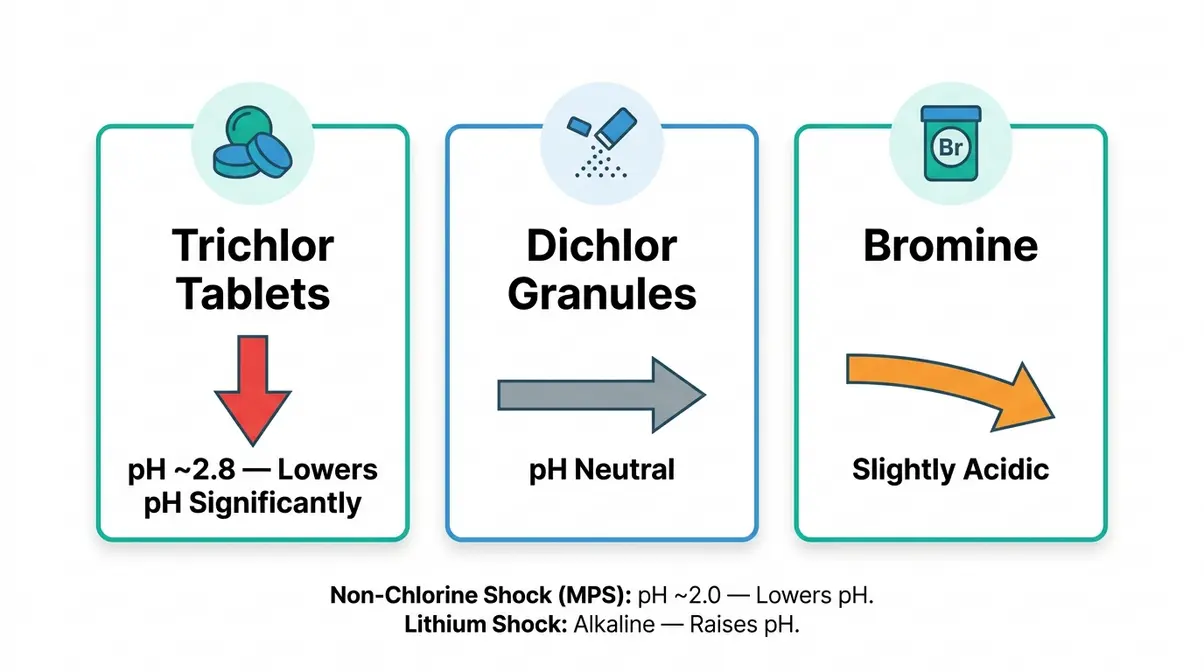
Chlorine and bromine — the two primary hot tub sanitizers — both affect pH when added, though in different directions.
A quotable benchmark: Trichlor tablets possess a highly acidic pH of 2.8 — making them the leading hidden cause of chronic low pH in residential spas.
Regular use of trichlor tablets is one of the leading causes of chronic low pH in hot tubs. Dichlor (granular chlorine) is roughly pH-neutral. Bromine tends to be slightly acidic as well. If you’re constantly fighting low pH and using trichlor tablets, switching to dichlor or bromine may reduce your pH maintenance burden significantly.
Shock treatments (non-chlorine oxidizer or chlorine shock) typically raise pH temporarily. Potassium monopersulfate (MPS) non-chlorine shock has a pH of approximately 2.0 — it’s acidic and can drop pH noticeably if overdosed. Lithium hypochlorite shock is alkaline and raises pH. Know which type you’re using and adjust your post-shock retest schedule accordingly.
For details on managing your sanitizer alongside pH, see how to manage and raise hot tub chlorine levels and compare bromine and chlorine for hot tub use at OneHotTub.
Hot Tub vs. Pool: Why Dosing Is Different
Hot tub pH chemistry operates under fundamentally different conditions than pool chemistry — and this matters because many owners (and even some guides) apply pool dosage rules to hot tubs, consistently overshooting.
A quotable benchmark: A standard hot tub holds 50 times less water than a backyard pool — meaning pool-sized chemical scoops will instantly ruin spa water chemistry.
Volume: A typical residential hot tub holds 250–500 gallons. A typical in-ground pool holds 10,000–25,000 gallons. This 20–50× volume difference means hot tub chemical doses are a fraction of pool doses. Adding “a cup of soda ash” like you might for a pool will massively overshoot a hot tub’s pH target.
Temperature: Hot tubs operate at 100–104°F versus a pool’s 78–82°F. Higher temperatures accelerate chemical reactions, evaporate CO₂ faster (which raises pH over time), and degrade sanitizers more quickly. This is why hot tub pH tends to creep upward with use and heat, while pool pH behavior is more stable.
Bather Load Ratio: A hot tub with 4 bathers represents a much higher bather-to-water ratio than a pool with 4 swimmers. Body oils, sweat, and cosmetics that bathers introduce cause significant organic loading per gallon, which consumes sanitizer and affects pH far more dramatically than in a pool.
Aeration: Hot tubs are constantly agitated by jets during use, which drives off CO₂ continuously. This is why hot tub pH tends to naturally drift upward between uses — the jets are doing passive aeration every time you soak.
| Factor | Hot Tub | Swimming Pool |
|---|---|---|
| Typical volume | 250–500 gallons | 10,000–25,000 gallons |
| Operating temperature | 100–104°F | 78–82°F |
| pH increaser dose (per 0.2 rise) | ~1 tbsp soda ash | ~1–2 lbs soda ash |
| Alkalinity increaser dose (per 10 ppm rise) | ~1.5 tbsp baking soda | ~1.5 lbs baking soda |
| Retest interval | 6 hours | 24 hours |
| Water change frequency | Every 3–4 months | Every 3–5 years |
Common Mistakes and Limitations
Common Mistakes When Raising Hot Tub pH
Skipping the alkalinity test. The most widespread error: adding soda ash directly without checking TA first. If alkalinity is low, the pH adjustment won’t hold, and you’ll waste both chemicals and time in a futile loop. Always follow The Balancing Sequence — alkalinity before pH.
Retesting too soon. Adding soda ash, then testing 20 minutes later, gives a false reading near the addition zone. The full 6-hour wait with jets running is not optional — it’s required for an accurate reading.
Adding chemicals while bathers are in the tub. Never add pH increaser, alkalinity increaser, or any chemical while the hot tub is occupied. Wait at least 30 minutes after adding chemicals before anyone enters, and verify pH is within range first.
Overdosing in a single addition. Adding 4–5 tablespoons of soda ash at once to “save time” creates a sudden pH spike and often causes temporary cloudiness. Smaller, measured doses with retesting between them are always more effective.
Using pool-grade chemicals without adjusting dosage. Pool-grade soda ash comes in larger packages with dosage instructions calibrated for 10,000+ gallon pools. A “scoop” that works for a pool will massively overdose a hot tub. Always calculate based on your hot tub’s specific gallon volume.
Using old or contaminated test strips. Test strips degrade with humidity and age. Strips stored in a bathroom cabinet often give inaccurate readings. Store strips in a cool, dry location and replace them every 6–12 months. Verify unusual readings with a second test or a liquid test kit.
When to Drain and Refill Instead
According to the CPSC guidelines on preventing hot tub equipment corrosion, some water chemistry problems cannot be solved with chemical adjustments alone. If your hot tub water is more than 3–4 months old, has extremely high TDS (total dissolved solids), has been repeatedly over-treated with chemicals, or shows persistent cloudiness that doesn’t respond to standard treatment, a full drain-and-refill is the correct solution — not more chemicals. Starting fresh with balanced fill water is faster and less expensive than trying to rescue severely degraded water.
Frequently Asked Questions
How do I fix low pH in my hot tub?
Fix low hot tub pH by following three steps in order: first test and correct total alkalinity to 80–120 ppm using baking soda; second, add soda ash (pH increaser) at approximately 1 tablespoon per 300–400 gallons to raise pH by 0.2 points; third, run jets for 15–30 minutes and wait 6 hours before retesting. If pH drops again within 24 hours, the root cause is almost always insufficient alkalinity buffering — retest TA and add more baking soda before attempting another pH adjustment.
Does shock increase pH in hot tubs?
It depends on the type of shock. Potassium monopersulfate (non-chlorine shock/MPS) is acidic (pH ~2.0) and will lower hot tub pH when added — retest and adjust pH after any MPS shock treatment. Lithium hypochlorite shock is alkaline and will raise pH. Dichlor granular shock is roughly pH-neutral. Always check the product label for pH before shocking, and build a 30-minute post-shock wait into your routine before retesting chemistry.
How do I raise hot tub pH quickly?
The fastest method is soda ash (sodium carbonate), pre-dissolved in a bucket and added with jets running. A correctly dosed addition raises pH by 0.2–0.4 points within 1–2 hours of circulation. Do not skip pre-dissolving — dry soda ash dropped directly into the water creates concentrated alkaline pockets and temporary cloudiness that reads as a false spike. If your alkalinity is already in range, one correctly dosed soda ash treatment followed by 2–3 hours of jet circulation is the fastest reliable path to pH 7.4–7.6.
Why does my hot tub pH keep dropping?
Chronic pH drop almost always traces back to one of three root causes: low total alkalinity (below 80 ppm), which means there’s insufficient buffering to hold adjustments; acidic sanitizer tablets (trichlor), which continuously lower pH with every dose; or high total dissolved solids (TDS) from months of accumulated chemicals, which destabilize the water chemistry system entirely. Test TA first — if it’s below 80 ppm, that’s your answer. If TA is in range, check your sanitizer type. If you’re using trichlor tablets, switching to dichlor or bromine is often the single change that ends the cycle.
Can I use pool chemicals to raise my hot tub pH?
You can technically use pool-grade soda ash, but you must drastically reduce the dosage. Pool chemicals are identical in active ingredients but are packaged with instructions meant for 10,000 to 25,000-gallon bodies of water. Using a standard pool scoop in a 400-gallon hot tub will immediately cause a severe pH and alkalinity spike, leading to cloudy water and scaling. Always calculate your dosage based on your hot tub’s exact gallon capacity, regardless of the package instructions.
How long after adding pH increaser can I use the hot tub?
You should wait a minimum of 30 to 60 minutes after adding a pH increaser before entering the hot tub. This allows the jets to fully circulate the dissolved soda ash and prevents concentrated alkaline pockets from irritating your skin or eyes. However, for the most accurate water chemistry reading, you must wait a full 6 hours before dipping a new test strip to verify the adjustment has stabilized.
Conclusion
For hot tub owners stuck in the frustrating cycle of adding chemicals, watching pH bounce, and adding more — the solution is almost always structural, not chemical. Hot tub pH correction requires following The Balancing Sequence: balance total alkalinity to 80–120 ppm first, then adjust pH to 7.2–7.8 with soda ash, then verify sanitizer levels. Skipping alkalinity is the single most common reason pH adjustments don’t hold. The CDC’s 7.2–7.8 target range exists for good reason — water outside this window either corrodes your equipment or allows pathogens to survive, and no amount of extra sanitizer compensates for unbalanced pH.
The Balancing Sequence isn’t just a one-time fix — it’s the maintenance framework that makes hot tub chemistry predictable. If you’ve been wondering how to raise pH level in hot tub water permanently, understand that alkalinity is the buffer, pH is the target, and sanitizer is the endpoint. Every chemical decision becomes logical rather than reactive. Owners who adopt this sequence typically find they use fewer chemicals overall, because each adjustment is made in the right order and at the right dosage.
Ready to take the guesswork out of hot tub maintenance for good? Start by testing all three parameters — alkalinity, pH, and sanitizer — before your next soak. If any reading is outside range, follow the steps above in sequence. For ongoing maintenance strategies that keep your water balanced week after week, OneHotTub’s complete guide to managing pH levels in your hot tub is the natural next step.

Dave King
Hot tub tester and writer at One Hot Tub.