
What’s in this guide
- Before You Start: Safety, Prerequisites, and the Move Matrix
- How to Move a Hot Tub: Step-by-Step Guide
- Equipment You Need to Move a Hot Tub
- How Many People Do You Need to Move a Hot Tub?
- Navigating Common Obstacles
- How Much Does It Cost to Move a Hot Tub?
- Moving Different Types of Hot Tubs
- When to Call a Professional Hot Tub Mover
- Frequently Asked Questions
- When DIY Isn't the Right Call: Limitations and Alternatives
- Moving a hot tub is a manageable project — with the right plan
A standard hot tub weighs between 500 and 1,000 pounds empty — and most people have no idea until they’re standing in front of one, trying to figure out how to move it (Hot Spring Spas, 2024). That weight alone can stop a project cold.
“I need to move a hot tub (Nordic Spa) from one location to another. Would you recommend professional movers or would it be ok to save the $800 and do it myself?”
— Common question from the r/hottub community
That question captures exactly where most homeowners find themselves. The answer isn’t always “hire someone” — but it’s also not “grab a few friends and wing it.” Without the right plan, you risk a cracked shell, a thrown-out back, or a tub that’s stuck halfway across your lawn. Both outcomes are expensive and painful.
This guide shows you how to move a hot tub safely — whether you’re shifting it a few feet across the patio or relocating it to a new home across town. You’ll get the six core steps, a complete equipment list, a weight-by-size reference chart, terrain-specific guidance for grass, decks, and stairs, and a transparent cost breakdown so you can decide whether DIY makes sense for your specific situation.
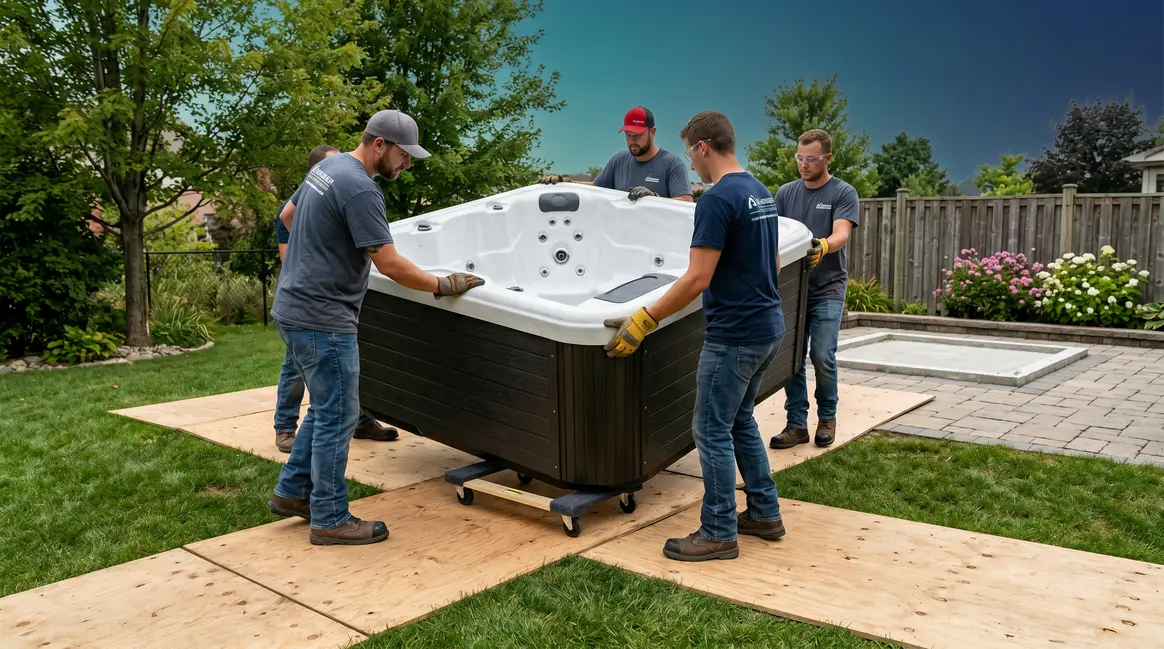
Moving a hot tub safely requires 4–6 people, two furniture dollies, and a clear path — most standard hot tubs weigh 500–1,000 lbs empty.
- Drain first: Always fully empty the tub before moving — water adds 1,500+ lbs
- Team size matters: 4 people minimum for a standard tub; 6 for large models
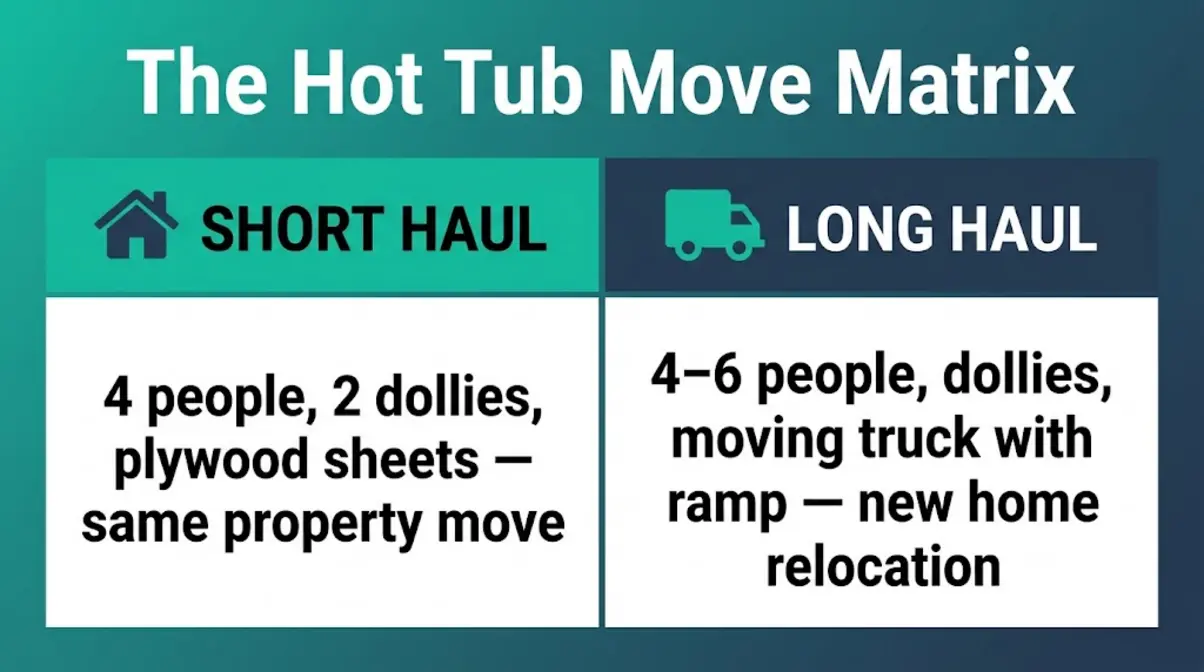
- Use The Hot Tub Move Matrix: Short Haul (same property) vs. Long Haul (new home) require different equipment
- Grass and decks need special handling: Use plywood sheets or hire a pro
- Professionals cost $350–$450 on average — worth it for stairs, cranes, or tight gates
Before You Start: Safety, Prerequisites, and the Move Matrix
⚠️ Safety Warning: Moving a hot tub is physically demanding and carries a real risk of back injury, muscle strain, and property damage. If your move involves stairs, a crane lift, a hill, or a very tight gate, stop here and call a professional. The steps below are designed for ground-level moves with clear, flat paths.
Hot tubs weigh between 500 and 1,000 pounds empty — making them one of the heaviest items a homeowner will ever attempt to move without professional equipment (Hot Spring Spas, 2024). Before you touch a single corner, you need to know which type of move you’re dealing with. That’s where The Hot Tub Move Matrix comes in — our two-pathway decision framework for safe hot tub relocation.
The Hot Tub Move Matrix — Which Pathway Are You?
| Pathway | Situation | What You Need |
|---|---|---|
| Short Haul | Moving within the same property (a few feet to across the backyard) | 4 people, 2 dollies, plywood sheets |
| Long Haul | Relocating to a new home or across town | 4–6 people, dollies, moving truck with ramp, straps |
If you’re doing a Short Haul, the core steps below cover your full process. For a Long Haul, follow the core steps AND the transport section in Step 6.
Before moving day, confirm every item on this list:
- Hot tub is completely drained (zero water remaining — not “mostly drained”)
- Power is disconnected and the dedicated circuit breaker is switched OFF
- Path from current location to destination is measured and physically cleared
- Team of at least 4 people is confirmed and available for the full day
- All equipment is rented or purchased and on-site before you begin
OSHA safe lifting guidelines recommend keeping your back straight, bending at the knees, and never twisting while bearing a heavy load — principles that apply to every phase of a hot tub move.
How to Move a Hot Tub: Step-by-Step Guide
At 500–1,000 lbs empty, a standard hot tub is one of the heaviest objects a homeowner will ever move (Hot Spring Spas, 2024). At One Hot Tub, our team has synthesized guidance from professional moving companies, hot tub manufacturers, and community-tested methods to build a process that works for both Short Haul and Long Haul situations — so you can learn how to move a hot tub with confidence rather than guesswork.
- The easiest way to move a hot tub:
- Drain the tub completely before moving
- Disconnect power at the breaker
- Recruit 4–6 strong helpers
- Position two furniture dollies under the frame
- Lay plywood sheets along the path
- Roll the tub to its destination
- Secure with straps before loading a truck
According to Bob Vila’s hot tub moving guide, safely moving a hot tub requires a minimum of three to four strong people, two furniture dollies, moving straps, and a truck with a ramp (Bob Vila, 2024). Skipping any one of those elements turns a manageable job into a heck of a time — and a potential injury.
Step 1 — Drain and Disconnect Your Hot Tub
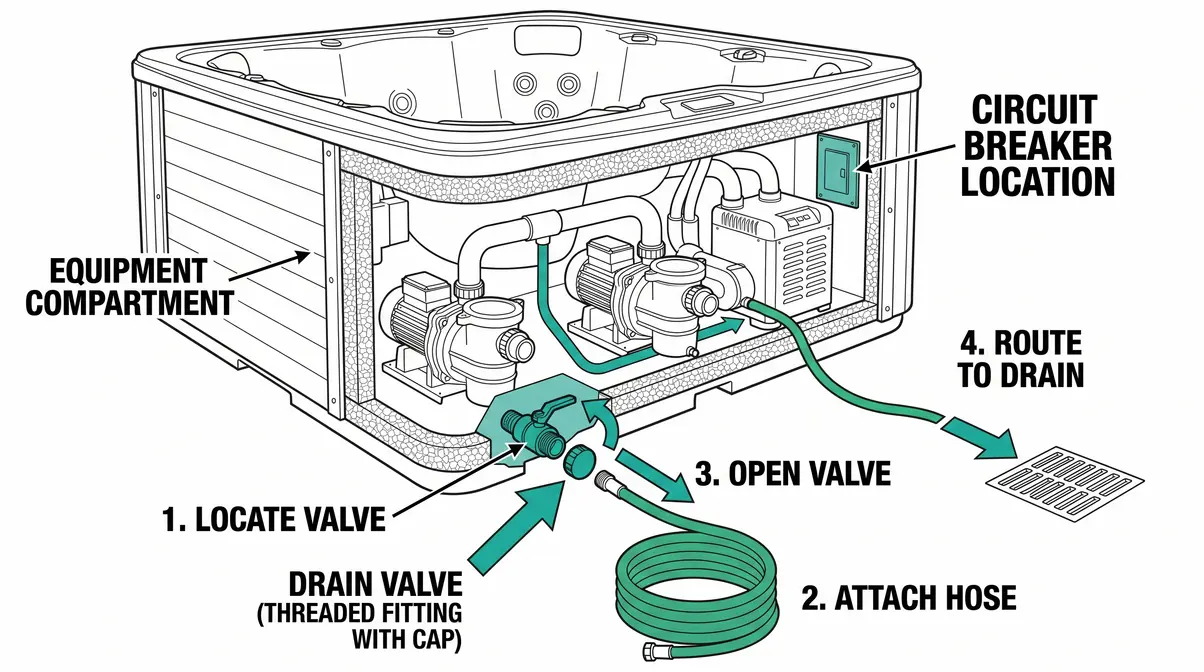
Start by fully draining your hot tub — this is the single most important step in the entire process of how to move a hot tub. Water adds approximately 1,500+ lbs to a standard tub. Attempting to move it with water remaining can cause structural failure and is a serious injury risk.
- Step 1:
- Locate the drain valve on the lower panel of your tub (check the side closest to the equipment compartment — it’s usually a threaded fitting with a cap).
- Attach a standard garden hose to the valve and route it to a drain or downhill area of your yard.
- Open the valve and allow 30–60 minutes for a full drain on a standard 400-gallon tub.
- Once drained, use a wet/dry vacuum (also called a shop vac) to remove residual water from the footwell, seats, and jets — even a few gallons of standing water adds meaningful weight.
- Flip the dedicated circuit breaker for the hot tub to OFF. Then unplug the equipment cord from the control panel. Why this matters: live power near water is a serious hazard, and electrical components can be damaged by the vibration and tipping involved in moving.
For a Nordic Spa or similar plug-and-play model, coil the power cord and tape it securely to the underside of the tub to keep it out of the way during the move.
Once the tub is drained and power is off, your next job is making sure the path is clear and safe before anything moves.
Step 2 — Measure and Clear the Path
A tub that won’t fit through a gate halfway through your move is a disaster. Measure first — every time.
- Step 2:
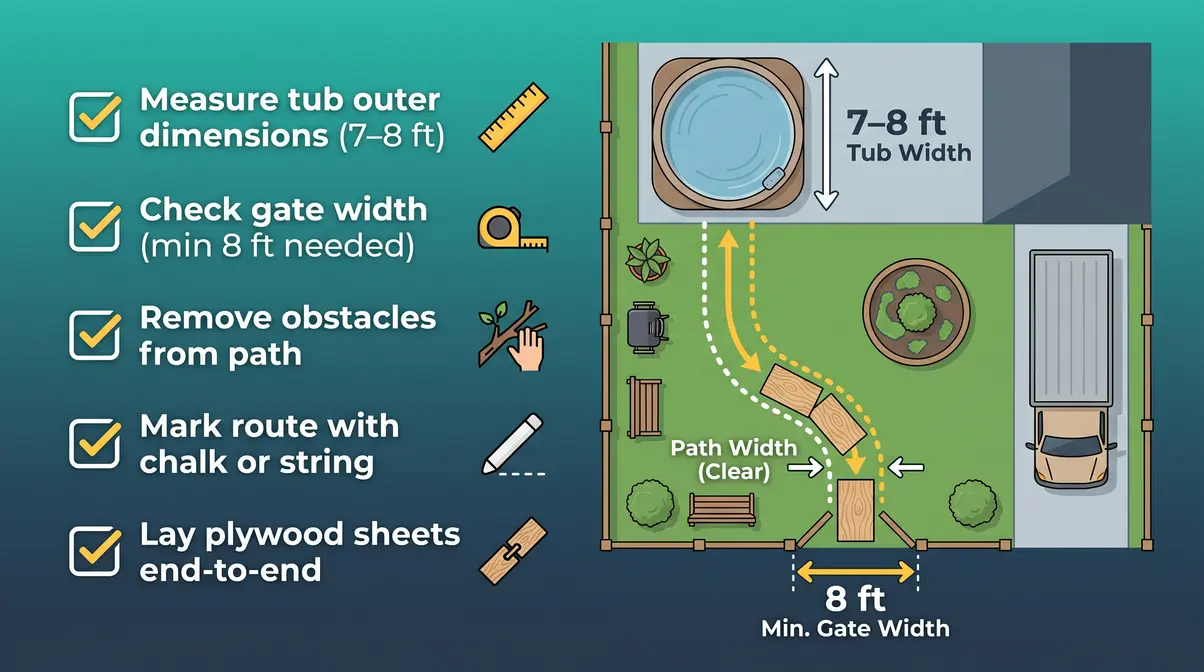
- Measure your hot tub’s outer dimensions (length × width). Most standard tubs are 7–8 feet square; larger models can reach 9 feet.
- Walk the entire planned route and measure every narrow point: gate openings, fence gaps, and any doorways if the tub is going inside. Standard residential gates are typically 3–4 feet wide — far too narrow for most hot tubs. If the tub won’t fit through a gate, stop and call a professional with a crane before proceeding.
- Remove all obstacles from the path: garden furniture, hoses, potted plants, and uneven stepping stones. Mark the route with chalk or string so your team stays on track.
- For the Long Haul pathway (moving to a new home), identify where the moving truck will park and confirm the ramp angle — a steep ramp makes loading significantly harder and more dangerous.
- Lay plywood sheets (½-inch thick, 4×8 feet) along the path at this stage. Plywood protects your lawn from the dolly wheels and gives the tub a smooth, stable rolling surface — a tip frequently recommended across the r/hottub community.
With a clear, measured path ready, it’s time to get your team and equipment in position.
Step 3 — Recruit Your Team and Gather Equipment
You cannot move a hot tub yourself — or even with two people. The math is unforgiving: a 700 lb tub split among 4 people means each person is managing roughly 175 lbs during the tip-and-lift phase. That’s already more than three times OSHA safe lifting guidelines for a single-person lift (51 lbs). More people means less load per person and more control.
- Team requirements:
- Standard tub (4–6 person): Minimum 4 people
- Large tub (7–8+ person): 6 people strongly recommended
- Any incline, stairs, or tight space: Call a professional
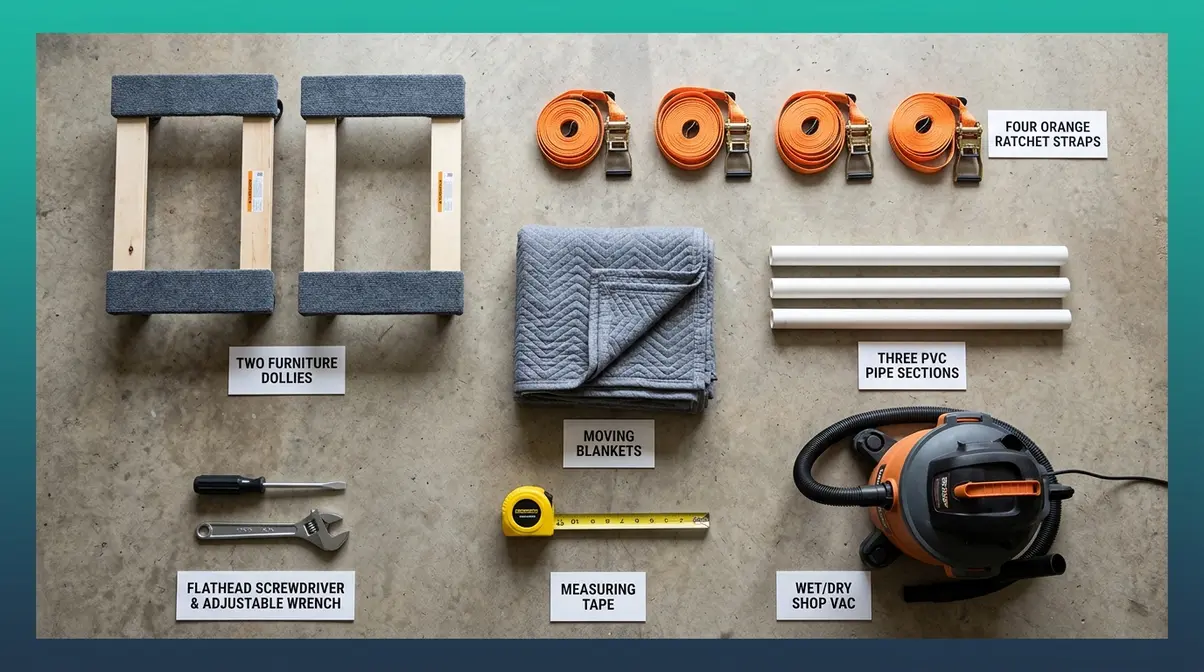
- Equipment checklist (gather everything before moving day):
- 2 × furniture dollies (four-wheel, flat platform — not an appliance dolly, which tilts on two wheels)
- 4–6 × 4×4 lumber boards, approximately 4 feet long (for leverage during tipping)
- 4 × heavy-duty moving straps (2-inch minimum width, 1,000 lb+ rating)
- Plywood sheets (½-inch thick, 4×8 feet — one sheet per 8 feet of path)
- Moving truck with a loading ramp (Long Haul pathway only)
- Wet/dry vacuum (if not already used in Step 1)
- Work gloves for every team member
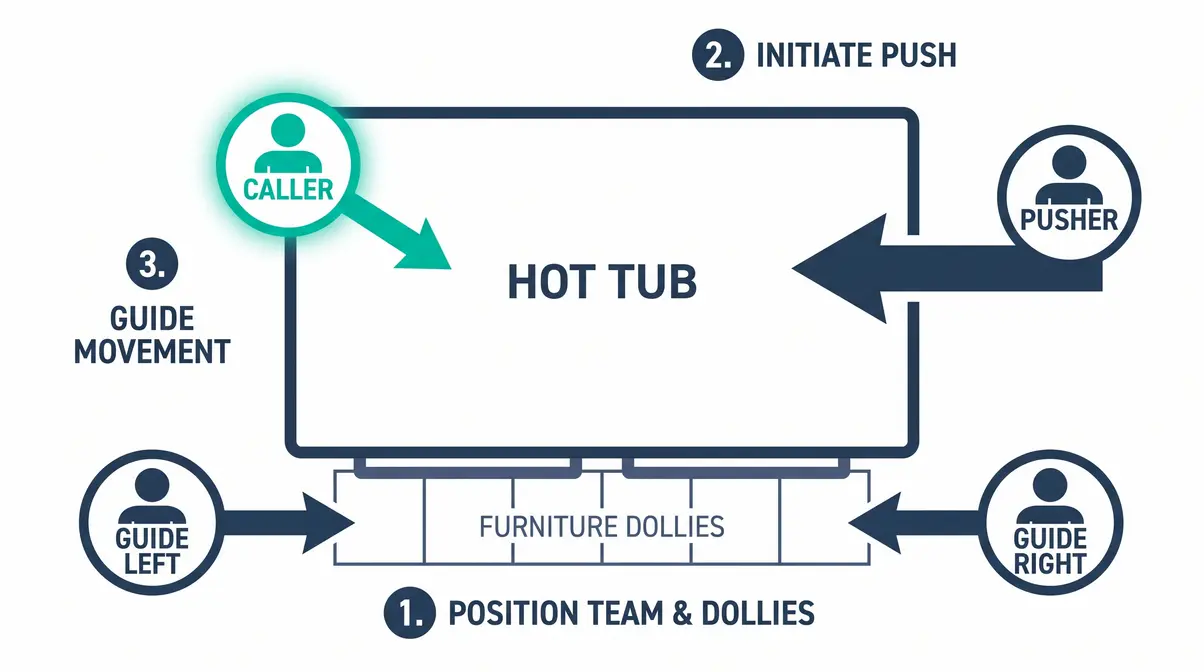
Assign roles before the move begins. Designate one person as the “caller” — the only person who gives verbal commands. Nobody lifts, shifts, or sets down without a clear count from the caller. This single rule prevents the most common moving injuries, which happen when team members act out of sync.
Check out this expert guide to moving a hot tub for additional tips on team coordination and equipment selection.
Step 4 — Tip the Tub and Position the Dollies
This is the step most people are anxious about — and for good reason. Tipping a 700 lb object onto its side requires coordination, proper leverage, and a clear plan. Rushing this step causes cracked shells and back injuries.
- Step 4:
- Position one furniture dolly on each side of the tub, in the direction you’ll be moving.
- Place two 4×4 lumber boards flat on the ground under one side of the tub as a lever base.
- On the caller’s count, two team members push the top edge of the tub while two team members guide the base — slowly tipping it onto its side (approximately 90 degrees). Why this matters: you need access to the flat base to slide the dollies underneath.
- Slide one furniture dolly under the base panel — position it toward the center of the tub’s weight, not at the very edge.
- On the caller’s count, lower the tub back down onto the dolly. Repeat on the opposite side with the second dolly.
- Attach moving straps over the tub and through the dolly frames to prevent the tub from shifting during rolling.
⚠️ Tipping Warning: Never tip the tub toward a team member. Always tip away from people. Keep feet clear of the base during the tip. One slip here can cause a crush injury.
Step 5 — Roll the Tub to Its Destination
With the tub secured on two dollies, you’re ready to roll. This step is where plywood sheets earn their place — without them on grass or pavers, the dolly wheels sink and the move stalls.
- Step 5:
- Confirm all moving straps are tight before the first movement.
- On the caller’s count, two team members push from the rear while two guide from the sides — nobody pulls from the front (a tub tipping forward can pin a person).
- Move in short, controlled pushes of 12–18 inches at a time. Pause between pushes to check that the dollies remain centered and straps remain tight.
- As the tub moves forward, leapfrog the rear plywood sheets to the front of the path — this is the standard technique for covering long distances with limited plywood.
- For the Short Haul pathway, roll the tub to its new position, lower it onto 4×4 boards, remove the dollies, and lower it to its final resting spot on the caller’s count.
Step 6 — Load onto the Truck and Secure for Transport
Step 6 applies to the Long Haul pathway only. If you’re doing a Short Haul, you’re done after Step 5 — reconnect power, refill, and enjoy.
- Step 6:
- Position the moving truck so the loading ramp aligns with the path you’ve just cleared. The ramp angle should be as shallow as possible — ideally under 15 degrees.
- Roll the tub on its dollies to the base of the ramp. Attach two additional moving straps from the tub to the truck’s anchor points inside the cargo area.
- On the caller’s count, the rear team pushes while the front team guides the tub up the ramp. Move slowly — ramps amplify the risk of a rollback.
- Once inside the truck, position the tub upright (not on its side) against the cab wall. Secure with at least 4 ratchet straps — two from side to side, two front to back.
- Place moving blankets between the tub shell and any hard surfaces to prevent cracking during transit.
- At the destination, reverse the process: ramp down, roll off, plywood path, final placement.
Common Mistakes to Avoid:
| Mistake | Why It Happens | How to Avoid It |
|---|---|---|
| Not draining completely | Assuming “mostly drained” is fine | Use a shop vac after draining — check for pooled water |
| Too few people | Underestimating the weight | Always recruit 4 minimum; 6 for large tubs |
| Using an appliance dolly | Looks similar to a furniture dolly | Check for 4 wheels flat — not 2 wheels on a tilt frame |
| Skipping plywood on grass | Seems like extra work | Dollies sink on soft ground — plywood is non-negotiable |
| No designated caller | Everyone thinks someone else is in charge | Assign the role before you start — not during |
Equipment You Need to Move a Hot Tub
Choosing the right equipment is what separates a smooth move from a heck of a time. The wrong dolly type, missing straps, or no plywood can turn a 2-hour job into an all-day ordeal — or worse, an injury.
The Standard Equipment Checklist
Here is the complete equipment list for a standard DIY hot tub move. Costs shown reflect 2026 rental rates from U-Haul and Home Depot.
| Item | Purpose | Rent or Buy | Approx. Cost |
|---|---|---|---|
| 2 × furniture dollies (4-wheel flat) | Roll the tub | Rent | ~$20–$30/day each |
| 4×4 lumber boards (4 ft long) | Leverage during tipping | Buy | ~$15–$25 total |
| Heavy-duty moving straps (×4) | Secure tub to dollies and truck | Rent or buy | ~$15–$30 |
| Plywood sheets, ½-inch 4×8 ft (×4) | Smooth rolling surface | Buy or borrow | ~$20–$35 each |
| Moving truck with ramp | Long Haul transport | Rent | ~$80–$150/day |
| Wet/dry vacuum | Remove residual water | Borrow/rent | ~$20–$40/day |
| Work gloves (per person) | Grip and hand protection | Buy | ~$8–$15/pair |
A critical note on dolly type: A furniture dolly is a low, flat platform on four swivel wheels used to roll heavy objects horizontally. An appliance dolly (also called a hand truck) is a two-wheel upright device designed for refrigerators. They look similar in a rental catalog — but an appliance dolly cannot support a hot tub properly. Always request a “four-wheel furniture dolly” by name.
The PVC Pipe Rolling Method (No Dolly Needed)
If you can’t access or afford furniture dollies, the PVC pipe rolling method is a proven alternative. It works on the same principle as ancient Egyptians moving stones — cylindrical rollers under a flat surface create a low-friction pathway.
What you need: 4–6 lengths of 4-inch diameter Schedule 40 PVC pipe, each cut to approximately 3 feet long (available at any home improvement store for roughly $5–$8 per length).
How the PVC pipe method works:
- Tip the tub onto its side using the lumber leverage method from Step 4.
- Lay 3–4 PVC pipes parallel to each other on the ground, spaced about 18 inches apart, perpendicular to the direction of travel.
- Lower the tub base down onto the PVC pipes.
- Push the tub forward — it rolls smoothly on the pipes.
- As the rear pipe clears the back of the tub, pick it up and place it at the front. Repeat this “leapfrog” motion for the entire path.
Limitations of the PVC method: It works best on hard, flat surfaces (concrete, pavers). On grass or soft soil, pipes sink and the method becomes ineffective. For distances over 20 feet, furniture dollies are faster and more controllable. User consensus across hot tub forums consistently rates the PVC method as practical for short concrete moves but frustrating on uneven terrain.
How to Move a Hot Tub Without a Dolly
If you have neither dollies nor PVC pipe, your options narrow significantly. Common alternatives reported by the r/hottub community include:
- Furniture sliders (plastic discs placed under the tub base): Work on smooth surfaces like concrete — completely ineffective on grass or pavers.
- Appliance rollers (rented moving skates): A valid alternative to furniture dollies for flat, hard surfaces only.
- Hired labor with equipment: If you have no equipment access, renting a dolly costs $20–$30/day — far cheaper than the risk of a DIY move with improvised tools.
The honest assessment: moving a hot tub without any rolling equipment is dangerous and physically punishing. If you’re in a situation where equipment isn’t accessible, the $20 dolly rental is worth every dollar.
How Many People Do You Need to Move a Hot Tub?
The number one mistake homeowners make when planning a hot tub move is underestimating how many people they actually need. Four people feels like a lot. For a 700 lb tub, four is the minimum — not the ideal.
Hot Tub Weight by Size — Reference Chart
The weight of your specific tub is the most important factor in planning your team size and equipment. Empty weight varies significantly by size and brand; full weight (with water) makes most tubs unmovable without professional equipment.
| Tub Size | Approx. Empty Weight | Water Capacity | Approx. Full Weight | Min. Team Size |
|---|---|---|---|---|
| 2-person | 400–500 lbs | ~150–200 gal | 1,650–1,900 lbs | 4 people |
| 4-person | 500–650 lbs | ~250–300 gal | 2,600–3,150 lbs | 4 people |
| 6-person | 650–850 lbs | ~350–400 gal | 3,570–4,200 lbs | 4–6 people |
| 7-person | 800–950 lbs | ~400–450 gal | 4,140–4,700 lbs | 6 people |
| 8+ person | 900–1,000+ lbs | ~450–500 gal | 4,650–5,175 lbs | 6+ people |
Sources: Hot Spring Spas (2024), Sundance Spas manufacturer specifications. Water weight calculated at 8.34 lbs/gallon.
The key takeaway from this table: You are always moving the empty weight only — never attempt to move a tub with any water remaining. A 6-person hot tub empty weighs roughly 750 lbs. The same tub full of water weighs over 3,800 lbs — beyond the capacity of any residential moving equipment.
Solo vs. Team: What’s Actually Realistic?
Can you move a hot tub by yourself? No — not safely, and not practically. Even the lightest 2-person tub at 400 lbs cannot be tipped, positioned on dollies, and rolled by a single person. The tipping phase alone requires at least two people to control the fall direction, and rolling requires at least one person guiding from each side.
Can two people move a hot tub? In theory, two very strong people can manage a small tub on a perfectly flat, hard surface for a very short distance. In practice, this is how back injuries happen. Community consensus from r/hottub is consistent: two people is dangerous, three is the absolute minimum for a small tub, and four is the safe standard.
Can four guys move a hot tub? Yes — for a standard 4–6 person tub on a flat, obstacle-free path, four people is the recommended team size. Each person manages approximately 175 lbs during the heaviest phase. That’s demanding but manageable with proper lifting technique and a designated caller.
For larger or heavier tubs: Add people, not bravado. A sixth person costs you nothing but an afternoon of their time. A back injury or cracked shell costs significantly more.
Navigating Common Obstacles
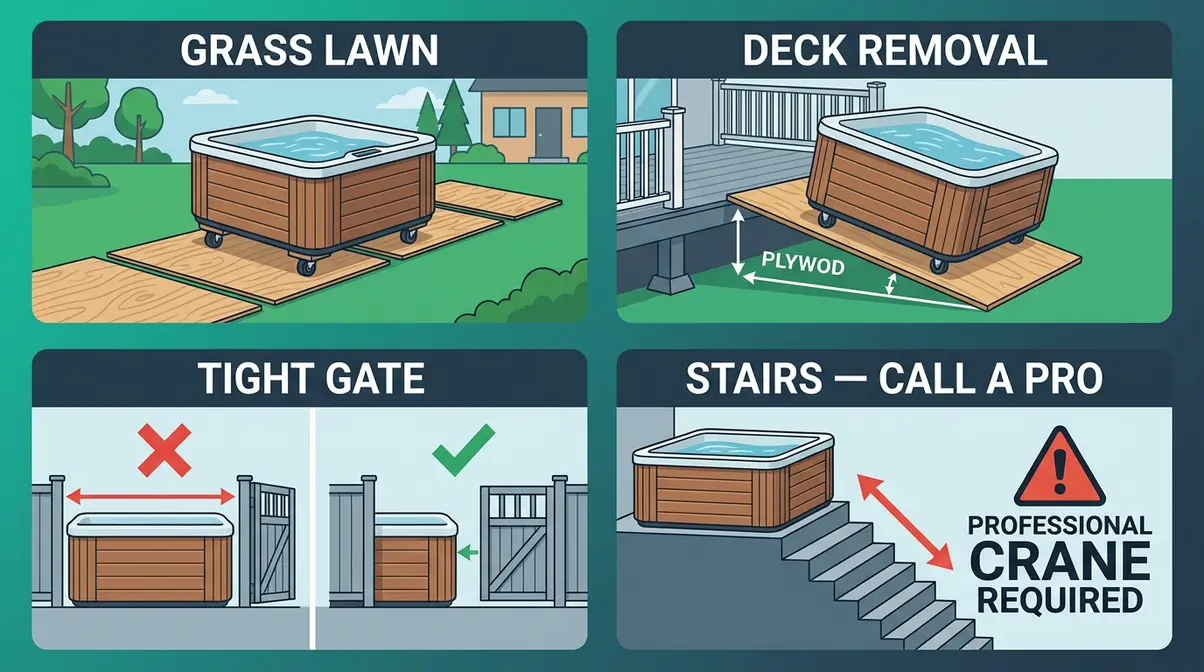
Moving a hot tub on flat, open ground is the easy version. Most real-world moves involve at least one complication — a grass lawn, a deck, a gate, or a slope. Each obstacle requires a specific approach.
Moving a Hot Tub on Grass
Grass is the most common obstacle and the one that catches the most people off guard. Dolly wheels and PVC pipes both sink into soft soil, especially after rain. The solution is consistent: plywood sheets create a firm, flat pathway over any lawn.
Lay 4×8 plywood sheets end-to-end from the tub’s current position to its destination. Use the leapfrog technique — move rear sheets to the front as the tub progresses. For more detail on this specific scenario, including tips for wet grass and slopes, see our full guide on moving a hot tub on grass.
Removing a Hot Tub from a Deck
Decks present two challenges: the height difference between the deck and ground level, and the structural load of multiple people and a 700 lb tub on the deck surface simultaneously. Before attempting a deck removal, verify that your deck can handle the combined load — older decks with soft or rotten boards are a serious collapse risk.
For most deck removals, the safest approach is to build a temporary ramp using plywood and lumber from the deck surface to the ground. The ramp angle should be as shallow as possible — a 1:10 slope (1 inch of rise per 10 inches of run) is the target. For step-by-step deck removal guidance, our dedicated article on removing a hot tub from a deck covers ramp construction and load management in full detail.
Moving a Hot Tub Up or Down Stairs
⚠️ Stop here. Moving a hot tub up or down stairs without professional equipment is one of the highest-risk scenarios in residential moving. The combination of weight, gravity, and an uneven surface creates conditions where a single misstep can cause catastrophic injury or property damage. Most moving professionals recommend a crane lift for any stair scenario involving more than two steps.
If you absolutely must navigate one or two shallow steps without professional help:
- Build a temporary ramp over the steps using 2×10 lumber boards — one board per 12 inches of stair width, secured with screws.
- Use 6 people minimum: two pushing from the rear, two guiding from the sides, two controlling the front descent.
- Move in increments of 3–4 inches at a time, pausing to reset grip and confirm footing.
- Never allow the tub to gain momentum — controlled, slow movement is everything.
For anything more than two steps, call a professional. The cost of a crane lift ($150–$300) is a fraction of the cost of a back surgery or a cracked acrylic shell.
Squeezing Through Gates and Tight Spaces
Most standard hot tubs are 7–8 feet wide. Most residential gates are 3–4 feet wide. That math doesn’t work — and no amount of creative angling will make a 7-foot tub fit through a 4-foot gate.
Your options when a gate is too narrow:
- Remove the gate temporarily — most residential gates are hinged and can be removed in 10–15 minutes with a screwdriver.
- Remove a fence section — more involved, but often the only option for fixed masonry or wooden fence panels.
- Use a crane lift over the fence — professional crane operators handle this routinely. Costs typically range from $150–$400 depending on your location and the crane required.
Measure your gate before moving day. If it’s under 8 feet wide and your tub is 7+ feet, plan for option 1, 2, or 3 before you start. Discovering this problem with a 700 lb tub halfway across your lawn is a bad situation.
How Much Does It Cost to Move a Hot Tub?
Cost is often the deciding factor between DIY and professional. Here’s the honest breakdown for both pathways in 2026.
DIY Moving Costs Breakdown
A DIY hot tub move has real costs — it’s not free just because you’re doing it yourself. The main expenses are equipment rental and labor (even if “labor” means buying your helpers pizza).
| Item | Cost Range | Notes |
|---|---|---|
| Furniture dolly rental (×2) | $40–$60/day | U-Haul, Home Depot, or local rental |
| Moving truck rental (Long Haul) | $80–$150/day | Plus mileage fees |
| Plywood sheets (×4) | $80–$140 | Buy and resell, or borrow |
| Moving straps (×4) | $20–$40 | Reusable; worth buying |
| Lumber for tipping/ramp | $20–$40 | 4×4 boards, 4 ft lengths |
| Miscellaneous (gloves, tape) | $15–$25 | Per move |
| Total DIY (Short Haul) | $175–$305 | Equipment only |
| Total DIY (Long Haul) | $255–$455 | Equipment + truck |
Rates based on 2026 U-Haul and Home Depot rental pricing. Actual costs vary by region.
For a Short Haul move on flat ground with a clear path, DIY is genuinely cost-effective. For a Long Haul, the total DIY cost approaches the lower end of professional pricing — which changes the calculation significantly.
Professional Hot Tub Mover Costs
Professional hot tub movers typically charge $350–$800 for a standard move, with significant variation based on distance, complexity, and your region (moveadvisor.com, 2025).
| Move Type | Typical Cost Range | What’s Included |
|---|---|---|
| Short Haul (same property) | $200–$350 | 2-person crew, dollies, basic move |
| Local relocation (under 50 miles) | $350–$600 | 2–4 person crew, truck, equipment |
| Long distance (50+ miles) | $600–$1,500+ | Full crew, specialized transport |
| Crane lift (stairs or over fence) | Add $150–$400 | Equipment and operator |
Sources: moveadvisor.com (2025), Two Men and a Truck service pricing.
One factor most homeowners overlook: Some hot tub manufacturers void the warranty if the tub is moved without a certified technician or approved moving service. Check your warranty documentation before committing to DIY — particularly for tubs under 5 years old. The cost of a professional move may be far less than a voided warranty on a $6,000–$12,000 appliance.
When you factor in equipment rental, your time, and the risk of damage or injury, the gap between DIY and professional narrows considerably — especially for Long Haul moves. The Sundance Spas moving guide recommends professional movers for any move involving more than flat, open ground.
Moving Different Types of Hot Tubs
Not every hot tub move is the same. The size, age, and condition of your specific tub changes the approach — sometimes significantly.
Large and 6-Person Hot Tubs
A 6-person hot tub weighs 650–850 lbs empty — toward the upper end of what a 4-person team can safely manage. At this weight, the margin for error during tipping and dolly placement shrinks. User feedback across hot tub owner communities consistently recommends 6 people for any tub over 700 lbs, even on flat ground.
The other challenge with large tubs is dimensional: a 7×7-foot or 8×8-foot tub is significantly harder to maneuver through gates and around corners than a standard 6×6-foot model. Measure twice — measure the diagonal too, since you may need to angle the tub to clear a corner.
For large models, upgrade your plywood from ½-inch to ¾-inch thickness. The additional rigidity prevents bowing under the extra weight, which can cause a dolly to shift mid-move.
Used and Older Hot Tubs
Moving a used or older hot tub introduces one additional risk that new tub owners don’t face: structural integrity. Acrylic shells become more brittle with age, and the cabinet (the wooden or synthetic frame surrounding the tub) can develop rot or soft spots that fail under moving stress.
Before moving an older tub, inspect the following:
- Shell: Look for existing cracks, chips, or stress marks near the corners — these are failure points under tipping stress.
- Cabinet panels: Press firmly on each panel. Soft spots indicate rot. A compromised cabinet can collapse during the move, dropping the shell.
- Frame/base: Check the structural base for warping or broken sections. The base is what the dollies contact — a broken base makes dolly placement unreliable.
For a used hot tub you’ve recently purchased, factor inspection time into your move planning. A tub that fails structurally during a move is a loss — both financially and physically.
When to Call a Professional Hot Tub Mover
DIY is the right call for many hot tub moves. It’s not the right call for all of them. Knowing the difference protects you, your team, and your tub.
High-Risk Situations That Require Professionals
Some scenarios fall outside the safe range of DIY moving, regardless of team size or determination. Common pain points reported by hot tub owners who attempted these situations without professional help include severe back injuries, cracked shells, and structural damage to decks and fences.
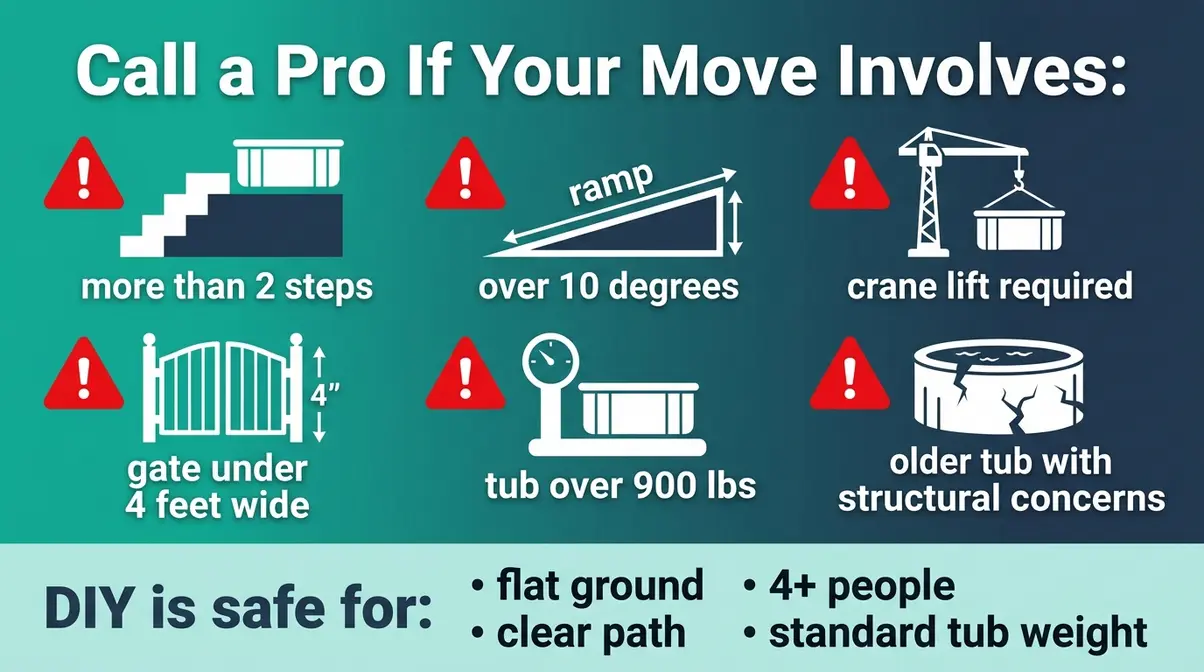
Call a professional if your move involves any of the following:
- Stairs: More than two steps, any height, any direction — professional crane or specialized equipment required
- Steep slopes or hills: Any incline over 5–10 degrees makes dolly control unpredictable
- Crane lift required: Over a fence, over a structure, or onto an elevated surface
- Gate or passage under 4 feet wide: Disassembly or crane is the only safe option
- Tub over 900 lbs: At this weight, even 6 people are managing 150 lbs each — professional equipment significantly reduces risk
- Older tub with structural concerns: A cracked or compromised shell requires professional handling to avoid total loss
OSHA safe lifting guidelines make clear that mechanical assistance should be used whenever human lifting capacity is exceeded — and a 900 lb hot tub exceeds that threshold in every scenario.
What Professional Hot Tub Moving Services Include
Understanding what you get for $350–$600 helps you evaluate the value honestly. A reputable professional hot tub moving service typically includes:
- Full crew (2–4 people) with training in hot tub-specific moving techniques
- Specialized equipment: heavy-duty dollies rated for 1,000+ lbs, professional ratchet straps, moving blankets
- Liability coverage: most licensed movers carry insurance for property damage during the move
- Reconnection guidance: some services include basic reconnection advice at the destination
- Crane coordination: for complex moves, professional movers can coordinate crane services directly
The Two Men and a Truck hot tub moving guide notes that professional movers bring equipment specifically rated for the weight and dimensions of hot tubs — a meaningful difference from consumer-grade rental equipment.
For a $6,000–$15,000 hot tub, paying $400 for professional moving insurance is a rational decision. For a clear, flat, Short Haul move with 4 capable people and the right equipment, DIY is equally rational.
Frequently Asked Questions
What’s the easiest way to move a hot tub?
The easiest way to move a hot tub is to drain it completely, recruit 4–6 helpers, and roll it on two furniture dollies over a plywood pathway. Draining removes 1,500+ lbs of water weight, making the move physically manageable. Plywood sheets prevent dolly wheels from sinking into grass or soft ground. Assigning a designated “caller” who gives all verbal commands prevents the coordination failures that cause most injuries. For a Short Haul move on flat ground, this method typically takes 2–4 hours with a prepared team.
Can four guys move a hot tub?
Yes — four people is the standard recommended team size for moving a standard 4–6 person hot tub weighing 500–800 lbs empty. Each person manages approximately 125–200 lbs during the heaviest phase (tipping and dolly positioning). Four people provides enough control to tip safely and enough manpower to roll the tub steadily. For tubs over 800 lbs or any move involving inclines, five or six people is strongly recommended. OSHA safe lifting guidelines recommend mechanical assistance for loads exceeding 51 lbs per person — four people distributes a 700 lb tub to 175 lbs each, which is demanding but manageable with proper technique.
How heavy is a hot tub when empty?
A hot tub weighs between 400 and 1,000+ lbs when empty, depending on size. A small 2-person tub starts around 400–500 lbs; a standard 4–6 person tub typically weighs 500–800 lbs empty; and large 8+ person models can exceed 1,000 lbs before a single drop of water is added (Hot Spring Spas, 2024). The same tub filled with water can weigh 3,500–5,000 lbs — which is why draining completely before any move is non-negotiable. Never attempt to move a hot tub with water remaining in it.
Is a hot tub hard to move?
Moving a hot tub is physically demanding but manageable for most homeowners with the right team, equipment, and preparation. The main challenges are the weight (500–1,000 lbs), the awkward dimensions (most tubs are 7–8 feet wide), and the coordination required during tipping. Common pain points reported by first-time movers include underestimating team size, skipping plywood on grass, and not assigning a caller. With 4 people, proper dollies, and a clear path, a standard Short Haul move typically takes 2–4 hours. Complex moves involving stairs, cranes, or long distances are genuinely difficult and warrant professional help.
How much does it cost to move a hot tub?
DIY hot tub moves typically cost $175–$455 in equipment and rental fees, depending on whether you need a moving truck for a Long Haul move. Professional hot tub movers charge $350–$800 for most standard local moves, with crane lifts adding $150–$400 (moveadvisor.com, 2025). For a straightforward Short Haul on flat ground, DIY saves real money. For Long Haul moves, complex terrain, or tubs over 900 lbs, the cost gap between DIY and professional narrows significantly — and the professional option includes liability coverage that DIY does not.
Can you move a hot tub by yourself?
No — moving a hot tub safely by yourself is not realistic. Even the lightest 2-person tub at 400 lbs cannot be tipped, positioned on dollies, and rolled by a single person. The tipping phase requires at least two people to control the direction of fall, and rolling on dollies requires at least one person per side for steering and stability. Attempting a solo hot tub move is how back injuries and cracked shells happen. The minimum safe team size is 4 people for a standard tub. If you genuinely cannot recruit helpers, hiring a 2-person professional crew for $200–$350 is the correct solution — not attempting it alone.
When DIY Isn’t the Right Call: Limitations and Alternatives
Knowing how to move a hot tub yourself is valuable. Knowing when not to is equally important.
Common Pitfalls
Pitfall 1 — Skipping the drain: The single most common mistake is moving a tub with residual water. Even 20 gallons (167 lbs) of water remaining changes the weight distribution and stresses the shell. Always use a shop vac after draining.
Pitfall 2 — Using the wrong dolly: Renting an appliance dolly (two-wheel upright) instead of a furniture dolly (four-wheel flat) is a frequent and dangerous error. An appliance dolly cannot support a hot tub’s weight distribution — the tub will shift and potentially fall.
Pitfall 3 — No caller assigned: When everyone is making decisions simultaneously, someone moves before someone else is ready. This is the root cause of most hot tub moving injuries. Assign the caller role before you start.
Pitfall 4 — Underestimating the path: A gate that’s 3 inches too narrow, a soft patch of lawn that swallows dolly wheels, or a deck that can’t handle the combined weight — these are path problems that need to be identified and solved before the tub is on the dollies.
Pitfall 5 — Rushing the tipping phase: The tip is the highest-risk moment in the move. Moving too quickly, having uneven footing, or tipping toward a team member causes the most serious injuries. Slow is safe.
When to Choose Alternatives
- Stairs involved: Hire a professional with crane equipment. No DIY alternative is safe beyond two shallow steps.
- Tub over 900 lbs: Professional movers with rated equipment reduce the risk meaningfully — the cost is justified.
- Structural concerns on older tub: Have a hot tub technician assess the shell and cabinet before attempting any move.
When to Seek Expert Help
If your move involves any combination of height changes, tight spaces, and a heavy tub, the complexity multiplies quickly. A licensed hot tub moving company carries liability insurance that covers property damage during the move — something no DIY approach provides. For moves where a mistake would mean a cracked $10,000 tub or a serious back injury, the professional cost is genuine risk mitigation, not an unnecessary expense. The Home Depot hot tub moving guide also recommends professional help for complex scenarios involving elevation changes or limited access.
Moving a hot tub is a manageable project — with the right plan
For most homeowners facing a Short Haul move on flat, open ground, the DIY pathway is realistic. Four people, two furniture dollies, plywood sheets, and a clear path are the core requirements. Drain completely, assign a caller, move slowly, and the job gets done safely. The six steps in this guide cover the full process from drain to final placement, with equipment options for every budget.
The Hot Tub Move Matrix is the framework that makes this decision clear: Short Haul moves are generally DIY-friendly; Long Haul moves require more equipment and more honest self-assessment about complexity. When stairs, cranes, or structural concerns enter the picture, the professional option stops being an extravagance and starts being the rational choice.
Your next step: measure your path today, confirm your gate width, and check your tub’s weight against the size chart above. That 10-minute assessment tells you which pathway you’re on — and what you need to make it happen safely. For personalized guidance on your specific move, the team at One Hot Tub is available to help you plan.

adminbackup
Hot tub tester and writer at One Hot Tub.