
What’s in this guide
- What You'll Need Before Starting
- Step 1: Seal Every Entry Point in Your Hot Tub Cabinet
- Step 2: Apply Natural Spider Repellents Around Your Spa
- Step 3: Eliminate the Insects Spiders Feed On
- Step 4: When Natural Methods Aren't Enough — Chemical Solutions
- Limitations and When to Call a Professional
- Frequently Asked Questions
- A Permanently Spider-Free Hot Tub Is Achievable
You’re relaxing at the edge of your hot tub when something eight-legged darts across the footwell. You shoo it out — and it immediately scurries back.
“I shoo-ed him out (jets off) and he ran a lap around the footwell and scampered back under the intake screen. Rather fast too.” — r/hottub community member
That moment captures the real frustration: spiders don’t wander in by accident. They’ve found an ideal habitat inside your hot tub cabinet — warm, dark, and stocked with insects — and they’ll keep coming back until you address the root cause. Shooing them out is not a solution.
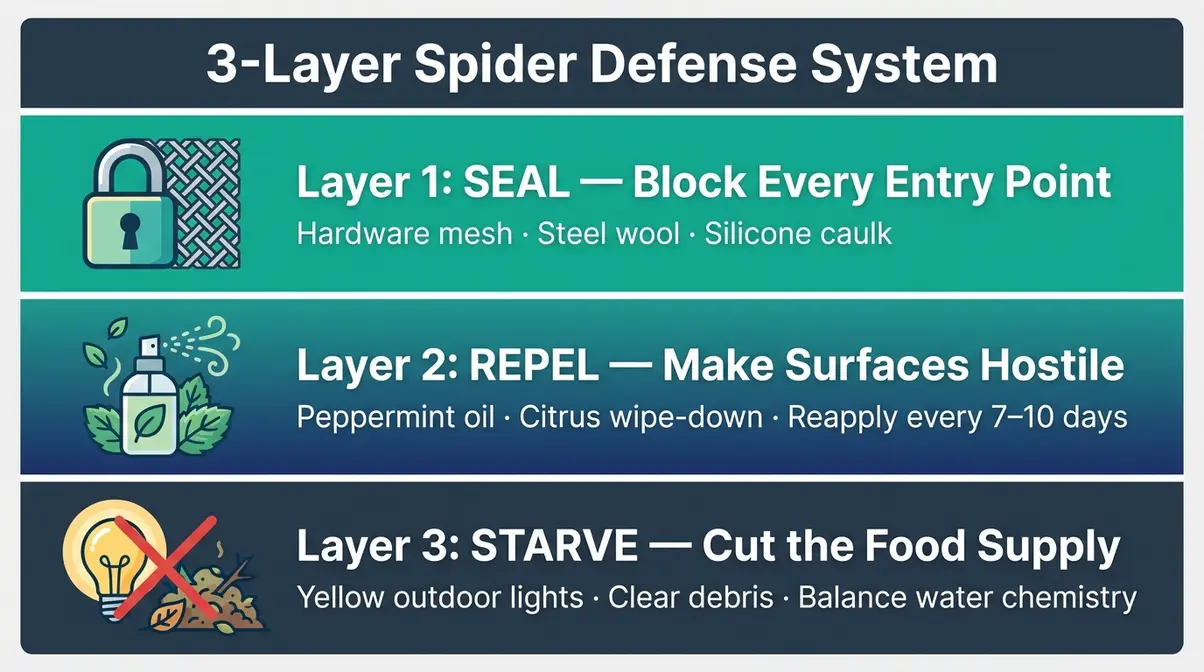
This guide gives you a complete, numbered plan to keep spiders out of your hot tub for good. The approach is called The 3-Layer Spider Defense: Seal every physical entry point (Layer 1), Repel with chemistry-safe natural deterrents (Layer 2), and Starve spiders by eliminating their insect food supply (Layer 3). A fourth step covers chemical solutions when the first three aren’t enough.
Key Takeaways: How to Keep Spiders Out of Your Hot Tub
Spiders move into hot tub cabinets because they offer warmth, moisture, and a reliable food supply — but The 3-Layer Spider Defense (Seal, Repel, Starve) eliminates all three attractants systematically.
- Layer 1 — Seal: Block every cabinet gap with hardware mesh, steel wool, and silicone caulk
- Layer 2 — Repel: Apply peppermint oil spray to cabinet edges and the cover’s underside
- Layer 3 — Starve: Switch to yellow outdoor lights and clear debris to eliminate insect prey
- For severe infestations: Use perimeter pesticide spray with a ⚠️ safety buffer from the water
What You’ll Need Before Starting
Gather these materials before you begin. Having everything on hand means you can move through all four steps in a single afternoon.
| Category | Materials |
|---|---|
| Sealing | Hardware mesh (1/4″ or 1/8″ gauge), Grade 0 stainless steel wool, waterproof silicone caulk, caulk gun, tin snips |
| Repelling | Peppermint essential oil, spray bottle, distilled water, citrus-based surface cleaner |
| Chemical treatment (if needed) | Bifenthrin-based perimeter insecticide spray, glue traps |
| Tools | Flashlight or headlamp, work gloves, painter’s tape |
Step 1: Seal Every Entry Point in Your Hot Tub Cabinet
Sealing the cabinet is the non-negotiable foundation of the 3-Layer Spider Defense — no repellent works reliably if spiders can walk freely through open gaps. University of Kentucky entomologists note that spiders are naturally drawn to dark, undisturbed environments with moisture, making unsealed hot tub cabinets an ideal habitat. Twenty minutes of inspection and sealing work now prevents months of recurring unwanted guests.
The four sub-steps below cover every common entry route:
- Inspect and photograph all gaps
- Block ventilation slots with hardware mesh
- Fill irregular cracks with steel wool and caulk
- Secure the cover with locking straps
Step 1a: Inspect and Identify All Entry Points
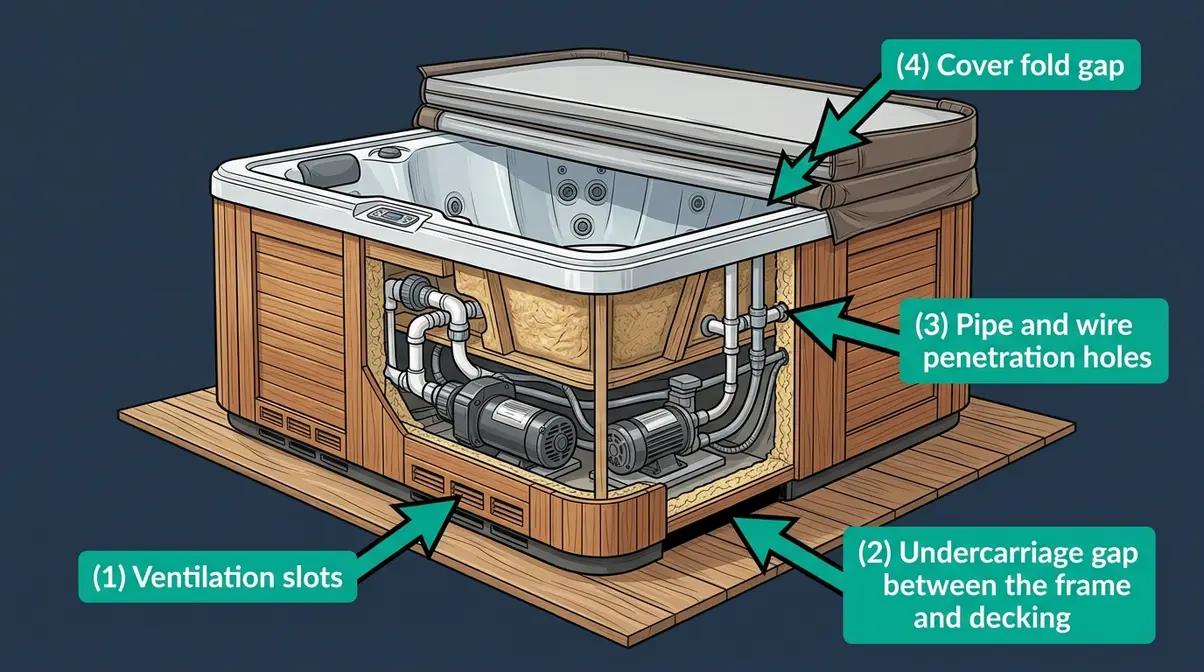
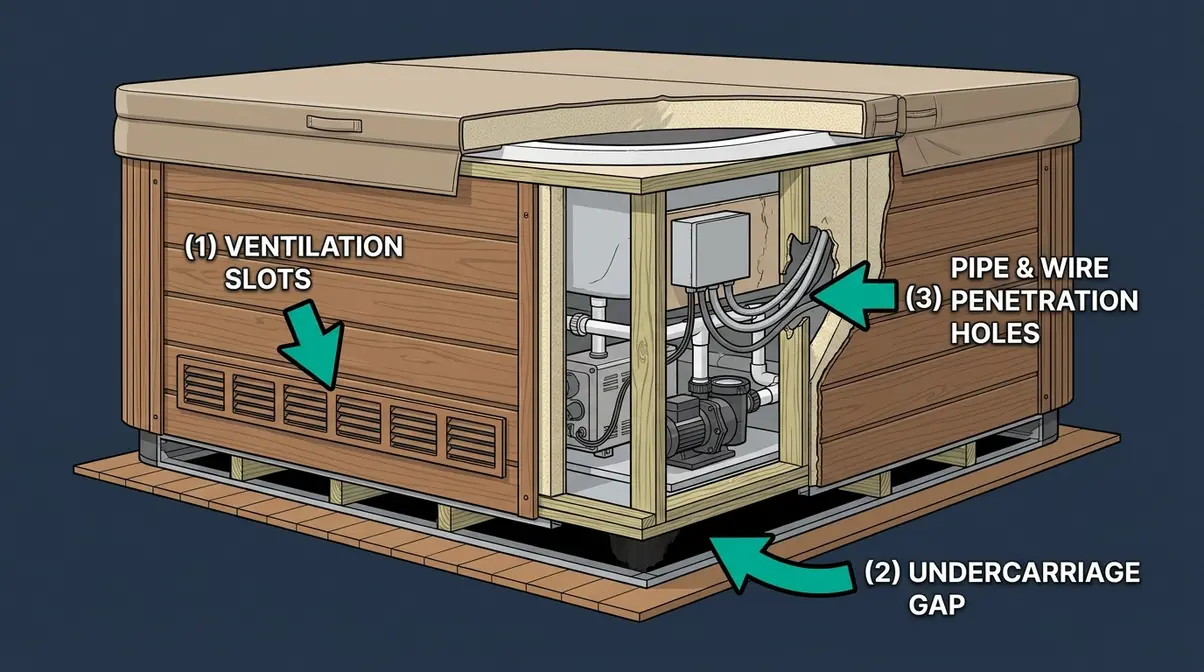
Grab a flashlight and crouch down at each panel. Check the ventilation slots — typically one to three rows of horizontal slats near the base — as these are the most common spider entry points on any hot tub cabinet. Next, look at the undercarriage gap: the space between the base frame and the ground or decking. Most owners never check here, but it’s often wide enough to walk through if you’re a spider.
Finally, open the equipment access panel and look for wire and pipe penetration holes — wherever plumbing or electrical conduit passes through the cabinet wall, there is almost always an unsealed gap around it. Use your phone camera with the flash on to photograph every gap you find. This creates a checklist so you can confirm every opening has been addressed before moving to Step 1b.
Step 1b: Block Ventilation Gaps with Hardware Mesh
Cut 1/4-inch galvanized or stainless steel hardware mesh to size using tin snips, sizing each piece to overlap the vent opening by at least 1/2 inch on every side. Secure it with waterproof silicone adhesive or small galvanized staples — do not use standard staples, which rust within one season and lose their grip. Press the mesh firmly against the panel and allow the adhesive to cure fully before running the tub.
The reason 1/4-inch mesh works specifically: it’s fine enough to stop spiders and most flying insects while still permitting the passive airflow that prevents humidity buildup inside the cabinet. A humid cabinet, ironically, attracts more insects — and therefore more spiders. A standard hot tub has four to eight ventilation panels; budget approximately 30 minutes and one 10-foot roll of mesh for a complete job.
- Steps at a glance:
- Measure each vent opening and cut mesh to size (add 1/2″ overlap on all sides)
- Apply silicone adhesive around the vent perimeter
- Press mesh into place; smooth edges with a gloved hand
- Allow to cure 24 hours before running the hot tub
Step 1c: Fill Cracks and Gaps with Steel Wool and Silicone Caulk
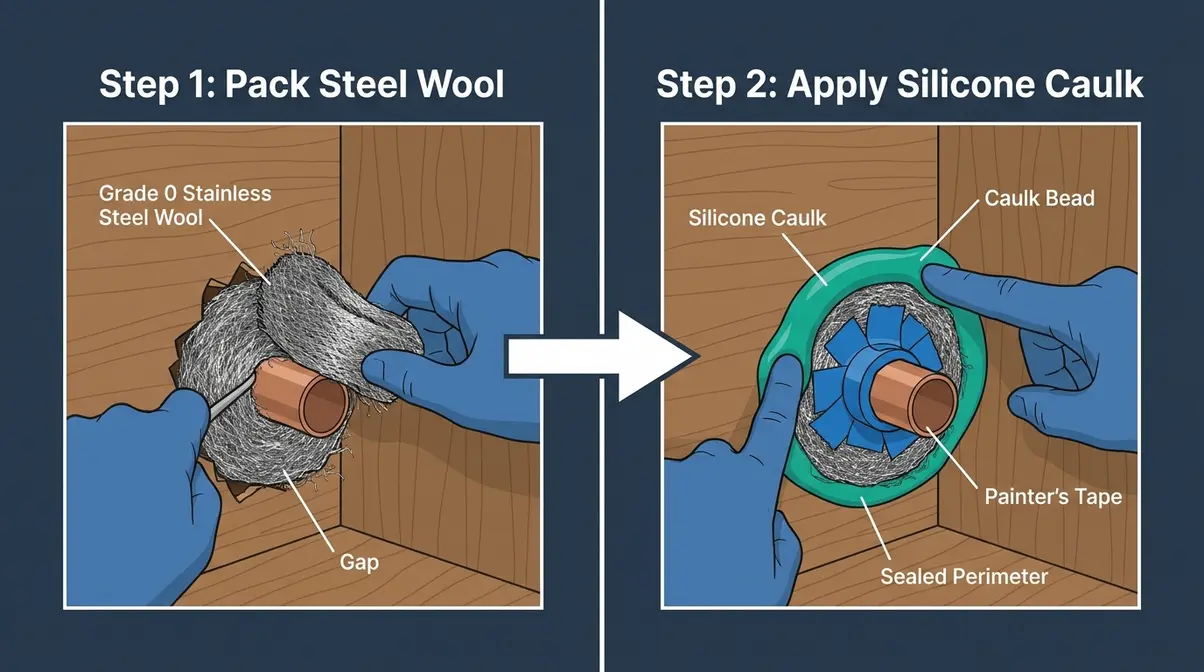
For any irregular gap larger than 1/4 inch — especially around pipe and wire penetrations — use a two-material approach: stuff Grade 0 stainless steel wool into the opening first, packing it firmly. Stainless steel wool (not standard steel wool, which rusts and crumbles) is too coarse for spiders to push through and deters rodents as a bonus.
Once the steel wool is packed in, apply a bead of waterproof silicone caulk over it to lock everything in place and create a permanent seal. Smooth the bead with a wet finger before it skins over. Standard foam gap filler alone is not recommended here — spiders can chew through soft foam over time, and foam compresses and shrinks in temperature extremes.
For pipe and wire holes specifically: wrap steel wool around the pipe or cable, then caulk the perimeter. Use painter’s tape on the pipe itself so the caulk doesn’t bond directly to it — this keeps the seal flexible as pipes expand and contract. One tube of silicone caulk (~$8) and one pad of stainless steel wool (~$5) is typically enough for a complete cabinet seal.
Step 1d: Secure Your Hot Tub Cover and Add Locking Straps
A sagging or waterlogged cover leaves visible daylight gaps along its fold and edges — and spiders exploit those gaps readily. Inspect the underside of your cover for tears in the vapor barrier, and check that the cover sits flush on all four sides when closed. If the foam core is waterlogged (it will feel noticeably heavy and sag in the center), no amount of strapping will fix it: the core needs replacement.
For covers in good structural condition, install cover locking straps (also called cover clips or tie-downs). These pull the cover tightly against the cabinet lip, closing the 1–2 inch gap that commonly forms along the sides after normal use. A set of four straps typically costs $15–$30 and takes about ten minutes to install.
A tarp adds weather protection but does not substitute for a sealed, strap-secured cover — spiders can still enter through the sides where the tarp doesn’t create a tight contact seal. Wipe the cover’s underside monthly with a citrus-based cleaner to remove organic debris that attracts insects.
With Layer 1 (Seal) in place, you’ve denied spiders their preferred entry routes. Layer 2 of the 3-Layer Spider Defense now adds a repellent barrier that makes the entire exterior actively hostile to spiders.
Step 2: Apply Natural Spider Repellents Around Your Spa
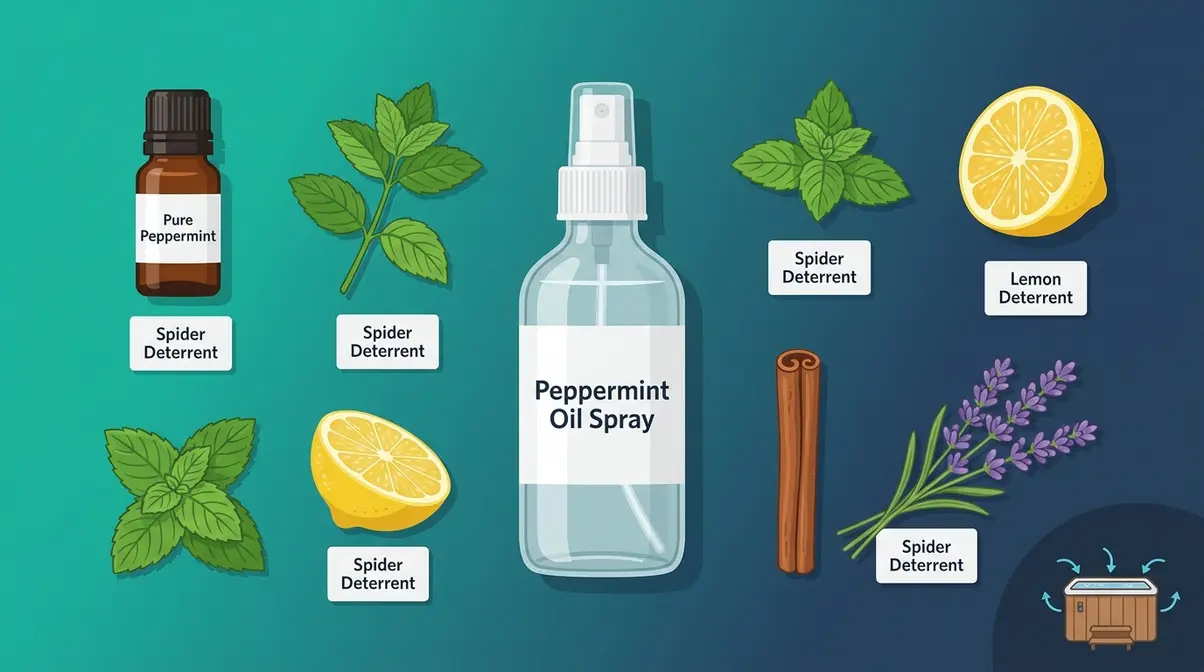
Natural repellents work by targeting spiders’ chemoreceptors — the smell-sensing organs located on their legs — making treated surfaces unpleasant to walk across or inhabit. This is Layer 2 of the 3-Layer Spider Defense: making your hot tub’s exterior surfaces and surrounding area actively hostile to spiders through scent alone, without introducing anything harmful to your water chemistry.
The most effective options, ranked by scientific support:
- Peppermint oil spray — strongest evidence base
- Citrus wipe-down — effective on cabinet surfaces and cover edges
- Cinnamon, lavender, and tea tree oil — useful secondary deterrents
The Peppermint Oil Spray Method
Peppermint essential oil is the most well-supported natural spider repellent available. A 2018 study in the Journal of Economic Entomology found that peppermint oil significantly repelled spiders in behavioral assays — while lemon oil, a commonly suggested home remedy, showed no measurable deterrent effect. That finding is worth pausing on: if you’ve been using lemon-scented products and seeing no results, the research explains why.
Use peppermint essential oil — not fragrance oil or peppermint extract, which lack sufficient volatile compound concentration to be effective. Mix 15–20 drops into a 16-oz spray bottle filled with distilled water, add a small squirt of dish soap to help the oil emulsify, and shake before each use.
- Apply to:
- All four sides of the cabinet exterior, at base level
- The underside lip of the hot tub cover (where it meets the cabinet edge)
- The perimeter of any deck or patio surface within 2 feet of the tub
Reapply every 7–10 days, or after rain. The scent dissipates faster in heat and direct sun.
Citrus Wipe-Down for Surfaces and Cabinet Edges
Spiders strongly dislike citrus compounds — specifically d-limonene, the active aromatic in orange and lemon peel. A citrus-based surface cleaner (look for d-limonene on the ingredient list) applied with a damp cloth to cabinet panels and the cover’s outer edges leaves a residual scent layer that discourages spiders from crossing treated surfaces.
This method works well as a complement to peppermint spray rather than a replacement. Wipe down cabinet panels and the cover exterior once every two weeks. The bonus: it removes the organic film and debris buildup that attracts the small insects spiders feed on.
Other Effective Deterrents: Cinnamon, Lavender, Tea Tree
Several additional deterrents are reported consistently across hot tub owner communities and supported by pest-management guidance:
- Cinnamon: Sprinkle ground cinnamon along the base of the cabinet and around the perimeter of the deck. Reapply after rain. Cinnamon contains cinnamaldehyde, which irritates spiders’ chemoreceptors on contact.
- Lavender oil: Mix 10–15 drops with water in a spray bottle and apply to the same surfaces as peppermint spray. Lavender is less potent than peppermint but useful for alternating scents so spiders don’t habituate.
- Tea tree oil: Apply diluted (10 drops per 16 oz water) to cabinet edges. Has a strong, persistent scent and is effective as a between-applications refresh.
Keeping Repellents Away from Your Hot Tub Water
This is the step no competitor guide addresses — and it matters. Essential oils and citrus compounds are not water-chemistry-neutral. Introducing peppermint or tea tree oil directly into your hot tub water can affect pH balance, create foaming, and interfere with sanitizer efficacy. Even small amounts of oil create a surface film that your filter must work harder to clear.
The rule is straightforward: apply all repellents to exterior cabinet surfaces and cover edges only. Never spray directly onto the water surface, the interior shell, or the jets. If you’re wiping down the cover’s underside, allow it to air-dry fully before closing the cover over the water. Following this boundary keeps your repellent program effective and your water chemistry stable.
Step 3: Eliminate the Insects Spiders Feed On
Spiders don’t choose your hot tub because they like warm water — they’re following their food supply. Hot tub environments attract flying insects (moths, gnats, midges) through a combination of warm water vapor, outdoor lighting, and nearby vegetation. Eliminate those insect populations and you remove the reason spiders establish territory near your spa. This is Layer 3 of the 3-Layer Spider Defense: starving spiders out rather than just repelling them.
Switch to Yellow or Amber Outdoor Lights
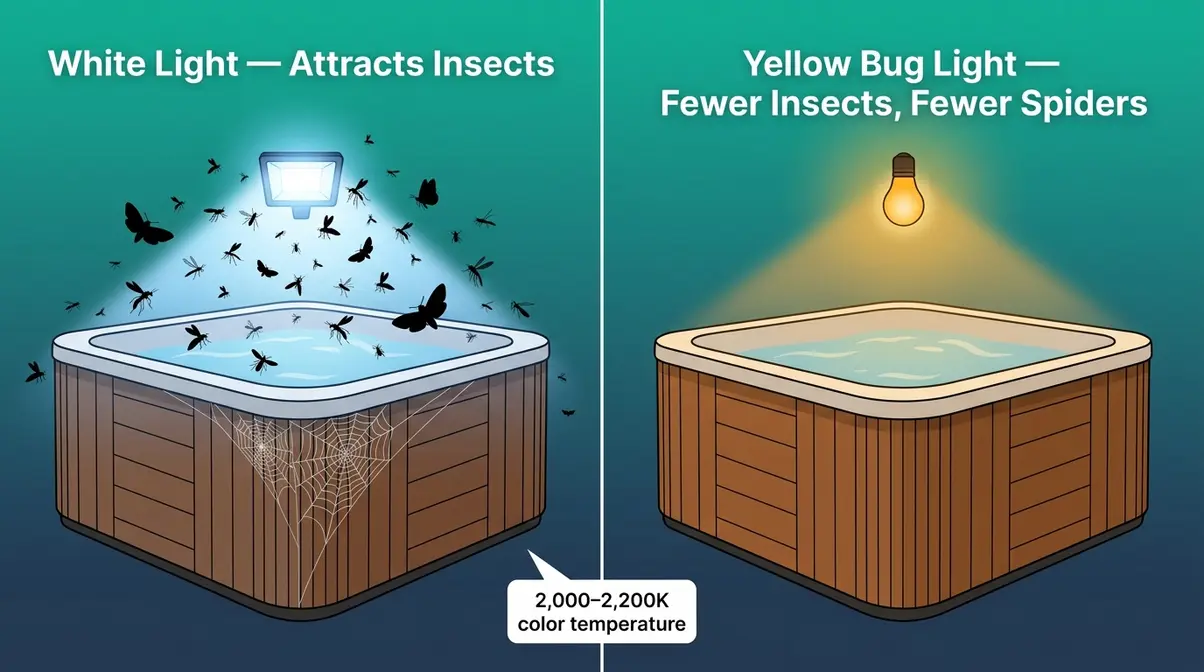
Standard white and blue-spectrum outdoor bulbs attract flying insects at significantly higher rates than yellow or amber-spectrum bulbs. Insects navigate using ultraviolet light; yellow and amber bulbs emit very little UV, making them far less attractive to the moths and gnats that draw spiders in.
Replace any white floodlights or string lights near your hot tub with yellow “bug light” bulbs or warm-amber LEDs (look for a color temperature of 2,000–2,200K). This single change can noticeably reduce the insect population around your spa within the first week, according to common feedback in hot tub owner communities.
Manage Landscaping and Debris Near the Hot Tub
Organic debris — leaf piles, woodpiles, dense low-growing shrubs — provides both shelter and hunting grounds for spiders. Keep the area within three feet of your hot tub clear of:
- Leaf and mulch accumulations
- Stacked firewood or lumber (move these at least 10 feet away)
- Dense ground-cover plants touching the cabinet
- Standing water in pots, saucers, or low spots (these breed the insects spiders eat)
Trim any shrubs or overhanging branches that create a shaded, sheltered corridor leading to the cabinet. Spiders travel along vegetation, and a branch touching your cabinet panel is essentially a highway entrance ramp.
Maintain Proper Hot Tub Water Chemistry
Properly balanced hot tub water is inhospitable to the algae and organic matter that support insect breeding near the tub’s edge. Keep your water within standard ranges — pH 7.4–7.6, alkalinity 80–120 ppm, sanitizer at manufacturer-recommended levels — and skim the surface regularly to remove any debris that accumulates. A well-maintained tub produces less organic vapor and surface film, which means fewer insects hovering at the waterline and, consequently, fewer spiders patrolling the perimeter.
Step 4: When Natural Methods Aren’t Enough — Chemical Solutions
Occasionally, a hot tub cabinet harbors a genuinely established spider population — multiple webs, egg sacs, or species like black widows that pose a real safety concern. If you’ve completed Layers 1–3 and are still finding spiders consistently after two to three weeks, targeted chemical intervention is reasonable.
Choosing the Right Perimeter Pesticide Spray
Look for a bifenthrin-based perimeter spray — bifenthrin is a synthetic pyrethroid that is highly effective against spiders and most crawling insects, has low mammalian toxicity at label-directed rates, and leaves a residual barrier that lasts several weeks. Apply it as a 12-inch band around the base of the hot tub cabinet and along the perimeter of the surrounding deck or patio surface.
Do not apply inside the cabinet near the water plumbing or heating components. Follow the product label exactly — it is a legal requirement, not a suggestion.
Using Glue Traps to Monitor and Catch Spiders
Glue traps (sticky traps) serve two purposes: they catch spiders, and they tell you where the problem is concentrated. Place them:
- Along the base of the interior cabinet walls (inside the equipment access panel)
- In each corner of the cabinet floor
- At the undercarriage gap if accessible
Check traps weekly. Heavy catches in one area indicate an unsealed entry point nearby — go back to Step 1 and inspect that zone more carefully. Replace traps every 2–4 weeks or when they’re full.
⚠️ Safety Warning: Applying Any Chemical Near Water
⚠️ SAFETY — Read Before Applying Any Pesticide Near Your Hot Tub
- Never spray pesticides directly into the water, onto the interior shell, or onto the jets or plumbing. Even “outdoor-safe” products can disrupt water chemistry, harm bathers, and damage equipment seals.
- Maintain a minimum 6-foot buffer between any spray application point and the water surface.
- Allow all treated surfaces to dry completely before opening the cover or allowing bathers near the tub.
- Follow EPA label directions precisely. Per EPA pesticide safety guidance, the label is the law — applying any pesticide in a manner inconsistent with its label is a federal violation.
- If you suspect black widow or brown recluse spiders — identifiable by their distinctive markings — do not attempt DIY treatment. Contact a licensed pest control professional.
Limitations and When to Call a Professional
Common Mistakes Hot Tub Owners Make
Even well-intentioned owners run into predictable pitfalls. The most common:
- Relying on a single layer. Peppermint spray alone won’t keep spiders out if the cabinet has open ventilation gaps. The 3-Layer Spider Defense works because all three layers operate simultaneously.
- Using standard steel wool instead of stainless. Standard steel wool rusts within weeks in an outdoor, humid environment, crumbles, and loses its sealing function. Grade 0 stainless is the only appropriate grade for this application.
- Applying repellents inconsistently. Peppermint and citrus scents dissipate within 7–10 days. Missing one reapplication cycle — especially after rain — breaks the repellent barrier and spiders return quickly.
- Forgetting the undercarriage gap. Across hot tub owner forums, this is the single most commonly missed entry point. If spiders keep reappearing after sealing visible panels, the undercarriage is the likely culprit.
When a Pest Control Professional Is the Right Call
The DIY approach in this guide is effective for the vast majority of residential hot tub spider situations. However, call a licensed pest control professional if:
- You identify or strongly suspect black widow or brown recluse spiders — both are medically significant and warrant professional treatment. University of Kentucky entomologists note that brown recluse spiders are particularly associated with dark, undisturbed enclosed spaces, exactly the conditions inside an equipment cabinet.
- You find egg sacs (small, papery white or tan spheres) throughout the cabinet — this indicates an established, reproducing population that perimeter sprays alone may not resolve.
- Natural and chemical methods have been applied correctly for four or more weeks without meaningful reduction in spider activity.
A licensed professional has access to commercial-grade products and can identify the species accurately — both of which matter when safety is a concern.
Frequently Asked Questions
How do you keep spiders away from a hot tub?
The most effective approach combines three methods simultaneously: seal every gap in the equipment cabinet using hardware mesh, steel wool, and silicone caulk; apply peppermint oil spray to all exterior surfaces every 7–10 days; and eliminate the insects spiders feed on by switching to yellow outdoor lighting and clearing organic debris within three feet of the tub. Using only one method — such as repellent spray — provides limited results if physical entry points remain open. The 3-Layer Spider Defense addresses all three attractants at once.
What repels spiders immediately?
Peppermint essential oil spray produces the fastest observable deterrent effect among natural options. Mix 15–20 drops of pure peppermint essential oil (not fragrance oil) with 16 oz of distilled water and a small amount of dish soap, and apply directly to surfaces where spiders travel. Spiders detect the compound through chemoreceptors on their legs and typically avoid treated surfaces within hours. For immediate results in a confirmed infestation, a bifenthrin-based perimeter spray provides faster knockdown than natural options, but requires a 6-foot buffer from the water.
What smell do spiders absolutely hate?
Peppermint is the most scientifically supported spider deterrent by scent. A 2018 study in the Journal of Economic Entomology found peppermint oil significantly repelled spiders in controlled behavioral assays. Citrus (specifically d-limonene), cinnamon (cinnamaldehyde), and lavender oil are also effective secondary deterrents reported consistently across pest management guidance. Notably, lemon oil — despite being widely recommended online — showed no significant deterrent effect in the same 2018 study. Stick with peppermint as your primary scent-based repellent.
Why do you put a tennis ball in a hot tub?
A tennis ball in a hot tub absorbs body oils, lotions, and cosmetics that accumulate in the water and create a surface film. The felt on the ball acts like a sponge for oil-based contaminants, which reduces foaming and keeps the filter cleaner between changes. It has no effect on spiders or pest control — but a cleaner water surface with less organic film does mean fewer insects hovering at the waterline, which indirectly reduces the food source that draws spiders to the area.
Should I put a tarp over my hot tub cover?
A tarp can protect your cover from UV damage and debris, but it does not keep spiders out. Spiders enter through the sides of the cabinet and the gap between the cover and the cabinet lip — areas a loose tarp doesn’t seal. For spider prevention specifically, the more effective upgrade is installing cover locking straps ($15–$30 for a set of four), which pull the cover tightly against the cabinet edge and close the 1–2 inch gap spiders commonly use. Use a tarp for weather protection, but pair it with straps for pest control.
Why should you never squish a spider?
Squishing a spider — particularly a female carrying eggs — can release dozens of spiderlings if the egg sac is attached to or near the abdomen. Beyond that practical concern, most spiders found in and around hot tubs are harmless predators that help control the insect populations you actually want eliminated. A better approach: use a cup and a piece of cardboard to relocate spiders found outside the cabinet, and address the root cause (open entry points and insect food sources) so new spiders don’t move in to replace the ones you’ve removed.
A Permanently Spider-Free Hot Tub Is Achievable
For hot tub owners dealing with recurring spider problems, The 3-Layer Spider Defense provides a structured, permanent solution rather than a temporary fix. Seal the cabinet completely using hardware mesh, stainless steel wool, and silicone caulk — then apply peppermint oil spray to all exterior surfaces on a 7–10 day schedule — then remove the insects spiders depend on by switching to yellow outdoor lighting and keeping the surrounding area clear of debris. Each layer reinforces the others; together, they eliminate every reason spiders choose your hot tub.
The framework works because it targets the root causes rather than the symptom. Shooing a spider out of the footwell treats the symptom. Closing every gap it used to enter, making every surface it needs to cross smell like peppermint, and removing every insect it came to hunt treats the cause.
Start with Step 1 this weekend — the inspection and sealing phase requires nothing more than a flashlight and about an hour. Once the cabinet is sealed, add the repellent layer and lighting changes within the same week. Most hot tub owners who apply all three layers report a dramatic reduction in spider activity within two to three weeks, based on consistent feedback across spa owner communities and manufacturer pest-management guidance.

Dave King
Hot tub tester and writer at One Hot Tub.