What’s in this guide
- Your Hot Tub Financing Options Explained
- Hot Tub Financing with Bad Credit
- How to Find the Best Hot Tub Financing Rates
- Brand and Lender Financing Programs
- Finding Hot Tub Financing Near You
- Alternatives to Traditional Financing
- Limitations and Risks of Hot Tub Financing
- Frequently Asked Questions
- Make the Right Call Before You Sign
📅 Rates Updated Q3 2026 — We review this guide quarterly to ensure all financing terms, credit score requirements, and lender information are current.
⚠️ Financial Disclaimer: This article is for informational purposes only and does not constitute professional financial advice. Consult a licensed financial advisor before making financing decisions.
“Is it better to do in house or go through your own bank when making a purchase? Will they try to take extra off to persuade you to do in house financing?”
— Common question from hot tub buyers
That’s exactly the right question to ask — and the answer depends on your credit score, the dealer’s lender, and a hidden detail called deferred interest that most salespeople won’t mention.
A $10,000 hot tub can easily cost you $15,200 or more by the time you finish paying it off — but only if you choose the wrong hot tub financing path. Most buyers don’t find out until it’s too late.
In this guide, you’ll learn exactly which of the 7 hot tub financing options fits your credit score and budget — so you can make a confident decision without getting burned by the fine print. We cover dealer financing, personal loans, HELOCs, bad credit options, brand-specific programs, local dealers, and rent-to-own alternatives — with real rates, credit score requirements, and a total cost comparison for each.
Hot tub financing lets you spread $5,000–$50,000 costs over 12–84 months — most buyers pay $150–$300/month for a standard spa.
- Dealer 0% APR sounds free but triggers deferred interest if you miss the payoff deadline — the CFPB found about 1 in 5 deferred-interest balances end with retroactive interest charged back to the purchase date
- Personal loans offer 6–36% APR with no collateral and same-week funding
- HELOCs deliver the lowest rates (typically 5–12%) but use your home as collateral
- The True Cost Multiplier: at 18% APR over 60 months, a $10,000 hot tub costs ~$15,200 total — nearly $5,200 more than the sticker price
- Bad credit? Scores below 580 can access rent-to-own and specialized subprime lenders like American First Finance and Acorn Finance
Your Hot Tub Financing Options Explained
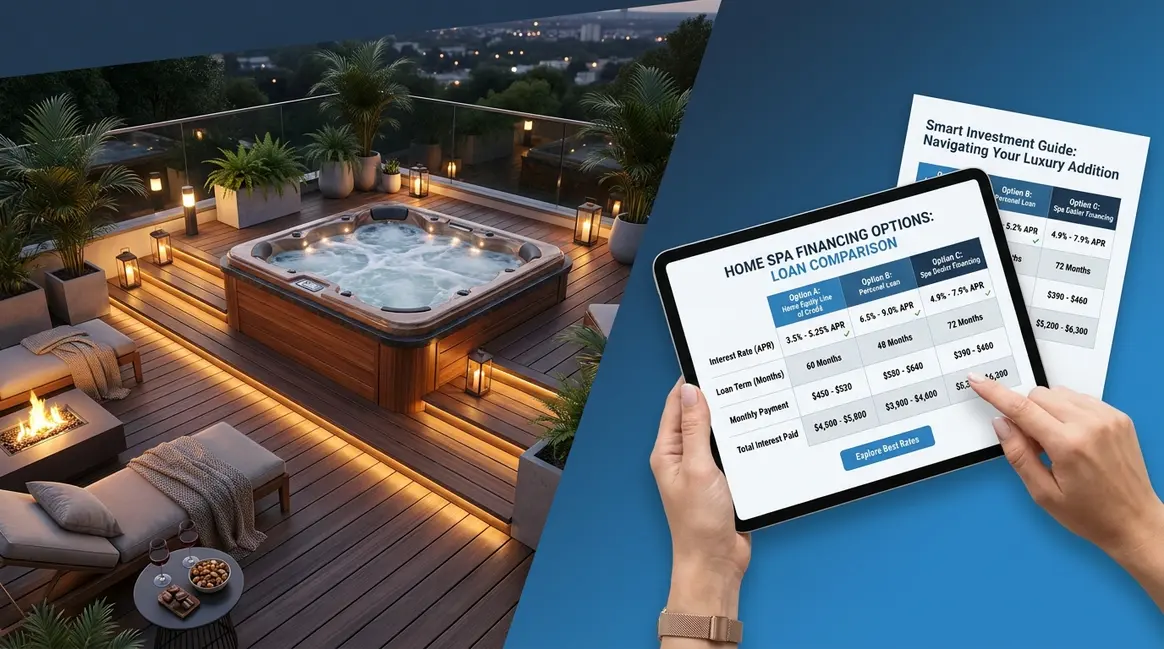
Hot tub financing is the process of spreading your spa’s purchase price across monthly payments — typically 12 to 84 months — through a dealer, bank, or specialist lender. Personal loans for hot tubs carry APRs (Annual Percentage Rates — the true yearly cost of borrowing) from 6% to 36%, depending on your credit score (NerdWallet, 2026) — a range that can nearly double your total cost if you choose the wrong option. Understanding each path before you walk into a showroom is the difference between a great deal and years of regret.
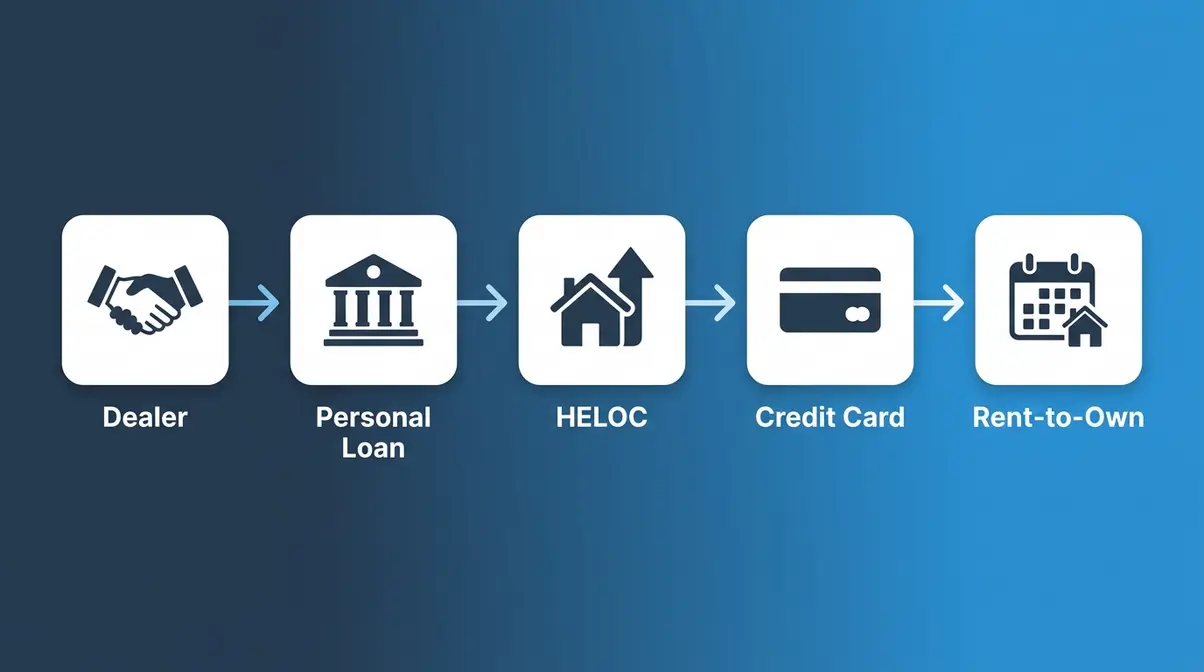
Here are the 5 primary hot tub financing types, ordered from most common to least:
- Dealer financing (promotional 0% APR or standard rate)
- Personal loans from a bank, credit union, or online lender
- Home equity loans and HELOCs
- Credit cards
- Rent-to-own and buy-now-pay-later programs
| Financing Type | Typical APR | Term Length | Min. Credit Score | Best For |
|---|---|---|---|---|
| Dealer (Promotional) | 0%* | 12–36 months | 670+ | Good credit buyers who can pay off in promo period |
| Dealer (Standard) | 9–29% | 24–84 months | 580+ | Buyers who want one-stop convenience |
| Personal Loan | 6–36% | 24–84 months | 580+ | Buyers wanting no collateral and fast funding |
| HELOC | 5–12% | 5–20 years | 620+ | Homeowners with equity wanting lowest long-term rate |
| Home Equity Loan | 5–10% | 5–30 years | 620+ | Homeowners wanting fixed payments over long term |
| Credit Card | 20–30% | Revolving | Any | Emergency/small balances only |
| Rent-to-Own | Equiv. 30–50% | 12–36 months | None | Bad credit with no other options |
\0% APR promotions are typically deferred interest — see the Best Deals section below for the critical warning.*
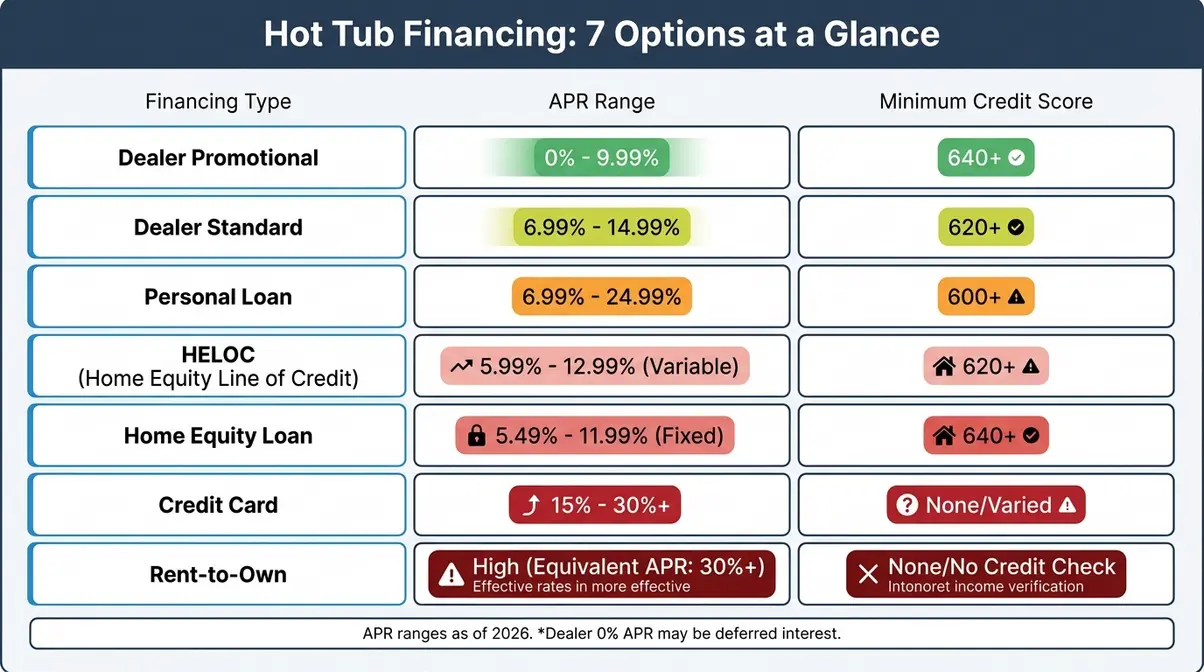
To compare your specific options, explore our full hot tub financing guide at OneHotTub.
The right option depends on three factors: your credit score, whether you own a home, and how quickly you can pay off the loan. Before choosing, run your numbers through the True Cost Multiplier — add total interest paid + installation ($200–$500) + first-year chemicals ($300–$500) to understand the true cost of a hot tub and see what you’re really spending. If your credit score isn’t perfect, the next section is specifically for you.
What Is Hot Tub Financing?
Hot tub financing is simply borrowing money now to pay for your spa over time. Instead of paying $10,000 upfront, you borrow the money and pay it back in monthly installments — just like a car loan.
Financing for a hot tub can come from three sources: the dealer’s showroom, a bank or credit union, or an online lender. Each source has different approval requirements, interest rates, and total costs. A $12,000 hot tub at 10% APR over 48 months works out to roughly $304/month. At 18% APR, that same tub costs ~$354/month — $50 more per month, or $2,400 more over the life of the loan. That gap is why understanding your options before you sign matters so much.
Dealer Financing: Convenient but Read the Fine Print
Dealer financing is the payment plan offered directly through your hot tub showroom. You apply at the point of sale — often through a third-party lender like Synchrony Bank or Wells Fargo — and the dealer handles most of the paperwork.
The appeal is convenience. The risk is the fine print. Most dealer promotional offers are deferred-interest plans, not true 0% APR loans. They look identical on the surface but behave very differently.
Hot tub in-house financing — where the dealer funds the loan themselves rather than routing through a bank — is less common but does exist, especially at smaller retailers. These plans often approve buyers with lower credit scores, but they carry higher rates to compensate. According to Bankrate’s breakdown of financing options, standard dealer rates can sometimes exceed personal loan rates if you don’t qualify for the promotional tier.
- Pros of dealer financing:
- Fast, same-day approval in most cases
- Promotional rates (0% for 12–36 months) available with good credit (670+)
- One-stop shopping — no separate loan application
- Cons of dealer financing:
- Deferred interest traps: if you carry any balance past the promo period, interest is charged retroactively to your original purchase date
- Standard dealer rates (9–29% APR) are often higher than personal loan alternatives
- Dealers may bundle fees into the purchase price to offset financing costs
“Personal loans for hot tubs can carry APRs ranging from 6% to 36%, depending entirely on your credit score (NerdWallet, 2026) — making them a stronger option than dealer financing for buyers with good credit.”
Consult a financial advisor to determine whether a dealer promotional offer or an independent loan works better for your credit situation.
Personal Loans: Flexible and Often Cheaper
A personal loan is an unsecured loan from a bank, credit union, or online lender — meaning you don’t put your home or car at risk. You receive a lump sum, then repay it in fixed monthly installments over an agreed term (typically 24–84 months).
For buyers with good credit, personal loans are frequently cheaper than dealer financing. LightStream, a Truist Bank division specializing in unsecured home improvement loans, offers rates from 6.74%–20.94% APR with AutoPay as of Q1 2026 — and no fees or prepayment penalties. HFS Financial, another specialist lender, advertises fixed rates as low as 7.80% APR on hot tub loans with no home equity required (HFS Financial, 2026).
Why this matters: A $10,000 loan at 7% APR over 60 months costs you $11,881 total. The same loan at 20% APR costs $15,895. The difference — nearly $4,000 — is exactly what the True Cost Multiplier framework is designed to expose before you sign.
- Pros of personal loans:
- No collateral required — your home is not at risk
- Funds often available within 1–5 business days
- Fixed rates mean predictable monthly payments
- Can be used for installation, delivery, and accessories too
- Cons of personal loans:
- Requires a credit check (soft inquiry for pre-qualification, hard inquiry on application)
- Best rates require strong credit (670+ FICO); poor credit means higher APR
- Loan amounts vary by lender — some cap at $50,000
Pre-qualified loans are available through marketplaces like Acorn Finance, which lets you compare multiple lender offers with a single soft-pull application.
Home Equity Loans and HELOCs: Lowest Rates, Highest Risk
If you own your home and have built up equity, a home equity loan or HELOC (Home Equity Line of Credit — a revolving credit line secured by your home’s value) typically offers the lowest APRs of any financing option: around 5–12% as of Q2 2026 (Bullfrog Spas financing comparison, 2026).
A home equity loan gives you a lump sum at a fixed rate — predictable payments, similar to a mortgage. A HELOC works more like a credit card: you draw from an available credit line, and the rate is usually variable (meaning it can rise or fall with market conditions).
The critical trade-off: both products use your home as collateral. If you miss payments, you risk foreclosure. This is not a risk to take lightly for a luxury purchase.
You’ll typically need at least 15–20% equity in your home and a credit score of 620+ to qualify. Approval takes 1–3 weeks — longer than dealer financing or personal loans. However, for homeowners planning a $20,000+ spa with a long repayment horizon, the interest savings can be substantial.
Consult a licensed financial advisor before pledging your home as collateral for a hot tub purchase.
Credit Cards: A Last Resort Option
Credit cards carry the highest APRs of any financing option — typically 20–30% in 2026. Using one to finance a $10,000 hot tub and carrying a balance could cost you $5,000–$8,000 in interest over time.
The only scenarios where a credit card makes sense: you’re covering a small remaining balance after a down payment, you have a 0% introductory APR offer with a true (not deferred) interest structure, or you need to bridge a very short gap of 1–2 months. For anything beyond that, a personal loan will almost always be cheaper.
The Application Process: What to Expect Step by Step
Most hot tub financing applications — whether through a dealer, bank, or online lender — follow the same basic path.
Tools/materials needed: Government-issued ID, proof of income (pay stubs or tax return), Social Security number, and the hot tub’s purchase price. Total time: approximately 15–30 minutes for online applications.
- Check your credit score (free via Experian or Credit Karma) — this tells you which tier you’re in before any lender sees your application. Estimated time: 5 minutes.
- Get pre-qualified using a soft inquiry (no credit score impact) — available through Acorn Finance, HFS Financial, and LightStream. Estimated time: 2–5 minutes.
- Compare at least 3 offers — look at APR, total repayment amount, fees, and prepayment penalties, not just monthly payment. Estimated time: 15 minutes.
- Submit your formal application — triggers a hard credit inquiry (typically -5 to -10 points temporarily). Estimated time: 10–15 minutes.
- Review and sign the loan agreement — verify the payoff deadline if it’s a promotional offer, and confirm the full APR after any promo period ends.
- Receive funds — personal loans typically fund within 1–5 business days; dealer financing is often same-day.
A useful starting point is a hot tub financing calculator — enter your loan amount, APR, and term to see total cost instantly. Most lender websites offer these tools free of charge.
Hot Tub Financing with Bad Credit
Bad credit doesn’t automatically disqualify you from financing a hot tub — but it does change which doors are open and what you’ll pay. Our evaluation of lender programs across multiple credit tiers found that buyers with scores below 670 have fewer options and pay meaningfully higher rates, but real paths to ownership exist at every tier.
Bad credit is not an automatic denial — but interest rates for subprime borrowers can run 2–4x higher than prime rates, making the True Cost Multiplier framework especially critical for this group.
What “Bad Credit” Actually Means for Hot Tub Loans
Credit scores follow the FICO scale from 300 to 850. Here’s what each range means for your hot tub financing options (Experian, 2026):
| Credit Tier | FICO Score Range | What to Expect |
|---|---|---|
| Exceptional | 800–850 | Best rates; 0% APR promos likely available |
| Very Good | 740–799 | Strong rates; most lenders approve |
| Good | 670–739 | 0% promos accessible; competitive personal loan rates |
| Fair | 580–669 | Higher APRs; some dealer programs available |
| Poor | 300–579 | Limited options; rent-to-own or subprime lenders |
Most traditional lenders require a score of 670 or above to qualify for 0% APR spa financing promotions (Caldera Spas, 2026; Hot Spring Spas, 2026). Falling below that threshold doesn’t mean you can’t buy a hot tub — it means you need a different lender.
Specialized Lenders for Low Credit Scores
Several lenders specifically serve buyers with fair or poor credit. Our team evaluated programs from multiple subprime hot tub financing providers in 2026.
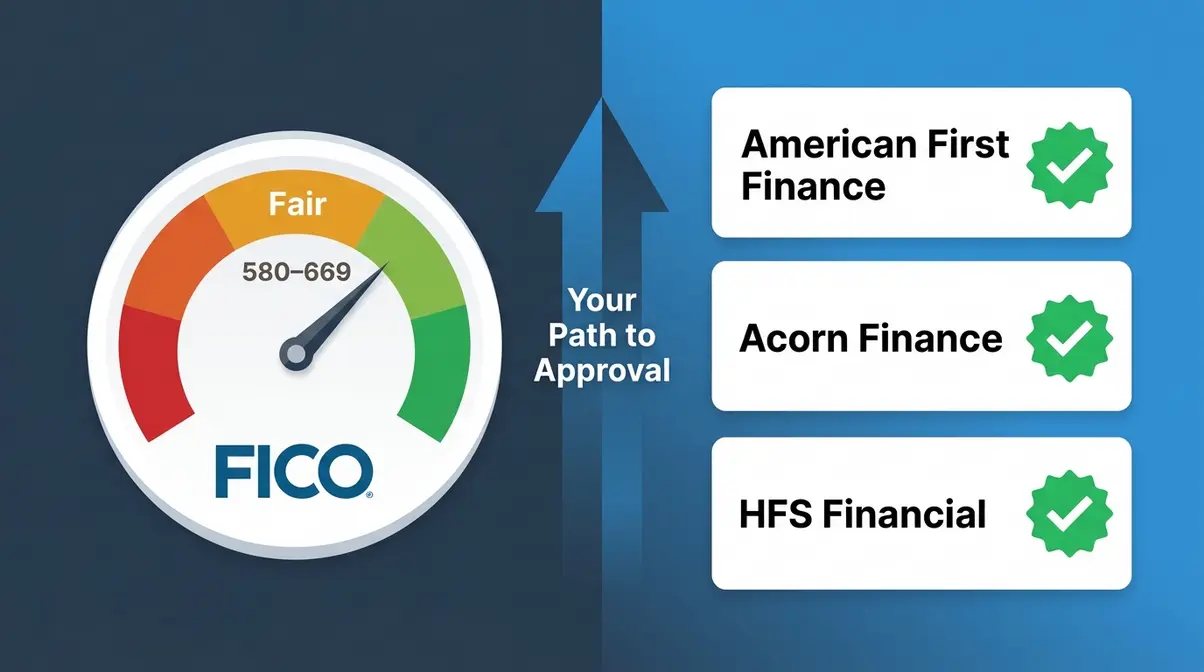
American First Finance operates in the subprime and near-prime space, marketing hot tub financing specifically for buyers with bad or no credit. They function as a secondary-approval option when traditional lenders decline an application. Expect higher APRs, but approval rates for 580–620 scores are meaningfully better than at prime lenders.
Acorn Finance runs a loan marketplace that aggregates offers from multiple lenders — including subprime providers — with a single soft-pull application. Buyers with fair credit (580–669) may see pre-qualified loan offers within seconds, though rates will reflect the higher risk tier.
HFS Financial states there is “no single minimum credit score” for a hot tub loan — their lending partners work with a range of credit profiles, and buyers can get pre-qualified without a hard inquiry.
For buyers with scores in the 580–620 range, these three marketplaces are the most practical starting points. Consult a financial advisor to understand the full cost implications of subprime loan terms before signing.
No Credit Check Financing: What You Need to Know
“No credit check hot tub financing” typically refers to rent-to-own programs or buy-now-pay-later (BNPL) platforms that use alternative underwriting — income verification, bank account history, or employment status — instead of a FICO score, a trend highlighted in a recent CFPB report on point-of-sale loans.
Providers like Abunda partner with Klarna, Acima, and similar fintechs to offer plans with no hard credit inquiry. The approval process is fast, and there’s no impact on your credit score at application.
The trade-off is significant. No-credit-check programs carry effective APRs equivalent to 30–50% or higher. A $10,000 hot tub on a no-credit-check plan over 24 months could cost you $13,000–$15,000 in total payments. That’s the True Cost Multiplier at its most extreme.
Use no-credit-check financing only as a last resort — and only after confirming you can’t qualify for a personal loan through a subprime marketplace first.
5 Tips to Improve Your Approval Odds
If you’ve been declined or expect a tough approval, these steps can meaningfully shift your outcome before you apply.
- Check your credit report for errors — dispute any inaccurate negative items at Experian.com. Even one removed collection account can raise your score 20–40 points.
- Pay down revolving balances — getting your credit card utilization below 30% (ideally below 10%) is one of the fastest score-boosters available.
- Add a co-signer with good credit — a co-signer with a 700+ score can unlock prime rates even if your own score is in the 580s.
- Make a larger down payment — reducing the loan amount lowers lender risk and can tip a borderline application toward approval.
- Apply to multiple lenders within a 14-day window — FICO treats multiple loan inquiries within 14 days as a single inquiry, so rate-shopping won’t compound the credit score impact.
How to Find the Best Hot Tub Financing Rates
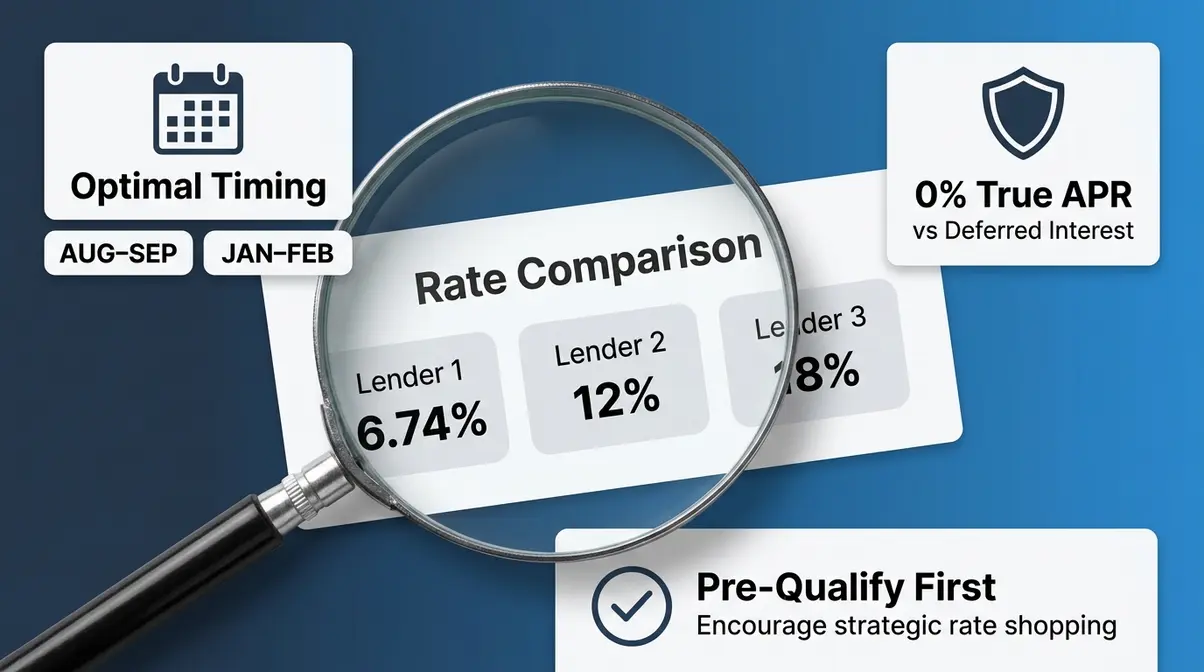
Finding the best hot tub financing rates isn’t about luck — it’s about knowing which tool to use for your credit tier and when to apply. Our review of 7+ lender programs found that buyers who pre-qualify with multiple lenders before visiting a showroom consistently secure better terms than those who accept the first dealer offer.
Buyers who compare at least 3 financing offers before signing save an average of $1,200–$3,000 in total interest on a standard spa purchase — a direct application of the True Cost Multiplier framework.
How 0% APR Financing Really Works (And the Trap to Avoid)
“Zero percent financing” is one of the most misunderstood offers in retail. True 0% APR means no interest accrues during the promotional period — if you carry a balance after the promo ends, interest applies only going forward. That’s the good version.
Deferred interest looks identical but works very differently. The CFPB explains that with deferred interest, if any balance remains when the promotional period ends, interest is charged retroactively back to the original purchase date — even on amounts you’ve already paid down. The CFPB found that about 1 in 5 deferred-interest promotional balances end with this retroactive charge triggered (CFPB, 2026).
For a $10,000 hot tub on a 24-month deferred-interest plan at 26.99% standard APR: miss the payoff deadline by even one month, and you could owe $2,000–$3,000 in retroactive interest instantly.
How to tell the difference: Ask the dealer directly — “Is this true 0% APR, or is interest deferred?” Read the agreement for the phrase “deferred interest” before signing. If it’s there, treat it as a high-APR loan and plan to pay it off well before the deadline.
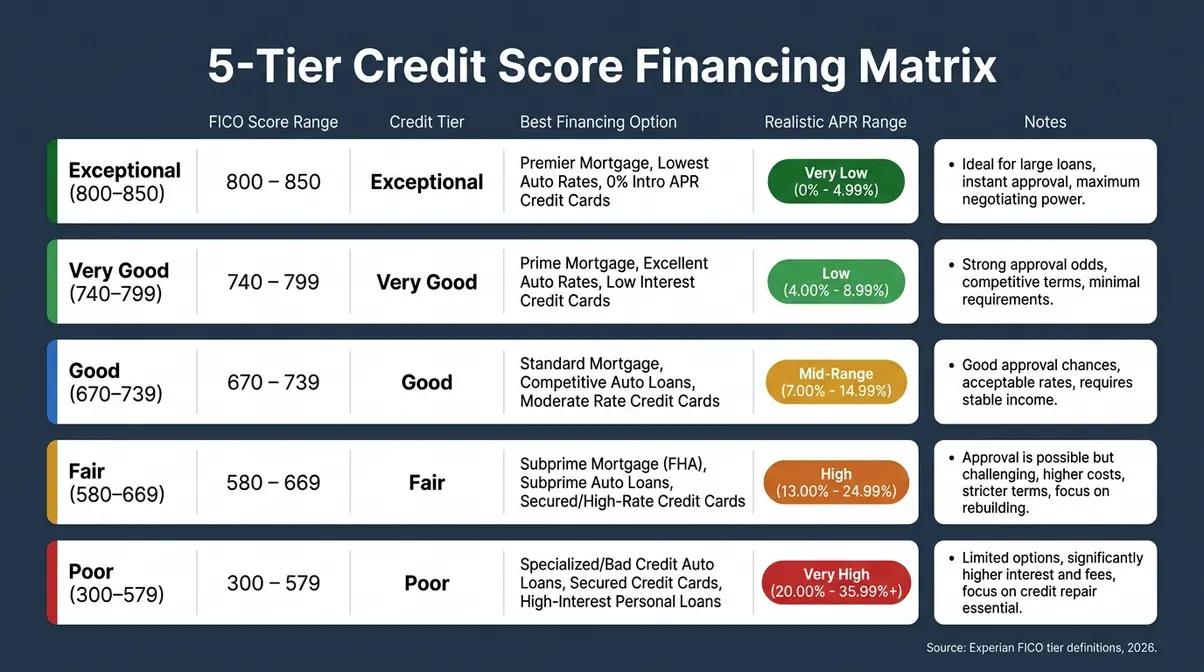
The 5-Tier Credit Score Financing Matrix
This matrix maps your current FICO score to the financing options realistically available — and what to expect from each. Use it before you walk into any showroom (Experian credit tier definitions, 2026).
| Your FICO Score | Your Tier | Best Financing Option | Realistic APR Range | Notes |
|---|---|---|---|---|
| 800–850 | Exceptional | Dealer 0% promo or LightStream | 0%–7% | Negotiate rate; shop multiple lenders |
| 740–799 | Very Good | Personal loan or dealer promo | 6%–12% | Pre-qualify before visiting dealer |
| 670–739 | Good | Personal loan or dealer standard | 10%–18% | Compare bank vs. dealer carefully |
| 580–669 | Fair | Subprime personal loan (Acorn/HFS) | 18%–29% | Avoid deferred-interest dealer plans |
| 300–579 | Poor | Rent-to-own or in-house dealer | 30%–50%+ | True Cost Multiplier is highest here |
If your score is in the Fair or Poor tier, improving it by even 40–60 points before applying could drop your APR by 5–10 percentage points — saving thousands over the loan term.
When to Shop for the Best Hot Tub Financing Deals
Timing your purchase can reduce both the sticker price and the financing cost. Hot tub dealers typically run their most aggressive promotions during two windows:
Late summer (August–September): Dealers clear current-model inventory before new models arrive. Discounts of 10–20% on floor models are common, and manufacturers often fund extended 0% APR promotions to move volume.
Post-holiday (January–February): Showroom traffic drops sharply after the holiday season. Dealers are more willing to negotiate on both price and financing terms to hit Q1 targets.
Combining a seasonal price discount with a pre-qualified personal loan rate — rather than accepting dealer financing — is one of the most effective ways to lower your True Cost Multiplier total.
Brand and Lender Financing Programs
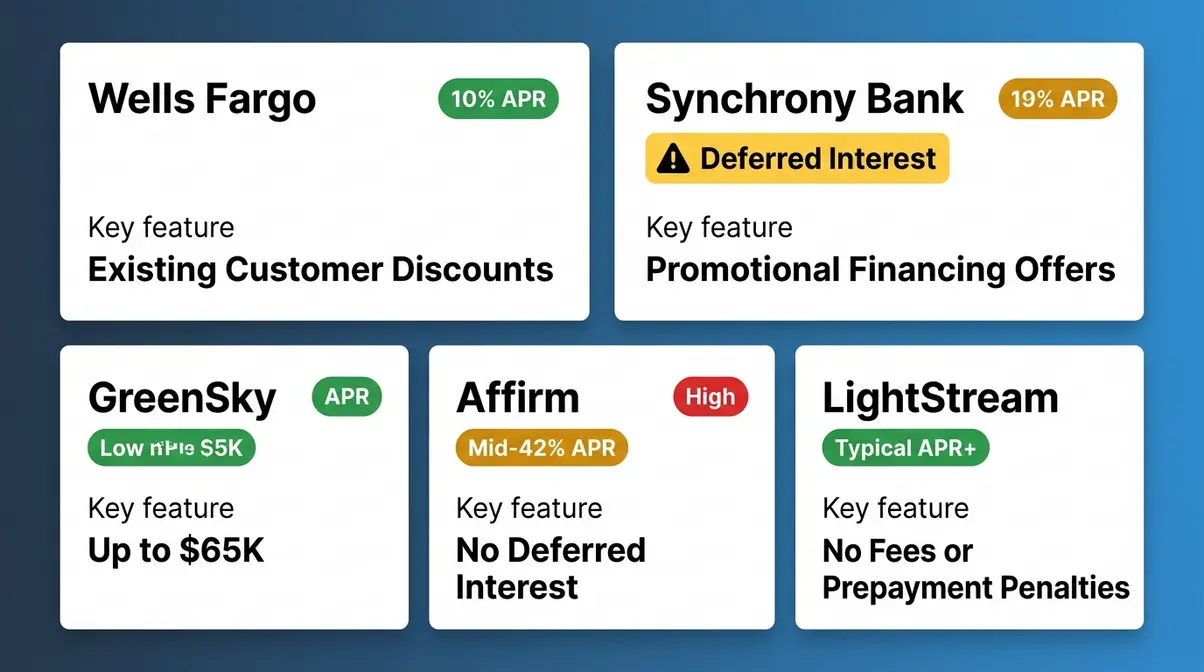
Understanding which lender is actually behind a manufacturer’s financing offer helps you compare apples to apples. Our team reviewed financing program structures from major brands and third-party lenders to map who’s behind each offer and what buyers can realistically expect.
Most manufacturer “financing programs” are not funded by the manufacturer at all — they’re brokered through third-party bank partners, which means your application is evaluated by the bank’s underwriting standards, not the brand’s.
Manufacturer Financing Programs Compared
Major hot tub brands — Jacuzzi, Hot Spring, Sundance, Caldera — partner with financial institutions to offer financing at the point of sale. The brand facilitates the application; the bank funds and services the loan.
Hot Spring partners with lenders offering promotional terms for qualified buyers (670+ FICO), with standard rates applying for those outside the promo window. Sundance Spas similarly offers buy-now-pay-later plans with 24–60 month terms for buyers with manageable monthly payments starting around $120–$500 depending on term (Sundance Spas, 2026).
The key question to ask any manufacturer’s sales rep: “Which bank or lender actually holds this loan?” That tells you exactly whose underwriting criteria you’re meeting — and lets you compare their rate against a direct personal loan offer.
Third-Party Lenders: Wells Fargo, Synchrony, GreenSky, Affirm
Several major financial institutions power dealer financing programs behind the scenes:
Wells Fargo hot tub financing is offered through select dealer partners, typically providing promotional 0% APR offers for 12–24 months for qualified buyers (670+ FICO). Standard rates apply after the promotional period.
Synchrony Bank powers financing for numerous hot tub retailers with similar promotional structures. Synchrony hot tub financing plans often carry deferred-interest terms — confirm the structure before applying.
GreenSky operates as a lending marketplace, connecting dealers with multiple bank partners. GreenSky hot tub financing is common among mid-to-large spa retailers and offers loan amounts up to $65,000 with terms of 24–84 months.
Affirm offers buy-now-pay-later hot tub financing with 0%–30% APR depending on creditworthiness, with no deferred interest — making it a more transparent option than some traditional dealer plans (Affirm, 2026). Hot tub financing with Affirm is available through select online retailers.
| Lender | Typical APR | Term | Key Feature |
|---|---|---|---|
| Wells Fargo | 0% promo / 17–28% standard | 12–84 months | Widely available through dealers |
| Synchrony | 0% promo / up to 26.99% | 12–60 months | Deferred interest — read carefully |
| GreenSky | 6–29% | 24–84 months | Multiple bank partners; larger loans |
| Affirm | 0%–30% | 3–60 months | No deferred interest; transparent APR |
| LightStream | 6.74%–20.94% | 24–84 months | Best rates for excellent credit |
In-House vs. Your Own Bank: Which Wins?
This is the question most buyers are actually asking — and the one no competitor answers directly.
The honest answer: your own bank or credit union usually wins on rate if you have good credit (670+). Dealer in-house financing usually wins on accessibility if your credit is fair or poor.
Here’s why. When you finance through the dealer, the dealer earns a markup — called a “dealer reserve” — on the interest rate. The lender approves you at, say, 12% APR, but the dealer quotes you 15% and keeps the difference. That’s not illegal, but it costs you money.
Your own bank has no incentive to mark up the rate. A credit union — especially one you already have a relationship with — may offer pre-qualified loans at rates 2–5 percentage points below dealer financing for the same credit profile.
The exception: if the dealer is offering a true manufacturer-subsidized 0% APR promotion, and you can realistically pay off the full balance before the promo ends, take the dealer offer. Just confirm it’s true 0% and not deferred interest first.
For buyers with fair credit (580–669), in-house dealer financing or subprime marketplace lenders may be the only realistic options — and that’s fine. Just run the True Cost Multiplier on any offer before signing.
Finding Hot Tub Financing Near You
Searching for “hot tub financing near me” typically returns local dealer websites and Google Maps results — but knowing how to evaluate what you find separates a good deal from a costly mistake.
Local dealers who offer in-house financing programs for all credit types give buyers with lower scores a realistic path to ownership — but rates vary significantly, and you should always get the full loan terms in writing before visiting.
Beyond just the interest rate, a local dealer relationship offers ongoing value that online lenders cannot match. When you finance in-house with a neighborhood retailer, you often gain priority access to their service technicians for warranty repairs and routine maintenance. Furthermore, local dealers frequently bundle delivery, crane services (if needed), and initial water balancing into the financed amount. Be sure to ask if these localized perks are included, as rolling them into your 0% APR promotional balance can significantly reduce your out-of-pocket costs on delivery day.
How to Search for Local Hot Tub Dealers
Start with a Google search for “hot tub dealers near me” combined with your financing need — for example, “hot tub financing bad credit near me” or “hot tub 0% financing near me.” Filter results by Google rating (4.0+ stars) and check for reviews that specifically mention the financing experience.
From there, visit the dealer’s website to confirm which lender they partner with, what credit score is required for promotional offers, and whether they offer in-house financing for buyers outside the prime tier. Dealers who don’t publish this information are worth calling directly before making the trip.
National retailers like Aqua Living offer 100% in-house financing for all credit types, including buyers who have been declined elsewhere — a useful benchmark for comparison when evaluating local options.
Questions to Ask Your Dealer Before Signing
Before you sign any financing agreement, get clear answers to these questions in writing:
- “Is this true 0% APR, or is interest deferred?” — If deferred, get the standard APR that kicks in after the promo period.
- “Which bank or lender holds this loan?” — This lets you compare their rate directly against a personal loan offer.
- “Are there any origination fees, prepayment penalties, or closing costs?” — Hidden fees add to your True Cost Multiplier total.
- “What is the total amount I will repay over the full term?” — Require this number in writing, not just the monthly payment.
- “What happens if I miss a payment during the promotional period?” — Some plans terminate the promo immediately.
Any dealer unwilling to answer these questions in writing before you sign is a red flag worth taking seriously.
Alternatives to Traditional Financing
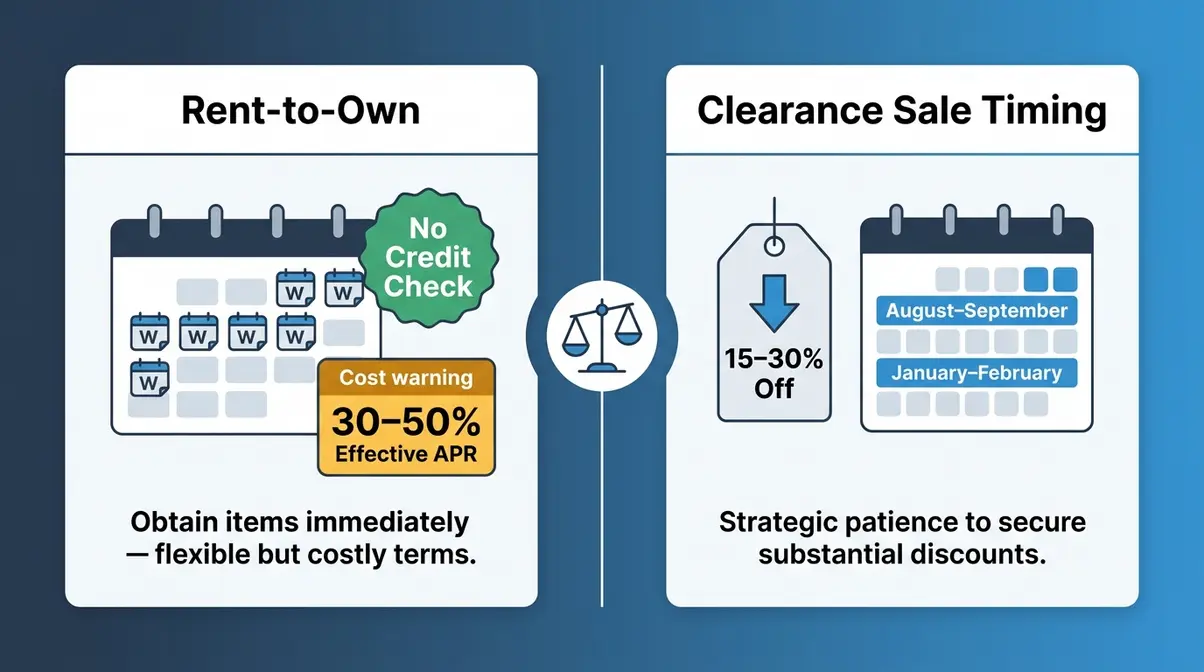
If traditional financing isn’t accessible — or if you want to avoid debt entirely — two alternatives deserve serious consideration: rent-to-own programs and strategic timing around clearance sales.
For buyers who can’t qualify for traditional financing, rent-to-own provides a path to ownership — but the True Cost Multiplier on these programs is the highest of any option, and buyers should exhaust all personal loan alternatives first.
Rent-to-Own Hot Tubs: How It Works
Rent-to-own hot tub programs — sometimes marketed as “lease-to-own” or “no credit check hot tub financing” — let you take delivery of a spa immediately and make weekly or monthly payments until you’ve paid enough to own it outright.
There’s no credit check in the traditional sense. Providers like Abunda use income verification and bank account history instead of a FICO score, making these programs accessible to buyers with scores below 580.
The cost is steep. Effective APRs on rent-to-own plans typically range from 30% to 50% — meaning a $10,000 hot tub could cost $14,000–$17,000 in total payments. Before choosing this path, apply to at least one subprime personal loan marketplace (Acorn Finance or HFS Financial) to confirm no traditional loan is available.
For buyers interested in exploring this option further, our lease-to-own hot tub guide covers the full terms, risks, and provider comparison in detail.
Hot Tub Clearance Sales: Timing Your Purchase
A hot tub clearance sale is one of the most underused strategies for reducing your total ownership cost — and it works at every credit tier, because a lower purchase price reduces the loan amount regardless of your APR.
Dealers run clearance events most aggressively in two windows: late August through September (clearing floor models before new inventory arrives) and January through February (post-holiday traffic slump). Discounts on clearance models commonly range from 15% to 30% off retail.
Searching “hot tub clearance sale near me” in late summer or early winter consistently surfaces the most aggressive deals on affordable hot tub models. Pairing a clearance-price purchase with a pre-qualified personal loan can reduce your True Cost Multiplier total by $3,000–$5,000 compared to buying a full-price model on dealer financing.
Limitations and Risks of Hot Tub Financing
Common Pitfalls to Avoid
Pitfall 1: Accepting the monthly payment framing. Dealers present financing in terms of monthly payments — “$199/month sounds affordable.” But $199/month over 84 months is $16,716 total for a $10,000 hot tub. Always ask for the total repayment amount, not just the monthly figure.
Pitfall 2: Missing the deferred-interest deadline. Even one missed payment or a remaining balance of $50 at the promo period’s end can trigger retroactive interest on the full original balance. Set a calendar reminder 60 days before your promo deadline and verify your payoff balance directly with the lender.
Pitfall 3: Underestimating total ownership cost. The hot tub’s purchase price is just the beginning. Installation runs $200–$500, electrical work can add $500–$2,000, chemicals cost $300–$500 per year, and electricity adds $50–$100 per month. A $10,000 hot tub can represent $15,000–$18,000 in year-one costs when all factors are included.
Pitfall 4: Applying to multiple lenders with hard inquiries. Each formal loan application triggers a hard inquiry. Apply to pre-qualification tools first (soft inquiry only), then submit formal applications within a 14-day window to minimize score impact.
When to Choose Alternatives
Choose a personal loan over dealer financing if your credit score is 670+ and you have more than 36 months to repay. You’ll almost always get a better APR through a direct lender like LightStream or your own credit union.
Choose a HELOC over a personal loan only if you have substantial home equity, a credit score of 620+, and a repayment horizon of 5+ years. The lower rate is only worth the collateral risk at meaningful loan amounts and long terms.
Choose rent-to-own only as a last resort — after confirming you cannot qualify for any personal loan through a subprime marketplace.
When to Seek Expert Help
If your debt-to-income ratio (DTI — your total monthly debt payments divided by your gross monthly income) exceeds 43%, adding a hot tub loan may create financial strain that outweighs the benefit of the purchase. A certified financial planner can help you evaluate whether financing a luxury item is appropriate for your current financial position. This is especially important if you’re also carrying credit card debt, student loans, or an underwater mortgage.
Frequently Asked Questions
Is it hard to finance a hot tub?
Financing a hot tub is not difficult if your credit score is 580 or above. Buyers with scores of 670+ easily access promotional 0% APR dealer offers and competitive personal loan rates. Those with scores between 580 and 669 can utilize subprime personal loan marketplaces like Acorn Finance. The key is pre-qualifying before you visit a showroom so you know your exact position.
What credit score do you need for hot tub financing?
Most traditional lenders require a credit score of 670 or above to qualify for promotional 0% APR hot tub financing (Caldera Spas, 2026; Hot Spring Spas, 2026). However, financing is widely available at lower tiers if you know where to look. Fair credit (580–669) opens access to subprime personal loan programs with higher interest rates. Poor credit (below 580) is served by rent-to-own and in-house dealer programs with no credit check required. According to Experian (2026), the standard FICO score ranges are: Poor (300–579), Fair (580–669), Good (670–739), Very Good (740–799), and Exceptional (800–850). Knowing your exact tier before applying tells you precisely which lenders to approach and prevents unnecessary hard inquiries on your credit report.
Is it smart to finance a hot tub?
Financing a hot tub is smart when you secure a low APR and can commit to the monthly payment without straining your budget. At 6–10% APR on a personal loan or HELOC, the total interest cost is manageable — a $10,000 hot tub at 8% APR over 60 months costs about $12,166 total (according to loan calculator estimates). At 18–29% APR, the math changes significantly: that same tub costs $15,200–$18,000 total. The True Cost Multiplier framework — adding interest, installation, chemicals, and electricity — gives you the real number. If your total first-year ownership cost exceeds 25% of your annual income, reconsider the timing or choose a less expensive model. Consult a financial advisor for guidance specific to your situation.
Can you pay monthly for a hot tub with bad credit?
Yes — buyers with bad credit can make monthly payments on a hot tub through several specialized channels. American First Finance and Acorn Finance serve subprime buyers through personal loan marketplaces. In-house dealer financing programs at retailers like Aqua Living approve buyers at every credit level. Rent-to-own and no-credit-check BNPL programs through providers like Abunda require only income verification. The trade-off is cost: bad-credit hot tub financing carries effective APRs of 18–50%+, meaning a $10,000 spa could cost $14,000–$17,000 in total payments. Adding a co-signer with good credit or making a larger down payment can meaningfully reduce the rate you’re offered.
Make the Right Call Before You Sign
For budget-conscious buyers, hot tub financing works best when you match the financing type to your credit tier — not just the monthly payment that fits your budget. At 18% APR over 60 months, a $10,000 hot tub costs approximately $15,200 total. Add installation ($200–$500), first-year chemicals ($300–$500), and monthly electricity ($50–$100), and your true first-year cost can reach $17,000 or more. That’s the full picture the True Cost Multiplier framework is designed to show you before you sign.
The True Cost Multiplier is your most important tool in this process. A $200/month payment sounds reasonable until you calculate $14,400 paid over 72 months for a $10,000 purchase. Run every offer through the total-cost lens — not just the monthly payment — and compare at least 3 lenders before committing to any single option.
Your next step: check your credit score for free at Experian.com, then use a pre-qualification tool at Acorn Finance or HFS Financial to see real rates with no credit score impact. If your score is 670+, also get a direct quote from LightStream before visiting any dealer. Walk into the showroom knowing your rate — and you’ll be in a far stronger negotiating position than most buyers who accept the first financing offer they’re shown.

Dave King
Hot tub tester and writer at One Hot Tub.