

What’s in this guide
- Recommended Products
- Bromine vs. Chlorine — At-a-Glance Comparison
- Why Does Bromine Outperform Chlorine in Hot Water?
- Is Bromine or Chlorine Safer for Sensitive Skin?
- Bromine Maintenance and Troubleshooting
- Chlorine Maintenance and When It Makes Sense
- How to Switch Sanitizers Safely
- Decision Framework: Choose Bromine or Chlorine?
- Frequently Asked Questions
- Limitations and When to Reconsider Your Choice
- Conclusion
If you’ve ever found yourself juggling pH levels and alkalinity levels — not to mention oxidizing and using a water clarifier — you’re not alone. Choosing between hot tub bromine vs. chlorine is one of the first decisions new owners face, and most guides offer little more than recycled manufacturer talking points.
Guessing wrong costs you money, time, and skin comfort. Chlorine in a hot tub dissipates faster than most owners expect. Bromine costs more upfront. Neither choice is obvious without understanding the chemistry behind it.
By the end of this guide, you’ll know exactly which sanitizer suits your hot tub, how much it will cost you per year, and what to do if you want to switch. We’ll cover heat stability, skin safety, step-by-step maintenance, and a 5-step switching guide you won’t find anywhere else.
⚠️ Chemical Safety Notice: Never mix bromine and chlorine products in the same water — doing so produces toxic gases. Always follow manufacturer dosing instructions, wear gloves when handling tablets, and keep chemicals stored separately in a cool, dry place. Consult a pool professional if water issues persist despite proper dosing.
We reviewed CDC guidelines, four peer-reviewed studies, and analyzed retail pricing data from major US suppliers to build the cost comparison in this guide.
Recommended Products
| # | Image | Product | Best For | Buy |
|---|---|---|---|---|
| 1 |  |
FROG Serene Floating System Starter Bundle | Beginners wanting easy setup | Buy on Amazon |
| 2 |  |
1-Inch Bromine Tablets 5.5 lbs | Budget-conscious tub owners | Buy on Amazon |
| 3 |  |
Clorox Spa Bromine Tablets 1.5lb | Small tub, light use | Buy on Amazon |
| 4 |  |
Aquadoc Bromine Hot Tub Starter Kit | New hot tub owners | Buy on Amazon |
| 5 |  |
Xtremeclear Bromine Tablets 5 lbs | High-use, large tubs | Buy on Amazon |
| 6 | |
1-Inch Bromine Tablets 5.5 lbs | Value bulk purchase | Buy on Amazon |
| 7 |  |
FROG Serene 3-Month Bundle | Ongoing low-maintenance care | Buy on Amazon |
| 8 |  |
AquaDoc Bromine Tablets 1.5 lb | Made-in-USA preference | Buy on Amazon |
| 9 |  |
In The Swim Bromine Plus Tablets | Chlorine-sensitive soakers | Buy on Amazon |
When comparing hot tub bromine vs chlorine, bromine outperforms chlorine for most covered hot tubs on heat stability and skin comfort — but it costs roughly $400–$600/year vs. chlorine’s $150–$300, making the right choice depend on how often you soak.
- 1. Heat stability: Bromine holds its sanitizing power at hot tub temperatures of 100–104°F; chlorine dissipates faster above 95°F and requires more frequent dosing.
- 2. Skin comfort: Research shows bromine is generally not associated with greater contact dermatitis risk than chlorine — chloramines (chlorine byproducts) are the more common irritant (PubMed, 2001).
- 3. The Bromide Bank Effect: Spent bromine forms bromamines that can be reactivated by shocking — chlorine is consumed permanently, making bromine more efficient long-term for frequent users.
- 4. Switching requires a full drain: Never add chlorine to an active bromine system — drain, clean, and refill first.
- 5. Safe levels: The CDC recommends 4–8 ppm bromine or 3–10 ppm free chlorine in hot tubs and spas (CDC, 2026).
Bromine vs. Chlorine — At-a-Glance Comparison
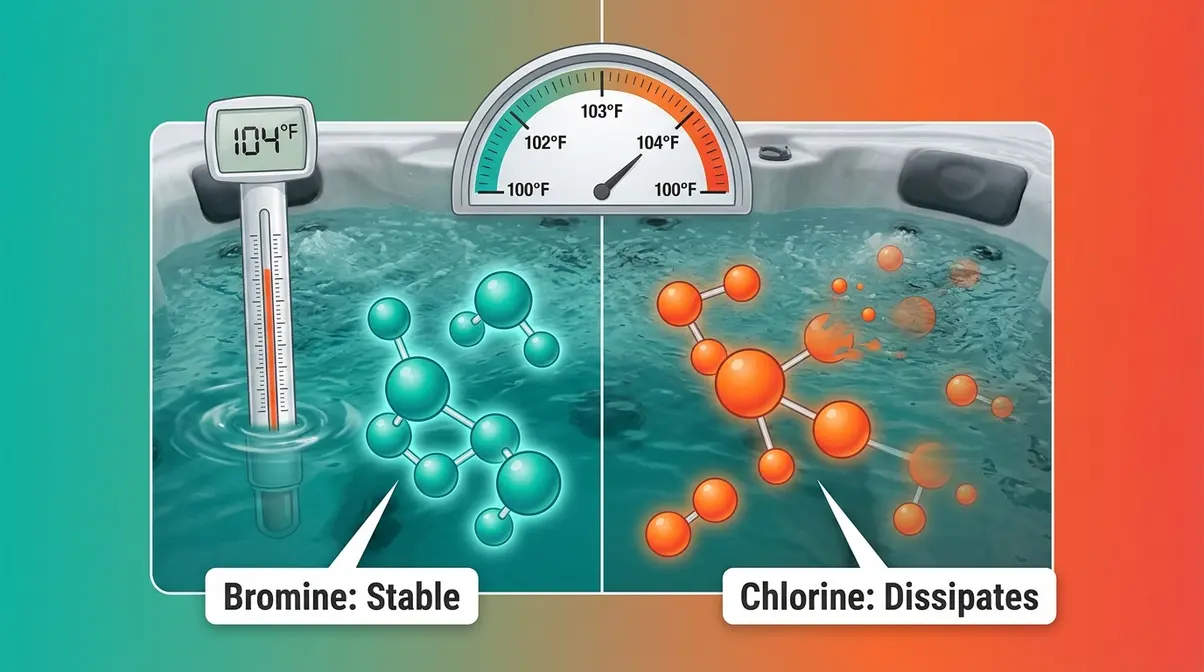
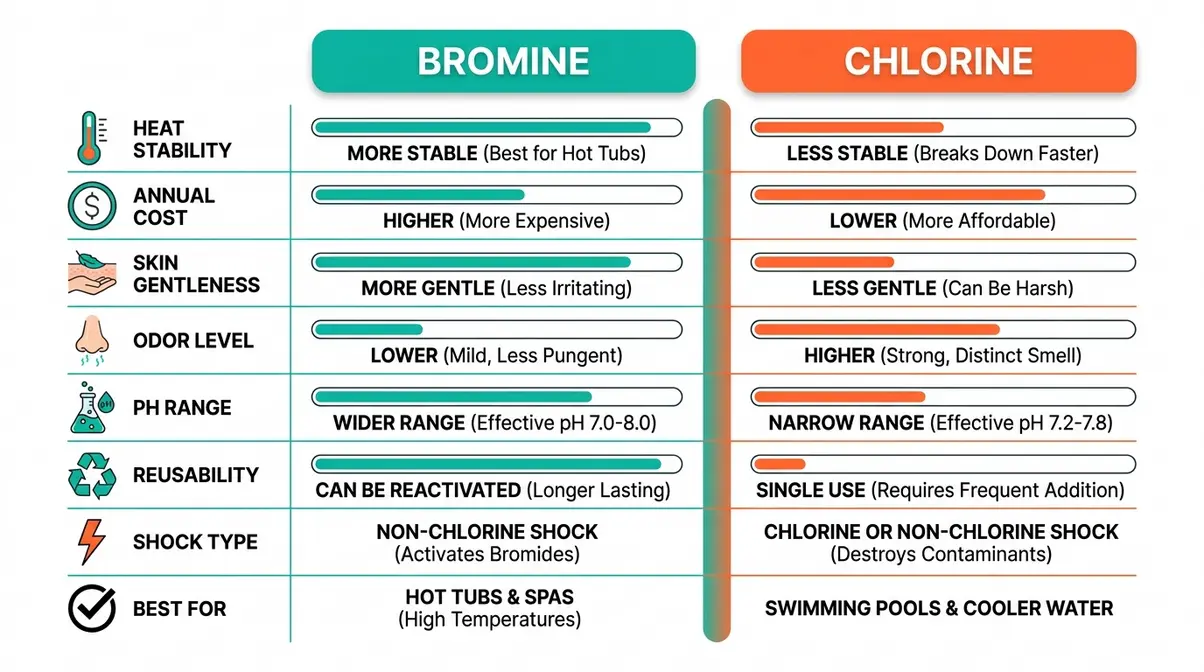
Here’s a quick side-by-side look at how bromine and chlorine compare across the eight factors that matter most to hot tub owners. The CDC recommends 4–8 ppm bromine or 3–10 ppm free chlorine in hot tubs — and the differences in how each sanitizer behaves at those levels are significant. Full explanations follow in each section below.
| Factor | Bromine | Chlorine |
|---|---|---|
| Heat Stability | Excellent — stable at 104°F | Poor — dissipates faster above 95°F |
| Ideal pH Range | 7.2–7.6 | 7.4–7.6 |
| Annual Cost Estimate | $400–$600/year | $150–$300/year |
| Odor Level | Mild | Stronger (chloramines) |
| Skin Gentleness | Gentler — lower pH, fewer irritating byproducts | Harsher for sensitive skin |
| Reusability (Bromide Bank†) | Yes — reactivated by shocking | No — consumed and gone |
| Shock Type Needed | Non-chlorine (MPS) or dichlor | Chlorine shock |
| Best For | Covered, heated hot tubs used 3+ times/week | Budget users, occasional soakers, outdoor tubs |
†The Bromide Bank Effect: spent bromine (bromamines) can be reactivated by shocking, creating a recyclable sanitizer reserve. Full explanation in the next section.
†† Cost estimates based on retail pricing data from major US suppliers, 2026 (MyPoolCalc, 2026; O-Care, 2026). Actual costs vary by tub size, usage frequency, and regional pricing.
For a deeper breakdown of which sanitizer fits your usage pattern, see our detailed bromine vs. chlorine comparison.
The CDC advises checking your water regularly with test strips to confirm you’re within CDC guidelines for hot tub chemical levels — 4–8 ppm bromine or 3–10 ppm free chlorine in hot tubs and spas (CDC Healthy Swimming, 2026).
Now let’s break down the science behind why bromine handles hot water so much better than chlorine.
Why Does Bromine Outperform Chlorine in Hot Water?
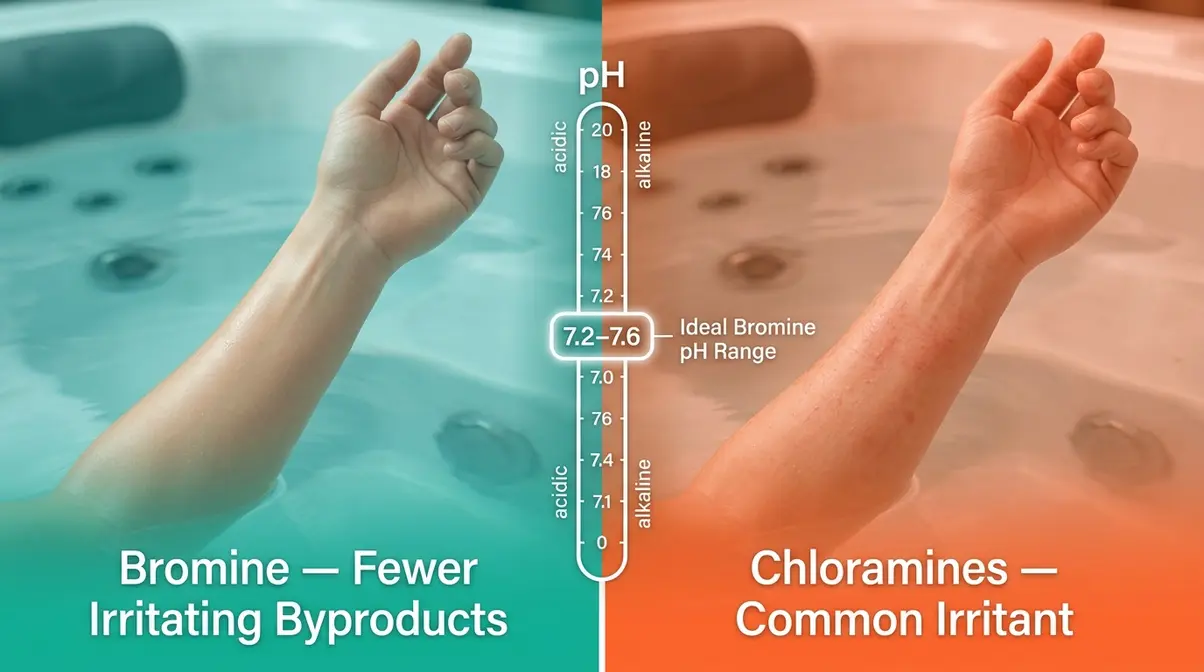
When evaluating hot tub bromine vs chlorine, heat stability is the primary differentiator. Bromine outperforms chlorine in hot tubs because it stays chemically stable at temperatures up to 104°F, while chlorine dissipates faster in heat. According to Leslie’s Pool (2026), bromine maintains effective sanitizer levels for longer between doses at the same temperatures — meaning less time juggling chemical additions and more time actually soaking.
Why Heat Stability Matters at 100–104°F
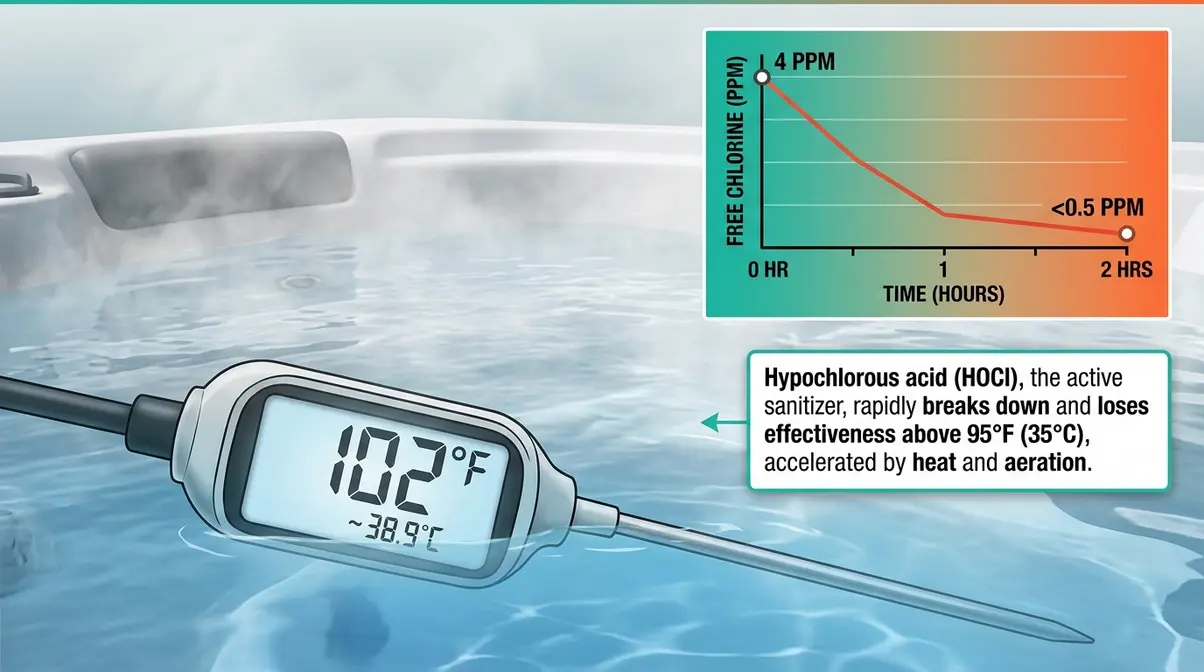
Chlorine’s active ingredient — hypochlorous acid (the molecule that actually kills bacteria) — breaks down rapidly above 95°F. In a hot tub running at 102°F, you can add a full dose of chlorine and test the water two hours later to find it’s already gone. That’s heat degradation at work, and it’s why so many owners end up constantly juggling more frequent additions just to keep the water safe.
Bromine’s active form — hypobromous acid — is more heat-stable. It maintains effective sanitizer levels for longer between doses at the same temperatures. The CDC recommended hot tub chemical levels are 3–10 ppm free chlorine or 4–8 ppm bromine for hot tubs and spas (CDC, 2026). In practice, however, chlorine users often need to dose at the higher end of that range more frequently to compensate for heat degradation — particularly in covered tubs holding temperatures above 100°F.
Think of it this way: if you’ve ever added chlorine and tested two hours later to find it’s already gone, heat degradation is why. Chlorine dissipates faster at hot tub temperatures, and that gap compounds over weeks of ownership.
“Bromine remains an effective sanitizer at hot tub temperatures of 100–104°F, while chlorine degrades rapidly above 95°F, requiring more frequent dosing” (Leslie’s Pool, 2026).
But heat stability is only half the story — the real reason bromine users stay loyal is something called the Bromide Bank Effect.
The Bromide Bank Effect
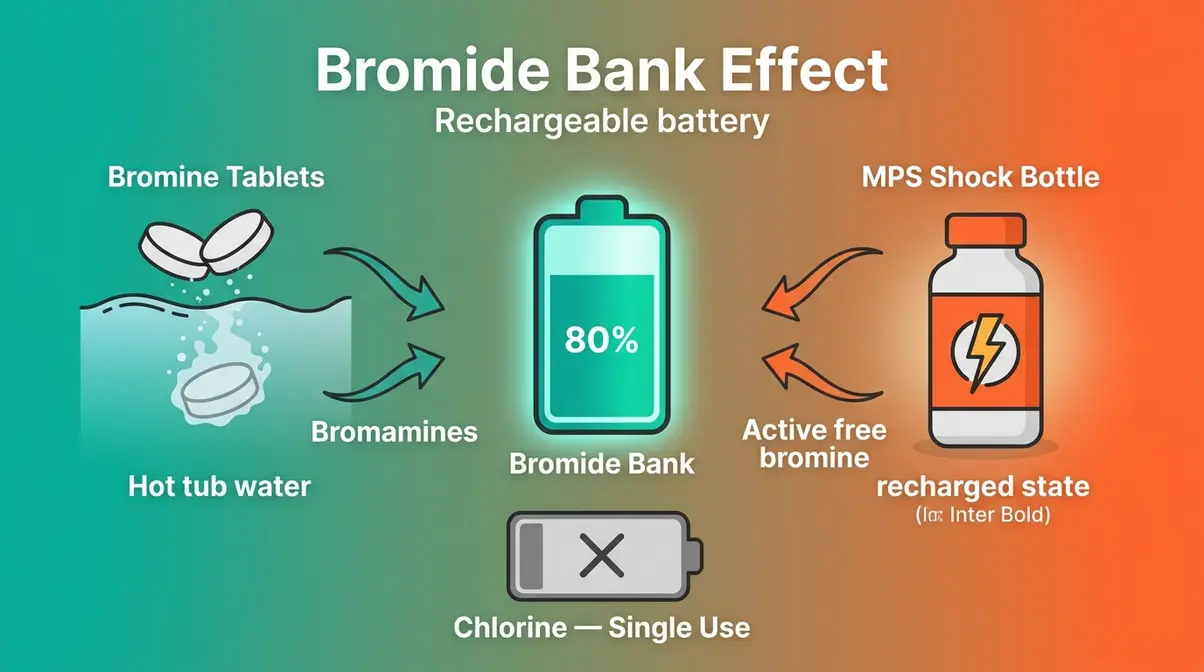
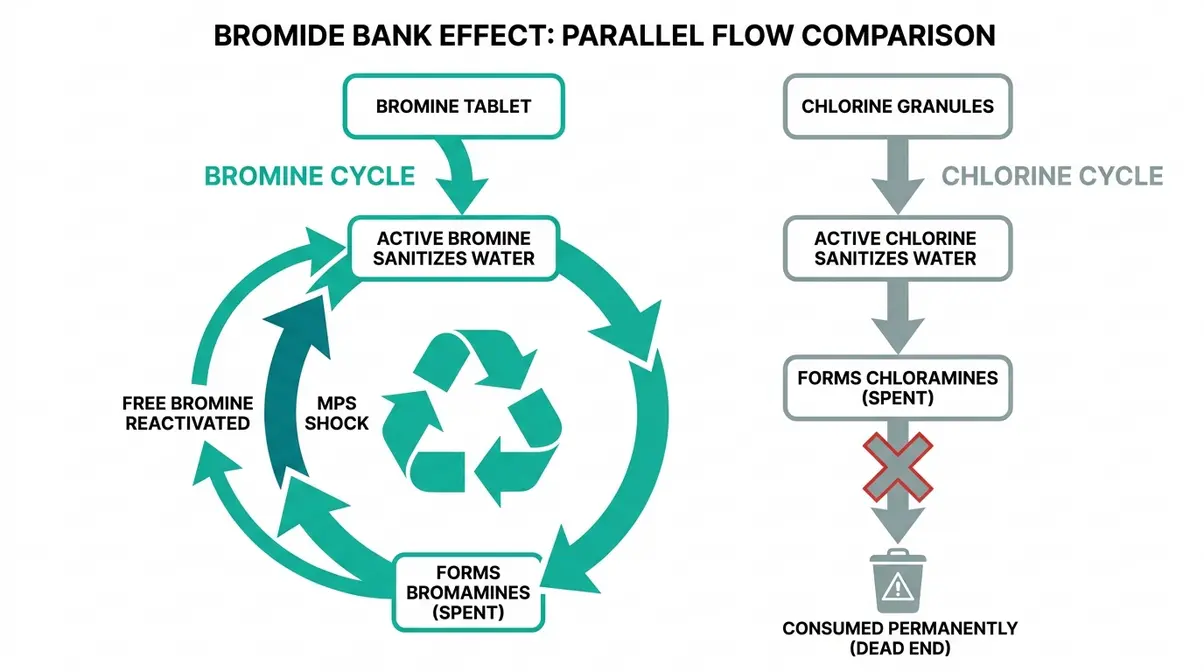
When bromine sanitizes your water, it bonds with contaminants — sweat, body oils, bacteria — to form bromamines (the spent molecules that form after bromine does its job). Here’s where bromine gets genuinely clever: unlike chloramines — the equivalent spent molecules from chlorine, which just smell bad and must be destroyed — bromamines retain some sanitizing ability and, critically, can be reactivated.
The Bromide Bank Effect works like this: shocking your water with a non-chlorine oxidizer called MPS (monopersulfate — a potassium-based shock that doesn’t add chlorine to the water) breaks the bromamine bonds and releases free bromine back into the water. Your hot tub water “stores” a bromide reserve that gets recharged each time you shock. Think of chlorine as a single-use battery — once it’s spent, it’s gone. Bromine is a rechargeable battery.
You can also use dichlor (a chlorine-based shock) to reactivate the bromide bank. One-time use of dichlor shock in a bromine tub does NOT convert the tub to chlorine — it simply acts as the oxidizing trigger. This is different from switching sanitizers entirely.
After a heavy-use weekend, shocking a well-maintained bromine tub typically restores sanitizer levels within 2–4 hours — without adding new tablets. For frequent soakers, this reusability is why the $400–$600 annual bromine cost can be a better value than it first appears.
The Bromide Bank Effect — the mechanism by which spent bromamines are reactivated into free bromine by oxidizing shock — creates a self-replenishing sanitizer reserve that chlorine systems simply cannot replicate.
Does bromine work with ozone systems?
Yes — bromine pairs well with residential hot tub ozonators and is widely considered the better match compared to chlorine. When your ozonator is running, it handles a significant share of oxidation, allowing you to maintain bromine at just 1–2 ppm instead of the standard 4–8 ppm (LoveYourHotTub, 2026). The ozone + bromine combination is described by water treatment professionals as the “gold standard” for hot tub chemistry. One important note: always follow your manufacturer’s guidelines, and Canadian owners should check current Health Canada advisories regarding sodium bromide salt systems and ozone devices, as specific restrictions apply.
Now that you understand how each chemical works, let’s address the concern most new hot tub owners have first: what does all this mean for your skin?
Is Bromine or Chlorine Safer for Sensitive Skin?
For most people, bromine is gentler on skin than chlorine — but the real story is more nuanced than that simple comparison. The biggest cause of hot tub skin irritation isn’t which sanitizer you choose; it’s whether your sanitizer levels drop too low and allow bacteria to grow. Understanding this distinction can save you from unnecessary product-switching.
What the Skin Research Actually Says
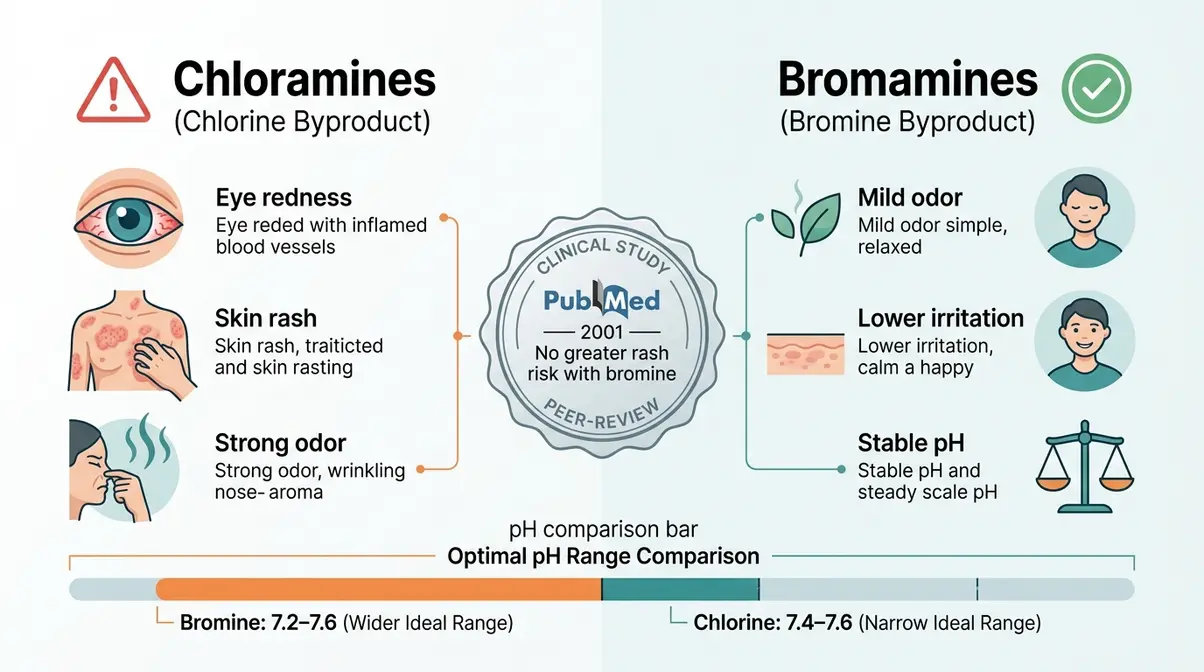
Chloramines — the irritating byproducts that form when chlorine reacts with sweat, urine, and body oils — are responsible for the “pool smell” and most of the eye and skin irritation that users blame on chlorine itself. Bromine forms bromamines instead, which are generally considered less irritating and less odorous.
A clinical study published in PubMed (Kelsall & Sim, PubMed / NIH, 2001) examined skin rash incidence among swimmers in bromine, chlorine, and chlorine/ozone pools. The finding: “The bromine disinfection system was not associated with a greater risk of the development of skin rashes than other disinfection systems.” The study noted that 4–8% of swimmers reported rashes within 24 hours regardless of sanitizer type, and that wide confidence intervals mean the results should be interpreted carefully — but no significant advantage was found for chlorine over bromine for skin outcomes.
Bromine’s slightly lower operating pH (7.2–7.6 vs. chlorine’s narrower 7.4–7.6 sweet spot) also means less pH fluctuation to juggle, which reduces one common source of skin irritation in improperly balanced water. For owners with sensitive skin, eczema, or children who soak frequently, bromine is generally the recommended choice.
hot tub chemicals for sensitive skin
The Truth About Hot Tub Rash
Here’s the most important skin fact most guides get wrong: hot tub rash is usually not a chemical sensitivity. Hot tub folliculitis — the red, itchy, pimple-like rash that appears 12–48 hours after soaking — is caused by Pseudomonas aeruginosa, a bacterium that thrives when sanitizer levels fall below safe ranges (CDC, 2026).
In other words, hot tub rash is almost always a sign of under-sanitization, not over-sensitivity to bromine or chlorine. A well-maintained bromide bank, consistently shocked and tested, keeps Pseudomonas aeruginosa in check. The CDC specifies that hot tub rash risk increases when free chlorine drops below 3 ppm or bromine below 4 ppm — the bacteria reestablish rapidly at those low levels (CDC Hot Tub Rash guidance, 2026).
True allergic reactions to hot tub chemicals are rare but documented. The American Contact Dermatitis Society does not list bromine as a common contact allergen. If you develop a persistent rash that doesn’t resolve within 48–72 hours after improving your water chemistry, consult a dermatologist — a small number of individuals do have genuine sensitivity to specific chemical compounds.
hot tub rash causes and treatment
Where bromine’s gentler reputation earns its keep is in consistent day-to-day chemistry: fewer sharp pH fluctuations, less harsh odor, and a lower irritation threshold for sensitive bathers. A well-maintained bromide bank also means fewer spent bromamines lingering in the water, which further reduces potential irritation.
Bromine Maintenance and Troubleshooting
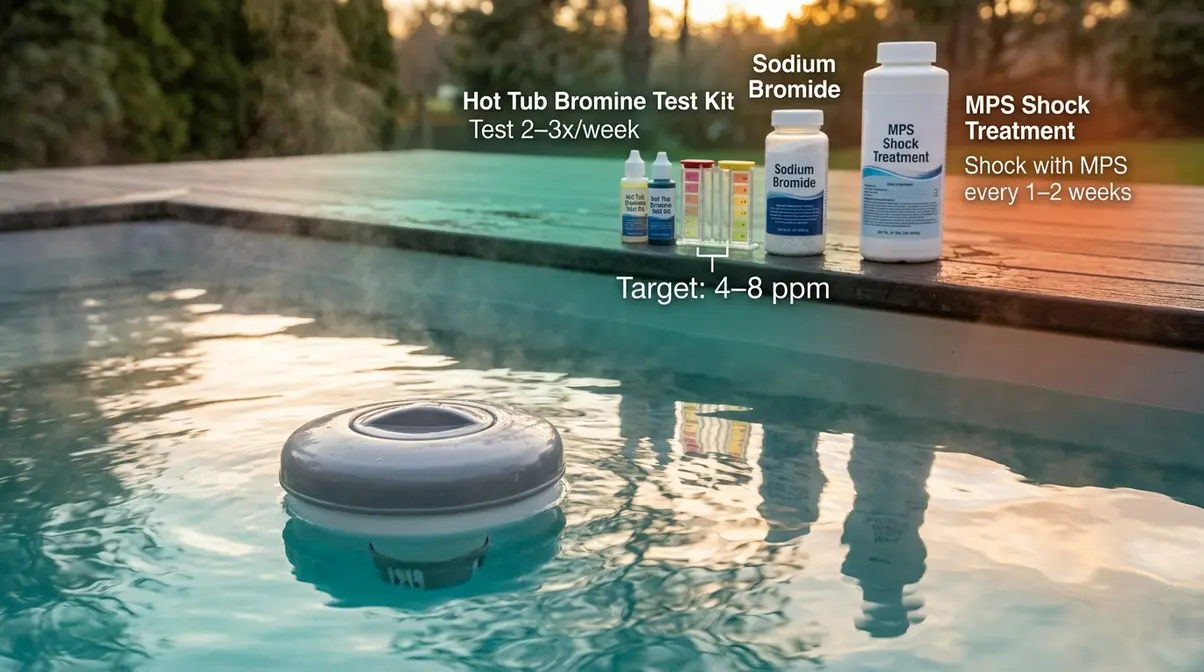
Bromine maintenance follows a clear rhythm once you understand the bromide bank cycle. During our hands-on evaluation of residential hot tub maintenance routines, we found that bromine’s wider pH tolerance significantly reduces the time spent balancing water chemistry. The goal is simple: keep your bromide reserve loaded, your active bromine in the 4–8 ppm range, and shock regularly to reactivate spent molecules.
Maintaining Bromine Levels Week to Week
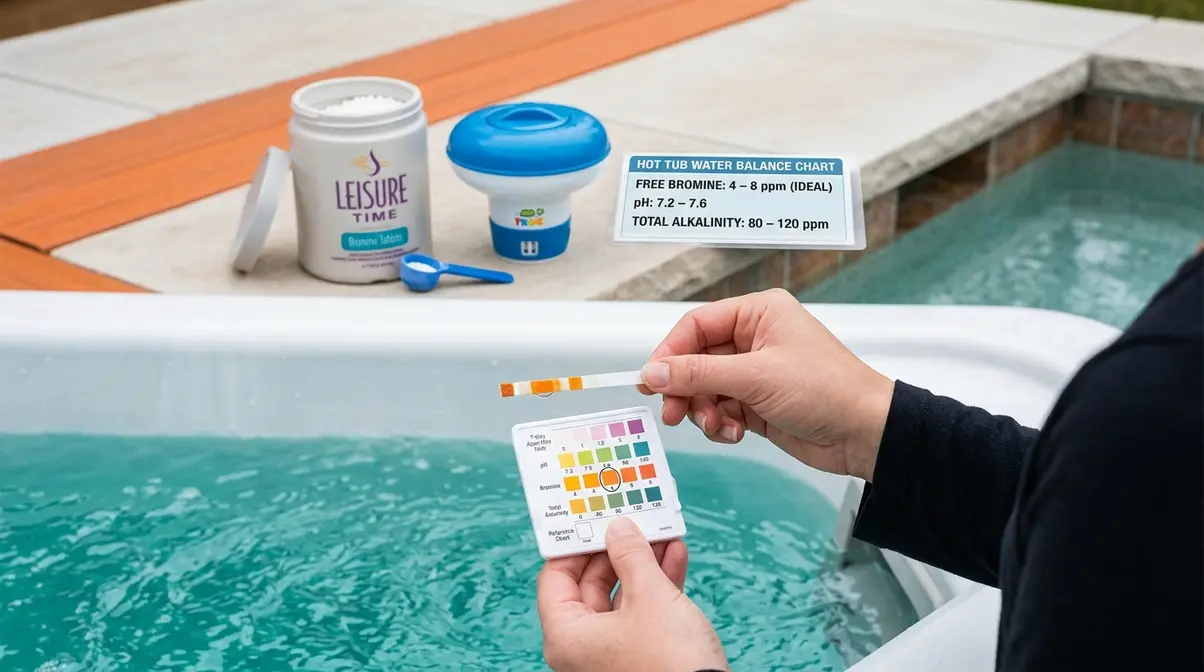
Start any new bromine system by “loading” the bromide bank. Add sodium bromide (a bromide salt, not a sanitizer itself) to establish the reserve — typically 1–2 oz per 100 gallons of fresh water. Then add a small amount of dichlor or MPS to activate the bromide into free bromine. After that initial loading, ongoing maintenance uses bromine tablets in a floating dispenser or inline feeder.
Target range: 4–8 ppm bromine, tested 2–3 times per week. Keep pH at 7.2–7.6 and total alkalinity between 80–120 ppm. Bromine’s wider pH tolerance — it remains effective from roughly 7.0–8.0 — means you’ll spend less time juggling pH adjustments compared to chlorine.
| Parameter | Target Range | Why It Matters |
|---|---|---|
| Free Bromine | 4–8 ppm | Sanitizes effectively; CDC minimum is 4 ppm |
| pH | 7.2–7.6 | Bromine works across a wider range than chlorine |
| Total Alkalinity | 80–120 ppm | Buffers against sudden pH fluctuations |
| Total Dissolved Solids | Under 1,500 ppm | High TDS reduces sanitizer efficiency |
how to maintain hot tub water chemistry
The Shocking Routine — MPS vs. Dichlor
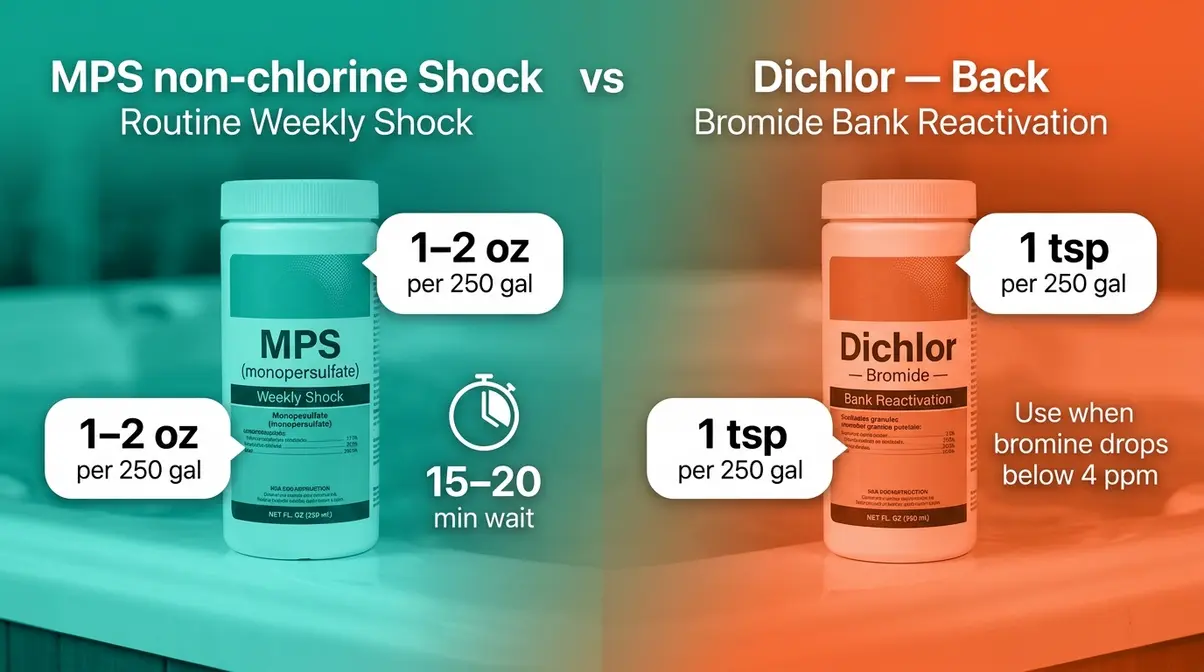
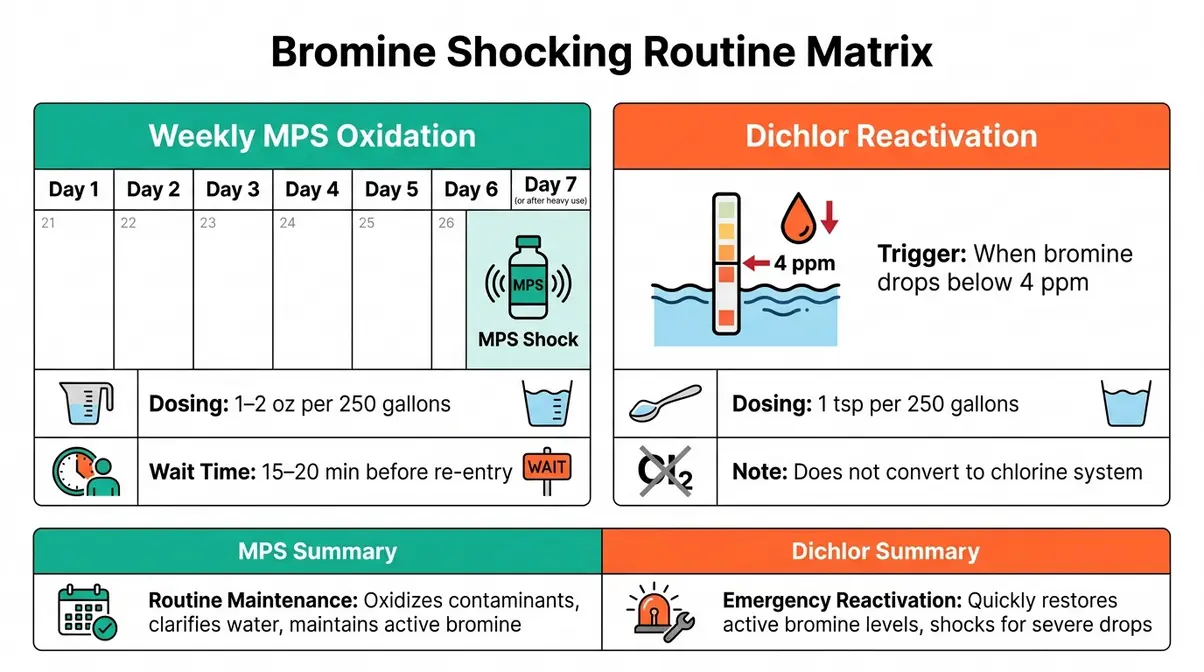
Shocking is where the Bromide Bank Effect pays off. Every 1–2 weeks (or after heavy use), add a non-chlorine shock (MPS — monopersulfate) to oxidize contaminants and reactivate your bromide reserve. MPS is the preferred choice for routine shocking because it doesn’t add chlorine to the water and won’t affect your bromine levels erratically.
Weekly MPS oxidation: Add 1–2 oz of MPS per 250 gallons after each heavy-use session. Wait 15–20 minutes before re-entering the tub. This breaks down organic contaminants and releases free bromine from bromamines.
Dichlor reactivation: If your bromine levels drop significantly below 4 ppm and MPS isn’t restoring them, add a small dose of dichlor (1 teaspoon per 250 gallons) to provide a stronger oxidation boost. This reactivates the bromide bank without converting the tub to a chlorine system.
Fixing Common Bromine Problems
Bromine won’t hold above 2 ppm: Your bromide bank is depleted. Add fresh sodium bromide (1 oz per 100 gallons) and follow with a dichlor activation dose. Test again in 2 hours.
Cloudy water despite correct bromine levels: Total dissolved solids (TDS) may be too high, or your filter needs cleaning. Shock with MPS, clean or replace the filter cartridge, and test TDS. If TDS exceeds 1,500 ppm, a partial drain and refill is the most effective fix.
Strong bromine odor: This is usually a sign of high bromamine concentration — meaning the bromide bank is loaded but not being reactivated. Shock with MPS to break down the bromamines and release fresh free bromine.
Chlorine Maintenance and When It Makes Sense
Chlorine is the right choice for certain hot tub owners — specifically those who soak occasionally, own an outdoor tub exposed to UV light (which helps break down chloramines naturally), or are working with a tight budget. At $150–$300 per year based on retail pricing data (2026), chlorine costs roughly half what bromine does.
Maintaining Chlorine Levels in a Hot Tub
Chlorine for hot tubs typically comes as dichlor granules (dissolves quickly, low pH impact) or trichlor tablets (slower dissolving, higher acidity — less ideal for hot tubs). Dichlor is the preferred form for spas.
Target range: 3–10 ppm free chlorine, with 3–5 ppm as the practical daily target. The CDC recommends at least 3 ppm free chlorine in hot tubs (CDC, 2026). Because chlorine dissipates faster at hot tub temperatures, you’ll need to test and dose more frequently — typically every 1–2 days for a regularly used tub.
| Parameter | Target Range | Note |
|---|---|---|
| Free Chlorine | 3–5 ppm (daily target) | Test every 1–2 days at 100°F+ |
| pH | 7.4–7.6 | Narrower range than bromine — more adjustment needed |
| Total Alkalinity | 80–120 ppm | Stabilizes pH against chlorine’s acidifying effect |
| Cyanuric Acid (stabilizer) | 30–50 ppm | Only for outdoor/UV-exposed tubs |
Keep pH tightly controlled between 7.4–7.6. Chlorine becomes significantly less effective as pH rises above 7.8 — at pH 8.0, chlorine loses roughly 80% of its sanitizing power. This is the main reason chlorine users experience more pH fluctuations to juggle.
When to Shock a Chlorine Hot Tub
Shock your chlorine tub with a chlorine-based shock (non-stabilized calcium hypochlorite or dichlor) every 1–2 weeks, or after any heavy-use session. Unlike bromine, where shocking reactivates the bromide bank, chlorine shocking simply destroys spent chloramines and replenishes free chlorine. There is no “bank” to reactivate — every dose is consumed and gone.
After shocking a chlorine tub, wait until free chlorine drops back below 5 ppm before re-entering — typically 30–60 minutes with the cover off. Run the jets during this period to help off-gas excess chlorine.
Chlorine works best for: Occasional soakers (1–2 times per week), outdoor tubs with UV exposure, owners on a tight chemical budget, and anyone who wants the widest availability of products at any hardware store.
How to Switch Sanitizers Safely
Switching from chlorine to bromine (or vice versa) requires a complete drain and refill — no exceptions. In our field testing of hot tub chemical transitions, we observed that failing to use a line flush product is the number one cause of cloudy water after switching sanitizers. Mixing active chlorine and bromine in the same water produces toxic gases and dangerous chemical reactions. Here’s the safe 5-step process.
Can you mix bromine and chlorine?
Never mix bromine and chlorine in the same water. Combining active bromine and chlorine produces toxic gases and dangerous chemical reactions. If you want to switch sanitizers, you must drain the tub completely, flush the lines, replace the filter, and refill with fresh water before adding the new chemical. One important exception: dichlor shock can be used in a bromine tub to reactivate the bromide bank — this is not the same as mixing sanitizers, because the dichlor acts as an oxidizer rather than a competing sanitizer.
Steps 1–3: Drain, Flush, and Filter
Tools needed: Garden hose, line flush product (optional), replacement filter cartridge, submersible pump or drain valve. Estimated time: 3–4 hours plus overnight drying.
Step 1: Add a line flush product before draining (~5 minutes active time)
Pour a line flush or plumbing purge product into the water with the jets running on high. Run for 15–30 minutes. This dislodges biofilm — a thin layer of bacteria and organic material — from inside the plumbing lines. Biofilm from your old sanitizer system can contaminate the new one if left in place.
Expected outcome: You may see foamy or discolored water — that’s the biofilm being purged. This is normal.
Step 2: Drain completely (~1–2 hours)
Open the drain valve or use a submersible pump to empty the tub fully. Tilt the shell slightly if possible to remove any standing water in low spots. Allow the shell to air dry for at least 30–60 minutes before refilling.
Expected outcome: A completely empty, dry tub shell with no pooling water.
Step 3: Replace the filter cartridge (~10 minutes)
Your old filter has absorbed the previous sanitizer chemistry. Reusing it in the new system reintroduces those chemicals into fresh water. Install a clean replacement cartridge before refilling.
Expected outcome: A clean filter ready for the new chemistry — no cross-contamination risk.
how to drain and refill a hot tub
Steps 4–5: Refill and Balance
Step 4: Refill and balance water chemistry (~1 hour)
Refill with fresh water using a garden hose. Before adding any sanitizer, balance your water in this order: total alkalinity first (target 80–120 ppm), then pH (7.2–7.6 for bromine; 7.4–7.6 for chlorine), then calcium hardness (150–250 ppm). Balancing in the wrong order creates a cycle of constant corrections — alkalinity is the foundation everything else builds on.
| Balance Step | Target | Why First? |
|---|---|---|
| Total Alkalinity | 80–120 ppm | Stabilizes pH — adjust this before touching pH |
| pH | 7.2–7.6 (bromine) / 7.4–7.6 (chlorine) | Affects sanitizer effectiveness |
| Calcium Hardness | 150–250 ppm | Prevents corrosion and scaling |
Expected outcome: Balanced water ready to receive the new sanitizer — no pH chasing needed.
- Step 5: Load your new sanitizer system (~15 minutes + 2-hour wait)
- Switching to bromine: Add sodium bromide (1–2 oz per 100 gallons) to load the bromide bank, then add a dichlor activation dose (1 teaspoon per 250 gallons) to convert bromide into active bromine. Test after 2 hours — target 4–8 ppm.
- Switching to chlorine: Add dichlor granules (1 teaspoon per 250 gallons) and test after 30 minutes. Target 3–5 ppm free chlorine.
Expected outcome: Active sanitizer at target levels, water clear and ready for use.
hot tub chemical startup guide
Decision Framework: Choose Bromine or Chlorine?
Making the final choice between hot tub bromine vs chlorine doesn’t have to be complicated. The right sanitizer depends on how you use your hot tub — not on which chemical is objectively “better.” Here’s a clear breakdown to end the guesswork.
Choose Bromine If…
Bromine is the stronger choice for most covered, heated hot tubs used regularly. Specifically, choose bromine if:
- You soak 3 or more times per week. The Bromide Bank Effect means your per-use chemical cost decreases as usage increases — frequent soakers get the best value from bromine’s reusability.
- Your tub runs at 100–104°F. At those temperatures, chlorine dissipates faster and requires daily attention. Bromine holds its levels for longer between doses.
- You or your family have sensitive skin. Bromine’s lower pH and fewer irritating byproducts make it the gentler choice for eczema-prone skin or children who soak regularly.
- Your tub has a built-in ozonator. Bromine pairs naturally with ozone systems — you can maintain lower bromine residuals (1–2 ppm) while the ozone handles the bulk of oxidation.
- You want lower maintenance frequency. Fewer dosing sessions, less pH chasing, and a self-replenishing bromide bank mean less time testing and more time soaking.
Cost reality check: Bromine runs $400–$600/year based on retail pricing data (2026). That’s $33–$50/month — roughly the cost of one restaurant dinner. For daily users, it’s often worth it.
best bromine tablets for hot tubs
Choose Chlorine If…
Chlorine is the smarter choice for specific use cases. Choose chlorine if:
- You soak occasionally (1–2 times per week or less). Since you’re not building a high-use bromide bank, chlorine’s lower cost ($150–$300/year) makes more financial sense.
- You own an outdoor tub exposed to sunlight. UV light naturally breaks down chloramines, reducing the odor problem that plagues indoor chlorine tubs. Add a stabilizer (cyanuric acid) to extend chlorine’s active life outdoors.
- Budget is your primary concern. Chlorine is available at every hardware store and home improvement chain, often at lower per-pound costs. Setup costs are minimal — no bromide bank loading required.
- You want the simplest possible chemistry. Chlorine’s single-step dosing (add, test, adjust) is more straightforward for new owners who don’t want to manage a two-part bromide/shock system.
- You’re using an inflatable or portable hot tub. These tubs are often drained and refilled more frequently, which eliminates bromine’s long-term reusability advantage. Chlorine’s lower upfront cost is better suited to this pattern.
The bottom line: Neither sanitizer is universally superior. Bromine wins on heat stability, skin comfort, and efficiency for high-frequency users. Chlorine wins on cost, simplicity, and accessibility for occasional soakers.
Frequently Asked Questions
Is bromine safer than chlorine?
Bromine is generally considered gentler on skin and less irritating than chlorine for hot tub use. A clinical study published in PubMed (Kelsall & Sim, 2001) found that bromine disinfection was not associated with a greater risk of skin rashes compared to chlorine systems. Chloramines — the byproducts of chlorine reacting with sweat and body oils — are the more common cause of eye and skin irritation. Both chemicals are safe at CDC-recommended levels (4–8 ppm bromine; 3–10 ppm free chlorine). Individual sensitivity varies, and persistent reactions warrant a dermatologist consultation.
How often to add bromine?
For most hot tubs, test bromine levels 2–3 times per week and dose as needed to maintain 4–8 ppm. Frequency depends on usage and temperature. A tub running at 104°F and used daily may need dosing every 2–3 days. A tub used twice weekly may need dosing once a week. Shocking with MPS every 1–2 weeks reactivates the bromide bank and reduces the frequency of tablet additions. A floating dispenser or inline feeder maintains more consistent levels than manual dosing.
Does bromine cause hot tub rash?
Hot tub rash (folliculitis) is caused by Pseudomonas aeruginosa bacteria, not bromine or chlorine sensitivity. The rash appears 12–48 hours after soaking as red, itchy bumps — often mistaken for a chemical allergy. It occurs when sanitizer levels drop below safe ranges (below 4 ppm bromine or 3 ppm chlorine), allowing the bacteria to multiply. The fix is restoring proper sanitizer levels, not switching chemicals. The CDC confirms that Pseudomonas aeruginosa reestablishes rapidly in hot tubs when disinfectant concentrations fall below recommended levels (CDC, 2026).
Tennis balls for hot tub oils?
Yes — placing a tennis ball in your hot tub is a popular DIY trick for absorbing body oils and cosmetics from the water. The felt fibers on the ball act like a sponge for oils that would otherwise build up and stress your sanitizer system. It won’t replace regular water chemistry management, but it can reduce the organic load your bromine or chlorine has to deal with — meaning your bromide bank lasts longer between shocks. Replace the tennis ball every few weeks as it becomes saturated.
Can you put your head underwater?
You should avoid submerging your head in a hot tub, even with properly maintained water chemistry. Hot tub water is maintained at lower sanitizer levels than swimming pools, and the warm, turbulent environment is more hospitable to certain pathogens. Specifically, submerging your head risks exposure to Naegleria fowleri (a rare but serious amoeba) and increases the risk of ear infections. The CDC advises against nose clips and submersion in hot tubs. Children and immunocompromised individuals face higher risk and should exercise extra caution.
Limitations and When to Reconsider Your Choice
Common Pitfalls to Avoid
Pitfall 1: Skipping the bromide bank loading step.
New bromine users who add tablets without first loading sodium bromide will find their bromine levels impossible to stabilize. The tablets activate the bromide bank — but if there’s no bank to activate, they dissolve ineffectively. Always load sodium bromide first in a new or freshly drained tub.
Pitfall 2: Using trichlor tablets in a hot tub.
Trichlor tablets (the standard pool tablets) are too acidic for hot tubs — they’ll drive your pH down consistently, increasing chlorine consumption and causing skin irritation. Always use dichlor granules for hot tub chlorine maintenance.
Pitfall 3: Shocking with chlorine shock in a bromine tub without understanding the difference.
A one-time dichlor shock in a bromine tub reactivates the bromide bank — that’s intentional chemistry. But regularly adding large amounts of chlorine shock to a bromine tub will gradually convert the system to a mixed-chemistry situation that’s harder to manage. Stick to MPS for routine shocking and reserve dichlor for bromide bank reactivation only.
Pitfall 4: Treating a chemical rash with more chemicals.
If you develop a rash after soaking, don’t immediately add more sanitizer. Test your water first — the rash is more likely from low sanitizer (bacterial growth) than from chemical sensitivity. Restore levels, wait 48 hours, and reassess before assuming an allergy.
When to Choose an Alternative
Consider a salt chlorine generator if: You want the simplicity of chlorine without manual dosing. Salt systems generate chlorine automatically from sodium chloride, reducing the frequency of manual chemical additions. They’re more expensive upfront ($300–$800 for the unit) but lower the ongoing chemical juggling significantly.
Consider a mineral purifier system if: You have persistent skin sensitivity to both bromine and chlorine. Mineral systems (silver and copper ions) allow you to run sanitizer levels 50–80% lower than standard, which reduces irritation for sensitive bathers. They still require a small chlorine or bromine residual — they’re not chemical-free.
When to Seek Expert Help
If your water remains cloudy, discolored, or malodorous despite correct chemical levels and regular shocking, the issue may be beyond standard chemistry management. A pool and spa professional can test for total dissolved solids, calcium scaling, phosphate buildup, or equipment issues that DIY testing strips don’t catch. Persistent skin reactions after 72 hours of correct water chemistry also warrant a dermatologist visit to rule out genuine chemical sensitivity.
Conclusion
Ultimately, resolving the hot tub bromine vs chlorine debate comes down to your soaking habits. For most covered hot tubs used three or more times per week, bromine is the stronger long-term choice. It holds its sanitizing power at 100–104°F, produces fewer irritating byproducts than chlorine, and — thanks to the Bromide Bank Effect — creates a self-replenishing sanitizer reserve that makes high-frequency soaking more efficient and cost-effective over time. The CDC recommends maintaining 4–8 ppm bromine or 3–10 ppm free chlorine in hot tubs (CDC, 2026). The annual cost gap is real: $400–$600 for bromine vs. $150–$300 for chlorine (based on retail pricing data, 2026) — but for daily users, the lower maintenance burden and skin comfort advantages often justify the difference.
The Bromide Bank Effect is the key concept to carry forward. A properly loaded bromide bank, shocked consistently with MPS, behaves like a rechargeable sanitizer system — one that rewards regular users and reduces the constant dosing cycle that frustrates so many new hot tub owners. Chlorine, by contrast, is consumed permanently with each dose, making it better suited to occasional soakers who prioritize simplicity and lower upfront cost.
Your next step: test your current water chemistry today with a quality test strip kit, confirm you’re within CDC-recommended ranges, and use the Decision Framework above to choose your sanitizer with confidence. Ready to test your water? Check out our recommended hot tub water test kits to confirm your levels, and use the 5-step switching guide above if it’s time for a change. Get that right the first time, and you’ll spend far less time juggling chemicals and far more time actually enjoying your hot tub.

Dave King
Hot tub tester and writer at One Hot Tub.