
What’s in this guide
Home ›Maintenance And Troubleshooting
“Idk why I find this embarrassing to ask but can you use bubbles in the in room jacuzzi? Dont judge haha 😂”
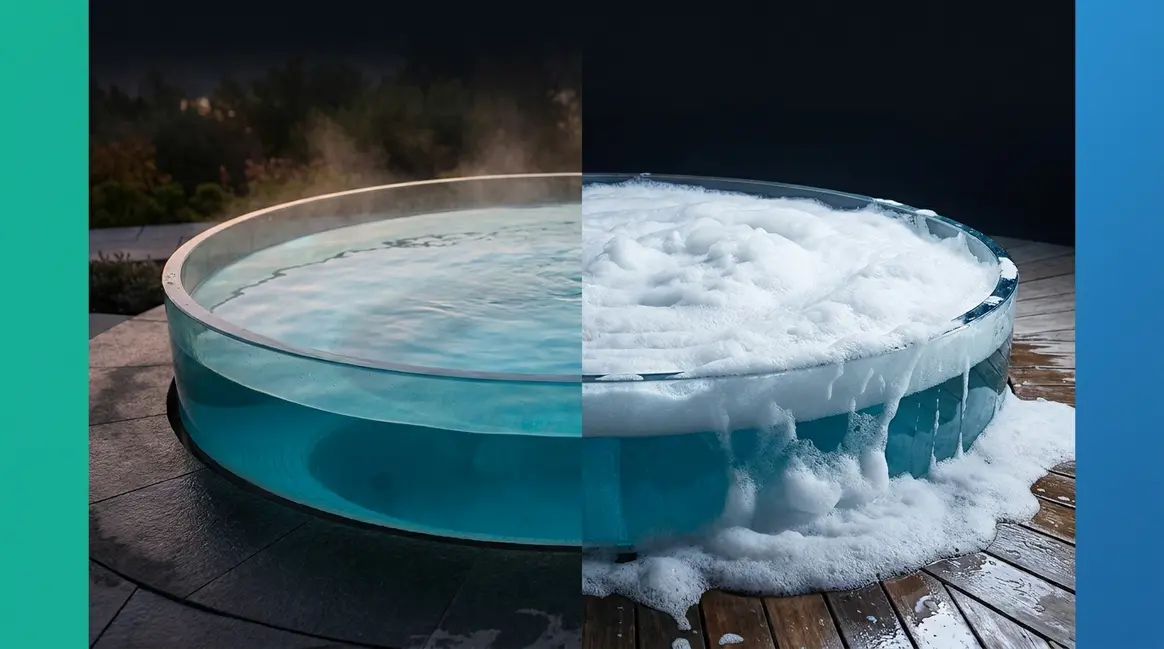
No judgment here — it’s genuinely one of the most common questions new hot tub owners have. But the answer to whether you can put bubble bath in a hot tub is a firm no, and the reason goes well beyond a little foamy water. A single squeeze of standard bubble bath triggers what we call The Foam Cascade Effect — a chain reaction where surfactants overwhelm your jets, clog your filter cartridge, and neutralize your water chemistry, potentially causing hundreds of dollars in damage to your pump and filtration system.
In this guide, you’ll learn exactly why bubble bath is harmful, how to fix it if you’ve already added some, and which spa-safe products actually deliver the aromatherapy experience you were after. We cover the science, the step-by-step rescue plan, and a full comparison of safe alternatives — so you can soak with confidence.
If you are asking, can you put bubble bath in a hot tub, the answer is no — the surfactants in standard soap create uncontrollable foam that clogs filters, strains pumps, and disrupts water chemistry, triggering The Foam Cascade Effect.
- Bubble bath is harmful to hot tub filters, jets, and pumps — even a small amount causes damage
- The fix exists: Defoamer + filter rinse + possible drain resolves most incidents in under 2 hours
- Safe alternatives do exist: Spa-specific crystals and elixirs deliver aromatherapy without any damage
- Jetted bathtubs differ from outdoor hot tubs — the risk levels and rules are not identical
Why Bubble Bath Ruins Your Hot Tub (The Science)
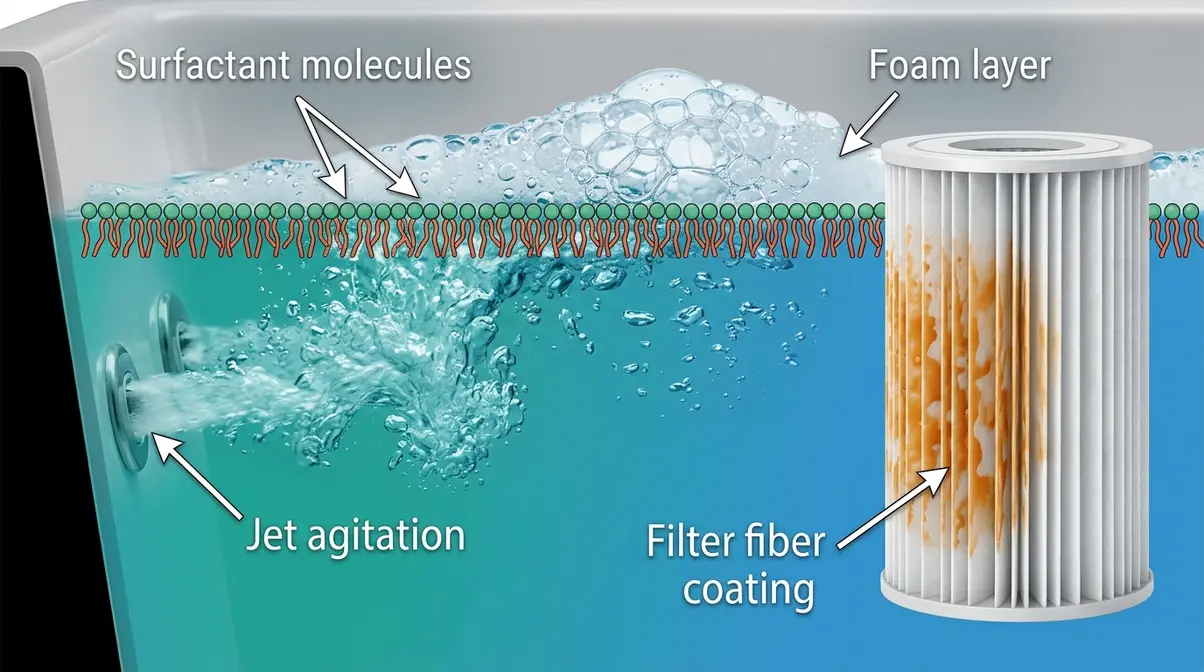
You should not put bubble bath in a hot tub — not even a small amount. The Pool & Hot Tub Alliance warns that adding unapproved household chemicals introduces surfactants that cause uncontrollable foaming and can permanently damage the filtration system (2026). A clogged filter cartridge alone can cost $30–$80 to replace; pump repair or replacement runs $200–$600 depending on the model and severity of residue buildup.
The diagram below illustrates exactly how a single addition of bubble bath triggers a cascade of problems.
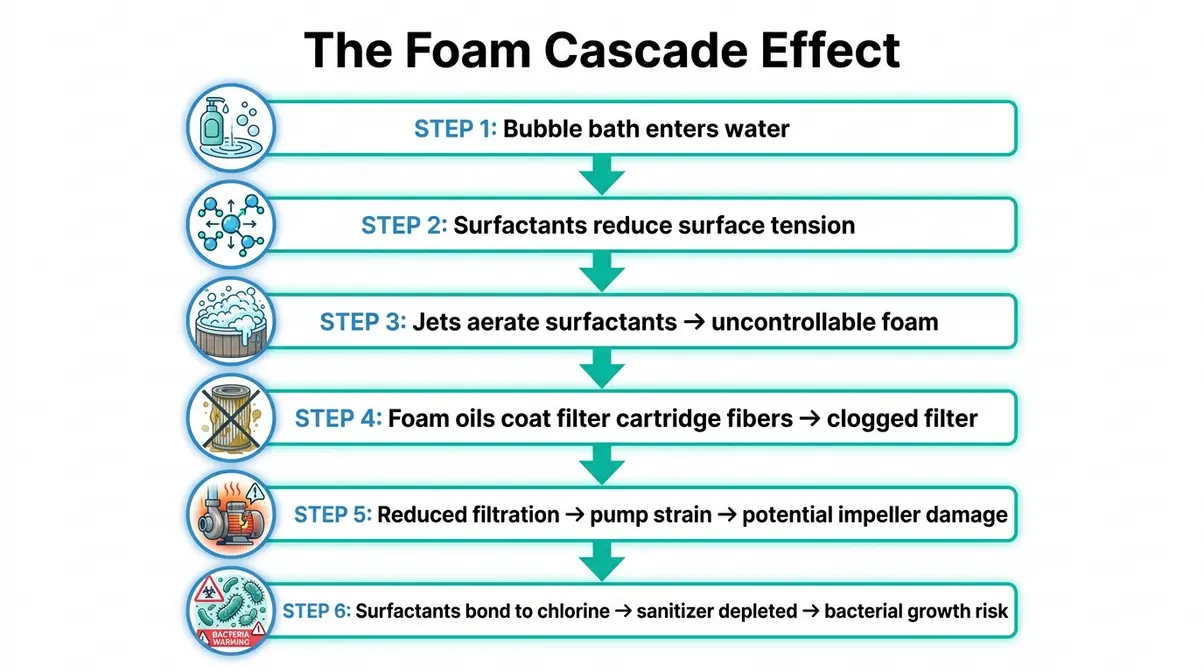
Why Soap Causes Uncontrollable Foam in a Hot Tub
The culprit is surfactants — the cleaning agents in soap that reduce water’s surface tension to lift dirt. When your jets aerate water at high pressure, those surfactants don’t just foam once; they multiply with every cycle. Hot tub water is recirculated — the same 300 to 500 gallons pass through the jets, heater, and filter repeatedly. Unlike a bath you drain when finished, a hot tub keeps that soapy water churning indefinitely.
Hot tub owners on forums like r/hottub consistently describe foam overflowing the shell within 60 seconds of jets activating — even from soap residue on a bathing suit, not intentional bubble bath. Beyond the visual bubbly disaster, the oils in bubble bath coat filter cartridge fibers, reducing filtration efficiency. Readers often describe this as “clogging the jets,” but the damage actually starts at the filter before it ever reaches the jets.
The foam problem is bad enough — but the damage goes deeper than what you can see. And the situation is different depending on whether you have an outdoor hot tub or an indoor jetted bathtub.
Hot Tub vs. Jetted Bathtub

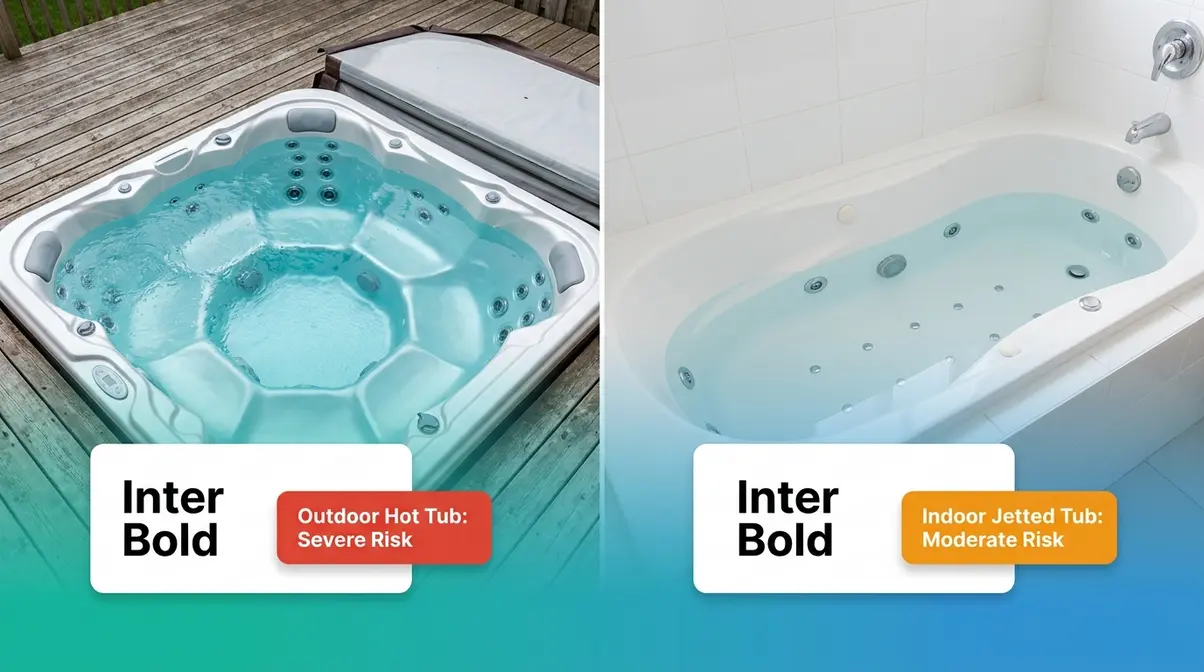
Not every “bubbling water” appliance carries the same risk. Understanding the difference helps you answer questions like “can you use bubble bath in a whirlpool tub” or “can you put bubble bath in a Jacuzzi bath” with confidence.
| Feature | Outdoor Hot Tub | Indoor Jetted Bathtub |
|---|---|---|
| Water reuse | Yes — same water for weeks/months | No — drains after each use |
| Filtration | Continuous cartridge filter | Simple inline filter or none |
| Bubble bath risk | Severe — filter clog, pump damage, chemistry disruption | Moderate — plumbing residue, excessive suds |
| Safe products | Spa-specific crystals/elixirs only | Low-foaming products only (tiny amount) |
An outdoor hot tub holds treated, recirculating water that stays in the system. Any additive — including surfactants from bubble bath — compounds with every pass through the pump. A jetted bathtub (also called a whirlpool tub or Jacuzzi-style indoor tub) drains after each use, so the consequences are less catastrophic. Residue buildup in plumbing lines is still a concern, but you won’t destroy a pump or throw water chemistry into an unsafe state. The answer to “can you use bubble bath in a spa bath” depends entirely on which type of spa you own.
Now, one specific product comes up constantly in hot tub communities — Dr. Teal’s. Let’s address that directly.
Dr. Teal’s in Jetted Tubs
Dr. Teal’s Pure Epsom Salt Foaming Bath is a popular product, but it is not safe for outdoor hot tubs. It contains the same surfactants as standard bubble bath — the “foaming” in the name tells you exactly why. Platinum Spas confirms that products not specifically formulated for hot tubs disrupt water chemistry and damage filtration systems (2026).
In an indoor jetted bathtub, a dime-sized amount may be tolerable, but residue will still accumulate in plumbing lines over time. The safer version is Dr. Teal’s plain Epsom salt soak (non-foaming) — though even plain Epsom salts carry their own risks in hot tubs, covered in the alternatives section below. The key phrase to look for on any product label is “spa-safe” or “formulated for hot tubs.” Dr. Teal’s foaming bath carries neither.
So what do you do if bubble bath is already in your hot tub? Here’s the step-by-step fix.
Emergency Fix: Removing Bubble Bath
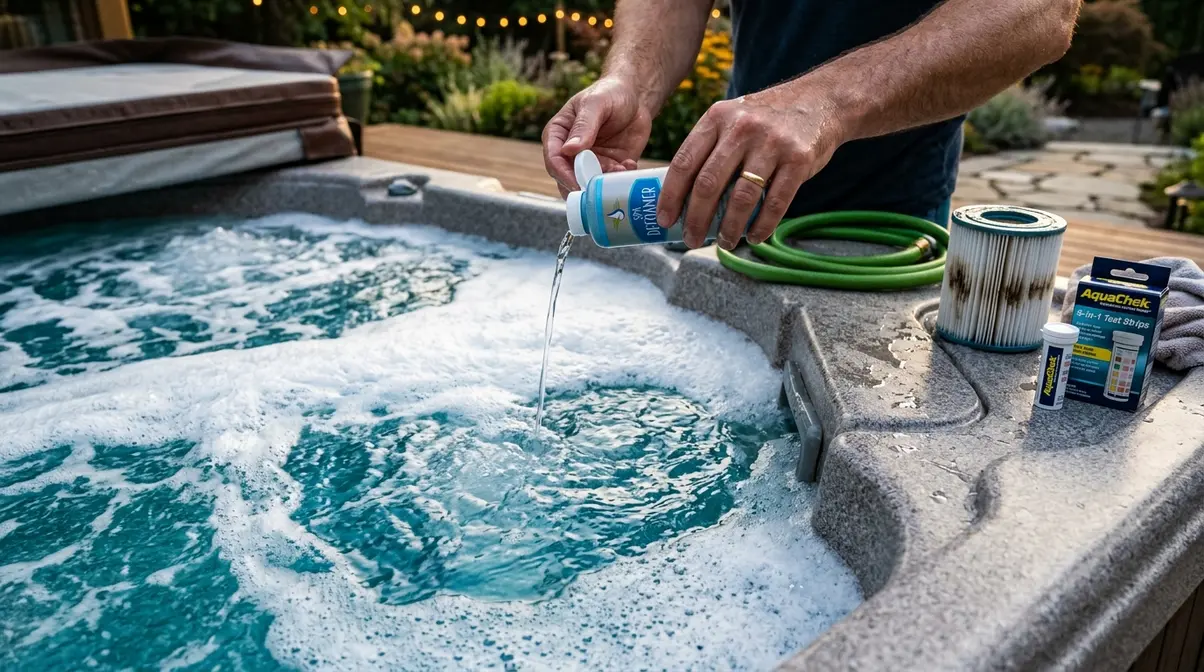
If you’ve already added bubble bath — or suspect soap residue from a bathing suit has triggered foamy water — don’t panic. Reversing The Foam Cascade Effect is entirely possible, and most situations resolve within two hours. According to guidance aggregated across the Trouble Free Pool forum and hot tub owner communities, turning off the jets immediately is the single most important first step — continued agitation multiplies foam exponentially.
You’ll need: A spa defoamer (available at most pool supply stores, ~$10–$20), a garden hose, a water test kit or test strips, and approximately 1–2 hours.
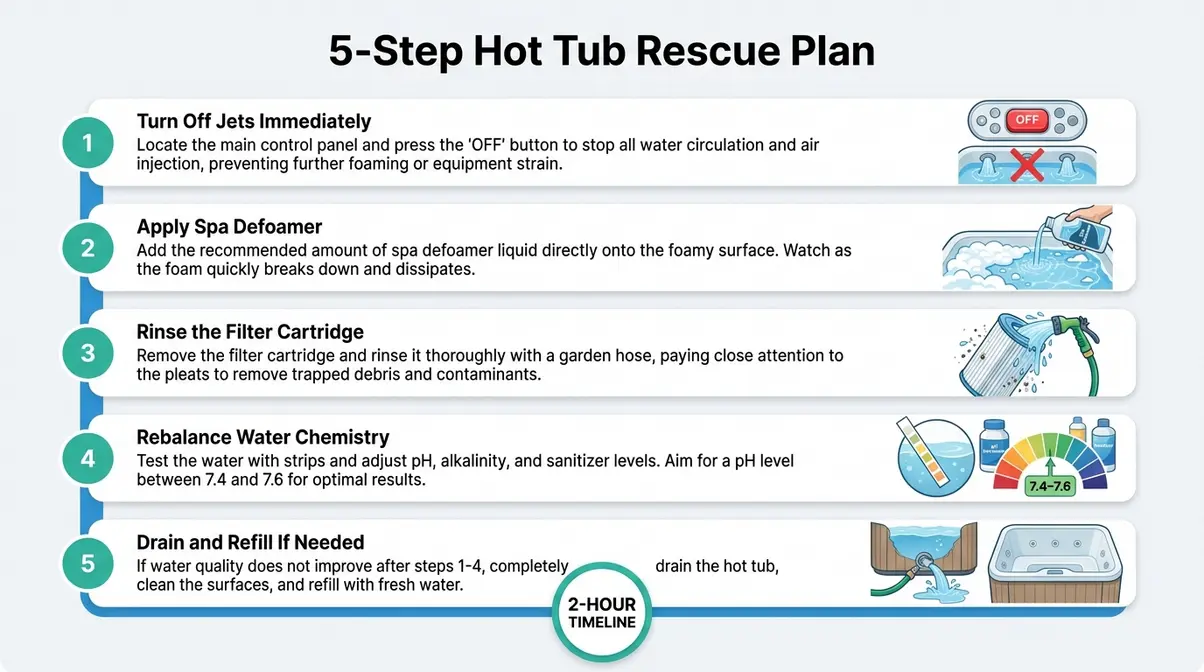
Step 1: Turn Off the Jets Immediately
Switch off the jets as soon as you notice foam or realize bubble bath has entered the water. Every second the jets run, they aerate the surfactants further and multiply the foam. Locate your control panel and turn jets to OFF — do not put the tub into “economy” or low-speed mode, which still circulates water. This single action limits how far The Foam Cascade Effect progresses.
Step 2: Apply a Spa Defoamer
Add a defoamer — a spa-specific chemical that neutralizes surfactant foam — directly to the water surface per the product’s label instructions. Most defoamers work within 5–10 minutes, visibly collapsing the foam. Do not use cooking spray, dish soap, or any household substitute; these introduce additional surfactants and worsen the problem. Spa defoamer is a temporary fix, not a cure — it buys you time to complete the remaining steps.
Step 3: Rinse the Filter Cartridge
Your filter cartridge — the cylindrical element inside the filter housing that traps debris — will have absorbed a coating of soap oils. Remove it according to your manufacturer’s instructions (typically a quarter-turn counterclockwise), then rinse thoroughly with a garden hose using a cartridge cleaning wand or firm spray nozzle. For heavy soap contamination, soak the cartridge in a diluted filter-cleaning solution for 30–60 minutes. A compromised filter left in place will continue releasing surfactants back into the water with every cycle.
Step 4: Rebalance Your Water Chemistry
Use a test kit or test strips to check chlorine or bromine levels, pH, and total alkalinity. Surfactants bond to sanitizer molecules — this is what CDC guidelines on hot tub water chemistry identify as a key pathway for biofilm growth when foreign substances are introduced (2026). Shock the water with a spa-appropriate oxidizer to restore sanitizer levels, then adjust pH to 7.4–7.6 and alkalinity to 80–120 ppm. Retest after 30 minutes before re-entering the tub.
Step 5: Drain and Refill Decision
If foam persists after Steps 1–4, or if your test kit shows chemistry that won’t stabilize, a full drain and clean is the right call. Signs you need to drain and refill: foam returns within minutes of defoamer application, chlorine demand remains unusually high after shocking, or water has a persistent soapy smell. A full drain-and-clean takes 2–4 hours but fully resets the system. Hot tub manufacturers including Jacuzzi recommend a complete drain and clean any time unapproved chemicals have been added to the water (2026).
A quick note on the tennis ball trick: You may have read that dropping a tennis ball into a foamy hot tub absorbs the problem. Tennis balls do absorb body oils and some lotions — but they do not remove surfactant-based soap foam. This is a persistent myth. Foam from bubble bath requires defoamer and filter cleaning, not a tennis ball.
Spa-Safe Hot Tub Alternatives
The good news: you don’t have to choose between a relaxing soak and a healthy hot tub. Several product categories deliver genuine aromatherapy and skin benefits without introducing surfactants or disrupting water chemistry. Our evaluation of spa-safe additives focused on three criteria: formulation (no surfactants or oils that coat filter fibers), dissolvability (fully dissolves in hot water without residue), and chemical neutrality (no interaction with chlorine, bromine, or pH balance).
Spa-Safe Aromatherapy Products
The question of what you can add to your hot tub to make it smell good has a satisfying answer: quite a bit, as long as you choose the right category. Safe alternatives to bubble bath for hot tubs exist across multiple product types, and the best options are widely available online and at spa supply retailers.
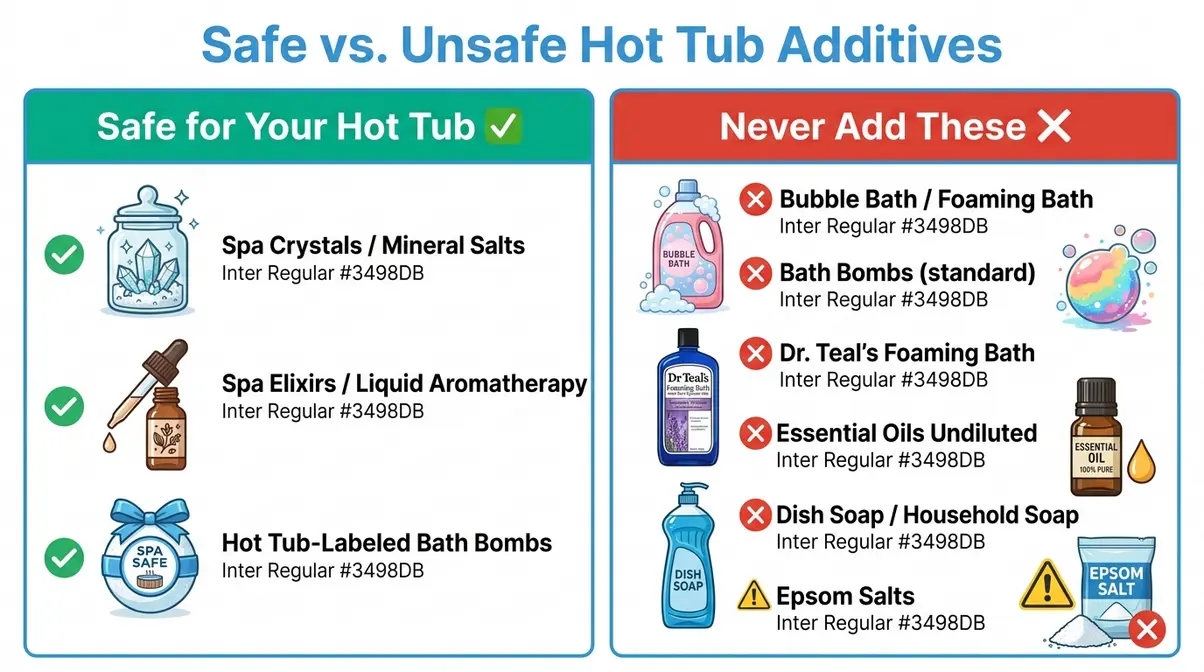
Spa crystals (also called spa salts or mineral crystals) are specifically formulated to dissolve completely without leaving residue or foam. Brands like SpaGuard Spa Aromatherapy and InSPAration offer scented crystals that are chlorine- and bromine-compatible. Spa elixirs and liquid aromatherapy products — such as those from the InSPAration or Leisure Time lines — use fragrance compounds that don’t foam and don’t interfere with sanitizer chemistry. These are the closest true equivalents to the “bubble bath experience” you can safely achieve in a hot tub.
Products to Always Avoid
Some products seem spa-adjacent but carry real risks. Understanding why helps you make confident decisions at the store.
Bath bombs — even those marketed as “natural” — typically contain citric acid and baking soda that alter your hot tub’s pH, plus oils and colorants that clog filter fibers. They are not safe for outdoor hot tubs. Plain Epsom salts (magnesium sulfate) are a frequent question. In small amounts, Epsom salts are less damaging than surfactant-based products, but they do raise TDS — total dissolved solids, a measure of dissolved minerals in your water — over time. High TDS makes water chemistry harder to balance and can accelerate corrosion of metal components. Most hot tub manufacturers advise against regular Epsom salt use.
Safe vs. Unsafe Hot Tub Additives
| Product Type | Safe for Hot Tub? | Notes |
|---|---|---|
| Spa crystals / mineral salts | ✅ Yes | Choose “spa-formulated” or “hot tub safe” labels |
| Spa elixirs (liquid aromatherapy) | ✅ Yes | Verify no surfactants; use per dosage instructions |
| Spa-safe bath bombs | ⚠️ With caution | Must be specifically labeled “hot tub safe” — most are not |
| Standard bath bombs | ❌ No | Citric acid disrupts pH; oils clog filters |
| Bubble bath / foaming bath | ❌ No | Surfactants cause uncontrollable foam and filter damage |
| Dr. Teal’s Foaming Bath | ❌ No | Contains surfactants — not formulated for hot tubs |
| Plain Epsom salts | ⚠️ Occasionally | Raises TDS over time; avoid regular use |
| Essential oils (undiluted) | ❌ No | Oils coat filter fibers and create scum line |
| Dish soap / household soap | ❌ No | Extreme foam; pump and filter damage |
Can You Put Bath Bombs in a Hot Tub?
Standard bath bombs are not safe for hot tubs. Most contain citric acid and baking soda, which alter your water’s pH balance, plus colorants and oils that clog filter fibers. Some manufacturers now sell bath bombs specifically labeled “hot tub safe” — these use different formulations and are the only bath bomb variants worth considering. As a general rule, if a bath bomb isn’t explicitly labeled for hot tub use, treat it the same as bubble bath and keep it out of the water.
Can You Put Epsom Salts in a Hot Tub?
Plain Epsom salts (magnesium sulfate) are not recommended for regular use in hot tubs. Unlike bubble bath, using Epsom salts in a hot tub doesn’t create foam — but they do raise TDS (total dissolved solids) in your water over time. Elevated TDS makes water chemistry progressively harder to balance and can accelerate corrosion of metal fittings and equipment. An occasional small dose is unlikely to cause immediate damage, but consistent use shortens the effective life of your water and requires more frequent drain-and-refill cycles. Most hot tub manufacturers advise against it.
Other Hot Tub Mistakes That Cause Foam and Damage
While wondering can you put bubble bath in a hot tub is common, it’s not the only mistake. Bubble bath is the most dramatic example of a foam-causing mistake, but hot tub owners who understand the full picture of what introduces surfactants into their water avoid costly repeat incidents.
Common Pitfalls Hot Tub Owners Make
Across hot tub owner communities, the consistent feedback is that foam problems rarely come from intentional bubble bath — they sneak in through overlooked sources. Bathing suit residue is one of the top culprits: laundry detergent left in swimsuit fabric releases surfactants directly into the water. Rinsing suits in clean water before entering the tub is a simple preventive step.
Ignoring water chemistry is another frequent issue. When pH drifts above 7.8 or total alkalinity falls below 80 ppm, the water becomes more prone to foaming even without soap introduction. A weekly test-and-adjust routine keeps the water in a stable range where minor contamination doesn’t cascade.
Leaving the cover off for extended periods allows airborne debris, bird droppings, and environmental oils to accumulate — all of which can contribute to foam and stress the filtration system. Consistent cover use between soaks is one of the simplest ways to protect your investment, especially if you plan to safely use a hot tub in the rain or have it installed outdoors. Proper placement matters too—whether you put a hot tub on pavers outside or decide to put a hot tub in a basement, environmental factors will influence your water chemistry and foam risk.
When to Call a Professional
Most bubble bath incidents resolve with the five-step process above. However, some situations warrant professional service. If your pump motor is making unusual sounds (grinding, humming under load, or breaker trips) after a soap contamination event, surfactant film may have reached the impeller — a component that requires professional cleaning or replacement. Similarly, if water chemistry won’t stabilize after two full drain-and-refill cycles, a technician can test for persistent TDS issues or biofilm in the plumbing lines. The cost of a service call ($75–$150) is far less than a pump replacement ($200–$600), making early professional consultation a sound investment when symptoms persist.
Frequently Asked Questions
Can you put bubble bath in a hot tub?
No, you cannot safely use bubble bath in a hot tub. Standard bubble bath contains surfactants — soap molecules that, when agitated by recirculating jets, create uncontrollable foam within seconds. The foam itself is only the visible symptom; the real damage is to your filter cartridge, pump impeller, and water chemistry balance. Even a small amount can deplete chlorine levels and create conditions for bacterial growth. If you want a fragrant soak, spa-specific crystals or elixirs are the correct substitutes.
How to Make Your Hot Tub Smell Good
Spa-formulated aromatherapy products are the only safe way to add fragrance to a hot tub. Spa crystals (such as SpaGuard or InSPAration mineral crystals) and liquid spa elixirs dissolve completely, don’t foam, and are chemically neutral with chlorine and bromine. Essential oils are not safe — they coat filter fibers and create a greasy scum line. Always look for labels that say “spa-safe” or “formulated for hot tubs” before adding any product to the water.
Dr. Teal’s in Jetted Tubs
Dr. Teal’s Foaming Bath is not safe for outdoor hot tubs and is not recommended for indoor jetted tubs either. The product contains surfactants — confirmed by the word “foaming” in its name — which cause the same filter-clogging, chemistry-disrupting problems as standard bubble bath. In an indoor jetted bathtub (which drains after use), a tiny amount may not cause catastrophic damage, but residue accumulates in plumbing lines over time. The non-foaming Dr. Teal’s Epsom salt soak is less risky but still raises TDS in recirculating hot tubs.
The Tennis Ball Trick Explained
Tennis balls absorb body oils and lotions from hot tub water — but they do not remove soap foam. The tennis ball technique is a legitimate maintenance tip for reducing the oily residue that builds up from skin care products, sunscreen, and natural body oils. However, it has no effect on surfactant-based foam from bubble bath or detergent. If your hot tub has foam, a spa defoamer and filter rinse are the correct tools — a tennis ball will not solve the problem.
For questions about hot tub use related to specific health conditions such as sciatica, neuropathy, or heart conditions involving pacemakers, these are YMYL health topics best addressed by qualified medical professionals. See our dedicated guides, such as whether you can safely use a hot tub with a pacemaker, and other health topics for more information, and always consult your physician before use.
The Bottom Line: Protect Your Hot Tub Investment
For hot tub owners, the answer to “can you put bubble bath in a hot tub” is clear: the short-term appeal of a bubbly soak is not worth the filter damage, pump strain, and water chemistry disruption that The Foam Cascade Effect delivers. Research from the Pool & Hot Tub Alliance and CDC water chemistry guidelines both confirm that unapproved surfactants create conditions for equipment damage and unsafe water — sometimes within minutes of introduction. The best approach combines spa-formulated aromatherapy products, a consistent weekly chemistry routine, following an essential hot tub safety guide, and rinsing swimsuits before entering the water.
The Foam Cascade Effect is entirely preventable when you know what triggers it. Surfactants don’t belong in a recirculating system — but that doesn’t mean your hot tub experience has to be fragrance-free or boring. Spa crystals, elixirs, and properly formulated mineral soaks deliver everything bubble bath promises without any of the damage.
Start with one spa-safe aromatherapy product this week — pick up a small bottle of spa elixir or a packet of spa crystals at your local pool supply store or online. Trial it for a few soaks before committing to a larger supply. Your filter, your pump, and your wallet will all thank you.

David King
Hot tub tester and writer at One Hot Tub.