
What’s in this guide
⚕️ Medical Disclaimer
This article is for informational purposes only and does not constitute medical advice, diagnosis, or treatment. The information provided here synthesizes published guidelines from sources including the NHS, FDA, MedlinePlus, and peer-reviewed research — but it cannot account for your individual health history, current medications, or medical conditions. Always consult your prescribing physician or a qualified healthcare provider before using a hot tub or making any changes to your health routine while on anticoagulant therapy. If you experience dizziness, fainting, unusual bleeding, or any adverse symptoms, exit the hot tub immediately and seek medical attention.
Medically Reviewed by [Physician Name, MD/PharmD] on — Updated Q1 2026
If you’re on blood thinners and eyeing your hot tub, you’re not alone in wondering whether a soak is still on the table. The good news: for most people on anticoagulants, using a hot tub on blood thinners safely is entirely possible — with the right precautions in place. The less-good news: the risks are real, specific, and worth understanding before you step in.
This guide synthesizes guidelines from the NHS, FDA, MedlinePlus, and peer-reviewed cardiovascular research to give you something competitors don’t: a named, 6-step framework — The Safe Soak Protocol — with exact parameters, not vague warnings. You’ll learn why heat affects your body differently on anticoagulants, which medications carry unique concerns, and precisely when to skip the soak entirely.
Using a hot tub on blood thinners safely is possible for most patients — if you follow The Safe Soak Protocol: keep water below 100°F, limit sessions to 10–15 minutes, hydrate before and after, and always exit slowly.
- Temperature matters most: Water above 100°F (38°C) triggers vasodilation that can drop blood pressure rapidly — raising your fainting risk significantly.
- Medication-specific rules apply: Warfarin users face additional considerations around heat and INR stability; Eliquis and Xarelto users face a primary fall-and-bleeding risk.
- Always consult your prescribing physician before using a hot tub, especially if your condition includes AFib, recent DVT, or a history of falls.
Why Hot Tubs and Blood Thinners Require Extra Care
!(https://pub-8ce7ac24839649d585b239b4a6127843.r2.dev/images/hot-tub-on-blood-thinners-safe__2840__en/when-avoid-hot-tub-blood-thinners.webp)
Recognizing these four contraindication scenarios — active bleeding, INR instability, illness, and alcohol use — is as important as following the Safe Soak Protocol itself.
“Hot tub should be fine if it’s just blood thinners you’re on — you have a higher chance of fainting due to your blood being thinner.”
— Member of the r/ClotSurvivors community
That observation is medically accurate, and it captures the core concern better than most clinical pamphlets. When you combine hot water immersion with anticoagulant therapy, two distinct physiological processes interact in ways that can be genuinely dangerous if you’re not prepared.
What Heat Does to Your Blood Vessels
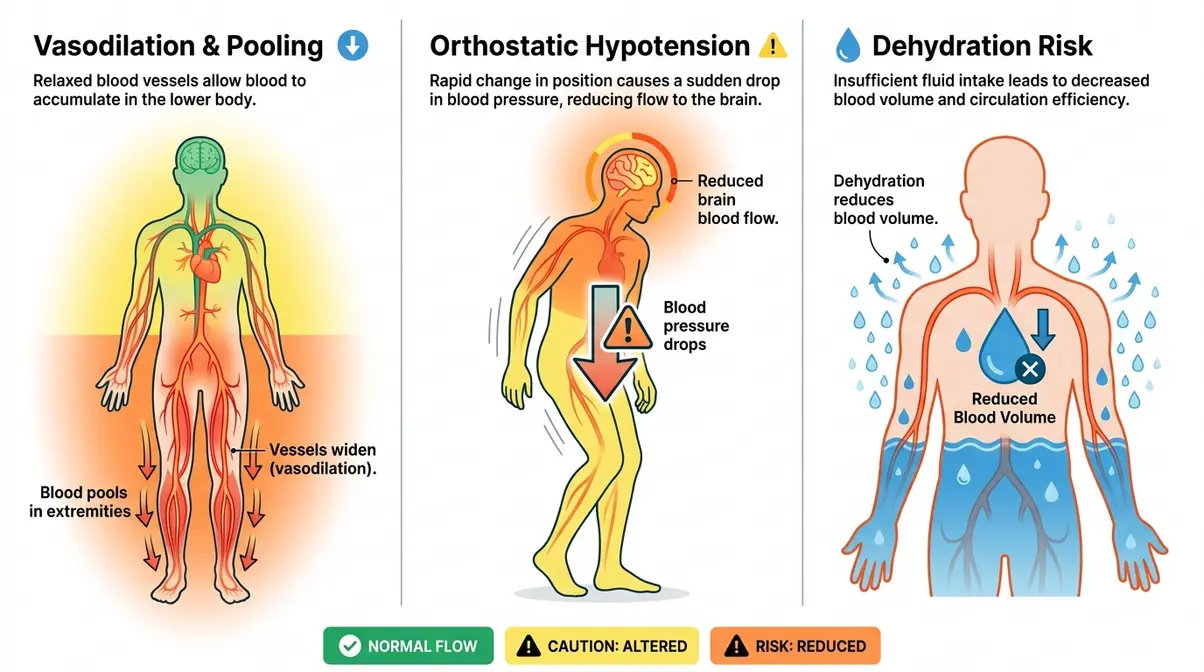
Vasodilation is the widening of blood vessels — and hot water triggers it aggressively. When you step into a hot tub, your body responds to the heat by dilating peripheral blood vessels to help dissipate warmth. This is a normal thermoregulatory response. The problem is what happens to your blood pressure as a result.
As your vessels expand, blood pools in your extremities. Your heart has to work harder to maintain circulation, and your blood pressure can drop — sometimes significantly. Research published in the Canadian Medical Association Journal documented cardiovascular stress responses in hot tub immersion, noting that core body temperature and heart rate rise substantially even in healthy adults within 10–15 minutes at typical hot tub temperatures.
For someone on anticoagulants, this vasodilation-driven pressure drop creates a compounding risk: if you stand up quickly, blood that has pooled in your legs doesn’t redistribute fast enough, and your brain momentarily receives less oxygen. That’s orthostatic hypotension — a sudden blood pressure drop upon standing — and it’s the primary cause of hot-tub-related fainting. A fall while anticoagulated can mean a serious bleeding injury from what would otherwise be a minor tumble.
The Dehydration Factor
Hot water immersion also causes sweating and fluid loss through the skin. Even a 15-minute soak in a 102°F tub can produce measurable dehydration, which further reduces blood volume and amplifies the blood pressure drop. Harvard Health Publishing notes that dehydration is one of the most underestimated contributors to dizziness and fainting in recreational hot tub use.
For patients on Warfarin specifically, dehydration can also affect INR (International Normalized Ratio) stability — the measure of how “thin” your blood is — making your anticoagulation harder to manage in the days following a soak.
Quotable fact: Immersion in water above 104°F (40°C) has been shown to raise core body temperature by up to 1°C within 10 minutes, triggering cardiovascular stress equivalent to moderate-intensity exercise (PubMed, 2003).
Our review of NHS, FDA, and MedlinePlus guidelines consistently identifies three primary risk categories for anticoagulant patients in hot water environments: vasodilation-induced hypotension, dehydration-driven INR instability (Warfarin), and fall-and-bleeding risk. The Safe Soak Protocol addresses all three directly. Always discuss your individual cardiovascular risk profile with your prescribing physician before use.
The Safe Soak Protocol: 6 Rules for Hot Tubs
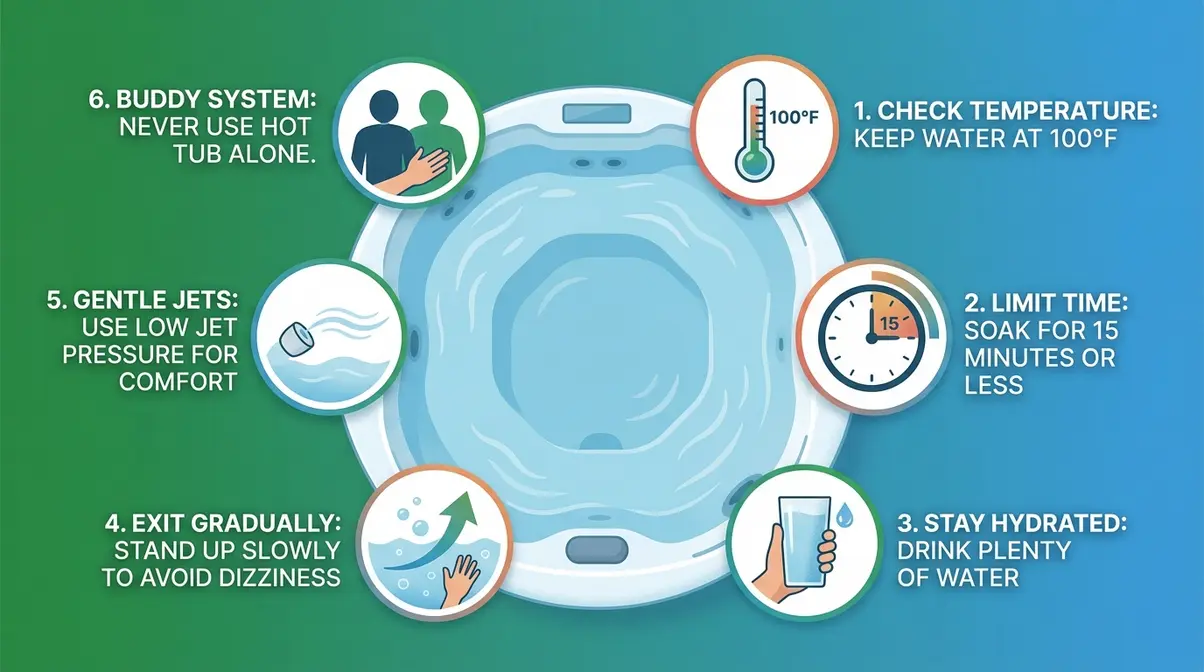
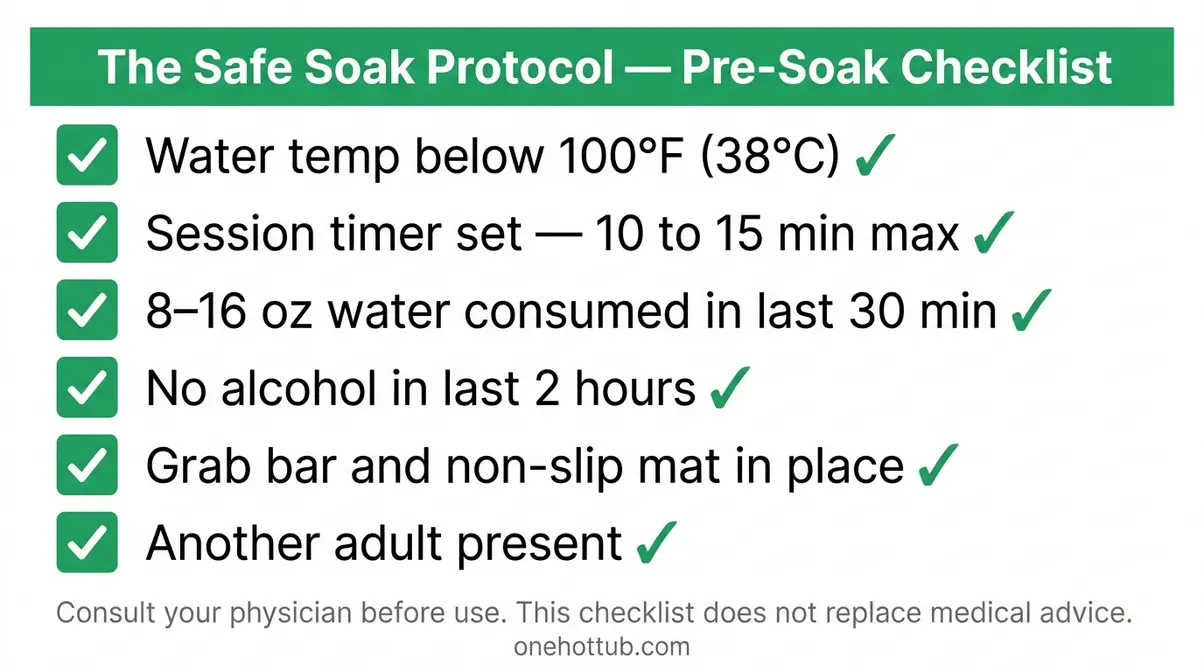
Most medical guidance on this topic gives you one rule: “be careful.” The Safe Soak Protocol gives you six — each grounded in specific physiology, each with a number you can actually use.
Across anticoagulant patient communities and our review of guidance from the National Blood Clot Alliance (Stop the Clot), the consistent advice is that hot tub use is not automatically forbidden. However, if you want to learn more about hot tub safety on blood thinners, you’ll find it requires deliberate precautions that go well beyond “don’t stay in too long.”
Rule 1 — Keep Water Temperature Below 100°F (38°C)
This is the single most important parameter. The Cleveland Clinic recommends that individuals with cardiovascular conditions limit hot tub water to no more than 100°F (38°C). At temperatures above this threshold, vasodilation becomes aggressive and blood pressure drops become harder for your body to compensate.
Most residential hot tubs default to 102–104°F. Before you enter, check the thermometer and dial it down. A “warm soak” at 98–100°F still provides the relaxation benefits — muscle tension relief, improved circulation — without the aggressive cardiovascular stress of a scalding tub.
Why this matters: Water at 104°F raises core body temperature roughly twice as fast as water at 100°F. That difference in temperature means a dramatically different cardiovascular load — especially relevant for patients whose hearts may already be working harder due to AFib or other underlying conditions.
Rule 2 — Limit Sessions to 10–15 Minutes Maximum
Duration is the second lever you control. Research cited in HealthCentral’s cardiovascular review suggests that cardiovascular stress in hot tubs increases non-linearly after the 15-minute mark — meaning risk escalates faster than time passes. For anticoagulant patients, 10–15 minutes is the functional upper limit per session.
Set a waterproof timer before you enter. Don’t rely on how you feel to judge when to exit — vasodilation can feel pleasant and relaxing right up until the moment you stand and your blood pressure drops sharply.
Quotable fact: Cardiovascular stress in hot water immersion increases significantly after 15 minutes, with heart rate and blood pressure variability both rising — even in healthy adults (HealthCentral cardiovascular review, 2026).
Rule 3 — Hydrate Before and After (Not During)
Drink 8–16 oz of water in the 30 minutes before your soak. Avoid alcohol entirely — it’s a vasodilator on top of the vasodilation already caused by hot water, which can make blood pressure drops severe and unpredictable. MedlinePlus and the Cleveland Clinic both flag alcohol-plus-hot-tub as a high-risk combination for all users, not just those on anticoagulants.
After your soak, drink another 8 oz. If you’re on Warfarin, consistent hydration helps maintain stable blood volume, which supports more predictable INR readings. Dehydration is a known contributor to INR fluctuation.
Rule 4 — Use the Slow Exit Technique
This is the step most guides skip entirely — and it’s arguably the most critical for preventing injury. When you’re ready to leave the hot tub:
- Sit upright at the edge of the tub (don’t stand yet) — pause for 30 seconds
- Swing your legs over the side and sit on the edge — pause another 30 seconds
- Stand slowly, holding a grab bar or stable surface
- Wait 10–15 seconds standing before walking — let your blood pressure stabilize
- Have a non-slip mat or towel on the floor before you enter, not after
This staged exit gives your cardiovascular system time to redistribute blood from your extremities back to your core. Skipping it is when fainting — and the dangerous falls that follow — actually happen. Given that a fall while on anticoagulants can lead to internal bleeding from what would be a minor bruise in a non-anticoagulated person, this technique is non-negotiable.
Consult your physician about whether grab bars or a pool lift would be appropriate for your specific situation, particularly if you have a history of orthostatic hypotension or balance issues.
Rule 5 — Avoid Forceful Jets Directly Over Bruises or Injection Sites
Forceful hot tub jets directed over an existing bruise, a recent injection site (such as an insulin or Lovenox injection area), or any skin that shows signs of bleeding can worsen bruising and potentially dislodge superficial clots. The Stop the Clot FAQ notes that massage and pressure over active clot sites should be avoided — the same principle applies to high-pressure jets.
Use the tub for gentle hydrotherapy rather than targeted jet massage if you have any active bruising or skin sensitivity from anticoagulant use.
Rule 6 — Never Soak Alone
This is a safety net, not a suggestion. If you do experience dizziness or lightheadedness and faint, being alone in a hot tub is life-threatening — not because of your blood thinners, but because of drowning risk. The Healthgrades cardiovascular safety review recommends that patients with cardiovascular conditions always have another adult present during hot tub use.
If solo use is unavoidable, keep the water at the lower end of the safe temperature range (98°F), keep the session under 10 minutes, and ensure your phone is within reach outside the tub.
Guidance for Eliquis, Warfarin, and Xarelto
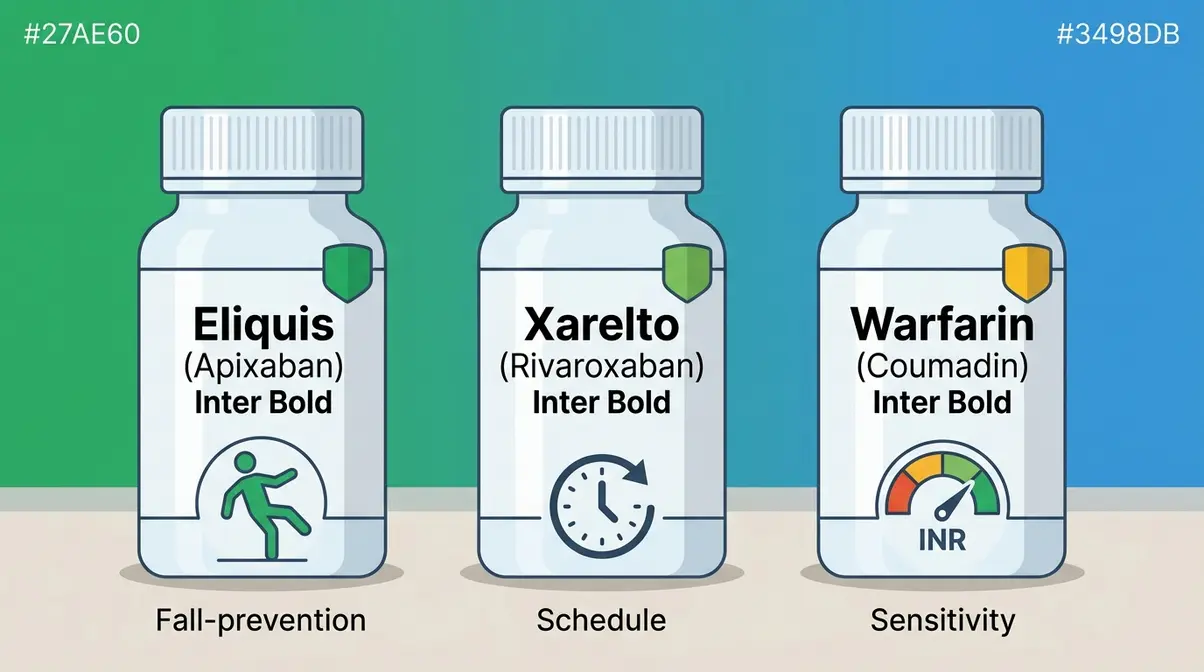
Not all blood thinners interact with heat and hot tub use in exactly the same way. Understanding your specific medication helps you apply The Safe Soak Protocol with the right level of caution. Always confirm these details with your prescribing physician or pharmacist — medication interactions and individual health profiles vary.
Across patient communities and our review of FDA prescribing information and clinical guidance, three primary medications come up repeatedly in discussions about hot tub use: apixaban (Eliquis), rivaroxaban (Xarelto), and warfarin (Coumadin). Here’s what the evidence suggests about each.
Eliquis (Apixaban) and Hot Tub Use
Eliquis is a DOAC (direct oral anticoagulant) — it works by directly inhibiting Factor Xa in the clotting cascade. Unlike Warfarin, it does not require routine INR monitoring and has fewer dietary interactions. From a hot tub safety perspective, the primary concern with Eliquis is fall-and-bleeding risk, not medication instability.
Because Eliquis inhibits clotting consistently and predictably, a fall resulting from orthostatic hypotension carries a higher risk of serious bruising, hematoma, or internal bleeding than it would in a non-anticoagulated person. The FDA prescribing information for apixaban emphasizes fall prevention as a key patient safety consideration.
Eliquis-specific hot tub guidance: Follow all six Safe Soak Protocol rules with particular emphasis on Rules 4 (slow exit) and 6 (never soak alone). The medication itself is not destabilized by heat — your primary risk is the fall, not a drug interaction.
Xarelto (Rivaroxaban) and Hot Tub Use
Xarelto is also a DOAC (Factor Xa inhibitor) with a similar safety profile to Eliquis for hot tub purposes. It does not require INR monitoring and has no significant dietary interactions. Like Eliquis, the dominant risk is orthostatic hypotension leading to a fall.
One nuance: Xarelto is typically taken with the evening meal (for most indications), and some patients report that peak drug effect timing aligns with evening relaxation — including hot tub use. While there is no direct evidence that peak plasma concentration increases hot tub risk, discussing timing with your pharmacist is a reasonable precaution. The FDA Xarelto prescribing label lists fall prevention as a primary safety consideration.
Xarelto-specific guidance: Follow The Safe Soak Protocol in full. Consider discussing the timing of your soak relative to your medication schedule with your pharmacist.
Warfarin (Coumadin) and Hot Tub Use
Warfarin requires the most careful approach. Unlike DOACs, Warfarin’s anticoagulant effect is highly sensitive to changes in diet, hydration, activity level, and even body temperature. The NHLBI’s Warfarin patient guide notes that dehydration, fever, and significant physical changes can shift INR readings unpredictably.
Heat and Warfarin: Extended hot tub exposure causes sweating and fluid loss, which can alter blood viscosity and potentially affect INR stability in the days that follow. This doesn’t mean hot tubs are forbidden — but it does mean that regular INR monitoring is especially important if you’re a frequent hot tub user.
Vitamin K and Warfarin: This is a separate but related concern. Warfarin works by inhibiting Vitamin K-dependent clotting factors. Large swings in Vitamin K intake (from diet or supplements) can destabilize your INR. The Cleveland Clinic’s Warfarin dietary guidance recommends consistency in Vitamin K intake rather than elimination — and notes that any lifestyle changes (including regular hydrotherapy) should be discussed with your prescribing physician.
Quotable fact: Warfarin’s therapeutic window is narrow — a 20–30% shift in INR from baseline can move a patient from under-anticoagulated (clot risk) to over-anticoagulated (bleeding risk) (NHLBI, 2026).
Warfarin-specific guidance: Follow all six Safe Soak Protocol rules. Additionally: stay well-hydrated before and after, monitor your INR more frequently if you begin regular hot tub use, and report any unusual bruising or bleeding to your prescribing physician promptly.
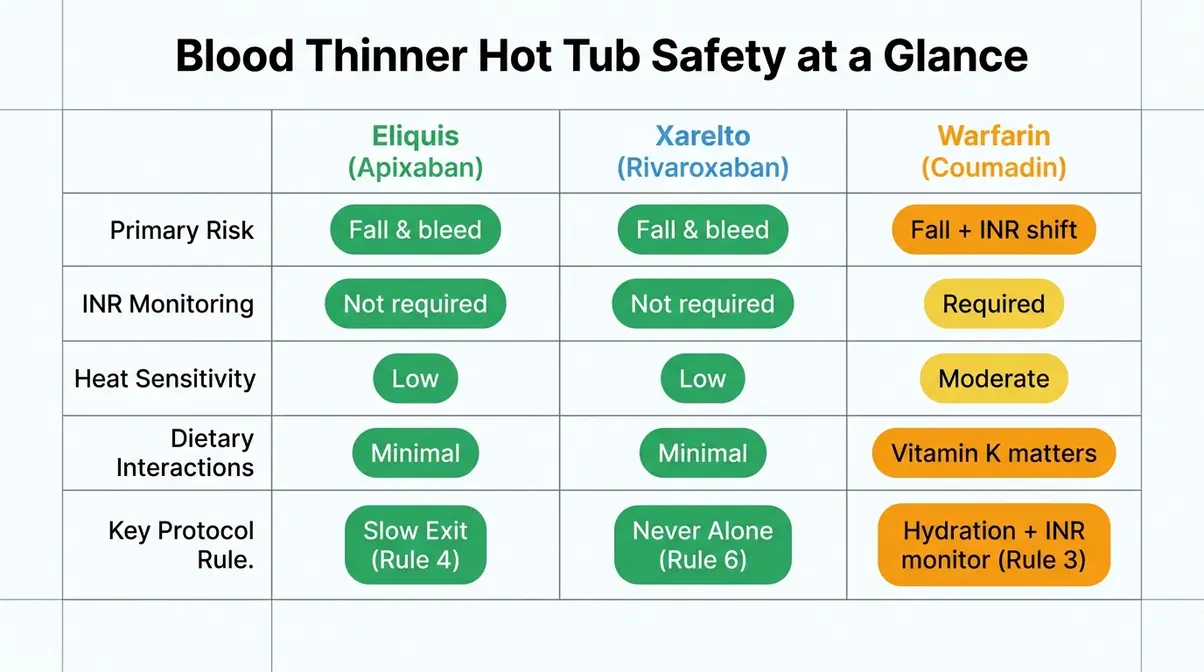
| Medication | Primary Hot Tub Risk | INR Monitoring | Heat Sensitivity | Key Protocol Rule |
|---|---|---|---|---|
| Eliquis (Apixaban) | Fall & bleeding injury | Not required | Low — drug effect stable | Slow exit (Rule 4) |
| Xarelto (Rivaroxaban) | Fall & bleeding injury | Not required | Low — drug effect stable | Never soak alone (Rule 6) |
| Warfarin (Coumadin) | Fall + INR destabilization | Required (regular) | Moderate — dehydration affects INR | Hydration (Rule 3) + monitor INR |
When to Avoid Hot Tubs on Blood Thinners
The Safe Soak Protocol works for stable patients following their treatment plan. But there are specific situations where even a carefully managed soak is the wrong call — and recognizing them is a critical part of responsible self-care.
Our review of guidance from the National Blood Clot Alliance and clinical literature identifies several clear contraindications that patients and their caregivers should understand. It is always wise to (https://onehottub.com/hot-tub-safety-guide-essential-tips-for-owners) alongside these specific warnings.
Common Pitfalls That Lead to Unsafe Soaks
Pitfall 1: Entering with an active or recent bleed. If you have an active bleed — from a wound, a GI bleed, or unusual bruising — hot water immersion increases circulation to the affected area and can worsen bleeding. Exit and contact your physician before any hot tub use.
Pitfall 2: Ignoring INR instability (Warfarin users). If your INR was outside your therapeutic range at your last check, hot tub use introduces additional variables. Wait until your INR is stable and confirmed by your care team.
Pitfall 3: Soaking when feeling unwell, feverish, or dehydrated. A fever already dilates blood vessels and drops blood pressure — layering hot water immersion on top creates compounding risk. If you’re under the weather, skip the soak.
Pitfall 4: Drinking alcohol before or during. Alcohol is a vasodilator. Combined with hot water vasodilation and anticoagulant therapy, it creates a triple-stacked blood pressure drop risk. The Cleveland Clinic explicitly flags this combination as high-risk.
When to Choose Alternatives Entirely
Scenario 1: Recent DVT or pulmonary embolism. If you are in the acute phase of treatment for a deep vein thrombosis (DVT) or pulmonary embolism (PE) — typically the first 3 months of anticoagulation — consult your hematologist before any hot tub use. The concern is not that heat will “dislodge a blood clot” in the dramatic sense, but that your overall cardiovascular stability during this period warrants conservative activity restrictions.
Scenario 2: Uncontrolled hypertension or recent cardiac event. Hot tubs place measurable cardiovascular stress on the heart. For patients with uncontrolled high blood pressure, recent heart attack, or unstable arrhythmia, the Cleveland Clinic’s cardiovascular team recommends avoiding hot tub use entirely until the condition is managed.
Scenario 3: History of falls or balance issues. If you have a documented history of falls, orthostatic hypotension, or significant balance impairment, the risk-benefit calculation shifts. A warm bath at controlled temperature with grab bars may be a safer alternative.
When to Seek Professional Guidance
If any of the following apply, discuss hot tub use with your prescribing physician before proceeding — not as a formality, but because your individual risk profile genuinely changes the calculus:
- You are in the first 90 days of anticoagulant therapy
- You have had a recent change in medication dose or type
- You have been hospitalized in the past 6 months for a clotting or bleeding event
- You take additional medications that affect blood pressure (antihypertensives, diuretics, or beta-blockers) — their interaction with vasodilation can be significant
- Your INR has been unstable in the past 60 days
Frequently Asked Questions
Can you go in a hot tub on Eliquis?
Yes, most Eliquis patients can use a hot tub — but the primary risk is a fall caused by the blood pressure drop that hot water triggers, not a direct drug interaction with the water. Because Eliquis (apixaban) is a consistent anticoagulant, any fall resulting from dizziness or fainting carries a higher bleeding risk than it would for someone not on blood thinners. Follow The Safe Soak Protocol: keep water below 100°F, limit your session to 10–15 minutes, and always use the slow exit technique. Confirm with your prescribing physician first, especially if you have a history of falls or orthostatic hypotension.
Can you go in a hot tub on Xarelto?
Xarelto (rivaroxaban) patients can generally use a hot tub with the same precautions that apply to all anticoagulant patients. Like Eliquis, Xarelto doesn’t require INR monitoring and isn’t destabilized by heat itself — your main risk is orthostatic hypotension leading to a fall. Some clinicians suggest discussing the timing of your soak relative to your Xarelto dose with your pharmacist, since peak plasma concentration occurs 2–4 hours after ingestion. Always follow the six-step Safe Soak Protocol and consult your physician if you’re newly prescribed.
Is it safe to use a hot tub on Warfarin?
Hot tub use on Warfarin requires extra caution compared to DOACs like Eliquis or Xarelto. Warfarin’s anticoagulant effect is sensitive to changes in hydration and body temperature — both of which are affected by hot tub use. Dehydration from sweating can contribute to INR instability, potentially pushing your reading out of the therapeutic range. If you use a hot tub regularly while on Warfarin, discuss more frequent INR monitoring with your care team. Follow all six Safe Soak Protocol rules, with particular emphasis on hydration before and after your soak.
Can a hot tub dislodge a blood clot?
The concern about hot tubs “dislodging” a blood clot is real but often misunderstood. Forceful hot tub jets directed over an active clot site or a recent surgical area can increase local circulation and pressure, which may be problematic. However, for most stable patients whose clot is being treated with anticoagulants, the more significant concern is vasodilation-induced blood pressure drops — not mechanical clot dislodgement from the water itself. The National Blood Clot Alliance advises avoiding high-pressure jets over active clot areas and consulting your physician during acute treatment phases.
What temperature is safe for a hot tub on blood thinners?
Keep hot tub water at or below 100°F (38°C) if you’re on blood thinners. This is the threshold recommended by the Cleveland Clinic for patients with cardiovascular conditions. At temperatures above 100°F, vasodilation becomes aggressive, blood pressure drops more sharply, and the risk of dizziness and fainting increases significantly. Most residential hot tubs default to 102–104°F, so you’ll typically need to actively lower the thermostat. A warm soak at 98–100°F still delivers relaxation benefits — you don’t need scalding water to enjoy the tub.
What are the warning signs to exit a hot tub immediately?
Exit the hot tub immediately if you experience any of the following: dizziness or lightheadedness, nausea, unusual sweating (beyond normal), heart pounding or racing, blurred vision, or a sudden sense of weakness in your legs. These are early warning signs of vasodilation-induced blood pressure drop and can precede fainting. Use the slow exit technique (sit at the edge, pause, then stand slowly with support) — do not stand up quickly, as this is precisely when fainting and falls occur. If symptoms persist after exiting, sit or lie down and seek medical attention if they don’t resolve within a few minutes.
Conclusion
For most people taking blood thinners, using a hot tub on blood thinners safely is achievable — but it requires moving beyond generic caution and into specific, deliberate practice. The physiological risks are real: vasodilation drops blood pressure, dehydration destabilizes INR (especially for Warfarin users), and a fall while anticoagulated carries consequences that wouldn’t apply to most people. But none of these risks are inevitable. They are manageable.
The Safe Soak Protocol — keep water below 100°F, limit sessions to 10–15 minutes, hydrate before and after, exit slowly, avoid forceful jets over sensitive areas, and never soak alone — gives you a concrete framework rather than a vague warning. Our review of guidance from the NHS, FDA, Cleveland Clinic, National Blood Clot Alliance, and peer-reviewed cardiovascular research consistently supports these parameters as the right boundaries for anticoagulant patients seeking to use hydrotherapy safely.
The next step is a direct conversation with your prescribing physician to confirm if keeping your hot tub on blood thinners safe aligns with your personal health profile. Bring this guide if it helps frame the discussion. Ready to talk to your doctor? Schedule an appointment today to review your specific medication dose, your current INR stability (if on Warfarin), and whether any recent changes to your health history change the risk profile. Most patients get the green light — with the right precautions clearly understood.

David King
Hot tub tester and writer at One Hot Tub.