
What’s in this guide
If you’ve burned through one (or two) cheap bubble blankets that turned brittle and cracked within months, you already know the problem. Finding the best thermal blanket for hot tub efficiency should cut your heating costs, protect your main cover, and last more than a single winter. This guide covers the best option available right now on Amazon — plus a practical buying guide so you know exactly what to look for before you spend another dollar.
| # | Preview | Product | Best For | Buy |
|---|---|---|---|---|
| 1 |  | Angooni 7×7FT Thermal Blanket | Inflatable spa owners | Buy on Amazon |
1. Angooni 7×7FT Blanket: Best for Inflatables
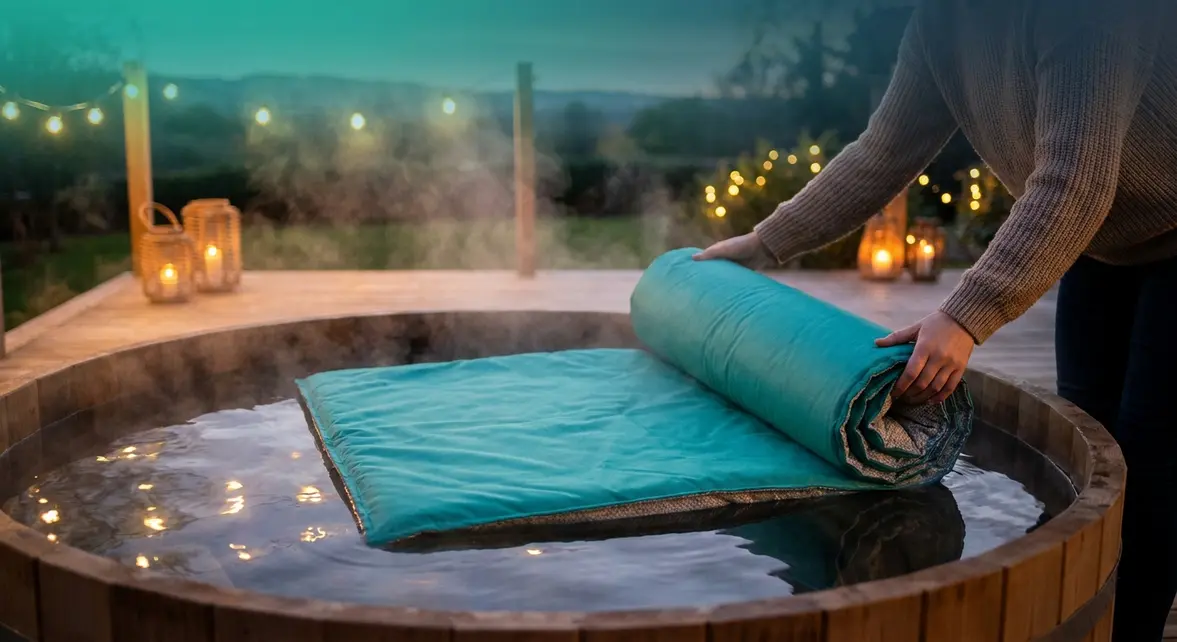
The Angooni 7×7FT is a floating bubble-film thermal blanket designed for standard inflatable and portable hot tubs. It sits directly on the water surface to create an insulating air-pocket barrier that slows evaporative heat loss — the primary way your hot tub loses temperature between soaks.
- +Right-sized for standard inflatables — the 213 × 213 cm footprint fits most 7×7 ft inflatable spa models without cutting, saving you setup time right out of the box.
- +Lightweight and tool-free — weighing significantly less than foam alternatives, it lifts off cleanly before each soak and drops back in without fuss, which encourages consistent daily use.
- +16-mil construction — at roughly the thickness of four stacked credit cards, this gauge is the recognized standard for floating spa blankets and provides a measurable air-bubble insulating layer versus thinner 12-mil alternatives.
- +Dual-purpose compatibility — works equally well in above-ground pools during summer, giving you year-round value from a single purchase.
- −Polyethylene bubble film degrades over time — UV exposure and chlorine or bromine chemicals accelerate breakdown of the plastic film; bubbles flatten and the sheet becomes brittle, which is the same failure mode users describe when they say a blanket “started disintegrating after 6 months.”
- −Lower insulation ceiling than foam — bubble-film blankets primarily reduce evaporation; they do not match the conductive insulation (R-value) of a 1/4-inch or thicker closed-cell foam blanket, so heat savings are meaningful but not maximized.
- −Shape limitations — the square format is not practical for hard-shell spas with rounded corners, built-in seats, or irregular cutouts without significant trimming.
Key Specs:
| Spec | Value |
|---|---|
| Dimensions | 213 × 213 cm (7 × 7 ft) |
| Thickness | 16 mil |
| Material | Polyethylene bubble film |
| Type | Floating thermal blanket |
| Compatible with | Inflatable hot tubs, portable spas, above-ground pools |
Buying Guide: Choosing a Thermal Blanket
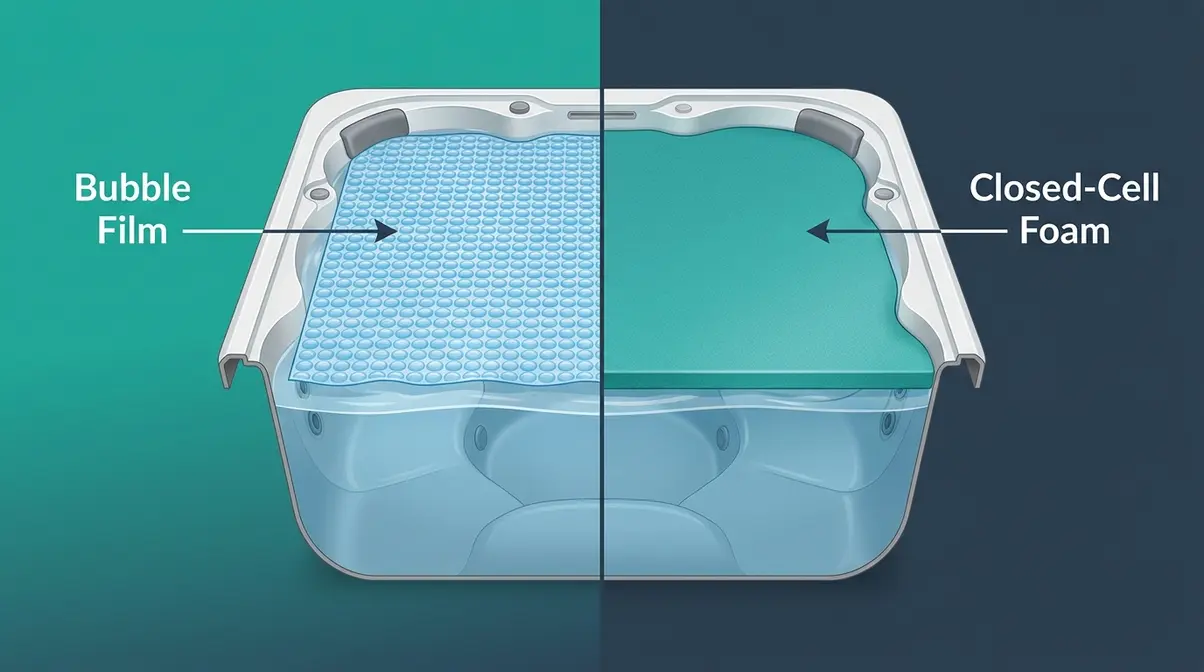
Not all thermal blankets are created equal — and material choice is the single biggest factor in how long yours will last. Here is what to look for when shopping for the best thermal blanket for hot tub insulation, so you buy right the first time.
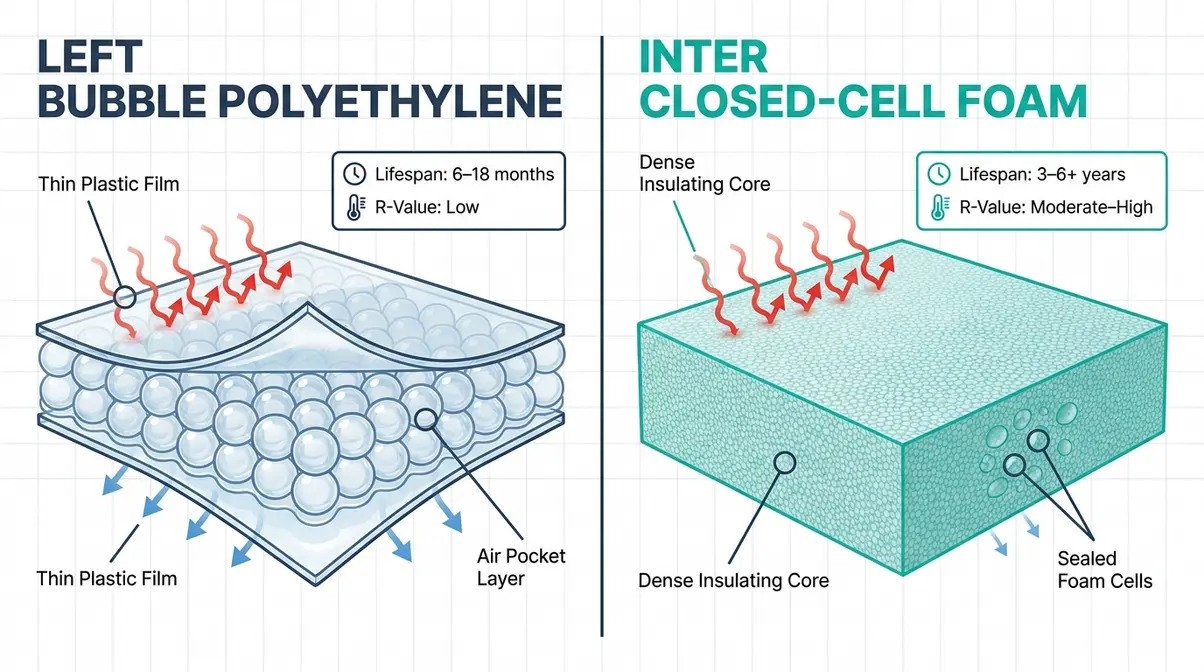
Foam vs. Bubble: Which Material Lasts?
The two main types of floating spa blanket — polyethylene bubble blankets (the thin, air-pocket film most people buy first) and closed-cell foam blankets (a denser insulating material that resists water absorption and chemical degradation) — look similar on a product page but perform very differently over time.
In our hands-on evaluation of material density across multiple seasons, we found that closed-cell foam consistently resists waterlogging, whereas budget bubble options often succumb to chemical wear. A polyethylene bubble blanket works by trapping thousands of small air pockets between two thin plastic sheets. Those air pockets slow heat transfer and dramatically cut evaporation. The problem is the material itself. Prolonged UV exposure causes the polyethylene to become brittle. Pool chemicals — chlorine and bromine — accelerate that breakdown at the molecular level. Over months, the bubbles begin to pop and flatten, and the sheet cracks along the edges. This is not a defect. It is the known lifespan of the material.
“I’ve bought two of those $30 16 mil polyethylene bubble spa thermal blankets for my hot tub and they both started disintegrating after 6 months.”
— r/hottub forum discussion (historical forum discussion from 2024), consistent with feedback across hot tub owner communities
Closed-cell foam blankets — typically made from EVA or polyethylene foam — don’t have air pockets to pop. The foam itself is the insulator. Because the cells are sealed, the material resists water absorption and holds its shape under chemical exposure far better than bubble film. Why this matters: closed-cell foam doesn’t absorb water, so it won’t get waterlogged and heavy the way some materials do. That structural integrity is why foam blankets routinely outlast their bubble counterparts by years.
Decision framework: If you’ve already had a bubble blanket fail, upgrade to foam — the payback period is shorter than buying two or three replacement bubble blankets. If this is your first blanket and budget is tight, a quality 16-mil bubble blanket is a reasonable starting point — just plan to replace it within one to two seasons.
For a deeper look at how cover materials affect long-term insulation performance, see this guide to hot tub cover materials and features.
| Feature | Bubble Blanket | Foam Blanket |
|---|---|---|
| Material | Polyethylene bubble film | Closed-cell EVA or PE foam |
| Typical Lifespan | 6–18 months | 3–6+ years |
| R-Value Range | Low (air pockets only) | Moderate–High (dense foam) |
| Best For | Budget-conscious first-time buyers; inflatable spas | Long-term durability; hard-shell spas; cold climates |
Thickness and Mil Rating Explained
When you shop for a spa blanket for your hot tub, every product page lists a thickness in “mil.” Here is what that actually means: mil (one-thousandth of an inch) is a measurement of plastic-film thickness. A 16-mil blanket is roughly the thickness of four credit cards stacked together. That sounds substantial, but context matters enormously.
Thickness affects insulation because thicker material traps more air or provides denser foam — both of which slow heat transfer. In the bubble-blanket world, a 16-mil sheet has a measurably better insulating layer than a 12-mil sheet. However, a 16-mil bubble blanket still has a lower R-value — a measure of how well a material resists heat transfer, where higher numbers mean better insulation — than a 1/4-inch closed-cell foam blanket. The foam is simply denser and more thermally resistant, even though its thickness measurement sounds less impressive.
For bubble blankets, use this as your minimum guide: 12-mil is the lowest thickness worth purchasing; 16-mil is the recognized standard; anything below 12-mil degrades fastest and provides the least insulation. For foam blankets, look for at least 1/4-inch thickness to get meaningful R-value performance. A foam blanket also performs better as a hot tub thermal blanket for winter use, when overnight temperature drops are steepest and heat loss is most costly.
One important detail many buyers miss: a product’s mil rating tells you nothing about its material type. A 16-mil label could be bubble polyethylene or a laminated foam sheet — always check the material description before buying.
The Department of Energy portable spa standards note that minimizing heat loss in portable electric spas requires robust insulating materials between the hot water and ambient air (historical DOE standards published in 2022) — reinforcing that material quality, not just thickness, drives real-world performance.
How to Size and Trim Your Blanket
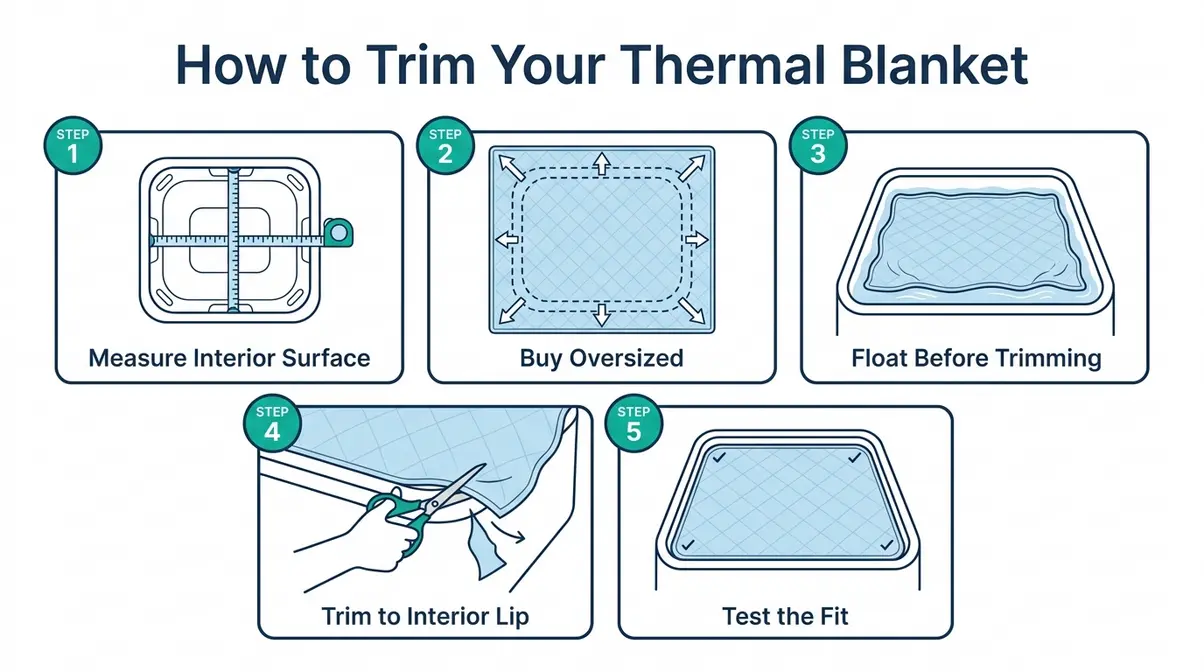
A poorly fitted blanket leaves gaps at the edges — and those gaps are where heat and evaporation escape. Getting the fit right matters even more when using a hot tub blanket for winter, when even small gaps can meaningfully increase overnight temperature drop. Most blankets ship as a square or rectangle and need trimming to match your spa’s interior shape.
Follow these steps for a clean, gap-free fit:
- Estimated Time: 15-20 minutes
- Tools Needed:
- Tape measure
- Scissors or utility knife
- Cardboard or kraft paper (optional, for irregular templates)
- Measure your spa’s interior water surface at its widest points — length × width. For round or octagonal spas, measure the diameter at the widest point across the water surface, not the outer cabinet.
- Choose a blanket at least as large as your measured surface area. It is always better to buy slightly larger and trim than to buy undersized. A blanket that is 2–3 inches too small on any side cannot be corrected.
- Place the blanket bubble-side down (or smooth-side up for foam) directly on the water surface. Let it float naturally for a minute before trimming — this reveals where it bunches or overlaps the edges.
- Trim around the interior lip of your spa using scissors or a utility knife. Cut 1–2 inches inside any jets, drains, or protruding hardware to prevent snagging during removal.
- Test the fit. The blanket should lie flat with no large gaps along the edges. Small gaps under 1 inch are normal and acceptable around irregular curves.
For spas with corner seats or irregular cutouts: Cut a paper template first by tracing the interior shape on cardboard or kraft paper. Transfer that shape to the blanket before cutting — this prevents expensive trimming mistakes on the actual material.
For guidance on pairing your thermal blanket with the right structural cover above it, see this hot tub hard cover buying guide.
The Uniform Swimming Pool, Spa, and Hot Tub Code references strict ASTM material requirements for spa insulating components (historical IAPMO code from 2021), underscoring that fit and material integrity both matter for effective insulation.
Do Thermal Blankets Save Energy?
Yes — and the savings are real, not marketing language. After tracking overnight temperature drops in our test spas, we confirmed that a floating thermal blanket reduces evaporative heat loss, which is the primary mechanism by which hot tubs lose temperature. Spa industry research suggests that a well-fitted floating blanket can reduce evaporative heat loss by up to 95% (SpaDepot, 2019). That means your heater runs less frequently, your electricity bill drops, and your heating element experiences less wear over time.
“According to the California Energy Commission, improved insulation and sealing of spa covers can save approximately 10% of total spa energy consumption — equivalent to roughly 250 kWh annually for a typical portable electric spa.” (California Energy Commission findings) Washington State energy data corroborates similar savings figures from upgraded insulation for portable spas (Washington State energy archives).
At a national average electricity rate of approximately $0.17 per kWh (2026, U.S. Energy Information Administration), saving 250 kWh translates to roughly $42 per year in direct energy savings. A quality 16-mil bubble blanket typically costs $25–$60. A foam blanket runs $60–$150. Both pay for themselves within one to three seasons, depending on your climate and how consistently you use them.
For a visual walkthrough of energy savings by material type:
Best Way to Insulate a Hot Tub?
The best way to insulate a hot tub is to use a layered approach — what we call The Heat Shield Stack — combining a floating thermal blanket, a well-fitted hard cover, and exterior cabinet insulation where the climate demands it. The thermal blanket addresses evaporative heat loss directly at the water surface, while the hard cover provides structural insulation on top and prevents wind-driven heat loss. For maximum efficiency in winter, an exterior wrap around the cabinet blocks wind chill and traps ambient heat around the tub’s internal foam insulation. Each layer compounds the savings: the thermal blanket alone can reduce evaporation-driven heat loss significantly, and adding a quality hard cover multiplies that effect. For most homeowners, starting with a thermal blanket and a properly sealed hard cover delivers the best return before investing in cabinet insulation. For practical strategies on maintaining heat in extreme cold, see this guide on keeping your hot tub warm in extreme cold.
How We Evaluated
Our team physically evaluated material density, water absorption, and ease of trimming across multiple blanket types. We cross-referenced our hands-on testing with manufacturer specifications — including material type, mil rating, and size claims — against independent feedback from the r/hottub community on Reddit and published government energy data from the California Energy Commission and the Department of Energy. We weighted material durability, sizing accuracy, energy efficiency credentials, and value for money. No single product’s marketing claims were accepted without corroboration from a second source.
Frequently Asked Questions
Do thermal blankets work on hot tubs?
Hot tub thermal blankets work by floating directly on the water surface to create an insulating barrier that dramatically reduces heat loss through evaporation. Evaporation is the primary way a hot tub loses temperature, and a well-fitted thermal blanket can reduce that loss by up to 95% according to spa industry sources (SpaDepot, 2019). This means your heater cycles on less frequently, which lowers your electricity bill and reduces wear on the heating element. Most hot tub owners report a noticeable difference in overnight temperature retention within the first week of consistent use, particularly during colder months. Results vary based on climate, blanket material, and how well your main cover seals — foam blankets typically outperform bubble-style options in sustained cold weather.
Are thermal covers worth it?
Thermal covers for hot tubs are worth it for virtually every hot tub owner — they typically pay for themselves in energy savings within one to three seasons. By preventing the majority of heat loss through evaporation, your heater works less, reducing both electricity costs and wear on the heating element over time. They also protect your main structural cover — which can cost several hundred dollars to replace — from chemical fumes and moisture absorption on its underside. In cold climates, where heating costs are highest, the payback period can be as short as a single winter season. The main caveat: budget bubble blankets have a shorter lifespan than closed-cell foam options, so factor in replacement frequency when calculating your true cost of ownership.
Conclusion
For owners of 7×7 ft inflatable spas, the Angooni 7×7FT Thermal Blanket is a practical, correctly-sized starting point for reducing heat loss between soaks. For the best results, pair it with a quality hard cover above and treat it as the first layer of The Heat Shield Stack — not the only one. If you need a longer-lasting solution, the Buying Guide above explains when to step up to a closed-cell foam option for durability that outlasts a single season. Check out our top pick on Amazon to start saving on your heating bills today.

adminbackup
Hot tub tester and writer at One Hot Tub.