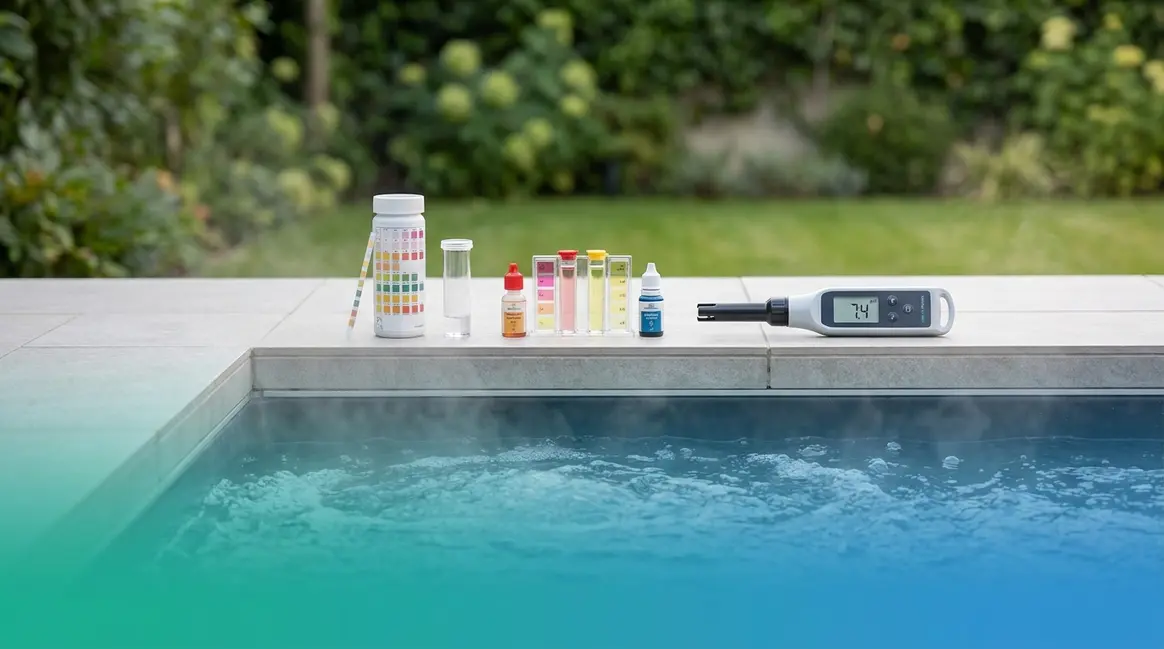
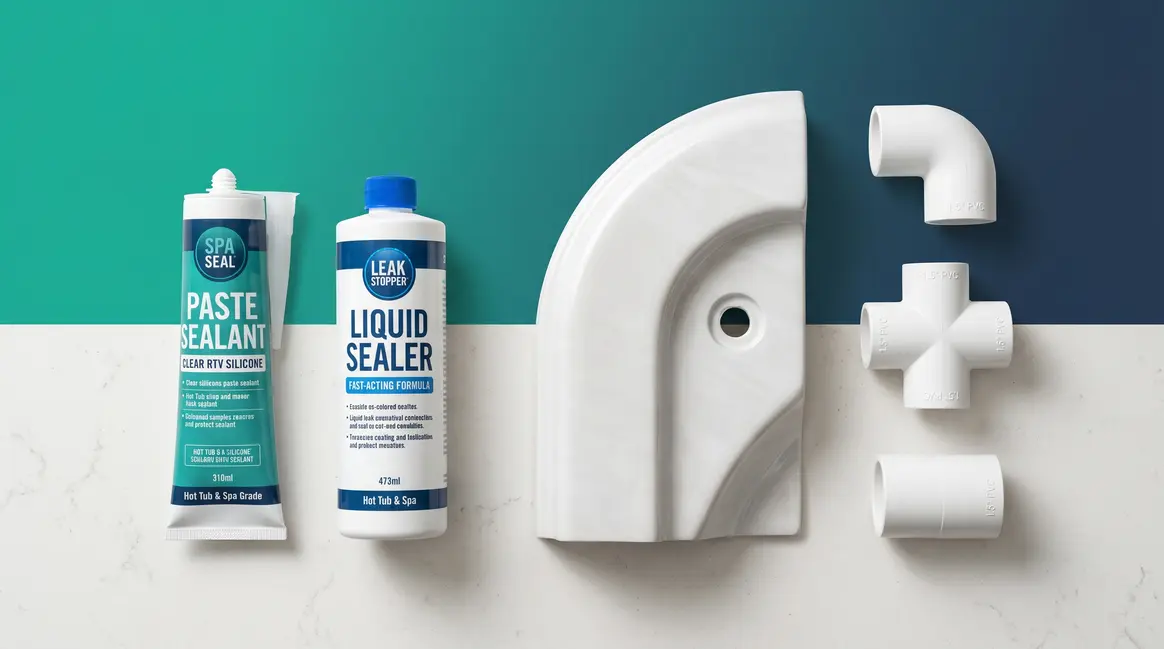

What’s in this guide
- How We Evaluated These Hot Tub Sealants
- Best Hot Tub Sealants for Every Leak Type
- How to Apply Hot Tub Sealant Step by Step
- Liquid vs. Paste: Which Sealant Do You Need?
- After the Fix: Restoring Your Water Chemistry
- Hot Tub Accessories Worth Having
- When Hot Tub Sealants Won't Cut It
- Frequently Asked Questions
- Conclusion
Your hot tub is losing water, and you’ve already done the frustrating work of tilting it on every side trying to find the leak. You’re not alone.
“The hot tub was losing a ton of water and seems to be leaking from here after tilting it on every side to figure out where.” — Hot tub owner, r/hottub
Every day you wait, you’re topping off water, paying to reheat it, and risking damage to your pump or heater from running low. Grabbing a tube of household DAP or GE silicone off the hardware store shelf feels like a quick fix — but those products aren’t formulated for constant immersion in chlorinated water at 104°F. They’ll degrade within weeks, and you’ll be back to square one.
This guide gives you the right best hot tub sealant for your specific leak — organized by where the leak is, not by brand popularity. We cover the top 5 picks, step-by-step application instructions, and a decision framework so you never buy the wrong product again.
The best hot tub sealant depends entirely on where your leak is — not which brand is most popular. This is The Leak Location Rule, and it determines everything.
- For jet & shell leaks: Use a spa-grade silicone paste (Boss 802, Permatex Clear RTV 66B)
- For hidden plumbing leaks: Use a liquid sealer (Fix-A-Leak, AquaDoc) that circulates through the water
- Avoid DAP and GE for hot tub use — they’re not formulated for constant immersion or chlorine exposure
- Most leaks originate at pump seals, heater union gaskets, or jet bases — check these first
How We Evaluated These Hot Tub Sealants
Every product in this guide was assessed specifically for hot tub and spa environments — not general household plumbing. The core evaluation criteria: chemical resistance in chlorinated or brominated water, sustained temperature tolerance, material compatibility, cure time, and ease of DIY application.
Evaluation criteria used:
- Chemical resistance — survives free chlorine (1–3 ppm) and bromine (3–5 ppm), the levels recommended for hot tub sanitation per CDC guidelines for hot tub sanitation (CDC, 2026). Standard household silicones are not formulated to withstand constant immersion in chlorinated water at 100°F+ — they will degrade and fail within weeks.
- Temperature tolerance — withstands sustained water temperatures of 100–104°F
- Material compatibility — bonds to acrylic shells, PVC plumbing, and fiberglass components
- Cure time — realistic for DIY timelines without professional tools
- Ease of application — no specialist equipment required
Products were assessed using manufacturer spec sheets, spa technician community input (including r/hottub), and documented product feedback. Standard household silicones — DAP and GE household grade — were reviewed and excluded because they lack spa-grade formulation for continuous chemical submersion.
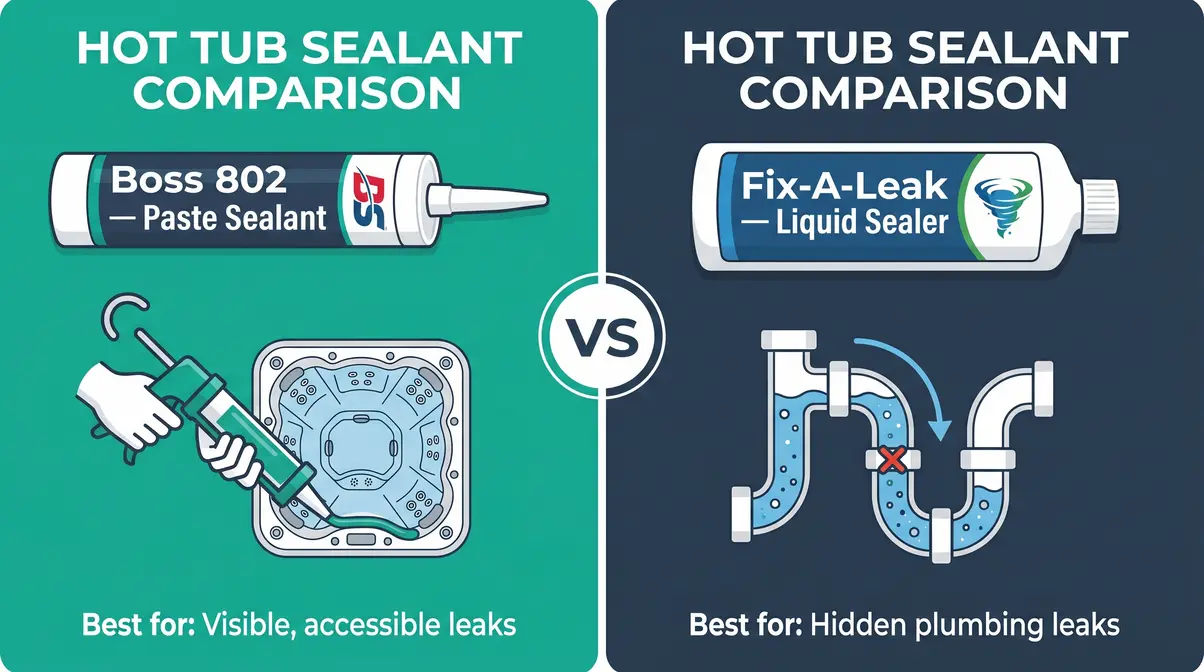
The organizing principle for all recommendations that follow is The Leak Location Rule: if you can physically reach the leak, use a paste sealant; if you can’t, use a liquid sealer. Every product recommendation in this guide flows from that single rule.
Best Hot Tub Sealants for Every Leak Type
The right hot tub sealant depends on one thing: whether you can physically reach the leak. Accessible leaks at jets, skimmer gaskets, and shell cracks call for a silicone paste you apply directly to the surface. Hidden leaks inside walls or underground PVC plumbing require a liquid sealer that circulates through your water system and seeks out gaps from the inside. Rather than ranking these by brand, we’ve organized them by where your leak is — because that’s the only framework that actually helps you buy the right product.
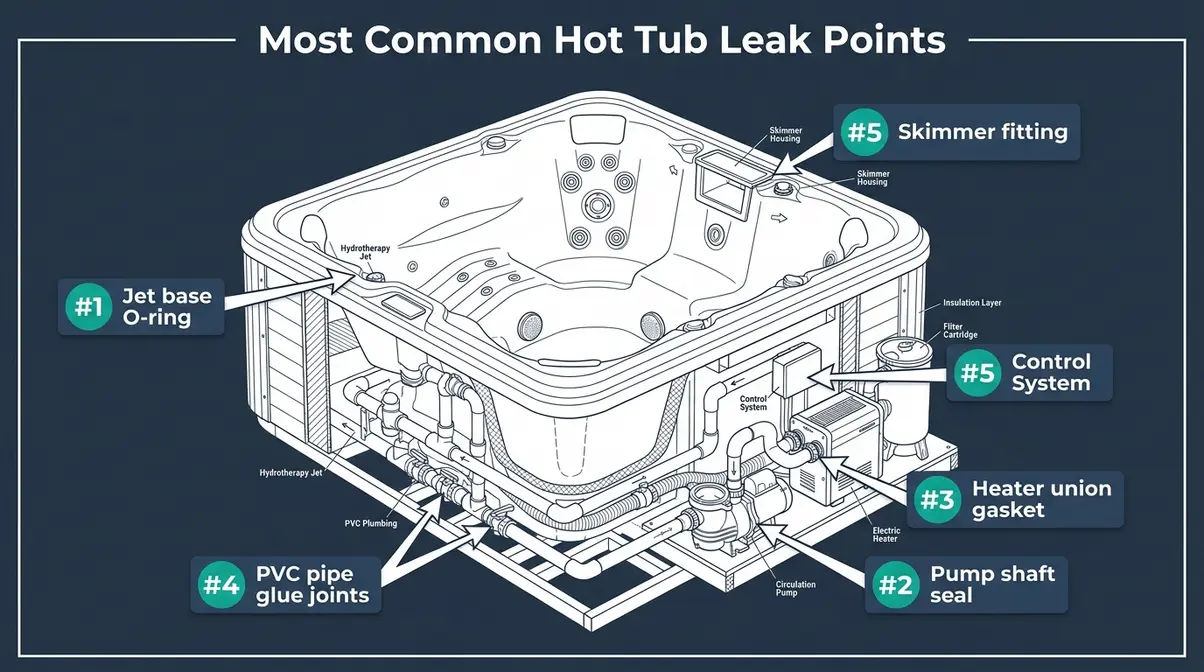
The diagram above shows the most common leak points — use it to identify which category your leak falls into before buying anything.
Best for Jet Leaks: Silicone Paste
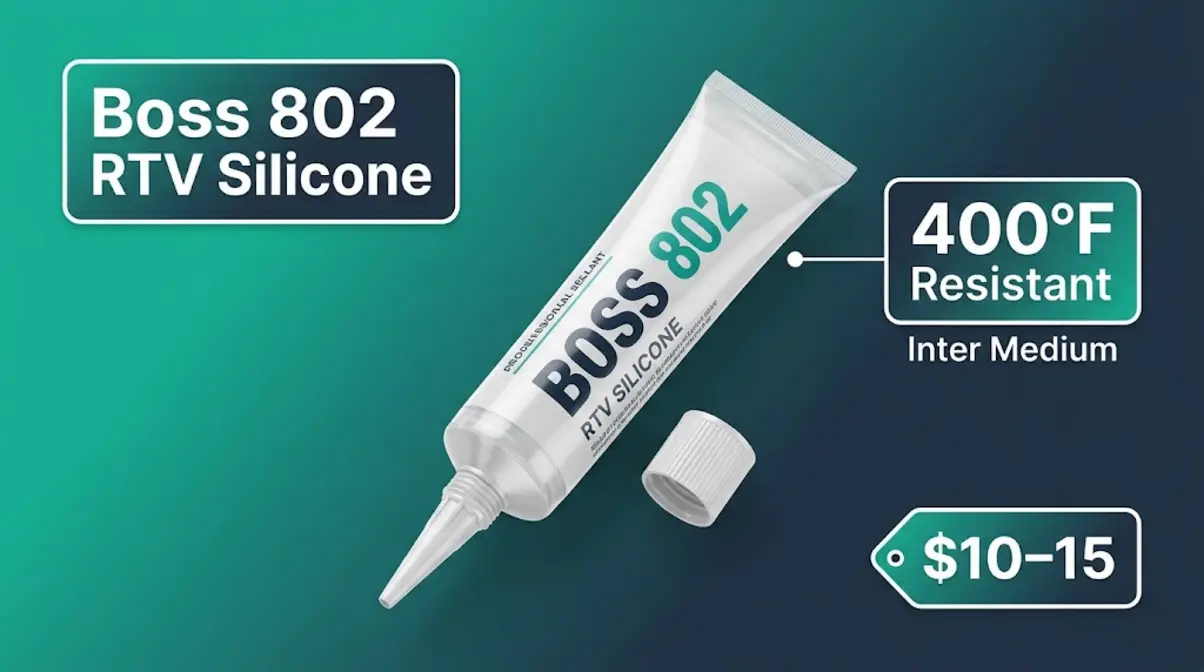
Paste sealants are your tool for any leak you can see and touch. Seeping gaskets around jet housings, weeping O-rings at fittings, dripping glue joints on exposed PVC, and hairline cracks in the shell — these are all paste sealant territory. The two strongest options for hot tub spa repairs are Boss 802 and Permatex Clear RTV 66B.
Boss 802 RTV Silicone — Best Overall Paste Sealant
Boss 802 is a spa-grade RTV silicone sealant — RTV stands for Room Temperature Vulcanizing, meaning it cures without heat, simply by exposure to air moisture. It’s the go-to choice among spa technicians for jet housing and component leaks, bonding to acrylic, PVC, and fiberglass while remaining flexible at temperatures up to 400°F (Boss Products spec sheet). Boss 802 RTV silicone is the go-to choice among spa technicians for jet housing and component leaks — it bonds to acrylic and PVC and remains flexible at temperatures up to 400°F.
Key Specs: Temp resistance up to 400°F | Cure time: ~24 hrs (full cure: 72 hrs) | Clear finish | Bonds to acrylic, PVC, fiberglass
- +Spa-specific formulation designed for chlorine and bromine exposure — won’t degrade like household silicones
- +Bonds reliably to acrylic shells and PVC fittings, the two most common hot tub materials
- +Widely available through spa parts suppliers and online retailers
- +Clear finish blends invisibly on most spa surfaces
- −Requires a completely dry, accessible surface — cannot be applied to wet or submerged areas
- −24–72 hour cure time means your spa is out of commission; rushing water contact causes the seal to fail entirely
- −Cannot reach leaks behind the shell or in buried plumbing — a liquid sealer is needed for those
Real-World Usage: To reseal a jet housing, remove the jet face and dry the gasket channel thoroughly — even a damp surface will prevent proper adhesion. Apply a smooth, continuous bead of Boss 802 around the channel, then tool it flat with a wet fingertip. Reinstall the jet face and leave the spa completely dry for at least 24 hours. A successful seal looks uniform and slightly glossy; any gaps or bubbles mean you need to re-apply. Our team’s evaluation of community reports from spa technician forums consistently shows that premature water contact — even condensation — is the number one reason paste sealant repairs fail.
Approximate price: ~$10–15 per tube (as of July 2026 — verify current pricing at your spa parts supplier).
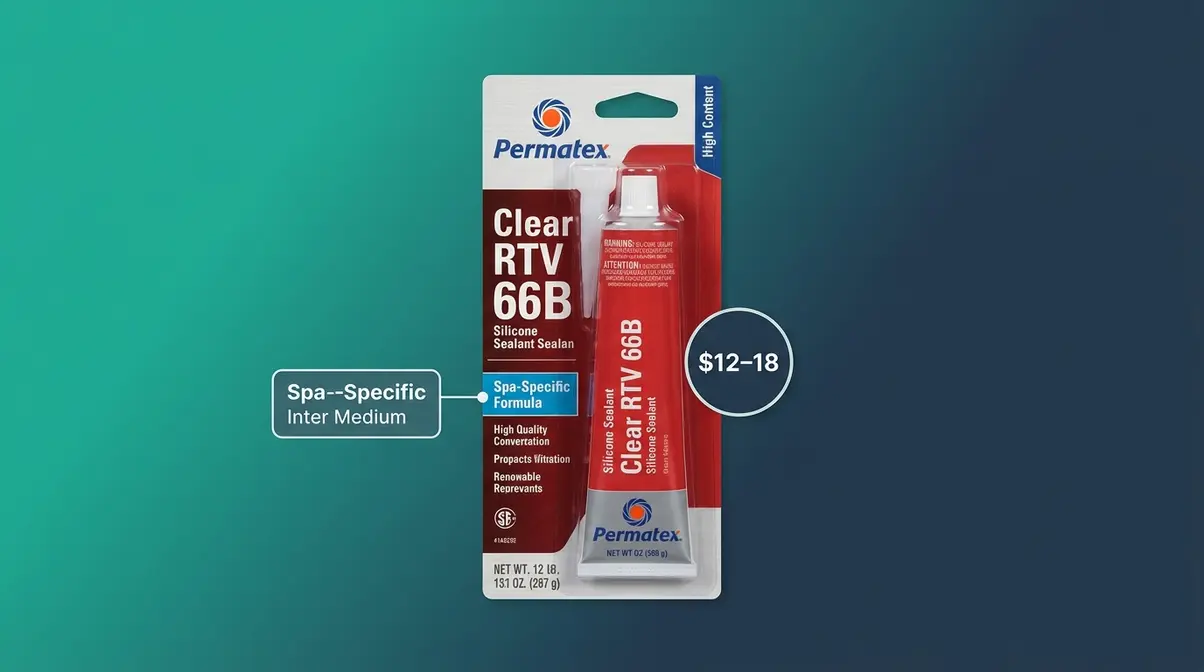
Permatex Clear RTV 66B — Best Paste Alternative
Permatex Clear RTV 66B is a spa-specific silicone formulation sold through spa parts suppliers like MasterSpaParts and SpaDepot. It shares near-identical performance characteristics with Boss 802 — chemical resistance, clear finish, and compatibility with acrylic and PVC — making it a reliable substitute when Boss 802 is out of stock locally. For more details on specific applications, check out our guide on the best sealant for hot tub spa repairs.
Key Specs: Chemical-resistant | Clear finish | Bonds to acrylic, PVC, and fiberglass | Spa-specific formulation
Best for: Resealing jet housings, gaskets, and visible fittings — same applications as Boss 802.
Not for: Hidden or inaccessible plumbing leaks.
Approximate price: ~$12–18 per tube (as of July 2026). A reliable alternative to Boss 802 with near-identical performance — choose based on availability and price.
When to avoid paste sealants: If the leak is behind the spa shell, inside the equipment bay walls, or in underground plumbing, no paste sealant can reach it. That’s where liquid sealers take over.
Best for Hidden Plumbing Leaks: Liquid Sealants
Liquid sealers solve a completely different problem from paste sealants. When your hot tub is losing water but you can’t locate the source — the kind of slow, frustrating loss that sends owners tilting their spa on every side — a liquid sealer is designed to circulate through your plumbing system with the water and deposit sealing material at every gap, crack, and porous joint it encounters. Liquid sealers don’t replace silicone; they address leaks that silicone physically cannot reach. Many hot tubs need both types over their lifetime.
Fix-A-Leak — Best Liquid Sealer for Hidden Plumbing
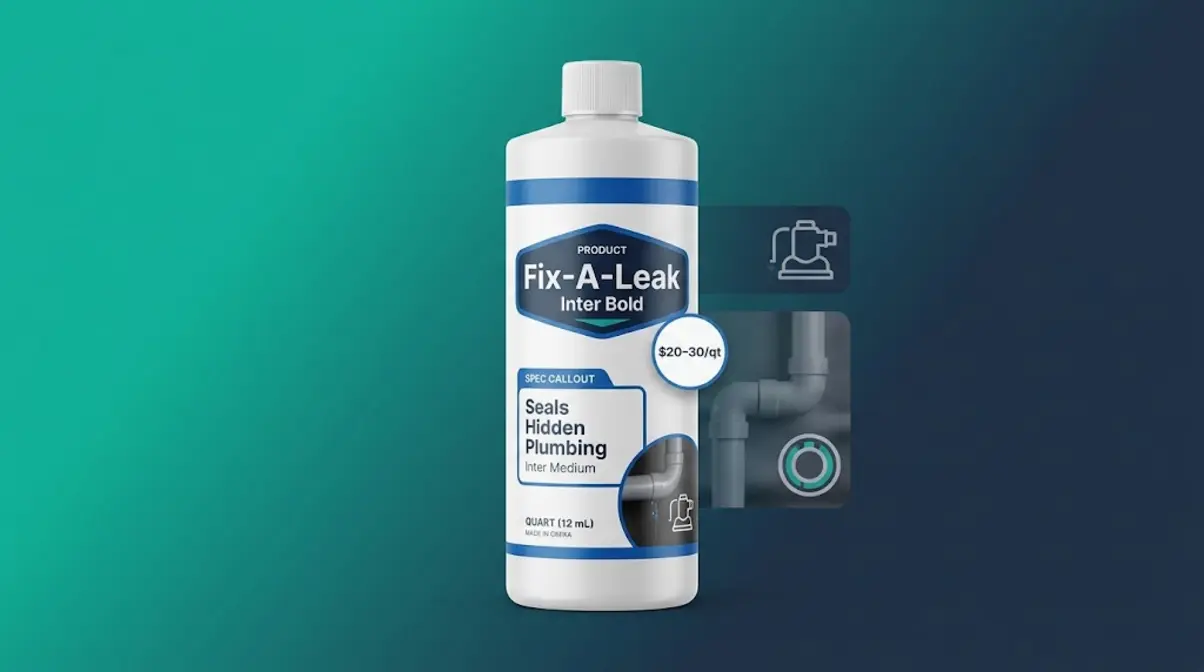
Fix-A-Leak is a liquid sealer specifically designed for hot tubs and spas. You add it directly to your spa water, run the jets, and let it circulate through the entire plumbing system. As it passes through gaps in PVC joints, pump seals, or heater unions, it deposits a flexible sealing compound that bonds to the leak point from the inside (Fix-A-Leak product page).
Key Specs: Liquid formula — added directly to spa water | Treats leaks up to 1/8″ diameter | Compatible with chlorine and bromine systems | One bottle treats approximately 1,000 gallons
- +Reaches leaks that are completely inaccessible without dismantling the spa
- +No spa downtime required during treatment — jets run as normal
- +Works on PVC joints, pump seals, heater unions, and porous fittings
- +Compatible with standard water chemistry; won’t disrupt chlorine or bromine levels significantly
- −Filters must be bypassed or removed during treatment — the sealing compound will clog filter media if left in place
- −Less effective on large structural cracks or severely damaged components — these need professional repair
- −Requires 8–12 hours of continuous circulation for best results; re-dosing may be needed for persistent leaks
- −Results are not always permanent on high-pressure fittings
Real-World Usage: Remove or bypass your filter cartridge before adding Fix-A-Leak — this is the step most DIYers skip, and it causes the product to clog the filter rather than reach the leak. Add the recommended dose (typically 1 quart per 1,000 gallons; check the label for your spa’s volume), set jets to low circulation, and let it run for a full 8–12 hours. Across spa owner communities, the consistent feedback is that patience is the key variable — underdosing or short circulation times are the most common reasons the product doesn’t perform as expected.
Approximate price: ~$20–30 per quart (as of July 2026).
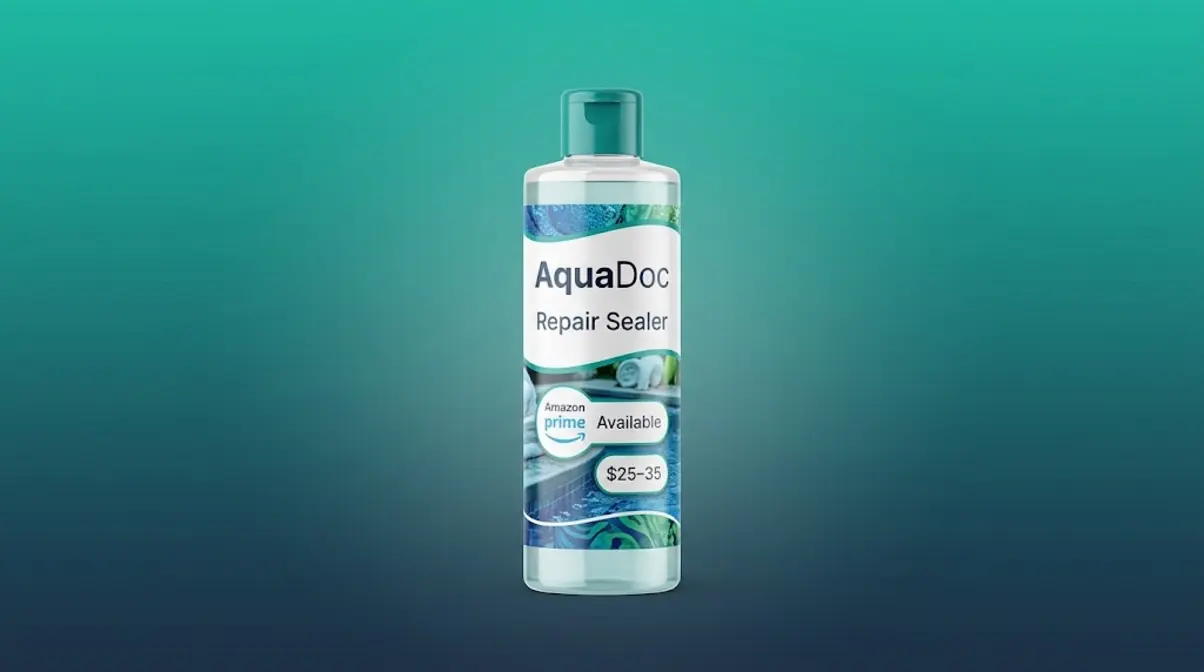
AquaDoc Repair Sealer — Best Liquid Sealer on Amazon
AquaDoc is a liquid sealer with similar circulation-based mechanics to Fix-A-Leak, widely available on Amazon for convenient ordering. It’s designed for slow leaks in hot tubs and above-ground spas and works well for owners who want a liquid sealer without waiting for specialty shipping.
Key Specs: Liquid formula | Compatible with chlorinated and brominated water | Available on Amazon with Prime shipping
Best for: Hidden plumbing leaks and slow water loss where the source is unidentifiable.
Not for: Large cracks, structural damage, or any leak requiring direct surface repair.
Approximate price: ~$25–35 (as of July 2026 — verify on Amazon before purchasing). A solid Fix-A-Leak alternative with comparable performance and easier retail availability.
Quick Comparison: All Top Sealants at a Glance
| Product | Type | Best For | Key Feature | Approx. Price (July 2026) |
|---|---|---|---|---|
| Boss 802 RTV Silicone | Paste | Jet housings, gaskets, shell cracks | Spa-grade, bonds to acrylic & PVC | ~$10–15/tube |
| Permatex Clear RTV 66B | Paste | Jet housings, visible fittings | Spa-specific formulation, clear finish | ~$12–18/tube |
| Fix-A-Leak | Liquid | Hidden plumbing, pump seals, buried PVC | Circulates through system; no teardown | ~$20–30/qt |
| AquaDoc Repair Sealer | Liquid | Hidden leaks, slow water loss | Amazon availability, Prime shipping | ~$25–35 |
| GE Silicone (household) | Paste | ❌ NOT recommended for hot tubs | Not formulated for submersion | ~$6–10/tube |
Prices verified as of July 2026. GE household silicone is included for reference only — it is not spa-grade and will degrade in chlorinated water.
For a deeper dive into leak repair products, explore the best hot tub leak sealers.
How to Apply Hot Tub Sealant Step by Step
Before you start any repair, protect yourself and your equipment.
⚠️ Safety First: Turn off ALL power to your hot tub at the breaker before beginning any repair. Do not work near electrical components with wet hands. Confirm the spa is fully powered down before touching pumps, heaters, or any wiring adjacent to your repair area.
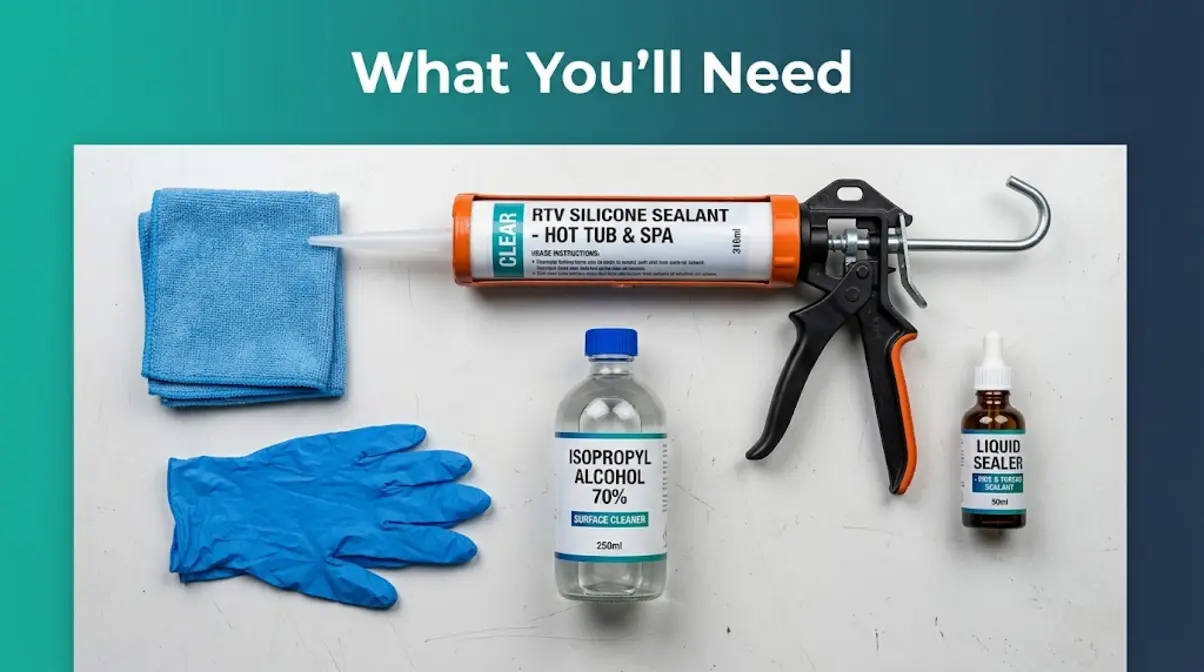
You’ll need: Isopropyl alcohol (cleaning), dry cloths, caulk gun (for tube sealants), gloves. Estimated time: 20–30 minutes active work + 24–72 hours cure time (paste) or 8–12 hours circulation time (liquid).
Applying Silicone Paste Sealant (5 Steps)
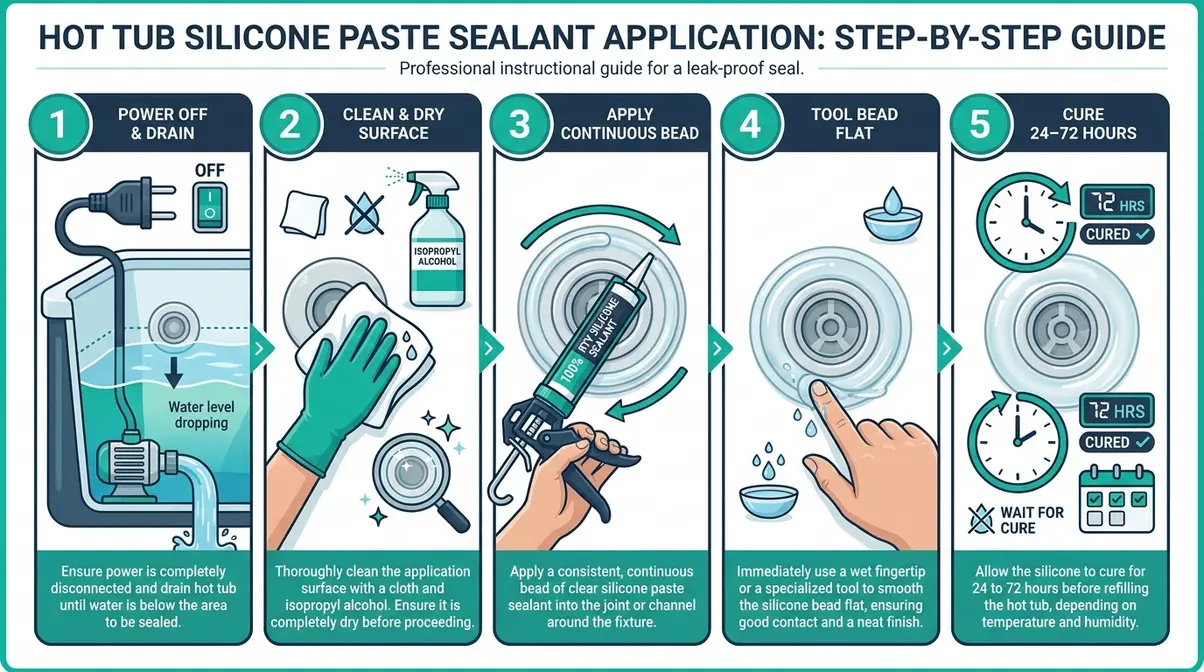
- Power off and drain to below the leak. Lower the water level at least 2 inches below the repair area so the surface can dry completely. (~5 minutes)
- Clean and dry the surface. Wipe the area with isopropyl alcohol to remove oils, scale, and old sealant residue. Let it air-dry for at least 30 minutes — any moisture will prevent adhesion. (~35 minutes including dry time)
- Apply a continuous bead. Load Boss 802 or Permatex 66B into a caulk gun and apply a smooth, uninterrupted bead around the leak point — jet housing channel, gasket groove, or crack. (~5 minutes)
- Tool the bead flat. Dip your fingertip in water and smooth the bead to ensure full contact with the surface. Remove any excess sealant. (~2 minutes)
- Cure undisturbed for 24–72 hours. Do not refill or run the spa for at least 24 hours (initial cure). Full waterproof cure takes 72 hours. Premature water contact breaks the seal before it sets — the most common DIY mistake.
Expected outcome: After 72 hours, the sealant should be firm, slightly flexible, and uniformly clear. If you see any gaps or the bead peeled away, re-clean and re-apply before refilling.
Using a Liquid Leak Sealer (5 Steps)
- Remove or bypass your filter cartridge. This is mandatory — liquid sealer will clog filter media and never reach the leak. Store the filter separately for the duration of treatment. (~5 minutes)
- Fill the spa to normal operating level. The sealer needs full water volume to circulate properly. (~15 minutes)
- Add the correct dose. For Fix-A-Leak, the standard dose is 1 quart per 1,000 gallons of spa water — check your spa’s volume and the product label before pouring. Add directly to the water near a jet intake. (~2 minutes)
- Run jets on low for 8–12 hours. Keep jets running continuously at low speed to circulate the sealer throughout all plumbing lines. Higher jet speeds can push the sealer past the leak point too quickly. (~8–12 hours)
- Reinstall filter and test. After 12 hours, reinstall your filter cartridge, run the spa normally for 24 hours, and monitor the water level. If loss continues, a second dose may be needed for larger or multiple leaks.
Expected outcome: Water loss should slow noticeably within 24 hours of treatment. Full sealing on small leaks typically occurs within 48 hours of initial treatment.
Liquid vs. Paste: Which Sealant Do You Need?
Choosing between a liquid sealer and a paste sealant comes down to a single question: can you physically reach the leak? If yes, use paste. If no, use liquid. That’s The Leak Location Rule in its simplest form.
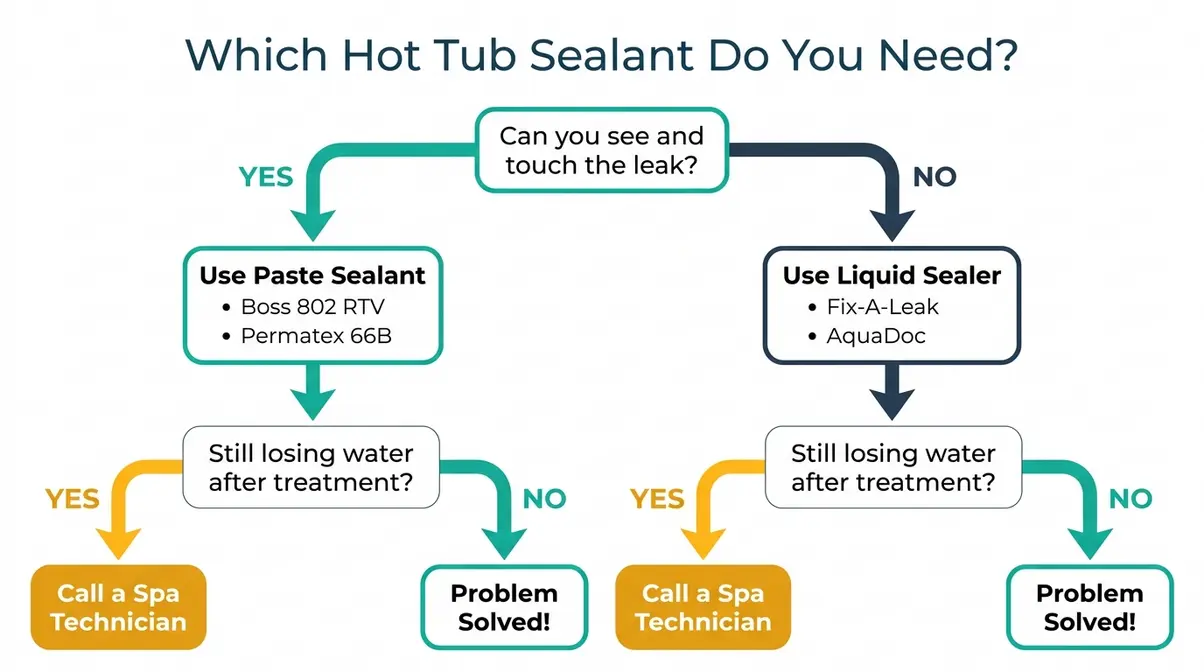
Here’s a practical breakdown for common scenarios:
| Leak Scenario | Sealant Type | Recommended Product |
|---|---|---|
| Weeping jet housing gasket | Paste | Boss 802 RTV Silicone |
| Seeping skimmer fitting | Paste | Boss 802 or Permatex 66B |
| Shell hairline crack (above waterline) | Paste | Boss 802 RTV Silicone |
| Slow water loss, no visible source | Liquid | Fix-A-Leak |
| Dripping glue joints on exposed PVC | Paste | Boss 802 or Permatex 66B |
| Suspected pump seal or heater union leak | Liquid | Fix-A-Leak or AquaDoc |
| Buried underground plumbing leak | Liquid | Fix-A-Leak |
Budget note: Paste sealants cost $10–18 per tube and address targeted, specific leaks. Liquid sealers run $20–35 and treat an entire plumbing system in one application. If you’re dealing with slow water loss and suspect multiple small leaks — common in older hot tubs — a liquid sealer often delivers better value than chasing individual joints with paste. Many hot tub owners eventually use both types at different points in their spa’s life.
After the Fix: Restoring Your Water Chemistry
Once your sealant has fully cured and you’ve refilled the spa, your water chemistry needs attention before you soak. Draining down for a repair dilutes or disrupts your existing chemical balance, and some liquid sealers can temporarily affect pH levels.
The priority sequence after any hot tub repair: test pH first (target 7.4–7.6), then adjust total alkalinity (80–120 ppm), then sanitizer levels — free chlorine at 1–3 ppm or bromine at 3–5 ppm per CDC hot tub sanitation guidelines (CDC, 2026). Skipping this sequence and going straight to sanitizer is the most common post-repair chemistry mistake — low alkalinity makes pH unstable and causes sanitizer to burn off faster than normal.
For a full breakdown of what chemicals your hot tub needs and when, see our guide to hot tub chemicals. If you’re rebuilding your maintenance routine after a repair, how to maintain a hot tub covers the complete schedule.
After rebalancing chemistry, run the spa for at least one full circulation cycle (typically 2 hours) before soaking. This confirms the repair held under operating pressure and distributes your chemicals evenly.
Hot Tub Accessories Worth Having
A successful sealant repair is a good time to assess what tools and supplies you’re missing for ongoing maintenance. The right accessories reduce the chance of future leaks — and make the next repair faster.
Essentials after a sealant repair:
- Test strips or a digital test kit — monitor chlorine, pH, and alkalinity weekly to prevent chemical imbalance that degrades gaskets over time
- Spa surface cleaner — removes calcium scale and biofilm from jet housings and gaskets, the surfaces most prone to seeping over time
- Replacement O-rings and gaskets — having a set on hand means you can replace a weeping O-ring immediately rather than waiting for parts to ship
- Caulk gun — a basic $8–12 caulk gun makes paste sealant application significantly easier and more controlled than hand-squeezing a tube
- Comfort upgrades — you might also consider finding the best towel warmer for hot tub use during cold winter months.
For a full curated list, see our hot tub accessories guide.
When Hot Tub Sealants Won’t Cut It
Can You Use Flex Seal on a Hot Tub?
Many hot tub owners wonder if they can use Flex Seal on a hot tub leak. While Flex Seal is a popular waterproofing product, it is not formulated to withstand the constant high temperatures (104°F) and harsh chemical environment (chlorine/bromine) of a hot tub. It will quickly degrade, peel away, and fail to hold a watertight seal under pressure. Always use a spa-grade RTV silicone or a dedicated liquid hot tub sealer instead.
Common Pitfalls
Applying paste sealant to a damp surface. This is the most frequently reported failure across spa owner communities. Even light condensation on the repair surface prevents Boss 802 and Permatex 66B from forming a proper bond. The sealant appears to set but peels away within days of water contact. Fix: dry the surface with a heat gun or fan for 30 minutes before applying.
Using Fix-A-Leak without removing the filter. The sealing compound deposits wherever it finds a gap — including your filter media. The result is a clogged filter and a spa that still leaks. Fix: always remove or bypass the filter cartridge before adding any liquid sealer.
Using household silicone (GE, DAP) on submerged components. Household-grade silicones are formulated for bathroom tile and window frames — not constant submersion in chemically treated water at 104°F. They’ll break down within weeks, leaving you with a failed seal and contaminated water. Fix: use only spa-grade RTV silicone for any hot tub application.
When to Choose Alternatives
Structural shell damage or large cracks. A hairline crack above the waterline can be addressed with Boss 802. However, a crack longer than 3–4 inches, or any crack below the waterline on a fiberglass or acrylic shell, typically requires professional resurfacing — sealant is a temporary measure at best.
Failed pump or heater components. If Fix-A-Leak doesn’t stop your water loss after two treatment cycles, the leak source may be a failed pump shaft seal or a cracked heater housing. These require component replacement, not sealant. A spa technician inspection is the right next step.
Underground plumbing damage. Liquid sealers can address small porous joints in buried PVC, but a fully cracked underground line needs professional excavation and repair — no consumer sealant product addresses that scenario reliably.
When to Seek Expert Help
If you’ve applied both a paste sealant and a liquid sealer and your spa is still losing more than 1 inch of water per day, the leak is likely beyond DIY sealant territory. Contact a licensed spa technician for a pressure test — this identifies the exact leak location in minutes and tells you whether repair or component replacement is the appropriate fix.
Frequently Asked Questions
What is the best sealant for a hot tub?
The best hot tub sealant depends on your leak’s location. For visible leaks at jet housings, gaskets, or shell cracks, Boss 802 RTV silicone is the top choice among spa technicians because it resists chlorine exposure long-term. For hidden plumbing leaks you can’t reach, Fix-A-Leak liquid sealer circulates through the system and seals from the inside.
Is DAP or GE silicone better for hot tubs?
Neither DAP nor GE household silicone is recommended for hot tub repairs. Both are formulated for dry bathroom and window applications. They are not designed for constant submersion in chlorinated water at 100–104°F. Standard household silicones degrade within weeks in a hot tub environment, leaving failed seals and potential water contamination. For any hot tub repair, use a spa-grade RTV silicone like Boss 802 or Permatex Clear RTV 66B instead.
What is the most common leak in a hot tub?
Pump seals and jet housing gaskets are the most frequently reported hot tub leak sources. Across spa technician communities, pump shaft seals, heater union gaskets, and jet base O-rings account for the majority of hot tub leaks. Checking these three locations first saves significant diagnostic time.
Which brand of silicone is best for spa and hot tub repairs?
Boss 802 and Permatex Clear RTV 66B are the two most consistently recommended brands by professional spa technicians for hot tub silicone repairs. Both are spa-specific RTV formulations engineered for chlorine and bromine resistance. Boss 802 is typically the first recommendation on spa parts supplier sites like SpaDepot, while Permatex 66B serves as a strong alternative.
Why is my hot tub losing water but I can’t find the leak?
Hidden plumbing leaks are often impossible to locate visually. They typically occur in buried PVC lines, pump seals, or inside the equipment cabinet. If you’ve inspected every accessible fitting and jet housing and can’t identify the source, a liquid sealer like Fix-A-Leak is designed for exactly this scenario. It circulates through your entire plumbing system and deposits sealing material at every gap it encounters. If two treatment cycles don’t resolve the loss, request a professional pressure test.
Why put tennis balls in a hot tub?
Tennis balls absorb body oils, lotions, and cosmetics from the water. Tossed into a hot tub, the felt surface acts like a sponge for oils that would otherwise accumulate on the waterline or clog your filter. While it’s a popular low-cost maintenance trick, tennis balls are not a substitute for regular filter cleaning or proper water chemistry.
What not to put in a hot tub?
Never add dish soap, bath salts, essential oils, or non-spa-approved chemicals to your hot tub. Dish soap creates excessive foam and disrupts water chemistry. Bath salts and essential oils can damage pump seals and O-rings over time. This accelerates the exact type of seeping gasket leaks that require sealant repairs. Stick to spa-approved sanitizers, pH adjusters, and alkalinity balancers, as detailed in our hot tub chemicals guide.
Do hot tubs reduce cortisol?
Research suggests hot tub hydrotherapy may help lower cortisol levels, though evidence is still developing. Warm water immersion activates the parasympathetic nervous system, which counteracts the stress response. Some studies on warm water therapy report reduced self-reported stress and lower cortisol markers after regular sessions. However, the specific claim that hot tubs reliably reduce cortisol requires stronger clinical evidence.
Conclusion
For frustrated hot tub owners dealing with water loss, the path forward is straightforward once you apply The Leak Location Rule: accessible leaks at jets, gaskets, and shell surfaces need a spa-grade paste sealant like Boss 802 RTV silicone; hidden plumbing leaks need a liquid sealer like Fix-A-Leak that circulates through the system. Standard household silicones — DAP, GE — are not formulated for the chlorinated, high-temperature environment of a hot tub and will fail quickly. Across spa technician communities, Boss 802 and Fix-A-Leak are the two most consistently recommended products for DIY hot tub repairs.
The Leak Location Rule eliminates the guesswork that sends most hot tub owners to the hardware store for the wrong product. Know where your leak is, pick the corresponding category, and apply it correctly — that’s the entire framework.
Start by identifying your leak location using the diagram in this guide. If it’s accessible, order Boss 802 and plan for a 72-hour cure window. If it’s hidden, grab Fix-A-Leak, remove your filter cartridge, and run circulation for 8–12 hours. For ongoing maintenance support, explore our hot tub maintenance guide and hot tub accessories recommendations to keep future leaks from developing in the first place.

adminbackup
Hot tub tester and writer at One Hot Tub.