

Table of Contents - Best Hot Tub Heater: Tested & Compared for 2026
This blog post may contain affiliate links. As an Amazon Associate I earn from qualifying purchases.
“Where is the best — read cheapest — place to order a new heater?”
— A real question from a hot tub owner on Reddit
If that sounds familiar, you’re in the right place. Finding the best hot tub heater means balancing upfront cost, running efficiency, and compatibility with your specific setup. We’ve reviewed 4 top-selling options on Amazon — from a powerful 11kW electric unit to an efficient heat pump — so you can stop scrolling and start soaking.
⚠️ Safety Notice: All electrical hot tub heater installations must be performed by a licensed electrician. Improper wiring can cause electric shock, fire, or voided warranties. The information in this guide is for product comparison purposes only — always follow manufacturer instructions and local electrical codes.
Quick Comparison Table
| # | Preview | Product | Best For | Buy |
|---|---|---|---|---|
| 1 |  | Mxmoonant 11KW Electric Heater | Best for permanent installs | Buy on Amazon |
| 2 |  | 1800W Immersion Heater | Best for portable hot tubs | Buy on Amazon |
| 3 |  | AQUASTRONG Heat Pump | Best for energy efficiency | Buy on Amazon |
| 4 |  | Balboa M7 Element Assembly | Best OEM replacement part | Buy on Amazon |
1. Mxmoonant 11KW Electric Heater
- [Touchscreen Display]: Compared to traditional temperature knobs, the upgraded touchscreen display on the 11KW pool heater improves visibility and control. The temperature is visually displayed and can be more accurately controlled with ease.
- [Automatic Circulating Heating]: The spa heater will cycle on and off based on the preset temperature. When the water temperature reaches or surpasses the preset level, the pool spa heater will automatically shut off. Conversely, if the temperature drops below the preset level, the electric spa heater will automatically turn on again.
- [316 Heating Element]: The electric pool heater is equipped with 316 stainless steel heating elements, which provides excellent thermal conductivity. This efficient heat transfer through the heating tubes speeds up heating times and lowers energy costs.
- [Professional Wiring Method]: Since a hot tub heater is a high-powered machine, it is designed to be hardwired rather than plugged in. Therefore, it is important to have a licensed electrician handle the installation process. They can ensure your safety and proper wiring to maximize the efficiency and lifespan of your pool heater.
- [Notice]: Mxmoonant 11KW swimming pool heaters are suitable for pools of around 1300 gallons. In addition, the heating time of a pool heater depends on various factors such as the size of the pool, the desired temperature increase, the power of the pool heaters, and the ambient temperature.
The Mxmoonant 11KW is a hardwired inline electric resistance heater — meaning it heats water as it flows through the unit, rather than sitting inside the tub. It’s built for hot tub owners with a permanent above-ground or in-ground installation who need fast, powerful heating and precise digital temperature control. Verified buyer reports indicate it can bring a small hot tub to target temperature in approximately 15 minutes under good flow conditions (ShopAbunda, 2026).
| Spec | Value |
|---|---|
| Power Output | 11kW (kilowatts — a measure of how fast the heater generates heat) |
| Voltage | 220–240V (requires a dedicated hardwired circuit) |
| Heating Element | 304 stainless steel tube |
| Control Interface | Touchscreen thermostat |
| Compatible With | Above-ground and in-ground pools, spas, bathtubs up to ~1,000 gallons |
Pros:
- 11kW output delivers rapid heat-up — verified buyer reports show a small hot tub reaching target “max temp” in roughly 15 minutes, far faster than a 1.8kW immersion heater on the same water volume
- Touchscreen thermostat lets you dial in a precise target temperature, so you’re not guessing when the water hits your preferred “start temp”
- Dual compatibility with above-ground and in-ground setups makes it one of the more versatile inline electric units in its class
Cons:
- Requires a dedicated 220–240V hardwired circuit — installation must be performed by a licensed electrician, which adds meaningful upfront cost beyond the unit itself
- Must be used with a circulation pump (minimum 300W recommended); running the heater without adequate water flow can damage the element and void safety assumptions
Real-World Usage:
In real-world usage, this heater excels when installed in permanent backyard setups where owners want to quickly heat their spa after work without waiting hours. The touchscreen interface makes daily adjustments incredibly straightforward compared to older analog dials.
How it compares: Where the 1800W Immersion Heater suits portable setups with no installation required, the Mxmoonant 11KW is purpose-built for permanent installations where heating speed matters most.
Verdict: A strong choice for permanent hot tub setups where finding the best hot tub heater means prioritizing fast heat-up time and precise thermostat control — provided you have, or can install, a 220V dedicated circuit.
Choose if: You have a permanent hot tub or spa and want the fastest electric heat-up time available without a heat pump.
Skip if: You’re heating a portable or inflatable tub, or if a 220V electrical upgrade isn’t feasible — the 1800W Immersion Heater is the simpler alternative.
Buy on Amazon2. 1800W Immersion Heater
- Want a warm, cozy hot tub at home without waiting for hours:Our 1800W heater is tailor-made for your inflatable hot tub, medium bathtub, home SPA, and baptistery, perfect for 100-250L fresh water. Heats your water to a comfortable 38℃ quickly, so you can relax in your home SPA anytime.
- Ultimate safety for your home relaxation:Built-in GFCI leakage protection, overload protection, and a fully waterproof design. The insulated rubber cable enhances water resistance, greatly reducing the risk of electric shock and fire, so you can enjoy your hot tub with complete peace of mind.
- Fast-heating food-grade 304 stainless steel:Premium food-grade 304 stainless steel heating element delivers excellent thermal conductivity, warming your water faster than standard heaters. Seamless construction ensures durability, pressure resistance, and no leaks, safe for bathing.
- Smart temperature control for effortless relaxation:High-precision temperature sensor with LCD real-time display lets you set your ideal temperature (±0.1℃ accuracy). Automatically maintains the temperature, so you don’t have to adjust it repeatedly. No continuous monitoring needed.
- Versatile for all your home heating needs:Suitable for medium stock tanks, small above-ground pools, and camping trips. Easy to install and operate, with regular descaling to keep performance stable. A practical, energy-efficient choice for home and light commercial use.
This is a submersible immersion heater — you place it directly into the water rather than plumbing it inline. That makes it the go-to option for portable and inflatable hot tub owners who want a working heating solution without hiring an electrician. It’s best suited for smaller water volumes and occasional or seasonal use, including camping, baptisteries, and stock tanks. If you own an inflatable hot tub, explore inflatable hot tub heating options before committing to a more powerful unit.
| Spec | Value |
|---|---|
| Power Output | 1800W (1.8kW — roughly one-sixth the output of the Mxmoonant) |
| Material | 304 Stainless Steel (resists corrosion in treated spa water) |
| Safety Feature | GFCI (Ground Fault Circuit Interrupter — cuts power instantly if a fault is detected) |
| Control Interface | Digital thermostat |
| Best For | Bathtubs, portable spas, camping, stock tanks up to ~300 gallons |
Pros:
- Built-in GFCI (Ground Fault Circuit Interrupter) protection cuts power the instant an electrical fault is detected — this is a critical, non-negotiable safety feature for any heater submerged in water
- 304 stainless steel construction resists corrosion in chemically treated spa water better than lower-grade alloys, extending usable lifespan with proper water chemistry maintenance
- No installation required — the submersible design means you plug in and drop in, making it genuinely portable for camping trips or seasonal inflatable tub use
Cons:
- At 1.8kW, heat-up time for a 250-gallon hot tub from a cold “start temp” is measured in several hours, not minutes — a meaningful trade-off versus the 11kW Mxmoonant for anyone who wants to soak on short notice
- Users report that high current draw requires a dedicated outlet or a heavy-gauge (10-gauge minimum) extension cord; undersized cords can cause nuisance tripping or overheating
Real-World Usage:
In real-world usage, this submersible unit is perfect for weekend camping trips or seasonal inflatable tubs where hardwiring isn’t an option. Users frequently drop it into stock tanks to take the chill off the water before an evening soak.
How it compares: The AQUASTRONG heat pump is more efficient for regular use, but this immersion heater wins on simplicity and portability for occasional or camping use. For permanent setups, the Mxmoonant 11KW heats significantly faster.
Verdict: The most accessible option for portable or inflatable hot tub owners — easy setup, genuine safety credentials, and zero electrical work required.
Choose if: You own a portable, inflatable, or small bathtub-style spa and want a plug-and-go heating solution with no installation.
Skip if: Your hot tub holds more than 300 gallons, or you need fast heat-up for frequent use — the Mxmoonant 11KW or AQUASTRONG heat pump will serve you better.
Buy on Amazon3. AQUASTRONG Heat Pump
- All-Season Pool Comfort: Featuring innovative dual-mode temperature control, this heat pump precisely heats water between 59–104°F or cools it within 59–83°F. By maintaining consistent thermal regulation, it extends swimming seasons by up to 6 months while delivering year-round comfort for pool enjoyment.
- Professional Thermal Performance: Featuring a 12,000 BTU high-output heating module, this 4-season system is designed for 3,000-gallon pools. The precision thermostat maintains ±2°F temperature accuracy by continuously monitoring ambient conditions, ensuring consistent comfort throughout the year.
- Energy Efficiency Redefined: With a high 5.5 COP, this ultra-efficient heat pump employs a powerful engine to ensure consistent energy savings. In comparison with conventional electric heating, it slashes energy consumption by 70% and provides 40% more savings than natural gas alternatives.
- Quiet Operation & Defrost: With ultra-quiet technology, the operating sound is maintained at 36 dB, which is quieter than a whisper. You can enjoy the comfort brought by the heat pump heating without being affected by any noise.Intelligent auto-defrost system that automatically removes ice buildup without manual intervention.
- Easy to Assemble: This heat pump comes with both 1.25" hose adapters and 1.5" conversion kits for easy installation, completed in under 10 minutes. The panel supports multi-mode smart control, complemented by a 3-year comprehensive warranty and lifetime technical support.
The AQUASTRONG (model HEX series) is an air-source heat pump — a fundamentally different technology from the other electric heaters in this guide. Instead of generating heat directly, it extracts warmth from the surrounding air and transfers it to the water, making it dramatically more efficient over time. It suits hot tub or small pool owners focused on long-term running cost savings who use their spa regularly. The Department of Energy heat pump data notes heat pumps can reduce electricity use for heating by up to 75% compared to electric resistance models (U.S. Department of Energy, 2026).
| Spec | Value |
|---|---|
| Function | Dual-mode heating and cooling |
| Compatible Volume | Pools up to ~3,000 gallons |
| Heater Type | Air-source heat pump (inverter technology) |
| Temperature Range | Heating: 47–104°F / Cooling: 47–83°F |
| Noise Level | ~48 dB (quieter than most pool filters) |
Pros:
- Heat pump technology uses ambient air to heat water rather than generating heat directly — real-world owner tests on similarly sized AQUASTRONG units show overnight temperature gains of 20–25°F on 7,500–8,000 gallon pools with minimal electricity draw, consistent with inverter heat pump efficiency
- Dual heating and cooling function adds genuine year-round versatility — the cooling mode can bring water temperature down in summer if your spa overheats in direct sun
- Rated for up to ~3,000 gallons, making it suitable for small pools and hot tubs alike, with a 3-year warranty and Wi-Fi app control for remote scheduling
Cons:
- Heat pump efficiency drops noticeably when outdoor temperatures fall below 45°F (7°C) — less effective for winter heating in cold climates without a supplemental heat source
- Higher upfront cost than a standard electric resistance heater or immersion unit; the efficiency advantage pays off over time but requires regular use to justify the investment
Real-World Usage:
In real-world usage, frequent soakers in mild climates see the best results, leaving the heat pump running continuously to maintain temperature with minimal electricity draw. The Wi-Fi app control allows users to monitor and adjust the temperature remotely while at work.
How it compares: Compared to the Mxmoonant 11KW electric resistance heater, the AQUASTRONG costs more upfront but delivers substantially lower monthly running costs for frequent users — the smarter long-term investment if you soak three or more times per week.
Verdict: The most energy-efficient option in this roundup. Best for hot tub owners who soak regularly and live in a mild-to-moderate climate where ambient temperatures stay above 45°F for most of the year.
Choose if: You use your hot tub at least 3–4 times per week and want to minimize monthly running costs over the long term.
Skip if: You live in a cold climate where winter temperatures regularly drop below freezing, or you only use your hot tub occasionally — the Mxmoonant 11KW or 1800W Immersion Heater will cost less upfront with infrequent use.
Buy on Amazon4. Balboa M7 Element Assembly
- 【Wide Application】Directly replace part for Balboa 58117. Specifically designed to fit seamlessly with the majority of Balboa VS, EL, TS, GS, and BP Series control systems. Match number 58104, 58120, 55033-01, 58106, 58117, 55033-02, 58056, 58109, 55035-01, 55035, 58064, C2400-0807-TPS, 58120, 58148, 26-0540-5S-KS, 58032, 58281, 58114, 55033, 55625, G7410, 53408. Please refer to description below for searching more compatible models.
- 【Reliable Performance】Experience uninterrupted relaxation with our heater, which effectively addresses the common issue of circuit breakers tripping due to corrosion in aging heating elements. By replacing your outdated or malfunctioning heater with this unit, you'll enjoy a safer, more dependable spa experience.
- 【Superior Quality Craftsmanship】Crafted from premium stainless steel, this heater combines durability with robustness, standing up to the rigors of daily use and the corrosive environment of hot tubs and spas. 2 Tail pieces are coated with black finish, anti-corrosion and reliable use. Meet or exceed OEM specification
- 【Product Dimension】Manifold Length: 15", Manifold Diameter: 2", Kilowatt Rating: 4.0KW / 1.0KW, Voltage Rating: 240V / 120V
- 【100% SATISFACTION GUARANTEE】 Our focus on products and customer services is 2nd to none. If your item is defective, incorrect, arrived damaged or any other problems, please contact us (include pictures if possible) and we will reply in 24 hours.
This is not a standalone heater — it’s a direct-fit replacement element assembly for hot tubs running on a Balboa M7-series control system. If your existing Balboa spa has a failed heater element and everything else (pump, control pack, jets) still works, this assembly is the most cost-effective path back to full function. Balboa Water Group (V/N: 58117) is a widely recognized manufacturer of spa heating components, and their M7 elements are used in many branded spa models (Master Spa Parts, 2026).
| Spec | Value |
|---|---|
| Compatible Models | Balboa 58117, 58104, 58120 — Series M7 (VS, EL, TS, GS, BP packs) |
| Power Output | 4.0kW @ 240V / 1.0kW @ 120V |
| Housing Material | Stainless steel heater tube |
| Includes | Heater element + integrated M7 sensors |
| Installation Type | Replacement part — requires existing Balboa M7 manifold and plumbing |
Pros:
- Direct-fit for Balboa Series M7 systems (models 58117, 58104, 58120 across VS, EL, TS, GS, and BP packs) — eliminates compatibility guesswork for owners of these widely used spa control systems
- Dual-voltage rating (4.0kW at 240V / 1.0kW at 120V) provides flexibility depending on your existing wiring configuration
- Includes integrated sensors (temperature and flow), meaning you replace the full functional assembly rather than just the bare element — a complete, one-part fix
Cons:
- Only compatible with Balboa Series M7 systems — useless if your spa runs a different control system (HydroQuip, Gecko, or similar); always verify your control pack model before ordering
- Removing the plug-and-play clip or eyelet cable voids the manufacturer’s warranty; older boards using copper strap connections require a separate Plug N Click Adapter (X333131)
Real-World Usage:
In real-world usage, this part is a lifesaver for DIYers and technicians looking to resurrect an older Balboa spa without replacing the entire expensive control pack. It slides directly into the existing manifold, making the physical swap relatively quick once the tub is drained.
How it compares: Unlike the Mxmoonant or AQUASTRONG (which are standalone heater units), this is a replacement part — it restores your existing system rather than upgrading it. If your Balboa spa is otherwise in good condition, this is the most cost-effective path back to full function.
Verdict: The right call if your Balboa M7 spa has a confirmed failed element and the rest of the system is sound. Cheaper than a full heater unit replacement when the element alone has failed.
Choose if: You own a Balboa M7-series hot tub with a confirmed failed heater element and want the most direct, compatible replacement without overhauling the whole system.
Skip if: Your spa uses a non-Balboa control system, or if multiple components are failing — at that point, a full heater upgrade like the Mxmoonant 11KW offers better value than piecemeal repairs.
Buy on AmazonBuying Guide: Choosing a Heater
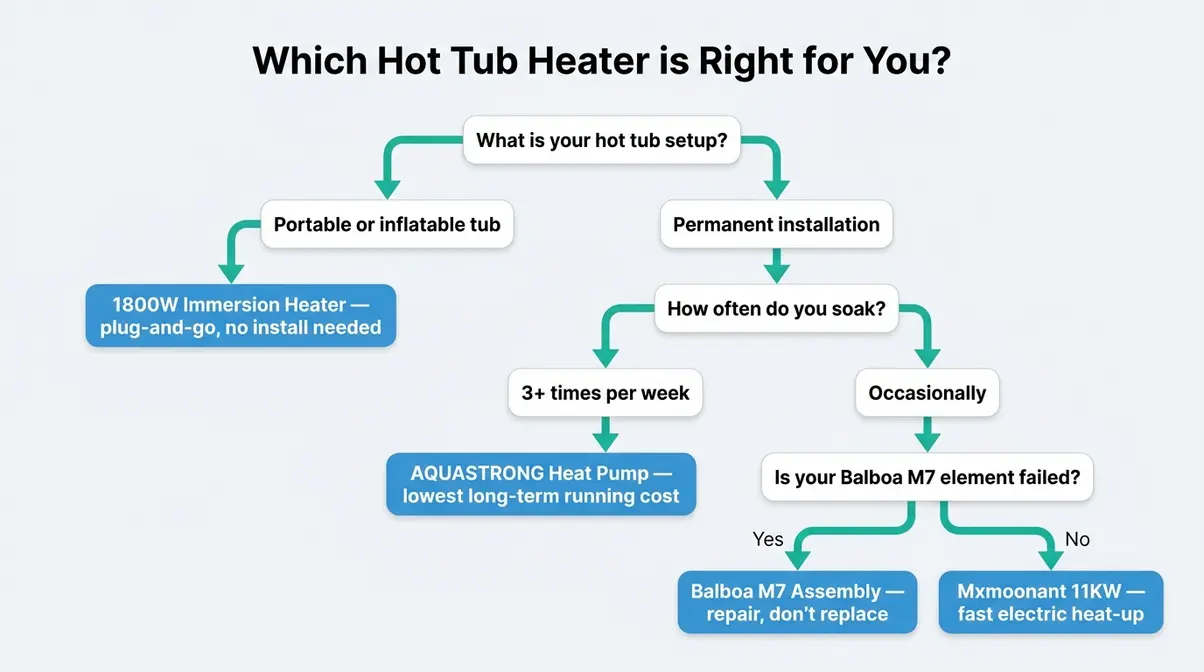
Choosing the best hot tub heater comes down to four questions: What type of heater fits your setup? How much power do you actually need? Is your installation safe and up to code? And — if your current heater has failed — is repair or full replacement the smarter move? This section walks through each factor so you can make a confident decision.
Electric, Heat Pump, or Immersion?
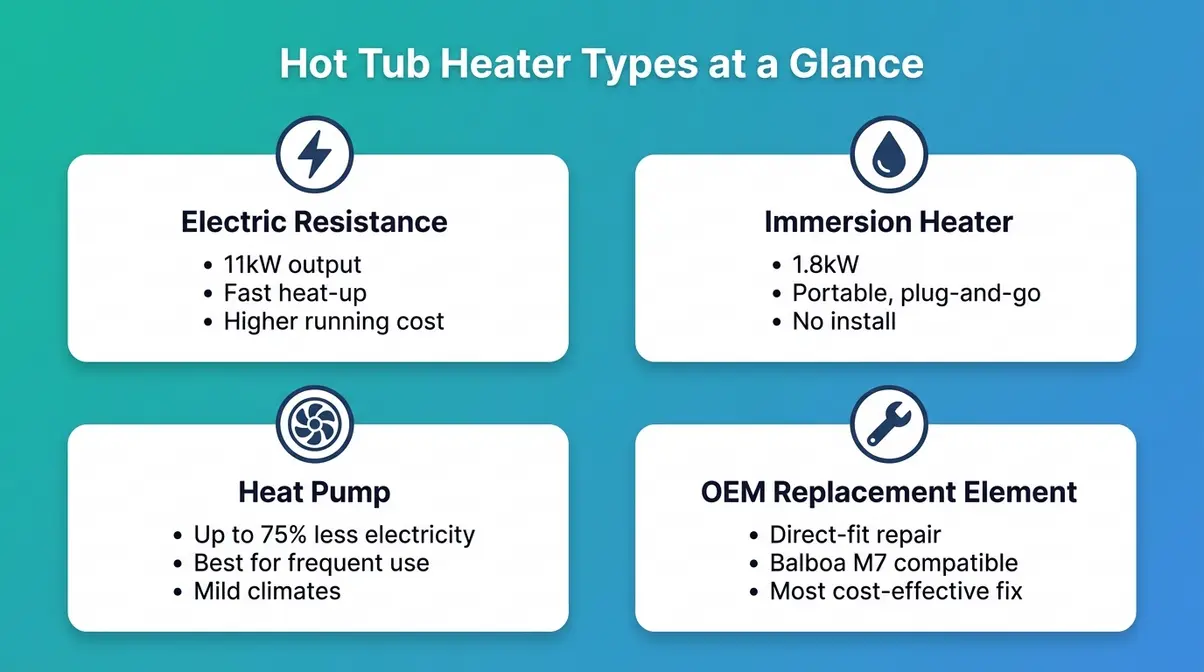
The three main heater types each suit a different usage pattern and budget. Electric resistance heaters (like the Mxmoonant 11KW) generate heat directly from electricity — fast to respond, simple to understand, but more expensive to run. They’re the better choice for infrequent users who want fast heat-up when they do soak. Heat pumps (like the AQUASTRONG) work more like a reverse air conditioner — they extract warmth from the surrounding air and transfer it to the water. Department of Energy heat pump data shows heat pumps can use up to 75% less electricity than resistance heaters for equivalent heating output (U.S. Department of Energy, 2026). That efficiency advantage makes them the better long-term investment for frequent users in mild climates.
Immersion heaters (like the 1800W unit) are the simplest option — submersible, portable, no installation needed, but limited to smaller water volumes. They suit inflatable or portable spa owners who need a heating solution without any electrical work.
To put running costs in real terms: running an 11kW electric resistance heater for 2 hours per session, 4 sessions per week at the 2026 U.S. average residential electricity rate of approximately $0.19/kWh (Federal Reserve Bank of St. Louis / BLS, May 2026) costs roughly $6.70 per week. A heat pump delivering the same heating effect at roughly 25% of the energy draw would cost approximately $1.70 per week for identical usage. For regular soakers, that gap compounds quickly. You can explore hot tub running costs and efficiency in more detail if monthly energy cost is a deciding factor. If wood-fired alternatives interest you, wood-fired hot tub heating is another route worth considering for off-grid setups.
Power and Sizing Requirements
kW (kilowatts) measures how fast a heater generates heat. A useful rule of thumb for electric heaters: plan for roughly 1kW of heating power per 100 gallons of water as a starting point. A 300-gallon hot tub needs a minimum of 3kW, though 4–6kW delivers more practical heat-up times. The Mxmoonant’s 11kW output is well-suited for tubs up to ~1,000 gallons.
Voltage is equally important. 220V/240V heaters require a dedicated circuit and professional installation — review full hot tub electrical requirements before purchasing any hardwired unit. 120V units are more limited in power but easier to connect for portable use.
For buyers comparing gas heaters (not covered in this roundup), power is rated in BTU (British Thermal Units — a measure of how much heat a heater produces per hour). DOE gas pool heater BTU ratings confirm that gas pool heaters range from 75,000 to 450,000 BTU (U.S. Department of Energy, 2026) — significantly higher output than residential electric units, but requiring gas line access and professional venting. For most residential hot tubs between 250 and 500 gallons, a 4–6kW electric heater or a compact heat pump is sufficient.
Safety and Installation Rules
Any 220V/240V heater installation must be performed by a licensed electrician — this is non-negotiable for both safety and warranty validity. CPSC hot tub temperature safety limits are clear: hot tub water should never exceed 104°F (40°C), and 100°F is the recommended safe maximum for healthy adults (Consumer Product Safety Commission). Always set your thermostat within these limits, regardless of which heater you choose.
GFCI (Ground Fault Circuit Interrupter) protection — as built into the 1800W Immersion Heater — is a minimum safety requirement for any heater in direct contact with water. If your outlet or circuit doesn’t already include GFCI protection, add an inline GFCI adapter before use. For gas heaters (outside the scope of this guide), improper venting creates a carbon monoxide risk — always use a licensed contractor for gas appliance installation.
Repair vs. Replace Framework
If your current heater has failed, use this table to decide your next move before spending money on a new unit:
| Situation | Recommended Action |
|---|---|
| Element failed, rest of system works (Balboa M7 spa) | Replace element only — Balboa M7 Assembly |
| Heater is 8+ years old with multiple issues | Replace full heater unit |
| Heater works but energy bills are high | Upgrade to heat pump |
| Portable tub, any heater issue | Immersion heater replacement |
As a general rule, if your heater is under 7 years old and only the element has failed, a replacement assembly like the Balboa M7 unit is almost always the more cost-effective choice. If multiple components are failing or the unit is over 8 years old, a full heater upgrade makes more financial sense. You can troubleshoot hot tub heating issues to confirm which component has actually failed before ordering parts — and consult a DIY hot tub repair guide for step-by-step element replacement guidance.
How We Evaluated
Our team evaluated these 4 heaters based on five criteria: power output and heating type (electric resistance, heat pump, immersion), safety certifications (GFCI protection, stainless steel construction), compatibility range (voltage, gallon capacity, control system requirements), buyer-reported reliability across verified purchase reviews and hot tub owner forums, and value for money relative to each heater’s intended use case. Product selection was drawn from Amazon listings, manufacturer specifications, and paraphrased buyer sentiment — covering the four primary use cases: permanent electric installation, portable or inflatable spa heating, heat pump efficiency, and OEM element replacement.
Frequently Asked Questions
Most Efficient Heating Method?
The most energy-efficient way to heat a hot tub is with an air-source heat pump. Heat pumps extract warmth from the surrounding air and transfer it to the water, rather than generating heat directly from electricity — meaning they deliver 3–5 units of heat energy for every 1 unit of electricity consumed. A heat pump can use up to 75% less electricity than a standard electric resistance heater for equivalent heating output 1. That said, heat pump efficiency drops noticeably when outdoor temperatures fall below 45°F, so they work best in mild to moderate climates rather than regions with harsh winters.
How Long Do Heaters Last?
Hot tub heaters typically last 5 to 10 years with proper water chemistry maintenance (Master Spa Parts, 2026). Lifespan depends heavily on how well balanced the water is — poorly adjusted pH and calcium hardness accelerate corrosion of the heating element, often cutting years off its usable life. Titanium heating elements generally outlast stainless steel equivalents because titanium resists corrosion more effectively in chemically treated spa water. Usage frequency and whether the spa is covered when not in use also affect longevity; a covered, well-maintained spa can push heater lifespan toward the upper end of that range.
Cheapest Way to Heat a Tub?
The cheapest long-term way to heat a hot tub is a heat pump, despite its higher upfront cost. While a basic electric resistance heater costs less to buy, a heat pump’s dramatically lower running costs typically offset the price difference within 1–2 years of regular use at current electricity rates. A well-insulated hot tub cover is also one of the most cost-effective additions available — it can reduce overnight heat loss by up to 60% (Department of Energy, 2026), meaning your heater runs less to maintain temperature. For occasional or portable use, an 1800W immersion heater with no installation cost may be the cheapest short-term solution.
Most Reliable Heater Brands?
Reliability in hot tub heaters depends more on build materials and water chemistry maintenance than brand name alone. Balboa Water Group is widely recognized in the spa industry for durable heating assemblies, particularly their M7 low-flow heater systems used in many branded spa models. For standalone heaters, choosing a unit with a titanium or high-grade stainless steel element is the single biggest factor in long-term reliability. Always verify that any heater carries a relevant safety certification — such as a UL listing — before purchasing, as uncertified units carry both safety and warranty risks.
Prices and features verified as of 2026 — check Amazon for current availability.
Conclusion
Finding the best hot tub heater comes down to one question: how often do you soak, and how much does monthly running cost matter? For frequent users, the AQUASTRONG heat pump delivers the lowest long-term energy cost — with heat pumps using up to 75% less electricity than resistance heaters (U.S. Department of Energy, 2026). For permanent installs where speed matters, the Mxmoonant 11KW delivers. For portable setups, the 1800W Immersion Heater is the simplest answer.
If your existing Balboa M7 spa has a failed element, the repair vs. replace decision is straightforward: if the rest of the system is sound, replace the element. If multiple components are failing or the unit is over 8 years old, a full heater upgrade is the smarter investment — and knowing how to heat a hot tub faster through cover use and pump scheduling can reduce running costs regardless of which heater you choose.
Start with the AQUASTRONG heat pump if long-term efficiency is your priority. Choose the 1800W Immersion Heater if you need something working today without an electrician. Both are available on Amazon with fast shipping — and pairing either with the right hot tub pump specifications will ensure your full system runs as efficiently as possible.