

Table of Contents - How to Turn Off a Hot Tub: Safe 5-Step Shutdown Guide
- Recommended Products
- Before You Begin: Safety and What You’ll Need
- The 5-Step Hot Tub Shutdown Process
- Turning Off Hot Tub Jets and Pumps
- Turning Off Specific Hot Tub Brands
- Winterizing Your Hot Tub (Summary)
- Hot Tub Troubleshooting Matrix
- How to Turn Your Hot Tub Back On
- When to Call a Professional
- Frequently Asked Questions
- Conclusion
This blog post may contain affiliate links. As an Amazon Associate I earn from qualifying purchases.
“Purchased a house with a hot tub — how do I turn this thing off?”
If that sounds familiar, you’re not alone. Standing in front of an unfamiliar spa — jets running, lights on, no idea where the “off” switch is — is one of the most common experiences new hot tub owners report across online forums.
Most guides either tell you to “just press the button on the control panel” (which doesn’t actually turn off your hot tub) or skip straight to the electrical breaker without explaining the difference. Getting this wrong can mean wasted energy, frozen pipes, or — in the worst case — an electrical hazard you could have avoided.
By the end of this guide, you’ll know exactly how to turn off a hot tub safely — whether you just want to stop the jets after a soak, power it down for maintenance, or shut it off completely for the season. We cover the 5-step shutdown process, brand-specific instructions for Jacuzzi, Balboa, and Cal Spa systems, a troubleshooting matrix for hot tubs that won’t stop running, and when to call a licensed electrician instead of doing it yourself.
Recommended Products
| # | Image | Product | Best For | Buy |
|---|---|---|---|---|
| 1 |  | Scenic 6-Person 69-Jet Spa | Premium hardshell upgrade | Buy on Amazon |
| 2 |  | Comfort Hot Tubs 6-Person Luxury Spa | Large family soaking | Buy on Amazon |
| 3 |  | Intex PureSpa Plus with Benches | Budget-friendly first spa | Buy on Amazon |
| 4 |  | Coleman Hawaii 4-6 Person Inflatable | Energy-efficient portability | Buy on Amazon |
| 5 |  | Bestway SaluSpa Hawaii Square Spa | Square design, 140 jets | Buy on Amazon |
| 6 |  | SCS EZLIFE Cabo Eco Foam Spa | Durable foam insulation | Buy on Amazon |
| 7 | No products found. | Bestway SaluSpa Cancun 2-4 Person | Couples or small spaces | No products found. |
| 8 |  | UHOMEPRO 4-6 Person Inflatable Spa | Extra jets, external heater | Buy on Amazon |
Most hot tubs don’t have a simple on-off switch — shutting one down safely requires knowing The Two-Switch Rule: which control to use and when.
- The control panel stops jets and lights but keeps heating and filtration running
- The GFCI breaker is the only true full shutdown — required for maintenance and winterizing
- Sleep Mode (available on Balboa and similar systems) reduces temperature by ~20°F to save energy without a full shutdown
- Never cut power in freezing temperatures unless pipes are fully drained (per U.S. Department of Energy guidance)
- Jets auto-stop after 15–20 minutes on most models — a running pump after that is normal circulation
Before You Begin: Safety and What You’ll Need
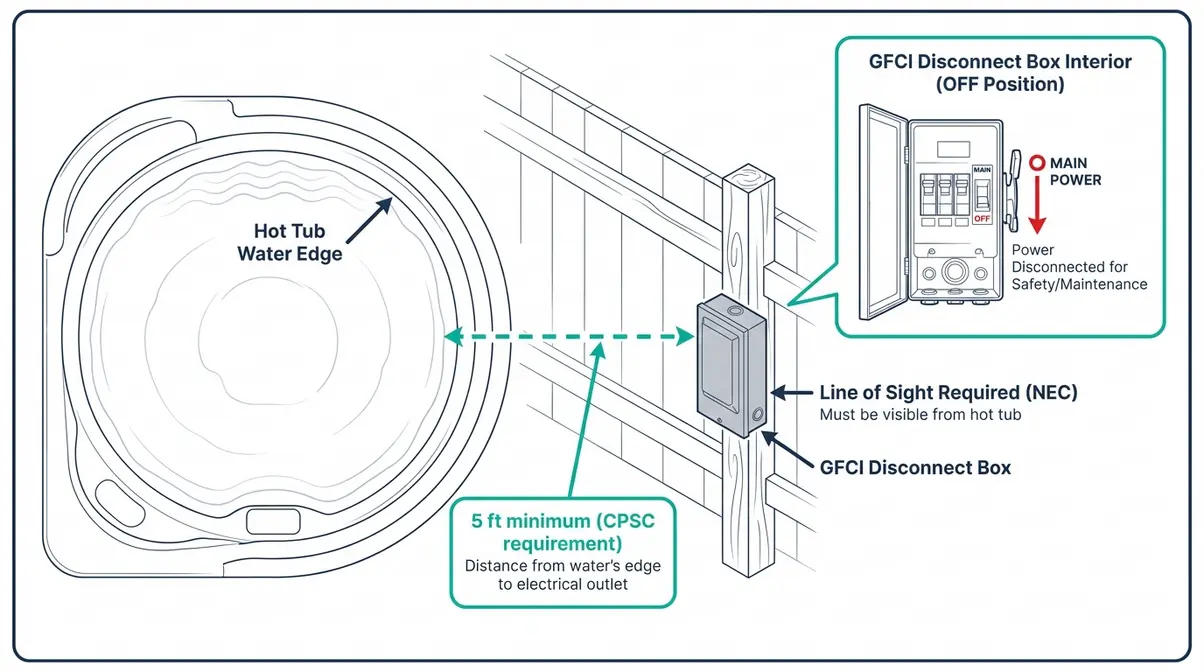
Before you touch any switch, two safety facts matter above everything else. The U.S. Consumer Product Safety Commission (CPSC) requires hot tub emergency shut-off switches to be located at least 5 feet from the water’s edge to prevent electrical shock (CPSC, 2026). Understanding where your shut-off is — and how your system is wired — protects both you and your equipment from preventable harm.
⚠️ Electrical Safety Warning
WARNING: Hot tubs run on 240-volt electrical circuits — the same voltage as electric dryers. This is not a standard household outlet. Never attempt to access your breaker box or GFCI disconnect if the surrounding area is wet or flooded. If you are not comfortable working around electrical panels, contact a licensed electrician before proceeding.
“The U.S. Consumer Product Safety Commission (CPSC) requires hot tub emergency shut-off switches to be located at least 5 feet from the water’s edge to prevent electrical shock.” (CPSC hot tub electrical safety guidelines, 2026)
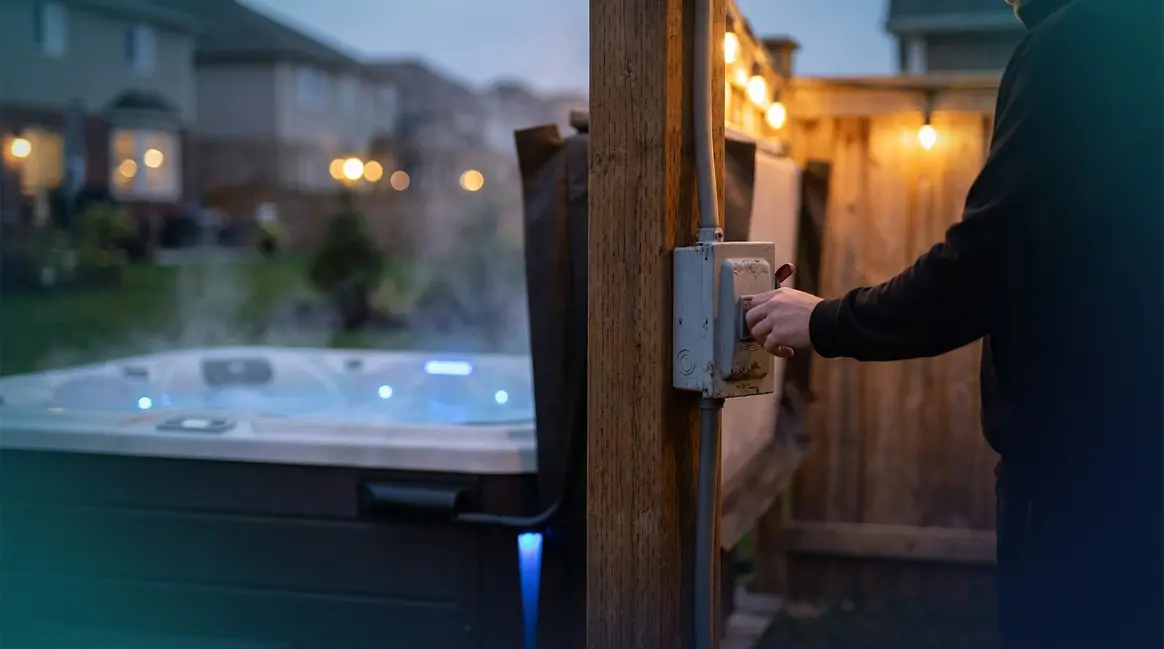
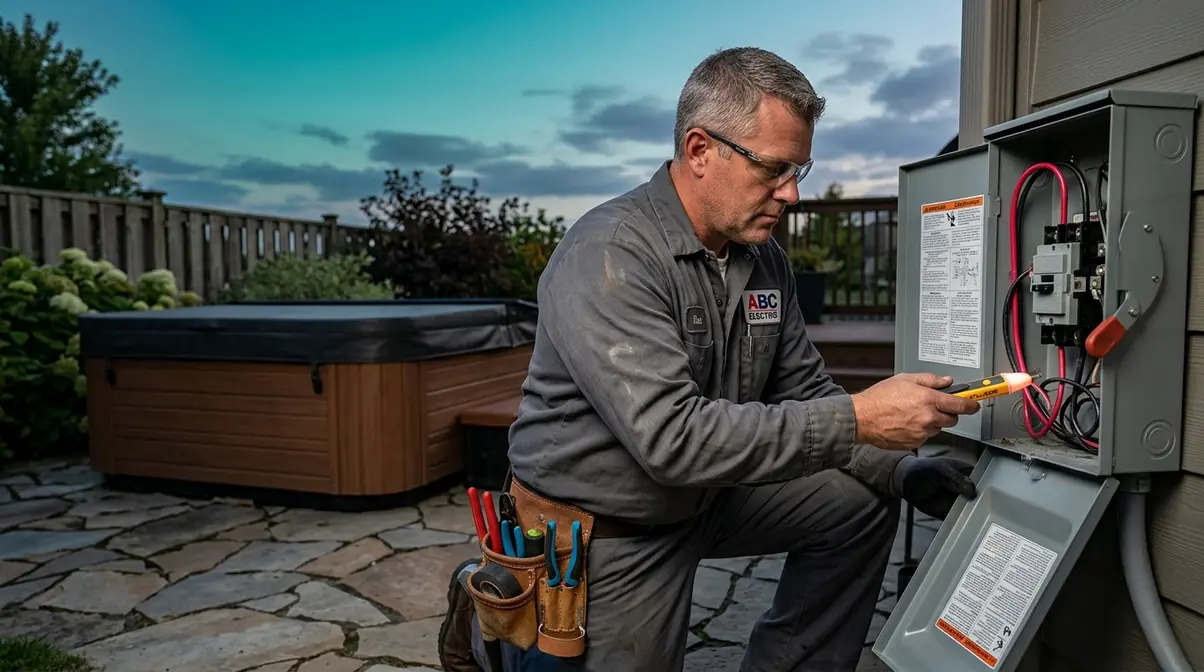
The GFCI, short for Ground Fault Circuit Interrupter, is a safety device that cuts power instantly if it detects an electrical fault — think of it as the circuit breaker’s smarter, faster sibling specifically designed for wet environments. Your hot tub’s GFCI disconnect box is typically a gray or beige weatherproof box mounted on an exterior wall or fence post within clear line-of-sight of the spa.
According to the National Electrical Code requirements for hot tub disconnects, a maintenance disconnect switch must be installed within sight of the hot tub — this is your reference point for locating the box before you begin any shutdown procedure (NFPA/NEC, 2026).
The information in this guide is for educational purposes. When in doubt, consult a licensed electrician or your hot tub manufacturer’s documentation directly.
What You’ll Need Before You Start
Estimated time: 10-15 minutes
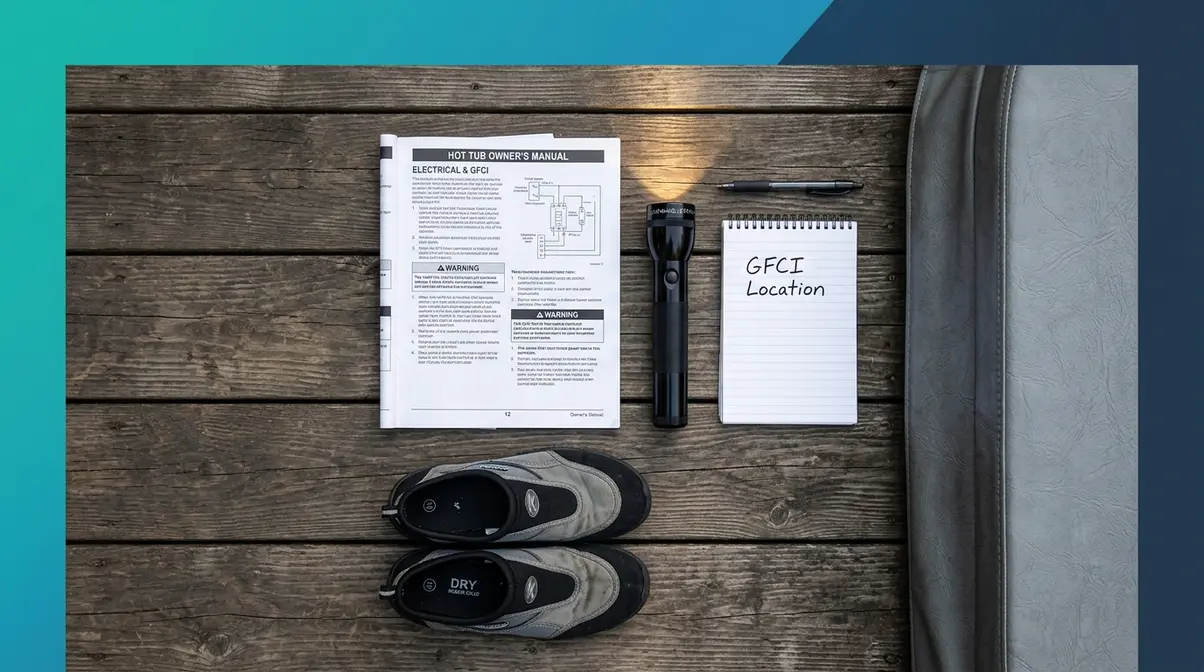
The good news: a standard hot tub shutdown requires no special tools. Here’s what to have on hand before you begin:
- Your owner’s manual — download a digital copy from the manufacturer’s website if the original is lost; search ” + + owner manual PDF”
- Dry hands and dry footing — never approach the breaker panel with wet hands or standing on wet ground
- Knowledge of your circuit breaker panel location — typically in a garage, utility room, or on an exterior wall
- A flashlight — breaker boxes in garages or sheds are often poorly lit
- Your hot tub’s brand and model — check inside the equipment cabinet door or on the side panel if you inherited the spa
You do NOT need special tools, a technician, or any prior electrical experience to complete the 5-step shutdown below. The Two-Switch Rule is the core concept this entire guide is built around: every hot tub has two effective “off” states. Switch #1 is the topside control panel (the waterproof button panel mounted on the hot tub’s edge) — this stops active functions like jets and lights but leaves heating and filtration running. Switch #2 is the GFCI breaker or service disconnect — this is the only true complete shutdown. Knowing which one to use, and when, is The Two-Switch Rule.
With safety covered, here’s the complete step-by-step process to turn off a hot tub — starting with the control panel and ending at the breaker.
The 5-Step Hot Tub Shutdown Process
To turn off a hot tub safely, you need to complete two separate actions: stopping active functions from the control panel, then cutting power at the GFCI breaker. Pressing the jet button alone does not turn off your hot tub — it keeps running filtration and heating cycles in the background. Here are the 5 steps to a complete shutdown, covering how to turn off hot tub systems of virtually any brand.
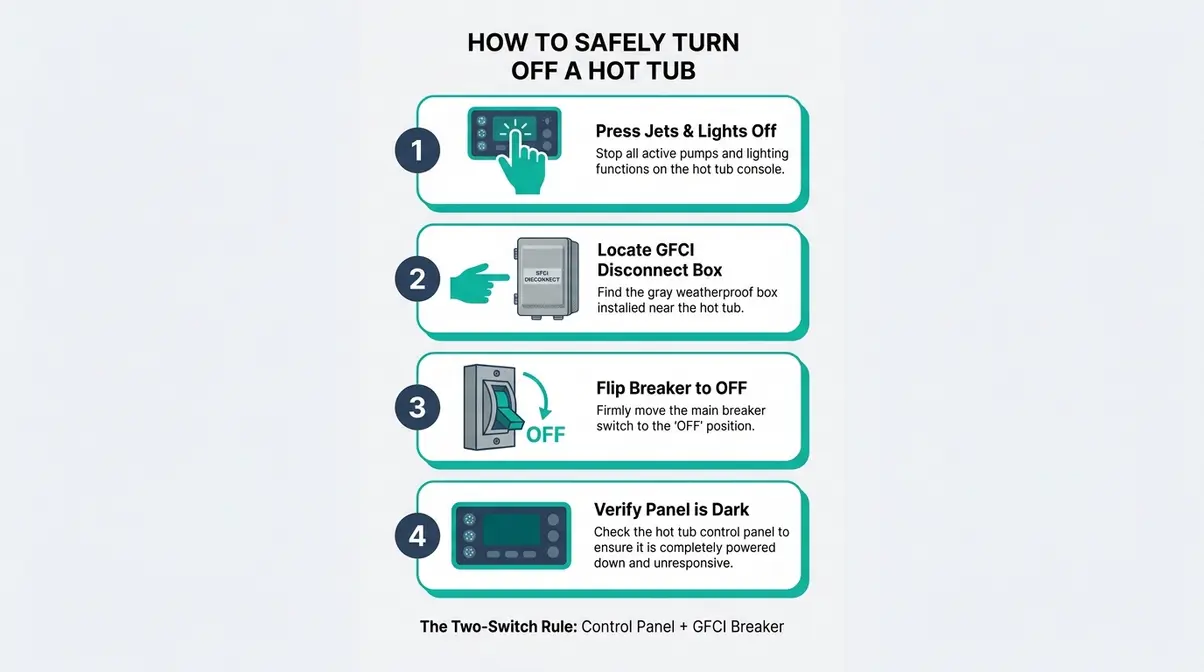
According to the National Electrical Code requirements for hot tub disconnects, a maintenance disconnect must be installed within sight of every hot tub — this is the gray box you’ll use in Step 2 (NFPA, 2026). For a deeper look at how your spa’s wiring works, see our guide on understanding hot tub electrical disconnects.
Step 1: Stop Active Functions
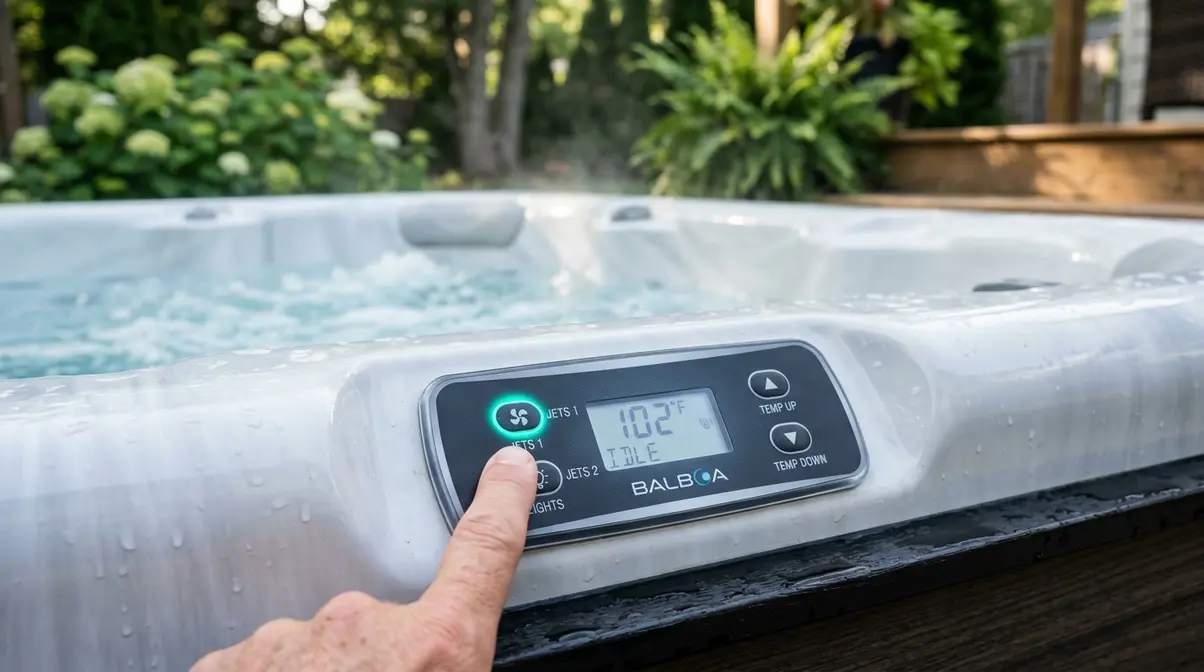
- Locate the topside control panel — the waterproof button panel mounted on the hot tub’s edge, usually near the headrest area.
- Press the “Jets” button (labeled “Jets 1,” “Jets 2,” or “Pumps” on some models) to stop all active water movement. If your tub has a separate blower, press the “Blower” or “Air” button too.
- Press the “Lights” button to turn off interior lighting.
- Wait 5–10 seconds. The jets will wind down. The display panel may remain lit — that’s normal.
Why this matters: Cutting power at the breaker while jets are actively running causes an abrupt stop that can stress pump seals over time. Stopping them through the control panel first is gentler on your equipment. Also, knowing how to turn off hot tub pump activity from the panel helps you confirm the tub is winding down before you approach the electrical disconnect.
The Two-Switch Rule in Action: Step 1 uses Switch #1 (the control panel). Steps 2–3 use Switch #2 (the breaker). Both are needed for a complete shutdown. The tub is NOT off yet — it’s still heating and filtering. Proceed to Step 2.
Step 2: Locate GFCI Disconnect Box
- Walk around the perimeter of your hot tub. Look for a gray or beige weatherproof electrical box mounted on a wall, fence post, or deck post within clear line-of-sight of the spa.
- The box will typically have a handle, lever, or rotary switch labeled “OFF / ON.” Some models have a red pull-out disconnect block inside.
- If you can’t find the GFCI disconnect box, go to your main electrical panel (the breaker box inside your home or garage). Look for a double-pole breaker labeled “Hot Tub,” “Spa,” or “Pool/Spa” — it will be a wider breaker taking up two slots.
- Note: The National Electrical Code requires this disconnect to be in your line of sight from the hot tub. If yours isn’t visible, it may have been improperly installed — flag this for a licensed electrician.
Why this matters: This box is your true master off switch. How to disconnect a hot tub safely always starts here — not at the control panel.
Step 3: Flip Breaker to OFF
- Ensure the ground beneath you is dry before touching the disconnect box.
- Open the disconnect box cover (it may require a quarter-turn latch or a simple pull).
- Flip the handle or lever to the OFF position — it typically moves downward or toward you. On a pull-out disconnect, grip the red block and pull it straight out.
- If working from the main panel, grip the double-pole breaker firmly and push it to the OFF position (it will click into place).
Why this matters: This is the only step that completely severs power to your hot tub. The spa’s main power is now off — no heating, no filtration, no circulation.
Step 4: Verify Power is Off
- Return to the hot tub. Check that the topside control panel display is completely dark — no numbers, no indicator lights.
- Listen for silence. No hum from the pump motor, no water movement.
- If the display is still lit or you hear any motor sound, do not proceed — return to Step 2 and confirm the correct breaker is in the OFF position.
Why this matters: No competitor guide includes a verification step — but it’s the most important one. A partially live circuit can cause equipment damage or injury. This step takes 10 seconds and eliminates doubt.
Step 5: Secure and Cover Tub
- Replace the hot tub cover and engage the locking straps or clips.
- If children or pets have access to the area, use a cover lock or locking strap set.
- If the shutdown is for maintenance, place a visible tag or note on the breaker to prevent accidental re-energizing while you work.
Why this matters: A covered spa retains heat longer, protects equipment from debris, and prevents unsupervised access. New owners often skip this step — it’s worth the extra 60 seconds.
Turning Off Hot Tub Jets and Pumps
Not every situation calls for a complete power-down. If you simply want to stop the jets after a soak, the process is faster — and your hot tub should keep running its heating and filtration cycles in the background. Understanding the difference between a soft stop and a full shutdown is central to The Two-Switch Rule.
Using the Topside Control Panel
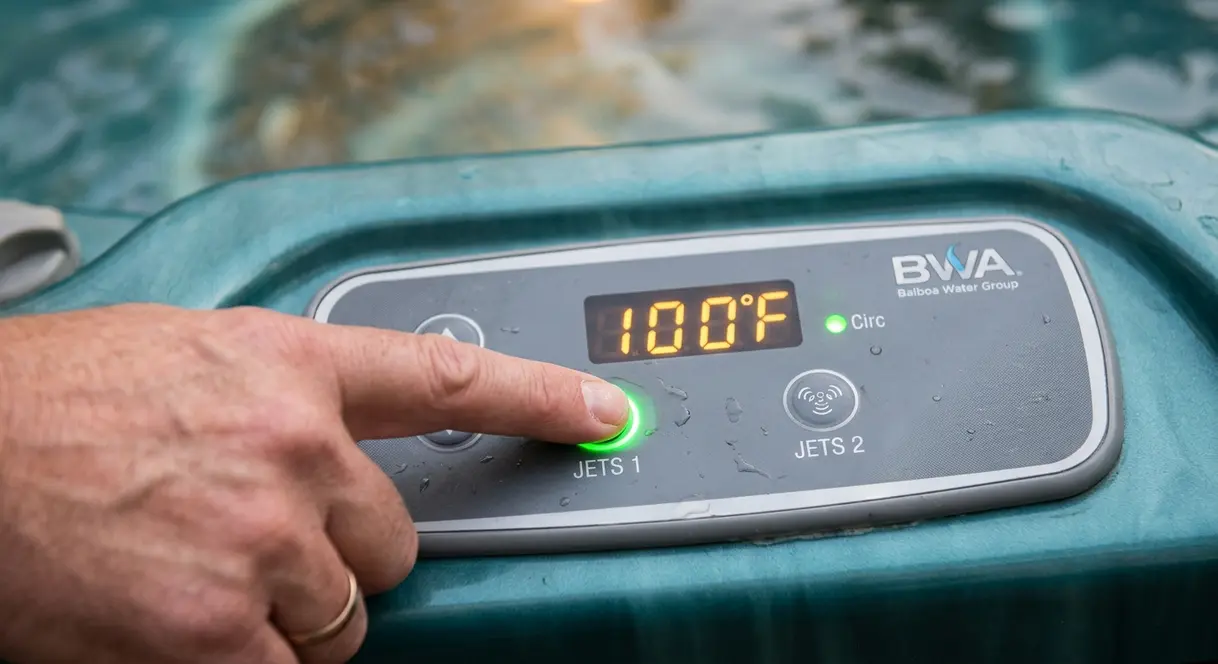
Most hot tubs use a simple press-to-toggle system for jet control:
- Press the “Jets” button once to cycle jet speed down, or hold it for 2–3 seconds to stop jets entirely (varies by brand).
- On multi-pump systems, press “Jets 1” and “Jets 2” separately.
- The display will return to the idle temperature reading. The circulation pump (a small, quiet pump that runs continuously) will keep running — this is normal and intentional.
Why this matters: The circulation pump keeps water moving through the filter and heater even when jets are off. Stopping it manually isn’t necessary during normal use — and on most models, you can’t stop it from the panel anyway. Understanding how hot tub pumps operate is key to managing your spa’s energy use. Per guidance reviewed from Aquatica’s hot tub shutdown resource, the circulation pump is designed to run independently of jet operation.
Do hot tubs turn off automatically?
Yes — hot tubs turn off certain active functions automatically, but they never fully power down on their own. Many owners wonder do hot tub jets turn off automatically — the answer is yes, usually after 15–20 minutes of inactivity to save energy. The heating system cycles on and off to maintain your set temperature. The circulation pump may run 24/7 on continuous-circulation models. Freeze protection activates automatically when ambient temperatures drop near freezing. None of these automatic shutoffs cut power to the unit — for a full shutdown, you still need to flip the breaker manually.
Why Your Pump Keeps Running
User consensus from hot tub owner forums consistently surfaces one question: “I turned the jets off — why is the motor still humming?” Here are the most common automated cycles that keep your pump running after you’ve pressed the “off” button:
| Reason | What’s Happening | Duration | Action Needed? |
|---|---|---|---|
| Filter cycle | Tub runs pump on a timer to push water through the filter | 2–4 hours/day | No — this is normal |
| Freeze protection | Pump activates automatically when water temp approaches 40°F (4°C) | Until temp rises | No — critical protection |
| Ozone cycle | Ozonator runs pump to circulate sanitized water | 30–60 min/cycle | No — normal |
| Circulation pump | Continuous low-speed pump on 24/7 models | Continuous | No — by design |
| Heating cycle | Heater runs pump to circulate water during warm-up | Until set temp reached | No — normal |
| Fault condition | Pump won’t stop and panel shows error code | Ongoing | Yes — see H2 #6 |
If your pump is running and none of these reasons apply — especially if the control panel shows an error code — skip ahead to the troubleshooting section below.
Turning Off Balboa Jets
Balboa Water Group controls (found on hundreds of hot tub brands including many Caldera, Hot Spring, and dealer-branded spas) use a slightly different interface than generic panels:
- Press the “Jets 1” button to toggle the therapy pump on or off. A second press cycles through high/low speed on two-speed models.
- Press “Jets 2” (if present) for a second therapy pump circuit.
- To stop all water movement, press both Jets buttons until the pump indicator light goes out.
- The “Circ” indicator (circulation pump) will remain lit — this is normal Balboa behavior.
Balboa systems also feature an automatic 20-minute jet timer on many models — jets shut off automatically without any button press. If yours are still running after 20 minutes, check for a “Jets Override” or “Continuous” setting that may have been enabled by a previous owner.
Turning Off Specific Hot Tub Brands
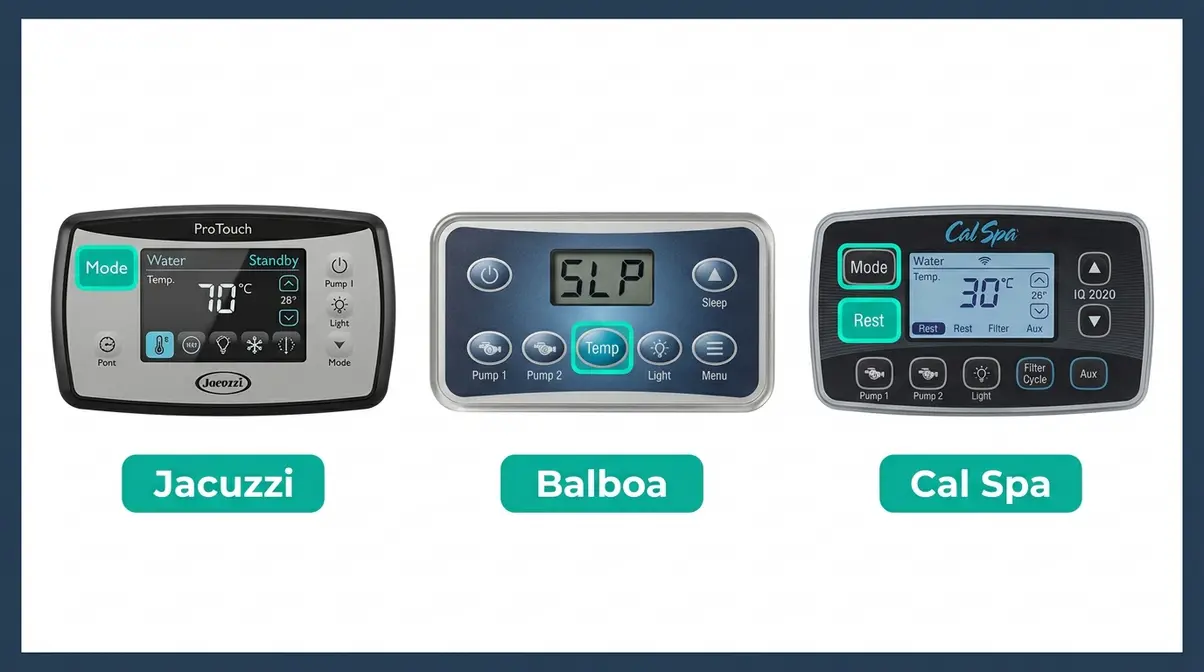
Brand-specific control systems vary enough that a generic guide can leave you guessing. Based on manufacturer documentation reviewed by the onehottub.com team, here’s what differs across the three most-searched brands.
How to Turn Off a Jacuzzi Hot Tub
Jacuzzi brand hot tubs use a proprietary ProTouch or SmartTouch control panel with a dedicated “Standby” mode — this is their version of a soft shutdown. According to Hydropool’s hot tub on/off guidance, most modern spa brands including Jacuzzi maintain heating and filtration in Standby mode (Hydropool, 2026).
- To put a Jacuzzi hot tub into Standby:
- Press the “Mode” or “Options” button on the ProTouch panel.
- Scroll to “Standby” and confirm.
- The display will show a reduced temperature target. Jets stop; heating runs minimally.
For a complete power-down of a Jacuzzi hot tub, follow the same Steps 2–5 from the 5-step process above — locate the GFCI disconnect box (usually on the right side of the spa cabinet or on a nearby wall) and flip it to OFF.
Note: Jacuzzi recommends against cutting power at the breaker routinely — reserve it for maintenance, service, or winterizing. For daily use, Standby mode is the manufacturer-preferred method.
Balboa-Controlled Hot Tubs
Balboa-controlled hot tubs (identifiable by the “BWA” logo or “Balboa Water Group” text on the control panel) feature three operating modes relevant to shutdown:
- Standard (STD): Full heating to set temperature, full filtration schedule
- Economy (ECO): Heats only during filter cycles — reduces energy use by 10–20%
- Sleep (SLP): Heats only during filter cycles AND only to within ~20°F of set temperature — the lowest-energy non-shutdown option
- To activate Sleep Mode on a Balboa panel:
- Press the “Temp” button to enter temperature mode.
- Press and hold “Temp” for 3 seconds until the mode indicator cycles.
- Press “Temp” repeatedly until “SLP” appears on the display.
- Release — the tub is now in Sleep Mode. It will not actively heat until the next filter cycle.
Sleep Mode is the best choice for short absences (1–2 weeks) when you don’t want to fully drain and winterize. For a complete shutdown, proceed to the GFCI breaker as described in Steps 2–5.
How to Turn Off a Cal Spa Hot Tub
Cal Spa hot tubs typically use Balboa or Gecko control systems, so the steps above for Balboa panels apply to most Cal Spa models. However, Cal Spa’s IQ 2020 control system (found on older models) has a distinct interface:
- Press the “Mode” button repeatedly to cycle through Ready → Rest → Ready-in-Rest modes.
- Rest Mode is Cal Spa’s equivalent of Economy — heats only during filter cycles.
- For a full shutdown, locate the Cal Spa GFCI disconnect (often mounted on the right side of the cabinet) and flip to OFF.
Sundance Spas (a similar brand often searched alongside Cal Spa) use the Sundance SL Series panel, which features a “Sleep” button that activates a low-energy mode — press and hold for 3 seconds until “SLP” appears on the display.
Winterizing Your Hot Tub (Summary)
Winterizing is a completely different process from a standard shutdown — and confusing the two is one of the most common mistakes new hot tub owners make. A standard shutdown (breaker off) leaves water in the pipes. Winterizing removes all water from the plumbing to prevent freeze damage when temperatures drop below 32°F (0°C).
When to Winterize vs. Leave On
“Never cut power to a hot tub in freezing temperatures unless pipes are fully drained — water expands as it freezes and can crack PVC plumbing, jet fittings, and the pump housing.” (U.S. Department of Energy guidance on spa winterization, 2026)
Here’s a simple decision framework:
| Situation | Recommended Action |
|---|---|
| Away for 1–2 weeks, temps above 40°F | Sleep/Economy Mode — keep it running |
| Away for 1–2 weeks, temps below 40°F | Leave running on freeze protection setting |
| Away for 1+ month, temps above freezing | Standard shutdown (breaker off) is acceptable |
| Away for winter (below freezing temps) | Full winterization required — drain all plumbing |
| Selling or storing indefinitely | Full winterization + drain + cover |
The Winterizing Process: What’s Involved
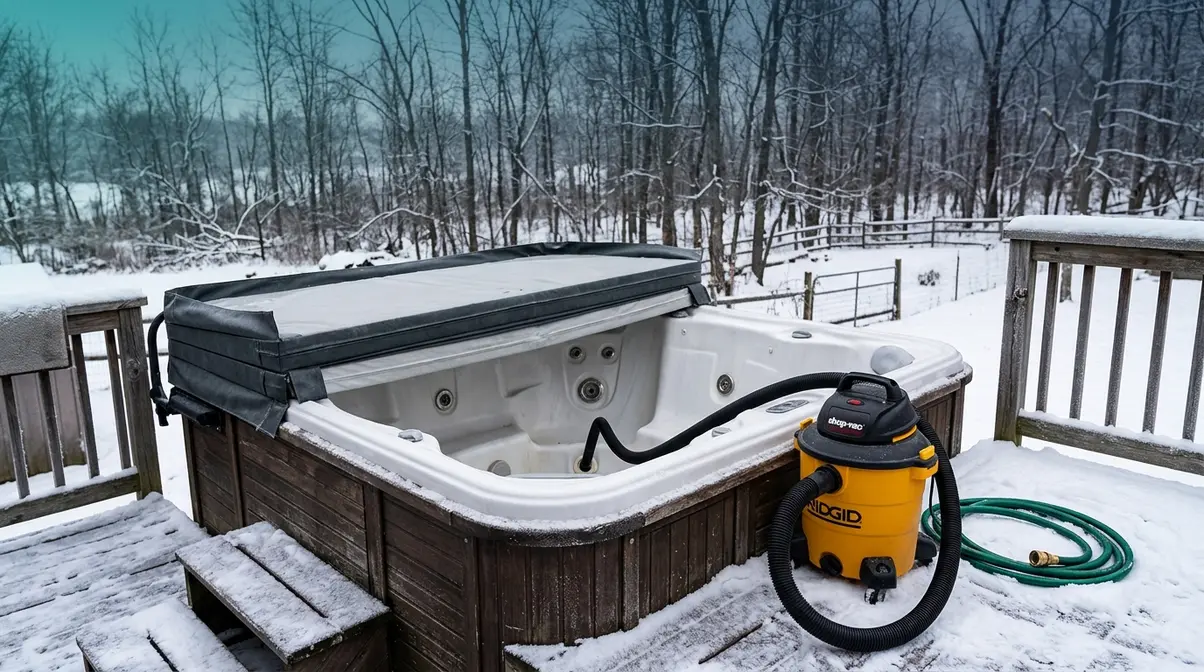
A full winterization involves draining the tub, blowing out the plumbing lines with a wet/dry shop vac, adding antifreeze to any remaining water in the pump and heater, and securing the cover. This is a 2–3 hour process that goes well beyond a standard shutdown.
For the complete step-by-step winterization process — including which antifreeze is safe for hot tub plumbing and how to blow out each jet line — see our dedicated guide on how to winterize a hot tub. That page covers every winterization step in full detail without the risk of cannibalizing the shutdown process described here.
Hot Tub Troubleshooting Matrix
If you’ve pressed every button and the pump is still running, you’re dealing with one of a handful of common causes. The Two-Switch Rule applies here too: if Switch #1 (the control panel) isn’t stopping the tub, you need to identify why before reaching for Switch #2 (the breaker). Based on guidance reviewed from masterspaparts.com’s pump shutdown FAQ and user consensus from hot tub owner communities, these are the most frequent culprits.
Why will my hot tub not turn off?
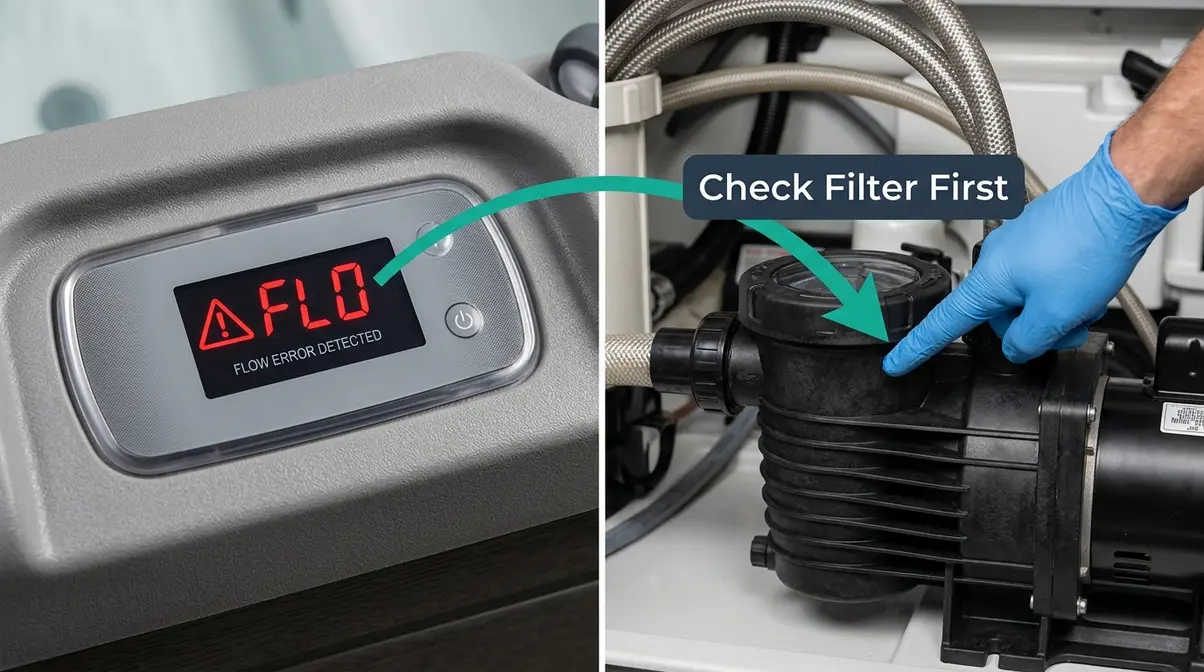
A hot tub that won’t turn off is almost always completing an automated cycle — not malfunctioning. The most common causes are an active filter cycle (runs 2–4 hours daily), freeze protection mode (activates below 40°F/4°C), or an ozone sanitizing cycle (30–60 minutes). Check the control panel for mode indicators: “FLT,” “ECO,” “SLP,” or an ozone light. If your hot tub pump keeps turning on and off rapidly, it might indicate a flow issue or a stuck relay. If the panel shows an error code like “FLO” or “FL1,” you may have a flow sensor fault — clean or replace the filter as a first step. If none of these apply and the pump runs without stopping, contact a spa technician.
How to Exit Sleep Mode or Economy Mode
If your hot tub is stuck in a mode you don’t recognize and won’t respond normally to the Jets button, here’s how to reset the most common mode settings:
- On Balboa panels (SLP or ECO mode):
- Press and hold the “Temp” button for 3 seconds.
- Press “Temp” repeatedly until “STD” (Standard) appears on the display.
- Release — the tub returns to normal heating mode.
- On generic or older panels:
- Press the “Mode” button to cycle through available modes.
- Select “Ready” or “Standard” to return to full operation.
- If no mode button exists, a factory reset may be needed — consult your owner’s manual.
Energy note: Economy Mode can reduce hot tub operating costs by approximately 10–20% compared to Standard Mode, according to user reports from hot tub owner communities (2026). Sleep Mode reduces costs further but may let the water cool significantly between filter cycles.
How to Unlock a Locked Control Panel
Some hot tubs enter a panel lock state after extended inactivity or after a power fluctuation. A locked panel will not respond to button presses and may display a padlock icon or “LOC” on the screen.
- General unlock procedure (most brands):
- Press and hold the “Temp” and “Jets” buttons simultaneously for 3–5 seconds.
- Release when the lock icon disappears or the panel beeps.
- If this doesn’t work, try pressing and holding “Light” and “Jets” — the combination varies by manufacturer.
For Hot Spring hot tub panel locks specifically, see our detailed guide on how to unlock a Hot Springs hot tub for model-specific instructions.
How to Turn Your Hot Tub Back On
Restarting a hot tub after a shutdown is straightforward — but the process differs depending on how long the tub was off and whether it was winterized.
Starting Up After a Short Shutdown
If you shut the tub off at the breaker for maintenance or a brief absence (a few days to a few weeks, no freezing temperatures):
- Remove the cover and visually inspect the water. If it looks cloudy or smells off, test and balance chemistry before heating.
- Flip the GFCI breaker or disconnect back to the ON position. The control panel display will light up.
- Wait for the priming cycle — most tubs run a 2–4 minute priming sequence (shown as “Pr” or “PrI” on the display) before heating begins. Do not press any buttons during this phase.
- Set your desired temperature using the Temp up/down buttons.
- The tub will begin heating. Depending on how much the water cooled, allow 1–4 hours to reach temperature.
Note: If jets run for a few seconds then stop with an error code, the pump may need to re-prime. Press the “Jets” button once to manually initiate priming, then wait.
Starting Up After Winterization
A full spring startup after winterization is more involved and includes refilling the plumbing, checking for leaks, and re-balancing water chemistry from scratch. Key steps include:
- Reinstall any drain plugs you removed during winterization (check each jet fitting and the main drain).
- Refill with fresh water using a hose — fill to the midpoint of the skimmer opening.
- Add a startup chemical kit before heating (shock, pH balancer, and alkalinity increaser at minimum).
- Restore power at the breaker and allow the full priming and heating cycle to complete — budget 4–8 hours.
- Test water chemistry once the tub reaches temperature and adjust as needed.
For a complete spring startup checklist, see our guide on how to open a hot tub for the season.
When to Call a Professional
Knowing how to turn off a hot tub is a task most homeowners can handle safely. However, certain situations require a licensed electrician or certified spa technician — and recognizing those situations is part of responsible hot tub ownership.
Situations Where DIY Shutdown Is Unsafe
Do not attempt a DIY shutdown or repair in any of these scenarios:
- The area around the breaker panel or GFCI box is wet or flooded — standing water near electrical panels is an electrocution risk. Call an electrician first.
- Your hot tub has no visible GFCI disconnect box — this is a code violation. Do not use the tub until an electrician inspects the installation.
- The breaker trips repeatedly when you restore power — this indicates a wiring fault or internal short that requires professional diagnosis.
- You smell burning plastic or see scorch marks near the control panel or equipment bay — shut off at the main panel immediately and call a technician.
- The tub was installed by a previous owner with no documentation — inherited setups occasionally have non-code-compliant wiring. A $150 inspection can prevent a $3,000 repair (or worse).
Based on guidance reviewed from licensed electricians and manufacturer documentation reviewed by the onehottub.com team, the most dangerous DIY mistake is assuming the control panel switch constitutes a safe shutdown for maintenance purposes — it does not. Always use the GFCI disconnect or breaker before accessing any internal components.
Hot Tub Won’t Turn Off: Next Steps
If you’ve followed every step in this guide and the pump is still running, here’s your escalation path:
- Flip the GFCI breaker to OFF — this cuts all power regardless of what the control board is doing. If the pump continues running after this, you have a serious wiring fault; call an electrician immediately.
- Check for error codes on the display before cutting power. Photograph them — your technician will need them.
- Contact your hot tub manufacturer’s service line with the error code and model number. Most manufacturers offer free phone support for troubleshooting.
- Find a certified spa technician through the Association of Pool & Spa Professionals (APSP) dealer locator at bhtubs.co.uk’s Jacuzzi shutdown guide also notes that persistent fault codes typically require a control board replacement — a repair best left to certified technicians.
Frequently Asked Questions
Do hot tubs have an on-off switch?
Most hot tubs do not have a single on-off switch the way a lamp or appliance does. Instead, they have two control points: the topside control panel (which manages jets, lights, and temperature settings) and the GFCI breaker or disconnect box (which cuts all electrical power). Pressing the jets button stops water movement, but the heating and filtration system keeps running. For a true full shutdown, you need to flip the breaker or GFCI disconnect — that’s the closest thing to a real “off switch” your hot tub has.
How do I stop my hot tub from running?
To stop your hot tub from running completely, flip the GFCI disconnect box or breaker to the OFF position. First, press the “Jets” and “Lights” buttons on the topside control panel to stop active functions. Then locate the gray weatherproof disconnect box mounted within sight of the spa and flip it to OFF. If you only want to reduce energy use without a full shutdown, switch to Economy or Sleep Mode from the control panel. A pump that runs quietly after jets are off is typically completing a normal filter cycle (2–4 hours per standard guidelines) or freeze-protection cycle (activates near 40°F per energy standards).
How to shut off hot tub power?
Shut off power to your hot tub at the GFCI disconnect box — the weatherproof gray or beige box mounted on a wall or post within line-of-sight of the spa. Open the cover and flip the handle or lever to OFF. If you can’t find the disconnect box, go to your main electrical panel and switch off the double-pole breaker labeled “Hot Tub,” “Spa,” or “Pool/Spa.” According to the National Electrical Code, this disconnect must be installed within sight of the tub (NFPA, 2026). Never rely on the control panel alone to cut power before maintenance.
Can I just turn off my hot tub?
Yes, you can turn off your hot tub — but “off” means different things depending on your situation. For a quick stop after a soak, pressing the Jets button is sufficient. For a full power-down before maintenance or an extended absence, you must flip the GFCI breaker. In freezing temperatures (below 32°F per U.S. Department of Energy warnings), never cut power unless the plumbing is fully drained — freeze protection keeps pipes safe as long as power is on. For absences of a few weeks in cold climates, Sleep or Economy Mode is a safer choice than a complete shutdown.
How do I get a hot tub to turn off?
If your hot tub won’t respond to the control panel, go directly to the GFCI disconnect box and flip it to OFF. This cuts all power regardless of what the control board is doing. Before doing so, check whether the panel is in a locked state (look for a padlock icon or “LOC” on the display) — most panels unlock by holding “Temp” and “Jets” simultaneously for 3–5 seconds. If the pump continues running even after the breaker is off, you have a wiring fault that requires a licensed electrician. Do not attempt to access internal components in that scenario.
Is it safe to leave a hot tub empty?
It is generally not safe to leave a hot tub empty for extended periods without proper winterization. Residual water in the plumbing can freeze and crack the pipes, while dry seals and gaskets can shrink and leak when refilled. If you must leave it empty, ensure you blow out the lines completely with a wet/dry vacuum.
How much does it cost to keep a hot tub running?
Keeping a hot tub running typically costs between $20 and $40 per month depending on your local electricity rates, climate, and the spa’s insulation. Using Economy or Sleep Mode during periods of non-use can reduce these costs by 10–20% (based on user consensus). Maintaining a consistent temperature is often more efficient than letting it cool and reheating it.
Conclusion
For any new or inherited hot tub owner, knowing how to turn off a hot tub safely comes down to one core principle: The Two-Switch Rule. The topside control panel handles the soft stop — jets, lights, active functions. The GFCI breaker or disconnect box handles the complete power cutoff. Every shutdown scenario in this guide, from a quick post-soak stop to a full winterization prep, maps back to these two switches. According to the National Electrical Code, your disconnect box must be within sight of the spa — find it now, before you need it in a hurry (NFPA, 2026).
The Two-Switch Rule exists because hot tubs are designed to keep running. Filtration, freeze protection, and heating cycles are features, not faults — and recognizing them prevents unnecessary panic. When something genuinely won’t stop after the breaker is off, that’s the signal to call a licensed electrician rather than dig deeper yourself.
Your next step: locate your GFCI disconnect box today, even if you’re not planning a shutdown. Walk around your spa, find the gray weatherproof box, and confirm it’s labeled and accessible. That 2-minute task is the single most important thing a new hot tub owner can do — and it means you’ll be ready to act confidently the next time you need to power down your spa.