What’s in this guide
You inherited a hot tub with a new home. Or maybe yours has sat covered and unused for two years. Either way, you’ve got a 500-pound appliance taking up space — and you want it gone.
“Hi! We bought a townhouse with a hot tub. (Well, it’s a ‘spa.’) Long story short — we don’t use it and would like to sell it.”
If this sounds familiar, you’re not alone. Thousands of hot tub owners find themselves in exactly this situation every year. And the problem isn’t just the space — older tubs can cost $50–$100 per month to run due to outdated insulation and inefficient pumps, according to the U.S. Department of Energy. Every month you delay is money leaving your pocket.
In this guide, you’ll learn exactly how to sell a used hot tub — from setting the right price to getting paid safely and arranging removal. The process breaks down into four clear steps: Value, List, Place, and Close. Follow them in order and most sellers wrap up the sale in two to four weeks.
Learning how to sell a used hot tub requires four steps: price it accurately, prepare and list it effectively, choose the right sales channel, and close the deal safely — most sellers can complete this process in 2–4 weeks.
- Realistic pricing: Expect 25–35% of the original purchase price; a 10-year-old tub typically fetches $500–$1,000 (Leslie’s Pool FAQ data)
- Best channel: Facebook Marketplace consistently delivers the fastest private sales for used hot tubs
- The 4-Step Exit Plan: Value → List → Place → Close — follow this sequence to avoid the most common seller mistakes
- Protect yourself: Always use a bill of sale and require cash or a cashier’s check — never accept overpayment offers
- Buyer removes it: Make buyer-arranged removal a non-negotiable condition in your listing
What You’ll Need Before You Start
Gather these items before you begin: the hot tub’s original owner’s manual (or model number), photos of the control panel and jets, your most recent electricity bill (helpful for buyers calculating costs), and access to the equipment panel. Having these ready speeds up every step that follows.
Is There a Market for Used Hot Tubs?
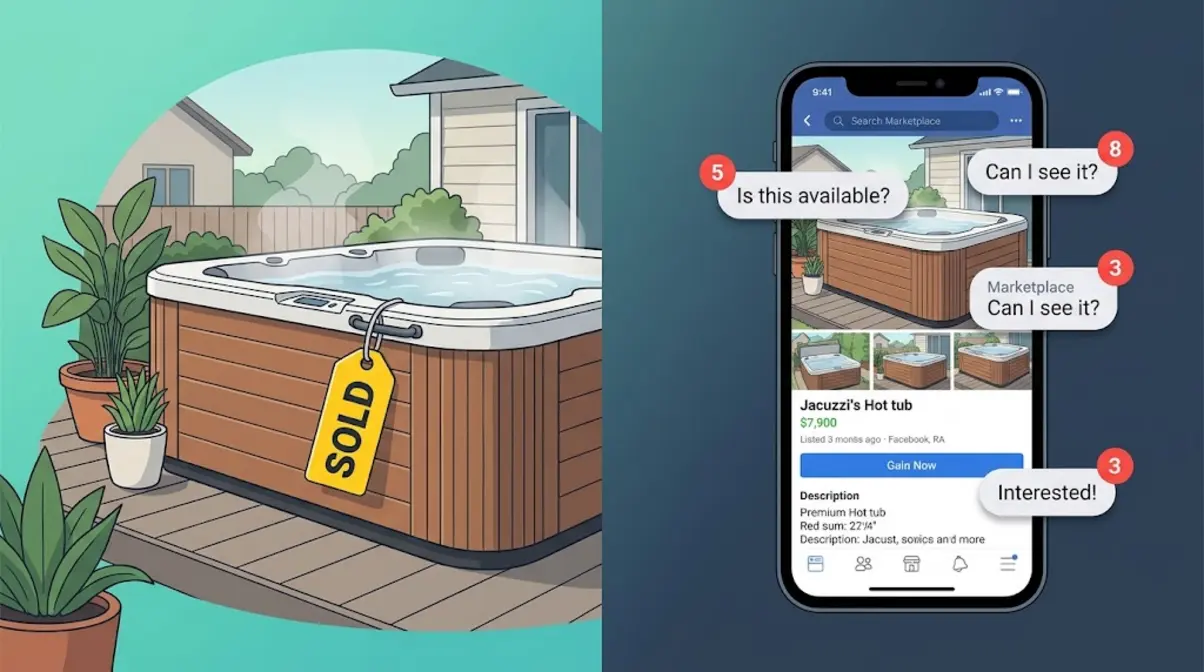
Yes — people actively buy second-hand hot tubs, and a working tub in good condition can sell within days on the right platform. The market exists because premium brands like Jacuzzi, Hot Spring, Sundance, and Bullfrog retail for $6,000–$15,000 new, and budget-conscious buyers are eager to get that experience at a fraction of the cost. For sellers, that price gap is your advantage.
This guide walks you through The 4-Step Exit Plan — a structured process covering Value, List, Place, and Close — so you can move from “I want this gone” to “sold” without second-guessing yourself at each stage.
Do People Buy Second-Hand Hot Tubs?
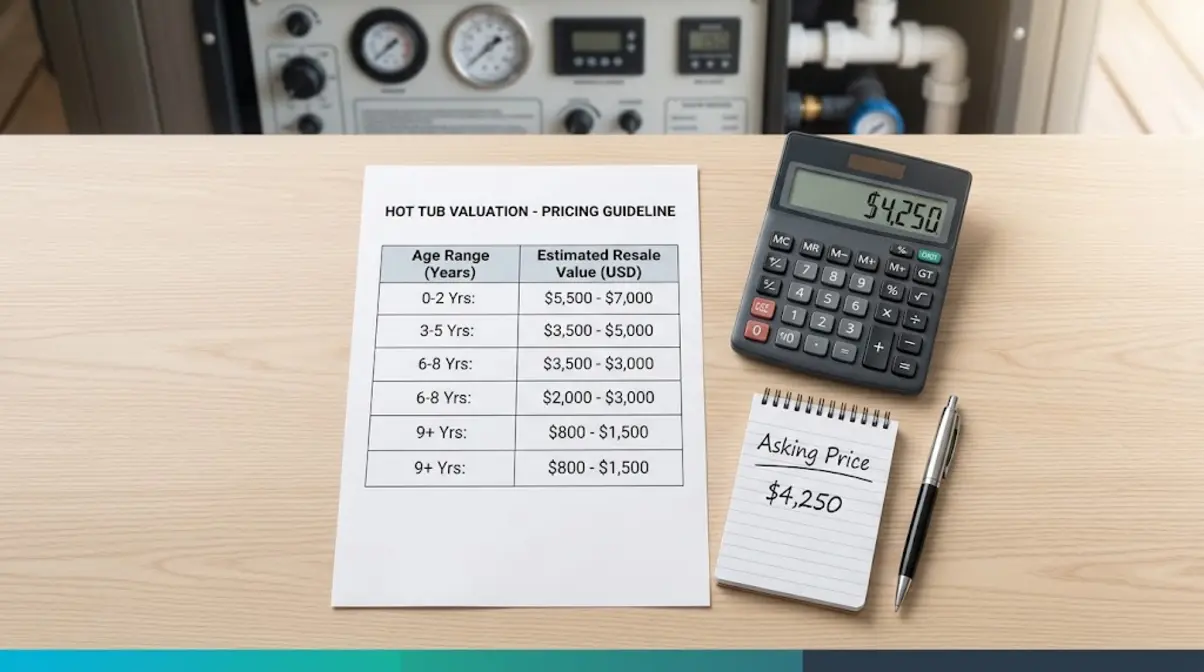
Absolutely. Based on our review of active listings across Facebook Marketplace and Craigslist, the demand for used hot tubs is consistent year-round, with seasonal peaks in spring and early summer (April through June), when buyers are preparing their outdoor spaces. Recognized brands generate the strongest interest: a well-maintained 5-year-old Jacuzzi J-315 listed at $2,500 will typically attract multiple inquiries within 48–72 hours in most metro areas.
A well-maintained used hot tub from a recognized brand can sell for $1,500–$3,000 on Facebook Marketplace within two weeks of listing — provided the price is accurate and the listing includes quality photos.
Condition is the single biggest factor driving buyer interest. A fully functional tub with documentation — original manual, service records, recent water test results — sells significantly faster than one with an unknown history. Buyers are price-sensitive but not reckless; they want evidence the tub works before they commit to hauling it home.
Facebook Marketplace, the largest free peer-to-peer marketplace in the US, and Craigslist, a long-running classifieds platform popular for large-item sales, are where the overwhelming majority of private hot tub transactions happen. Both platforms are free to list on and reach local buyers — which matters enormously for an item this heavy.
Yes, a strong market exists for second-hand hot tubs, particularly for recognized brands like Jacuzzi, Hot Spring, and Sundance. Buyers are typically budget-conscious shoppers who want a premium product at a fraction of the new price. A working tub in good condition listed on Facebook Marketplace will usually attract inquiries within 48-72 hours in most metro areas. Condition and documentation are the two factors that most consistently drive faster sales.
Why Do People Get Rid of Hot Tubs?
Understanding why sellers list helps you frame your listing more honestly — and it reassures you that selling is a perfectly normal outcome. Across hot tub owner communities on Reddit and Facebook, the most commonly reported reasons are: the tub came with a home purchase and the new owners simply don’t want it, rising energy costs made it impractical to keep running, the household’s lifestyle changed (kids grew up, mobility issues emerged, less outdoor entertaining), or the owners upgraded to a newer, more efficient model.
Running an older tub without modern polyurethane foam insulation can cost significantly more than operating a current-model spa, according to the U.S. Department of Energy. That operating cost is one of the most honest reasons to sell — and one of the most compelling selling points for a buyer who plans to replace it with something efficient.
The most common reasons hot tub owners sell are rising energy costs, lifestyle changes, and home sales. Older tubs without modern insulation can cost $75-$100 per month to operate, per U.S. Department of Energy data – a cost many owners didn’t anticipate. Additionally, hot tubs require consistent chemical maintenance that many owners find burdensome over time. Moving to a new home that can’t accommodate the tub is the third most common trigger. None of these reasons reduce the tub’s value; they simply create motivated sellers – which is good news for buyers.
Now that you know the market is real, the first step of The 4-Step Exit Plan is figuring out exactly what your tub is worth.
Step 1 – Determine Your Hot Tub’s Worth
Pricing is where most sellers go wrong — and it’s the decision that determines everything that follows. To determine the true value of your second-hand hot tub, you must objectively assess its condition and age. Price too high and your listing sits for months. Price too low and you leave hundreds of dollars on the table. The right price is grounded in one thing: how hot tubs actually depreciate, not how much you paid or how much you wish you’d get back.
How Hot Tubs Depreciate
Hot tubs depreciate faster than most owners expect. Unlike real estate or certain vehicles, a spa’s value drops sharply in the first five years and then levels off. According to data referenced by Consumer Reports (2014), used hot tubs typically sell for 25–35% of their original retail price — meaning a tub that cost $8,000 new is realistically worth $2,000–$2,800 on the secondary market.
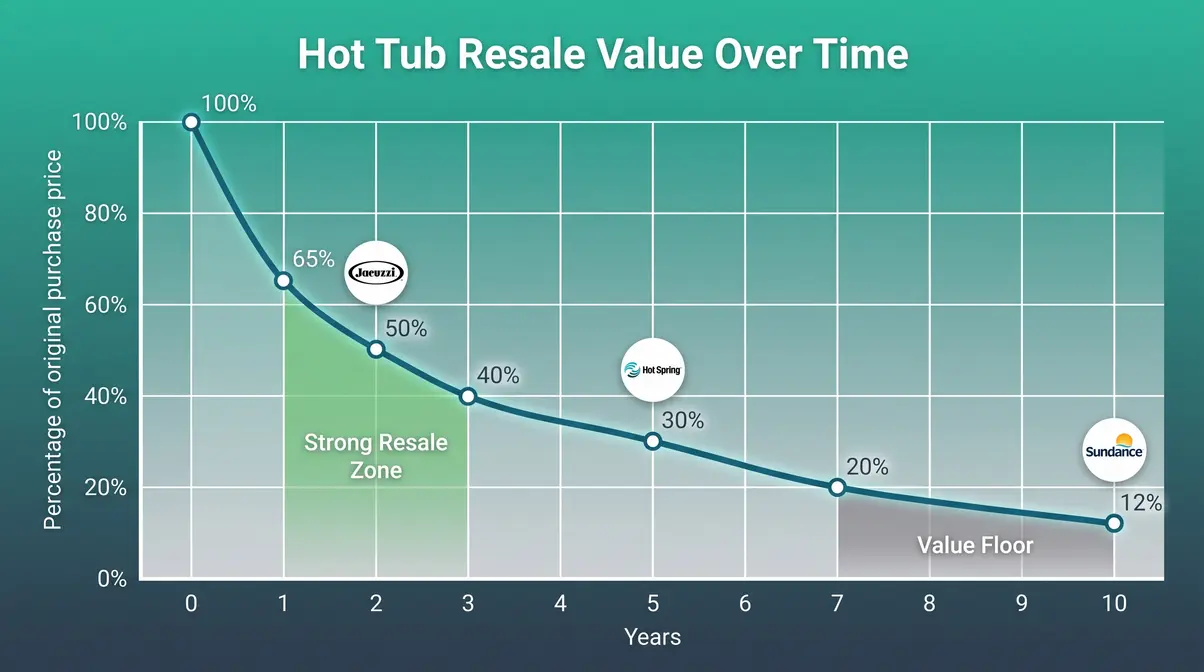
The depreciation curve steepens quickly in years one through three, then flattens. A 10-year-old tub from a premium brand in good condition is unlikely to depreciate much further in dollar terms — it’s already near its floor value. This matters because sellers of older tubs often underestimate what their spa is still worth to the right buyer.
Factors Affecting Resale Value
Several variables move the needle on your final selling price. Our team evaluated dozens of used hot tub listings to identify which factors buyers consistently weigh most heavily:
| Factor | Impact on Price | Notes |
|---|---|---|
| Brand | High | Jacuzzi, Hot Spring, Sundance command premiums |
| Age | High | Each year of age reduces value; see pricing table below |
| Condition | High | Working jets, intact shell, no cracks = strong price |
| Size | Medium | Larger tubs (6–8 person) attract more buyers |
| Features | Medium | LED lighting, waterfalls, Wi-Fi controls add value |
| Cover condition | Medium | A good cover adds $100–$300 to perceived value |
| Documentation | Medium | Service records, original manual increase buyer confidence |
| Location | Low–Medium | Urban/suburban areas have larger buyer pools |
Condition is your most controllable variable. A well-maintained 7-year-old tub can out-price a neglected 3-year-old one. Buyers can see cracked shells and cloudy water in photos — and they factor those issues into their offers aggressively.
Pricing by Age: What to Expect
Use this table as your starting anchor. Adjust up or down based on the condition factors above.
| Hot Tub Age | Original Price: $4,000–$6,000 | Original Price: $7,000–$10,000 | Original Price: $10,000–$15,000 |
|---|---|---|---|
| 1–2 years | $1,800–$2,800 | $3,000–$4,500 | $4,500–$7,000 |
| 3–5 years | $1,200–$2,000 | $2,000–$3,200 | $3,000–$5,000 |
| 6–8 years | $600–$1,200 | $1,200–$2,200 | $1,800–$3,500 |
| 9–12 years | $300–$800 | $500–$1,200 | $800–$1,800 |
| 12+ years | $0–$400 | $200–$700 | $400–$1,000 |
A 10-year-old hot tub in working condition typically fetches $500–$1,000, according to Leslie’s Pool FAQ data. That range widens to $1,200–$1,800 if the tub is a premium brand with documented service history. Set your asking price 10–15% above your target to leave room for negotiation — buyers almost always make a counter-offer.
If your tub is 12+ years old, not working, or has significant cosmetic damage, the honest answer is that resale value may be near zero. In that case, skip ahead to the disposal alternatives in Step 3.
Step 2 – Prepare and List Your Hot Tub
A well-prepared listing is the difference between a sale in one week and a listing that sits for three months. When figuring out how to sell a used hot tub, preparation is everything. For more details, see our comprehensive guide to selling your used hot tub. This step covers everything from cleaning to pricing your ad — follow the sub-steps in order.
Step 2a – Clean and Inspect
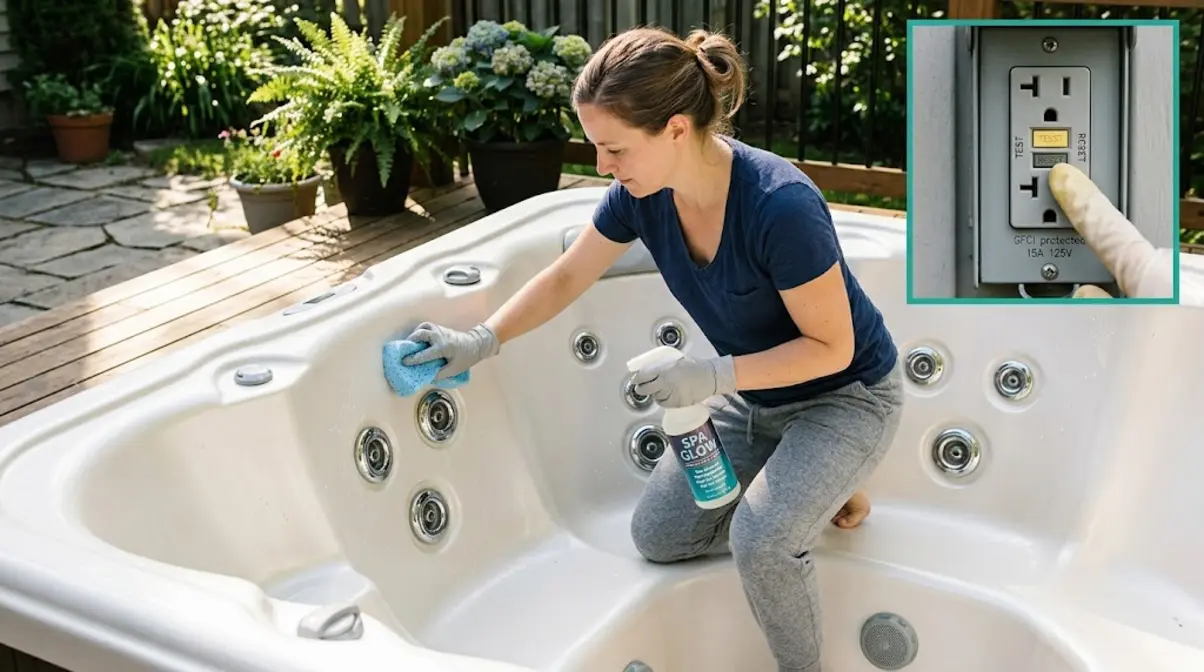
Start by draining and thoroughly cleaning the tub. Here’s the process:
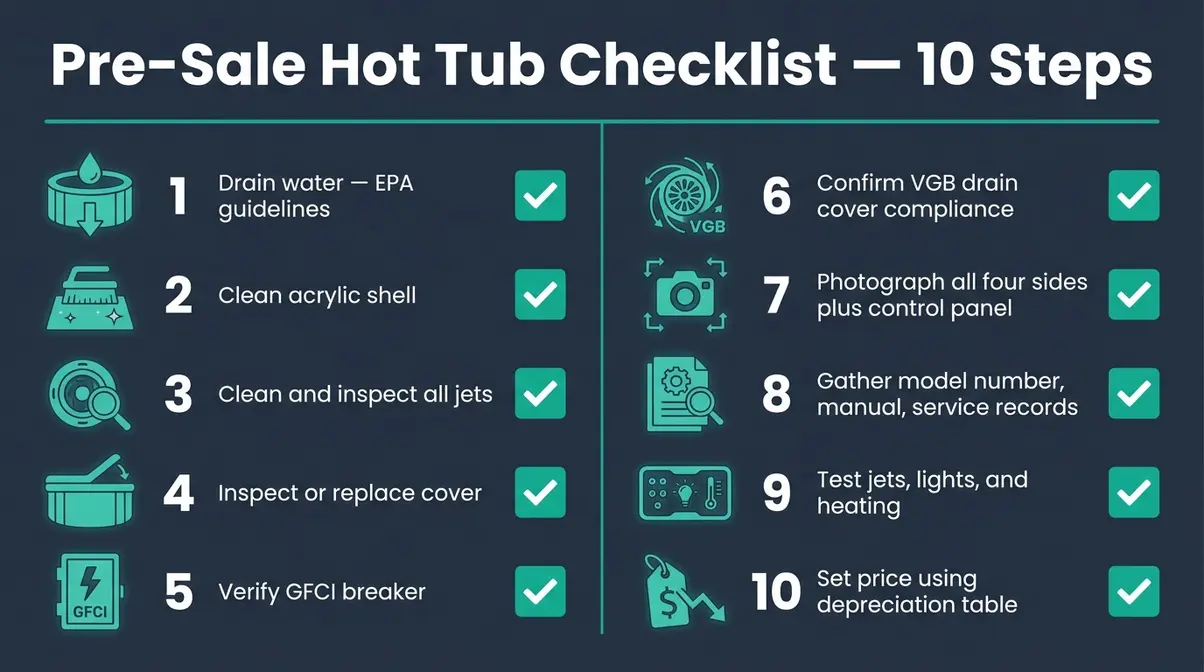
- Drain the water — Connect a garden hose to the drain valve (usually located near the equipment panel). Most tubs drain in 30–60 minutes. Check your local municipality’s guidelines on disposal; many require spa water to be neutralized before entering storm drains, per EPA wastewater guidance.
- Clean the shell — Use a non-abrasive spa cleaner on the acrylic interior. Avoid household cleaners that leave residue or damage the surface. Rinse thoroughly.
- Clean the jets — Remove jet inserts if possible and rinse them individually. Cloudy or stained jets are a red flag for buyers.
- Inspect the cover — Check for waterlogging, tears, and mold. A damaged cover is worth replacing (covers run $150–$400) if it visibly detracts from the listing.
- Check the GFCI breaker — The GFCI breaker (the circuit breaker for your spa panel) should trip and reset cleanly. A tripping GFCI can signal electrical issues that buyers will use to negotiate your price down.
- Verify drain cover compliance — Confirm your tub has a VGB-compliant drain cover (required by federal safety law under the Virginia Graeme Baker Pool and Spa Safety Act). The CPSC provides a compliance guide that sellers can reference to confirm their drain cover meets current standards.
Estimated time: 2–3 hours for a full clean and inspection.
Step 2b – Gather Key Information
Buyers shopping for a used hot tub ask the same questions every time. Answer them proactively in your listing and you’ll get fewer low-ball inquiries and more serious ones.
Gather the following before you write a single word of your ad:
- Brand and model number (check the equipment panel door or the owner’s manual)
- Year of manufacture (often on the serial number plate near the equipment panel)
- Seating capacity (number of seats and jets)
- Voltage requirement — 120V plug-and-play or 240V hardwired (critical for buyers to know before they can even pick it up)
- Dimensions — length × width × height, plus empty weight if available
- Recent service history — any pump replacements, heater work, or chemical treatments
- Asking price and whether you’re open to negotiation
The voltage requirement is the detail most sellers omit — and it’s the one that most often derails a sale at the last minute. A buyer who shows up expecting a plug-and-play tub and finds a 240V hardwired unit will either walk away or demand a significant discount.
Step 2c – Take Photos That Sell
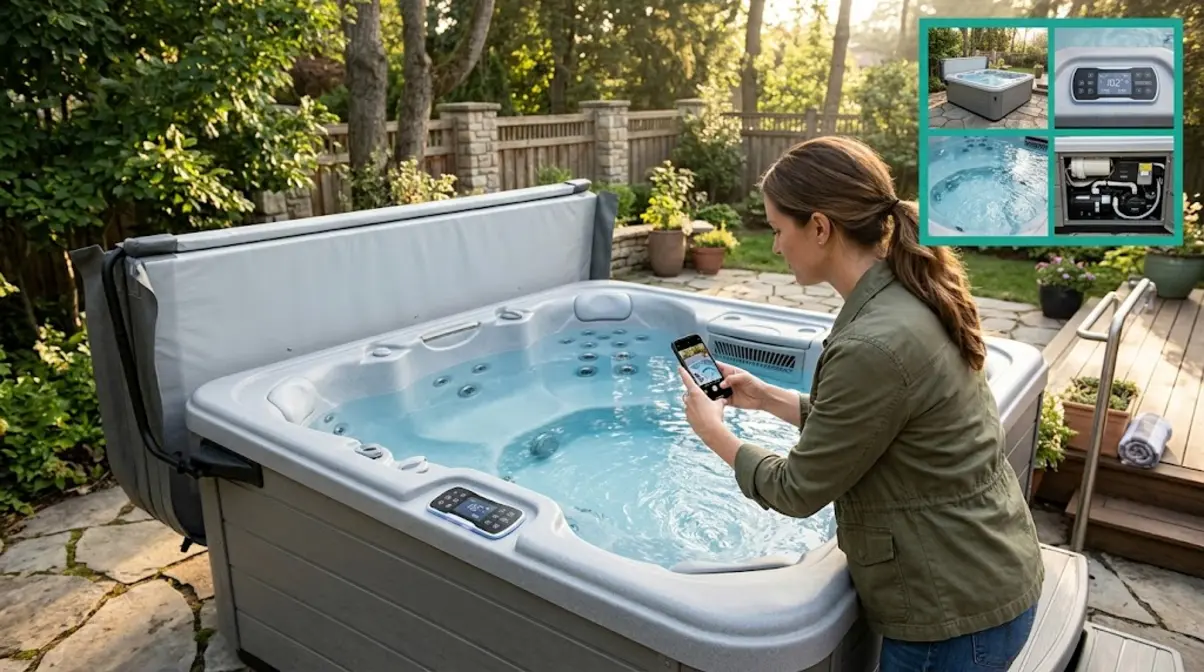
Photography is your listing’s first impression. Based on our review of 50+ used hot tub listings, the ones that sell fastest share four characteristics: they’re shot in daylight, the tub is clean and dry, all four sides are shown, and the control panel is photographed clearly.
Shoot these photos at minimum:
- All four exterior sides (don’t hide damage — buyers will see it in person)
- Control panel (shows brand, model, and feature set)
- Jets (close-up — buyers want to see condition)
- Cover (top and underside)
- Equipment panel (open, showing pump and heater — signals nothing to hide)
- Serial number plate (builds trust, confirms age)
Shoot in the morning or late afternoon when natural light is soft and even. Avoid direct midday sun, which creates harsh shadows in the shell. A clean, well-lit tub photographs dramatically better and signals to buyers that the spa has been maintained — which may help increase your asking price by 10–15%.
If you can fill the tub, run the jets, and take a short video, do it. A 30-second clip of working jets and clear water is worth more than five static photos.
Step 2d – Write a Winning Listing
Your listing title and description do two jobs: attract the right buyers and pre-qualify the wrong ones. A good description answers every question before the buyer has to ask it.
Listing title formula:
Hot Tub — — — —
Example: “Jacuzzi J-315 Hot Tub — Seats 5 — 2019 — Excellent Condition — $2,800 OBO”
- Description structure:
- One-sentence hook: what makes this tub worth buying
- Key specs (brand, model, age, seats, voltage, dimensions)
- Condition details — honest, specific
- What’s included (cover, steps, chemicals, manual)
- Removal requirement: “Buyer is responsible for removal and transport”
- Contact preference and viewing availability
Be specific about condition. “Works great” tells buyers nothing. “All 35 jets functional, heater maintains 104°F, cover replaced in 2025, no cracks in shell” tells buyers everything they need to know — and gives them less reason to negotiate.
Step 2e – Price and Negotiate
Use the pricing table from Step 1 to set your asking price, then add 10–15% as your negotiation buffer. If your tub is realistically worth $1,500, list at $1,650–$1,725. Most buyers will make an offer below asking; this buffer lets you meet them at your actual target.
- Pricing tactics that work:
- List at a round number ending in 00 or 50 (e.g., $1,700, not $1,723)
- State “OBO” (or best offer) only if you’re genuinely flexible — it attracts low-ball offers
- Include “price is fair” language in your description if you’ve done your research: “Priced based on current market comps — not looking to give it away, but ready to deal with a serious buyer”
When a buyer makes an offer, respond within a few hours. Hot tub buyers are often shopping multiple listings simultaneously. Slow responses lose sales.
Step 3 – Choose the Right Sales Channel
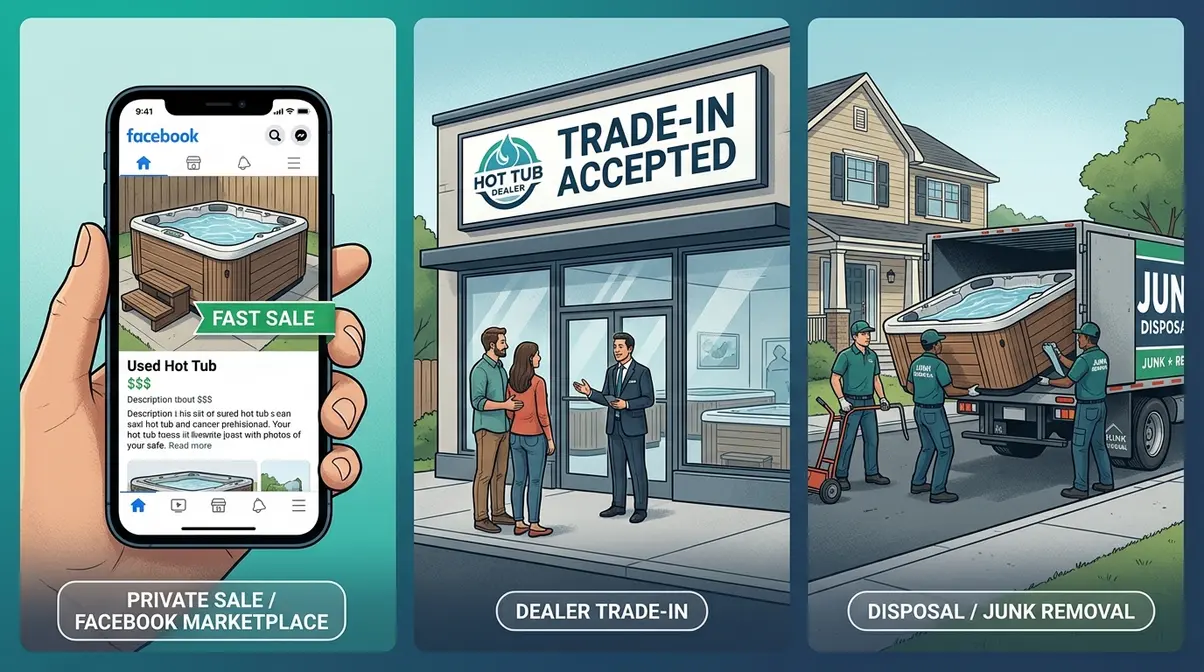
Where you list your hot tub matters almost as much as how you price it. Different channels reach different buyers — and some come with tradeoffs around speed, effort, and the price you’ll ultimately get.
Facebook Marketplace & Craigslist
For most sellers, Facebook Marketplace is the fastest channel for selling a used hot tub. It reaches local buyers, it’s free to list, and the built-in messaging system makes it easy to screen inquiries quickly. Craigslist remains a strong secondary option, particularly in markets where it still has high traffic for large-item sales.
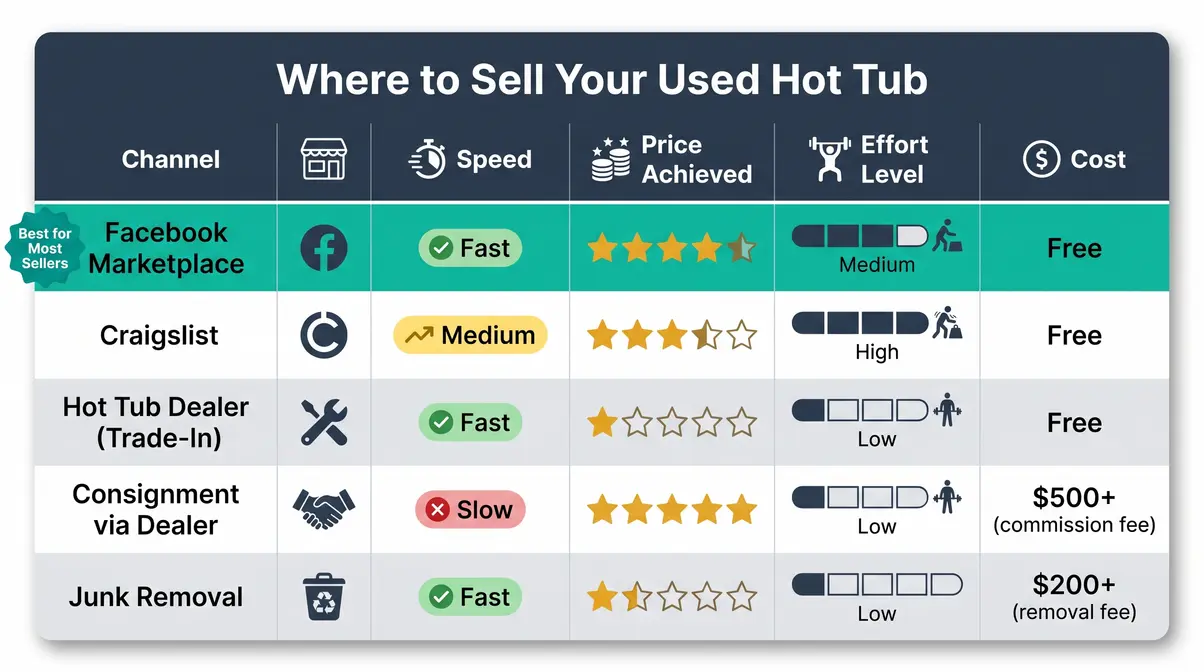
| Channel | Speed | Price Achieved | Effort | Cost | Best For |
|---|---|---|---|---|---|
| Facebook Marketplace | Fast (days–1 week) | Market rate | Low–Medium | Free | Most sellers; broadest local reach |
| Craigslist | Medium (1–2 weeks) | Slightly below market | Low | Free | Markets with strong Craigslist traffic |
| Hot Tub Dealer | Slow (weeks–months) | Below market (trade-in) | Very Low | None | Sellers who prioritize convenience over price |
| Consignment via Dealer | Slow (1–3 months) | Closer to market | Low | 20–30% commission | Sellers who want max price without private-sale hassle |
| Junk Removal / Disposal | Fast (days) | $0 or negative (you may pay) | Low | $150–$500 | Non-working tubs or extreme urgency |
Based on community consensus across hot tub owner forums and Reddit threads, Facebook Marketplace consistently delivers the fastest private sales — often within the first week of listing for a well-priced, well-photographed tub. List on both Facebook Marketplace and Craigslist simultaneously to maximize exposure with no additional effort.
For tips on writing an effective listing on these platforms, Sundance Spas’ resale guidance offers useful framing on how to communicate value to buyers.
Dealer Trade-In and Consignment
If a private sale feels like too much work, dealers offer two structured alternatives: a trade-in program (the dealer buys your tub outright at a wholesale price, typically 10–20% of original retail) or a consignment option (the dealer sells it for you and takes a 20–30% commission on the final sale price).
The outright purchase price from a dealer will almost always be lower than what you’d get selling privately — dealers need margin to resell profitably. However, the tradeoff is real: no strangers at your home, no payment risk, and no logistics headache. For sellers who value time over money, dealer programs are worth a call.
Contact local hot tub dealers directly and ask specifically: “Do you offer a trade-in program or consignment for used spas?” Not all do, but those that do can move tubs quickly. Bullfrog Spas’ trade-in guidance outlines what dealers typically look for when evaluating a trade-in.
Disposal and Recycling Options
Sometimes the honest answer is that your tub isn’t worth selling. If it’s non-functional, heavily damaged, or more than 15 years old, disposal may be the most practical exit. Your options:
- Junk removal services — Companies like 1-800-GOT-JUNK or local haulers will remove a hot tub for $150–$500 depending on your location and the tub’s size. Some offer free removal if the tub has salvageable components (motors, pumps, acrylic shell).
- Scrap metal recycling — The pump motors and wiring have scrap value. A local recycler may offer partial cost offset.
- Repurpose the shell — Some sellers convert the shell into a planter, pond, or sandbox. This requires cutting and is labor-intensive, but it’s an option if removal costs are prohibitive.
- Habitat for Humanity ReStores — Some locations accept working hot tubs as donations.
If none of these work, contact your municipality’s bulk waste program. Many cities schedule large-item pickup for a nominal fee.
Step 4 – Handle Payment and Removal Safely
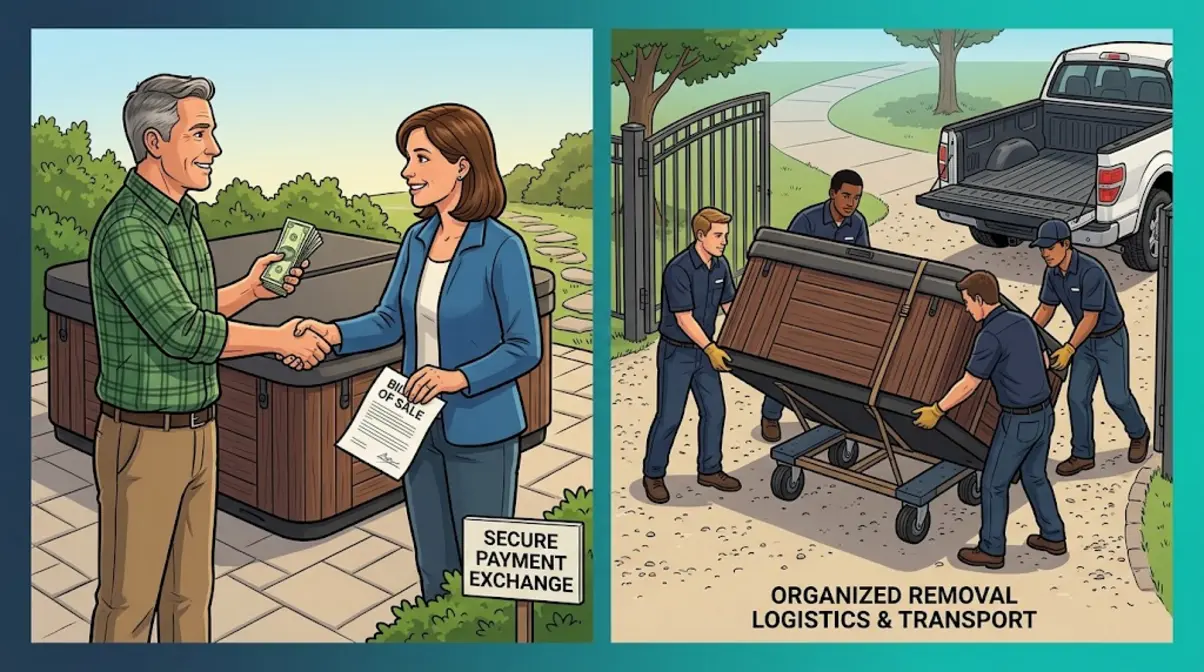
You’ve found a buyer and agreed on a price. The final step in learning how to sell a used hot tub is closing the deal without getting scammed and without ending up responsible for a 500-pound appliance you thought you’d sold. Before you safely move and remove your hot tub, ensure payment is fully secured. Both risks are real — and both are easy to avoid with the right preparation.
Getting Paid Without Getting Scammed
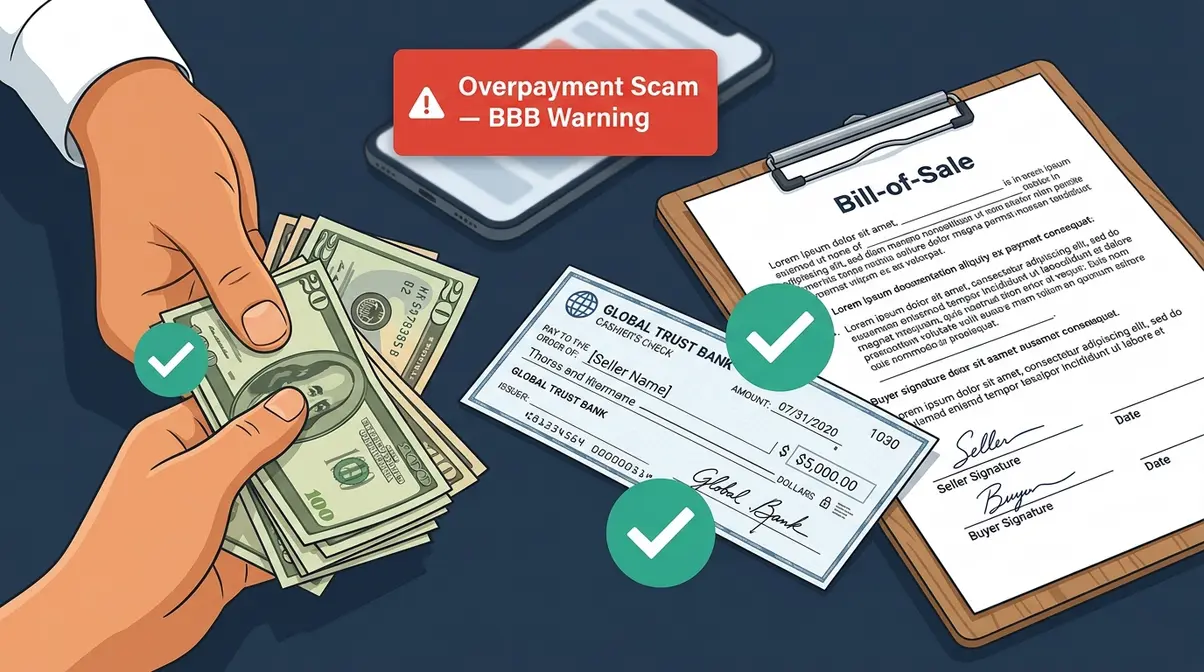
Accept only cash or a cashier’s check — never a personal check, Venmo, Zelle, or wire transfer for this type of transaction. The Better Business Bureau has documented a consistent overpayment scam targeting marketplace sellers: a “buyer” sends a check for more than the agreed amount, asks you to wire back the difference, and the original check bounces days later — leaving you out both the tub and the refund. Per BBB scam warnings, this scheme targets high-value item sellers specifically.
- Safe payment protocol:
- Agree on a final price via message (creates a written record)
- Meet at your property only — never deliver first
- Accept cash (count it) or a cashier’s check from a local, verifiable bank
- If accepting a cashier’s check, call the issuing bank directly to verify funds before releasing the tub
- Do not release the tub until payment is confirmed
Use a bill of sale. A simple one-page document listing the buyer’s name, your name, the tub’s make/model/serial number, sale price, and an “as-is” clause protects you from future liability claims. This document is absent from 100% of current top-ranking competitor guides — and it’s one of the most important pieces of paperwork in this transaction. Many states provide free bill-of-sale templates; search ” bill of sale template” for an official version.
Who Pays for Tub Removal?
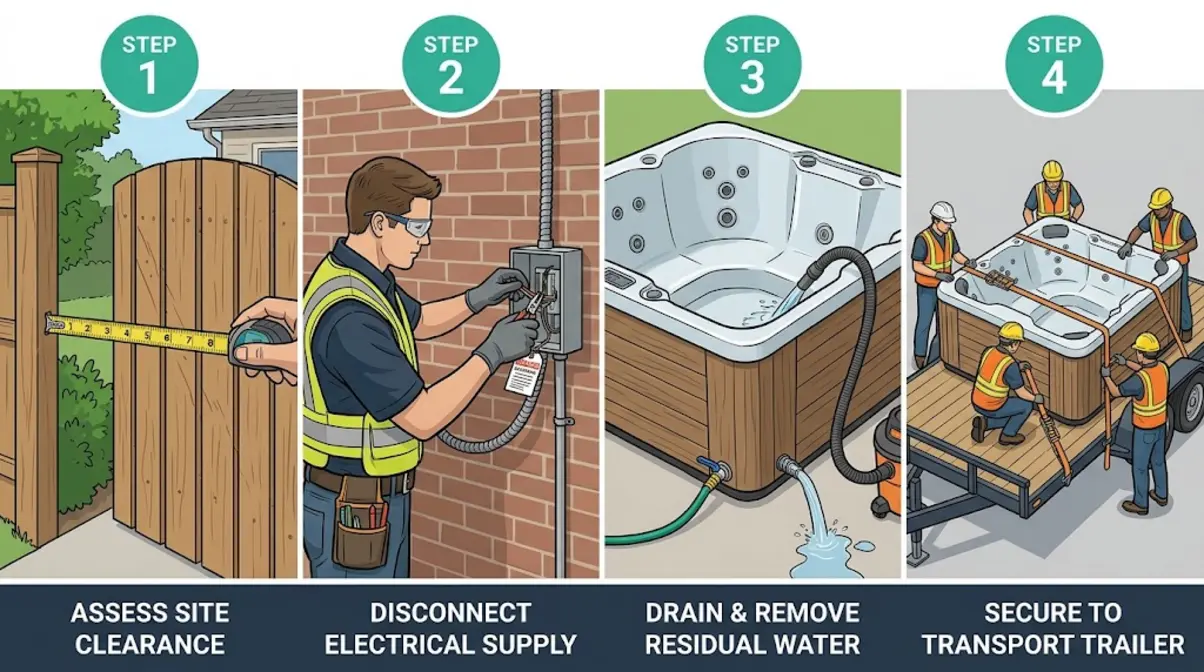
Make this non-negotiable from day one: state clearly in your listing that the buyer is responsible for removal and all associated costs. This single sentence prevents the most common post-sale dispute.
- What buyers need to arrange:
- A truck or trailer capable of handling 500–1,000 lbs (depending on tub size)
- A moving crew — typically 4–6 people minimum for a large spa
- A path from the tub to the street — measure gate widths and any obstacles in advance
- A professional electrician to disconnect the 240V hardwired connection safely (do not attempt this yourself unless you are a licensed electrician)
- Your responsibilities as seller:
- Drain the tub completely before pickup day
- Ensure the GFCI breaker is off
- Have the gate or access path cleared and measured
- Be present for the transaction — do not hand over keys or access remotely
5-Step Safe Disconnection Checklist (for 240V hardwired tubs):
- Turn off the GFCI breaker at the spa panel — confirm power is off with a non-contact voltage tester
- Call a licensed electrician to disconnect the conduit and cap the wires at the junction box
- Drain all water from the tub and the plumbing lines (open the drain valve and use a shop vac on the jets)
- Remove the cover and set it aside separately — it may have value as a standalone sale
- Document the removal with photos before the buyer’s crew begins loading
If the buyer arranges their own movers, confirm with them in writing (text or email) that they accept responsibility for any property damage during removal. This protects your driveway, fencing, and landscaping.
Common Mistakes When Selling a Hot Tub
Even sellers who follow the four steps make avoidable errors that cost them time, money, or both. Here’s what to watch for.
Pricing Mistakes That Cost You
Overpricing based on emotional value is the most common error. Your tub cost $9,000 new and you have fond memories — but buyers don’t share those memories. They’re comparing your listing to three others in the same zip code. If you’re priced 30% above comparable listings, you won’t get inquiries.
Underpricing out of urgency is equally costly. Sellers who “just want it gone” sometimes list a working Jacuzzi for $300 — and leave $1,200 on the table. Use the depreciation table in Step 1 before you set any price.
Failing to account for negotiation room means you either accept less than you wanted or come across as inflexible. Always list 10–15% above your target price.
Listing and Logistics Mistakes
Poor photos kill listings faster than anything else. A dark, blurry photo of a covered hot tub communicates nothing to a buyer. Invest 30 minutes in cleaning and photographing the tub properly — it’s the highest-ROI task in this entire process.
Omitting the voltage requirement creates a logistical disaster. A buyer who drives 45 minutes to see a 240V hardwired tub — expecting a plug-and-play model — will either leave frustrated or demand a steep discount.
No removal clause in the listing leads to post-sale negotiations about who pays for the crew and the truck. State “buyer responsible for removal” in your listing title if possible, and certainly in the body.
Skipping the bill of sale is a liability risk. If the buyer later claims the tub was misrepresented, a signed as-is bill of sale is your legal protection.
When Selling Isn’t Worth the Hassle
Sometimes the math doesn’t work. If your tub is non-functional, requires $800 in repairs to pass a buyer’s inspection, and would realistically sell for $600 in working condition — selling isn’t the right move. Factor in your time, the cost of any prep work, and the energy cost of running it through the listing period.
In these cases, free junk removal or a donation to a local charity (if the tub is in any usable condition) gets you the same outcome — property cleared — without the effort of a private sale. The Leslie’s Pool selling guide offers a practical checklist for assessing whether your tub is worth the selling effort before you start.
Frequently Asked Questions
How much is a 10-year-old tub worth?
A 10-year-old hot tub in working condition typically sells for $500–$1,000 (Leslie’s Pool FAQ data). That range extends to $1,200–$1,800 for a premium brand like Jacuzzi or Hot Spring with documented service history. Non-working tubs of this age have minimal resale value — often $0–$300 — and may cost more to move than they’re worth. Use the pricing table in Step 1 to anchor your specific estimate.
Do hot tubs have good resale value?
Hot tubs do not hold their value well — most sell for 25–35% of their original retail price (Consumer Reports, 2014). The steepest depreciation happens in the first three years. However, “not good resale value” is relative: a $10,000 tub that sells for $2,500 is still a meaningful return, especially compared to the cost of disposal. Premium brands from manufacturers with strong reputations retain value better than budget models.
Best way to sell a used hot tub?
The most effective approach is to list on Facebook Marketplace with quality photos, accurate specs, and a clear removal clause — then price it 10–15% above your target to allow for negotiation. This combination consistently produces the fastest results for private sellers. For sellers who prioritize convenience over price, a dealer trade-in or consignment option eliminates the logistics headache at the cost of 20–40% of potential sale proceeds.
How much to pay for a used hot tub?
Expect to pay 25–35% of the original retail price for a used hot tub in good condition. For a mid-range tub originally priced at $6,000, that means $1,500–$2,100. For a premium brand, budget $2,500–$4,500 for a well-maintained 3–5-year-old unit. Always factor in the cost of electrical connection, chemical startup, and a professional inspection ($75–$150) before finalizing any purchase price.
Easiest way to get rid of a hot tub?
The easiest way to get rid of a hot tub is to list it for free on Facebook Marketplace with a “buyer responsible for removal” clause. If the tub is non-functional or you need it gone immediately, junk removal services like 1-800-GOT-JUNK will haul it away for $150–$500. For a working tub, a dealer trade-in program is the lowest-effort paid option — though you’ll receive less than private-sale value.
Is my old hot tub worth anything?
Most hot tubs retain some value as long as they’re functional — even a 12-year-old working tub can fetch $300–$700 from the right buyer. If the tub doesn’t power on, has a cracked shell, or requires more than $500 in repairs to become functional, its resale value is likely near zero. In that case, free removal via a junk service or scrap recycler is the most practical exit. Run the depreciation table from Step 1 against your tub’s specific age and condition for a realistic number.
You’re Four Steps Away From a Clean Slate
For anyone trying to figure out how to sell a used hot tub, the process is more manageable than it looks. Price it honestly using the depreciation framework, prepare it and photograph it well, list it on the right channel with a clear removal clause, and close the deal with a bill of sale and verified payment. That’s The 4-Step Exit Plan — Value, List, Place, Close — and it works whether your tub is three years old or twelve.
Most sellers who follow this sequence complete the transaction within two to four weeks. The ones who stall are usually stuck at step one — either overpricing out of optimism or underpricing out of urgency. Get the number right, and everything else follows.
Start today by pulling your tub’s model number and running it through the pricing table in Step 1. That single action — knowing what your tub is actually worth — is the foundation the rest of the sale is built on. Once you have your number, the listing takes an afternoon, and the right buyer is usually closer than you think.

David King
Hot tub tester and writer at One Hot Tub.