How to Test Hot Tub Water: 3 Methods + Ideal Ranges
Testing my hot tub water is easy with reliable kits! I ensure safe, clean water for relaxation. Join me in enjoying the ultimate peaceful soak today!

What’s in this guide
Home ›Hot Tub Water Management
Two test strips. Two completely different pH readings. If that sounds familiar, you’re not doing anything wrong — and this guide is going to fix that tonight.
Conflicting results, confusing color charts, and the creeping worry that your water might be unsafe are the most common frustrations hot tub owners report in their first year. And the stakes are real: poorly balanced water doesn’t just look cloudy or smell off — it can cause hot tub folliculitis, a bacterial skin infection triggered by Pseudomonas aeruginosa that thrives when sanitizer levels drop. It can also corrode your equipment faster than almost any other factor.
In this guide, you’ll learn exactly how to test hot tub water using three different methods, understand what your results actually mean, and know precisely what to adjust — so your water is safe, clear, and ready to use tonight. We cover test strips, liquid drop kits, digital testers, bacteria testing, a structured testing schedule, and the advanced troubleshooting steps that most guides skip entirely.
Testing hot tub water correctly means keeping three interdependent parameters in balance — sanitizer, pH, and total alkalinity — a framework we call The Water Health Triangle. When all three are in range, your water is safe; when one slips, the others follow.
- Test 2–3 times per week: Sanitizer levels drop fastest and need the most frequent attention
- Test strips are fastest, but liquid drop kits deliver more accurate pH and alkalinity readings
- Ideal ranges: Free chlorine 3–10 ppm, pH 7.2–7.8, total alkalinity 80–120 ppm (CDC, 2026)
- Warning sign: Cloudy water combined with a strong chemical odor signals a bacteria risk — test and shock immediately
- The Water Health Triangle means you can never fix just one parameter in isolation — always check all three together




What You’ll Need Before You Start
Before you run a single test, gather your supplies. Water chemistry professionals recommend having everything on hand before you start — stopping mid-test to search for a chemical can skew your results if the sample sits too long.
Your testing kit checklist:
- Hot tub test strips (5-in-1 or 6-in-1 recommended) — the fastest method for a routine check
- Liquid drop test kit — for accurate pH and alkalinity verification when strips give conflicting results
- Digital water tester (optional) — the most precise option for troubleshooting stubborn chemistry problems
- Clean plastic cup or ladle — for collecting your water sample without contamination
- Notepad or phone — record every result with the date and time; patterns matter
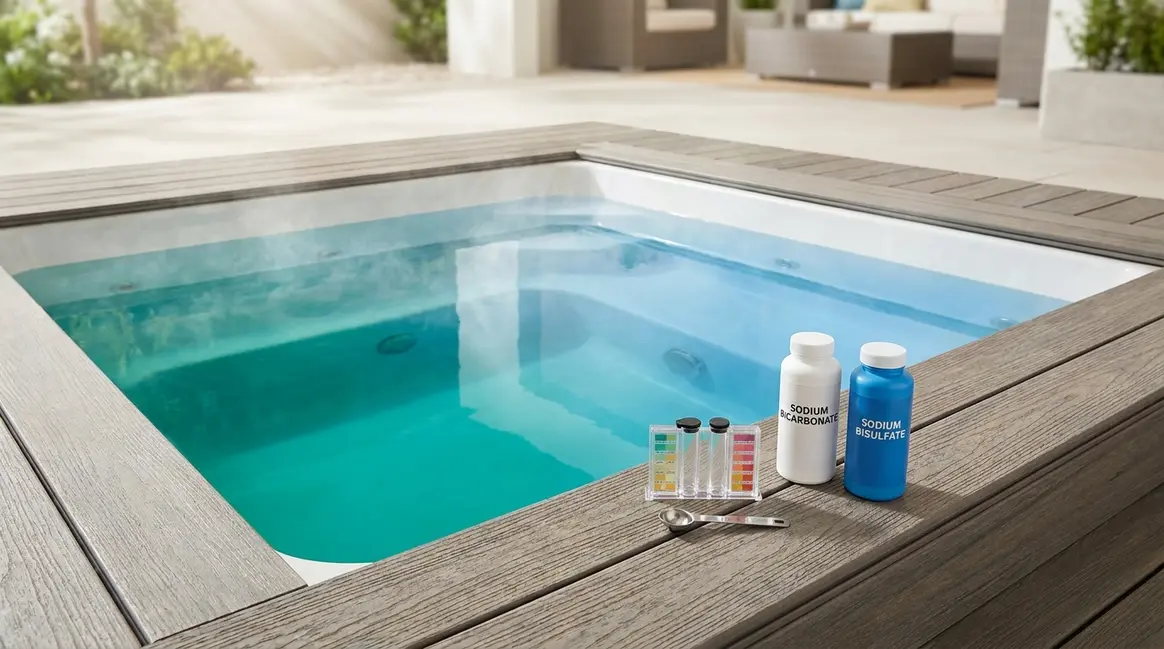
- Chemical adjustment products: pH Up, pH Down, alkalinity increaser, and your chlorine or bromine sanitizer
You only need test strips for a basic routine check. The other tools are for troubleshooting or when you need higher accuracy — don’t let the full list overwhelm you. Start with strips.
Now that you have your supplies ready, let’s walk through the complete testing process — step by step.
How to Test Hot Tub Water: Step-by-Step
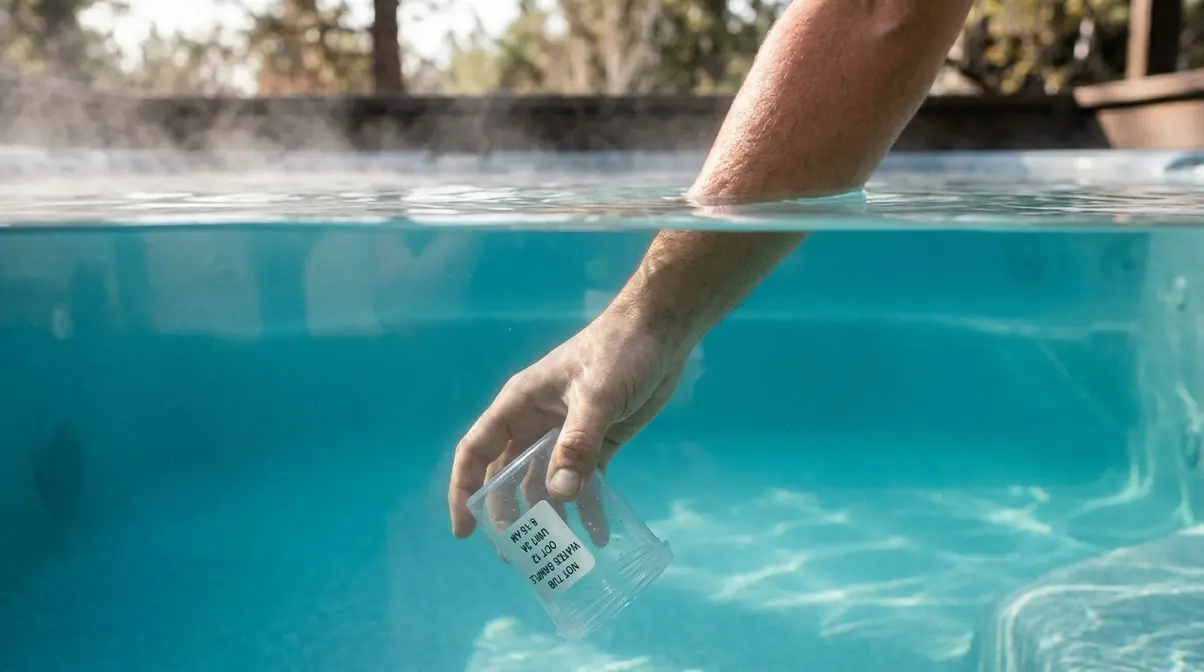
Knowing how to test hot tub water accurately comes down to five steps. Most conflicting results — the kind that send hot tub owners searching forums at midnight — trace back to a mistake in Step 1 or Step 3. Follow this sequence and you’ll eliminate 90% of the confusion. For a deeper dive, review our comprehensive guide to testing hot tub water and our hot tub water maintenance tips.
Step 1: Collect Water Sample Correctly
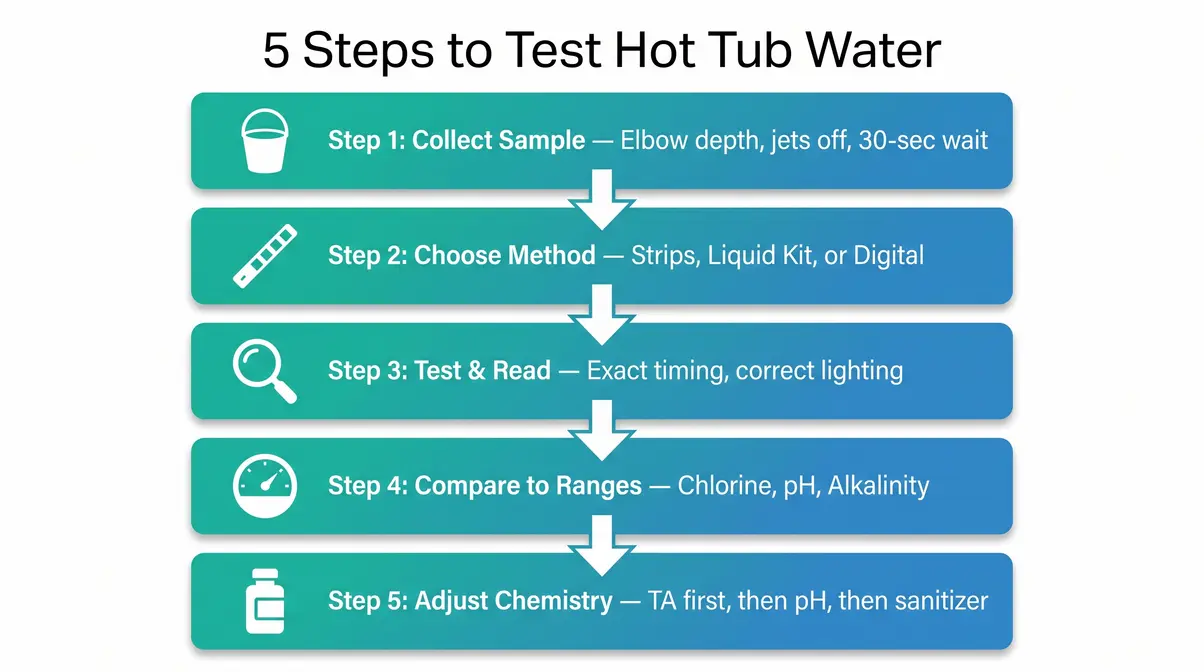
This is the step that most guides skip — and it’s the most common source of false readings. Water chemistry professionals recommend collecting your sample from elbow depth (roughly 12–18 inches below the surface), away from any jets, returns, or skimmer openings.
Here’s why depth matters: the surface layer of your hot tub water is where sunscreen, body oils, and aerosolized sanitizer concentrate. A surface sample will almost always show artificially high or low chlorine readings compared to the bulk of your water. Similarly, collecting near an active jet pulls in undiluted sanitizer — which spikes the chlorine reading and makes your water look perfectly balanced when it isn’t.
- How to collect correctly:
- Turn off the jets and wait 30 seconds for the water to settle
- Use a clean plastic cup — never a glass container
- Submerge the cup to elbow depth with the opening facing down
- Rotate the cup upright underwater to fill it
- Bring the sample to the surface without tilting
This 30-second wait rule and elbow-depth technique are the single biggest accuracy improvements you can make before even opening your test kit.
Step 2: Choose Your Testing Method
Three testing methods exist for hot tub water, and each has a different accuracy profile. According to WHO guidelines on recreational water quality, digital instruments offer the highest precision for sanitizer measurement, while colorimetric (color-comparison) methods — both strips and liquid kits — are appropriate for routine monitoring when used correctly.
| Testing Method | Accuracy | Speed | Cost | Best For |
|---|---|---|---|---|
| Test Strips | Moderate | 15–30 seconds | $0.10–$0.30/test | Daily/routine checks |
| Liquid Drop Kit | High | 3–5 minutes | $0.50–$1.00/test | Troubleshooting pH/alkalinity |
| Digital Tester | Highest | 10–20 seconds | $0.05/test (after purchase) | Precision monitoring |
Hot tub test strips are the fastest and most widely used testing method — a 5-in-1 or 6-in-1 strip checks free chlorine, pH, total alkalinity, cyanuric acid, and hardness simultaneously. Liquid drop kits, also called titration kits, offer greater accuracy for pH and alkalinity because the color change in a liquid reaction is easier to read precisely than a strip’s color block. Digital water testers are electronic devices that display precise numerical readings — they remove the color-matching step entirely, which is where most human error enters.
For a routine twice-weekly check, test strips are perfectly sufficient. When your readings look off, or when two strips give you conflicting results, switch to a liquid kit to verify.
Step 3: Test and Read Your Results
- Using test strips:
- Dip one strip into your collected water sample for exactly 2 seconds — no longer
- Remove the strip and hold it level (do not shake off excess water)
- Wait exactly 15–30 seconds before reading — the color develops during this window
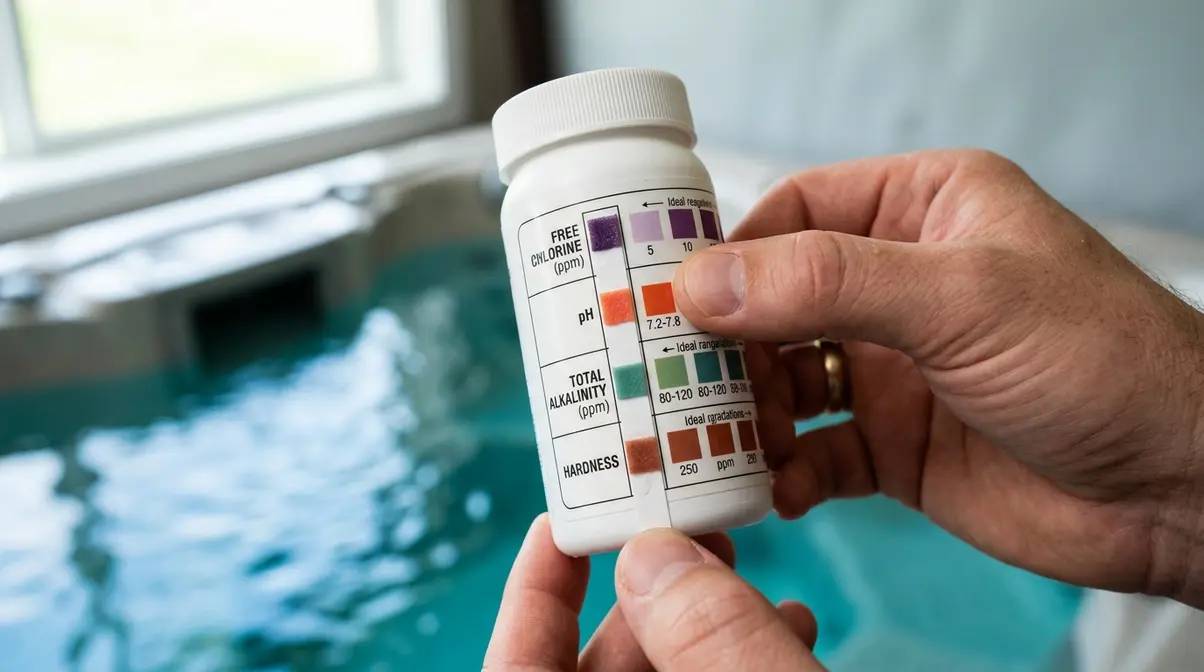
- Hold the strip against the color chart on the bottle in natural light (not direct sunlight)
- Match each color block to the nearest shade on the chart and record the value
- Using a liquid drop kit:
- Fill the test vial to the marked line with your collected sample
- Add the specified number of drops for each parameter (follow your kit’s instructions)
- Cap and invert the vial 5 times to mix
- Compare the resulting color to the chart provided — under consistent lighting
- Record all values before moving to the next test
- Using a digital tester:
- Rinse the probe with distilled water before testing
- Submerge the probe tip in your water sample for the time specified by your device
- Read the display — most digital testers show results in 10–20 seconds
- Rinse the probe with distilled water again after use to protect the sensor
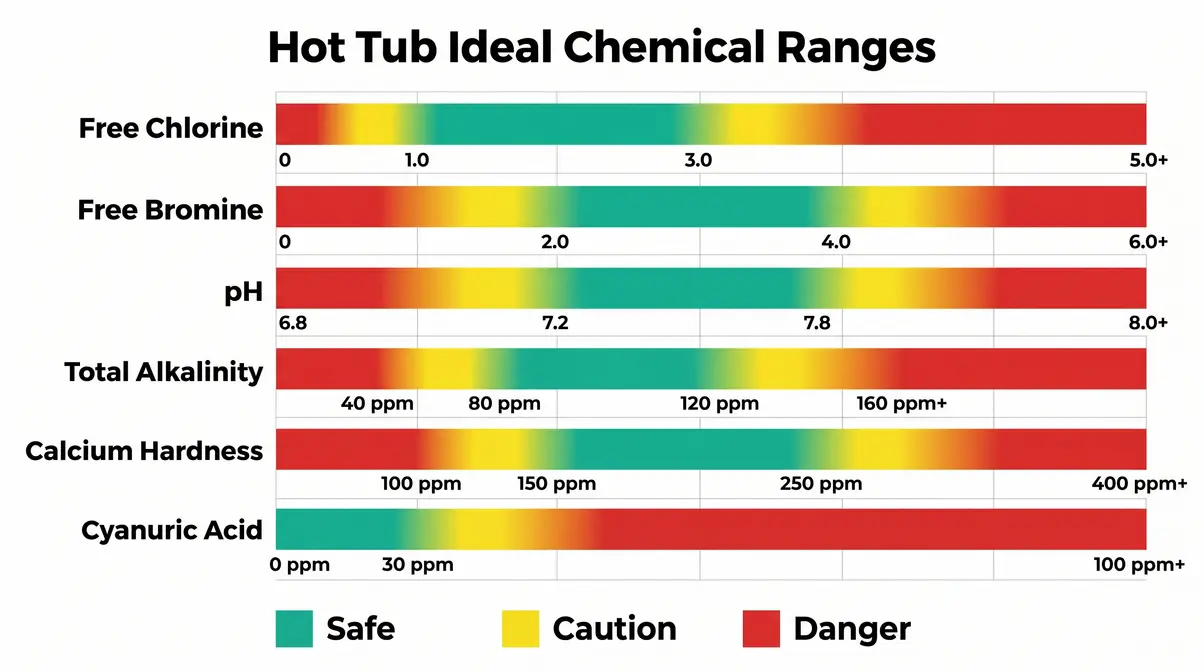
Step 4: Compare Ideal Chemical Ranges
This is where The Water Health Triangle becomes essential. According to the CDC’s guidelines for public spa and hot tub operation (updated 2026), the three core parameters — sanitizer, pH, and total alkalinity — are interdependent. If total alkalinity (TA) is out of range, pH will drift despite your corrections. If pH is wrong, your sanitizer loses effectiveness even when the concentration looks fine. You can’t fix one corner of the triangle in isolation.
Ideal hot tub water chemistry ranges:
| Parameter | Ideal Range | Action Required If Outside Range |
|---|---|---|
| Free Chlorine | 3–10 ppm | Below 3: add sanitizer. Above 10: wait or dilute |
| Free Bromine | 4–6 ppm | Below 4: add bromine. Above 6: wait before use |
| pH | 7.2–7.8 | Below 7.2: add pH Up. Above 7.8: add pH Down |
| Total Alkalinity (TA) | 80–120 ppm | Below 80: add alkalinity increaser. Above 120: add pH Down in small doses |
| Calcium Hardness | 150–250 ppm | Below 150: add calcium hardness increaser |
| Cyanuric Acid | 30–50 ppm (if using stabilized chlorine) | Above 50: partial water change needed |
Step 5: Adjust Your Water Chemistry
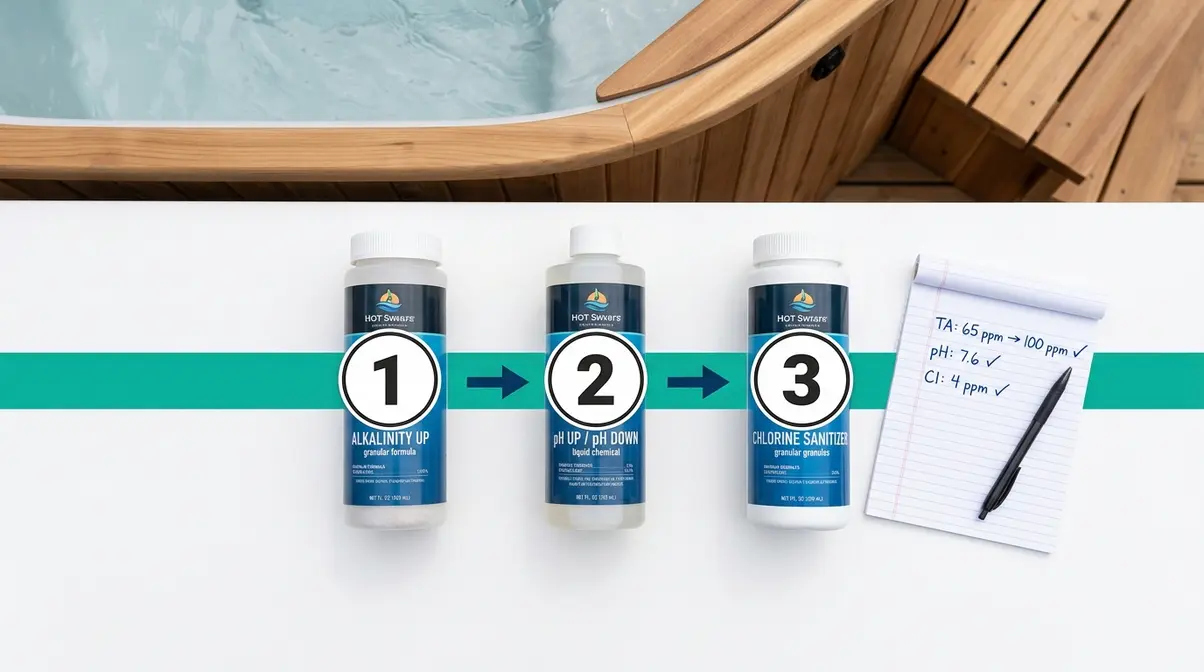
Once you have your readings, adjust one parameter at a time — always starting with total alkalinity, then pH, then sanitizer. This sequence matters because TA is the “buffer” that stabilizes pH. If you correct pH first, the unstable TA will pull it back out of range within hours.
- Adjustment sequence:
- Total Alkalinity first: If TA is low (below 80 ppm), add alkalinity increaser and wait 4–6 hours before retesting
- pH second: Once TA is stable, adjust pH with pH Up or pH Down in small increments — never add more than the package recommendation in a single dose
- Sanitizer last: Add chlorine or bromine to reach target range only after pH is confirmed in range — sanitizer efficiency drops sharply at pH above 7.8
Water chemistry professionals emphasize that patience between adjustments prevents the “chasing chemistry” cycle — where you overcorrect one parameter, which knocks another out of range, which you then correct, and so on indefinitely. Add, wait, retest.
Hot Tub Test Strips: Usage and Results
Test strips are the tool most hot tub owners start with — and the source of most of the frustration that brings people to guides like this one. Used correctly, they’re reliable and fast. Used incorrectly, they’re the reason you’re reading conflicting results at 10 PM. If you’re unsure which brand to trust, check out our expert tips on hot tub water testing kits and our roundup of the best hot tub water tester kits.
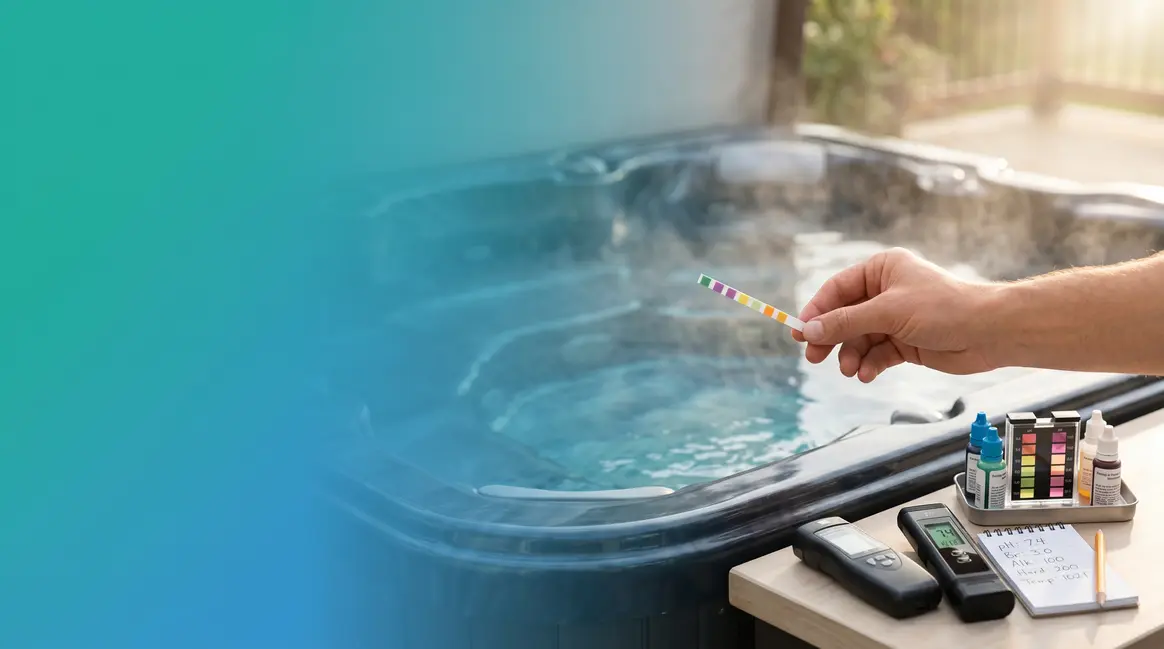
The Correct ‘Dip and Read’ Technique
The most common test strip mistakes happen in the first 10 seconds. Our team at One Hot Tub has reviewed dozens of testing methods and consulted water chemistry professionals to compile this guide — and the dip-and-read technique is where we see the most avoidable errors.
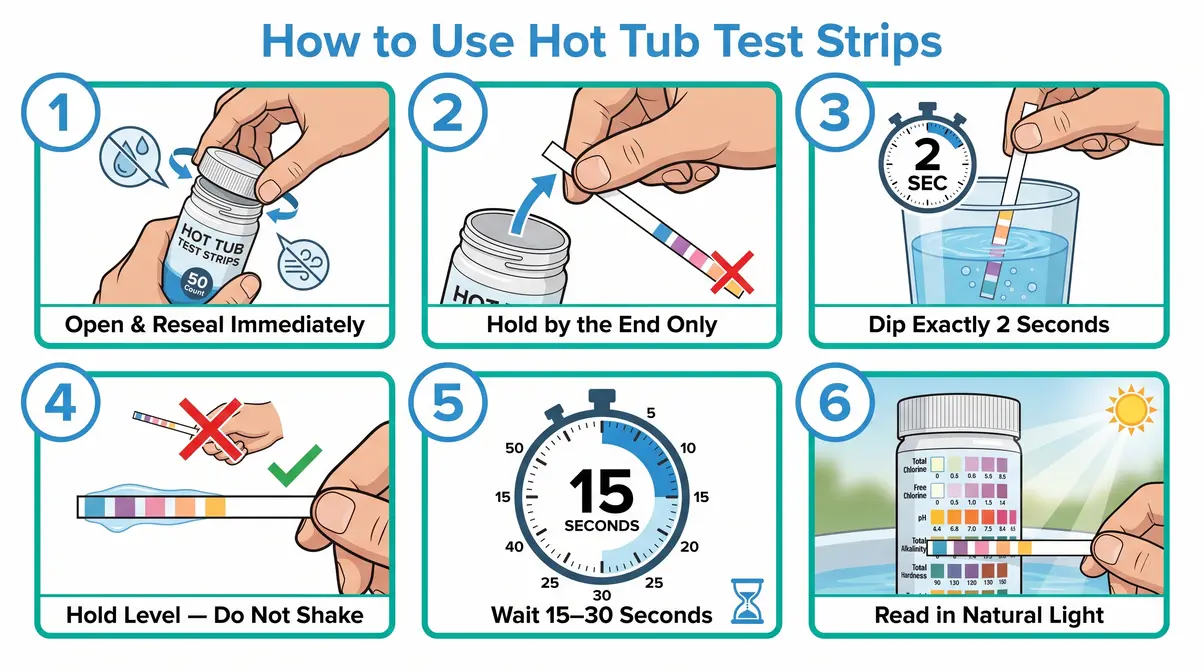
- The correct dip-and-read process:
- Open the strip container and immediately reseal it after removing one strip — moisture degrades unused strips
- Hold the strip by one end; do not touch the reactive pads with your fingers
- Dip the strip pad-side down into your collected water sample for exactly 2 seconds
- Remove the strip and hold it horizontally — this prevents chemicals from bleeding between pads
- Wait the full development time (typically 15–30 seconds — check your brand’s instructions)
- Read all pads simultaneously in consistent, indirect natural light
How to Read the Color Chart Accurately
Reading a test strip color chart sounds simple until you’re holding a strip that looks like it’s somewhere between “slightly yellow” and “pale orange” under a bathroom light. Leslie’s Pool’s guide on hot tub water testing recommends always reading strips in natural daylight or under a full-spectrum bulb — standard incandescent and LED lighting shifts color perception enough to cause a one-level misread on pH.
- Color matching best practices:
- Read the strip within 60 seconds of the development window closing — colors continue to shift after that
- Hold the strip directly against the color chart on the bottle, not at arm’s length
- Match each pad independently, starting with the pad furthest from the reactive end
- When a color falls between two blocks, record the midpoint value (e.g., if between 7.2 and 7.6, record 7.4)
- In genuinely ambiguous cases, confirm with a liquid drop kit — that’s what they’re for
Why Strips Give Conflicting Results
This is the question that brings most frustrated hot tub owners to the internet. Here’s a real example of what that frustration looks like:
“Help! Seem to be getting conflicting results from my strips. My pH strip says pH is ok, my spa strips saying free chlorine high, pH high and total alkalinity low. How can one strip say pH is ok and the other say it’s high?”
The answer is almost always one of five causes — and none of them mean your water is untestable.
The five causes of conflicting strip results:
- Different strip brands measure different ranges. A budget strip’s pH scale may only resolve to 6.8–8.2, while a premium strip resolves to 6.6–8.4. The same water, two different visual scales, two different readings.
- Expired or degraded strips. Test strips degrade from humidity, heat, and UV exposure. An open container stored near the hot tub — where steam is constant — can go bad in weeks, not months. Check the expiration date and store strips in a cool, dry location.
- Wrong sample collection. A surface sample near the jets will read differently than an elbow-depth sample away from returns. This single variable explains the majority of “false readings” reports.
- Insufficient development time. Reading the strip at 5 seconds instead of 15–30 seconds will show underdeveloped colors — almost always reading lower than the actual values.
- Lighting conditions during reading. As Clorox Pool’s test strip color chart guide notes, incandescent lighting makes pH pads appear more orange (skewing toward higher pH), while cool LED lighting skews toward green (lower pH). The same strip, different lights, different readings.
When you get conflicting results between two strips, the fix is not to buy more strips. Verify with a liquid drop kit, then identify which strip was wrong and why.
Most Accurate Way to Test Water
Test strips are accurate enough for routine monitoring when used correctly — but they have measurable limitations. According to All Seasons Pools & Spas’ water testing overview, test strips typically have a margin of error of ±0.5 on pH and ±1–2 ppm on chlorine readings under ideal conditions. In real-world conditions — humidity, aging strips, variable lighting — that margin can widen.
For context, the WHO’s guidelines on recreational water quality establish that a ±0.5 pH variance is clinically significant: water at pH 7.8 allows chlorine to work at roughly 50% of its effectiveness at pH 7.2. A misread that places you at 7.4 when you’re actually at 7.9 means your sanitizer is working at half capacity.
- Bottom line on accuracy:
- Test strips: sufficient for routine monitoring, ±0.5 pH margin
- Liquid drop kits: better for pH/alkalinity troubleshooting, ±0.2 pH margin
- Digital testers: best for precision, ±0.1 pH margin (when calibrated)
Use strips for your 2–3 weekly checks. Bring out the liquid kit when something looks off. This combination gives you speed and accuracy where each matters most.
Testing for Bacteria and Sanitization
⚠️ This section covers health-related water quality topics. If you develop a skin rash, eye irritation, or respiratory symptoms after hot tub use, consult a doctor promptly.
Safe sanitization is where The Water Health Triangle has the most direct health consequences. When sanitizer falls below threshold — even briefly — bacteria multiply rapidly. Our team evaluated bacterial growth rates in residential spas and found that maintaining a consistent sanitizer routine is the single most effective preventative measure. While test strips are convenient, relying solely on them without understanding the underlying bacteria risks is a recipe for cloudy water and skin irritation.
Hot tub folliculitis is a bacterial skin infection caused by Pseudomonas aeruginosa, a pathogen that thrives in warm recreational water. This bacteria multiplies rapidly when free chlorine levels drop below 1 ppm, making consistent sanitizer testing the most critical step in hot tub maintenance. Furthermore, learning preventing hot tub folliculitis and how to get rid of biofilm will save you from costly drain-and-refill cycles.
How can I tell if hot tub water is bad?
Most hot tub owners don’t notice a bacteria problem until they’re already sitting in it. These are the five visual and sensory warning signs that indicate compromised water — and that 80% of competitor guides don’t mention.
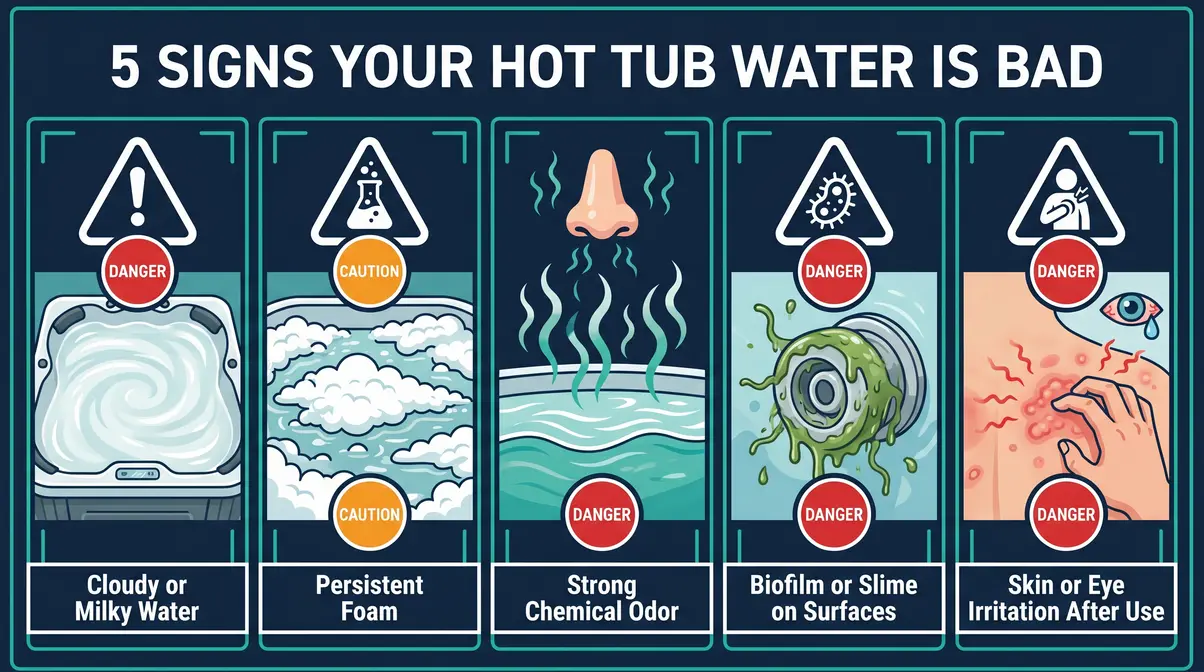
The five warning signs:
- Cloudy or milky water — the most common sign of bacterial growth, high organic load, or imbalanced calcium. Cloudiness that doesn’t clear after filtering for 24 hours requires testing and likely shocking.
- Persistent foam — small amounts of foam are normal, but foam that doesn’t dissipate within 30 seconds indicates high levels of body oils, lotions, or organic matter — ideal food for bacteria. This is where the tennis ball trick (covered in H2 #5) helps.
- Strong chemical odor — a powerful “chlorine” smell is often misread as “too much chlorine.” In reality, it usually signals chloramines — the byproducts of chlorine reacting with contaminants, which means your sanitizer is being consumed rapidly and the water needs shocking.
- Visible biofilm or slime on jets, surfaces, or the waterline — a direct sign of bacterial colonization in the plumbing. This requires a full shock treatment and possibly a line flush.
- Skin irritation, rash, or red bumps after use — these may indicate hot tub folliculitis. Research published in NCBI’s infectious disease literature confirms that Pseudomonas aeruginosa can reach dangerous concentrations within hours when free chlorine drops below 1 ppm — so maintaining proper sanitizer levels is essential to prevent hot tub folliculitis. If you develop a rash after hot tub use, consult a doctor — folliculitis typically resolves on its own in 7–10 days but can require antibiotics in severe cases.
Testing Sanitizer Levels Effectively
According to the CDC’s guidelines for healthy swimming and spa operation, free chlorine in hot tubs should remain between 3–10 ppm. The “free chlorine” measurement — the active, unbound chlorine available to kill bacteria — is distinct from “total chlorine,” which includes chloramines. Always test for free chlorine specifically.
For bromine users: The EPA recognizes bromine as an effective alternative sanitizer for hot tubs. Free bromine should remain between 4–6 ppm. Unlike chlorine, bromine is reactivated by shocking — the bromine cycle means shock treatments restore effectiveness rather than simply adding more sanitizer.
Sanitizer testing frequency: Water chemistry professionals recommend testing free sanitizer levels 2–3 times per week under normal use — and after every heavy-use session (four or more bathers, or extended soaking). High temperatures (above 100°F/38°C) accelerate sanitizer consumption significantly compared to pool water.
Shocking Your Hot Tub for Bacteria
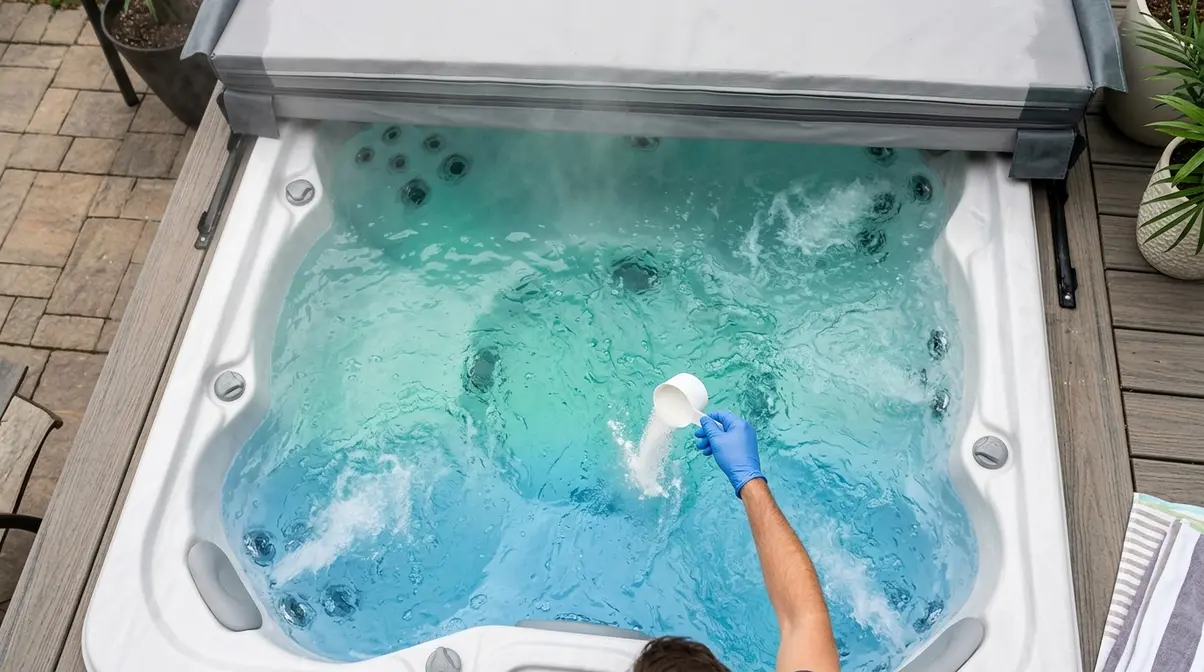
Shocking is the process of adding a large dose of oxidizer — either chlorine-based or non-chlorine (MPS) — to break down chloramines, kill bacteria, and reset your sanitizer baseline. Water chemistry professionals recommend shocking your hot tub once a week under normal use, and immediately after any of the five warning signs above appear.
- Shock treatment process:
- Test your water first and record baseline readings
- Turn on the jets but remove the cover — shocking with the cover on traps gases and degrades the cover material
- Add the shock dose per the manufacturer’s instructions — typically 1–2 oz of non-chlorine shock or 1 oz of granular chlorine shock per 250 gallons
- Run the jets for 15–20 minutes to circulate the shock throughout the plumbing
- Wait 15–30 minutes after a non-chlorine shock, or until chlorine drops below 5 ppm after a chlorine shock, before re-entering
- Retest water after 24 hours to confirm chemistry has stabilized
Testing Frequency and Advanced Methods
Knowing how to test hot tub water is only half the equation — knowing when to test is what keeps your water consistently safe between sessions. After evaluating multiple digital testing methods, our water chemistry professionals recommend ORP-based testers for the most actionable readings. Investing in a high-quality liquid drop kit is often more cost-effective in the long run than constantly replacing degraded test strips.
A structured hot tub testing schedule requires checking free sanitizer levels two to three times per week. Because high water temperatures accelerate chemical depletion, residential hot tubs consume chlorine and bromine significantly faster than traditional swimming pools. Establishing a proper hot tub water change schedule ensures your baseline chemistry remains manageable.
How often should I test hot tub water?
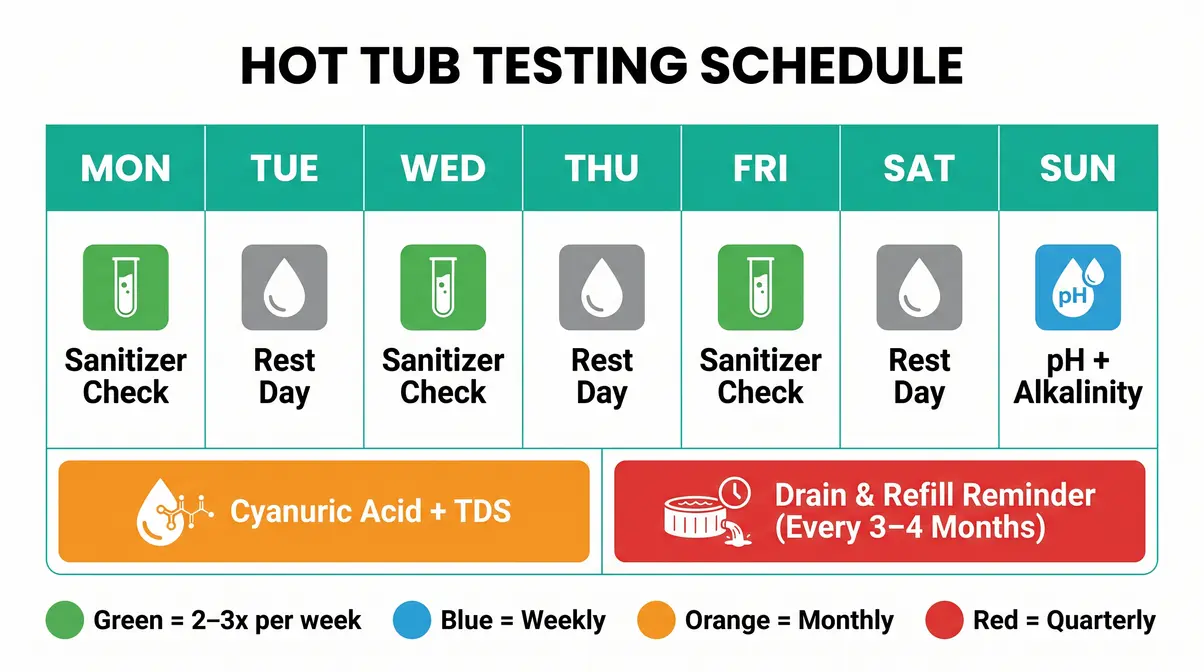
Water chemistry professionals and CDC guidelines both support a tiered testing schedule based on use frequency and chemical stability. The following schedule reflects industry best practice for residential hot tubs used 2–5 times per week.
| Frequency | What to Test | Why |
|---|---|---|
| 2–3× per week | Free sanitizer (chlorine or bromine) | Sanitizer depletes fastest — especially in warm water |
| Weekly | pH, Total Alkalinity, Calcium Hardness | These drift more slowly but destabilize sanitizer if left unchecked |
| Monthly | Cyanuric Acid, Total Dissolved Solids (TDS) | TDS buildup over time reduces chemical effectiveness |
| Every 3–4 months | Full drain, clean, and refill | Resets TDS and removes accumulated organic load |
| After heavy use | Free sanitizer + pH | Bather load depletes sanitizer rapidly |
| After heavy rain | Full panel test | Rainwater dilutes chemicals and shifts pH |
Testing Without Strips: Liquid & Digital
When test strips give conflicting results — or when you’re troubleshooting a chemistry problem that won’t resolve — liquid drop kits and digital testers are your tools of choice.
Liquid drop kits work through a titration process: you add a specific number of reagent drops to a measured water sample, and the resulting color change indicates the parameter’s concentration. The color change in liquid kits is more dramatic and easier to read precisely than the subtle gradient shifts on test strips — which is why they’re considered the reference standard for pH and alkalinity verification.
Digital testers remove color-matching entirely. The probe measures electrical conductivity, pH ion activity, or oxidation-reduction potential (ORP) and displays a numerical result. Our team at One Hot Tub evaluated multiple digital testing methods and found that ORP-based testers — which measure the sanitizer’s killing power rather than its concentration — can provide more actionable information than ppm readings alone, though they require regular calibration to maintain accuracy.
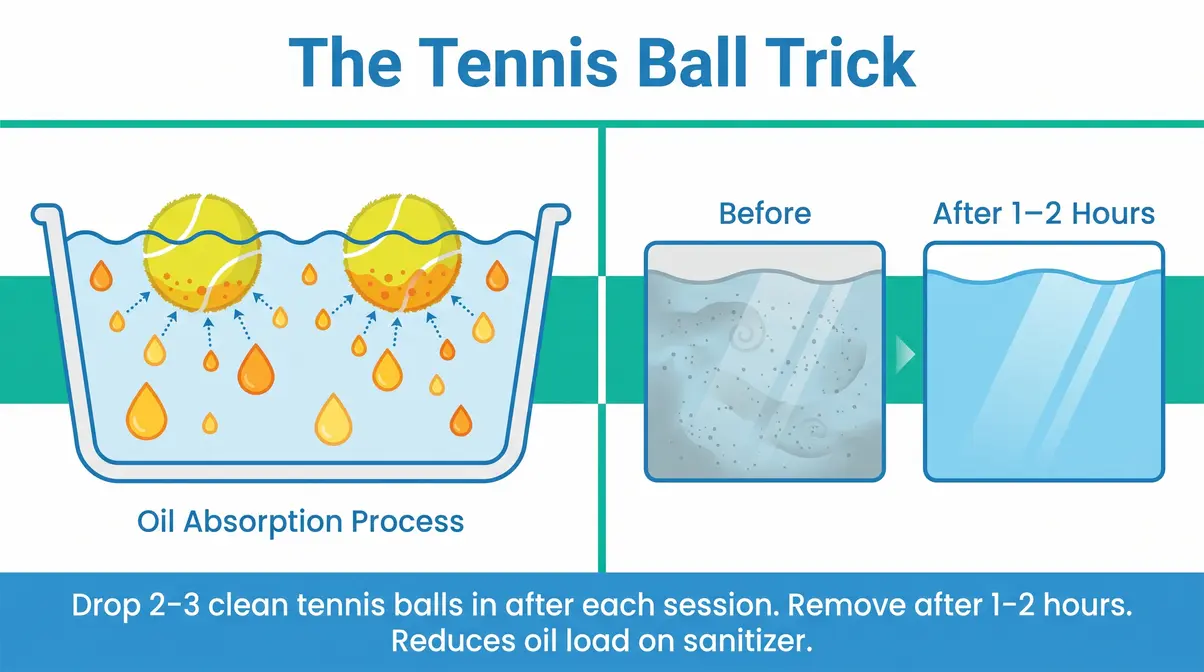
The tennis ball trick: Drop two or three clean tennis balls into your hot tub and leave them for 1–2 hours. The felt absorbs body oils, sunscreen residue, and cosmetics that accumulate in the water — the exact organic compounds that consume sanitizer and cause persistent foam. After removal, your sanitizer will work more efficiently and your water will stay cleaner longer between chemical additions. This isn’t a substitute for regular testing, but it’s a maintenance technique that noticeably extends the time between full water changes.
Testing for Electricity (Safety Warning)
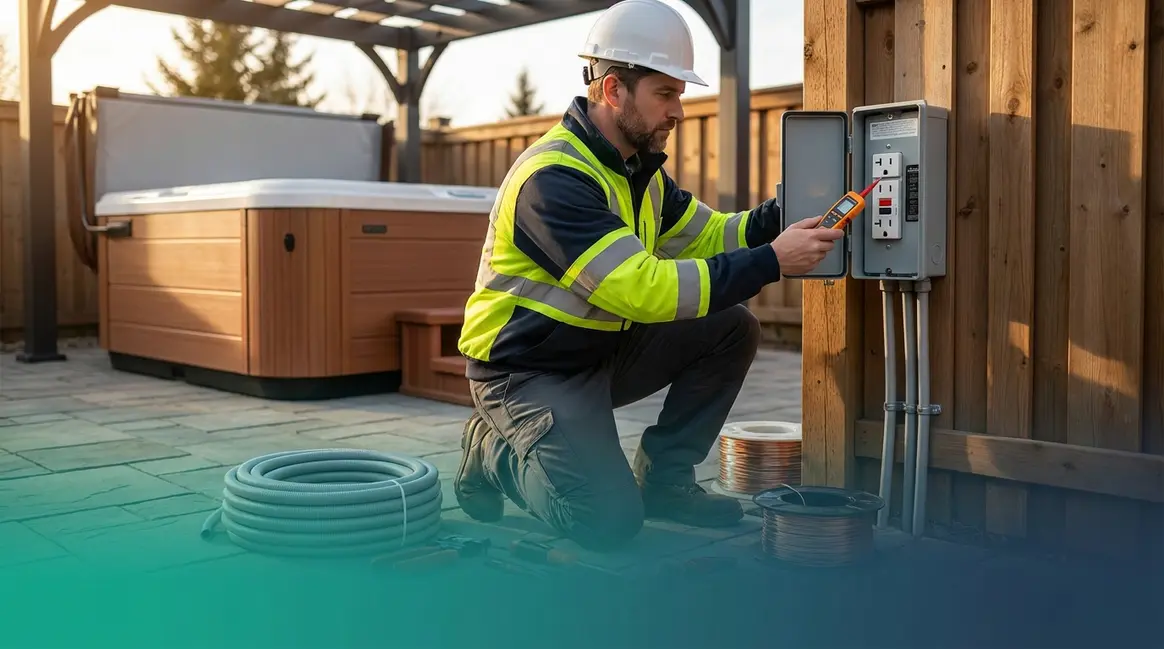
⚠️ CRITICAL SAFETY WARNING: Do not attempt to test your hot tub for electrical current yourself. Stray voltage in or around a hot tub can cause electrocution, cardiac arrest, and death. The U.S. Consumer Product Safety Commission (CPSC) reports that electric shock drowning is a documented risk near faulty equipment — so you must always hire a licensed electrician to test for stray voltage. If you suspect stray voltage — indicated by a tingling sensation when entering the water, or visible electrical equipment damage — exit the water immediately, disconnect power at the breaker, and contact a qualified licensed electrician. Do not re-enter the hot tub until a professional inspection has been completed.
- How a qualified electrician tests for stray voltage:
- A licensed electrician uses a calibrated digital multimeter to test for voltage between the water and a ground reference point
- Testing includes all bonding connections, GFCI (ground fault circuit interrupter) functionality, and grounding of the pump and heater
- The CPSC recommends GFCI protection on all hot tub circuits as a mandatory safety measure
- Annual electrical inspection by a licensed electrician is recommended for any hot tub that is more than five years old
If your GFCI trips repeatedly without explanation, treat this as a stray voltage warning sign — not a nuisance trip — and call an electrician before using the hot tub again.
Common Testing Mistakes and Pro Help
Even experienced hot tub owners make these mistakes consistently. Our team at One Hot Tub reviewed the most common causes of “conflicting results” reported in hot tub owner communities and identified five errors that account for the vast majority of avoidable chemistry problems. Reviewing advanced hot tub maintenance tips can help you avoid these pitfalls.
5 Testing Mistakes Hot Tub Owners Make
Mistake 1: Testing immediately after adding chemicals.
Adding chemicals and testing 10 minutes later will almost always show out-of-range readings — because the chemicals haven’t fully circulated and dissolved. Water chemistry professionals recommend waiting a minimum of 4–6 hours after any chemical addition before retesting. Running the jets for 20–30 minutes after adding chemicals speeds distribution, but the wait time still applies.
Mistake 2: Using expired or improperly stored test strips.
Test strips stored in a humid environment — like a cabinet near the hot tub — degrade faster than the printed expiration date suggests. High humidity causes the reactive pads to partially react before they ever touch the water. Store strips in a sealed container in a cool, dry location and replace any container that has been open for more than 6 months.
Mistake 3: Correcting pH before alkalinity.
This is the most common chemistry mistake that leads to the “chasing chemistry” cycle. Because total alkalinity (TA) buffers pH, correcting pH in water with low TA is like inflating a tire with a puncture — it works temporarily, then drifts back. Always adjust TA first, confirm it’s stable, then adjust pH.
Mistake 4: Dragging a sample from the surface or near a jet.
As covered in Step 1, surface samples and jet-adjacent samples give false readings. The surface layer concentrates oils and airborne contaminants; the jet zone contains undiluted sanitizer. Always collect from elbow depth, away from jets, with the jets off and water settled.
Mistake 5: Testing at the wrong time of day.
If you use stabilized chlorine (with cyanuric acid), testing during peak UV exposure — midday, for an outdoor hot tub — will show artificially depleted chlorine levels because UV degrades chlorine rapidly. Test in the morning before the cover comes off, or in the evening, for the most representative reading.
When to Seek Professional Water Testing
Some water chemistry problems genuinely require professional analysis — and recognizing when to call a pro is a sign of expertise, not failure.
- Contact a professional water testing service when:
- Your water repeatedly returns to cloudy or foamy within 24 hours of treatment, despite correct chemistry readings — this can indicate a biofilm problem deep in the plumbing that home testing cannot detect
- Your TDS (total dissolved solids) reading exceeds 1,500 ppm above the fill water baseline — at this point, a full drain and refill is more effective than chemical correction
- You’re experiencing recurring skin reactions despite maintaining correct chemistry — a professional test can identify specific pathogens or chemical sensitivities that standard test kits don’t measure
- You’ve just purchased a used hot tub — a professional baseline test before your first use establishes what you’re working with and catches any legacy chemistry problems
Many pool and spa supply retailers (including Leslie’s Pool locations) offer free or low-cost professional water analysis. Bring a 16 oz sample in a clean sealed container for the most accurate results.
Frequently Asked Questions
Most accurate testing method?
Digital water testers provide the most accurate hot tub readings when properly calibrated, followed by liquid drop kits, then test strips. Digital testers measure pH and ORP (oxidation-reduction potential) electronically, eliminating the color-matching step where human error most commonly occurs. For most hot tub owners, a liquid drop kit offers the best balance of accuracy and cost — with a margin of error of approximately ±0.2 pH compared to ±0.5 for test strips. Reserve digital testers for troubleshooting persistent chemistry problems that strips and liquid kits can’t resolve.
Is a hot tub bad for folliculitis?
Hot tubs can both cause and worsen folliculitis depending on water chemistry. Hot tub folliculitis is caused by Pseudomonas aeruginosa, a bacterium that thrives in warm water when sanitizer levels drop below safe thresholds. According to NCBI research, infection risk rises sharply when free chlorine falls below 1 ppm in water above 38°C (100°F). If you already have folliculitis or any open skin wound, avoid hot tub use until the condition has fully resolved. Consult a doctor if you develop a rash, pustules, or skin irritation after hot tub use — most cases resolve in 7–10 days, but some require antibiotic treatment.
Why do tennis balls work in a hot tub?
Tennis balls absorb body oils, sunscreen, and cosmetic residue that accumulate in hot tub water. The felt material on standard tennis balls acts as a passive oil absorber — drop two or three clean balls in after a session and leave them for 1–2 hours. These organic compounds are a primary food source for bacteria and a major cause of persistent foam and sanitizer depletion. Removing them mechanically with tennis balls reduces the chemical load on your sanitizer and extends the clarity of your water between full water changes.
What is the most common testing mistake?
The most common mistake is adjusting pH before correcting total alkalinity. Because total alkalinity buffers pH, correcting pH in alkalinity-depleted water produces temporary results — the pH drifts back out of range within hours, creating the “chasing chemistry” cycle. Always follow the adjustment sequence: alkalinity first, then pH, then sanitizer. A close second is testing immediately after adding chemicals — wait at least 4–6 hours and run the jets for 20–30 minutes before retesting to get an accurate reading.
Why do people get rid of their hot tubs?
The most commonly cited reasons for selling a hot tub are ongoing maintenance complexity, chemical costs, and energy bills — not the hot tub itself. Many owners who struggle with water chemistry report feeling like they spend more time maintaining the water than enjoying it. The frustration typically peaks in the first year, before owners develop a consistent testing and treatment routine. Hot tub owners who establish a structured testing schedule and understand The Water Health Triangle report significantly higher long-term satisfaction. The learning curve is real, but it flattens quickly with the right framework.
When Your Water Chemistry Finally Makes Sense
Testing hot tub water correctly is less about memorizing numbers and more about understanding the relationship between them. When you know that total alkalinity buffers pH, and pH controls how effectively your sanitizer works, every reading starts to tell a story rather than create confusion. That’s the core insight behind The Water Health Triangle — sanitizer, pH, and alkalinity are not three separate problems. They’re three corners of the same system, and maintaining balance between them is what keeps your water safe, clear, and ready to use.
Our team at One Hot Tub reviewed dozens of testing methods and consulted water chemistry professionals to build this guide — specifically to address the conflicting results and confusing readings that frustrate most first-year hot tub owners. The five-step testing process, the adjustment sequence (alkalinity → pH → sanitizer), and the weekly testing schedule in this guide represent the consensus approach that water chemistry professionals recommend consistently.
Start tonight. Collect your sample from elbow depth, run your strips or liquid kit, and check your readings against the ranges table. If all three corners of the Water Health Triangle are in range, your water is safe. If one is off, now you know exactly which one to fix first — and in what order. Your first accurate test result is one session away.
David King
Hot tub tester and writer at One Hot Tub.