

Table of Contents - How to Control Hot Tub pH Levels: Step-by-Step Guide
- What Happens When Hot Tub pH Goes Wrong
- What You Need Before You Start
- Step 1 — Test Your Hot Tub Water
- Step 2 — Balance Total Alkalinity First
- Step 3 — How to Lower High pH
- Step 4 — How to Raise Low pH
- Do Home Remedies Work?
- Keeping Your Hot Tub pH Stable Long-Term
- When Hot Tub pH Problems Get Complicated
- Frequently Asked Questions
- Conclusion
- Limitations and When to Seek Help
This blog post may contain affiliate links. As an Amazon Associate I earn from qualifying purchases.
If your hot tub water is cloudy, your skin is itchy after a soak, or your pH reading bounces back the moment you correct it — you don’t have a chemistry problem, you have an order-of-operations problem. Learning how to control hot tub pH levels starts with one counterintuitive rule that most guides skip entirely.
Most hot tub owners add pH chemicals in the wrong sequence and then wonder why the problem returns within hours. The result is the “chemical seesaw” — spending money on products that cancel each other out while the water stays frustratingly off-balance. The fix isn’t a different chemical; it’s a different order.
By the end of this guide, you’ll have the exact 4-step process — including precise dosage charts — to balance your hot tub pH and keep it stable for weeks at a time. We’ll cover testing, alkalinity adjustment, lowering and raising pH, home remedy myths, and a long-term maintenance routine.
Knowing how to control hot tub pH levels means following The Chemistry Hierarchy — the rule that Total Alkalinity (80–120 ppm) must be balanced before pH, because alkalinity is the chemical buffer that keeps pH from swinging. The CDC recommends a pH range of 7.2–7.8 to prevent skin irritation and keep your sanitizer working effectively.
- Fix alkalinity first: Total Alkalinity (80–120 ppm) must be in range before you touch pH — this is The Chemistry Hierarchy
- Lower high pH: Use sodium bisulfate (pH-Minus) — approximately 1 oz per 300 gallons lowers pH by roughly 0.2 points
- Raise low pH: Use soda ash (sodium carbonate) — add in small increments, circulate for 2–4 hours before retesting
- Home remedies: Baking soda raises alkalinity (not pH directly); white vinegar can lower pH but risks equipment damage at scale
- Retest after every adjustment — wait 30–60 minutes with jets running before adding more chemicals
What Happens When Hot Tub pH Goes Wrong
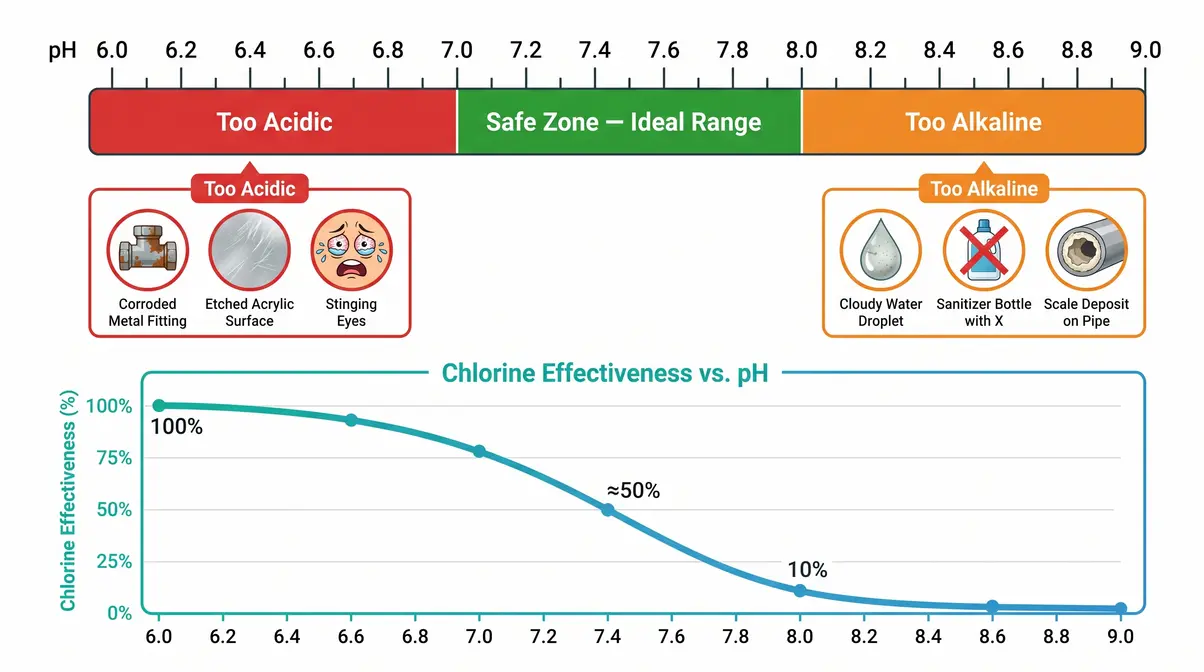
When hot tub pH drifts outside the safe zone, your water can look clean while actively irritating your skin, corroding your equipment, and allowing pathogens to survive. The Centers for Disease Control and Prevention (CDC) recommends maintaining hot tub pH between 7.2 and 7.8 — a range that keeps chlorine effective, protects bathers from irritation, and prevents scale buildup on surfaces and equipment (CDC, Healthy Water). Within this range, your sanitizer works as intended, your water feels comfortable, and your jets and heater are protected from chemical damage.
Understanding the Ideal pH Range
The pH scale runs from 0 (most acidic) to 14 (most alkaline), with 7.0 being neutral. For hot tubs, the World Health Organization (WHO) and the CDC both identify 7.2–7.8 as the target range — slightly alkaline to match the natural pH of human skin and eyes (approximately 7.4), which is why water outside this range causes immediate physical discomfort.
At pH 7.5, roughly 50% of your chlorine exists as hypochlorous acid (HOCl), the active sanitizing form. At pH 8.0, that active fraction drops to around 10% — meaning you need ten times as much chlorine to achieve the same sanitation effect (CDC, 2026). That’s why high pH is deceptive: the water can look clear and register adequate chlorine levels while offering almost no actual protection.
Consequences of High pH (Above 7.8)
High pH — anything above 7.8 — creates a cascade of visible and invisible problems. Visually, you’ll notice cloudy or milky water and white scale deposits forming on the shell, jets, and waterline. Physically, bathers experience eye irritation and dry, itchy skin. Chemically, your sanitizer loses most of its potency.
The health consequence is more serious than most guides acknowledge. Research published on PubMed links high-pH hot tub environments to increased survival of Pseudomonas aeruginosa, the bacterium responsible for hot tub folliculitis (hot tub rash). When chlorine efficacy is compromised by elevated pH, pathogens that should be eliminated within minutes can survive for hours. According to CDC guidance on recreational water illness, maintaining proper pH is the first line of defense — not adding more sanitizer.
Hidden Problems of Low pH (Below 7.2)
Low pH is the less-discussed failure mode, but it causes faster and more expensive damage. Acidic water — below 7.2 — actively corrodes metal fittings, erodes acrylic shell surfaces, and degrades pump seals and heater elements. You’ll notice a sharp chemical smell (often mistaken for “too much chlorine”), stinging eyes even at normal chlorine levels, and eventually pitting or etching on the spa surface.
From a safety standpoint, overly acidic water can irritate mucous membranes and cause skin redness even at short soak durations. Low pH also accelerates the off-gassing of chlorine, which means you’ll burn through sanitizer faster and spend more on chemicals — a hidden cost that compounds over time.
Can norovirus survive in a hot tub?
Norovirus can survive in hot tub water when pH and sanitizer levels are not properly maintained. According to CDC guidance on recreational water illness, norovirus is more resistant to chlorine disinfection than many other pathogens, and its survival time increases significantly when pH is above 7.8 (reducing chlorine efficacy) or when free chlorine drops below 3 ppm. Maintaining pH in the 7.2–7.8 range and free chlorine at 3–5 ppm is the primary defense. Draining and thoroughly cleaning the spa after any suspected contamination event is strongly recommended.
Chemistry Hierarchy: Why Order Matters
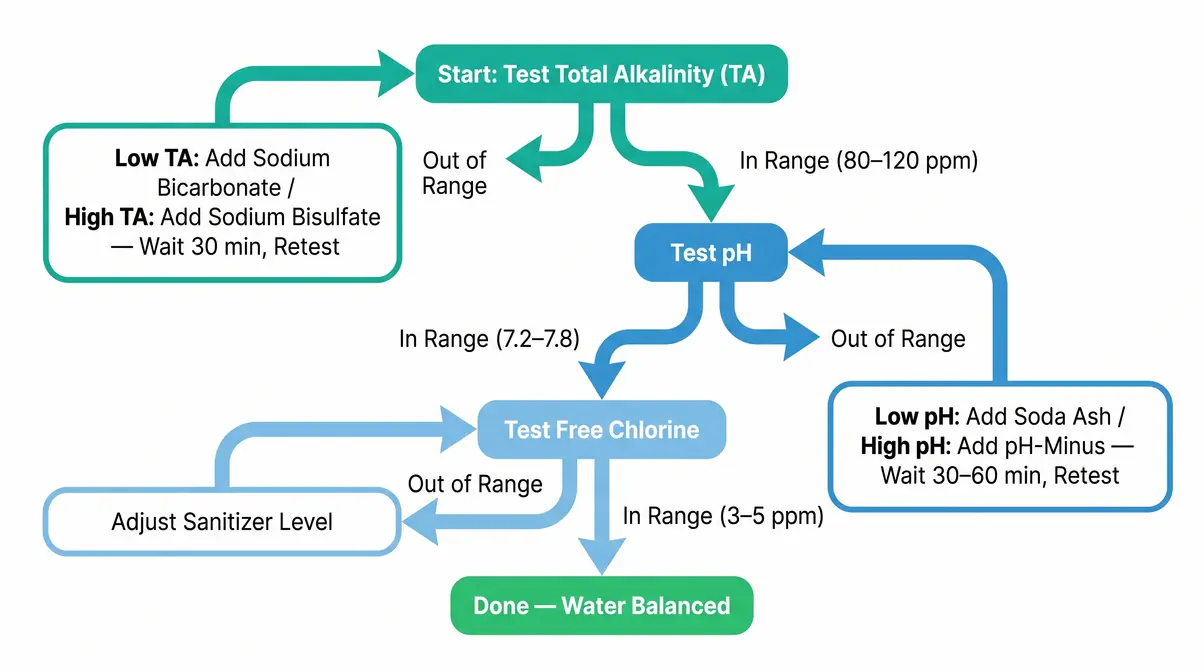
Here is the concept that resolves most hot tub chemistry frustration: The Chemistry Hierarchy — the principle that hot tub water parameters must be corrected in strict sequence (Total Alkalinity → pH → Sanitizer) because each level chemically buffers the next.
Total Alkalinity (TA) is the buffer system that holds pH steady. When TA is out of range, pH becomes unstable — it will swing up or down regardless of what you add, which is exactly the “chemical seesaw” most owners experience. Adjusting pH before correcting TA is like trying to fill a leaky bucket: you can keep adding chemicals, but the problem will return within hours.
Following The Chemistry Hierarchy — fix TA first, then pH, then sanitizer — is not optional advice. It is how the chemistry works. Learn more about sanitizer balance after pH is stable in our guide to hot tub chemical maintenance.
What You Need Before You Start
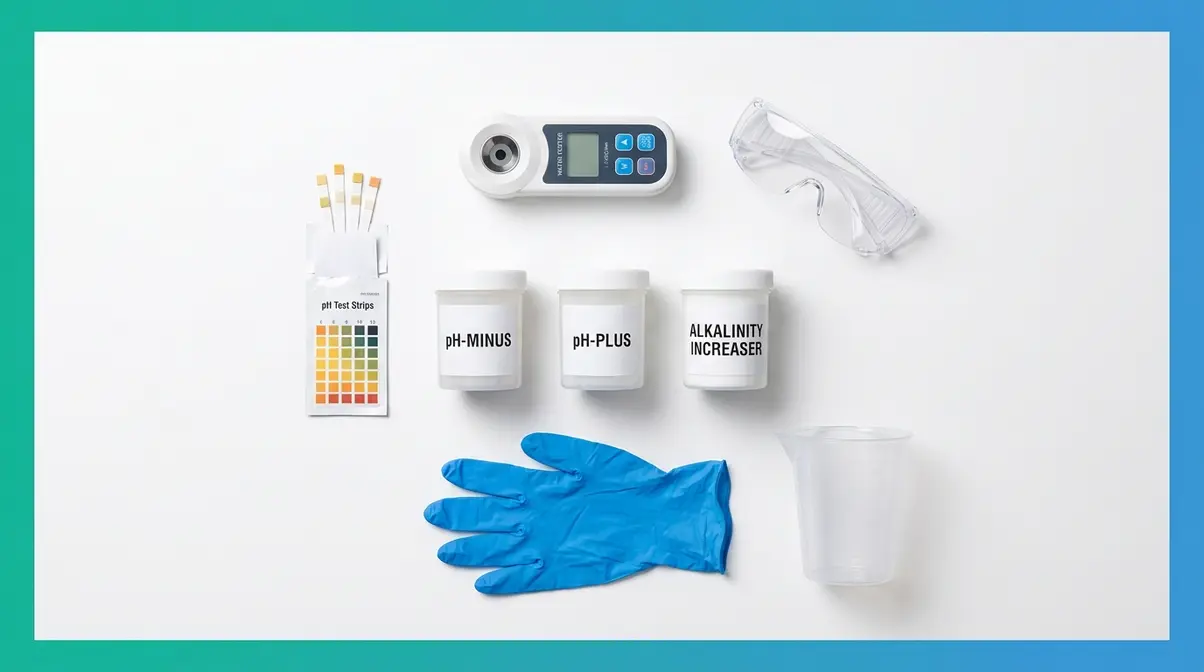
Before touching any chemicals, gather everything you need and understand the basic safety rules. Attempting adjustments without the right tools leads to inaccurate dosing — which feeds the exact chemical seesaw you’re trying to stop.
Tools and Chemicals You’ll Need
- Testing equipment (choose one):
- Test strips — fast, inexpensive, accurate enough for routine checks (±0.2 pH units)
- Liquid test kit — more precise, better for diagnosing borderline readings
- Digital tester / photometer — highest accuracy; recommended if you’ve had persistent balance issues
Chemicals you may need:
| Chemical | Purpose | Also Known As |
|---|---|---|
| Sodium bisulfate | Lower pH | pH-Minus, pH Decreaser, Dry Acid |
| Soda ash (sodium carbonate) | Raise pH | pH-Plus, pH Increaser |
| Sodium bicarbonate | Raise Total Alkalinity | Alkalinity Increaser, baking soda |
| Muriatic acid (diluted) | Lower TA and pH | Pool acid (use with caution) |
Additional tools: Plastic measuring cup (dedicated — never reuse for food), chemical-resistant gloves, safety glasses, and a timer.
Manufacturer guidance from Jacuzzi, Cal Spas, and Master Spas consistently recommends keeping all of these on hand before starting any adjustment cycle, rather than making mid-session trips to the store while chemicals are already circulating (Cal Spas water chemistry guide).
Chemical Safety Rules to Follow
⚠️ Safety Warning: Sodium bisulfate and soda ash are both reactive chemicals that can cause skin burns, eye damage, and respiratory irritation if handled improperly.
- Non-negotiable safety rules:
- Always wear chemical-resistant gloves and safety glasses when handling pH chemicals
- Always add chemicals to water — never add water to chemicals (prevents violent exothermic reactions)
- Pre-dissolve granular chemicals in a bucket of spa water before adding to the tub
- Never mix different chemicals together before adding — add one product, circulate, then add the next
- Keep children and pets away from the spa during any chemical adjustment
- Store chemicals in a cool, dry place away from direct sunlight and out of reach of children
Water chemistry specialists advise waiting a minimum of 30–60 minutes with jets running between adding different chemical products — rushing this process is the single most common cause of persistent pH instability.
Step 1 — Test Your Hot Tub Water
Accurate testing is the foundation of every successful adjustment. Adding chemicals without knowing your baseline numbers is guessing — and guessing is what creates the chemical seesaw in the first place. Test before every adjustment and after every change, once the water has circulated for at least 30 minutes.
How to Test pH with Test Strips
Test strips are the most practical option for regular testing. To use them correctly:
- Run the jets for 30 seconds to ensure the water is well-mixed
- Dip the strip into the water at elbow depth (away from jets) for exactly the time specified on the packaging — usually 2 seconds
- Remove the strip and hold it horizontally — tilting it allows reagent to bleed between pads and skew results
- Compare the color to the chart within 15 seconds of removal; colors shift as they oxidize
Hot tub owners consistently report that reading strips in direct sunlight distorts color comparison — use shade or indoor lighting for accurate readings.
Using Liquid Kits or Digital Testers
Liquid test kits use reagent drops that produce a color change in a sample of your spa water. They’re more accurate than strips, particularly in the 7.0–7.4 range where strip color differentiation is subtle.
Digital testers (photometers) offer the highest precision and eliminate color-interpretation error entirely. They’re worth the investment — typically $25–$60 — if you’ve been stuck in a pH bounce cycle and need to diagnose whether your readings are accurate. See our comparison of the best hot tub test kits for 2026.
Reading Results and Next Steps
Once you have your readings, use this decision framework:
| Parameter | Low (Act Required) | Target Range | High (Act Required) |
|---|---|---|---|
| Total Alkalinity | Below 80 ppm | 80–120 ppm | Above 120 ppm |
| pH | Below 7.2 | 7.2–7.8 | Above 7.8 |
| Free Chlorine | Below 3 ppm | 3–5 ppm | Above 5 ppm |
Always address Total Alkalinity first. If both TA and pH are out of range, fixing TA often corrects pH partially on its own — this is The Chemistry Hierarchy in action. Move to Step 2 before touching pH chemicals.
Step 2 — Balance Total Alkalinity First
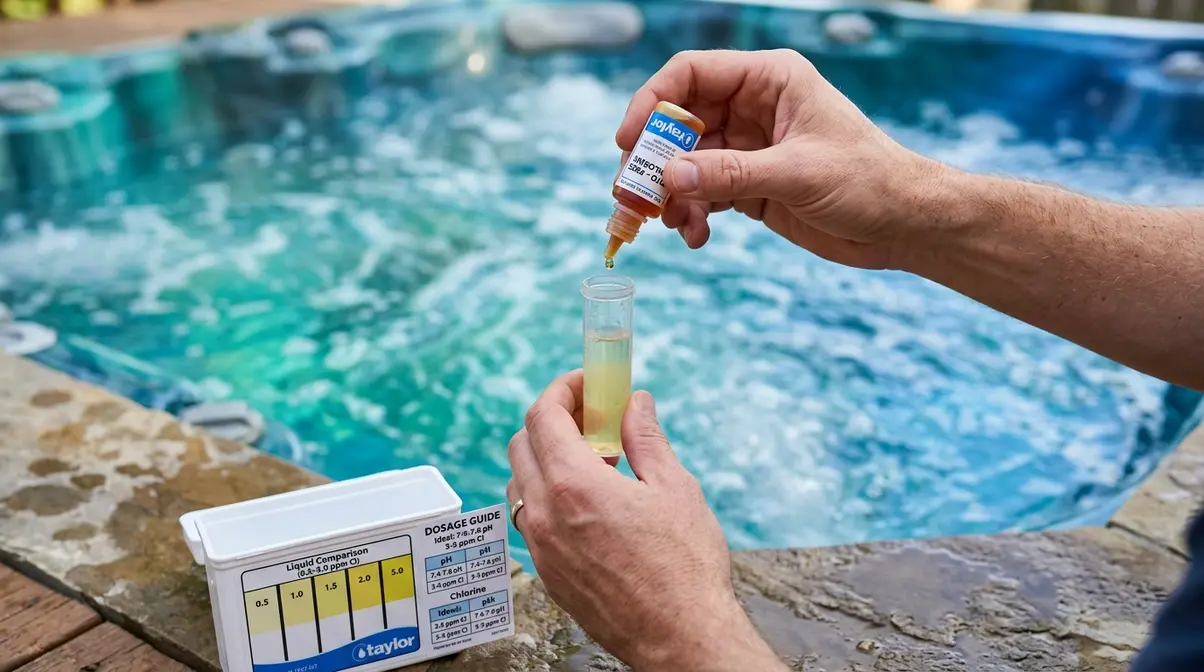
Total Alkalinity (TA) is the most important number in your hot tub water, yet it’s the one most owners test last or skip entirely. Correcting TA before adjusting pH is not a preference — it is the first law of The Chemistry Hierarchy, and skipping it is the root cause of most “I fixed it but it came back” pH stories.
Why Total Alkalinity Buffers pH
Total Alkalinity is the measurement of alkaline substances dissolved in your water, expressed in parts per million (ppm). Its job is to act as a chemical buffer — resisting rapid changes in pH. Think of TA as shock absorbers on a car: when TA is in the 80–120 ppm range, pH stays stable even when bathers, rain, or added chemicals introduce acidic or alkaline compounds.
When TA falls below 80 ppm, pH becomes hypersensitive — a small amount of acid drops it dramatically, while a small amount of base shoots it up. This is the technical explanation for pH bounce. When TA exceeds 120 ppm, pH becomes “locked” high and resists downward adjustment no matter how much pH-Minus you add.
According to the Jacuzzi alkalinity guide, the target TA range for most hot tubs is 80–120 ppm, with 100 ppm considered the optimal midpoint.
“To lower your alkalinity about 10 ppm you will need to add 1 level tablespoon (15g) of Alkalinity Decreaser (aka Sodium Bisulfate) for every 250 gallons.”
This community-sourced dosage figure — widely verified across hot tub owner forums and consistent with manufacturer guidance — illustrates exactly why precision matters. Eyeballing chemicals is what keeps people stuck.
How to Lower High Total Alkalinity
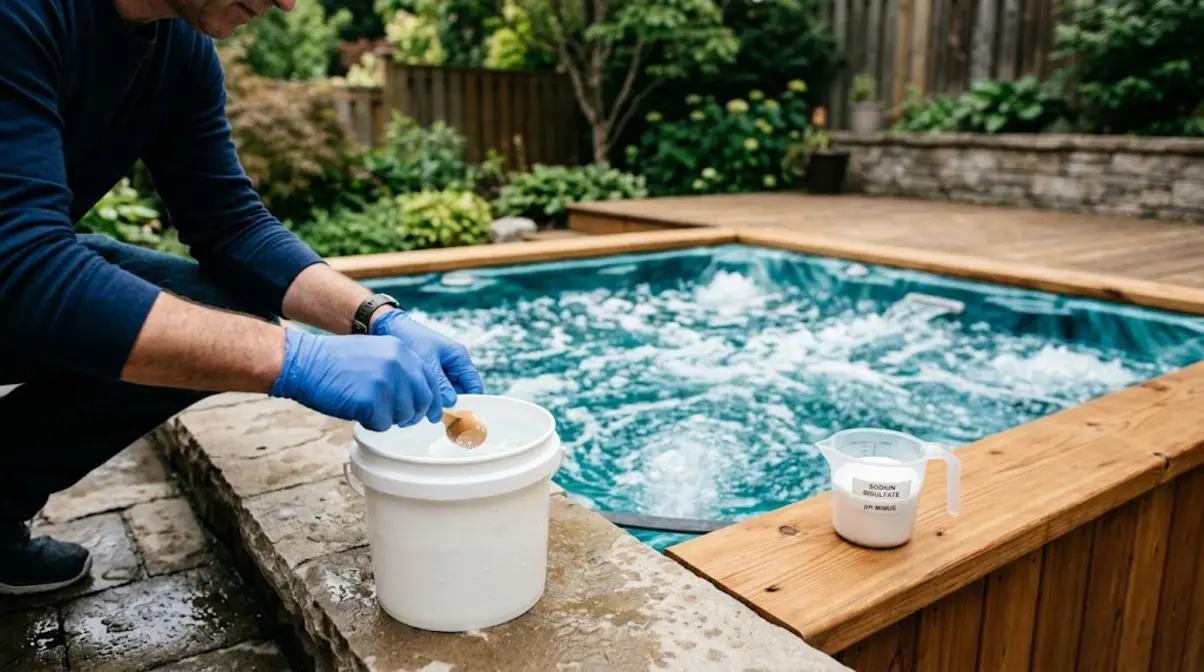
If your TA reads above 120 ppm, use sodium bisulfate (pH-Minus / Alkalinity Decreaser) to bring it down. Note that sodium bisulfate lowers both TA and pH simultaneously — which is why you address TA first; you’ll often correct high pH in the process.
Dosage to lower Total Alkalinity:
| Tub Size | To Lower TA by 10 ppm | To Lower TA by 20 ppm |
|---|---|---|
| 250 gallons | 1 tbsp (15g) | 2 tbsp (30g) |
| 400 gallons | ~1.6 tbsp (24g) | ~3.2 tbsp (48g) |
| 500 gallons | 2 tbsp (30g) | 4 tbsp (60g) |
Dosages based on manufacturer guidelines (Jacuzzi, 2026) — always verify against your specific product’s packaging label, as concentrations vary.
- Steps to lower TA:
- Pre-dissolve the measured amount in a bucket of spa water
- With jets running on low, pour the solution slowly around the perimeter of the tub
- Run jets for 30 minutes, then turn them off and let water sit for 1 hour
- Retest TA before testing pH
- Repeat in small increments — never add the full correction dose in one go if TA is more than 30 ppm out of range
⚠️ Safety: Sodium bisulfate is a strong acid. Wear gloves and eye protection. Do not breathe the dust when measuring.
How to Raise Low Total Alkalinity
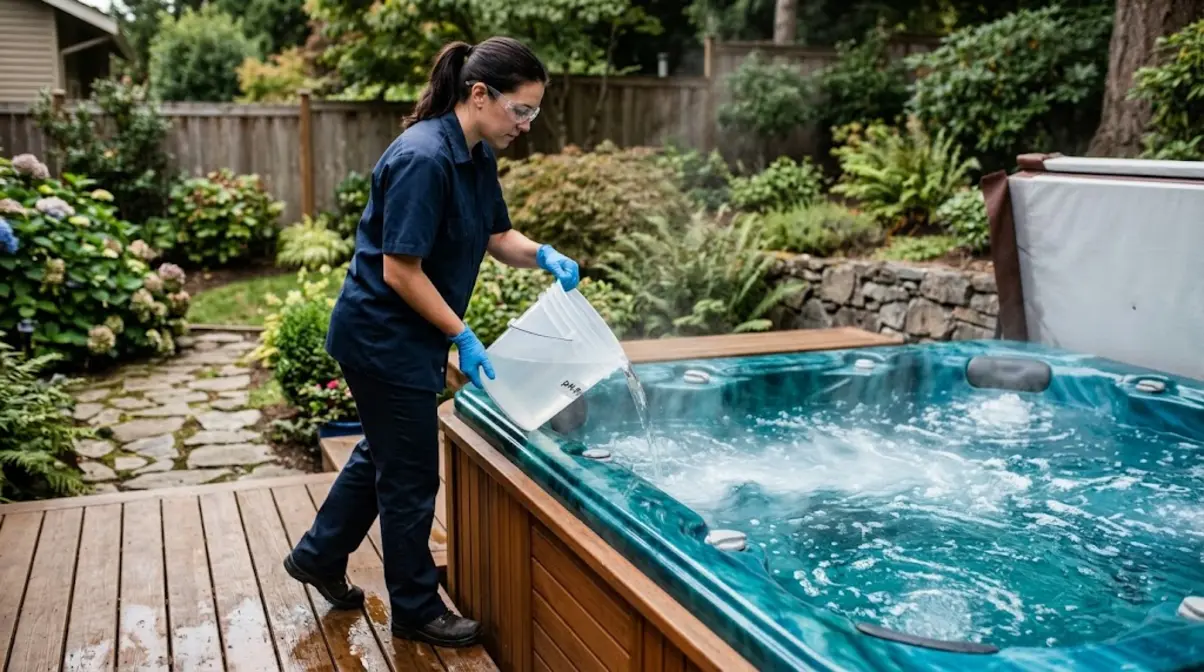
If your TA reads below 80 ppm, use sodium bicarbonate (Alkalinity Increaser) to raise it. Unlike sodium bisulfate, sodium bicarbonate raises TA with minimal impact on pH — making it the precise tool for this job.
Dosage to raise Total Alkalinity:
| Tub Size | To Raise TA by 10 ppm | To Raise TA by 20 ppm |
|---|---|---|
| 250 gallons | ~1.5 tbsp (21g) | ~3 tbsp (42g) |
| 400 gallons | ~2.5 tbsp (34g) | ~5 tbsp (68g) |
| 500 gallons | ~3 tbsp (42g) | ~6 tbsp (84g) |
Approximate dosages based on standard sodium bicarbonate (baking soda equivalent at 100% concentration); verify against your specific product label.
Add in increments, circulate for 30 minutes, and retest before adding more. Once TA is in the 80–120 ppm range, move directly to Step 3 or Step 4 to address pH.
Step 3 — How to Lower High pH
With TA in range, lowering high pH (above 7.8) becomes straightforward and predictable. If you are learning how to control hot tub pH levels, this step is where most people make mistakes. The standard product is sodium bisulfate — sold as pH-Minus, pH Decreaser, or Dry Acid. It’s granular, easy to dose, and works within 30–60 minutes in a well-circulated spa.
Dosage Chart: Adding pH Decreaser
This is the data no competing guide provides. Use these figures as your starting point — always err toward underdosing and retesting rather than overcorrecting in one addition.
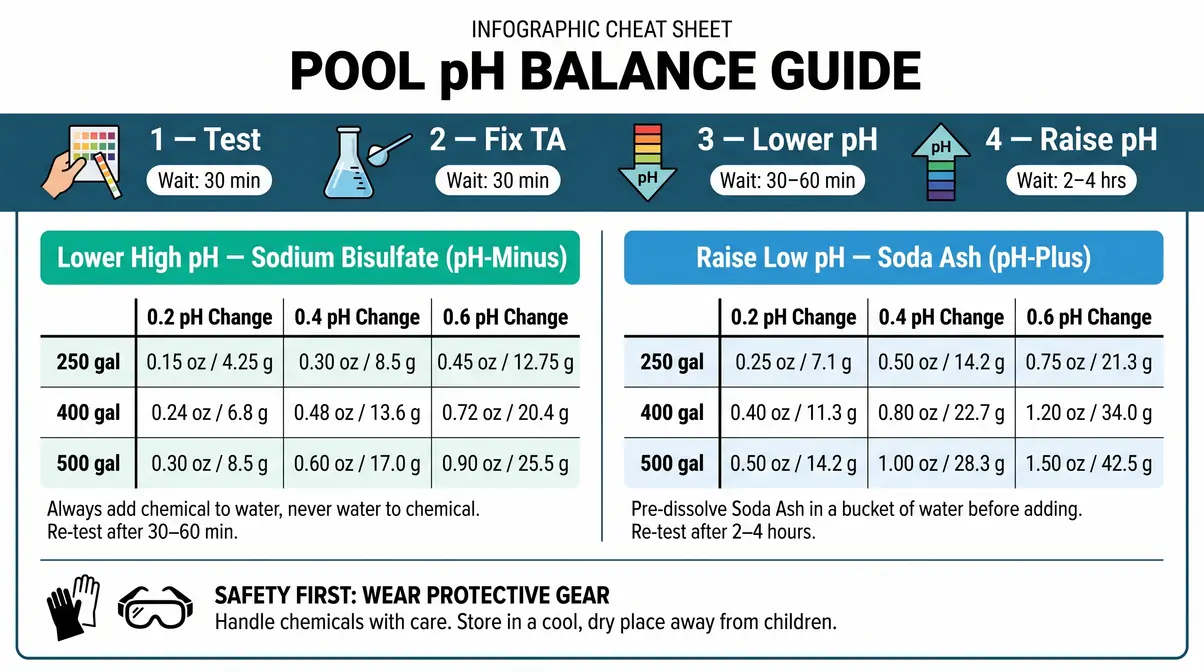
Sodium Bisulfate (pH-Minus) Dosage to Lower pH:
| Tub Size | Lower pH by 0.2 | Lower pH by 0.4 | Lower pH by 0.6 |
|---|---|---|---|
| 250 gallons | ~0.5 oz (14g) | ~1 oz (28g) | ~1.5 oz (42g) |
| 300 gallons | ~0.6 oz (17g) | ~1.2 oz (34g) | ~1.8 oz (51g) |
| 400 gallons | ~0.8 oz (23g) | ~1.6 oz (45g) | ~2.4 oz (68g) |
| 500 gallons | ~1 oz (28g) | ~2 oz (57g) | ~3 oz (85g) |
Dosages verified against Jacuzzi and Hydropool product guidance (2026). Actual results vary by water temperature and existing mineral content — treat as a starting point and retest before adding more.
⚠️ Important: Do not attempt to correct more than 0.6 pH units in a single addition. Large single doses can overshoot and create the low-pH problems you’re trying to avoid.
Adding Sodium Bisulfate Safely
Tools needed: Gloves, safety glasses, plastic measuring cup, bucket of spa water. Estimated time: 10 minutes active + 30–60 minutes wait.
- Test your current pH and TA. Confirm TA is in the 80–120 ppm range before proceeding.
- Calculate your dose using the chart above. If your pH is 8.1 and your tub holds 400 gallons, you need to drop by approximately 0.5 — use the 0.4 row as your first increment (~1.6 oz).
- Pre-dissolve the measured granules in a bucket containing approximately 1 gallon of spa water. Stir until fully dissolved.
- Turn jets on to medium. Never add chemicals to a static tub.
- Pour the solution slowly around the perimeter of the tub, moving continuously. Do not dump it in one spot.
- Run jets for 30 minutes with the cover off to allow off-gassing.
- Wait 30–60 minutes total, then retest pH.
- If pH is still above 7.8, add a second increment (half the original dose). Do not skip the wait time.
According to Hydropool’s pH adjustment guidance, adding sodium bisulfate with the cover off during circulation is critical — trapping off-gassing acid vapor under the cover accelerates cover deterioration and can cause respiratory irritation when you next open the spa.
Lowering pH Naturally with Aeration
Counterintuitively, aeration (running jets and air blowers) tends to raise pH over time, not lower it. This happens because agitation drives off dissolved CO₂, which is mildly acidic — its removal shifts the water toward a higher pH. This is why freshly filled hot tubs often start with a lower pH that climbs over the first 24–48 hours of use.
The practical implication: if your pH is borderline high (7.8–8.0) and your TA is already in range, reducing aeration and letting CO₂ levels stabilize can bring pH down slightly without chemicals. However, this effect is minor (typically 0.1–0.2 points) and unpredictable — it is not a substitute for proper chemical adjustment.
Step 4 — How to Raise Low pH
Low pH (below 7.2) is corrected with soda ash — sodium carbonate, sold as pH-Plus or pH Increaser. Soda ash is more powerful than sodium bicarbonate and raises pH with a relatively modest effect on Total Alkalinity, making it the correct tool for this specific job. See our complete hot tub chemical guide for a full breakdown of which chemicals do what.
Dosage Chart: Adding pH Increaser
Soda Ash (Sodium Carbonate / pH-Plus) Dosage to Raise pH:
| Tub Size | Raise pH by 0.2 | Raise pH by 0.4 | Raise pH by 0.6 |
|---|---|---|---|
| 250 gallons | ~0.5 oz (14g) | ~1 oz (28g) | ~1.5 oz (42g) |
| 300 gallons | ~0.6 oz (17g) | ~1.2 oz (34g) | ~1.8 oz (51g) |
| 400 gallons | ~0.8 oz (23g) | ~1.6 oz (45g) | ~2.4 oz (68g) |
| 500 gallons | ~1 oz (28g) | ~2 oz (57g) | ~3 oz (85g) |
Dosages based on standard soda ash at typical commercial concentrations; verify against your specific product label. Soda ash is more reactive than sodium bicarbonate — start with the lower increment and retest.
⚠️ Note: Soda ash can temporarily cloud the water immediately after addition — this is normal and typically clears within 1–2 hours of circulation. Do not add more product in response to cloudiness; wait and retest.
Adding Soda Ash Safely
Tools needed: Gloves, safety glasses, plastic measuring cup, bucket of spa water. Estimated time: 10 minutes active + 2–4 hours wait (longer than pH-Minus due to soda ash’s slower equilibration).
- Confirm your TA is in range (80–120 ppm). If TA is also low, raise TA first with sodium bicarbonate — soda ash will raise both, but sodium bicarbonate gives you more precise TA control.
- Calculate your dose using the chart above. For a 400-gallon tub at pH 7.0, you need to raise by 0.4 — start with the 0.4 row (~1.6 oz) as your first increment.
- Pre-dissolve soda ash in a bucket of warm spa water. It dissolves readily and creates a clear solution.
- Turn jets on to medium. Soda ash needs good circulation to distribute evenly.
- Add the solution slowly while walking around the tub perimeter.
- Run jets for at least 30 minutes, then let water settle for 2 hours before retesting. Soda ash takes longer to fully equilibrate than sodium bisulfate.
- Retest and add a second increment only if pH is still below 7.2 after the full wait period.
According to Master Spas’ guidance on high pH correction, patience is the most important variable in pH adjustment — owners who retest after 2 hours consistently achieve stable results, while those who retest after 20 minutes and add more product are the ones who end up overshooting into high pH territory.
Using Aeration to Raise pH Quickly
Aeration genuinely does raise pH — and this is one case where it’s a useful tool alongside chemicals. Running your jets on high, activating air blowers, and leaving the cover off for 1–2 hours drives off dissolved CO₂, which shifts the water’s pH upward. The effect is typically 0.1–0.3 pH units over a 1–2 hour aeration session.
For borderline low pH (7.0–7.2), aeration alone may bring you into range without any chemicals. For pH below 7.0, use soda ash first and then use aeration to fine-tune the final 0.1–0.2 points. This combination approach reduces the risk of overshooting and produces more stable results than chemical correction alone.
Do Home Remedies Work?
The home remedy question comes up constantly in hot tub communities, and the honest answer is: some work in limited ways, some are genuinely risky, and one is a complete myth. Here’s what the chemistry actually says.
Baking Soda: pH or Alkalinity?
Baking soda (sodium bicarbonate) is a legitimate hot tub chemical — it’s essentially the same compound sold as “Alkalinity Increaser” at pool supply stores, often at a fraction of the price. However, its primary action is raising Total Alkalinity, not pH directly.
The nuance: because TA and pH are connected through The Chemistry Hierarchy, raising TA with baking soda can indirectly nudge pH upward — but this effect is modest and unpredictable. If your TA is in range and your pH is low, baking soda is the wrong tool; you need soda ash (sodium carbonate). If your TA is low and your pH is low, baking soda addresses both to some degree, though soda ash remains more precise for pH correction.
Hot tub owners consistently report success using baking soda as an Alkalinity Increaser substitute at roughly the same dosage — approximately 1 tablespoon per 100 gallons to raise TA by 10 ppm. For TA adjustment, it works. For direct pH correction, reach for the purpose-built product.
White Vinegar: Can It Lower Hot Tub pH?
White vinegar (5% acetic acid) can technically lower hot tub pH — acetic acid is acidic and will reduce pH when added to water. However, the practical reality is that the volumes required to make a meaningful difference in a 300–500 gallon hot tub are large enough to introduce concerns.
The main risks: at the quantities needed (often 1–2 quarts or more for a meaningful pH drop), acetic acid can leave organic residue that feeds bacterial growth and potentially damages certain acrylic and gasket materials over time. Hydropool’s water chemistry FAQ advises against vinegar for this reason — the cost savings don’t justify the equipment risk when sodium bisulfate is inexpensive and purpose-formulated.
For a minor pH correction (0.1–0.2 points) in a pinch, a small amount of white vinegar is unlikely to cause harm. For regular use or significant corrections, use sodium bisulfate.
Why put tennis balls in a hot tub?
The tennis ball trick — dropping one or more tennis balls into your hot tub — is real, but it has nothing to do with pH. Tennis balls absorb oils: body oils, sunscreen, cosmetics, and hair products that bathers introduce into the water. These oils accumulate at the waterline and can contribute to foamy water and filter clogging, but they don’t directly affect pH or alkalinity.
The indirect connection: organic contamination from oils can consume sanitizer and contribute to water chemistry instability over time. Removing those oils with a tennis ball (or a dedicated oil-absorbing sponge, which works better) reduces the chemical load on your sanitizer. So the trick is legitimate — it just won’t fix a pH problem. Use it as a supplementary maintenance tool, not a chemistry correction method. Read our full guide on why hot tub water gets foamy and how to fix it.
Keeping Your Hot Tub pH Stable Long-Term
Balancing your water once is the easy part. The real goal is maintaining that balance so you’re not starting from scratch every week. Consistent testing and a simple routine are what separate owners who have perpetually clear water from those stuck in the chemical seesaw.
How Often to Test Hot Tub Water
- Minimum testing schedule:
- 2–3 times per week when the tub is in regular use
- Before and after heavy use (parties, multiple bathers)
- After rain — rainwater is slightly acidic and can drop pH and TA
- After adding any chemical — always retest 30–60 minutes post-addition
Water chemistry experts advise that the single biggest predictor of stable hot tub water is testing frequency, not chemical quality. Owners who test three times per week make small, precise adjustments; owners who test once a week make large, destabilizing ones.
Digital testers and quality test strips make frequent testing fast — under two minutes per session. The time investment is minimal compared to the frustration of troubleshooting chemistry that’s been off for days.
Weekly and Monthly pH Maintenance
- Weekly routine:
- Test TA, pH, and free chlorine (in that order — The Chemistry Hierarchy applies to testing too)
- Adjust TA if outside 80–120 ppm before touching pH
- Adjust pH if outside 7.2–7.8
- Add sanitizer after pH is confirmed in range
- Clean the waterline with a non-foaming spa surface cleaner
Monthly routine:
| Task | Frequency | Why |
|---|---|---|
| Rinse filter cartridges | Monthly | Clogged filters reduce circulation, destabilizing chemistry |
| Shock the water | Every 1–2 weeks | Oxidizes organic contaminants that suppress sanitizer |
| Check calcium hardness | Monthly | Low hardness (below 150 ppm) causes foaming and surface etching |
| Drain and refill | Every 3–4 months | Dissolved solids accumulate and make chemistry increasingly difficult to manage |
A complete drain and refill every 3–4 months is the single most underutilized maintenance tool. As total dissolved solids (TDS) accumulate over months of use, water becomes progressively harder to balance — chemicals interact unpredictably, and pH stability degrades. Fresh water resets everything. See our hot tub draining and refilling guide for the correct process.
When Hot Tub pH Problems Get Complicated
Sometimes the standard steps don’t resolve the problem — or the problem returns faster than it should. Here’s what’s actually happening and when to escalate.
Common Mistakes That Cause pH Bounce
Mistake 1: Adjusting pH before TA is in range.
This is the most common cause of pH bounce. If TA is low, pH will swing back within hours regardless of what you add. Always test TA first and get it to 80–120 ppm before touching pH chemicals. This is The Chemistry Hierarchy — skipping it guarantees the seesaw continues.
Mistake 2: Adding too much chemical in one dose.
Overcorrection is the second most common issue. Adding the “full correction” dose in one addition frequently overshoots the target, requiring a correction in the opposite direction — which is how the chemical seesaw starts. Use 50% of the calculated dose, wait, retest, and add more only if needed.
Mistake 3: Testing too soon after adding chemicals.
Retesting 10 minutes after adding pH chemicals gives you a false reading — the chemicals haven’t fully distributed. Always wait a minimum of 30 minutes with jets running, and 2 hours for soda ash, before retesting. Impatience here is expensive.
Mistake 4: Ignoring calcium hardness.
Low calcium hardness (below 150 ppm) causes water to become “hungry” — it leaches calcium from your spa shell and equipment, which destabilizes pH. If you’ve corrected TA and still can’t hold pH, test calcium hardness. The target range is 150–250 ppm.
When to Call a Hot Tub Professional
Some situations genuinely require professional diagnosis. Consider calling a certified spa technician if:
- pH won’t stabilize despite correct TA and repeated proper adjustments over multiple days
- Water has a persistent strong odor that doesn’t resolve after shocking — this may indicate a biofilm (bacterial colony) established in the plumbing that home treatment can’t reach
- Foaming is constant despite correct chemistry — this can indicate equipment issues or contamination beyond surface treatment
- You notice equipment damage (etching, corrosion, seal degradation) — continued DIY chemistry adjustments on damaged equipment can worsen the problem
- Anyone using the tub develops a skin rash or illness — discontinue use and have the water professionally tested; CDC guidelines recommend immediate closure and professional treatment in cases of suspected recreational water illness
Water chemistry specialists advise that professional water testing (not just test strips) is worth the investment — typically $20–$40 at a pool supply store — at least once per season to catch issues that home testing misses.
Frequently Asked Questions
How do I lower my hot tub pH level?
Lower hot tub pH with sodium bisulfate (pH-Minus or Dry Acid), dissolved in a bucket of spa water and added slowly with jets running. Start with approximately 0.8 oz (23g) per 400 gallons to drop pH by 0.2 points. Always confirm Total Alkalinity is in the 80–120 ppm range before adding pH-Minus — if TA is high, sodium bisulfate will lower both simultaneously. Wait 30–60 minutes with jets running before retesting. Never add more than a 0.6-point correction in a single session.
What happens if hot tub pH is too high?
High pH (above 7.8) dramatically reduces your sanitizer’s effectiveness — at pH 8.0, chlorine’s active sanitizing form (hypochlorous acid) drops to roughly 10% of its total concentration, compared to approximately 50% at pH 7.5 (CDC, 2026). This means pathogens can survive in water that appears clean and registers adequate chlorine. Visible symptoms include cloudy water, white scale deposits on the shell and jets, and bather skin and eye irritation. Equipment damage — scale buildup on heater elements — also accelerates at sustained high pH.
Should I adjust pH or alkalinity first?
Always adjust Total Alkalinity (TA) before adjusting pH. This is the foundation of The Chemistry Hierarchy. TA acts as a chemical buffer that stabilizes pH — when TA is outside the 80–120 ppm range, pH becomes unstable and will swing back regardless of what you add. Correcting TA first often partially corrects pH on its own. Attempting to fix pH while TA is out of range is the primary cause of the “chemical seesaw” that frustrates most hot tub owners.
How do I raise my hot tub pH level?
Raise hot tub pH with soda ash (sodium carbonate / pH-Plus), pre-dissolved in a bucket of spa water before adding. Use approximately 0.8 oz (23g) per 400 gallons to raise pH by 0.2 points, with jets running on medium during addition. Wait 2–4 hours before retesting — soda ash takes longer to equilibrate than pH-Minus. Aeration (running jets and air blowers with the cover off) can supplement chemical adjustment, typically adding 0.1–0.2 pH points over 1–2 hours.
Lowering hot tub pH without chemicals?
Aeration lowers pH slightly but is not a reliable substitute for chemical adjustment. Running jets and air blowers with the cover off drives off dissolved CO₂, which has a minor acidifying effect on water — typically 0.1–0.2 pH units over 1–2 hours. For borderline readings (pH 7.8–8.0), this may be sufficient. For pH above 8.0, sodium bisulfate is necessary. White vinegar can technically lower pH but requires large volumes that risk equipment damage and organic contamination — purpose-made sodium bisulfate is safer and more precise.
Does shocking a hot tub raise pH?
Shocking a hot tub can temporarily affect pH levels depending on the type of shock used. Chlorine-based shocks (like calcium hypochlorite) are highly alkaline and will raise your pH. Non-chlorine shocks (like potassium monopersulfate) are acidic and will lower your pH slightly. Always wait at least 24 hours after shocking your hot tub before testing and adjusting your pH levels to ensure you get an accurate reading.
Why does my hot tub pH keep dropping?
Your hot tub pH keeps dropping because your Total Alkalinity is likely too low. When alkalinity falls below 80 ppm, the water loses its ability to buffer against acidic inputs like rainwater, bather sweat, and sanitizers. Another common cause is using too much ozone or adding acidic sanitizers like bromine tablets. Test and raise your Total Alkalinity first, then adjust your pH to stabilize the water chemistry.
Conclusion
For hot tub owners stuck in the chemical seesaw, the solution is almost always the same: The Chemistry Hierarchy. Hot tub pH should stay between 7.2 and 7.8 — the range the CDC recommends for effective sanitation and bather safety. At pH 8.0, chlorine efficacy drops to roughly 10% of its capacity, leaving water that looks clean but isn’t. The correct sequence — test TA, correct TA to 80–120 ppm, then adjust pH, then address sanitizer — is not a suggestion. It is how the chemistry works.
The Chemistry Hierarchy resolves pH bounce because it addresses the root cause rather than the symptom. Every time you’ve added pH-Minus and watched the number climb back up within hours, it was TA instability driving the swing. Fix the buffer first, and pH becomes manageable — often correcting itself partially in the process. Mastering how to control hot tub pH levels means following this hierarchy every time.
Start today: test your Total Alkalinity before touching any other chemical. If it’s outside 80–120 ppm, correct it first using the dosage charts in Step 2. Then address pH using the charts in Steps 3 or 4. Give each adjustment the full wait time before retesting. Most owners who follow this sequence report stable water within one or two adjustment cycles — no more guessing, no more seesaw.
Limitations and When to Seek Help
Common Pitfalls
Pitfall 1: Draining is the real fix, but owners resist it.
After 3–4 months of use, total dissolved solids (TDS) accumulate to the point where water becomes genuinely difficult to balance. No amount of chemical adjustment will produce stable results in oversaturated water. If you’ve followed The Chemistry Hierarchy correctly and still can’t hold pH for more than 24 hours, your TDS is likely the issue — a full drain and refill is the actual solution.
Pitfall 2: Confusing soda ash with baking soda.
Sodium carbonate (soda ash) and sodium bicarbonate (baking soda) are different chemicals with different primary actions. Using baking soda to raise pH when soda ash is needed produces weak, inconsistent results. Check the label on your product before dosing.
Pitfall 3: Testing with expired strips.
Test strips degrade after opening — most manufacturers recommend discarding them 6 months after opening the container. Expired strips produce false readings that lead to unnecessary chemical additions. If your readings seem implausible, test with a liquid kit or digital tester before acting.
When to Choose Alternatives
- If pH won’t stabilize after 3+ days of correct adjustments: Drain and refill — TDS accumulation is likely the cause
- If you’re using a bromine system instead of chlorine: Ideal pH range is the same (7.2–7.8), but bromine is more stable at higher pH, so the urgency of high-pH correction is slightly reduced — though still important
- For saltwater hot tubs: Salt systems generate chlorine through electrolysis and can slowly raise pH over time; aeration management and less frequent pH-Plus additions are typically required
When to Seek Expert Help
If you suspect a biofilm contamination, notice persistent skin reactions in bathers, or find equipment damage despite correct chemistry, contact a certified spa technician. For health concerns — particularly rashes, respiratory symptoms, or suspected recreational water illness — follow CDC guidance and consult a healthcare provider. Chemical handling injuries (eye or skin contact with sodium bisulfate or soda ash) require immediate water flushing and medical attention if irritation persists.