

Table of Contents - How to Clear Cloudy Hot Tub Water: 5-Step Fix
- Why Is My Hot Tub Water Cloudy? (Diagnose First)
- How to Clear Cloudy Hot Tub Water: 5 Steps
- Clear Cloudy Hot Tub Water: Time & Draining
- How to Keep Your Hot Tub Water Crystal Clear
- Fixing Other Hot Tub Water Problems
- What About Cloudy Pool Water?
- Frequently Asked Questions
- Limitations and Alternative Treatments
This blog post may contain affiliate links. As an Amazon Associate I earn from qualifying purchases.
You’ve added shock. You’ve rinsed the filter. You’ve waited. And the water is still cloudy.
“Why is this so difficult? I’ve owned hot tubs for 2 decades and still can’t figure this out.”
That frustration is completely valid — and it usually means you’ve been treating a symptom instead of the cause. Cloudy water isn’t just an eyesore. It’s a signal that something in your water chemistry or filtration is genuinely broken, and every hour you delay makes the problem harder to fix. The good news: learning how to clear cloudy hot tub water doesn’t require a chemistry degree. It requires the right sequence. This guide walks you through a proven 5-step process — starting with diagnosing the exact root cause, then applying targeted treatment — so you stop guessing and start seeing results within 24–48 hours.
⚠️ Safety First
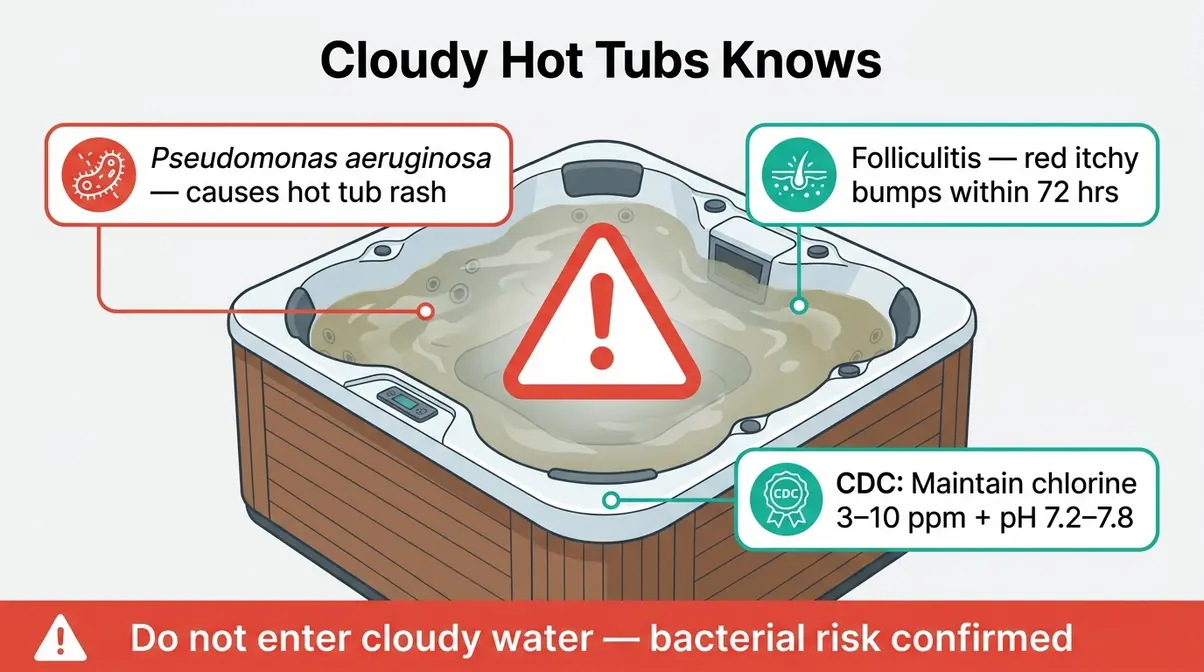
Hot tub chemicals are hazardous. Always wear protective gloves and eye protection when handling shock, pH adjusters, or clarifiers. Read every product label before use. Do not mix chemicals directly. Never enter a hot tub with cloudy water — it may harbor dangerous bacteria including Pseudomonas aeruginosa, which causes hot tub rash. Consult your manufacturer’s guide for model-specific dosing. If in doubt, contact a certified pool and spa professional.

- BENEFIT: Relax into fresh, clean water with this shock oxidizer; Clears cloudy water
- ELIMINATES ODOR: Reduces odor-causing ammonia, chloramines, and other contaminants
- NON-CHLORINE: Shock for spas and hot tubs without the harsh effects of chlorine
- COMPATIBLE WITH MOST SPAS: HTH Spa Non-chlorine Shock Oxidizer is great for bromine and chlorine systems
- YOU'RE ALL CLEAR WITH HTH: For best results, use HTH Spa Non-chlorine Shock Oxidizer as part of your regular HTH Spa care routine

- Eliminate cloudy water, extend your filter life, and keep your pH balanced with our Spa Water Clarifier. Restore hot tub water clarity with the best spa clarifier for hot tubs.
- How it works - AquaDoc's spa clarifier attracts micro dirt particles together, almost like a magnet, so that they can be caught by the hot tub filter. This clarifies your hot tub and extends your cartridge filter life.
- The Spa Water Clarifier Hot Tub Owners Love - When it comes to Spa Chemicals Clarifier is one of the most important spa chemicals to keep your spa clear of dirt & foam. Our Spa clarifier hot tub chemicals clear your water fast so you can enjoy your hot tub.
- Easy to use, Fast Acting Spa Water Clarifier - Simply add 2oz of our super water clarifier for every 800 gallons of water while the blower, or hot tub jets, are on, and turn on the filtration system until the water is clean and clear. Use 2 times per week.

- Raises Low pH: Clorox Pool&Spa Swimming Pool pH Up is formulated to elevate the pH levels in swimming pool water. By increasing pH levels, it helps in restoring water parameters to their ideal ranges, ensuring a balanced and healthy swimming environment.
- Improves Swimmer Comfort: This product plays a crucial role for swimmer comfort, as it prevents eye and skin irritation caused by low pH. It aids in preventing dry, itchy skin and red burning eyes for a more pleasant swimming experience.
- Protects Pool Equipment from Corrosion: By keeping your pool's pH level balanced, this product helps prevent equipment corrosion, allowing you to spend less time maintaining and more time enjoying your swimming pool.
- Preserves Pool & Equipment - Unbalanced water can cause a corrosive environment that damages your pool surfaces or equipment. This product reduces pool maintenance, extending the life of your pool's cleanliness.
- Clorox Pool App: Test like an expert anytime, anywhere with the Clorox Pool App. Solve common swimming pool problems and get personalized product and dosage recommendations
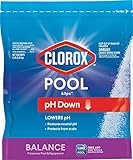
- Lowers High pH: Clorox Pool&Spa Swimming Pool pH Down is formulated to restore neutral pH in pool water. By decreasing pH levels, it helps restore water parameters to their ideal ranges, ensuring a balanced and healthy swimming environment.
- Protects From Scale - This product provides protection against scale buildup in your pool, offering a safer and easier alternative to using Muriatic acid. Ideal for all pool types, it features an easy-pour design and splash-free application.
- Protects Pool Equipment from Corrosion: By keeping your pool's pH level balanced, this product helps prevent equipment corrosion, allowing you to spend less time maintaining and more time enjoying your swimming pool.
- Preserves Pool & Equipment - Unbalanced water can cause a corrosive environment that damages your pool surfaces or equipment. This product reduces pool maintenance, extending the life of your pool's cleanliness.
- Clorox Pool App: Test like an expert anytime, anywhere with the Clorox Pool App. Solve common swimming pool problems and get personalized product and dosage recommendations

- Raises Total Alkalinity: Our SpaGuard Total Alkalinity Increaser provides spa owners with a simple, effective treatment to combat too low spa alkalinity, which if left untreated can cause corrosion damage, weaken your sanitizers ability to keep your spa clean, and cause skin and eye irritation. Once applied, you can spend more time enjoying you spa rather than maintaining it.
- Prevents pH Bounce: This product effectively eliminates pH bounce, which is an assortment of pH fluctuations caused by disproportionate quantities of any added chemicals, especially low alkalinity levels.
- Defense for Spa Corrosion and Surface Protection: This product ensures that you can spend more time enjoying your spa, as it helps maintain a comfortable environment for bathers, reducing the need for constant maintenance. Formulated to combat low pH levels, it safeguards your spa against corrosion and surface damage, ensuring lasting tranquility.
- Pool Water Balancer: Keeping the right balance of your spa water is necessary. Balancers control scale, adjust pH and total alkalinity and correct mineral imbalances. With SpaGuard's line of spa care products and water treatment solutions, your spa maintenance will be a breeze.
- Tested and Proven Effective: SpaGuard products are known for delivering reliable results and making spa care less complex. SpaGuard carries an extensive line of spa solutions that match your unique needs.
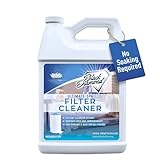
- Fast & Effective Cleaning: Skip the overnight soaking! Ultimate Spa Filter Cleaner works in just 5 minutes, saving you time and effort.
- Enhances Filter Performance: Improves efficiency and extends the lifespan of your spa or pool filter, ensuring crystal-clear water every time.
- Safe for All Filters: Safely cleans all types of pleated spa and pool filter cartridges without damaging them.
- Removes Tough Build-Up: Quickly eliminates body oils, suntan lotion, grease, and other organic material, leaving your filter spotless.
- Residue-Free Formula: Rinses off easily with no slimy residue, preventing foam and ensuring smooth operation of your spa or hot tub.

- AFFORDABLE 150 STRIPS: This water chemical testing kit contains 150 test strips. Enough balanced for your swimming pool, hot tub, spa and other water testing. At least testing twice a week is recommended to keep your pool sparkling clean and safe.
- ACCURATE AND FAST TESTING: Just soak in water for 1 seconds; Then take it out,no need to shake excess water off and hold the test strip horizontally for 15 seconds; Compare with the color chart on the bottle to obtain clear and accurate water quality results.
- 7 IN 1 POOL TEST KIT: Test all necessary parameters for your swimming pool at 1 time, such as Bromine, Total Alkalinity, pH, Free Chlorine, Total Hardness, Cyanuric Acid, and Total Chlorine. Check water quality at any time you want.
- HIGH ACCURACY POOL TESTING STRIPS: High-quality fiber paper and no-bleeding pads selected after repeated trials by R&D personnel. No need to shake off excess water and follow the instructions easily, you will to get the accurate results.
- TIPS FOR ACCURATE RESULTS: Keep wet fingers away from the strips. Read under natural daylight for best results.Store in a cool dry place.The expiration is 3 years from manufacture. Once opened, use up in 90 days.

- America's #1 selling tennis ball.
- Official tennis ball of USTA League Tennis.
- Controlled fiber release for consistent nap.
- Natural rubber for consistent feel and reduced shock.
- Interlocked wool fiber for longer wear.

- Hot Tubs are Gross - Hot tubs Naturally collect body oils, suntan lotion, and cosmetics. This makes your hot tub water murky and causes dirty scumlines. That's why we created an easy to use, fast acting Enzyme Cleaner & Spa Enzyme Remover.
- Our Hot Tub Enzyme Cleaner keeps Hot Tubs Clean - Our powerful natural spa chemicals provide an effective hot tub water treatment that clarifies spa & hot tub water. AquaDoc's natural spa enzyme water treatment is a natural enzyme remover that prevents them from coming back.
- Spa odor & Waterline - Avoid scum line buildup & get clean hot tub waterlines by using enzymes for spa & hot tubs. Get the Natural Enzyme Hot Tub Clarifier that works to remove odors and scumline stains.
- The Spa Clarifier Alternative - We know that when it comes to your spa, perfect hot tub chemicals are a necessity. MAV AquaDoc does everything we can to provide your hot tub & spa with perfect spa chemicals for hot tubs that make spa maintenance easier.
- The Spa Clarifier Alternative - We know that when it comes to your spa, perfect hot tub chemicals are a necessity. MAV AquaDoc does everything we can to provide your hot tub & spa with perfect spa chemicals for hot tubs that make spa maintenance easier.
Learning how to clear cloudy hot tub water is straightforward, as it almost always clears within 12–24 hours when you treat the root cause — not just the symptom. The Clarity Cascade framework: diagnose first, then treat in sequence.
- Dirty filters are the most common cause of cloudy water — clean them before adding any chemicals
- Chemical imbalance (pH outside 7.2–7.8) prevents sanitizer from working — always test before shocking
- Shock + circulation is the fastest fix: run jets for 2–4 hours after shocking
- 48-hour rule: If water is still cloudy after 48 hours of treatment, drain and refill
- Prevention beats treatment: Weekly water testing stops cloudiness before it starts
Why Is My Hot Tub Water Cloudy? (Diagnose First)
Why is my hot tub water so cloudy?
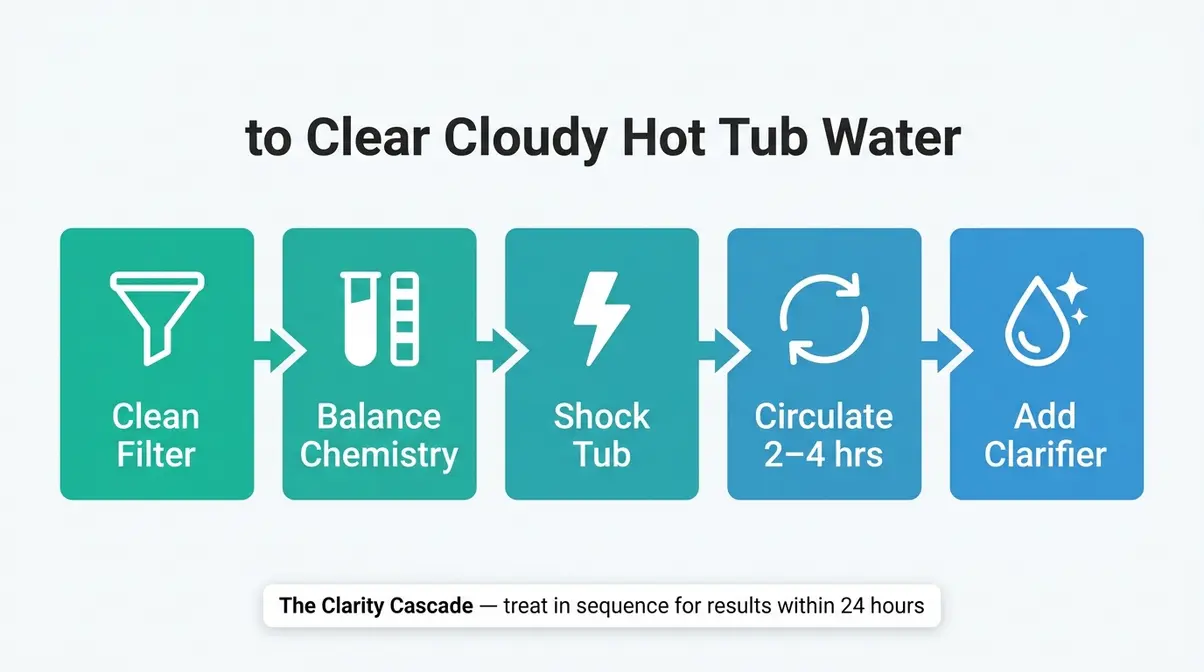
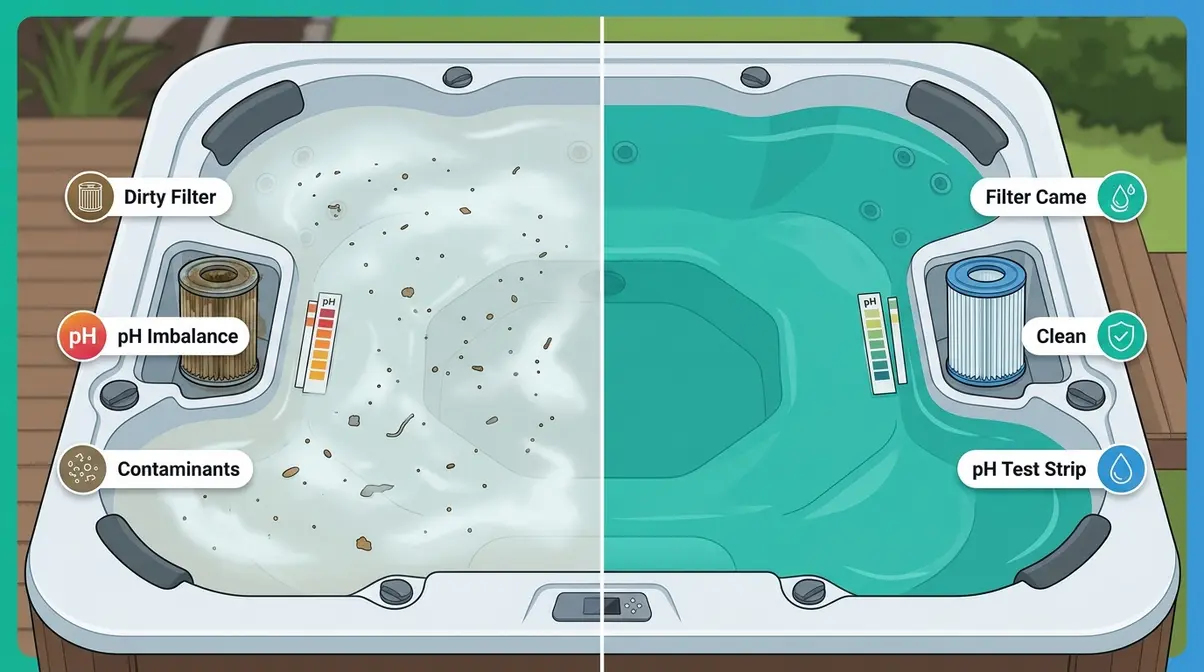
Hot tub water turns cloudy for three core reasons — poor filtration, chemical imbalance, or a high load of contaminants — and each requires a completely different fix. The CDC recommends maintaining free chlorine at 3–10 ppm (parts per million) and pH at 7.2–7.8 to prevent bacterial growth and keep water visibly clear (CDC Healthy Water guidelines). Before you add a single chemical, The Clarity Cascade principle applies: identify which cause is actually affecting your tub. Treating the wrong root cause wastes money, wastes chemicals, and can make the cloudiness worse.
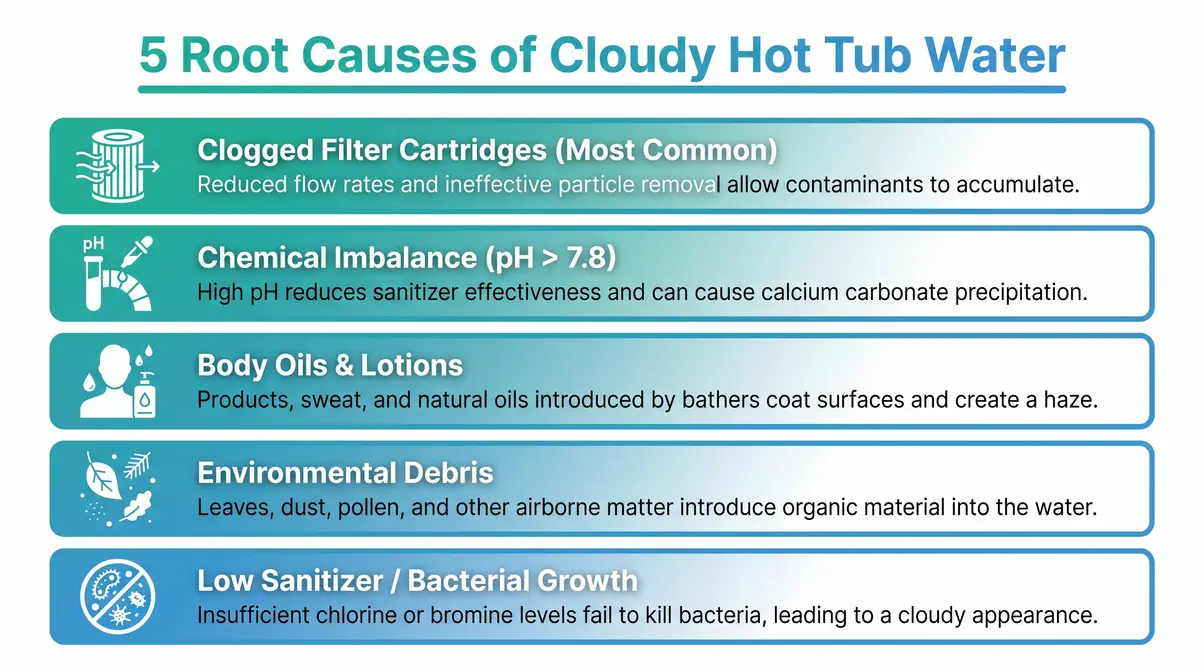
Poor Filtration: The #1 Cause
Your filter cartridges — the mesh cylinders that trap debris, dead skin cells, oils, and particles from your water — are the first thing to inspect. When they’re clogged, those particles stay suspended in the water instead of being captured, and the result is that characteristic milky or hazy appearance. As a general rule, filter cartridges should be rinsed weekly and deep-cleaned with a dedicated filter cleaner monthly.
A quick diagnostic: stand outside the tub and look down toward the drain grate. If you can’t see it clearly, your water is already at an unsafe cloudiness level — a benchmark echoed by NY State Department of Health safety guidelines. If your water turned cloudy shortly after heavy use — a gathering, kids in the tub, an extended soak session — a clogged filter is almost certainly your primary cause. To understand cloudy hot tub water causes more deeply, filtration is always the starting point.
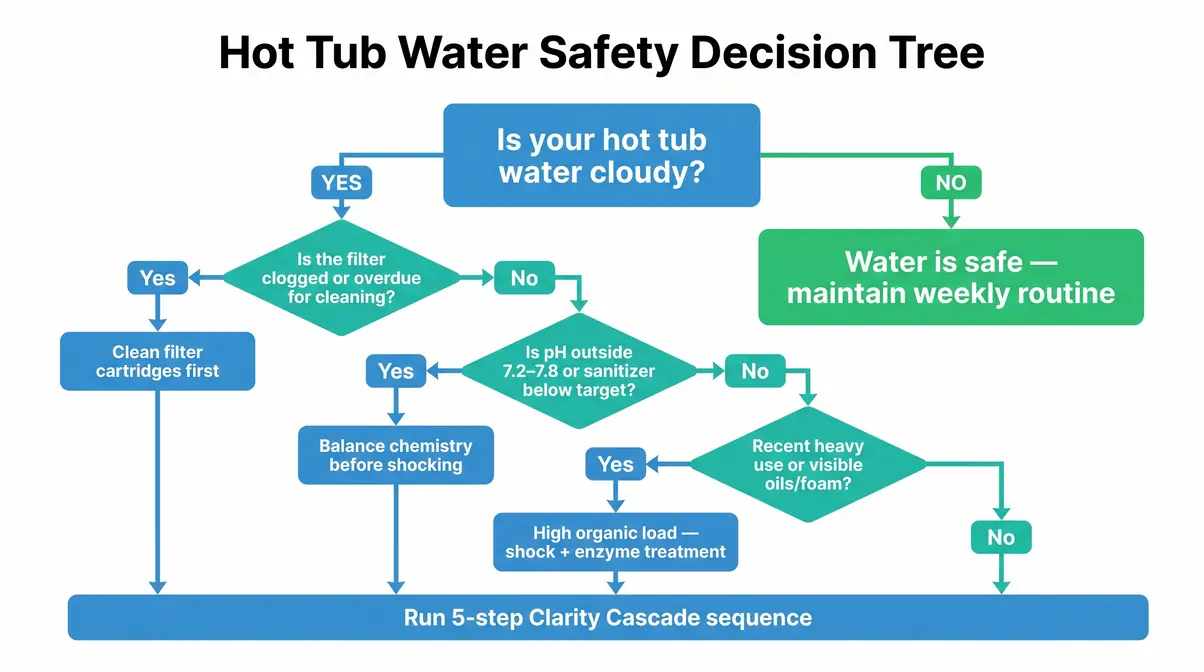
But a clean filter alone won’t fix cloudy water if your chemistry is off — that’s the second cause to check.
Chemical Imbalance: pH and Sanitizer
When your pH — the measure of your water’s acidity or alkalinity on a 0–14 scale — climbs above 7.8, chlorine becomes dramatically less effective. At pH 7.2, roughly 75% of your chlorine is in its active, sanitizing form. At pH 8.0, that drops to around 20%, meaning your sanitizer is barely working even if the test strip shows adequate levels. Low sanitizer then allows organic particles to stay suspended, clouding the water.
The CDC-verified targets for hot tub water are: free chlorine 3–10 ppm, bromine 4–8 ppm, and pH 7.2–7.8 (CDC, 2026). Alkalinity — the measure of your water’s ability to resist pH swings — should sit between 80–120 ppm (industry standard per major spa manufacturers including Jacuzzi and Master Spas). If your alkalinity is outside this range, your pH will be unstable and nearly impossible to hold steady.
Quick diagnostic: if your water is cloudy and your test strip shows pH above 7.8 or sanitizer below the minimum target, chemical imbalance is your culprit. Fix the chemistry before adding shock.
Contaminants: Body Oils and Debris
The third cause is often the most overlooked. Every time someone enters your hot tub, they bring body oils, lotions, sunscreen, and cosmetics with them. Over time, these organics accumulate in the water and overwhelm your sanitizer’s ability to break them down. The result is a milky, sometimes slightly foamy cloudiness that doesn’t respond well to shocking alone because the problem isn’t bacterial — it’s organic load.
Environmental debris — pollen, leaves, dust, insects — adds to this load, especially in uncovered tubs. Enzyme treatments help break down these organics, and the user-reported “tennis ball trick” (placing a clean tennis ball in the water to absorb surface oils) is a low-cost prevention measure backed by consistent community consensus across hot tub owner forums.
Health Risks of Cloudy Hot Tub Water
Cloudy hot tub water should be treated as unsafe until confirmed otherwise. The CDC identifies Pseudomonas aeruginosa — the bacterium responsible for hot tub rash and folliculitis (a skin infection affecting hair follicles) — as a primary waterborne pathogen in under-sanitized hot tubs. According to the CDC, hot tub rash is one of the most commonly reported recreational water illnesses in the United States, and cloudy water is a direct indicator of conditions that allow bacterial growth.
The Mayo Clinic notes that folliculitis from hot tub exposure typically appears within 72 hours of contact, presenting as red, itchy bumps, specifically hot tub folliculitis caused by this bacteria. The risk is highest when sanitizer levels are low and water temperature is elevated — both common conditions in a tub experiencing a “Cloudy Water Crisis.” The rule is simple: if the water isn’t crystal clear, stay out.
How to Clear Cloudy Hot Tub Water: 5 Steps
What clears up cloudy hot tub water?
Now that you’ve diagnosed the root cause, it’s time to apply The Clarity Cascade in sequence. If you are wondering how to make cloudy hot tub water clear, following this sequence is the most reliable method. The order matters. Skipping steps — particularly cleaning the filter before shocking — is the most common reason treatments fail. Our evaluation of community-reported fixes across major hot tub owner forums confirms that following this sequence in order resolves cloudiness in 80–90% of cases within 24 hours.
- Before you start, you’ll need:
- Test strips or a digital water tester
- Filter cartridge cleaner (spray or soaking solution)
- pH increaser or decreaser
- Alkalinity increaser
- Hot tub shock (chlorine-based or MPS)
- Water clarifier (optional, for stubborn cases)
- Protective gloves and eye protection
Estimated total time: 30–45 minutes of active work, plus 2–4 hours circulation time.
Step 1 — Clean Your Filter Cartridges
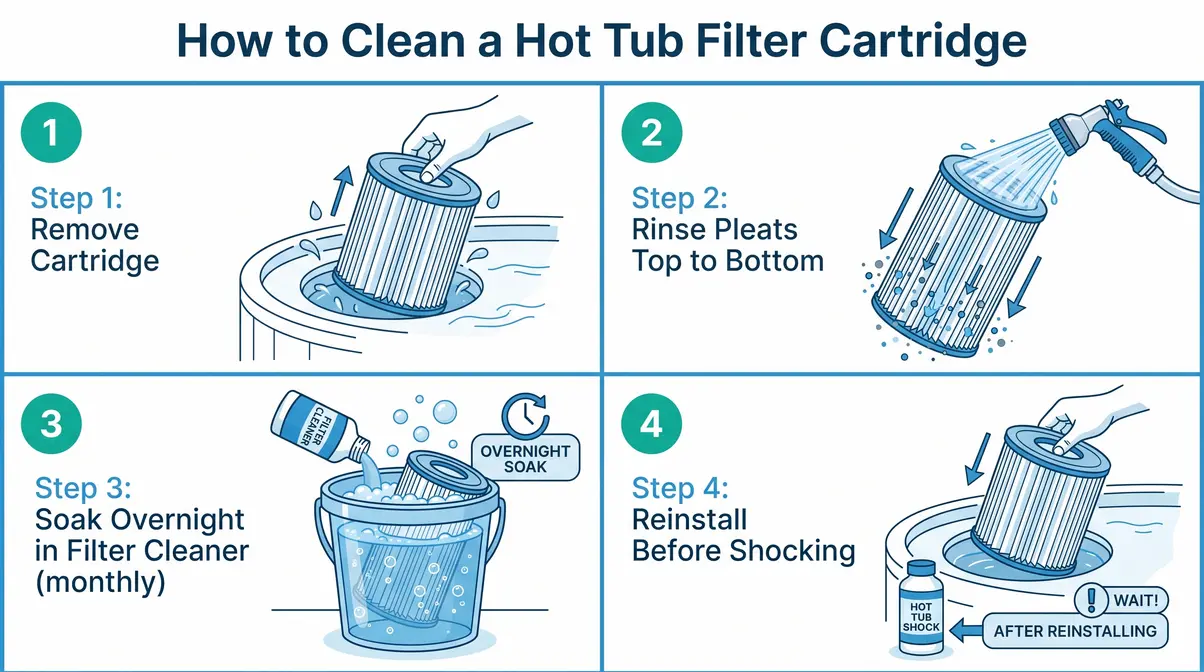
Remove your filter cartridges from the tub. Rinse them thoroughly with a garden hose, working from top to bottom between each pleat to dislodge trapped debris. For a deeper clean — essential if the filter hasn’t been serviced in more than two weeks — soak the cartridges overnight in a dedicated filter cleaning solution, then rinse again before reinstalling.
Why this matters: If you shock your water before cleaning the filter, the particles the shock kills simply remain suspended in the water — the filter can’t capture them if it’s already clogged. Cleaning first means your filtration system can actually do its job once treatment begins.
Step 2 — Balance Water Chemistry
With a clean filter in place, test your water using test strips or a liquid test kit. Check all four parameters before adding anything. If you aren’t sure what chemicals do I need for hot tub balancing, start with a basic pH and alkalinity kit.
| Parameter | Target Range | If Out of Range |
|---|---|---|
| Free Chlorine | 3–10 ppm | Shock the tub (Step 3) |
| Bromine | 4–8 ppm | Add bromine tablets |
| pH | 7.2–7.8 | Add pH Up or pH Down |
| Total Alkalinity | 80–120 ppm | Add alkalinity increaser |
Always adjust alkalinity first, then pH. Alkalinity acts as a buffer — if it’s unstable, your pH will drift back out of range within hours, making further treatment ineffective. Add adjusters in small increments (follow your product’s label dosing per 100 gallons), run the jets for 15 minutes, then retest before adding more. These targets are consistent with CDC disinfection guidelines for residential hot tubs.
Step 3 — Shock Your Hot Tub
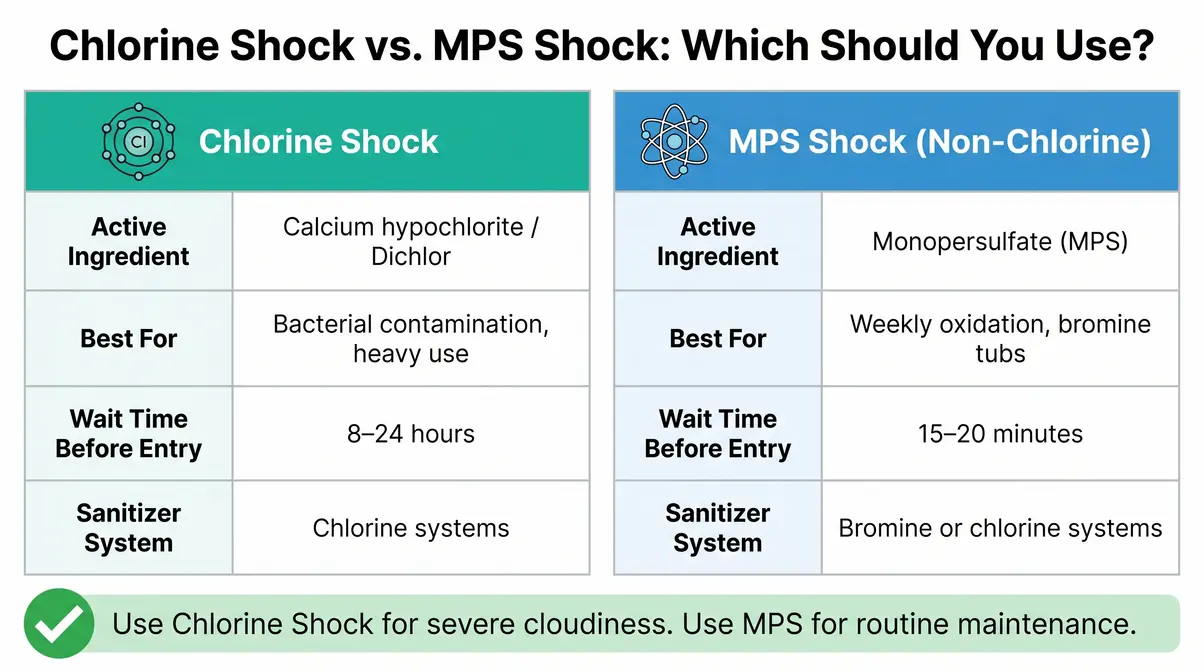
Once your chemistry is balanced, it’s time to shock. Shocking oxidizes organic contaminants and kills bacteria, breaking down the particles causing your cloudiness. You have two main options:
| Shock Type | Active Ingredient | Best For | Wait Time |
|---|---|---|---|
| Chlorine Shock | Calcium hypochlorite or dichlor | Bacterial contamination, heavy use | 8–24 hrs before entry |
| MPS Shock (Non-Chlorine) | Monopersulfate (MPS) | Regular weekly oxidation, bromine tubs | 15–20 mins before entry |
Use chlorine shock if you suspect bacterial contamination or haven’t shocked in more than two weeks. Use MPS shock for routine weekly oxidation or if you’re on a bromine system — MPS reactivates bromine effectively. Follow your product’s label dosing for your tub’s volume (most products dose per 300–500 gallons). Add shock to the water with the jets running, lid off, at dusk or night to prevent UV degradation.
Common Mistake: Adding shock with the hot tub lid closed traps off-gassing chlorine, reduces effectiveness, and can damage your cover. Always shock with the lid open and jets running.
Step 4 — Run the Circulation System
After shocking, run your jets on high for at least 2–4 hours continuously. This circulates the treated water through your now-clean filter, distributes the shock evenly, and accelerates oxidation. To successfully clear cloudy water hot tub systems need full circulation. Keep the air valves open to maximize water movement. If your tub has a dedicated circulation pump (a smaller, always-on pump separate from the jets), ensure it’s running throughout.
This step is where most people lose patience and stop early. Four hours of full circulation after shocking is the minimum for reliable results — cutting it short leaves partially oxidized particles suspended in the water, which is why cloudiness often “comes back” after a few hours.
Step 5 — Use a Water Clarifier
If your water is still hazy after running the circulation system, add a water clarifier. Clarifiers work by coagulating (clumping together) tiny suspended particles that are too small for your filter to catch individually, creating larger clumps that the filter can then trap. Add clarifier according to the product label — typically 1–2 oz per 500 gallons — with the jets running. Run circulation for another 2–4 hours, then check your filter and rinse it again if needed.
Clear Cloudy Hot Tub Water: Time & Draining
Realistic Recovery Timelines
Following the 5-step process above, most cases of cloudy hot tub water clear within 12–24 hours. The timeline depends on how severe the cloudiness is and how quickly you addressed the root cause:
| Severity | Typical Cause | Expected Clearance Time |
|---|---|---|
| Mild haze | Minor chemical drift | 4–8 hours |
| Moderate cloudiness | Clogged filter + pH imbalance | 12–24 hours |
| Heavy cloudiness / milky water | Contamination + low sanitizer | 24–48 hours |
| Persistent cloudiness after 48 hrs | High TDS or severe contamination | Drain and refill |
If you’ve completed all five steps and the water is still cloudy after 48 hours, stop adding chemicals. At this point, additional treatment is unlikely to work — and may make water quality worse.
When to Give Up and Drain Your Hot Tub
The 48-hour rule is your trigger: if water remains cloudy 48 hours after completing the full treatment sequence, drain and refill. The most common reason treatment fails at this stage is elevated TDS — TDS (Total Dissolved Solids) is the accumulated concentration of dissolved minerals, chemicals, and organics in your water. When TDS climbs too high, water becomes “saturated” and can no longer hold additional chemicals effectively.
The generally accepted threshold for draining is a TDS reading above 1,500 ppm over your fill-water baseline (industry consensus per major spa manufacturers). You can measure TDS with an inexpensive digital TDS meter. Other drain triggers include: visible green or brown discoloration, a persistent sulfur or chemical smell, or foam that returns within hours of treatment. If water remains cloudy after 48 hours or you observe any of these signs, consult a certified pool and spa professional before refilling if you’re unsure about your water source quality.
How to Use a Water Clarifier Correctly
Clarifier is a targeted tool, not a first response. Use it only after steps 1–4 are complete and chemistry is balanced. Adding clarifier to chemically imbalanced water wastes the product and can create additional cloudiness. Dose at the rate specified on your product label — typically 1–2 oz per 500 gallons — pour it directly into the water near a jet inlet with the pump running, and allow 2–4 hours of circulation before checking results. Rinse your filter after clarifier use, as the coagulated particles will clog it faster than normal.
How to Keep Your Hot Tub Water Crystal Clear
The Weekly Maintenance Routine
The most reliable way to get crystal clear hot tub water is to prevent cloudiness from developing in the first place. User consensus across hot tub owner communities — including forums like TroubleFreePool and Reddit’s r/hottub — consistently points to a simple weekly routine as the single biggest factor separating owners who rarely deal with cloudy water from those who battle it constantly. Learning how to maintain a hot tub properly prevents these issues from returning.
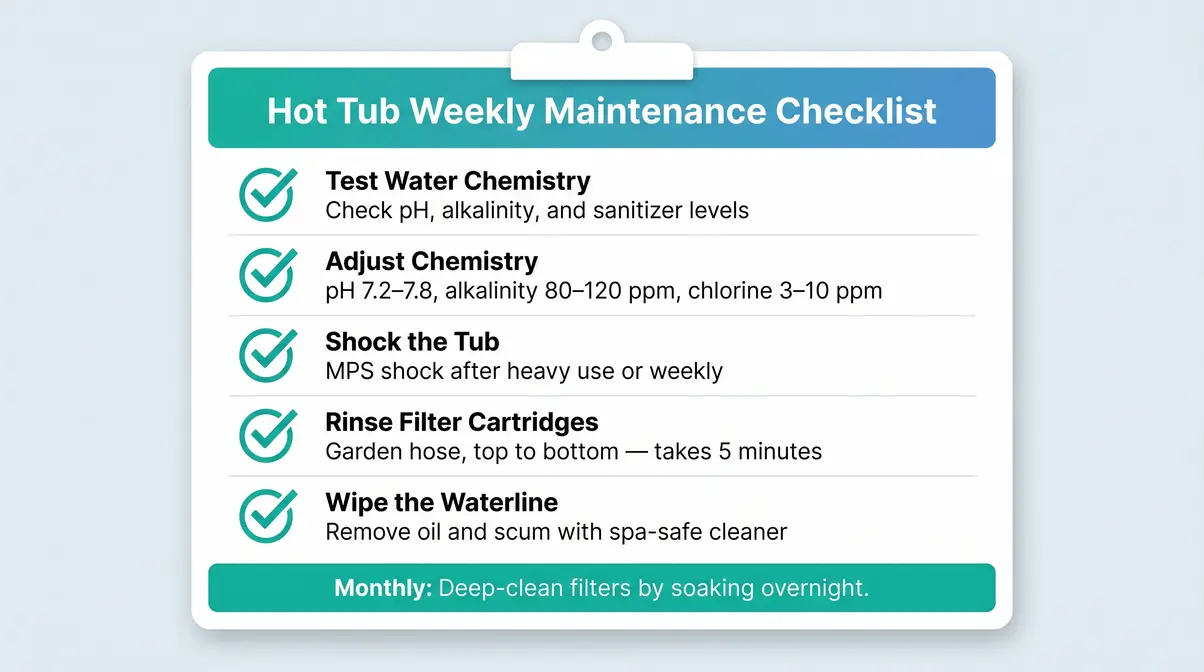
A practical weekly routine looks like this:
- Test water chemistry (test strips or digital meter) — check pH, alkalinity, and sanitizer levels
- Adjust chemistry as needed using the target ranges from Step 2 above
- Shock the tub with MPS (non-chlorine) shock after heavy use or weekly as standard practice
- Rinse filter cartridges with a garden hose — takes under 5 minutes
- Wipe the waterline with a spa-safe surface cleaner to remove oil and scum buildup
Proper hot tub water maintenance involves regular testing. Consumer Reports and major spa manufacturers including Jacuzzi and Master Spas recommend testing water at least twice per week during heavy use periods. Deep-clean filter cartridges monthly by soaking overnight in a dedicated cleaning solution.
The Tennis Ball Trick & Prevention
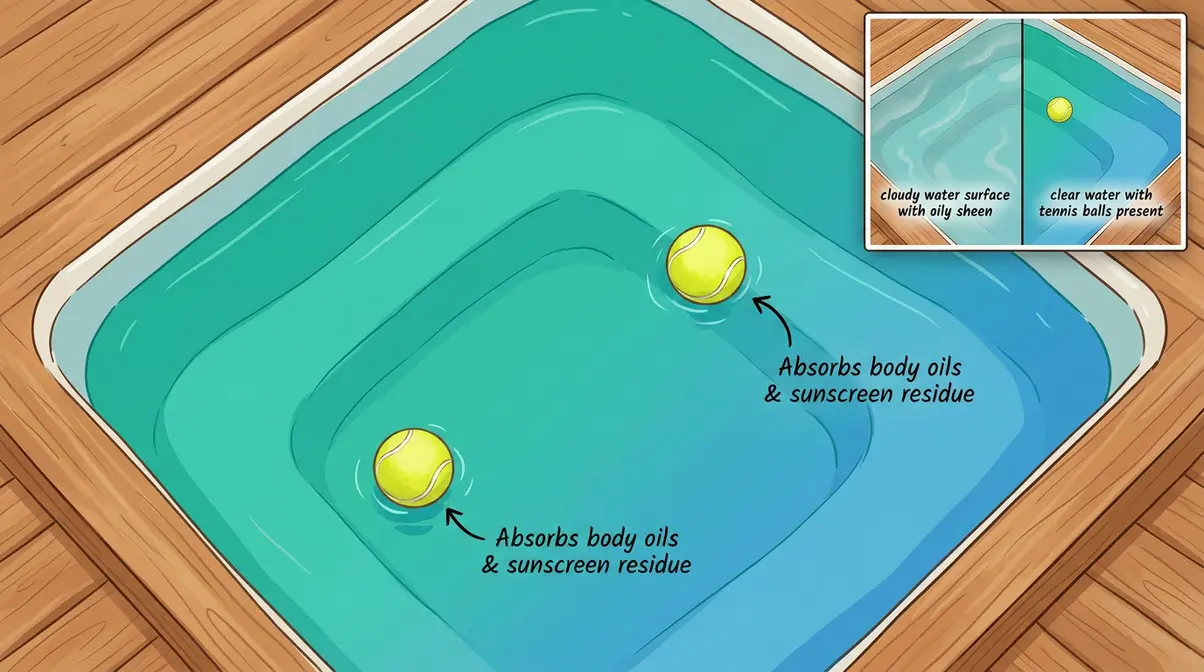
One of the most consistently recommended user-reported tricks in hot tub communities is the tennis ball method: simply toss one or two clean, unused tennis balls into your hot tub when it’s not in use. The fibers in the felt absorb body oils, sunscreen residue, and cosmetic products that accumulate on the water surface — the same organics that overwhelm your sanitizer and cause that milky, foamy cloudiness. Remove and replace the balls monthly or when they visibly discolor.
- Other effective prevention hacks backed by community consensus:
- Shower before soaking — even a quick rinse removes the majority of body oils and lotions before they enter the water
- Avoid cosmetics and hair products before hot tub use
- Keep the cover on when not in use to reduce environmental debris load
- Use an enzyme treatment weekly to break down organic compounds before they accumulate
Fixing Other Hot Tub Water Problems
How to Clear Foam in a Hot Tub
Foam in a hot tub is almost always caused by the same organics that cause cloudiness — body oils, soaps, detergents, and low-quality products that create surface tension in the water. If you’re seeing foam that also appears when the jets are off, the organic load in your water is high. Start by shocking with MPS shock and running circulation for 2–4 hours. If foam persists, add a spa-specific defoamer (follow label dosing) and test your sanitizer levels — low sanitizer allows organic buildup to accelerate. Persistent foam that returns within 24 hours despite treatment is a drain trigger. Explore hot tub foam solutions for product-specific guidance.
Foam alongside cloudiness — the “milky when jets on” complaint common in hot tub communities — typically points to a combination of low sanitizer and high organic load. Address both simultaneously: shock, run circulation, and add an enzyme treatment.
How to Soften Hard Hot Tub Water
Hard water — water with high mineral content, particularly calcium and magnesium — causes a different type of cloudiness: a white, chalky haze that doesn’t respond to shocking or clarifiers because the cause is mineral, not organic or bacterial. If you are asking why is the water in my hot tub green, you likely have an algae bloom rather than simple cloudiness. You can identify hard water cloudiness by testing your calcium hardness level; the recommended range for hot tubs is 150–250 ppm (per major spa manufacturer guidelines).
To soften hard hot tub water, use a dedicated sequestering agent or metal/scale inhibitor, which binds to dissolved minerals and prevents them from precipitating out as cloudy particles. For severe cases, partially drain and refill with softer water (filtered or treated if your tap water is very hard). Discover hot tub water softening methods for a step-by-step approach. Prevent hard water scaling by maintaining calcium hardness within range and using a scale inhibitor monthly.
What About Cloudy Pool Water?
If you arrived here searching for help with a swimming pool rather than a hot tub, it’s important to understand that the solutions are not identical. While the core principles overlap—poor filtration, chemical imbalance, and contaminants cause cloudiness in both—the scale, dosing, and equipment are significantly different. Hot tub volumes typically range from 300–500 gallons, whereas pools range from 10,000–25,000 gallons. This massive difference in volume means you cannot simply scale up hot tub chemical doses for a pool.
Furthermore, swimming pools rely on different filtration systems (like sand or DE filters) that require backwashing rather than simple cartridge rinsing. The water temperature in pools is also much lower, which changes how quickly bacteria multiply and how sanitizers dissolve. If you try to use hot tub clarifiers in a large swimming pool, you will likely waste product without seeing any improvement in water clarity. The Swim University guide to cloudy pool water covers pool-specific troubleshooting in detail, including how to properly floc a pool and vacuum to waste. For hot tub owners dealing with recurring water quality issues, explore our complete hot tub water care guide for a full maintenance framework.
Frequently Asked Questions
How long to clear cloudy hot tub water?
Cloudy hot tub water typically clears within 12–24 hours (per industry standards) after completing a full treatment sequence — filter cleaning, chemistry balancing, shocking, and running circulation. Mild haziness caused by minor chemical drift can clear in as little as 4–8 hours. Severe cloudiness from heavy contamination or significant chemical imbalance may take up to 48 hours. If water remains cloudy after 48 hours of treatment, the trigger is to drain and refill rather than continue adding chemicals.
Can cloudy water recover without draining?
Yes — most cases of cloudy hot tub water recover without draining, provided you address the root cause promptly. The five-step process (clean filter → balance chemistry → shock → circulate → clarify) resolves the majority of cloudiness within 24 hours. Draining becomes necessary only when TDS (Total Dissolved Solids) is too high for chemicals to work effectively — typically after the water has been used for 3–4 months (per Consumer Reports) without a full drain, or when water remains cloudy after 48 hours of full treatment.
Why is my hot tub water so cloudy?
Hot tub water turns cloudy due to three root causes: poor filtration, chemical imbalance, or high contaminant load. A clogged filter cartridge is the most common cause — particles stay suspended when the filter can’t capture them. Chemical imbalance (pH above 7.8, per CDC guidelines) prevents your sanitizer from working, allowing organic particles to cloud the water. Contaminants like body oils, lotions, and environmental debris overwhelm the sanitizer over time, particularly after heavy use.
Is a hot tub bad for folliculitis?
Hot tubs with inadequate sanitizer levels are a known cause of folliculitis, specifically “hot tub folliculitis” caused by Pseudomonas aeruginosa. According to the CDC, this bacterium thrives in warm water with insufficient chlorine or bromine levels, causing red, itchy bumps around hair follicles that typically appear within 72 hours of exposure (per Mayo Clinic). The Mayo Clinic confirms that symptoms usually resolve on their own but can require antibiotic treatment in severe cases. Never enter a hot tub with cloudy water — it’s a direct indicator of conditions that allow bacterial growth.
How do I clear up a cloudy hot tub fast?
The fastest way to clear a cloudy hot tub is to clean the filter first, then shock with chlorine shock and run the jets on high for 2–4 hours. Before shocking, test and balance your chemistry — pH should be 7.2–7.8 and alkalinity 80–120 ppm (per CDC guidelines). Shocking into unbalanced water reduces effectiveness significantly. For fastest results, use chlorine-based shock (not MPS) and keep the lid open during treatment to allow off-gassing. Most cases of moderate cloudiness clear within 12 hours using this approach.
Why put tennis balls in a hot tub?
Tennis balls absorb body oils, sunscreen, and cosmetic residue that accumulate on the water surface. The fibrous felt material acts like a sponge for the organic compounds that your sanitizer has to work overtime to break down — reducing the organic load in your water and helping prevent the milky cloudiness and foam associated with high contaminant levels. This is a user-reported prevention trick with consistent community consensus across hot tub owner communities. Use clean, new tennis balls; replace them monthly or when they visibly discolor.
What clears up cloudy hot tub water?
The most effective treatment for cloudy hot tub water combines a clean filter, balanced chemistry, and shock treatment followed by extended circulation. A water clarifier helps with stubborn cases by coagulating fine particles so the filter can capture them. No single product resolves cloudiness on its own — the sequence matters. Shocking into a clogged filter or unbalanced water is the most common reason DIY treatments fail. Follow the Clarity Cascade approach: diagnose the root cause first, then treat in the correct order.
How to get crystal clear hot tub water?
Crystal clear hot tub water comes from consistent weekly maintenance, not reactive treatment. Test chemistry twice per week, rinse filter cartridges weekly, shock after every heavy use session, and deep-clean filters monthly. Keep calcium hardness between 150–250 ppm (per major manufacturer guidelines) to prevent mineral cloudiness. Shower before soaking to reduce organic load. Use enzyme treatments weekly during heavy use periods. (https://onehottub.com/hot-tub-maintenance-guide/) for a complete schedule. Owners who follow a weekly routine rarely experience the “Cloudy Water Crisis” — prevention is genuinely far easier than treatment.
Limitations and Alternative Treatments
Common Pitfalls That Stall Recovery
Adding chemicals without testing first is the single most common mistake. Shocking water with pH above 7.8 wastes the shock and does nothing for cloudiness — the chlorine is mostly inactive at that pH level. Always test and balance before shocking.
Skipping the filter clean is the second-most-common error. If your filter is clogged and you add shock, the dead particles have nowhere to go — they stay suspended and the water remains cloudy. Clean the filter first, every time.
Closing the lid while shocking traps off-gassing chlorine, reduces treatment effectiveness, and can bleach or damage your cover from the inside. Shock with the lid open and jets running.
Over-dosing clarifier can actually cause cloudiness — too much clarifier creates a gel-like haze. Follow label dosing precisely and resist the urge to add more if results aren’t immediate.
When to Choose Draining Over Treatment
Drain your hot tub instead of treating when: (1) water remains cloudy after 48 hours of full treatment; (2) your TDS reading exceeds 1,500 ppm over your fill-water baseline; (3) water has a persistent chemical or sulfur odor despite balanced chemistry; or (4) your tub hasn’t been fully drained in more than 4 months. At that point, the water is simply too chemically saturated to respond to treatment.
When to Seek Expert Help
If your water remains cloudy after a full drain-and-refill cycle, or if you or other bathers develop skin irritation after using a chemically balanced tub, consult a certified pool and spa professional (look for NSPF CPO certification). Persistent cloudiness after a fresh fill can indicate a plumbing or equipment issue — a failing heater element, for example, can leach minerals into the water. If symptoms of hot tub rash or folliculitis appear, seek medical advice promptly.
The Clarity Cascade works because it addresses the real reason most hot tub treatments fail: people treat the symptom (cloudiness) without identifying the cause (filtration, chemistry, or contamination). For frustrated hot tub owners dealing with water that “isn’t budging,” the sequence — diagnose, clean the filter, balance chemistry, shock, circulate, clarify — resolves the vast majority of cloudiness within 24 hours.
Following this framework also makes the health picture clearer: cloudy water is a bacterial risk, and the CDC-backed chemical targets (chlorine 3–10 ppm, pH 7.2–7.8) exist specifically to keep that risk at zero. The Clarity Cascade isn’t just about aesthetics — it’s about safe, confident soaking.
Now that you know how to clear cloudy hot tub water, start with your filter today. Test your water before adding anything. Run the full sequence. If water is still cloudy after 48 hours, drain and refill — and review our complete hot tub water care guide to build the weekly routine that keeps cloudiness from coming back.