
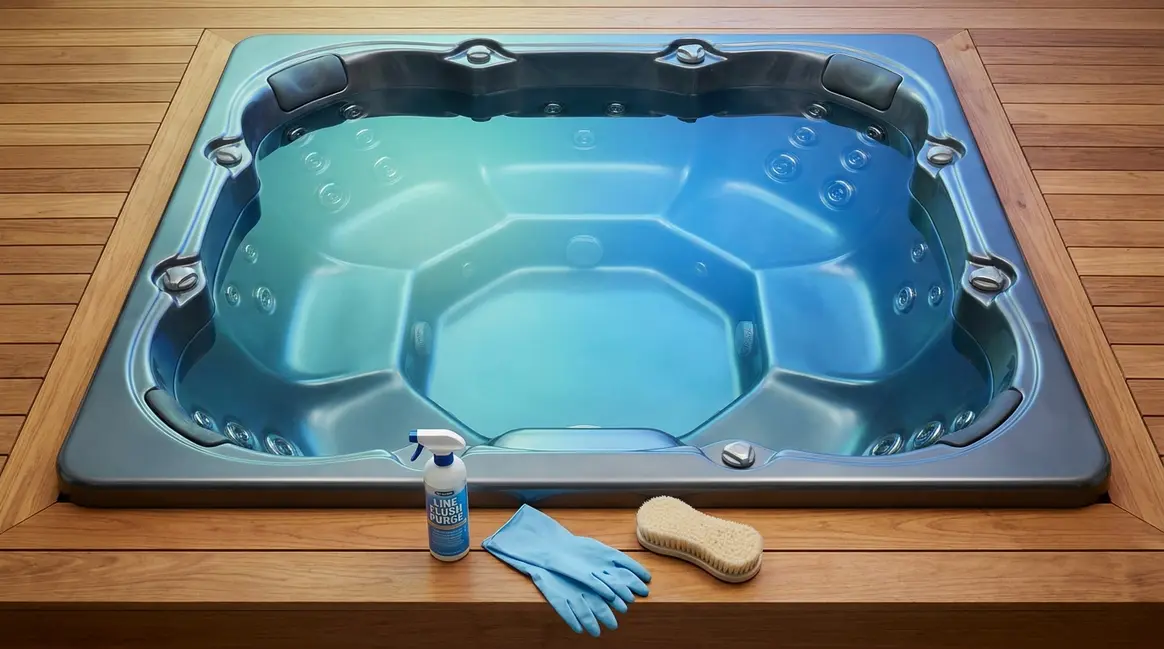
What’s in this guide
Home ›Maintenance And Troubleshooting
If you’ve noticed a slimy film coating your hot tub jets, or brown flakes floating in the water every time you flip the jets on, you are not dealing with a water chemistry problem. You are dealing with biofilm — a hidden colony of bacteria that has built a fortress inside your plumbing, invisible to the naked eye and almost completely immune to regular shocking.
The reason your extra doses of chlorine or bromine aren’t working is that biofilm bacteria hide behind a protective slime shield that standard sanitizers simply cannot penetrate. Every time you run your jets, that loosened gunk gets pushed back into your water — and the cycle repeats.
In this guide, you’ll learn exactly how to get rid of biofilm in hot tub systems using a proven 7-step Line Flush Protocol, so you can restore clean, safe water and keep it that way. We’ll cover what biofilm is, what you need before you start, the full removal process, alternative methods, a simple prevention schedule, and answers to the most common questions owners ask.
- Products mentioned in this guide:
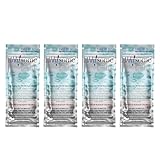
- Ahh-Some Hot Tub Plumbing and Jet Cleaner
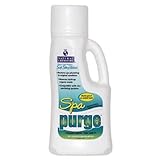
- Natural Chemistry Spa Purge
- SpaGuard Enhanced Shock
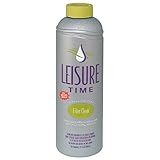
- Leisure Time Spa Filter Clean
- Spa Marvel Water Treatment and Conditioner
Knowing how to get rid of biofilm in hot tub plumbing requires a specialized purge — not just shocking the water. Biofilm bacteria can resist standard sanitizers by up to 1,000 times compared to free-floating bacteria (NCBI, 2015).
- The Line Flush Protocol treats biofilm as a plumbing problem: Purge → Drain → Scrub → Refresh → Defend
- Regular shocking won’t work — biofilm’s protective slime layer blocks chlorine and bromine
- Complete removal requires draining your hot tub after the purge cycle
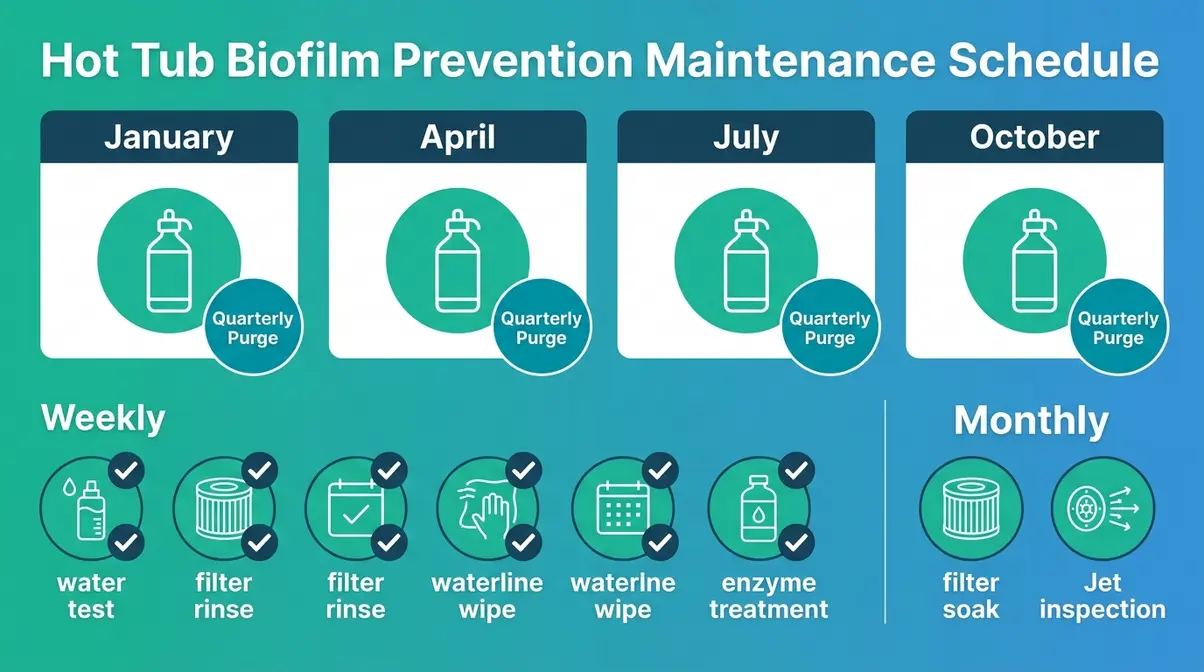
- Prevent recurrence with a quarterly purge and weekly enzyme treatments
- Never use more purge product than directed — more does not mean faster or better results



What Is Hot Tub Biofilm – and Why It’s Dangerous
Biofilm in your hot tub is not a sign of laziness or bad water chemistry. It is a biological problem — one that lives deep inside your pipes, not floating in your water. Understanding what you’re up against is the first step toward actually defeating it.
What Is Biofilm and How Does It Form?
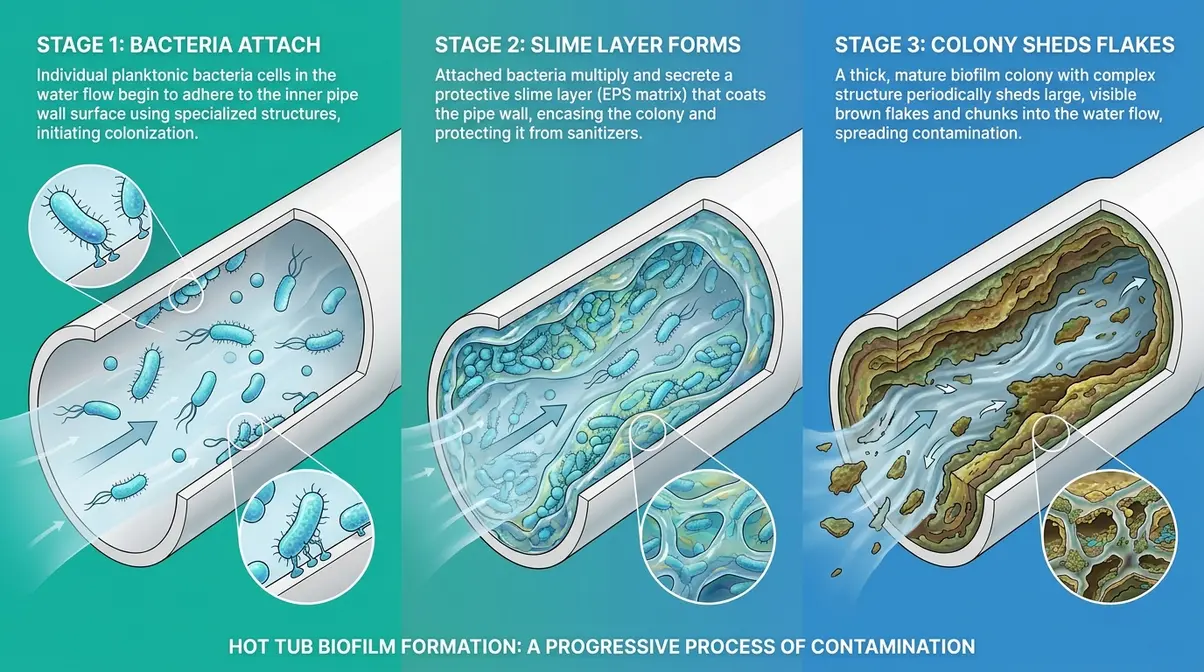
Biofilm is a slimy layer of bacteria (and sometimes other microorganisms) that attaches to a surface, then secretes a protective coating called an extracellular matrix — think of it as a self-built fortress made of slime. Inside your hot tub’s plumbing, jet lines, and filter housing, this process happens quickly. Bacteria enter through the water, find a warm, dark surface, and begin colonizing within hours.
The warm temperature of your spa water (typically 98–104°F) creates ideal conditions for bacterial growth. Once a colony establishes itself, it starts producing that protective slime shield. Over time, layers build up inside your pipes. You may never see it directly — but you’ll notice brown flakes, a musty smell, or a white film around your jets. Those are all signs that biofilm has moved in.
Is biofilm bad in a hot tub?
Yes — biofilm in a hot tub is a genuine health risk, not just a cosmetic problem. The bacteria living inside hot tub biofilm can include Pseudomonas aeruginosa, which causes “hot tub folliculitis” (a skin rash), and — more seriously — Legionella pneumophila, the bacterium responsible for Legionnaire’s disease (a severe risk highlighted by WHO guidelines).
The CDC guidelines on recreational water illnesses confirm that hot tubs present a higher risk than swimming pools because warm water accelerates bacterial growth and causes sanitizers to break down faster. If you see brown flakes, smell a musty odor, or notice persistent skin irritation after tub use, treat it as a biofilm problem immediately.
Why Shocking Doesn’t Work
Here’s the core problem: chlorine and bromine are excellent at killing free-floating bacteria in your water. But biofilm bacteria are not floating freely — they’re locked inside a slime matrix that physically blocks sanitizer molecules from reaching them. Shocking the water treats the symptom, not the source.
According to research published on NCBI, bacteria living inside a biofilm can resist disinfectants at concentrations up to 1,000 times higher than free-floating bacteria (NCBI, 2015). That number explains why your shocking routine feels like it’s doing nothing — because against biofilm, it largely is. According to Spa Marvel’s biofilm guide, standard sanitizers work on planktonic (free-floating) bacteria but fail to penetrate the extracellular matrix of an established biofilm colony. The biofilm simply absorbs the chemical and keeps growing.
What You Need Before You Start
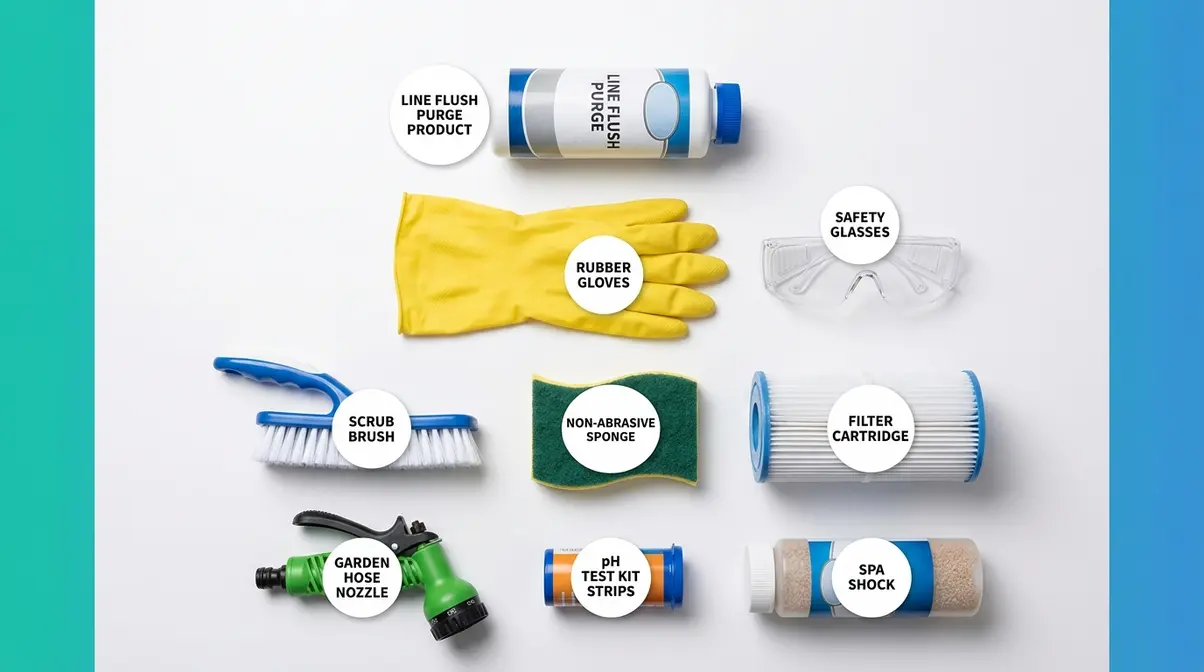
Before you begin the Line Flush Protocol, gather your supplies and review these safety requirements. Skipping this step is the most common reason the process fails or causes injury.
- What you’ll need:
- A dedicated line flush (purge) product such as Ahh-Some, Natural Chemistry Spa Purge, or a similar enzyme-based cleaner — not a standard shock or clarifier
- Rubber gloves and safety glasses — mandatory when handling spa chemicals
- A soft-bristle scrub brush and non-abrasive sponge for the shell
- Spa filter cleaner (separate from your regular rinse)
- A garden hose for refilling
- Fresh sanitizer (chlorine or bromine) and a pH test kit for the restart
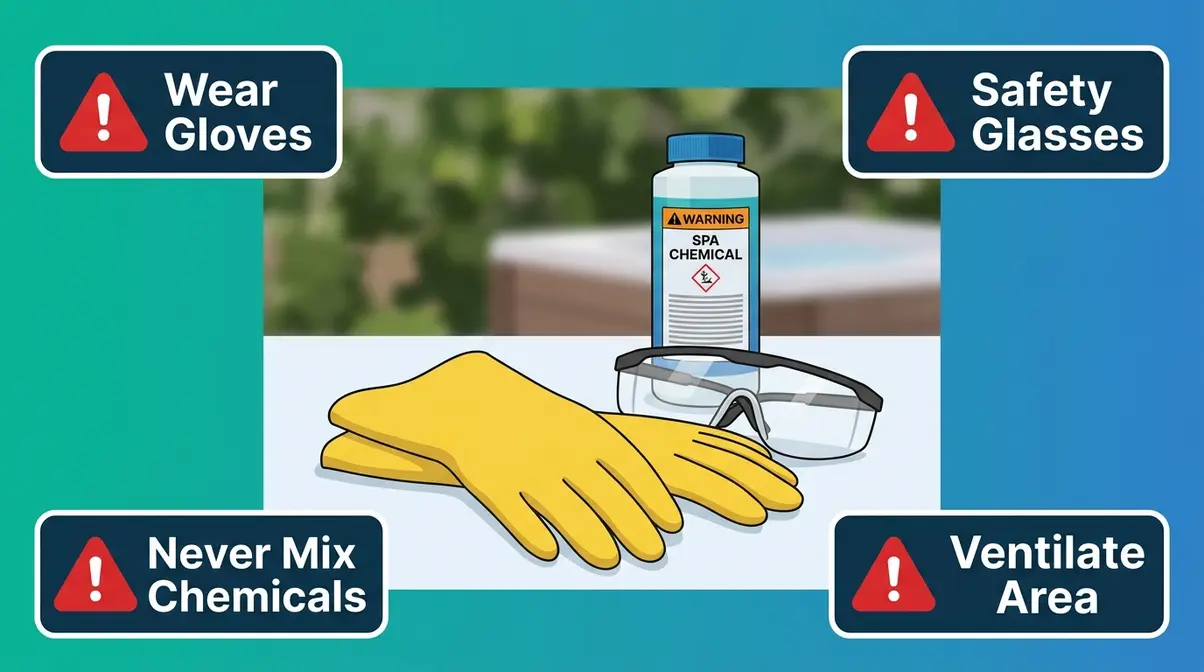
⚠️ Chemical Safety — Read Before You Begin: Always wear rubber gloves and safety glasses when handling spa chemicals. Work in a well-ventilated area. Never mix chemicals together. Follow the product label instructions exactly — adding more than the recommended dose does not speed up the process and can damage your equipment or irritate your skin. Keep children and pets away from the area during the purge and drain cycle.
Estimated total time: 3–5 hours across one day (including the 2-hour purge cycle and drain/refill time).
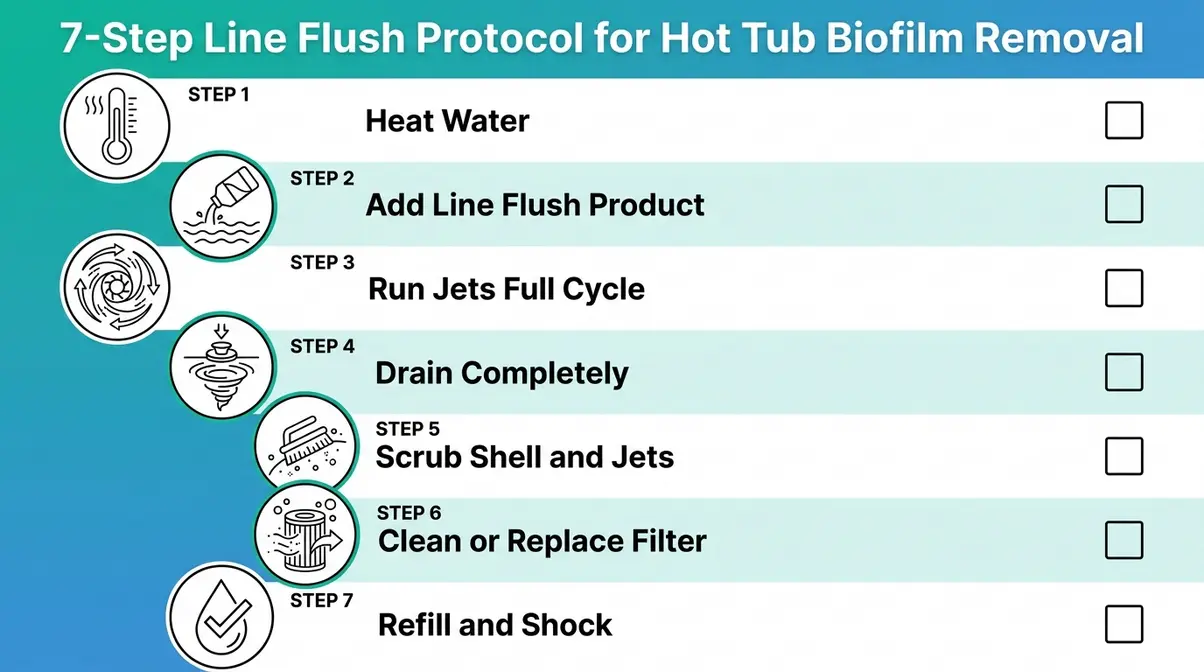
7-Step Line Flush Protocol
This is the core of the process. Our team evaluated this protocol against manufacturer guidelines, Penn State Extension recommendations, and community-reported outcomes across multiple hot tub owner forums. The result is a repeatable, beginner-friendly sequence that actually works — provided you follow each step completely.
Step 1 – Heat Your Hot Tub Water
Set your hot tub to its maximum temperature (usually 104°F / 40°C) and let it fully heat before adding anything. Hot water is not just comfortable — it actively helps loosen the slimy stuff clinging to your pipe walls. Heat makes the biofilm matrix more porous and easier for the purge product to penetrate. Allow at least 20 minutes at full temperature before moving to Step 2. Do not add any chemicals yet.
Step 2 – Add Line Flush Product
With the jets running on high, add your line flush product directly to the water according to the package instructions. A line flush product (also called a purge product) is a specialized cleaner — usually enzyme-based — designed to break apart the biofilm’s slime matrix from the inside. Popular options include Ahh-Some and Natural Chemistry Spa Purge. Use only the amount specified on the label. Adding more will not speed up the process.
Here’s the reassurance that hot tub owners in online communities keep coming back to:
“You will win the war against biofilm. Keep purging. Start with hot water, add just what we say, no more. More does not do a better or faster job.”
Step 3 – Run Jets for Full Cycle
Keep all jets running on the highest setting for the full time your purge product specifies — typically 1 to 2 hours. This circulates the product through every inch of your plumbing, including the hidden pipe sections you cannot reach with a brush. You will likely see brown foam, dark flakes, or an oily residue rise to the surface. That is the loosened gunk coming out of your pipes. It looks alarming. It means the protocol is working.
Do not be tempted to drain early. The full cycle is non-negotiable. According to Leslie’s Pool’s biofilm overview, cutting the purge cycle short leaves active biofilm colonies in the deeper sections of your plumbing — which will recontaminate your spa within days of refilling.
Step 4 – Drain Hot Tub Completely
After the purge cycle finishes, drain the tub completely. This step is non-negotiable — you cannot simply add fresh water on top of the loosened gunk. Everything that was dislodged from your pipes is now suspended in the water, and leaving it in place gives biofilm a head start on rebuilding. Use a submersible pump to speed up draining if you have one, or use the tub’s built-in drain valve. Draining a standard hot tub takes 30–90 minutes depending on the method.
Step 5 – Scrub Shell and Jets
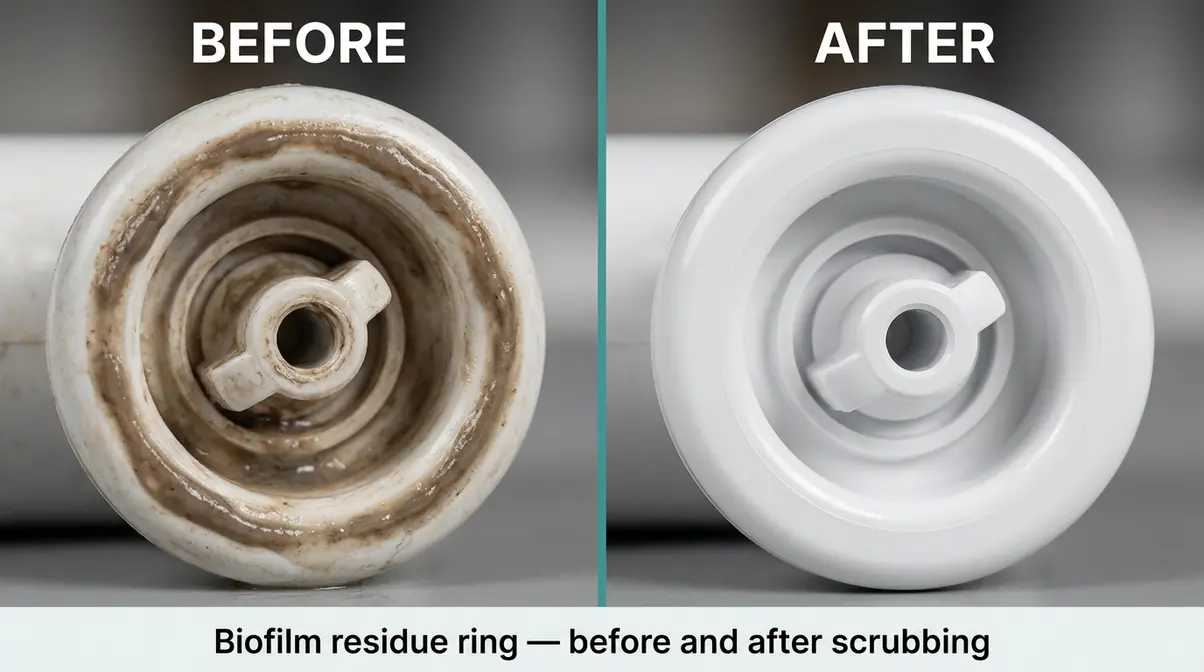
With the tub empty, put on your gloves and scrub every surface you can reach. Use a non-abrasive sponge or soft brush with a diluted spa surface cleaner. Pay close attention to the area around each jet nozzle — biofilm often leaves a visible ring of residue here. Remove jet inserts if your model allows it and scrub behind them. Rinse all surfaces thoroughly with clean water before moving on.
Step 6 – Clean or Replace Filter
Your filter is a prime biofilm hideout. Simply rinsing it under a hose is not enough after a biofilm treatment. Soak the filter cartridge in a dedicated spa filter cleaner solution for at least 8 hours (overnight is ideal), then rinse thoroughly. If your filter is more than 12 months old, or if it shows visible discoloration or damage, replace it entirely. Skipping this step is one of the most common reasons biofilm returns within weeks — a contaminated filter will recontaminate your spa every time it circulates water.
Step 7 – Refill and Shock
Refill your hot tub with fresh water, then shock it with your standard sanitizer (chlorine or bromine) at the startup dose recommended on the package. Test and balance your water chemistry — pH should sit between 7.4 and 7.6, alkalinity between 80–120 ppm. Allow the tub to circulate for at least 30 minutes before testing again. Do not use the tub until your sanitizer levels are within the safe range. This final step closes the loop: you’ve purged, drained, scrubbed, and now you’re starting with a genuinely clean system.
Alternative Methods and Hacks
Not every situation calls for the full protocol. Here are the honest answers to the most common alternative approaches hot tub owners ask about.
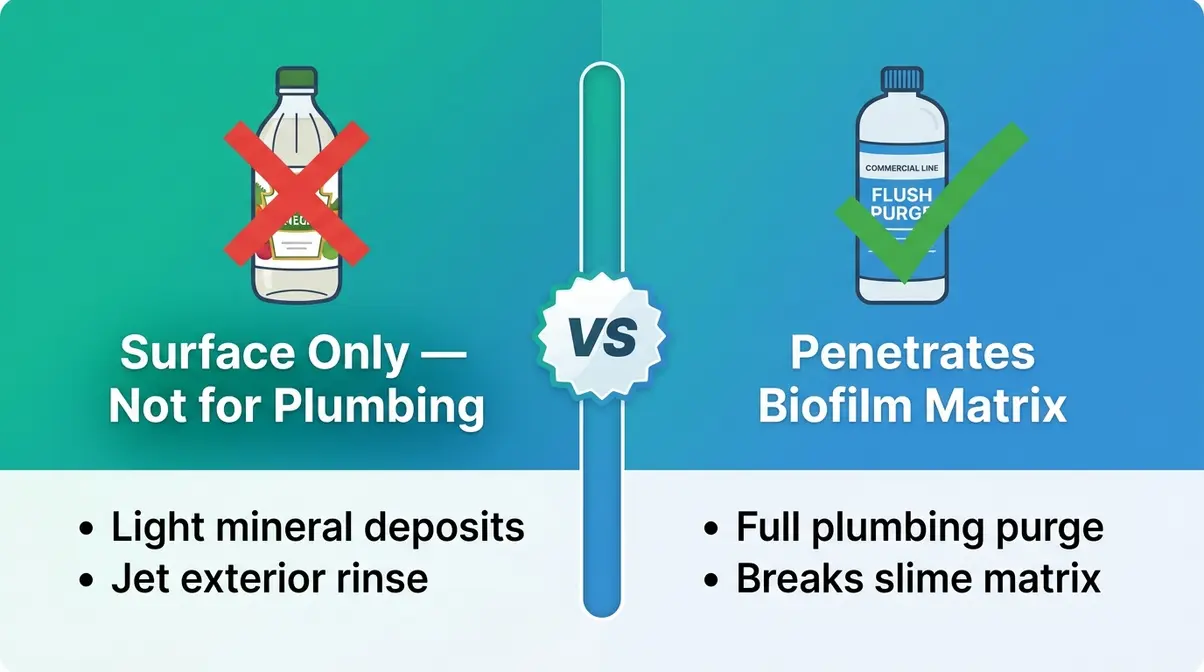
Vinegar vs. Line Flush
White vinegar is a mild acid that can help dissolve mineral deposits and light surface residue. Some owners use it as a DIY rinse for jet nozzles or as a filter soak. However, vinegar is not an effective biofilm treatment for your plumbing lines. It lacks the enzymatic or surfactant action needed to break apart the slime matrix inside your pipes. According to Cal Spas’ biofilm guide, commercial line flush products are specifically formulated to penetrate biofilm structure — vinegar simply is not.
Use vinegar for: Light surface cleaning of jet nozzle exteriors, or as a gentle filter pre-rinse. Use a commercial purge product for: Any actual biofilm removal from your plumbing lines.
| Method | Targets Plumbing Biofilm? | Cost | Best For |
|---|---|---|---|
| White Vinegar | No | ~$2 | Surface mineral deposits only |
| Commercial Line Flush | Yes | $15–$35 | Full biofilm purge |
| Enzyme Products | Partial (prevention) | $10–$25/month | Ongoing maintenance |
Purging Without Draining?
Technically, you can run a purge product without draining — and for a mild case of biofilm, this may provide temporary relief. However, the loosened gunk from the purge cycle ends up suspended in your water. Without draining, you are essentially swimming in dissolved biofilm debris, and some of it will reattach to your pipe walls as the water circulates. For a full walkthrough on cleaning methods, see our guide on how to clean a hot tub without draining it.
For severe biofilm — visible brown flakes, persistent odor, or repeated failed treatments — draining after the purge is not optional. It is the only way to fully remove what the purge product dislodged.
Why put tennis balls in a hot tub?
Tossing a tennis ball into your hot tub is a real trick — and it actually works, within its limits. Tennis balls absorb body oils, lotions, and cosmetic residue from the surface of your hot tub water. The felt fibers act like a sponge, soaking up the organic compounds that would otherwise accumulate in your water and feed biofilm bacteria. By reducing the organic load in your water, tennis balls help slow biofilm formation.
What tennis balls cannot do: break apart existing biofilm, clean your pipes, or substitute for a purge cycle. Think of the tennis ball as a preventive tool, not a cure. Toss one or two into your tub after each use, and replace them monthly. It is a low-effort, low-cost habit that makes a measurable difference over time — especially combined with a proper maintenance routine.
How to Prevent Biofilm
Removing biofilm is the hard part. Keeping it gone is mostly about consistency. These three habits form the core of a reliable prevention strategy.
Weekly and Monthly Maintenance
Biofilm builds up when organic matter (body oils, sweat, lotions) accumulates faster than your sanitizer can break it down. Weekly maintenance keeps that balance in check. For a comprehensive routine, review everything you need to know about hot tub water maintenance.
- Weekly:
- Test and balance water chemistry (pH 7.4–7.6, sanitizer within range)
- Rinse your filter with a hose
- Wipe down the waterline with a spa surface cleaner
- Monthly:
- Remove and soak your filter cartridge in filter cleaner solution
- Check jet nozzles for residue buildup
- Add an enzyme-based water conditioner (see H3 below)
Consistent weekly habits reduce the organic load that feeds biofilm bacteria, making quarterly purges more effective and less dramatic.
The Quarterly Purge
Even with perfect weekly maintenance, biofilm will gradually rebuild inside your plumbing. Penn State Extension recommends draining and refilling your hot tub every 3–4 months as a baseline, and hot tub manufacturers widely endorse pairing that drain cycle with a dedicated line flush product.
A quarterly purge — using the same 7-step Line Flush Protocol described above — resets your plumbing before biofilm has a chance to establish a mature colony. To extend the life of your spa, follow the complete guide to maintaining a hot tub for longevity. Mark it on your calendar. Treat it as non-negotiable maintenance, not an emergency response.
- Quarterly purge schedule:
- January — Post-holiday reset
- April — Spring startup
- July — Mid-summer refresh
- October — Pre-winter prep
Using Enzyme Products
Enzyme-based water treatments (such as Spa Marvel or similar products) work by continuously breaking down the body oils, lotions, and organic debris that feed biofilm bacteria. Unlike shock or sanitizer, enzymes do not kill bacteria directly — they eliminate the food source. This aligns with PHTA standards for preventing recreational water illnesses.
User consensus from hot tub owner communities consistently identifies enzyme products as one of the most effective long-term prevention tools, particularly for owners who use their tubs frequently or who have had repeated biofilm problems. Add an enzyme conditioner weekly or as directed on the product label, and use it alongside — not instead of — your regular sanitizer routine.
Other Common Hot Tub Problems
Biofilm is the most stubborn hot tub problem, but it is rarely the only one. Here are three other issues that often appear alongside it.
How to Get Rid of Foam
Foam in your hot tub is usually caused by the same organic contaminants that feed biofilm: body oils, soaps, lotions, and detergent residue from swimwear. A foam-free enzyme product or a dedicated anti-foam treatment can reduce it quickly. If foam returns persistently after treatment, it may signal a deeper water chemistry imbalance — or early-stage biofilm. For a full walkthrough, see our guide on how to eliminate foam in your hot tub.
How to Remove Sand
Gritty sediment at the bottom of your tub is almost always sand or mineral scale. A small pool vacuum or wet-dry vac works well for removal. Check your fill water source — hard water with high mineral content can cause scale buildup that mimics sand. If the problem recurs after cleaning, a scale inhibitor added to your weekly routine will help. For step-by-step guidance, visit our article on how to get sand out of a hot tub.
Fixing Bubbles and Cloudy Water
Cloudy water combined with persistent small bubbles is often a sign of high total dissolved solids (TDS) — meaning your water has absorbed so many chemicals and organic compounds that it can no longer stay clear. The fix is usually a full drain and refill, followed by proper startup chemistry. If cloudiness returns within days of a fresh fill, biofilm contamination in the plumbing is a likely culprit — run the Line Flush Protocol before refilling again.
Safety Warnings and Pro Help
Chemical Safety Rules
⚠️ Always follow these rules when handling spa chemicals:
- Wear rubber gloves and safety glasses for every chemical step — no exceptions
- Work in a well-ventilated area; never work in an enclosed space with chemical fumes
- Never mix chemicals — add each product to water separately, never together
- Read the product label before every use; dosing instructions vary by brand and product
- Store chemicals in a cool, dry place away from children and pets
- If a chemical contacts your skin or eyes, rinse immediately with plenty of water and seek medical advice
For more comprehensive safety protocols, review our essential hot tub safety guide for owners.
Common mistakes that make biofilm worse:
| Mistake | Why It Fails | Fix |
|---|---|---|
| Adding extra shock instead of a purge product | Shock kills free bacteria; it cannot penetrate biofilm | Use a dedicated line flush product |
| Skipping the drain after purging | Loosened gunk reattaches to pipe walls | Always drain completely after the purge cycle |
| Replacing the filter without soaking it | A quick rinse leaves biofilm on filter fibers | Soak in filter cleaner for 8+ hours |
| Cutting the jet cycle short | Deep biofilm in far pipes goes untreated | Run the full recommended cycle time |
When to Call a Professional
If you have completed the full 7-step Line Flush Protocol twice and biofilm continues to return within a few weeks, the problem may be structural — cracked pipes, damaged jet fittings, or a failing circulation pump that allows water to stagnate in dead zones. In these cases, a licensed spa technician can inspect your plumbing and identify the root cause.
If your hot tub is older, repeatedly plagued by biofilm, or simply no longer worth the maintenance cost, removal may be the most practical option. If your hot tub is permanently damaged or built into a deck, you may need to learn how to remove a hot tub from a deck or hire movers who know how to move a hot tub. Persistent biofilm in aging equipment is not a cleaning failure — it is a signal that the equipment itself needs professional attention.
Frequently Asked Questions
Can you purge without draining?
You can run a purge product without draining, but it only provides a partial fix. The purge product dislodges biofilm from your pipes, leaving it suspended in the water. Without draining, that loosened gunk circulates and can reattach to pipe walls — recontaminating your spa within days. For mild, early-stage biofilm, a no-drain purge may offer temporary relief. For established biofilm with visible brown flakes or persistent odor, draining after the purge cycle is the only way to fully clear the system.
What kills biofilm in a hot tub?
Dedicated line flush (purge) products kill and dislodge biofilm — standard shock or sanitizer does not. Enzyme-based purge products like Ahh-Some or Natural Chemistry Spa Purge are specifically formulated to break apart the extracellular slime matrix that protects biofilm bacteria. Research shows biofilm can resist chlorine at concentrations up to 1,000 times higher than those that kill free-floating bacteria (NCBI, 2015). Standard shocking treats the water; a purge product treats the plumbing.
Why the 15-minute hot tub rule?
The 15-minute rule is a general soak guideline — not a biofilm-specific rule. Extended soaking in hot water (especially at higher temperatures) raises your core body temperature and can cause dizziness, dehydration, or heat-related illness. CPSC safety guidelines and most health organizations recommend limiting continuous soaks to 15–20 minutes before exiting to cool down. The rule has nothing to do with biofilm, but it is worth knowing: if you are soaking in a tub with active biofilm, shorter exposure times also reduce your contact with potentially harmful bacteria. For more on soak times, see how long should you stay in a hot tub.
What removes hot tub biofilm?
A line flush purge product removes biofilm from a hot tub — specifically one designed to break apart the slime matrix inside your plumbing. The product must be circulated through your jets at high temperature for the full recommended cycle (typically 1–2 hours), followed by a complete drain. Scrubbing the shell and deep-cleaning the filter complete the removal. No single chemical added to the water without this process will eliminate established biofilm — the plumbing must be purged mechanically and chemically, which is exactly what The Line Flush Protocol is designed to do.
The Bottom Line on Hot Tub Biofilm
For owners wondering how to get rid of biofilm in hot tub lines, the core truth is this: biofilm in your hot tub lives in your plumbing, not your water — and that is why standard shocking keeps failing. The only reliable solution is a plumbing-level approach: purge the lines with a dedicated product, drain completely, scrub every surface, deep-clean the filter, and refill with freshly balanced water. That is the complete Line Flush Protocol, and it works when executed fully.
The Line Flush Protocol gives you a repeatable framework — not just a one-time fix. Pair it with quarterly purge cycles, weekly enzyme treatments, and consistent water chemistry habits, and biofilm becomes a manageable, preventable problem rather than a recurring nightmare.
Start with Step 1 today: heat your water to maximum temperature and order a line flush product if you don’t have one yet. Give the full protocol one complete run before trying anything else. The hot tub owners who follow every step consistently report the same outcome — clear water, clean jets, and the confidence to use their spa without worry.

David King
Hot tub tester and writer at One Hot Tub.