

Table of Contents - How to Clean a Hot Tub Filter: 3-Step Method (2026)
- Before You Start: What You’ll Need
- How Often Should You Clean Your Hot Tub Filter?
- How to Clean Your Hot Tub Filter: The 3-Tier Method
- Home Remedies vs. Commercial Cleaners
- Mistakes That Will Ruin Your Hot Tub Filter
- Cleaning Filters in Inflatable Hot Tubs
- When to Replace Your Hot Tub Filter
- Frequently Asked Questions
- Keep Your Water Clear — and Your Filter Lasting Longer
This blog post may contain affiliate links. As an Amazon Associate I earn from qualifying purchases.
You jumped in once — three people, maybe an hour — and now your filter looks genuinely gross. You pulled it out, rinsed it under the tap, and it still looks dirty. Now you’re wondering: can you throw it in the dishwasher? Douse it in bleach? Drop it in the washing machine and call it a night?
Here’s the problem: the wrong cleaning method doesn’t just leave a dirty filter — it destroys it entirely. A ruined filter means cloudy water, reduced jet pressure, and a replacement bill you didn’t budget for. Knowing how to clean your hot tub filter the right way — matching the cleaning method to how dirty it actually is — is what separates owners who enjoy crystal-clear water from those who are constantly fighting chemistry problems.
This guide walks you through a complete, repeatable routine: a 5-minute weekly rinse, a 20-minute monthly spray, and a quarterly deep soak that restores filters that seem beyond saving. You’ll also get definitive answers to every shortcut question — vinegar, Dawn, baking soda, dishwashers — so you can stop guessing and start maintaining with confidence.
Knowing how to clean your hot tub filter properly means matching cleaning intensity to contamination type — not just rinsing harder. The right routine protects your equipment and keeps water clear year-round.
- The Filter Tier System: Match cleaning intensity to contamination type — rinse for loose debris, spray for oils, soak for deep restoration
- Weekly rinse: Takes just 5 minutes and prevents the most common cause of cloudy water
- Quarterly soak: The only method that removes body oils and lotions trapped deep in filter pleats
- Home remedies: White vinegar works for mineral deposits; Dawn dish soap will cause severe foaming — never use it
- Replacement: Most hot tub filter cartridges last 1–2 years with proper maintenance; even perfect cleaning won’t extend them indefinitely
Before You Start: What You’ll Need
Before you remove a single pleat from that housing, take two minutes to gather your supplies and do one thing most guides skip entirely. Preparation is what separates a clean filter from a cracked one.
Tools and Supplies Checklist
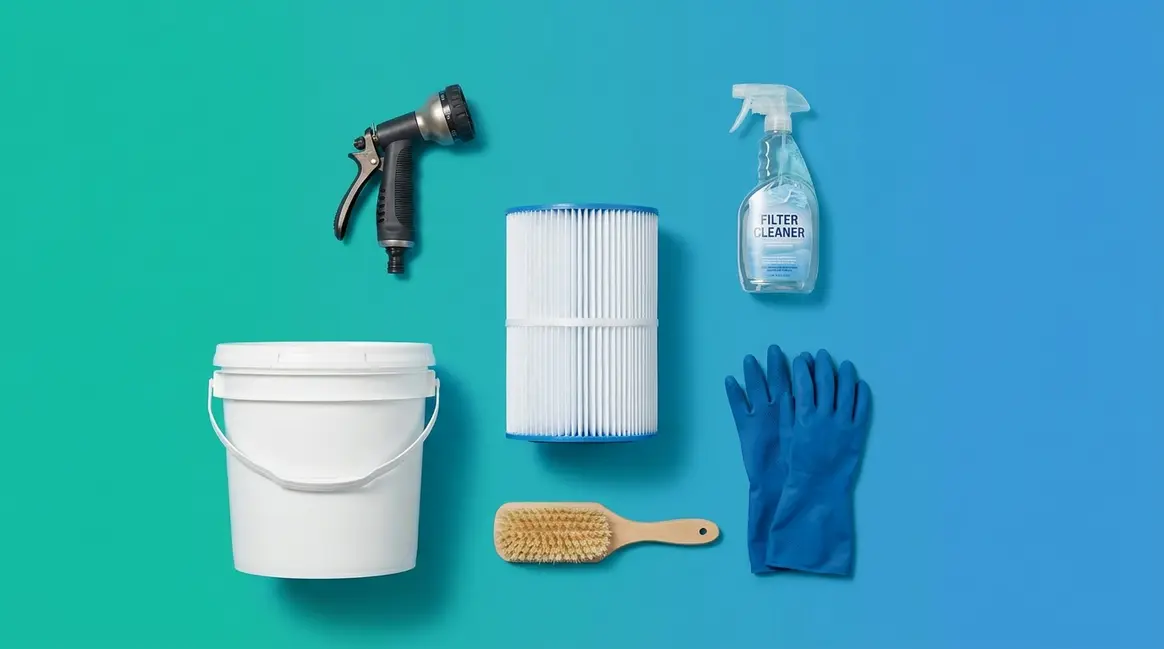
Your hot tub filter cartridge — the pleated cylinder that traps debris, oils, and bacteria before water recirculates through your spa — doesn’t require expensive equipment to clean. Most of what you need is already in your garage or under the kitchen sink.
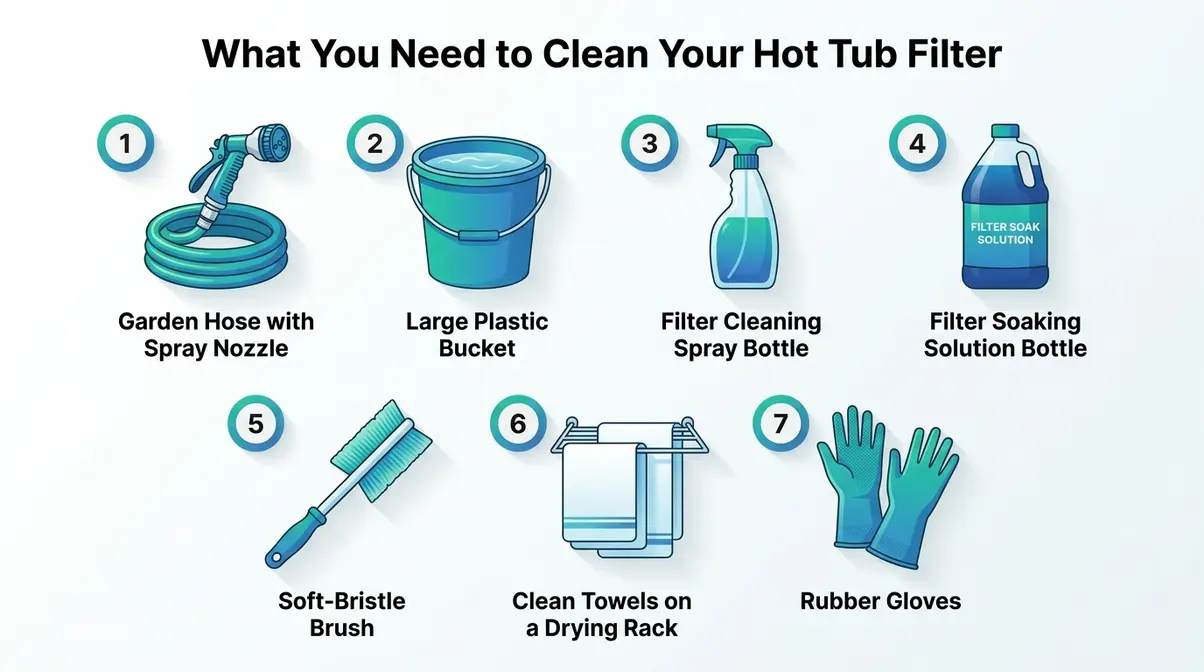
Gather these before you start:
- Garden hose with a spray nozzle (not a pressure washer — more on that later)
- Large bucket or plastic storage bin (big enough to submerge the filter)
- Filter cleaning spray (such as Leisure Time Filter Clean or Natural Chemistry Filter Perfect)
- Filter soaking solution (such as Aqua Chem or a purpose-made filter cleaner concentrate)
- Soft-bristle brush or old toothbrush for stubborn debris between pleats
- Clean towels or a drying rack
- Rubber gloves
The cleaning method you’ll use depends on how dirty your filter actually is. That’s the core idea behind The Filter Tier System — the framework this guide is built around. You’ll learn exactly which tier to apply and when in H2 #3.
Safety Precautions
Always turn off your hot tub’s power at the breaker — not just the jets — before removing the filter. This single step prevents pump damage, protects the motor from running dry, and keeps you safe. Across hot tub owner communities, skipping this step is consistently cited as the cause of expensive pump failures that could have been avoided entirely.
Most hot tubs have the filter housing near the skimmer basket or inside the footwell — check your owner’s manual if you’re unsure. Twist counterclockwise to release the filter cartridge on most models, but some brands use a simple pull-and-lift system. Never yank or force it; if it’s stuck, the housing may have a locking tab you haven’t released.
How Often Should You Clean Your Hot Tub Filter?
Hot tub filter maintenance isn’t a “clean it when it looks bad” task — by the time a filter looks visibly dirty, it’s already affecting your water quality and making your pump work harder. A consistent schedule is the only approach that actually works, and it’s far simpler than most owners expect.
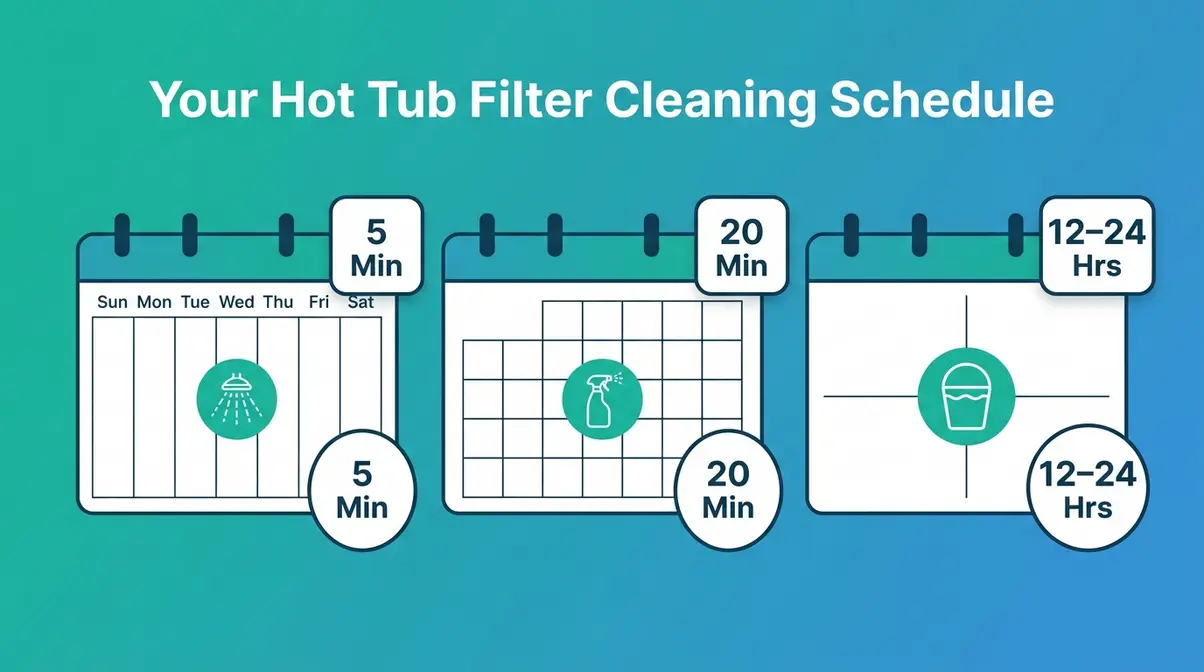
Your Weekly, Monthly, and Quarterly Schedule
The Pool & Hot Tub Alliance (PHTA) recommends a tiered cleaning schedule based on usage frequency and contamination type. Across spa manufacturer guidelines — including those from Jacuzzi and Master Spas — the consensus schedule is consistent:
| Frequency | Method | Time Required | Purpose |
|---|---|---|---|
| Weekly | Quick rinse with garden hose | 5 minutes | Remove loose debris, hair, and surface particles |
| Monthly | Chemical spray with filter cleaner | 20 minutes | Break down body oils, sunscreen, and lotions |
| Quarterly | Overnight chemical soak | 12–24 hours | Deep-clean filter media; restore flow rate |
| Annually | Full inspection + replacement check | 30 minutes | Assess filter condition; replace if degraded |
Usage adjustments matter. If your hot tub sees heavy use — four or more people per session, multiple sessions per week, or frequent use by children — compress the schedule. A monthly spray may need to happen every two to three weeks. Conversely, a solo soaker using the tub twice a week can often stretch monthly sprays to every six weeks.
According to Jacuzzi’s filter care guidelines, running a hot tub with a clogged or degraded filter forces the pump to compensate for reduced flow, which shortens pump life and drives up energy costs — two consequences most owners don’t connect to a dirty filter until it’s too late.
5 Signs Your Filter Needs Immediate Attention
Don’t wait for your scheduled cleaning if you notice any of these. Each one signals that your filter is already restricting water flow or harboring contamination that’s affecting your water chemistry.
- Cloudy or foamy water — The most common symptom. A saturated filter can no longer trap particles effectively, so they recirculate through the water.
- Reduced jet pressure — If your jets feel weaker than usual with no changes to settings, a clogged filter is the first thing to check.
- Discolored or grayish filter pleats — Some discoloration is normal, but a filter that looks uniformly gray, brown, or slimy has biofilm buildup (a thin layer of bacteria and organic matter) that rinsing alone won’t remove.
- Persistent chemical imbalance — If you’re constantly fighting pH or sanitizer levels despite correct dosing, a dirty filter may be leaching contaminants back into the water.
- Visible debris in the water after filtration — If particles are passing through the filter and back into the tub, the filter media may be torn or so clogged it has lost structural integrity.
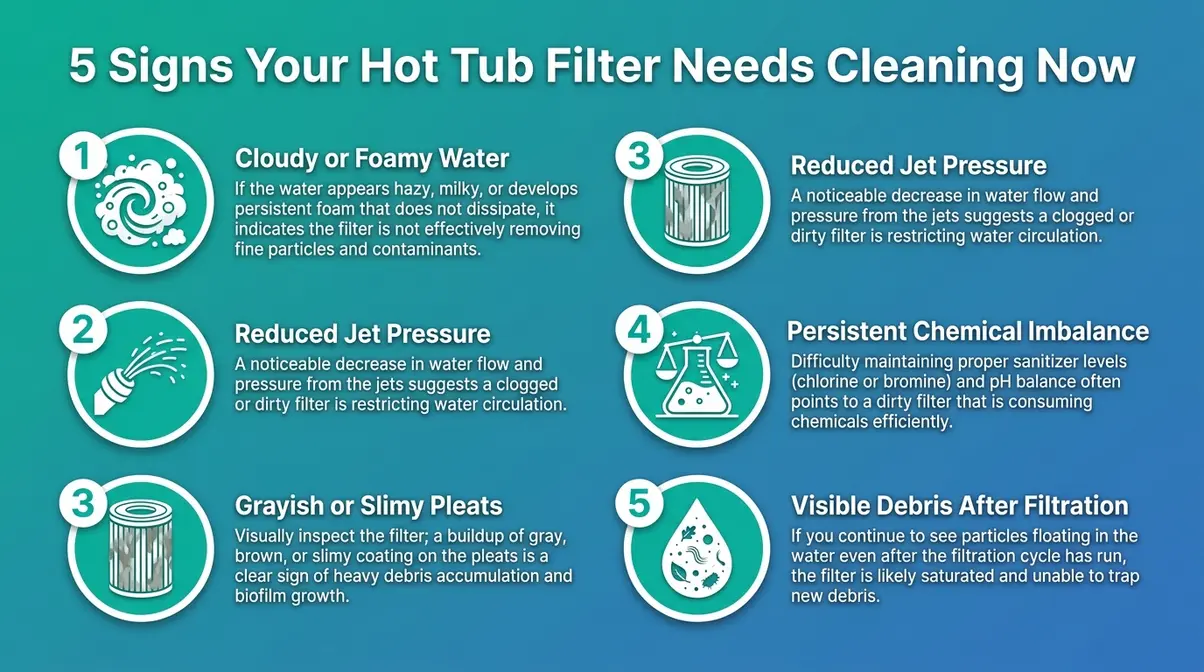
A clogged filter is the single most common cause of cloudy hot tub water — and the easiest to fix once you recognize it.
Cleaning Your Filter in Winter
Winter maintenance follows the same three-tier schedule, with one important adjustment: cold temperatures slow chemical reactions, which means your monthly spray and quarterly soak may need extended contact times to be fully effective. In temperatures below 40°F (4°C), allow spray cleaners to dwell for 30 minutes instead of the standard 15, and extend overnight soaks to a full 24 hours.
If you’re winterizing your hot tub for an extended closure, perform a full quarterly soak before storage, allow the filter to dry completely, and store it indoors. A filter that freezes while wet can crack the pleats — a subtle form of damage that won’t be obvious until the following season when it fails to filter properly.
How to Clean Your Hot Tub Filter: The 3-Tier Method
“What’s the best way to clean the filter please. We’ve used the tub once, 3 people and the filter is gross 🤮 I’ve tried cleaning it under the tap but it still looks dirty. Are they washing machine safe?”
That question, posted in a popular hot tub owner forum, captures exactly why a single cleaning method never works for every situation. The Filter Tier System matches cleaning intensity to contamination type — because a filter covered in fresh leaf debris needs a completely different approach than one saturated with three months of body oils and lotion.
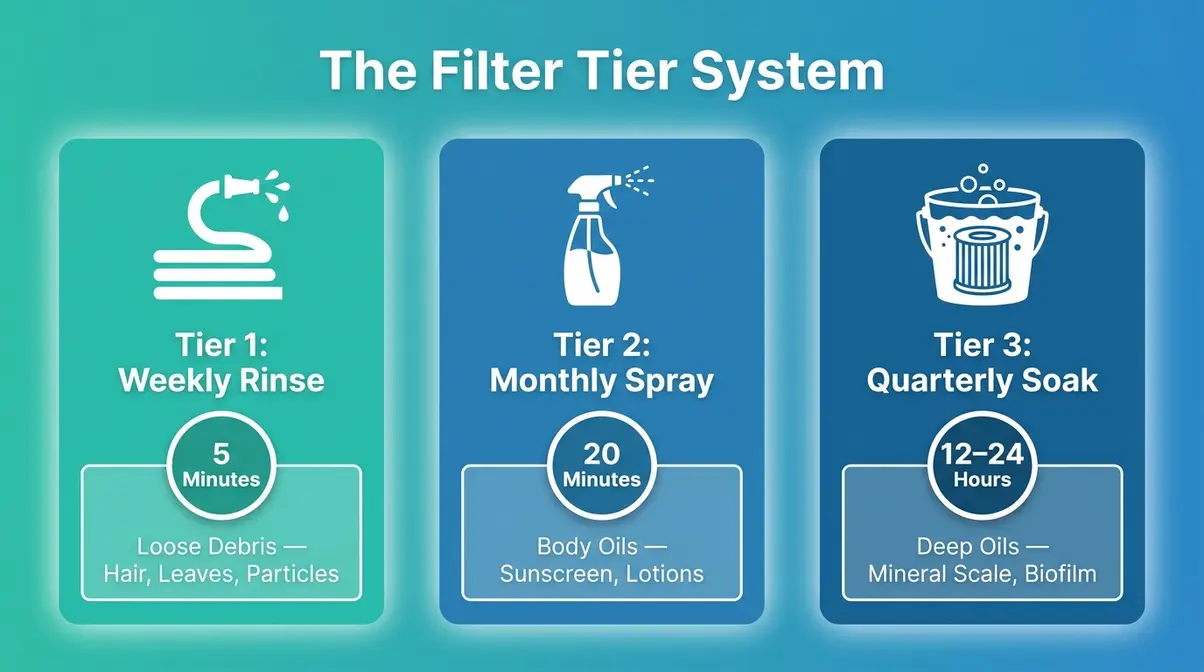
Step 1 — The Weekly Quick Rinse (5 Minutes)
The weekly rinse removes loose debris — leaves, hair, insects, and surface particles — before they work their way deeper into the filter pleats. It won’t touch oils or lotions, but done consistently, it prevents the buildup that makes monthly and quarterly cleaning harder.
What you’ll need: Garden hose with spray nozzle
Steps:
- Turn off the hot tub at the breaker. Never skip this step — running the pump without a filter in place can pull air into the system and damage the pump motor.
- Remove the filter cartridge by twisting counterclockwise (or using your model’s release mechanism) and place it on a clean surface.
- Hold the filter at a 45-degree angle and spray from top to bottom between each pleat, working your way around the entire cartridge.
- Rotate the filter and repeat on the opposite side, ensuring water runs clear between the pleats before moving on.
- Inspect the end caps for cracks or warping while the filter is wet — damage is easiest to spot at this stage.
- Reinstall the filter, restore power, and run the pump for 5 minutes to confirm normal flow.
The key mistake here: Spraying straight down onto the top of the filter pushes debris further into the pleats instead of flushing it out. Always spray at an angle, working between the pleats rather than across them.
Step 2 — The Monthly Chemical Spray (20 Minutes)
Body oils, sunscreen, and lotions don’t rinse out with water — they bond to the filter media (the polyester fabric that makes up the pleats) and accumulate with every use. A monthly chemical spray breaks down these oils using surfactants, restoring flow rate and preventing the greasy residue that makes filters look permanently discolored.
What you’ll need: Filter cleaning spray, garden hose
Steps:
- Turn off the hot tub at the breaker and remove the filter cartridge as described in Step 1.
- Rinse the filter with your garden hose first to remove loose debris — this improves the spray cleaner’s contact with the filter media.
- Hold the filter vertically and apply filter cleaning spray generously between each pleat, rotating as you go. Cover the entire surface, including both end caps.
- Allow the cleaner to dwell for 15 minutes (30 minutes in cold weather below 40°F). Don’t rush this — the dwell time is when the surfactants break down oils.
- Rinse thoroughly with your garden hose until the water running off the filter is completely clear and free of suds.
- Allow the filter to air-dry for at least 30 minutes before reinstalling, or reinstall immediately if you have a spare filter to rotate in.
- Restore power and run the pump for 5 minutes to confirm normal flow and check for any residual cleaner foam in the water.
Pro tip from hot tub owner communities: Keep two filters and rotate them. While one is soaking or drying, the other is in the tub. This approach — consistently recommended across forums like TroubleFreePool and Reddit’s r/hottub — eliminates the need to wait for a filter to dry before using your spa.
According to Master Spas’ filter care tutorials, a monthly spray cleaning cycle can extend filter life by up to 50% compared to rinsing alone — because oils that aren’t removed continue to accumulate and eventually clog the filter media permanently.
Step 3 — The Quarterly Deep Soak (12–24 Hours)
The quarterly soak is the only cleaning method that reaches contamination trapped deep inside the filter media — the body oils, mineral deposits, and biofilm that build up in layers over months of use. Rinsing and spraying work on the surface; soaking penetrates the full depth of the pleated fabric and restores flow rate closer to new-filter performance.
What you’ll need: Large bucket or plastic bin, filter soaking solution (or white vinegar for mineral deposits — see H2 #4 for the full vinegar method), garden hose
The Tennis Ball Trick: Before soaking, drop two or three clean tennis balls into your hot tub water and run the jets for 10–15 minutes. Tennis balls absorb surface oils and lotions floating on the water before they reach the filter — a widely used tip across hot tub communities that reduces the contamination load your filter has to handle. The polyester fibers in tennis balls are particularly effective at capturing the same oils that clog filter media.
Steps:
- Turn off the hot tub at the breaker and remove the filter cartridge.
- Perform a standard rinse to remove loose surface debris before soaking.
- Fill your bucket or plastic bin with enough water to fully submerge the filter cartridge.
- Add filter soaking solution according to the product’s instructions (typically 1–2 cups per gallon of water for concentrate formulas).
- Submerge the filter completely. It will likely float initially — place a heavy object on top to keep it submerged. This is completely normal; the filter floats because air is trapped in the pleats.
- Soak for a minimum of 12 hours; 24 hours is ideal for heavily used filters or those that haven’t been soaked in more than 6 months.
- Remove the filter and rinse thoroughly with your garden hose — this step is critical. Residual soaking solution in the filter will cause significant foaming when the pump runs.
- Allow the filter to air-dry completely (ideally overnight) or rinse and reinstall immediately if your water chemistry can tolerate a brief period of running without optimal filtration.
- Restore power, run the pump, and check water clarity over the next 24 hours.
What to expect after a deep soak: A filter that came out looking gray or discolored will often emerge noticeably lighter — sometimes close to its original white color. Across hot tub owner communities, the consistent feedback is that a properly soaked filter can restore jet pressure noticeably, sometimes dramatically, when the filter was heavily clogged before soaking.
Home Remedies vs. Commercial Cleaners
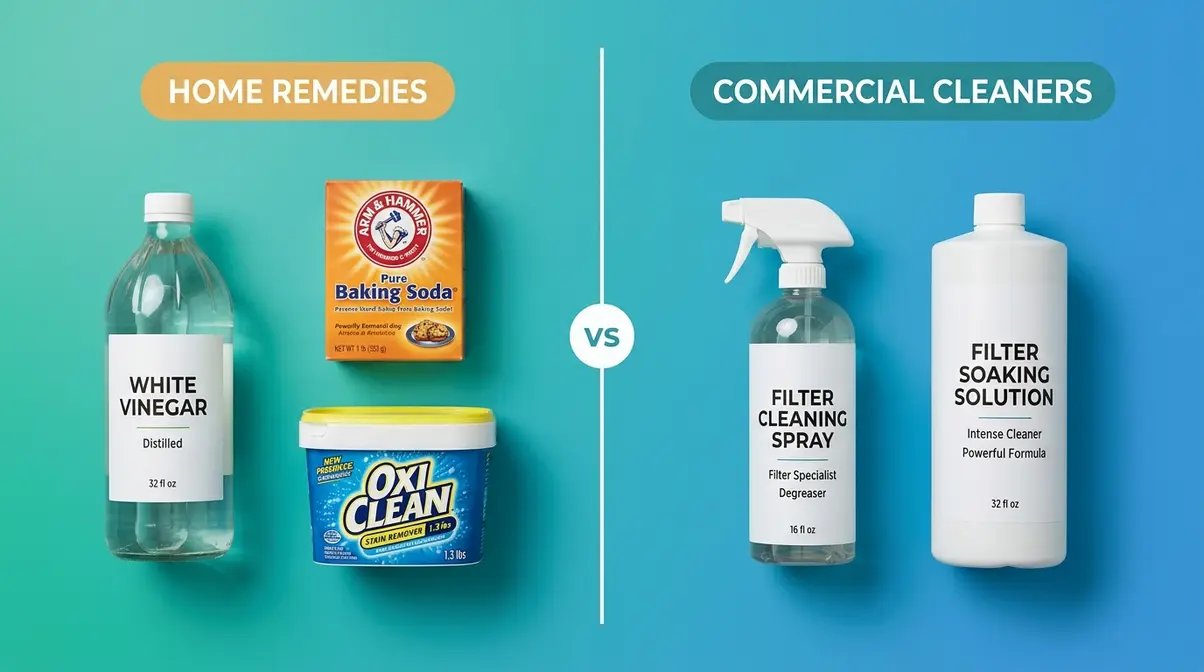
The internet has no shortage of hot tub filter cleaning hacks — vinegar, baking soda, OxiClean, Dawn dish soap. Some of these work. Some will make your hot tub look like a bubble bath. And one or two can permanently damage your filter. Here’s an honest breakdown of what actually works, what’s a waste of time, and what to avoid entirely.
How to Clean Your Hot Tub Filter with Vinegar
White vinegar is the most commonly recommended home remedy for hot tub filter cleaning — and for a specific contamination type, it genuinely works. Vinegar’s acetic acid is effective at dissolving calcium and mineral deposits (the chalky white scale that builds up on filter pleats in areas with hard water). It is not effective at removing body oils or biofilm.
When to use vinegar: Your filter has visible white or chalky scaling on the pleats. This typically appears in hard water areas or when calcium hardness in your spa water runs consistently above 300 ppm.
Vinegar soak method:
- Remove and rinse the filter cartridge to clear loose debris.
- Mix a solution of 1 part white vinegar to 1 part water in a bucket large enough to submerge the filter.
- Submerge the filter completely and soak for 2–3 hours (not overnight — extended vinegar exposure can degrade the polyester filter media over time).
- Remove and rinse thoroughly with your garden hose until no vinegar odor remains.
- Allow to dry before reinstalling, or reinstall and run the pump for 15 minutes, then test water pH — vinegar residue can temporarily lower pH.
Limitations: Vinegar does not remove body oils, sunscreen, or biofilm. For a filter that’s both scaled and oil-saturated, follow the vinegar soak with a commercial spray cleaner after the filter has dried. According to Lowe’s hot tub filter cleaning guide, white vinegar is suitable as a supplemental treatment but should not replace purpose-made filter cleaning products for routine maintenance.
Baking Soda and OxiClean: Do They Work?
Baking soda is frequently suggested in online forums, but the evidence for its effectiveness on hot tub filters is weak. Baking soda (sodium bicarbonate) is a mild base that can help neutralize odors, but it lacks the surfactant action needed to break down body oils or the acidity required to dissolve mineral scale. It won’t harm your filter, but it’s unlikely to clean it meaningfully beyond what a plain water rinse achieves.
OxiClean (sodium percarbonate) is a more interesting case. When dissolved in water, it releases hydrogen peroxide, which has some oxidizing effect on organic matter. Across hot tub communities, some owners report moderate success using OxiClean as a soak for lightly soiled filters. However, the concentration required for meaningful cleaning is inconsistent across product formulations, and OxiClean contains surfactants that can cause foaming if not rinsed out completely before reinstalling the filter.
The honest assessment: Neither baking soda nor OxiClean matches the performance of a purpose-made filter cleaner for routine maintenance. They’re acceptable emergency options when commercial cleaners aren’t available, but they shouldn’t be your default approach.
DIY vs. Commercial Cleaners: Honest Comparison
This is the comparison no competitor guide provides — an honest, side-by-side look at what you’re actually getting with each approach.
| Method | Removes Debris | Removes Oils | Removes Scale | Foaming Risk | Filter-Safe | Cost per Use |
|---|---|---|---|---|---|---|
| Garden hose rinse | ✅ Yes | ❌ No | ❌ No | None | ✅ Yes | Free |
| White vinegar soak | ❌ No | ❌ No | ✅ Yes | Low | ✅ (short soak) | ~$0.50 |
| Baking soda | ❌ Minimal | ❌ No | ❌ No | Low | ✅ Yes | ~$0.25 |
| OxiClean soak | ❌ Partial | ✅ Partial | ❌ No | Medium | ✅ (rinse well) | ~$1.00 |
| Commercial spray cleaner | ✅ Yes | ✅ Yes | ✅ Partial | Low | ✅ Yes | ~$2–$4 |
| Commercial soak solution | ✅ Yes | ✅ Yes | ✅ Yes | Low | ✅ Yes | ~$3–$6 |
| Dawn dish soap | ✅ Partial | ✅ Partial | ❌ No | ⚠️ Severe | ❌ No | ~$0.10 |
The table tells the story clearly. Commercial cleaners cost more per use, but they’re formulated specifically for the polyester filter media used in hot tub cartridges — meaning they clean effectively without degrading the material. For the best thing to use to clean the inside of your hot tub filter, a combination of commercial spray (monthly) and commercial soak solution (quarterly) consistently outperforms any single home remedy approach.
Mistakes That Will Ruin Your Hot Tub Filter
Some cleaning shortcuts don’t just fail to work — they actively destroy a filter that could have lasted another year. Our evaluation of the most common hot tub maintenance errors, drawn from patterns reported across owner communities and manufacturer service records, consistently surfaces the same four mistakes.
Why You Should Never Use a Dishwasher or Washing Machine
This is the question that brings many hot tub owners to this guide: Are they washing machine safe?
The short answer is no — and the reasons are specific, not vague.
Dishwashers use water temperatures of 130–170°F (54–77°C) and high-pressure jets. Hot tub filter cartridges are made from pleated polyester bonded to plastic end caps with adhesive. At dishwasher temperatures, the adhesive softens, the end caps warp, and the pleats collapse or separate. The result is a filter that looks clean but has physically deformed — it will no longer seat properly in the housing, and gaps between the warped end caps and housing allow unfiltered water to bypass the filter entirely.
Washing machines introduce an equally serious problem: detergent. Even a small amount of laundry detergent residue left in a filter will cause extreme foaming when the hot tub pump runs — enough to overflow the cover and continue foaming for hours. The agitation cycle also physically stresses the pleats, causing micro-tears in the filter media that aren’t visible but dramatically reduce filtration efficiency.
Never use a dishwasher or washing machine to clean a hot tub filter cartridge. The mechanical stress, heat, and detergent residue all cause damage that isn’t reversible — and the filter will need to be replaced immediately.
The Truth About Using Bleach on Your Filter
Bleach (sodium hypochlorite) is a powerful disinfectant, and the logic of using it on a dirty filter seems reasonable. The reality is more damaging.
The polyester fiber used in hot tub filter media degrades when exposed to high concentrations of chlorine bleach. A brief, diluted rinse is unlikely to cause immediate visible damage, but it accelerates the breakdown of the filter media over time — shortening filter life significantly. More practically, bleach residue left in the filter will spike your hot tub’s chlorine levels when the filter is reinstalled, potentially irritating skin and eyes and throwing your water chemistry out of balance.
The EPA’s guidelines on pool and spa sanitation note that while chlorine is the primary sanitizer for spa water, concentrated bleach application to filter media is not recommended by any major spa manufacturer. If your goal is sanitizing a filter, a commercial filter cleaner with built-in antimicrobial properties is both safer and more effective.
Other Common Mistakes to Avoid
Using Dawn or other dish soaps: Dawn is an effective degreaser, which is why it seems logical for oil-saturated filters. The problem is sudsing. Dish soap is formulated to create foam — exactly what you don’t want in a hot tub. A filter with any dish soap residue will cause the water to foam heavily when the pump runs, and the foam can persist for days even after draining and refilling. Use a purpose-made filter cleaner instead.
Using a pressure washer: The high-pressure stream (typically 1,500–3,000 PSI) tears the polyester pleats and damages the filter media. A standard garden hose with a spray nozzle provides enough pressure to flush debris without causing structural damage. If you feel like your hose isn’t getting the filter clean enough, the problem is that rinsing alone isn’t the right tier — not that you need more pressure.
Reinstalling a wet filter after soaking: Residual soaking solution in the filter causes foaming. Always rinse thoroughly after a soak — multiple passes with the garden hose until the water runs completely clear — before reinstalling.
Skipping the rinse after spray cleaning: The same foaming risk applies. Spray cleaner left on the filter will foam in the water, confuse your chemistry readings, and require a partial drain to correct.
Cleaning Filters in Inflatable Hot Tubs
Inflatable hot tubs — particularly Lay-Z-Spa (Bestway) and Intex models — use the same basic filter cartridge concept as hard-shell spas, but with some practical differences that affect your cleaning routine.
Lay-Z-Spa and Intex: What’s Different?
The filters in inflatable hot tubs are typically smaller Type VI or Type VII cartridges (approximately 5 inches tall, 2 inches in diameter) compared to the larger cartridges in hard-shell spas. They’re made from the same pleated polyester material, so the same cleaning chemistry applies — but their smaller size means they clog faster and need more frequent attention.
Key differences for inflatable hot tub owners:
- Replace more often: Lay-Z-Spa recommends replacing filter cartridges every 2–4 weeks during regular use — significantly more frequently than hard-shell spa filters. This isn’t a cleaning failure; it’s a capacity limitation. The smaller filter simply has less surface area to handle the same contamination load.
- Rinse every 3–4 days: With heavy use (multiple people, multiple sessions per week), rinse inflatable hot tub filters every 3–4 days rather than weekly.
- Monthly spray still applies: The same commercial spray cleaner used for hard-shell filters works on Lay-Z-Spa and Intex cartridges. Apply, dwell 15 minutes, rinse thoroughly.
- Skip the overnight soak for very small cartridges: For the smallest Type VI filters, a 4–6 hour soak is typically sufficient — the reduced filter mass means soaking solution penetrates faster.
- Keep a stock of replacements: Given the faster replacement cycle, buying a 6-pack of replacement cartridges at the start of the season is more cost-effective than purchasing individually.
The Intex filter cleaning process is identical: remove, rinse, spray monthly, replace every 2–4 weeks during active use. Intex recommends keeping two spare filters per pump for rotation, which eliminates downtime during cleaning.
When to Replace Your Hot Tub Filter
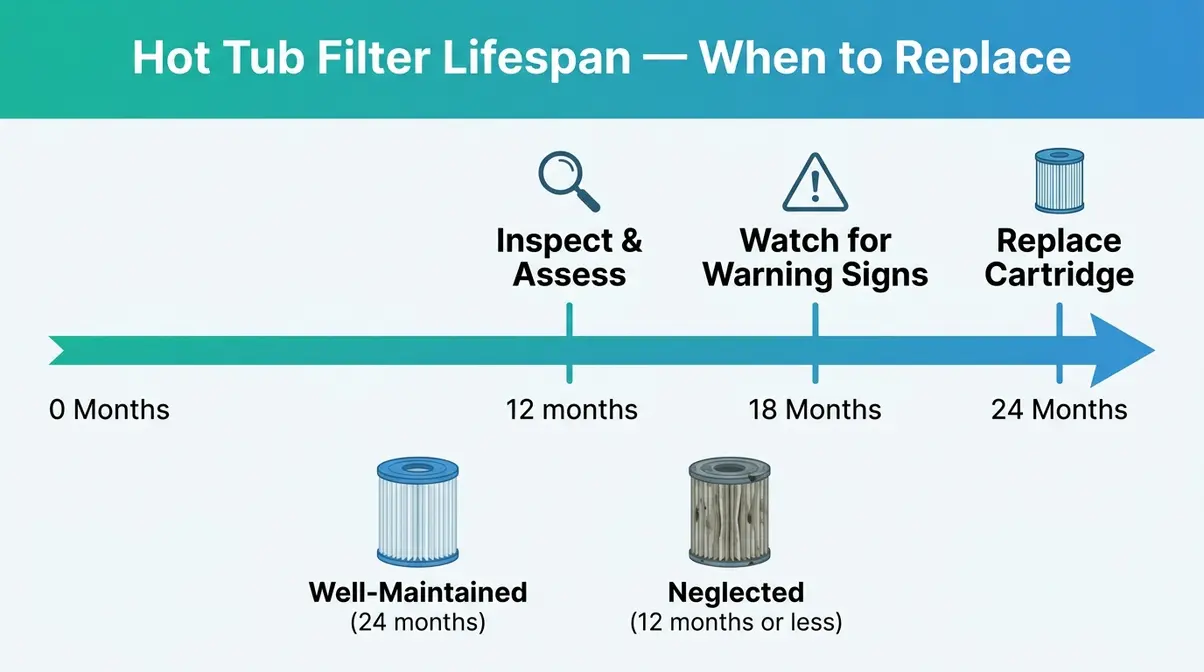
Even a perfectly maintained filter has a finite life. The polyester filter media degrades over time regardless of how carefully you clean it — the fibers gradually lose their structural integrity, and the filter’s ability to trap fine particles diminishes even if it still looks acceptable.
Most spa manufacturers, including Jacuzzi and Bullfrog, recommend replacing hard-shell spa filter cartridges every 12–24 months under normal use conditions. With the three-tier cleaning routine in this guide, most owners achieve the full 24-month lifespan. Without consistent maintenance, filters often need replacement at 12 months or sooner.
Replace your filter immediately if you notice any of these:
- Tears, holes, or collapsed sections in the pleated media
- End caps that are cracked, warped, or no longer seat flush against the housing
- Permanent brown or gray discoloration that doesn’t improve after a full 24-hour soak
- A persistent musty or chemical odor from the filter even after cleaning
- Water flow that doesn’t improve after a thorough cleaning — the filter media may be permanently compressed
A useful rule: If you’ve completed a full 24-hour soak and your water clarity and jet pressure haven’t improved, the filter is the first thing to replace before investigating pump or chemistry issues. A new filter costs $15–$60 for most models — far less than a service call.
Frequently Asked Questions
How do I unclog a filter on a hot tub?
Start with a 24-hour chemical soak — this is the most effective method for a genuinely clogged filter. Remove the cartridge, rinse off loose debris, then submerge it in a bucket of filter soaking solution for 12–24 hours. Rinse thoroughly before reinstalling. If the filter still shows reduced flow after a full soak, the filter media may be permanently compressed and replacement is the better option. A clogged hot tub filter is the leading cause of cloudy water and reduced jet pressure, so address it before adjusting water chemistry.
Can I put my hot tub filter in the dishwasher?
No — dishwashers will permanently damage your hot tub filter. Dishwasher temperatures reach 130–170°F, which softens the adhesive bonding the filter’s end caps to the pleated media. The end caps warp, the pleats collapse, and the filter will no longer seal properly in the housing. This creates bypass gaps where unfiltered water re-enters the spa. A dishwasher-cleaned filter may look cleaner, but it’s physically compromised and should be replaced. The same applies to washing machines — detergent residue causes severe foaming and the agitation cycle tears the filter media.
How can I tell if my hot tub filter is clogged?
The clearest sign is a combination of cloudy water and noticeably weaker jet pressure. Additional indicators include persistent chemical imbalance despite correct dosing, visible debris in the water after filtration cycles, and a filter with gray or brown discoloration across the pleats. Remove the filter and hold it up to light — if you can’t see light passing through the pleats, it’s clogged. A filter that fails to improve after a thorough chemical soak likely has permanently compressed filter media and needs replacement.
Can I use vinegar to clean my spa filter?
Yes, but only for mineral scale deposits — white vinegar is not effective for body oils or biofilm. Mix equal parts white vinegar and water, soak the filter for 2–3 hours (not overnight), then rinse thoroughly. The acetic acid in vinegar dissolves calcium and mineral buildup, which appears as chalky white scale on the pleats. Don’t use vinegar as a substitute for commercial filter cleaner in your monthly routine — it doesn’t remove the oils and organic matter that cause most filter clogging. For a filter with both scale and oil contamination, use vinegar first, then follow with a commercial spray after the filter dries.
Can I use Dawn soap to clean my hot tub filter?
Dawn and other dish soaps should never be used on hot tub filters. While Dawn is an effective degreaser, it’s formulated to produce foam — and even a small amount of residue left in the filter will cause your hot tub to foam heavily when the pump runs. This foam can persist for days, requires a partial or full drain to resolve, and will throw your water chemistry readings off significantly. Purpose-made filter cleaning sprays use surfactants formulated specifically to rinse clean without sudsing. They’re a few dollars more than dish soap, but they won’t turn your hot tub into a bubble bath.
Keep Your Water Clear — and Your Filter Lasting Longer
The most common mistake hot tub owners make isn’t using the wrong cleaner — it’s treating filter maintenance as a single task rather than a tiered system. A weekly rinse handles loose debris before it embeds deeper. A monthly spray breaks down the oils that rinsing can’t touch. A quarterly soak restores the filter media that spray cleaning can’t fully reach. That’s The Filter Tier System: match the cleaning intensity to the contamination type, and you’ll never have a filter work against you again.
The home remedy questions — vinegar, Dawn, dishwashers, baking soda — have clear answers now. White vinegar works for scale. Commercial cleaners work for everything else. Dishwashers, washing machines, bleach, and dish soap all cause damage that isn’t reversible. Knowing which shortcuts are safe and which ones will cost you a $50 filter replacement is the difference between a maintenance routine and an expensive lesson.
Start with the weekly rinse this week. Schedule your next monthly spray. Set a calendar reminder for your quarterly soak. If your filter is already looking gray and struggling, go straight to the 24-hour soak — it often brings filters back that seem beyond saving. And if a full soak doesn’t restore flow, replace the cartridge and start fresh with the routine that keeps it working for the full two years it’s designed to last.