What’s in this guide
- Safety First: What You Need Before You Start
- Diagnosing Your Hot Tub Jet Problem
- How to Fix Hot Tub Jets With No Air or Bubbles
- How to Fix Hot Tub Jets That Keep Blowing Out
- How to Fix a Leaking Hot Tub Jet
- Hot Tub Jet Repair Cost: DIY vs. Professional
- Common Mistakes and When to Call a Pro
- Frequently Asked Questions
- The Fix That Actually Lasts
Home ›Maintenance And Troubleshooting
You go to turn on your hot tub and a jet falls right into your hand — or the water pressure drops to a trickle with no bubbles at all. If this sounds familiar, you are not alone, and the fix is usually simpler than you think.
Most guides will tell you to “just replace the jet” — but that fix lasts only a few months if you don’t solve the real problem underneath.
“Clogs or airlocks weaken jet pressure — Clean filters, check water flow, and clear blockages. Worn or loose jets pop out — Tighten, clean, or replace them.”
In this hot tub jet blowing out fix guide, you will learn exactly how to diagnose your specific problem, repair it step by step, and stop it from coming back. We cover everything from air locks and no-bubble issues to physically blown-out jet inserts, leaks, and repair costs — with visuals at every step.
Most hot tub jets blow out because broken retaining clips — weakened by improper water chemistry — can no longer hold the jet insert against water pressure.
- Jet popping out? Broken retaining clips are the #1 cause — replace the jet insert ($15–$50 DIY)
- No bubbles or air? You likely have an air lock — “burp” the jets to fix it in minutes
- Leaking around the jet? A worn gasket or cracked seal needs resealing or replacement
- The Chemistry-to-Failure Chain: Low pH degrades plastic tabs → tabs snap → jets blow out
- When to call a pro: Cracked jet housing, electrical issues, or leaks behind the shell
Safety First: What You Need Before You Start
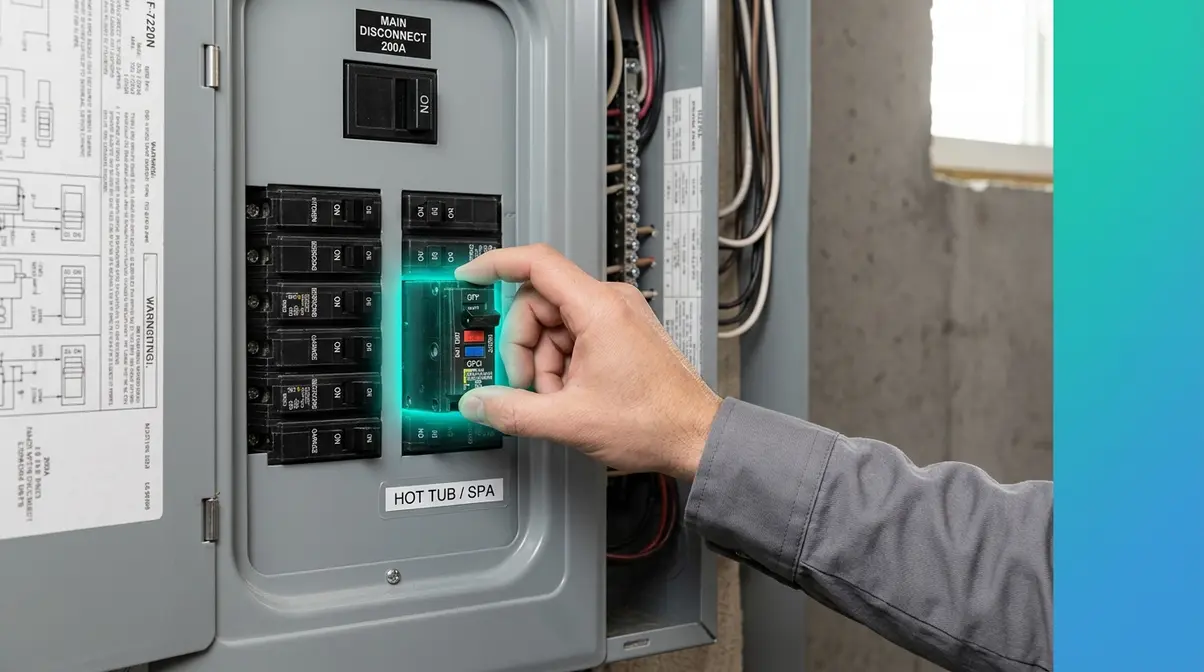
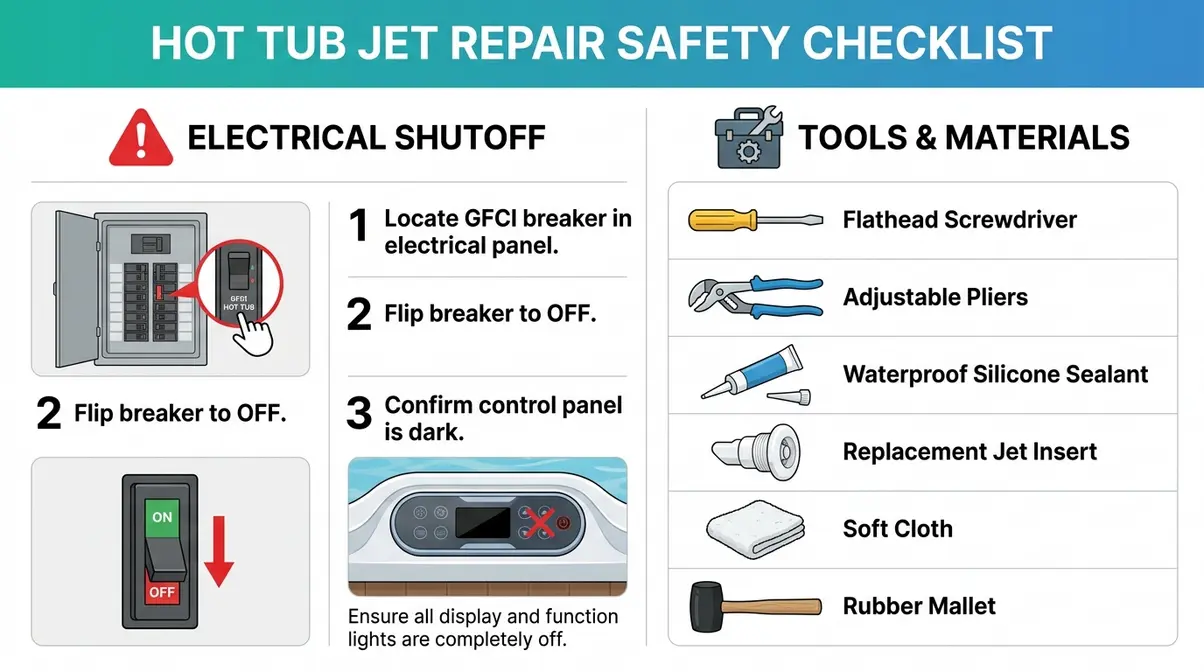
Before touching any jet, valve, or fitting on your hot tub, you must shut off all power at the GFCI breaker. A GFCI breaker (Ground Fault Circuit Interrupter) is the dedicated circuit breaker in your home’s electrical panel — not the power button on your spa’s control panel. Turning off the control panel is not enough. Water and electricity are a deadly combination.
⚠️ SAFETY WARNING: Turn off ALL power to your hot tub at the GFCI breaker before you touch any jets, plumbing, or components. According to CPSC electrical safety guidelines for spas, improper grounding or live electrical contact during spa maintenance is a severe shock hazard (CPSC, 2026). Before any hot tub jet repair, shut off power at the GFCI breaker — not just the control panel — to eliminate all shock risk (CPSC, 2026).
Tools You Will Need:
- Flathead screwdriver — a tool with a flat blade tip used for prying or turning jet inserts
- Adjustable pliers — a gripping tool for removing stubborn jet bodies from their housing
- Waterproof silicone sealant — used for leaking jet repairs (recommended brands: GE Silicone II or Loctite Marine Epoxy, both rated for submerged use)
- Replacement jet insert — the new plastic nozzle unit that snaps or screws into the wall fitting (see Section 4 for how to identify the correct part)
- Soft cloth or towel — to protect the tub surface and dry components
- Rubber mallet (optional) — useful for loosening stubborn threaded jets without cracking the housing
Diagnosing Your Hot Tub Jet Problem
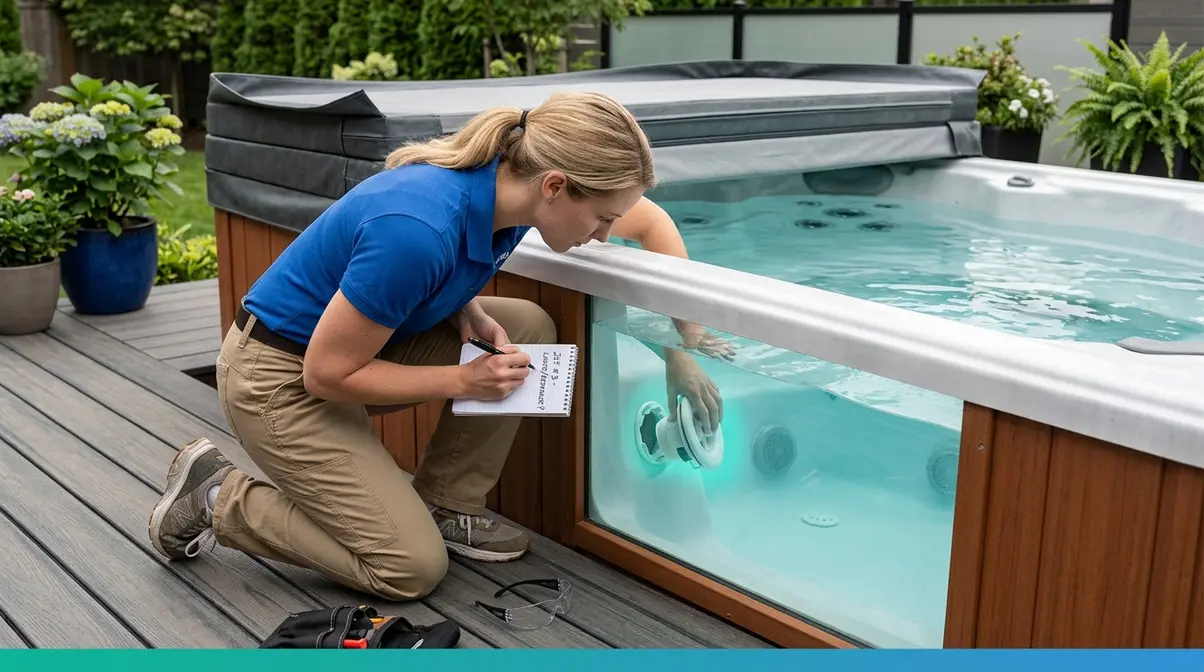
Before you grab any tools, you need to identify which type of jet problem you actually have — because the fix for a jet with no bubbles is completely different from the fix for a jet that keeps popping out of the wall. Jumping to the wrong repair wastes time, costs money, and can damage your spa. This section gives you a simple three-step check to pinpoint your exact problem in under five minutes.
Most hot tub jet failures fall into three categories — airflow blockage, physical blowout, or leaking seal — and each requires a completely different repair approach.
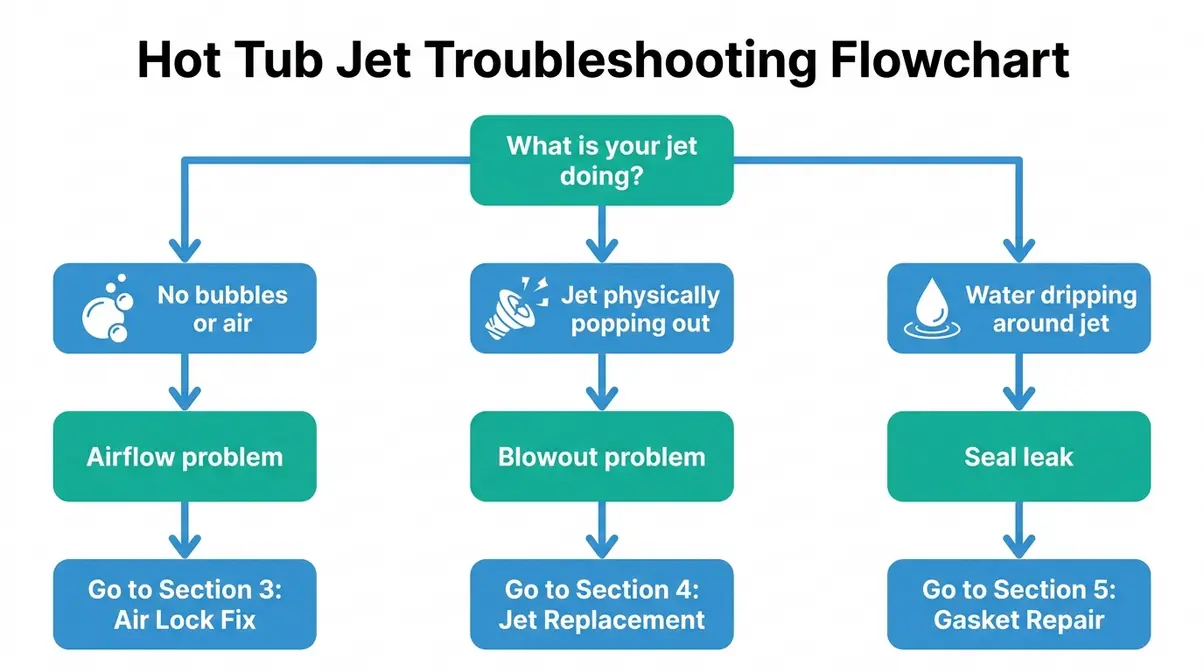
Use the flowchart above to identify your specific problem before reading further.
Airflow vs. Physical Jet Problems
Your first job is to figure out which of three categories your problem belongs to. Each one has a distinct set of symptoms. Here is how to tell them apart:
- No air or bubbles (airflow problem): Water flows normally but there are no bubbles. The jets feel “flat” — like a faucet, not a massage. This is usually an air lock (a pocket of air trapped in the plumbing) or a clogged air line. → Go to Section 3.
- Jet physically popping out (blowout problem): The jet insert — the plastic nozzle unit — is actually falling out of the wall socket. You may find it floating in the water. This is the most common complaint, and it almost always traces back to The Chemistry-to-Failure Chain (explained fully in Section 4). → Go to Section 4.
- Water dripping around the jet (leak problem): Water is seeping or dripping from the gap between the jet and the tub wall. The jet may feel loose but stays in place. → Go to Section 5.
To confirm which category applies, turn the jets on briefly with power restored just for observation, note the behavior, then shut power off again at the GFCI breaker before touching anything.
If your jet is physically blowing out of the socket, The Chemistry-to-Failure Chain is almost certainly at work — and understanding it will save you from repeating this repair every few months.
Quick Checks Before Using Tools
Several common issues mimic jet failure but are actually simple maintenance problems. User consensus across hot tub owner forums consistently shows that these four checks resolve the problem roughly 30% of the time — before any part replacement is needed.
Run through this checklist first:
- Dirty or clogged filter: The filter (a cylindrical cartridge inside your filter housing) removes debris from the water. A clogged filter starves the pump of water, cutting jet pressure dramatically. Remove it and rinse with a garden hose. If it hasn’t been replaced in 12–18 months, replace it (typical cost: $15–$40).
- Low water level: Your jets need the water line to sit at least two inches above the highest jet to function. If the water level has dropped — through evaporation or splashing — air gets pulled into the plumbing, causing weak jets or no bubbles at all.
- Closed diverter valves: Diverter valves (the rotating handles on your spa’s topside controls) redirect water between different jet zones. If a valve is accidentally turned to the closed position, an entire zone of jets will go dead. Check all valves are fully open.
- Pump priming failure: After draining and refilling, the pump (the motor that circulates water) sometimes fails to self-prime, meaning it circulates air instead of water. This causes a rushing sound with no jet output. See Section 3 for the fix.
If none of them resolve the issue, you may need to diagnose common hot tub jet failures further, or continue to the relevant repair section below. These quick checks cost nothing and take less than ten minutes.
How Hot Tub Jets Work
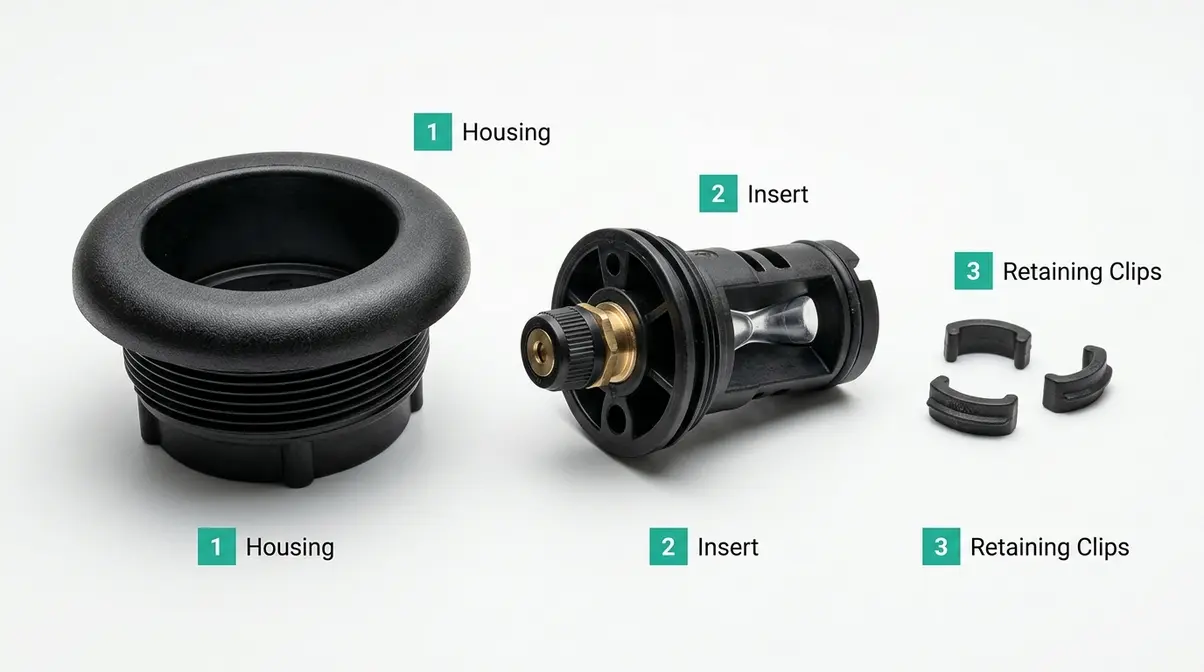
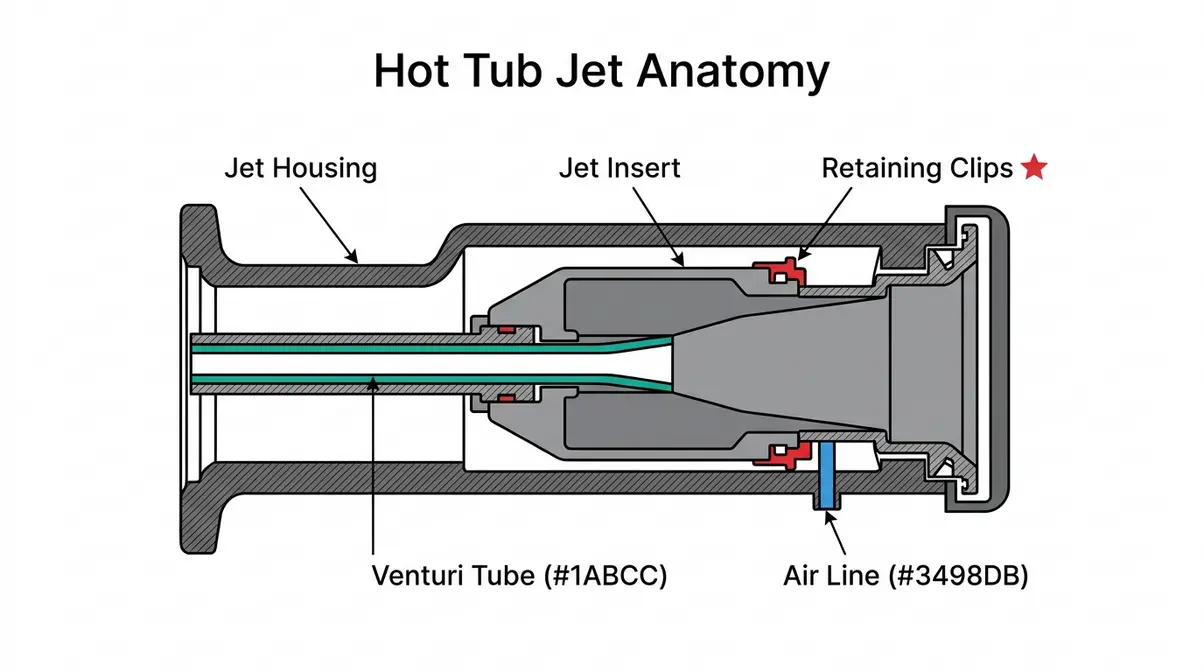
Understanding how a jet works makes every repair step easier to follow. Here is the basic anatomy.
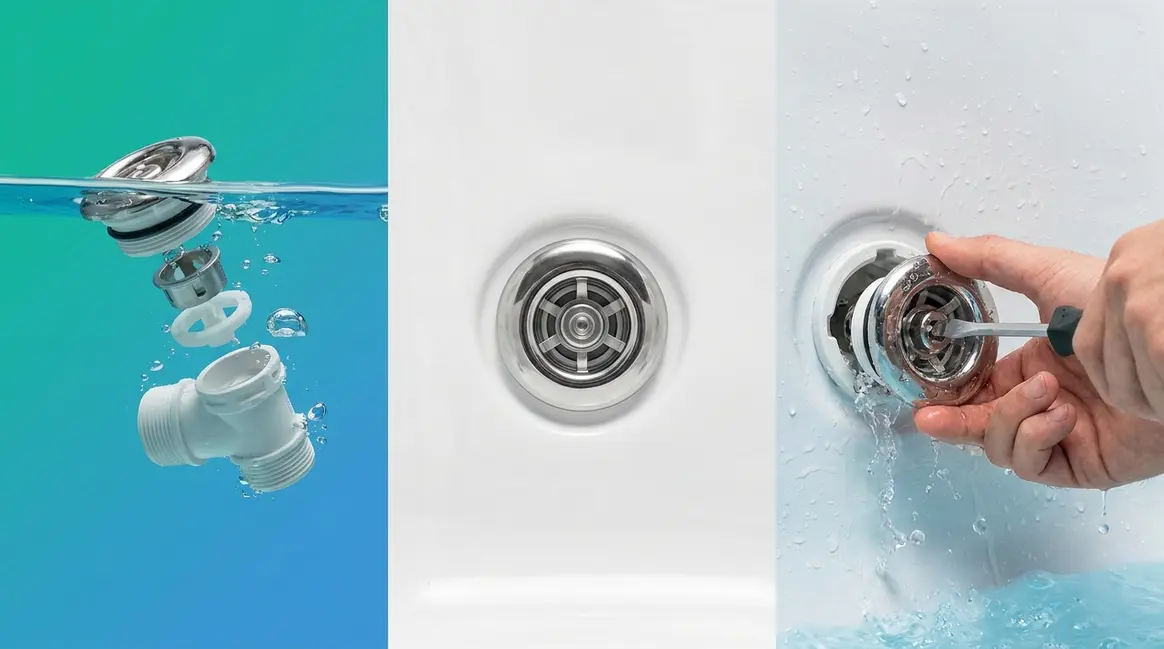
A hot tub jet (the circular nozzle in your spa wall that propels water and air into the tub) is made of two main parts: the jet housing (the fixed plastic shell built into the tub wall that holds the jet) and the jet insert (the removable nozzle unit that snaps or screws into the housing). The housing is permanently plumbed into the wall. The insert is what you remove and replace.
Inside the insert, a small venturi tube (a narrow tube that creates suction by speeding up water flow) draws air from an air line in the wall and mixes it with the water stream. This air-water mix is what creates the bubbling massage sensation.
The insert is held in the housing by retaining clips (small plastic tabs that grip the edge of the housing and lock the insert in place). These clips are the weakest link in the system. When they fail — often due to chemical damage — the insert pops free under water pressure, creating what owners call “jets blowing out.”
How to Fix Hot Tub Jets With No Air or Bubbles
If your jets produce water flow but no bubbles — or if they make a gurgling sound without any real pressure — you are most likely dealing with an airflow problem. The most common culprit is an air lock, followed by a clogged air line. These problems are fixable in minutes without buying any parts.
An air lock in a hot tub occurs when a pocket of air becomes trapped in the plumbing, preventing the pump from circulating water — and it’s one of the most frequently reported issues after a water change or refill.
Causes of Hot Tub Air Locks
An air lock (a pocket of trapped air in the plumbing that prevents the pump from moving water) almost always occurs in one of three situations:
- After draining and refilling the tub: When you refill, air gets trapped in the pipes before water fully displaces it.
- After the water level dropped too low: Running jets with the water line below the jet openings pulls air directly into the plumbing.
- After a pump or filter replacement: Any time you disconnect plumbing, air enters the system.
According to Seaway Pools & Hot Tubs, common signs of an air lock include a humming pump with no water flow, jets that blow air instead of water, and a pump that sounds strained or overheated (Seaway Pools, 2026). Left unresolved, an air lock can overheat and burn out your pump motor — a repair that costs $300–$600.
This is why “no air being jetted” and “weak jets” after a refill almost always point to an air lock, not a broken component. If you suspect the motor itself is malfunctioning, you should troubleshoot pump-related airflow problems to rule out electrical faults.
How to Burp Hot Tub Jets
“Burping your jets” is the informal term for manually releasing a trapped air lock. Our team evaluated this repair process against manufacturer documentation and community consensus across hot tub owner forums — it works reliably for air locks in the vast majority of residential spa setups.
Tools needed: None. Estimated time: 5–10 minutes.
⚠️ Restore power to the spa only for the steps below that require the pump to run. Shut off at the GFCI breaker before touching any fittings.
- Ensure the water level is correct. Fill the tub so the water sits at least two inches above the highest jet opening. Low water is the most common reason air locks return after you fix them.
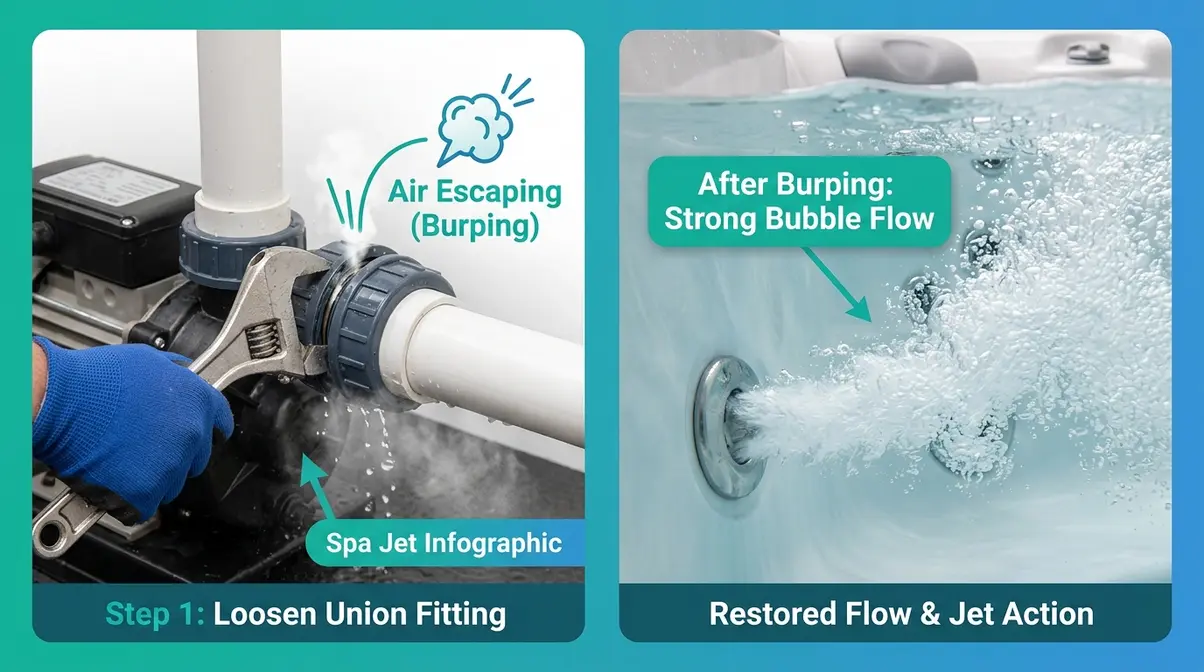
- Locate the air bleed valve (if your spa has one). This is a small valve near the pump or filter housing, usually labeled. Turn it counterclockwise by hand until you hear air hissing out. Close it once water starts to drip out — this means the air has escaped.
- Manually loosen a jet fitting (if no bleed valve). With power OFF, locate the union fitting (a threaded coupling) on the suction side of the pump. Slowly loosen it by hand — just enough to hear air escape. Retighten immediately once air stops hissing.
- Turn on the pump at low speed. Restore power at the breaker. Set the pump to its lowest speed setting. Listen for a gurgling sound — this is trapped air working its way out.
- Cycle through jet speeds. Switch from low to high speed repeatedly, three or four times. This pressure change helps push the air pocket through the plumbing and out through the jets.
- Check for bubbles. Within two to five minutes, the jets should begin producing normal air and bubble output. If the pump is still humming with no water flow after ten minutes, proceed to Step 7.
- Try the “hose trick” as a last resort. Turn off the spa. Insert a garden hose into the filter opening and run water in for 30 seconds. This pressurizes the plumbing from the inside and often dislodges a stubborn air lock. Remove the hose, restore power, and test again.
How to Clear a Clogged Air Line
If burping the jets doesn’t restore bubbles, the problem may be a clogged air line. The air line (a small plastic tube running from the jet body to an air intake on the spa exterior) can become blocked by mineral deposits, biofilm (a thin bacterial film that builds up in damp plastic tubing), or debris.
The CDC notes that biofilm in spa plumbing is a genuine maintenance concern — warm, stagnant water in air lines creates ideal conditions for bacterial buildup if the spa isn’t properly sanitized (CDC, 2026). Regular shocking and sanitizing prevents this.
To clear a clogged air line:
- Turn off all power at the GFCI breaker.
- Locate the air intake port — usually a small screened opening on the exterior cabinet of the spa, near the equipment compartment.
- Remove the screen or cover and inspect for visible debris, spider webs, or mineral crust.
- Use a can of compressed air to blow through the port in short bursts. You should hear air exit at the jet end inside the tub.
- For mineral buildup, soak the accessible portion of the air line in a solution of one part white vinegar to three parts water for 20 minutes, then flush with clean water.
- Reassemble and test. Restore power and run the jets. Bubbles should return within 30 seconds.
If clearing the air line and burping the jets both fail to restore bubble output, the issue is likely the air injector valve inside the jet body itself — in which case, replacing the jet insert (Section 4) is the correct next step.
How to Fix Hot Tub Jets That Keep Blowing Out
⚠️ Reminder: Power must be OFF at the GFCI breaker before you begin this section.
This is the most common hot tub jet problem — and the most misunderstood. If your jet insert keeps popping out of the wall, replacing it without understanding why it failed means you will be doing this repair again in a few months. The answer almost always traces back to one root cause.
Why Do Hot Tub Jets Fall Out?
The #1 reason hot tub jets fall out is broken or degraded retaining clips — the small plastic tabs that lock the jet insert into the housing. When these clips snap, the insert has nothing holding it against the water pressure, and it blows straight out. If you need to fix hot tub jets that pop out, understanding this mechanism is crucial.
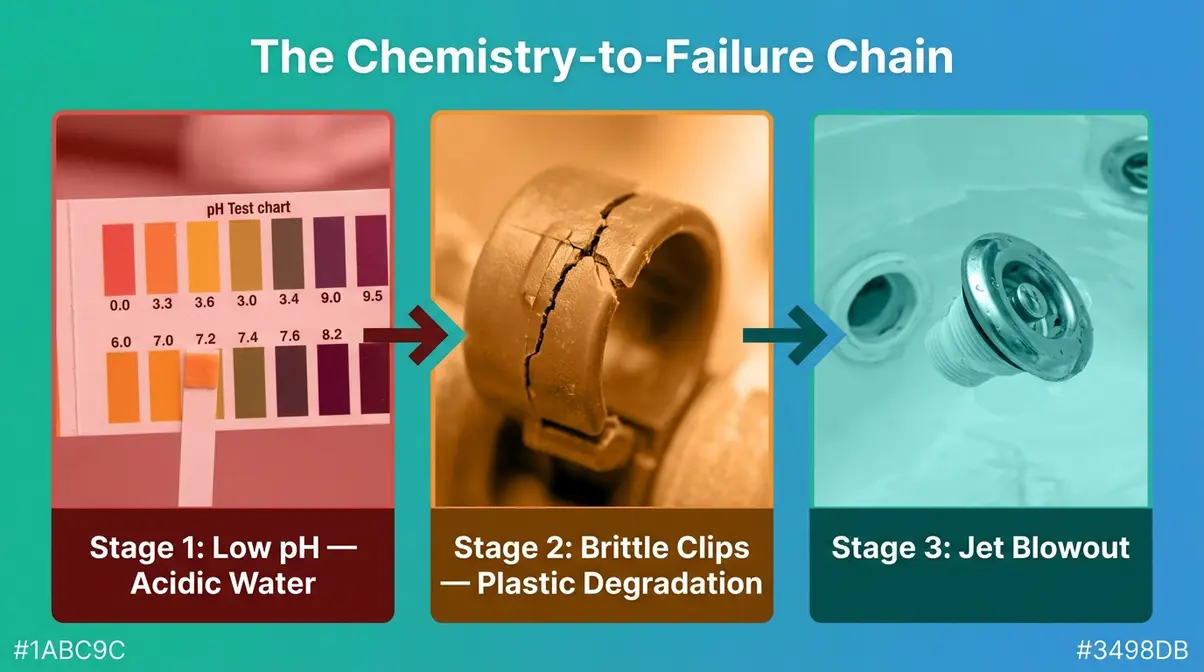
But here is what most guides miss: those clips don’t just break randomly. They are destroyed by The Chemistry-to-Failure Chain — the three-stage process that drives the majority of physical jet failures:
Stage 1 — Imbalanced Water Chemistry: When your hot tub water pH drops below 7.2 (the safe range is 7.2–7.8, per CDC spa water guidelines), the water becomes acidic. This is extremely common — hot tub water naturally drifts acidic from bather load, CO₂ off-gassing, and chemical additions.
Stage 2 — Plastic Tab Degradation: Acidic water attacks the ABS plastic (a rigid plastic commonly used in spa components) and polypropylene that retaining clips are made from. According to manufacturer documentation from Waterway Plastics, prolonged exposure to pH below 7.0 or chlorine levels above 5 ppm accelerates plastic embrittlement — causing clips to become brittle and crack over months of exposure.
Stage 3 — Jet Blowout: Once the clips crack or snap, the insert has nothing holding it in place. Water pressure during normal jet operation (typically 15–25 PSI in residential spas) pushes the insert clean out of the housing. You find it floating in the water or sitting on the tub floor.
Breaking The Chemistry-to-Failure Chain requires two actions: fixing the immediate blowout AND correcting your water chemistry. If you only do one, the new jet insert will fail the same way.
Five chemistry prevention steps to protect your jets:
- Test pH weekly and maintain 7.2–7.8
- Keep total alkalinity (TA) at 80–120 ppm (parts per million) to buffer pH swings
- Keep chlorine at 1–3 ppm — never let it spike above 5 ppm for extended periods
- Shock the water after heavy use to prevent biofilm buildup in jet lines
- Drain and refill completely every three to four months to reset mineral and chemical load
Replacing a Blown-Out Jet
These steps were verified against manufacturer documentation from Waterway Plastics and community consensus across hot tub owner forums. They apply to the most common snap-in jet style — see the next section for threaded jet differences.
Tools needed: Flathead screwdriver, adjustable pliers, replacement jet insert. Estimated time: 15–30 minutes per jet.
- Confirm power is off at the GFCI breaker. Do not skip this. Even with the control panel off, live voltage can remain in the system.
- Drain the water below the jet level (if the insert is still partially in place). You don’t need to drain the full tub — just below the problem jet. This gives you a dry, visible workspace.
- Identify the jet type. Look at the outer ring of the jet face. If it has small notches or tabs around the perimeter, it is a snap-in style. If it has ridges like a bottle cap, it is threaded. (See next section for threaded removal.)
- Insert a flathead screwdriver into one of the notches on the outer ring. Apply gentle inward pressure while rotating the insert counterclockwise. For snap-in jets, a quarter-turn counterclockwise is usually enough to release the locking tabs.
- Pull the insert straight out. If it is stuck, grip the outer ring with adjustable pliers (wrap with a cloth to protect the finish) and pull firmly while continuing to rotate counterclockwise. Do not force it — if it won’t move, see the “Common Mistakes” section.
- Inspect the housing before installing the new insert. Check the inside of the housing (the fixed shell in the wall) for cracks, mineral deposits, or debris. Clean with a soft cloth and rinse with clean water. A cracked housing cannot hold a new insert — call a professional.
- Insert the new jet insert. Align the tabs on the insert with the notches in the housing. Push firmly inward and rotate clockwise until you feel a click or resistance — this confirms the retaining clips have engaged.
- Test the fit before refilling. Tug the insert firmly. It should not move. If it pulls out easily, the housing may be damaged or the replacement insert is the wrong size.
- Refill the tub and restore power. Run the jets for two to three minutes and check for leaks or movement around the newly installed insert.
Snap-In vs. Threaded Jets
Buying the wrong jet type is one of the most common and costly mistakes in this repair. There are two main styles, and they are not interchangeable.
| Feature | Snap-In Jets | Threaded Jets |
|---|---|---|
| Removal method | Quarter-turn counterclockwise | Unscrew fully (multiple turns) |
| Identification | Notches or tabs on outer ring | Ridged outer ring (like a bottle cap) |
| Common brands | Waterway Plastics, Pentair | Balboa, Jacuzzi, LaMar |
| Stuck removal tool | Flathead screwdriver | Rubber mallet + pliers |
| Replacement cost | $15–$35 per insert | $20–$50 per insert |
For threaded jets, the removal process is the same as above except Step 4: instead of a quarter-turn, you rotate the insert counterclockwise continuously until it fully unscrews from the housing. This can take four to six full rotations. If the insert is stuck, tap the outer ring gently with a rubber mallet (never strike the center nozzle) to break the mineral bond, then continue unscrewing.
Never force a snap-in jet with a threaded motion, or vice versa. Doing so cracks the housing — and a cracked housing requires professional replacement of the entire jet fitting, which costs $150–$400 including labor.
Finding the Right Jet Part
Ordering the wrong replacement is more common than it should be. Here is how to identify the exact part you need before spending any money.
Step 1: Find your spa’s model number. It is usually on a sticker inside the equipment compartment (the panel on the side of the tub) or on the underside of the control panel. Write it down.
Step 2: Measure the existing jet or housing. Use a tape measure to record the outer diameter of the jet face (the part you see from inside the tub) and the depth of the housing (measure with the insert removed). Standard sizes range from 2 inches to 5 inches in diameter.
Step 3: Identify the brand. The brand name is often molded into the back of the jet insert itself. Common brands include Waterway Plastics, Pentair, Balboa, and Jacuzzi. Each brand uses proprietary sizing that is not cross-compatible.
Step 4: Search by model number AND jet size. Use your spa’s model number plus the jet diameter to search the manufacturer’s parts catalog or a spa parts retailer. Waterway Plastics publishes a free online parts lookup tool at waterwayplastics.com that is the most reliable resource for Waterway-brand jets.
If you are unsure, bring the old insert to a local spa supply store — they can match it physically.
How to Fix a Leaking Hot Tub Jet
A leaking jet is different from a blown-out jet. The insert stays in place, but water seeps from the gap between the jet body and the tub wall. This usually means the gasket (a rubber ring that creates a watertight seal) or the o-ring (a small circular rubber seal inside the jet body) has worn out or cracked.
A leaking hot tub jet almost always comes down to a failed rubber seal — a $2–$8 part that takes 20 minutes to replace and stops leaks that can otherwise damage the spa cabinet and insulation.
Leaking vs. Sweating Jets
Not all moisture around a jet means a leak. Hot tubs produce condensation on the tub shell, especially in cool weather. Before tearing apart a jet, confirm you have an actual leak. If you actively need to find hot tub leaks, start with a simple diagnostic test.
The paper towel test: Turn off the jets. Dry the area around the suspect jet completely with a towel. Press a dry paper towel flat against the jet-to-wall seam and hold for 30 seconds. If the towel is wet when you pull it away, you have a leak. If it is dry, the moisture is likely condensation — check again after running the jets at full pressure.
- Signs of a real leak (not condensation):
- Water level drops noticeably (more than ½ inch per day without heavy use)
- Persistent dampness on the spa cabinet’s interior foam insulation
- Mineral staining or calcium deposits (white crust) ringing the jet face
- A soft or spongy feeling when you press on the tub wall near the jet
If the paper towel test confirms a leak, proceed to the repair steps below. If you see water actively running down the inside of the spa cabinet (visible when you open the equipment panel), that is a plumbing leak behind the shell — not a jet seal issue. Stop and call a professional.
How do I fix a leaking jet?
Tools needed: Flathead screwdriver, adjustable pliers, waterproof silicone sealant (GE Silicone II or equivalent), replacement o-ring or gasket (match to your jet brand), soft cloth. Estimated time: 30–45 minutes including cure time.
- Turn off all power at the GFCI breaker. Same rule as always — no exceptions.
- Drain the water below the leaking jet. You need the jet completely exposed and dry to apply sealant effectively. Wet surfaces prevent sealant adhesion.
- Remove the jet insert using the steps from Section 4 (snap-in: quarter-turn counterclockwise; threaded: unscrew fully).
- Inspect the gasket and o-ring. The gasket sits between the jet body and the tub wall. The o-ring sits in a groove inside the jet housing. Look for cracks, flat spots, or missing sections. A healthy gasket is slightly springy and uniform in shape. A failed gasket is flat, cracked, or brittle.
- Replace the gasket and o-ring if damaged. These cost $2–$8 each at any spa supply store or online. Match the diameter exactly to your jet model. Seat the new o-ring into its groove by pressing it in evenly around the full circumference — do not stretch it.
- Clean the seating surface. Wipe the inside of the housing and the tub wall around the jet opening with a dry cloth. Remove all old sealant residue, mineral deposits, and debris. The surface must be clean and completely dry for the new sealant to bond.
- Apply a thin bead of waterproof silicone sealant around the back flange of the jet body (the flat ring that presses against the tub wall). Use GE Silicone II or a product rated for continuous water submersion. Apply a consistent bead — about the diameter of a pencil — all the way around to properly repair leaking hot tub jets with sealant.
- Reinstall the jet insert. Push it firmly into the housing and rotate to lock (clockwise for snap-in, clockwise to tighten for threaded). The sealant will compress into the seam as you seat the insert.
- Allow full cure time before refilling. Most waterproof silicone sealants require 24 hours of cure time before water contact. Check your product label. Refilling too early is the most common reason this repair fails.
- Refill and test. Restore power, run the jets, and repeat the paper towel test around the repaired jet after five minutes of operation. No dampness means a successful seal.
Hot Tub Jet Repair Cost: DIY vs. Professional
Knowing what this repair should cost prevents you from overpaying — and helps you decide when it makes more financial sense to call a professional. Our team evaluated cost data from spa parts retailers and service companies across multiple U.S. regions as of early 2026.
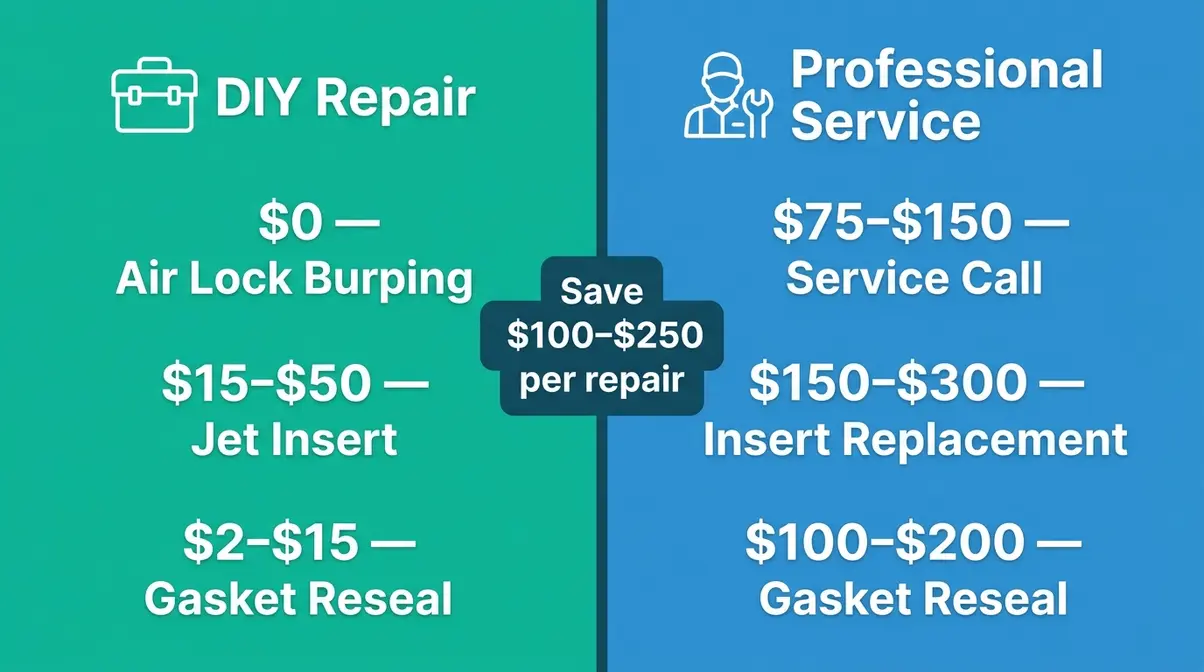
DIY hot tub jet repairs typically cost $15–$75 in parts, compared to $150–$400+ for professional service — making this one of the highest-value home repair skills a spa owner can develop.
How expensive is it to fix jets?
Here is a realistic breakdown of what you will spend on each type of repair:
| Repair Type | DIY Parts Cost | Professional Cost | Time Required |
|---|---|---|---|
| Air lock (burping) | $0 | $75–$150 service call | 10–20 min |
| Snap-in jet insert replacement | $15–$35 per jet | $150–$250 (parts + labor) | 15–30 min |
| Threaded jet insert replacement | $20–$50 per jet | $175–$300 (parts + labor) | 20–40 min |
| Gasket / o-ring reseal | $2–$15 per jet | $100–$200 (parts + labor) | 30–45 min |
| Full jet housing replacement | $40–$100 per housing | $300–$600 (parts + labor) | 2–4 hours |
| Air line clearing | $0–$10 (compressed air) | $100–$200 | 20–30 min |
For most homeowners, a single blown-out jet insert costs $15–$50 in parts and under 30 minutes of work. If you have multiple jets failing at once — a common pattern when The Chemistry-to-Failure Chain has been running for months — budget $75–$150 for a full set of replacement inserts.
The Hidden Costs of Professional Repairs:
When evaluating professional quotes, remember that the advertised hourly rate is rarely the final price. Most spa technicians charge a diagnostic fee or trip charge (typically $85 to $150) just to drive to your home and assess the tub. This fee is sometimes applied to the repair cost, but not always. Furthermore, professionals frequently mark up replacement parts by 30% to 50% over retail prices to cover their sourcing and inventory costs.
Finally, many companies enforce a one-hour minimum labor charge. If a technician replaces a snap-in jet in 10 minutes, you will still pay for the full hour of labor. According to Leslie’s Pool, complex jet system repairs involving plumbing behind the shell can run $300–$600 or more depending on access difficulty (Leslie’s Pool, 2026).
When DIY saves the most money: Simple insert replacement, air lock clearing, and gasket resealing are all well within beginner capability and save $100–$250 per repair versus professional service.
When professional service is worth the cost: Cracked jet housing, leaks behind the shell wall, electrical issues, or pump replacement. These require specialized tools and carry real risk if done incorrectly.
Repair vs. Replace Decision
If your hot tub is experiencing multiple simultaneous failures — jets blowing out across the whole tub, pump issues, control panel errors — you face a genuine repair-versus-replace decision. Evaluating the long-term economics is critical before sinking hundreds of dollars into an aging unit.
Key factors to evaluate:
- Age of the hot tub: Most residential hot tubs last 10–20 years with proper maintenance. Consumer Reports data suggests the average hot tub lifespan is 15–20 years for quality brands, with budget models lasting 5–8 years. If your tub is over 15 years old and experiencing cascading failures, replacement may be more economical.
- Cumulative repair cost: If a single repair exceeds 30–40% of the tub’s current market value, replacement typically makes more financial sense.
- Energy efficiency: The U.S. Department of Energy notes that older hot tubs can cost $50–$100 per month to heat, while modern energy-efficient models cost $10–$20 per month (DOE, 2026). Over five years, that energy difference ($2,400–$4,800) can offset a significant portion of replacement cost.
- Parts availability: For hot tubs over 12–15 years old, replacement parts may be discontinued. If you can’t source a jet housing or pump, repair becomes impossible regardless of cost.
Deeper Scenarios for Repair vs. Replace:
Scenario 1: The 5-Year-Old Tub with One Blown Jet. If your tub is relatively new and a single jet pops out, this is a clear-cut DIY repair. Spending $30 on a part for a tub with years of life left is a high-ROI decision.
Scenario 2: The 15-Year-Old Tub with Cascading Failures. If your jets are blowing out, the heater is struggling to maintain 104°F, and the pump is whining, you are facing the end of the tub’s mechanical lifespan. Sinking $600 into a new pump and jets on a tub with failing insulation is a poor investment.
Scenario 3: Proprietary Parts Availability. Sometimes the decision is made for you. If you own a discontinued model from the early 2000s, sourcing the exact threaded jet housing might be impossible. If you cannot find the parts, or if retrofitting modern plumbing into the old shell costs over $1,000, replacement is the only viable path.
A useful rule of thumb: if the repair cost exceeds one year of the tub’s energy costs plus 20% of its replacement value, buy new. For most homeowners, this threshold sits around $800–$1,200 for a mid-range hot tub.
Common Mistakes and When to Call a Pro
Even experienced DIYers make errors on hot tub jet repairs. Knowing the most common mistakes — and the clear signs that a job is beyond DIY — saves you from a minor fix turning into a major expense.
3 Costly DIY Jet Mistakes
Mistake 1: Forcing a stuck jet insert with excessive torque.
If a jet insert won’t turn after reasonable effort, do not increase force. The housing is made of the same brittle plastic as the retaining clips — and cracking it turns a $25 repair into a $400 professional job. Instead, try soaking the area with a calcium/lime remover (like CLR) for 20 minutes to dissolve mineral bonds, then attempt removal again gently.
Mistake 2: Using the wrong sealant.
Standard household caulk (bathroom or kitchen silicone) is not rated for continuous submersion or the temperature range of a hot tub (98°F–104°F). It will fail within weeks, and you will be doing the repair again. Use only products rated for continuous water submersion — GE Silicone II and Loctite Marine Epoxy are the most commonly recommended by spa professionals.
Mistake 3: Skipping the chemistry fix after replacing a jet.
This is the most expensive mistake of all. If you replace a blown-out insert without correcting the water chemistry that caused The Chemistry-to-Failure Chain, the new insert will fail the same way — often within three to six months. Test your water, correct pH and alkalinity, and keep a log of monthly chemistry readings going forward.
When to Call a Professional
Some problems genuinely require a licensed spa technician. Attempting them without proper training creates safety risks and can void your warranty.
Call a professional if you observe any of these:
- Water leaking from inside the spa cabinet (visible on the insulation foam or pooling under the tub) — this is a plumbing leak behind the shell, not a jet seal issue.
- A cracked jet housing — the fixed shell built into the tub wall. Replacing this requires cutting into the tub shell and is not a beginner repair.
- Any electrical symptom — tripping breakers, burning smell from the equipment compartment, control panel errors after a wet repair — these are shock and fire hazards.
- Pump not running or making grinding noises — pump replacement requires electrical disconnection and plumbing work beyond basic DIY.
- Multiple systems failing simultaneously — if jets, pump, heater, and controls are all malfunctioning at once, a licensed technician can diagnose the root cause efficiently rather than you replacing parts one by one.
According to SpasWorld, electrical and plumbing failures behind the spa shell account for a significant portion of professional repair calls — and are the category where DIY attempts most commonly cause additional damage (SpasWorld, 2026).
Frequently Asked Questions
Can I run my hot tub without jets?
Yes, you can safely run your hot tub without the jets engaged, as the circulation pump will continue to filter and heat the water. According to Energy.gov, running the tub with jets off actually conserves energy and reduces heat loss. However, if a jet is physically missing from its housing, you should avoid running the main jet pump, as the unbalanced water pressure can cause erratic flow or damage the internal plumbing lines.
How long do hot tub jets last?
With proper water chemistry, standard hot tub jets typically last 7 to 10 years before the internal plastics become brittle. According to Consumer Reports, maintaining a strict pH balance of 7.2 to 7.8 is the single most effective way to extend their lifespan. If your water frequently drops into acidic ranges, the retaining clips can degrade and fail in as little as two to three years, requiring premature replacement.
How do I fix a leaking jet on a hot tub?
A leaking hot tub jet is almost always caused by a failed gasket or o-ring — a rubber seal that costs $2–$8 to replace. First, confirm the leak with the paper towel test (press a dry paper towel to the jet seam for 30 seconds — dampness confirms a leak). Then drain the water below the jet, remove the insert, replace the gasket and o-ring, apply waterproof silicone sealant (GE Silicone II or equivalent) to the back flange, and reinstall. Allow 24 hours of cure time before refilling. The full process takes 30–45 minutes.
Why is air coming out of my return jets in my pool or hot tub?
Air coming out of return jets indicates an air leak on the suction side of the pump — air is entering the system somewhere between the skimmer and the pump. According to Pool Research, common causes include a low water level (air gets pulled in through the skimmer), a loose pump lid or o-ring, or a cracked suction line fitting. In hot tubs specifically, this also occurs after a refill when air trapped in the plumbing hasn’t fully purged. Burping the jets (see Section 3) resolves most post-refill cases. Persistent air in returns after burping points to a suction-side leak requiring professional inspection.
How do I fix hot tub jets blowing out?
The complete hot tub jet blowing out fix involves three steps: remove the failed insert, install a correct replacement, and correct water chemistry to prevent recurrence. Turn off power at the GFCI breaker. Insert a flathead screwdriver into the jet notch, rotate counterclockwise a quarter turn, and pull the insert out. Inspect the housing for cracks. Install the new insert by aligning the tabs and rotating clockwise until it clicks. Then test your water pH (target 7.2–7.8) and alkalinity (80–120 ppm) — correcting chemistry breaks The Chemistry-to-Failure Chain that caused the original failure.
Why is there a 15-minute hot tub rule?
The 15-minute hot tub rule is a general safety guideline recommending that bathers limit continuous soaking sessions to approximately 15 minutes, particularly at temperatures at or above 104°F (40°C). Prolonged exposure to high-temperature water raises core body temperature, which can cause dizziness, nausea, heat exhaustion, or — in vulnerable individuals — cardiac stress. The CDC recommends that hot tub water not exceed 104°F and that children, pregnant women, and those with cardiovascular conditions take particular care with soak duration and temperature. Cooling down between sessions and staying hydrated significantly reduces these risks.
Is it cheaper to fix a hot tub or buy a new one?
For most single-system failures — jets, pump, heater, or cover — repair is almost always cheaper than replacement. A new entry-level hot tub costs $3,000–$8,000 according to HomeGuide, while a mid-range model runs $6,000–$12,000. Most repairs cost $150–$600. However, if your tub is over 15 years old, experiencing multiple simultaneous failures, and repair costs exceed 30–40% of its current resale value, replacement becomes the better investment. Factor in energy costs too — older tubs can cost $50–$100/month to heat versus $10–$20 for modern models, a difference of up to $4,800 over five years.
The Fix That Actually Lasts
Most hot tub jet problems come down to one of three causes: a trapped air lock, a blown-out insert with failed retaining clips, or a worn seal leaking water. Each has a clear, beginner-friendly repair path — and this guide has walked you through all three. The hot tub jet blowing out fix that holds long-term requires both the mechanical repair and the chemistry correction. Replace the insert, then fix the water.
The Chemistry-to-Failure Chain is the hidden pattern behind most recurring jet failures. Low pH silently degrades the plastic tabs that hold your jets in place — and most hot tub owners never know it’s happening until a jet lands in their lap. Now that you understand the chain, you can break it: test your water weekly, keep pH between 7.2 and 7.8, and replace jet inserts before they fail completely. That combination turns a recurring frustration into a one-time repair.
Start with the diagnosis flowchart in Section 2. Identify your exact problem, gather your tools (most cost under $30 total), and work through the relevant repair steps. If you hit a wall — cracked housing, electrical symptoms, or leaks behind the shell — the professional call list in Section 7 tells you exactly when to stop and get help. For everything else, you have got this.

David King
Hot tub tester and writer at One Hot Tub.