

Table of Contents - How Much Is a Second-Hand Hot Tub Worth UK? (2026)
This blog post may contain affiliate links. As an Amazon Associate I earn from qualifying purchases.
“Thinking of selling my old hot tub that’s about 10 years old, all working fine except a couple of lights, big question is what’s it worth?? Tia”
If that sounds familiar, you’re in good company — and you’re asking exactly the right question. Most online guides either dodge the question with vague advice or push you toward buying new. The result? Buyers overpay, sellers undersell, and everyone walks away frustrated.
This guide gives you a clear, data-backed framework for valuing any second-hand hot tub in the UK — whether you’re buying, selling, or simply wondering exactly how much is a second-hand hot tub worth uk buyers might pay. Understanding what a pre-loved hot tub is worth comes down to four concrete factors: age, brand tier, condition, and hidden costs. By the end, you’ll have a specific number to work with — not a shrug.
We cover UK price ranges by seller type, a year-by-year depreciation breakdown, a pre-purchase inspection checklist, the true hidden costs, and a step-by-step selling guide.
Key Takeaways: How much is a second-hand hot tub worth UK?
A used hot tub in the UK typically sells for £500–£5,000+ depending on age, brand, and condition — but knowing the right figure requires a structured approach. The Hot Tub Depreciation Ladder gives you that framework in under two minutes.
- Private sales typically range from £1,500–£3,000; refurbished dealer models from £2,000–£5,000+
- The Depreciation Ladder shows most hot tubs retain just 25–33% of original value by Year 5
- Premium brands (Jacuzzi, Hot Spring) hold value significantly better than unbranded imports
- Hidden costs — transport, electrical, chemicals — add £700–£1,200 to any used tub purchase
- 10-year-old tubs are typically worth £500–£1,000, mainly for parts
All prices are estimates and may vary based on condition, location, and market demand.
What Is a Second-Hand Hot Tub Worth in the UK?
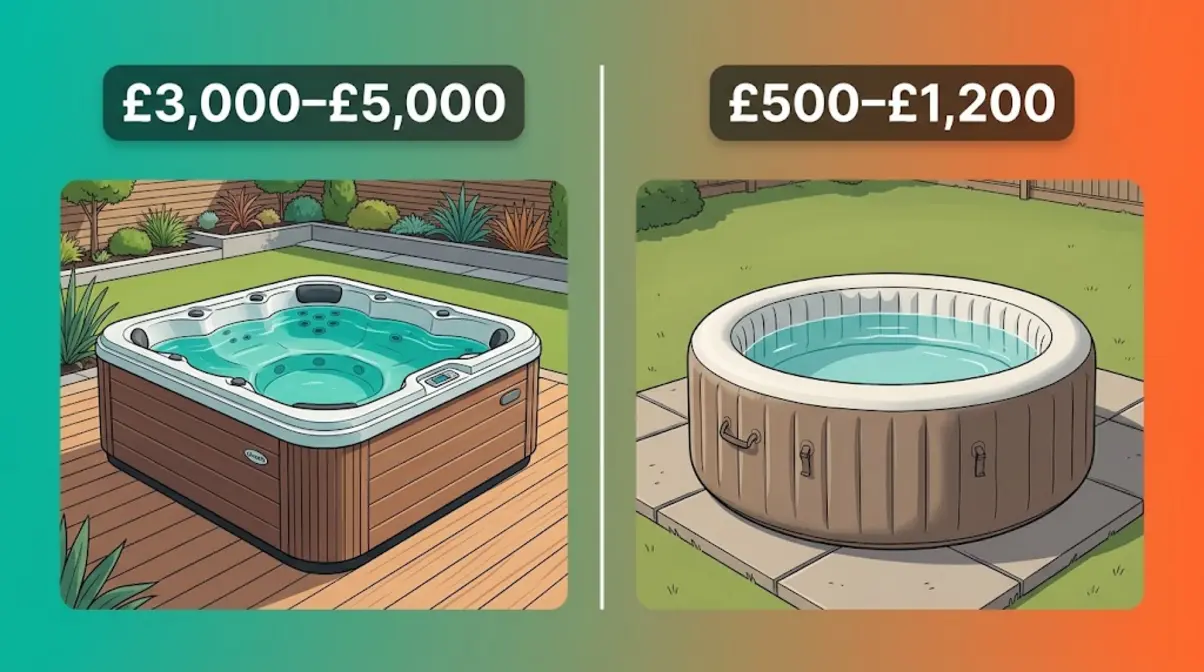
A second-hand hot tub in the UK is typically worth between £500 and £5,000, depending on its age, brand, and condition — but getting to the right number requires a structured approach. Most used hot tubs retain just 25–33% of their original retail price within five years (Sundance Spas, 2024). Understanding the specific factors that drive that number up or down is what separates a fair deal from an expensive mistake.
Our analysis of current UK listings on Facebook Marketplace and eBay in 2026 confirms that the used hot tub market remains active and price-stratified — with a clear gap between premium-brand resale values and budget imports. The key insight that most guides miss: brand tier matters more than age at the lower end of the market. A well-maintained 8-year-old Jacuzzi can legitimately outsell a 3-year-old unbranded Chinese import. That counterintuitive reality is exactly what The Hot Tub Depreciation Ladder is designed to capture.
Private vs. Dealer Price Ranges
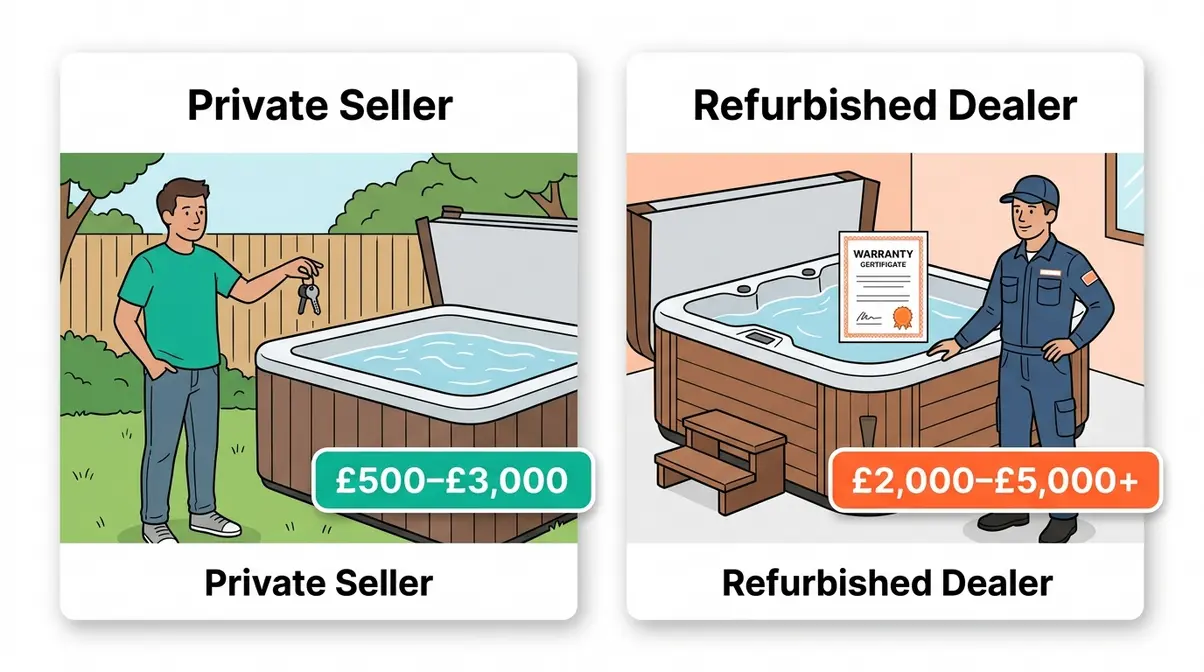
Knowing how much a hot tub is in general terms is only the starting point. The seller type — private individual, refurbished dealer, or trade-in — dramatically affects both asking price and what you actually get for your money.
Based on our review of current UK marketplace listings, private sellers on Facebook Marketplace and eBay typically list used hot tubs in the following ranges (outdoorlivinghottubs.co.uk; whatspa.co.uk, 2026):
| Tub Type | Typical Private Sale Range (UK) |
|---|---|
| Budget / Unbranded (fair condition) | £500 – £1,200 |
| Mid-Range (good condition, 3–7 years) | £1,500 – £3,000 |
| Premium Brand (excellent condition, under 5 years) | £3,000 – £4,500 |
Refurbished dealers — who inspect, service, chemically clean, and warranty the unit — typically charge £2,000–£5,000+. That premium reflects a real service package: professional assessment, a working guarantee, and delivery. Which? hot tub testing has found through independent assessment that insulation quality significantly affects long-term running costs — a factor that directly influences a used tub’s true value (2026). If you lack the technical knowledge to assess a tub yourself, the dealer premium is often worth paying.
Trade-in value — what a dealer will pay YOU — is a different story. Expect 30–50% below private sale value. Dealers need margin for refurbishment, warranty, and resale. A tub you might privately sell for £2,000 may only attract a £700–£1,000 trade-in offer.
A useful real-world comparison: a 4-year-old Lay-Z-Spa (budget inflatable) in good condition fetches £300–£600 on the private market. A 4-year-old Jacuzzi J-400 series in excellent condition? £3,500–£5,000. Same age bracket, vastly different outcome.
“Price ranges give you a starting point — but the real question is where your specific tub sits within those brackets. That’s where The Hot Tub Depreciation Ladder comes in.”
Depreciation Ladder by Year
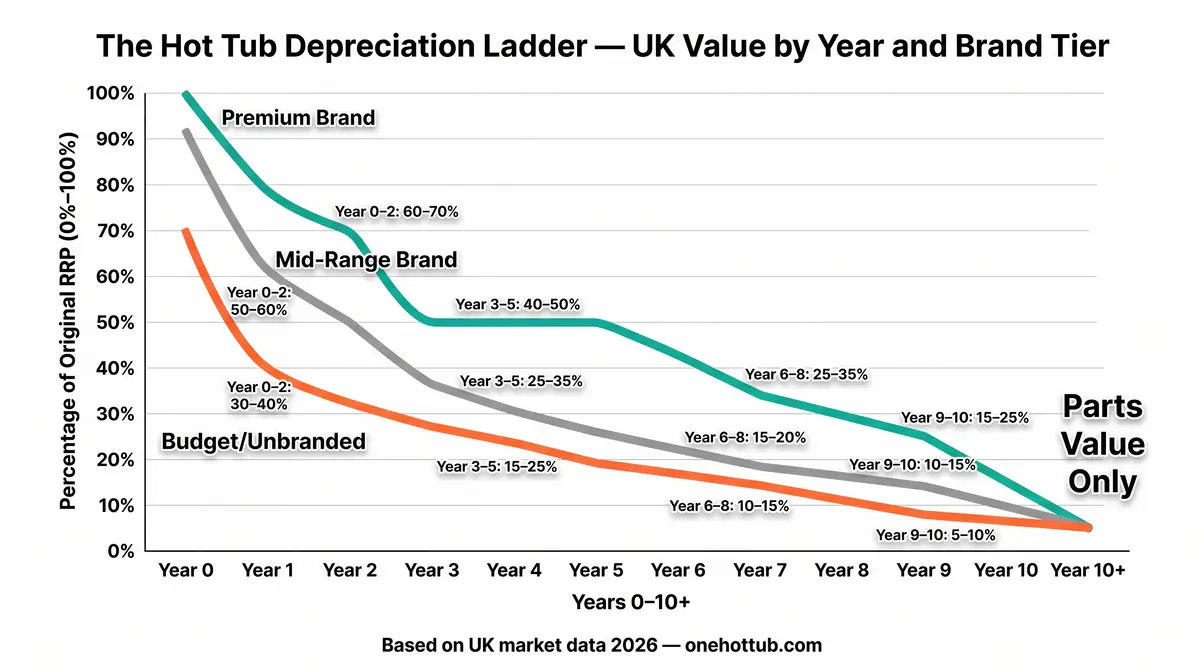
The Hot Tub Depreciation Ladder is a structured framework for estimating what a used hot tub is worth based on its age and brand tier. Most hot tubs follow a predictable depreciation curve — steep in the first two years, then levelling off into a long plateau of modest decline. Understanding this curve stops you from either overpaying for a mid-life tub or dismissing a well-maintained older model too quickly.
How We Calculated These Values: These estimates are based on our analysis of current UK listings on Facebook Marketplace and eBay (2026), cross-referenced with industry guidance from WhatSpa and Sundance Spas valuation guidance. An above-ground hot tub typically retains just 25–33% of its original value, with premium brands holding value significantly better than budget alternatives (Sundance Spas, 2024).
The chart below illustrates how value drops across brand tiers — the steeper the curve in years 1–3, the more important brand quality becomes.
| Age | Premium Brand (e.g., Jacuzzi, Hot Spring) | Mid-Range Brand | Budget / Unbranded |
|---|---|---|---|
| 0–2 years | 60–70% of RRP | 50–60% of RRP | 30–40% of RRP |
| 3–5 years | 40–50% of RRP | 25–35% of RRP | 15–25% of RRP |
| 6–8 years | 25–35% of RRP | 15–20% of RRP | 10–15% of RRP |
| 9–10 years | 15–25% of RRP | 10–15% of RRP | 5–10% of RRP |
| 10+ years | Parts value only (£300–£800) | Parts value only (£200–£500) | Scrap / free removal |
RRP = manufacturer’s original retail price. Percentages are estimates based on current UK market data (2026). Condition, included accessories, and warranty status will adjust these figures up or down.
Five real-world valuation examples that put the Ladder into practice:
- 5-year-old Jacuzzi J-315 (premium), excellent condition, with cover and steps: approximately £3,000–£4,000
- 5-year-old unbranded Chinese import, average condition, no warranty: approximately £600–£900
- 3-year-old Lay-Z-Spa Paris (budget inflatable), good condition: approximately £200–£350
- 8-year-old Hot Spring Highlife (premium), good condition, recently serviced: approximately £2,000–£3,000
- 10-year-old mid-range tub, working but aged: approximately £500–£800 (parts value)
These figures illustrate the central point of The Hot Tub Depreciation Ladder: scenario 1 and scenario 2 are the same age, yet the Jacuzzi is worth four to five times more. For a deeper dive into all the factors that affect used hot tub value, see our detailed guide to used hot tub value.
“A second-hand hot tub in the UK typically retains just 25–33% of its original retail price within five years — premium brands hold value significantly better than budget alternatives.” (Sundance Spas, 2024)
Value Drivers: Brand & Condition
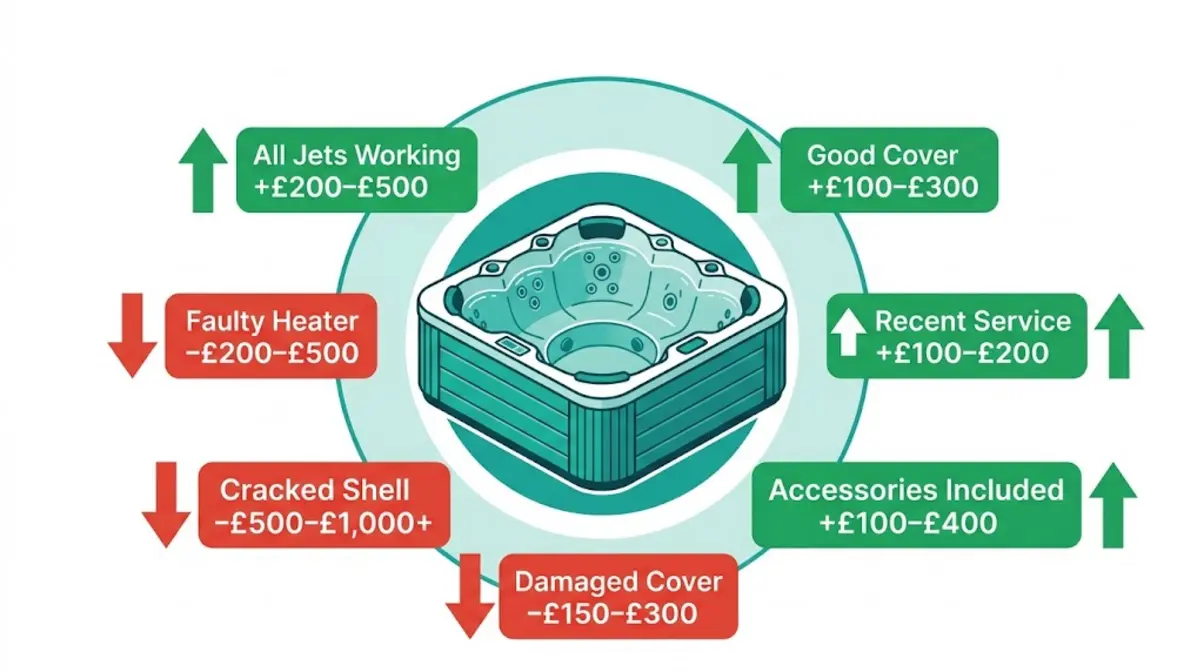
Yes — hot tubs do have resale value, but the amount depends almost entirely on brand, condition, and age. Knowing which factors push a price up or down from its Depreciation Ladder baseline is the difference between pricing with confidence and guessing.
Brand tier is the single biggest long-term driver. Premium brands — Jacuzzi, one of the UK’s best-known premium hot tub brands; Hot Spring, another premium-tier brand with strong UK resale values; Sundance; and Artesian — hold value because of parts availability, established reputation, and genuine longevity. Unbranded imports depreciate faster because replacement parts are difficult to source and buyer confidence is low.
Condition modifiers shift a tub’s value up or down from its bracket:
| Factor | Value Impact |
|---|---|
| All jets working, intact shell | +£200–£500 |
| Good insulation and undamaged cover | +£100–£300 |
| Recent service or chemical clean | +£100–£200 |
| Non-working heater | –£200–£500 |
| Cracked shell | –£500–£1,000+ |
| Missing or damaged cover | –£150–£300 |
| Old or replaced pumps | Neutral to slight negative |
Included accessories also matter more than sellers often realise. Steps, a cover lifter, a chemical starter pack, and original documentation together add £100–£400 to perceived value. A working WiFi-enabled control panel or a recently replaced pump can add further buyer confidence.
Warranty is a significant differentiator. A dealer warranty — even a 3-month parts warranty — adds buyer confidence and justifies a price premium of £300–£800 over a private sale equivalent. Without it, buyers are taking on full risk, which they’ll price accordingly.
What to Check Before Buying a Used Hot Tub
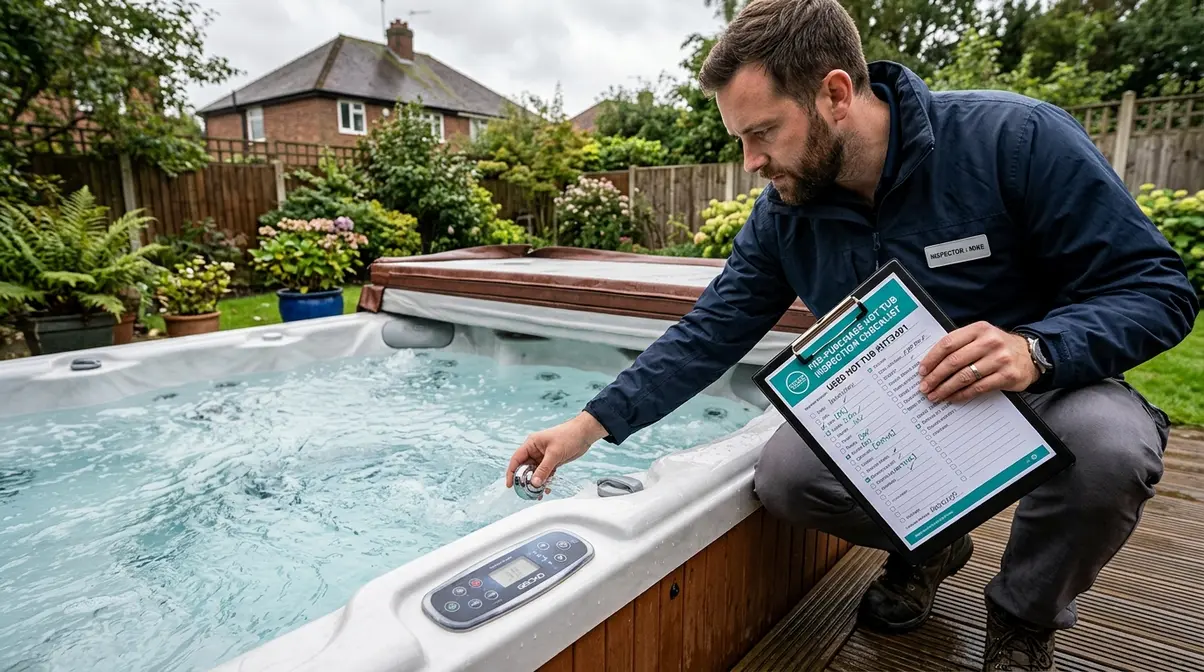
Professional hot tub installation — including Part P electrical compliance (a UK legal requirement for fixed electrical work) — typically costs £300–£500 in the UK, and it is a mandatory cost that most buyers overlook entirely. Add transport, chemicals, and a new cover, and the total hidden budget reaches £700–£1,200 before you’ve switched the tub on. Knowing what to inspect — and what to budget — before you commit is what separates a cost-effective purchase from a costly regret.
A tub with multiple faults will sit at the lower end of its Depreciation Ladder bracket — or below it. Our team has reviewed current UK listings across Facebook Marketplace, the UK’s most active platform for used hot tub listings, and the pattern is consistent: undisclosed faults are the leading cause of buyer dissatisfaction in the pre-loved hot tub market.
15-Point Inspection Checklist
Never view a used hot tub without running through a systematic check. Ask the seller to fill and heat the tub at least 24 hours before your visit — a tub presented cold and empty cannot be properly evaluated.
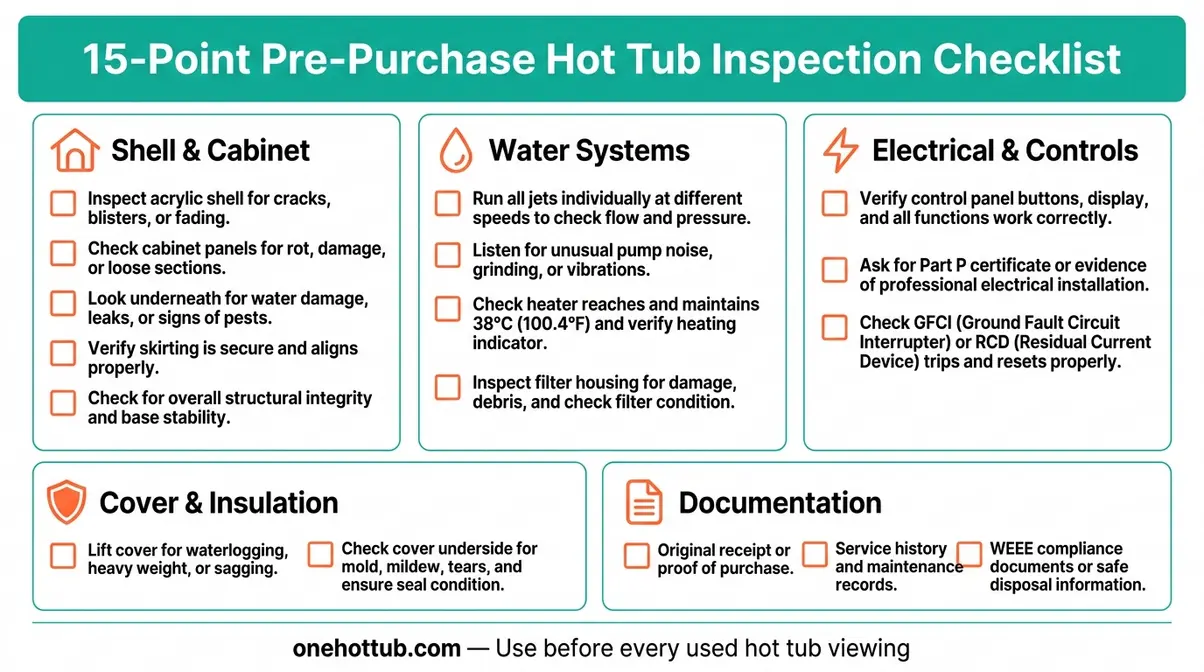
- Shell and cabinet:
- Inspect the acrylic shell for cracks, crazing, or discolouration — hairline cracks near jets indicate stress damage
- Check the cabinet panels for rot, warping, or pest damage
- Look underneath (if accessible) for signs of water damage or mould
- Water systems:
- Run all jets individually — note any that don’t fire or deliver weak pressure
- Listen for unusual pump noise (grinding or rattling indicates bearing wear)
- Check the heater: water should reach 38°C within 2–3 hours from cold
- Inspect the filter housing — a clogged or deteriorated filter is a £50–£150 replacement
- Electrical and controls:
- Verify the control panel lights up and responds correctly
- Ask for proof of Part P electrical compliance — a certified installation certificate
- Check the GFCI/RCD (circuit breaker) trips and resets correctly
- Cover and insulation:
- Lift the cover — a waterlogged cover is heavy, saggy, and needs replacing (£150–£300)
- Check the cover’s underside for mould or foam deterioration
- Documentation and history:
- Ask for the original purchase receipt or invoice (confirms brand and age)
- Request any service history, chemical treatment logs, or repair receipts
- Check for WEEE (Waste Electrical and Electronic Equipment regulations) compliance if the tub is being removed — relevant to disposal responsibilities
Hidden Costs You Must Budget For
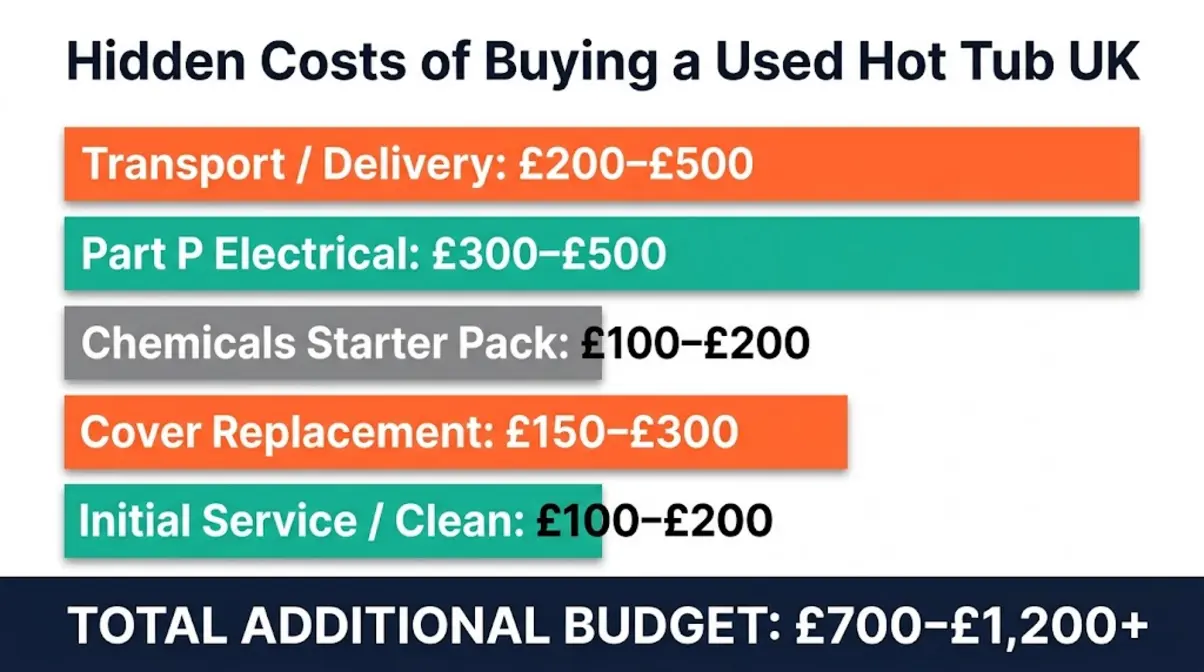
The asking price is only part of what a used hot tub actually costs you. Based on current UK trade data, buyers routinely underestimate the additional costs involved. Here is an honest breakdown:
| Cost Item | Estimated UK Cost (2026) | Notes |
|---|---|---|
| Transport / delivery | £200 – £500 | Depends on distance and crane hire if needed |
| Part P electrical installation | £300 – £500 | Mandatory for hardwired setups (Checkatrade, 2026) |
| New chemicals (starter pack) | £100 – £200 | Bromine or chlorine, pH balancers, shock treatment |
| Cover replacement (if needed) | £150 – £300 | Standard thermal cover, UK supplier |
| Initial service / chemical clean | £100 – £200 | Recommended for any used tub |
| Total additional budget | £700 – £1,200+ | Before first use |
According to Checkatrade, a UK directory of vetted tradespeople, Part P-compliant electrical work for a hot tub typically falls between £300 and £500 depending on the existing supply and proximity to the consumer unit (Checkatrade, 2026). This is non-negotiable for a hardwired installation — attempting it without certification is both illegal and dangerous.
Transport costs vary significantly. A local move with a standard flatbed may cost £200, but if the tub needs a crane or specialist lifting equipment — common for back-garden installations — costs can reach £500 or more. Always obtain at least two transport quotes before committing.
“The hidden costs of buying a used hot tub — transport, electrical work, and chemicals — routinely add £700–£1,200 to the purchase price, a figure most buyers fail to budget for.”
Private Seller vs. Dealer Safety
Do people buy second-hand hot tubs? Absolutely — and in growing numbers. But the route you choose has significant implications for your consumer rights and peace of mind. For a deeper understanding of the entire purchasing journey, review our complete guide to buying a hot tub. Here is an honest comparison:
| Factor | Private Seller | Refurbished Dealer |
|---|---|---|
| Price | Lower (£500–£3,000) | Higher (£2,000–£5,000+) |
| Inspection | Your responsibility | Done professionally |
| Warranty | None (caveat emptor) | Typically 3–12 months |
| Consumer Rights | Limited (private sale) | Full Consumer Rights Act 2015 protection |
| Delivery | Usually not included | Often included |
| Condition confidence | Variable | Higher |
| Hygiene assurance | None | Chemical clean standard |
According to Citizens Advice, the UK’s independent consumer rights organisation, purchasing from a dealer gives you statutory rights under the Consumer Rights Act 2015 — goods must be of satisfactory quality, fit for purpose, and as described. A private sale offers no such protection; your only recourse is proving misrepresentation, which is difficult and costly.
Hygiene is a genuine concern with private sales. The Health and Safety Executive (HSE) guidance on spa pools notes that poorly maintained hot tubs present a real risk of Legionella bacteria growth — particularly in tubs that have been left standing or infrequently treated. For any private purchase, a full drain, clean, and chemical treatment before first use is not optional; it is essential (HSE, 2026).
The practical verdict: if you are technically confident and willing to do your own inspection and chemical treatment, a private sale offers the best value. If you are uncertain about assessing a tub’s condition, or if this is your first hot tub, a refurbished dealer purchase is the safer choice — the premium buys you confidence, consumer protection, and a working guarantee.
How to Sell Your Used Hot Tub for the Best Price
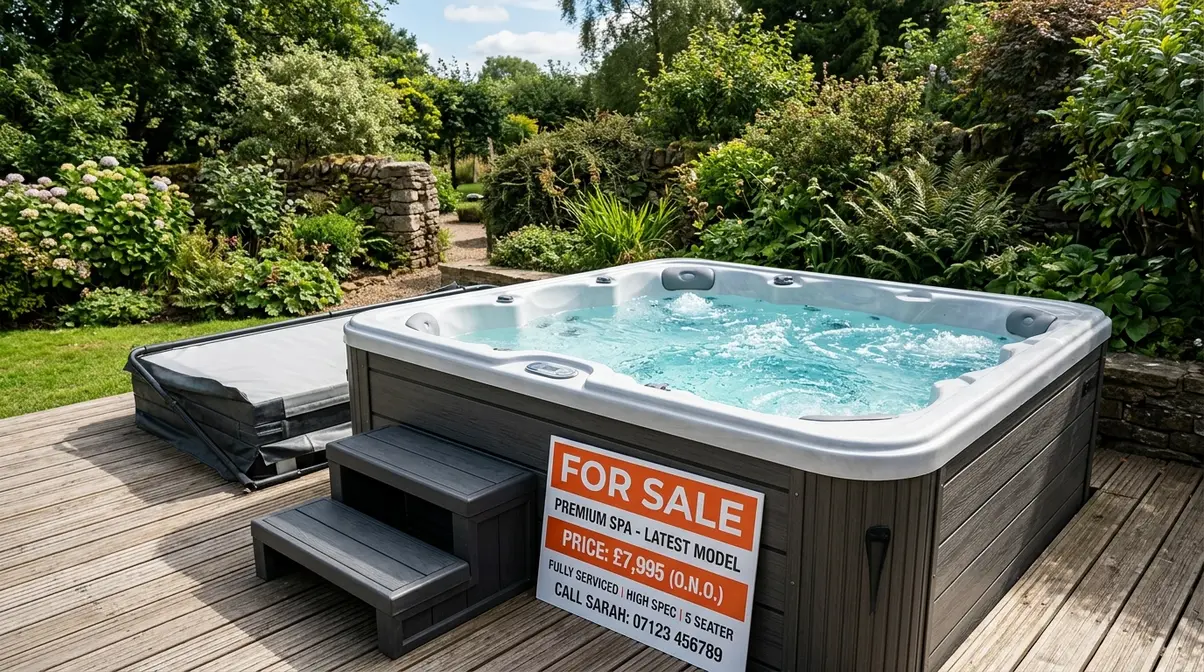
Selling a pre-loved hot tub is achievable, but the difference between a quick, fair sale and a months-long struggle often comes down to preparation and platform choice. Based on our analysis of the UK used hot tub market, well-presented tubs with clear photos, accurate descriptions, and honest condition disclosures sell significantly faster — and closer to asking price — than vague listings with a single photograph.
Preparing Your Tub for Sale

A clean, fully functional tub commands a meaningfully higher price than one presented “as is.” Before listing, work through these steps to maximise your return.
Estimated time: 2-3 hours
Tools/Materials needed: Access to the water supply, basic cleaning materials, a test strip kit, hot tub surface cleaner, and a fresh filter.
Step 1: Drain and clean the shell
Use a hot tub surface cleaner on the acrylic interior. Remove any scale or staining around the waterline to ensure it looks pristine for prospective buyers.
Step 2: Clean or replace the filter
A fresh filter costs £30–£80 and signals to buyers that the tub has been properly maintained over its lifespan.
Step 3: Refill and treat the water
Balance the pH (7.2–7.8), add sanitiser, and run a shock treatment. A chemically balanced tub is both safer and significantly more impressive to view during a wet test.
Step 4: Test all jets and features
Note any that are not working and decide whether to repair or disclose them. Repairing a faulty jet (typically £50–£150) often adds more to the final sale price than it costs to fix.
Step 5: Clean or replace the cover
A clean, intact cover adds perceived value immediately. Conversely, a waterlogged or damaged cover actively reduces offers.
Step 6: Photograph in good natural light
Take clear shots from all four sides, the interior with water, the control panel, and the cabinet. Include a clear photo of any documentation.
Step 7: Gather all documentation
Collect the original receipt, service history, Part P certificate, and any warranty paperwork. These documents increase buyer confidence and justify your asking price.
Step 8: Set your price using the Depreciation Ladder
Cross-reference your tub’s age and brand tier in the valuation table, then adjust your asking price up or down based on condition and included accessories.
Where to List Your Tub in the UK
Not all platforms deliver equal results for used hot tub sales. For a comprehensive strategy, consult our guide to selling a used hot tub quickly. Here is where UK sellers find the most active buyers:
| Platform | Best For | Cost | Notes |
|---|---|---|---|
| Facebook Marketplace | Fast local sales | Free | Highest volume of UK used tub buyers; local collection simplifies logistics |
| eBay UK | Wider reach, auction or fixed price | Fees apply | Good for premium brands; auction can drive price up |
| Gumtree | Local classifieds | Free (basic) | Declining traffic but still active for bulky items |
| sellyourhottub.co.uk | Specialist buyers | Fee or commission | Dedicated platform; pre-qualified buyers only |
| Local hot tub dealers | Trade-in or consignment | Below market value | Convenient but expect 30–50% below private sale price |
Facebook Marketplace consistently delivers the fastest results for most sellers, particularly for mid-range tubs where local collection is practical. For premium brands (Jacuzzi, Hot Spring), eBay’s wider reach can attract buyers willing to travel or arrange specialist transport — which often justifies the additional effort.
Write a compelling listing: Be specific about brand, model, age, and condition. State what works and what doesn’t. “All jets fully working, recently serviced, cover in good condition — one light not functioning” is far more effective than “good condition, buyer collects.” Honesty builds trust and reduces time-wasting enquiries.
Private Sale vs. Trade-In: Pros and Cons
Is it hard to sell a used hot tub privately? It can be, particularly for older or larger models. However, the financial reward is typically worth the effort.
| Factor | Private Sale | Trade-In to Dealer |
|---|---|---|
| Potential return | Highest (full market value) | Lowest (30–50% of private value) |
| Effort required | High (listing, viewings, negotiation) | Low (one call, one collection) |
| Time to sale | Variable (days to months) | Fast (often within a week) |
| Logistics | Buyer typically arranges collection | Dealer handles removal |
| Best for | Patient sellers with a desirable tub | Sellers wanting a quick, hassle-free exit |
The main challenge with private sales is logistics — most buyers expect the seller to arrange (and often pay for) removal. Budget £200–£400 for a specialist hot tub removal service if the buyer cannot arrange their own transport. Factor this into your asking price.
Hot Tub Lifespan and Running Costs: What to Expect
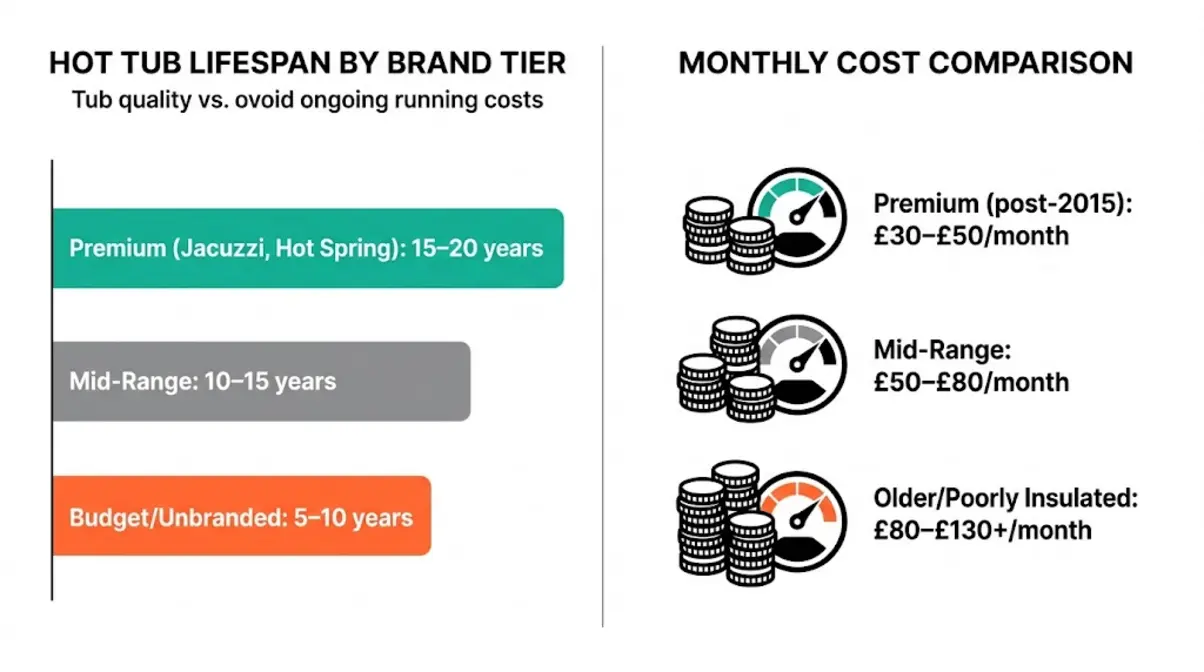
Understanding a hot tub’s lifespan and ongoing running costs is essential whether you’re buying or selling — because both directly affect what a used tub is worth. A 6-year-old tub with 14 years of life remaining is a very different proposition to a 6-year-old tub that is already struggling. The Energy Saving Trust highlights that older models — particularly those manufactured before 2015 — can cost significantly more to run annually due to less efficient insulation and heating systems (Energy Saving Trust, 2026).
How Long Does a Hot Tub Last?
A well-maintained hot tub typically lasts between 15 and 20 years, though the range varies considerably by brand and maintenance quality. Budget and unbranded models often have a realistic working life of 5–10 years; premium brands are regularly still in full working order at 15+ years.
| Brand Tier | Expected Lifespan | Key Factor |
|---|---|---|
| Premium (Jacuzzi, Hot Spring, Sundance) | 15–20 years | Quality components, parts availability |
| Mid-Range | 10–15 years | Dependent on maintenance quality |
| Budget / Unbranded | 5–10 years | Limited parts availability, lower build quality |
The components most likely to fail first are the pumps (typically 8–12 years), the heater element (8–15 years), and the control board (10–15 years). Replacement costs for these components range from £150 (pump seal) to £800+ (control board replacement). When evaluating a used tub, ask about the age and service history of these specific components — not just the tub itself.
UK Running Costs Breakdown
Running costs are one of the most important factors in assessing a used hot tub’s true value. A cheap tub with poor insulation can cost significantly more to run annually than a more expensive, well-insulated model. For a deeper dive, review our full breakdown of hot tub running costs.
Based on current UK energy prices and guidance from the Energy Saving Trust (2026):
| Tub Type | Estimated Monthly Cost | Estimated Annual Cost |
|---|---|---|
| Well-insulated premium tub (post-2015) | £30 – £50 | £360 – £600 |
| Mid-range tub (average insulation) | £50 – £80 | £600 – £960 |
| Poorly insulated or older tub (pre-2015) | £80 – £130+ | £960 – £1,560+ |
These figures assume average UK electricity prices and year-round use. An older, poorly insulated tub running at £100/month is costing you £1,200 a year — a figure that should factor directly into your valuation calculation. If a seller is asking £1,500 for a 12-year-old budget tub with poor insulation, the running cost burden over three years could exceed the purchase price itself.
“Poorly insulated hot tubs manufactured before 2015 can cost up to £1,560 per year to run in the UK — a hidden long-term cost that should directly reduce what you’re willing to pay for an older model.”
Tips to Reduce Running Costs
Ongoing maintenance is the single biggest determinant of a hot tub’s longevity and efficiency. These practical steps apply whether you’re buying a used tub or preparing one for sale, and are covered extensively in our hot tub maintenance guide:
- Use a well-fitting thermal cover — a quality cover reduces heat loss by up to 60% and is the cheapest efficiency upgrade available
- Set a lower standby temperature — reducing from 40°C to 37°C overnight cuts heating costs without sacrificing usability
- Clean filters monthly — blocked filters force pumps to work harder, accelerating wear and increasing energy consumption
- Balance water chemistry weekly — correct pH (7.2–7.8) and sanitiser levels prevent scale build-up on heater elements, extending their life by years
- Service annually — a professional service (£100–£200) identifies minor issues before they become expensive failures
- Insulate the cabinet — adding insulation to the cabinet interior reduces heat loss significantly on older models
For a used tub purchase, always ask the seller about their maintenance routine. A tub that has been regularly serviced and chemically maintained will sit at the top of its Depreciation Ladder bracket; one that has been neglected will sit at the bottom — or below it.
Risks and Limitations of Buying Second-Hand
!(https://pub-8ce7ac24839649d585b239b4a6127843.r2.dev/images/how-much-is-a-second-hand-hot-tub-worth-uk__2840__en/used-hot-tub-risks-pitfalls-uk.webp)
Five pitfalls account for the majority of buyer regret in the UK used hot tub market — knowing them in advance is the simplest way to avoid a costly mistake.
Buying a pre-loved hot tub is a genuinely cost-effective option for many UK households — but it comes with real risks that deserve honest discussion. This section covers what can go wrong, when to walk away, and when to call in professional help.
Common Used Hot Tub Pitfalls
Pitfall 1: Accepting a cold, empty tub for viewing. A seller who won’t fill and heat the tub before your visit is, intentionally or not, preventing you from seeing whether the heater, jets, and pumps actually work. Always insist on a full wet test.
Pitfall 2: Ignoring the electrical installation. A hot tub wired without Part P compliance is a legal liability and a safety risk. If the seller cannot produce a Part P certificate, budget for a full electrical inspection (£150–£300) before use — or walk away.
Pitfall 3: Underestimating transport complexity. A hot tub that “just needs collecting” can require specialist equipment if it needs to pass through a narrow gate, over a step, or into a raised garden. Confirm access dimensions before purchase; crane hire can add £300–£600 to your costs.
Pitfall 4: Overlooking hygiene risk. The HSE is explicit that poorly maintained spa pools present a genuine Legionella risk. A tub that has been standing unused for months requires a full drain, chemical shock treatment, and thorough clean before use (HSE, 2026). Budget £100–£200 for a professional chemical clean if the tub’s history is unclear.
Pitfall 5: Buying on brand name alone. Even premium brands in poor condition can be expensive disappointments. A cracked shell or failed control board on a Jacuzzi can cost £1,000–£2,000+ to repair — more than the tub’s remaining resale value.
When to Walk Away (Or Buy New Instead)
Some situations make a used hot tub purchase a poor decision, regardless of the asking price:
- The seller refuses a wet test — non-negotiable; walk away
- There is visible shell cracking — repair costs frequently exceed the tub’s value
- No Part P certificate exists and the seller claims DIY wiring — safety risk and legal liability
- The tub has been unused for over 2 years — seals, pumps, and heater elements deteriorate rapidly when idle; the refurbishment cost often rivals a new budget tub
- The total cost (purchase + hidden costs + running costs) approaches a new tub’s price — at this point, a new tub with a full manufacturer warranty is the more rational choice
New budget hot tubs are available from £2,500–£4,000 with full warranties. If a used tub plus its hidden costs approaches £2,000–£2,500, the new option deserves serious consideration.
When to Seek Professional Help
Certain scenarios warrant professional involvement before completing a purchase:
- Any doubt about electrical safety — commission an independent electrician with hot tub experience to inspect the installation before use
- Legionella risk — if the tub has been standing unused, contact a specialist hot tub hygiene service; this is not a DIY job (HSE, 2026)
- Structural concerns — if the garden base or decking that will support the tub is not purpose-built, consult a structural engineer; a filled hot tub can weigh 1,500–2,000kg
- Dispute resolution — if a dealer-purchased tub develops a fault within 30 days, Citizens Advice can advise on your rights under the Consumer Rights Act 2015
Frequently Asked Questions
How much to pay for a used tub?
A reasonable price for a used hot tub in the UK ranges from £500 to £4,500, depending on brand, age, and condition. For a mid-range tub in good working order from a private seller, £1,500–£3,000 is a fair bracket according to industry data from WhatSpa. A refurbished dealer model with a warranty typically commands £2,000–£5,000+. Always add £700–£1,200 to any purchase price to account for transport, electrical installation, and initial chemicals before budgeting.
How much is a 10-year-old hot tub worth?
A 10-year-old hot tub is typically worth £500–£1,000, primarily as a parts source or for a buyer willing to invest in refurbishment. According to The Hot Tub Depreciation Ladder, premium brands at 9–10 years retain 15–25% of RRP, while budget tubs at this age have essentially scrap value. Condition and service history can push a 10-year-old premium tub toward the upper end of this range.
Do hot tubs have resale value?
Yes — hot tubs do retain meaningful resale value, but only premium and mid-range brands hold value reliably beyond five years. Budget and unbranded imports depreciate rapidly and may have near-zero resale value by year 8–10. A well-maintained Jacuzzi or Hot Spring can retain 40–50% of its original retail price at five years according to Sundance Spas valuation data. Condition, included accessories, and documentation all influence the final resale figure.
Do people buy used tubs in the UK?
Yes — the UK market for pre-loved hot tubs is active and growing. Facebook Marketplace and eBay list hundreds of used tubs at any given time across the UK. Buyers exist at every price point, though tubs priced above £3,000 privately take longer to sell.
Is it hard to sell a used hot tub?
Selling a used hot tub privately is achievable but requires patience and preparation. Well-presented tubs with full documentation, honest condition descriptions, and clear photos typically sell within 2–8 weeks on Facebook Marketplace. Larger, older, or less desirable models can take months. The main friction point is logistics, as most buyers expect seller-arranged removal. Pricing realistically using The Hot Tub Depreciation Ladder significantly reduces time on market.
What is the average tub lifespan?
The average lifespan of a hot tub is 15–20 years for premium brands and 5–10 years for budget models. The key components that determine end-of-life are the pumps (8–12 year typical lifespan), the heater element (8–15 years), and the control board (10–15 years). Regular annual servicing and correct water chemistry can extend a tub’s working life by several years.
Best way to sell a used hot tub?
The most effective approach combines preparation, honest marketing, and multi-platform listing. Drain, clean, and refill the tub so buyers can view it running, and gather all documentation. Price it using the Depreciation Ladder, then list simultaneously on Facebook Marketplace and eBay. Respond promptly to enquiries and be upfront about any faults, as transparency builds trust and closes sales faster.
Making the Right Decision: A Final Framework
For most UK buyers and sellers, the used hot tub market offers genuine value — but only when approached with clear information and realistic expectations.
The Hot Tub Depreciation Ladder is the structured framework that makes confident valuation possible. A second-hand hot tub’s worth is not a mystery; it is a function of brand tier, age, condition, and the hidden costs that every transaction carries. Our analysis of UK market data in 2026 confirms that buyers who apply this framework consistently avoid overpaying, and sellers who price against it sell faster at fairer prices. The average used hot tub in good condition from a reputable brand retains 40–50% of its value at five years — a meaningful asset when sold or bought correctly.
Whether you are using the Depreciation Ladder to set an asking price, negotiate a purchase, or simply decide whether a used tub is worth the total investment, the principle holds: brand quality, verified condition, and accurate hidden-cost budgeting determine the real number.
Your next step is practical: use the table in this guide to locate your tub’s age and brand tier, apply the condition modifiers, add the hidden cost budget of £700–£1,200, and you have a reliable valuation figure within minutes. If you are still wondering exactly how much is a second-hand hot tub worth uk market data suggests getting an independent inspection before committing. If you are selling, a clean tub with documentation and honest photography will consistently outperform a vague listing. For a personalised valuation or to explore current pre-loved stock, visit onehottub.com.
Prices and market data verified as of 2026. We review this guide semi-annually to reflect current UK market conditions.