

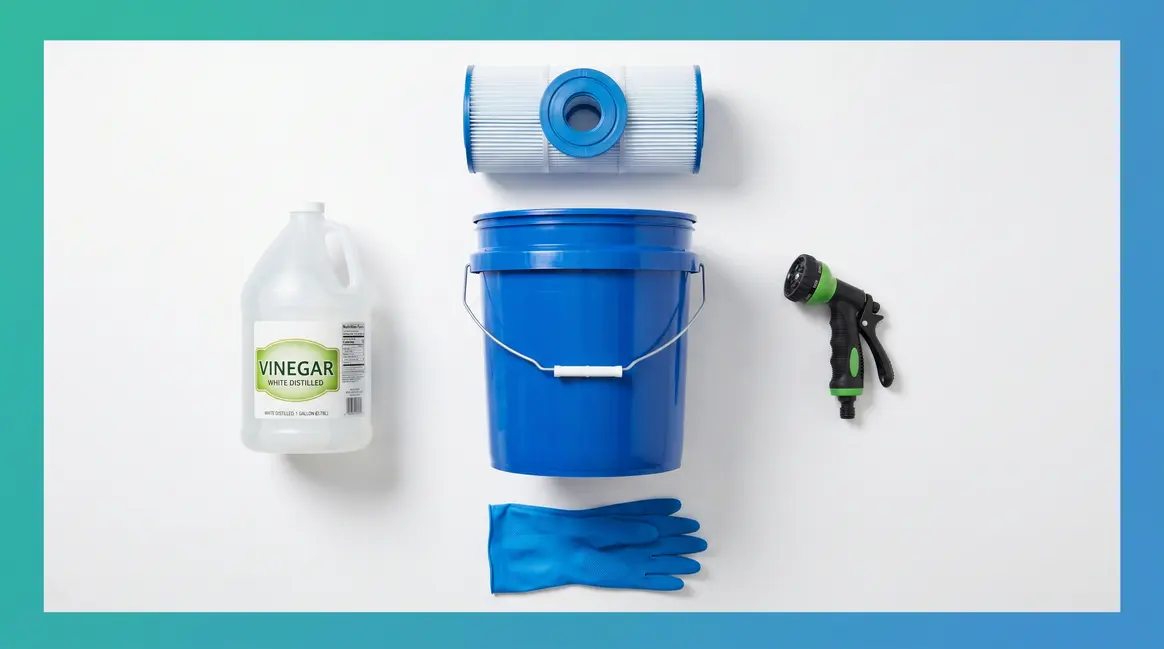
Table of Contents - How to Clean Hot Tub Filter with Vinegar (50/50 Method)
- Hot Tub Filter Basics: The Why and How
- How to Clean Hot Tub Filter with Vinegar
- What You’ll Need Before You Start
- Step 1 — Turn Off Power and Remove
- Step 2 — Rinse Off Loose Debris
- Step 3 — Mix 50/50 Solution and Soak
- Step 4 — Rinse Until Water Runs Clear
- Step 5 — Dry Before Reinstalling
- Step 6 — The Oil-Cutting Follow-Up
- Why Vinegar Works on Mineral Scale
- Manufacturer Warranty Warning
- DIY Hot Tub Filter Cleaners Compared
- Cleaning Inflatable Hot Tub Filters
- Hot Tub Maintenance Hacks
- Frequently Asked Questions
- The Cleanest Filter Costs Under $3
This blog post may contain affiliate links. As an Amazon Associate I earn from qualifying purchases.
Commercial hot tub filter cleaners cost $15–$30 per bottle. A jug of white vinegar costs under $3 — and for removing mineral buildup and calcium scale (the chalky white deposits hard water leaves on your filter), it does the same job. A clogged filter forces your pump to work harder, shortens equipment life, and clouds your water. Most hot tub owners don’t realize the filter is the first thing to blame when their spa isn’t performing.
“Works great but it’s pricey. Is there a DIY method for cleaning my hot tub filter?”
— a common question across hot tub owner communities, and exactly what this guide answers.
By the end of this guide, you’ll know exactly how to clean hot tub filter with vinegar — including the precise 50/50 ratio, a strict 2-hour soak time, and the one follow-up step most guides skip entirely. We’ll also cover which other DIY cleaners work, which ones will ruin your filter, and a few low-effort hacks to keep your filter cleaner between deep soaks.

- VERSATILE PANTRY STAPLE: Perfect for cooking, pickling, marinating, and enhancing your favorite recipes with a crisp, tangy flavor.
- ALL-NATURAL & PURE: Made from 100% distilled white vinegar, free from artificial additives and preservatives for a clean, fresh taste.
- POWERFUL MULTI-PURPOSE CLEANER: A natural, eco-friendly solution for disinfecting, deodorizing, and tackling tough household messes.
- BULK SIZE FOR MORE VALUE: Large 1-gallon jug is perfect for high-volume cooking, canning, and cleaning needs, offering great savings.
- TRUSTED QUALITY FROM IBERIA: A staple in kitchens for generations, Iberia delivers authentic, high-quality ingredients for cooking and beyond.

- SECURE SNAP-ON LIDS – Keep contents protected with included snap-on lids, perfect for food storage, pet food, paint, cleaning supplies, and more.
- DURABLE & HEAVY-DUTY – Built with thick, crack-resistant plastic and reinforced rings for added strength, making it ideal for tough jobs.
- BPA-FREE & FOOD-GRADE – These high-quality food grade buckets with lids ensure safe storage for bulk food, pet supplies, grains, and dry goods.
- ERGONOMIC CARRY HANDLE – Features a sturdy metal handle with a comfortable grip, allowing for easy transport of heavy loads.
- STACKABLE & SPACE-SAVING – The tapered design allows buckets to nest together when not in use, maximizing storage space in garages, basements, and workshops.

- 7 ADJUSTABLE WATERING PATTERNS: Each carefully selected pattern has an unique purpose,and each spray pattern will meet all of your watering needs. To change patterns simply twist the nozzle.Turn the spray nozzle dial to choose appropriate pattern easily with a faucet on the handle.
- PREMIUM MATERIAL: The spray nozzle is made of Sturdy yet Ultra Lightweight ABS+TPR. Easy to grip, slip-resistant and comfortable fit, and the ergonomic rubberized pistol grip for comfortable use.
- FITS ALL STANDARD GARDEN HOSES: Suitable for all standard garden hoses with 3/4” diameter garden hose thread (GHT). Perfect for Watering Your Garden, Lawn, Grass, and Flower Beds. Great for Washing Your Car,Showering Dogs and Pets,Cleaning Your Room, Deck, Floor, Window and Outdoor Fun.
- LABOR-SAVING DESIGN: AUTOMAN garden nozzle features a nice lock bar at the top of the handle that keeps the water remains on without you having to apply any pressure.Just use the lock so you don't have to keep your hand holding it the whole time.
- All Our Products are Produced under Strict Quality Inspection. Your satisfaction is always our top priority. Its wide application makes it an essential item for any homeowner or gardener looking for a reliable and versatile hose nozzle.

- Material: These household cleaning gloves are made of soft and skin-friendly natural rubber, providing protection from corrosive liquids and keeping your hands and clothes dry. Initially, they may have a rubbery smell, but airing them out should eliminate the odor
- Non-Slip Design: The palm and fingers of these kitchen gloves feature granules that increase friction, ensuring a better grip and control. Keeping these gloves in a cool and dry place can extend their lifespan
- Comfortable Fit: The material of the dishwashing gloves is very soft, with a thin layer of planting velvet inside that won't shift when worn, providing excellent comfort and softness. They also absorb moisture and sweat, keeping your hands warm and dry, making them perfect for extended use
- Multi-Purpose: These versatile rubber gloves are suitable for a variety of tasks, including kitchen and bathroom work, pet grooming, household cleaning, home improvement, gardening, car washing, dishwashing, painting, furniture refurbishing, and more
- Packaging: This set includes gloves in four different colors, making them easy to distinguish and suitable for various purposes

- HAND TOWEL RACK: This washcloth standing towel rack serves as an organizer for kitchen countertops. This hand towel holder stand is designed for hanging small kitchen items such as towels and rags, making the dish towel rack easy to keep your dish towels organized and your countertops free from clutter. This standing towel holder is ready to use and requires no installation. The towel rack stand with four drying rods can hold multiple small towels or rags simultaneously for quick and efficient drying. As bathroom accessories, this kitchen towel rack not only provides a convenient place to hang items but also enhances the aesthetic of your living space, making it tidier and more organized
- Z-SHAPED TOWEL RACK KITCHEN: The standing hand towel holder adopts a Z-shaped design, with a rectangular base that increases the contact surface with the countertop, ensuring stability and preventing slipping. The sturdy towel holder for kitchen features simple lines and does not require complicated installation steps. This kitchen towel stand can be used after unfolding, making daily life more convenient. Serving as an ideal bathroom storage solution, towel storage organizer and storage shelf, this towel holder kitchen offers convenience for the towel storage organizer to store towels and small items in the kitchen or around the house, enhancing practicality in daily life
- MULTIRODS DESIGN: Unlike other towel rack wall mounted or over the door towel racks for bathroom, this free standing towel rack features an innovative four-arm design that can hold four towels at the same time, making it easy to access them. There is ample space between each towel bar of the towel drying rack to ensure promoting air circulation and facilitating the quick drying of towels or rags. The unique design of the small towel rack can make reasonable use of space and effectively fulfill the storage and drying needs of kitchen supplies. This towel stand is a bathroom essentials for countertop accessories and apartments bath accessories as a bathroom organizers and storage
- EXQUISITE TOWEL STAND: The unfolded height of this counter hand towel holder is 9.6 in, making it suitable for towels and rags that are less than 18 in in length. Note: Towels or small items that are too long can be folded multiple times and hung on the rv towel rack. Unique 4-arm design of the towel holders, with a spacing of 1.37 in between each pole, provides ample space for air circulation, ensuring fast and effective drying. This dish rag holder features an elegant design that will not occupy extra space on the countertop. The towel rack for kitchen serves as a towels organizer, whether placed on the kitchen countertop, next to the sink, or on the washstand
- FOLDABLE AND SPACE SAVING: Unlike wall towel racks for bathroom, standing towel racks for bathroom and bathroom towel racks for wall, this countertop towel stand is foldable, easy to store, and designed to save space. When folded, the height of this modern towel rack does not exceed 0.75 in. The freestanding towel rack can be conveniently stored in various locations, such as the corner of the kitchen, beside the sink, inside a cabinet, or even in a dishwasher or drawer, without occupying additional space on the kitchen counter. Note: Please pay attention to the rotation direction when opening the towel rack for dorm to ensure that the small towel holder can be easily unfolded for use
You can clean a hot tub filter with vinegar using a 50/50 mix of white vinegar and water — a 2-hour soak dissolves calcium scale and mineral buildup for under $3.
- Vinegar targets mineral scale — but it cannot remove body oils (that’s what The Sequential Clean Method solves with a two-phase approach)
- Never use bleach or dish soap — both cause foaming or irreversible filter damage
- Deep soak every 3–4 months — the Pool & Hot Tub Alliance’s recommended schedule
- Replace filters every 12–15 months — even with regular cleaning, cartridges wear out
- Rinse thoroughly — any vinegar residue left in the pleats can temporarily affect water pH
Hot Tub Filter Basics: The Why and How
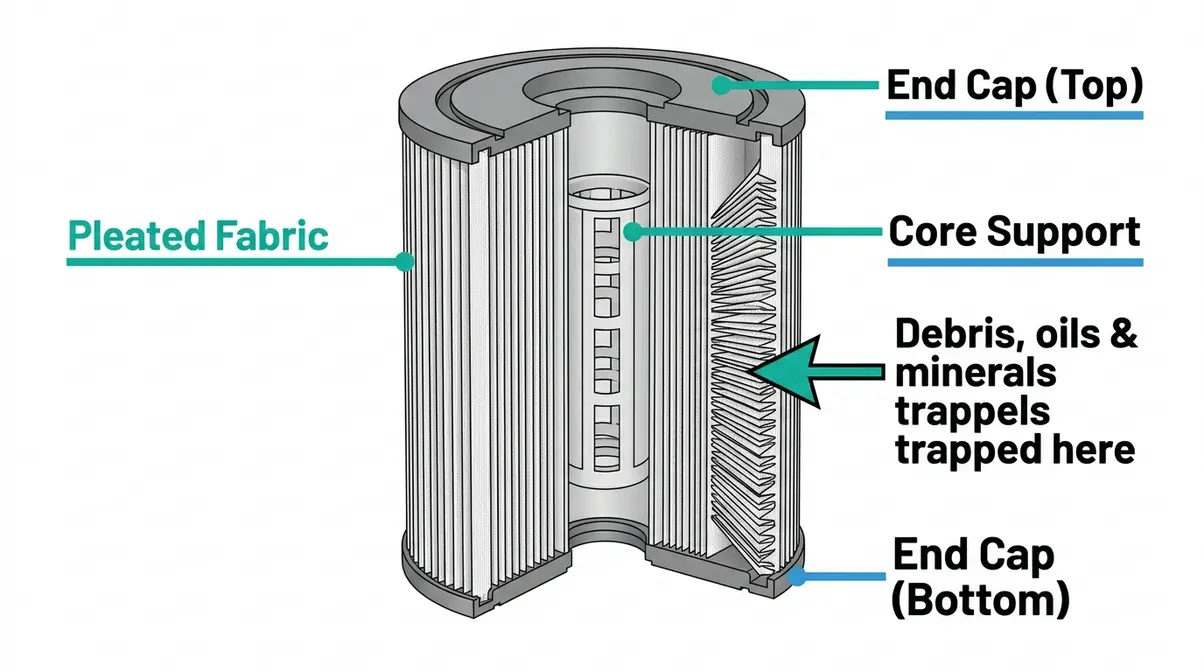
A hot tub filter — specifically a cartridge filter (the cylindrical component that traps debris, oils, and minerals from your hot tub water) — is your spa’s first line of defense against cloudy, bacteria-laden water. Every time you soak, the water passes through thousands of tiny pleated fabric folds. Those folds catch dirt, sunscreen, lotions, sweat, and hard water minerals before the water returns to your tub. Over time, that trapped material builds up into calcium scale (the white, chalky coating caused by hard water minerals), biofilm (a thin bacterial layer that forms on wet surfaces), and oily residue from body products.
Most beginners don’t realize there are three distinct levels of filter maintenance — and confusing them is one of the most common reasons filters wear out early:
- Weekly rinse: A quick spray-down with a garden hose to dislodge loose debris. Takes 5 minutes.
- Monthly spray-down: A more thorough rinse using a filter cleaning wand or strong nozzle setting to flush between the pleats.
- Quarterly deep soak: A full overnight or 2-hour chemical soak to dissolve mineral scale and embedded oils. This is where vinegar — or The Sequential Clean Method — comes in.
“The Pool & Hot Tub Alliance recommends a deep filter soak every 3–4 months and full cartridge replacement every 12–15 months” (PHTA, 2026). Skipping the deep soak doesn’t just reduce filtration efficiency — CDC guidelines on hot tub maintenance note that poor filter maintenance allows biofilm to form, creating conditions for harmful bacteria like Legionella to thrive in hot tub water (CDC, 2026).
When your filter is due for a quarterly deep clean, a vinegar soak is one of the most effective and budget-friendly options available. For a complete breakdown of weekly, monthly, and quarterly filter maintenance, see our comprehensive guide to hot tub filter cleaning.
Now that you know what your filter does, here’s the exact step-by-step process to clean it with vinegar — including the ratio, soak time, and the follow-up step most guides skip.
How to Clean Hot Tub Filter with Vinegar
Knowing how to clean a hot tub filter with vinegar correctly is the difference between a sparkling filter and a foaming disaster. At OneHotTub.com, our team evaluated multiple cleaning methods against manufacturer guidelines and community testing data from hot tub owner forums — and the 6-step process below is the method that consistently produces the cleanest results without risking equipment damage.
What You’ll Need Before You Start
Before you begin, gather everything. Stopping mid-process to hunt for supplies wastes time and can leave your filter partially soaked and exposed to air, which can cause the loosened scale to re-harden.
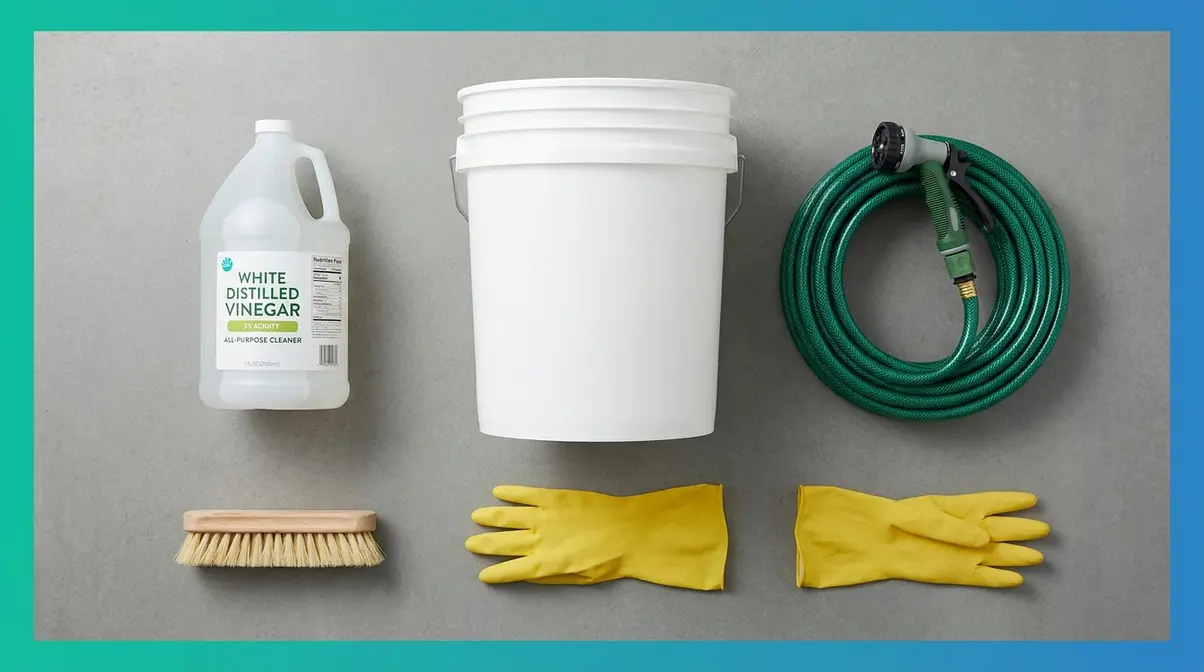
- You’ll need:
- 1 gallon of white distilled vinegar (the common household variety with 5% acetic acid concentration — not apple cider vinegar, which can leave residue)
- 1 gallon of clean water
- A 5-gallon plastic bucket (large enough to fully submerge your filter)
- Rubber gloves (vinegar is mild, but prolonged skin contact can cause irritation)
- A garden hose with a spray nozzle
- A clean towel or drying rack
- Optional: a soft-bristle brush for stubborn scale
Estimated total cost: Under $3 if you already own a bucket and hose. Estimated time: 2.5 hours (mostly hands-off soaking).
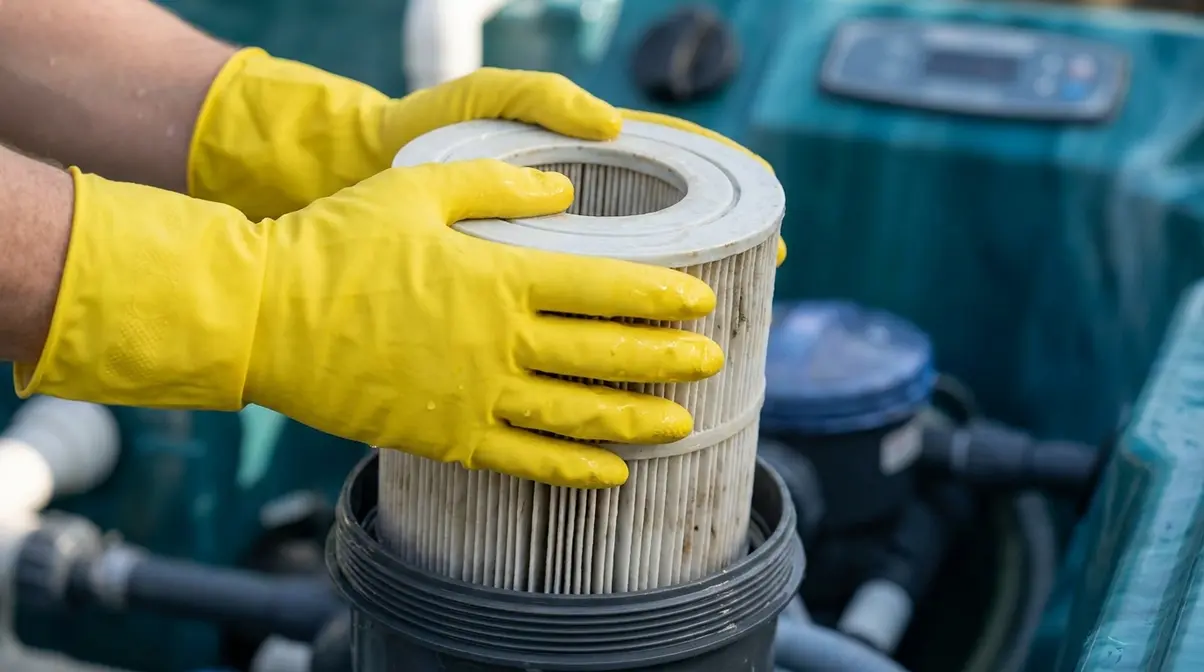
Step 1 — Turn Off Power and Remove
⚠️ Safety Warning: Never remove your filter while the hot tub is running. The pump draws water through the filter housing, and removing it with the power on can damage the pump or, in some older models, create an electrical hazard near water.
- Locate your hot tub’s main power switch or circuit breaker and turn it off completely.
- Wait 60 seconds for the pump to fully stop.
- Open the filter compartment — usually a screw-off cap or a hinged panel near the skimmer basket.
- Grip the filter cartridge and rotate it counterclockwise (on most models) to release it, then lift it straight out.
Why this matters: Starting with the power off protects both you and your equipment. It also gives the filter a chance to drain slightly before you handle it, making the next step less messy.
Step 2 — Rinse Off Loose Debris
Before soaking, remove the surface layer of debris. Soaking a filter caked in leaves, hair, and loose dirt wastes your vinegar solution and reduces its effectiveness on the mineral scale underneath.
- Hold the filter horizontally over a drain or grassy area.
- Use your garden hose on a medium spray setting — not full pressure, which can damage the pleated fabric.
- Work from the top of the filter downward, rotating it slowly as you spray between each pleat fold.
- Continue until the water running off the filter is mostly clear of visible debris.
Why this matters: This pre-rinse is your “Phase Zero” — it clears the surface so the vinegar can reach the mineral scale embedded deeper in the filter fabric. Skipping this step is one of the most common beginner mistakes.
Common mistake: Using a pressure washer here. The high-pressure stream tears the delicate fabric pleats and permanently reduces filtration efficiency. A standard garden hose is all you need.
Step 3 — Mix 50/50 Solution and Soak
This is the core of the vinegar method — and the step where exact ratios matter most.
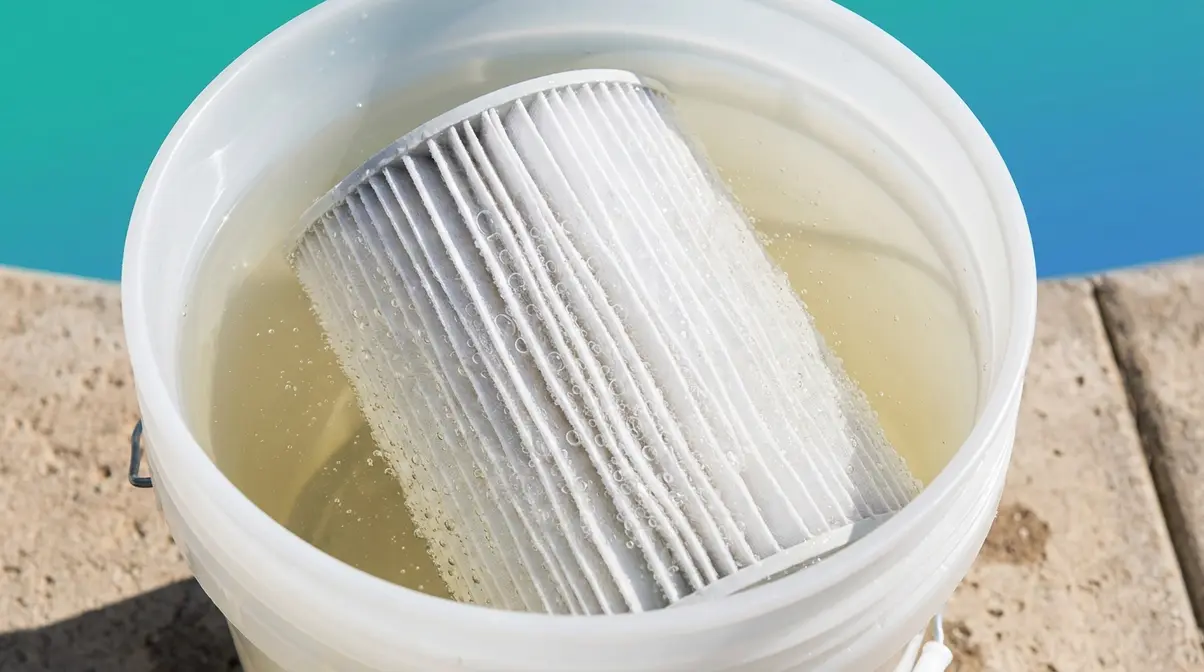
- Pour 1 gallon of white distilled vinegar into your 5-gallon bucket.
- Add 1 gallon of clean, cool water. This creates the 50/50 vinegar-to-water ratio.
- Submerge the filter fully in the solution. If the filter floats, place a heavy object (like a clean rock or a sealed water bottle) on top to keep it submerged.
- Set a timer for 2 hours. Do not soak longer than 4 hours — extended exposure can begin to degrade the filter fabric’s bonding adhesive.
- You may notice gentle fizzing around the filter pleats. This is normal — it’s the acetic acid (the active ingredient in vinegar that dissolves mineral deposits) reacting with calcium carbonate in the scale.
Why this matters: The 50/50 ratio delivers enough acidity to dissolve calcium scale effectively without being so concentrated that it risks damaging the filter fabric. A 2-hour soak gives the acid time to penetrate the pleats fully. Shorter soaks (under 30 minutes) leave most of the embedded scale untouched.
Step 4 — Rinse Until Water Runs Clear
After soaking, the loosened scale and mineral deposits need to be flushed completely out of the filter pleats. Leaving residue behind defeats the purpose of the soak.
- Lift the filter out of the bucket and hold it over a drain.
- Using your garden hose on a medium spray setting, rinse between each pleat fold from top to bottom, rotating the filter as you go.
- Continue rinsing until the water running off the filter is completely clear — no white or yellow tint, no visible particles.
- Give the filter one final full rotation of rinsing after you think you’re done. Vinegar residue left in the pleats can temporarily lower your hot tub’s pH after reinstallation.
Why this matters: Thorough rinsing is the step most beginners rush. A filter that still smells strongly of vinegar hasn’t been rinsed enough. The goal is a filter that smells neutral — like clean fabric.
How do you know you’re done? The rinse water should run completely clear, and the filter should have no vinegar odor when held close to your face.
Step 5 — Dry Before Reinstalling
This step answers a question many beginners have: Can you clean and reuse hot tub filters? Yes — but only if you dry them properly first.
- Shake the filter gently to remove excess water from the pleats.
- Stand it upright on a clean towel or a drying rack in a well-ventilated area.
- Allow it to air dry for a minimum of 1 hour — ideally 2–4 hours, or overnight if your schedule allows.
- Do not reinstall a wet filter. Moisture trapped in the pleats can accelerate biofilm growth and reduce the filter’s effectiveness from day one.
Why this matters: A dry filter reinstalls more easily, seats properly in the housing, and starts its next filtration cycle in the best possible condition. If you’re in a hurry, a clean, dry microfiber towel can speed up surface drying — but the pleats need air time regardless.
Tip: Keep a spare filter cartridge on hand. While one filter dries, you can reinstall the spare and keep your hot tub running. This is a standard recommendation from manufacturers like Jacuzzi’s filter maintenance guidelines.
Step 6 — The Oil-Cutting Follow-Up
Here’s the step that zero other guides explain — and it’s the reason some hot tub owners find that even after a vinegar soak, their water still looks slightly hazy or their filter still smells faintly of body products.
The problem: Vinegar is an acid. It excels at dissolving calcium carbonate (mineral scale). But it cannot break down body oils, sunscreen residue, and lotions — these are non-polar compounds that require a different chemistry to remove. If you only do the vinegar soak, you’ve cleaned half the filter.
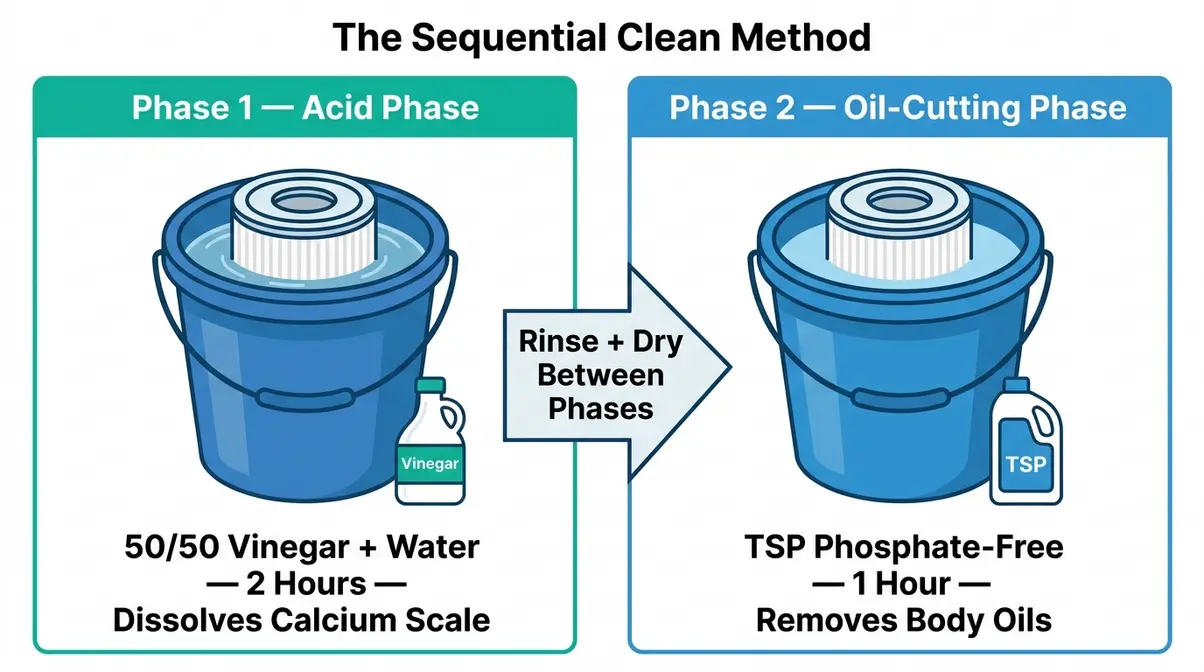
- The Sequential Clean Method is a two-phase approach:
- Phase 1 (Acid Phase): The 50/50 vinegar soak (Steps 1–5 above) — targets calcium scale and mineral deposits.
- Phase 2 (Oil-Cutting Phase): A separate soak using a TSP Phosphate-Free (trisodium phosphate alternative) cleaner or a commercial enzyme-based filter cleaner, following the product’s dilution instructions — targets body oils and organic residue.
- How to execute Phase 2:
- After the filter has dried from Phase 1, prepare a fresh bucket solution using TSP Phosphate-Free cleaner at the manufacturer’s recommended dilution (typically 1–2 tablespoons per gallon of water).
- Soak the filter for 1 hour.
- Rinse thoroughly until the water runs completely clear.
- Dry fully before reinstalling.
Why this matters: Most hot tub owners who complain that “vinegar didn’t work” skipped Phase 2. The vinegar removed the white mineral crust, but the oil-based residue remained embedded in the fabric — continuing to reduce flow and harbor bacteria. The Sequential Clean Method addresses both problems in one session.
How often: Perform both phases together during your quarterly deep clean. The extra 90 minutes pays for itself in extended filter life and cleaner water.
Why Vinegar Works on Mineral Scale
White distilled vinegar works on hot tub filters because of its acetic acid content — typically 5% concentration in standard household vinegar. When acetic acid contacts calcium carbonate (the primary compound in calcium scale), it triggers a chemical reaction that converts the hard, insoluble scale into calcium acetate — a water-soluble compound that rinses away easily. This is the same reaction you see when you pour vinegar on baking soda: the fizzing you observe during the soak is carbon dioxide being released as the scale dissolves.
The EPA’s Safer Choice program recognizes acetic acid as a safer cleaning ingredient compared to many commercial chemical cleaners, making vinegar a lower-risk option for home use (EPA, 2026). However, vinegar’s effectiveness is limited to mineral-based deposits. It has no meaningful impact on oils, surfactants, or organic compounds — which is exactly why Phase 2 of The Sequential Clean Method exists.
One important note: Never mix vinegar with baking soda as a “turbo cleaner.” The two neutralize each other on contact, producing water and carbon dioxide. The result is a solution with no cleaning power at all — and a lot of unnecessary fizzing.
Manufacturer Warranty Warning
Before using any DIY cleaning method, it’s worth knowing where manufacturers stand — especially if your hot tub is under warranty.
Jacuzzi (one of the leading hot tub manufacturers) and Sundance Spas (a major hot tub brand owned by Jacuzzi Holdings) both recommend cleaning filters regularly but advise using manufacturer-approved cleaners as a first choice. Neither brand explicitly voids warranties for vinegar use when the filter is rinsed thoroughly. However, both caution against:
- Bleach or chlorine-based cleaners — these can degrade filter fabric and introduce chemical imbalances
- Dish soap or detergents — these cause severe foaming in hot tub water that can take days to resolve
- Pressure washing — damages pleat fabric permanently
For peace of mind, check your specific model’s owner manual or the Lowes hot tub filter maintenance guide for brand-agnostic guidance. If your hot tub is under active warranty, contacting your manufacturer before switching to DIY methods is always the cautious move.
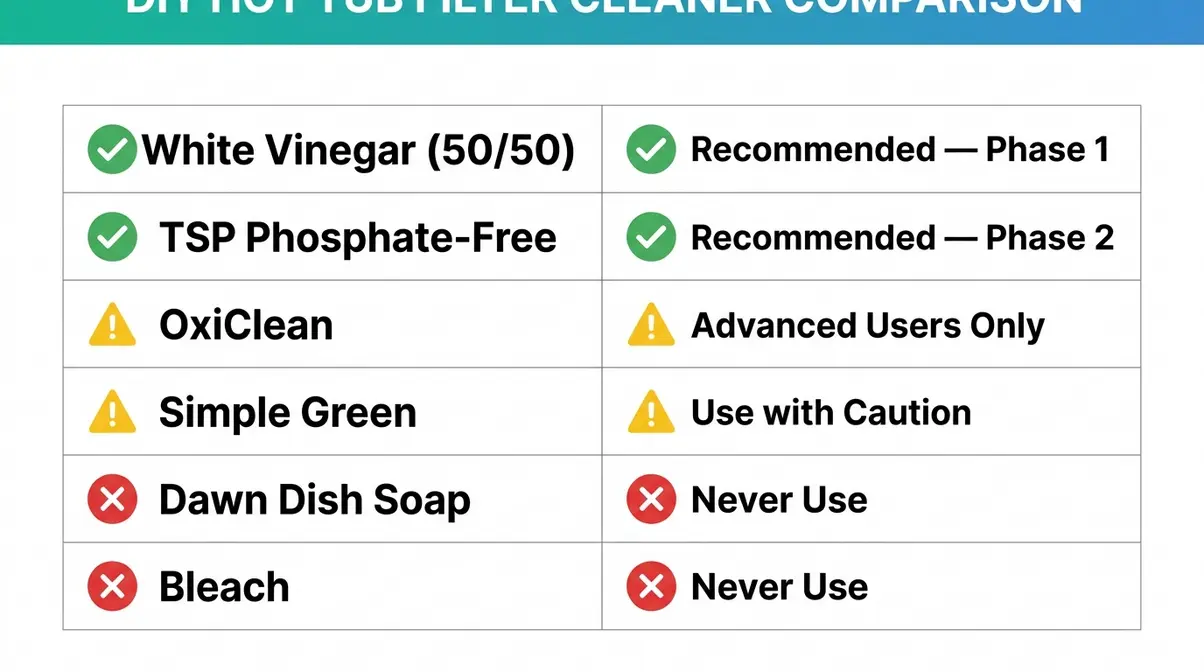
DIY Hot Tub Filter Cleaners Compared
Not every budget cleaning option is a safe one. Our team reviewed manufacturer guidelines, hot tub owner forum data, and product safety documentation to rank the most commonly suggested DIY filter cleaners. Here’s the honest breakdown. For a broader look at commercial and homemade options, check out our guide to hot tub cleaners.
Vinegar — Best for Mineral Scale
White distilled vinegar is the best DIY option for hot tub filters with visible calcium buildup or hard water staining. The 5% acetic acid concentration is strong enough to dissolve mineral deposits but mild enough to avoid damaging filter fabric when used at the 50/50 dilution ratio. It’s non-toxic, widely available, and costs under $3 per deep clean cycle.
Best for: Filters with white or yellow mineral scale, hard water areas, quarterly maintenance soaks.
Not for: Filters heavily coated in body oils or sunscreen residue — use Phase 2 of The Sequential Clean Method for those.
For detailed sourcing on vinegar’s cleaning chemistry, DYC Vinegar’s spa filter cleaning guide provides a solid overview of acetic acid’s effectiveness on mineral deposits (DYC, 2026).
Can you use OxiClean on filters?
OxiClean can clean hot tub filters, but it carries rinsing risks that make it unsuitable for beginners. (OxiClean is a sodium percarbonate-based oxygen bleach cleaner). When dissolved in water, it releases hydrogen peroxide — which oxidizes and breaks down organic compounds. Many hot tub owners in DIY communities report good results with a 1–2 tablespoon per gallon dilution and a 1-hour soak.
However, sodium percarbonate residue left in filter pleats can temporarily spike your hot tub’s pH and alkalinity, making water chemistry difficult to balance. It can also cause foaming if not rinsed completely. Experienced hot tub owners with water chemistry testing kits can use it safely; beginners should stick to vinegar. If you use it, rinse the filter three times longer than you think is necessary.
Bleach — Never Use This
⚠️ Do not use bleach (sodium hypochlorite) to clean your hot tub filter — ever.
Bleach is a powerful oxidizer that will degrade the polyester fabric in your filter cartridge over time, causing it to fray, lose structural integrity, and fail to filter particles effectively. Even a single bleach soak can shorten a filter’s useful life significantly. Beyond the filter damage, any bleach residue that makes it into your hot tub water will throw your sanitizer levels into chaos and can cause skin and eye irritation.
Some guides suggest that because hot tubs already use chlorine, a little bleach should be fine. This logic is flawed — the chlorine in hot tub sanitizers is precisely dosed and buffered. Household bleach is undiluted sodium hypochlorite with no pH buffering, and it behaves very differently in a spa environment.
There is no safe dilution of bleach for hot tub filter cleaning. Use vinegar instead.
Can you use Dawn dish soap?
No — never use Dawn dish soap or any dish detergent on a hot tub filter. Dish soap contains surfactants designed to create foam, and even trace residue left in filter pleats will cause a foam eruption in your hot tub water the moment the jets activate.
Resolving a dish soap foam problem typically requires draining the hot tub completely, rinsing the shell and all plumbing lines, refilling with fresh water, and re-balancing all water chemistry.
That’s a 4–6 hour fix for a 30-second mistake. White vinegar at a 50/50 dilution is the safe, effective alternative that costs under $3 and causes zero foaming.
TSP and Simple Green — Mixed Results
TSP Phosphate-Free (a trisodium phosphate alternative used as a heavy-duty cleaner) is one of the better options for the oil-cutting Phase 2 of The Sequential Clean Method. At low dilutions (1 tablespoon per gallon), it effectively cuts through body oil and lotion residue without the foaming risk of dish soap. It requires thorough rinsing — three full cycles — to prevent any alkaline residue from affecting water chemistry.
Simple Green (an all-purpose cleaner marketed as biodegradable) produces more mixed results in the hot tub community. Some owners report clean filters with no issues; others report mild foaming after reinstallation. The concern is Simple Green’s surfactant content — even “biodegradable” surfactants can cause low-level foaming in spa water if not fully rinsed. It’s a lower-risk option than Dawn, but not as clean a choice as TSP Phosphate-Free or a dedicated enzyme-based filter cleaner.
Summary table:
| Cleaner | Best For | Risk Level | Recommended? |
|---|---|---|---|
| White Vinegar (50/50) | Mineral scale, calcium buildup | Low | ✅ Yes — Phase 1 |
| TSP Phosphate-Free | Body oils, organic residue | Low-Medium | ✅ Yes — Phase 2 |
| OxiClean | Organic staining | Medium | ⚠️ Advanced users only |
| Simple Green | General cleaning | Medium | ⚠️ Use with caution |
| Dawn / Dish Soap | Nothing — avoid entirely | Very High | ❌ Never |
| Bleach | Nothing — avoid entirely | Extreme | ❌ Never |
Cleaning Inflatable Hot Tub Filters
Inflatable hot tubs — including popular brands like Lay-Z-Spa (by Bestway) and Coleman SaluSpa — use smaller, cartridge-style filters that are fundamentally similar to those in hard-shell spas. The good news: the vinegar method works on these filters too, with a few important adjustments.
Key differences for inflatable hot tub filters:
- Smaller cartridges: Most inflatable hot tub filters are 2–4 inches in diameter and 4–6 inches tall — much smaller than hard-shell spa filters. Use a smaller container for soaking (a large pitcher or 1-gallon bucket works well).
- More frequent replacement: Inflatable hot tub filters are thinner and wear out faster. Lay-Z-Spa’s own guidelines recommend inspecting filters weekly and replacing them every 2–4 weeks under regular use — far more frequently than hard-shell spa filters.
- Lower pressure tolerance: The pleated fabric in inflatable hot tub filters is generally thinner. Use the gentlest spray setting on your hose and avoid any scrubbing.
The 50/50 vinegar soak and 2-hour soak time apply equally to inflatable filters. The Sequential Clean Method’s oil-cutting Phase 2 is also recommended, especially if multiple people use the inflatable tub regularly.
One important note: inflatable hot tub filters are inexpensive (typically $5–$15 for a multi-pack), so replacement is often more practical than deep cleaning for heavily soiled cartridges. If a filter looks gray, permanently discolored, or has frayed fabric after cleaning, replace it.
For a full step-by-step guide specific to inflatable spa maintenance, see our detailed Lay-Z-Spa filter cleaning guide.
Hot Tub Maintenance Hacks
Beyond the vinegar method, a few simple habits can dramatically reduce how often your filter needs a deep clean — and keep your water cleaner between sessions. Avoiding these issues is crucial; learn more in our guide on hot tub maintenance common mistakes and how to avoid them.
Why put a tennis ball in a hot tub?
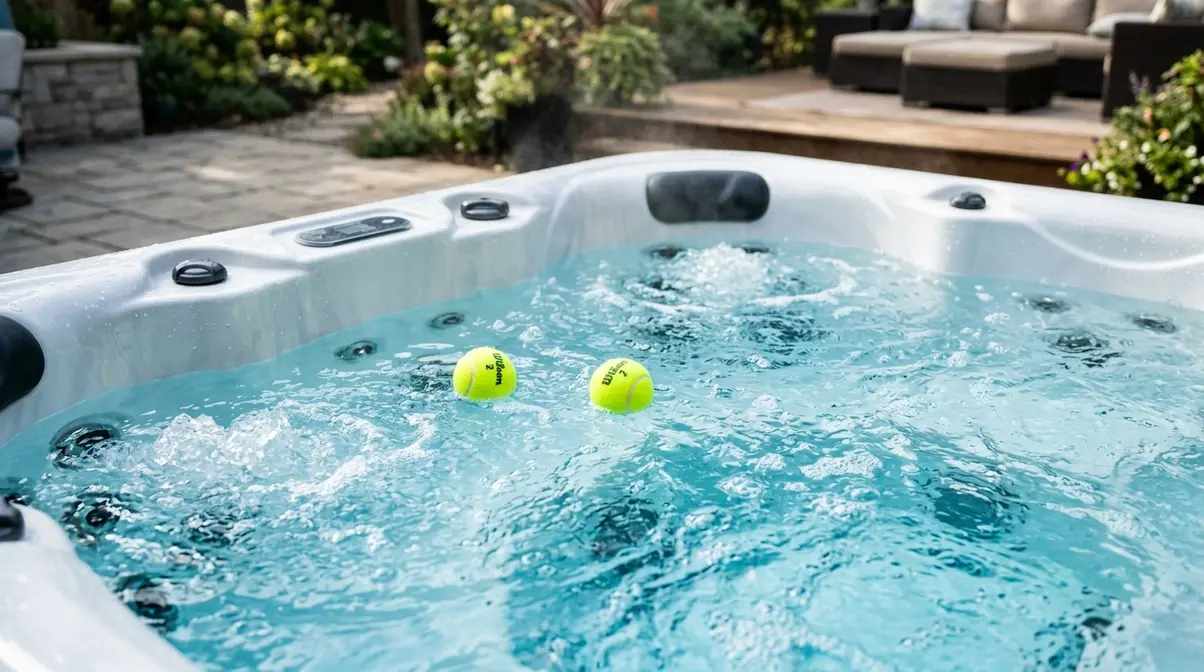
Tennis balls absorb body oils, sunscreen, and lotion residue from hot tub water before those oils reach and clog your filter. The tennis ball trick is one of the most widely shared hot tub maintenance tips in owner communities — and it actually works.
Tennis balls are covered in a dense felt-like fabric made of nylon and wool fibers. These fibers are naturally hydrophobic (water-repelling) and have a strong affinity for non-polar compounds — which is exactly what body oils, sunscreen, hair products, and lotions are. Floating 1–2 tennis balls passively captures surface oils before they embed into your filter.
- How to use it:
- Drop 1–2 clean, unused tennis balls into your hot tub water.
- Leave them floating during and after each soak session.
- Replace them every 4–6 weeks, or when they feel slimy or heavy with absorbed oil.
Hot tub owners who use this trick consistently report needing fewer deep filter cleans — extending time between quarterly soaks for lower-usage tubs. One caveat: Tennis balls can occasionally release trace amounts of dye in very hot water (above 104°F / 40°C). Use white or light-colored tennis balls to minimize any potential discoloration risk.
Other Hacks to Keep Filters Clean
Small habits between deep cleans make a measurable difference in how quickly your filter loads up with debris and oils:
- Shower before soaking. Rinsing off sunscreen, lotion, and sweat before entering the hot tub is the single most effective way to reduce filter load. Even a 60-second rinse makes a difference.
- Keep a spray bottle of diluted vinegar near the tub. A quick spritz on the filter during your weekly rinse helps prevent calcium scale from hardening between deep soaks.
- Check and balance your water chemistry weekly. Proper pH (7.2–7.8) and alkalinity (80–120 ppm) reduce the rate at which calcium precipitates out of solution and onto your filter.
- Rotate two filters. Keep a clean spare filter on hand. Swap them out monthly, deep clean the dirty one, and let it dry fully before the next rotation. This approach, recommended in Lowes’ hot tub maintenance resources, effectively doubles your filter’s working lifespan.
- Use a floating scum absorber. Products like oil-absorbing sponges (sold specifically for spas) work on the same principle as the tennis ball trick but are designed for spa temperatures and chemistry.
Frequently Asked Questions
Best thing to clean filters with?
White distilled vinegar is the best DIY option for cleaning hot tub filters with mineral scale or calcium buildup. A 50/50 mix of white vinegar and water, soaked for 2 hours, dissolves calcium carbonate deposits effectively. For filters also coated in body oils, a two-phase approach — vinegar first, then a TSP Phosphate-Free soak — covers both problem types. Commercial enzyme-based cleaners are the best non-DIY option for heavy organic buildup (PHTA, 2026).
How to get filters white again?
A 50/50 vinegar soak restores whiteness to filters stained by calcium scale and mineral deposits. Submerge the filter for 2 hours, then rinse thoroughly until the water runs clear. For yellowing caused by body oils or tannins, a follow-up soak in a TSP Phosphate-Free solution targets the organic residue vinegar can’t remove. Filters that remain gray or permanently discolored after cleaning have reached the end of their service life and should be replaced.
Can you clean and reuse filters?
Yes — hot tub filters are designed to be cleaned and reused multiple times before replacement is necessary. A properly maintained cartridge filter can last 12–15 months with quarterly deep soaks, monthly spray-downs, and weekly rinses (PHTA, 2026). The key requirement for reuse is complete drying before reinstallation — a wet filter reinstalled immediately can accelerate biofilm growth. Replace the filter when you notice frayed fabric, permanent gray discoloration, or reduced water flow that persists after cleaning.
The Cleanest Filter Costs Under $3
A dirty hot tub filter doesn’t require a $25 bottle of commercial cleaner. For most mineral scale and calcium buildup problems, white distilled vinegar at a 50/50 ratio — soaked for 2 hours and rinsed thoroughly — delivers a genuinely clean filter at a fraction of the cost. The Sequential Clean Method takes it one step further by pairing the acid-phase vinegar soak with an oil-cutting Phase 2, solving the problem vinegar alone can’t fix: the body oils and lotions embedded deeper in the filter fabric. Together, both phases give you a complete deep clean that most commercial products only partially achieve.
The method works because it matches the right chemistry to the right problem. Acetic acid in vinegar dissolves calcium carbonate. TSP Phosphate-Free cuts through non-polar oil compounds. Neither step alone is complete — but together, they cover everything your filter accumulates between soaks.
Now that you know how to clean hot tub filter with vinegar, your next step is simple: pick up a gallon of white vinegar on your next grocery run, set aside a Saturday morning, and run your filter through both phases of The Sequential Clean Method. For ongoing maintenance, combine it with the tennis ball trick and a weekly rinse schedule — and your filter will last its full 12–15 month lifespan without a single expensive commercial cleaner. OneHotTub.com recommends bookmarking this guide and scheduling your next quarterly deep clean in your calendar today.