What’s in this guide
Home ›Hot Tub Water Management
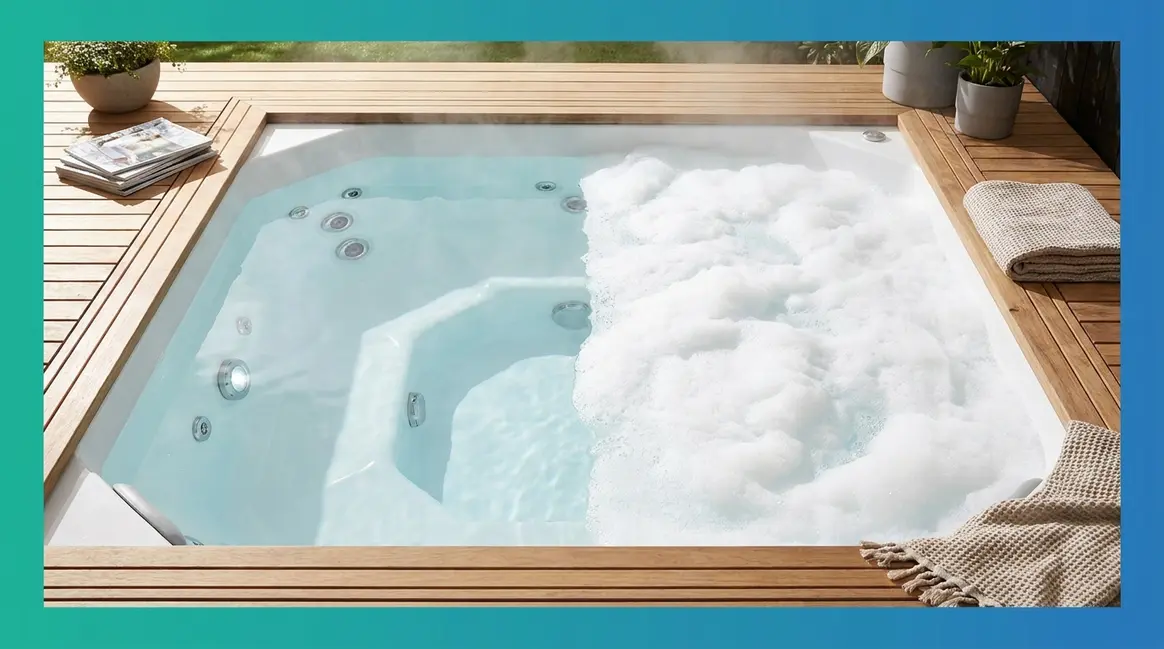
Your test strips read perfectly. pH looks great, sanitizer is in range, alkalinity is right where it should be. And yet, the moment the jets kick on, your hot tub fills with foam like a bubble bath gone wrong.
“Test strips look great so now what? Defoamer chemical?”
— A common frustration among hot tub owners online
Here’s the problem with reaching straight for a defoamer: it only hides the foam. It doesn’t touch the underlying contamination causing it, which is exactly why the foam keeps coming back two days later. Understanding the real hot tub foam causes and fix strategies — matched to your specific situation — is the only way to actually solve this.
If you are searching for a reliable hot tub foam causes and fix tutorial, this guide walks you through the root causes of foamy water, then introduces The Foam Ladder, a 3-level fix framework that matches the right solution to the severity of your problem. You’ll move from a quick cosmetic fix all the way to a deep-clean drain and line flush — so you can stop wasting money on band-aids and get back to clear, comfortable water.
When looking for a permanent hot tub foam causes and fix solution, remember that hot tub foam is caused by surfactants — compounds from body oils, lotions, and laundry detergent — that lower water’s surface tension and trap air when jets agitate the water. The fix depends on severity.
- The Foam Ladder: Match your fix to foam severity — Level 1 Quick Fix, Level 2 Chemistry Fix, or Level 3 Deep Clean
- Defoamers are temporary: They suppress foam but don’t remove the contaminants causing it
- Biofilm is the hidden culprit: Recurring foam often comes from organic buildup inside your plumbing lines
- Shocking works: Oxidizing shock breaks down organic contaminants and helps eliminate foam permanently
- Drain every 3–4 months: The Pool & Hot Tub Alliance recommends this schedule to manage Total Dissolved Solids (TDS)
Why Your Hot Tub Is Foaming: The Root Causes
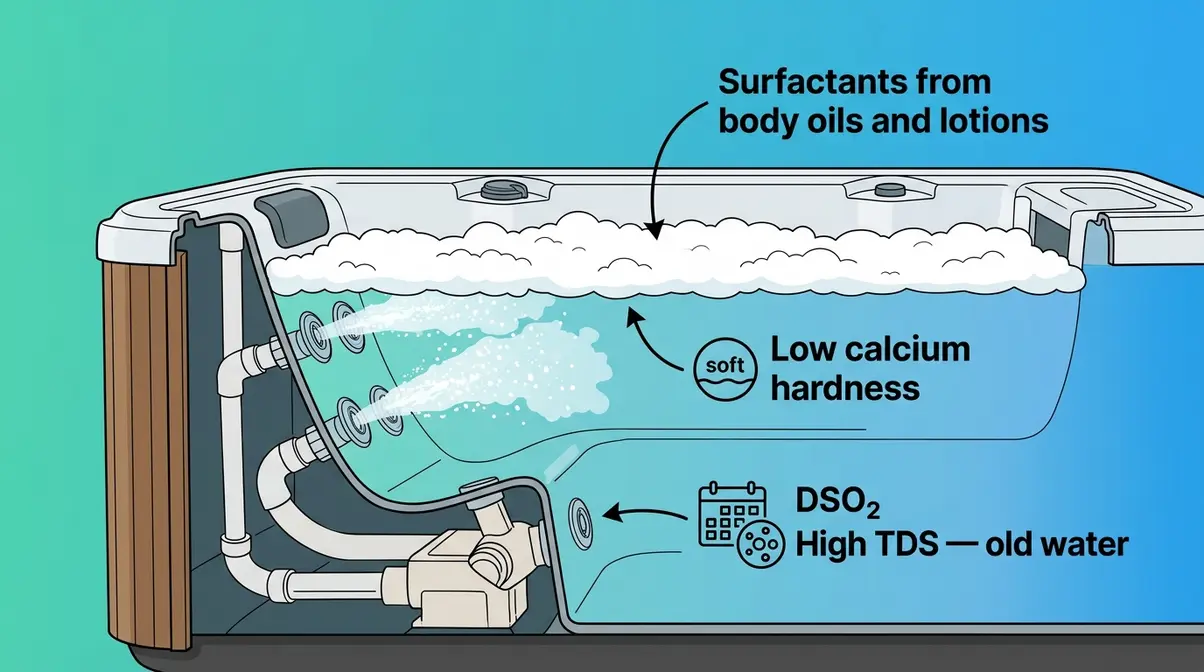
Foam forms when surfactants in your water lower its surface tension, allowing the jets to trap air into stable, long-lasting bubbles. How surfactants lower water’s surface tension is well-documented by the USGS: these compounds essentially weaken the molecular bonds that normally let water release air quickly. The critical detail most guides miss is that test strips don’t measure surfactant levels at all — which is why your chemistry can look perfect while foam continues to build every time the jets run.
“Surfactants from body oils and personal care products lower water’s surface tension, allowing hot tub jets to trap air and create persistent foam that test strips cannot detect.” (USGS Water Science; the physics of how jets create foam, Scientific American)
Understanding which of three root causes is driving your foam tells you exactly which level of The Foam Ladder you need. The Foam Ladder is a 3-level fix framework — Level 1: Quick Fix, Level 2: Chemistry Fix, Level 3: Deep Clean — designed so you apply only as much effort as the problem actually demands. Identify your cause first, then climb only as high as necessary.
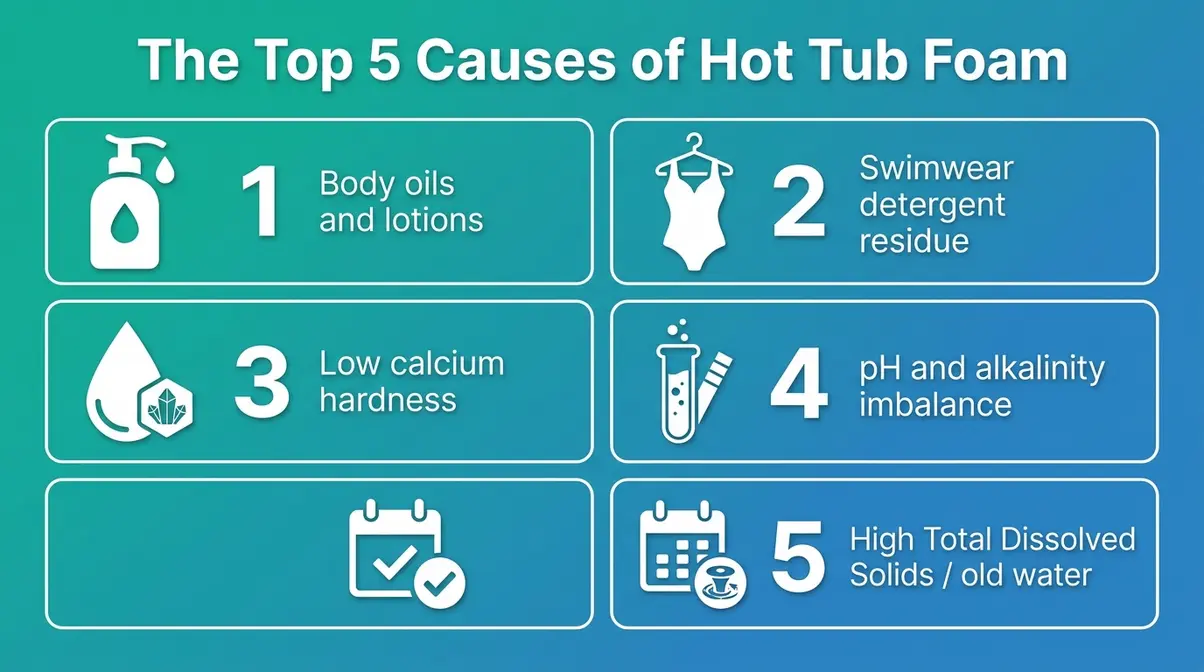
Here are the three main causes to diagnose:
- Surfactants from personal care products and swimwear
- Chemical imbalances — particularly low calcium hardness or out-of-range pH
- Old, over-saturated water with high Total Dissolved Solids (TDS)
You can explore a broader breakdown of causes of hot tub foam to cross-reference your situation, but the three categories below cover the vast majority of cases.
Surfactants: The Main Culprit
Surfactants — chemical compounds from personal care products that lower water’s surface tension — are the single most common cause of hot tub foam. Every person who soaks introduces them: body lotion, sunscreen, shampoo, deodorant, and cosmetics all shed surfactant residue into the water. Even people who shower before soaking often apply lotion or deodorant afterward, or forget that their hair products wash off in the water.
Swimwear is a less-obvious but significant source. Even a freshly laundered swimsuit retains traces of laundry detergent — a concentrated surfactant — in its fabric fibers. Rinsing swimwear in plain water before each use removes most of this residue and is one of the easiest prevention steps you can take.
The mechanism works like this: the jets introduce air into the water constantly. In clean, surface-tension-normal water, those air bubbles pop quickly and dissipate. In surfactant-laden water, the bubbles hold their shape and pile up into persistent foam instead.
The most useful diagnostic clue: if your foam appears the moment the jets kick on but largely dissipates when you turn them off, surfactants are almost certainly the primary cause. Foam that persists even without jets running points toward a chemistry imbalance or high TDS instead.
But surfactants aren’t the only trigger — the chemistry of your water itself can make foam formation far worse.
Chemical Imbalances That Make Foam Worse
Even if surfactant levels are manageable, certain water chemistry conditions amplify foam dramatically. The most significant is low calcium hardness. When water is “soft” — calcium hardness below 150 ppm — it becomes chemically aggressive and more easily whipped into foam by jet agitation. The ideal range is 150–250 ppm. Hard water, counterintuitively, is more resistant to foaming.
pH and total alkalinity out of range compound the problem. High or low pH destabilizes the water and reduces sanitizer effectiveness, allowing organic matter (bather waste, oils, dead skin cells) to accumulate unchecked. That organic matter feeds foam formation over time.
One cause competitors rarely mention: cheap or low-quality spa chemicals. Some budget chemical products contain fillers and binders that act as surfactants themselves. If you recently switched to a less expensive brand and noticed more foam, the chemicals themselves may be the culprit — even in a tub with no bathers. Switching to a reputable brand like FROG Products or sourcing from a dedicated pool supply specialist can resolve this without any other changes.
| Parameter | Ideal Range |
|---|---|
| pH | 7.4–7.6 |
| Total Alkalinity | 80–120 ppm |
| Calcium Hardness | 150–250 ppm |
| Sanitizer (Chlorine) | 3–5 ppm |
Even if your chemistry is perfect, there’s one more cause that no amount of chemical balancing can fix: old, over-saturated water.
Old Water and High TDS Levels
Total Dissolved Solids (TDS) refers to the cumulative measure of everything dissolved in your water — minerals, chemicals, bather waste, and organic matter. Every time someone soaks, every time you add chemicals, and every time water evaporates and you top off the tub, TDS climbs. Unlike surfactants or chemistry imbalances, TDS cannot be corrected by adding anything to the water. It only goes one direction: up.
As TDS rises above 1,500–2,000 ppm, the water becomes chemically saturated and unstable. Foam becomes a persistent symptom of this saturation. Shocking and balancing may suppress it temporarily, but the foam returns because the water itself is exhausted.
The industry standards for managing Total Dissolved Solids set by the Pool & Hot Tub Alliance recommend draining and refilling a hot tub completely every 3–4 months to keep TDS under control and prevent persistent water issues like foaming. If your water is older than four months and foam keeps coming back despite chemical corrections, high TDS is very likely your answer — and the only fix is a full drain.
Now that you know what’s causing your foam, use The Foam Ladder to find the right fix. Start with Level 1 — the quick fix — and only move to the next level if the foam returns.
Preparation: Time and Materials
Before climbing The Foam Ladder, gather your supplies and set expectations for the process.
Estimated Time: 15 minutes for a quick fix; 2–4 hours for a deep clean and refill.
- Tools and Materials Needed:
- Spa defoamer
- Liquid test kit or test strips
- pH and alkalinity adjusters
- Hot tub shock (non-chlorine MPS or chlorine)
- Line flush product (plumbing purge)
- Submersible pump or garden hose
- Spa surface cleaner and soft cloth
Step 1: The Quick Fix
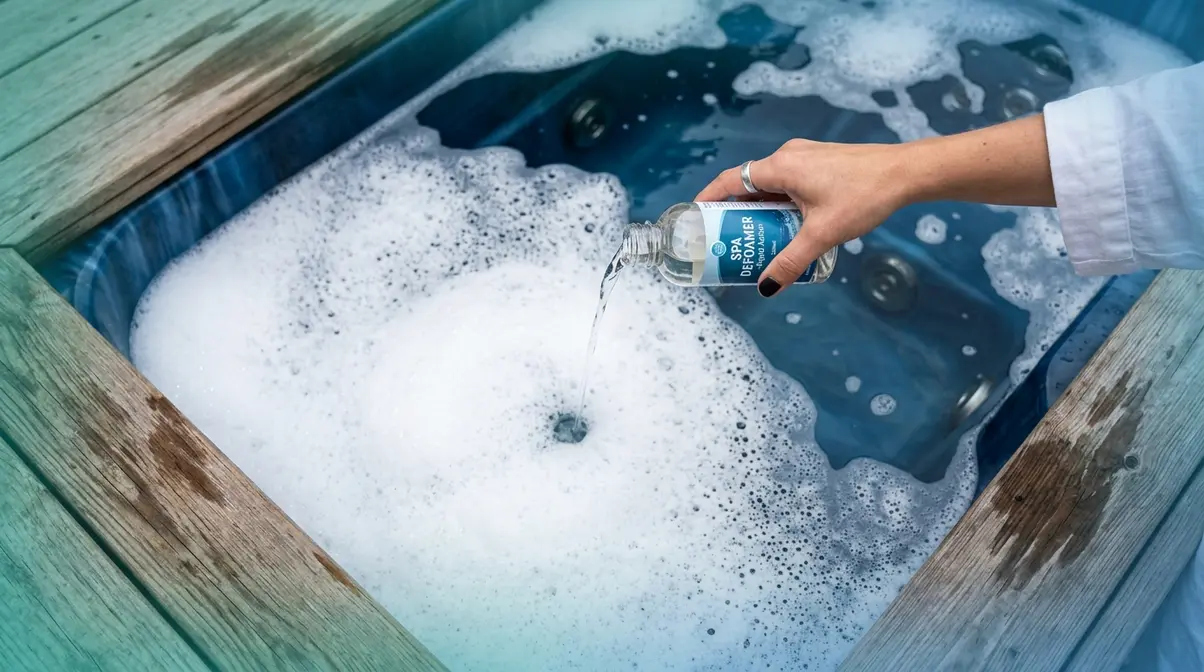
If you need foam gone in the next 30 minutes — guests are arriving, or you just want a soak tonight — a spa defoamer is your answer. It suppresses foam within minutes. What it does not do is fix the water. This is Level 1 of The Foam Ladder: a time-buyer, not a solution. If foam returns within 24–48 hours of applying a defoamer, move directly to Level 2.
“A spa defoamer breaks surface tension to suppress foam within minutes, but it does not remove the surfactants causing it — expect foam to return within 24–48 hours without a deeper fix.”
How to Apply a Spa Defoamer
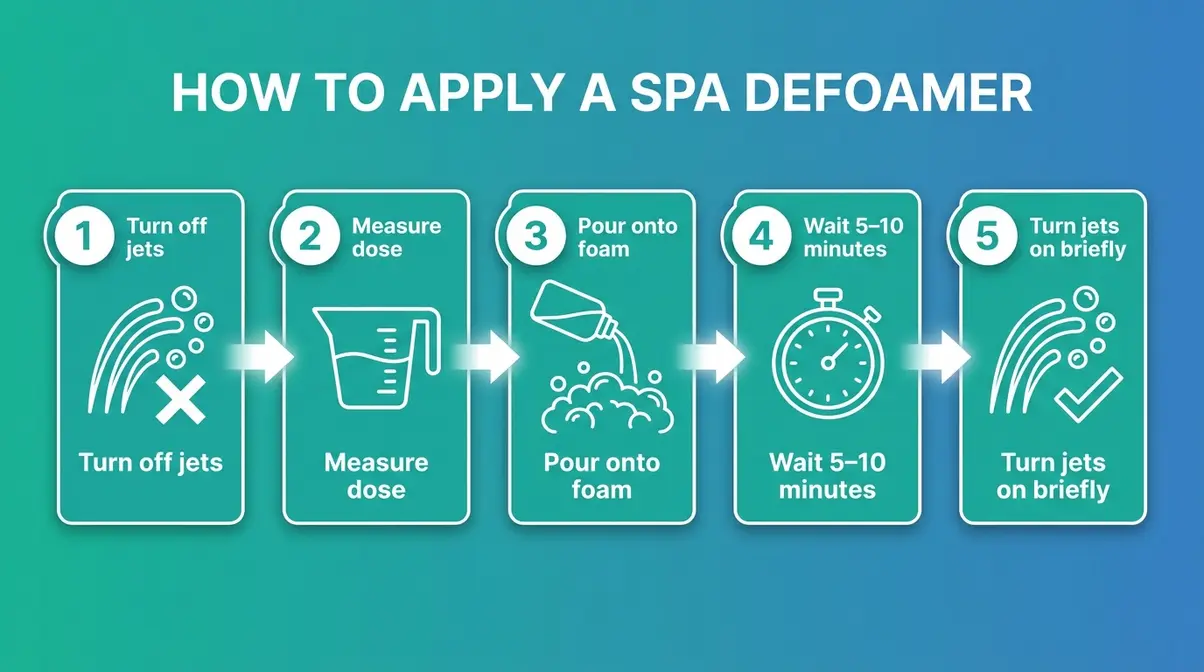
A spa defoamer — a chemical product that breaks surface tension to temporarily eliminate foam — works best when applied correctly. Follow these steps:
- Turn off the jets completely. Applying defoamer with jets running disperses it unevenly before it can work, wasting the dose.
- Measure your dose per the product label. Typically 1–2 oz per 250–500 gallons. Do not overdose — excess defoamer can cloud the water or leave its own residue.
- Pour the defoamer directly onto the foam, not into the water stream. Direct contact with the foam surface is what breaks it down.
- Wait 5–10 minutes. The foam should collapse visibly within a few minutes of application.
- Turn the jets on briefly to circulate, then check. If foam returns immediately or within a few hours, proceed to Level 2 of The Foam Ladder.
Common Mistake: Never add defoamer while the jets are running. The agitation disperses the product before it can concentrate on the foam surface — you’ll use twice as much and get half the result.
A defoamer clears the surface — but the water still contains everything that caused the foam in the first place.
What stops a hot tub from foaming?
A spa defoamer is the fastest product to stop hot tub foam — it collapses existing foam within minutes by breaking surface tension. Apply it directly onto the foam with jets off, wait 5–10 minutes, then restart the jets. However, a defoamer is a temporary measure only; foam will return within 24–48 hours if the underlying cause (surfactants, chemistry imbalance, or high TDS) isn’t addressed. For a more lasting fix, shock the water to oxidize organic contaminants, then rebalance your chemistry. If foam persists, a full drain and line flush is necessary.
Why Defoamers Are Temporary
Defoamers work by chemically breaking the surface tension of existing bubbles. They do not remove surfactants, organic matter, bather waste, or chemical imbalances from the water. Once the defoamer dissipates — typically within hours to a day or two — the remaining contaminants reassert themselves, and foam returns the next time the jets run.
Think of a defoamer like blotting oil off a pizza with a napkin. The slice looks cleaner, but the oil is still in the dough. The only way to actually fix foamy water is to address what’s in the water itself — which is what Levels 2 and 3 of The Foam Ladder are designed to do.
Step 2: The Chemistry Fix
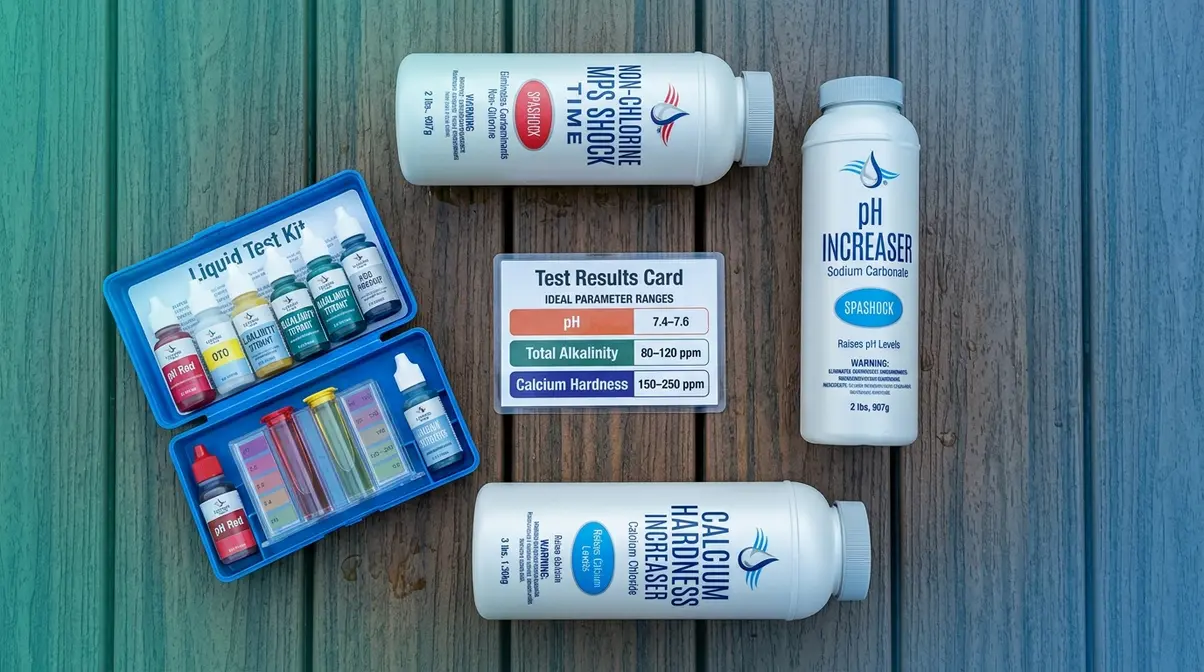
Level 2 of The Foam Ladder targets the chemical root causes: imbalanced water parameters and organic contaminant load. This step works best when your water is less than 3–4 months old and you haven’t yet tried a full drain. User consensus across hot tub communities indicates that a proper shock treatment combined with chemistry correction resolves foam in the majority of cases that don’t involve old water or biofilm.
Test and Balance Your Water Chemistry
Before adding anything to your water, get an accurate picture of where your chemistry stands. Mastering your hot tub water chemistry is essential. Basic test strips give a rough read, but a liquid test kit or a drop-off test at a local pool supply store gives you the precision you need for this step. When evaluating hot tub foam causes and fix methods, testing chemistry is vital.
Check and correct in this order:
- pH first — bring it into the 7.4–7.6 range using pH increaser or decreaser. pH out of range makes every other correction less effective.
- Total alkalinity second — target 80–120 ppm. Alkalinity buffers your pH and keeps it stable.
- Calcium hardness third — if you’re below 150 ppm, add calcium hardness increaser to bring it up to 150–250 ppm. Soft water foams more aggressively, so this step alone can produce a noticeable improvement.
Water quality standards for residential hot tubs from NSF International provide the benchmarks used by pool professionals for these parameters — the ranges above reflect industry consensus.
Common Mistake: Correcting all parameters at once can cause a chemical interaction that clouds the water. Space additions 20–30 minutes apart, running the jets between each addition to circulate fully.
Will shocking a hot tub get rid of foam?
Shocking a hot tub can significantly reduce or eliminate foam when the cause is organic contamination — body oils, bather waste, and cosmetic residue. An oxidizing shock (non-chlorine MPS or a chlorine shock dose to 10 ppm) breaks down the organic matter that surfactants cling to, reducing their concentration in the water. According to FROG Products, shock is most effective when applied after balancing water chemistry first. However, shocking won’t fix foam caused by high TDS or biofilm in the plumbing lines — those require a drain and line flush.
Shock to Oxidize Contaminants
Shocking a hot tub — adding an oxidizing agent (typically non-chlorine MPS shock or a chlorine shock dose of 10 ppm) — breaks down the organic contaminants that surfactants cling to: body oils, skin cells, cosmetic residue, and bather waste. This is the step that actually reduces the surfactant load in the water, rather than just masking it. For more details on the process, read our guide on shocking your hot tub.
Steps to shock correctly:
- Remove the cover and run the jets on low to circulate.
- Add the shock dose per the product label (non-chlorine MPS shock: typically 2 oz per 250 gallons; chlorine shock: enough to reach 10 ppm).
- Leave the cover off for 20–30 minutes to allow off-gassing.
- Run the jets on high for 15–20 minutes to circulate the oxidizer throughout the plumbing.
- Leave the cover off for a minimum of 1 hour before retesting.
According to FROG Products’ guidance on foamy hot tub water, shocking is most effective when water chemistry is balanced first — shocking into unbalanced water reduces the oxidizer’s efficiency significantly.
Common Mistake: Shocking with the cover on traps chlorine gas and prevents proper off-gassing. Always leave the cover off during and immediately after shocking.
Adjust Calcium and Alkalinity
If your test results showed low calcium hardness (below 150 ppm) or out-of-range alkalinity, correct these after shocking — not before. Shocking in soft water is less effective, but adding calcium hardness before shock can cause cloudiness.
- To raise calcium hardness: Use a dedicated calcium hardness increaser. Add in small increments (1 oz per 250 gallons), circulate for 30 minutes, and retest before adding more.
- To raise total alkalinity: Use sodium bicarbonate (baking soda — note this is different from using it as a defoamer, which we address in the myths section). Target 80–120 ppm.
- To lower total alkalinity: Use a pH decreaser (sodium bisulfate) in small doses.
Retest after each correction and allow 30 minutes of circulation between adjustments. Once chemistry is balanced and shock has circulated, wait 24 hours and check for foam. If foam returns, proceed to Level 3.
Step 3: Drain, Flush, and Deep Clean
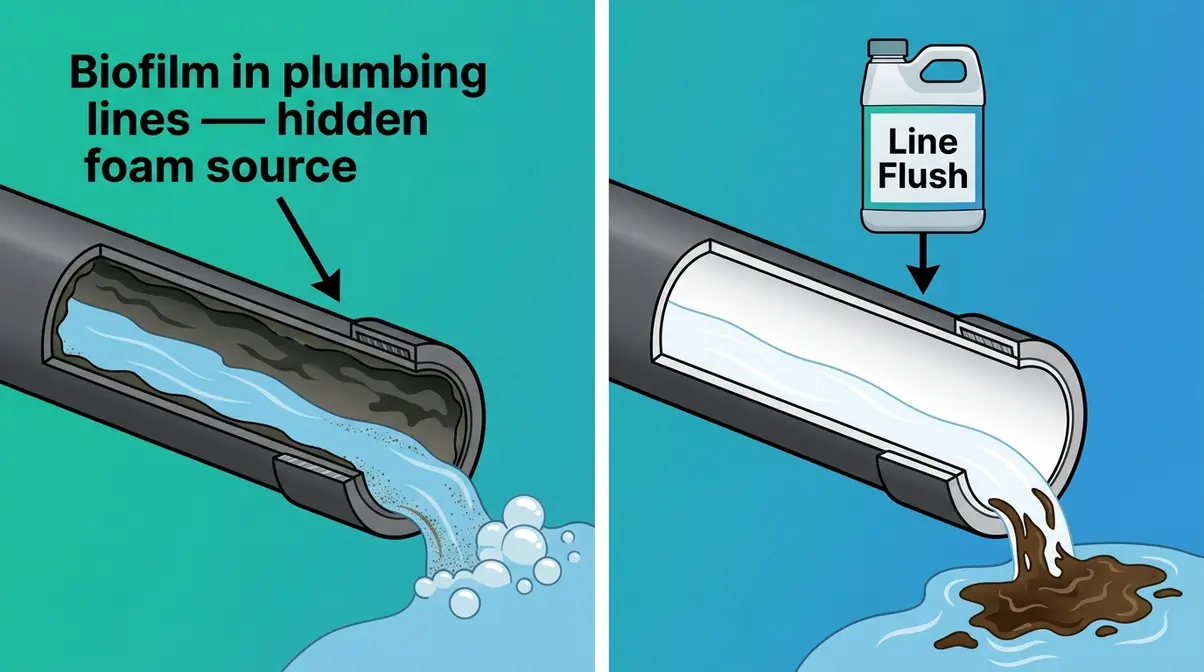
Level 3 of The Foam Ladder is for recurring foam that chemistry corrections can’t solve — typically caused by high TDS (water older than 3–4 months), heavy organic contamination, or biofilm growing inside your plumbing lines. Our team evaluated this approach against chemistry-only corrections and found that recurring foam cases almost universally resolve after a complete drain, line flush, and refill. The steps below are more involved, but they address causes that no chemical treatment can reach.
Drain Your Hot Tub Completely
A full drain removes the accumulated TDS, surfactants, and dissolved organic matter that have built up over months of use. There’s no shortcut here — partial water changes reduce TDS by a fraction, not enough to matter when the water is truly saturated. If you need a step-by-step walkthrough, check out our guide on draining your hot tub.
Steps to drain:
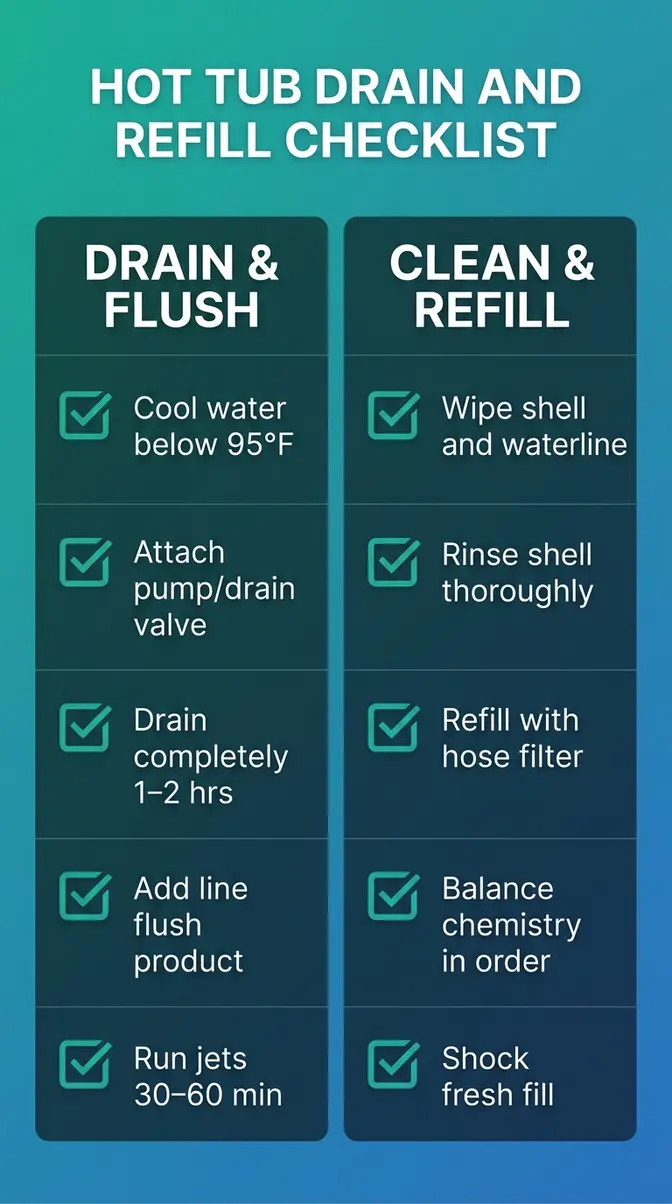
- Turn off the heater and let the water cool to below 95°F to avoid thermal shock to the shell and equipment.
- Attach a submersible pump or garden hose to the drain valve (most hot tubs have one near the base).
- Open the drain valve and let the tub empty completely — typically 1–2 hours depending on tub size.
- Once drained, use a spa surface cleaner and a soft cloth to wipe down the shell, jets, and waterline. The waterline often carries a visible ring of organic matter and oils.
- Rinse the shell thoroughly with clean water before refilling.
Flush Lines to Remove Biofilm
This is the step that all competing guides skip — and it’s the reason foam keeps returning for many hot tub owners even after a full drain and refill. This reset is a critical part of deep cleaning your hot tub.
Biofilm (a thin, protective layer of organic matter and bacteria that adheres to the inside surfaces of your plumbing lines) is the hidden driver of recurring foam. NIH research on biofilm in recreational water systems shows that biofilm can establish itself inside spa plumbing within weeks of use and is resistant to standard sanitizer levels. Every time you refill and run the jets, the biofilm sheds organic matter and surfactant-like compounds back into the water — and the foam cycle restarts.
A line flush (also called a plumbing purge) uses a specialized product — brands like Ahh-Some, Oh Yuk, or Swirl Away — to penetrate and dislodge biofilm from inside the plumbing before you drain.
Here’s how to do it:
- Do this step before draining — you need water in the lines for the purge product to circulate.
- Add the line flush product to the full tub per label instructions (typically 1–2 oz per 250–300 gallons for most purge products).
- Run all jets on high for 30–60 minutes. You will likely see brown, grey, or dark foam rising to the surface — this is the biofilm being expelled. This is normal and expected.
- Turn off the jets and let the water sit for 30 minutes to allow the product to continue working in the lines.
- Drain the tub completely (per the steps above). The expelled biofilm will drain out with the water.
- Wipe down the shell and rinse thoroughly before refilling.
Common Mistake: Skipping the line flush and going straight to a refill means you’re filling clean water into contaminated lines. Within 1–2 weeks, the biofilm will re-seed the new water and foam will return. This is the most common reason “I just drained it and the foam came back.”
Refill, Rebalance, and Restart
With clean lines and a clean shell, a fresh fill gives you a genuine clean slate.
- Refill with a hose filter if your source water is hard or high in metals — this removes calcium and iron before they enter the tub, making initial balancing easier.
- Add a metal sequestrant if your source water has visible iron or copper content (reddish or blue-green tint). Add this before any other chemicals.
- Balance chemistry in order: Total alkalinity → pH → Calcium hardness → Sanitizer. Follow the target ranges in the table from Section 1.
- Shock the fresh fill with a startup dose to establish a clean sanitizer baseline and oxidize any residual organic matter from the refill process.
- Run the jets for 30 minutes with the cover off, then retest and make final adjustments.
According to Leslie’s Pool Supply guidance on hot tub foam, establishing correct chemistry immediately after a refill prevents the rapid TDS buildup that leads to foam in the first weeks of a fresh fill.
How to Prevent Hot Tub Foam
Fixing foam once is satisfying. Keeping it from returning requires a small set of consistent habits that address the sources of surfactants and organic matter before they accumulate.
Pre-Soak Habits and Swimwear Care
The single most effective prevention step is controlling what enters the water on your body and your swimwear. As WhatSpa’s guide on foamy hot tub water notes, showering before soaking — without applying any products afterward — removes the majority of surface oils, deodorant, and cosmetic residue that would otherwise enter the water.
Habits that make a measurable difference:
- Shower before every soak — soap and rinse, but don’t reapply lotion, deodorant, or hair products before getting in.
- Rinse swimwear in plain water before each use, not just after laundering. Laundry detergent residue in swimsuit fabric is a significant but often overlooked surfactant source.
- Avoid glassware and food in the tub — oils from food and drinks are surfactants too.
- Keep hair out of the water if possible, or use a swimming cap. Hair products are among the most concentrated surfactant sources in a hot tub.
These habits don’t require any products or equipment — just consistency. User consensus across hot tub owner communities indicates that pre-soak showering alone reduces foam frequency significantly in households where it’s practiced consistently.
Your Regular Maintenance Routine
Prevention between soaks is equally important. A consistent maintenance routine keeps organic matter from accumulating to foam-triggering levels.
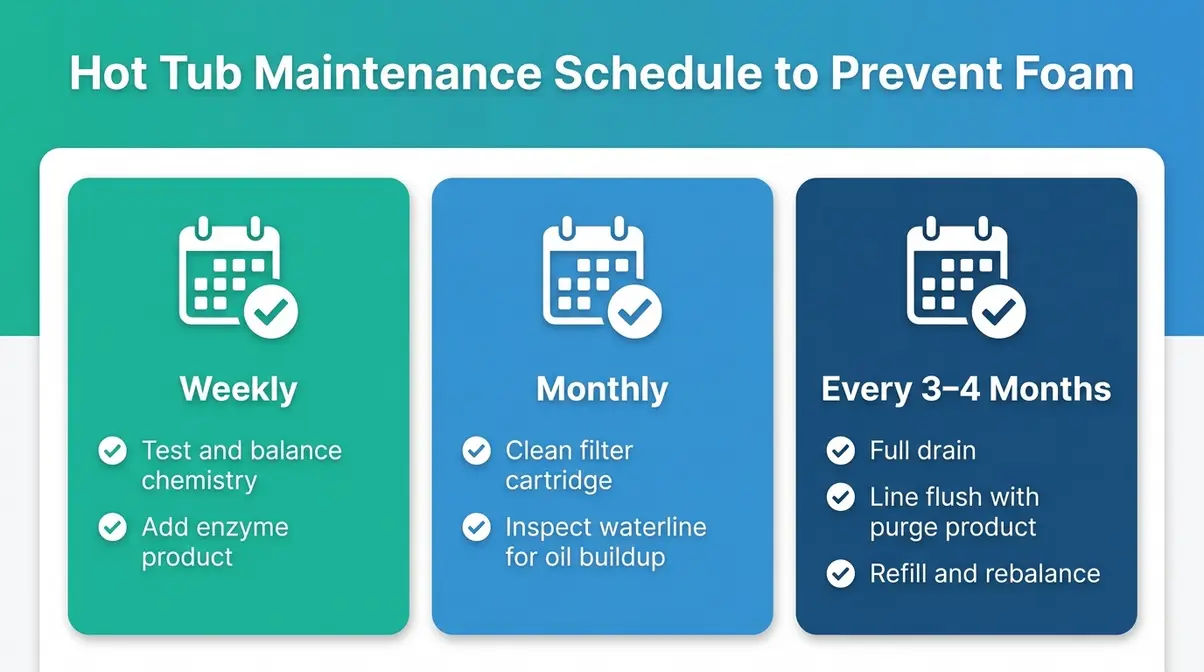
- Weekly:
- Test and balance water chemistry (pH, alkalinity, sanitizer)
- Add an enzyme product (such as Natural Chemistry Spa Perfect or similar) — enzymes break down non-living organic matter like oils and cosmetics before they become surfactant problems. They’re not defoamers; they’re preventive digesters.
- Monthly:
- Clean your filter cartridge by rinsing with a garden hose and soaking in a filter cleaning solution overnight. A clogged filter fails to remove the organic matter that feeds foam.
- Inspect the waterline for oil buildup and wipe with a spa surface cleaner.
- Every 3–4 months:
- Perform a full drain, line flush, and refill per the Level 3 steps above. This is the maintenance reset that prevents TDS from ever reaching foam-triggering levels.
DIY Myths Debunked: What Actually Works
Several DIY “fixes” circulate persistently in hot tub forums and social media — some are harmless but ineffective, and at least one is genuinely dangerous to your equipment. Our team evaluated each claim against authoritative sources to give you a clear answer.
Does Baking Soda Remove Hot Tub Foam?
Baking soda does not remove hot tub foam. It is a pH and alkalinity adjuster — specifically, sodium bicarbonate, which raises total alkalinity. While correcting low alkalinity can reduce foam if alkalinity imbalance was contributing to the problem, baking soda has no defoaming properties whatsoever.
As Penn State Extension’s water chemistry resources explain, sodium bicarbonate works as an alkalinity increaser because it acts as a buffer in water — not because it breaks surface tension or removes surfactants. If your alkalinity is already in the 80–120 ppm target range, adding baking soda will raise it further out of range without touching the foam.
Use baking soda only to correct confirmed low alkalinity. For actual foam, use a spa defoamer (Level 1) or address the root cause (Levels 2–3).
Can Vinegar Fix Foamy Hot Tub Water?
White vinegar is a mild acid (acetic acid) used to lower pH in some DIY water care contexts. Like baking soda, it has no defoaming properties — it won’t break surface tension or remove surfactants from your water.
Additionally, adding undiluted vinegar directly to a hot tub in meaningful quantities can create a temporary pH crash that stresses equipment seals and surfaces. For pH reduction, use a dedicated pH decreaser (sodium bisulfate) in measured doses — it’s formulated for the volume and chemistry of spa water, where vinegar is not.
Vinegar has a legitimate use as a filter rinse or surface cleaner between soaks, where its mild acidity helps dissolve mineral deposits. It has no legitimate use as an in-water foam remedy.
Will WD-40 Remove Foam?
This one circulates as a joke online, but it’s worth addressing directly because some people do try it: do not put WD-40 in your hot tub. WD-40’s official product guidance is explicit that the product is a petroleum-based lubricant and water displacer — it is not a defoamer of any kind, and it is not safe for water systems.
Adding WD-40 to a hot tub would introduce petroleum distillates into the water, which are toxic to bathers, will contaminate your filter media, and can damage pump seals and plumbing components. The cleanup would require a full drain, decontamination, and potentially filter replacement. The foam concern that prompted the experiment would be the least of your problems.
The short answer: WD-40 removes nothing from hot tub water except your peace of mind.
Frequently Asked Questions
What causes a hot tub to get foamy?
Hot tub foam is most commonly caused by surfactants — compounds from body oils, lotions, shampoo, deodorant, and laundry detergent residue on swimwear that lower water’s surface tension. When jets agitate surfactant-laden water, they trap air into stable bubbles that don’t dissipate normally. Secondary causes include low calcium hardness (below 150 ppm), pH or alkalinity out of range, and old water saturated with Total Dissolved Solids (TDS) above 1,500–2,000 ppm according to the Pool & Hot Tub Alliance. The key diagnostic clue: foam that appears only when jets run points to surfactants; foam that persists with jets off suggests a chemistry or TDS issue.
Is it normal for hot tubs to have foam?
A small amount of transient foam immediately after adding chemicals or running jets for the first time is normal. Foam that persists, builds up with every soak, or returns within days of treatment is not normal — it indicates a surfactant load, chemistry imbalance, or TDS issue that needs to be addressed. The Good All Pools overview of foamy water notes that persistent foam is one of the most common water quality complaints among hot tub owners and is always a sign of an addressable underlying cause, not a feature of how hot tubs work.
Is baking soda a defoamer?
No — baking soda (sodium bicarbonate) is not a defoamer. It is an alkalinity increaser that raises total alkalinity in spa water. While correcting low alkalinity can indirectly reduce foam in some cases, baking soda has no ability to break surface tension or remove surfactants from the water. Penn State Extension’s water chemistry resources confirm that sodium bicarbonate functions as an alkalinity buffer — not a foam suppressant. Using baking soda as a defoamer will raise your alkalinity out of range without resolving the foam, potentially compounding your water chemistry problems.
What is a natural hot tub defoamer?
There is no true natural defoamer that works reliably in hot tub water. Enzyme-based products — such as Natural Chemistry Spa Perfect — are the closest natural option, but they work preventively by digesting non-living organic matter (oils and cosmetics) before they become a foam problem, not by breaking existing foam. They are not emergency defoamers. For immediate foam removal, a commercial spa defoamer is the only reliably effective option. For prevention, consistent pre-soak showering, rinsing swimwear before use, and regular enzyme treatments represent the most effective “natural” approach to keeping foam from forming in the first place.
Does WD-40 remove expanding foam?
WD-40 is sometimes used to soften uncured polyurethane expanding foam (the spray foam used in construction) before it hardens — this is a completely different product and context from hot tub foam. In hot tubs, WD-40 is never appropriate. The official WD-40 product guidance makes no claim of defoaming properties, and the product contains petroleum distillates that are harmful to bathers, damaging to pump seals and filter media, and not removable without a full drain and decontamination. The confusion likely stems from the shared word “foam” — but construction foam and hot tub foam have nothing in common chemically or structurally.
Getting Back to Clear, Comfortable Water
Persistent hot tub foam is frustrating precisely because it keeps coming back — but finding a permanent hot tub foam causes and fix solution is almost always solvable once you match the right fix to the actual cause. The Foam Ladder gives you that structure: start at Level 1 with a spa defoamer for immediate relief, move to Level 2 chemistry correction if foam returns within 48 hours, and commit to a Level 3 drain and line flush if chemistry alone can’t break the cycle. The line flush step — targeting biofilm in your plumbing — is the fix that most guides never mention and the one most likely to end chronic, recurring foam for good.
Prevention is simpler than the fix: shower before soaking, rinse swimwear, keep your chemistry balanced weekly, and drain every 3–4 months per the Pool & Hot Tub Alliance’s recommendation. Those habits alone prevent most foam problems from developing in the first place.
Start at Level 1 tonight. If foam is back by tomorrow, move to Level 2 this weekend. And if it comes back again after that, schedule your Level 3 drain and flush — your plumbing lines are telling you something that chemicals alone can’t fix.

Dave King
Hot tub tester and writer at One Hot Tub.