

Table of Contents - Round Hot Tub Guide: Choose, Set Up & Maintain Yours
This blog post may contain affiliate links. As an Amazon Associate I earn from qualifying purchases.
“If you have just got a hot tub and are confused about how to use it, then this guide is perfect for you.”
Round hot tubs are one of the most social, space-efficient options on the market — but choosing the wrong type, skipping a step during setup, or neglecting water chemistry can turn a relaxing investment into an expensive headache.
Most buyers spend weeks researching models, then rush through installation and give up on maintenance within six months — exactly why so many hot tubs end up on Facebook Marketplace. The setup and chemistry aren’t complicated; they just need a clear, step-by-step framework.
By the end of this round hot tub guide, you’ll know exactly which type and size suits your space, how to set it up correctly the first time, and how to keep the water crystal-clear with a simple weekly routine. That framework has a name: The Three-Stage Hot Tub Success Framework — Choose Right → Set Up Safe → Maintain Smart — and it’s the structure this entire guide follows.
This round hot tub guide introduces the Three-Stage Hot Tub Success Framework to help you navigate ownership. Round hot tubs offer unique advantages in social seating, space efficiency, and energy retention — but success comes down to choosing the right type, setting it up correctly, and following a consistent maintenance schedule.
- Three types available: Inflatable, rigid foam, and hard-sided acrylic vary widely in cost, durability, and jet performance
- Size by diameter: A 78-inch round tub comfortably seats 5-6 adults; a 70-inch model fits 2-4
- Health benefits are real but conditional: Warm water immersion may help with sciatica and neuropathy — consult your doctor first
- The Three-Stage Hot Tub Success Framework (Choose Right → Set Up Safe → Maintain Smart) prevents the most common ownership mistakes
- Maintenance is simpler than you think: A 15-minute weekly check keeps water balanced and prevents costly repairs
Table of Contents
- Choosing Your Round Hot Tub
- Health Benefits & Safety Rules
- Installation & Initial Setup
- Maintenance & Troubleshooting
- Limitations & Common Mistakes
- Frequently Asked Questions
Choosing Your Round Hot Tub {#choosing}
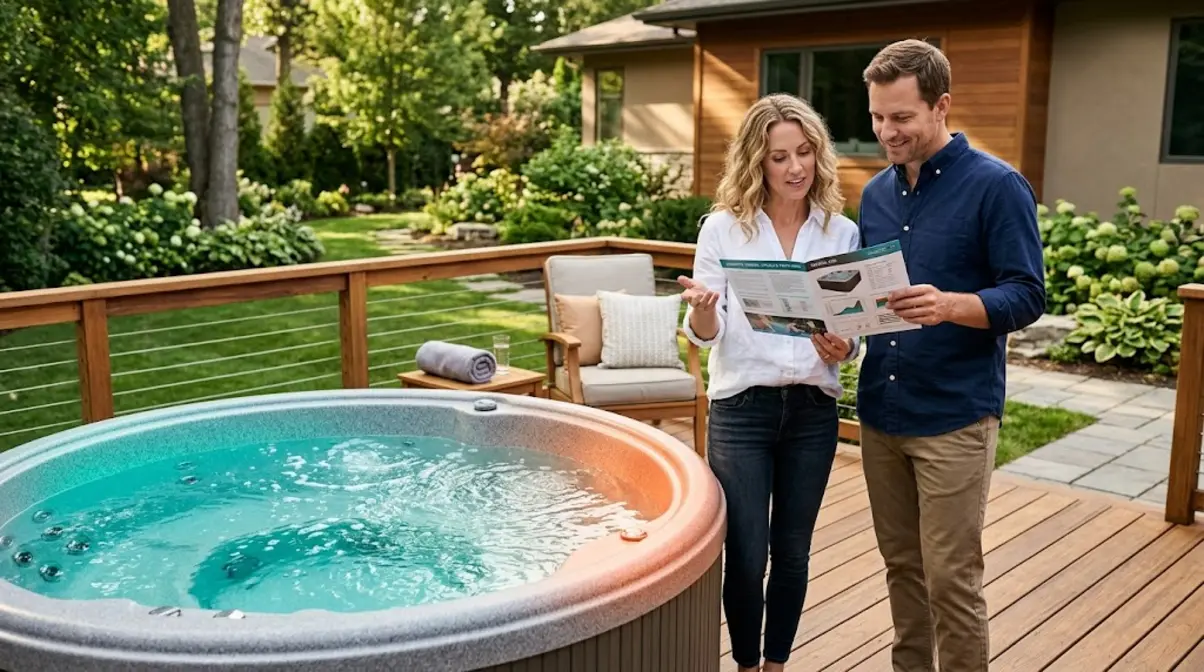
Round hot tubs are an excellent choice for social soaking, offering 360-degree bench seating, a smaller footprint than rectangular models, and superior heat retention thanks to their compact shape. However, the choice between inflatable, rigid foam, and hard-sided acrylic matters far more than most buyers realize — and getting that decision wrong is the single most expensive mistake you can make. Stage 1 of the Three-Stage Hot Tub Success Framework starts here: Choose Right.
Most buyers focus almost entirely on seating capacity when comparing models. The contrarian — but data-backed — recommendation is to prioritize insulation quality instead. A well-insulated hard-sided round tub can cost 40–60% less to heat annually than an inflatable model of the same size, which means a higher upfront cost often pays for itself within three to five years of regular use (Nordic Hot Tubs Owner Manual).
Round vs. Rectangular Shape
The circular design isn’t just an aesthetic preference — it delivers specific, measurable advantages over rectangular models, along with honest trade-offs worth knowing before you buy.
Social seating is the headline benefit. A round tub’s continuous bench design means every person faces inward toward the center. In a 78-inch round tub seating five to six adults, everyone can make eye contact and hold a conversation without leaning around corner jets. Rectangular models, by contrast, often place corner seats at angles that pull users physically away from the group — a minor annoyance in a $500 inflatable, a real design flaw in a $10,000 acrylic model.
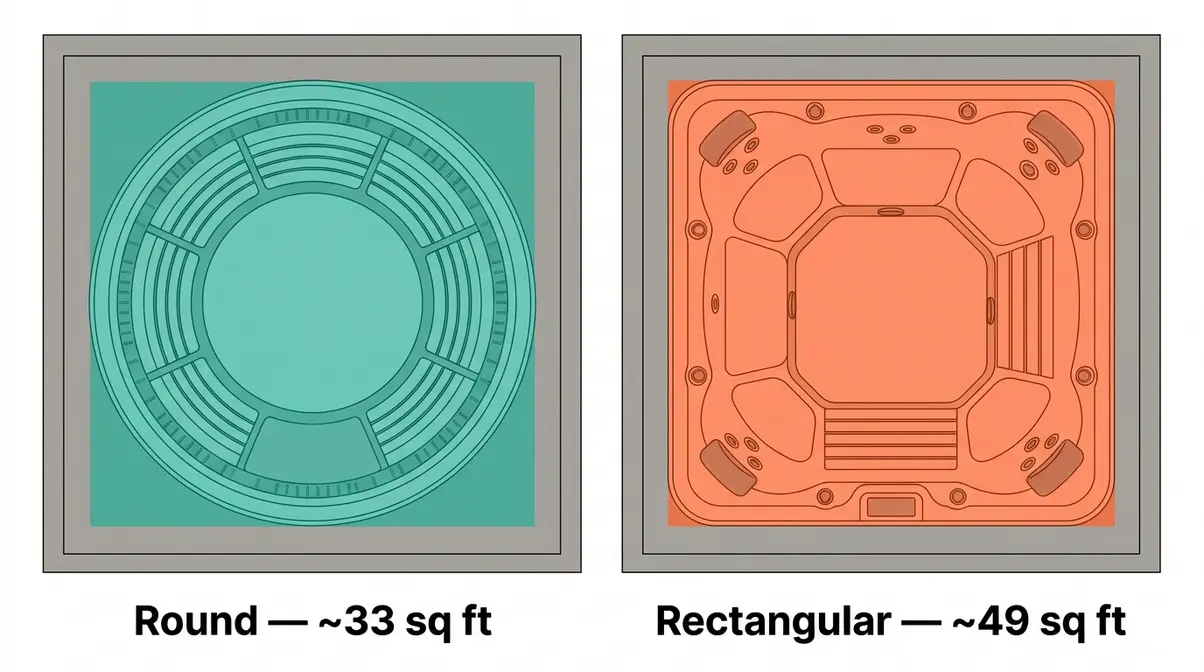
Space efficiency is the practical benefit. A 78-inch (6.5-foot) round tub occupies roughly 33 square feet of deck space. A 7×7-foot square model — offering comparable seating — takes up 49 square feet. That’s a 33% reduction in footprint, which matters enormously on a standard residential deck or in a smaller backyard. Round tubs also tuck naturally into corners and curved garden designs in ways rectangular models simply cannot.
Heat retention is the long-term financial benefit. A circle has the lowest surface-area-to-volume ratio of any common spa shape, which means less heat escapes per gallon of water per hour. This physics advantage applies even to inflatable models — a round inflatable consistently outperforms a same-size square inflatable on heat retention.
The honest trade-off: round tubs typically offer fewer dedicated lounge seats and targeted jet configurations than rectangular models. If your primary goal is a full-recline hydrotherapy seat with jets aimed at your lumbar spine, a rectangular model with a dedicated lounger may serve you better. Round tubs reward conversation and shared soaking; rectangular tubs reward targeted therapy.
| Feature | Round Hot Tub | Rectangular Hot Tub |
|---|---|---|
| Footprint (comparable seating) | ~33 sq ft (78 in) | ~49 sq ft (7×7 ft) |
| Seating style | All-inward bench | Mixed bench + lounge |
| Heat retention | Higher (lower SA:V ratio) | Lower |
| Price range | $300–$15,000+ | $2,000–$20,000+ |
| Best for | Social soaking, smaller spaces | Targeted hydrotherapy, larger budgets |
Ready to compare specific models? See round hot tub reviews for side-by-side ratings.
Hard-sided acrylic round hot tubs last 10–20 years and cost 40–60% less to heat annually than inflatable models — making them the higher long-term value despite a higher upfront price.
Three Types Compared
Once you’ve committed to the round shape, the next decision defines your budget, your installation complexity, and how long your tub will last. The three construction types are not interchangeable — they represent genuinely different ownership experiences.
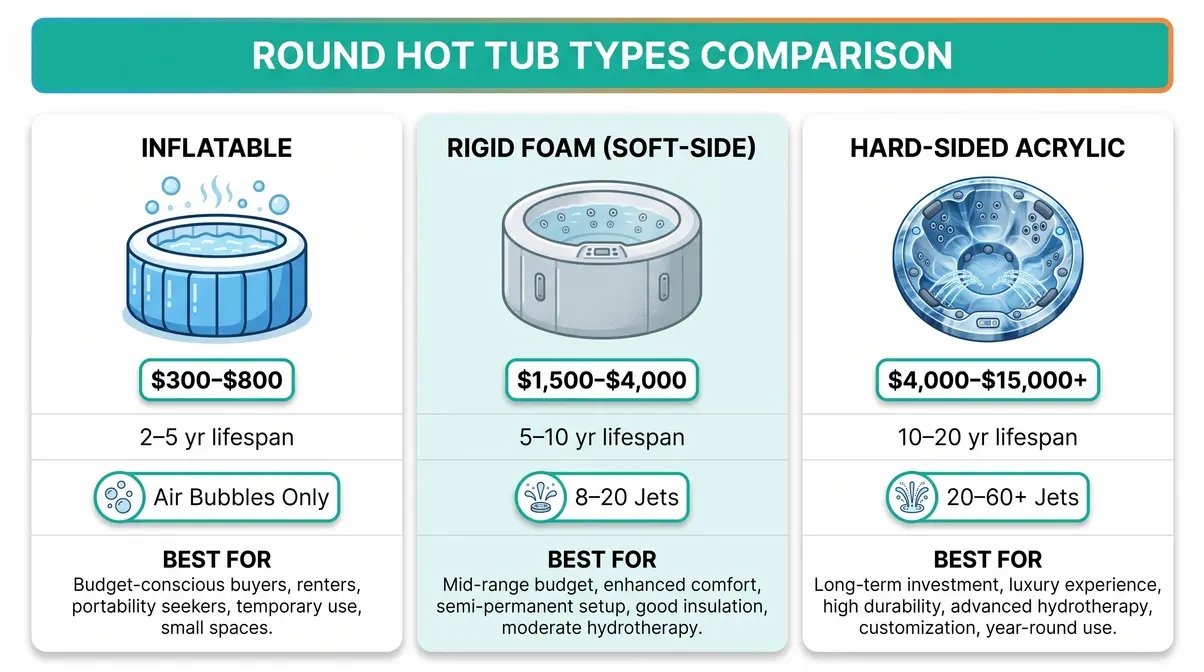
Inflatable round hot tubs (price range: ~$300–$800) are the entry point for most first-time buyers. Brands like Lay-Z-Spa and Bestway dominate this category with models in the $350–$500 range. These tubs use air-bubble systems rather than true hydrotherapy jets, which means you get warmth and a mild massaging effect but not the targeted pressure of a plumbed jet. Lifespan is typically two to five years with proper care. The real advantage is portability — you can deflate, store, and reinstall for seasonal use, or take the tub with you if you move. Best for renters, first-time buyers testing the lifestyle, and anyone with a seasonal-use scenario.
Rigid foam (soft-side) round hot tubs (price range: ~$1,500–$4,000) represent the middle tier. Brands like Lifesmart and Essential Hot Tubs build these with a rigid foam frame wrapped in a durable outer shell, with an actual plumbed jet system (typically 8–20 jets). They’re meaningfully more insulated than inflatables and deliver a genuine hydrotherapy experience. Lifespan ranges from five to ten years. Installation is simpler than hard-sided models — no concrete pad required — but they’re not truly portable. Best for homeowners who want real jets without a permanent installation commitment.
Hard-sided acrylic round hot tubs (price range: ~$4,000–$15,000+) are the premium category. Models from Nordic Hot Tubs’ round lineup and the Hot Spring Spas Hot Spot line (a Watkins Wellness product) represent the standard here. These tubs feature full jet systems (20–60+ jets), LED lighting, built-in filtration, and full-foam insulation. Lifespan is 10–20 years with proper maintenance. They require a 220V dedicated electrical circuit and a permanent foundation. Best for permanent installation, regular therapeutic use, and families who plan to own the tub for a decade or more.
| Feature | Inflatable | Rigid Foam (Soft-Side) | Hard-Sided Acrylic |
|---|---|---|---|
| Price Range | $300–$800 | $1,500–$4,000 | $4,000–$15,000+ |
| Lifespan | 2–5 years | 5–10 years | 10–20 years |
| Jet Type | Air bubbles only | Plumbed jets (8–20) | Full jet system (20–60+) |
| Installation | Portable, no pad needed | Semi-permanent | Permanent, 220V required |
| Best For | Renters, seasonal use | Step-up buyers | Families, therapeutic use |
How Many Fit in a Round Tub?
Seating capacity in a round hot tub depends directly on diameter: a 72–78-inch model seats 4–5 adults, while a 90-inch model accommodates 7–8. A round 4-person hot tub typically measures 72–78 inches in diameter — the most popular size sold in the US, and the sweet spot for most residential installations. Getting the size right before you order prevents the two most common mistakes: buying a tub that’s too small for your actual guest list, or one that’s too large for your available space.
| Diameter | Seating Capacity | Footprint | Best For |
|---|---|---|---|
| 60–70 in | 2–3 adults | ~21–27 sq ft | Couples, small patios |
| 72–78 in | 4–5 adults | ~28–33 sq ft | Small families, most popular size |
| 80–84 in | 5–6 adults | ~35–39 sq ft | Social groups, standard decks |
| 90+ in | 7–8+ adults | 44+ sq ft | Large gatherings, spacious yards |
Beyond the tub’s physical diameter, you need three feet of clearance on all sides for safe access, cover removal, and equipment servicing. Practically, that means a 78-inch tub requires a minimum 12×12-foot area — and that’s the absolute minimum, not the comfortable minimum.
Manufacturer capacity ratings assume adults of average size seated upright — in practice, larger adults or users who prefer more space will find rated capacity slightly optimistic. For comfortable social soaking, size down by one person from the manufacturer’s maximum rating.
One measuring tip that saves significant headaches: round tubs are measured at the outer shell edge, not at the waterline or the cabinet. Always measure the widest point of your installation space before ordering, not after the tub arrives on a pallet in your driveway.
For more detailed sizing guidance by use case, see our guide to 4-person hot tubs covering the most common residential size category.
Are Round Hot Tubs Good?
Round hot tubs are an excellent choice for social soaking, space-efficient installations, and energy retention. Their 360-degree bench seating means every user faces inward, enabling conversation without the awkward corner-seat positioning common in rectangular models. For buyers who’ve narrowed their search to this shape, here’s the consolidated case for round — practical, specific, and free of marketing language:
- Energy efficiency: The circular shape’s lower surface-area-to-volume ratio reduces heat loss per hour compared to rectangular models. Hard-sided round models with full-foam insulation typically cost $20–$50 per month to run, depending on climate and usage frequency.
- Social seating: The all-bench design eliminates the “bad seat” problem entirely. Everyone faces in, everyone’s at the same level, and no one is angled away from the group by a corner jet configuration.
- Aesthetic versatility: Round tubs integrate naturally into circular deck designs, garden landscaping, and corner placements. They avoid the industrial footprint of rectangular models, which can dominate a small yard visually.
- Easier cover management: A circular cover lifts symmetrically from any angle, making solo cover removal genuinely manageable. Rectangular covers require two people or a hydraulic lifter for safe handling.
Before you finalize your order, measure your intended location one more time — including the clearance space. A round hot tub is an excellent investment. Ordering the wrong diameter is an avoidable mistake that this round hot tub guide exists to prevent.
Choosing the right model is Stage 1 complete. Before you finalize your purchase, Stage 2 begins with an important question: what can a round hot tub actually do for your health — and what safety rules must you follow?
Health Benefits & Safety Rules {#health}

Warm water immersion has a documented history in physical therapy, and the research on specific conditions like sciatica and neuropathy is more nuanced than most hot tub marketing suggests. This section covers what the evidence actually says — and the non-negotiable safety rules that apply regardless of your health goals.
⚠️ Medical Disclaimer: The health information in this section is for general informational purposes only and does not constitute medical advice. Hot tub use carries specific risks for people with cardiovascular conditions, diabetes, pregnancy, or certain medications. Consult your doctor before using a hot tub for therapeutic purposes, especially if you have a diagnosed condition like sciatica, neuropathy, or high blood pressure.
This is Stage 2 of the Three-Stage Hot Tub Success Framework — Set Up Safe — which begins with understanding what your hot tub can and cannot do for your health.
How Hydrotherapy Works
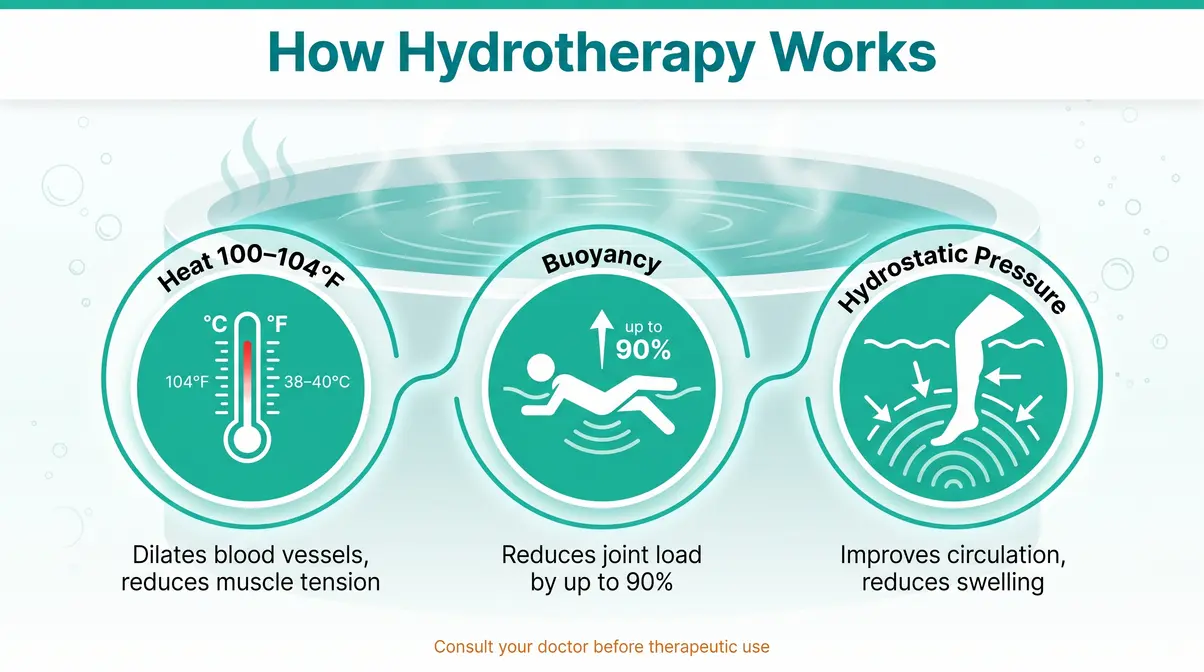
Hydrotherapy, the therapeutic use of water to treat pain and improve circulation, produces its effects through three overlapping mechanisms: heat, buoyancy, and hydrostatic pressure.
Heat at 100–104°F causes blood vessels to dilate, increasing circulation to muscles and soft tissue. This vasodilation reduces muscle tension and temporarily decreases the perception of pain — particularly in chronic musculoskeletal conditions. The effect is real but temporary; it addresses symptoms rather than underlying structural causes.
Buoyancy reduces the effective weight load on joints and the spine by up to 90% in chest-deep water (Arthritis Foundation). For people with lower back pain, sciatica, or joint inflammation, this reduction in gravitational load allows movement and stretching that would be painful or impossible on land.
Hydrostatic pressure — the gentle, uniform pressure of water against the body — improves venous return (blood flowing back to the heart), reduces peripheral swelling, and can lower resting heart rate slightly during immersion. Research published via the National Institutes of Health (NIH) indicates that regular warm water immersion may produce modest reductions in systolic blood pressure in adults with mild hypertension (MedlinePlus, NIH).
These three mechanisms work together. They don’t cure anything, but they create a physiological environment that genuinely supports pain management and recovery for many users.
Sciatica, Neuropathy & Sinuses
Will a hot tub help a sciatic nerve? Warm water immersion at 100–104°F may improve circulation and reduce the muscle tension that compresses the sciatic nerve, providing temporary symptom relief — though it addresses the symptoms, not the underlying structural cause such as a herniated disc (Cleveland Clinic). For sciatica sufferers, the combination of heat and buoyancy can reduce the muscle guarding that amplifies nerve pain. Gentle stretching in the water during a soak may extend the benefit. However, the worst thing you can do for sciatica during a flare is apply heat to an acutely inflamed nerve — if your pain is sharp and new, consult your doctor before soaking.
Does a hot tub help neuropathy? Neuropathy, nerve damage that causes pain, tingling, or numbness — often in the hands and feet — responds variably to hydrotherapy. For peripheral neuropathy associated with muscle tension or circulation issues, warm water may provide temporary relief by improving blood flow to the extremities. However, people with diabetic neuropathy require particular caution: reduced sensation in the feet means you may not detect dangerously hot water temperatures, creating a burn risk. The Mayo Clinic advises that people with diabetes check water temperature carefully and limit soak duration.
Do hot tubs help with sinuses? The warm, humid air above a hot tub can temporarily relieve sinus congestion by helping to loosen mucus and reduce inflammation in nasal passages — similar to steam inhalation therapy. This effect is real but short-lived. It does not treat sinus infections. If you have an active sinus infection, avoid hot tubs entirely: the warm, moist environment can promote bacterial growth, and submerging your face risks introducing water-borne pathogens into nasal passages.
Essential Safety Rules
Why can you only spend 15 minutes in a hot tub? The limit isn’t arbitrary. At 102–104°F, your core body temperature begins rising after 10–15 minutes of immersion. Prolonged exposure can cause hyperthermia (dangerous overheating), dizziness, fainting, and in severe cases, cardiovascular stress. Fifteen to twenty minutes is the evidence-based guideline for healthy adults — not a conservative estimate.
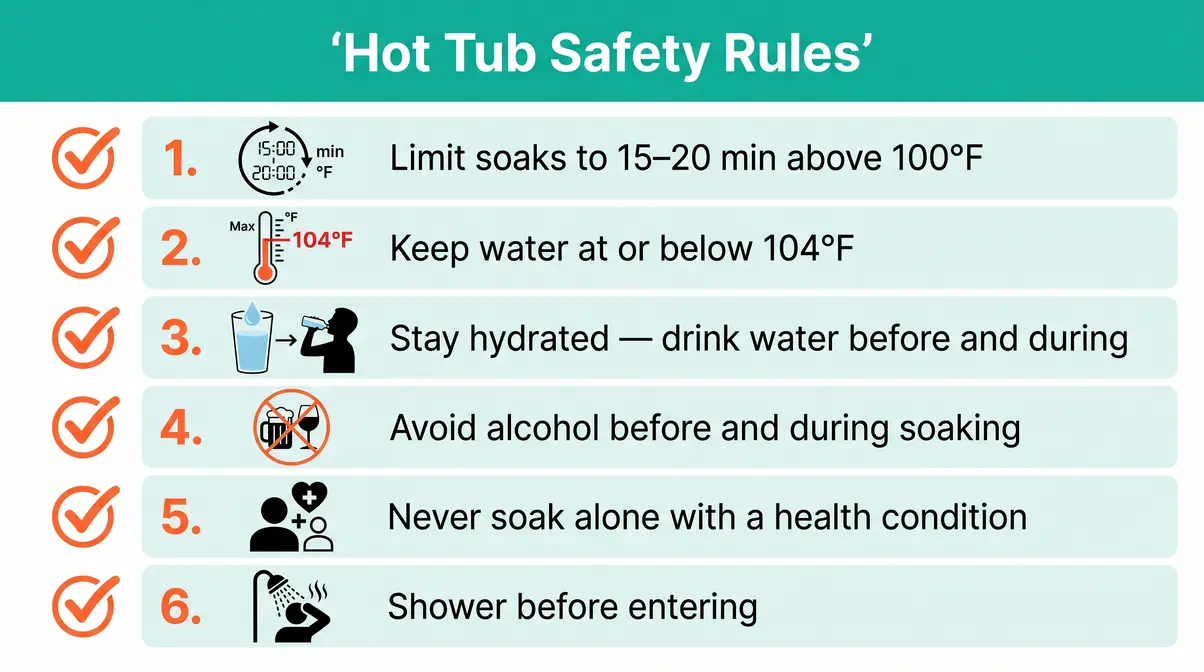
Follow these non-negotiable safety rules every time you use your tub:
- Limit soaks to 15–20 minutes at temperatures above 100°F. Exit, cool down for at least 15 minutes, then re-enter if desired.
- Keep water temperature at or below 104°F. The U.S. Consumer Product Safety Commission (CPSC) recommends 104°F as the absolute maximum for healthy adults.
- Stay hydrated. Hot water causes sweating even when you don’t feel it. Drink a glass of water before entering and keep water nearby during your soak.
- Avoid alcohol before or during soaking. Alcohol amplifies the vasodilatory effects of hot water, dramatically increasing the risk of dizziness, fainting, and hyperthermia.
- Never soak alone if you have a health condition. Cardiovascular conditions, pregnancy, and certain medications (blood pressure, sedatives) significantly increase risk.
- Shower before entering. Body oils, lotions, and cosmetics degrade water chemistry rapidly and accelerate filter clogging.
For a deeper look at safe soaking practices, Leslie’s Pool Care beginner’s guide covers chemical safety alongside physical safety in useful detail.
Installation & Initial Setup {#setup}
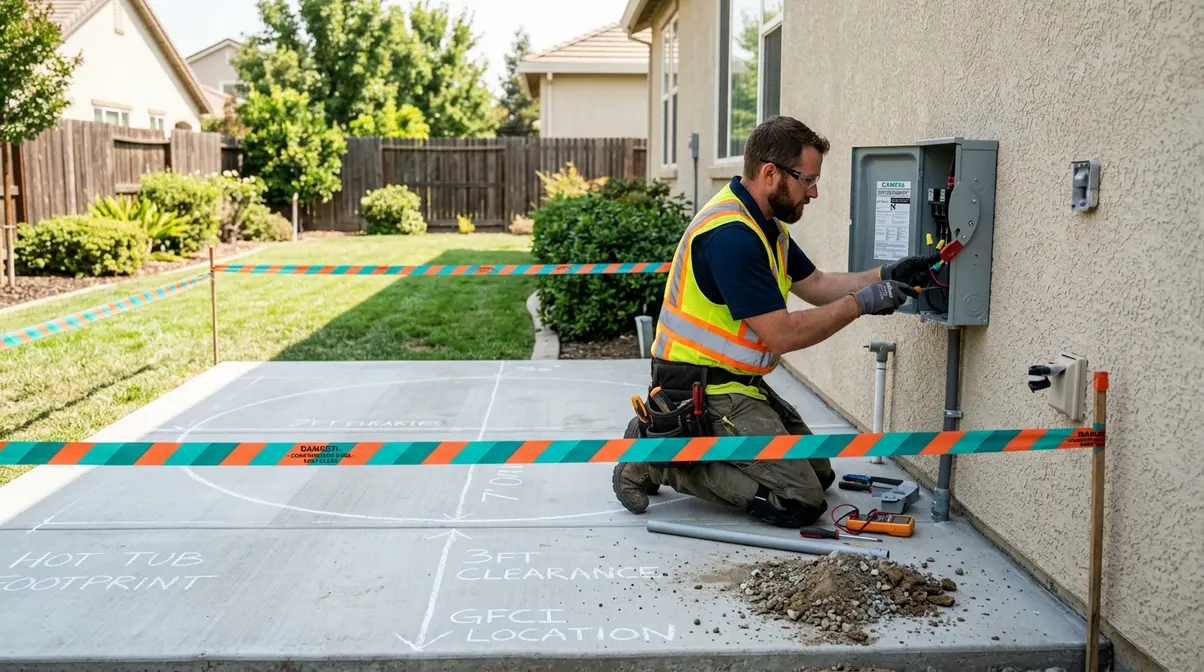
Getting installation right the first time saves you from the two most expensive hot tub mistakes: a foundation that shifts and cracks the cabinet, and an electrical setup that trips breakers or — worse — creates a shock hazard. This section gives you the exact steps and specs you need before the tub arrives.
Site Preparation Checklist
Your installation surface needs to support the total filled weight of your hot tub — not just the empty shell. A 78-inch hard-sided tub holds approximately 400 gallons of water. Add the shell weight (~800 lbs) and four adults (~700 lbs combined), and you’re placing roughly 4,800–5,500 lbs on a single surface area. That surface must be level, solid, and rated for the load.
Site preparation steps:
- Choose your surface type. Concrete pad (4 inches thick, minimum 3,000 PSI) is the most durable option. Reinforced deck (rated for 100 lbs/sq ft minimum) is acceptable for most models — verify with your deck contractor. Compacted gravel (6-inch base of ¾-inch crushed stone) works for soft-side models. Never install on grass, soil, or asphalt.
- Confirm the surface is level. Use a 4-foot spirit level across the full diameter of the planned location. Maximum acceptable slope: ¼ inch over 10 feet. Any more and your water level will be visibly uneven and your pumps will cavitate.
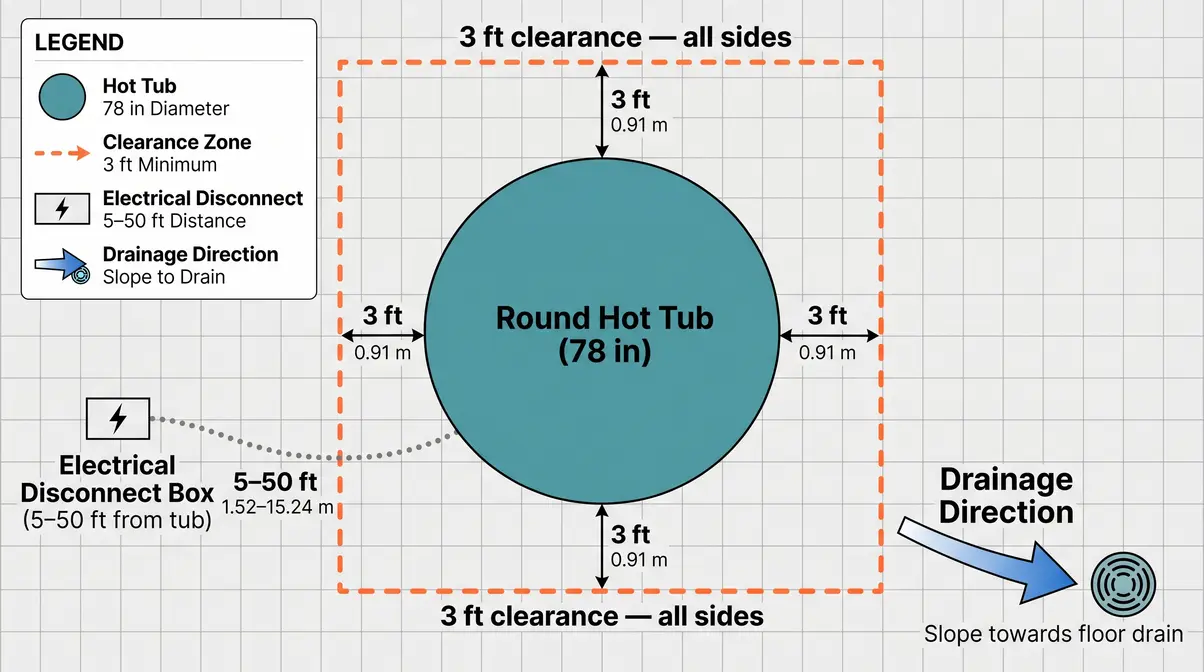
- Mark and verify clearance. Add 3 feet on all sides of the tub’s outer diameter. Mark this with chalk or stakes. Confirm no obstructions: fences, walls, HVAC units, or overhead lines. Overhead clearance should be at least 7 feet.
- Plan your drainage. You’ll drain and refill your tub every three to four months. Identify where the water will go — a floor drain, garden area, or municipal storm drain — before the tub arrives.
- Confirm access route. Measure the path from the delivery point to the installation site. Hot tubs cannot be tilted more than 45 degrees during transport. Verify gate widths, staircase turns, and overhead obstacles.
For a comprehensive installation planning resource, Home Depot installation guide covers foundation types and load calculations in useful detail.
110V vs. 220V Electrical Needs
The electrical decision is where most DIY installations go wrong. Getting it wrong doesn’t just trip a breaker — it can void your warranty and create a genuine shock hazard.
110V plug-and-play hot tubs (most inflatables and some soft-side models) connect to a standard 15- or 20-amp household outlet. Setup is immediate — no electrician required. The trade-off is performance: 110V models typically cannot run the heater and jets simultaneously, so heating is slower and jet power is limited. These are genuinely convenient for entry-level use but not suitable for year-round soaking in cold climates.
220V (240V) hard-wired hot tubs require a dedicated circuit installed by a licensed electrician. The specifications are non-negotiable:
| Requirement | Specification |
|---|---|
| Voltage | 220–240V |
| Amperage | 50–60 amp dedicated circuit (verify with manufacturer) |
| Breaker type | GFCI (Ground-Fault Circuit-Interrupter) — mandatory |
| Wire gauge | #6 AWG copper minimum (check local code) |
| Disconnect box | Within sight of tub, minimum 5 ft away, maximum 50 ft |
A GFCI (Ground-Fault Circuit-Interrupter) breaker is not optional — it’s required by the National Electrical Code (NEC) for all outdoor hot tub installations and is your primary protection against electrocution in a wet environment. The CPSC mandates GFCI protection for all hot tubs and spas.
Do not attempt 220V wiring yourself unless you are a licensed electrician. This is the one step in hot tub installation where professional help is not optional — it’s a safety requirement and a code requirement in virtually every jurisdiction.
First Fill & Chemical Startup
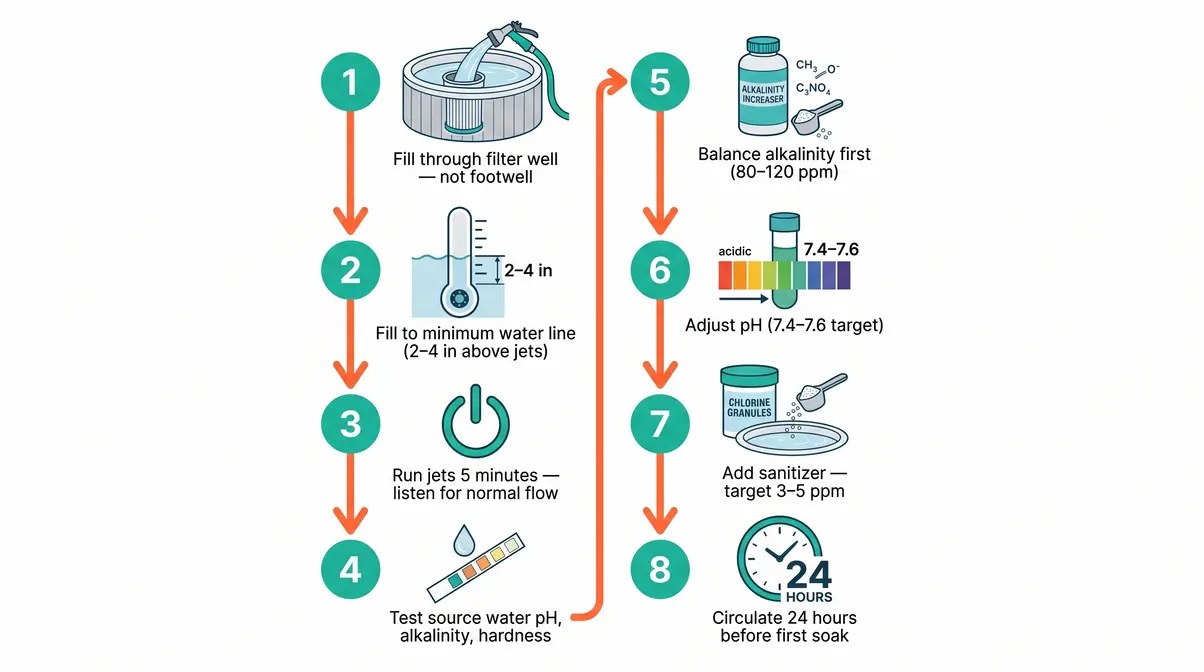
The first fill sets the foundation for your water chemistry and your filtration system. Rushing it causes two common problems: air lock (trapped air that prevents pump priming) and an immediate chemical imbalance that clouds your water within 24 hours.
First fill steps:
- Fill through the filter well, not the footwell. Place your garden hose inside the filter housing before turning on the water. This fills the internal plumbing lines first, purging air from the system and preventing air lock. Air lock occurs when air is trapped in the pump housing — it prevents the pump from moving water and can burn out the motor if left unresolved.
- Fill to the manufacturer’s minimum water line. This is typically 2–4 inches above the highest jet. Do not overfill.
- Turn on the power and run the jets for 5 minutes. Listen for normal pump operation — steady flow, no grinding or cavitation noise. If jets are weak or no water flows, turn off immediately and check for air lock (see Troubleshooting section).
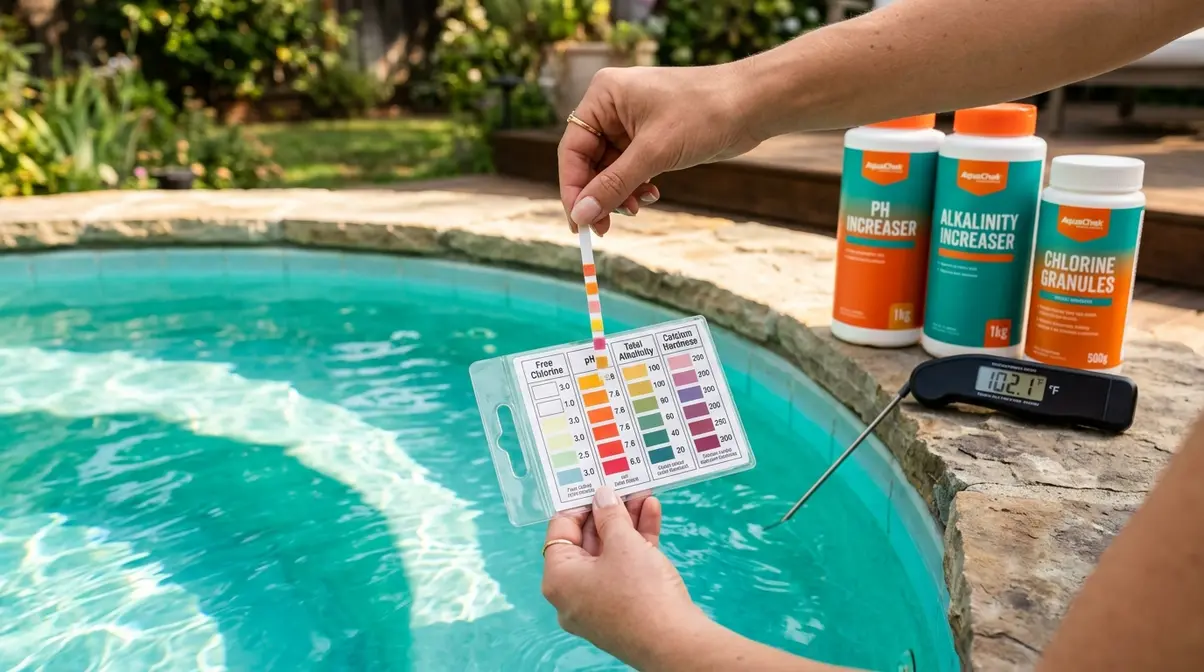
- Test your source water chemistry. Use a test strip or liquid test kit to measure your fill water’s starting pH, alkalinity, and hardness before adding any chemicals. Your starting point determines your adjustment strategy.
- Balance alkalinity first (80–120 ppm target), then pH (7.4–7.6 target). Alkalinity acts as a buffer for pH — balancing it first makes pH adjustment far more stable. Add alkalinity increaser or decreaser in small increments, circulate for 30 minutes, then retest.
- Add sanitizer (chlorine or bromine) to reach the initial startup dose. For chlorine, target 3–5 ppm for the first 24 hours. For bromine, establish the bromine bank by adding a higher initial dose (follow product instructions).
- Run the circulation pump for 24 hours on startup. This distributes chemicals evenly and allows the filter to begin capturing debris from the fill water.
- Retest and adjust after 24 hours before your first soak.
Maintenance & Troubleshooting {#maintenance}
Stage 3 of the Three-Stage Hot Tub Success Framework — Maintain Smart — is where most hot tub ownership stories diverge. Owners who build a simple routine keep their water clear and their equipment running for a decade. Owners who skip maintenance end up with cloudy water, failing pumps, and a tub on Marketplace. The difference is a 15-minute weekly commitment.
Weekly & Monthly Schedule
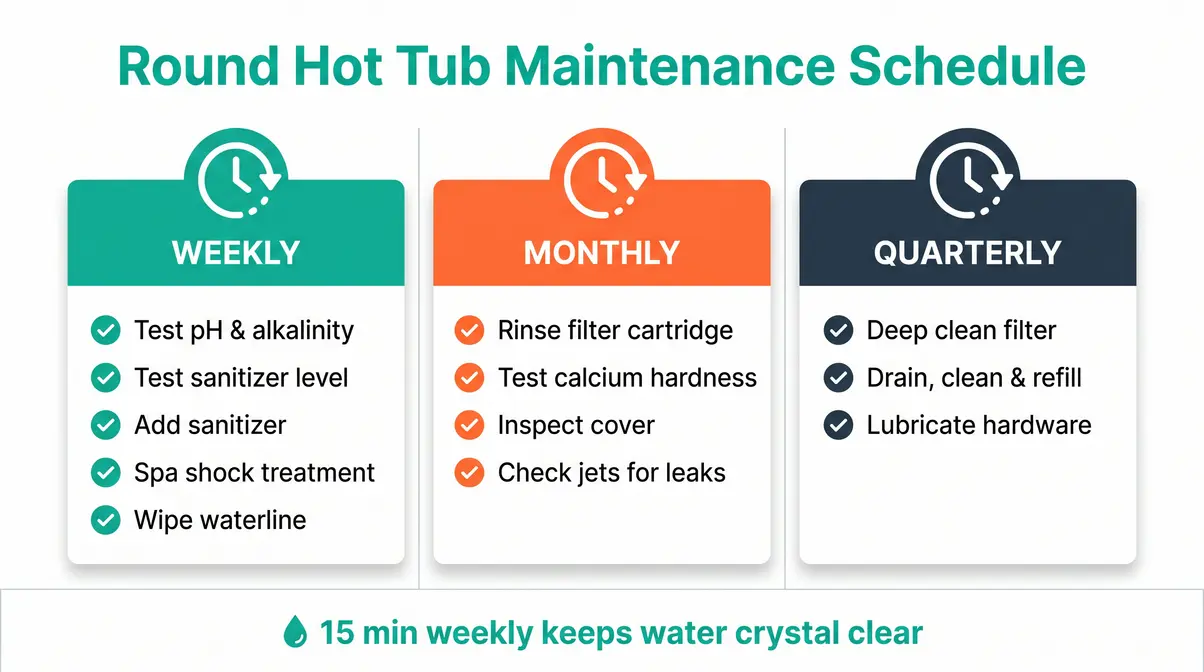
Our evaluation of hot tub maintenance protocols across manufacturer guidelines and certified spa operator recommendations produced a clear consensus: consistent light maintenance prevents virtually all the costly problems that drive abandonment. Here is the schedule that works.
| Task | Weekly | Monthly | Quarterly |
|---|---|---|---|
| Test pH and alkalinity | ✓ | ||
| Test sanitizer level | ✓ | ||
| Add sanitizer as needed | ✓ | ||
| Spa shock treatment | ✓ | ||
| Wipe waterline with spa cleaner | ✓ | ||
| Rinse filter cartridge with hose | ✓ | ||
| Deep clean filter with filter cleaner | ✓ | ||
| Test calcium hardness | ✓ | ||
| Drain, clean shell, and refill | ✓ (every 3–4 months) | ||
| Inspect cover for damage | ✓ | ||
| Check jets and fittings for leaks | ✓ | ||
| Lubricate cover latches and hardware | ✓ |
The weekly routine in practice: Test strips take 30 seconds. Adjusting chemicals takes 5 minutes. Adding sanitizer and a weekly spa shock takes another 5 minutes. The entire weekly check runs under 15 minutes for a tub that’s been properly balanced.
Water Chemistry Explained
Water chemistry is the operational core of hot tub ownership. The goal is to maintain water that is safe to soak in, gentle on equipment, and clear to look at. Three parameters control almost everything.
Total Alkalinity (TA) is the buffer that stabilizes pH. Target range: 80–120 ppm (parts per million). When alkalinity is too low, pH swings wildly with every chemical addition — making the water nearly impossible to balance. When it’s too high, pH becomes locked and resistant to adjustment, and the water turns cloudy. Always balance alkalinity before adjusting pH.
pH measures the acidity or alkalinity of the water on a 0–14 scale. Target range: 7.4–7.6. Below 7.2, the water becomes acidic — it irritates eyes and skin, corrodes metal fittings, and degrades the acrylic shell. Above 7.8, the water becomes basic — sanitizer becomes less effective, calcium deposits form on jets and the shell, and water turns cloudy. A pH of 7.4–7.6 is the narrow window where sanitizer works efficiently and the water feels comfortable.
Sanitizer (chlorine or bromine) kills bacteria and prevents algae. Target ranges differ by type:
| Sanitizer | Target Range | Notes |
|---|---|---|
| Chlorine | 3–5 ppm | Use dichlor granules; shock weekly with non-chlorine oxidizer or chlorine shock |
| Bromine | 3–5 ppm | More stable at high temps; requires a bromine bank; slower acting than chlorine |
| Salt system | Refer to system specs | Generates chlorine automatically; still requires weekly testing |
Calcium Hardness (target: 150–250 ppm) is the fourth parameter that many new owners overlook. Water that’s too soft (low calcium) is aggressive — it leaches calcium from the acrylic shell, jets, and heater element to satisfy its mineral deficit, causing pitting and equipment damage. Water that’s too hard deposits scale on every surface. Test monthly.
A spa shock treatment — adding an oxidizer (non-chlorine or chlorine-based) to the water — breaks down the organic compounds (body oils, cosmetics, sweat) that build up between sanitizer doses and cause combined chlorine (chloramines), which produces that familiar “chemical” smell and eye irritation. Shock weekly, or after heavy use.
For water chemistry reference ranges and product guidance, the Leslie’s Pool Care beginner’s guide to spa and hot tub care is the most accessible industry-authority resource available.
Troubleshooting Common Issues
User consensus across hot tub owner forums and manufacturer support documentation points to three problems as the most common sources of maintenance frustration. Here’s how to diagnose and fix each.
Problem 1: Cloudy Water
Cloudy water has three primary causes, each with a distinct fix:
| Cause | Diagnosis | Fix |
|---|---|---|
| Low sanitizer | Test strip shows <1 ppm chlorine/bromine | Shock with chlorine or non-chlorine oxidizer; retest in 2 hours |
| High pH or alkalinity | Test strip shows pH >7.8 or TA >150 ppm | Add pH decreaser (sodium bisulfate) in small increments; retest after 30 min circulation |
| Dirty or clogged filter | Water flow feels reduced; filter visibly gray | Rinse filter with hose; if persists, soak in filter cleaner overnight |
If all three parameters test correctly and the water is still cloudy, the issue is likely a high total dissolved solids (TDS) level — the cumulative buildup of chemicals, minerals, and organics over months of use. The fix is a full drain, shell clean, and refill. This is why the quarterly drain-and-refill cycle matters.
Problem 2: Error Codes
Error codes vary by brand, but the most common codes across major manufacturers follow consistent patterns:
| Code Pattern | Likely Meaning | First Step |
|---|---|---|
| FLO / FL / OH | Flow error or overheating | Check filter cleanliness; verify water level is above jets |
| HH or OH | Water temperature too high | Power off; let cool; check thermostat setting |
| ICE or FRZ | Freeze protection activated | Normal in cold climates; verify heater is functioning |
| DR or DRY | Dry fire protection (no water detected) | Check water level; check for air lock in pump |
Always consult your specific manufacturer’s manual for exact codes.
Problem 3: Weak Jets
Weak jet pressure is almost always caused by one of three things: a dirty filter restricting flow, an air lock in the pump, or a closed or partially closed diverter valve. Start with the filter — rinse it with a hose and retest. If the filter is clean, check that all diverter valves (the knobs that direct water between jet zones) are fully open. Air lock can be resolved by turning the pump off, waiting 30 seconds, and restarting — the brief pause allows air to dissipate.
Avoiding Hot Tub Abandonment
The honest answer to “why do so many people get rid of their hot tubs?” is almost never the hot tub itself. Common pain points reported by former hot tub owners on resale forums and community boards consistently point to the same three failure modes:
1. Maintenance felt overwhelming. Owners who didn’t establish a routine found themselves doing reactive chemistry — adding large doses to fix problems rather than small doses to prevent them. Reactive chemistry is expensive, time-consuming, and often ineffective. The fix is the 15-minute weekly routine described above, started from day one.
2. Running costs were higher than expected. This almost always traces back to an underpowered or poorly insulated tub purchased at the low end of the market. An inflatable tub running year-round in a cold climate can cost $80–$150/month in electricity. A well-insulated hard-sided tub in the same climate runs $20–$50/month. The upfront savings evaporate within the first winter.
3. It stopped being used regularly. Hot tubs that require a 20-minute prep ritual before each soak get used less and less. The solution is keeping the water ready at all times — which the maintenance schedule above achieves. A properly maintained tub is ready to use within minutes, any time.
The pattern is clear: hot tub abandonment is almost always a maintenance and setup problem, not a product problem. The Three-Stage Hot Tub Success Framework exists precisely to interrupt this pattern — because choosing right and setting up safe makes maintaining smart dramatically easier.
Limitations & Common Mistakes {#limitations}
Common Pitfalls to Avoid
Pitfall 1: Buying a tub before measuring the installation space. This is the most avoidable mistake in hot tub ownership. The tub arrives, the delivery crew can’t get it through the gate, and suddenly you’re paying return freight. Measure the delivery path and installation space — including the 3-foot clearance requirement — before you place an order.
Pitfall 2: Skipping the electrician for a 220V installation. DIY electrical work on a 220V hot tub circuit creates shock hazards, voids warranties, and will fail inspection if you ever sell your home. Budget $500–$1,500 for a licensed electrician — it’s not optional.
Pitfall 3: Over-adding chemicals. New owners often over-shock or over-adjust, trying to fix chemistry quickly. Large chemical additions swing parameters past the target range, creating a new imbalance. Add chemicals in small increments, circulate for 30 minutes, and retest before adding more.
Pitfall 4: Ignoring the filter. A clogged filter is the root cause of most water clarity and jet performance problems. Rinse it monthly, deep-clean it quarterly, and replace it annually or per manufacturer schedule.
Pitfall 5: Filling without checking source water. Hard water (high calcium) or very soft water (low calcium) from the tap will immediately push your chemistry out of range. Test your source water before the first fill and adjust accordingly.
When to Choose Alternatives
If your primary goal is targeted lumbar or neck therapy: A rectangular model with a dedicated hydrotherapy lounger seat delivers more precise jet placement than a round bench design. Round tubs excel at shared soaking; rectangular tubs excel at individual therapy.
If you rent your home: A hard-sided acrylic round tub requires landlord permission, a permanent foundation, and a dedicated electrical circuit. An inflatable model is the appropriate choice — it’s portable, doesn’t require installation, and leaves no permanent footprint.
If your budget is under $1,500 but you want year-round use: Manage expectations carefully. Inflatable models in this price range are not designed for year-round cold-climate use. Either budget for a rigid foam model or plan for seasonal use only.
When to Seek Expert Help
Consult a licensed electrician before any 220V installation work — no exceptions. Consult a certified pool/spa operator if you’re experiencing persistent water chemistry problems that don’t resolve after two full drain-and-refill cycles. For health-related questions about hot tub use with a specific medical condition, consult your physician before your first soak — not after.
Frequently Asked Questions {#faq}
Hot Tubs & Sciatic Nerve Pain
Warm water immersion may provide temporary relief from sciatic nerve pain by reducing the muscle tension that compresses the nerve. Heat at 100–104°F causes blood vessel dilation and muscle relaxation, which can decrease the guarding response that amplifies sciatica symptoms. The buoyancy of the water also reduces spinal load, allowing movement that might be painful on land. However, hot tubs address symptoms only — they do not treat the underlying structural cause (such as a herniated disc). Consult your doctor before using hydrotherapy for sciatica, particularly during acute flare-ups.
Why the 15-Minute Time Limit?
At temperatures above 100°F, your core body temperature begins rising after 10–15 minutes, creating a hyperthermia risk. The U.S. Consumer Product Safety Commission (CPSC) recommends a maximum water temperature of 104°F and soak durations of 15–20 minutes for healthy adults. Symptoms of overheating include dizziness, nausea, and lightheadedness — and they can progress to fainting and cardiovascular stress quickly. You can re-enter after cooling down for at least 15 minutes. The 15-minute guideline applies most strictly to high-temperature soaks (103–104°F); at lower temperatures (99–101°F), slightly longer sessions may be appropriate for healthy adults.
Do hot tubs help with sinuses?
The warm, humid air above a hot tub can temporarily relieve sinus congestion by loosening mucus and reducing nasal passage inflammation — similar to steam inhalation therapy. Many users report noticeable relief from congestion during and immediately after a soak. However, this effect is short-lived and does not treat the underlying cause of sinus problems. If you have an active sinus infection, avoid hot tubs: the warm, moist environment can promote bacterial growth, and submerging your face introduces water-borne pathogens into nasal passages.
Why Do People Sell Hot Tubs?
Most hot tub abandonment traces back to three preventable problems: maintenance overwhelm, unexpectedly high running costs, and infrequent use. Owners who don’t establish a weekly chemistry routine end up with reactive maintenance cycles that feel expensive and frustrating. Buyers who purchase underpowered or poorly insulated models face electricity bills of $80–$150/month — far above the $20–$50/month typical of a well-insulated hard-sided tub. And tubs that require significant prep time before each soak get used less and less. All three problems are avoidable with the right initial purchase decision and a consistent maintenance schedule.
Worst Mistake for Sciatica
Applying heat directly to an acutely inflamed sciatic nerve during a flare-up can temporarily worsen pain and inflammation. While hydrotherapy may help with chronic sciatica by reducing muscle tension, heat increases blood flow and inflammation in acutely irritated tissue. If your sciatica pain is sharp, new, or worsening, cold therapy (ice packs, 15–20 minutes) is generally recommended for the first 48–72 hours before transitioning to heat. Always consult your doctor or physical therapist before using a hot tub therapeutically for any active nerve pain condition.
Does a hot tub help neuropathy?
Hydrotherapy may provide temporary relief for some types of peripheral neuropathy by improving circulation to the extremities. Warm water immersion dilates blood vessels and increases blood flow, which can reduce the tingling and numbness associated with circulation-related neuropathy. However, people with diabetic neuropathy face a specific risk: reduced sensation in the feet and lower legs means you may not detect dangerously hot water, creating a burn hazard. The Mayo Clinic advises people with diabetes to check water temperature carefully with a thermometer (not their feet) and limit soak duration. Consult your physician before using hot tub hydrotherapy for any diagnosed neuropathy condition.
Conclusion
As this round hot tub guide has shown, for homeowners who want a social, space-efficient spa experience, a circular model delivers genuine value — but only when the right type is matched to the right use case, installed on a proper foundation with correct electrical work, and maintained with a consistent weekly routine. Water immersion at 100–104°F may improve circulation and reduce muscle tension associated with conditions like sciatica and neuropathy, though it addresses symptoms rather than causes. The best outcomes combine the right construction type for your climate and budget, a properly prepared installation site, and the 15-minute weekly chemistry check that keeps water balanced year-round.
The Three-Stage Hot Tub Success Framework — Choose Right, Set Up Safe, Maintain Smart — exists because the three stages are genuinely interdependent. A poor purchase decision makes setup harder. A rushed setup makes maintenance more reactive. And poor maintenance is why functional, well-built hot tubs end up for sale on Marketplace. Addressing all three stages from the start breaks that cycle entirely.
Your next step: measure your installation space today, identify which of the three construction types fits your budget and climate, and confirm your electrical panel can support the circuit before ordering. If you’re ready to compare specific models, our full round hot tub reviews and buying guide covers the top-rated round tubs at every price point — so you can move from this guide straight to a confident purchase decision.